Calculating the Total Cost of Selling Property in Australia (2026 Guide)
What if your sale price looks strong, but the amount left after settlement is much lower than you expected? When calculating total cost of selling property, the difference often comes down to expenses that vary with your approach, from agent fees and marketing to conveyancing and mortgage discharge costs.
It can be hard to tell which charges are essential, which are optional and whether a commission-based service or flat-fee approach offers better value. Comparing headline fees alone can be misleading. A more useful comparison includes everything each option covers and how the full set of costs affects your estimated proceeds.
This guide will help you build a property-specific estimate, compare selling approaches on equal terms and work out what may remain after settlement. It covers common expenses, less obvious items to check and costs that apply only in certain circumstances. You’ll also find out what to confirm with your conveyancer, lender, tax adviser or service provider, so you can plan with fewer surprises.
Key Takeaways
- When calculating total cost of selling property, group expenses by when they’re paid: before marketing, during the sale and at settlement.
- Use an itemised checklist and mark each cost as applicable, not applicable or awaiting a written quote.
- Compare commission and flat-fee options using the same sale scenario. Check inclusions, exclusions, payment timing and contract terms.
- Estimate potential proceeds by starting with your expected sale price, then subtracting relevant expenses and settlement deductions.
- Keep optional preparation spending separate from transaction costs, and verify unclear items with the relevant professional or provider.
How to approach calculating total cost of selling property
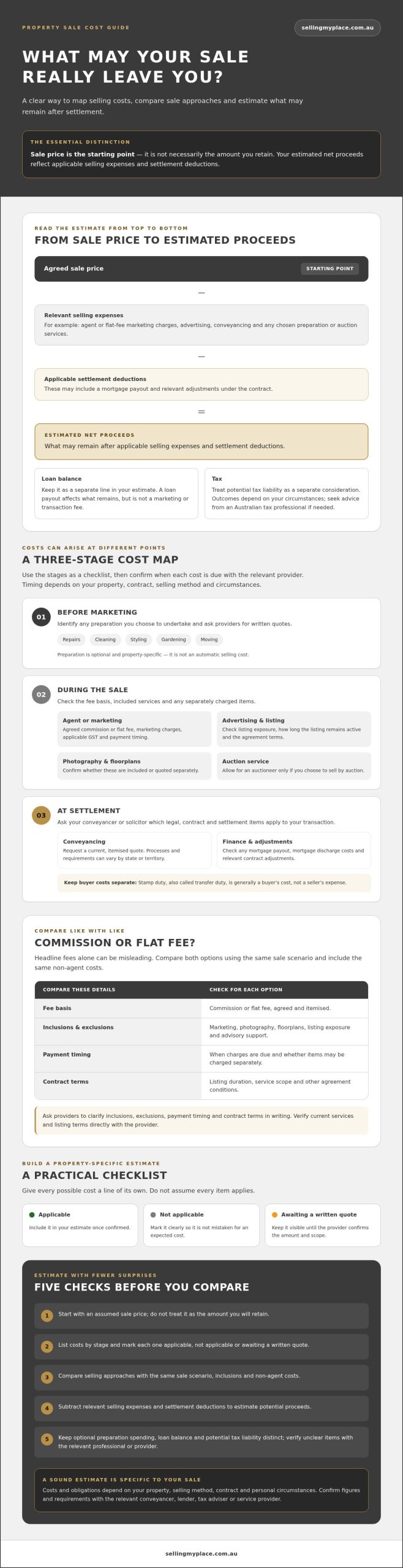
Start by separating the amount your property sells for from the costs and deductions associated with the sale. The sale price is the agreed amount, not necessarily what you retain. Your estimated net proceeds are what remains after applicable selling expenses and settlement deductions, including any loan payout. Tax outcomes depend on your circumstances, so treat tax as a separate consideration and seek advice from an Australian tax professional if needed.
Costs also fall due at different stages. You might pay some expenses before the property is listed, incur others during marketing, then have certain amounts accounted for at settlement. Timing and costs depend on your property, contract, selling method and personal circumstances. First identify what may apply, then confirm the figures and obligations with the relevant professionals and providers.
Selling costs versus sale price and net proceeds
Think of the sale price as the starting point for your estimate, not the final result. Sale-related expenses may include agent or flat-fee marketing charges, advertising, conveyancing, property preparation or an auctioneer if you choose to sell by auction. At completion, settlement may also involve paying out a mortgage and accounting for relevant adjustments under the contract.
For a working estimate, subtract expected selling costs and applicable settlement deductions from your assumed sale price. Keep the loan balance and any potential tax liability on separate lines. Both can affect what remains, but neither is the same as a marketing or transaction fee.
Which costs vary between Australian property sales?
Some costs are common to many sales, while others depend on the property and the approach you choose. Marketing inclusions can differ, for example. Check whether photography and floorplans are included or quoted separately. Styling, repairs, auction services and mortgage discharge costs may apply only in particular circumstances. Stamp duty, also called transfer duty, is generally a buyer’s cost, not a seller’s expense.
Conveyancing helps manage the transfer of property title. You can read more about the legal process of conveyancing, but the work and requirements for an Australian sale can vary by state or territory. Don’t rely on a single national fee schedule. Ask a conveyancer or solicitor for a current, itemised quote, and check the settlement terminology and requirements that apply to your transaction.
Make a property-specific list and mark each line as applicable, not applicable or awaiting a written quote. Ask providers to clarify inclusions, exclusions, payment timing and contract terms. You can compare a flat-fee marketing option with other sale approaches, but use the same assumptions and include the same non-agent costs. This gives you a fairer view of likely expenses and potential proceeds.
Which property-selling costs should you include in your estimate?
A reliable estimate reflects the costs that apply to your sale, not a standard list where every item is assumed. For calculating total cost of selling property, create a line for each category below and mark it applicable, not applicable or awaiting a written quote. Ask providers what’s included, what may be charged separately and when payment is due.
Marketing, preparation and professional support
Start with the sale method and the services you plan to use. If you’re comparing an agent with a flat-fee marketing option, check the fee basis and service scope side by side. Confirm whether photography, floorplans, listing exposure and advisory support are included or charged separately. Ask how long the listing remains active under the agreement, and verify the current inclusions and listing terms directly with the provider.
- Agent or marketing: Record the agreed commission or flat fee, any marketing charges, applicable GST and payment timing. Don’t compare headline fees without checking what’s included.
- Property preparation: Consider repairs, cleaning, styling, gardening or moving only if they suit the property and your plans. These are choices to assess after inspecting the home, not automatic selling costs.
- Professional support: Note any separate advice or services you intend to use. Request a written quote that sets out the scope.
Conveyancing, finance, tax and settlement items
Ask a conveyancer or solicitor to identify likely legal, contract and settlement charges for your transaction. Processes and requirements can vary by state or territory, so request a current, itemised estimate rather than relying on a general figure.
- Finance: If there’s a mortgage, ask your lender for a current payout figure and whether any discharge-related amounts apply. Use a figure that reflects your expected settlement timeframe.
- Settlement: Ask your conveyancer which adjustments or deductions may apply under your contract and how they’ll appear in the settlement statement.
- Tax: Don’t guess a potential capital gains tax amount. Your circumstances matter. Speak with a qualified tax adviser and consult the ATO’s guidance on calculating Capital Gains Tax.
Once you’ve gathered the relevant quotes and figures, you’ll have a more useful estimate for your property. If you’re considering a flat-fee marketing approach, you can ask about property marketing options and confirm which inclusions and terms apply to your sale.
How do commission and flat-fee selling approaches compare?
For a fair comparison, hold the sale scenario constant. Use the same property and estimated sale price, then keep conveyancing, finance, preparation and other applicable expenses identical for each option. Change only the selling service and the costs that genuinely differ. This makes calculating total cost of selling property more useful than comparing two headline fees in isolation.
With a commission-based arrangement, the fee is generally calculated as a percentage of the agreed sale price, so the amount changes if the final price changes. A flat fee is a set service charge under the provider’s written terms. For either option, confirm the fee basis, additional charges and payment timing in the agreement.
Compare the complete service, not just the headline fee
Ask what each option includes, such as professional photography, floorplans, listing exposure and advisory support. Check for exclusions and extra charges, as well as cancellation terms, listing duration and any conditions that could affect the final bill. Request the details in writing so you can compare like with like. A lower fee doesn’t automatically mean weaker service or better value. The right fit depends on the support and inclusions you need.
| Comparison point | Commission-based arrangement | Flat-fee arrangement |
|---|---|---|
| Fee basis | Percentage of the agreed sale price. Confirm how it’s calculated. | Set service charge. Confirm what the written terms cover. |
| Inclusions and exclusions | Record photography, floorplans, listing exposure and advice, plus anything charged separately. | Record the same items and note any exclusions or optional extras. |
| Payment timing | Check when the fee becomes payable and how payment is arranged. | Confirm payment timing and any conditions in the agreement. |
| Contract terms | Check cancellation provisions, listing duration and other conditions. | Check the same terms, including how long the listing remains active. |
How a flat-fee model fits into the calculation
Kincade International Direct Sales is one example of commission-free, flat-fee property marketing. Its service includes professional photography, floorplans, global property listings and advisory support. Confirm current inclusions and listing terms with the provider before using them in your estimate.
To compare estimated net proceeds, start with the same assumed sale price for both approaches. Subtract each option’s service and marketing charges, then deduct the same conveyancing, finance, preparation and settlement items that apply to your property. If the final sale price differs from your estimate, recalculate any percentage-based fee using the actual agreement terms. This is an informed comparison, not a guarantee of what you’ll retain.
How to calculate your estimated selling costs step by step
A worksheet brings quotes and settlement details together in one estimate you can update as the sale progresses. Keep the assumed sale price separate from expenses, and label each figure as confirmed, estimated or unknown. Use A$ placeholders until you have figures for your property.
Gather the figures needed for a property-specific estimate
Collect written quotes and check what each covers, including marketing inclusions, conveyancing, any preparation work and your lender’s current payout information. Base your sale-price assumption on relevant market evidence rather than an unsupported online estimate. For help developing that assumption, see this guide to determining a home’s market value.
Build your worksheet
- Estimated sale price: A$[amount] | Status: [estimated/unknown]. Note the evidence and date behind your assumption.
- Agent or flat-fee service: A$[amount] | Status: [confirmed/estimated/unknown]. Record the fee basis and written agreement terms.
- Marketing and listing expenses: A$[amount] | Status: [confirmed/estimated/unknown]. List photography, floorplans, listing exposure and any separately quoted items.
- Conveyancing and transaction charges: A$[amount] | Status: [confirmed/estimated/unknown]. Use an itemised estimate for your state or territory and transaction.
- Property preparation: A$[amount] | Status: [confirmed/estimated/unknown]. Include only work you’ve decided is worthwhile, such as cleaning, repairs or styling.
- Finance payout and discharge items: A$[amount] | Status: [confirmed/estimated/unknown]. Enter the lender’s current payout figure and note any applicable charges.
- Settlement adjustments or other deductions: A$[amount] | Status: [confirmed/estimated/unknown]. Confirm relevant items with your conveyancer.
- Potential tax liability: A$[amount] | Status: [adviser to confirm]. Don’t treat this as a generic estimate. Ask a qualified tax adviser about your circumstances.
Estimated net proceeds = assumed sale price − selling expenses − applicable settlement deductions. Keep tax and loan figures clearly identified so you can see what’s confirmed and what still needs checking. Don’t treat an unknown as a confirmed charge. Flag it and follow up with the relevant provider.
To stress-test your estimate, repeat the calculation with more than one plausible sale-price assumption. Apply the same non-agent expenses to each scenario, changing only figures that genuinely depend on the sale price or agreed terms. These are planning scenarios, not promises of a result. The agreed sale terms can also affect the final outcome, so review these property sale negotiation tips.
Update the worksheet when quotes, the lender payout figure or sale assumptions change. For help reviewing property marketing options and inclusions, contact Kincade International Direct Sales.
How to manage selling costs and choose your next step
Once your worksheet is taking shape, make each line clear and verifiable. A low headline fee can look appealing, but it’s difficult to judge until you know what’s included, what may cost extra and when payment is due. Ask providers for written details, then update your estimate rather than relying on verbal assurances.
Reduce uncertainty without overlooking essential support
Request an itemised quote that identifies inclusions, exclusions, additional charges, payment timing and relevant contract terms. For marketing services, check the scope of professional photography, floorplans, listing exposure and advisory support. A clear comparison helps you decide whether the service suits your needs, rather than simply choosing the lowest quoted fee. For a closer look at what listing services can cover, read this residential property listing services guide.
Keep optional preparation spending separate in your worksheet. Cleaning, repairs or styling may be useful for your property, but they’re not automatic costs for every seller. Transaction and settlement items also need checking with the relevant professionals. Ask your conveyancer about the sale process and settlement figures, your lender for current payout information, and a qualified tax adviser about any tax questions that apply to your circumstances.
Choose a selling approach that fits your cost plan
Use the same worksheet to compare a commission-based arrangement with a flat-fee option. Keep your sale-price assumptions and non-agent expenses consistent, then compare the service fee, inclusions, exclusions, payment timing and contract terms. This gives you a more grounded view of estimated net proceeds than comparing headline charges alone. The aim of calculating total cost of selling property is to understand the whole picture, not to assume one method will suit every owner.
Kincade International Direct Sales is an option for owners considering commission-free marketing through a flat-fee model. Its service includes professional photography, floorplans, property listings and advisory support. Confirm current inclusions and listing terms directly before adding them to your estimate.
If you’d like to explore whether commission-free marketing fits your plans, discuss your property sale. Ask about the service scope and terms so you can assess the option without assuming a particular sale price or saving.
Make your next property-sale decision with confidence
Calculating total cost of selling property is easier with a property-specific estimate than with a headline fee or broad rule of thumb. List each expense and settlement deduction, mark what’s confirmed and what still needs a quote, then check relevant figures with your conveyancer, lender or tax adviser.
Before choosing a selling approach, compare the full service scope and written terms. Commission-free, flat-fee marketing may suit some sellers, but value depends on the inclusions and support you need. Kincade International Direct Sales describes professional photography, floorplans and advisory support as service inclusions. Confirm current inclusions and listing terms directly before comparing them with other options.
A clear estimate and a considered comparison can help you decide what to do next. The questions and answers below cover common points sellers may need to check.
Frequently Asked Questions
Is the agent commission the only major cost when selling a property?
No. Depending on your sale, the estimate may also include marketing, conveyancing, property preparation, finance-related amounts and settlement deductions. Some items may be included in a provider’s fee, while others are charged separately or are optional. Ask for written, itemised terms so you can see what each service covers. Then check which expenses actually apply to your property before comparing selling approaches or estimating your proceeds.
What costs should I include when calculating the total cost of selling property?
Start with the selling service and marketing, then check conveyancing, property preparation, moving, lender-related amounts and any tax questions that may apply. Not every seller will incur every cost, and some services may be bundled. Create an itemised list and label each figure as confirmed, estimated or not applicable. Verify transaction-specific charges with the relevant provider or professional instead of treating a general checklist as a final quote.
How do I calculate how much money I may keep after selling?
Begin with a realistic sale-price assumption, then subtract your selling expenses and relevant settlement deductions. Use verified figures where possible, and clearly mark estimates or unknowns. The result is an estimate, not a guaranteed amount. Your final proceeds may depend on the contract, lender’s payout information, transaction costs and personal tax circumstances. Confirm the final figures with your conveyancer and lender as settlement approaches.
Is a flat-fee property service cheaper than a commission-based agent?
It depends on the agreed fee, sale circumstances, service inclusions and any extra charges. Compare both approaches using the same sale-price assumption and identical non-agent expenses. Check the written terms for marketing, photography, floorplans, advisory support, listing duration and payment timing. Kincade International Direct Sales offers commission-free property marketing through a flat-fee model, with service inclusions to verify. A headline fee alone can’t establish overall value.
Can I deduct property selling costs from capital gains tax?
Tax treatment depends on the property, your ownership history and individual circumstances. Don’t assume every selling expense can be deducted or estimate your tax outcome from a general guide. Keep invoices and transaction records, then ask a qualified Australian tax adviser which costs may be relevant to your situation and what evidence you’ll need. This helps you avoid treating a general explanation as personal tax advice.
What happens if my selling-cost estimate changes before settlement?
Update your worksheet when you receive a revised quote, agree to additional work or obtain current lender or conveyancing information. Keep earlier figures and assumptions so you can track what changed and why. Before settlement, ask the relevant professionals to confirm outstanding amounts and explain any adjustments. An estimate is a planning tool, not a final proceeds statement, so don’t rely on an older version as the settlement figure.
Do selling costs vary between Australian states and territories?
Yes. Some conveyancing steps, transaction requirements and related charges may vary by state or territory, while other costs depend on your property and chosen services. A national guide can help you identify cost categories, but it can’t confirm every local requirement or charge. Ask a conveyancer familiar with the property’s jurisdiction to check which costs apply and when they’re payable. Request a current, itemised estimate for your transaction.
Ready to compare flat-fee marketing with your other selling options? Discuss your property-selling options with Kincade International Direct Sales and confirm the service inclusions and terms for your sale.
The Real Cost of Selling a House in Australia: 2026 Seller’s Guide
What if the single largest expense in your property sale this year isn’t the glossy brochures or the legal fees, but a silent “tax” on your hard-earned equity? As we look at the cost of selling a house 2026, many Australian homeowners are realising that traditional percentage-based commissions often leave their bank accounts unnecessarily light. It’s completely natural to feel a sense of unease about where your profit goes once the “Sold” sticker is up. You’ve worked for years to build your home’s value, and seeing a significant portion of that legacy disappear can feel like a step backwards.
We believe you deserve a partnership that honours your hard work and protects your future. This guide provides a complete breakdown of the current selling landscape, offering the clarity you need to budget with total confidence. We’ll show you how to protect your equity from outdated structures while still achieving a premium, professional result that stands out. From understanding the latest ATO clearance certificate rules to identifying which marketing costs actually drive buyer interest, we’re here to provide the steady hand and expert insight you need to potentially save tens of thousands at settlement.
Key Takeaways
- Learn how to accurately forecast the total cost of selling a house 2026 by identifying the three pillars of expense: marketing, legal protection, and transactional friction.
- Discover which “unavoidable” costs, such as professional photography and conveyancing, are essential for protecting your legal interests and attracting premium buyers.
- Uncover the “Equity Tax” hidden within traditional commission structures and see how a flat-fee model allows you to keep 100% of your property’s hard-earned profit.
- Gain practical, zero-cost strategies for pre-sale presentation that maximise your return on investment and create an immediate emotional connection with visitors.
- Understand how to leverage a global marketing network and expert advisory support to sell your home with professional confidence and total control.
Navigating the Real Cost of Selling Your Property in 2026
Selling your family home is a deeply personal journey, often representing the culmination of years of hard work and memories. Understanding the actual cost of selling a house 2026 requires looking far beyond the obvious marketing invoices or legal bills. We view the total cost as a combination of three distinct pillars: Statutory requirements, Presentation, and “transactional friction,” which is the commission paid to an agency. While some costs are fixed, others are highly negotiable, and it’s here that your equity is most at risk.
Many Australian families are currently focused on protecting their financial legacy. Given the historical discussions around the Australian property bubble, preserving every dollar of capital growth is vital. A significant gap in traditional advice is the failure to mention the “Success Fee Trap.” This is where an agent takes a percentage of the entire sale price, effectively taxing the capital growth you earned by simply holding the asset for years. Transitioning to a commission-free model isn’t just about saving money; it’s about reclaiming the profit that belongs to your family.
The Shift in the Australian Real Estate Landscape
The days when a local agency held the keys to the market are long gone. Digital platforms have dismantled the old gatekeeper model, allowing your property to reach the same global audience regardless of the logo on the “For Sale” sign. Savvy vendors now prioritise their own bottom line over an agency’s branding. You can now access professional photography, floorplans, and elite digital listings without the heavy burden of a percentage-based fee. This modern approach proves that “full service” can be sophisticated, supportive, and incredibly cost-effective.
Statutory and Compliance Costs You Can’t Skip
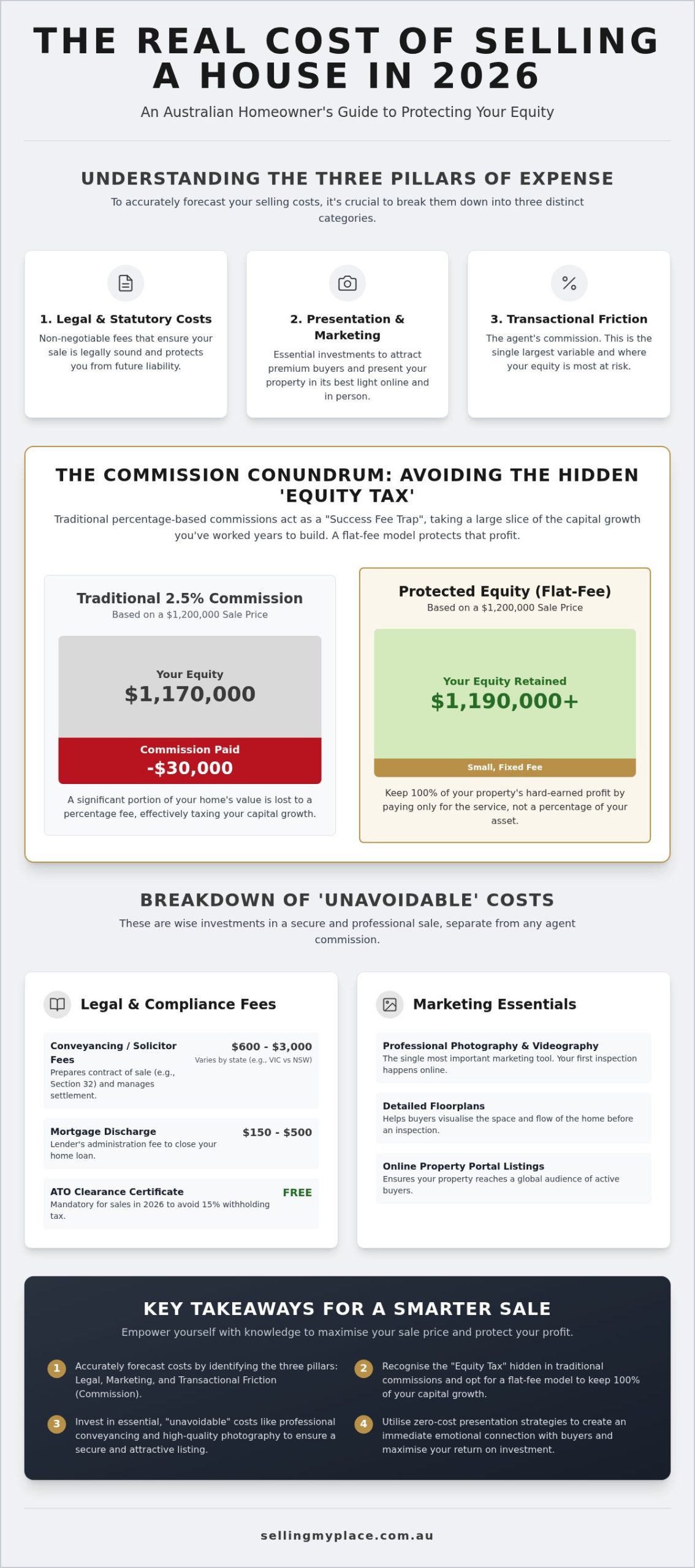
While you can avoid commissions, certain professional fees are essential safety nets. These statutory costs ensure your sale is legally sound and protects you from future liability. You’ll need to budget for several key items:
- Conveyancing: Professional Conveyance Advice is non-negotiable for preparing your Section 32 or Contract of Sale.
- Mortgage Discharge: Most lenders charge between $150 and $500 to close out your loan at settlement.
- Compliance Certificates: This includes the free ATO clearance certificate, which is mandatory for sales in 2026 to avoid a 15% withholding tax.
- Settlement Adjustments: Pro-rata payments for council rates and land tax are settled on the final day.
By identifying these pillars early, you can build a clear, honest budget. This transparency reduces the anxiety of hidden fees at settlement, letting you focus on the excitement of your next chapter. We believe that with the right guidance, you can navigate these complexities with a steady hand and a clear heart.
Breaking Down the ‘Unavoidable’ Costs: From Conveyancing to Marketing
While we’ve discussed the impact of commissions, certain outgoings are vital for a secure and successful transaction. These expenses ensure your property is legally protected and visually captivating. When calculating the cost of selling a house 2026, you’ll need to account for professional services that facilitate the transfer of title and attract the right calibre of buyer. It’s about finding the balance between spending wisely and ensuring no detail is overlooked during this significant life transition.
The Legal Side: Conveyancers vs. Solicitors
Securing professional Conveyance Advice is your most important safety net. In 2026, fees vary by state; for instance, NSW metro areas typically range from $1,000 to $3,000, while Victorian sellers might expect between $600 and $1,400. While conveyancers are specialists in property transfers, solicitors offer broader legal support if your contract involves complex trust structures. Preparing your paperwork early prevents stressful delays at settlement and ensures your disclosure documents, like the Section 32, are watertight. Local knowledge is particularly valuable here, as it helps navigate specific council requirements or heritage overlays that might affect your contract.
Marketing That Actually Moves the Needle
In a digital-first market, your first inspection happens on a smartphone screen. A standard marketing campaign in 2026 usually sits between $2,000 and $10,000. Investing in professional photography and accurate floorplans isn’t just about looking good; it’s about providing the data buyers crave. High-quality visuals increase click-through rates, while floorplans help buyers mentally move their furniture into your space. While premium major city campaigns can reach $20,000, focusing your budget on online listing ‘premiums’ often yields the strongest return on investment. Traditional signboards still have a place for local foot traffic, but your digital presence is where the real competition lives.
Don’t forget the ‘hidden’ costs that create that vital first impression. We often see that a weekend spent on high-pressure cleaning the driveway, fresh mulch in the garden, and fixing those small ‘to-do’ list items can add thousands to your final result. Additionally, your bank will likely charge a mortgage discharge fee to close out your loan. As of May 2025, these fees averaged around $329, though they can reach up to $795 at some institutions. These small details might seem minor, but tracking them early ensures a smooth, surprise-free settlement. If you’re looking for a steady hand to help coordinate these elements, starting a conversation with an expert can provide the reassurance you need.
The Commission Conundrum: Comparing Traditional vs. Flat-Fee Models
When you sit down to calculate the cost of selling a house 2026, the elephant in the room is almost always the percentage-based commission. While many traditional agencies frame this as an “unavoidable” expense, it’s actually the most significant variable in your budget. In Australia, commission rates typically range from 1.8% to 3.0%, with a national median sitting around 2.65%. On a property worth $1,000,000, that’s a staggering $26,500 plus GST, often before you’ve even paid for a single Facebook ad or signboard.
We often refer to this as the “Equity Tax.” It’s a confronting term, but it accurately describes how commission eats into your actual profit rather than just the sale price. If you bought your home for $800,000 and sell it for $1,000,000, your gross profit is $200,000. A $25,000 commission doesn’t just represent 2.5% of the sale; it represents 12.5% of the wealth you’ve built through years of mortgage payments and market growth. Reclaiming this portion of your legacy is why flat-fee models are rapidly gaining traction across every state and territory.
The Math of Selling: A Side-by-Side Comparison
To truly visualise the savings gap, let’s look at two common scenarios for a typical Australian family home. In Scenario A, a traditional agent charges a 2.5% commission plus a separate marketing budget. By settlement, the vendor may see over $30,000 deducted from their final cheque. In Scenario B, using the Kincade International Direct Sales model, that same vendor pays a transparent flat fee for professional marketing and advisory services. The difference is often an average saving of $20,000. Think about what that extra capital could do for your next deposit, a well-deserved holiday, or even a celebratory night of live music and cocktails at kissmybrass.au once the sale is finalised.
There is a persistent myth that a high-commission agent is the only way to secure a record-breaking price. However, buyers don’t pay more because an agent’s fee is higher; they pay more because the property is presented beautifully, marketed to the right audience, and negotiated with skill. Professionalism isn’t tied to a percentage of your asset’s value.
The ‘Success Fee’ vs. Professional Advisory
There’s a profound difference between paying a “success fee” and investing in professional expertise. You shouldn’t have to sacrifice a chunk of your home’s value just to access high-level support. By choosing an advisory-based model, you receive a steady hand to guide you through the complexities of the market without the high price tag. This includes access to expert property sale negotiation tips that empower you to handle offers with confidence. You maintain total control over your sale timeline and decisions, ensuring the process remains a celebratory transition rather than a high-pressure transaction.
Maximising ROI: Smart Spending on Pre-Sale Presentation
When you’re fine-tuning the cost of selling a house 2026, it’s tempting to think that every dollar spent on presentation will magically return double at settlement. This isn’t always the case. True success lies in identifying the high-impact activities that cost almost nothing but significantly shift a buyer’s emotional needle. We recommend starting with the “Rule of Three”: cleaning, decluttering, and depersonalising. These tasks require more elbow grease than capital, yet they allow potential buyers to visualise their own lives within your walls rather than feeling like a guest in yours.
Strategic spending also protects you from “buyer chipping.” This occurs when a building inspector identifies minor, easily fixable flaws that a buyer then uses as leverage to negotiate thousands off your price. Fixing leaky taps, tightening loose door handles, and ensuring all light globes are working prevents these small friction points from becoming expensive hurdles. By investing a few hundred dollars in maintenance now, you protect the tens of thousands in equity we discussed earlier.
Styling and Staging on a Budget
You don’t always need to hire a full house of furniture to create a premium feel. Often, the most effective styling involves “editing” what you already own. Focus your energy on the “entry zone.” First impressions are formed within the first eight seconds of a buyer stepping through the front door. Use lighting to your advantage by opening every blind and switching on warm lamps to maximise the sense of space. A fresh coat of neutral paint in high-traffic areas or new, plush towels in the bathroom can create a sophisticated lifestyle appeal without the heavy price tag of a full renovation.
Data-Driven Pricing
Pricing your home is an emotional exercise, but it must be grounded in hard data. Relying on gut feel or outdated figures is a risk to your bottom line. We provide Neighborhood Market Reports to help you understand exactly what buyers are paying for similar properties in your specific street. The first 21 days on the market are your most valuable; this is when the “new listing” glow is brightest and buyer urgency is highest.
If you overprice your home based on a guess, you risk the listing becoming “stale,” which often leads to a lower final result than if you had priced accurately from day one. Use recent comparable sales to determine your market value with precision. This transparency gives you the confidence to stand firm during negotiations. If you’re ready to see how our advisory approach can protect your equity and streamline your sale, get in touch with our team today for a personalised pre-sale consultation.
Selling Smarter with Kincade International Direct Sales
By now, you understand that the cost of selling a house 2026 doesn’t have to include a five-figure commission. We’ve built a model that bridges the gap between the high-cost traditional agency and the daunting prospect of going it alone. Kincade International Direct Sales (KIDS) provides the sophisticated digital infrastructure and global marketing network you need to reach buyers across Australia and beyond. It’s about giving you the tools of a top-tier agency while ensuring you remain the primary beneficiary of your property’s capital growth.
Our approach is built on the belief that professional marketing is a service you should own, not a percentage of your wealth you should give away. Every package we offer is designed to present your home in its best light, including high-end photography and accurate floorplans that meet the high standards of 2026 buyers. You aren’t just getting a listing; you’re gaining an entire ecosystem of support that allows you to sell your own home with the confidence of a seasoned professional.
Your Partnership for a Successful Sale
The most vital part of our service is the Expert Agent Advisory Service. Think of this as your “steady hand” throughout the journey. While you handle the inspections and connect with buyers, our advisors are in your corner to guide you through the nuances of negotiation and the technicalities of settlement. We take the stress out of the “what happens next” moments, providing a calm, grounded perspective when high-stakes decisions need to be made.
We also understand that life doesn’t always move to a strict real estate calendar. That’s why our “Listed Until Sold” policy is so important. It removes the ticking clock and the anxiety of expiring contracts, allowing you to wait for the right buyer at the right price. This patience, combined with our advisory support, is how we help you protect your legacy and keep 100% of your sale profit.
Getting Started with a Flat-Fee Package
Onboarding with us is a methodical and inviting process. We offer various marketing tiers, allowing you to choose the level of exposure that best suits your property and your budget. Whether you’re selling a cozy suburban unit or a sprawling family estate, our simple digital process gets your home on the market fast without the usual administrative hurdles. You’ll have total control over your listing, backed by a team that values your family’s needs over a quick transaction. If you’re ready to reclaim your equity and experience a more respectful way to sell, explore our flat-fee listing services today.
Your Path to a Successful and Profitable Sale
Your home is more than just a listing on a screen; it’s the foundation of your family’s future and a testament to your hard work. By understanding the true cost of selling a house 2026, you’ve taken the first step toward protecting that legacy from unnecessary “equity taxes.” We’ve explored how a strategic focus on presentation and professional legal advice provides a secure path forward, while the shift toward flat-fee models ensures you remain in the driver’s seat of your own transaction.
Why settle for traditional structures that eat into your hard-earned profit? With our support, you can access a global marketing network, professional photography, and floorplans without the burden of a percentage-based commission. Our Expert Agent Advisory Service acts as your steady hand, guiding you through every negotiation with calm confidence. Most of our partners save an average of $20,000 in commissions, allowing that capital to go exactly where it belongs: back into your pocket.
Are you ready to move forward with a partner who values your results as much as you do? Keep 100% of your profit; sell with Kincade International Direct Sales today. We look forward to helping you start your next chapter with total peace of mind.
Frequently Asked Questions
What is the average real estate commission in Australia for 2026?
The national median real estate commission rate in 2026 is 2.65% according to recent surveys. This is often the largest single component of the cost of selling a house 2026. Rates typically range from 1.8% to 3.0% of the final sale price. In Melbourne, you’ll usually find rates between 1.6% and 2.5%, while regional Victoria often sits between 2.5% and 3.5%.
Are marketing costs included in an agent’s commission?
Marketing costs are almost never included in a traditional agent’s commission. This is known as “Vendor Paid Advertising” or VPA. Sellers are usually expected to pay these costs upfront to cover online listings, professional photography, and signboards. For a standard 2026 campaign, you should budget between $2,000 and $10,000, though premium campaigns in major cities can reach $20,000.
How much should I budget for conveyancing when selling my house?
Your conveyancing budget will depend on your state’s specific requirements. In New South Wales metro areas, fees typically range from $1,000 to $3,000. Victorian sellers should budget between $600 and $1,400, while Queenslanders usually pay between $500 and $1,300. Remember that disbursements for title searches and certificates will add a few hundred dollars to these professional service fees at the end of the process.
Do I have to pay Capital Gains Tax (CGT) when I sell my home?
You generally don’t pay Capital Gains Tax on your main residence if you’re an Australian resident and the property is your primary home. However, if the property was an investment or used for business purposes, you’ll likely be liable for CGT. To help manage your investment records and tax obligations, you can learn more about PropAlly. As of 2025, you must also obtain a free ATO clearance certificate before settlement to avoid a mandatory 15% withholding tax.
Is it worth paying for professional home styling?
Professional styling often provides a strong return on investment by creating an immediate emotional connection with prospective buyers. While full staging can cost between $2,000 and $8,000, many sellers find success with partial styling. This involves using your existing furniture combined with hired accessories to highlight your home’s best features. It’s a strategic way to help buyers visualise their future lifestyle in your space.
What happens if my property doesn’t sell within the first month?
If your property hasn’t sold within the first month, it’s a good time to review your pricing strategy and presentation with a steady hand. The first 21 days are the most critical for buyer urgency. Unlike traditional agencies with expiring contracts, our model ensures your property stays listed until it’s sold. This gives you the patience and space to find the right buyer without unnecessary pressure.
Can I really sell my house without a traditional real estate agent?
You can absolutely sell your home without a traditional percentage-based agent. Many Australian families are now choosing flat-fee models to protect their hard-earned equity from high commissions. This approach provides the professional marketing and expert advisory support you need while you manage the inspections yourself. It’s a sophisticated way to manage the cost of selling a house 2026 and keep more of your profit.
What are the hidden fees I should look out for at settlement?
The most common hidden costs at settlement include mortgage discharge fees and pro-rata council rate adjustments. Mortgage discharge fees currently average around $329 but can reach $795 depending on your lender. You should also account for conveyancing disbursements. These cover the cost of required certificates and title searches that are often not included in the initial professional quote you receive from your conveyancer.
Flat Fee vs Commission Real Estate: Which Model Saves You More in 2026?
If you sold your family home this year, would you be comfortable handing over tens of thousands of dollars in equity to an agent for just a few weekend inspections? It’s a question more Australian homeowners are asking as they weigh up the benefits of flat fee vs commission real estate in 2026. Selling a home is a significant life transition, and it’s natural to feel protective of the nest egg you’ve spent decades building. You deserve a result that reflects your hard work, yet the lack of transparency in traditional agency costs often leaves vendors feeling more like a transaction than a partner.
We understand that the pressure to accept a quick offer just to satisfy an agent’s commission can be incredibly stressful. This article explores the vital financial differences between these models to help you protect your equity and sell with confidence. We’ll show you how it’s possible to secure professional photography and expert advisory services while maximising your final sale price without the traditional ‘agent tax’. We’re going to compare these structures side by side to see which one truly puts your family’s financial future first.
Key Takeaways
- Understand the fundamental differences between flat fee vs commission real estate to identify which model best protects your family’s hard-earned equity.
- Learn how to spot the hidden costs of traditional agency marketing and why budget transparency is the key to a stress-free sale.
- Discover why high-end visual marketing and global reach are essential for attracting the right buyers without paying a premium ‘agent tax’.
- Unpack the ‘incentive myth’ to see how traditional commission structures can sometimes prioritise a quick sale over your best possible price.
- Explore how a partnership-based advisory service allows you to manage your property journey with a steady hand while keeping every cent of your profit.
Flat Fee vs Commission: Understanding the Choice for Australian Sellers
Selling your home is a deeply personal milestone, often marking the end of one chapter and the hopeful beginning of another. It’s a time filled with both excitement and a touch of trepidation, especially when you start looking at the costs involved. The decision between flat fee vs commission real estate is one of the most significant choices you’ll make in this journey. It isn’t just about numbers on a spreadsheet; it’s about how much of your hard-earned equity stays in your pocket to fund your next move. In Australia, we’re seeing a genuine shift as more homeowners look for a partnership that offers both professional authority and financial fairness.
What is Traditional Real Estate Commission?
The traditional model has long been the default for Australian suburbs. Under this structure, an agent takes a percentage of your final sale price at settlement. In the 2026 market, these rates typically sit between 2% and 3%. While a few percentage points might sound modest in a casual chat, the reality hits home when you apply it to Australian property values. On a $1,000,000 sale, you could be looking at a $30,000 bill just for the agent’s fee.
There’s also the matter of transparency. Many sellers are surprised to find that high marketing costs, such as premium portal listings and signage, are often charged on top of the commission. As property values rise, the agent’s pay cheque increases significantly, even if the amount of work required to sell the home remains the same. This ‘commission tax’ can feel particularly heavy when you realise it’s being carved directly out of your family’s future stability.
The Rise of the Flat-Fee Marketing Model
The flat-fee approach, often called a fee-for-service model, is gaining ground because it offers budget certainty from the very start. Instead of a percentage-based gamble, you pay a single, transparent fee for the professional tools and marketing required to find a buyer. Digital platforms have democratised the way we find homes, meaning your property can reach the same audience as a big-name agency without the overheads that drive up their fees.
Choosing a commission-free path doesn’t mean you’re left to manage a complex sale entirely on your own. Modern flat-fee services have evolved to include a “steady hand” to guide you. For instance, an Agent Advisory Service provides the expert coaching and local knowledge you need to negotiate with confidence. You get the professional marketing, like high-end photography and floorplans, while retaining 100% of your sale profit. It’s about empowering you to lead the sale of your own home, supported by experts who value your legacy as much as you do.
The Financial Reality: Comparing the Costs of Selling
When you look at your home, you see a lifetime of memories and a hard-earned nest egg. When a traditional agency looks at it, they often see a percentage. Understanding the financial mechanics of flat fee vs commission real estate is the first step in reclaiming control over your biggest asset. It’s about more than just a fee; it’s about the equity you’ve built through years of mortgage repayments and weekend renovations. Every dollar saved on commission is a dollar that stays with your family, helping you fund your next adventure or secure your retirement.
Commission Math: What You Really Pay
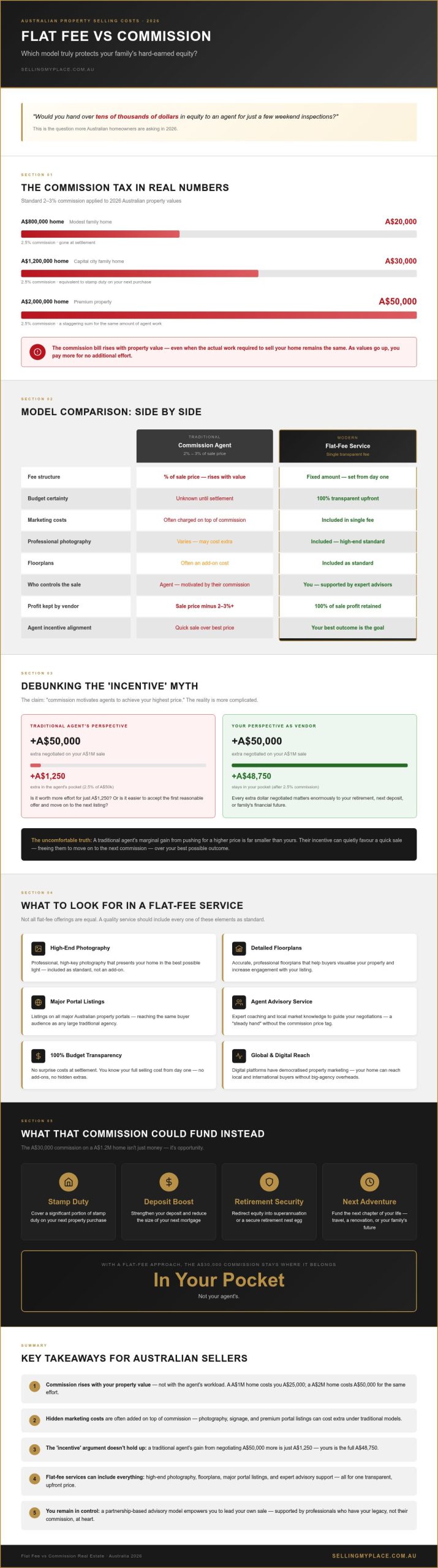
In the Australian market, a “standard” commission of 2% to 3% can feel like a small detail in a thick contract. However, the numbers tell a different story once you apply them to our 2026 property values. If you sell a modest home for A$800,000, a 2.5% commission takes A$20,000 from your pocket. For a family home in a capital city selling at A$1,200,000, that figure jumps significantly. A 2.5% commission on a A$1,200,000 home equals A$30,000 out of your pocket. For those selling premium properties at A$2,000,000, the commission bill hits a staggering A$50,000.
This “commission tax” has a compounding effect on your future. That A$30,000 isn’t just cash; it’s the stamp duty on your next purchase or a significant boost to your deposit. When you consider that many agents also charge extra for marketing on top of this fee, the financial burden becomes even heavier. It’s a high price to pay for a service that often doesn’t scale with the actual work performed.
The Flat-Fee Alternative: Transparency and Value
A flat-fee model replaces the guesswork with absolute certainty. You pay a single, upfront price for a comprehensive suite of professional tools. This typically includes high-end photography, detailed floorplans, and listings on major property portals. Because there’s no commission, you don’t have to worry about a surprise bill appearing on settlement day. You know exactly what your costs are from the moment you decide to list. This transparency allows you to plan your move with a sense of calm confidence.
Before you set your expectations, it helps to know how to determine the market value of a home in Australia. Once you have a realistic figure in mind, the savings offered by the flat fee vs commission real estate model become even clearer. You’re essentially choosing to invest in professional marketing while keeping 100% of the sale profit for yourself. If you’re ready to see how this approach could work for your unique situation, you might like to start a conversation about your property goals today.
Debunking the ‘Incentive’ Myth in Real Estate
One of the most common arguments in the traditional property industry is that a commission-based agent will work harder for you because their pay cheque depends on the final sale price. It sounds logical on the surface, doesn’t it? The idea is that the more you make, the more they make. However, when we look closer at the actual mechanics of the transaction, this “incentive” often doesn’t align with your best interests. The debate around flat fee vs commission real estate often centres on motivation, but true motivation should come from a duty of care to the client, not just a percentage of the loot.
The Reality of Agent Motivation
Let’s look at the numbers. Imagine your agent is negotiating an offer that is A$10,000 below your target price. If they push the buyer to find that extra A$10,000, you keep the bulk of that money. But for an agent on a 2.5% commission, that extra effort only nets them an additional A$250. When you consider the extra weeks of inspections, phone calls, and marketing coordination required to secure that higher figure, many agents find it more profitable to settle for the lower offer and move on to the next listing. This creates a subtle conflict of interest where a “quick sale” is prioritised over the “best sale.”
Taking control of your own negotiation ensures that your priorities remain front and centre. You don’t have to be a professional closer to achieve a great result; you just need the right preparation. Reading through expert property sale negotiation tips can give you the confidence to stand your ground when an offer doesn’t reflect your home’s true worth. It’s about empowerment rather than reliance on someone whose financial goals might differ from your own.
Expert Support Without the Percentage
Choosing a commission-free path doesn’t mean you’re navigating the stormy seas of the property market alone. In fact, professional advisory services often provide more practical value than a traditional agent’s “hustle.” Pre-sale property consulting helps you identify which small improvements will actually add value to your sale price, while neighbourhood market reports provide the data you need to price your home with authority. You aren’t just guessing; you’re making informed decisions based on local landscape knowledge.
This partnership-based approach offers a “steady hand” throughout the process. You get the professional marketing and global reach required to find the right buyer, but you keep the role of the decision-maker. When you’re deciding between flat fee vs commission real estate, remember that true advocacy doesn’t require a percentage of your equity. It requires a commitment to your family’s future and a transparent service that respects the legacy of the home you’re selling.
What to Look for in a Flat-Fee Property Service
Deciding between flat fee vs commission real estate is only half the battle. Once you’ve chosen to protect your equity, the next step is ensuring the service you partner with actually delivers the professional punch required to stand out in the 2026 Australian market. Not all flat-fee models are created equal. You aren’t just looking for a listing on a website; you’re looking for a comprehensive marketing engine that treats your home with the respect it deserves. A truly supportive service should feel like a partnership, offering a steady hand from the first photo to the final settlement.
Marketing Essentials for a Successful Sale
In our digital-first world, your home’s first inspection happens on a smartphone screen. If the visuals don’t captivate immediately, buyers will simply scroll past. This is why high-end photography and professional floorplans are non-negotiable. A detailed floorplan does more than show the layout; it allows a potential buyer to mentally move their furniture in, creating an emotional connection before they even step through the front door. It’s a small detail that significantly boosts engagement and helps buyers feel at home before they’ve even visited; to see this level of presentation in action, you can learn more about Zed Real Estate and their luxury marketing strategies.
Beyond the local suburb, you should consider where your buyers are coming from. High-value Australian homes often attract interest from expats and investors in the UK and the USA. A service that provides global marketing network coverage ensures your property isn’t just seen locally but reaches a worldwide audience. For a deeper look at how to present your home, our professional residential property listing services guide covers everything you need to know about modern marketing standards.
The Advisory Advantage
While the tools are important, the expert guidance behind them is what truly reduces stress. A professional pre-sale property consultation can reveal simple, cost-effective ways to enhance your home’s appeal, ensuring you don’t overspend on unnecessary renovations. Having access to conveyance advice and contract support means you aren’t left second-guessing the legalities of the sale. It provides that much-needed peace of mind during a high-stakes life transition, ensuring you feel protected at every turn.
One of the most liberating aspects of a quality flat-fee service is the absence of time limits. Traditional agencies often pressure you into lowering your price once a standard 90-day contract expires. A ‘listed until sold’ guarantee gives you the freedom to wait for the right buyer who truly values your home’s legacy. If you’re ready to showcase your property to a global audience while keeping your profit intact, you can book a consultation with our advisory team to discuss your property goals.
How to Sell Smarter with Kincade International Direct Sales
Choosing the right path for your property sale is a decision that impacts your family’s financial legacy. Many homeowners hesitate to step away from traditional agencies because they fear they’ll be left to handle the complexities alone. At Kincade International Direct Sales, we’ve designed the KIDS model to bridge this gap. It’s a 0% commission structure built on 100% transparency. We believe that you shouldn’t have to choose between professional expertise and keeping your hard-earned equity. By removing the percentage-based fee, we ensure that the average saving of A$20,000 stays exactly where it belongs: in your bank account.
Our approach isn’t about DIY; it’s about empowerment. When you weigh up flat fee vs commission real estate, the real differentiator is the level of support you receive throughout the journey. We provide a “steady hand” through our Agent Advisory Service, offering the professional authority you need to handle contracts and conveyance with total confidence. You lead the way, but you’re never walking the path by yourself. It’s a partnership that respects the emotional significance of your move while prioritising your financial stability.
A Partnership-Based Approach to Selling
We focus on your long-term goals rather than a quick transaction. The process begins with a comprehensive neighbourhood market report, giving you a grounded understanding of the local landscape. From there, we deploy a global marketing infrastructure that rivals any traditional agency. Your home is showcased with professional photography and floorplans, reaching potential buyers across Australia and international markets. This global exposure is vital in 2026, as it ensures your property’s legacy is seen by the widest possible audience, all while you retain full control of the final sale price. For those interested in how these international networks operate in major hubs, you can learn more about Kay & Co and their work in the London market.
Secure Your Profit Today
There has never been a better time to rethink the traditional real estate model. As property values continue to shift, the “commission tax” becomes an increasingly heavy burden for Australian families to carry. Choosing a flat-fee model is a proactive step toward protecting your home equity for your next life transition. Whether you’re downsizing for retirement or upscaling for a growing family, those saved tens of thousands of dollars make a world of difference to your future plans. You’ve done the hard work of building your home’s value; now it’s time to ensure you receive the full benefit of that effort.
If you’re ready to move forward with a sense of calm confidence and professional support, we’re here to guide you. You can contact the team at Kincade International Direct Sales to start your smarter sale journey and discover how our advisory-led model can help you achieve a premium result without the premium price tag.
Secure Your Financial Future and Your Home’s Legacy
Choosing how to list your property is a pivotal moment in your family’s journey. We’ve explored how the choice between flat fee vs commission real estate impacts your bottom line, noting that moving away from a percentage-based model can save you an average of A$20,000 per sale. You don’t have to sacrifice professional quality to achieve these savings. With global marketing network coverage and a professional Agent Advisory Service, you can maintain a steady hand throughout the negotiation while keeping every cent of your profit.
Selling your home should be a rewarding transition, not a source of financial stress. By choosing transparency and expert support, you’re protecting the equity you’ve worked so hard to build. It’s about more than just a transaction; it’s about setting yourself up for whatever comes next with confidence and peace of mind. You’ve spent years turning a house into a home, and you deserve a sale process that respects that effort.
Ready to take the first step toward a smarter sale? Book your expert pre-sale consultation and save thousands today. You deserve a partner who values your home and your future as much as you do.
Frequently Asked Questions
Is a flat-fee real estate model legal in all Australian states?
Yes, the flat-fee model is entirely legal and regulated across every Australian state and territory. It operates under the same property laws as traditional agencies; the primary difference is simply how the service is billed. You have the legal right to choose a fee-for-service arrangement that protects your equity rather than being locked into a percentage-based commission structure that can vary wildly between suburbs.
Will my property appear on the major Australian real estate portals with a flat fee?
Your property will be listed on all the leading Australian property portals where buyers actually look. A quality flat-fee service ensures your home receives the same digital visibility as any listing from a traditional high-street agency. This exposure is vital because the vast majority of Australian buyers begin their search online, making portal presence a non-negotiable part of any modern marketing strategy.
What happens if my property doesn’t sell within three months?
Unlike traditional 90-day agency agreements that often require expensive re-listing fees or contract renewals, our model includes no time limits on your listing. You have the freedom to wait for the right buyer who truly values your home’s legacy without the pressure of a ticking clock. This “listed until sold” approach provides a sense of calm confidence, ensuring you never feel forced to accept a lower offer.
Do I have to do my own property inspections with a flat-fee service?
Yes, hosting your own inspections is a key part of the flat-fee model. This approach allows you to share your genuine love for the home and your local insider knowledge directly with potential buyers. Most sellers find that buyers appreciate the personal touch and the honest information that only a homeowner can provide, often leading to a more relaxed and productive viewing experience for everyone involved.
Can I still get professional photography and floorplans with a flat-fee package?
Professional photography and high-end floorplans are standard inclusions in our comprehensive packages. We know that premium visual marketing is essential for a successful sale in the 2026 market. These tools ensure your home stands out on global listing networks, capturing the attention of serious buyers from the first click. You get the same professional polish as a traditional agency without the excessive marketing mark-ups.
How much can I realistically save by choosing flat fee vs commission?
Australian homeowners can save an average of A$20,000 per sale by choosing the flat fee vs commission real estate path. Because you aren’t handing over a percentage of your final sale price at settlement, you keep 100% of the profit you’ve built. These significant savings stay in your pocket, providing a much-needed boost for your next deposit, stamp duty costs, or your family’s future financial stability.
Is the flat-fee model suitable for high-value or luxury properties?
The flat-fee model is actually one of the smartest choices for luxury property owners. As house prices rise, a traditional 2% to 3% commission can quickly become a staggering financial burden that doesn’t reflect the actual work performed. Our model provides the global reach and sophisticated advisory services required for premium sales, ensuring your high-value asset is protected from the traditional “agent tax” while still reaching international buyers.
What kind of legal support do I get with Kincade International Direct Sales?
You receive dedicated Real Estate Advisory Services to guide you through the complexities of contracts and conveyance advice. Our Agent Advisory Service acts as a “steady hand” throughout the entire transaction, ensuring you feel supported during every legal milestone. You have professional experts in your corner to help you navigate the paperwork with total confidence, ensuring your family’s interests are always the top priority.
