How to Sell Your Own House in Australia: A Practical 2026 Guide
What if selling your home yourself didn’t mean handling every detail alone? If you’re weighing how to sell your own house in australia, a clear sequence can help you stay in control: prepare the property, organise the paperwork, reach buyers and respond to offers. You can lead the key decisions while using professional support for tasks that need specialist advice or practical marketing help.
Sale documents and requirements vary between states and territories, so getting the legal foundations right is an important early step. This guide takes you through preparation and pricing, marketing, buyer enquiries, inspections, offers and settlement. It also explains how photography, floorplans, pre-sale advice and flat-fee listing support can fit into an owner-led sale.
Key Takeaways
- Use a step-by-step sale plan to organise preparation, pricing, marketing, buyer conversations and settlement.
- Gather property information and sale documents early, then use comparable sales to inform a realistic price range.
- Present your home with accurate listing copy, professional photography and a clear floorplan to help buyers assess it.
- When comparing offers, look beyond price to conditions, timing and buyer readiness before agreeing to terms.
- Learn how to sell your own house in australia while choosing which tasks to manage yourself and where flat-fee marketing or advisory support can help.
How to sell your own house in Australia: understand the process before you begin
Selling your own home means leading the sale’s key decisions and tasks, while arranging professional support for specialist work where it’s useful. You set your priorities, decide how to present the property and choose which offer to accept. You also organise the information, communication and transaction support needed to move the sale forward.
That’s different from appointing a traditional agent to manage the sale on your behalf, but it doesn’t mean you have to do every task unaided. The real estate market in Australia operates within a national framework, while practical sale requirements can vary by state and territory. Keep that variation in mind when planning your sale.
Break the process into stages so it’s easier to track what needs doing:
- Prepare: gather property information, plan presentation and get sale documentation underway.
- Establish a price: use comparable sales and current market evidence to inform a realistic range.
- Market: prepare an accurate listing and decide how you’ll reach prospective buyers.
- Manage buyers: respond to enquiries, arrange inspections and keep communication organised.
- Agree terms: assess offers and conditions, and seek appropriate advice before signing.
- Settle: coordinate the final transaction with the relevant conveyancing support.
Each stage builds on the one before it. Accurate property details support your pricing and listing, while a record of enquiries helps you keep track of buyer interest and follow-ups. This roadmap makes how to sell your own house in australia more manageable without assuming there’s only one way to do it.
What does selling your own house actually involve?
As the owner, you set the priorities, approve the marketing and decide how to respond to buyers. You can handle enquiries personally or use selected marketing and advisory support while keeping the final decisions in your hands. Contracts and conveyancing are specialist areas, so arrange suitable professional advice to understand the documents and transaction steps before you commit.
If you’d like a more detailed walkthrough of the stages, the existing guide How to Sell Your Own Home: A Step-by-Step Guide to Sale by Owner in Australia complements this overview.
Is a private sale the same as doing everything alone?
No. You can manage the sale and choose support for particular tasks, such as property marketing, photography, floorplans, pre-sale advice or conveyancing. Flat-fee marketing and advisory support can help with listing tasks without transferring sale decisions to a traditional commission agent. The right balance depends on your priorities and the time you can set aside.
Be realistic about the workload. You’ll need to keep information up to date, respond to buyers, coordinate inspections and track next steps. Decide early which tasks you’ll manage and where advice or practical support would make the process more manageable.
Prepare your Australian home for sale: pricing evidence, presentation and paperwork
Before publishing a listing, build a clear picture of the property, decide what needs attention and get the relevant sale documents underway. Accurate property information supports pricing and marketing, while organised paperwork helps you respond when a buyer is ready to proceed.
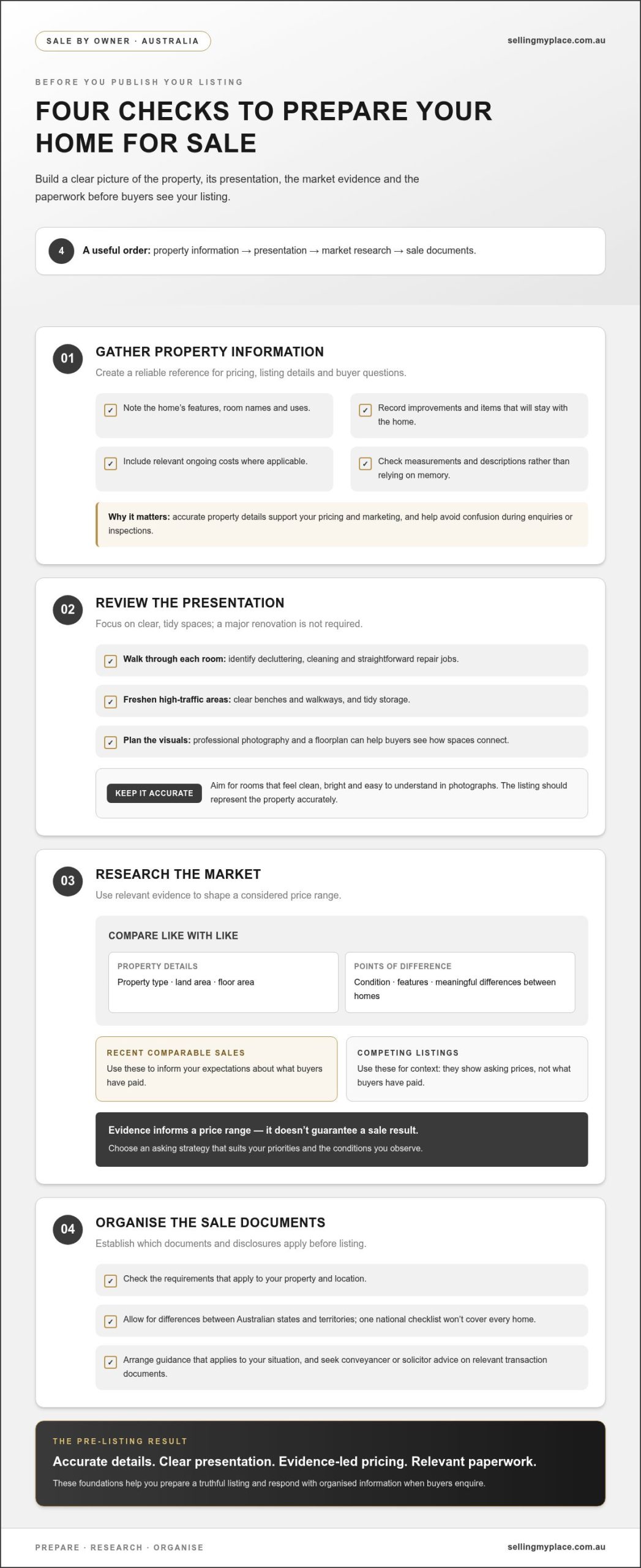
Use this pre-listing sequence:
- Gather property information: note the home’s features, improvements, inclusions and any relevant ongoing costs.
- Review presentation: walk through each room and identify decluttering, cleaning or straightforward repair jobs.
- Research the market: compare relevant sales and competing listings to shape your price expectations.
- Organise documentation: establish which sale documents and disclosures apply to your property and location.
How should you set an asking price?
Start with recent sales of genuinely comparable properties. Consider property type, land and floor area, condition, features and meaningful differences between the homes. Current competing listings provide context, but they show what other owners are asking, not what buyers have paid.
Use the evidence to develop a considered price range, then choose an asking strategy that suits your priorities and the conditions you observe. An asking price is a guide for the market, not a guaranteed sale result. For a closer look at the evidence behind a valuation, see how to determine the market value of a home in Australia in the 2026 valuation guide.
Presentation doesn’t have to mean a major renovation. Clear benches and walkways, tidy storage, freshen high-traffic areas and take care of small visible repairs. Aim for rooms that feel clean, bright and easy to understand in photographs. A floorplan and professional photography can help show how spaces connect, but your listing should represent the property accurately.
What should you organise before listing?
Prepare a property fact sheet for your own reference and to keep listing details accurate. Include room names and uses, notable features, improvements, items staying with the home and relevant ongoing costs where applicable. Check measurements and descriptions rather than relying on memory. A mismatch between the listing and the property can create confusion during enquiries or inspections.
Sale documents and disclosure requirements differ across Australian states and territories, so one national checklist won’t cover every home. Arrange guidance that applies to your property and location, and have a conveyancer or solicitor advise on the relevant transaction documents. For a state-level example, the Victorian government guide to selling property outlines information for sellers in Victoria.
Once you’ve gathered the evidence and identified any gaps, pre-sale property advice can help turn your preparation decisions into a practical plan.
Market your own house in Australia: compare exposure, presentation and buyer enquiries
A strong campaign gives prospective buyers clear, accurate information and makes it straightforward to understand the property and arrange an inspection. As you decide how to sell your own house in australia, weigh the reach you want against the time you can commit and the decisions you want to keep in your hands.
With owner-managed promotion, you organise the listing and buyer communication yourself. That gives you direct control, but you’re also responsible for the practical details. Flat-fee marketing support can help with listing presentation, professional photography and floorplans while you retain decisions about the sale. Compare options by identifying what tasks you’ll handle, what support is included and where the listing will be distributed. Exposure varies with distribution, presentation and buyer demand; no listing method can guarantee a particular response.
What makes a property listing clear and compelling?
Lead with accurate details buyers can picture: the layout, natural light, storage, outdoor areas or a useful recent improvement. Avoid sweeping claims such as “perfect for everyone”. Specific, verifiable features give readers a better sense of whether the home suits their needs.
Professional photography and a clear floorplan help buyers understand the home before they inspect it. Check that room descriptions, advertised inclusions and inspection information match the property. If something changes, update the listing promptly so buyers aren’t working from outdated details.
Before publication, compare the listing copy with your fact sheet and walk through the home as if you were seeing it for the first time. Does the description match the photos? Are room uses and inclusions clear? This check can prevent avoidable questions and help set realistic expectations from the first enquiry.
How can you manage inspections and buyer enquiries?
Set up an enquiry log in a spreadsheet or notebook. Record each buyer’s name, contact details, questions, inspection request and follow-up. One reliable record makes conversations easier to track, especially when several people are interested at once.
Respond as promptly as you reasonably can, and keep answers factual. If you’re unsure about a detail, say you’ll clarify it rather than guessing or making a promise. Before inspections, decide how buyers will book, which areas they’ll see and how you’ll record feedback. Consistent communication helps you manage the process and give interested buyers the same information.
With flat-fee marketing support, professional photography and a floorplan can help present the property, while advisory support can assist with the marketing process. You remain responsible for decisions such as how to respond to interest and which offer to consider. This approach suits owners who want practical listing support without handing over control of the sale.
Manage offers and the sale process: practical steps from negotiation to settlement
An offer is more than a number. Before responding, make sure you understand what the buyer is proposing, what they need from you and what happens next if you agree. A consistent process helps you compare offers fairly and keep a clear record of decisions.
For each offer, note the proposed price, any conditions, the requested timing and what the buyer has said about their position. Record counteroffers and changes in writing too. If a point is unclear, ask for it to be set out plainly before you decide. This is a practical part of how to sell your own house in australia while keeping negotiations organised.
How do you compare offers beyond the headline price?
Consider the whole proposal. A higher price may come with conditions or timing that don’t suit your plans, while another offer may appear more straightforward based on the information available. Consider the buyer’s stated position, but don’t treat an expression of interest or assurance as a substitute for written terms.
Keep an offer record with the date received, proposed terms, your response and any agreed changes. Before accepting or signing, have the proposed contract and relevant terms reviewed by a conveyancer or solicitor. For further perspective on weighing proposals and responding thoughtfully, Mastering the Deal: Expert Property Sale Negotiation Tips for Australian Homeowners explores property sale negotiation in more detail.
What happens after you accept an offer?
Acceptance moves the sale into the contract and settlement process. The next steps depend on the contract and the rules and procedures that apply in the state or territory where the property is located. Cooling-off rights, where applicable, and other requirements can differ, so don’t rely on a general national checklist.
A conveyancer or solicitor can advise on the contract, explain its terms and help coordinate the legal steps towards settlement. Track agreed conditions and deadlines, keep communication clear between the relevant parties, and get professional advice on questions before you sign or act on a contractual obligation. This section is general information, not legal advice for a particular transaction.
As you plan how to sell your own house in australia, allow time to understand the paperwork as well as the offer. Your conveyancing professional can guide you on documents and settlement steps relevant to the transaction. Keep copies of correspondence and agreed changes together, and refer to the signed contract for the terms and dates that govern what happens next.
If you’d like support with the sale process while retaining your decisions, explore property sale advisory and marketing support.
Choose the right selling support: keep control without carrying every task yourself
Owner-managed selling gives you direct control over decisions, but it also requires time for the work behind the sale. You don’t have to choose between doing every task alone and handing the whole process to a traditional agent. Selected support can ease particular workloads while you remain responsible for the decisions that matter to you.
Match tasks to your time and confidence. You might be comfortable speaking with buyers but want help preparing marketing materials, or prefer advice on presentation while managing enquiries yourself. Be realistic about the time you can set aside alongside work, family and your next move. That assessment helps you decide how to sell your own house in australia in a way that suits your circumstances.
Which parts of the sale can you manage, and where can support help?
Owners commonly lead decisions such as setting priorities, approving the listing and considering offers. Support can focus on particular areas: pre-sale advice can help you plan preparation, while professional photography and a floorplan can help present the home clearly. Choose which tasks to take on and where guidance or practical help would be useful.
Kincade International Direct Sales provides national flat-fee residential marketing and advisory support, rather than acting as a commission agency. Its services include professional photography, floorplans, global residential listings and an Agent Advisory Service. Listings remain available until sold, with no time limits. This support helps present and promote an owner-led sale while you retain decisions about the property and offers.
For a broader look at listing presentation and seller considerations, Professional Residential Property Listing Services: The Modern Australian Seller’s Guide explores how listing support can fit into a sale plan.
How can you take the next step with confidence?
Before settling on an approach, write down your sale goals, likely timing and preferred level of involvement. Note which jobs you’re happy to manage, where you’d value advice and what you need to understand before committing to a plan. This turns a broad decision into a practical list of support needs.
A flat-fee model suits owners who want marketing and advisory support without agency commission while keeping control of sale decisions. The right arrangement depends on the tasks you want help with and the responsibilities you’re prepared to take on. Start with the parts that feel least clear.
If you’re considering an owner-led sale, discuss your home sale and the support you need to explore an approach that fits your goals.
Set your sale up for a confident next step
Your next move doesn’t need a perfect, fully mapped plan. Start by deciding what matters most: the level of control you want, the time you can give the sale and the support that would make the process manageable. Those priorities give you a practical foundation for choosing how to sell your own house in australia.
For owners who want marketing support while keeping sale decisions in their hands, Kincade International Direct Sales provides national residential property marketing through a flat-fee model with no agency commission. Professional photography, floorplans and Agent Advisory Service support can help with listing presentation and guidance, while you remain in control of decisions about your home.
Before taking the next step, note your preferred timing, the tasks you’d like help with and any questions you want to resolve. Talk through your home sale and explore a flat-fee approach, then decide what fits your priorities.
Frequently Asked Questions
Can I sell my own house in Australia without a real estate agent?
Yes, you can sell your own home without appointing a real estate agent in Australia. If you’re considering how to sell your own house in Australia, plan for the time involved in presenting the property, coordinating enquiries and responding to offers. You can still engage specialist help for legal documents or selected sale tasks. A private sale means you lead the process, not that you have to manage every part without support.
What do I need to do before listing my house for sale?
Before listing, gather records that support what you advertise, such as renovation documents, appliance manuals, warranties and available notices about rates or utilities. Keep digital copies together and note where original documents are held. This makes it easier to answer detailed buyer questions without relying on memory. Confirm the disclosure material required for your state or territory before publishing the listing, as requirements differ across Australia.
How do I work out an asking price for my house in Australia?
Use recent completed sales as your main evidence, then consider current listings as competition rather than proof of value. Compare homes with similar property type, land, layout and condition, and account for differences such as renovations or parking. Your asking price is a marketing decision informed by that evidence, not a promise of the final sale price. If buyer feedback consistently suggests a mismatch, review your approach.
Do I need a solicitor or conveyancer to sell my house?
Plan to use a conveyancer or solicitor to prepare or advise on the sale contract and related legal documents. Documents and processes vary between states and territories, so seek guidance that applies to your property and transaction. A legal professional can explain the terms before you sign and help coordinate the legal steps towards settlement. This FAQ is general information, not legal advice for your circumstances.
Can I sell my house privately and still get professional marketing support?
Yes. Selling privately is compatible with getting help to prepare and promote your listing while you retain decisions about the sale. Kincade International Direct Sales provides flat-fee residential marketing and advisory support nationally in Australia. For major property portals, sellers generally need to use a licensed third-party platform to arrange a listing. Clarify how promotion is handled so you understand where your property will be advertised.
What happens after I accept an offer on my house?
After accepting an offer, have your conveyancer or solicitor confirm the next steps under the proposed contract and the process in your state or territory. They can clarify when the agreement becomes binding, explain relevant conditions and help coordinate settlement communication. Keep a copy of the written terms and note any dates or obligations. Don’t assume an informal conversation settles every contractual detail.
How long does it take to sell a house privately in Australia?
There’s no fixed timeframe for a private sale. The time to find a buyer can depend on buyer demand, your asking strategy, the property, and how it’s presented and promoted. The time from an accepted offer to settlement is a separate part of the process, shaped by the contract, conditions and relevant local procedures. When planning your move, allow flexibility rather than relying on a single expected date.
Property Photography: 2026 Australian Seller’s Guide
What if the most expensive mistake you make when selling your home isn’t the price you set, but the lens through which buyers see it? Your property’s digital front door is the single most powerful tool you have to prove your home’s worth in a market where 87% of professionals expect values to keep climbing through 2026. Investing in professional property photography is the non-negotiable standard that transforms a simple listing into a premium destination. You might worry that without a traditional agent, your home won’t get the same “glossy” treatment, but the truth is quite the opposite. By taking control of your visual story, you ensure your home looks sophisticated rather than “cheap”, capturing the attention of savvy buyers who are scrolling through major property portals with high expectations.
We understand the weight of this transition. It’s a significant life moment, and the pressure to get the presentation “just right” can feel overwhelming. This guide is designed to be your steady hand, showing you exactly how high-end visual marketing builds buyer trust and secures a premium price for your home while you keep 100% of the sale profit. We will walk through the essential assets you need to outshine agent-managed properties, ensuring you look like the seasoned professional your home deserves.
Key Takeaways
- Master the “2-second rule” to ensure your home captures immediate buyer interest and signals a high-quality, well-maintained property.
- Discover why professional property photography is a non-negotiable standard that outshines basic smartphone snaps and commands higher engagement on major portals.
- Learn why floorplans are your second most vital asset and how 3D “digital twins” can pre-qualify serious buyers before they even step through the door.
- Use our practical pre-shoot checklist to maximise natural light and create a depersonalised canvas that helps buyers visualise their future in your home.
- See how a flat-fee listing model allows you to access premium marketing assets while retaining an average of $20,000 in sale profit.
The Psychology of the Click: Why Professional Visuals Matter
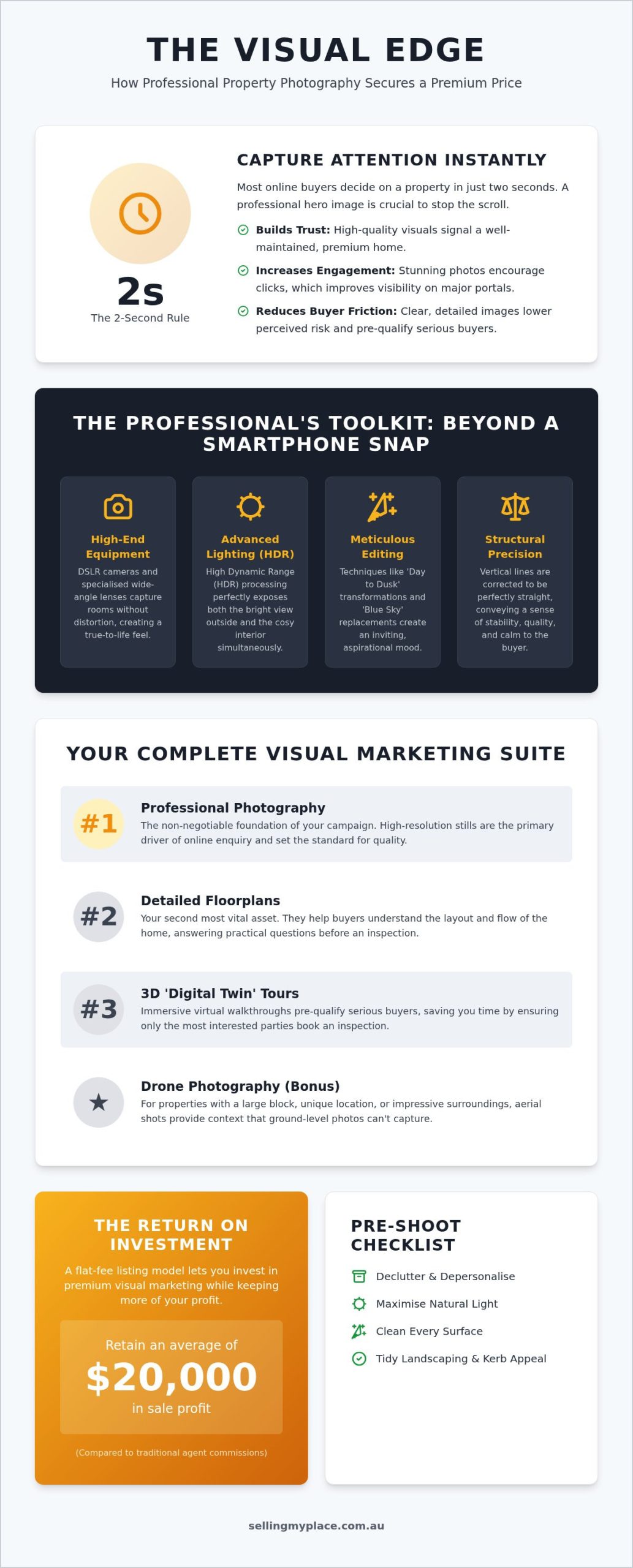
Have you ever found yourself scrolling through a property portal late at night, dismissing dozens of listings in seconds? You aren’t alone. Most buyers apply a strict “2-second rule” to every listing they see. If the hero image doesn’t resonate immediately, they move on. This is where professional property photography becomes your most valuable asset. High-quality visuals aren’t just about looking pretty; they signal to a prospective buyer that the home is well-maintained and cared for. If the photos are crisp, well-lit, and thoughtfully composed, the buyer subconsciously assumes the property’s structural integrity and maintenance match that high standard. Professional property photography is the primary driver of digital enquiry rates in the current market.
Building Buyer Trust in a Digital-First Market
In a digital-first market, high-resolution images do the heavy lifting of reducing “buyer friction”. When a buyer can see every detail clearly, their perceived risk drops. They start to trust the listing before they’ve even requested a contract. This trust is especially vital when you choose to sell without a traditional agent. There’s often a lingering anxiety that “Sale by Owner” means amateur, but high-end visuals instantly dismantle that myth. By applying foundational Architectural photography principles, you validate your home’s market value. In fact, owner-managed listings often require better photos than agency ones to prove that the sale is being handled with absolute professionalism and heart. It’s about closing the “trust gap” before the first phone call is even made.
The Impact on Major Australian Listing Portals
The algorithms on major Australian property platforms aren’t just random; they prioritise engagement. When your listing “stops the scroll” and keeps a user clicking through the gallery, the platform’s internal logic notices. Higher engagement leads to better visibility, which is crucial in a competitive landscape where demand remains high and supply is tight. These visual assets are the engine room of your campaign. Once you’ve captured their attention, you can guide them through the practical steps of how to sell your own home with confidence. It’s about creating a narrative of stability and premium quality that resonates with families looking for their next chapter, ensuring your property remains at the top of the search results through sheer popularity and visual appeal.
What Defines “Professional” Property Photography in 2026?
While modern smartphones are impressive, they can’t replicate the depth and clarity of a professional DSLR or mirrorless camera setup. True professional property photography relies on high-grade sensors and specialised lenses that capture more than just a room; they capture an atmosphere. Take the “Day to Dusk” technique, for example. By digitally transforming a daytime shot into a twilight masterpiece, we tap into a buyer’s emotional desire for a warm, inviting sanctuary. It’s a sophisticated touch that commands attention in a crowded feed, making your home feel like a premium retreat.
Professional lenses are equally critical. We use wide-angle glass designed to show the full scope of a room without the “fish-eye” distortion that makes walls look curved or rooms look unnaturally long. This technical precision is paired with meticulous colour correction. If the day of the shoot was overcast, a professional editor will perform a “blue sky” replacement, ensuring your listing looks vibrant and sunny regardless of the Australian weather on the day.
Advanced Lighting and Composition Techniques
Capturing the view through a window while keeping the interior perfectly lit is a challenge only “HDR” (High Dynamic Range) processing can solve. This involves layering multiple exposures to ensure the sun-drenched garden is just as clear as the lounge room rug. We also focus on vertical line correction. Have you ever noticed how amateur photos make walls look like they are leaning inwards? Professional shots keep those lines perfectly straight, providing a sense of structural stability and calm. It’s about showing the flow of the home, inviting the buyer to imagine walking from the kitchen to the alfresco area with ease. If you’re feeling unsure about which angles will best showcase your home’s unique character, you can always reach out for a quick chat to discuss your specific needs.
The 2026 Standard: Virtual Staging and AI Enhancement
By 2026, virtual staging has become a sophisticated tool for helping buyers visualise the potential of empty or dated spaces. It’s a cost-effective way to add stylish, contemporary furniture to a photo without the physical effort of hire companies. However, we maintain a clear ethical line. AI-driven retouching should enhance the truth, not hide it. We might remove a stray garden hose or brighten a dark corner, but we never remove permanent fixtures or distort the property’s reality. Professional property photography is about presenting the most polished version of your home’s legacy while maintaining the absolute trust of your future buyer.
Beyond Still Images: 3D Tours, Drones, and Floorplans
While professional property photography captures the emotional heart of your home, the supporting visual assets provide the logical framework buyers need to commit. Think of it as a multi-layered story. If the photos are the hook, the floorplan and 3D tour are the chapters that satisfy a buyer’s curiosity. In 2026, savvy Australians aren’t just looking for a pretty facade; they’re looking for a functional layout that fits their lifestyle. These tools work in tandem with understanding market reports to justify your asking price and build a rock-solid case for your home’s value.
The Essential Role of Accurate Floorplans
A floorplan is often the second most clicked item on a listing, right after the hero shot. It allows a family to mentally move in before they’ve even booked an inspection. Can the king-sized bed fit in the master? Is the kitchen close enough to the alfresco for entertaining? By including total square metreage and clear orientation, you remove the guesswork. Listings that include a professional floorplan often see a significant increase in enquiries because they provide the “bones” of the property. It’s about transparency and helping someone visualise their life within your walls. It makes the transition feel real and achievable.
Aerial and 3D Visualisation Strategies
Aerial drone photography has moved from a luxury to a standard for properties where the land is as important as the house. Whether you’re showcasing a large block or the home’s proximity to local parks and schools, a drone shot provides the “neighbourhood context” that a street-level photo simply can’t. It’s a bird’s-eye view of a buyer’s future community. It helps them understand the legacy and stability of the area they are buying into.
Similarly, the rise of the “Digital Twin” through 3D virtual tours has changed the game for pre-qualifying buyers. A virtual walkthrough allows interstate or international buyers to explore every corner of your home at their own pace. This is particularly valuable for investors, who can also use this 3D data to assist with tax depreciation schedules. By the time someone requests a physical inspection, they are already deeply familiar with the space. This means fewer “tyre-kickers” and more serious offers, which is a respectful, efficient way to manage your sale. Integrating these tools with your professional property photography ensures your listing is as informative as it is beautiful.
Preparing Your Home for the Lens: A Seller’s Checklist
Preparing your home for professional property photography isn’t just about a quick tidy; it’s about curated storytelling. You’ve lived in this house and built memories here, but now you’re handing that legacy over to someone new. To help them see themselves in your space, you need to create a blank canvas. This is why the “Declutter and Depersonalise” rule is so vital. Removing family photos and excess knick-knacks allows a buyer’s imagination to take root. You want them to see the architecture and the potential of the rooms, not the details of your daily life.
Sellers should always aim to emphasise the clean and bright aesthetic favoured by Australian buyers to ensure their listing feels modern and aspirational. Maximising natural light is the most effective way to achieve this. Start by cleaning your windows inside and out. It’s a small task that makes a massive difference in how a camera captures a room’s vibrancy. Open all blinds and curtains, and ensure they are hung straight. This simple step invites the sun in and makes the home feel airy and expansive. Don’t forget the kerb appeal; the exterior “money shot” is often the first thing a buyer sees, so ensure the lawns are mown and the entrance is welcoming.
Room-by-Room Preparation Tactics
In the kitchen and bathroom, aim for “spa-like” vibes. Clear every single item off the benches, including toasters and kettles, to showcase the workspace. Fresh, neutral-toned towels and a high-quality hand soap are all you need. In the living areas, give your cushions a “karate chop” to create that plush, inviting look, and ensure all rugs are perfectly aligned with the furniture. Don’t forget the outdoor spaces. A quick pressure clean of the driveway and alfresco area can take years off the property’s appearance. If you have a pool, make sure it’s sparkling and the surrounding area is staged with a few simple, stylish accessories.
The “Invisible” Details That Ruin Photos
It’s often the things we stop noticing that show up most prominently in a professional lens. Look for tangled power cables under the TV or pet bowls in the laundry and tuck them away. Hide wheelie bins and garden hoses so they don’t distract from the garden’s beauty. Replacing blown light globes is essential; consistent interior warmth ensures the camera doesn’t struggle with uneven lighting. Finally, consider the power of fresh flowers or greenery. A simple vase of native Australian foliage or a bowl of fresh fruit adds a touch of life and colour that feels authentic rather than staged. If you’re feeling overwhelmed by the list, contact our advisory team today for personalised guidance on how to get your home camera-ready.
Maximising Profit: Integrating Photography into Your KIDS Strategy
When you choose to lead your own sale, you aren’t just saving on costs; you’re taking ownership of your family’s financial legacy. In the KIDS model, professional property photography isn’t a luxury add-on or a hidden expense. It’s a foundational component of our flat-fee marketing packages. By providing high-end visuals as part of a transparent fee structure, we remove the anxiety of escalating marketing costs. Traditional agents often hide these expenses within hefty commissions, but our approach ensures you know exactly where you stand from day one. You get the same glossy, high-end result without the transactional sting.
The financial impact of this decision is significant. On average, our owners save $20,000 in commissions, funds that can be better spent on your next chapter, whether that’s a new home or a well-deserved retirement. These professional tools empower you during the property sale negotiation phase. When a listing looks this polished, it commands respect from the outset. Buyers don’t see a “cheap” DIY effort; they see a premium property presented by a confident, informed owner. This “Steady Hand” approach reduces the stress of the process and puts you in the driver’s seat of your own transition.
Using Visuals to Justify Your Asking Price
Presenting a premium brand image is your best defence against low-ball offers. In a market where buyers are increasingly savvy, high-quality visuals attract “emotional buyers”, those who fall in love with the lifestyle your home promises and are often willing to pay more to secure it. This visual strategy is a key part of our professional residential property listing services guide, which helps you navigate the 2026 market with absolute confidence. When your marketing is flawless, your asking price becomes much easier to justify during a walk-through.
The KIDS Advantage: Professionalism Without the Commission
The KIDS advantage is about more than just saving money; it’s about retaining your hard-earned equity while accessing a global marketing network. You get the peace of mind that comes from a listing that looks just as good, if not better, than the local agent-managed properties on the same street. It’s a smarter way to sell that values your time and your home’s worth. By using professional property photography to tell your story, you ensure your home stands out for all the right reasons. If you’re ready to take the next step towards a successful sale, you can start your commission-free journey with professional photography today and see how much you could save.
Secure Your Property’s Legacy and Your Sale Profit
Selling your home is a significant milestone that marks the end of one chapter and the beginning of another. By prioritising professional property photography, you ensure your home’s story is told with the sophistication and care it deserves. We have seen how high-end visuals and accurate floorplans act as a “digital front door”, building the trust necessary to attract premium offers without the need for a traditional agent. It’s about presenting a polished, professional image that validates your home’s worth while you lead the way with a steady hand.
Our commitment is to provide you with the tools to succeed, including expert pre-sale consulting and comprehensive marketing assets as standard. Owners who take this path save an average of $20,000 in commissions, allowing that equity to stay where it belongs: with your family. You don’t have to navigate this complex process alone. View our commission-free marketing packages including professional photography to see how we can support your journey. You have built a beautiful legacy in your home, and we are here to help you protect it as you move toward your next bright future.
Frequently Asked Questions
Is professional property photography really worth the cost?
Yes, investing in professional property photography is one of the most effective ways to secure a higher sale price. High-quality visuals act as your digital front door, instantly validating your home’s value to prospective buyers. In the Kincade International Direct Sales model, these services are included in your flat fee, ensuring you don’t face the high marketing costs associated with traditional agencies. This professional edge helps you retain your equity while presenting a polished image.
Can I just use my high-end smartphone to take the photos?
While modern smartphones are impressive for daily life, they cannot replicate the technical precision required for high-end real estate marketing. Professional cameras use specialised wide-angle lenses and high-dynamic-range sensors to capture detail in both shadows and bright windows simultaneously. This ensures your rooms look spacious and inviting rather than distorted or dark. Choosing professional property photography over smartphone snaps signals to buyers that your sale is being handled with absolute professionalism and a nurturing, expert hand.
How long does a professional property photo shoot typically take?
A standard photo shoot for a residential property usually takes between one and three hours. This timeframe allows our photographers to find the best angles, adjust lighting, and capture the unique character of your home without rushing. Larger homes or those requiring additional services like 3D tours and drone work may take slightly longer. We work methodically to ensure every room is presented in its best light, respecting your schedule while maintaining our high, authoritative standards.
What happens if it rains on the day of my scheduled shoot?
Don’t let a grey sky dampen your spirits. Our professional editors use advanced techniques like blue sky replacement to ensure your exterior shots look sunny and vibrant even on an overcast day. If the weather is truly extreme and prevents safe drone operation or clear outdoor shots, we will discuss rescheduling those specific elements. We aim to be a steady hand during these minor hiccups, ensuring your listing timeline remains on track despite the unpredictable Australian weather.
Do I need to be home when the photographer arrives?
You aren’t required to be home during the shoot, provided we have clear access to the property. Many sellers find it easier to step out, allowing the photographer to move freely through the rooms and focus on the composition. However, if you prefer to stay and assist with final invisible details like hiding pet bowls or smoothing cushions, you are more than welcome. We aim to make the process as low-stress and personal as possible for your family.
Should I include drone photography if I live in a standard residential street?
Aerial drone photography is highly beneficial even on standard residential streets because it provides essential neighbourhood context. It allows buyers to see the property’s proximity to local parks, schools, and transport hubs, which are key drivers for family buyers. Drone shots also clearly illustrate the block size and the home’s footprint relative to the land. This bird’s-eye view helps build a narrative of stability and community that street-level photos simply cannot capture on their own.
Why is a floorplan considered a “must-have” for Australian listings?
A floorplan is the second most vital element of your listing after the hero image. Australian buyers are detail-oriented and use floorplans to mentally move their furniture into the space and assess the home’s flow. It provides the logical bones that support the emotional appeal of the photography. By including total square metreage and orientation, you provide the transparency buyers expect in 2026, which often leads to higher engagement and more serious, pre-qualified enquiries.
How quickly will I receive my edited photos after the shoot?
We understand that timing is critical when you are ready to launch your listing. You can typically expect to receive your professionally edited images and floorplans within 24 to 48 hours after the shoot is completed. This fast turnaround ensures you can move forward with your sale by owner strategy without unnecessary delays. Our team works diligently to ensure every image is colour corrected and polished, helping you present a premium brand image to the market quickly.
Floor Plan Costs: A Guide for Australian Sellers
Would you buy a car without looking under the bonnet, or a book with half the pages missing? For many Australian buyers, a property listing without a floor plan feels just as incomplete. When you’re weighing up the cost of floor plan for selling house, it’s easy to view it as just another line item in a mounting list of marketing expenses. We know it’s stressful to manage a sale on your own; you want to look professional and attract the right people without feeling like you’re being overcharged at every turn.
It’s a common worry, but providing a clear layout is actually one of the kindest things you can do for a potential buyer. You’ll learn how these drawings serve as a vital spatial narrative that helps high-value families “move in” mentally before they ever step through your front door. This guide explores current market expectations, the psychological impact of layout on buyer confidence, and why a professional floor plan is a non-negotiable part of keeping more of your hard-earned equity during a smart, commission-free sale.
Key Takeaways
- Learn why a floor plan acts as the essential spatial bridge for buyers, correcting the visual distortions often found in wide-angle real estate photography.
- Identify which layout style-2D, 3D, or a full site plan-best suits your property’s unique features and appeals most to your target demographic.
- Understand the legal and financial risks of DIY drawings and how the cost of floor plan for selling house is a minor investment compared to protecting your professional reputation.
- Master the art of listing placement to ensure your layout appears exactly when a buyer needs to see it, turning casual scrollers into highly qualified leads.
- Explore how leveraging a flat-fee service provides you with top-tier marketing assets and expert guidance without the burden of traditional agency commissions.
Beyond the Photos: Why Floor Plans are Essential for a Successful Sale
A marketing floor plan is a scaled, simplified diagram of a residential property’s layout and spatial flow. It serves as the essential spatial map that turns a house into a relatable home for a prospective buyer. While professional photography captures the emotion and light of your home, it can sometimes be misleading. Wide-angle lenses, while great for showing off a renovated kitchen or a spacious alfresco area, often distort the actual distance between rooms. The floor plan provides the spatial narrative that anchors these images in reality, giving buyers the context they crave. It bridges the gap between simply seeing a house and truly understanding how it functions as a home.
When you’re calculating the cost of floor plan for selling house, it’s helpful to view it as a tool for efficiency. It significantly reduces inspection fatigue by allowing buyers to qualify the property before they commit to a physical visit. This means the people who attend your open home aren’t just tyre-kickers; they are individuals who already know the layout suits their lifestyle, making your sale process much more streamlined.
The Buyer’s Mental Move-In
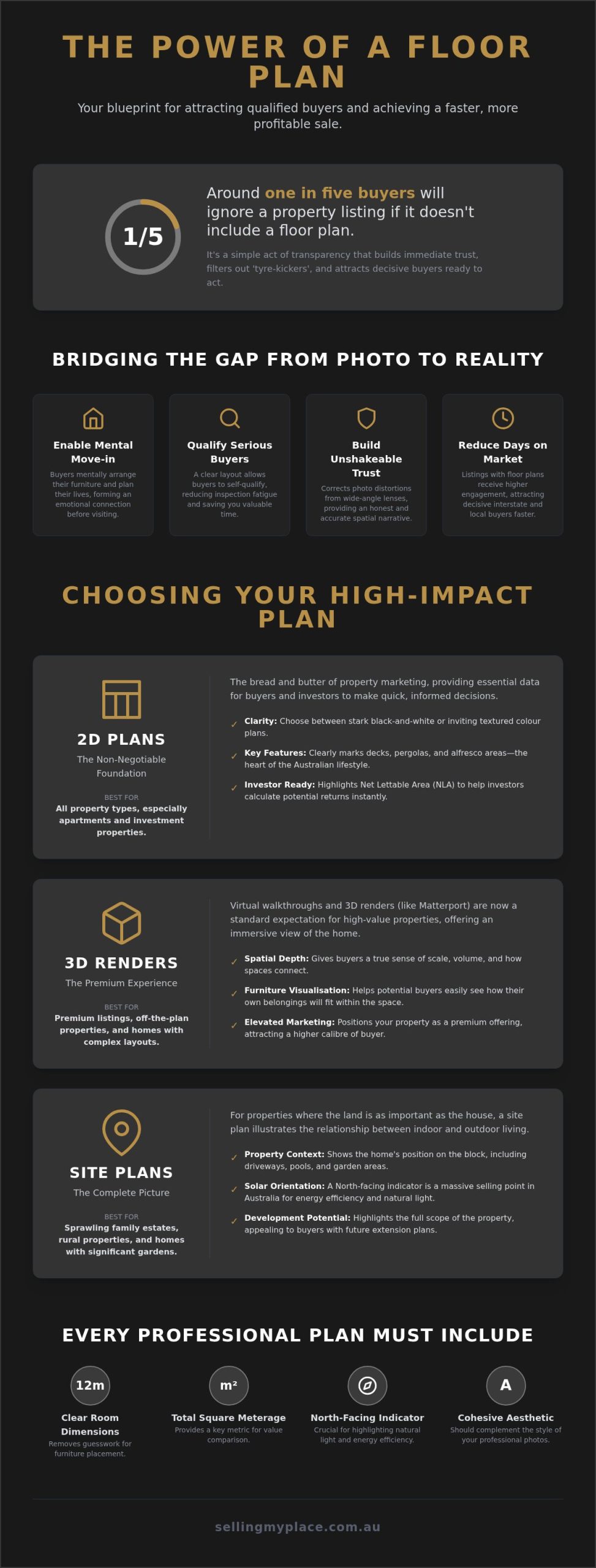
Australian families use floor plans to begin the emotional process of moving in. They look at the dimensions to see if their heirloom dining table fits or if the work-from-home nook is sufficiently separated from the noise of the living area. This is particularly crucial for multi-generational households where privacy and flow are top priorities. Statistics suggest that roughly 1 in 5 buyers will skip a listing entirely if it doesn’t include a clear layout. Providing this information is a gesture of transparency that builds immediate trust with your audience. It allows them to measure the distance between bedrooms in metres and plan their daily routines before they’ve even picked up the keys.
The Statistics of Spatial Marketing
To truly understand What is a Floor Plan? in the context of a modern sale, we have to look at how buyers behave online. Listings with floor plans receive significantly higher engagement on major Australian property portals. There is a documented correlation between high-quality spatial marketing and a reduction in “days on market.” For interstate buyers or those moving across the country, a professional layout is the primary tool that gives them the confidence to make a serious offer. When you consider the cost of floor plan for selling house, the value lies in attracting those high-quality, decisive buyers who are ready to act quickly. By removing the guesswork, you’re not just selling a structure; you’re offering a clear vision of a future lifestyle. This clarity is what drives higher offers and leads to a more certain result.
The Anatomy of a High-Impact Floor Plan: 2D, 3D, and Site Plans
Choosing the right visual format is about understanding who your buyer is and what they value most in a home. For a compact apartment, a clean 2D plan might be all you need to show the flow. For a sprawling family estate, you likely need a site plan to explain the garden’s relationship to the house. When you’re weighing up the cost of floor plan for selling house, remember that these assets are foundational marketing investments that establish the professional standard of your listing. Transparency is your greatest ally here. Every plan should include clear room dimensions, total square meterage, and a North-facing indicator. In Australia, solar orientation is a massive selling point for energy efficiency and natural light. It’s also vital that the aesthetic of your plan complements your professional photography to maintain a cohesive, premium brand for your listing.
Standard 2D Plans: The Non-Negotiable Foundation
A high-quality 2D plan is the bread and butter of property marketing. You can choose between the stark clarity of black-and-white lines or the inviting warmth of textured colour plans. For Australian homes, it’s essential to clearly mark the “Great Australian Dream” features. This includes decks, pergolas, and alfresco areas where buyers imagine spending their summer evenings. If you’re selling to an investor, highlighting the Net Lettable Area (NLA) helps them calculate potential returns immediately. It’s about providing the data they need to say “yes” faster without any ambiguity.
3D Renders and Virtual Walkthroughs
As we move through 2026, technology like Matterport has become a standard expectation for premium listings. 3D renders are perfect for properties with complex layouts, such as mezzanine levels or high-pitched ceilings that a flat drawing just can’t capture. These interactive tools allow buyers to “walk through” the home on their smartphones, which is a game-changer for qualifying leads before they ever book an inspection. If you’re unsure which tech fits your specific property, you can always reach out to our advisory team for a quick chat about your marketing strategy.
The Site Plan: Context is Everything
A site plan shows the home in relation to its boundaries, driveways, and easements. This context is vital for larger suburban blocks or regional properties where land use is a primary concern. It allows buyers to see the room for a future pool or perhaps a secondary dwelling (Subject to Council Approval). Showing the “bones” of the land helps a buyer justify the price and see the long-term potential of the legacy they’re buying into. When you provide this level of detail, you aren’t just selling a house; you’re selling the future possibilities of the entire block.
Professional Drafting vs DIY: Protecting Your Equity and Reputation
While it’s tempting to try and trim the upfront cost of floor plan for selling house by sketching it yourself, the risks to your reputation and equity are substantial. A floor plan isn’t just a drawing; it’s a legal representation of your property’s dimensions. Misleading spatial information can lead to disputes or even legal challenges if a buyer feels they’ve been misinformed about the total living area. By aligning your marketing materials with expert Conveyance Advice, you ensure that every detail of your listing is transparent and defensible. Laser measurements provided by professionals build immediate trust, eliminating those nagging doubts that can stall a sale during an open home. It’s about providing a clear, honest foundation that allows buyers to commit with their hearts and their heads.
The Pitfalls of DIY Measurement
Most homeowners don’t account for wall thicknesses, chimney breasts, or the exact depth of built-in alcoves. These small errors add up, resulting in a total square metreage that doesn’t match reality. Beyond the numbers, hand-drawn sketches often use non-standard symbols for wet areas, windows, and doors. This “unprofessional” look can subtly signal to a buyer that the entire sale process might be amateurish. When a buyer arrives and finds the master suite is significantly smaller than your sketch suggested, trust is lost instantly. It’s much harder to negotiate a premium price once a prospect feels they have to double-check your claims. We want your buyers to feel they’re in safe hands from the very first click.
The Value of CAD Precision
Computer-Aided Design (CAD) ensures every centimetre is accounted for with mathematical precision. This level of detail allows you to compete directly with top-tier boutique agencies that never settle for “near enough.” Digital plans are also incredibly flexible. If you decide to perform a minor pre-sale renovation, such as removing a non-load-bearing wall to create an open-plan kitchen, a digital file is easily updated without needing a full redraw. This precision is a vital part of the cost of floor plan for selling house because it prevents the “valuation gap” that occurs when buyers perceive a property as smaller than advertised. Investing in professional drafting means your listing looks polished and reliable, reflecting the care you’ve put into your home over the years.
Strategic Marketing: Floor Plans for Higher Offers
How do you transform a casual scroller into a committed buyer? It’s often about where you place the map. While your hero image captures the heart, the floor plan captures the logic, and in the digital carousel, timing is everything. We recommend making your floor plan the second or third image in your online gallery. This allows a buyer to orient themselves immediately after seeing the facade or the main living area. When assessing the cost of floor plan for selling house, it’s vital to look at it through the lens of strategic asset placement. If you’re managing a Sale by owner, this professional touch is exactly what signals to buyers that they’re dealing with a serious, well-prepared seller.
Social media offers another brilliant stage for your layout. You can use cropped sections of your plan to highlight specific lifestyle features, such as a secluded “parent’s retreat” or an integrated home office. It turns a flat drawing into a story about how your home supports a modern life. The modest cost of floor plan for selling house pays dividends when your listing achieves a higher quality score on property portals, keeping you at the top of the search results for longer.
Digital Integration and Mobile Optimisation
With 80% of property searches now occurring on smartphones, your floor plan must be legible on a small screen. A cluttered or low-resolution DIY sketch will simply be ignored. Professional plans ensure that room names and dimensions remain clear even when pinched and zoomed. By linking these interactive plans to your Neighborhood Market Reports, you provide a data-rich experience that helps buyers justify their offer based on both the home’s layout and the local area’s value. It’s about building a narrative of stability and worth.
Physical Marketing and Signboards
Including a floor plan on your street-front signboard is a clever way to filter out “tyre-kickers” before they even ring your doorbell. It ensures that those who do request an inspection are already satisfied with the basic flow of the home. Inside the house, provide high-quality “printable” floor plans for buyers to take away. After a long day of looking at half a dozen properties, your home can easily blur into the next. A clear, physical layout acts as a memory anchor, helping your property stand out when the family sits down at their kitchen table to discuss their options. If you’re ready to elevate your property’s presence, you can start planning your marketing strategy with our team today.
Selling Smarter: Professional Floor Plans in a Commission-Free Model
Many sellers worry that by stepping away from a traditional real estate agent, they’ll lose access to the high-end marketing tools that drive premium results. That simply isn’t the case. In fact, a flat-fee model allows you to secure the exact same world-class collateral, including professional photography and laser-accurate drafting, without sacrificing a massive chunk of your home’s value to a commission. When you look at the cost of floor plan for selling house through this lens, it’s not just a marketing expense; it’s a strategic investment in your financial independence. We’ve seen that Australians can save an average of $20,000 by taking this path, keeping 100% of their sale profit while still presenting a listing that competes with the country’s top-tier agencies.
The “Kincade International Direct Sales” approach is built on a partnership. We combine these professional floor plans with our expert advisory services to ensure you’re never navigating the process alone. You get the steady hand of a seasoned expert who understands the local landscape, paired with the practical tools needed to attract high-value buyers. It’s a way to sell with heart and intelligence, focusing on your family’s future rather than a transactional fee. You don’t need a traditional agent to access premium marketing; you just need the right support system to help you tell your home’s story.
Protecting Your Equity through Strategic Marketing
Calculating your return on investment is a powerful way to reduce the stress of selling. A small upfront cost of floor plan for selling house is a minor fraction of the typical 2% to 3% commission an agent might charge. By investing in superior marketing yourself, you often attract more competitive offers because your property is presented with total transparency and professional polish. This empowered sale process gives you peace of mind, knowing you’ve done everything possible to showcase your home’s legacy while protecting your hard-earned equity. It turns a complex life transition into a celebratory milestone where you remain in control of the outcome.
Next Steps for Your Empowered Sale
Getting started is simpler than you might think. You can easily organise your professional photography and floor plan session through our established network of experts. To prepare your home, we recommend ensuring all rooms are accessible so the drafting accurately reflects your property’s best features, from the sun-drenched alfresco area to the quiet study nook. Once your floor plan is ready, our advisory support helps you transition from a prepared seller to a successful closer. Professional floor plans are a cornerstone of modern Residential Property Listing Services, providing the clarity buyers need to make their move with confidence.
Your Path to a Successful, Empowered Sale
Selling your home is a significant life transition, and we believe you deserve to feel supported every step of the way. We’ve seen how a professional layout serves as the vital spatial bridge for your buyers, helping them visualise their future within your walls. By opting for a high-impact 2D or 3D plan, you don’t just provide data; you build the trust and clarity that leads to higher offers. While the upfront cost of floor plan for selling house is a minor investment, its role in protecting your equity and professional reputation is truly immense.
You don’t have to sacrifice your hard-earned profit to traditional commissions to get world-class results. Our flat-fee bundles include professional floor plans and photography, paired with our Expert Agent Advisory Service, helping Australians save an average of $20,000. You have the power to present a premium listing while keeping your legacy intact. We’re here to provide the steady hand and expert tools you need to move forward with confidence and peace of mind.
Start Selling Smarter with a Professional Marketing Package
Frequently Asked Questions
Do I really need a floor plan if my house has a very simple layout?
Yes, you definitely do. Even a simple layout needs a professional drawing to confirm exact room dimensions and the relationship between spaces. Buyers use these plans to determine if their existing furniture will fit, which is a major part of the mental “move-in” process. When you consider the cost of floor plan for selling house, remember that providing this clarity reduces inspection fatigue and attracts more qualified leads to your door.
What is the difference between an architectural blueprint and a marketing floor plan?
Architectural blueprints are complex technical documents used for construction, showing structural elements, plumbing, and electrical wiring. In contrast, a marketing floor plan is a simplified, scaled diagram designed for buyers. It focuses on the lifestyle flow, room names, and key features like alfresco decks or sunrooms. It’s meant to be easily readable on a smartphone screen while still providing accurate measurements for potential residents who want to understand the home’s daily function.
Can I draw my own floor plan to save on marketing costs when selling my home?
While you could draw your own, it’s generally not recommended for a premium sale. DIY sketches often lack laser precision, which can lead to awkward questions if a buyer finds a room is smaller than you claimed. Professional drafting provides the polished, authoritative look that buyers expect from a high-value listing. It’s a small investment that protects your reputation and ensures you don’t undermine the perceived value of your home during negotiations.
How long does it typically take to get a professional floor plan drafted for a listing?
You can usually expect your final digital files within 24 to 48 hours of the site visit. A professional technician will typically spend 30 to 60 minutes onsite using laser measuring tools to capture every nook and cranny. The data is then processed through CAD software to create a clean, accurate layout. This quick turnaround ensures your marketing campaign can launch without unnecessary delays, keeping your sale momentum high and your stress levels low.
Will a floor plan help sell a property that is in need of major renovations?
Yes, a floor plan is arguably more important for a “fixer-upper.” It allows builders and renovators to see the structural potential without being distracted by cosmetic issues. While they consider the cost of floor plan for selling house, they are actually looking for the layout’s potential for future growth. It turns a daunting renovation into a manageable project with a clear, logical starting point for their vision of a dream home.
Should I include furniture in my floor plan or keep it as a clean “blank canvas”?
We generally suggest a clean, “blank canvas” approach for most Australian listings. This allows buyers to visualise their own lives and furniture within the space without distraction. If you do include furniture, keep it minimal and use it only to demonstrate the scale of particularly large or unusually shaped rooms. The goal is to provide enough detail to be helpful without cluttering the spatial narrative you’re trying to tell to your potential buyers.
Are floor plans a legal requirement for real estate listings in Australia?
Floor plans aren’t a strict legal requirement in Australia, but they are effectively a standard industry expectation. Providing one is a proactive step toward total transparency. It helps protect you from potential disputes regarding room sizes or property features later in the settlement process. In a competitive market, omitting a plan can make buyers suspicious or lead them to skip your listing in favour of one that provides more detail about the home’s layout.
What is the most popular floor plan format for Australian buyers in 2026?
In 2026, the 2D full-colour plan remains the gold standard for most Australian residential sales. It offers a warm, inviting aesthetic while maintaining the mathematical clarity of a black-and-white drawing. Many sellers are now pairing these with a basic site plan to show the home’s position on the block. This combination provides the “full picture” that today’s energy-conscious and lifestyle-focused buyers are looking for during their initial property search on major portals.
Choosing the Best For Sale By Owner Marketing Packages in Australia (2026)
Why should the final chapter of your home-selling journey involve handing over A$20,000 or more in commissions that could stay in your own pocket? It’s a daunting thought, isn’t it? You want a premium result and a glossy professional presence, but the idea of losing a significant chunk of your hard-earned equity feels like a sting you’d rather avoid. Many homeowners worry that choosing for sale by owner marketing packages means sacrificing quality or risking legal slip-ups, especially with the ongoing updates to property disclosure requirements across Australia.
We’re here to show you that you don’t have to choose between professional excellence and keeping 100% of your profit. You can have the global portal exposure, the high-end photography, and the expert guidance you need to navigate contracts with total confidence. This guide explores how to select a private sale marketing package that protects your legacy and ensures your property shines on the world stage, all while keeping you firmly in the driver’s seat.
Key Takeaways
- Protect your hard-earned equity by moving away from traditional percentage-based commissions and embracing a transparent, flat-fee model.
- Identify the non-negotiable features in premium for sale by owner marketing packages, including professional-grade photography and global portal exposure.
- Utilise detailed neighbourhood market reports and pre-sale consulting to accurately price and position your home for a top-tier result.
- Eliminate the pressure of arbitrary deadlines with a “listed until sold” promise that keeps your property in front of buyers for as long as it takes.
- Gain peace of mind with access to expert advisory services that help you navigate complex legal disclosures and final contract negotiations.
Why For Sale By Owner Marketing Packages are the Modern Australian Standard
The Australian property market has undergone a quiet revolution. Gone are the days when real estate agents held all the keys to market data and buyer access. Today, digital transparency means you have the same information at your fingertips as any high-street office. Understanding what For Sale By Owner means in this modern context is about more than just avoiding a fee; it’s about taking ownership of a major life transition. By using professional for sale by owner marketing packages, you’re not just “giving it a go” yourself. You’re deploying the same high-impact tools the big agencies use, but you’re doing it with the heart and personal insight only a homeowner can provide.
There’s a unique power in being the primary narrator of your home’s story. You know the exact spot where the afternoon sun hits the deck and which local cafe makes the best flat white. When you combine this intimate knowledge with professional-grade marketing, you level the playing field entirely. You’re no longer at a disadvantage compared to traditional agencies; instead, you’re offering something they can’t: a genuine, lived-in perspective that resonates deeply with prospective buyers.
The true cost of traditional real estate commissions
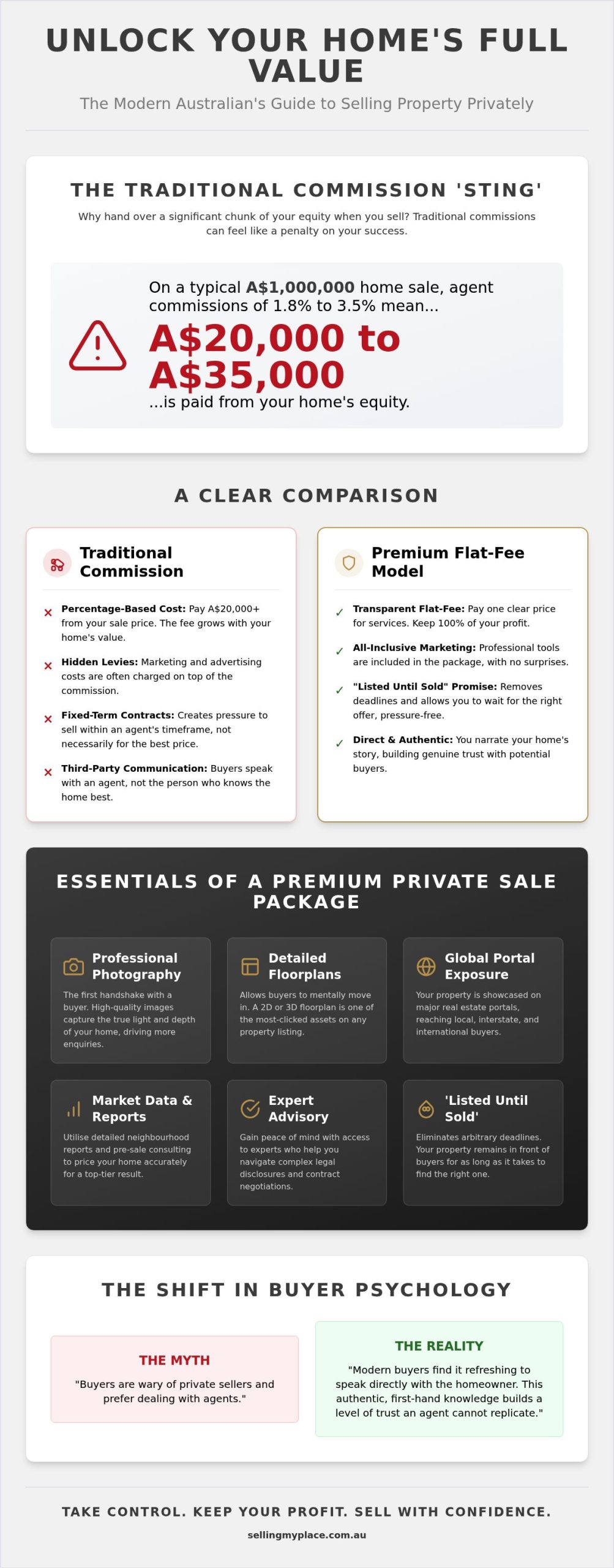
Let’s talk about the “commission sting.” In Australia, agents typically charge between 1.8% and 3.5% of your sale price. On a million-dollar home, that’s a massive A$20,000 to A$35,000 that simply disappears from your bank account at settlement. It’s often the difference between being able to afford that extra bedroom in your next home or having a comfortable buffer for your retirement. What’s more, many traditional agencies charge marketing “levies” on top of this commission. When you choose for sale by owner marketing packages, you’re choosing financial clarity. You pay a transparent flat fee, keep your equity intact, and ensure every dollar of your home’s value stays where it belongs: with your family.
The shift in buyer psychology
There’s a common myth that buyers are wary of private sellers. In reality, the opposite is becoming true. Modern buyers often find it refreshing to speak directly with the person who knows the property best. This authentic, first-hand knowledge builds a level of trust that a third-party agent simply can’t replicate. When negotiations happen directly between a buyer and a seller, the process often feels more human and less transactional. It’s a partnership based on transparency, allowing both parties to reach a fair agreement without the pressure sometimes associated with commission-driven sales.
Essential Components of a Premium Private Sale Marketing Package
Choosing between different for sale by owner marketing packages requires a keen eye for detail. It isn’t just about ticking a box to get onto a website; it’s about building a digital storefront that rivals the most expensive agencies in the country. To truly maximise your equity, your package must combine high-end visual storytelling with a reach that extends far beyond your local suburb. When you have the right tools, you aren’t just listing a property; you’re presenting a lifestyle that buyers can’t ignore.
One of the most significant advantages of a premium approach is the “Listed Until Sold” promise. Traditional agreements often come with a ticking clock, creating a pressure-cooker environment where you might feel forced to accept a lower offer before your contract expires. Removing this time limit restores a sense of calm to the process, allowing you to wait for the buyer who truly sees the value in your home.
Visual assets that drive enquiries
Quality matters. While smartphone cameras have come a long way, they often fail to capture the true depth and light of a room, which can inadvertently devalue your property in a competitive market. Professional photography is the first handshake you have with a buyer. Following closely behind is the floorplan. A 2D or 3D floorplan is the second most clicked item on a property listing because it allows buyers to mentally move their furniture into the space and understand the flow of the home before they even book an inspection. This visual storytelling shifts the focus from simple bricks and mortar to the future memories a family will create there.
Global reach and digital infrastructure
The modern buyer isn’t always living around the corner. They might be an Aussie expat in London looking for a way back home or an interstate investor seeking a stable return. A premium package ensures your home is synchronised across all major Australian portals while also tapping into international networks. This global visibility is a crucial component that many basic services overlook. When you consider the high cost of traditional agent commissions, having access to this level of digital infrastructure for a flat fee becomes a powerful financial strategy.
Managing these enquiries shouldn’t be a 24/7 burden for you, either. Sophisticated systems now handle the initial digital brochures and enquiry routing, ensuring no lead is lost while you’re at work or spending time with family. If you’re curious about how these digital tools can work for your specific suburb, you might like to reach out for a friendly chat about your goals.
Finally, never underestimate the power of data. Using detailed neighbourhood market reports allows you to find the pricing “sweet spot” based on actual recent sales rather than guesswork. This evidence-based approach gives you the confidence to stand firm during negotiations, knowing exactly what your property is worth in the current climate.
Comparing the Value: Flat-Fee Packages vs. Traditional Commissions
Choosing how to sell your home is ultimately a choice about who keeps the reward for years of mortgage payments and weekend renovations. The difference between a traditional commission and a flat-fee model isn’t just a few dollars; it’s often the equivalent of a year’s salary. While a traditional agent might quote a percentage that sounds small, the reality hits home at settlement. When you consider that the average owner saving is A$20,000, the financial impact on your next property purchase or your retirement fund is undeniable. Using for sale by owner marketing packages allows you to bypass this “equity tax” while still accessing high-tier marketing tools.
Financial transparency is the cornerstone of a modern sale. With a flat-fee approach, you aren’t left wondering what the final bill will look like. There’s a grounded, reassuring certainty in knowing your costs upfront. This model removes the conflict of interest often found in traditional real estate, where an agent might feel pressured to close a quick sale to secure their commission. Instead, you maintain total control over the final figure, supported by professional resources that protect your interests from start to finish.
The flat-fee financial model explained
A professional residential property listing service should be all-inclusive. It’s a common trap to be lured by “ultra-cheap” packages that eventually rack up costs with hidden advertising extras or fees for every minor listing update. A premium package provides everything you need, from portal synchronisation to signage, for one clear price. This creates peace of mind, allowing you to focus on presenting your home beautifully rather than worrying about a mounting marketing bill. It’s about value, not just the lowest price point, ensuring you have a “steady hand” guiding the process without the sting of a percentage-based fee.
Control vs. Convenience
Many homeowners worry that selling privately means sacrificing convenience. However, most buyers actually prefer speaking with the owner. You’re the one who can describe the quietness of the street or the reliability of the local school bus. Handling your own inspections isn’t a burden; it’s a strategic advantage. You aren’t just a face in a crowd to an agent; you’re the primary advocate for your home’s value.
To bridge the gap between DIY and a full agency, Real Estate Advisory Services provide the expert support you need when things get complex. Whether it’s interpreting market data or having a professional on hand when a contract is on the table, this advisory-led approach offers the convenience of an agent’s expertise without the high cost. You get the best of both worlds: the personal touch of a private sale and the professional safety net of a seasoned expert.
Maximising Sale Price with Professional Advisory and Market Data
Many people think for sale by owner marketing packages are just about getting a listing on a website. While visibility is vital, the real magic happens in the preparation and the strategic advisory that happens before the first buyer walks through the door. It’s about having a seasoned expert in your corner to help you see your home through a buyer’s eyes, identifying those small details that make a huge difference. This is where Pre-Sale Property Consulting becomes your secret weapon. By pinpointing high-impact changes that yield a strong return on investment, you ensure your home isn’t just another listing, but a must-have property.
Presentation is about more than just a fresh coat of paint or some new cushions. It involves using detailed Neighbourhood Market Reports to understand exactly where your property sits in the current landscape. When a prospective buyer questions your asking price, you don’t have to rely on a vague gut feel. Instead, you can present concrete data from recent local sales to justify your position with confidence. This evidence-based approach removes the friction from the transaction and builds professional credibility. Our Real Estate Advisory Services bridge the gap between a basic DIY listing and a high-performance sale, ensuring every detail is polished and every question has an answer.
Pre-sale strategy and property presentation
The goal of pre-sale strategy is to out-position the competition. By analysing local trends, we can help you decide which upgrades are worth the effort and which ones won’t add to your bottom line. This level of professional residential property listing support ensures you aren’t wasting time on renovations that don’t appeal to your specific target market. It’s a methodical way to build value, ensuring that when the “for sale” sign goes up, your home is the most attractive option in the street.
The closing phase: Negotiation and Settlement
Negotiating can often feel like the most intimidating part of the entire process for many homeowners. How do you handle multiple offers at once? What’s the best way to counter a low-ball bid without losing the lead? This is where Mastering the deal with expert property sale negotiation tips becomes essential reading. Having a steady hand to guide you through these high-stakes conversations ensures you stay focused on your goal. You want to keep 100% of your profit without leaving money on the table, and that requires a calm, calculated approach to every offer.
Once the deal is struck, the focus shifts to the legalities. Navigating conveyance and legal requirements is a critical final step that demands precision. For instance, sellers in Queensland must be particularly mindful of the new disclosure requirements introduced in August 2025. Missing a single required form can delay a settlement or, in the worst cases, jeopardise the entire sale. Having access to professional Conveyance Advice means you aren’t walking this technical path alone. It’s about protecting your hard-earned equity and ensuring a smooth transition to your next chapter. If you’re ready to start preparing your home for a record result, book a pre-sale consultation with our team today to explore your options.
Selecting Your Partner: Why Selling My Place is the Steady Hand You Need
Deciding to sell your home is a profound moment. It’s the culmination of years of memories, and choosing the right partner to help you move forward is about more than just finding a digital platform. At Selling My Place, we operate under the Kincade International Direct Sales (KIDS) philosophy. This isn’t just a business acronym; it represents a unique blend of empathy and expertise. We understand the emotional weight of major life transitions. Our goal is to provide a steady hand that guides you through the process, ensuring you feel protected rather than overwhelmed.
When you explore our for sale by owner marketing packages, you’re tapping into a global network that retains a warm, neighbourly accessibility. We believe that professional authority and heartfelt warmth can coexist. You aren’t just another listing on a server. You’re a partner in a shared mission to protect your hard-earned equity while securing a bright financial future for your family. This multi-generational expertise means we’ve seen the market’s cycles, giving us the perspective needed to keep you grounded and confident when things get complex.
A partnership-based approach to selling
We treat your sale as a shared mission. This means our relationship goes far beyond a simple transaction. By providing a 0% commission model with a flat fee and no time limits, we remove the traditional pressures of the real estate industry. Our multi-generational expert advisory service acts as your personal safety net, offering the type of seasoned wisdom usually reserved for high-end boutique agencies. It’s about protecting your legacy. We’re here to ensure the transition to your next chapter is as smooth and rewarding as possible, keeping you in total control of your property’s story.
Your next steps to a commission-free sale
Getting started is a straightforward, methodical process designed to put you in the driver’s seat immediately. You don’t need to wait for an agent’s permission to begin your journey. By taking these practical steps, you can start building your listing today:
- Access your neighbourhood market report to see exactly where your property sits in the current 2026 landscape.
- Organise your professional photography and floorplan session to capture your home’s best light.
- Synchronise your listing across all major Australian and global portals for maximum exposure.
- Leverage our Pre-Sale Property Consulting to ensure your presentation is polished and ready for inspections.
The path to keeping 100% of your sale profit starts with a single conversation. If you’re ready to bypass the high costs of traditional agencies and take charge of your equity, speak with our expert advisory team today to see how we can support your goals.
Your Path to a Successful, Commission-Free Future
You’ve seen how the Australian real estate landscape has evolved to put more power back into your hands. By choosing the right for sale by owner marketing packages, you aren’t just opting for a listing; you’re investing in a strategic partnership that values your home’s story as much as you do. You now understand that high-impact visual storytelling and global digital reach are the keys to out-positioning the competition without the burden of traditional agency costs. It’s about combining your local heart with our professional expertise to secure a result that truly reflects your property’s worth.
With an average saving of A$20,000 in commissions, the impact on your financial legacy is significant. You can move forward with total confidence, supported by our Expert Agent Advisory Service and premium marketing assets like professional photography and floorplans as standard. This is your opportunity to lead the sale of your home with a steady hand and a clear vision. Are you ready to take the next step toward a more rewarding settlement? Start your commission-free journey and protect your equity today. Your next chapter is waiting, and we’re here to help you begin it with peace of mind and your full profit intact.
Frequently Asked Questions
Is it legal to sell my own home in Australia without an agent?
Yes, it’s perfectly legal for any homeowner in Australia to sell their own property. You don’t need a real estate licence to sell your primary residence, though you must still comply with your specific state’s disclosure laws and contract requirements. While you manage the marketing and inspections, it’s essential to engage a qualified solicitor or conveyancer to handle the legal transfer of title and ensure everything is documented correctly.
Will my property appear on Australia’s leading property portals with a private sale package?
Yes, premium for sale by owner marketing packages provide the bridge you need to access these major platforms. Because individuals can’t list directly on these sites, a licensed provider facilitates the listing for you. This ensures your property receives the same high-level visibility as any home listed by a traditional agency, reaching millions of potential buyers across Australia and the globe every single month.
How much can I realistically save on commissions by using a flat-fee marketing package?
Australian homeowners save an average of A$20,000 in commissions by choosing a private sale model. Traditional agents typically charge between 1.8% and 3.5% of the final sale price. On a home sold for A$1,000,000, that’s a minimum of A$20,000 that stays in your pocket. These substantial savings can be used to pay down your next mortgage or bolster your retirement fund, protecting your family’s hard-earned equity.
What happens if my property doesn’t sell within the first three months?
Your property remains listed until it’s sold. Unlike traditional agency agreements that often expire after 90 days, our approach offers a “no time limit” promise. This removes the artificial pressure to accept a lower offer just because a contract is nearing its end. You have the freedom and peace of mind to wait for the right buyer who truly understands the value of your home, no matter how long it takes.
Do I need to handle the legal contracts and conveyancing myself?
No, we always recommend that you leave the legal heavy lifting to the professionals. While you act as the primary advocate for your home’s story, a solicitor or conveyancer handles the formal Contract of Sale and the settlement process. This is particularly vital given recent changes, such as the 2025 Queensland seller disclosure requirements, ensuring your transition is legally compliant and your interests are fully protected at every step.
Can a for sale by owner marketing package help with property valuation?
Yes, a quality package provides you with detailed Neighbourhood Market Reports to ensure your pricing is grounded in reality. These reports offer concrete data on recent local sales, helping you identify the “sweet spot” for your asking price. Instead of relying on a gut feel, you’ll have the same evidence-based tools as professional appraisers, giving you the confidence to justify your price to prospective buyers during negotiations.
How do I handle buyer enquiries and inspections?
You speak directly with buyers, which many people find is a significant advantage. Digital enquiries are routed to you, allowing you to arrange inspection times that fit your personal schedule. Modern buyers often appreciate the authentic, first-hand knowledge only an owner can provide about the home and the local community. It builds a level of trust and transparency that is often missing in third-party real estate transactions.
What is the difference between a basic listing and a professional marketing package?
A basic listing might only get you onto a website, but a premium for sale by owner marketing package offers a complete digital storefront. These professional packages include high-end photography, 2D or 3D floorplans, and expert advisory services. These high-quality assets are proven to drive much higher engagement, ensuring your home stands out in a competitive digital marketplace and helps you achieve a premium sale price without the commission sting.
High-Impact Real Estate Marketing Strategies for Sellers in 2026
What if you could command a premium sale price and professional-grade exposure without handing over a single cent of your hard-earned equity in commissions? It’s natural to feel a bit of anxiety when looking at the 2026 property market, especially when trying to implement effective real estate marketing strategies for sellers on your own. Between navigating the latest digital portal requirements and the stress of organising high-end photography, the weight of selling your own home can feel overwhelming. You want your property to stand out. However, the thought of high upfront costs or underselling your family’s biggest asset is enough to keep anyone awake at night.
This guide will show you how to master professional-grade tactics that rival any traditional agency, ensuring you keep 100% of your commission while achieving a top-tier result. We will explore everything from leveraging global digital networks to managing professional suppliers with ease, so you can transition to your next chapter with confidence and a much healthier bank balance. By the end of this article, you’ll have a clear roadmap to a stress-free, professional-looking listing that protects your profit and honours the value of your home.
Key Takeaways
- Discover how the shift toward property-centric marketing in 2026 allows you to reach global buyers without relying on traditional agency models.
- Learn why professional-grade photography and floorplans are essential to capturing interest within the critical first three seconds of a listing.
- Master effective real estate marketing strategies for sellers by utilising Australia’s major property portals and targeted social media to find passive buyers.
- Follow a clear, step-by-step playbook to prepare your property for a premium sale while retaining 100% of your commission.
- Explore how a sophisticated flat-fee approach can save you an average of A$20,000 while still providing expert advisory support and global exposure.
The Evolution of Property Marketing: Why 2026 Favours the Seller
The Australian property market has undergone a profound transformation. For decades, the focus was firmly on the agent, with their portrait dominating the billboard and their personal brand taking centre stage. However, the evolution of property marketing has shifted the spotlight back to where it belongs: on your home. In 2026, buyers don’t care about an agent’s career highlights; they care about the lifestyle your property promises. This move toward property-centric marketing means that the right real estate marketing strategies for sellers are now more accessible than ever, allowing you to present your home with the same polish as a high-end agency.
Digital globalisation has played a massive part in this shift. Your buyer is no longer just the person driving past your “For Sale” sign on a Saturday morning. They could be a professional relocating from Melbourne, an expat in London, or an investor in Singapore. Because the search process has moved entirely online, a property in a quiet Australian suburb can now achieve global visibility instantly. This transparency has empowered sellers, but it has also raised the bar for quality. A professional listing isn’t just a luxury; it’s a fundamental requirement for building trust with a buyer who may be viewing your home from thousands of kilometres away.
Breaking the Commission Cycle
Traditional real estate models often demand a 2% to 3% commission, which can feel like a heavy tax on your hard-earned equity. On a typical Australian home, this can easily amount to tens of thousands of dollars. Many savvy homeowners are joining the “Direct Sale” movement, realising that they can achieve a premium result without the sting of a commission. It’s a common misconception that choosing a no-commission path means going it alone. By using modern real estate marketing strategies for sellers, you can access professional listing services and global reach while keeping your profit in your own pocket. In fact, sellers using a flat-fee model often save an average of A$20,000, which is a significant boost to their next deposit or retirement fund.
The Role of Expert Advisory in Marketing
Effective marketing begins long before the first shutter click of a camera. It starts with pre-sale property consulting to identify the high-value improvements that actually move the needle for buyers. Whether it’s a fresh coat of paint in the right neutral tone or minor landscaping, these choices are informed by detailed neighbourhood market reports. Having a steady hand to guide you through the complexities of the settlement process and conveyance advice ensures that the professional image you’ve built is matched by a seamless transaction. This advisory-led approach provides the confidence of an expert partnership without the traditional agency price tag.
Visual Storytelling: Professional Photography and Floorplans
In the digital age, your first open house doesn’t happen on a Saturday morning at your front door. It happens on a smartphone screen, often late at night while a potential buyer is scrolling through property portals. You have roughly three seconds to capture their attention before they move on to the next listing. This is why visual assets are the cornerstone of effective real estate marketing strategies for sellers. It isn’t just about showing the rooms; it’s about telling the story of a life well-lived and inviting someone else to imagine their future within your walls.
Professional wide-angle photography is a non-negotiable element of this process. These specialized lenses capture the true volume of a room, creating a sense of space and light that a standard phone camera simply cannot replicate. While modern phones are impressive, they often struggle with “barrel distortion” or poor light balancing, which can make even the most beautiful home look cramped or gloomy. To ensure your shoot is a success, follow this simple preparation checklist:
- Declutter every surface, including kitchen benches and bathroom vanities.
- Open all curtains and blinds to flood the home with natural Australian sunlight.
- Turn on every light in the house, including bedside lamps, to create a warm glow.
- Remove personal items like family photos, fridge magnets, and pet bowls.
- Ensure the exterior is tidy, with bins tucked away and cars moved out of the driveway.
Capturing the Heart of the Home
Buyers generally buy on emotion and then justify the purchase with logic. Using natural light and “lifestyle” shots, such as a sun-drenched reading nook or a beautifully set alfresco dining area, helps create that vital emotional pull. Your “hero shot,” which is usually the front of the house or the primary living area, must be impeccable. DIY photos can actually devalue your property in the eyes of a buyer, as they suggest a lack of care or professional oversight. If you’re feeling unsure about how to present your home’s best side, reaching out for a bit of expert advice can ensure your visual presentation is flawless.
Floorplans: The Blueprint of a Sale
Research suggests that approximately one in three buyers will completely ignore a listing if it lacks a floorplan. It’s a critical tool that allows people to “move in” mentally before they’ve even stepped foot on the property. They can measure where their favourite sofa will go or see exactly how the master bedroom relates to the nursery. A professional floorplan adds a layer of agent-grade legitimacy to your listing, reassuring buyers that the information is accurate and professional. It provides the spatial context that static photos sometimes lack, making the entire marketing package feel comprehensive and trustworthy.
Maximising Digital Reach: Portals, Socials, and Global Networks
Getting your home in front of the right eyes requires more than just a “For Sale” sign and a prayer. In the Australian market, visibility is dominated by the leading property portals that attract millions of monthly visitors. While these platforms are often seen as the exclusive playground of traditional agencies, modern real estate marketing strategies for sellers now provide a direct pathway to these high-traffic platforms. By listing your home where the buyers already are, you ensure your property is seen alongside every other professional listing in your suburb. It’s about creating a level playing field where the quality of your home, and the professional visual storytelling we discussed earlier, can truly shine.
Beyond the major portals, successful sellers use data-driven neighbourhood market reports to understand exactly who their buyer is. Is it a young family looking for a backyard, or an investor seeking a high-yield unit? Knowing this allows you to tailor your digital reach. If your property is a high-value residence, a global marketing network becomes essential. In 2026, capital is incredibly mobile. An Australian lifestyle property is an attractive asset for international buyers, and your marketing should reflect that global appeal by appearing on international syndication networks that reach expats and investors worldwide.
Beyond the Local Suburb
Your property’s discoverability shouldn’t end at the suburb boundary. Sophisticated SEO ensures that when someone searches for a lifestyle change in your specific region, your home appears in the results. This is particularly vital for attracting international interest. Global listing syndication pushes your property to dozens of countries, reaching buyers who might never visit a local Australian portal. Even “off-market” strategies have evolved. You can build momentum through private networks and digital infrastructure before the public launch, creating a sense of exclusivity that can drive up the final sale price without the stress of a public deadline.
The Social Media Strategy
Social media is a powerhouse for finding “passive” buyers, making it one of the most effective real estate marketing strategies for sellers in a competitive market. These are people who aren’t actively checking portals every day but would move for the right opportunity. Targeted social media ads allow you to place your home directly into the feeds of people based on their lifestyle interests and browsing habits. A short, engaging video walkthrough can stop a thumb mid-scroll far more effectively than a static image. Don’t underestimate the power of community, either. Sharing your listing in local suburb groups can spark word-of-mouth interest that leads to a genuine enquiry. It’s a personal, neighbourly way to find a buyer who will love your home as much as you have.

The Direct Seller’s Playbook: A Step-by-Step Marketing Plan
Many traditional agencies like to keep their marketing processes shrouded in mystery, suggesting that only they possess the “secret tools” for a successful sale. In reality, the most effective real estate marketing strategies for sellers are quite straightforward when you have a structured plan to follow. This playbook demystifies the process, putting the power back into your hands while ensuring you don’t sacrifice an ounce of professionalism. By following these five steps, you can transition from a homeowner to a successful seller with total confidence.
- Step 1: Pre-Sale Consultation. Before you even think about a camera, you need to identify high-value improvements. A professional pre-sale property consulting session helps you decide which minor repairs or styling choices will actually increase your sale price.
- Step 2: Professional Assets. Secure your professional photography and floorplans. As we’ve discussed, these are the primary drivers of digital engagement.
- Step 3: Compelling Copywriting. Draft benefit-driven copy that highlights the lifestyle your home offers. Instead of just listing “three bedrooms,” describe the “sun-drenched morning coffee spot” or the “short, leafy walk to the local primary school.”
- Step 4: The Global Launch. Go live across the “Big Three” Australian portals and global networks simultaneously. This creates an immediate surge of interest and competition.
- Step 5: Advisory Support. Utilise expert real estate advisory services to manage enquiries, negotiate offers, and guide you through the conveyance process.
Timing Your Launch
The “Golden Window” for a property listing is typically the first 14 days. This is when your home is “new” to the market and receives the highest volume of views. To make the most of this period, you must coordinate your professional photography, signage, and online listing so they all hit the market at once. One of the greatest benefits of a modern flat-fee model is the “no time limit” listing. This removes the stress of a ticking clock, allowing you to wait for the right buyer without the fear of your listing becoming “stale” or being forced into a price reduction by a looming agency contract expiry.
Negotiating Like a Pro
Negotiation doesn’t have to be a high-stress confrontation. When you’re armed with detailed neighbourhood market reports, you have the data needed to defend your asking price with calm authority. If you receive multiple offers, you can manage them transparently without the pressure of a public auction. This methodical approach ensures the marketing success you’ve built translates into a premium final settlement. If you’re ready to take the first step toward a commission-free sale, get in touch with us to discuss your property’s potential.
The Kincade Advantage: Professional Results Without the Sting
Selling My Place (Kincade International Direct Sales) isn’t just about listing a property; it’s about redefining how Australians approach the biggest transaction of their lives. By combining global digital infrastructure with a personal, advisory-led model, we ensure you don’t have to choose between professional exposure and financial sense. Implementing high-impact real estate marketing strategies for sellers shouldn’t come with a hidden “success tax” that drains your profit. Instead, our model prioritises your equity, allowing you to deploy sophisticated tactics while retaining 100% of your commission. It’s a smarter, more transparent way to move forward.
The financial reality of this approach is quite remarkable. On average, our sellers save approximately A$20,000 by avoiding traditional percentage-based fees. When you consider that this saving comes while still receiving professional photography, detailed floorplans, and reach into global networks, the decision becomes a matter of logic rather than tradition. We view this as a genuine partnership. Our goal is your success, not a quick transaction to meet an agency quota. By removing the pressure of commission, we create an environment where the focus remains entirely on your needs and your property’s potential.
A Partnership Approach
We believe selling a home is an emotional transition that deserves more than a purely transactional service. Our Agent Advisory Service acts as your “steady hand,” providing the calm confidence needed to navigate complex negotiations and buyer enquiries. You aren’t left to figure out the legalities alone, either. With professional conveyance advice available, you have a clear, supported path from the first enquiry to the final settlement. This supportive experience aims to reduce the typical stress of selling, replacing it with a sense of shared purpose and expert local knowledge that feels both personal and protective.
Your Equity, Your Future
Take a moment to visualise what that A$20,000 saving could mean for your future. Perhaps it’s a significant boost to the deposit for your next family home, a contribution to your children’s education, or the security of a more comfortable retirement. This is your legacy. Keeping that profit where it belongs is a powerful way to honour the years of hard work you’ve put into your property. Selling smarter isn’t just about the final price on the contract; it’s about the financial freedom you carry into your next chapter. Are you ready to take control? Contact our expert advisors today to start your commission-free journey.
Your Path to a Successful, Commission-Free Sale
The shift toward property-centric marketing in 2026 has opened doors that were once locked behind agency gates. By mastering professional real estate marketing strategies for sellers, you’ve seen how simple it is to combine global reach with high-end visual storytelling. You don’t need to sacrifice your equity to achieve a premium result. Instead, you can rely on a model that includes professional photography and floorplans as standard, ensuring your home looks impeccable on every major portal from day one.
Choosing to sell your own home is an empowering step toward protecting your family’s financial legacy. With an average saving of A$20,000 in commissions and the peace of mind that comes from being listed until sold with no time limits, you’re firmly in the driver’s seat. We’re here to act as your steady hand, providing the advisory support you need to navigate this transition with total confidence and warmth. It’s about more than just a transaction; it’s about honouring the home you’ve built.
Start your commission-free sale today with our expert marketing advisory. It’s time to celebrate your home’s true value and keep your hard-earned profit exactly where it belongs.
Frequently Asked Questions
Can I really list my home on Australia’s major property portals without a traditional agent?
Yes, you can list on the nation’s premier property search platforms through a licensed listing service. While the largest portals typically don’t allow private individuals to list directly, a flat-fee service provides the professional bridge required. This ensures your home appears alongside every other agency listing, maintaining a level playing field for your property’s visibility and reach.
How much can I actually save by using a flat-fee real estate marketing strategy?
Australian homeowners save an average of A$20,000 in commissions by opting for a flat-fee model. This figure represents the equity you would otherwise pay to a traditional agent based on a percentage of the final sale price. By implementing these real estate marketing strategies for sellers, you retain more of your property’s value while still accessing professional-grade exposure and support.
Is professional photography included in the flat-fee marketing packages?
High-quality wide-angle photography and professional floorplans are standard inclusions in our marketing packages. We understand that visual storytelling is the most critical factor in capturing a buyer’s interest within the first few seconds of their search. Providing these assets as part of a fixed fee ensures your property presents with the same polish and authority as any high-end agency listing.
What happens if my property doesn’t sell within the first few months?
Your property remains listed until it’s sold, as there are no time limits on your listing. Traditional agency contracts often expire after 90 days, which can lead to stressful price reductions or the need to re-list. Our approach removes this pressure, allowing you to wait for the right buyer and the right price without worrying about additional fees or contract renewals.
How do I handle the legal side of the sale without an agent?
You can manage the legal requirements by utilising professional conveyance advice and advisory services. While you are the primary point of contact for buyers, experts guide you through the documentation and settlement process. This partnership ensures all Australian legal standards are met, providing a secure and compliant path from the initial offer to the final exchange of keys.
Will buyers take my listing seriously if I am selling it myself?
Buyers focus on the property’s quality and the professionalism of the listing rather than the name of the agency. When your home is presented with professional photography, accurate floorplans, and clear descriptions, it carries a high level of legitimacy. Many buyers actually prefer the direct transparency and local knowledge that only a homeowner can provide during an inspection.
What is pre-sale property consulting and do I really need it?
Pre-sale property consulting is a strategic review that identifies which minor improvements will yield the highest return on investment. It’s an essential step for those using real estate marketing strategies for sellers to ensure they aren’t over-capitalising on renovations. By focusing on high-impact changes like styling or landscaping, you can significantly boost your home’s appeal and final sale price.
How does a global marketing network help sell a local Australian home?
A global marketing network exposes your property to international investors and Australian expats living abroad. In a mobile world, your buyer might be searching from London or Singapore. Global syndication ensures your listing appears on international platforms, increasing the pool of potential buyers and creating more competition; this often leads to a more favourable sale price for your local residence.
The Power of Floorplans: Why Spatial Clarity Sells Australian Homes Faster
Imagine a potential buyer sitting on their lounge on a Tuesday night, scrolling through your listing. They love the kitchen’s stone benchtops and the sun-drenched deck, but they’re squinting at the screen trying to figure out if the third bedroom is close enough to the master for a nursery. Without professional floorplans, that uncertainty often turns into a skipped inspection. It’s a missed opportunity that happens more often than most sellers realise, especially when the national median dwelling value is sitting at $922,838 and every click counts.
We understand the frustration of listing fatigue when your home sits on the market while others seem to fly. It’s disheartening to host open homes only to see buyers walk out because the flow isn’t what they imagined from the photos. We’re here to help you move past the stress of high-stakes marketing and find a clearer path. In this guide, you’ll discover how a professional floorplan transforms your property listing from a simple gallery into a high-converting spatial narrative. We’ll explore the genuine ROI of spatial clarity, the essential details your plan must include to meet Australian Consumer Law standards, and how to present your home’s layout to attract truly serious buyers.
Key Takeaways
- Understand why professional floorplans act as the “rational logic” that bridges the gap between a beautiful photo and a firm offer.
- Learn how accurate dimensions and clear labelling of storage spaces help buyers visualise their life (and their furniture) in your home.
- Discover how providing spatial data can qualify potential buyers early, saving you from the frustration of wasted weekend inspections.
- Explore why professional measurements are vital for legal accuracy and how to achieve a high-end listing without the burden of traditional agency commissions.
Why Floorplans are the Secret Weapon of Successful Australian Property Listings
In the Australian property market, where the national median dwelling value reached $922,838 as of February 2026, every detail of a listing carries significant weight. While professional photography captures the heart, it’s the floorplan that satisfies the head. Essentially, What is a floor plan? It’s a scaled 2D or 3D bird’s-eye view that reveals the internal logic of a home, showing how rooms connect and where the boundaries of each space lie. For many local buyers, this is the most critical piece of information after the photos themselves. It provides a sense of transparency that photos alone can’t achieve, building an immediate bridge of trust between the seller and the purchaser.
Beyond just a simple drawing, a floorplan creates a spatial narrative. It tells the story of how a family will live, move, and grow within the walls. By offering this clarity, you’re not just selling a house; you’re providing the blueprint for a future lifestyle. This transparency is especially important given the strict Australian Consumer Law regulations regarding misleading advertising. Providing an accurate layout shows you’ve got nothing to hide and respect the buyer’s need for honest, practical data.
The Psychology of the Online Browser
When someone is scrolling through a listing, they’re doing more than just looking at colours and finishes. They’re trying to solve a puzzle. Without floorplans, the “cognitive load” of trying to piece together a kitchen’s relationship to the dining area based on separate photos can be exhausting. A clear layout allows a buyer to mentally “move in” before they’ve even stepped foot on the property. It turns a poetic description of a “sun-drenched living area” into a verifiable fact by showing the northern orientation and window placements. This clarity reduces anxiety and helps a family decide if their heavy heirloom dining table or that specific king-sized bed will actually fit.
Statistical Advantage in the 2026 Market
The 2026 market has seen a shift toward more cautious, data-driven buying. With interest rates for owner-occupiers averaging 5.50% in early 2026, purchasers aren’t likely to gamble their time on vague listings. Some industry reports suggest that properties featuring professional floorplans can sell up to 38% faster and may even command prices up to 6% higher than those without. In a cooling market where home values saw a 0.4% dip in June 2026, staying on a buyer’s shortlist is vital.
A well-executed layout ensures your home remains a contender long after the initial emotional spark of the photography has settled. It serves several practical purposes:
- It defines the flow between indoor and outdoor living spaces.
- It highlights the proximity of bedrooms to bathrooms for young families.
- It identifies “hidden” value like storage cupboards, laundries, or study nooks.
By providing this information upfront, you’re treating potential buyers as partners in the process. It’s the first step toward a successful, stress-free sale.
The Anatomy of a Perfect Floorplan: What Modern Buyers Expect to See
While we’ve established that floorplans are a vital part of your marketing toolkit, not all plans are created equal. A blurry, hand-drawn sketch scribbled on a napkin won’t cut it in today’s competitive market. Modern Australian buyers, particularly those looking at property values nearing the million-dollar mark, expect a level of technical precision that mirrors the quality of the home itself. They’re looking for a document that acts as a reliable reference point for their future life. This means including accurate room dimensions in metres or millimetres for every major living area and bedroom. It’s the difference between a buyer wondering if their king-sized bed will fit and them knowing for certain that it will.
Beyond simple wall placements, a high-quality plan must clearly label every space. Don’t leave people guessing. If there’s a tucked-away laundry, a walk-in linen cupboard, or a compact ensuite, mark it clearly. Buyers also look for permanent fixtures that dictate how they’ll use a room. Indicating the position of kitchen islands, baths, and built-in wardrobes helps them understand the functional flow of the house. To provide a truly complete picture, always include a site plan. This shows the home’s footprint in relation to the entire block, detailing driveways, garden spaces, and the distance to boundary lines.
Orientation and Natural Light
In our climate, the direction a house faces is everything. A professional floorplan must include a North-point indicator. This isn’t just a technicality; it’s a guide to how much sun will hit the living room in winter or how cool the bedrooms might stay in summer. By showing window placements and their relationship to alfresco areas, you highlight the home’s ventilation and light flow. It allows a buyer to visualise themselves enjoying a morning coffee in a sun-drenched nook or hosting a summer BBQ in a shaded outdoor zone. If you’re unsure how to best showcase your home’s unique layout, it’s often worth reaching out for a chat about your listing needs.
Gross Internal Area (GIA) vs. Total Area
Transparency is your best friend when it comes to square meterage. Buyers want to know exactly what they’re paying for, and being vague can lead to difficult conversations during the conveyance process. Gross Internal Area is the total floor space within the external walls. It’s important to distinguish this from the “total area,” which might include carports, open decking, or balconies. Providing these separate figures prevents any feeling of deception. With the Australian Consumer Law carrying heavy penalties for misleading conduct, including accurate spatial data isn’t just good marketing; it’s a necessary step to protect your sale and provide peace of mind to everyone involved.
Photography vs. Floorplans: Why You Need Both to Tell a Complete Story
If professional photography is the first spark of romance in a property search, the floorplan is the deep, meaningful conversation that follows. It’s a simple truth in the Australian market. Photos are designed to create an “emotional hook,” pulling a buyer in with beautiful light, polished floorboards, and the promise of a certain lifestyle. However, savvy purchasers are increasingly aware of the “wide-angle lens” trickery. They know a clever angle can make a modest study look like a grand master suite. To bridge this gap, floorplans provide the “rational logic” that validates those beautiful images with factual, indisputable data.
Think of your marketing as creating a digital twin of your home. When you pair high-quality images with an accurate layout, you’re providing a comprehensive view that respects the buyer’s intelligence. This synergy is more important than ever. In June 2025, New South Wales introduced legislation requiring mandatory disclosure when images in advertisements have been digitally altered to conceal faults. This reflects a broader national trend toward transparency. By providing a professional plan, you’re offering a grounding truth that reassures buyers your home is exactly what it claims to be. It turns a collection of pretty pictures into a cohesive, believable story.
Bridging the Gap Between Clicks and Inspections
A well-placed layout acts as a map for your photo gallery. Without it, a buyer might see a stunning parents’ retreat and then a separate shot of a kids’ wing, but have no idea how they relate to one another. Are they on opposite sides of the house? Is there a central lounge between them? When a buyer can reference the floorplan while scrolling through photos, they stay on your listing page significantly longer. This increased “time on page” is a key metric that property portals use to rank listings, potentially giving your home more visibility in a crowded market.
The Risk of Only Using Photos
Relying solely on photography is a gamble that often leads to high-volume but low-quality inspections. There is nothing more frustrating for a seller than hosting ten groups on a Saturday morning, only to find that half of them left disappointed because the layout didn’t suit their specific needs. Maybe they needed a home office far from the kitchen, or perhaps they required a ground-floor bathroom for an elderly relative. When you skip the spatial data, you’re inviting “tyre kickers” who could have been qualified earlier. To ensure your marketing strategy is as efficient as possible, it’s wise to look into Professional Residential Property Listing Services that prioritise this balance. Providing clarity upfront means the people walking through your front door are already half-convinced that your home is the right fit for their life.
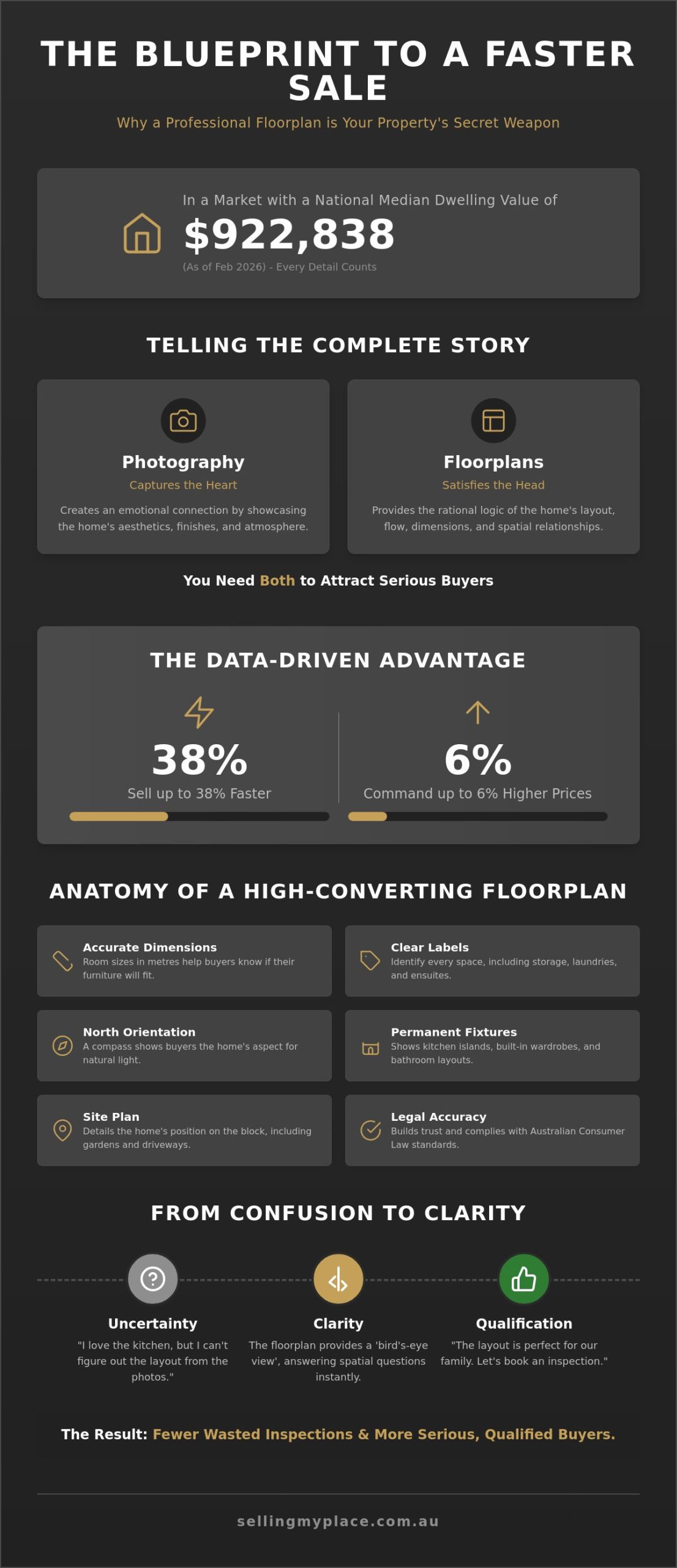
Qualifying Buyers Early: How Spatial Data Reduces Wasted Inspections
One of the most draining parts of selling property is the “tyre-kicker” effect. These are lovely people who adore your photography but realise within moments of arriving that the house simply doesn’t fit their life. It’s a waste of their Saturday and, more importantly, your time and energy. Using floorplans as a pre-screening tool solves this problem before the first doorbell rings. It allows potential purchasers to check if their oversized modular sofa fits the lounge or if the third bedroom is actually large enough for a home office. By providing this data upfront, you’re essentially handing them a checklist to qualify themselves.
This creates a “Serious Buyer” filter. When someone books a viewing after studying the layout, they’ve already done the mental heavy lifting. They aren’t wondering if the flow works; they’re already imagining how they’ll style the space. During the open for inspection, the floorplan becomes a natural talking point. It gives you a structured way to point out the subtle benefits of the home, such as the separation between the master suite and the guest wing, which might be hard to appreciate while walking through a crowded room. If you want to ensure your listing is working as hard as possible for you, consider reaching out for a chat about your property presentation.
Saving Time for the Private Seller
For those taking the “Sale by Owner” route, efficiency isn’t just a preference; it’s a necessity. You’re likely balancing work, family, and the sale itself, so every lead needs to be high-quality. A professional layout answers those repetitive questions about room sizes and storage before they’re even asked. It reduces the number of “just looking” calls and ensures your weekends are spent with people who are genuinely interested in your home’s specific configuration. If you’re managing the process yourself, it pays to learn How to Sell Your Own Home with a focus on these time-saving tools.
Empowering the Buyer’s Decision
A floorplan’s value doesn’t end when the inspection does. It becomes a vital reference point for buyers as they discuss the property with architects or builders about potential future renovations or extensions. It even plays a role in securing finance, as valuers often use these documents to verify the property’s living area during their assessment. Providing this level of detail empowers the buyer to move forward with confidence, knowing they have all the facts at their fingertips. A professional floorplan acts as a permanent, tangible reference that keeps your home at the forefront of a buyer’s mind long after they’ve left the driveway.
Professional Marketing Without the Commission: The Kincade Advantage
By now, it’s clear that spatial clarity isn’t just a “nice to have” feature; it’s a fundamental pillar of a successful sale. However, many homeowners worry that accessing high-end assets like professional floorplans requires signing away a significant portion of their equity through a 2-3% agency commission. We believe you shouldn’t have to choose between professional quality and your family’s financial future. Through Kincade International Direct Sales (KIDS), we’ve designed a model that provides those same elite marketing tools within a transparent, flat-fee structure. It’s about giving you the “big agency” look while keeping your hard-earned results in your own pocket.
While some might be tempted to save a few dollars with a DIY sketch or a basic smartphone app, the risks are substantial. Under the Australian Consumer Law, misleading or deceptive conduct in property advertising can lead to staggering penalties, with corporations facing fines up to $100 million. A professional measurement ensures that your Gross Internal Area is recorded with pinpoint accuracy, protecting you from legal disputes during the conveyance process. When your property is uploaded to our global marketing network, these precise details ensure your home stands out to serious buyers across the country and overseas, presented with the authority it deserves.
A Partnership Approach to Selling
We don’t just hand you a marketing bundle and walk away. Our “Steady Hand” philosophy means we act as your nurturing guide through the entire process. This starts with expert pre-sale property consulting to identify which features of your layout will most appeal to your local market. We then integrate your professional photography and floorplans into a listing that competes directly with the biggest agencies on the major property portals. It’s a collaborative effort where we provide the professional framework and you provide the heart and history of the home.
Your Next Steps to a Commission-Free Sale
Getting your home ready for the market is a significant life transition, and we’re here to make it as calm and organised as possible. When you choose one of our marketing bundles, we arrange for a professional to visit your home for a comprehensive measure-up and photo session. To prepare, simply ensure all rooms are tidy and clear of clutter so the technician can easily access every corner and wall. This small bit of preparation ensures your floorplans are as detailed and inviting as possible. If you’re ready to take control of your sale and move toward your next chapter with confidence, Discover our commission-free marketing packages today.
Take the Next Step Toward Your Successful Sale
Selling your home is one of life’s most significant transitions, and it deserves a strategy that respects both your heart and your hip pocket. We’ve explored how floorplans do more than just show wall placements; they qualify your buyers, reduce the stress of wasted inspections, and provide the legal transparency required in the modern Australian market. It’s about giving purchasers the confidence to say “yes” before they’ve even walked through your front door.
You don’t have to navigate this process alone or pay high marketing costs to get professional results. Our partners save an average of $20,000 in commissions while still receiving high-end photography and professional measurement as part of their bundle. With your property listed until sold and no time limits to worry about, you can move at a pace that feels right for your family. Save thousands and sell smarter with our flat-fee marketing packages. We’re here to ensure your next chapter starts with a sense of calm and a very successful result.
Your Questions About Spatial Marketing Answered
Do I really need a professional floorplan for a small apartment?
Yes, spatial clarity is arguably more important in smaller homes where every square metre counts toward the final sale price. Buyers looking at apartments often worry about whether their existing furniture will fit without making the space feel cramped. Professional floorplans help them visualise the layout of studios or one-bedroom units that can sometimes look identical in photos, giving your listing a distinct competitive edge.
Can I draw my own floorplan for a real estate listing?
While you can technically create a sketch yourself, it is not recommended due to the legal risks involved in property marketing. Accuracy is a strict requirement under Australian Consumer Law, and professional services provide the precision needed to avoid claims of misleading conduct. A DIY version often lacks the authority and exact millimetre-perfect measurements that serious purchasers and their solicitors expect to see.
What is the difference between a 2D and a 3D floorplan for selling?
A 2D plan is a flat, bird’s-eye view showing dimensions and room connections, while a 3D version adds depth and furniture visualisations to the mix. 2D versions are excellent for technical clarity and helping buyers plan their furniture placement. 3D versions are a wonderful tool for buyers who struggle with spatial awareness, as they help them “feel” the volume and height of the rooms more effectively.
How long does it take to get a professional floorplan created?
Most professional measures take about 30 to 60 minutes on-site, with the final digital files usually delivered within 24 to 48 hours. This quick turnaround ensures your marketing campaign isn’t delayed while you wait for assets. It is a small time investment that pays off significantly by ensuring your listing is comprehensive and ready for the portals from the very first day.
Will a floorplan help with my property valuation?
Yes, providing a detailed layout can assist a valuer in accurately calculating the Gross Internal Area (GIA) of your home. Valuers rely on precise data to compare your property with recent sales in the local area. Having this information ready shows you are a prepared and transparent seller, and it helps ensure no living space or utility area is overlooked during the formal assessment.
Should I include the garden and outdoor areas in my floorplan?
Absolutely, as including a site plan that shows the house in relation to the block is highly beneficial for the Australian lifestyle. Our way of living revolves around the indoor-outdoor flow, so marking alfresco areas, decks, and garden boundaries is essential. It helps buyers understand the total utility of the land and how they might use the backyard for future entertaining or play.
How much do floorplans typically cost when not included in a package?
Industry rates vary depending on the size and complexity of the home, but they are generally considered a very low-cost investment relative to the property’s value. While we include floorplans in our flat-fee bundles to provide the best possible value, standalone costs usually reflect the time taken for a professional measure-up and digital rendering. It is a small price to pay for the peace of mind that comes with professional accuracy.
Is a floorplan legally required to sell a house in Australia?
No, there is no national law that mandates a floorplan for a residential sale, but you are legally bound to be accurate if you choose to use one. Under the Australian Consumer Law, any visual representation must be a truthful and accurate reflection of the property. Providing a professional plan is the most reliable way to meet these transparency standards and protect yourself from potential disputes during the settlement process.
