Legal Requirements for Selling a House Privately in Australia: The 2026 Guide
You don’t need a middleman to sign away $20,000 of your hard-earned equity just to move onto your next life chapter. While many feel pressured to hire a traditional agent, selling your own home is a protected legal right in every corner of Australia. We understand that the weight of responsibility can feel heavy; nobody wants to risk a lawsuit or a failed settlement because they missed a state-specific disclosure. Understanding the legal requirements for selling a house privately is the first step toward a confident, successful sale that keeps your profit where it belongs: in your pocket.
It’s natural to feel a bit cautious as property laws become more digital and complex. Whether you’re worried about the mandatory 2026 Edition Contract in NSW or the strict new Seller Disclosure Statements in Queensland, you’re not alone in this journey. This guide provides a clear, professional roadmap to help you handle the 2026 legal landscape with ease. We will preview the essential documents required for each state, explain the updated 15% national withholding tax rules, and show you how to organise a legally sound settlement that protects your family’s future and your legacy.
Key Takeaways
- Confirm your legal right to sell property without an agent in any Australian state, allowing you to take full control of your home’s transition.
- Understand the essential legal requirements for selling a house privately, from preparing the Contract of Sale to providing mandatory vendor disclosures.
- Stay ahead of 2026 regulatory changes, including the new digital-first contract standards in NSW and updated identity verification rules across the country.
- Learn how to manage the exchange and settlement process safely by partnering with professional conveyancing and advisory experts.
- Discover how pre-sale consulting helps you identify and resolve legal or structural issues before they impact your sale price or settlement timeline.
Understanding Your Legal Right to Sell Property Privately in Australia
The idea that you need a real estate agent to sell your home is one of the most persistent myths in the Australian property market. In reality, no state or territory law requires you to use a middleman. You have the absolute right to represent yourself; choosing the “Sale by Owner” path is a legitimate, well-trodden route for thousands of Australians every year. By taking the reins, you’re not just saving on commission. You’re taking full ownership of your family’s transition and financial future.
While you have the freedom to sell, you also carry the weight of professional responsibility. The legal requirements for selling a house privately include a strict duty of care under the Australian Consumer Law (ACL). Essentially, you must avoid any “misleading or deceptive conduct” during your marketing and negotiations. If there’s a structural issue, a boundary dispute, or a known defect, honesty isn’t just the best policy; it’s a legal necessity that protects you from future litigation. We like to think of our role as the “steady hand” beside you. You stay in control of the heart and soul of the sale while we provide the expert advisory infrastructure to ensure every legal detail is handled with precision.
The Role of State Legislation in Property Sales
Property law in Australia is governed at the state and territory level rather than by a single federal body. This means the rules for a sale in one state will differ slightly from those in another. Understanding Your Legal Right to Sell Property Privately requires a look at your local jurisdiction, such as the Sale of Land Act or the Conveyancing Act applicable to your specific region. While the specific forms and certificates change, the core principles of transparency and full disclosure remain the same across the country. Following these local Property Acts ensures your sale stands on firm ground and remains valid from the first inspection through to the final handover.
Why Legal Compliance is Your Best Marketing Tool
Many sellers view legal paperwork as a dry, administrative hurdle to be cleared. We see it differently. A legally robust contract is actually one of your most powerful marketing assets. When potential buyers see a comprehensive disclosure package ready to go, it builds immediate, grounded trust. It shows you’ve been a diligent steward of the property and that you have nothing to hide.
Professional documentation also protects your settlement timeline. By being upfront with all mandatory reports and certificates, you significantly reduce the risk of a buyer “getting cold feet” or finding a reason to withdraw during the cooling-off period. In a 2026 market where buyers are increasingly cautious about high-stakes decisions, providing a smooth, legally sound path to purchase makes your home stand out as a low-risk, high-quality opportunity.
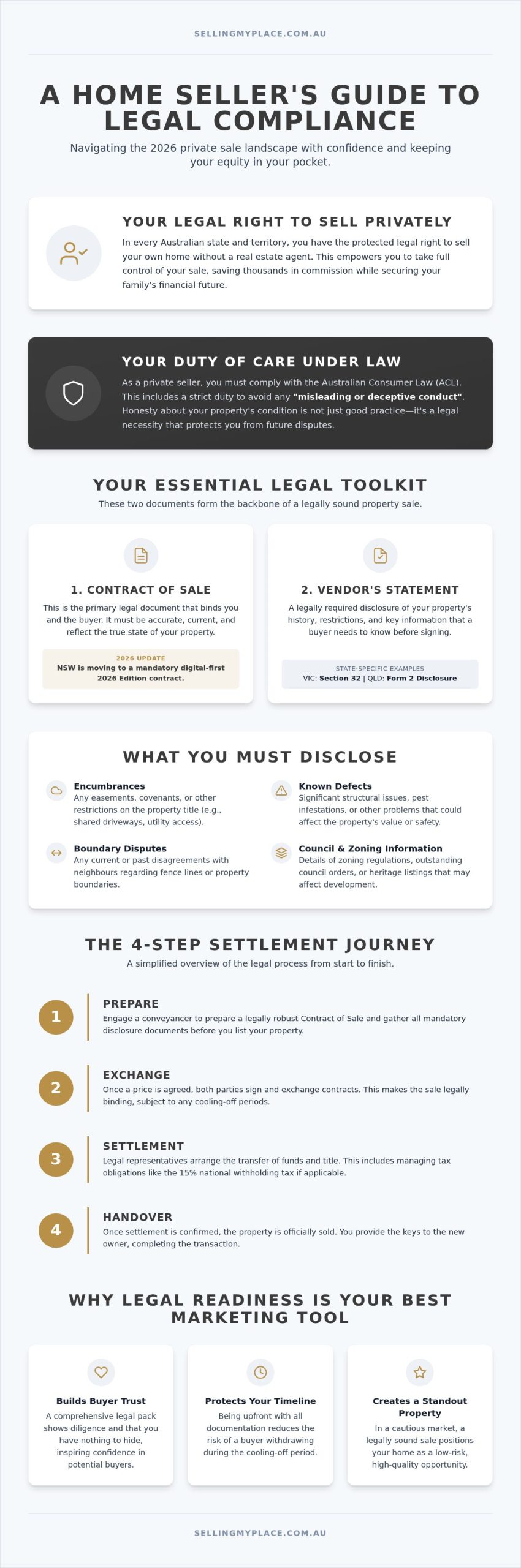
Essential Documents: The Contract of Sale and Vendor Disclosures
The Contract of Sale is the primary legal instrument of your transaction. It’s the document that formally binds you and your buyer together. While it might look like a stack of intimidating fine print, it’s actually a protective shield for both parties. In 2026, many states have moved toward digital-first contracts, such as the mandatory 2026 Edition in NSW, which is designed to streamline the exchange process. Meeting the legal requirements for selling a house privately starts with ensuring this document is current, accurate, and reflects the true state of your property.
Beyond the contract itself, most states require a Vendor’s Statement. A Vendor Statement is a legally binding disclosure of a property’s history and restrictions. In Victoria, this is famously known as a Section 32, while Queensland sellers must now provide a signed Form 2 Disclosure Statement and all prescribed certificates before a contract is signed. These documents ensure the buyer enters the deal with their eyes wide open, which is a vital part of managing legal obligations during a sale.
What Must Be Disclosed to the Buyer?
Transparency is your greatest ally here. You’re legally required to reveal any factors that might affect the property’s value or the buyer’s enjoyment of it. This includes:
- Encumbrances: Any easements, such as a water pipe running through the backyard, covenants, or restrictions on how the land can be used.
- Zoning: Whether the land is residential, commercial, or subject to specific overlays.
- Building Works: Any permits or structural works completed in the last seven years, ensuring they were properly certified.
- Financial Outgoings: A clear breakdown of council rates, water charges, and the 2026 land tax thresholds.
Using professional photography and Residential Property Listing Services ensures your floorplans and property details are perfectly aligned with the physical reality of the home, preventing any claims of misleading conduct.
The Consequences of Non-Disclosure
Cutting corners on disclosures is a risk that simply isn’t worth taking. If a buyer discovers a material fact was hidden or misrepresented, they often have the legal right to rescind the contract immediately. This means they can walk away with their full deposit, even just days before settlement, leaving you back at square one. Beyond a lost sale, you could face significant legal penalties for deceptive conduct. If you’re feeling unsure about which certificates apply to your specific block, it’s always worth reaching out for a bit of expert guidance to keep your sale on the right track.
Navigating State-Specific Regulations and Cooling-Off Periods
While your right to sell is a national constant, the specific legal requirements for selling a house privately change the moment you cross state lines. It’s a bit like local weather; the climate is similar, but you need to know when to pack an umbrella. One of the most significant variations involves the cooling-off period, which acts as a safety net for buyers. In NSW and Queensland, the standard period is 5 business days, whereas Victorian buyers typically have 3 business days to reconsider. If a buyer chooses to withdraw during this time, they forfeit a small portion of the deposit, usually 0.25% in NSW and QLD, or 0.2% in Victoria. In Western Australia, things are a little different, as there’s no mandatory cooling-off period unless you specifically agree to include one in the contract.
Another critical detail often overlooked is the “Warning Statement.” Many jurisdictions require specific, verbatim legal text to be physically present on the front page of the contract. If this statement is missing or obscured, the buyer might gain the legal right to walk away from the deal entirely. Additionally, if your home features a pool or spa, you must ensure a valid safety certificate is attached to the contract. In states like NSW and QLD, selling without a compliant pool fence or the correct certification isn’t just a safety risk; it’s a breach of your legal requirements for selling a house privately that can stall your settlement indefinitely.
Understanding the Cooling-Off Period
Think of the cooling-off period as a statutory “change of heart” clause. It gives the buyer time to finalise their finance or conduct one last building inspection. However, it’s not always set in stone. In NSW, a buyer can waive their right to a cooling-off period by providing a “66W certificate” signed by their solicitor. This is often used in fast-moving markets to make an offer more attractive to a seller. Understanding these nuances helps you manage expectations and ensures you don’t celebrate a “sold” sign before the legal window has officially closed.
The Auction Exception
The rules of engagement shift significantly when you move from a private treaty to an auction. Generally, properties sold under the hammer, or even within a few days on either side of a scheduled auction, carry no cooling-off period at all. This creates a “done deal” the moment the hammer falls, but it also requires stricter compliance with “Bidders Records” and public auction rules. Choosing to move forward with selling your own home via private treaty often allows for more heartfelt, flexible negotiations that auctions sometimes lack. You can take the time to find a buyer who truly values the legacy of your home, rather than just the highest bidder in a high-pressure environment.
The Settlement Journey: Managing Legal Obligations from Exchange to Handover
Once you’ve accepted an offer and the handshakes are finished, you enter the “exchange of contracts” phase. This is the pivotal moment when your agreement becomes a binding legal reality. The buyer pays their deposit, which is typically 10% of the purchase price. In a private sale, this money must be held in a solicitor’s or licensed agent’s trust account for safekeeping until the deal is finalised. Meeting the legal requirements for selling a house privately means ensuring these funds are handled with total transparency, protecting both your interests and those of the buyer as you move toward the finish line.
The period between exchange and settlement is the home stretch of your sale. It’s a time for finalising paperwork and preparing for the physical move. While the initial marketing and negotiation are in your hands, the final legal transfer requires a specialist touch. This stage is about precision. It’s about ensuring every “i” is dotted and every “t” is crossed so that the ownership transition is as smooth as a quiet Sunday morning. If you’re feeling the weight of these final steps, reach out to our advisory team for expert guidance on managing your settlement timeline.
The Role of Your Conveyancer or Solicitor
While you can market your home, a licensed conveyancer must legally perform the transfer of title. They act as your legal representative in the digital sphere, handling the electronic lodgement through platforms like PEXA. This is mandatory in most Australian states in 2026. Your conveyancer also calculates the final “adjustments.” They work out the pro-rata split for council rates, water charges, and land tax, ensuring you aren’t paying for services after you’ve handed over the keys. This mathematical accuracy is essential for a clean, undisputed settlement.
Preparing for the Handover
The final week of a sale is often filled with a mix of packing and nostalgia. Legally, you’re required to provide “vacant possession” on the settlement date unless your contract specifically includes an existing tenancy. This means the property must be empty, tidy, and all rubbish removed. It’s also the time for the buyer’s final inspection. They have a statutory right to visit the property, usually within a few days of settlement, to ensure it’s in the same condition as when they signed the contract. They’ll check that the inclusions you agreed upon, like that specific chandelier or the dishwasher, are still in place. Managing this transition with a sense of calm and professional decorum ensures the legacy of your home is passed on with grace and goodwill.
How Kincade International Direct Sales Simplifies the Legal Process
Selling your home is a deeply personal transition, and while the legal side can feel a bit daunting, you don’t have to walk that path alone. We believe that every Australian should have the right to sell their own property with the confidence of a seasoned professional. Our Real Estate Advisory Services act as a vital bridge; they give you the autonomy of a private sale with the expert backing typically reserved for high-end agencies. By partnering with us, you’re ensuring that the legal requirements for selling a house privately are met with a steady hand and a meticulous eye for detail.
Our Pre-Sale Property Consulting is designed to catch potential legal or structural hiccups before they ever reach a buyer’s solicitor. We help you look at your home through a regulatory lens, identifying things like uncertified works or boundary questions that could otherwise derail a settlement. When we provide professional photography and detailed floorplans, we aren’t just making your listing look beautiful. We’re providing the visual proof that supports your mandatory disclosures, ensuring your marketing is as honest as it is inviting. This proactive approach reduces the stress of high-stakes decision-making and allows you to focus on the emotional significance of your move.
The most rewarding part of this partnership is the financial freedom it creates. By removing the traditional agency commission, our sellers save an average of $20,000. This is a significant sum that stays where it belongs: in your pocket, ready to fund your next chapter or secure your family’s legacy. We provide the professional infrastructure, you keep the profit.
Expert Backing for Every Private Seller
You’ll have access to comprehensive neighbourhood market reports, giving you a price point that is both realistic and legally defensible during negotiations. Our global marketing network ensures your property is “Listed Until Sold,” providing a sense of security that doesn’t come with a ticking clock. Having a “Steady Hand” advisor by your side means you can navigate the emotional highs and lows of negotiation with a grounded, calm perspective. We’re here to ensure you feel understood and protected throughout the entire journey.
Starting Your Commission-Free Journey
Taking control of your sale is a powerful way to honour the legacy of your home while embracing a new future. We invite you to look through our flat-fee packages, which incorporate essential conveyance advice to keep your journey legally sound from start to finish. You deserve a sale process that is as respectful and rewarding as the time you’ve spent in your home. It’s time to move forward with confidence and clarity. Explore our commission-free marketing and advisory packages today.
Step Into Your Next Chapter with Confidence
You’ve now seen that the legal requirements for selling a house privately are entirely manageable when you have the right roadmap in place. By taking charge of your own sale, you’re choosing a path that respects both your property’s legacy and your financial future. Remember, while the paperwork requires precision, you don’t have to navigate the 2026 landscape alone. From preparing the mandatory disclosures to finalising the digital settlement, the process is designed to protect your interests just as much as the buyer’s.
Why hand over a massive chunk of your equity when you can keep it? Our sellers save an average of $20,000 per sale by opting for our commission-free, flat-fee model. With our Expert Agent Advisory Service included, you get the professional safety net you need without the high marketing costs. Save thousands in commission—sell your home with Kincade International Direct Sales today.
You’ve built a life in your home; now it’s time to reap the full rewards of that hard work. We’re here to be the steady hand that guides you home.
Frequently Asked Questions
Do I legally need a real estate agent to sell my house in Australia?
No, you don’t need a real estate agent to sell your home in any Australian state or territory. The law protects your right to represent yourself as a private vendor. While you must still meet the same legal requirements for selling a house privately as an agency would, you have total control over the marketing and negotiation. Many families find this path more rewarding, both emotionally and financially, as they move toward their next chapter.
What is a Section 32 and is it required for a private sale?
A Section 32, also known as a Vendor Statement, is a mandatory legal document in Victoria that must be provided to a buyer before they sign the contract. It doesn’t matter if you’re selling with an agent or doing it yourself; the requirement remains the same. This statement discloses vital information like land use, outgoings, and easements. It’s a key part of ensuring your sale is transparent and legally binding under Victorian law.
Can I write my own Contract of Sale for a property?
While you could technically draft a document, it’s highly recommended to use a legally compliant template or have a professional prepare it. In states like NSW, the mandatory 2026 Edition Contract for Sale is the required standard for all transactions. Using a professionally drafted contract ensures you’re meeting the legal requirements for selling a house privately without leaving yourself open to technical errors that could allow a buyer to walk away from the deal.
How long is the cooling-off period for a private house sale?
The length of the cooling-off period depends entirely on your property’s location. In NSW and Queensland, buyers generally have 5 business days to change their minds, while in Victoria, the period is 3 business days. It’s important to remember that these periods only apply to private treaty sales, not auctions. Knowing these timelines helps you manage the emotional transition of the sale with a clear, grounded perspective on when the deal is final.
What happens if I make a mistake in the legal disclosures?
If you provide incorrect information or fail to disclose a material fact, the buyer may have the legal right to rescind the contract. This often means they can exit the sale and have their full deposit returned, even shortly before the settlement date. In some cases, you could also face legal penalties for misleading conduct. This is why having a steady hand and expert advisory backing is so valuable for private sellers who want to avoid these high-stakes risks.
Is the process of settlement different when selling without an agent?
The settlement process itself remains exactly the same whether you use an agent or sell privately. Your solicitor or conveyancer will still use the PEXA platform to handle the electronic transfer of title and the distribution of funds. The only difference is that you’ve managed the marketing and negotiation yourself. You still get the same professional security during the final handover, ensuring the legal transition of your home is smooth, certain, and celebratory.
Can a buyer waive their cooling-off rights in a private sale?
Yes, a buyer can choose to waive their cooling-off rights, which is often done to make their offer more competitive in a fast-moving market. In NSW, this is achieved through a 66W certificate signed by the buyer’s solicitor. In other states, specific forms or contract conditions may be used to achieve the same result. This can provide you with more certainty earlier in the process, though it’s a decision the buyer must make with their own legal advice.
Who holds the deposit when I sell my house privately?
The deposit must be held in a secure trust account, usually managed by your solicitor or conveyancer. Legally, you cannot hold the deposit in your personal bank account. This ensures the funds are protected for both parties until the settlement is successfully completed. Once the handover is finished, the trust account manager will release the funds to you, minus any agreed adjustments for rates or taxes. It’s a simple, secure way to handle the final financial exchange.
Fee Real Estate in Australia: Your Guide to the Flat-Fee Revolution
Why should a traditional agent walk away with $20,000 of your hard-earned equity just for doing their job? It’s a question more Australian homeowners are asking as property values climb and commissions feel increasingly out of touch with the actual work involved. You’ve spent years maintaining your home and building a life there, so the thought of losing a significant chunk of your sale profit can feel incredibly unfair. The rise of fee real estate models is changing this dynamic, offering a transparent alternative that puts you back in the driver’s seat.
We understand that selling your family home is a major life transition. You deserve a steady hand to guide you without the pressure of a looming commission. You don’t have to settle for less or feel rushed into a quick sale just so an agent can collect their cheque. In this guide, you’ll discover how the flat-fee revolution empowers you to sell your home while keeping 100% of the profit. We’ll explore how to access professional-grade marketing tools and expert advisory services, giving you the confidence to manage your sale with professional authority and heartfelt support.
Key Takeaways
- Understand how traditional percentage models can erode your equity and why the transition to a fee real estate structure is empowering Australian sellers.
- Learn how to keep 100% of your sale profit by moving away from commission-based agents and embracing a transparent, upfront payment model.
- Discover the essential professional tools, from photography that captures your home’s heart to accurate floorplans, that help buyers visualise their future in your space.
- Evaluate your readiness to take an active role in your property sale while leaning on expert advisory services for a stress-free transition.
- Explore the significant savings potential when you compare standard industry commissions against the modern flat-fee revolution.
Understanding the Traditional Fee Real Estate Model and Its Limitations
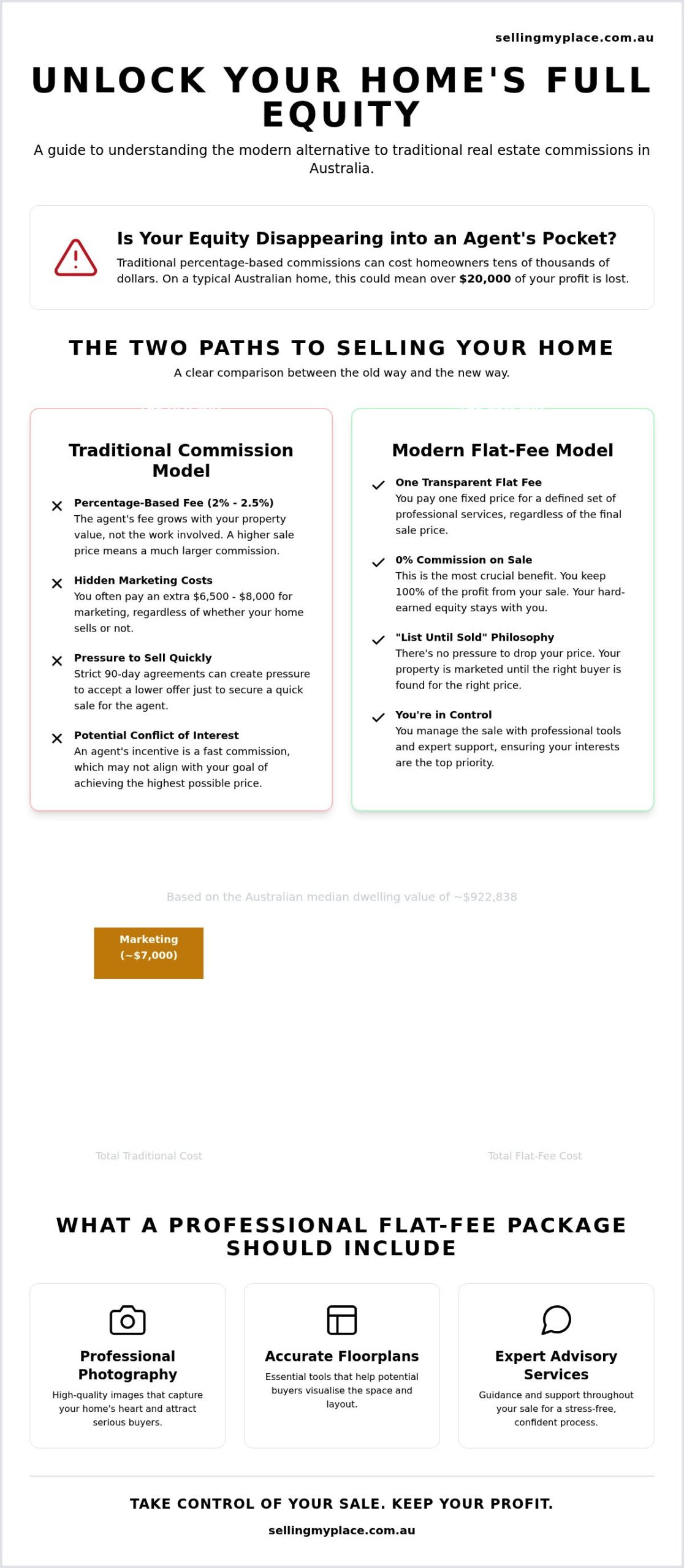
For generations, the Australian property market has relied on a percentage-based commission model. Under this traditional approach, an agent typically charges between 2% and 2.5% of the final sale price, with the payment deducted only once the property settles. While this might seem convenient on the surface, it often masks a deeper imbalance. As property values across the country have climbed, with the national median dwelling value reaching $922,838 in early 2026, these commissions have ballooned into significant sums that can strip away a huge portion of your profit. This traditional fee real estate structure often feels less like a partnership and more like a significant financial hurdle at a time when you need every dollar for your next chapter.
Many sellers find themselves trapped in a “commission gap.” This is where you aren’t just paying for the work required to sell your home; you’re also subsidising the agent’s local branding, their office overheads, and their glossy marketing materials. It raises a valid question: why should your home’s equity fund an agent’s personal brand? This tension is why many are looking toward unbundled services, much like the concept of a flat-fee MLS listing, which allows homeowners to pay for the specific tools they need without the heavy commission price tag. The emotional weight of watching $20,000 or more disappear from your settlement statement is a burden no homeowner should have to carry quietly.
The Problem with Percentage-Based Commissions
The fundamental flaw in a percentage model is that it penalises homeowners who have achieved higher property values through years of care. It doesn’t actually take twice as much effort to sell a house worth $1.5 million compared to one worth $750,000, yet the fee doubles. This structure can also lead to a quiet conflict of interest. An agent might be tempted to pressure you into accepting a lower offer just to secure a quick settlement. For them, the difference in commission on a $10,000 price drop is minor; however, for you, it’s a significant loss. These thousands of dollars could be better used to increase your budget for your next purchase or to provide a nest egg for your family’s future.
Hidden Costs in Traditional Agency Agreements
Beyond the commission, traditional agreements often come with a list of “marketing contributions” that you must pay regardless of the outcome. These can include photography, floorplans, and premium portal listings, often costing between $6,500 and $8,000 in major capital cities across Australia. When combined with a strict 90-day exclusivity period, you might feel rushed and pressured to settle for less. The hidden cost of traditional selling is ultimately the loss of hard-earned equity, money that represents years of mortgage repayments and weekend renovations. You deserve a more transparent, supportive way to move forward that respects the legacy you’ve built in your home.
How the Flat-Fee Real Estate Model Empowers Australian Sellers
The flat-fee revolution is fundamentally about shifting the power balance back to you, the homeowner. Instead of a percentage-based gamble, this modern fee real estate model operates on a single, upfront payment for a defined suite of professional services. It’s a straightforward exchange that removes the mystery from the process. The most significant advantage is the 0% commission promise. When you aren’t watching a portion of your sale price vanish into an agent’s pocket, you’re free to focus on what matters most: your family’s next move. This approach also introduces a “List Until Sold” philosophy. Unlike traditional agencies that might pressure you to lower your price as a 90-day agreement nears its end, a flat-fee partner stays with you until the right buyer is found.
With 97.4% of house resales in Australia resulting in a profit during the first half of 2026, protecting that gain through a fixed cost model is more vital than ever. You’ve worked hard for that equity, and you deserve a steady hand to help you keep it. By unbundling services, you essentially become the project manager of your own sale, supported by professional infrastructure every step of the way.
Transparency and Budgeting with Flat Fees
Planning a relocation is stressful enough without the uncertainty of settlement-day surprises. This shift toward fee real estate transparency allows for precise financial planning. Whether you’re upgrading to a larger family home or downsizing for a quieter life, knowing your exact sale proceeds provides immense psychological relief. You’re in total control of your equity. There’s a certain calm that comes from knowing that a higher sale price benefits your bank account, not your agent’s. It allows you to budget for your next purchase with confidence, knowing exactly how much you’ll have in your pocket when the keys are handed over.
The Role of Technology in Modern Property Marketing
The days of buyers wandering past local real estate windows are largely behind us. Today, the real drivers of interest are digital. Modern sellers are “selling smarter” by utilising professional digital infrastructure that connects them to global listing networks. This increased competition on a global scale ensures your property gets maximum exposure without the need for a costly physical shopfront. Technology has democratised the market, giving individual sellers the same reach as the biggest agencies.
In this digital-first landscape, professional photography and accurate floorplans are the most critical tools in your arsenal. They capture the “heart” of your home and allow buyers to visualise their own lives within your walls before they even step through the front door. By investing in these high-quality assets through a flat-fee model, you ensure your property stands out on major portals. If you’re ready to explore how this partnership can work for you, it might be time to reach out for a chat about your property’s potential.
Comparing Flat Fees vs. Commissions: Which Saves You More?
Deciding how to sell your family home is a deeply personal choice. You want the best price, of course, but you also want to feel that the process is fair and transparent. When looking at traditional real estate agent fees, the numbers can be staggering. On an average Australian home valued at over $922,000, a 2.5% commission equals a payment of more than $23,000. That’s a massive sum of money that could be sitting in your bank account instead of being handed over at settlement. By choosing a fee real estate model, you’re essentially giving yourself a significant pay rise before the first open home even begins.
There’s a common myth in the industry that you need a high-commission agent to achieve a record-breaking price. However, buyers don’t fall in love with an agent’s business card; they fall in love with your home. It’s the professional marketing, the global reach, and the presentation of the property that drive competitive bidding. When you have the right infrastructure in place, you aren’t just saving on costs; you’re often in a stronger position to negotiate because you aren’t under pressure to cover a massive commission bill. For more practical context on managing this yourself, check out this step-by-step guide to sale by owner in Australia.
Calculating Your Potential Savings
The math is simple but the impact is profound. Every dollar you don’t spend on commission is extra equity you keep. In many ways, saving on fees is the most reliable way to “increase” your net sale price. It’s guaranteed money in your pocket, regardless of market fluctuations on the day of sale. The average Australian seller could save approximately $20,000 by choosing a flat-fee model. This isn’t just a number on a spreadsheet. It’s the cost of a new kitchen in your next home, a year of private school fees, or a much-needed family holiday after the stress of moving.
The Value of Professional Support Services
Choosing a modern fee real estate path doesn’t mean you’re left to navigate the complexities alone. We believe in a partnership approach where you retain control while leaning on expert support. This includes vital services like pre-sale property consulting to ensure your home looks its absolute best. You can also access professional conveyance advice to handle the legalities with confidence. Even after your sale, buyer representation services can be a game-changer, helping you find and secure your next dream home without overpaying. You get the expertise of a seasoned professional without the percentage-based price tag, ensuring your major life transition is handled with both heart and precision.
What Should a Professional Flat-Fee Real Estate Package Include?
When you move away from the traditional commission model, it’s vital to ensure you aren’t sacrificing the quality of your campaign. A comprehensive fee real estate package should provide all the high-calibre tools used by top-tier agencies, but without the hidden markups or percentage-based costs. You’re looking for a suite of services that presents your home as a premium lifestyle choice, not just another listing. This professional infrastructure is what builds confidence in buyers and ultimately protects your equity. It’s about unbundling the service so you only pay for what actually sells the house: great presentation, massive exposure, and expert advice.
Visual Marketing Essentials
In the digital age, your first “open home” happens on a smartphone screen. High-end photography is absolutely non-negotiable because it’s the only way to capture the “heart” and unique character of your property. It’s about more than just lighting; it’s about evoking an emotional response that makes a buyer say, “I can see us living there.” These images are your most powerful tool for online engagement. Alongside these visuals, accurate floorplans are essential. They help buyers visualise the lifestyle and layout, allowing them to mentally place their furniture before they even book an inspection. This effectively qualifies serious purchasers and saves you time. When your presentation is polished and professional, it signals to the market that you are a serious seller who values their property, fostering immediate trust.
Data and Advisory Tools
Pricing your home correctly is perhaps the most critical decision you’ll make in this entire journey. To get this right, you need access to detailed neighbourhood market reports that go beyond surface-level statistics. These reports ground your expectations in real-time data, showing you exactly what similar properties have sold for in your specific area. For a deeper dive into this process, you might find our 2026 seller’s guide on determining market value particularly helpful. Setting a competitive and realistic asking price from day one is the best way to generate early momentum and avoid the “stale listing” trap that often leads to lower offers later on.
Beyond the data, your fee real estate package must include broad exposure on major national and global property portals. In our connected world, your buyer could be just around the corner or on the other side of the globe. Having a “steady hand” advisor to lean on during negotiations and the complex legal steps of conveyance is equally important. This ensures you have professional support when the stakes are highest, without the pressure of a commission-driven agenda. You deserve a partner who values your long-term stability over a quick result. If you’re ready to see what a professional marketing suite looks like for your home, contact our team to discuss our listing services today.
Taking the Next Step: How to Transition to a Flat-Fee Sale
Transitioning to a fee real estate model is a journey of empowerment. It requires a shift in mindset from being a passive observer to an active participant in your home’s legacy. You’ve built a life within these walls, so who better to show the property than the person who knows the best morning light in the kitchen or the way the garden provides a sanctuary in summer? This transition is supported by a unique partnership with Kincade International Direct Sales (KIDS). We provide the professional backing and global reach, while you retain personal control over the sale process. It’s a “steady hand” approach that ensures you aren’t alone, even as you take the lead.
The first practical step involves organising your professional marketing materials through a trusted partner. This isn’t about doing everything yourself; it’s about unbundling the services so you only use what works. Once your photography and floorplans are ready, the focus shifts to the legal safety net. Understanding the settlement process is vital, and securing expert conveyancing advice early ensures that your interests are protected from the moment a contract is signed. This professional support allows you to navigate the complexities of a property transaction with calm confidence.
Preparing Your Home for the Market
Before the cameras arrive, take simple steps to declutter and centre your home. Removing excess items allows prospective buyers to see the space’s true potential rather than your personal belongings. It’s about creating a canvas where they can paint their own future. When it comes time to talk to buyers, use your neighbourhood market report as your foundation. This data gives you the authority to speak confidently about your price, grounding your conversations in facts rather than emotion. There is also a profound emotional benefit to being the one to tell your home’s story. You can share the small details that an agent might miss, creating a genuine connection with people who will appreciate the home just as much as you have.
Securing Your Financial Future
Keeping 100% of your sale profit is more than just a win on settlement day; it’s a long-term wealth strategy. When you realise an average saving of $20,000 by avoiding commissions, that money becomes a powerful tool for your next chapter. It might mean a smaller mortgage on your next property, a boost to your retirement nest egg, or the ability to help your children enter the market. The peace of mind that comes from a transparent, commission-free partnership is invaluable. You can move forward without the stress of hidden costs or the pressure of a looming expiry date on your listing. If you’re ready to embrace a smarter way to sell, explore how the KIDS model can help you achieve a successful, stress-free transition while protecting your hard-earned equity.
Securing Your Legacy and Your Equity
Choosing to sell your home is one of life’s most significant transitions, and it’s a journey you shouldn’t have to navigate while worrying about losing your hard-earned equity. Throughout this guide, we’ve explored how the fee real estate revolution provides a transparent, empowering alternative to traditional percentage-based commissions. By unbundling professional services, you ensure that every dollar of your property’s value stays where it belongs: in your pocket. Whether it’s the professional photography that captures your home’s heart or the expert Agent Advisory Service providing a steady hand, you have the tools to succeed on your own terms.
With an average saving of $20,000 per sale and the power of global marketing reach, you can transition to your next chapter with financial freedom and total peace of mind. It’s time to move away from the stress of traditional agencies and embrace a partnership built on trust and respect for your family’s future. If you’re ready to take control, keep 100% of your profit and discover our flat-fee selling packages today. You’ve worked hard for your home; now it’s time to let that hard work reward you fully as you step into your new beginning.
Frequently Asked Questions
What is the difference between a flat-fee real estate agent and a traditional agent?
The primary difference lies in how you pay for the service. Traditional agents charge a percentage commission, often around 2% to 2.5%, which is deducted at settlement. A flat-fee model involves a single, upfront payment for a specific suite of professional marketing tools. This unbundled approach allows you to keep 100% of your sale profit, removing the financial pressure that often comes with high-stakes commissions and percentage-based fees.
Do I still get listed on major property sites with a flat-fee service?
Yes, you certainly do. A professional fee real estate service ensures your home is visible on all the major national property portals where buyers are actively looking. Beyond just local sites, your property often gains exposure on global networks to reach international purchasers. This digital-first approach replaces the need for a physical agency window, placing your home’s heart and features directly in front of a massive, targeted online audience.
How much can I realistically save by avoiding real estate commissions?
Most Australian homeowners find they save a significant amount of their hard-earned equity. On average, sellers save approximately $20,000 by opting for a commission-free structure. Since you aren’t paying a percentage of your home’s total value, every dollar above your costs stays in your bank account. This extra profit can be a game-changer for your next property purchase, providing the financial stability you need for a smoother life transition.
Is a flat-fee real estate service the same as “For Sale By Owner”?
While it shares similarities, it’s more of a supported partnership. Pure “For Sale By Owner” can sometimes feel isolated, but a flat-fee model provides the professional infrastructure you need to succeed. You get the benefits of high-end photography, floorplans, and expert advisory services while retaining personal control over showing your home. It’s about being in the driver’s seat with a seasoned expert acting as your steady hand throughout the process.
Will buyers be put off if I am not using a traditional real estate agent?
Not at all. Modern buyers are primarily focused on the property itself and the quality of the marketing they see online. When your listing features professional photography and accurate data from neighbourhood market reports, it builds immediate trust and credibility. Buyers appreciate the direct connection with the owner, who can answer specific questions about the home’s history and community with a level of warmth and detail an agent might lack.
What happens if my property doesn’t sell within a few months?
You don’t need to worry about the pressure of a looming expiry date. Our “List Until Sold” philosophy means your property remains active on major portals until the right buyer is found. Unlike traditional 90-day agency agreements that might force you into a rushed decision or a price drop, this model respects your timeline. You have the freedom to wait for the offer that truly reflects your home’s value and your family’s needs.
Do I need to handle the legal paperwork and conveyancing myself?
You aren’t expected to handle the complex legalities on your own. While you take an active role in the sale, you have access to expert conveyance advice to ensure all paperwork is handled correctly. This professional support reduces the stress of the settlement process, providing a clear path through the legal requirements. Having a trusted advisor to guide you through these steps ensures your transition is both secure and legally sound.
Can I still get professional photos and floorplans with a flat-fee model?
Absolutely. Visual marketing is a cornerstone of any successful fee real estate campaign. Professional photography is used to capture your home’s best features and emotional appeal, while accurate floorplans help buyers visualise the layout and lifestyle. These aren’t “extras”; they are essential tools included to ensure your property stands out on digital portals. High-quality visuals are the real drivers of buyer interest and are vital for a premium sale result.
