Final Inspection Checklist: Prepare for Settlement
What if the easiest way to avoid a settlement-day surprise is to start preparing before the buyer arrives? A final inspection can bring small details into sharp focus, from the property’s condition to the items listed in the contract. This final inspection checklist for sellers helps you get organised without turning the last days of your sale into a scramble.
It’s understandable to wonder what the buyer may check, whether cleaning or a minor repair could lead to disagreement, and which keys, remotes or manuals need to be handed over. The final inspection is generally an opportunity for the buyer to check the property against its condition at the time of sale, allowing for fair wear and tear, and to confirm agreed inclusions and any required work.
Use this practical Australian checklist to prepare the home, review inclusions and plan a clear handover. We’ll cover the rooms and features to check, the small jobs worth completing before inspection, and the details to gather for settlement, so you can approach handover with more confidence and fewer avoidable surprises.
Key Takeaways
- Use a final inspection checklist for sellers to work through the property room by room, rather than relying on a rushed final glance.
- Compare items that will remain with the sale contract and any written agreements so inclusions are clear.
- Separate routine presentation issues from damage, missing items or agreed repairs that may need follow-up.
- Plan access, inspection-day preparation and handover details in advance, including keys, remotes and manuals.
- For questions about contract terms or settlement arrangements, follow your conveyancer’s advice.
Final inspection checklist for sellers: what the buyer is checking
Before settlement, the buyer is generally given an opportunity to revisit the property and check that its condition is consistent with the sale agreement, allowing for fair wear and tear where applicable. For sellers, the contract and any written agreements are the practical starting point: they clarify what stays, what must be completed and what the buyer may reasonably expect to see at handover.
There isn’t one inspection scope that applies to every Australian sale. Timing, access arrangements and expectations can vary according to the contract and the state or territory. Use your sale documents as the guide, and direct questions about contract meaning or settlement arrangements to your conveyancer.
What does a buyer usually look at during a final inspection?
A buyer may look over the property’s visible condition, check agreed fixtures and fittings, and see that the home and relevant areas are accessible. They may compare what they see with the property’s earlier presentation, the contract and any written agreement about inclusions or repairs. For example, if a refrigerator is listed as staying, they may check that it remains at the property. If a repair was agreed, they may look for a visible sign it has been completed.
This visit isn’t automatically a fresh building inspection or a comprehensive assessment of the property’s structure and systems. A general Home inspection can involve a broader evaluation, while the final inspection is usually focused on checking the agreed condition and inclusions before settlement. The exact scope still depends on the relevant sale documents and arrangements.
As you prepare, keep these common areas in mind. The contract determines what applies to your sale:
- Visible changes or damage since the buyer last viewed the property.
- Fixtures, fittings and other items identified as included in the sale.
- Any agreed repair or other specific written commitment.
- Access to the home and any areas the buyer is permitted to inspect.
What is the seller’s role before settlement?
Your role is to prepare the property in line with the agreement and make the handover practical. That can mean checking each room, ensuring agreed inclusions are still in place, arranging completion of any agreed work and gathering keys or access devices. Organise inspection access through the appropriate sale contacts, rather than making assumptions about timing or entry.
A seller’s preparation role is to present the agreed property, preserve its inclusions and organise a clear handover.
Keep practical tasks separate from contractual interpretation. Note what has been completed, retain relevant receipts or messages, and take clear photos if you need a record of an item or repair. Whether a particular condition or item meets the contract is a contractual question, not something to settle by guesswork on inspection day. If there’s uncertainty, pass the details to your conveyancer for advice.
A useful final inspection checklist for sellers isn’t about promising a flawless home. It’s about knowing what the sale documents require, checking the details that matter and making the transition to settlement more orderly for everyone involved.
Before the final inspection: prepare the home and check agreed inclusions
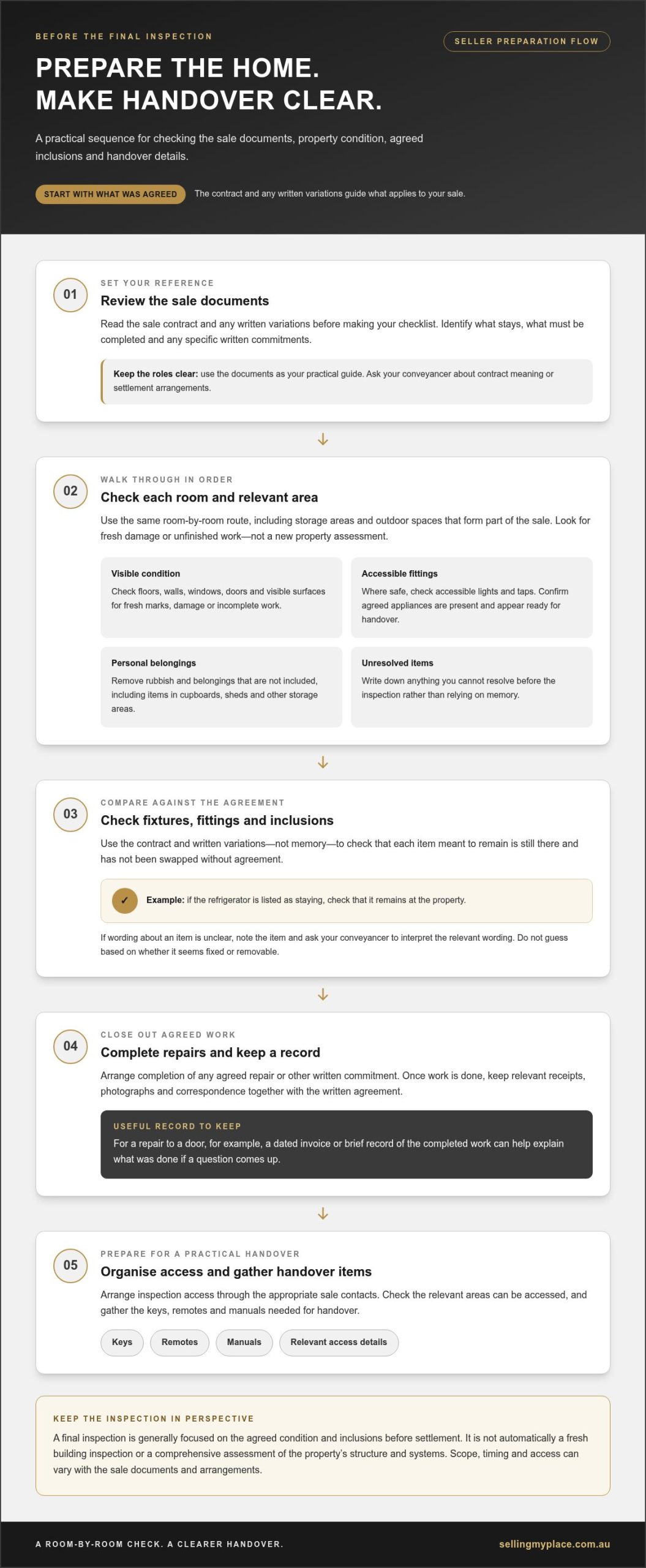
A steady preparation routine beats a rushed lap of the house. Start with the sale contract and any written variations, then make a room-by-room list of what to check, remove or leave behind. This keeps practical jobs tied to what was actually agreed, rather than assumptions about what a buyer might expect. If you’re managing the sale yourself, a clear process such as this guide to selling your own home can help you organise the wider steps, too.
Room-by-room property condition check
Walk through each room in the same order, including storage areas and outdoor spaces that form part of the sale. Look for new damage or unfinished work, and check accessible fittings only where it’s appropriate and safe. The aim is practical: spot anything that needs attention, not to create a new property assessment.
- Check floors, walls, windows, doors and visible surfaces for fresh marks, damage or incomplete work.
- Where safe, check accessible lights and taps, and confirm agreed appliances are present and appear ready for handover.
- Remove rubbish and personal belongings that aren’t included, including items in cupboards, sheds or other storage areas.
- Make a note of anything you can’t resolve before the inspection, rather than relying on memory.
Fixtures, fittings and agreed inclusions
Use the contract and written variations as your reference for items meant to remain. Check each one is still there and hasn’t been swapped for a different item without agreement. A fixture can be easy to overlook during packing, especially if it’s something you use every day, so compare the documents against each room rather than relying on memory.
If wording about an item is unclear, don’t guess based on whether it seems fixed in place or removable. Note the item and ask your conveyancer to interpret the relevant wording. That keeps preparation moving while leaving contractual meaning to the right adviser.
Agreed repairs deserve the same orderly approach. Once work is completed, keep any relevant receipts, photographs and correspondence together with the written agreement. For instance, if you arranged a repair to a door, a dated invoice or a brief record of the completed work can help explain what was done if a question comes up. Keep the records easy to find, but don’t assume they change the terms of the sale.
A useful final inspection checklist for sellers can be as simple as a room-by-room list with three columns: check, remove and leave. Mark off each task as you go, then compare the property against the inclusion list. If you’d value informed guidance as you organise the sale, get property sale advice tailored to your next steps.
Final inspection concerns: condition, repairs and what to document
A buyer raising a concern at the final inspection doesn’t automatically change the sale agreement. First, identify what they’ve noticed and whether it relates to the property’s agreed condition, an item included in the sale or a repair you agreed to complete. A dusty shelf or minor presentation issue is different from new damage, a missing inclusion or work that appears unfinished.
That distinction matters, but don’t decide on the spot that an issue is insignificant or that you must offer a particular remedy. Any obligation or possible response depends on the contract, the facts and the relevant state or territory. Keep communication calm and pass the details to your conveyancer for guidance before agreeing to a change or making a commitment.
How to respond if the buyer raises a concern
Listen first. Ask which room, item or agreed repair they’re referring to, and make a note of the specific concern. Then compare it with the sale documents and any written repair agreement. A clear description, such as “the laundry tap is leaking” or “the listed outdoor table isn’t present”, is more useful than a general comment that something is wrong.
Keep your reply factual and measured. You might acknowledge the concern and say you’ll review the relevant documents and seek advice. Avoid promising to repair, replace or pay for anything until you understand what was agreed and have received appropriate conveyancer guidance. If the issue is unclear, request the details in writing so everyone is responding to the same point.
What evidence should sellers keep?
Make a simple record while the details are fresh. Save dated photos of the relevant area, copies of repair records or receipts, and messages or written agreements about the item. Keep them together in one folder, with filenames or notes that identify the room and date. These records won’t determine what the contract means, but they can help your conveyancer understand the sequence of events.
A compact comparison can help organise the facts before you follow up:
Observed issue: A mark on a wall, a missing agreed item or a repair the buyer says remains outstanding.
Relevant agreement: The contract clause, inclusion list or written repair arrangement that appears relevant.
Follow-up action: Locate supporting photos or correspondence, record what you know and refer the question to your conveyancer.
Use your final inspection checklist for sellers to note the concern without treating it as a settled dispute. If it’s routine presentation, record it accurately. If it involves damage, an inclusion or agreed work, preserve the evidence and seek advice promptly. This keeps the discussion grounded in the documents and leaves any decision about contractual remedies to the appropriate process.
Inspection-day checklist for sellers: access, presentation and handover
A simple run sheet can make inspection day feel far less rushed. Use this final inspection checklist for sellers in order: confirm access, prepare the property, have handover items ready, then record any follow-up. Keep arrangements consistent with the sale documents and coordinate access through the relevant sale contacts. If questions develop into a broader discussion about sale terms, these property sale negotiation tips offer useful context.
The day before: final readiness checks
Confirm the inspection time and access plan with the relevant sale contacts, rather than assuming the buyer can enter independently. Finish any agreed cleaning, remove belongings that aren’t included and leave agreed items where they belong. Gather handover materials in one place so keys, remotes and manuals don’t get packed or misplaced in the final rush.
- Check the agreed time, access method and any instructions for gates, alarms or shared entry points.
- Do a final tidy and remove rubbish or personal items that aren’t part of the sale.
- Keep agreed inclusions in place and collect keys, garage remotes, access devices and appliance manuals.
- Put relevant handover notes together, such as which key opens a particular door.
At inspection time: keep access straightforward
Follow the access plan arranged through the sale contacts. Make sure the buyer can reach the areas they’re entitled to inspect, including any relevant storage or outdoor spaces, and avoid leaving access devices where they could be misplaced. If you’re present, be courteous and allow the inspection to proceed without hovering. If you’re not, make sure the agreed arrangements are clear.
Keep your notes nearby, but let the buyer raise any questions through the established contact. If an issue needs a response, record the specific item and follow up calmly rather than debating the contract at the doorway.
After the inspection: record and follow up
Once the inspection is finished, note any concerns raised, who received them and who will follow up. A short written summary helps keep details clear, especially if several items need attention. Keep communication courteous and timely, and use writing where practical so the request and response are easy to refer back to.
- Record the exact room, item or work mentioned, without adding assumptions.
- Save relevant messages and pass contract questions or proposed changes to your conveyancer promptly.
- Confirm who is handling each follow-up and keep a copy of any response or agreed next step.
Inspection day is one part of the wider handover. For support organising your property sale and the next steps, get advice about your sale.
From final inspection to settlement: get steady support for the next step
The inspection is a milestone, not the finish line. A clear close-out sequence helps you move from any follow-up questions to a practical handover, while keeping settlement decisions with the people responsible for advising on your contract. Your final inspection checklist for sellers can help you keep track of the last details, but it doesn’t replace guidance tailored to your sale documents.
A simple seller close-out sequence
Work through the remaining tasks in order, and keep a written record as you go. This gives you a clear reference if a question arises and helps prevent small handover details from getting lost among settlement arrangements.
- Confirm inspection follow-up. Record any concern raised, the response and any action agreed in writing. If the issue could affect your obligations, refer it to your conveyancer before making a commitment.
- Check the handover plan. Confirm how and when keys, remotes and other access devices will be provided, and make sure agreed items are accounted for.
- Follow settlement advice. Ask your conveyancer about contract interpretation, required steps and timing for your transaction. These details can depend on the contract and the relevant jurisdiction, so avoid relying on general assumptions.
Keep the roles clear. Your conveyancer advises on the contract and settlement arrangements; practical preparation means following that advice, keeping agreed handover details organised and completing any confirmed actions. If something changes or an issue remains unresolved, share the relevant written record promptly rather than trying to settle a contractual question informally.
When broader selling advice can help
Questions at the end of a sale can also highlight where informed support across the wider process is useful. Kincade International Direct Sales offers pre-sale consulting to help owners understand the steps involved in selling and approach decisions with greater clarity. Its conveyance advice can provide guidance through a complex sale, alongside the role of your conveyancer. The residential property listing services guide offers broader context on organising a sale, from preparing the listing to managing the process through to handover.
Take the next step steadily: resolve outstanding questions through the appropriate contacts, confirm the handover plan and follow your conveyancer’s settlement guidance. For owners who are also preparing for their next move, specialist representation from Robert Caicedo Real Estate can help navigate residential transactions with clarity and confidence. With those details in order, the final stretch can feel more manageable and less like a scramble.
Speak with the team about selling support and get informed guidance for the wider sale process.
Move towards settlement with confidence
A well-used final inspection checklist for sellers can do more than help you prepare for one appointment. It gives you a clear starting point for the last stage of your sale, so you can make decisions calmly and keep moving towards the next chapter. If your next move involves financing another property, The Home Loan Partners can provide tailored guidance through the mortgage process. Let your sale documents and conveyancer guide settlement-specific questions, and focus on the practical handover.
Kincade International Direct Sales offers commission-free property marketing and advisory services for residential owners, with professional photography and floorplans as part of its offering. Its flat-fee approach means you can use listing and advisory support without paying a traditional agency commission.
Talk with the team about your property sale to discuss commission-free marketing and advisory support.
Frequently Asked Questions
Is the final inspection the same as a building inspection?
No. A buyer’s final inspection is generally a pre-settlement check of the property against the sale agreement, rather than a new, detailed assessment of its structure or building systems. A building inspection has a different purpose and scope. If the buyer raises a concern about a defect, avoid treating the final inspection as a technical report; note the concern and refer contract-related questions to your conveyancer.
Can a seller attend the buyer’s final inspection?
Possibly, but whether you attend depends on the arrangements made for the sale and any relevant contract terms. Coordinate access through the appropriate sale contacts rather than arriving unexpectedly or assuming you need to be present. If you do attend, give the buyer room to look around and keep any discussion calm and factual. This can help avoid turning a practical visit into a pressured negotiation.
What happens if the buyer finds damage at the final inspection?
Damage may prompt a request for clarification or action, but the outcome depends on when it occurred and what the contract requires. For example, a new crack or a broken fitting may need to be considered differently from a mark that was already visible when the buyer agreed to purchase. Record the location and details, avoid admitting liability or promising a remedy on the spot, and promptly seek your conveyancer’s advice.
Do sellers need to leave appliances and manuals at the property?
Leave appliances that are identified as inclusions in the sale documents, and don’t remove or swap them without agreement. Manuals aren’t automatically an inclusion in every sale, so check the contract and any written arrangements. If you have a manual for an appliance staying behind, placing it with the appliance is a considerate handover touch. Keep personal documents or account details out of manuals and paperwork you leave.
Should utilities remain connected until settlement?
There isn’t one rule that suits every property or transaction. If utilities are disconnected too early, it may affect access to services before settlement; leaving accounts active also has practical and billing implications. Check your contract and discuss timing with your conveyancer, then arrange any provider notifications to match your circumstances. If the property is vacant, clarify who is responsible for access and services during the period before handover.
Can a buyer request repairs after the final inspection?
A buyer can raise a concern or ask for a repair, but a request doesn’t automatically change the contract. Whether you’re required to act depends on the agreement, any relevant written promises and the circumstances of the issue. Don’t agree to a repair, payment or change to settlement arrangements before getting advice. Send the request and supporting details to your conveyancer so you can understand your position and available next steps.
When should sellers complete the final inspection checklist?
Start your final inspection checklist for sellers early enough to deal with agreed work and locate inclusions, then revisit it close to the inspection. The buyer’s visit is commonly arranged in the lead-up to settlement, but the contract and local arrangements determine timing. A practical approach is to do an initial pass while packing, then a final check the day before access, leaving time to follow up any overlooked handover detail.
Tips for a Fast House Sale: A Practical Australian Seller’s Checklist
The fastest way to sell your home may be to slow down before it goes on the market. These tips for a fast house sale start with reducing buyer hesitation, not rushing into a listing or accepting the first offer. When your home is prepared, priced with current comparable sales in mind and presented clearly, serious buyers have fewer reasons to hold back.
It’s understandable to feel pressure to move quickly, especially when there’s a big life change behind the sale. But a fast result shouldn’t mean making decisions in the dark or leaving important tasks until inspection day. A little structure can help you attract early interest while keeping your expectations and priorities in view.
This practical Australian seller’s checklist will help you decide what to tackle before launch, how to shape a pricing and marketing plan, and what to look for as enquiries, inspections and offers come in. Whether you’re selling by owner or using professional support, you’ll have a clearer way to prepare, compare your options and make considered decisions without feeling hurried.
Key Takeaways
- Use these tips for a fast house sale to build a clear plan around your timing, priorities and what buyers are looking for.
- Compare recent sales of similar homes with current competing listings to support a realistic price position, rather than relying on a formula.
- Help buyers assess your home with clear photographs, accurate listing details and a floorplan that answers practical questions.
- Review enquiries, inspection attendance and buyer feedback regularly to spot when your presentation, listing information or price positioning may need attention.
- Compare selling by owner, traditional agency support and flat-fee marketing based on the involvement, guidance and fee structure that suit you.
Tips for a Fast House Sale Start With a Clear, Realistic Plan
A move can be time-sensitive, whether you’re coordinating a new job, a family change or your next home. But setting a firm sale date before you know how ready the property is or what buyers are doing can add pressure without giving you more control. Treat a fast sale as a goal shaped by your preparation, buyer demand and the terms you’re willing to accept.
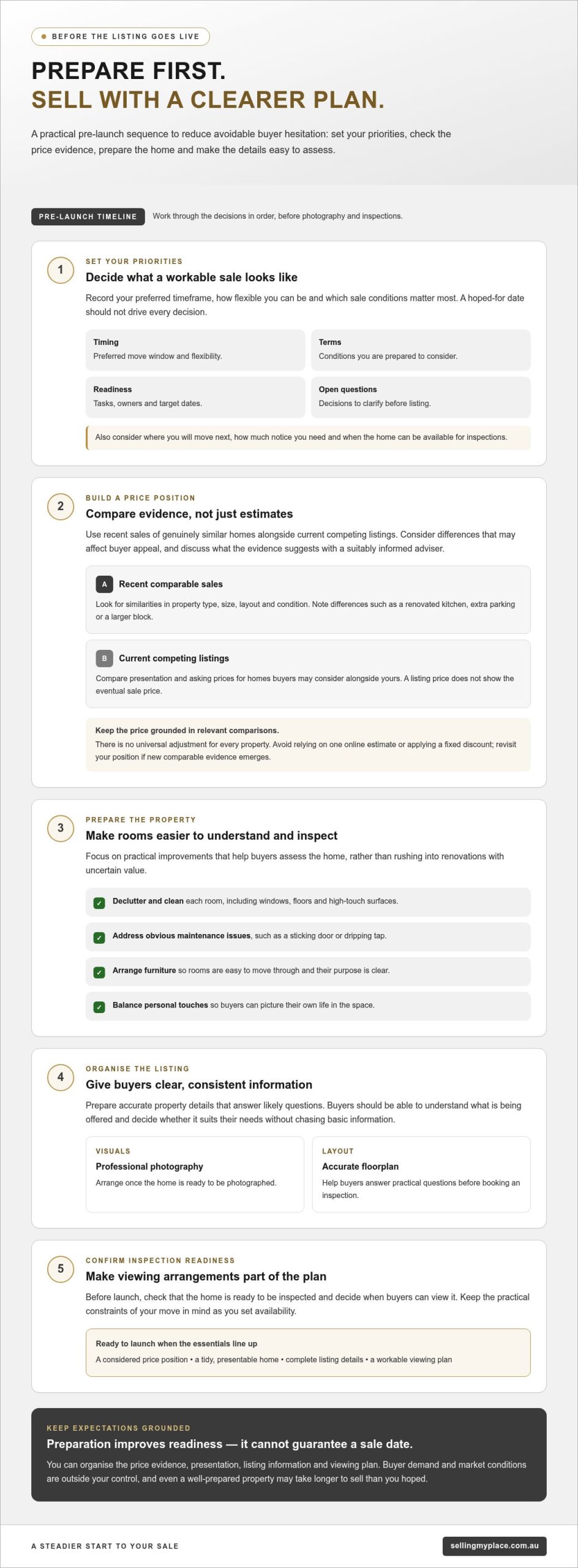
Preparation before launch can reduce avoidable buyer hesitation by making the home, its price and its key details easier to assess. Start with four practical areas: set a considered price position, prepare the property for presentation, organise accurate marketing information and decide how buyers can view the home. Then record your preferred timing, acceptable terms and what needs to happen before you can move.
What Can You Control When Selling a Home Quickly?
You can organise the parts of the sale that are in your hands. Buyers and market conditions aren’t controllable, and even a well-prepared property may take longer to sell than you’d hoped. Focus first on a price position informed by comparable evidence, a tidy and presentable home, and listing information that answers likely questions. These steps improve readiness; they can’t guarantee a particular result or timeframe.
Before the listing goes live, check that the home is ready to be photographed and inspected, and that the property details are consistent and complete. Buyers should be able to understand what’s being offered and decide whether it suits their needs without having to chase basic information.
Set Your Sale Priorities Before You List
Write down your preferred timeframe, how flexible you can be and which sale conditions matter most. Consider practical constraints, too: where you’ll move next, how much notice you need to organise the move, and when you can make the home available for inspections. If you’re considering a seller-led approach, this overview of For Sale By Owner (FSBO) offers background on the model. Check sale or contract questions against relevant Australian advice.
Turn those priorities into a working checklist. Assign each task, set a realistic deadline and record decisions that still need advice. For example, one household member might coordinate repairs while another gathers property information. The right split depends on your circumstances. This simple plan keeps urgent tasks visible without letting a hoped-for sale date drive every decision.
- Timing: preferred move window and flexibility.
- Terms: conditions you’re prepared to consider.
- Readiness: tasks, owners and target dates.
- Open questions: decisions to clarify before listing.
With your priorities recorded, you’ll have a steadier basis for the next decisions: setting a price position and preparing the property for buyers.
Price and Prepare Your House Before the Listing Goes Live
Price and presentation work together. Buyers weighing your home against other options may lose interest if the asking price seems out of step with the evidence or the property is difficult to assess from its listing. One of the most useful tips for a fast house sale is to do this thinking before launch, when you still have time to make considered adjustments.
Evidence-based price preparation means comparing recent sales of genuinely similar homes with current competing listings, then accounting for differences that may affect buyer appeal. It doesn’t mean applying a fixed discount or relying on one online estimate. For a closer look at the process, read this 2026 guide to determining a home’s market value.
How to Set a Realistic Asking Price
Look for recent sales with meaningful similarities in property type, size, layout and condition. Note where a comparison differs: a renovated kitchen, extra parking or a larger block may affect how useful that sale is as a guide. Then review current listings buyers are likely to consider alongside yours. Compare their presentation and asking prices, but remember that a listing price doesn’t show the eventual sale price. Discuss what the evidence suggests with a suitably informed adviser, and revisit your position if new comparable evidence emerges. For context on weighing offers, see these property sale negotiation tips.
An asking price set too high for the available evidence may discourage buyers from enquiring or inspecting, especially if competing homes appear to offer better value. There’s no universal adjustment that suits every property. Aim for a price position you can explain using relevant comparisons, and be ready to consider both the buyer’s offer and its conditions.
A Pre-Launch Home Preparation Checklist
Choose practical improvements that help buyers understand and inspect the property, rather than rushing into renovations with uncertain value. Before photography, work through this short list:
- Declutter and clean each room, including windows, floors and high-touch surfaces.
- Address obvious maintenance issues, such as a sticking door or a dripping tap.
- Arrange furniture so rooms feel easy to move through and their purpose is clear.
- Keep personal touches balanced so buyers can picture their own life in the space.
- Once the home is ready, arrange professional photography and an accurate floorplan.
Clear images and a reliable floorplan help buyers judge the home before they book an inspection. Kincade International Direct Sales provides professional photography and floorplans as part of its property marketing service. For guidance on preparing your property or reviewing your sale approach, explore pre-sale support.
Make Your House Easy to Discover, Understand and Inspect
A buyer who can quickly understand a home’s layout, features and practical details is better placed to decide whether to enquire or book an inspection. Accurate listing materials help buyers assess whether a property suits their needs and make more informed enquiries. Treat the photographs, description and floorplan as one set of information, and check that they tell a consistent story.
What Buyers Need From Your Listing
Use clear photographs that represent the home honestly and help buyers understand how rooms connect. Pair them with accurate property details, useful room descriptions and a well-prepared floorplan. Before publishing, check that the description matches what a buyer will see in person. For further guidance on presenting a home online, read this guide to residential property listing services.
A simple question-and-answer check can reveal gaps in your listing:
- How does the home flow? Use the floorplan and images to show the connection between living areas, bedrooms and outdoor spaces.
- What are the rooms used for? Give each room a clear, accurate description rather than relying on photos alone.
- What details might affect a buyer’s decision? Confirm the relevant property information and have reliable answers ready for common enquiries.
If a detail is uncertain, verify it before the listing goes live. Clear information builds confidence; vague or inconsistent details can leave buyers with questions that might otherwise have been answered upfront.
Prepare for Inspections Without Adding Unnecessary Stress
Inspection access needs to work for buyers and your household. Choose times that offer reasonable opportunities to view the home while fitting around work, school, pets and other routines. If several people share the home, agree on the plan in advance so everyone knows what to expect.
Before each viewing, focus on a short reset rather than trying to make the house perfect:
- Clear everyday clutter from key surfaces and walkways.
- Open curtains and switch on lights where needed.
- Secure personal belongings and confidential paperwork.
- Make sure buyers can move through the main rooms comfortably.
After each inspection, note attendance, recurring questions and feedback. If visitors repeatedly ask about the same feature, consider whether the listing needs clearer information. These observations can help you refine the buyer experience as the campaign progresses. Kincade International Direct Sales provides residential listing and marketing support, with details available through its listing options.
Use Early Buyer Feedback to Keep Your Sale Moving
Once your home is listed, buyer response gives you useful evidence about how the campaign is landing. Rather than reacting to every comment, look for patterns across enquiries, inspection attendance, questions and offers. These tips for a fast house sale are about making measured decisions, not changing course simply because the first few days feel quiet.
A Simple Process for Reviewing Buyer Response
After each inspection, record how many people attended, what they asked and any feedback they shared. Note the quality of enquiries and offers, too: are buyers asking relevant questions, requesting another look or proposing terms you can consider? Compare this with the expectations you set before launch. If you’re managing enquiries yourself, this step-by-step guide to selling your own home may help you organise the process.
Look for repeated signals. One visitor’s preference may be personal; several buyers asking about the same missing detail or expressing the same concern could point to something worth addressing. A trusted adviser can help you judge whether feedback is a pattern or an isolated view.
What to Revisit if Enquiries Are Slow
Work through the likely causes in a calm order before changing your strategy. Check whether the listing is reaching buyers, whether the photographs and description represent the property clearly, and whether inspection times are manageable for people interested in viewing. Then revisit your price position against current comparable evidence and competing listings.
Change one well-supported element at a time, then observe whether the response shifts. If you update the listing details and adjust the price simultaneously, it may be harder to tell what helped. Keep a short review record:
- Enquiries: volume and recurring questions.
- Inspections: attendance and any consistent feedback.
- Offers: price, conditions and how well the terms fit your priorities.
- Next step: the single change you’ll make, or why you’ll hold steady for now.
A quiet spell doesn’t automatically call for an incentive or price change. Consider the offer’s conditions and likely net proceeds alongside the headline amount, and seek advice if you’re unsure. A considered response can protect your sale priorities while keeping the campaign responsive.
Kincade International Direct Sales offers real estate advisory support to help owners interpret buyer response and consider next steps. Review the available sale support.
Choose a Fast-Sale Pathway That Fits Your Priorities
The right sale pathway depends on how much time you can give the process, how confident you feel handling buyer communication and what kind of support you want. Selling by owner, using traditional agency support or choosing flat-fee marketing are different ways to organise the work. None guarantees a faster sale or a higher price, so compare responsibilities and support before committing.
| Pathway | Seller involvement | Marketing support | Advice and fee structure |
|---|---|---|---|
| Sell by owner | You manage buyer enquiries, inspections and sale decisions. | You organise the listing and any photography or floorplan support you need. | You retain direct control, and should identify the advice you need and how any services are charged. |
| Traditional agency support | You make key decisions while agreeing on who handles campaign tasks and buyer contact. | Review the agreed scope for listing exposure, photography and floorplans. | Review the advice provided, commission or other fees, contract terms and your responsibilities. |
| Flat-fee marketing | You may retain decision-making control while taking responsibility for agreed seller tasks. | Review the agreed scope for listing, photography and floorplan support. | Understand the flat-fee structure, advisory support, contract terms and any additional responsibilities. |
How to Compare Selling Options
Don’t compare pathways by headline fee alone. Review the listing exposure provided, whether photography and a floorplan are included, what advice is available and which tasks remain yours. Read the contract carefully so the fee structure, term and responsibilities are clear before you agree. Choose a level of hands-on involvement that fits your available time and confidence, not just your preferred sale date.
Kincade International Direct Sales provides commission-free residential property marketing for a single flat fee. The service includes listing support, professional photography, floorplans and advisory support, so owners can retain control of key decisions while drawing on help with their sale. Consider how that combination fits the tasks you want to manage and the guidance you need.
Prepare for the Next Step After an Offer
An offer is more than its price. Review the conditions, proposed timing and settlement requirements as a complete package, and consider how each part fits your stated priorities and next move. Before committing to legal documents, seek conveyancing or other qualified professional advice relevant to your circumstances. Keep written records of offers, questions and agreed next steps so everyone involved is working from the same information.
For an overview of the support and responsibilities available through Kincade International Direct Sales, explore property sale options.
Take the Next Step With a Sale Plan That Fits
A well-managed sale starts with choices you can explain: a price position informed by evidence, a home ready for buyers to inspect, and a pathway that suits your time and appetite for involvement. These tips for a fast house sale can help you act with purpose, but buyer demand and decisions remain outside your control. A clear plan keeps your goals in view without making speed the only measure of success.
Kincade International Direct Sales provides commission-free property marketing through a single flat-fee model. The service includes professional photography, floorplans and an Agent Advisory Service, and listings remain active until sold with no time limit. This gives owners marketing and advisory support while keeping the sale free of agency commissions.
Talk through your sale plan with Kincade International Direct Sales to explore its flat-fee marketing and advisory support.
Frequently Asked Questions
How can I sell my house quickly without underselling it?
Set your price using recent sales of genuinely comparable homes and the current competition, then assess each offer against both price and conditions. Consider your preferred timing, settlement needs and likely net proceeds before deciding what you’re willing to accept. Strong preparation and clear marketing can help buyers assess the property, but no approach guarantees a quick sale. If evidence or offers are difficult to interpret, seek advice before changing your expectations.
What should I fix before listing my house for a fast sale?
Start with obvious maintenance and presentation rather than rushing into major renovations. Fix practical issues such as a dripping tap or sticking door, declutter, clean thoroughly and make rooms easy to move through. These steps help buyers focus on the home and its layout. Consider whether larger work is worthwhile for your property, budget and timing before committing. Have the home ready before photography and check that listing details are accurate.
Is it better to stage a house before selling?
Staging may help buyers understand how rooms can be used, but it isn’t essential for every home. First try simple presentation: remove excess furniture, clear surfaces, improve lighting and keep the layout easy to navigate. Consider professional staging if it addresses a specific presentation challenge and fits your circumstances. Weigh the expected benefit against the effort and cost, and avoid assuming staging will guarantee a faster sale or a higher offer.
How much does pricing affect how quickly a house sells?
Pricing can influence whether buyers consider your home alongside competing listings. A price that appears out of step with recent comparable sales, condition or current alternatives may discourage enquiries and inspections. There’s no universal discount or formula that determines the right asking price. Review relevant evidence, understand how your property differs from comparisons, and reassess if buyer response is consistently weaker than expected. Market conditions and buyer decisions also affect timing.
Can I sell my house fast without using a traditional real estate agent?
Yes. You can sell by owner, or use a marketing and advisory service while retaining responsibility for key decisions. The right fit depends on the time and confidence you have for managing enquiries, inspections and offers. Kincade International Direct Sales provides commission-free property marketing for a single flat fee, supported by professional photography, floorplans and an Agent Advisory Service. Review what’s included, what you’ll manage and the available advice before choosing.
What happens if my house gets few enquiries after listing?
Review the evidence before making a change. Check whether the listing is visible, the photos and description are clear, and inspection access is workable. Compare your price positioning with current comparable sales and competing homes. Then look for repeated feedback rather than reacting to one comment, and consider changing one well-supported element at a time. Avoid rushed price changes or incentives without weighing the offer terms and likely net proceeds.
How can professional photos and a floorplan help sell a house faster?
Professional photographs can help buyers see the home’s presentation, while an accurate floorplan makes its layout and room relationships easier to understand. Together with a precise description, these materials let people assess whether the property may suit them before arranging an inspection. They can support clearer, more informed enquiries, but can’t guarantee a faster sale. Check that images represent the home honestly and that the floorplan and listing details are accurate.
What is a Vendor’s Statement? The Essential Australian Guide to Property Disclosure
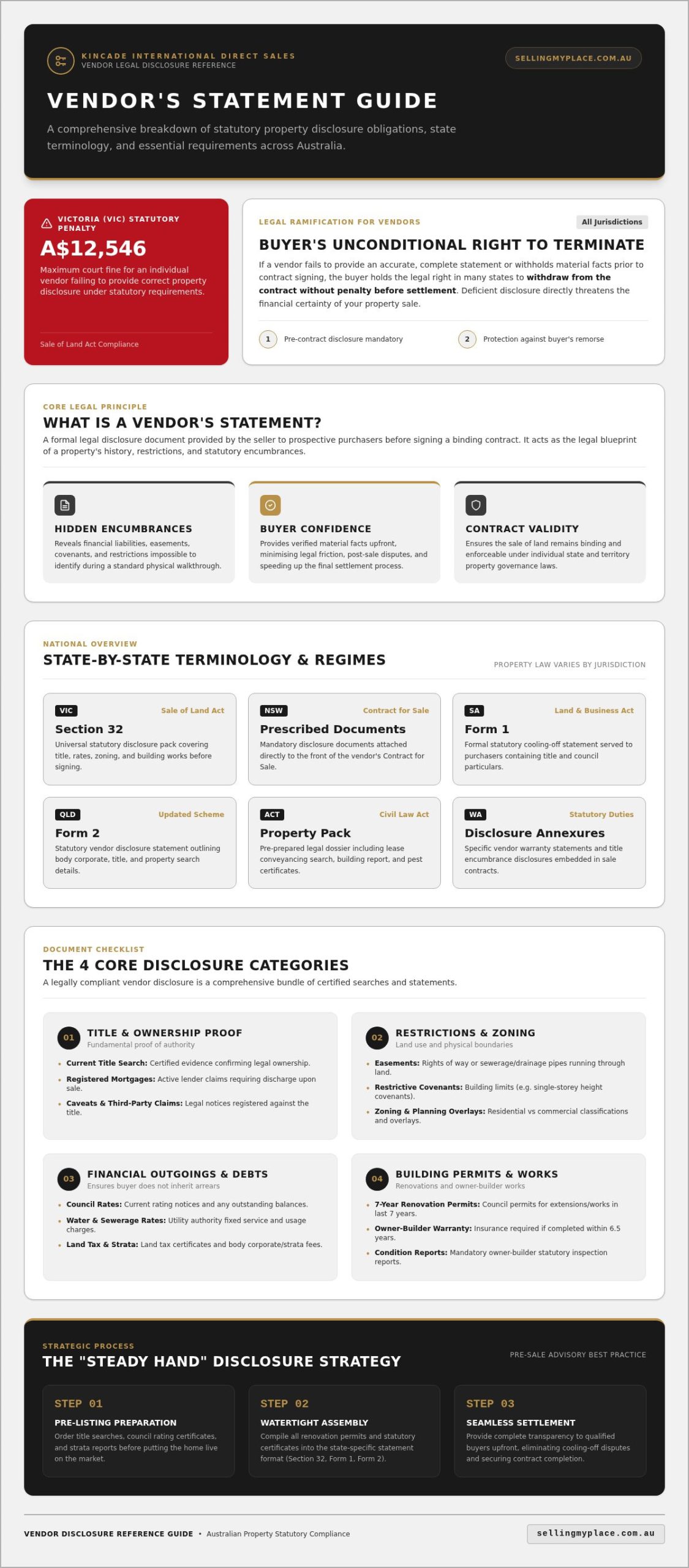
Did you know that in Victoria, an individual vendor can face a court fine of up to A$12,546 for failing to provide the correct property disclosure? It’s a sobering figure that highlights just how serious the legal side of selling can be. Selling your home is a major life transition, and it’s completely normal to feel a bit overwhelmed by the mountain of paperwork landing on your kitchen table. You’re likely asking yourself, what is a vendor’s statement, and why does every state seem to have a different name for it?
We understand the weight of this responsibility and the fear of getting it wrong. This guide will demystify exactly what this document entails, why it’s the most critical piece of your property sale, and how to navigate the legal requirements across Australia with absolute confidence. You don’t have to face this alone or worry about high conveyancing costs eating into your hard-earned equity. We’ll walk you through the specific rules for your state, from Section 32s to Form 1s, and provide a clear checklist to ensure your disclosure is watertight so you can focus on your next chapter.
Key Takeaways
- Gain a clear understanding of what is a vendor’s statement and how this essential disclosure document protects your interests throughout the sale.
- Identify the specific documents required in your state, from title searches to easement details, to ensure your contract remains legally sound.
- Learn why having your paperwork organised before your property goes live on the market fosters buyer confidence and speeds up the settlement process.
- Discover how to navigate complex disclosure laws without the stress of high commissions by using expert pre-sale property consulting.
- Empower yourself with a practical checklist of information you must share to avoid common legal pitfalls and secure a successful, commission-free sale.
What is a Vendor’s Statement in the Australian Property Market?
If you’re preparing to sell your home, you’ve likely come across a pile of paperwork that feels a bit daunting. At its heart, what is a vendor’s statement? It’s a formal legal disclosure document that you, as the seller, must provide to a potential purchaser before they sign a contract. The vendor’s statement is the legal blueprint of a property’s history and restrictions. It serves as the primary way to inform a buyer about encumbrances, financial obligations, or land use issues that aren’t easily spotted during a physical inspection or a Saturday morning walkthrough.
Transparency is the cornerstone of a successful sale. If you fail to provide an accurate or complete statement, the consequences are significant. In many states, a buyer has the legal right to withdraw from the contract without penalty before settlement if the disclosure is found to be deficient. This can be a devastating outcome after you’ve already started packing your boxes and planning your move. Getting this document right isn’t just about ticking a box; it’s about protecting your financial future and ensuring your sale remains “sold”. Professional Victorian agencies like Fateh Real Estate emphasize that this level of disclosure is what builds the necessary trust between a vendor and a prospective buyer.
Why Transparency Protects Your Sale
Choosing to be completely open about your property’s history is a strategic move that builds immediate credibility. When a serious buyer sees a thorough disclosure, they feel a sense of security. It reduces the likelihood of “buyer’s remorse” or legal disputes that can flare up long after the keys have changed hands. We often talk about the “steady hand” approach to selling. By being honest and proactive now, you save yourself a world of stress and potential litigation later. A complete statement shows you’re an organised, professional seller who respects the process and the people involved.
Common Names for the Statement Across Australia
Because property law is managed by state and territory governments, the name of this document changes depending on where your home is located. In Victoria, it’s almost universally called a “Section 32”, which refers to the specific part of the Sale of Land Act. If you’re selling in New South Wales, these disclosures are typically bundled as prescribed documents within the Contract for Sale. South Australians will know it as a “Form 1”, while Queenslanders now use a “Form 2” under their updated disclosure scheme.
While the names differ, the statutory vendor disclosure requirements in Australia all share the same underlying spirit. Whether you’re providing a property pack in the ACT or navigating the specific requirements in Western Australia, the goal is to ensure the buyer has all the material facts before making a life-changing decision. Understanding these local variations is the first step toward a confident, commission-free sale.
The Core Ingredients: What Must Be Disclosed?
Understanding what is a vendor’s statement requires looking closely at the legal bones of your property. It isn’t just a single document. Instead, it’s a comprehensive folder of certificates that ensures the buyer knows exactly what they’re stepping into. At the very top of your list is a current Title Search. This proves you’re the legal owner and reveals any mortgages or caveats that need to be cleared before the property changes hands.
Beyond ownership, you must disclose easements and covenants. Easements, such as sewerage pipes running through your backyard, or restrictive covenants that stop you from building a second storey, can significantly impact a buyer’s plans. Zoning information is equally vital. It confirms if the land is residential or commercial and identifies any specific overlays. You’ll also need to include financial details to ensure the buyer isn’t inheriting your debts. These typically include:
- Current council rates and any outstanding amounts.
- Water and sewerage charges.
- Land tax certificates, where applicable.
- Body corporate or strata fees if the property is on a shared title.
For a reliable benchmark on these requirements, Consumer Affairs Victoria’s guide to Section 32 statements offers a clear look at these statutory duties.
Building Permits and Warranty Insurance
Transparency about building works is non-negotiable. If you’ve renovated or extended in the last seven years, those permits must be included in your disclosure. Owner-builders have additional responsibilities. They often need a condition report and warranty insurance if the works were completed within the last six years and six months. Leaving out unapproved structures, like a “DIY” deck or shed, is a gamble that rarely pays off. It often leads to collapsed sales or messy legal claims after the settlement date.
Environmental and Neighbourhood Factors
Your disclosure must also cover the environment around your fence line. This includes whether the property is in a bushfire-prone area or has a flood-plain overlay. You’re also required to share any formal notices from authorities about future local developments, such as a planned road widening or new infrastructure nearby. These details are critical when you look at how to determine market value of a home in australia, as they affect long-term desirability. If you’re feeling unsure about which specific certificates apply to your street, a quick chat for conveyance advice can provide the steady hand you need.
State-by-State Breakdown: Navigating Regional Rules
Property law in Australia isn’t a “one size fits all” affair. Each state and territory operates under its own specific legislation, which means the answer to what is a vendor’s statement depends largely on where your fence line sits. This regional variation can feel like a hurdle, but it shouldn’t deter you. Whether you’re in a high-disclosure state like Victoria or a “buyer beware” region, the commission-free sale process is absolutely viable. It simply requires a steady hand and the right local knowledge. Securing professional conveyance advice early on is the smartest way to ensure you meet your specific local obligations without the stress of hidden legal traps.
Victoria, NSW, and Queensland Requirements
In Victoria, the rules are particularly clear. A Section 32 is mandatory and must be ready before your property is even “offered” for sale. You cannot legally market the home to the public without this document in place. Moving across the border to NSW, the focus shifts to the Contract of Sale. Specific prescribed documents, such as a Section 10.7 zoning certificate and a drainage diagram, must be attached before you start showing buyers through the front door. Queensland recently updated its framework with the Property Law Act 2023. As of 1 August 2025, sellers must provide a formal Form 2 Seller Disclosure Statement. If you’re selling a unit or townhouse, providing body corporate certificates and sinking fund details is now a critical part of the process. These eastern states place a significant burden of disclosure on the seller to ensure the buyer is fully informed before signing.
Western Australia, SA, and the Territories
South Australia uses a rigorous disclosure document known as a Form 1. This must be served to the purchaser at least 10 clear days before the settlement date. In many cases, the service of this form is what actually triggers the buyer’s statutory two-day cooling-off period. In Western Australia, the approach is slightly different. While WA doesn’t have a single “vendor’s statement” for general land, disclosure is managed through specific warranties within the Contract for Sale of Land. It remains a more traditional “buyer beware” environment, yet material facts about the property’s structural integrity or illegal drug contamination must still be shared to avoid future litigation.
The Territories and Tasmania have their own unique disclosure packets. In the ACT, the seller must commission and provide building, pest, and energy efficiency reports upfront. This is a significant shift from other states where the buyer typically covers these costs. While the names and timelines change across the country, the spirit of disclosure remains the same. Being organised with your paperwork shows you are a professional seller who values transparency and a smooth transition for the next family to call your house a home.
Preparing Your Statement: Timing and Professional Support
Timing is everything. Many homeowners only start asking what is a vendor’s statement after they’ve found a keen buyer, but that’s a risky strategy. You should ideally have your disclosure document finalised before your property ever goes live on the market. In a “Sale by Owner” context, having your paperwork ready is a significant advantage. It signals to every person walking through your open home that you are a professional, organised seller. This transparency builds immediate rapport and gives buyers the confidence to make an offer on the spot.
The process of gathering information starts with contacting your local council, water authorities, and state land registries. You’ll need to collect various certificates regarding zoning, rates, and any notices issued against the land. While you can certainly take the lead in collecting these raw documents to speed things up, the final assembly requires a qualified eye. A legal professional should always draft the final version to ensure every statutory requirement is met.
The Risk of the ‘DIY’ Legal Document
It might be tempting to use a generic template you’ve found online to save a few dollars. However, this is one area where “doing it yourself” can backfire. A minor omission or a misinterpretation of a planning overlay can grant the buyer a legal “right to rescind”. This allows them to walk away from the contract at the 11th hour without penalty. It’s a heartbreaking situation that is easily avoided. Our expert real estate advisory service is designed to help you spot these potential red flags early, keeping your sale on track.
Working with a Conveyancer or Solicitor
A professional conveyancer typically requires about 7 to 14 days to produce a complete statement. This timeframe depends on how quickly local authorities respond to certificate requests. When looking at the costs, you’ll encounter professional fees for the expert’s time and “disbursement” fees, which are the third-party costs for the certificates themselves. We understand that managing these details can feel stressful. That’s why SellingMyPlace integrates expert conveyance advice directly into our partnership approach. We provide the steady hand you need to navigate the legalities of disclosure without the burden of high commissions.
Ready to ensure your paperwork is watertight? Contact our advisory team for a pre-sale consultation.
Selling Smarter: How Expert Advisory Simplifies Disclosure
Taking control of your property sale doesn’t mean you have to walk the path alone. By now, you’ve gained a deep understanding of what is a vendor’s statement and why it serves as the foundation of a secure transaction. At SellingMyPlace, through the Kincade International Direct Sales (KIDS) approach, we’ve reimagined the selling journey. We pair professional authority with heartfelt support. Our Agent Advisory Service acts as the steady hand you need to navigate these complex disclosure requirements. We ensure you’re never just a number in a database, but a partner in a shared mission to protect your family’s legacy.
Success in the modern Australian market requires a two-pronged strategy. First, you need professional marketing, including high-end photography and detailed floorplans, to capture the buyer’s imagination. Second, you need total legal readiness. When these elements work together, you create a sense of trust that naturally leads to higher offers. By having your disclosure documents prepared and vetted early, you eliminate the friction that often kills deals at the last minute. You’re not just listing a house; you’re presenting a transparent, high-value opportunity to the market.
The Partnership Advantage
The traditional DIY route can feel isolating and fraught with legal anxiety. In contrast, the KIDS partnership model provides a safety net. We offer the expertise of a seasoned advisor who understands the emotional significance of your transition. This backing significantly reduces the stress of managing paperwork. If you’re curious about how this fits into the broader process, our guide on how to sell your own home provides the full context you need to move forward with confidence.
Your Next Steps to a Successful Sale
Your journey toward a successful, commission-free sale starts with a single, informed step. We encourage you to reach out for a comprehensive neighbourhood market report to ground your expectations in current data. Remember, the average seller saves around A$20,000 in commissions by choosing this path. That’s a significant amount of equity that stays in your pocket for your next adventure. Getting the foundations right, starting with a watertight vendor’s statement, is the key to unlocking these savings. Contact our expert team today to discuss your commission-free sale and let’s start this chapter together.
Your Path to a Confident, Commission-Free Sale
Selling your family home is more than a transaction; it’s the start of a new chapter. By understanding exactly what is a vendor’s statement and how it functions as the legal backbone of your sale, you’ve already taken a massive step toward a successful outcome. Whether you’re navigating Victoria’s Section 32 or South Australia’s Form 1, being prepared with the right title searches and certificates ensures you stay in the driver’s seat. You don’t have to tackle the legal complexities alone or worry about high costs. Our partnership model means you have a steady hand guiding you through every disclosure requirement.
With expert pre-sale consulting and comprehensive conveyance advice included, you can move forward with total peace of mind. Remember, the average seller saves around A$20,000 in commissions by choosing this transparent, direct path. It’s about keeping your equity where it belongs while ensuring your sale is watertight and professional. Ready to sell smarter and keep 100% of your profit? Contact our expert advisory team today. We’re here to help you protect your legacy and celebrate this significant life transition with confidence.
Frequently Asked Questions
Can I sell my house without a vendor’s statement in Australia?
In most Australian states, including Victoria, New South Wales, and Queensland, you cannot legally sell your residential property without a formal disclosure document. Failing to provide one usually grants the buyer a statutory right to rescind the contract at any time before settlement. While Western Australia operates under a different framework, sellers are still bound by strict warranties. We always recommend having your paperwork finalised before listing to ensure your sale is legally robust and professional from day one.
How long is a vendor’s statement valid for?
There isn’t a single expiry date for the entire document, but the individual certificates within it must be current to be legally valid. Most legal professionals recommend that documents like title searches and council rate certificates be no more than three to six months old. If your property remains on the market for an extended period, you may need to refresh certain reports to ensure the information remains accurate for a new purchaser. This keeps your disclosure “live” and protects you from claims of outdated data.
What happens if I forget to disclose something in the Section 32?
Forgetting a material fact in your Section 32 or vendor’s statement can be a costly mistake that jeopardises your transaction. If the omission is significant, such as a hidden easement or an unapproved renovation, the buyer may have the legal right to walk away from the sale and receive their full deposit back. In some jurisdictions, you could also face statutory fines. Our Agent Advisory Service acts as a steady hand to help you identify these details early, reducing the risk of a collapsed sale.
Do I need a lawyer to prepare my vendor’s statement?
While you can technically gather the certificates yourself, it is highly recommended to have a qualified conveyancer or solicitor prepare the final document. The legal requirements for what is a vendor’s statement are strict, and even a small clerical error can lead to a rescinded contract. At SellingMyPlace, we integrate expert conveyance advice into our partnership approach. This ensures your disclosure is professionally drafted while you still enjoy the benefits of a commission-free, flat-fee sale that protects your hard-earned equity.
Is a vendor’s statement the same as a contract of sale?
No, they are two distinct documents that serve different purposes in the selling process. The vendor’s statement is a disclosure document that provides the buyer with essential facts about the property’s history, zoning, and restrictions. The Contract of Sale is the legal agreement that outlines the purchase price, settlement date, and commercial terms. In many states, these two documents are bundled together, but the statement focuses on “what” is being sold, while the contract focuses on the “how” of the transaction.
How much does it cost to get a vendor’s statement drafted?
The cost typically consists of two parts: the professional fee for the conveyancer’s time and the disbursement costs for the required certificates. Disbursement costs vary depending on your local council and water authority, as they charge different rates for their reports. Since we operate on a flat-fee model, we focus on providing expert pre-sale consulting to help you manage these foundations efficiently. This approach ensures you save an average of A$20,000 in commissions compared to traditional agencies while still receiving professional support.
Does the vendor’s statement show if there is a mortgage on the property?
Yes, a vendor’s statement must include a current title search, which will show any registered mortgages or caveats currently on the land. This transparency allows the buyer’s legal team to confirm that any existing mortgage will be discharged at the time of settlement. It is a standard part of every property transaction and doesn’t affect your ability to sell, provided there is enough equity to cover the debt. Being open about these details from the start builds a foundation of trust with your potential purchaser.
What is the difference between a Section 32 and a Section 10.7 certificate?
A Section 32 is the term used in Victoria to describe the entire vendor’s statement package. In contrast, a Section 10.7 certificate is a specific planning document required in New South Wales that details how a property can be used, including zoning and development restrictions. While a Victorian Section 32 includes many different certificates, a Section 10.7 is just one of the prescribed documents that must be attached to an NSW Contract of Sale before a property can be marketed to the public.
Factors Affecting Property Value in Australia: The 2026 Seller’s Guide
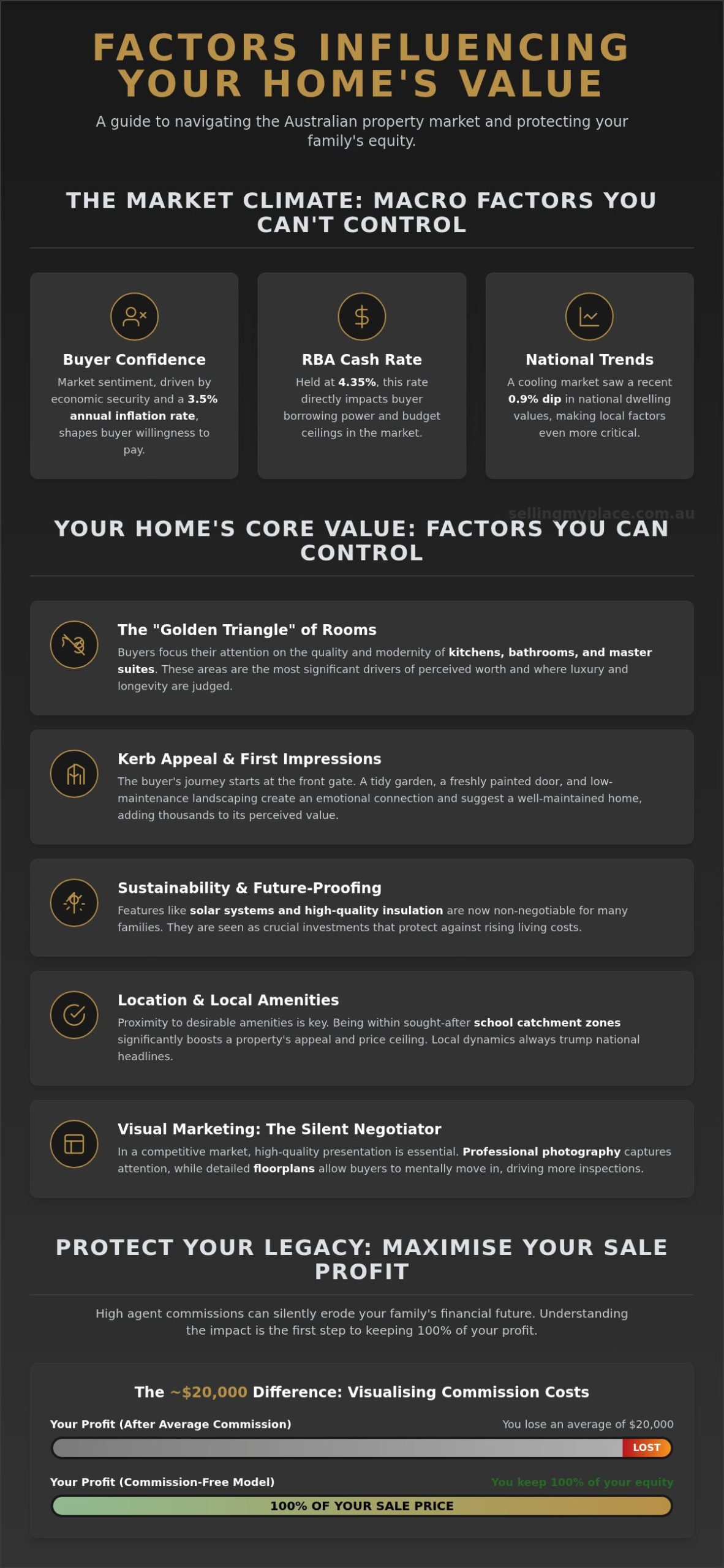
Your family home might be worth exactly what the market dictates, but the amount that actually lands in your bank account is entirely up to you. In a cooling market where national dwelling values recently dipped by 0.9 per cent, understanding the specific factors affecting property value in Australia has never been more critical. It’s a stressful tightrope to walk, especially when you’re trying to make sense of conflicting data while high agent commissions threaten to eat away at your life’s work. We understand that this transition is about more than just a transaction; it’s about protecting your family’s future and the legacy you’ve built.
This guide is designed to give you back control and provide a steady hand through the selling process. You’ll discover how to navigate the current 4.35 per cent cash rate environment and identify the specific home features that truly drive up local interest. We’ll show you how to maximise your sale price and keep 100 per cent of your profit, ensuring you don’t lose an average of $20,000 to commissions. By the end, you’ll have a clear strategy to sell with confidence and move into your next chapter with your full equity intact.
Key Takeaways
- Understand how the RBA cash rate and national economic trends influence the price ceiling for your home in the current 2026 landscape.
- Identify the specific physical and local factors affecting property value in Australia, such as the “Golden Triangle” of rooms and school catchment zones.
- Learn why professional photography and high-quality floorplans are essential for standing out and driving inspections in a cooling market.
- Discover how to protect your family’s legacy by avoiding high agent commissions and keeping 100 per cent of your sale profit.
- Gain a clear, step-by-step strategy to navigate conflicting market data with the calm confidence of a seasoned expert.
The Australian Property Market: Macro Factors You Can’t Control
Selling a family home often feels like trying to read the weather; you can prepare the garden and paint the deck, but you cannot stop the rain. In the current climate, macro-economic conditions act as the atmospheric pressure of the housing world. Understanding the external factors affecting property value in Australia is the first step toward building a grounded, realistic sale strategy. We often see homeowners stressed by national headlines, yet the “Big Three”—interest rates, inflation, and economic confidence—impact every suburb differently. While professional real estate appraisal methods provide a technical baseline for what a house is worth, these broader shifts often dictate the final price a buyer is actually willing to pay on auction day.
Government policy also plays a significant role in propping up or cooling down demand. For instance, the Australian Government 5% Deposit Scheme continues to support eligible buyers, while state-based First Home Owner Grants, such as the $20,000 available in Tasmania or the $50,000 in the Northern Territory, keep certain price brackets active. However, national data can be misleading. This is why a detailed Neighborhood Market Report is far more useful than generic news; it filters these broad trends through the lens of your specific street, where local supply and demand dynamics truly dictate your price ceiling.
The Interest Rate Ripple Effect
The Reserve Bank of Australia kept the official cash rate at 4.35 per cent as of September 2026, a figure that remains the primary lever for buyer borrowing power. When rates are steady or rising, buyers become more cautious, and mortgage stress can lead to increased inventory as more homes hit the market. You might feel tempted to hold out for a rate drop, but in a cooling market where national values recently fell by 0.9 per cent in a single month, waiting can sometimes mean chasing the market down. It is often better to sell with a clear head in today’s known conditions than to gamble on the RBA’s next move.
Demographic Shifts and Housing Demand
The legacy of the “tree change” and “sea change” movements continues to influence where Australians want to live, even as some return to employment centres. Migration patterns and the desire for more useable space keep certain regions resilient while others soften. For homeowners in lifestyle-rich areas, the ability to generate short-term income through BnB Booking can significantly enhance a property’s appeal to the growing investor market. Market sentiment is the collective emotional state of Australian buyers in 2026. This shared mood, driven by everything from employment security to the 3.5 per cent annual inflation rate, determines whether a buyer views your home as a safe harbour or a financial risk. By understanding these shifts, you can position your property to meet the specific aspirations of today’s families.
While the role of the RBA in relation to housing sets the broader financial boundaries for what buyers can afford, the physical reality of your home is what clinches the deal. Land size has long been one of the primary factors affecting property value in Australia, yet modern families now prioritise useable space over raw acreage. A smaller, well-designed block with an integrated alfresco area often outshines a sprawling, unkempt yard that suggests endless weekend chores. Buyers are looking for a lifestyle, not a second job.
Inside the home, the “Golden Triangle” of rooms remains the most significant driver of perceived worth. Kitchens, bathrooms, and master suites are where buyers look for luxury and longevity. In 2026, sustainability has also moved from a “nice-to-have” to a non-negotiable. High-quality insulation and solar systems are viewed as future-proofing measures that protect buyers from rising living costs. To help potential owners understand how these elements fit together, professional floorplans are essential; they allow a family to mentally move their furniture in before they even step foot on the property.
Kerb Appeal and First Impressions
The psychology of the “front gate” experience cannot be overstated. A buyer’s emotional connection often begins the moment they pull up to the kerb. Simple acts like tidying garden beds, painting the front door, or ensuring the letterbox isn’t leaning can add thousands to the perceived value. Modern Australian buyers are particularly drawn to low-maintenance landscaping that offers a lush feel without the heavy lifting. Organising your exterior to look effortless suggests a home that has been loved and meticulously maintained, which reduces buyer anxiety about hidden maintenance issues.
Internal Layout and Modern Functionality
We’ve seen a permanent shift toward multi-purpose living. A dedicated “work from home” space is now a top priority for professionals, and a home that offers quiet zones alongside open-plan areas will always command a premium. High-end Photography is the best way to showcase this balance; it captures the light and flow that make a house feel like a home. If you’re wondering how your specific layout measures up against current buyer expectations, you might find it helpful to speak with an advisor about your property’s unique strengths.
Location and Infrastructure: Beyond the Boundary Fence
Value doesn’t end at your front gate. In fact, many of the most significant factors affecting property value in Australia are entirely external to your title deed. Buyers aren’t just purchasing bricks and mortar; they’re buying into a lifestyle, a commute, and a community. This is why two identical houses in the same suburb can have vastly different price tags based on which side of a specific road they sit. It’s about the “anchor” of the location, the sense of place that makes a family feel they’ve found their forever home.
Local amenities play a massive role in this emotional connection. Walking distance to a vibrant local cafe strip or a well-maintained park adds a layer of desirability that generic data simply can’t capture. We’ve seen that the “good coffee” factor is real; buyers will often pay a premium for the convenience of a weekend stroll to their favourite local spot. However, it’s also vital to look at what’s coming next. Checking local council plans for zoning changes or new developments is a crucial step in future-proofing your sale. A new shopping centre nearby might boost convenience, but a proposed high-rise development next door could impact your privacy and sunlight. Staying informed about these external shifts ensures you’re never caught off guard during negotiations.
The Power of School Zones
For many Australian families, the local school catchment is the ultimate “hidden” value driver. Being on the right side of a boundary line can change a valuation by a six-figure sum, as parents look to secure their children’s education without the ongoing cost of private tuition. These properties tend to show remarkable long-term stability, even when the broader market softens, because the demand for quality education remains constant. You can learn how to determine the market value of a home in Australia by cross-referencing your address with the latest NAPLAN results and local school intake maps. It’s one of the most reliable ways to justify a higher asking price to a motivated buyer.
Transport and Connectivity
The rise of the “20-Minute Neighbourhood” has reshaped urban planning across the country. Buyers now prioritise homes where work, shops, and health services are all reachable within a short trip. Proximity to public transport hubs or major employment centres is a massive drawcard, though there’s a delicate balance to strike. While being near a train station adds value, being too close to the tracks can detract from the “quiet street” premium that many families still crave. Upcoming infrastructure projects, like rail extensions or highway upgrades planned for the next few years, can act as a catalyst for future capital growth. If your home is positioned to benefit from these connections, it’s a major selling point that deserves a spotlight in your marketing.
Visual Marketing: The “Silent Negotiator” of Property Value
Many sellers assume that market value is a rigid number set in stone by banks and spreadsheets. In reality, value is often a range, and where your final sale price lands within that range depends heavily on perception. While we have already explored the economic shifts and local infrastructure that provide the foundation, visual marketing is one of the most powerful controllable factors affecting property value in Australia. It acts as a silent negotiator, setting the tone for every conversation before a buyer even steps onto your driveway. Choosing to sell your own home shouldn’t mean settling for a ‘DIY’ look; it’s about meeting professional standards to ensure your property is taken seriously by the most competitive buyers. To see how these standards are applied by industry leaders, you might check out The Agency Coffs Coast for an example of high-end regional property presentation.
High-quality marketing does more than just look pretty. It builds trust and reduces the perceived risk for a buyer. When a listing looks polished, it suggests the home itself has been cared for with the same level of attention. By positioning your home as a lifestyle rather than just a collection of rooms, you invite buyers to visualise their own future there. This emotional connection is what drives people to stretch their budgets during negotiations, turning a casual browser into a determined bidder. If you are ready to showcase your home’s true potential, you can book a consultation with our team to discuss the best visual strategy for your area.
Smartphone cameras have come a long way, but they still cannot replicate the impact of professional equipment and expert editing. A professional photographer understands how to use wide-angle lenses to capture the flow of a room without distorting it, and how to balance natural light to make a space feel warm and inviting. These images are often the first point of contact a buyer has with your legacy. We’ve seen that listings with professional media receive significantly more clicks and inspection requests than those without. This is why Kincade International Direct Sales includes professional photography in every package; we believe every Australian seller deserves to put their best foot forward without the burden of high upfront marketing costs.
The Floorplan Advantage
An accurate floorplan is perhaps the most underrated tool in your marketing arsenal. Research within the real estate industry suggests that approximately 1 in 3 buyers will actually ignore a listing if it doesn’t include a floorplan. It provides the essential context that photos alone cannot, helping buyers understand the relationship between the “Golden Triangle” of rooms we discussed earlier. Beyond just generating interest, floorplans help qualify buyers by ensuring the layout suits their specific needs before they book an inspection. You can also use these documents during Pre-Sale Property Consulting to identify minor layout improvements that could significantly boost your final sale price. It’s about removing friction and making it as easy as possible for a buyer to say “yes”.
Maximising Your Sale Profit: The KIDS Commission-Free Model
After navigating the complex factors affecting property value in Australia, from the RBA cash rate to the “Golden Triangle” of internal rooms, the final hurdle is ensuring that value actually stays in your pocket. It’s a common misconception that a high sale price automatically equals a high profit. In reality, the traditional commission model often acts as a significant “equity leak,” draining your hard-earned wealth at the very moment you should be celebrating. Protecting your family’s legacy means looking beyond the “sold” sticker and focusing on the net result. We believe that the equity in your home belongs to you, not an agency’s bottom line.
Kincade International Direct Sales (KIDS) was founded on the belief that the modern Australian seller deserves a more transparent, partnership-based approach. By choosing to sell your own home with the support of our flat-fee model, you effectively bypass the commission trap. This isn’t just about cutting costs; it’s about empowerment. You receive the same professional-grade Residential Property Listing Services, including the global marketing reach and professional media we’ve discussed, but without the high marketing costs or percentage-based fees that can erode your profit.
Traditional Agents vs. Flat-Fee Advisory
The financial difference is often startling. On a typical Australian property, sellers save an average of $20,000 in commissions by moving away from the traditional model. There’s a persistent myth that local agents have a “magic touch” that unlocks higher prices, but in 2026, market exposure and presentation are the true drivers of value. KIDS provides the global marketing network required to find the right buyer, while our Agency Flat Fee ensures your costs remain fixed and predictable. This allows you to move into your next chapter with your full equity intact, rather than leaving a significant portion of it on the closing table.
The Steady Hand: Expert Advisory and Conveyance
We understand that the legal and negotiation phases of a sale can feel daunting. That’s why we provide a “steady hand” through our Real Estate Advisory Services, acting as a safety net for those who want to take control of their sale. Navigating the legal journey is made simple with professional Conveyance Advice, ensuring that every contract and disclosure meets the necessary standards. From handling initial enquiries to the final settlement steps, our team provides the expert guidance you need to close the deal with confidence. It’s a professional, supported way to sell that prioritises your family’s needs over a quick commission.
Taking Charge of Your Home’s Future
Navigating the various factors affecting property value in Australia can feel like a daunting task, but you don’t have to do it alone. We’ve explored how macro trends like the 4.35 per cent cash rate provide the backdrop, while your home’s unique physical features and local school catchments drive individual interest. Most importantly, we’ve seen how professional presentation and strategic marketing can elevate your property above the competition, ensuring you achieve the best possible result in any market condition.
Your home is likely your greatest asset; protecting the equity you’ve built over many years is our top priority. By choosing a commission-free model, you can save an average of $20,000 per sale while still benefiting from professional photography, floorplans, and our expert advisory service. It’s about selling with confidence and keeping your hard-earned profit where it belongs. When you’re ready to start your next chapter with a steady hand by your side, protect your equity and sell commission-free with SellingMyPlace.com.au. We look forward to helping you move forward with peace of mind and your full legacy intact.
Frequently Asked Questions
What is the single biggest factor affecting property value in Australia?
While location is the traditional answer, the primary ceiling on property prices in 2026 is the RBA cash rate and its impact on buyer borrowing power. The current 4.35 per cent rate directly dictates what a family can afford to bid. However, within your local area, the specific street position and proximity to lifestyle amenities remain the most influential factors affecting property value in Australia that you can actually leverage.
How much value does a renovation actually add to an Australian home?
A well-planned renovation can return significantly more than its cost, provided you focus on the “Golden Triangle” of rooms. Kitchens, bathrooms, and master suites typically offer the highest return on investment because they are the most expensive for a buyer to fix themselves. Modern Australian buyers also look for energy-efficient upgrades, such as solar and insulation, which can add thousands to the perceived worth of a property in today’s climate.
Does the school catchment area really impact my property price?
Yes, being on the right side of a boundary line for a high-performing public school is one of the most resilient factors affecting property value in Australia. Parents often view a home in a top catchment as a long-term investment in their children’s education, which can lead to a six-figure premium over similar homes nearby. These properties tend to hold their value even when broader market sentiment begins to soften.
Can I sell my home without a traditional agent and still get a high price?
You can certainly achieve a premium price by selling your own home if you maintain professional standards in your marketing and presentation. Buyers respond to quality photography, clear floorplans, and accurate data rather than the logo on a sign. With the right real estate advisory services to guide your negotiations, you can achieve a result that matches or exceeds what a traditional agent might deliver.
How much can I save by using a commission-free real estate model?
Australian sellers save an average of $20,000 by choosing a commission-free, flat-fee model over a traditional percentage-based agency. This significant saving allows you to protect your home’s equity and put that money toward your next life transition. Because you aren’t paying a large portion of your profit to an agent, you have more flexibility in your negotiations while still ensuring you walk away with 100 per cent of the profit.
What should be included in a professional neighbourhood market report?
A comprehensive report should include recent local sales data, current supply and demand levels, and an analysis of how long properties are sitting on the market. It should also highlight local infrastructure projects or zoning changes that might influence future growth. These reports empower you to set a realistic asking price based on hard evidence rather than guesswork, giving you a steady hand during the entire selling process.
Is professional photography worth the investment for a private sale?
Professional photography is essential because it acts as your silent negotiator in the digital space. High-quality images and floorplans are the primary tools for reducing buyer friction and driving inspections. Since 1 in 3 buyers will skip a listing that lacks a floorplan, including professional media is non-negotiable for a successful result. It ensures your home stands out as a premium lifestyle choice rather than just another online listing.
What are the legal risks of selling my own property in Australia?
The primary risks involve ensuring all legal disclosures are accurate and that the contract of sale is correctly prepared for your specific state. These risks are easily managed by seeking professional Conveyance Advice and utilising an expert advisory service as a safety net. Having professional support through the legal journey ensures that your sale is compliant and secure, allowing you to focus on the emotional significance of your move.
The Real Cost of Selling a House in 2026: An Australian Homeowner’s Guide
What if the biggest expense in your property sale wasn’t the marketing that finds the buyer, but an outdated commission fee that takes a massive chunk of your hard-earned equity? When planning your move, understanding the total cost of selling a house 2026 is essential to protecting your financial future. Selling a home is one of life’s most significant transitions, and it’s natural to feel anxious about hidden extras or the thought of losing $20,000 or more in commission when you should be celebrating your next chapter.
We believe you deserve a clear path forward, free from the stress of unexpected bills. In this guide, we’ll provide a complete breakdown of property sale expenses, showing you exactly where every dollar goes. You’ll discover how a professional flat-fee model can save you tens of thousands in equity while still providing the expert tools and photography you need to succeed.
We’ll walk through the difference between mandatory legal fees and optional marketing spend, helping you create a transparent budget. By the end, you’ll have the confidence to manage your sale with a steady hand, ensuring you walk away with the maximum profit to fund your next adventure.
Key Takeaways
- Learn how to deconstruct your settlement statement to identify mandatory legal fees versus optional marketing costs for a clearer budget.
- Discover why the total cost of selling a house 2026 is often inflated by commission structures and how to protect your family’s equity.
- Shift your strategy toward a transparent flat-fee model that ensures you pay for professional services rather than a percentage of your home’s value.
- Understand the importance of investing in high-impact visual marketing, including professional photography and floorplans, to attract the right buyers.
- Gain confidence in your selling journey with a “listed until sold” approach that removes the pressure of time limits and hidden fees.
The Shifting Landscape: Property Sale Costs in 2026
The Australian property climate in 2026 is defined by a renewed sense of ownership. With house prices in major metropolitan areas reaching significant peaks in early 2026, homeowners are becoming fiercely protective of their equity. It makes sense. After years of mortgage repayments and weekend renovations, you want that value to fund your next chapter rather than seeing it swallowed by fees. When calculating the total cost of selling a house 2026, we need to separate the non-negotiable “hard costs” from the variables. Hard costs include essential legal requirements governed by Australian property law, such as conveyancing and title searches, which provide the necessary framework for a secure transaction.
Variable costs are where most sellers lose their footing. Traditional commissions can fluctuate wildly, often feeling disconnected from the actual effort required to move a property in a digital-first market. We believe in a more transparent, partnership-based selling experience. This approach replaces high-pressure tactics with grounded, professional support, ensuring you remain in the driver’s seat of your own sale.
Why Traditional Models are Feeling the Pressure
Digital listing technology has fundamentally altered how we connect with buyers. Today, your future buyer is likely scrolling through a social media feed or a global property portal rather than walking past a local office. Because these platforms do the heavy lifting of visibility, the traditional percentage-based commission model feels increasingly outdated. It’s difficult to justify why selling a more expensive home should cost tens of thousands more in fees when the marketing process remains largely the same. This shift toward digital efficiency is driving a massive demand for fairer, service-based pricing that reflects the modern world.
The “Hidden” Emotional Cost of Selling
Beyond the financial figures, the emotional weight behind the cost of selling a house 2026 is often the most challenging part for families. Selling a home is rarely just a financial transaction; it’s a deeply personal milestone. The stress of managing open homes and legal paperwork can be taxing if you feel like just another number. Instead of a high-pressure environment, we see the value in a steady hand approach. A guide who provides professional tools and calm expertise helps reduce the anxiety of the unknown. When costs are transparent from the start, the path to settlement becomes much smoother, allowing you to focus on the legacy you’re building for your family.
Deconstructing the Bill: Where Your Money Goes
When you sit down to calculate the total cost of selling a house 2026, the list of expenses can feel overwhelming. It’s not just about the final number on the contract; it’s about the various steps required to get there safely and professionally. A typical Australian home sale involves several layers of spending, from the initial marketing push to the final legal sign-off. Understanding these costs upfront allows you to maintain control over your equity and prevents those stressful “hidden” surprises during settlement.
The first step in any successful sale is grounding your expectations in reality. Using Neighborhood Market Reports helps you set a realistic price based on current local data. This prevents the costly mistake of overpricing, which often leads to a property languishing on the market. Beyond pricing, you’ll need to account for mortgage discharge fees, which typically range from $150 to $400, and potentially auctioneer fees if you choose that path, which can add another $400 to $1,000 to your bill.
Visual Marketing: Photography and Floorplans
In 2026, your digital presence is your primary open home. Research indicates that metropolitan marketing campaigns now typically range from $4,000 to $8,000. While that sounds like a lot, the quality of your visual assets is where you shouldn’t cut corners. Professional photography captures the emotional heart of your home, while a clear floorplan provides the logical blueprint buyers need to visualise their future life in the space. High-quality imagery doesn’t just look nice; it builds immediate trust and significantly reduces the time your property spends on the market, often resulting in stronger final offers.
The Legal Essentials: Conveyancing and Advice
The legal side of selling is your protective shield. A solicitor or conveyancer handles the complex task of contract preparation and title searches, ensuring the transfer of ownership is watertight. In Australia, these fees generally fall between $700 and $2,500. Seeking expert Conveyance Advice early in the piece is a smart move to avoid common settlement pitfalls that can delay your move or cost you money. This professional oversight ensures that every box is ticked according to current regulations, giving you the peace of mind that your transition will be as smooth as possible. If you’re feeling unsure about where to start your budget, feel free to reach out for a chat about your specific situation.
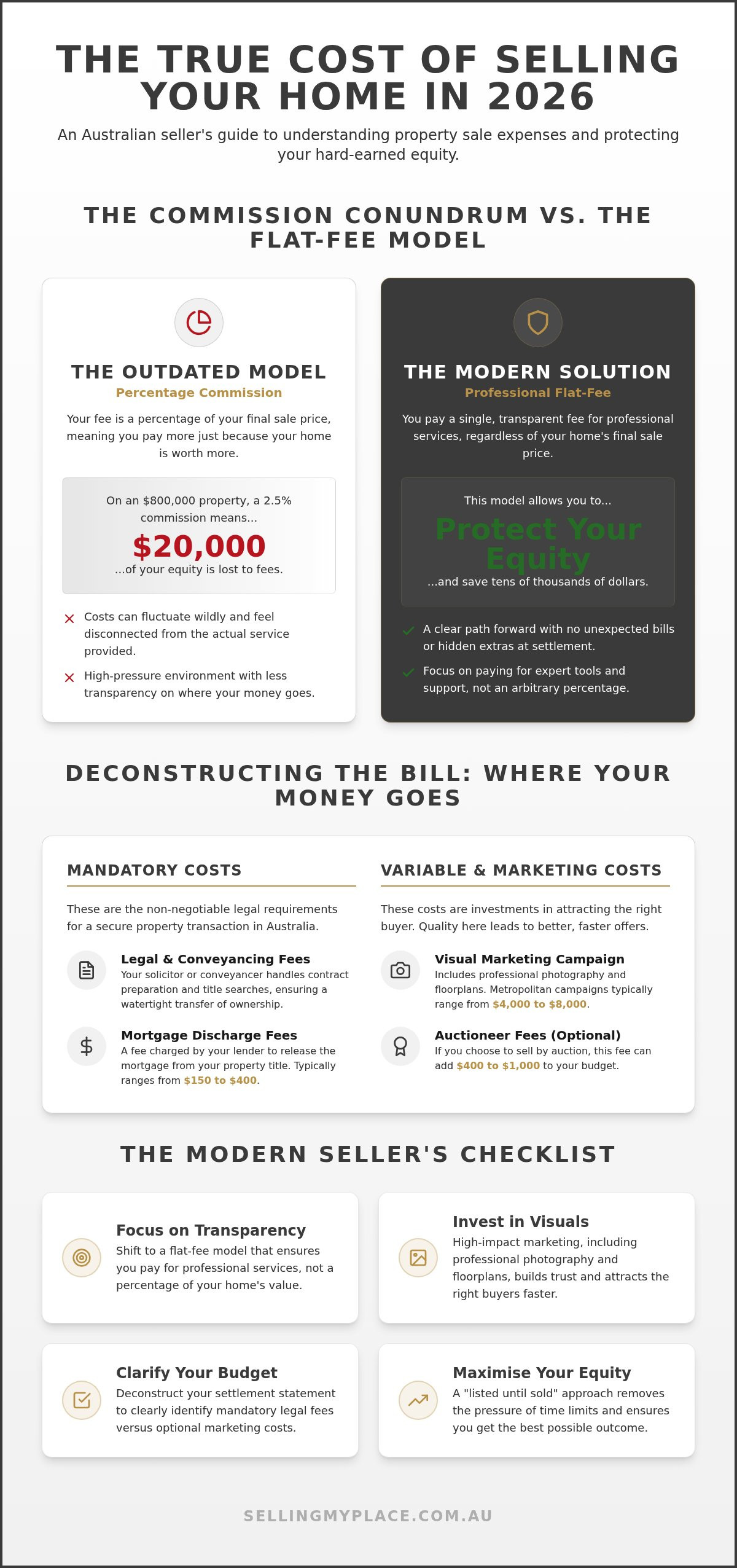
The Commission Conundrum vs. The Flat-Fee Model
Many homeowners view the real estate agent’s commission as an unavoidable tax on their hard-earned equity. It’s a significant burden. When we look closely at the cost of selling a house 2026, it’s clear that these fees are actually a strategic choice rather than a fixed rule. Traditional commissions, which typically sit between 1.5% and 3.5% plus GST, might have been justifiable in an era of print newspapers and physical shopfronts. Today, with property prices reaching new heights, that percentage translates into a staggering amount of money. For a home valued at $1.5 million, a 2% commission means handing over $30,000 of your wealth at the settlement table.
We call this the Equity Gap. It represents the difference between a traditional sale and a more modern, efficient approach. On average, owners who step away from the commission model save approximately $20,000. Think about what that amount could do for your family’s next transition. It could fund a significant renovation on your next property, clear a substantial portion of debt, or simply provide a safety net for your retirement. There’s a persistent myth that paying a lower fee results in a lower sale price. In reality, the final figure is driven by market demand and the quality of your presentation, not the size of the agent’s final cheque.
Comparing the Incentives
Traditional agents often operate on a high-volume model. Their goal is to close the deal quickly to move on to the next listing, which can sometimes lead to pressure on the seller to accept a lower offer as an agency agreement nears its end. Our flat-fee advisory service flips this dynamic. We believe in empowering you to be the best advocate for your home. By removing the ticking clock of an expiring contract, the “listed until sold” model provides a sense of calm. You have the luxury of time to wait for the buyer who truly understands the value of your property’s legacy, without the stress of mounting fees or pressuring phone calls.
The Global Reach Advantage
You don’t need a local shopfront to achieve a premium sale. In 2026, the physical office has been replaced by a sophisticated global marketing network. Modern digital platforms connect Australian homes to buyers across the country and around the world. These buyers aren’t walking past windows; they’re searching online for community and stability. By leveraging this digital reach, you can attract high-value interest from international networks while keeping your costs grounded. To further expand your reach, you can discover HomesGoFast and see how international property advertising connects sellers with global opportunities. This direct-to-consumer efficiency ensures your home is seen by the right eyes, regardless of where they are located, driving up competition and your final result.
Creating a financial roadmap is about more than just tracking numbers; it’s about giving yourself the control to manage a major life transition with confidence. When calculating the cost of selling a house 2026, a structured approach ensures you aren’t caught off guard by the small details that often accumulate during settlement. We’ve found that a clear plan reduces the emotional weight of the process, allowing you to focus on the future.
Your first step is obtaining an accurate market appraisal. This provides the grounded foundation for your entire strategy. Next, allocate your budget toward high-impact visual marketing. As we’ve discussed, professional photography and floorplans are the tools that actually move the needle in a digital-first market. Third, secure professional Sale by owner advisory. Having an expert guide to handle negotiations ensures you don’t leave your hard-earned equity on the table. Finally, remember to factor in “exit costs.” These include mortgage discharge fees, which typically range from $150 to $400, alongside your moving expenses and any minor repairs needed to present the home at its best.
Prioritising Your Marketing Spend
In 2026, digital infrastructure is far more powerful than traditional print advertising. While a glossy brochure might feel like a nice keepsake, it’s your online reach that finds the buyer. Investing in Pre-Sale Property Consulting can help you identify high-ROI fixes that actually add value to your final offer. Be wary of “premium listing” traps on major property portals. These often come with significant price tags but don’t always result in more genuine interest. Focus your resources on quality content and professional presentation instead.
The Importance of Accurate Market Data
Relying solely on automated online valuations can be a risky move. These tools often miss the nuances of your home’s unique character or the subtle shifts in local community demand. Comprehensive market reports provide the granular data you need to avoid the stress of underpricing or overpricing. When a buyer begins to negotiate, having this data at your fingertips allows you to justify your price with logic and evidence. This transparency builds a sense of trust and leads to a much calmer settlement process for everyone involved. If you’re ready to build your custom roadmap, book a consultation with our advisory team to discuss your goals.
Maximising Your Equity with Kincade International Direct Sales
We’ve explored the various layers involved in the cost of selling a house 2026, but the most empowering part of this journey is choosing a model that puts your family’s future first. At Kincade International Direct Sales (KIDS), our approach is built on a simple, transparent foundation. We’ve removed the single largest obstacle to your profit: the agency commission. By operating on a commission-free, flat-fee basis, we ensure that the equity you’ve built through years of mortgage repayments and weekend renovations stays exactly where it belongs. In your pocket.
Our “Listed Until Sold” guarantee is designed specifically to reduce the anxiety that often accompanies traditional real estate agreements. There are no ticking clocks or expiring contracts here. We provide you with the same professional tools used by the country’s top agencies, including high-end photography and detailed floorplans, as standard. This partnership ensures your home is presented with the polish it deserves while you maintain complete control over the process and the final result.
A Steady Hand through the Selling Journey
You don’t have to navigate this transition alone. Our Expert Agent Advisory Service acts as your steady hand, providing professional guidance whenever you need it. We believe that you are the best person to tell the story of your home’s legacy. After all, you’re the one who knows which corner gets the best morning sun and which local cafe serves the best coffee. We provide the professional framework and digital reach, while you provide the authentic heart that buyers in 2026 are looking for. It’s a collaborative way to sell that balances expert support with personal advocacy.
Taking the Next Step
Moving from the “thinking about it” stage to having an active listing is a significant emotional step. We’ve made our process as straightforward as possible to help reduce that initial friction. Our flat-fee structure is clear from the outset, allowing you to budget with absolute certainty. There are no hidden marketing “add-ons” or surprise fees at settlement. If you’re ready to move toward your next life chapter with confidence and a protected bottom line, we’re here to help you get started. You can protect your equity and start your commission-free journey today by joining a community of homeowners who are changing the way Australia sells property.
Securing Your Equity for the Next Chapter
Selling your home is a monumental life transition, and you deserve to walk away with every cent of equity you’ve worked so hard to build. By deconstructing the total cost of selling a house 2026, you’ve seen that high commissions are no longer an inevitable part of the process. Instead, you can choose a path that prioritises your family’s financial legacy through transparent, flat-fee services and grounded, professional support.
A successful sale relies on professional presentation and a steady hand during negotiations. With our Dedicated Agent Advisory Service and professional photography included, you don’t have to sacrifice quality to achieve significant savings. On average, our partners save $20,000 in commissions, allowing them to fund their next adventure with confidence. Your future is waiting, and we’re here to help you reach it with ease.
Keep 100% of your profit with Kincade International Direct Sales
Frequently Asked Questions
What is the average real estate commission in Australia in 2026?
Real estate commissions generally range between 1.5% and 3.5% of the final sale price. Rates tend to be lower in metropolitan areas where property values are higher, while regional areas often see rates exceeding 3%. You must also factor in a 10% GST on top of the quoted percentage. For a home valued at $1 million, these fees can represent a significant portion of your equity, often reaching $25,000 or more.
Are there hidden costs when selling a house by owner?
While you avoid traditional commissions, you must budget for professional essentials to ensure a successful result. These include high-quality photography, floorplans, and digital listing fees. Some homeowners also overlook mandatory legal costs like title searches. We bundle these professional tools into a transparent flat fee, providing a clear roadmap that eliminates surprise bills at settlement and ensures you have everything needed to attract the right buyer.
How much should I spend on marketing my property?
A standard metropolitan marketing campaign in 2026 typically ranges from $4,000 to $8,000. This investment covers professional imagery, floorplans, and digital reach across major property portals. While some platforms offer premium tiers that cost significantly more, we recommend focusing on high-quality content that builds genuine buyer trust. Our model includes professional photography and floorplans as standard to help you achieve a premium result without the burden of high marketing costs.
Is a flat-fee real estate model legally safe in Australia?
Yes, the flat-fee model is completely legal and increasingly popular across the country. It provides a structured alternative to the traditional commission system while still utilising professional legal frameworks. You still engage a solicitor or conveyancer for the formal transfer of title, ensuring your sale complies with all national property laws. It’s a safe, modern way to manage your cost of selling a house 2026 while protecting your hard-earned equity.
What is the cost of conveyancing when selling a house?
You should expect to pay between $700 and $2,500 for professional conveyancing or legal fees. This amount covers contract preparation, title searches, and the formal legal transfer of the property. Costs vary depending on the complexity of the sale and any specific requirements of the transaction. We provide expert conveyance advice to help you navigate this essential step, ensuring your legal interests are protected throughout the entire settlement process.
Do I need to pay for a property appraisal in 2026?
Many digital platforms offer automated valuations for free, but these can be inaccurate as they miss the nuances of your home. We provide comprehensive Neighborhood Market Reports as part of our service. These reports use granular local data to give you a realistic and grounded starting point for your sale price. Having accurate data is essential for justifying your price to buyers during negotiations and ensuring you don’t leave money on the table.
Can I sell my home to an international buyer through a flat-fee service?
Absolutely. Our digital infrastructure and global marketing network ensure your home is visible to buyers across the country and overseas. Modern buyers aren’t limited by geography; they look for community and stability through international property portals. For instance, savvy investors often explore New Launch to discover premier residential developments in Singapore, demonstrating how digital platforms connect global buyers with local opportunities. By using a flat-fee service with global reach, you can attract high-value interest from international networks without needing a physical local shopfront or paying an agency commission that scales with the sale price.
This model removes the financial pressure of expiring agency agreements. Traditional agents often sign you for a fixed period, which can lead to stress or the cost of a second campaign if the property doesn’t move quickly. With our “listed until sold” guarantee, you have the luxury of time to wait for the right offer that respects your home’s legacy. It provides peace of mind and ensures your initial investment covers the entire journey.
Property Photography: 2026 Australian Seller’s Guide
What if the most expensive mistake you make when selling your home isn’t the price you set, but the lens through which buyers see it? Your property’s digital front door is the single most powerful tool you have to prove your home’s worth in a market where 87% of professionals expect values to keep climbing through 2026. Investing in professional property photography is the non-negotiable standard that transforms a simple listing into a premium destination. You might worry that without a traditional agent, your home won’t get the same “glossy” treatment, but the truth is quite the opposite. By taking control of your visual story, you ensure your home looks sophisticated rather than “cheap”, capturing the attention of savvy buyers who are scrolling through major property portals with high expectations.
We understand the weight of this transition. It’s a significant life moment, and the pressure to get the presentation “just right” can feel overwhelming. This guide is designed to be your steady hand, showing you exactly how high-end visual marketing builds buyer trust and secures a premium price for your home while you keep 100% of the sale profit. We will walk through the essential assets you need to outshine agent-managed properties, ensuring you look like the seasoned professional your home deserves.
Key Takeaways
- Master the “2-second rule” to ensure your home captures immediate buyer interest and signals a high-quality, well-maintained property.
- Discover why professional property photography is a non-negotiable standard that outshines basic smartphone snaps and commands higher engagement on major portals.
- Learn why floorplans are your second most vital asset and how 3D “digital twins” can pre-qualify serious buyers before they even step through the door.
- Use our practical pre-shoot checklist to maximise natural light and create a depersonalised canvas that helps buyers visualise their future in your home.
- See how a flat-fee listing model allows you to access premium marketing assets while retaining an average of $20,000 in sale profit.
The Psychology of the Click: Why Professional Visuals Matter
Have you ever found yourself scrolling through a property portal late at night, dismissing dozens of listings in seconds? You aren’t alone. Most buyers apply a strict “2-second rule” to every listing they see. If the hero image doesn’t resonate immediately, they move on. This is where professional property photography becomes your most valuable asset. High-quality visuals aren’t just about looking pretty; they signal to a prospective buyer that the home is well-maintained and cared for. If the photos are crisp, well-lit, and thoughtfully composed, the buyer subconsciously assumes the property’s structural integrity and maintenance match that high standard. Professional property photography is the primary driver of digital enquiry rates in the current market.
Building Buyer Trust in a Digital-First Market
In a digital-first market, high-resolution images do the heavy lifting of reducing “buyer friction”. When a buyer can see every detail clearly, their perceived risk drops. They start to trust the listing before they’ve even requested a contract. This trust is especially vital when you choose to sell without a traditional agent. There’s often a lingering anxiety that “Sale by Owner” means amateur, but high-end visuals instantly dismantle that myth. By applying foundational Architectural photography principles, you validate your home’s market value. In fact, owner-managed listings often require better photos than agency ones to prove that the sale is being handled with absolute professionalism and heart. It’s about closing the “trust gap” before the first phone call is even made.
The Impact on Major Australian Listing Portals
The algorithms on major Australian property platforms aren’t just random; they prioritise engagement. When your listing “stops the scroll” and keeps a user clicking through the gallery, the platform’s internal logic notices. Higher engagement leads to better visibility, which is crucial in a competitive landscape where demand remains high and supply is tight. These visual assets are the engine room of your campaign. Once you’ve captured their attention, you can guide them through the practical steps of how to sell your own home with confidence. It’s about creating a narrative of stability and premium quality that resonates with families looking for their next chapter, ensuring your property remains at the top of the search results through sheer popularity and visual appeal.
What Defines “Professional” Property Photography in 2026?
While modern smartphones are impressive, they can’t replicate the depth and clarity of a professional DSLR or mirrorless camera setup. True professional property photography relies on high-grade sensors and specialised lenses that capture more than just a room; they capture an atmosphere. Take the “Day to Dusk” technique, for example. By digitally transforming a daytime shot into a twilight masterpiece, we tap into a buyer’s emotional desire for a warm, inviting sanctuary. It’s a sophisticated touch that commands attention in a crowded feed, making your home feel like a premium retreat.
Professional lenses are equally critical. We use wide-angle glass designed to show the full scope of a room without the “fish-eye” distortion that makes walls look curved or rooms look unnaturally long. This technical precision is paired with meticulous colour correction. If the day of the shoot was overcast, a professional editor will perform a “blue sky” replacement, ensuring your listing looks vibrant and sunny regardless of the Australian weather on the day.
Advanced Lighting and Composition Techniques
Capturing the view through a window while keeping the interior perfectly lit is a challenge only “HDR” (High Dynamic Range) processing can solve. This involves layering multiple exposures to ensure the sun-drenched garden is just as clear as the lounge room rug. We also focus on vertical line correction. Have you ever noticed how amateur photos make walls look like they are leaning inwards? Professional shots keep those lines perfectly straight, providing a sense of structural stability and calm. It’s about showing the flow of the home, inviting the buyer to imagine walking from the kitchen to the alfresco area with ease. If you’re feeling unsure about which angles will best showcase your home’s unique character, you can always reach out for a quick chat to discuss your specific needs.
The 2026 Standard: Virtual Staging and AI Enhancement
By 2026, virtual staging has become a sophisticated tool for helping buyers visualise the potential of empty or dated spaces. It’s a cost-effective way to add stylish, contemporary furniture to a photo without the physical effort of hire companies. However, we maintain a clear ethical line. AI-driven retouching should enhance the truth, not hide it. We might remove a stray garden hose or brighten a dark corner, but we never remove permanent fixtures or distort the property’s reality. Professional property photography is about presenting the most polished version of your home’s legacy while maintaining the absolute trust of your future buyer.
Beyond Still Images: 3D Tours, Drones, and Floorplans
While professional property photography captures the emotional heart of your home, the supporting visual assets provide the logical framework buyers need to commit. Think of it as a multi-layered story. If the photos are the hook, the floorplan and 3D tour are the chapters that satisfy a buyer’s curiosity. In 2026, savvy Australians aren’t just looking for a pretty facade; they’re looking for a functional layout that fits their lifestyle. These tools work in tandem with understanding market reports to justify your asking price and build a rock-solid case for your home’s value.
The Essential Role of Accurate Floorplans
A floorplan is often the second most clicked item on a listing, right after the hero shot. It allows a family to mentally move in before they’ve even booked an inspection. Can the king-sized bed fit in the master? Is the kitchen close enough to the alfresco for entertaining? By including total square metreage and clear orientation, you remove the guesswork. Listings that include a professional floorplan often see a significant increase in enquiries because they provide the “bones” of the property. It’s about transparency and helping someone visualise their life within your walls. It makes the transition feel real and achievable.
Aerial and 3D Visualisation Strategies
Aerial drone photography has moved from a luxury to a standard for properties where the land is as important as the house. Whether you’re showcasing a large block or the home’s proximity to local parks and schools, a drone shot provides the “neighbourhood context” that a street-level photo simply can’t. It’s a bird’s-eye view of a buyer’s future community. It helps them understand the legacy and stability of the area they are buying into.
Similarly, the rise of the “Digital Twin” through 3D virtual tours has changed the game for pre-qualifying buyers. A virtual walkthrough allows interstate or international buyers to explore every corner of your home at their own pace. This is particularly valuable for investors, who can also use this 3D data to assist with tax depreciation schedules. By the time someone requests a physical inspection, they are already deeply familiar with the space. This means fewer “tyre-kickers” and more serious offers, which is a respectful, efficient way to manage your sale. Integrating these tools with your professional property photography ensures your listing is as informative as it is beautiful.
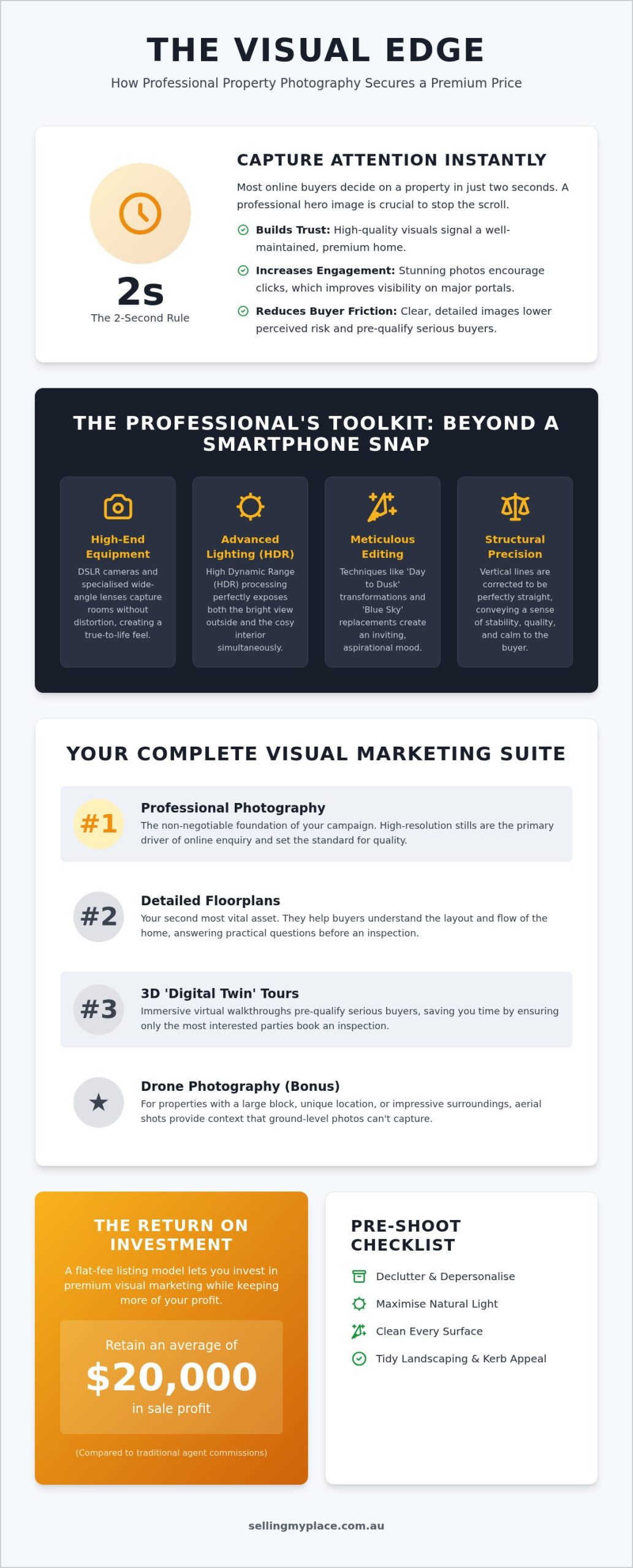
Preparing Your Home for the Lens: A Seller’s Checklist
Preparing your home for professional property photography isn’t just about a quick tidy; it’s about curated storytelling. You’ve lived in this house and built memories here, but now you’re handing that legacy over to someone new. To help them see themselves in your space, you need to create a blank canvas. This is why the “Declutter and Depersonalise” rule is so vital. Removing family photos and excess knick-knacks allows a buyer’s imagination to take root. You want them to see the architecture and the potential of the rooms, not the details of your daily life.
Sellers should always aim to emphasise the clean and bright aesthetic favoured by Australian buyers to ensure their listing feels modern and aspirational. Maximising natural light is the most effective way to achieve this. Start by cleaning your windows inside and out. It’s a small task that makes a massive difference in how a camera captures a room’s vibrancy. Open all blinds and curtains, and ensure they are hung straight. This simple step invites the sun in and makes the home feel airy and expansive. Don’t forget the kerb appeal; the exterior “money shot” is often the first thing a buyer sees, so ensure the lawns are mown and the entrance is welcoming.
Room-by-Room Preparation Tactics
In the kitchen and bathroom, aim for “spa-like” vibes. Clear every single item off the benches, including toasters and kettles, to showcase the workspace. Fresh, neutral-toned towels and a high-quality hand soap are all you need. In the living areas, give your cushions a “karate chop” to create that plush, inviting look, and ensure all rugs are perfectly aligned with the furniture. Don’t forget the outdoor spaces. A quick pressure clean of the driveway and alfresco area can take years off the property’s appearance. If you have a pool, make sure it’s sparkling and the surrounding area is staged with a few simple, stylish accessories.
The “Invisible” Details That Ruin Photos
It’s often the things we stop noticing that show up most prominently in a professional lens. Look for tangled power cables under the TV or pet bowls in the laundry and tuck them away. Hide wheelie bins and garden hoses so they don’t distract from the garden’s beauty. Replacing blown light globes is essential; consistent interior warmth ensures the camera doesn’t struggle with uneven lighting. Finally, consider the power of fresh flowers or greenery. A simple vase of native Australian foliage or a bowl of fresh fruit adds a touch of life and colour that feels authentic rather than staged. If you’re feeling overwhelmed by the list, contact our advisory team today for personalised guidance on how to get your home camera-ready.
Maximising Profit: Integrating Photography into Your KIDS Strategy
When you choose to lead your own sale, you aren’t just saving on costs; you’re taking ownership of your family’s financial legacy. In the KIDS model, professional property photography isn’t a luxury add-on or a hidden expense. It’s a foundational component of our flat-fee marketing packages. By providing high-end visuals as part of a transparent fee structure, we remove the anxiety of escalating marketing costs. Traditional agents often hide these expenses within hefty commissions, but our approach ensures you know exactly where you stand from day one. You get the same glossy, high-end result without the transactional sting.
The financial impact of this decision is significant. On average, our owners save $20,000 in commissions, funds that can be better spent on your next chapter, whether that’s a new home or a well-deserved retirement. These professional tools empower you during the property sale negotiation phase. When a listing looks this polished, it commands respect from the outset. Buyers don’t see a “cheap” DIY effort; they see a premium property presented by a confident, informed owner. This “Steady Hand” approach reduces the stress of the process and puts you in the driver’s seat of your own transition.
Using Visuals to Justify Your Asking Price
Presenting a premium brand image is your best defence against low-ball offers. In a market where buyers are increasingly savvy, high-quality visuals attract “emotional buyers”, those who fall in love with the lifestyle your home promises and are often willing to pay more to secure it. This visual strategy is a key part of our professional residential property listing services guide, which helps you navigate the 2026 market with absolute confidence. When your marketing is flawless, your asking price becomes much easier to justify during a walk-through.
The KIDS Advantage: Professionalism Without the Commission
The KIDS advantage is about more than just saving money; it’s about retaining your hard-earned equity while accessing a global marketing network. You get the peace of mind that comes from a listing that looks just as good, if not better, than the local agent-managed properties on the same street. It’s a smarter way to sell that values your time and your home’s worth. By using professional property photography to tell your story, you ensure your home stands out for all the right reasons. If you’re ready to take the next step towards a successful sale, you can start your commission-free journey with professional photography today and see how much you could save.
Secure Your Property’s Legacy and Your Sale Profit
Selling your home is a significant milestone that marks the end of one chapter and the beginning of another. By prioritising professional property photography, you ensure your home’s story is told with the sophistication and care it deserves. We have seen how high-end visuals and accurate floorplans act as a “digital front door”, building the trust necessary to attract premium offers without the need for a traditional agent. It’s about presenting a polished, professional image that validates your home’s worth while you lead the way with a steady hand.
Our commitment is to provide you with the tools to succeed, including expert pre-sale consulting and comprehensive marketing assets as standard. Owners who take this path save an average of $20,000 in commissions, allowing that equity to stay where it belongs: with your family. You don’t have to navigate this complex process alone. View our commission-free marketing packages including professional photography to see how we can support your journey. You have built a beautiful legacy in your home, and we are here to help you protect it as you move toward your next bright future.
Frequently Asked Questions
Is professional property photography really worth the cost?
Yes, investing in professional property photography is one of the most effective ways to secure a higher sale price. High-quality visuals act as your digital front door, instantly validating your home’s value to prospective buyers. In the Kincade International Direct Sales model, these services are included in your flat fee, ensuring you don’t face the high marketing costs associated with traditional agencies. This professional edge helps you retain your equity while presenting a polished image.
Can I just use my high-end smartphone to take the photos?
While modern smartphones are impressive for daily life, they cannot replicate the technical precision required for high-end real estate marketing. Professional cameras use specialised wide-angle lenses and high-dynamic-range sensors to capture detail in both shadows and bright windows simultaneously. This ensures your rooms look spacious and inviting rather than distorted or dark. Choosing professional property photography over smartphone snaps signals to buyers that your sale is being handled with absolute professionalism and a nurturing, expert hand.
How long does a professional property photo shoot typically take?
A standard photo shoot for a residential property usually takes between one and three hours. This timeframe allows our photographers to find the best angles, adjust lighting, and capture the unique character of your home without rushing. Larger homes or those requiring additional services like 3D tours and drone work may take slightly longer. We work methodically to ensure every room is presented in its best light, respecting your schedule while maintaining our high, authoritative standards.
What happens if it rains on the day of my scheduled shoot?
Don’t let a grey sky dampen your spirits. Our professional editors use advanced techniques like blue sky replacement to ensure your exterior shots look sunny and vibrant even on an overcast day. If the weather is truly extreme and prevents safe drone operation or clear outdoor shots, we will discuss rescheduling those specific elements. We aim to be a steady hand during these minor hiccups, ensuring your listing timeline remains on track despite the unpredictable Australian weather.
Do I need to be home when the photographer arrives?
You aren’t required to be home during the shoot, provided we have clear access to the property. Many sellers find it easier to step out, allowing the photographer to move freely through the rooms and focus on the composition. However, if you prefer to stay and assist with final invisible details like hiding pet bowls or smoothing cushions, you are more than welcome. We aim to make the process as low-stress and personal as possible for your family.
Should I include drone photography if I live in a standard residential street?
Aerial drone photography is highly beneficial even on standard residential streets because it provides essential neighbourhood context. It allows buyers to see the property’s proximity to local parks, schools, and transport hubs, which are key drivers for family buyers. Drone shots also clearly illustrate the block size and the home’s footprint relative to the land. This bird’s-eye view helps build a narrative of stability and community that street-level photos simply cannot capture on their own.
Why is a floorplan considered a “must-have” for Australian listings?
A floorplan is the second most vital element of your listing after the hero image. Australian buyers are detail-oriented and use floorplans to mentally move their furniture into the space and assess the home’s flow. It provides the logical bones that support the emotional appeal of the photography. By including total square metreage and orientation, you provide the transparency buyers expect in 2026, which often leads to higher engagement and more serious, pre-qualified enquiries.
How quickly will I receive my edited photos after the shoot?
We understand that timing is critical when you are ready to launch your listing. You can typically expect to receive your professionally edited images and floorplans within 24 to 48 hours after the shoot is completed. This fast turnaround ensures you can move forward with your sale by owner strategy without unnecessary delays. Our team works diligently to ensure every image is colour corrected and polished, helping you present a premium brand image to the market quickly.
How to Maximise Your Property Sale Price: The 2026 Australian Seller’s Guide
What if the secret to a record-breaking home sale wasn’t about finding the right agent, but about reclaiming the equity you’ve worked decades to build? Knowing how to maximise property sale price in 2026 requires a shift in perspective, moving away from traditional commission models that can quietly erode your hard-earned profit. With the national median real estate commission sitting at approximately 2.65 per cent, many Australian families are understandably anxious about losing a significant portion of their wealth just as they’re preparing for their next big chapter.
We understand that selling your home is about much more than a simple transaction; it’s the culmination of years of memories and a foundation for your future stability. It’s perfectly normal to feel some uncertainty about which renovations truly add value or how to present your home to stand out. This guide offers a clear, strategic framework to elevate your property’s value through professional presentation and smarter marketing. You’ll discover how to maintain a steady hand throughout the process, ensuring a smooth transition while keeping one hundred per cent of your sale profit. We’ll walk through the essentials of high-end photography, the power of accurate floorplans, and the professional advisory steps that lead to a truly exceptional result.
Key Takeaways
- Focus on your net sale price rather than just the offer figure to ensure high commissions don’t eat into your hard-earned equity.
- Discover how to maximise property sale price by prioritising a digital-first presentation that includes professional photography and high-definition floorplans.
- Understand the critical importance of the first 14 days on the market and why data-driven pricing beats relying on a gut feeling.
- Learn to maintain a steady hand during negotiations, giving you the confidence to decline low-ball offers while keeping serious buyers interested.
- Explore how a flat-fee marketing model provides the same global reach and professional tools as traditional agencies while saving you an average of $20,000.
Beyond the Offer: Understanding Net Profit and the Commission Trap
When you see a ‘Sold’ sticker on a signboard, it’s easy to get swept up in the headline figure. However, the number that truly dictates your next move is the net sale price. This is the final amount that lands in your bank account after every cost, fee, and tax has been settled. If you are exploring how to maximise property sale price, you must look beyond the offer and focus on your equity. The Commission Trap is the loss of equity to percentage-based fees that remain high regardless of the actual effort or time an agent spends on your sale.
The Real Math of a Property Sale
A typical sale involves several layers of expense that can quickly stack up. There is the marketing campaign, legal fees for conveyancing, and the agent’s commission. With the national median commission sitting at 2.65 per cent in 2026, a family selling a house for $800,000 could be looking at over $21,000 in commission alone, plus GST. A big part of this process involves understanding property valuation and how it differs from a purely emotional price tag.
This is why many savvy Australians are shifting toward a 0 per cent commission mindset. By choosing a flat-fee model, sellers are saving an average of $20,000 per sale. Visualise that extra $20,000 as part of your next home deposit or a boost to your retirement nest egg. It’s about protecting your legacy rather than funding an agent’s marketing. When you keep your equity, you’re not just making a sale; you’re securing your family’s future.
Shifting from Transactional to Strategic Selling
You’ve lived in the home. You know where the morning light hits the breakfast nook and which local park is best for a weekend stroll. This emotional intelligence is a powerful tool that no external agent can truly replicate. When you represent your own home, you’re not just selling bricks and mortar; you’re sharing a lifestyle. You are the expert on your own home’s story.
By moving away from a transactional approach, you can maintain a professional centre of operations for your sale. Professional advisory services now provide the technical support once exclusive to traditional agents. This setup ensures you have a steady hand to guide you through the complexities of the market while you remain the primary voice for your property. It’s a partnership that values your family’s needs over a quick result, helping you learn how to maximise property sale price through genuine connection and professional presentation.
The Visual Edge: Professional Presentation That Drives Premium Offers
Your digital storefront has officially replaced the traditional kerb appeal as the most critical factor in a successful sale. In 2026, a buyer’s journey doesn’t begin at your front gate; it starts with a thumb-scroll on a smartphone. This “First Click” psychology means you have roughly three seconds to capture a buyer’s imagination. Learning how to maximise property sale price begins with understanding that your online listing is a high-stakes invitation into a future lifestyle. While you focus on the visual appeal, remember that a higher sale price also interacts with your Australian taxation obligations for sellers, making it vital to protect your equity through smart presentation choices.
Why Professional Photography is an Investment, Not a Cost
Professional photography is the engine room of your marketing strategy. High-quality images, particularly those captured during the “golden hour” when Australian light is at its softest, can significantly increase digital engagement. It isn’t just about documenting rooms; it’s about capturing the soul of the home. A professional lens highlights the texture of your stone benchtops and the way light spills across the timber floors, creating an emotional hook that stock-standard photos simply miss. If you’re unsure where to start with your home’s presentation, a quick chat about tailored pre-sale advice can provide the clarity you need.
The Floorplan Factor: Helping Buyers Visualise Their Future
Modern buyers are analytical. They want to know if the third bedroom can double as a quiet home office or if the kitchen flows naturally to the alfresco area. Integrating accurate floorplans into your listing allows potential purchasers to “move in” mentally before they even book an inspection. This transparency builds trust and filters for the most serious enquiries, saving you time and energy. It’s a simple tool that demonstrates the true flexibility of your floor space, which is a key driver in how to maximise property sale price.
Preparing for the Camera: A Premium Checklist
To achieve a high-end look, your home needs to feel like a sanctuary. This involves strategic visual storytelling that highlights hidden value, such as ample storage or premium finishes. Use this room-by-room approach to ensure your property is camera-ready:
- Kitchen: Clear all appliances from benchtops, add a single bowl of fresh citrus or a bunch of herbs for a pop of colour.
- Living Areas: Plump all cushions, remove personal photographs, and ensure rugs are perfectly aligned.
- Bedrooms: Use crisp, neutral linen and ensure all bedside lamps are working to create a warm, inviting glow.
- Outdoor Spaces: Pressure-wash the paths, trim the lawn edges, and set the outdoor table to suggest a relaxed weekend lunch.
By treating your home as a professional set, you’re not just selling a house; you’re offering a dream that buyers are willing to pay a premium to secure.
Data-Driven Pricing: Mastering Market Reports for a Record Result
While professional photography and floorplans draw the eye, it’s the data that ultimately seals the deal. Many owners rely on a gut feel based on what they believe their home is worth, but this can be a costly mistake in a fluctuating market. To truly learn how to maximise property sale price, you need to lean on cold, hard facts rather than emotional attachment. Neighbourhood Market Reports provide a clear window into what buyers are actually paying right now, allowing you to find that sweet spot where value meets demand.
Analysing comparable sales correctly is an art form. It’s not just about the number of bedrooms; you must consider the land size, the home’s orientation to the sun, and the quality of internal finishings. Does your kitchen have stone benchtops or laminate? Is the backyard north-facing? These details matter. Start your journey by securing a free property value estimate to establish a realistic baseline for your strategy. This ensures you enter the market with a steady hand and a clear head.
Understanding the 2026 Market Dynamics
In 2026, interest rates and local supply levels play a significant role in buyer sentiment. If there are several similar homes on the market in your area, your pricing must be sharper to stand out. We often suggest an Anchor Pricing strategy. This involves setting a price that feels accessible enough to invite competition, which frequently drives the final result higher than a static, premium-only price tag. Identifying your target buyer profile, such as young families or downsizers, allows you to price the home in a way that resonates with their specific budget and lifestyle aspirations.
Leveraging Professional Advisory Services
It’s understandably difficult to be objective about a home where you’ve built a life. This is where a professional Agent Advisor becomes your greatest asset. They provide the necessary distance to make rational decisions, acting as a nurturing guide through the complexities of the sale. Pre-sale consulting can pinpoint exactly which repairs will offer the highest return on investment, ensuring you don’t spend money on renovations that buyers won’t value. By listening to real-time feedback from initial enquiries, you can adjust your position quickly. This is vital because the first 14 days on the market are when buyer interest is at its absolute peak; if you overprice during this window, you risk your listing becoming stale, which is the opposite of how to maximise property sale price.
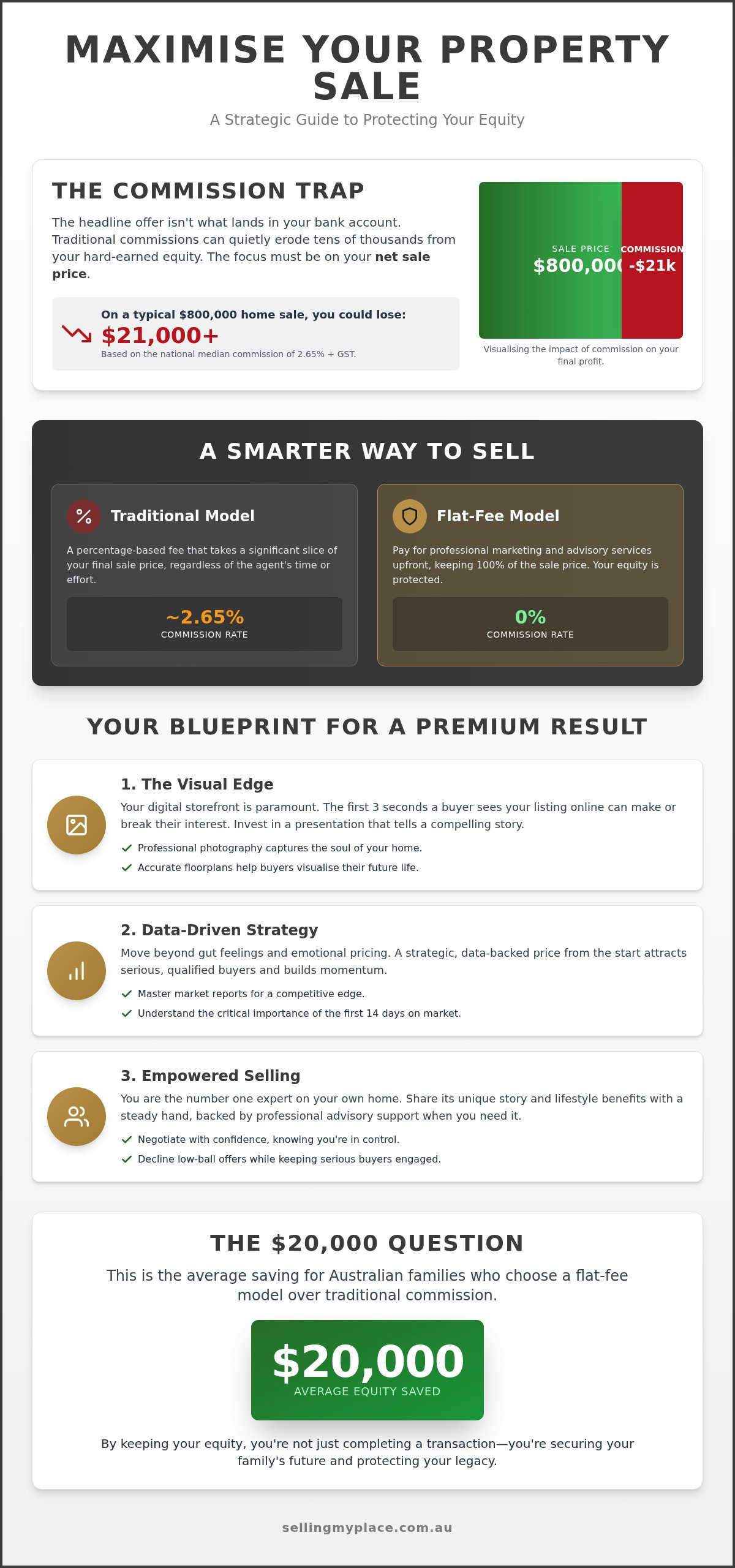
The Art of the Deal: Negotiation Tactics for Independent Sellers
Negotiation often feels like the most daunting part of the process, but it’s actually where your deep connection to the home becomes your greatest strength. To understand how to maximise property sale price, you must learn to separate your emotional memories from the financial transaction. By staying the “steady hand” during offers, you project a sense of calm confidence that reassures buyers and protects your position. It’s about being firm on value while remaining warm and accessible in your communication.
One of the most powerful tools in your kit is the word “No.” It might feel counterintuitive, but declining a low-ball offer doesn’t have to mean losing the buyer. Instead, it’s an opportunity to re-anchor the conversation to the data-driven value you’ve already established. If you need more granular strategies for these high-stakes moments, our property sale negotiation tips offer deep-dive tactics to help you navigate every counter-offer with ease.
Handling Enquiries and Filtering Buyers
Not every enquiry leads to a contract, and that’s perfectly fine. Your goal is to identify the most serious contenders early on so you can focus your energy where it matters most. Start by asking gentle, qualifying questions: “Has your finance been pre-approved?” or “What is your ideal settlement timeframe?” These conversations help you filter out the “tyre-kickers” while building genuine rapport. It’s about being the helpful, local expert without oversharing. If a buyer seems hesitant, a proactive follow-up call a few days after an inspection can often turn a “maybe” into a formal offer.
Closing the Sale: From Offer to Settlement
Once an offer is on the table, creating a gentle sense of urgency can help bring things to a head. Using “best and final” deadlines when you have multiple interested parties ensures everyone puts their best foot forward. After the price is agreed, the focus shifts to the technicalities. Professional conveyance advice is essential here to ensure your contract is legally sound and protects your hard-earned equity. Managing building and pest inspection results with confidence is also key; don’t let a minor maintenance issue derail your result. If you’re feeling overwhelmed by the back-and-forth, reach out for professional advisory support to ensure every detail of your sale is handled with care. This methodical approach ensures a smooth transition to settlement, allowing you to move forward with total peace of mind.
Empowered Selling: How Kincade International Direct Sales Maximises Your Equity
For many Australian families, the choice often feels like a compromise between a “cheap” private sale and an expensive agency experience. We believe you shouldn’t have to choose. The KIDS philosophy is built on the idea that every homeowner deserves access to professional tools and a global reach without the burden of a percentage-based commission. By providing a flat-fee marketing infrastructure, we empower you to take control of your future. Learning how to maximise property sale price is ultimately about combining your local heart with our global digital network, ensuring your home is seen by the right buyers at the right time.
One of the most significant advantages of this approach is the “Listed Until Sold” benefit. Traditional agents often push for a quick result to meet their own monthly targets, which can lead to unnecessary pressure to drop your price. With our model, there are no arbitrary time limits or mounting costs. You have the freedom to wait for the offer that truly reflects your home’s value, allowing you to maintain a steady hand throughout the entire process. Your property is positioned on a global stage through an integrated digital network that mirrors the marketing power of any premium agency, but with the equity staying exactly where it belongs: in your bank account.
A Partnership, Not a Commission
We see our role as a dedicated partner in your transition. Our Agent Advisory Service is designed to support you through every complex decision, from interpreting market data to navigating the final stages of a contract. We provide professional photography and high-definition floorplans that make your listing indistinguishable from an agent-led sale, ensuring you capture that critical “First Click” we discussed earlier. When you consider the average saving of $20,000 per sale, it becomes clear why sale by owner is becoming the smartest financial move for modern Australians who value their legacy and financial independence.
Taking the Next Step Toward Your Sale
Getting started is a straightforward process that begins with choosing a marketing package tailored to your needs. You’ll receive the same high-end presentation tools and professional advisory support used by the country’s top-performing listings. There is a profound sense of peace of mind that comes from knowing you are protected by a commission-free structure. You’ve done the hard work of maintaining and loving your home; now it’s time to ensure you reap the full rewards of that effort. If you’re ready to learn more about how to maximise property sale price while protecting your hard-earned equity, we’re here to guide you every step of the way. Enquire today to see how much commission you could save.
Securing Your Legacy and Your Next Big Chapter
Selling your home is a significant life transition, and it’s one you shouldn’t have to navigate with the weight of high commissions pulling at your profit. By focusing on professional-grade presentation and data-driven pricing, you’ve already taken the most important steps in learning how to maximise property sale price. The true measure of success isn’t just the figure on the contract; it’s the net equity that remains in your pocket once the dust has settled. Protecting that hard-earned wealth allows you to step into your next adventure with total financial confidence.
You don’t have to do this alone. With the support of our expert Agent Advisory Service, professional photography, and detailed floorplans, you can achieve a record-breaking result while saving an average of $20,000 in commissions. This partnership-based approach ensures you remain the steady hand in your sale while enjoying the global reach of a premium marketing infrastructure. It’s time to claim the full value of your home and your hard work. Maximise your sale profit with our commission-free listing packages and start your journey today. Your future self will certainly thank you for the extra equity.
Frequently Asked Questions
How much can I actually save by not using a traditional real estate agent?
You can save an average of $20,000 by choosing a flat-fee model over a traditional commission-based agent. Since the national median commission in Australia for 2026 is approximately 2.65 per cent, the costs of selling a standard family home can quickly escalate into the tens of thousands. By eliminating the percentage-based fee, you keep one hundred per cent of your sale profit. This extra equity provides a significant boost for your next deposit or retirement plans.
Will buyers be put off if I am selling the property myself?
Buyers are rarely put off by a direct sale if the listing is presented professionally. In fact, many purchasers appreciate the opportunity to speak directly with the person who knows the home’s history and lifestyle benefits best. When you utilise professional photography and floorplans, your listing is indistinguishable from one led by a traditional agency. This professional edge builds immediate trust and ensures that the focus remains entirely on the value of your property.
How do I know what my house is worth without an agent’s appraisal?
You can determine your home’s value by utilising comprehensive Neighbourhood Market Reports and data-driven property estimates. These reports look at actual recent sales of comparable properties in your area, considering land size, orientation, and internal finishes. Our Agent Advisory Service provides the objectivity needed to interpret this data without the emotional bias owners often feel. This methodical approach is a key part of how to maximise property sale price by finding the market’s sweet spot.
What is the most cost-effective renovation to increase my sale price?
The most cost-effective improvements often involve enhancing “First Click” appeal rather than major structural changes. Pre-sale property consulting can help you identify high-return tasks like professional painting, garden tidying, or updating lighting fixtures. These small but strategic updates ensure your home looks its best for the camera. By focusing on visual storytelling and presentation, you create an emotional hook that drives premium offers without the stress of a full-scale renovation project.
Can I still get my property on Australia’s major real estate websites without an agent?
Yes, your property will be featured on Australia’s leading property search websites through our integrated digital network. While individuals cannot typically list directly on these major national portals, our flat-fee infrastructure provides the necessary professional gateway. This ensures your home reaches a broad audience of active buyers, giving you the same marketing power as a high-end agency. You get the visibility you need to drive competition while maintaining total control over your equity and the sale process.
How does the Kincade Agent Advisory Service help with negotiations?
Our Agent Advisory Service acts as a steady hand, providing the technical expertise and distance required during high-stakes discussions. We help you qualify buyers by asking the right questions about their finance and settlement needs, which filters out less serious enquiries. When an offer arrives, we provide the strategic guidance to help you navigate counter-offers. This support ensures you feel empowered to hold firm on your price and achieve a record-breaking result.
What happens if my property doesn’t sell within the first month?
If your property doesn’t sell immediately, you are protected by our “Listed Until Sold” philosophy. Unlike traditional agencies that may pressure you to drop your price to meet their internal targets, we have no arbitrary time limits. This removes the stress of a ticking clock, allowing you to wait for the buyer who truly values your home. You can adjust your strategy based on real-time feedback while knowing your marketing presence remains active and professional.
Is professional photography really necessary for a private sale?
Professional photography is absolutely non-negotiable if you want to understand how to maximise property sale price. In a digital-first market, your photos are your first and most important point of contact with potential buyers. High-quality images captured in the right light highlight the lifestyle and “soul” of the home, which amateur smartphone snaps simply cannot replicate. This investment ensures your property stands out in a crowded market and attracts the serious, premium offers you deserve.
Private House Sales Australia: Maximise 2026 Profit
What if the $20,000 you’re planning to pay in agent commissions stayed exactly where it belongs, in your own bank account? As we move through 2026, many Aussie homeowners are realising that the traditional way of selling isn’t the only path to a premium result. While the national median commission rate currently sits at 2.65%, choosing private house sales australia allows you to bypass those hefty fees without sacrificing the professional polish your property deserves. It’s about taking back control of your equity while ensuring your home stands out on the major portals alongside the biggest agencies.
We understand that the thought of managing legal paperwork or negotiating a high-stakes sale can feel a bit daunting, especially when your family’s legacy is on the line. It’s completely natural to feel a flutter of anxiety about the technical side of listing or whether you’ll attract the right price. This guide shows you how to sell your property privately with total confidence, providing the expert advisory support and professional marketing tools you need to compete. You’ll discover how to navigate the settlement process smoothly and ensure you retain every cent of your hard-earned profit.
Key Takeaways
- Learn how transitioning to a flat-fee model can save you an average of $20,000 by removing traditional agent commissions from the equation.
- Discover how private house sales australia have evolved into a sophisticated “Direct Sale” strategy that empowers you to retain 100% of your property’s equity.
- Understand the essential steps for professional preparation, from high-quality photography to global marketing, ensuring your home competes with agency listings.
- Gain confidence in navigating the legal landscape with expert conveyance advice and advisory support that acts as your safety net throughout the sale.
- Explore the “listed until sold” advantage, which offers you the peace of mind to wait for the right buyer without the stress of arbitrary time limits.
The Evolution of Private House Sales in Australia
The landscape of property in Australia is changing. It’s no longer just about the “sold” sticker; it’s about how you get there. In 2026, private house sales australia have transitioned into a sophisticated “Direct Sale” model. This isn’t just a way to save a few dollars; it’s an evolution in how we value our homes and our time. Selling a family home carries immense emotional weight. It’s the place where memories were made and futures were planned. Naturally, you want more control over that transition and the equity you have built over the years.
The traditional high-commission agency model is facing a quiet revolution. Homeowners are realising that “selling smarter” doesn’t mean “selling cheaper” or cutting corners. By adopting a modern approach to the For Sale By Owner process, you can maintain professional standards while keeping your hard-earned profit intact. It’s a partnership where you lead the way, supported by expert advisory services that provide a steady hand during the negotiation and settlement phases. You aren’t just bypassing a middleman; you’re taking charge of your financial legacy.
Why Australian Homeowners are Choosing Direct Sales
Rising property values have inadvertently inflated traditional commission costs to eye-watering levels. With the national median commission rate sitting around 2.65% in 2026, a percentage-based fee feels less like a service charge and more like a tax on your home’s growth. Digital marketing tools that were once tucked away in agent-only portals are now accessible to everyone. This transparency allows for a direct, honest connection between you and the buyer. You know your home’s story better than anyone else, so why not be the one to tell it? Many families find that this direct interaction builds genuine trust and leads to a smoother, more personal exchange.
Debunking the “Agent-Only” Myth
When considering private house sales australia, there’s a common misconception that only traditional agents hold the keys to major buyer pools. That simply isn’t the case in today’s market. Professional marketing packages, including high-end photography and detailed floorplans, ensure your listing looks indistinguishable from agency-led properties on the major portals. This levels the playing field, allowing your home’s unique charm to shine through without the filter of a third party.
- Global Reach: Your property isn’t just seen by locals; it’s visible to international buyers searching for Australian lifestyle investments through global marketing networks.
- Professional Polish: High-quality visuals and professional-grade floorplans remove any “DIY” feel, projecting confidence and reliability to potential buyers.
- Expert Safety Net: Specialist advisory services replace the traditional agent’s role, guiding you through complex paperwork and negotiation tactics with calm authority.
By choosing this path, you aren’t going it alone. You’re simply choosing a more efficient, respectful way to move on to your next adventure. It’s about ensuring your hard-earned equity stays where it can best support your family’s future, rather than being lost to high marketing costs and commissions.
How to Organise a Successful Private Sale
Successful private house sales australia are built on a foundation of meticulous planning rather than a rushed weekend listing. The journey from valuation to settlement is a series of purposeful steps that require both a logical mind and a warm heart. Pricing your home correctly is the single most important decision you’ll make. It’s about finding that “sweet spot” where your property’s value meets the market’s appetite. To do this effectively, you should rely on detailed Neighborhood Market Reports rather than guesswork. Data from the Real Estate Institute of Australia suggests that buyers in 2026 are more informed than ever, making transparency and accuracy your best tools for a swift result.
Preparing Your Property for the Market
A “DIY” label can be a hurdle for a premium price, which is why professional preparation is your greatest ally. Think of your home as a product that needs a polished launch. Pre-sale property consulting is a wise first step; it helps you identify which small repairs will offer the highest return on investment and which ones you can safely skip. Professional photography and high-quality floorplans are absolutely non-negotiable. In the digital age, these assets serve as your home’s “first inspection” for thousands of potential buyers. You aren’t just selling bricks and mortar; you’re inviting someone to envision their own future within your walls. Creating an inviting, neutral atmosphere allows buyers to see the sanctuary your home provides rather than just a list of features.
Managing Enquiries and Inspections
Once your listing is live, managing the influx of interest requires a steady hand and a welcoming demeanour. You’ll need a digital infrastructure to track enquiries and vet potential buyers before they step through your front door. Hosting an open home is your chance to shine as a local expert. Be prepared to answer questions about the neighbourhood, the local schools, and the best coffee spots with a personal touch that a traditional agent might lack. If a question feels a bit technical or a negotiation becomes intense, having access to a dedicated advisory service provides the safety net you need. They can guide you through the “tough talk” with professional authority, ensuring you don’t feel overwhelmed by the process. If you’re feeling ready to take that first step, you can always reach out for a chat about your property’s potential.
The final phase, from contract exchange to settlement, is where the technical details really matter. This is the time to lean on expert conveyance advice to ensure every legal requirement is met and your interests are protected. By maintaining a professional standard from day one, you ensure that the transition to the new owners is as smooth and respectful as the years you spent in the home yourself.
The Financial Logic: Commission-Free vs. Traditional Fees
Selling your home is a major life milestone, but the financial side can often feel like a series of subtractions from your hard-earned equity. When you look at the numbers, the traditional commission model can be quite staggering. With the national median commission rate sitting at 2.65% in 2026, a homeowner selling a property for $1,000,000 is looking at a fee of $26,500 plus GST. That’s a significant amount of money that could be funding your next move, a renovation, or your retirement. Choosing private house sales australia allows you to keep that profit where it belongs, in your own pocket.
Transitioning to a flat-fee model isn’t just about cutting costs; it’s about financial empowerment. Instead of paying a percentage of your home’s value, you pay one transparent fee for the professional services required to reach a premium buyer. This shift in logic means you aren’t penalised for your home’s growth or the strength of the local market. It’s a fairer way to do business that respects the years of hard work you’ve put into your property.
Protecting Your Equity During the Sale
Traditional agency agreements often come with hidden strings. You might find yourself facing high marketing costs upfront or re-listing fees if the property doesn’t sell within a standard 90-day window. A modern fee real estate model removes this pressure entirely. With a “Listed Until Sold” commitment, you have the peace of mind to wait for the right buyer without the ticking clock of an expiring contract. This stability is vital for a calm, successful transition to your next property.
The Value of Professional Inclusions
Don’t mistake a commission-free sale for a budget service. Professional photography and floorplans are essential tools that pay for themselves by attracting higher-quality enquiries. While a local agent might focus on a small geographic radius, global marketing networks cast a much wider net. These platforms reach international buyers who see the unique value in the Australian lifestyle. Think of the Agent Advisory service as your financial insurance policy. It provides the expert guidance needed to navigate complex negotiations and secure the best possible outcome for your family’s future.
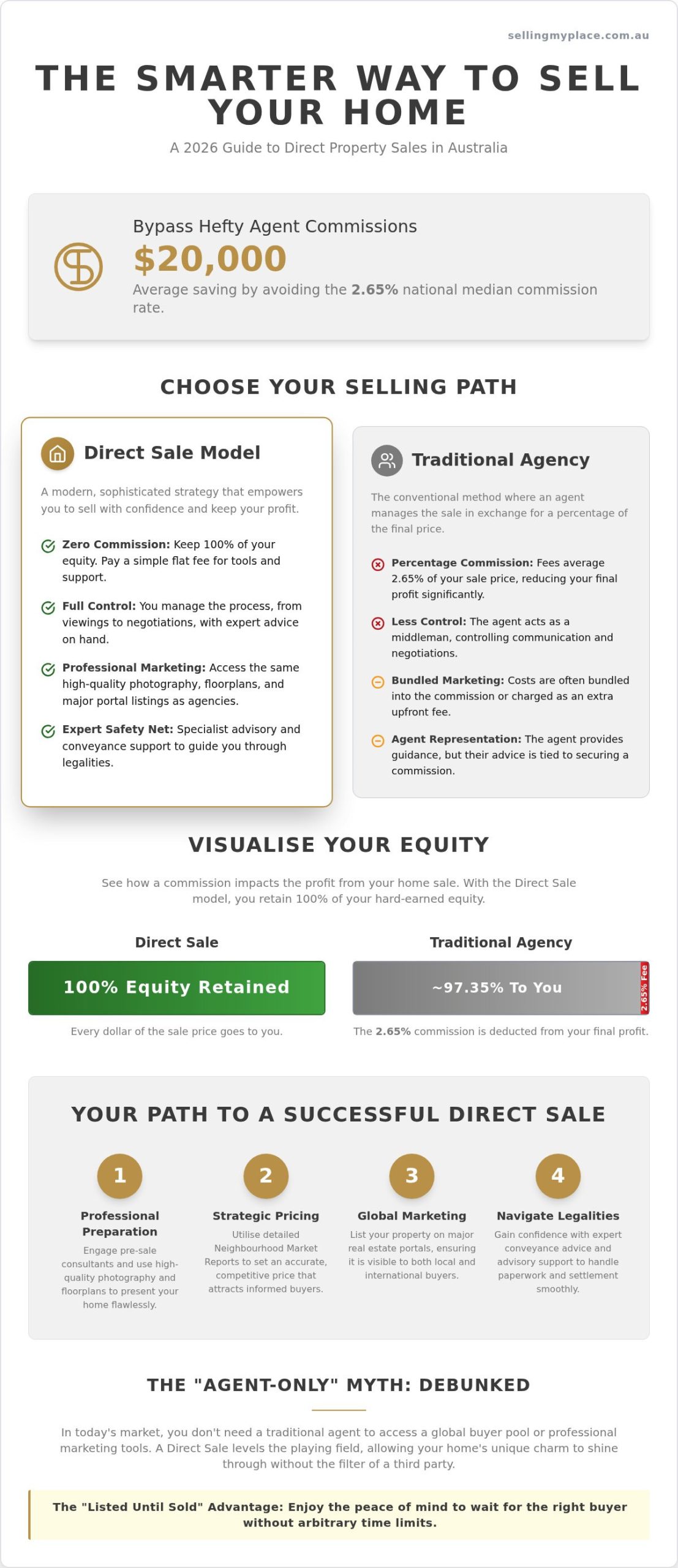
Navigating Legalities and Conveyance Advice
The legal side of selling a home is often where the most anxiety lives. It’s the “what if” that keeps many homeowners awake at night. What if a document is missing? What if the contract isn’t binding? It’s important to realise that the legal requirements for private house sales australia are structured to protect both parties, and you don’t have to navigate them in isolation. Think of conveyance advice as your professional shield; it ensures every “i” is dotted and every “t” is crossed before you ever sign on the dotted line. You are the heart of the sale, but you don’t have to be the legal expert.
While traditional agents often act as a conduit for paperwork, they aren’t legal professionals. By engaging directly with expert advisory services, you’re actually getting a more direct line to the expertise you need. This is where pre-sale property consulting adds immense value that many competitors overlook. By identifying potential legal hurdles, such as unapproved structures or complex easements, well before the first open home, you can address them calmly. It’s about being proactive rather than reacting under the pressure of a ticking settlement clock.
Understanding the Contract of Sale
Every Australian property contract must contain specific essential elements to be legally sound. Depending on your state, this might include a Section 32 or a similar disclosure statement that outlines the property’s history, rates, and zoning. Managing these documents without a traditional agent is straightforward when you have a clear roadmap. You can find a detailed breakdown of these legal requirements in our Sale by owner guide. Having an expert advisor review buyer offers is a vital safety net. They’ll look beyond the purchase price to ensure the terms, such as the deposit amount and settlement duration, align perfectly with your family’s needs.
The Settlement Process Simplified
The period between going “Under Contract” and reaching “Settled” is a time of transition. It’s when the financial obligations are cleared, titles are transferred, and the practicalities of moving house take centre stage. It can be an emotional time as you prepare to hand over the keys to a place that has been your sanctuary. Your conveyance advisor handles the heavy lifting of coordinating with banks and the buyer’s legal team, ensuring the financial exchange is flawless and titles are cleared correctly. This allows you to focus on the heart of the move, saying goodbye to your old neighbourhood and preparing for your next chapter.
If you’re feeling a bit overwhelmed by the technicalities of the paperwork, book a consultation with our advisory team to discuss your specific legal requirements and gain total peace of mind.
Why Kincade International is the Smarter Way to Sell
Choosing Kincade International Direct Sales (KIDS) means you aren’t just opting for a listing service; you’re entering a partnership. Most platforms for private house sales australia leave you to figure things out on your own, which can feel a bit like being left at sea without a compass. We believe the emotional weight of moving house requires more than just a digital portal. Our model combines global marketing reach with a deeply personal Agent Advisory Service. It’s a “steady hand” approach that balances professional decorum with a genuine understanding of your family’s needs and aspirations.
One of the most reassuring parts of our service is the “Listed Until Sold” commitment. Traditional agencies often trap you in 90-day cycles, creating a sense of urgency that can lead to undervalued sales or the stress of a looming deadline. We remove that ticking clock entirely. You have the freedom to wait for the buyer who truly appreciates your home’s value, without the anxiety of expiring contracts or the frustration of re-listing fees. This allows you to stay focused on your next chapter while we handle the technical heavy lifting.
Global Reach for Your Local Property
While local agents often focus on their immediate database or a small geographic radius, our network casts a much wider net. Our digital infrastructure is designed specifically for international visibility, ensuring your property is seen by expats and global investors looking for the stability and lifestyle of the Australian market. These buyers often see value that local-only advertising might miss. This global perspective is frequently the key to achieving a premium sale price, as it introduces your home to a much larger pool of motivated, high-intent purchasers.
A Steady Hand through Negotiation
Negotiation is the stage where many private sellers feel most exposed. Our Agent Advisory Service acts as your professional buffer, providing the authority needed to manage high-stakes conversations. You can utilise our property sale negotiation tips to prepare your strategy, but you’ll also have an expert by your side to handle the complex back-and-forth. Whether it’s managing multiple offers or vetting a buyer’s financial readiness, we provide the calm confidence needed to secure a result you’ll be proud of. It’s about ensuring you feel protected and supported until the moment the keys are handed over.
By blending professional authority with heartfelt warmth, we help you navigate the complexities of the sale with ease. You retain 100% of your equity while benefiting from the same high-end tools and global exposure used by the world’s leading agencies. It’s a smarter, more respectful way to honour the home you’ve built while preparing for the future.
Securing Your Property’s Future with Confidence
The journey of moving house is about more than just a transaction; it’s the start of your next chapter. By embracing the modern approach to private house sales australia, you’re choosing to protect the equity you’ve worked so hard to build over the years. You’ve seen how the combination of professional photography, global marketing reach, and expert conveyance advice ensures your home competes at the highest level without the weight of traditional commissions.
Retaining your profit doesn’t mean you have to go it alone. With a dedicated Agent Advisory Service by your side, you have a steady hand to guide you through every negotiation and legal hurdle. On average, our homeowners save $20,000 in commissions; a sum that can make a world of difference as you settle into your new neighbourhood. It’s about selling with heart, authority, and the calm confidence that your family’s financial legacy is secure. Ready to keep 100% of your equity? Explore our commission-free marketing packages today.
We’re here to help you make this transition as smooth and rewarding as it can possibly be.
Frequently Asked Questions
Is it legal to sell my own house privately in Australia?
Yes, it’s completely legal to sell your own property across every Australian state and territory. You don’t need a special licence to sell your own home; you simply need the right tools to handle the marketing and legal disclosures correctly. Many homeowners feel a sense of empowerment when managing private house sales australia. We provide the professional framework and conveyance advice required to ensure your contract is solid and your interests are fully protected.
How much can I actually save by choosing a private sale over a traditional agent?
Homeowners save an average of $20,000 in commissions by opting for a flat-fee model instead of a percentage-based charge. Traditional agents often take a significant slice of your home’s value, but private house sales australia allow you to keep that profit where it belongs. By replacing high commissions with a single, transparent fee, you retain 100% of your equity. This provides a much stronger financial foundation as you transition into your next family home.
Will my property appear on major property portals if I sell privately?
Your property will appear on Australia’s leading property websites and most prominent national portals, ensuring it stands side-by-side with agency listings. Our digital infrastructure provides high visibility, including access to our global marketing network for international reach. We provide professional photography and floorplans to ensure your listing looks polished and attracts high-quality enquiries. You’ll reach the same pool of motivated buyers while maintaining direct, personal control over the enquiries and inspections yourself.
How do I determine the right asking price without an agent?
You can set a realistic asking price by utilising our detailed Neighborhood Market Reports. These reports provide concrete data on recent sales and current market trends in your area, removing the guesswork from your decision. It’s about finding a balance between your property’s unique value and the current buyer appetite. Having this data at your fingertips gives you the confidence to stand firm during negotiations and achieve the premium result your family deserves.
What happens if my property doesn’t sell within a few months?
We offer a “Listed Until Sold” commitment, which means there are no arbitrary time limits or expiring contracts to worry about. This removes the immense pressure many sellers feel when a traditional 90-day agency agreement is coming to an end. You have the peace of mind to wait for the right buyer who truly values your home’s story. It’s a patient, respectful approach that ensures you never feel rushed into accepting a lower offer.
Do I still need a solicitor or conveyancer for a private sale?
You still need a legal professional, such as a solicitor or conveyancer, to handle the formal transfer of title. While you manage the marketing and inspections, they ensure the legalities are handled correctly during the settlement phase. We provide expert conveyance advice and pre-sale consulting as part of our service to act as your safety net. This ensures every document, from the Section 32 to the final contract, meets all Australian legal standards.
How does the Kincade International Advisory Service help with negotiations?
Our Real Estate Advisory Services provide a “steady hand” to guide you through the complexities of buyer talk and multiple offers. We act as your professional buffer, helping you vet potential buyers and interpret their feedback with total clarity. Whether you need specific negotiation tips or a second opinion on a contract term, our experts are there to ensure you feel supported. It’s a partnership that combines your local knowledge with our professional authority.
Can I sell my property privately if it is currently tenanted?
You can certainly sell a tenanted property privately, provided you follow the specific residential tenancy laws regarding notice periods for inspections. You’ll need to coordinate with your tenants for photography and open homes, which is often best handled with an open, respectful dialogue. We find that clear communication makes the process much smoother for everyone involved. Our pre-sale property consulting can help you navigate these requirements while ensuring your property is presented in the best light.
Boost Property Value: 2026 Guide for Australian Sellers
What if you could add twenty thousand dollars to your final sale price without lifting a single paintbrush or swinging a hammer? In 2026, the average Australian seller hands over roughly 2.65% of their home’s value in commission, which often means losing over $17,000 on a standard $700,000 property. It’s completely natural to feel a bit of anxiety about whether your renovation choices will actually pay off or if those high fees will simply eat away at your family’s future security. You’ve put years of love into your home, and we believe you should be the one to benefit most from its growth.
This guide will show you exactly how to increase property value before selling by focusing on the high-impact updates and strategic methods that modern buyers truly value. We’ll explore the latest energy efficiency trends, such as the new battery rebates, and explain how to present a professional listing that commands a premium price. You’ll learn how to refresh your space effectively while using a savvy, commission-free strategy that keeps your hard-earned equity right where it belongs. Let’s make your next big life transition as smooth and rewarding as possible.
Key Takeaways
- Learn how to distinguish between basic home maintenance and the high-ROI cosmetic updates, such as modern lighting and fresh paint, that truly drive up offers.
- Discover professional strategies on how to increase property value before selling by leveraging pre-sale consulting to identify exactly what local buyers are looking for in 2026.
- Understand why professional photography and detailed floorplans are the most critical tools for turning online browsers into premium, motivated bidders.
- Identify the latest value-adding features for the modern market, including energy-efficient solar systems and integrated smart home security tech.
- Master the “Net Profit” mindset to ensure you keep more of your home’s equity by choosing a commission-free selling model that puts your family first.
The ROI Mindset: Understanding Value vs. Expense in 2026
Before you pick up a hammer or visit a showroom, it’s vital to step back and look at your home through a buyer’s eyes. Selling a family home is a deeply emotional journey, but it’s also one of the biggest financial transactions you’ll ever manage. To get the best result, you need to master the Return on Investment (ROI) mindset. In the Australian market, ROI is the difference between what you spend on a refresh and the extra profit you walk away with at settlement. A solid grasp of understanding property valuation is the first step in ensuring your efforts translate into a higher bank balance rather than just a prettier room.
Many sellers confuse maintenance with improvement. Fixing a leaky roof or repairing a fence doesn’t necessarily add value; it simply prevents the price from dropping. These are “baseline” expectations. True improvements are strategic choices that make a buyer feel an immediate emotional connection. We often suggest the “Rule of Three” as a guide. For every $1,000 you invest in cosmetic updates, you should aim for a $3,000 increase in perceived value. If a renovation costs more than the suburb’s price ceiling can support, you’re at risk of overcapitalising. This is the most common mistake we see across the country, and it can quietly erode your equity before you even list.
Identifying ‘Profit-Killers’ in Your Home
Small defects often act as red flags. A cracked tile in the laundry or a dripping tap might seem minor to you, but to a nervous buyer, they signal years of hidden neglect. These “profit-killers” create a mental list of chores that lead to lower offers. Similarly, outdated colour schemes can make even a spacious floorplan feel cramped and tired. Clutter is another silent enemy. It swallows your square metreage and makes it impossible for a family to imagine their own lives in the space. Clearing the decks is the simplest way to make your home feel larger and more valuable.
The 2026 Buyer Profile: What Australians Value Now
Today’s buyers are looking for a sanctuary that’s ready for immediate enjoyment. The era of the “weekend warrior” fixer-upper has largely faded, replaced by a demand for move-in ready homes. With more Australians working flexibly, a dedicated home office nook or a clever multi-functional space is no longer a luxury; it’s a requirement. Buyers in 2026 also have high expectations for “invisible” value. This includes high-speed connectivity and integrated tech that makes daily life seamless. Focusing on these areas is a proven strategy for how to increase property value before selling while appealing to the modern Aussie lifestyle.
High-Impact Cosmetic Refreshes for Maximum Appeal
You don’t need a sledgehammer to transform your home’s marketability. Often, the most profound shifts in buyer interest come from subtle, thoughtful updates that breathe fresh life into tired spaces. When considering how to increase property value before selling, we recommend focusing on the “big four” cosmetic changes: paint, lighting, flooring, and hardware. A fresh coat of paint in a contemporary neutral palette, perhaps a warm white or a soft stone grey, can instantly modernise a property. It creates a clean, airy canvas that allows buyers to imagine their own furniture in every room. It’s easily the most cost-effective way to hit the “reset” button on an older home.
Lighting and hardware updates act as the jewellery of the home. Swapping out dated, yellowed oyster lights for sleek, energy-efficient LEDs creates a bright, inviting atmosphere that makes rooms feel larger and more vibrant. Similarly, updating old-fashioned cabinetry handles and kitchen taps can de-age a space by a decade. These small touches signal to buyers that the home has been meticulously cared for. If your carpets have seen better days, a professional deep clean is a must, but for a truly modern finish, consider installing hybrid planks. They offer the beauty of timber with incredible durability, making them a high-value favourite for busy Australian families.
Curb Appeal: Winning the Sale at the Front Gate
The sale often starts before the buyer even steps inside. A neat, well-defined garden with fresh mulch and pruned shrubbery creates an immediate sense of order and pride of ownership. Don’t underestimate the power of a bold, fresh front door and a thorough pressure clean of the driveway. Removing years of grime from paths can make the whole entrance look brand new. If you’re feeling overwhelmed by where to start, our team can provide expert pre-sale property consulting to help you prioritise the tasks that will make the biggest impact on your street appeal.
The ‘Mini-Makeover’ for Kitchens and Bathrooms
Kitchens and bathrooms are the emotional heart of a home, but you don’t always need a full demolition to see a result. A mini-makeover can be incredibly effective at boosting appeal without the high cost of a full renovation. Consider these high-impact steps:
- Regrout bathroom tiles to remove discolouration and provide a like-new finish.
- Replace old toilet seats and shower heads for instant hygiene appeal and a sense of freshness.
- Paint kitchen cabinetry using specialised laminate paint and update the splashback for a modern, high-end look.
These strategic updates ensure you are learning how to increase property value before selling by spending your budget where it will be seen and felt the most.
The Psychology of Presentation: Photography and Floorplans
In the 2026 Australian market, the “first inspection” doesn’t happen at your front gate. It happens on a smartphone screen while a potential buyer is sitting on their couch. Your online listing is the digital gateway to your home’s equity. If the photos don’t captivate within the first few seconds, a buyer has already swiped to the next suburb. High-quality imagery doesn’t just look pretty; it creates a psychological bridge that justifies a premium asking price before a single foot has crossed your threshold. It’s about building trust and excitement simultaneously.
When people ask how to increase property value before selling, they often focus on the physical walls, but the presentation of those walls is equally vital. Visual storytelling allows you to sell more than just bedrooms and bathrooms; you’re selling a lifestyle, a sanctuary, and a future. Professional presentation signals to the market that the property is a high-value asset, which naturally attracts more enquiries and, ultimately, more competitive offers.
Why Professional Photography is Non-Negotiable
There is a massive world of difference between a standard wide-angle phone shot and professional architectural composition. A seasoned pro knows how to harness the “golden hour” to make a living room feel warm and expansive. They understand how to lead the eye through a space, highlighting the premium finishes you’ve worked hard to update. For a deeper look at what makes a listing stand out, check out photography that boosts property clicks. It’s about creating an emotional pull that makes a Saturday viewing feel like an essential appointment.
The Strategic Importance of Accurate Floorplans
Floorplans are the unsung heroes of a successful sale. They allow buyers to “mentally move in” by figuring out where the family sofa goes or if the home office nook is large enough for their needs. This level of detail reduces “viewer fatigue” by ensuring that every person who walks through your door is already qualified and genuinely interested. A clear plan highlights storage, laundry placement, and the flow between indoor and outdoor living areas that a photo might miss. Recognising the importance of accurate floorplans is a key part of your strategy to attract premium buyers who value transparency and functionality.

Modern Upgrades: Sustainability and Lifestyle Value
By 2026, the Australian buyer’s wish list has shifted from purely aesthetic desires to practical, future-proofed functionality. While the cosmetic refreshes we discussed earlier create that vital emotional spark, modern upgrades in sustainability and lifestyle tech provide the logical justification for a premium offer. Today’s families are looking for homes that actively reduce their cost of living while enhancing their daily comfort. When you’re weighing up how to increase property value before selling, looking at the “invisible” infrastructure of your home can often yield the most significant results at settlement.
Solar power has transitioned from a niche addition to a top-tier selling point. With the 2026 battery rebate programs offering $300 per kWh for the first 14kWh of capacity, a home that’s already set up for energy independence is incredibly attractive. Beyond power, smart home integration is now a baseline expectation for many. Features like integrated security cameras, smart locks, and automated climate control systems offer a sense of modern luxury and peace of mind. These aren’t just gadgets; they’re investments in a seamless lifestyle that buyers are willing to pay extra for.
We also see a massive emphasis on the “home as a sanctuary.” This means creating dedicated, quiet spaces for productivity. A well-lit home office nook or a converted attic space can add immense value in a market where flexible work is the norm. Don’t forget the outdoor connection, either. A simple deck restain or the addition of a built-in fire pit area can turn a plain backyard into an alfresco retreat, effectively adding another “room” to your floorplan without the cost of a structural extension.
Energy Efficiency as a Value Driver
Small changes to your home’s thermal envelope can make a big difference in how it’s perceived during an inspection. High-quality ceiling fans and improved roof insulation are high-ROI updates that buyers notice, especially as energy costs remain a key concern. Highlighting these features, along with your home’s NatHERS energy rating, helps justify your asking price. For more insights on how these factors influence your final result, you can read our guide on how to determine the market value of a home in Australia. It’s all about proving the long-term savings your home offers to the next owner.
Storage Solutions: The Hidden Value
A lack of storage is a major deal-breaker for growing families. If your bedrooms lack built-in wardrobes, adding them is a smart move that instantly increases the room’s utility. In the garage, simple shelving and organisation systems can show off the potential for car and tool space, making the area feel like a bonus rather than a dumping ground. Even in the laundry or kitchen, a well-presented butler’s pantry or a clever cabinetry layout can be the final detail that seals the deal. If you’re unsure which upgrades will work best for your specific suburb, book a pre-sale property consultation with our team to get a tailored roadmap for your sale.
Protecting Your Equity: The Commission-Free Advantage
When we discuss how to increase property value before selling, the conversation usually revolves around kitchens, gardens, and fresh paint. While those physical updates are essential for attracting buyers, there’s a second, equally powerful way to boost your final result: reducing the cost of the sale itself. True property value isn’t just the number written on the contract; it’s the amount that actually lands in your bank account at settlement. We call this the ‘Net Profit’ reality. By choosing a smarter path to market, you can protect the equity you’ve spent years building and ensure your family’s future stays secure.
In August 2026, the national median real estate commission sits at approximately 2.65%. On a typical $700,000 home, that’s $18,550 before you’ve even considered GST or marketing costs. It’s a significant sum of money that could be better used for your next home deposit or to fund your retirement. There’s a common myth that only a traditional agent can secure a high price, but the reality is that motivated buyers care about the property, the location, and the presentation. As the owner, you’re the most passionate and knowledgeable advocate for your home’s unique story. No one else can describe the way the morning light hits the deck or the friendly vibe of the local street quite like you can.
Why Saving $20,000 in Fees is the Ultimate Value-Add
Think of a flat-fee model as an instant $20,000 upgrade to your sale price. While a traditional 2.5% commission scales up and penalises you for achieving a better result, a flat-fee approach keeps your costs predictable and fair. This saved capital is a tangible reward for your hard work. Whether you’re upgrading to a larger family home or downsizing for a sea change, that extra $20,000 provides a massive head start. If you’re curious about taking the reins yourself, our How to Sell Your Own Home: A Step-by-Step Guide offers a clear roadmap to navigate the process with confidence.
Expert Pre-Sale Consulting and Advisory
Taking control doesn’t mean you have to go it alone. You can still access professional-grade real estate advisory services and detailed neighbourhood market reports to ensure your pricing strategy is spot on. This partnership-based approach gives you the professional edge usually reserved for high-end agencies, but without the high-end price tag. By combining your local knowledge with expert data, you’re positioned to achieve a premium result while keeping 100% of the profit. It’s about being proactive, staying informed, and leading the process with heart. Maximise your profit with our commission-free advisory today.
Take the Lead on Your Home’s Final Chapter
Selling your home is a significant milestone, and getting the best result requires a blend of heart and strategy. You’ve now seen how focusing on high-ROI cosmetic updates and embracing modern sustainability can transform your property’s appeal. By mastering how to increase property value before selling, you ensure your home stands out in the 2026 market as a premium, move-in ready sanctuary. But remember, the most impactful way to boost your bottom line is by protecting the equity you’ve spent years building.
Why settle for losing a massive chunk of your profit to traditional fees? With our flat-fee model, you’ll save an average of $20,000 in commissions while still receiving the professional edge of high-end photography and accurate floorplans. It’s time to move forward with confidence, knowing you’ve kept 100% of your sale profit for your family’s next adventure. Start your commission-free selling journey with Kincade International Direct Sales and let’s make your next move your best one yet. You’ve got this, and we’re here to guide you every step of the way.
Frequently Asked Questions
What is the single best way to increase property value before selling?
The most effective approach is a combination of high-impact cosmetic refreshes and a commission-free selling strategy. While fresh paint and modern lighting create an emotional spark, keeping your equity by avoiding traditional commissions adds an average of $20,000 to your net result instantly. This dual focus ensures you present a professional listing that attracts premium buyers without losing your hard-earned profit to high marketing costs or traditional agency fees.
Is it worth renovating a kitchen before selling in 2026?
A full kitchen renovation is rarely worth the risk of overcapitalising in the current market. Instead, we recommend a “mini-makeover” that focuses on high-impact changes like regrouting tiles, painting cabinetry, and replacing dated hardware. These updates provide a fresh, modern look for a fraction of the cost. By spending less on the renovation itself, you protect your ROI and ensure the home appeals to the widest possible range of buyers.
How much does professional photography actually help a sale?
Professional photography is absolutely essential because your online listing is the actual first inspection. High-quality imagery creates a psychological bridge that justifies a premium price before a buyer even arrives. Properties with professional photos and floorplans typically receive a much higher volume of enquiries. Since these services are included in our flat-fee model, you can present a world-class listing that captures attention without the burden of high marketing costs.
Can I really sell my own home without a traditional real estate agent?
You certainly can, and many Australians find it incredibly rewarding to act as their own advocate. By using a flat-fee marketing and advisory service, you get access to the same professional tools as a traditional agency, including listings on major portals, professional photography, and floorplans. You’ll have expert pre-sale consulting to guide you through the process, allowing you to keep 100% of your sale profit while managing the transition on your own terms.
What colours should I paint my house to attract the most buyers?
To attract the most buyers, stick to a palette of modern neutrals like warm whites or soft, stony greys. These colours create a clean, airy canvas that makes rooms feel larger and allows potential buyers to imagine their own lifestyle in the space. Avoid bold or highly personal colour choices that might polarise your audience. A fresh coat of neutral paint is one of the simplest ways to modernise a property and boost its market appeal.
How do I calculate the potential ROI of a home improvement?
A reliable way to calculate ROI is the “Rule of Three,” where you aim for $3 in perceived value for every $1 you spend. Always research your local suburb’s price ceiling first to ensure your improvements don’t exceed what the market is willing to pay. Understanding how to increase property value before selling involves balancing these costs against the potential for a higher offer, ensuring every dollar spent works hard for your bottom line.
Do solar panels increase home value in Australia?
Solar panels and battery storage are now top-tier selling points for Australian buyers concerned about the rising cost of living. With the 2026 battery rebates offering significant savings on installation, energy-efficient homes are seen as future-proofed and more valuable. Highlighting solar capacity and a high NatHERS energy rating in your listing can be a decisive factor for families looking to reduce their ongoing expenses while enjoying a comfortable, sustainable lifestyle.
What are the most common mistakes sellers make when trying to add value?
The biggest mistake is overcapitalising on niche renovations that don’t appeal to the broader market. Many sellers also neglect small profit-killers like leaky taps or cracked tiles, which signal neglect to buyers. Finally, failing to account for high real estate commissions can be a costly error. Choosing a flat-fee model helps you avoid these pitfalls, ensuring you don’t lose twenty thousand dollars of your equity at the very end of the process.
Flat Fee Property Listing Australia: The 2026 Guide to Protecting Your Equity
The equity you’ve built in your home over the years is more than just a number; it’s your hard-earned security and your family’s legacy. Yet, as we move through 2026, many Australian homeowners still feel held to ransom by commission rates that swallow tens of thousands of dollars. It’s frustrating to watch a significant slice of your profit vanish simply because property values have risen. You aren’t alone if you’re questioning why a flat fee property listing australia model isn’t already the standard. You’ve done the hard work of maintaining the garden and paying the mortgage, so it feels only right that you keep the rewards of that effort.
We understand the anxiety that comes with changing the status quo, especially when you’re worried about whether a different approach might impact your final sale price. This guide is here to show you that you don’t have to choose between professional excellence and fair pricing. We’ll explore how to secure a high-calibre listing, complete with professional photography and floorplans, while leaning on expert advisory services for those tricky negotiations. You’ll learn exactly how to bypass hidden marketing blowouts and maintain 100% of your sale profit. We’re going to break down the 2026 landscape so you can move forward with a steady hand and total confidence.
Key Takeaways
- Discover how to decouple service costs from your home’s final price, ensuring you protect your hard-earned equity and avoid traditional commission traps.
- Learn the importance of professional-grade assets, like high-end photography and floorplans, in capturing the attention of the modern digital buyer.
- Understand how expert real estate advisory services provide a steady hand during complex negotiations, ensuring you never have to navigate the sale alone.
- Identify data-driven pricing strategies and simple pre-sale improvements that help you secure a premium result while keeping your profit.
- Explore why a flat fee property listing australia combined with global marketing reach is the smartest way to manage your next major life transition.
Rethinking Real Estate: What is a Flat Fee Property Listing in Australia?
A flat fee property listing is a transparent service where you pay a single fixed price for marketing and professional support. Unlike traditional models, the fee is decoupled from your home’s final sale price, protecting your hard-earned equity from being eroded by rising commissions. This model functions as a performance-oriented partnership between the seller and the marketing provider. By choosing a flat fee property listing australia, you remove the “commission tax” that often penalises homeowners in high-growth markets. It is a straightforward way to keep your profit where it belongs; in your bank account.
As we explore Rethinking Real Estate: What is a Flat Fee Property Listing in Australia?, it becomes clear that this model is about transparency and fairness. It’s a shift away from the “black box” of traditional real estate, where marketing costs and agent bonuses can feel opaque and overwhelming.
The Evolution of the Australian Property Market
Property values in 2026 have continued to show resilience, with the national median dwelling value reaching $922,838 in early February. For many Australian families, this growth represents a significant life milestone, yet it comes with a hidden sting. When commissions are percentage-based, every dollar your home gains in value results in a larger bill from your agent. This has sparked a significant shift toward “sell my home no commission” searches as owners seek more control over their financial outcomes. We are seeing a rapid local adoption of fixed-fee models that have already dominated the UK and USA landscapes for years, providing a more stable and predictable path for sellers.
Commission vs. Flat Fee: A Financial Comparison
There is a common “Incentive Myth” that suggests a percentage-based commission makes an agent work harder. In reality, the difference between a good sale and a great sale might only mean a few hundred extra dollars for the agent’s pocket, but it represents thousands of dollars for your family’s future. Consider the following points:
- The Real Cost: On a $1M home, a 2% commission takes $20,000 from your equity. A flat fee model allows you to access professional residential property listing services for a fraction of that cost.
- Budget Certainty: Knowing your exact selling costs before you even go to market offers a sense of calm confidence.
- Marketing Quality: You receive professional-grade assets without the fear of hidden marketing blowouts that often surprise sellers at the end of a campaign.
Decoupling the service fee from the sale price ensures that your interests are truly aligned. It allows you to plan your next move with a steady hand, knowing that your hard-earned equity is protected. This isn’t just about saving money; it’s about valuing the legacy you’ve built in your home.
The Mechanics of a Professional Flat Fee Listing Service
Understanding the inner workings of a flat fee property listing australia service helps demystify the process and build confidence. It is a structured, four-step journey designed to put you in the driver’s seat while providing a sturdy framework of professional support. We begin with expert pre-sale consulting. This isn’t just a chat about price; it’s a deep dive into your property’s unique story and its position in the current market. Identifying those special features that make a house a home allows for a targeted strategy that resonates with the right buyers.
Once the strategy is set, we move to professional asset creation. This includes high-end photography and accurate floorplans, ensuring your property stands out for all the right reasons. Your home is then listed across major Australian portals and a sophisticated global marketing network. Finally, we assist with managing enquiries. Having access to real estate advisory services for negotiation and conveyance advice ensures you have a seasoned partner by your side until the keys are handed over. This comprehensive approach ensures no detail is missed.
Why Visual Marketing is Non-Negotiable
In a digital-first world, your online presentation is your only first impression. High-quality professional photography is essential for stopping the scroll on busy portals. It’s about more than just a pretty picture; it’s about inviting a buyer to imagine their life within your walls. Accurate floorplans are equally vital. They provide the spatial context that serious, qualified buyers need, effectively reducing the number of “tyre-kickers” who might otherwise waste your time. This level of professional presentation is a key component of Maximising Your Profit: A Roadmap for Australian Sellers, as it signals value and quality to the market.
Global Reach for Local Australian Properties
The days of relying on a local high-street office window to sell your home are long gone. By 2026, the primary driver of property sales is digital infrastructure. This allows local Australian properties to reach interstate investors and international buyers with ease. One of the most reassuring aspects of this model is the “listed until sold” advantage. Traditional time limits on listings can create unnecessary pressure and anxiety for families. By removing these relics of the past, you can wait for the right offer that truly reflects your home’s worth. If you’re ready to see how this modern approach can work for you, reach out to our team for a chat about your goals.
Expert Backing: The Role of Real Estate Advisory Services
Selling your family home is one of the most significant transitions you’ll ever make. It’s a time filled with memories and, naturally, a bit of trepidation. A common misconception is that choosing a flat fee property listing australia means you’re going it alone, but that couldn’t be further from the truth. Instead, you’re simply choosing a different kind of expert. By utilising real estate advisory services, you gain access to a seasoned partner who provides the professional oversight you need without the hefty commission price tag. It’s about having a steady hand to guide you through the complexities of the market.
This partnership often begins long before the first “for sale” sign goes up. Pre-sale consulting is a vital step that helps you avoid the trap of over-capitalising on renovations. We’ve all seen it; a homeowner spends $40,000 on a designer kitchen only to find it adds half that to the sale price. An advisor helps you identify the high-impact, low-cost “quick wins” that actually move the needle. This grounded, practical approach ensures your equity stays in your pocket rather than being sunk into unnecessary upgrades that don’t offer a return on investment.
Negotiation Strategies for the Empowered Seller
Dealing with potential buyers can feel like a bit of a rollercoaster, especially when emotions are running high. It’s easy to take a low offer personally or feel pressured to make a snap decision during a tense phone call. An advisory service acts as your buffer, helping you maintain an objective stance. With a large majority of property professionals expecting dwelling values to rise throughout 2026, you need to be firm on your home’s worth. We help you use data-driven Neighborhood Market Reports to justify your asking price with cold, hard facts. This empowers you to negotiate with calm confidence rather than relying on a “gut feeling” or an agent’s agenda.
Navigating the Legal Landscape
The legal transition of a property is where many sellers feel the most stress. Managing contracts and required disclosures requires an eye for detail and a thorough understanding of current regulations. This is where conveyance advice becomes indispensable. It’s about ensuring the paperwork is as solid as the foundations of your home. By having a clear roadmap for the settlement process, you can focus on your next chapter while we help ensure the legal journey is seamless. Think of it as professional decorum paired with a genuine sense of duty to your family’s financial future.
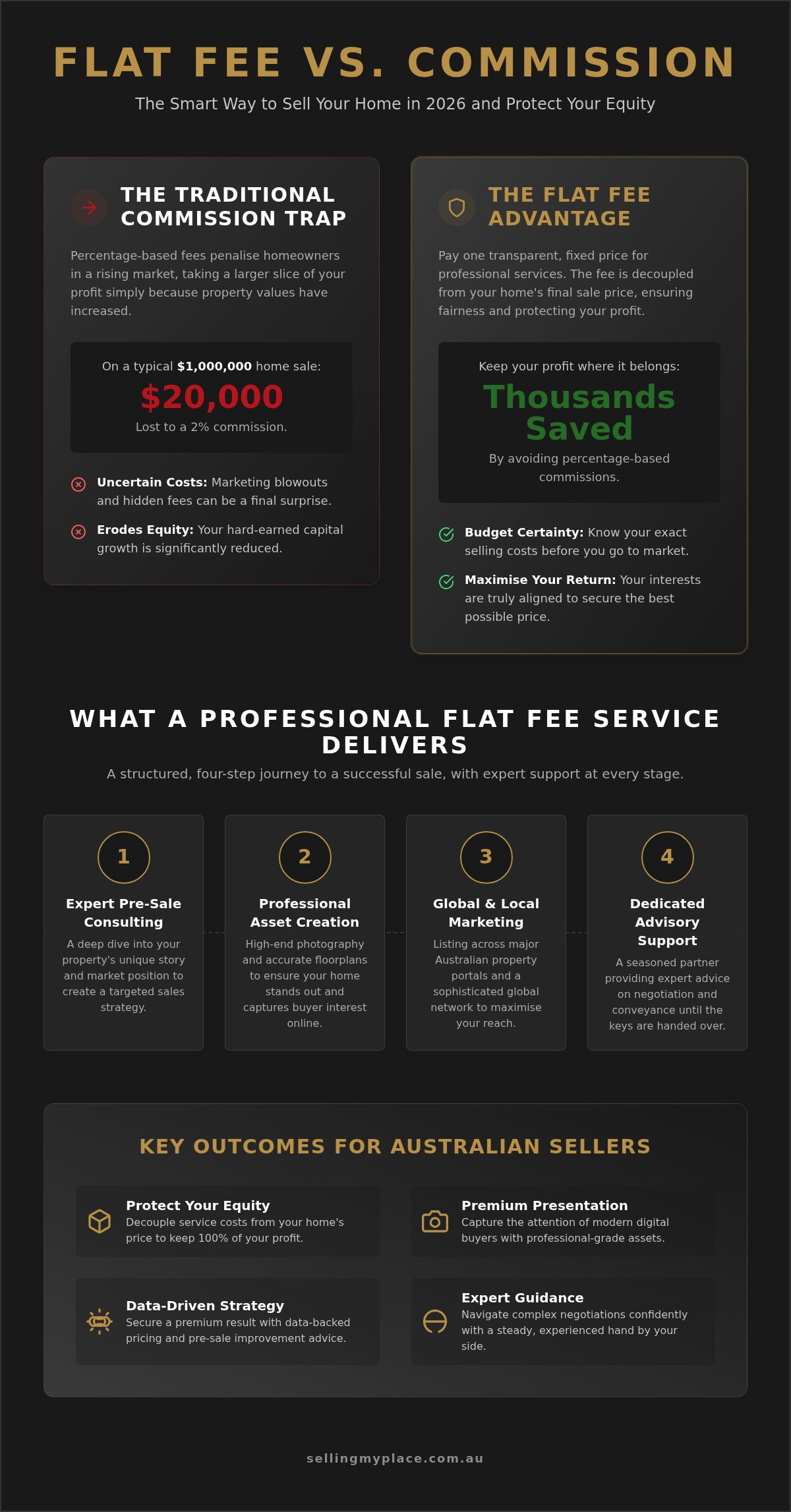
Maximising Your Profit: A Roadmap for Australian Sellers
Achieving a premium result is about more than just putting a sign in the front yard. It’s a methodical process that combines careful presentation with precise, objective data. When you opt for a flat fee property listing australia, you’re choosing a model that rewards your attention to detail and your intimate knowledge of your home. By focusing on high-impact minor repairs and curb appeal, you ensure the first impression is one of care and stability. This isn’t just about aesthetics; it’s about signalling to the market that your home has been a well-loved sanctuary for your family.
Utilising a flat fee property listing australia framework allows you to be the primary advocate for your property. You know which window catches the morning sun and which local park is best for a weekend stroll. Engaging with buyers directly allows you to convey these lifestyle benefits with a warmth and authenticity that no third party can replicate. To ensure your equity is fully protected, it’s wise to keep your marketing active until the final settlement. This provides a vital backup plan should circumstances change, giving you total peace of mind throughout the transition.
Preparing Your Home for the Professional Lens
Decluttering is your first essential step. It allows the space to breathe and lets buyers project their own lives onto the canvas you’ve created. When it comes to photography, the “Golden Hour” is particularly important in the Australian climate. This brief window of soft, warm light just before sunset can make your outdoor entertaining areas feel like a private oasis. Industry observations suggest that a well-prepared home can increase click-through rates by up to 40% compared to properties that appear cluttered or poorly lit. Small touches, like fresh mulch in the garden or a clean driveway, go a long way in stopping the scroll on a smartphone screen.
Setting the Right Price with Data
Setting the right price is perhaps the most critical decision you’ll make in your selling journey. It’s vital to determine the market value of a home in Australia using recent comparable sales rather than an agent’s “gut feeling”. Avoiding the overpricing trap is essential; a price that is too high can lead to a stale listing, which often results in a lower final sale price as buyers become wary. Transparency in your initial listing price builds immediate trust with the community and attracts genuine, qualified buyers who are ready to act. If you’re ready to take the next step in your property journey, get in touch with us today to discuss your personalised roadmap.
Why Kincade International Direct Sales is the Smarter Choice
Choosing the right partner for your property journey is about finding a balance between cutting-edge digital reach and a genuine, human connection. Kincade International Direct Sales (KIDS) provides exactly that. We don’t just list your home; we integrate it into a sophisticated global marketing network that ensures your property is seen by the right eyes, whether they’re across the street or on the other side of the world. By opting for a flat fee property listing australia through our model, you’re embracing a partnership approach that treats your sale as a significant life transition, not just another line in a ledger. We’re here to ensure your story is told with the respect and professional polish it deserves.
Security is at the heart of everything we do. This is why we offer a “listed until sold” guarantee, providing you with a sense of stability and peace of mind, regardless of how the market fluctuates in 2026. You won’t find arbitrary time limits here. Instead, you’ll find a comprehensive suite of professional assets included as standard in our packages. From high-end photography and accurate floorplans to the expert advisory services we’ve discussed, every element is designed to showcase your home’s true value while keeping your equity where it belongs. It’s a thorough, attentive service that leaves nothing to chance.
A Legacy of Expert Support
Experience matters when the stakes are this high. We leverage over 25 years of industry knowledge to guide you through every twist and turn of the selling process. This isn’t just about technical expertise; it’s about the emotional intelligence required to understand the weight of selling a family home. We know that behind every contract is a family looking toward their next chapter. We act as your “steady hand,” providing a reassuring presence that reduces the stress of complex negotiations and legal requirements. You can move forward with calm confidence, knowing you have a seasoned advisor in your corner who values long-term relationships over quick results.
Take Control of Your Property Future
The financial impact of choosing a flat fee property listing australia is profound. When you save an average of $20,000 in unnecessary commissions, that money stays with you to fund your next purchase, renovate your new space, or simply bolster your family’s financial security. You’re joining a growing movement of empowered Australian sellers who are choosing transparency and fairness over outdated traditions. It’s time to take control of your property future. Starting your journey with a professional listing is a simple, straightforward process that prioritises your needs and your legacy. We’re ready to help you make your next move your best move yet.
Your Path to a Smarter, More Profitable Sale
Your home is likely your most significant asset. As we navigate the 2026 property market, protecting the equity you’ve built should be your top priority. We’ve explored how a flat fee property listing australia allows you to maintain control while accessing the same high-calibre marketing tools used by the country’s top agencies. By choosing a partnership based on transparency rather than a percentage, you ensure your profit stays exactly where it belongs; with your family.
Securing a professional result doesn’t have to mean sacrificing your hard-earned gains to unnecessary commissions. With Kincade, you’ll save an average of $20,000 in fees while benefiting from professional photography, accurate floorplans, and our dedicated Agent Advisory Service. This isn’t just about a transaction; it’s about a steady hand guiding you through a major life transition with heart and expertise. You’ve done the hard work of building your home’s value, so let’s make sure you keep it.
Keep 100% of your profit and list with Kincade today to start your journey with a partner who values your legacy as much as you do.
Frequently Asked Questions
Is a flat fee property listing legal in all Australian states?
Yes, the flat fee model is completely legal across all Australian states and territories. Real estate commissions are not regulated by the government, meaning you have the freedom to negotiate how you pay for marketing and support. Choosing a flat fee property listing australia ensures you are operating within a transparent framework that prioritises your equity. It’s a modern approach that complies with national property laws while giving you more control over your financial outcome.
Do I still get my property listed on the major real estate websites?
Absolutely, your home will be featured on the major Australian property portals where the vast majority of buyers begin their search. We provide the digital infrastructure needed to ensure your listing looks professional and reaches a wide audience. Beyond local sites, our global marketing network helps your property gain visibility with interstate and international investors. You get the same premium digital exposure as a traditional agency listing without the high commission costs attached.
What happens if my property doesn’t sell within a few months?
We offer a “listed until sold” guarantee, which means there are no arbitrary time limits on your marketing campaign. If your property takes a little longer to find the right buyer, your listing stays active without additional listing fees. This removes the pressure to drop your price prematurely and provides a sense of stability. We’re committed to a long-term partnership, ensuring your home remains visible until the keys are successfully handed over to the new owners.
Who handles the actual property inspections and open houses?
As the person who knows your home best, you’ll handle the property inspections and open houses. This allows you to share the authentic story of your neighbourhood and the unique features of your property directly with buyers. While you host the visits, our Real Estate Advisory Services are always available to provide guidance on how to present your home effectively. Most owners find that buyers appreciate the direct, honest communication that comes from dealing with the homeowner.
Can I still use a solicitor or conveyancer for the legal paperwork?
Yes, you should always engage a qualified solicitor or conveyancer to manage the legal aspects of your sale. While we provide expert conveyance advice to help you understand the process, the actual preparation of the contract and the settlement must be handled by a legal professional. This ensures that your interests are fully protected throughout the legal journey. We work alongside your chosen representative to make sure the transition of your property is as seamless as possible.
How does the Agent Advisory Service actually help me during the sale?
Our Agent Advisory Service acts as your “steady hand” throughout the entire process, offering professional backing without the commission. We provide pre-sale consulting to help you identify high-impact improvements and use Neighborhood Market Reports to help you set a data-driven price. When it comes to negotiations, we’re there to offer strategic advice, helping you navigate complex conversations with buyers. It’s about giving you the confidence of a seasoned expert while you maintain control of the sale.
Will buyers be put off if they see I am selling without a traditional agent?
In 2026, savvy Australian buyers are becoming increasingly comfortable with direct sales models. They often prefer the transparency and direct communication that comes from dealing with the owner. As long as your property is presented professionally with high-quality assets, buyers will focus on the value of the home itself. Our professional photography and floorplans ensure your listing looks identical to a traditional agency ad, maintaining the decorum and authority expected in a high-stakes transaction.
What is included in the professional photography and floorplan package?
Our comprehensive package includes high-end photography designed to capture your home’s best features and stop the scroll on major portals. You’ll also receive accurate floorplans, which are essential for helping buyers understand the spatial layout of your property before they visit. These assets are produced to a professional standard, ensuring your home looks its absolute best. Providing this level of detail helps attract serious, qualified buyers and signals that you are committed to a high-quality, professional sale process.
The Average Real Estate Commission in Australia: 2026 Seller’s Guide
If you sold your family home tomorrow, would you feel comfortable handing over a $30,000 cheque for a few weeks of marketing, regardless of the final result? Most Australian homeowners feel a genuine sense of unease when they realise just how much of their hard-earned equity disappears into traditional fees. It is a high-stakes moment (perhaps the biggest of your life) and understanding the average real estate commission in Australia is the first step toward reclaiming control over your financial future.
We understand that the stress of selling isn’t just about the move itself, but the fear of overpaying for a service that doesn’t always feel personal or transparent. You deserve a professional partnership that values your legacy as much as you do. This guide will show you exactly what to expect from fee structures in 2026, including the latest regulatory changes and marketing costs. We will also explore modern, fixed-cost alternatives that offer a steady hand through the process, ensuring you keep the profit you have worked so hard to build.
Key Takeaways
- Learn what influences the average real estate commission Australia wide to ensure you aren’t overpaying for a standard service.
- Discover how to separate agent fees from marketing costs so your advertising budget is truly working to showcase your home’s value.
- Gain the confidence to negotiate by identifying which professional services are essential for a successful listing and which are unnecessary extras.
- Explore how a modern flat-fee model allows you to protect your hard-earned equity and keep 100% of your sale profit.
- Recognise how a “steady hand” advisory partnership reduces the stress of selling while prioritising your family’s long-term financial security.
Understanding the Real Estate Commission Landscape in Australia
Selling your home is a monumental life transition. It is about moving toward a new chapter, but it’s also about safeguarding the financial legacy you have built over many years. The professional fee you pay for this process is called a commission. To truly grasp the role of the person you are hiring, you might wonder, what is a real estate agent? Essentially, they are licensed professionals who facilitate the sale by finding buyers and managing the complex legalities involved. In the current market, the average real estate commission australia sellers encounter is a significant consideration that directly impacts your final profit.
While the traditional model has relied on percentage-based fees for decades, 2026 has seen a significant shift in seller sentiment. Homeowners are seeking a partnership that feels more like a shared journey and less like a transactional expense. They are moving away from the outdated idea that an agent’s pay should automatically balloon just because property values have risen. This is where modern, flat-fee alternatives are making a real difference. These models offer a steady hand and professional authority without the unpredictable price tag, allowing you to plan your next move with total confidence.
Fixed vs. Tiered Commission: What is the Difference?
A fixed commission is the most common structure. You agree on a set percentage of the final sale price before the campaign begins. It’s a standard approach, yet it still means your costs rise simply because the market is performing well. Tiered commissions are more intricate. These involve a bonus structure where the agent receives a higher percentage if they achieve a price above a specific threshold. While agents often pitch this as an incentive to go the extra mile, many sellers find it creates a conflict of interest or unnecessarily complicates the final settlement. Equity protection in commission-free selling means ensuring that every extra dollar a buyer pays stays in your pocket, not your agent’s.
Why Do Commissions Vary Across the Country?
You might notice that the average real estate commission australia reports varies quite a bit by location. In high-density capital cities, market competition is incredibly fierce. With hundreds of agencies vying for your listing, rates are often pushed down, sometimes dipping below 2% in certain competitive pockets. Conversely, regional areas frequently see higher percentages. This happens because there is typically less property turnover and fewer active agents to drive prices down.
It’s a bit of a local quirk, isn’t it? Even though the digital tools and professional photography used to market a home are identical whether you are in a major city centre or a quiet regional town, the going rate fluctuates based on local volume. Regardless of where you live, the service you receive should be comprehensive and supportive. You deserve expert advice and a polished presentation without a fee structure that feels like a penalty for your home’s location or its increasing value.
The Science of the Sale: What Influences the Average Rate?
Understanding what shapes the average real estate commission australia reports requires looking beyond just the numbers on a page. It’s about the local heartbeat of your specific area and the unique story of your home. If you’re selling a sleek apartment in a high-demand, inner-metropolitan pocket, you’ll likely find agents are more competitive with their fees. However, a sprawling family estate in a quiet regional area might attract a higher percentage because the buyer pool is smaller and the “days on market” are typically longer. It’s a simple case of supply and demand, but it can have a profound impact on your final settlement figure.
The reputation of the agent also plays a significant role in the fee you’re quoted. High-profile agents often charge a premium for their “brand”, but it’s vital to ask if that extra cost translates into a better experience for your family. Think about the maths for a moment. A 2% commission on a $500,000 home is $10,000. That same 2% on a $1 million home jumps to $20,000. Did the agent really perform twice the amount of work? In most cases, the digital tools and administrative processes are identical. This disparity is why many savvy sellers are questioning the fairness of the percentage model as property values continue to climb.
The Impact of Property Value on Percentage Rates
Data from early 2026 shows a clear trend: commission rates are often lower in areas with higher property values. In major metropolitan hubs, where the national median dwelling value reached $922,838, commission rates typically range from 1.6% to 2.5%. Compare this to more remote regional areas, where rates can climb to 3% or more. This is the regressive nature of real estate fees. As your property value increases, agents are often more willing to nudge their percentage down because the total dollar amount remains substantial. It’s a bit of a paradox, isn’t it? You’re essentially being asked to pay more simply because your home is worth more, regardless of the effort required to sell it.
Market Conditions and Negotiation Leverage
When market conditions favour the seller, you have much more leverage to dictate terms. If homes in your street are selling within a fortnight, the value an agent adds through traditional negotiation is often less than they’d like you to believe. With the RBA cash rate sitting at 4.35% in August 2026, some markets are cooling, making it even more important to protect your equity from being eroded by high fees. Many Australians are now choosing a sale by owner approach to keep their hard-earned profit where it belongs. If you’d like to see how this could work for your specific situation, feel free to reach out for a chat with our advisory team.
The “Commission Tax”: Hidden Costs of the Traditional Model
Have you ever sat at your kitchen table, looking over a draft settlement statement, and felt a sudden knot in your stomach? It is a common experience for Australian homeowners. After years of disciplined mortgage repayments and weekend renovations, seeing a massive chunk of your equity earmarked for “professional fees” can feel like an unexpected tax on your hard work. While the average real estate commission australia wide sits between 2% and 3%, the reality is that this figure is often just the beginning of the story.
A common concern we hear from families is the fear that without a traditional agent, they won’t achieve a premium price. It is a powerful emotional hook, but it’s vital to look at the “net” result. If a traditional agent promises to get you $20,000 more but charges you $30,000 in commissions and marketing costs, you haven’t actually won; you’ve lost $10,000 of your family’s legacy. True value isn’t found in the highest gross sale price, but in the amount that actually lands in your bank account once the dust settles.
Marketing Fees vs. Commissions: The Double Dip
Many sellers are surprised to learn that the commission they pay rarely covers the actual costs of finding a buyer. This is where “Vendor Paid Advertising” (VPA) comes in. In 2026, a standard marketing campaign in highly competitive metropolitan markets can easily range from $4,500 to $10,000. These costs, which cover portal listings and signage, are almost always billed on top of the commission. It feels like a double dip, doesn’t it? You’re paying a premium for the agent’s expertise, yet you’re also expected to fund the entire search for a buyer yourself.
Traditional agencies often outsource these marketing elements at a premium. We believe that high-quality photography and professional floorplans should be a standard part of a polished presentation, not a hidden extra designed to pad out a budget. When these costs are separated and transparent, you regain a sense of calm confidence, knowing exactly where every dollar is going.
The Opportunity Cost of Traditional Selling
Let’s talk about what that average real estate commission australia really represents in your daily life. A $20,000 fee isn’t just a number on a spreadsheet. For many Australian families, that represents two or three years of mortgage repayments, a child’s university fund, or the freedom to retire a little earlier. When you view your equity through this lens, the decision to protect it becomes about much more than just “saving money”; it is about protecting your future stability.
Traditional contracts also often include exclusivity periods without clear time limits on the listing itself. This can leave you feeling trapped if the agent isn’t performing as promised. Your home is your greatest asset and your sanctuary. It should be treated with the respect it deserves, not as a high-stakes commission check for a third party. By choosing a model that prioritises your profit, you ensure that the rewards of your home’s growth stay exactly where they belong: with your family.

Evaluating Value: A Seller’s Checklist for Fees
When you’re standing at the threshold of a major life change, you need more than just a vague percentage on a piece of paper. You need a clear roadmap that honours the value of your home and the effort you’ve put into maintaining it. Knowing that the average real estate commission australia wide is often between 2% and 3% is a helpful starting point, but the real magic happens when you look closer at what those dollars actually buy. It’s about shifting from a “cost” mindset to a “value” mindset, ensuring you have a steady hand guiding you through every open home and negotiation.
Think of your agency agreement as a partnership contract. If an agent is asking for tens of thousands of dollars, you have every right to expect a comprehensive suite of services that goes far beyond just sticking a sign in the front garden. You should feel empowered to ask for a line-by-line breakdown of their service. Are they offering genuine advisory support, or are they simply managing a database? Remember, a high commission doesn’t always guarantee a high level of care.
The Essential Marketing Toolkit
In a digital-first world, your home needs to shine on a global stage. A professional floorplan isn’t just a drawing; it’s a way for a buyer to mentally move their own furniture into your lounge room before they’ve even stepped through the front door. Neighbourhood market reports are equally vital, as they provide the context buyers need to feel confident in their offer. These tools shouldn’t be considered “premium extras” that drive up your costs.
Modern Residential Property Listing Services now provide these essentials as part of a transparent, fixed-cost model. By stripping away the commission, you can access professional photography, detailed floorplans, and global marketing reach without the sting of a percentage-based fee. This approach ensures your home is seen by the right people, whether they are just around the corner or on the other side of the world, while keeping your equity firmly in your pocket.
Questions to Ask Before Signing
Before you put pen to paper, it’s important to look for potential red flags. Long exclusivity periods, sometimes stretching beyond 90 days, can leave you feeling trapped if the relationship isn’t working. You should always have the freedom to change course if your needs aren’t being met. We recommend asking these three critical questions during your first consultation:
- Is the marketing fee refundable if the property doesn’t sell? In many traditional models, you lose this money regardless of the outcome.
- Who specifically handles the enquiries and negotiations? You want to ensure you’re getting the expert’s time, not just their junior assistant’s.
- Can I cancel the agreement without penalty? A confident advisor won’t need to lock you into a restrictive, long-term contract.
Taking the time to vet these details now will save you a world of stress later. If you’re feeling unsure about a contract you’ve been presented with, our team is always here to provide a second opinion. You can book a confidential chat with one of our advisors to ensure your family’s future is protected.
The Modern Alternative: Why Flat-Fee Selling is Winning
The journey through the Australian property market often feels like a series of complex hurdles. After exploring the intricacies of the average real estate commission australia wide, it becomes clear that the traditional percentage model often creates a mismatch between your goals and your agent’s incentives. This is why the Kincade International Direct Sales (KIDS) model has become the logical choice for the modern seller. By removing the commission entirely and replacing it with a single, transparent flat fee, the focus shifts from the agent’s bottom line back to your family’s future.
In this partnership, your advisor is a “steady hand” who prioritises your legacy over a quick result. Because there is no commission conflict, the advice you receive is grounded in pure market reality. Imagine the peace of mind that comes from knowing your advisor is working for a fixed outcome, saving you an average of $20,000 per sale. That’s a significant sum that could fund your next renovation, settle a portion of a new mortgage, or simply provide a comfortable buffer for your retirement. It’s about ensuring the reward for your years of home ownership stays with you.
Professional Support Without the Percentage
Choosing a flat-fee model doesn’t mean sacrificing professional expertise. In fact, it often means receiving more tailored, high-end support. Our Real Estate Advisory Services include pre-sale consulting and conveyance advice, ensuring you feel supported from the moment you decide to list until the keys are handed over. Unlike traditional agencies that might pressure you into a quick sale to meet their monthly targets, we offer listings with no time limits. You sell when the price is right for you, not when a contract expires.
A core part of this strategy involves a deep dive into how to determine market value of a home in Australia. This ensures your home is positioned correctly from day one, attracting the right buyers without the need for aggressive, high-cost marketing tactics. You’re not just listing a property; you’re executing a sophisticated sale strategy backed by expert photography and floorplans, all included as standard. It is a comprehensive approach that respects both your time and your intelligence.
Reclaiming Your Sale Profit
It’s time to take control of your financial transition. Your home is more than just bricks and mortar; it’s the backdrop to your life’s most precious memories and the foundation of your financial security. You deserve to keep 100% of your profit. By embracing a commission-free approach, you celebrate your home’s legacy while ensuring your hard-earned equity stays where it belongs. It’s a celebratory moment, marking the successful conclusion of one chapter and the exciting start of the next.
We invite you to explore a more respectful, transparent way to sell. Whether you are looking for buyer representation or need a comprehensive market report, our team acts as your dedicated partner. Don’t let the average real estate commission australia dictates erode your future. Choose a path that values your results as much as you do, and step into your next chapter with the confidence and clarity you deserve.
Step Into Your Next Chapter with Confidence
Selling a home is a deeply personal transition, one that deserves a professional partner who respects your financial legacy. We have explored how the average real estate commission australia reports can often be a heavy burden on your equity, especially when hidden marketing costs are added to the final bill. By choosing a more transparent path, you ensure that the profit from your home’s growth stays where it belongs; in your family’s pocket. It’s about reclaiming the rewards of your hard work and discipline.
Our Kincade International Direct Sales (KIDS) model offers a sophisticated alternative that aligns with your specific needs. You can save an average of $20,000 in commissions while still accessing an expert Agent Advisory Service, professional photography, and global marketing reach. It’s about having a steady hand by your side without the stress of unpredictable fees or tiered structures. You’ve worked too hard for your equity to see it eroded at the final hurdle.
Are you ready to take control of your sale? Discover how to sell commission-free with Kincade International Direct Sales and protect the profit you deserve. Your future self will thank you for making such a grounded, informed decision today. We are here to help you move forward with clarity and peace of mind.
Frequently Asked Questions
What is the average real estate commission in Australia in 2026?
In 2026, the average real estate commission australia wide typically falls between 2% and 3% of the final sale price. These rates aren’t regulated, so they vary significantly based on your location. For example, sellers in high-demand metropolitan hubs often see rates between 1.6% and 2.5%, while regional locations or areas with lower property turnover may face fees of 3% or higher. It’s a substantial cost that directly affects your final profit.
Is real estate commission negotiable in Australia?
Yes, real estate commissions are entirely negotiable across all Australian states and territories. Since there is no legislated “standard” fee, you have the freedom to discuss rates with different agencies before signing an agreement. While many traditional agents might suggest their fee is fixed, you should feel empowered to ask for a better deal. A lower percentage shouldn’t mean a lower level of service or support for your family’s important life transition.
Do I have to pay commission if my house doesn’t sell?
Typically, you only pay a commission if the agent successfully facilitates a sale. However, it’s a common trap to still be liable for marketing and advertising costs, often called Vendor Paid Advertising, even if the property remains unsold. This can result in a bill for thousands of dollars with no result to show for it. It is one of the reasons many sellers now prefer models with no time limits on listings and transparent, upfront costs.
What are the hidden costs of selling a house with a traditional agent?
Beyond the commission, hidden costs often include marketing for portal listings, signage, and photography. You might also encounter auctioneer fees ranging from $200 to $1,000 and conveyancing costs between $800 and $2,200. New anti-money laundering regulations in 2026 also require identity verification checks. These “extras” can quickly erode your equity, making it vital to see a full breakdown of expenses before you commit to a traditional listing and lose your hard-earned profit.
How does a flat-fee real estate model differ from a commission model?
A flat-fee model replaces the unpredictable percentage-based commission with a single, transparent cost. Unlike the traditional approach, where the fee increases as your home’s value rises, a flat fee ensures your costs remain stable regardless of the final sale price. This aligns the interests of the seller and the advisor, as the focus is purely on achieving the best result for your home rather than the size of a commission cheque at settlement.
Can I sell my own home and still get on major property portals?
You certainly can. Modern residential property listing services allow you to bypass the traditional agency model while still featuring your home on Australia’s major property portals. This ensures your home receives the same professional visibility as any other listing. By taking a “sale by owner” approach with the right advisory support, you maintain full control over the process and keep the profit that would otherwise go toward an agent’s commission fee.
What is included in a typical property marketing package?
A comprehensive marketing package should include professional photography, detailed floorplans, and high-visibility listings on major real estate websites. Many sellers also find value in neighbourhood market reports to help set a realistic price. In a modern, fixed-fee partnership, these essential tools are often bundled together as standard. This ensures your home is presented beautifully to a global audience without the stress of being billed for every individual marketing element or hidden administrative cost.
How much can I save by using a commission-free selling service?
Australian homeowners save an average of $20,000 by choosing a commission-free selling service. When you consider that the average real estate commission australia wide can claim a massive chunk of your equity, this saving represents a significant financial boost for your next move. Whether you are upgrading the family home or downsizing for retirement, keeping that $20,000 ensures your hard-earned profit stays with you rather than being lost to outdated and expensive fee structures.
Floor Plan Costs: A Guide for Australian Sellers
Would you buy a car without looking under the bonnet, or a book with half the pages missing? For many Australian buyers, a property listing without a floor plan feels just as incomplete. When you’re weighing up the cost of floor plan for selling house, it’s easy to view it as just another line item in a mounting list of marketing expenses. We know it’s stressful to manage a sale on your own; you want to look professional and attract the right people without feeling like you’re being overcharged at every turn.
It’s a common worry, but providing a clear layout is actually one of the kindest things you can do for a potential buyer. You’ll learn how these drawings serve as a vital spatial narrative that helps high-value families “move in” mentally before they ever step through your front door. This guide explores current market expectations, the psychological impact of layout on buyer confidence, and why a professional floor plan is a non-negotiable part of keeping more of your hard-earned equity during a smart, commission-free sale.
Key Takeaways
- Learn why a floor plan acts as the essential spatial bridge for buyers, correcting the visual distortions often found in wide-angle real estate photography.
- Identify which layout style-2D, 3D, or a full site plan-best suits your property’s unique features and appeals most to your target demographic.
- Understand the legal and financial risks of DIY drawings and how the cost of floor plan for selling house is a minor investment compared to protecting your professional reputation.
- Master the art of listing placement to ensure your layout appears exactly when a buyer needs to see it, turning casual scrollers into highly qualified leads.
- Explore how leveraging a flat-fee service provides you with top-tier marketing assets and expert guidance without the burden of traditional agency commissions.
Beyond the Photos: Why Floor Plans are Essential for a Successful Sale
A marketing floor plan is a scaled, simplified diagram of a residential property’s layout and spatial flow. It serves as the essential spatial map that turns a house into a relatable home for a prospective buyer. While professional photography captures the emotion and light of your home, it can sometimes be misleading. Wide-angle lenses, while great for showing off a renovated kitchen or a spacious alfresco area, often distort the actual distance between rooms. The floor plan provides the spatial narrative that anchors these images in reality, giving buyers the context they crave. It bridges the gap between simply seeing a house and truly understanding how it functions as a home.
When you’re calculating the cost of floor plan for selling house, it’s helpful to view it as a tool for efficiency. It significantly reduces inspection fatigue by allowing buyers to qualify the property before they commit to a physical visit. This means the people who attend your open home aren’t just tyre-kickers; they are individuals who already know the layout suits their lifestyle, making your sale process much more streamlined.
The Buyer’s Mental Move-In
Australian families use floor plans to begin the emotional process of moving in. They look at the dimensions to see if their heirloom dining table fits or if the work-from-home nook is sufficiently separated from the noise of the living area. This is particularly crucial for multi-generational households where privacy and flow are top priorities. Statistics suggest that roughly 1 in 5 buyers will skip a listing entirely if it doesn’t include a clear layout. Providing this information is a gesture of transparency that builds immediate trust with your audience. It allows them to measure the distance between bedrooms in metres and plan their daily routines before they’ve even picked up the keys.
The Statistics of Spatial Marketing
To truly understand What is a Floor Plan? in the context of a modern sale, we have to look at how buyers behave online. Listings with floor plans receive significantly higher engagement on major Australian property portals. There is a documented correlation between high-quality spatial marketing and a reduction in “days on market.” For interstate buyers or those moving across the country, a professional layout is the primary tool that gives them the confidence to make a serious offer. When you consider the cost of floor plan for selling house, the value lies in attracting those high-quality, decisive buyers who are ready to act quickly. By removing the guesswork, you’re not just selling a structure; you’re offering a clear vision of a future lifestyle. This clarity is what drives higher offers and leads to a more certain result.
The Anatomy of a High-Impact Floor Plan: 2D, 3D, and Site Plans
Choosing the right visual format is about understanding who your buyer is and what they value most in a home. For a compact apartment, a clean 2D plan might be all you need to show the flow. For a sprawling family estate, you likely need a site plan to explain the garden’s relationship to the house. When you’re weighing up the cost of floor plan for selling house, remember that these assets are foundational marketing investments that establish the professional standard of your listing. Transparency is your greatest ally here. Every plan should include clear room dimensions, total square meterage, and a North-facing indicator. In Australia, solar orientation is a massive selling point for energy efficiency and natural light. It’s also vital that the aesthetic of your plan complements your professional photography to maintain a cohesive, premium brand for your listing.
Standard 2D Plans: The Non-Negotiable Foundation
A high-quality 2D plan is the bread and butter of property marketing. You can choose between the stark clarity of black-and-white lines or the inviting warmth of textured colour plans. For Australian homes, it’s essential to clearly mark the “Great Australian Dream” features. This includes decks, pergolas, and alfresco areas where buyers imagine spending their summer evenings. If you’re selling to an investor, highlighting the Net Lettable Area (NLA) helps them calculate potential returns immediately. It’s about providing the data they need to say “yes” faster without any ambiguity.
3D Renders and Virtual Walkthroughs
As we move through 2026, technology like Matterport has become a standard expectation for premium listings. 3D renders are perfect for properties with complex layouts, such as mezzanine levels or high-pitched ceilings that a flat drawing just can’t capture. These interactive tools allow buyers to “walk through” the home on their smartphones, which is a game-changer for qualifying leads before they ever book an inspection. If you’re unsure which tech fits your specific property, you can always reach out to our advisory team for a quick chat about your marketing strategy.
The Site Plan: Context is Everything
A site plan shows the home in relation to its boundaries, driveways, and easements. This context is vital for larger suburban blocks or regional properties where land use is a primary concern. It allows buyers to see the room for a future pool or perhaps a secondary dwelling (Subject to Council Approval). Showing the “bones” of the land helps a buyer justify the price and see the long-term potential of the legacy they’re buying into. When you provide this level of detail, you aren’t just selling a house; you’re selling the future possibilities of the entire block.
Professional Drafting vs DIY: Protecting Your Equity and Reputation
While it’s tempting to try and trim the upfront cost of floor plan for selling house by sketching it yourself, the risks to your reputation and equity are substantial. A floor plan isn’t just a drawing; it’s a legal representation of your property’s dimensions. Misleading spatial information can lead to disputes or even legal challenges if a buyer feels they’ve been misinformed about the total living area. By aligning your marketing materials with expert Conveyance Advice, you ensure that every detail of your listing is transparent and defensible. Laser measurements provided by professionals build immediate trust, eliminating those nagging doubts that can stall a sale during an open home. It’s about providing a clear, honest foundation that allows buyers to commit with their hearts and their heads.
The Pitfalls of DIY Measurement
Most homeowners don’t account for wall thicknesses, chimney breasts, or the exact depth of built-in alcoves. These small errors add up, resulting in a total square metreage that doesn’t match reality. Beyond the numbers, hand-drawn sketches often use non-standard symbols for wet areas, windows, and doors. This “unprofessional” look can subtly signal to a buyer that the entire sale process might be amateurish. When a buyer arrives and finds the master suite is significantly smaller than your sketch suggested, trust is lost instantly. It’s much harder to negotiate a premium price once a prospect feels they have to double-check your claims. We want your buyers to feel they’re in safe hands from the very first click.
The Value of CAD Precision
Computer-Aided Design (CAD) ensures every centimetre is accounted for with mathematical precision. This level of detail allows you to compete directly with top-tier boutique agencies that never settle for “near enough.” Digital plans are also incredibly flexible. If you decide to perform a minor pre-sale renovation, such as removing a non-load-bearing wall to create an open-plan kitchen, a digital file is easily updated without needing a full redraw. This precision is a vital part of the cost of floor plan for selling house because it prevents the “valuation gap” that occurs when buyers perceive a property as smaller than advertised. Investing in professional drafting means your listing looks polished and reliable, reflecting the care you’ve put into your home over the years.

Strategic Marketing: Floor Plans for Higher Offers
How do you transform a casual scroller into a committed buyer? It’s often about where you place the map. While your hero image captures the heart, the floor plan captures the logic, and in the digital carousel, timing is everything. We recommend making your floor plan the second or third image in your online gallery. This allows a buyer to orient themselves immediately after seeing the facade or the main living area. When assessing the cost of floor plan for selling house, it’s vital to look at it through the lens of strategic asset placement. If you’re managing a Sale by owner, this professional touch is exactly what signals to buyers that they’re dealing with a serious, well-prepared seller.
Social media offers another brilliant stage for your layout. You can use cropped sections of your plan to highlight specific lifestyle features, such as a secluded “parent’s retreat” or an integrated home office. It turns a flat drawing into a story about how your home supports a modern life. The modest cost of floor plan for selling house pays dividends when your listing achieves a higher quality score on property portals, keeping you at the top of the search results for longer.
Digital Integration and Mobile Optimisation
With 80% of property searches now occurring on smartphones, your floor plan must be legible on a small screen. A cluttered or low-resolution DIY sketch will simply be ignored. Professional plans ensure that room names and dimensions remain clear even when pinched and zoomed. By linking these interactive plans to your Neighborhood Market Reports, you provide a data-rich experience that helps buyers justify their offer based on both the home’s layout and the local area’s value. It’s about building a narrative of stability and worth.
Physical Marketing and Signboards
Including a floor plan on your street-front signboard is a clever way to filter out “tyre-kickers” before they even ring your doorbell. It ensures that those who do request an inspection are already satisfied with the basic flow of the home. Inside the house, provide high-quality “printable” floor plans for buyers to take away. After a long day of looking at half a dozen properties, your home can easily blur into the next. A clear, physical layout acts as a memory anchor, helping your property stand out when the family sits down at their kitchen table to discuss their options. If you’re ready to elevate your property’s presence, you can start planning your marketing strategy with our team today.
Selling Smarter: Professional Floor Plans in a Commission-Free Model
Many sellers worry that by stepping away from a traditional real estate agent, they’ll lose access to the high-end marketing tools that drive premium results. That simply isn’t the case. In fact, a flat-fee model allows you to secure the exact same world-class collateral, including professional photography and laser-accurate drafting, without sacrificing a massive chunk of your home’s value to a commission. When you look at the cost of floor plan for selling house through this lens, it’s not just a marketing expense; it’s a strategic investment in your financial independence. We’ve seen that Australians can save an average of $20,000 by taking this path, keeping 100% of their sale profit while still presenting a listing that competes with the country’s top-tier agencies.
The “Kincade International Direct Sales” approach is built on a partnership. We combine these professional floor plans with our expert advisory services to ensure you’re never navigating the process alone. You get the steady hand of a seasoned expert who understands the local landscape, paired with the practical tools needed to attract high-value buyers. It’s a way to sell with heart and intelligence, focusing on your family’s future rather than a transactional fee. You don’t need a traditional agent to access premium marketing; you just need the right support system to help you tell your home’s story.
Protecting Your Equity through Strategic Marketing
Calculating your return on investment is a powerful way to reduce the stress of selling. A small upfront cost of floor plan for selling house is a minor fraction of the typical 2% to 3% commission an agent might charge. By investing in superior marketing yourself, you often attract more competitive offers because your property is presented with total transparency and professional polish. This empowered sale process gives you peace of mind, knowing you’ve done everything possible to showcase your home’s legacy while protecting your hard-earned equity. It turns a complex life transition into a celebratory milestone where you remain in control of the outcome.
Next Steps for Your Empowered Sale
Getting started is simpler than you might think. You can easily organise your professional photography and floor plan session through our established network of experts. To prepare your home, we recommend ensuring all rooms are accessible so the drafting accurately reflects your property’s best features, from the sun-drenched alfresco area to the quiet study nook. Once your floor plan is ready, our advisory support helps you transition from a prepared seller to a successful closer. Professional floor plans are a cornerstone of modern Residential Property Listing Services, providing the clarity buyers need to make their move with confidence.
Your Path to a Successful, Empowered Sale
Selling your home is a significant life transition, and we believe you deserve to feel supported every step of the way. We’ve seen how a professional layout serves as the vital spatial bridge for your buyers, helping them visualise their future within your walls. By opting for a high-impact 2D or 3D plan, you don’t just provide data; you build the trust and clarity that leads to higher offers. While the upfront cost of floor plan for selling house is a minor investment, its role in protecting your equity and professional reputation is truly immense.
You don’t have to sacrifice your hard-earned profit to traditional commissions to get world-class results. Our flat-fee bundles include professional floor plans and photography, paired with our Expert Agent Advisory Service, helping Australians save an average of $20,000. You have the power to present a premium listing while keeping your legacy intact. We’re here to provide the steady hand and expert tools you need to move forward with confidence and peace of mind.
Start Selling Smarter with a Professional Marketing Package
Frequently Asked Questions
Do I really need a floor plan if my house has a very simple layout?
Yes, you definitely do. Even a simple layout needs a professional drawing to confirm exact room dimensions and the relationship between spaces. Buyers use these plans to determine if their existing furniture will fit, which is a major part of the mental “move-in” process. When you consider the cost of floor plan for selling house, remember that providing this clarity reduces inspection fatigue and attracts more qualified leads to your door.
What is the difference between an architectural blueprint and a marketing floor plan?
Architectural blueprints are complex technical documents used for construction, showing structural elements, plumbing, and electrical wiring. In contrast, a marketing floor plan is a simplified, scaled diagram designed for buyers. It focuses on the lifestyle flow, room names, and key features like alfresco decks or sunrooms. It’s meant to be easily readable on a smartphone screen while still providing accurate measurements for potential residents who want to understand the home’s daily function.
Can I draw my own floor plan to save on marketing costs when selling my home?
While you could draw your own, it’s generally not recommended for a premium sale. DIY sketches often lack laser precision, which can lead to awkward questions if a buyer finds a room is smaller than you claimed. Professional drafting provides the polished, authoritative look that buyers expect from a high-value listing. It’s a small investment that protects your reputation and ensures you don’t undermine the perceived value of your home during negotiations.
How long does it typically take to get a professional floor plan drafted for a listing?
You can usually expect your final digital files within 24 to 48 hours of the site visit. A professional technician will typically spend 30 to 60 minutes onsite using laser measuring tools to capture every nook and cranny. The data is then processed through CAD software to create a clean, accurate layout. This quick turnaround ensures your marketing campaign can launch without unnecessary delays, keeping your sale momentum high and your stress levels low.
Will a floor plan help sell a property that is in need of major renovations?
Yes, a floor plan is arguably more important for a “fixer-upper.” It allows builders and renovators to see the structural potential without being distracted by cosmetic issues. While they consider the cost of floor plan for selling house, they are actually looking for the layout’s potential for future growth. It turns a daunting renovation into a manageable project with a clear, logical starting point for their vision of a dream home.
Should I include furniture in my floor plan or keep it as a clean “blank canvas”?
We generally suggest a clean, “blank canvas” approach for most Australian listings. This allows buyers to visualise their own lives and furniture within the space without distraction. If you do include furniture, keep it minimal and use it only to demonstrate the scale of particularly large or unusually shaped rooms. The goal is to provide enough detail to be helpful without cluttering the spatial narrative you’re trying to tell to your potential buyers.
Are floor plans a legal requirement for real estate listings in Australia?
Floor plans aren’t a strict legal requirement in Australia, but they are effectively a standard industry expectation. Providing one is a proactive step toward total transparency. It helps protect you from potential disputes regarding room sizes or property features later in the settlement process. In a competitive market, omitting a plan can make buyers suspicious or lead them to skip your listing in favour of one that provides more detail about the home’s layout.
What is the most popular floor plan format for Australian buyers in 2026?
In 2026, the 2D full-colour plan remains the gold standard for most Australian residential sales. It offers a warm, inviting aesthetic while maintaining the mathematical clarity of a black-and-white drawing. Many sellers are now pairing these with a basic site plan to show the home’s position on the block. This combination provides the “full picture” that today’s energy-conscious and lifestyle-focused buyers are looking for during their initial property search on major portals.
The Real Cost of Selling a House in Australia: 2026 Seller’s Guide
What if the single largest expense in your property sale this year isn’t the glossy brochures or the legal fees, but a silent “tax” on your hard-earned equity? As we look at the cost of selling a house 2026, many Australian homeowners are realising that traditional percentage-based commissions often leave their bank accounts unnecessarily light. It’s completely natural to feel a sense of unease about where your profit goes once the “Sold” sticker is up. You’ve worked for years to build your home’s value, and seeing a significant portion of that legacy disappear can feel like a step backwards.
We believe you deserve a partnership that honours your hard work and protects your future. This guide provides a complete breakdown of the current selling landscape, offering the clarity you need to budget with total confidence. We’ll show you how to protect your equity from outdated structures while still achieving a premium, professional result that stands out. From understanding the latest ATO clearance certificate rules to identifying which marketing costs actually drive buyer interest, we’re here to provide the steady hand and expert insight you need to potentially save tens of thousands at settlement.
Key Takeaways
- Learn how to accurately forecast the total cost of selling a house 2026 by identifying the three pillars of expense: marketing, legal protection, and transactional friction.
- Discover which “unavoidable” costs, such as professional photography and conveyancing, are essential for protecting your legal interests and attracting premium buyers.
- Uncover the “Equity Tax” hidden within traditional commission structures and see how a flat-fee model allows you to keep 100% of your property’s hard-earned profit.
- Gain practical, zero-cost strategies for pre-sale presentation that maximise your return on investment and create an immediate emotional connection with visitors.
- Understand how to leverage a global marketing network and expert advisory support to sell your home with professional confidence and total control.
Navigating the Real Cost of Selling Your Property in 2026
Selling your family home is a deeply personal journey, often representing the culmination of years of hard work and memories. Understanding the actual cost of selling a house 2026 requires looking far beyond the obvious marketing invoices or legal bills. We view the total cost as a combination of three distinct pillars: Statutory requirements, Presentation, and “transactional friction,” which is the commission paid to an agency. While some costs are fixed, others are highly negotiable, and it’s here that your equity is most at risk.
Many Australian families are currently focused on protecting their financial legacy. Given the historical discussions around the Australian property bubble, preserving every dollar of capital growth is vital. A significant gap in traditional advice is the failure to mention the “Success Fee Trap.” This is where an agent takes a percentage of the entire sale price, effectively taxing the capital growth you earned by simply holding the asset for years. Transitioning to a commission-free model isn’t just about saving money; it’s about reclaiming the profit that belongs to your family.
The Shift in the Australian Real Estate Landscape
The days when a local agency held the keys to the market are long gone. Digital platforms have dismantled the old gatekeeper model, allowing your property to reach the same global audience regardless of the logo on the “For Sale” sign. Savvy vendors now prioritise their own bottom line over an agency’s branding. You can now access professional photography, floorplans, and elite digital listings without the heavy burden of a percentage-based fee. This modern approach proves that “full service” can be sophisticated, supportive, and incredibly cost-effective.
Statutory and Compliance Costs You Can’t Skip
While you can avoid commissions, certain professional fees are essential safety nets. These statutory costs ensure your sale is legally sound and protects you from future liability. You’ll need to budget for several key items:
- Conveyancing: Professional Conveyance Advice is non-negotiable for preparing your Section 32 or Contract of Sale.
- Mortgage Discharge: Most lenders charge between $150 and $500 to close out your loan at settlement.
- Compliance Certificates: This includes the free ATO clearance certificate, which is mandatory for sales in 2026 to avoid a 15% withholding tax.
- Settlement Adjustments: Pro-rata payments for council rates and land tax are settled on the final day.
By identifying these pillars early, you can build a clear, honest budget. This transparency reduces the anxiety of hidden fees at settlement, letting you focus on the excitement of your next chapter. We believe that with the right guidance, you can navigate these complexities with a steady hand and a clear heart.
Breaking Down the ‘Unavoidable’ Costs: From Conveyancing to Marketing
While we’ve discussed the impact of commissions, certain outgoings are vital for a secure and successful transaction. These expenses ensure your property is legally protected and visually captivating. When calculating the cost of selling a house 2026, you’ll need to account for professional services that facilitate the transfer of title and attract the right calibre of buyer. It’s about finding the balance between spending wisely and ensuring no detail is overlooked during this significant life transition.
The Legal Side: Conveyancers vs. Solicitors
Securing professional Conveyance Advice is your most important safety net. In 2026, fees vary by state; for instance, NSW metro areas typically range from $1,000 to $3,000, while Victorian sellers might expect between $600 and $1,400. While conveyancers are specialists in property transfers, solicitors offer broader legal support if your contract involves complex trust structures. Preparing your paperwork early prevents stressful delays at settlement and ensures your disclosure documents, like the Section 32, are watertight. Local knowledge is particularly valuable here, as it helps navigate specific council requirements or heritage overlays that might affect your contract.
Marketing That Actually Moves the Needle
In a digital-first market, your first inspection happens on a smartphone screen. A standard marketing campaign in 2026 usually sits between $2,000 and $10,000. Investing in professional photography and accurate floorplans isn’t just about looking good; it’s about providing the data buyers crave. High-quality visuals increase click-through rates, while floorplans help buyers mentally move their furniture into your space. While premium major city campaigns can reach $20,000, focusing your budget on online listing ‘premiums’ often yields the strongest return on investment. Traditional signboards still have a place for local foot traffic, but your digital presence is where the real competition lives.
Don’t forget the ‘hidden’ costs that create that vital first impression. We often see that a weekend spent on high-pressure cleaning the driveway, fresh mulch in the garden, and fixing those small ‘to-do’ list items can add thousands to your final result. Additionally, your bank will likely charge a mortgage discharge fee to close out your loan. As of May 2025, these fees averaged around $329, though they can reach up to $795 at some institutions. These small details might seem minor, but tracking them early ensures a smooth, surprise-free settlement. If you’re looking for a steady hand to help coordinate these elements, starting a conversation with an expert can provide the reassurance you need.
The Commission Conundrum: Comparing Traditional vs. Flat-Fee Models
When you sit down to calculate the cost of selling a house 2026, the elephant in the room is almost always the percentage-based commission. While many traditional agencies frame this as an “unavoidable” expense, it’s actually the most significant variable in your budget. In Australia, commission rates typically range from 1.8% to 3.0%, with a national median sitting around 2.65%. On a property worth $1,000,000, that’s a staggering $26,500 plus GST, often before you’ve even paid for a single Facebook ad or signboard.
We often refer to this as the “Equity Tax.” It’s a confronting term, but it accurately describes how commission eats into your actual profit rather than just the sale price. If you bought your home for $800,000 and sell it for $1,000,000, your gross profit is $200,000. A $25,000 commission doesn’t just represent 2.5% of the sale; it represents 12.5% of the wealth you’ve built through years of mortgage payments and market growth. Reclaiming this portion of your legacy is why flat-fee models are rapidly gaining traction across every state and territory.
The Math of Selling: A Side-by-Side Comparison
To truly visualise the savings gap, let’s look at two common scenarios for a typical Australian family home. In Scenario A, a traditional agent charges a 2.5% commission plus a separate marketing budget. By settlement, the vendor may see over $30,000 deducted from their final cheque. In Scenario B, using the Kincade International Direct Sales model, that same vendor pays a transparent flat fee for professional marketing and advisory services. The difference is often an average saving of $20,000. Think about what that extra capital could do for your next deposit, a well-deserved holiday, or even a celebratory night of live music and cocktails at kissmybrass.au once the sale is finalised.
There is a persistent myth that a high-commission agent is the only way to secure a record-breaking price. However, buyers don’t pay more because an agent’s fee is higher; they pay more because the property is presented beautifully, marketed to the right audience, and negotiated with skill. Professionalism isn’t tied to a percentage of your asset’s value.
The ‘Success Fee’ vs. Professional Advisory
There’s a profound difference between paying a “success fee” and investing in professional expertise. You shouldn’t have to sacrifice a chunk of your home’s value just to access high-level support. By choosing an advisory-based model, you receive a steady hand to guide you through the complexities of the market without the high price tag. This includes access to expert property sale negotiation tips that empower you to handle offers with confidence. You maintain total control over your sale timeline and decisions, ensuring the process remains a celebratory transition rather than a high-pressure transaction.
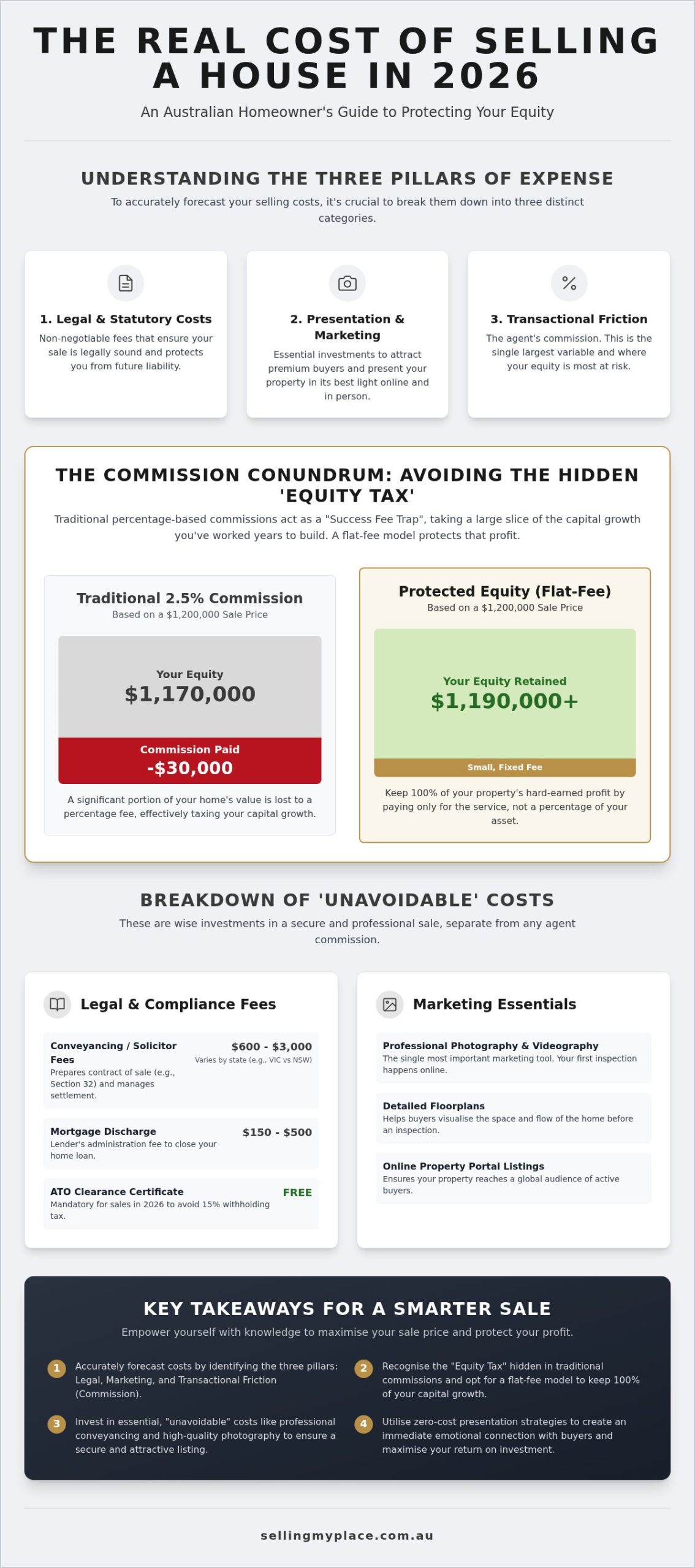
Maximising ROI: Smart Spending on Pre-Sale Presentation
When you’re fine-tuning the cost of selling a house 2026, it’s tempting to think that every dollar spent on presentation will magically return double at settlement. This isn’t always the case. True success lies in identifying the high-impact activities that cost almost nothing but significantly shift a buyer’s emotional needle. We recommend starting with the “Rule of Three”: cleaning, decluttering, and depersonalising. These tasks require more elbow grease than capital, yet they allow potential buyers to visualise their own lives within your walls rather than feeling like a guest in yours.
Strategic spending also protects you from “buyer chipping.” This occurs when a building inspector identifies minor, easily fixable flaws that a buyer then uses as leverage to negotiate thousands off your price. Fixing leaky taps, tightening loose door handles, and ensuring all light globes are working prevents these small friction points from becoming expensive hurdles. By investing a few hundred dollars in maintenance now, you protect the tens of thousands in equity we discussed earlier.
Styling and Staging on a Budget
You don’t always need to hire a full house of furniture to create a premium feel. Often, the most effective styling involves “editing” what you already own. Focus your energy on the “entry zone.” First impressions are formed within the first eight seconds of a buyer stepping through the front door. Use lighting to your advantage by opening every blind and switching on warm lamps to maximise the sense of space. A fresh coat of neutral paint in high-traffic areas or new, plush towels in the bathroom can create a sophisticated lifestyle appeal without the heavy price tag of a full renovation.
Data-Driven Pricing
Pricing your home is an emotional exercise, but it must be grounded in hard data. Relying on gut feel or outdated figures is a risk to your bottom line. We provide Neighborhood Market Reports to help you understand exactly what buyers are paying for similar properties in your specific street. The first 21 days on the market are your most valuable; this is when the “new listing” glow is brightest and buyer urgency is highest.
If you overprice your home based on a guess, you risk the listing becoming “stale,” which often leads to a lower final result than if you had priced accurately from day one. Use recent comparable sales to determine your market value with precision. This transparency gives you the confidence to stand firm during negotiations. If you’re ready to see how our advisory approach can protect your equity and streamline your sale, get in touch with our team today for a personalised pre-sale consultation.
Selling Smarter with Kincade International Direct Sales
By now, you understand that the cost of selling a house 2026 doesn’t have to include a five-figure commission. We’ve built a model that bridges the gap between the high-cost traditional agency and the daunting prospect of going it alone. Kincade International Direct Sales (KIDS) provides the sophisticated digital infrastructure and global marketing network you need to reach buyers across Australia and beyond. It’s about giving you the tools of a top-tier agency while ensuring you remain the primary beneficiary of your property’s capital growth.
Our approach is built on the belief that professional marketing is a service you should own, not a percentage of your wealth you should give away. Every package we offer is designed to present your home in its best light, including high-end photography and accurate floorplans that meet the high standards of 2026 buyers. You aren’t just getting a listing; you’re gaining an entire ecosystem of support that allows you to sell your own home with the confidence of a seasoned professional.
Your Partnership for a Successful Sale
The most vital part of our service is the Expert Agent Advisory Service. Think of this as your “steady hand” throughout the journey. While you handle the inspections and connect with buyers, our advisors are in your corner to guide you through the nuances of negotiation and the technicalities of settlement. We take the stress out of the “what happens next” moments, providing a calm, grounded perspective when high-stakes decisions need to be made.
We also understand that life doesn’t always move to a strict real estate calendar. That’s why our “Listed Until Sold” policy is so important. It removes the ticking clock and the anxiety of expiring contracts, allowing you to wait for the right buyer at the right price. This patience, combined with our advisory support, is how we help you protect your legacy and keep 100% of your sale profit.
Getting Started with a Flat-Fee Package
Onboarding with us is a methodical and inviting process. We offer various marketing tiers, allowing you to choose the level of exposure that best suits your property and your budget. Whether you’re selling a cozy suburban unit or a sprawling family estate, our simple digital process gets your home on the market fast without the usual administrative hurdles. You’ll have total control over your listing, backed by a team that values your family’s needs over a quick transaction. If you’re ready to reclaim your equity and experience a more respectful way to sell, explore our flat-fee listing services today.
Your Path to a Successful and Profitable Sale
Your home is more than just a listing on a screen; it’s the foundation of your family’s future and a testament to your hard work. By understanding the true cost of selling a house 2026, you’ve taken the first step toward protecting that legacy from unnecessary “equity taxes.” We’ve explored how a strategic focus on presentation and professional legal advice provides a secure path forward, while the shift toward flat-fee models ensures you remain in the driver’s seat of your own transaction.
Why settle for traditional structures that eat into your hard-earned profit? With our support, you can access a global marketing network, professional photography, and floorplans without the burden of a percentage-based commission. Our Expert Agent Advisory Service acts as your steady hand, guiding you through every negotiation with calm confidence. Most of our partners save an average of $20,000 in commissions, allowing that capital to go exactly where it belongs: back into your pocket.
Are you ready to move forward with a partner who values your results as much as you do? Keep 100% of your profit; sell with Kincade International Direct Sales today. We look forward to helping you start your next chapter with total peace of mind.
Frequently Asked Questions
What is the average real estate commission in Australia for 2026?
The national median real estate commission rate in 2026 is 2.65% according to recent surveys. This is often the largest single component of the cost of selling a house 2026. Rates typically range from 1.8% to 3.0% of the final sale price. In Melbourne, you’ll usually find rates between 1.6% and 2.5%, while regional Victoria often sits between 2.5% and 3.5%.
Are marketing costs included in an agent’s commission?
Marketing costs are almost never included in a traditional agent’s commission. This is known as “Vendor Paid Advertising” or VPA. Sellers are usually expected to pay these costs upfront to cover online listings, professional photography, and signboards. For a standard 2026 campaign, you should budget between $2,000 and $10,000, though premium campaigns in major cities can reach $20,000.
How much should I budget for conveyancing when selling my house?
Your conveyancing budget will depend on your state’s specific requirements. In New South Wales metro areas, fees typically range from $1,000 to $3,000. Victorian sellers should budget between $600 and $1,400, while Queenslanders usually pay between $500 and $1,300. Remember that disbursements for title searches and certificates will add a few hundred dollars to these professional service fees at the end of the process.
Do I have to pay Capital Gains Tax (CGT) when I sell my home?
You generally don’t pay Capital Gains Tax on your main residence if you’re an Australian resident and the property is your primary home. However, if the property was an investment or used for business purposes, you’ll likely be liable for CGT. To help manage your investment records and tax obligations, you can learn more about PropAlly. As of 2025, you must also obtain a free ATO clearance certificate before settlement to avoid a mandatory 15% withholding tax.
Is it worth paying for professional home styling?
Professional styling often provides a strong return on investment by creating an immediate emotional connection with prospective buyers. While full staging can cost between $2,000 and $8,000, many sellers find success with partial styling. This involves using your existing furniture combined with hired accessories to highlight your home’s best features. It’s a strategic way to help buyers visualise their future lifestyle in your space.
What happens if my property doesn’t sell within the first month?
If your property hasn’t sold within the first month, it’s a good time to review your pricing strategy and presentation with a steady hand. The first 21 days are the most critical for buyer urgency. Unlike traditional agencies with expiring contracts, our model ensures your property stays listed until it’s sold. This gives you the patience and space to find the right buyer without unnecessary pressure.
Can I really sell my house without a traditional real estate agent?
You can absolutely sell your home without a traditional percentage-based agent. Many Australian families are now choosing flat-fee models to protect their hard-earned equity from high commissions. This approach provides the professional marketing and expert advisory support you need while you manage the inspections yourself. It’s a sophisticated way to manage the cost of selling a house 2026 and keep more of your profit.
What are the hidden fees I should look out for at settlement?
The most common hidden costs at settlement include mortgage discharge fees and pro-rata council rate adjustments. Mortgage discharge fees currently average around $329 but can reach $795 depending on your lender. You should also account for conveyancing disbursements. These cover the cost of required certificates and title searches that are often not included in the initial professional quote you receive from your conveyancer.
Neighbourhood Market Reports: The Australian Seller’s Guide to Pricing with Confidence
What if the “expert” appraisal sitting on your kitchen bench is more about winning your signature than actually securing your family’s financial future? It is a daunting thought, especially as you try to make sense of neighborhood market reports while national house values have dipped by 1.1% throughout 2026. You likely feel the weight of this transition, perhaps even a bit of frustration at the conflicting data landing in your inbox. It is completely natural to worry about underpricing your most valuable asset or feeling pressured by agents who might be over-promising just to secure a listing.
We believe that local data is the ultimate equaliser for Australian homeowners. In this guide, you will learn how to interpret property data with the calm confidence of a seasoned pro. We are going to show you how to strip away agent bias, value your home accurately, and negotiate like an expert; all while keeping your hard-earned equity instead of paying it away in commissions. We will walk through the specific metrics that matter most in today’s market, giving you the tools to move toward your next chapter with total peace of mind.
Key Takeaways
- Learn why real-time data is more reliable than historical ‘gut feelings’ or outdated anecdotes in the shifting 2026 property market.
- Discover how neutral neighborhood market reports provide an objective truth, helping you avoid the common trap of over-inflated appraisals used to ‘buy’ your listing.
- Identify your property’s pricing ‘sweet spot’ by analysing actual sold prices rather than just the aspirational asking prices of your local competition.
- Master the art of timing your sale by using seasonal trend data to choose a listing date that maximises buyer interest and competition.
- Understand how a flat-fee model combined with professional advisory keeps your equity where it belongs, ensuring your strategy is always focused on your family’s bottom line.
Decoding Neighbourhood Market Reports: Why Data is Your Best Friend in 2026
The Australian property landscape in 2026 feels remarkably different than the post-COVID boom years. With national house values falling by 1.1% over the calendar year and the June quarter recording a 1.0% decline, the “gut feeling” approach to pricing is officially a thing of the past. This is where neighborhood market reports become your most valuable asset. They offer a data-driven snapshot of local performance that cuts through the noise of conflicting news headlines and dinner party anecdotes. Think of it as a clinical pulse check for your specific street, providing the clarity you need to make big decisions with a calm heart.
It’s vital to distinguish these from the simple Automated Valuation Models (AVMs) you might find on a bank’s website or a quick online estimator. While an AVM provides a rough guess based on broad suburb trends, a comprehensive market activity report dives into the specific nuances of your exact pocket. For anyone embarking on a sale by owner journey, this data acts as your foundational “steady hand.” It ensures you aren’t leaving money on the table or scaring off genuine buyers with an unrealistic figure that doesn’t align with current market conditions.
The Shift from Agent ‘Opinions’ to Hard Data
For decades, real estate agents held the “black box” of property data, leaving owners to rely entirely on their professional word. Today, digital transparency has shifted that power back into your hands. Buyers in 2026 are incredibly savvy; they’ve done their homework and they expect you to have done yours. Relying on an objective report rather than a traditional real estate appraisal helps remove the emotional attachment we all naturally feel toward our family homes. It’s much easier to negotiate when you can point to hard evidence rather than just an agent’s optimistic opinion, which might be inflated to secure your listing.
Key Metrics Every Australian Seller Should Track
To price with confidence, you need to look beyond the broad suburb median. Street-level performance often tells a very different story, especially in suburbs with diverse housing styles. Keep a close eye on Days on Market (DOM). If the average DOM is creeping up, it signals that buyer urgency is cooling. Similarly, with national auction clearance rates dropping below 50% in June 2026 for the first time since the 2020 lockdowns, you need to understand how this affects private treaty expectations. High-quality neighborhood market reports track these shifts in real-time, allowing you to pivot your strategy before the first open home even begins.
The Anatomy of a Comprehensive Property Report: What Really Matters
A truly effective property report is far more than a simple list of addresses and numbers. It’s a narrative of your local community’s recent history and a roadmap for your financial future. While broad Australian Bureau of Statistics data provides a high-level view of national trends, your success depends on understanding the specific heartbeat of your street. In a market where national house prices have recently dipped, distinguishing between an aspirational “asking price” and the cold, hard reality of a “sold price” is the difference between a successful settlement and a listing that languishes for months.
Comprehensive neighborhood market reports should also shed light on who is actually moving into your area. Are young families snapping up unrenovated post-war homes, or are downsizers looking for low-maintenance units? Knowing these demographic shifts allows you to tailor your presentation and marketing to the exact buyer profile most likely to fall in love with your home. It’s about working smarter, not harder, to protect your family’s legacy.
Comparables (Comps): Finding Your Home’s ‘Twins’
To value your home accurately, you must find its “twins” in the local area. This process involves looking at properties with similar land size, room counts, and level of finish. We suggest following the “Rule of Three”: identify at least three homes within a one-kilometre radius that have sold in the last ninety days. This provides a statistically significant baseline. Of course, no two homes are identical. You’ll need to make honest adjustments for your own property’s unique features. A sparkling new magnesium pool or a high-end kitchen renovation might add a specific premium, while a lack of off-street parking could require a slight downward adjustment to stay competitive.
Market Velocity and Inventory Levels
Understanding market velocity helps you gauge your negotiation leverage. If the “Stock on Market” is low, you’re in a position of strength, as buyers have fewer choices and may be willing to pay a premium to secure a stable home. Conversely, when inventory is high, your pricing must be razor-sharp to stand out. The absorption rate determines how many months it would take to sell all current listings at the current rate of sales, providing a clear window into buyer demand. If the data feels a bit overwhelming, you can always reach out for local property guidance to help interpret these shifting numbers with total clarity.
Market Reports vs. Real Estate Agent Appraisals: Cutting Through the Noise
It’s a scenario many Australian families face: three different agents walk through your front door, and you receive three wildly different numbers. One might be exactly what you hoped for, while another feels like a bit of a low-ball. This is where the “Buying the Listing” trap often catches well-meaning sellers. Some agents intentionally over-inflate their initial appraisal to win your business, knowing full well they will need to “condition” you to accept a lower price a few weeks into the campaign. It’s a stressful cycle that can be avoided by looking at the objective facts found in neighborhood market reports.
When you rely on a neutral data source, you’re choosing to determine the market value of a home in Australia without the polished sales pitch. The cost of a wrong appraisal isn’t just a bruised ego; it’s a tangible financial hit. Overpricing often leads to a “stale” listing that sits on the market for months. Buyers begin to wonder what’s wrong with the property, eventually leading to low-ball offers that fall far below what you might have achieved with a sharp, data-backed opening price. By checking the latest Australian Bureau of Statistics property values, you can see how your local expectations align with the broader state-level shifts, keeping your strategy grounded in reality.
The Psychology of the ‘Appraisal’ Process
Agents are often masters of persuasion, focusing on the highest possible price during their initial presentation. However, their primary goal is to get your signature on a listing agreement. Once the property is on the market, the conversation often shifts toward “the market is speaking” as they push you to lower your expectations. Using a market report allows you to cross-examine these claims. If an agent suggests a price significantly above recent local sales, you can ask for the data to back it up. A flat-fee model removes this conflict of interest entirely, as the advisor has no incentive to misrepresent the data just to secure a higher commission later.
Objectivity: Your Secret Weapon in Negotiation
Staying grounded in the numbers is your best defence against the emotional roller coaster of selling a home. When a buyer makes an offer, you can present the data from your report to justify your price point. This builds a bridge of trust that a verbal estimate from an agent simply can’t match. Buyers respect a seller who has done their homework and can point to neighborhood market reports as the basis for their decision. It transforms the negotiation from a battle of wills into a professional conversation about value, helping you stand your ground with calm confidence.
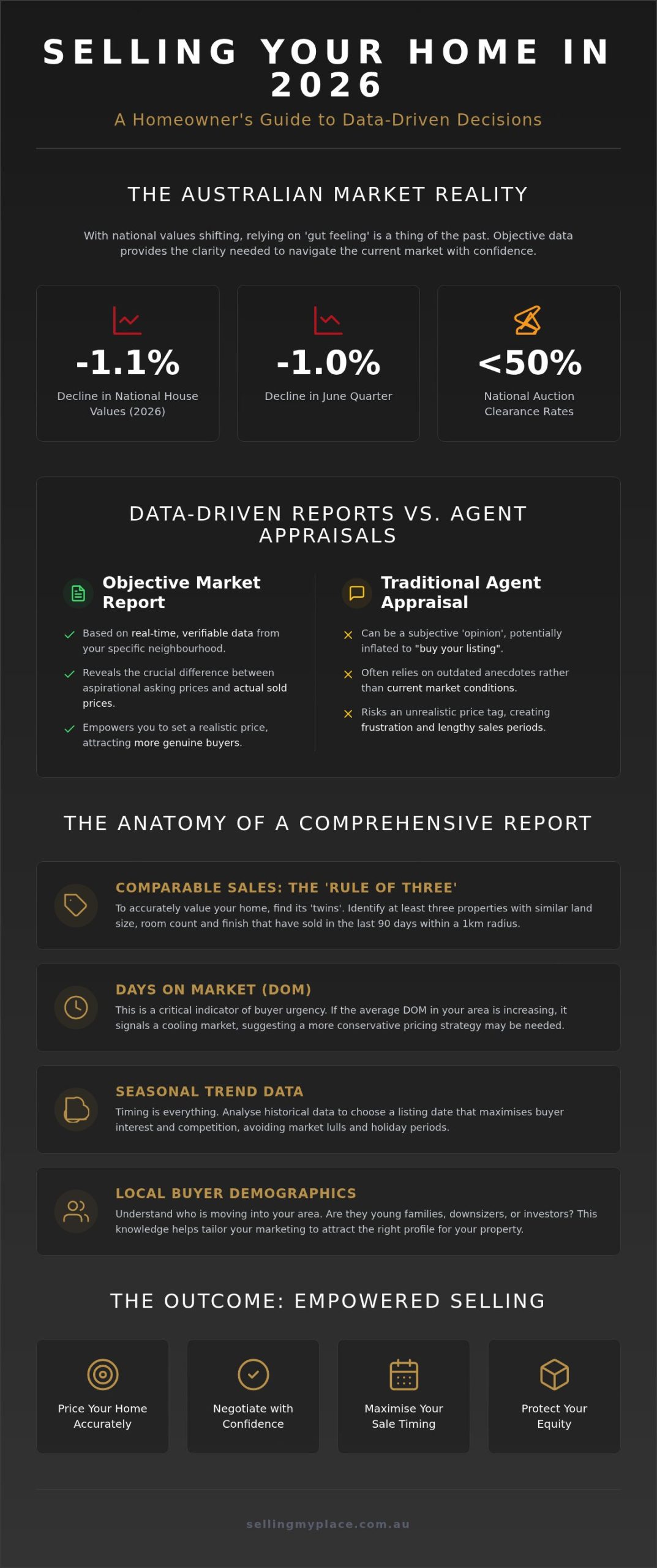
How to Leverage Local Data to Maximise Your Sale Price
Having the data at your fingertips is one thing; knowing how to wield it is what separates a standard sale from a result that truly changes your family’s future. Once you have digested your neighborhood market reports, the focus shifts to execution. It is about more than just a number on a screen; it is about how you present that value to the world. By aligning your Residential Property Listing Services strategy with the hard facts of your suburb, you can command attention and justify a premium price point with total confidence.
Strategic timing is another lever you can pull. Your report might reveal that four-bedroom family homes in your specific pocket sell for a notable premium in the spring, or perhaps that buyer activity peaks just after the school holidays. Beyond timing, you should highlight local strengths that data-savvy buyers crave. If your home sits within a coveted school catchment or boasts a high “Walk Score” to local cafes, these are non-negotiable features for your listing description. These details transform a house into a lifestyle opportunity, making it much easier for a buyer to see the long-term value of the investment.
Strategic Pricing Brackets
Most Australian buyers start their journey on major property portals, using specific price filters to narrow their search. These engines typically operate in $50,000 or $100,000 increments. If you price your home at $1,005,000, you will completely disappear from the search results of anyone with a $1M cap. This is why the “Sweet Spot” is so vital. Pricing at $995,000 ensures you appear in the maximum number of relevant searches while remaining just below a significant psychological barrier. It is the “Goldilocks” price; high enough to reflect your home’s worth, yet accessible enough to ignite a competitive bidding environment.
Using Reports for Pre-Sale Improvements
Before you pick up a paintbrush or call a landscaper, look at the “sold” comps in your report. You might find that in your area, a modernised kitchen adds far more value than a new deck. This allows you to invest your pre-sale budget where it will actually move the needle on your final sale price. Value-Add potential is identified through comparative market analysis by isolating specific features in recently sold local homes that commanded a clear price premium over unrenovated counterparts. If you are ready to see how this data applies to your specific street, reach out for a tailored market breakdown today.
Empowered Selling: How Kincade International Direct Sales Backs Your Strategy
Selling your home is a major life transition, and we don’t think you should have to sacrifice your hard-earned equity just to get professional support. The Kincade International Direct Sales (KIDS) approach is built on a foundation of transparency and partnership. We provide the exact same professional-grade neighborhood market reports that the “big” franchise agencies use, but we do it without the traditional commission structure. This means you can keep more of your profit, often saving an average of $20,000, while still having access to the highest quality data available in 2026. It is about giving you the same tools as the experts, without the high marketing costs or the pressure of a percentage-based fee.
Integration is key to a successful sale. Once you have your data, we help you weave those findings into a comprehensive marketing package. This isn’t just about putting a price on a website; it’s about building a compelling case for your home’s value. By combining your report insights with professional photography and floorplans, you create a listing that reflects the true worth of your property. This professional presentation attracts serious buyers who respect your informed position, allowing you to move through the process with a sense of calm confidence. We believe that when you are better informed, you are better protected.
Beyond the Data: The Agent Advisory Service
While data is powerful, interpreting it correctly is what makes mastering the deal second nature. Our Real Estate Advisory Services act as the “steady hand” you need when the numbers feel complex or the market feels volatile. Our advisors provide personalised pre-sale consulting to bridge the gap between a PDF report and a “Sold” sticker on your front gate. You aren’t just getting a document; you’re getting a partnership that aims to reduce the stress of the negotiation process. This guidance ensures that every decision you make is grounded in reality and focused on your family’s long-term stability.
Your Next Steps to a Commission-Free Sale
Taking control of your sale starts with a single, informed step. You can access your comprehensive neighborhood market reports today to begin your journey toward a commission-free settlement. From there, we help you prepare a professional listing with high-end photography and accurate floorplans, ensuring your home is presented in its best possible light. It is your home, your legacy, and your equity; we are simply here to ensure you have the tools to protect it all while selling on your own terms. We invite you to step into this process with us, knowing you have the support of a seasoned team that values your results as much as you do.
Step Into Your Next Chapter with Confidence
The journey of selling a family home is about more than just a transaction; it’s about honouring your hard work and protecting your future. You now have the knowledge to look past the noise of inflated appraisals and trust the objective truth found in neighborhood market reports. By focusing on actual sold data and strategic pricing brackets, you can navigate the shifts of the 2026 market with the calm authority of a seasoned pro. It’s about being informed, staying grounded, and making decisions that truly serve your family’s best interests.
At Kincade International Direct Sales, we are here to ensure you don’t have to walk this path alone. Our approach combines professional-grade data with an expert Agent Advisory Service, allowing you to keep 100% of your sale profit. You can access high-end professional marketing and street-level insights without the burden of a traditional commission. Are you ready to take the lead in your property sale? Get Your Professional Neighbourhood Market Report and Save Thousands today. We look forward to being the steady hand that helps you secure the result your family deserves.
Frequently Asked Questions
What is the difference between a market report and a bank valuation?
A bank valuation is a conservative assessment focused on lender risk, whereas a market report identifies the price a willing buyer is likely to pay in the open market. Banks often value properties lower to protect themselves against potential market shifts. A market report provides a more optimistic yet realistic range based on actual buyer competition and recent local momentum.
How often should I update my neighbourhood market report before listing?
In the shifting landscape of 2026, we suggest updating your data every 30 days. With national house values experiencing a correction, prices can move quickly. Staying current ensures your strategy remains aligned with the latest settled sales rather than outdated figures from months ago. It’s about maintaining that steady hand throughout your campaign so you don’t miss a beat.
Can I get a neighbourhood market report for free in Australia?
You can find basic summaries for free through bank apps or property portals, but they often lack the street-level nuance of a professional report. Free versions usually provide a broad suburb median which can be misleading for specific pockets. For a high-stakes sale, a comprehensive report ensures you aren’t missing the specific details that justify a premium price for your unique home.
Are online property value estimates actually accurate in 2026?
Online estimates are helpful starting points but often miss the heart of a home. They can’t see your high-end kitchen renovation or the quietness of your specific cul-de-sac. This is why neighborhood market reports are superior; they allow for a human-led interpretation of the data that accounts for the unique lifestyle features an algorithm might overlook during a market correction.
Does a neighbourhood market report include ‘off-market’ sales data?
Most reports focus on settled sales data, which is the most reliable truth in property. While off-market sales are common, they aren’t always publicly recorded with the same level of detail immediately. A professional report will focus on the most transparent and verifiable data to ensure your pricing strategy is defensible during a tough negotiation with a savvy buyer.
How do I use a market report if there haven’t been any sales in my street recently?
If your specific street is quiet, we expand the search to comparable pockets within your suburb. We look for areas with similar land sizes, school catchments, and proximity to local centres. This broader view provides a statistically significant baseline, allowing you to price your home accurately even when immediate street-level data is sparse or outdated.
Will a market report help me decide between an auction or a private treaty sale?
Absolutely. By analysing local auction clearance rates, which fell below 50% nationally in mid-2026, neighborhood market reports help you gauge the current appetite for public bidding. If your area shows a high percentage of properties passing in, a private treaty sale with a clear price might be the more reassuring and effective path for your family.
How do I explain my data-driven price to a buyer who thinks it’s too high?
Lead with the data rather than emotion. When a buyer questions your price, you can physically show them the recent comparable sales of “twin” properties in the area. This shifts the conversation from a personal disagreement to an objective discussion about market reality. It builds trust, as the buyer can see you’ve based your expectations on verifiable facts rather than guesswork.
Preparing Your House for Sale: 2026 Australian Guide
What if the secret to a record-breaking sale price in 2026 isn’t that $50,000 kitchen renovation you’ve been agonising over, but rather the things you choose to take away? We understand that the thought of learning how to prepare your house for sale can feel completely overwhelming, especially when you’re balancing a busy family life with the fear of over-capitalising. It’s a high-stakes transition, and you want to ensure every dollar spent adds genuine value to your final result without draining your hard-earned equity.
Most homeowners believe they need to fix every minor imperfection to attract a buyer, yet the most successful sales often come down to strategic subtraction and polished digital presentation. You’re likely looking for a way to stand out in the local market without losing your sanity or your savings in the process. This guide will show you how to prioritise your efforts for maximum impact. We’ll walk through a clear, stress-free checklist that covers everything from clever decluttering to the importance of professional photography, ensuring your home is ready for its close-up while you stay focused on your family’s next chapter.
Key Takeaways
- Learn how to create a neutral canvas and a “hotel feel” so buyers can easily visualise their own lives within your home.
- Apply the Golden Rule of repairs by focusing only on what’s broken or dated, ensuring you don’t over-capitalise before the sale.
- Understand why professional photography and floorplans are non-negotiable for making a powerful first impression on a smartphone screen.
- Discover how to prepare your house for sale while keeping an average of $20,000 more of your equity through a flat-fee advisory model.
- Optimise your kerb appeal to ensure the first 30 seconds of an inspection build immediate confidence and emotional connection.
The Psychology of a Sale: Decluttering and Depersonalising
Selling a home is often one of the most emotional chapters of your life. It’s where you’ve raised kids, celebrated milestones, and built a sanctuary. However, when you’re looking at how to prepare your house for sale, the first step is a psychological shift: you’re no longer selling a “home”, you’re presenting a “property”. This transition can feel a bit bittersweet, but it’s the most effective way to ensure a buyer falls in love with the space just as much as you once did.
The core of this process is depersonalising. The goal is to create a neutral canvas. If a potential buyer sees your family portrait in the hallway or your collection of vintage cricket bats in the study, they’re subconsciously reminded that they are a guest in someone else’s space. We want them to feel like they’ve just walked into their own future. Utilising proven home staging techniques helps bridge this gap, turning your personal sanctuary into a space that speaks to the widest possible audience. It’s about helping them mentally “move in” before they’ve even made an offer.
Think of the last time you stayed in a high-end boutique hotel. It felt warm, inviting, and lived-in, yet it didn’t feel like it “belonged” to anyone specific. That’s the gold standard for your presentation. It often starts with strategic subtraction. Removing bulky furniture pieces that block the natural flow of a room can instantly make a lounge feel twice its actual size. It’s amazing how much more light a room can hold once you’ve cleared out that oversized armchair that’s been in the corner for a decade.
We know this is easier said than done if you’re still living there with toddlers or a golden retriever. The trick isn’t to be perfect 24/7; that’s simply not realistic. Instead, it’s about having a “five-minute flurry” plan. Keep a few large, stylish baskets handy to quickly sweep up toys or pet accessories before an inspection. This keeps the house “inspection-ready” without making daily life a chore.
Creating a Neutral Palette
Buyers are often looking for a fresh start. While you might love your feature wall in a bold terracotta, it can be a mental block for others. Neutral colours like soft greys, warm whites, or “greige” do more than just look clean; they reflect light and make rooms feel significantly more spacious. By removing highly specific personal collections, you’re clearing the mental noise. This allows a buyer to focus on the architectural bones of the house rather than your taste in decor. When you’re figuring out how to prepare your house for sale, remember that “less is more” applies to every surface, from the kitchen bench to the mantelpiece.
The “Deep Clean” Checklist
A superficial tidy-up won’t cut it in 2026. Buyers are savvy; they’ll look at the details to judge how well the home has been maintained overall. This isn’t just about appearances, it’s about building trust.
- The “Hidden” Inspection: Yes, people will open your pantry and linen cupboards. Organised, half-empty shelves suggest the house has ample storage, whereas a packed cupboard suggests the home is too small.
- Sparkle and Shine: Focus on windows, grout lines in the bathroom, and steam-cleaning the carpets. These are the high-impact areas that signal a “well-loved” and healthy home.
- The Scent Factor: Avoid heavy air fresheners, which can trigger suspicions of hidden mould or pet issues. Instead, rely on natural ventilation and perhaps a single, subtle scent like eucalyptus or freshly laundered linen to create a sense of calm.
Strategic Repairs: Where to Invest for the Best ROI
When you’re deciding how to prepare your house for sale, it’s easy to feel pressured into expensive, full-scale renovations. You might hear stories about new kitchens adding value, but the reality is often quite different. Our Golden Rule is simple: only fix what is visibly broken or painfully dated. You want to avoid over-capitalising, which happens when the cost of your repairs exceeds the actual value they add to the final sale price. Your goal is to protect your equity, not spend it all on a house you’re about to leave.
A fresh coat of paint remains the single most cost-effective way to transform an interior. It’s remarkable how a warm, neutral white can hide years of scuffs and instantly make a space feel “new” again. Pair this with a lighting upgrade by swapping out old, yellowing plastic fixtures for modern, warm LED globes. These small changes create a sense of polished consistency throughout the home. Instead of a $30,000 kitchen gut-job, consider a “refresh” by painting old cabinetry or replacing a dated splashback. These tactical updates resonate with buyers without draining your bank account.
The “Quick Fix” Hit List
Buyers often use small maintenance issues as a barometer for how well the rest of the house has been cared for. A leaky tap or a wonky cupboard door might seem minor to you, but to a nervous buyer, it signals a potential list of hidden headaches. Walk through your home with a critical eye and tackle the easy wins. Replace dated door handles and mismatched tapware for an instant modern lift. Ensure every light switch and power point is scrubbed clean and functions perfectly. If you’re feeling stuck on where to start, our expert advisory service can help you prioritise the repairs that truly move the needle.
Flooring and Window Treatments
Your floors and windows occupy a huge amount of visual real estate. You don’t always need to replace carpets; a professional deep clean can often restore their life and remove lingering “house smells”. However, if the carpet is threadbare or heavily stained, a budget-friendly replacement in a neutral tone is usually worth the investment. For window treatments, focus on light. Remove heavy, dark drapes that block the sun. Clean, modern blinds or simple sheer curtains can make a room feel airy and inviting. If you have original floorboards hidden under old lino, consider polishing them. It’s a classic Australian feature that adds character and value for a relatively modest outlay. Knowing how to prepare your house for sale is about making these smart, tactical choices that celebrate the home’s existing strengths.
Street Appeal: Making the First 30 Seconds Count
They say you never get a second chance to make a first impression. In the world of real estate, that impression is often formed before a buyer even steps out of their car. Kerb appeal is your home’s first handshake. It sets the emotional tone for the entire inspection. If the exterior looks neglected, buyers may subconsciously assume the internal maintenance has been ignored too. When considering how to prepare your house for sale, starting at the boundary line is just as vital as the work you do inside.
Pressure washing is one of the most satisfying and high-impact tasks you can undertake. It’s incredible how years of grime on driveways and paths can vanish, revealing the original colour of the concrete or pavers beneath. Similarly, your garden needs to look manicured rather than just “tidy”. This involves a few key steps:
- Sharp edging: Define the lines along your paths and lawn to create a professional, clean finish.
- Fresh mulch: Use a dark mulch to make your plants stand out and keep weeds at bay.
- Strategic pruning: Cut back any overgrown shrubs that block windows or obscure the home’s architecture.
This level of attention to detail reassures a buyer they’re walking into a home that’s been truly cherished. The front door then acts as the final psychological focal point of the exterior. It’s where the buyer stands while the agent prepares the keys, giving them a moment to scrutinise the details. A fresh coat of paint here is a small investment with a huge emotional payoff. Choose a colour that complements your home’s existing palette but adds a touch of sophisticated personality. Whether it’s a classic navy, a contemporary charcoal, or a crisp, welcoming white, it signals that the home is modern and cared for.
The Entryway Experience
Small details at the threshold create a sense of welcome. Ensure your house number is visible and matches the home’s style; it’s a minor touch that adds instant polish. A brand-new welcome mat and a couple of healthy potted plants can soften the entry. Don’t forget the evening “drive-by”. Check that exterior lighting is functional and clean, as many buyers will cruise past after work to see how the home looks at night.
Outdoor Living Spaces
Australians value the outdoors, so treat your verandah or deck as an extension of the house. Staging these areas is a core part of how to prepare your house for sale for our local market. A clean BBQ area or a fire pit setup helps buyers visualise a lifestyle of relaxed summer evenings. Finally, ensure the lawn is freshly mowed before every open home. It’s the final piece that makes the property feel complete.
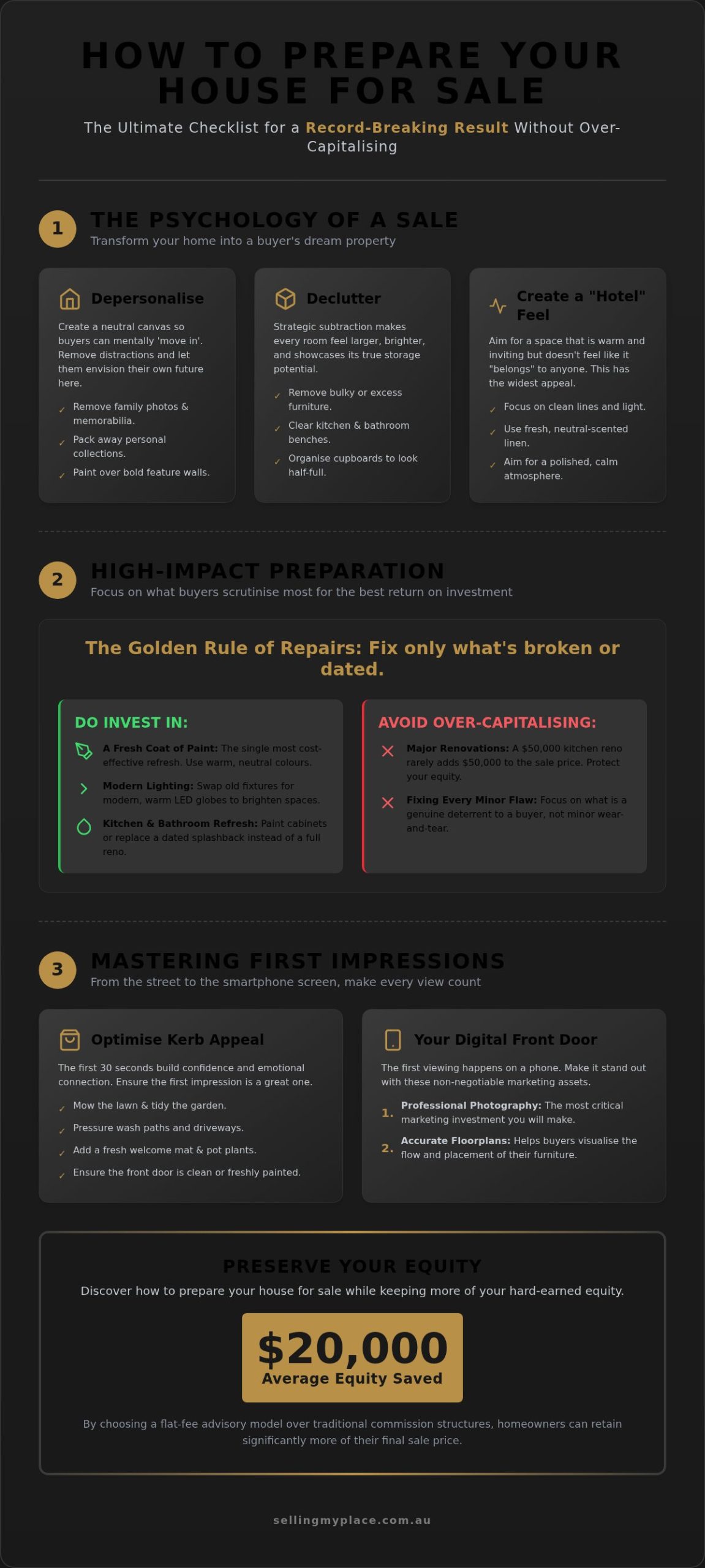
Visual Marketing: Your Digital Front Door
In 2026, the property market moves at the speed of a thumb-swipe. Before a potential buyer ever pulls up at your kerb, they’ve already walked through your hallways digitally. This makes your online listing the true “first inspection”. When you’re learning how to prepare your house for sale, understanding this digital-first reality is crucial. It’s no longer enough to have tidy rooms; you need images that stop the scroll and evoke an immediate emotional response. Your digital presentation needs to be as polished as the home itself.
Professional photography is a non-negotiable investment for any serious seller. It’s the difference between a house that sits on the market and one that sparks a bidding war. The camera sees differently than the human eye, picking up every stray power cord or smudge on a window. You’ll need to ensure the house is actually cleaner for the lens than it would be for a dinner party guest. High-definition sensors are notoriously unforgiving, so those “hidden” dust bunnies under the sofa or fingerprints on the stainless steel fridge might suddenly become the stars of the show. Think of the camera as a guest with perfect vision.
Photography: Capturing the Light
Timing is everything when it comes to capturing your home’s best side. We often recommend “Golden Hour” for exterior shots, that soft, honey-hued window just before sunset that makes every brick and leaf look magical. Inside, a professional photographer uses wide-angle lenses to capture the full volume of a room, helping buyers understand the layout without the “fish-eye” distortion of a cheap smartphone camera. Professional photos attract three times more clicks than DIY shots, ensuring your property gets the attention it deserves from the very first day it hits the portals.
The Role of Floorplans
While photos provide the “vibe”, floorplans provide the logic. They allow a buyer to “mentally move in” by measuring their existing furniture against your rooms. Accurate measurements build a bridge of trust, showing that you have nothing to hide and that the home’s proportions are exactly as described. This clarity is essential for buyers who are trying to narrow down their shortlist from their couch.
Use your floorplan to highlight flexible living zones or future renovation potential. Perhaps that sunroom could be a home office, or the master suite has space for an additional walk-in robe. By providing a comprehensive digital listing, you’re giving buyers the confidence to book a physical viewing. If you want to ensure your property stands out with high-end visual marketing and expert advice, reach out to our advisory team to discuss your listing needs.
The Financial Prep: Equity Preservation and Advisory
You’ve done the hard work of painting, decluttering, and polishing your home’s presentation. However, the final and perhaps most critical step in how to prepare your house for sale is securing your financial outcome. It’s easy to get caught up in the “vibe” of the sale and forget that at its heart, this is a major financial transition. Understanding the true cost of selling is vital. Traditional agency models often rely on a percentage-based commission, which can feel like a penalty for your home’s success. In 2026, many Australians are realising that they can achieve a record-breaking result without sacrificing a massive chunk of their hard-earned equity.
By opting for a Sale by owner approach, the average seller is able to keep an average of $20,000 more of their equity in their own pocket. That’s a significant sum that could go toward your next deposit, a well-deserved holiday, or your retirement fund. You don’t have to navigate this alone, though. Utilising a professional Agent Advisory Service allows you to access the same high-level strategy and staging advice used by top-tier agents, but within a much fairer financial framework. It’s about being the expert of your own home while having a steady, professional hand to guide you through the complexities.
Part of this “steady hand” approach includes getting your legal ducks in a row early. Seeking expert Conveyance Advice before you even hit the market is a smart move. It ensures your contract of sale is robust and ready to go the moment a buyer makes an offer, preventing unnecessary delays that can sometimes see a deal fall through. When you’re looking at how to prepare your house for sale, financial and legal readiness is just as important as a fresh coat of paint.
Determining Your Market Value
Setting the right price is a delicate balance of data and local insight. It’s important to look at actual recent sales in your specific pocket of the neighbourhood, rather than just the “asking” prices you see online. Emotion can often cloud our judgement when it comes to our own homes, so rely on hard numbers to set a realistic reserve. For a deeper dive into this process, read our guide on how to determine the market value of a home in Australia. This ensures you enter negotiations with confidence and a clear bottom line.
The Flat-Fee Advantage
The traditional commission model is often shrouded in mystery, but the flat-fee alternative is refreshingly transparent. Paying for your marketing and advisory services upfront is almost always smarter than paying a percentage of your final sale price at the end. It allows you to budget accurately and ensures that every extra dollar the market is willing to pay stays with you. At Kincade International Direct Sales, we empower you to take control of your sale journey while providing the professional tools—like photography and floorplans—you need to succeed. See how our flat-fee model can save you thousands on your next sale.
Your Next Chapter Starts with a Smart Strategy
Taking the first step toward selling your home is a significant life transition, and it’s completely natural to want everything to be perfect. As we’ve explored, knowing how to prepare your house for sale in 2026 isn’t about expensive renovations or chasing every minor flaw. It’s about strategic presentation, from the initial “hotel feel” of your decluttered lounge to the digital front door of your professional photography and floorplans. By focusing on high-impact repairs and kerb appeal, you create an emotional connection that resonates with buyers the moment they see your listing.
Beyond the aesthetics, protecting your equity is the most rewarding part of the process. With our Expert Agent Advisory Service and global marketing reach, you can navigate the market with local Australian expertise while saving an average of $20,000 in commissions. You have the power to be the expert of your own sale journey without the stress of traditional agency costs. Download our Full Seller’s Guide and start your commission-free journey today. We’re here to help you move forward with confidence and a steady hand.
Frequently Asked Questions
How much should I spend on preparing my house for sale?
You should aim to spend between 1% and 2% of your property’s estimated value on preparation. This range typically covers essential maintenance, professional cleaning, and cosmetic updates like fresh paint without the risk of over-capitalising. It’s about making smart, tactical improvements that protect your equity while ensuring the home presents at its absolute best for the first weekend of inspections.
Is it worth renovating the kitchen before selling?
A full kitchen renovation is rarely worth the investment just before a sale. Most buyers prefer to choose their own finishes, and you risk spending more on a new fit-out than you’ll actually recoup in the final price. Instead, we recommend a “refresh” by painting old cabinetry, replacing dated handles, or installing a modern splashback to provide a high-impact visual lift for a fraction of the cost.
Do I really need professional photography if I have a good smartphone?
Professional photography is a non-negotiable investment because your first inspection happens on a smartphone screen. While modern phones are impressive, they can’t match the wide-angle lenses and lighting expertise of a professional who knows how to capture a room’s true volume. High-quality images attract significantly more interest on property portals, which is a vital part of how to prepare your house for sale effectively.
How do I keep my house tidy for inspections while living in it?
The most effective strategy for living in an “inspection-ready” home is to use the “basket method” for quick tidying. Keep several large, stylish baskets handy to quickly sweep up toys, mail, or pet accessories before a potential buyer arrives. Focus on keeping high-impact areas like kitchen benches and bathroom vanities completely clear of daily clutter to maintain that polished, hotel-like feel without the stress.
What is the most important room to focus on when preparing to sell?
The kitchen is universally considered the most important room to get right for a successful sale. It acts as the emotional heart of the home and is often the space where buyers spend the most time scrutinising the details. If your kitchen feels clean, bright, and functional, it builds immediate confidence. Once the kitchen is polished, focus your attention on the main living area and the master bedroom.
Can I sell my house myself and still get a professional price?
Yes, you can absolutely achieve a professional price by selling the property yourself, especially when supported by expert advice. By using flat-fee marketing and an Agent Advisory Service, you reach the same audience as traditional agents while keeping an average of $20,000 more of your equity. This approach allows you to act as the expert on your own home while ensuring your digital presentation is world-class.
How long does it typically take to prepare a house for market?
Most homeowners should allow between two and four weeks to properly prepare their property for the market. This timeline provides enough space for deep cleaning, decluttering, and completing minor repairs without the process becoming overwhelming for the family. It also ensures you have plenty of time to book professional photography during the “Golden Hour” to make sure your online listing truly stands out from the competition.
What are the most common mistakes people make when preparing to sell?
The most common mistakes are over-capitalising on expensive renovations and neglecting the property’s street appeal. Many sellers spend thousands on internal upgrades that don’t offer a clear return, while forgetting that the front garden is the home’s first handshake. Another frequent error is failing to learn how to prepare your house for sale by depersonalising, which prevents buyers from mentally moving into the space during an inspection.
Real Estate Agent Fees to Sell a House in Australia (2026)
Why should your hard-earned home equity be treated like a communal pot of gold for everyone but your family? With the national median commission sitting at 2.65 per cent as of June 2026, many Australian homeowners are shocked to find that a standard sale can easily strip $20,000 or more from their final settlement. When you ask how much do real estate agents charge to sell a house, the answer is often a complex web of percentage-based fees, upfront marketing costs, and hidden expenses that can feel like an unnecessary tax on your legacy.
It’s completely understandable to feel protective of the value you’ve built over years of weekend renovations and mortgage repayments. This guide will peel back the layers of the 2026 property market to reveal the true cost of selling, from state-by-state commission averages to the latest anti-money laundering regulations. You’ll discover exactly how to navigate these expenses and, more importantly, how to secure a professional, premium result while keeping every cent of your profit where it belongs; in your pocket. We’ll explore the breakdown of marketing versus commission and introduce a more sophisticated, heart-led approach to selling that honours your home’s true worth.
Key Takeaways
- Identify the three main pillars of selling costs so you aren’t caught off guard by hidden legal or property preparation expenses.
- Get a clear breakdown of how much do real estate agents charge to sell a house in 2026 compared to more modern, commission-free alternatives.
- Learn why investing in professional photography and accurate floorplans is the most effective way to drive buyer interest without overspending on bloated marketing campaigns.
- Discover how to protect your hard-earned home equity by closing the “Equity Gap” typically created by traditional percentage-based models.
- Master the art of the deal with expert negotiation strategies that allow you to sell your property confidently while maintaining full control of your profit.
The True Cost of Selling a House: Understanding the 2026 Landscape
Selling a home is rarely just a financial transaction; it’s a major life transition that carries deep emotional weight. Whether you’re downsizing from the family nest or moving toward your next big adventure, the process involves a complex jigsaw of costs that can quickly add up. When you start tallying the figures, you’ll find the total cost of sale includes the agent’s commission, professional marketing, legal fees, and the necessary preparation to make your property shine. It’s a significant undertaking that requires a steady hand and a clear head to manage effectively.
Many homeowners find themselves asking how much do real estate agents charge to sell a house only to be met with a figure that represents years of mortgage repayments. In 2026, the national median commission rate has settled at approximately 2.65 per cent. On a million-dollar home, that is over $26,000 gone before you’ve even considered the cost of signage or photography. This loss of equity can feel like a penalty for your property’s capital growth, making it harder to fund your next chapter. While this percentage-based model has been the standard for decades, modern alternatives now allow for professional, high-end results without the predatory price tag.
The Breakdown of Traditional Agent Commissions
Most agencies calculate their fee as a slice of your final sale price, which means as the market grows, so does their payday. You will likely encounter two main structures: fixed and tiered. A fixed commission is a set percentage regardless of the final price, while a tiered structure might charge a higher percentage on any amount achieved above a certain threshold. While this is often framed as an incentive for the Real estate agent to work harder, it often just widens the gap between the service provided and the fee paid. In competitive Australian markets where property values remain high, these percentage-based fees have become an increasingly expensive “tax” on your hard-earned equity.
Conveyancing and Legal Costs
Beyond the agent, you will need a solicitor or licensed conveyancer to handle the legal transfer of ownership. This role is vital for protecting your interests and ensuring the contract is watertight. In 2026, typical fees for professional conveyance advice range between $800 and $2,200, depending on the complexity of the sale. This cost covers the preparation of the Contract of Sale and the navigation of the settlement process. Local knowledge is essential here; a seasoned expert can spot special conditions or zoning issues that could derail a sale. It’s one of the few areas where professional support is non-negotiable for a smooth, stress-free settlement.
Understanding these costs is the first step toward taking back control of your sale. You don’t have to follow the traditional path just because it’s the most common one. By looking closely at how much do real estate agents charge to sell a house and comparing it to modern, flat-fee advisory models, you can protect your equity while still achieving a premium result. The landscape has changed, and today’s sellers are more empowered than ever to choose a partnership that values their profit as much as they do.
Marketing Your Property: Where Your Money Actually Goes
While the commission covers the agent’s professional time and expertise, the marketing budget is the engine that actually brings potential buyers through your front door. It’s often the most visible part of the cost to sell a house, yet many vendors are surprised to learn it’s typically an additional, upfront expense. In the industry, this is known as Vendor Paid Advertising (VPA). It represents a critical investment in your home’s legacy, ensuring that the years of care you’ve poured into your property are reflected in how it’s presented to the world.
When you’re weighing up how much do real estate agents charge to sell a house, you must account for these separate promotional costs. In 2026, a standard marketing campaign in Australia generally ranges from $2,000 to $10,000. For those in competitive metro areas, the numbers are often more specific; Sydney campaigns typically sit between $4,500 and $10,000, while Melbourne averages between $6,500 and $8,000. These funds cover everything from the digital “town square” of online portals to the physical presence of a signboard on your nature strip.
The Power of Professional Visuals
Your property’s first showing doesn’t happen at a scheduled open house; it happens on a smartphone screen, often late at night. This makes professional photography a non-negotiable requirement for capturing those crucial initial clicks. It isn’t just about lighting or high-resolution lenses; it’s about evocative storytelling that helps a buyer visualise their future life in your home. Alongside imagery, a professional floorplan is the second most vital feature of any listing. It allows buyers to mentally arrange their furniture and understand the flow of the space before they’ve even arrived. While some might suggest a modern phone camera is sufficient, in a sophisticated market, “good enough” often leads to being overlooked by the most serious buyers.
Digital Reach and Global Exposure
A significant portion of your marketing budget is dedicated to premium listings on major Australian property portals. These platforms provide the essential visibility needed to attract local interest. However, a truly effective strategy in 2026 looks beyond the local suburb to target interstate investors and global buyers. By using advanced social media targeting and a global marketing network, your home can find its way to the right person, regardless of where they currently live. This digital infrastructure ensures your property stays listed until it’s sold, providing a sense of calm and security that you won’t be hit with unexpected “re-listing” fees if the perfect buyer takes a little longer to appear. If you’re feeling a bit overwhelmed by these choices, you can reach out for a friendly chat about a tailored marketing plan that suits your home’s unique needs.
Flat Fee vs. Commission: Comparing the Two Models
When you start investigating how much do real estate agents charge to sell a house, the standard 2 per cent or 2.5 per cent commission can seem like an unavoidable cost of doing business. However, it’s vital to remember that this fee is essentially a tax on the wealth you’ve built through years of hard work. The “Equity Gap” is the difference between what you walk away with after a traditional sale versus a modern, commission-free approach. For most Australian families, this gap represents a significant sum that could be better used to secure their next chapter.
There’s a persistent myth that agents are only motivated to get the best price if they have a percentage-based incentive. In reality, a professional advisor’s reputation and duty of care are far more reliable drivers of success. Savvy sellers are increasingly turning to flat-fee real estate because it provides the same professional support and market reach without the predatory cost structure. It’s a partnership built on transparency rather than a transactional slice of your home’s value.
Calculating Your Potential Savings
The numbers speak for themselves when you look at the impact on your bank balance. On a typical $1M home sale, choosing a flat-fee model over a 2 per cent commission can save you more than $20,000 in pure equity. This isn’t just “extra money”; it’s a deposit for a child’s first home, a significant boost to your retirement fund, or the freedom to renovate your next property. When homeowners ask how much do real estate agents charge to sell a house, they’re often looking for a way to justify the expense, but the math rarely favours the seller in a high-value market. Knowing your costs upfront before the campaign even begins removes the stress of the unknown and lets you plan your move with a sense of calm confidence.
What’s Included in a Professional Flat-Fee Package?
Choosing a flat fee doesn’t mean you’re on your own. A comprehensive package through the KIDS model provides all the professional tools you need to achieve a premium result:
- Professional Assets: High-end photography and floorplans that make your listing stand out in digital searches.
- Expert Advisory: Access to seasoned professionals who guide you through pricing, presentation, and legal requirements.
- Market Intelligence: Detailed neighbourhood reports to help you understand your property’s true value and local competition.
- Freedom of Time: Unlike traditional agents who may push for a quick sale to move on to the next commission, a flat-fee listing often has no time limits, letting you wait for the perfect offer.
By shifting the focus from commission to professional advisory, you’re not just saving money; you’re taking an empowered stance in the property market. It’s about ensuring that the reward for your years of homeownership stays exactly where it belongs; with you and your family.
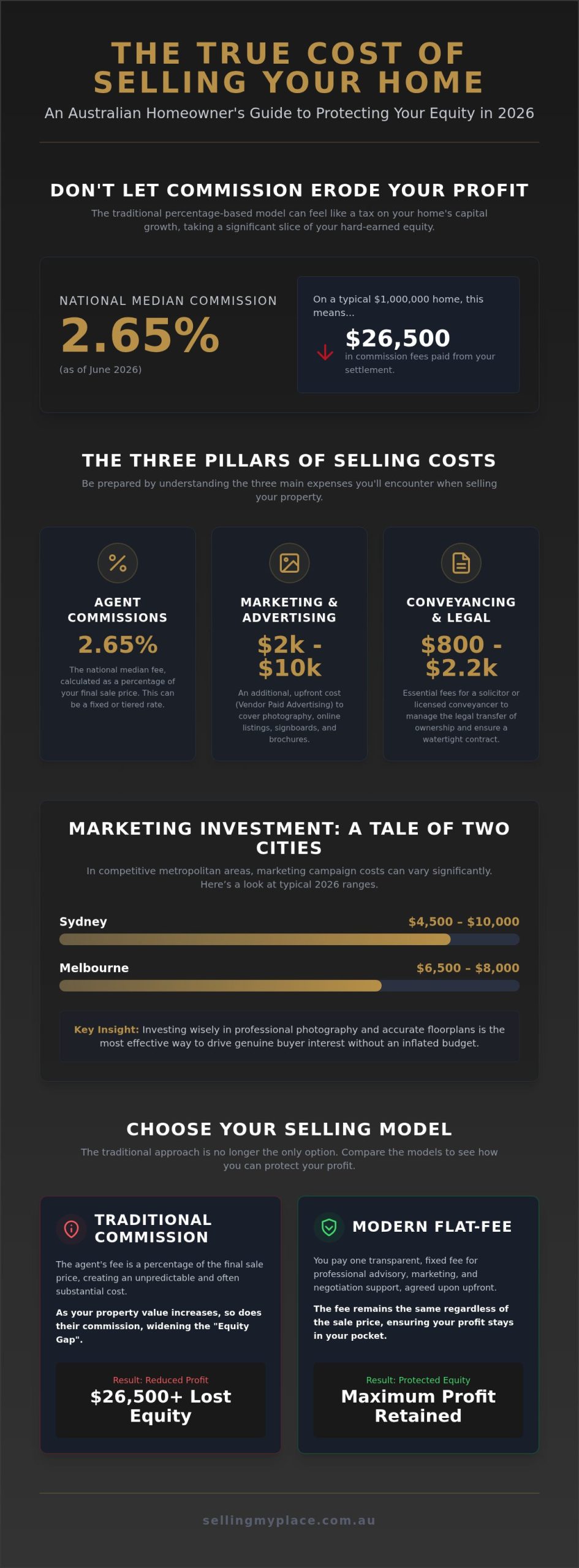
The ‘Negotiation Myth’: Do You Really Need a Traditional Agent?
One of the most common hurdles for homeowners considering a commission-free sale is the nagging fear of underselling. Traditional agencies often lean into this worry, suggesting that their specific “negotiation magic” is the only way to achieve a premium price. But is that true? When you reflect on how much do real estate agents charge to sell a house, it becomes clear that the value they provide must be weighed against the actual net profit you receive. Buyers in 2026 are savvy; they often find dealing directly with an owner refreshing and more transparent. You know the property’s soul, the best time of day for light in the kitchen, and the friendly nature of the neighbours better than any third party ever could.
The reality is that most buyers feel more at ease talking to the person who has actually lived in the home. This direct connection builds trust, which is the foundation of any successful negotiation. By removing the middleman, you eliminate the “transactional” feel that often accompanies traditional sales. When you combine your personal passion for the home with professional advisory support, you create a powerful environment for a successful sale.
Professional Backing for the Modern Seller
You don’t have to be a professional salesperson to achieve a professional result. By utilising detailed Neighbourhood Market Reports, you can price your home with the same precision as any local agency. Our Agent Advisory Service acts as your “steady hand,” ensuring you’re never navigating contract queries or conveyance hurdles alone. This support allows you to handle buyer enquiries with poise and confidence. Applying expert property sale negotiation tips ensures you maintain control of the conversation while keeping your family’s financial future at the heart of every decision.
Maximising Your Final Sale Price
True success isn’t measured by the “gross” sale price on a contract; it’s measured by the “net” result that lands in your bank account. If a traditional agent manages to squeeze an extra $5,000 out of a buyer but charges you $25,000 in commission, you haven’t won; you’ve lost $20,000 in hard-earned equity. Our pre-sale property consulting provides the styling and presentation insights needed to add genuine value before the first viewing. You can create a competitive environment among buyers by being transparent and responsive, often achieving a result that matches or exceeds traditional methods without the need for an expensive auctioneer.
Get expert advisory support for your sale today.
Selling Smarter: Protecting Your Equity with Kincade
Choosing how to sell your home is one of the most significant financial decisions you’ll ever make. In a 2026 market where every dollar of equity counts toward your future stability, the traditional commission model often feels like an outdated relic. When you look closely at how much do real estate agents charge to sell a house, it becomes clear that the value often doesn’t align with the cost. The Kincade International Direct Sales (KIDS) model offers a logical, sophisticated alternative. It’s a partnership designed for those who want to keep their profit while still benefiting from the “steady hand” of a seasoned expert. You aren’t just saving money; you’re choosing a more transparent, respectful way to handle a major life transition.
Many people start with a simple sale by owner mindset, focusing primarily on avoiding fees. However, the reality of being an empowered seller is much broader. It’s about having the confidence to lead the process, backed by the same high-end tools used by the country’s top agencies. This approach allows you to remain the primary advocate for your home, the person who understands its story best, while we provide the professional framework to ensure that story reaches the right audience. It’s a shift from being a “do-it-yourself” seller to a “professionally supported” owner who values legacy and community over quick, expensive transactions.
The Kincade Partnership Advantage
Our approach is built on providing a comprehensive suite of services that levels the playing field for every homeowner. You gain access to a global marketing network, ensuring your property is seen by investors and families across Australia and beyond. Professional photography and floorplans come as standard, because we know that high-quality visual storytelling is the most effective way to drive digital engagement. Throughout the journey, our dedicated advisory support remains by your side from the initial listing through to the final settlement, providing the calm confidence needed to navigate complex negotiations and legal requirements without the sting of a percentage-based commission.
Next Steps for Your Property Sale
Taking control of your sale is simpler than you might think. You can have a professional, high-impact listing live and attracting buyers in a matter of minutes. To get a clear picture of your starting point, we recommend requesting a neighbourhood market report to see exactly where your property stands in the current landscape. This data-driven insight, combined with our pre-sale consulting, ensures you price and present your home for maximum impact. When you’re ready to stop wondering how much do real estate agents charge to sell a house and start protecting your hard-earned equity, we’re here to help you take that next step. Start your commission-free selling journey with Kincade today.
Secure Your Legacy and Your Next Chapter
Deciding how to move forward with your property sale is about more than just finding a buyer; it’s about protecting the life you’ve built. We’ve explored the reality of how much do real estate agents charge to sell a house in 2026, from the national median commission of 2.65 per cent to the often hidden costs of premium marketing. You now know that while high-quality photography and floorplans are non-negotiable for a premium price, losing a massive slice of your equity to a percentage-based fee is entirely optional.
By choosing a partnership-based approach, you can keep your profit while still enjoying the security of a dedicated Agent Advisory Service. With professional visual assets included as standard, the average owner saves $20,000 per sale. This is money that stays in your pocket for your next deposit, your retirement, or your family’s future. You have the local knowledge and the passion for your home; we simply provide the professional tools and global reach to help you succeed.
Save an average of $20,000 and sell your home commission-free with Kincade.
It’s time to take the lead in your property journey with a steady hand by your side. You deserve a sale process that is as rewarding as it is professional. We look forward to helping you achieve the result your hard work deserves.
Frequently Asked Questions
How much is the average real estate commission in Australia in 2026?
The national median real estate commission in Australia is approximately 2.65 per cent of the final sale price as of June 2026. This figure varies significantly across the country; for instance, Tasmania often sees the highest median rates at around 3.25 per cent, while metropolitan areas in New South Wales and Victoria typically average closer to 2.1 per cent. These rates are fully negotiable and usually exclude GST and marketing costs.
Can I really sell my house without a traditional real estate agent?
Yes, you can absolutely sell your home without a traditional agent by choosing an empowered seller model. Modern platforms provide you with the same professional infrastructure used by high-end agencies, such as listings on major portals and expert floorplans, while allowing you to host your own inspections. This approach puts you in the driver’s seat, ensuring you retain the full value of your home’s equity without sacrificing professional standards.
What are the hidden costs of selling a house I should look out for?
When you’re trying to figure out how much do real estate agents charge to sell a house, don’t forget the separate marketing budget. These upfront advertising costs can range from $2,000 to $10,000 and are usually paid by the vendor regardless of the sale outcome. Other hidden expenses include conveyancing legal fees, auctioneer charges, and administrative costs related to 2026 anti-money laundering compliance checks for both buyers and sellers.
Is it worth paying for professional property styling?
Investing in professional property styling is often one of the most effective ways to increase your home’s perceived value. A well-presented home creates an immediate emotional connection with buyers, which can lead to a faster sale and a higher final price. Our pre-sale property consulting can help you decide whether a full furniture package or strategic decluttering is the right path to showcase your home’s unique character and legacy.
How do I negotiate the sale price if I sell the house myself?
Negotiating a sale requires a balance of firm market data and calm confidence. You should start with a clear understanding of your property’s value by using neighbourhood market reports to set a realistic expectation. When an offer arrives, focus on the buyer’s settlement terms as much as the price. Having access to a dedicated Agent Advisory Service ensures you have a professional sounding board to help you evaluate offers and counter-offer with poise.
What is the difference between a real estate agent and a property advisor?
A traditional real estate agent typically works on a commission basis and manages the entire sales transaction, often focusing on a quick result to move to their next listing. In contrast, a property advisor provides expert guidance and professional tools for a flat fee, acting as a “steady hand” to support your sale. This partnership model empowers you to handle the personal side of the sale while receiving high-level strategic support and market intelligence.
Does a flat-fee service include listing on major property portals?
A professional flat-fee service ensures your home is listed on Australia’s leading property portals, such as realestate.com.au and Domain. This digital visibility is the most critical element of any modern campaign, as it reaches the vast majority of active buyers nationally and globally. By using a professional listing service, you get the same premium exposure as a traditional agency but without the ongoing percentage-based commission costs that strip away your equity.
What happens if my property doesn’t sell within three months?
Unlike traditional agency agreements that often expire or require expensive renewals after 90 days, our model provides the freedom of no time limits on your listing. If your property hasn’t sold within three months, you can maintain your presence in the market without the pressure to drop your price prematurely. This allows you to wait for the right buyer who truly values your home, providing a sense of calm and security throughout the process.
Free Property Valuation Australia: The 2026 Seller’s Guide to Accuracy and Profit
What if the “flattery pricing” you’re hearing from local agents is actually the biggest risk to your family’s financial future? It is a stressful position to be in, standing at the crossroads of a major life transition while staring at three different online estimates that don’t seem to agree. You want a realistic figure, not a sales pitch, because underpricing your home could mean waving goodbye to years of hard-earned equity. We understand that a home is more than just a title deed; it’s your sanctuary and your legacy.
This guide is designed to help you secure a reliable free property valuation and transform that raw data into a strategic, commission-free sale. With the national median dwelling value sitting at $937,000 as of June 2026, and major cities like Sydney seeing recent price corrections, having a steady hand to guide you is more important than ever. We’ll walk you through how to identify a truly accurate price range, ways to boost your property’s appeal before listing, and the steps to keep your full profit without losing a cent to traditional agency fees. It’s about moving forward with calm confidence and the professional support you deserve.
Key Takeaways
- Understand why a free property valuation serves as a vital health check for your home’s equity, helping you separate a bank’s lending figures from your actual selling potential.
- Learn to distinguish between automated data and professional insights so you don’t leave money on the table when your unique home improvements aren’t captured by an algorithm.
- Guard yourself against “flattery pricing” and the common agent trap that often leads to price fatigue and disappointing final results.
- Discover how small, strategic updates and professional photography can help you justify a premium price and beat your initial valuation.
- Master the transition from data to dollars by using independent market reports and expert advisory to manage your own successful, commission-free sale.
What is a Free Property Valuation and Why is it Your Best Starting Point?
Think of a free property valuation as a vital health check for your most significant asset. It isn’t just a random figure on a screen; it’s the foundation of your future financial security. To move forward with clarity, you first need a solid grasp of what property valuation is and how it differs from the conservative estimates your bank might provide. While a bank’s report is designed to protect their lending risk, a market-focused valuation looks at the heartbeat of local demand. It’s about what a real person is willing to pay to call your house “home.”
The 2026 Australian property market has been a tale of two stories. With the RBA cash rate holding at 4.35% as of July, we’ve seen Sydney house prices dip by 3.3% in the June quarter while Perth has surged by a staggering 17.1%. This volatility means that an estimate from even six months ago is likely out of date. Regular check-ins via a free property valuation are no longer just a curiosity; they’re a necessity for any homeowner who wants to make an informed choice. It helps you answer the big questions. Should you invest in that kitchen renovation now, or is the market appetite strong enough to sell immediately and move on?
The Benefits of Knowing Your Home’s Worth Early
Getting an early handle on your property’s value allows you to plan your next move with a clear head. Whether you’re looking to downsize to a quiet suburb or upgrade for more space, you need to know your “walk-away” figure. This is the actual cash you’ll have left in your pocket after all costs are settled. It stops the guesswork and the midnight worrying. When you understand the specific trends in your street, you can spot opportunities that broader city-wide reports might miss.
How Kincade Supports Your Discovery Phase
We believe in empowering you with data that isn’t tied to a high-pressure sales pitch. Our Neighbourhood Market Reports provide a transparent look at what homes in your area are actually fetching, focusing on settled sale prices rather than ambitious listing figures. This independent perspective is vital. It’s about providing a steady hand and professional backing without the weight of a traditional agency commission. By using our Pre-Sale Property Consulting, you can prepare for a successful “sale by owner” experience. You’ll have the floorplans, photography, and advisory support needed to showcase your home’s true value while keeping your equity where it belongs: with your family.
AVMs vs. Professional Appraisals: Which One Should You Trust?
Most homeowners start their journey with a free property valuation generated by a computer. It’s incredibly convenient; you type in your address and get a number in seconds. This is what we call an Automated Valuation Model, or AVM. While these tools are a fantastic starting point for understanding your general equity, they operate by looking through a rear-view mirror. They rely on historical data and public records to provide a snapshot, which can sometimes lag behind the actual pulse of your neighbourhood.
An AVM is often spot on for suburban blocks where every house is similar. However, it can miss the mark significantly if you’ve recently added a third bathroom or spent your weekends perfecting a native garden. A computer simply cannot see the “soul” of a home. Relying solely on an algorithm in a shifting market, like we’ve seen in the June quarter of 2026 with capital city prices falling by 1.4% overall, can be risky. You need a steady hand to interpret those numbers and adjust for the nuances of your specific property.
Understanding Automated Valuation Models (AVMs)
AVMs pull data from three main pillars: recent sales of similar properties, land size, and basic property features like bedroom count. It is a helpful way to estimate the market value of your home quickly. But remember, these models don’t know if a house two doors down sold for less because it was in original 1970s condition. In rapidly changing cycles, such as the current 2026 downturn in Sydney and Melbourne, using multiple digital sources is the best way to find a realistic consensus value before you take the next step.
The Human Element: Professional Advisory Appraisals
A computer doesn’t feel the “wow factor” of a light-filled living room or a perfectly positioned deck. A professional advisor does. This human oversight is what separates a generic estimate from a strategic price point. This is where Kincade’s Advisory Service adds genuine value. We look at the emotional pull of your home and consider current buyer sentiment, which is vital given that auction clearance rates have dipped to 52.4% recently.
Don’t be seduced by the highest number you see on a screen or hear from a pushy agent. An inflated figure might feel good for a day, but it can lead to “price fatigue” if the market doesn’t agree, eventually forcing a lower final result. Accuracy is what protects your profit and your family’s legacy. If you’re feeling unsure about the conflicting numbers you’ve seen online, you might find it helpful to chat with a local expert who can help you make sense of the data without the pressure of a commission-based sales pitch.
Avoiding the “Agent Trap”: Why Free Appraisals Can Be Costly
It’s a lovely feeling when an agent walks through your front door and suggests a figure that exceeds your wildest expectations. However, this is often the moment where many Australian sellers unknowingly fall into the “agent trap.” In the industry, we call this “buying the listing.” It happens when an agent provides an inflated estimate simply to win your business, knowing full well the property will likely sell for less. While it feels good in the lounge room, it can be a costly mistake once the campaign begins.
When a home is launched at an unrealistic price, it often sits on the market for weeks without a serious offer. In the current 2026 climate, where buyers are increasingly selective and properties are taking longer to sell, this lead to “price fatigue.” Potential buyers start to wonder what is wrong with the home because it hasn’t sold yet. Eventually, the seller is forced to make significant price reductions, often ending up with a lower final result than if they had priced it accurately from the start. The psychological stress of adjusting your expectations mid-campaign is immense, especially when your family’s future plans are hanging in the balance.
The Conflict of Interest in Traditional Appraisals
The core of the problem lies in the traditional commission-based model. An agent who is chasing a percentage-based fee is naturally incentivised to tell you what you want to hear to secure your signature. That “free” agent appraisal isn’t truly free if it costs you $50,000 in lost equity due to a botched pricing strategy. To spot a realistic appraisal, look for an advisor who backs their claims with hard data from recent settled sales in your street, rather than just pointing to ambitious asking prices of homes that are still sitting on the market.
The Kincade Alternative: Data Without the Pressure
We take a different path. Because Kincade operates on a 0% commission structure, our advice is never clouded by the need to “win” a listing at any cost. Our focus is entirely on your success and helping you keep 100% of your profit. We believe in empowering you with factual strength. By using a professional market value determination, you can set a strategy based on reality. This independent free property valuation approach allows you to negotiate with buyers from a position of confidence. You aren’t just guessing a number; you are presenting a case for your home’s value that is supported by professional photography, floorplans, and a deep understanding of the local landscape. It’s about being a “steady hand” in your own sale, ensuring your hard-earned equity stays exactly where it belongs.
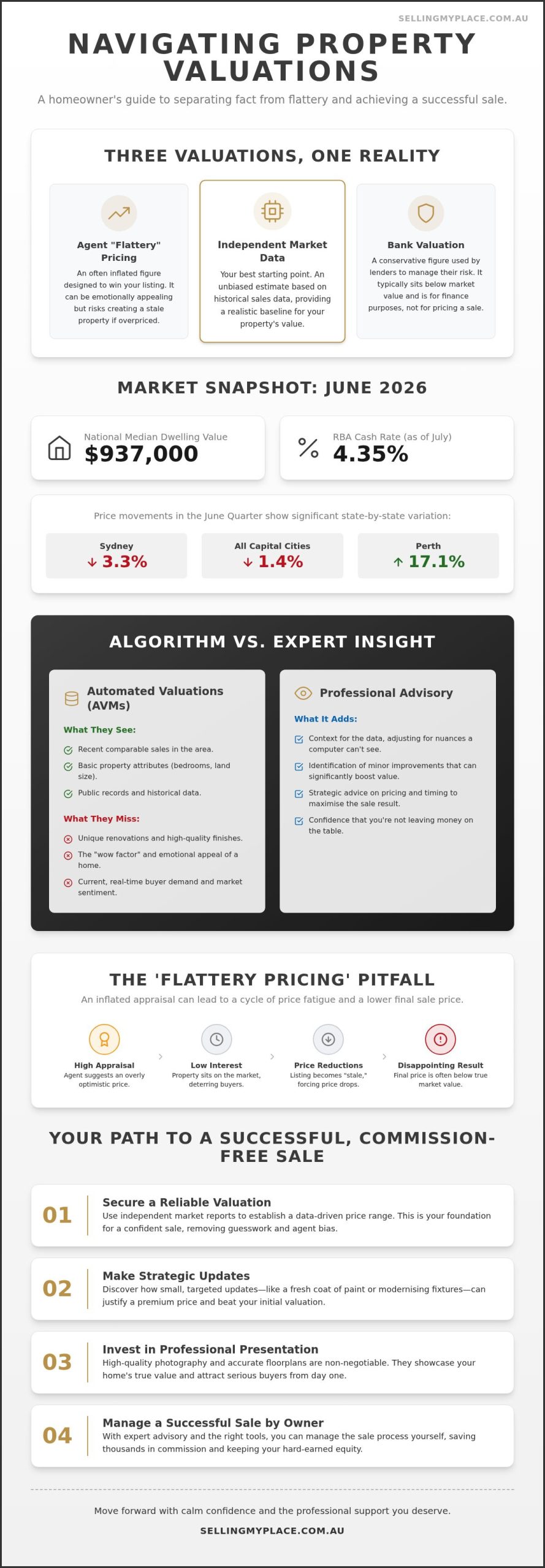
Maximising Your Result: How to Beat Your Current Valuation
Once you’ve received your free property valuation, it’s natural to feel either a sense of relief or a slight twinge of disappointment. However, that number is simply a starting point based on current market conditions and historical data. It isn’t a fixed destiny. You have the power to influence how buyers perceive your home’s worth. By focusing on both the visible and invisible elements of your property, you can push your final sale price toward the top end of your valuation range, or even beyond it. It’s about taking a proactive approach to your family’s equity.
Start with a “kerb appeal” audit. Buyers in 2026 are looking for stability and pride of ownership. Simple acts like pressure-cleaning the driveway, refreshing the mulch in your garden beds, or painting a tired front fence can add thousands to the perceived value. These aren’t just cosmetic changes; they signal to a buyer that the home has been loved and maintained. When a property looks cared for from the street, it sets a positive emotional tone before the front door even opens.
Pre-Sale Consulting and Presentation
In a digital-first market, your home’s first “showing” happens on a smartphone screen. This is why professional photography is non-negotiable. High-quality images captured with a steady hand can highlight the lifestyle your home offers, rather than just the dimensions of the rooms. Similarly, a clear floorplan is essential for the “mental move-in” process. It allows buyers to visualise where their favourite sofa will sit or how the kids’ rooms connect to the main living area. Addressing small DIY fixes, such as leaky taps or cracked tiles, prevents buyers from mentally “discounting” your valuation before they’ve even stepped inside.
Don’t overlook the “invisible” value. In 2026, energy efficiency is a high priority for Australian families facing rising living costs. If you have solar panels, double-glazed windows, or a high-star energy rating, make sure these are documented. Having a tidy folder of maintenance logs and appliance certificates gives buyers the calm confidence they need to make a premium offer. It shows you’ve been a diligent steward of the property, which reduces their perceived risk.
Strategic Marketing to the Right Audience
Your free property valuation also helps you identify the most likely buyer for your home. If your property sits in a price bracket favoured by first-home buyers, your marketing should focus on lifestyle, proximity to parks, and community roots. If it’s an executive residence, highlight the luxury finishes and proximity to business hubs. At Kincade, we use a global marketing network to reach buyers that local agents often miss. This broader reach, combined with highlighting lifestyle features that an algorithm cannot measure, ensures your home is presented to those who will value it most.
If you want to ensure you aren’t leaving money on the table, you can book a pre-sale consultation with our team to create a tailored plan that maximises your profit and protects your legacy.
Taking the Next Step: From Valuation to a Successful Sale
Once you’ve secured your free property valuation, the path forward often feels like the most daunting part of the journey. You have the data, but how do you translate those numbers into a successful result? It’s about moving from curiosity to a clear, actionable strategy. We view this transition not as a series of transactions, but as a partnership designed to protect your family’s financial legacy. By following a structured roadmap, you can replace the typical stress of selling with a sense of grounded control.
- Step 1: Secure your independent Neighbourhood Market Report. This document provides the factual bedrock for your sale, showing you exactly what buyers are paying for homes like yours without any agent-driven bias.
- Step 2: Consult with a Kincade advisor. Data is only half the story; the other half is interpretation. Our advisors help you read between the lines of your report to plan a “sale by owner” strategy that fits your specific timeline and goals.
- Step 3: Organise professional marketing assets. This is where you justify your price. High-quality photography and detailed floorplans ensure your home’s true worth is visible to every potential buyer from the first click.
- Step 4: List with confidence. Armed with facts and professional support, you can launch your property knowing you are keeping 100% of the sale profit. On average, our clients save $20,000 in commissions, which is a significant boost to any future plans.
Your Partnership with Kincade International
We pride ourselves on being the “steady hand” throughout your entire step-by-step selling process. Selling a home involves complex moving parts, from initial pricing to final settlement. This is why we facilitate access to conveyance advice, ensuring the legal transition is as smooth as the marketing campaign. By removing the traditional agent commission, we empower you to fund your next chapter, whether that’s a coastal downsize or a larger family sanctuary. You deserve to realise the full value of your hard-earned equity.
Ready to See What Your Place is Worth?
The Australian property market in 2026 requires a more sophisticated approach than simply putting a sign in the front yard. You have the expertise, the data, and the professional support of a global network at your fingertips. It is time to step away from the “agent trap” and take back control of your sale. Our flat-fee packages are designed to put the owner back in the driver’s seat, providing all the tools of a high-end agency without the high-end costs. You’ve worked hard for your home; now, let’s make sure that hard work pays off for you. Get your professional property advice today.
Secure Your Financial Legacy Today
Navigating the 2026 property market doesn’t have to be a source of stress. You now have the tools to distinguish between a basic free property valuation and the strategic advisory needed to secure a premium result. By moving past the “agent trap” and focusing on factual data, you’re not just selling a house; you’re protecting your family’s future. Whether it’s through a “kerb appeal” audit or leveraging global marketing exposure, you have the power to command the price your home truly deserves.
At Kincade, we’re here to act as your steady hand. Our 0% commission model means you keep 100% of your profit, allowing you to save an average of $20,000 in fees. With our Expert Advisory Service included, you’ll have professional guidance at every turn, from the first market report to the final settlement. It’s time to move forward with calm confidence and the support of a partner who values your legacy as much as you do.
Start your commission-free selling journey with Kincade today and take the first step toward a more profitable, stress-free move. We can’t wait to help you write your next chapter.
Common Questions About Property Valuation
Is a free online property valuation really accurate?
A digital estimate is a solid starting point, but it isn’t a definitive final price. These tools use Automated Valuation Models that look at historical data and public records. They often miss unique features, such as a bespoke native garden or a high-end kitchen renovation, which can add significant appeal. For a more precise figure, it’s best to pair digital data with professional advisory to account for the current “soul” of your home and buyer sentiment.
How often should I check my home’s estimated market value?
Checking your value every three to six months is a wise habit in the 2026 market. With national house prices showing quarterly shifts and interest rates holding steady, staying updated helps you make better decisions about when to sell or renovate. Regular digital check-ins ensure you aren’t basing your family’s financial future on outdated figures from 2025.
Do I need a real estate agent to get a property appraisal in Australia?
No, you don’t need a commission-based agent to understand what your home is worth. You can access independent Neighbourhood Market Reports and professional advisory services that provide factual, data-driven insights. This allows you to avoid the “flattery pricing” often used by agents to secure a listing, giving you a clearer, more honest view of your equity.
What is the difference between a bank valuation and a market appraisal?
A bank valuation is a conservative estimate used to manage lending risk, while a market appraisal focuses on what a buyer is likely to pay. Banks often value properties lower to protect their interests. A market-focused free property valuation considers lifestyle appeal and local demand, giving you a more realistic selling range for your next chapter.
Can I use a free valuation to set my reserve price at auction?
It isn’t recommended to use a basic online estimate as your sole guide for a reserve price. While it gives you a ballpark figure, a reserve should be based on recent settled sales and current auction clearance rates, which were around 52.4% in late July 2026. Professional advisory helps you set a strategic reserve that reflects real-time market conditions rather than just historical averages.
How much can I save by selling my own home after getting a valuation?
Australian homeowners typically save an average of $20,000 in commissions by managing their own sale. By using a free property valuation as your foundation and opting for a flat-fee advisory model, you keep 100% of your equity. This significant saving provides a much-needed boost when you’re looking to fund a downsize or upgrade to a new area.
Does solar or energy efficiency really increase my home value in 2026?
Yes, energy efficiency is a major drawcard for 2026 buyers who are increasingly conscious of rising living costs. Features like high-star energy ratings, solar panels, and double-glazing add tangible value that standard algorithms often overlook. Highlighting these “invisible” benefits in your marketing can help you justify a higher price point than a standard valuation suggests.
What documents do I need to prepare for a professional property advisory session?
Having your most recent rates notice, a list of major renovations, and any building or pest reports ready is very helpful. If you have warranties for appliances or solar installation certificates, include those as well. This information allows an advisor to provide a more nuanced and accurate assessment of your home’s true market potential, ensuring every detail is accounted for.
Flat Fee Real Estate Agent Sydney: Save Thousands on Your Sale in 2026
Why should a few weeks of marketing and a handful of open homes cost you more than a year’s worth of your hard-earned salary? With the median house price in Sydney sitting at $1.6 million as of early 2026, a traditional 2.1% commission means handing over more than $33,000 of your equity just for the privilege of selling. It’s a staggering figure that often feels more like a penalty than a service fee. If you’re looking for a more transparent way to move forward, partnering with a flat fee real estate agent in Sydney allows you to bypass these traditional structures and keep 100% of your property profit.
We understand that selling your family home isn’t just a transaction; it’s the bridge to your next chapter, whether that’s a comfortable retirement or a much-needed upgrade for a growing family. You deserve a steady hand to guide you through the process without the pressure of mounting costs or hidden marketing extras. In this guide, we’ll explain how the flat-fee model works in 2026 and how you can access professional-grade listings, including expert photography and floorplans, without the commission price tag. You’ll discover a smarter, more empathetic approach to real estate that puts your financial legacy and family needs first.
Key Takeaways
- Understand why the rise in Sydney property values has turned the standard 2% commission into an unnecessary tax on your family’s financial future.
- Discover how a flat fee real estate agent sydney offers a fixed, transparent alternative that allows you to bypass traditional commission structures entirely.
- Learn how to access professional-grade marketing, including photography and floorplans, while retaining 100% of your property’s sale profit.
- See how expert pre-sale consulting and a global marketing network can help you find the right buyer without the pressure to sell quickly.
- Uncover the “steady hand” approach to selling that provides professional authority and heartfelt support throughout your entire transition.
Why Sydney Sellers are Moving Away from Commission-Based Agents
For decades, the process of selling a home in Sydney has followed a predictable, albeit expensive, script. You hire an agent, agree to a percentage, and hope the final result justifies the massive slice of equity you’re handing over. However, as we move through 2026, the script is changing. With the median house price in our harbour city reaching $1.6 million, a standard 2.1% commission is no longer just a fee; it’s a significant financial burden. Many families are realising that $33,000 or more is simply too much to pay for a service that hasn’t fundamentally changed in years. This shift has led savvy homeowners to seek out a flat fee real estate agent sydney to protect their property profits and maintain control over their financial legacy.
The Australian real estate landscape is undergoing a quiet revolution. We’re seeing a move away from opaque commission structures toward a more transparent, fee-for-service model. This isn’t just about saving money, although that is a primary driver. It’s about a desire for transparency and a more honest exchange of value. People are tired of the “black box” of real estate costs where they aren’t quite sure what their money is actually buying. By choosing to take control, homeowners are ensuring that the profit from their years of mortgage repayments stays in their own pockets rather than being absorbed by agency overheads.
The True Cost of a Traditional Sale
When you sit down to calculate the impact of a traditional commission on your next home deposit, the numbers can be quite confronting. In the current Sydney market, the total cost of selling a property at the median price often ranges between $37,000 and $65,000 once you account for everything. Traditional agencies typically bill for marketing “extras” on top of their commission, with costs for photography and portal listings often reaching up to $10,000. Before you commit to these costs, it’s helpful to understand the foundational role of What is a Real Estate Agent? and how their historical fee structures were designed for a very different market. By moving to a smarter model, the average Kincade client enjoys a saving of $20,000 per sale, which is a substantial amount to put toward your next chapter.
A Partnership Approach to Selling
Choosing to sell your home with the support of a flat fee real estate agent sydney doesn’t mean you’re left to navigate the process alone. Instead, it transforms the experience from a transactional relationship into an empowered partnership. You remain the primary decision-maker, while an expert advisor acts as a steady hand to guide you through the complexities of the Sydney market. There is an immense emotional benefit to being the one who calls the shots. It reduces the stress of high-stakes transitions because you know your advisor is focused on your needs, not just on closing a deal to secure a commission. This protective, personal approach ensures that your family’s best interests are always the priority, providing a sense of calm confidence during what can otherwise be a very hectic time.
What is a Flat Fee Real Estate Agent and How Does it Work?
Put simply, a flat fee real estate agent sydney replaces the traditional percentage-based commission with a single, transparent fee for professional listing and advisory services. Instead of the agent’s pay cheque growing alongside your property’s value, you pay for the specific work required to market and sell your home. This 0% commission structure is the cornerstone of the model; it ensures that every extra dollar a buyer offers stays exactly where it belongs: in your bank account. It’s a shift from a transactional “success fee” to a professional “fee for service” that respects the equity you’ve built over many years.
While the concept might sound like “selling it yourself,” there is a world of difference between a lonely DIY sale and a supported direct sales model. You aren’t just sticking a sign in the front garden and hoping for the best. You’re accessing the same professional tools and digital infrastructure that top-tier agencies use, but without the high marketing costs or the conflict of interest that commissions can create. According to the official regulations on agent fees, commissions are entirely negotiable in NSW, yet many sellers feel pressured into standard rates. A flat-fee partnership empowers you to break that cycle while still having a seasoned expert by your side to provide neighbourhood market reports and strategic advice.
The Components of a Professional Listing
To achieve a premium price in a competitive market like Sydney, your property must look exceptional. This is why professional photography and detailed floorplans are non-negotiable components of the service. We don’t just list your home locally; we utilise global marketing networks to reach expatriates and international investors who might be looking for a foothold in the Australian market. Throughout this process, an Agent Advisory Service acts as your steady hand, providing guidance on pricing strategies and negotiation tactics. If you’re curious about how this might look for your specific suburb, you can always reach out for a chat about your property’s potential.
Digital Infrastructure for the Modern Seller
The digital age has truly levelled the playing field for homeowners. You now have access to a centralised system that allows you to track interest, manage enquiries, and view feedback in real time. This level of transparency is often missing in traditional sales, where you’re reliant on an agent’s filtered reports. By using a modern digital platform, you ensure your property remains highly visible on major portals until the “Sold” sticker finally goes up. There are no arbitrary time limits or pressure to accept a low offer just because a listing agreement is nearing its end; your home stays on the market until you achieve the result your family deserves.
Flat Fee vs. Traditional Commission: A Cost Comparison
To understand the true benefit of a flat fee real estate agent sydney, we need to look at the cold, hard numbers. Imagine you’re selling a lovely family home in a suburb like Marrickville or Ryde for $1.5 million. At a standard 2.1% commission, you’re looking at a bill of $31,500 before you’ve even paid for marketing. If you’re selling a premium $3 million property in the Eastern Suburbs, that commission fee doubles to a massive $63,000. It’s a significant amount of your equity that simply vanishes at the settlement table. When you partner with a flat fee real estate agent sydney, you’re opting for a transparent structure where the cost of the service doesn’t skyrocket just because your home is valuable.
The idea that a higher commission tier leads to a higher sale price is one of the most persistent myths in the industry. The market determines the price, supported by high-quality presentation and broad digital reach. A local agent’s window display is no match for a global digital network that puts your home in front of buyers across the country and overseas. You’re paying for the reach and the expertise, not for a promise of ‘extra effort’ that is hard to quantify. Traditional 90-day agreements can often work against you. As the expiry date approaches, the pressure to ‘just get it sold’ can be immense. This can lead to hasty decisions that don’t reflect the true value of your property. By removing the ticking clock, you stay in control of the narrative.
Protecting Your Home Equity
A successful sale starts with a realistic understanding of what your home is worth in the current market. Too often, agents provide inflated appraisals just to win your business. To get an honest, data-driven perspective, we recommend reading our guide on how to determine the market value of a home in Australia: The 2026 Seller’s Guide. Remember, ‘no commission’ doesn’t mean you’re going it alone. You still receive professional photography, floorplans, and the advisory support you need to protect your equity and negotiate with confidence. It’s about having all the professional tools at your disposal without the heavy financial penalty at the end.
The listed until sold advantage
One of the most reassuring aspects of a flat-fee partnership is the ‘listed until sold’ guarantee. You aren’t bound by a restrictive 90-day agency agreement that forces your hand. This freedom allows you to wait for the buyer who truly sees the emotional heart of your home, rather than rushing to accept the first offer that comes along just to meet an agent’s deadline. It effectively removes the risk of forfeiting fees if the market fluctuates or if you simply decide the timing isn’t right. You have a steady hand by your side for as long as it takes to achieve the result your family needs.
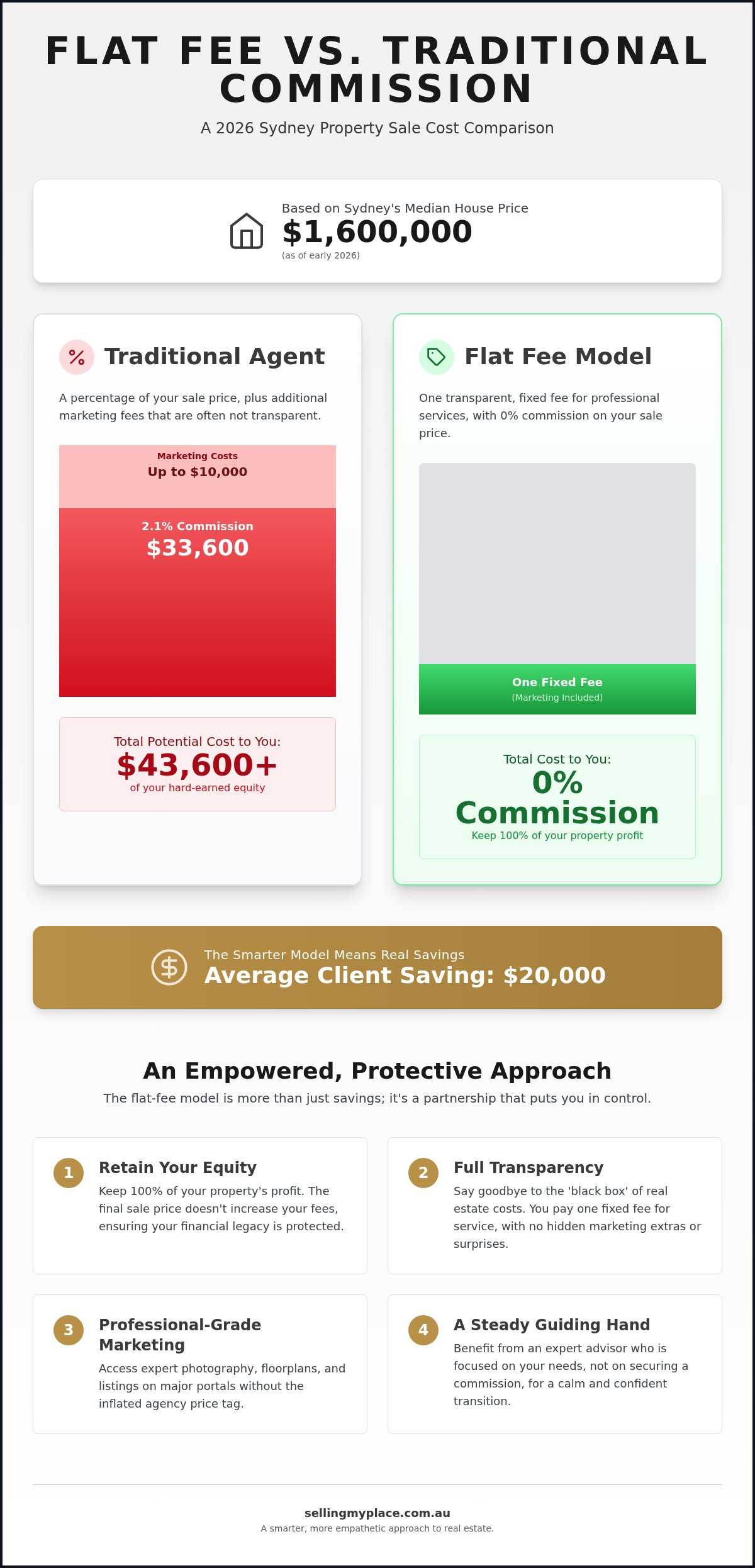
Preparing Your Home for a Successful Flat-Fee Sale
Success in the Sydney market isn’t just about listing your property; it’s about the thoughtful preparation that happens before the first buyer walks through the door. When you work with a flat fee real estate agent sydney, you aren’t just saving on commission; you’re gaining access to pre-sale property consulting designed to maximise your final price. This initial phase is crucial. It’s where we look at your home through the eyes of a potential buyer, identifying small changes that can lead to significant gains. Whether it’s a fresh coat of paint in a neutral tone or simply decluttering the living area, these details matter more than you might think.
Setting a realistic and competitive price is equally vital. We provide detailed neighbourhood market reports that strip away the guesswork, allowing you to see exactly what similar properties have sold for in your specific pocket of Sydney. This data-driven approach ensures you aren’t flying blind or relying on an agent’s “gut feeling.” Alongside this, we help you navigate the legal essentials, including providing conveyance advice to ensure the settlement process is as smooth as possible. It’s about building a solid foundation so you can move forward with confidence. If you’re ready to get started on your property journey, get in touch with our advisory team today for a personalised consultation.
Visual Storytelling and Presentation
In a digital-first market, your online presence is your most important asset. Visual storytelling is the key to high-click listings, turning a simple search result into an emotional connection. We organise professional photography that captures the emotional heart of your home, highlighting the features that make it special. Accurate floorplans are also essential, as they help buyers visualise their future lifestyle in your space before they even arrive. Simple staging tips, like adding fresh flowers or opening the blinds to let in that beautiful Sydney sunlight, make a massive difference in how your property is perceived online.
Mastering the Negotiation
Once the enquiries start rolling in, it’s time to handle buyer interest with confidence and professional decorum. You don’t need to be a seasoned salesperson to succeed; you just need the right tools and a bit of guidance. For a deeper dive into this part of the process, we recommend reading our guide on Mastering the Deal: Expert Property Sale Negotiation Tips for Australian Homeowners. There will be times when you need a second opinion or a strategic sounding board. This is exactly when you should seek advice from your dedicated property advisor. They act as your steady hand, ensuring you never feel pressured and always stay focused on achieving the best possible outcome for your family.
Selling Smarter with Kincade International Direct Sales
Kincade International Direct Sales (KIDS) represents a fundamental shift in how Sydney homeowners approach the market. We don’t believe your success should be measured by the size of an agent’s commission. Instead, we offer a 0% commission model that acts as a steady hand through every stage of your sale. This partnership is built on the idea that you, as the owner, are the best person to showcase your home’s story. We simply provide the professional tools and global reach to ensure that story finds the right audience. It’s a protective, supportive way to sell that prioritises your family’s financial future over agency profits.
One of the most significant concerns with traditional fixed-fee models is the risk of paying a fee and then being left unsupported if the property doesn’t sell immediately. We’ve removed that anxiety. Our “listed until sold” commitment means there are no hidden time limits and no pressure to accept a low offer just to close a file. You have the security of knowing your home remains visible on major portals until the result you want is achieved. Unlike local agencies that might rely on a shopfront window, we plug your property into a global marketing network that reaches buyers from all corners of the world. From professional photography to essential conveyance advice, we provide a comprehensive suite of services that traditional agents simply cannot match without charging a premium.
The Kincade Advantage for Sydney Homeowners
Our national reach and expert backing empower you to sell like a pro while feeling completely supported. We’ve designed our flat-fee packages to be the most comprehensive in the Australian market, ensuring you have everything you need to succeed. By choosing a flat fee real estate agent sydney, you’re taking a stand for transparency and value. If you’d like to see how our systems compare to the old-fashioned way of doing things, our Professional Residential Property Listing Services: The Modern Australian Seller’s Guide offers a clear look at the modern alternative. It’s about giving you the authority to manage your sale with a seasoned expert by your side.
Take the First Step Toward a Commission-Free Sale
The journey toward a smarter sale starts with a single, confident step. You don’t need years of industry experience to achieve a great result; you just need a proven framework and the right data. A great place to begin is by reading our How to Sell Your Own Home: A Step-by-Step Guide to Sale by Owner in Australia. This resource walks you through the practicalities of the process, ensuring you feel prepared for every enquiry. When you’re ready to see how your property stacks up in the current market, requesting your neighbourhood market report is the perfect way to kickstart your journey. It provides the clarity and confidence you need to make the best decisions for your family’s next big transition.
Secure Your Family’s Financial Future
Selling your home is one of the most significant life transitions you’ll ever navigate. It’s about more than just a property transaction; it’s about protecting the hard-earned equity that will fund your next chapter. By choosing a flat fee real estate agent sydney, you’re opting for transparency and a partnership that respects your financial goals. We’ve seen how moving away from traditional commissions allows homeowners to save an average of $20,000, providing vital extra funds for a comfortable retirement or a much-needed family upgrade.
With professional photography, floorplans, and a “listed until sold” commitment included, you have all the tools of a top-tier agency at your fingertips. There is no pressure to rush and no hidden time limits, just a steady hand to guide you toward the result you deserve. You’ve worked hard to build the value in your home; now it’s time to ensure you keep it. We invite you to keep 100% of your profit—explore Kincade’s flat-fee listing packages today. We are here to help you move forward with confidence, clarity, and a sense of calm.
Frequently Asked Questions
What is the difference between a flat fee and a commission-based agent?
A flat fee agent charges a single, transparent price for specific services regardless of your property’s final sale price, whereas a commission agent takes a percentage of the total. In a high-value market like Sydney, where commissions often range between 1.8% and 2.5%, this difference can represent tens of thousands of dollars. Choosing a flat fee real estate agent sydney allows you to pay for professional marketing and advisory work rather than a “success tax” on your home equity.
Do I still get my property listed on major real estate websites with a flat fee?
Yes, your property is listed on all major Australian real estate portals, ensuring it receives the same digital visibility as any traditional agency listing. We believe that digital reach is the great equaliser in the modern market. Your home will be visible to local buyers and our global marketing network until it is sold, ensuring you never miss out on the right enquiry because of where the listing is hosted.
Is it legal to sell my own home in Australia without a traditional agent?
It is completely legal to sell your own home in Australia, and many homeowners are choosing this path to maintain control over their sale. While the process involves specific legal requirements, such as the mandatory 2026 edition of the Contract for Sale in NSW, you aren’t required to hire a traditional commission-based agent. We provide the professional framework and advisory support to ensure you stay compliant while managing your own property journey.
How much can I realistically save by using a flat-fee real estate service?
Sellers can realistically save an average of $20,000 by bypassing traditional commission structures. With the median Sydney house price reaching $1.6 million in early 2026, a standard 2.1% commission would cost you over $33,000. By opting for a flat fee real estate agent sydney, you keep that equity in your pocket, which can be a life-changing amount when you’re planning for retirement or looking to upgrade your family’s lifestyle.
What happens if my property doesn’t sell within the first few months?
Your property remains listed until it is sold, with no arbitrary time limits or hidden fees to worry about. Traditional 90-day agency agreements often create unnecessary pressure to accept a lower offer just before the contract expires. Our “listed until sold” approach provides a sense of calm confidence, allowing you to wait for the buyer who truly values your home’s unique story and emotional heart.
Do I need to be a professional negotiator to sell my own home?
You don’t need to be a professional negotiator because you have a dedicated property advisor to guide you through every enquiry. While you are the primary decision-maker, we provide the strategic advice and market data needed to handle discussions with confidence and decorum. This partnership ensures you feel empowered during negotiations without the stress of going it entirely alone against seasoned buyers.
Are professional photography and floorplans included in the flat fee?
Professional photography and detailed floorplans are absolutely included as part of our comprehensive marketing package. We know that visual storytelling is essential for capturing interest in a competitive market like Sydney. High-quality imagery and accurate layouts help potential buyers visualise their future life in your space, which is the key to driving enquiries and achieving a premium result for your family.
How does Kincade support me during the legal settlement process?
Kincade provides expert conveyance advice to help you navigate the complexities of the legal settlement process with ease. From understanding the latest 2026 contract updates to ensuring identity verification requirements are met, we act as a steady hand during this final stage. This support reduces the stress of high-stakes paperwork, ensuring that the transition from “Sold” to settlement is as smooth and celebratory as possible.
Low Commission vs Flat Fee Real Estate: Which Saves Your Equity in 2026?
If you sold your family home for $900,000 this year, would you be comfortable handing over a $22,500 “thank you” note to an agent, especially if you still had to pay for marketing on top? It’s a significant slice of your hard-earned equity that could be better spent on your next chapter. We know many Aussie sellers feel a sense of dread when weighing up low commission vs flat fee real estate, fearing they must choose between losing their profit to high fees or being left to navigate a complex sale entirely on their own.
You deserve a selling experience that feels like a partnership, not just a transaction. In this article, we’ll pull back the curtain on the total out-of-pocket costs you can expect in 2026 and how to identify the best value for your specific situation. We will show you how it’s possible to save an average of $20,000 in fees while still securing the professional photography and expert guidance that ensures a premium result. It’s about finding that steady hand to guide you through the process, ensuring your home’s legacy is protected while your bank balance stays healthy.
Key Takeaways
- Understand why traditional percentage-based commissions have become a “legacy tax” on your equity in the current 2026 property market.
- Compare the total out-of-pocket costs of low commission vs flat fee real estate to see how even “discount” agents can leave you with a surprisingly large invoice.
- Identify the “hidden” marketing traps, such as Vendor Paid Advertising (VPA), that often inflate the final cost of a seemingly low-commission deal.
- Learn how an Agent Advisory Service bridges the gap between DIY and traditional agencies, providing professional support without the 2% price tag.
- Discover how to protect your profit and save an average of $20,000 by using a comprehensive flat-fee model that includes professional photography and floorplans.
The Evolution of Selling: Why Australians are Questioning Traditional Commissions
The Australian property landscape has shifted dramatically over the last decade. As we move through 2026, the old ways of doing things are being held up to the light. With property values sitting at record highs, that standard 2.5% or 3% commission doesn’t just feel like a fee; it feels like a massive chunk of your family’s future. When a house sells for $1.2 million, a 2.5% commission is $30,000. That’s a significant sum that could go toward your retirement, your children’s education, or the mortgage on your next home. Deciding between low commission vs flat fee real estate is no longer just a niche conversation for savvy investors; it’s a mainstream priority for every Aussie homeowner.
Digital platforms have changed the game for good. Nowadays, buyers find homes on their phones while they’re having their morning coffee. They aren’t searching for a specific agency brand or a high-profile agent. They’re looking for the right kitchen, the perfect backyard, and a suburb they love. This digital democratisation means the agent is no longer the sole gatekeeper of information. The “Direct Sale” movement is gaining momentum because Australians are realising they can take the lead while still presenting their home with professional polish. You don’t need to pay for an agency’s expensive office fit-out or their local awards dinner to get a great result.
The “Net Profit” Mindset
It’s easy to get caught up in the excitement of a high sale price, but the figure that truly matters is what lands in your bank account after the dust settles. If you’re planning to downsize or move into a bigger family home, every dollar of equity is precious. Before you list, it’s vital to determine the market value of a home in Australia so you can accurately forecast your net profit. Understanding this number helps you see exactly how much a traditional commission might eat into your next deposit. It’s about focusing on the outcome for your family, not just the number on the contract.
The Transparency Gap in Real Estate
For a long time, the industry relied on traditional real estate commission models where fees were often shrouded in complex marketing budgets and tiered structures. Today, the power has shifted. We live in an information-led era where transparency is the new gold standard. Buyers are savvy; they’re interested in the property’s story and its value, not the agency logo on the signboard. Choosing a path that offers upfront, honest costs isn’t just about saving money. It’s about taking back control of one of the most significant financial transitions in your life with a steady hand and a clear plan.
Decoding the Models: Low Commission vs Flat Fee Real Estate Explained
When you start interviewing agents, the terminology can quickly become a bit of a muddle. You will likely hear two main pitches: the traditional percentage model (sometimes dressed up as a “discount” or low-commission offer) and the modern flat-fee approach. Choosing between low commission vs flat fee real estate isn’t just about picking the smallest number on a page; it’s about understanding how that number is calculated and what it ultimately takes from your pocket at settlement. It’s the difference between sharing your home’s hard-earned equity and simply paying for the professional services required to find a buyer.
The Low-Commission Percentage Trap
Many agencies now offer “low” commissions, often ranging between 1.5% and 2%, to compete with digital alternatives. While this sounds appealing compared to the old 3% standard, the math can still be sobering. On a $1 million sale in Sydney or Melbourne, a 2% commission still results in a $20,000 invoice. You might also encounter “tiered commissions,” where an agent takes a higher percentage on any amount achieved above a certain price. While marketed as an incentive, this often means you are paying a premium for a result the market was already prepared to deliver. Homeowners are often caught off guard when a quoted commission rate excludes the mandatory 10% GST, effectively turning a “competitive” 2% fee into a 2.2% hit to the final settlement.
The Flat-Fee Transparency Model
In contrast, the flat-fee model treats real estate as a professional service rather than a partnership in your profit. By using Professional Residential Property Listing Services, you pay a set amount for the high-end tools needed to sell, such as professional photography, detailed floorplans, and listings on the major property portals. At Kincade International Direct Sales (KIDS), we’ve taken this a step further with a 0% commission structure. This “No Commission” revolution is built on the fact that you don’t legally need a traditional agent to sell property in Australia; you just need the right marketing and a steady hand to guide the process.
- Budget Certainty: You know exactly what you are paying from day one, with no surprises at the end.
- No Time Pressures: Unlike traditional 90-day agency agreements that can leave you feeling rushed, many flat-fee models allow your listing to remain active until it is sold.
- Retained Equity: Every dollar of the sale price above your costs stays with you, which can mean an average saving of $20,000 per sale.
If you are curious about how this structure might work for your specific suburb, you might find it helpful to speak with a property advisor who can walk you through the logistics of a direct sale.
The ‘Hidden’ Trap: Comparing Total Costs and Marketing Budgets
When you sit down to compare low commission vs flat fee real estate, it is vital to look beyond the headline rate. Many homeowners are seduced by a “discounted” commission only to find a secondary invoice for marketing sitting on their kitchen bench. This is the “plus marketing” model, and it’s where the costs of selling can quickly spiral out of control. It is a stressful experience to realise that the fee you negotiated only covers the agent’s time, not the actual tools needed to find a buyer.
The real sting often comes from Vendor Paid Advertising (VPA). Traditional agents typically ask you to fund the entire campaign upfront or at settlement. This includes everything from the portal listings on major websites to the physical signboards and social media boosts. Because the agent isn’t paying for it, there is often less incentive to keep these costs lean. It isn’t uncommon for a marketing budget to swallow another $5,000 to $10,000 of your equity before you’ve even hosted your first open home. These are out-of-pocket expenses that stay gone, regardless of whether your property actually sells.
Marketing: Investment or Expense?
We all know that high-end professional photography and detailed floorplans are non-negotiable in 2026. Buyers expect to see your home in its best light before they even think about booking an inspection. However, these shouldn’t be “add-ons” that keep ticking up your final bill. At Kincade, we include professional photography and floorplans within our flat fee marketing and advisory service. This approach treats marketing as a necessary investment in your sale result, not a profit centre for the agency. It ensures your home stands out without you having to second-guess every line item on a marketing schedule.
The Final Invoice: A Real-World Comparison
Let’s look at a hypothetical $1.2 million sale to see how the numbers truly stack up. With a 2% low-commission agent, you are looking at $24,000 in commission. Add 10% GST ($2,400) and a modest $6,000 marketing budget, and your total cost hits $32,400. When you compare low commission vs flat fee real estate through the lens of your final net profit, the difference is stark. The Kincade model focuses on a single, transparent fee with 0% agency commission, often saving sellers an average of $20,000. That’s money that stays in your pocket to fund your next deposit or perhaps a well-deserved family holiday.
Before you sign any agency agreement, look closely for the fine print. Ask about admin fees, auctioneer costs, and whether marketing “rebates” are passed back to you or kept by the agency. Having a clear, fixed cost from day one provides a sense of calm confidence. It allows you to focus on the emotional journey of moving house rather than worrying about a ballooning invoice that eats into your family’s future.
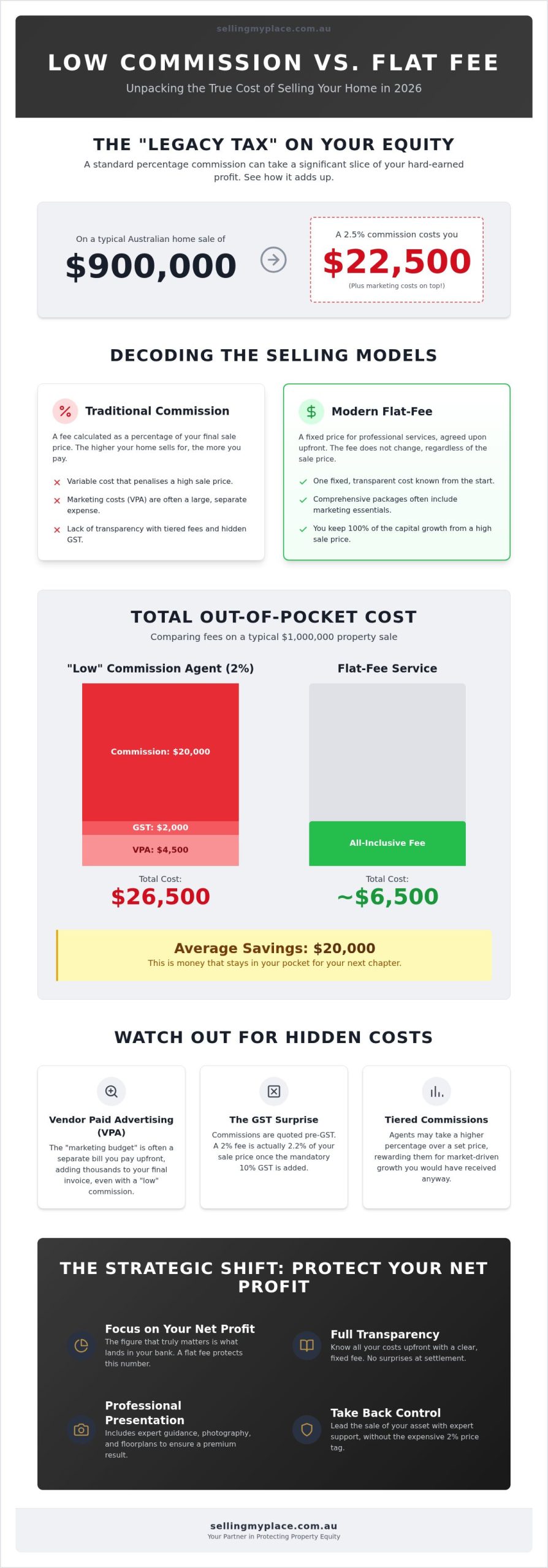
Service vs Savings: Can You Really Get Expert Support Without the 2% Tag?
There is an old saying in the property industry that you get what you pay for. It is a line often used to justify high commissions, suggesting that unless you are paying 2% or more, you are sacrificing the expertise needed to secure a top price. However, as we look at the choices between low commission vs flat fee real estate in 2026, it is clear that high fees do not always equal high service. In fact, many high-volume discount agents might treat your home as just another number to meet their monthly targets, whereas a partnership-based model focuses entirely on your result.
Choosing a flat-fee model doesn’t mean you are left to fend for yourself on the front lawn. It is about a strategic shift toward Direct Selling. You take the lead on showing your home, which, let’s be honest, nobody knows better than you do. But you aren’t doing it alone. When you sell your own home through a professional advisory model, you are backed by the same high-end tools and expert insights that traditional agencies use, just without the legacy tax on your profit. It is about having a steady hand to guide you, ensuring you feel protected throughout the entire journey.
The Value of Professional Advisory
A seasoned advisor is the missing piece that many people overlook when considering a flat-fee approach. This isn’t just about a listing on a website. It involves pre-sale consulting to ensure your property is presented perfectly and having an expert to help you navigate the nuances of buyer offers. Negotiation is an emotional process. Having an advisor to provide grounded, calm guidance during those final stages can be the difference between a good offer and a great one. They also provide essential conveyance and legal advice to ensure the transition to settlement is as smooth as possible, reducing the stress of complex paperwork.
What to Look for in a Flat-Fee Partner
Not all flat-fee services are created equal. To ensure you are protecting your equity while maintaining professional standards, use this quick checklist when comparing your options:
- Professional Marketing: Does the fee include high-end photography and floorplans? These are essential for a premium feel.
- Expert Advisory: Is there a dedicated human advisor you can call when things get complex or when an offer lands?
- Global Reach: Are your listings pushed to major national and global property portals to ensure maximum exposure?
Finding the right balance between saving on fees and receiving genuine support is key to a successful sale. It is about feeling empowered, not overwhelmed, as you transition to your next life stage. If you would like to see how our advisory model supports your specific goals, you can book a consultation with our team today.
Securing Your Equity: The Strategic Shift to Flat-Fee Property Marketing
Choosing between low commission vs flat fee real estate often feels like a trade-off between professional quality and cost savings. We believe it shouldn’t be. The strategic shift toward Direct Sales is about bridging that gap, providing you with a high-end marketing engine while keeping your equity where it belongs. It’s a sophisticated way to sell that respects both your property’s value and your family’s financial future. You aren’t just choosing a cheaper option; you’re choosing a smarter, more transparent way to move forward.
Kincade International Direct Sales (KIDS) operates on a 0% commission structure because we believe you shouldn’t have to pay a success tax on your own home. Instead of a traditional agency model that focuses on high-volume turnover, we act as a steady hand by your side. Our “Until Sold” guarantee is a cornerstone of this partnership. It removes the arbitrary 90-day pressure found in traditional agreements, giving you the peace of mind that your listing remains active and supported until the right buyer is found. This removes the anxiety of “what if it doesn’t sell in time?” and replaces it with grounded confidence.
One of the most empowering realisations for many sellers is that they are actually the best people to show their own home. You know which window catches the morning sun and which local cafe makes the best flat white. Buyers appreciate that authentic, local knowledge. When you combine your personal touch with our professional marketing and advisory, you create a powerful, trustworthy experience for potential buyers. It’s a collaborative approach that feels less like a high-pressure transaction and more like a neighbourly hand-over. By removing the middleman from the inspection, you foster a direct connection that often leads to clearer communication and better results.
The Kincade Advantage: Professional Marketing & 0% Commission
Our infrastructure is designed to give you a competitive edge without the high marketing costs. We plug your property into a global marketing network, ensuring it reaches the right buyers whether they are across the street or across the world. From high-end photography to detailed floorplans, we provide every tool necessary for a polished, professional listing. This isn’t a “DIY” project; it’s a fully supported Direct Sales programme that puts you in the driver’s seat with an expert navigator by your side. When you weigh up low commission vs flat fee real estate, the KIDS model stands out by offering the full-service results you expect with the 0% commission structure you deserve.
Taking the First Step Toward a Smarter Sale
Transitioning from considering a sale to actually listing your property can feel like a big leap. We make it easier by providing detailed neighbourhood market reports to help you understand your local landscape. Our pre-sale advisory consultation is a chance to discuss your goals, prepare your home for the market, and plan your strategy with confidence. You don’t have to navigate this alone. We’re here to ensure your transition is as smooth and rewarding as possible, protecting your legacy and your profit every step of the way.
See how much equity you can save with Kincade today
Take Control of Your Property Legacy
Selling your home is more than just a transaction; it is a major life transition that deserves both professional excellence and financial respect. By moving beyond the traditional commission model, you are choosing to prioritise your family’s net profit over an agency’s bottom line. we have explored how the choice between low commission vs flat fee real estate often comes down to transparency. You don’t have to settle for hidden marketing traps or high-volume discount agents who treat you like a number. Instead, you can embrace a partnership that provides a steady hand and expert guidance throughout the journey.
With Kincade International Direct Sales, you gain access to a 0% commission structure that helps sellers save an average of $20,000. Every package includes high-end essentials like professional photography and floorplans, backed by our expert Agent Advisory Service to navigate every offer. It’s about feeling empowered to show your own home while knowing you have a seasoned expert in your corner. If you are ready to keep your hard-earned equity and sell with confidence, we invite you to join the Direct Sale movement and save your equity today. Your next chapter is waiting, and we are here to help you start it on the best possible footing.
Common Questions About Selling Smart
Is a flat-fee real estate service legal in all Australian states?
Yes, selling your property through a flat-fee model is completely legal in every Australian state and territory. You have the legal right to represent your own home and manage the sale process yourself. This path is becoming increasingly popular as more homeowners look to protect their equity from traditional commission structures while maintaining professional marketing standards.
Do I still have to pay a commission to the buyer’s agent if I use a flat fee?
If a buyer chooses to engage their own professional representation, the seller is typically responsible for the buyer’s agent commission. This fee usually ranges between 2.5% and 3% of the sale price. It is a detail worth discussing during your initial consultation so you can factor it into your total costs when comparing low commission vs flat fee real estate.
What happens if my property doesn’t sell within three months?
With Kincade, your listing remains active until it is sold. Unlike traditional 90-day agency agreements that can leave you feeling rushed or pressured to drop your price, we don’t impose arbitrary time limits. We understand that finding the right buyer for your unique home takes a steady hand and a patient, methodical approach.
Who handles the legal paperwork and conveyance in a flat-fee sale?
While you manage the inspections and negotiations, the formal legal transfer is handled by a qualified solicitor or conveyancer. We provide expert conveyance advice to ensure you have the right legal support in place. This ensures all paperwork is compliant with your specific state’s property laws, giving you total peace of mind throughout the settlement process.
Can I really save $20,000 on commission by selling my own home?
Saving $20,000 is a very realistic outcome for many Australian families in the current market. When you consider that a 2.5% commission on an $800,000 home is $20,000 plus GST, the financial benefit is clear. By choosing a 0% commission structure, you are effectively keeping that entire slice of hard-earned equity for your own future needs.
Do flat-fee services include professional photography and floorplans?
High-quality visuals are essential for a premium result, so our flat-fee service includes professional photography and floorplans as standard. We don’t believe these should be hidden extras or expensive add-ons. Every listing is presented with the same professional polish you would expect from a high-end traditional agency to ensure it stands out online.
How do I handle negotiations with buyers without a traditional agent?
You aren’t left to negotiate in the dark. Our Agent Advisory Service provides a seasoned expert to guide you through buyer offers and counter-offers. We act as your “steady hand,” providing the data and strategic advice you need to make confident decisions without the stress or pressure of a traditional commission-driven environment.
Will my property be listed on the major Australian real estate portals?
Yes, your property will be seen by the widest possible audience. We ensure your home is listed on the major Australian property portals where active buyers are already searching. This visibility, combined with our global marketing network, ensures your home receives maximum exposure to both local and international buyers looking for their next move.
Fixed Fee Real Estate Agents in Australia: The 2026 Seller’s Buying Guide
Did you know that the average Australian homeowner now hands over roughly $20,000 in commissions just to sell their family home? It often feels like a success tax; after years of building equity and making memories, seeing a massive chunk of your hard-earned profit vanish into a percentage-based fee is understandably disheartening. You deserve to feel like a priority, not just another number in a high-volume office. While many are turning to fixed fee real estate agents australia wide to protect their equity, it’s only natural to worry that a lower fee might mean a lower level of care.
This guide is here to show you that you don’t have to choose between saving your money and receiving premium service. You’ll learn how to retain more of your sale profit while still securing world-class marketing and the steady hand of an expert advisor to sell for the highest possible price. We’ll walk you through the strategic benefits of this model, from professional-grade photography and floorplans to navigating the latest 2026 disclosure laws, ensuring you transition to your next chapter with confidence and a much fuller bank account.
Key Takeaways
- Understand how a flat-fee model protects your family’s equity, allowing you to save an average of $20,000 compared to traditional percentage-based commissions.
- Discover why professional-grade photography and a global marketing network are non-negotiable for capturing buyer attention in today’s crowded digital landscape.
- Learn how to identify the best fixed fee real estate agents australia has to offer by checking for ‘listed until sold’ guarantees and comprehensive pre-sale consulting.
- Identify the hidden costs often buried in traditional agency contracts, such as premium listing surcharges and auctioneer fees, to ensure you keep more of your profit.
- See how a partnership-based advisory service can provide the steady hand you need to navigate complex negotiations and settlement with total peace of mind.
The Evolution of Selling: Why Fixed Fee Real Estate is Dominating the Australian Market
For decades, the Australian property market operated under a “gatekeeper” model. You would hire an agent, they would handle the portal listings, and you would pay a slice of your home’s value at the end. But as we move through 2026, the scenery has shifted. A fixed fee model is simply a predetermined, transparent rate that stays the same regardless of what your home sells for. It’s a radical departure from the traditional commission-based approach, which often sees sellers in states like Queensland or Tasmania paying upwards of 3.25% plus GST. By opting for fixed fee real estate agents australia, homeowners are finally taking back control of their most significant financial asset.
Why is this shift happening so rapidly now? Because Australian sellers are prioritising equity protection over traditional prestige. In a climate where the national median commission rate is approximately 2.65%, the “Direct Sales” movement is gaining ground as the modern alternative to the agent-led gatekeeper. This isn’t just about saving money; it’s about a partnership. You aren’t just “another listing” in a high-volume agency. Instead, you are the decision-maker, supported by a professional advisory service that values your family’s future as much as you do.
The Death of the Percentage-Based Commission
Does it really take twice as much effort to sell a $2 million home as it does a $1 million home? Most savvy sellers don’t think so. The work involved in professional photography, floorplans, and digital marketing remains largely the same, yet a percentage-based commission punishes you for having a more valuable asset. There is also a psychological shift occurring. Sellers want total transparency over “hidden” incentives or quotas that might influence an agent’s advice. Technology has democratised the process, allowing homeowners to access the same high-traffic portals that were once the exclusive domain of traditional agencies through a flat-fee MLS style arrangement.
The Financial Logic: Protecting Your Home Equity
A flat fee preserves the “profit gap” by ensuring every extra dollar a buyer pays stays in your pocket rather than being split with an agency.
Think about what an extra $20,000 means for your next chapter. It’s not just a number on a spreadsheet; it is a larger deposit for your next family home, a significant boost to your retirement fund, or the freedom to renovate. It is important to realise that “low commission” isn’t the same as being commission-free. Even a “discounted” 1.5% rate on a median-priced home in Sydney or Melbourne can still strip away tens of thousands of dollars. Choosing a fixed-fee approach is a strategic move to treat your property sale as a legacy-building event rather than a costly transaction.
Decoding the Flat Fee Model: What Exactly Are You Paying For?
When you choose fixed fee real estate agents australia, you aren’t just buying a listing; you’re securing a comprehensive suite of professional tools designed to protect your equity. Unlike traditional models where marketing is often an additional, stress-inducing invoice, a high-quality flat-fee package bundles everything you need into one transparent price. This includes professional photography, detailed floorplans, and neighbourhood market reports that give you a realistic view of your local area. Perhaps the most reassuring part is the “Listed Until Sold” promise. It removes that nagging anxiety about time limits or losing your investment if the right buyer doesn’t appear in the first few weeks. Your property remains visible until the keys are handed over.
In 2026, the buyer for your home might not be just around the corner. They could be in London, New York, or Singapore. Digital infrastructure now allows your property to be seen on a global stage, reaching international portals that traditional local agencies often overlook. This global marketing network ensures your home isn’t just “on the market” but is actively being presented to a worldwide audience of qualified investors and families looking to relocate. It’s about casting the widest possible net to find the buyer who truly values what your home represents.
Professional Marketing vs. DIY
Visual storytelling is the heartbeat of a successful sale. High-end professional photography is non-negotiable; it’s the first thing a buyer sees on their screen at 10:00 PM. Accurate floorplans are equally vital, as they help potential buyers mentally place their furniture and reduce the number of “tyre-kickers” visiting your home. Citing standards often discussed by The Real Estate Institute of Australia, we know that professional presentation is what separates a quick sale from a stagnant listing. Market reports further empower you, providing the data needed to set a price that is both competitive and rewarding.
The Advisory Advantage
Beyond the photos and the portals, the real value lies in the human element. An Agent Advisory Service provides the expert backing you’d expect from a top-tier agency without the heavy commission. This includes pre-sale consulting to help you organise your home for maximum appeal. Small changes, like a fresh coat of paint or strategic decluttering, can lead to significantly higher prices. Additionally, having access to conveyance advice ensures you can navigate the legal landscape of Australian property sales with a steady hand. If you feel ready to discuss how this model fits your specific goals, you can speak with a property specialist today to explore your options.
Fixed Fee vs. Traditional Commission: A Financial Comparison for Savvy Sellers
When you sit down to calculate the potential return on your property, the “Value Gap” is often the most confronting figure on the page. In the traditional model, you’re effectively paying a success tax on your own home’s appreciation. If your property value has climbed significantly over the last few years, a percentage-based commission means your agent receives a pay rise for work that hasn’t actually become more difficult. By choosing fixed fee real estate agents australia wide, you’re making a conscious decision to keep that “Value Gap” where it belongs: in your bank account. This isn’t just about being frugal; it’s about strategic equity management.
Many sellers worry that a flat fee might lead to a lack of incentive. It’s a common myth that a commission-based agent will fight harder for every last dollar. However, if you look at the numbers, a 2% commission on an extra $10,000 in the sale price only nets the agent an additional $200. Is that enough to make them hold out for weeks? Often, the traditional incentive is actually geared toward a quick turnover rather than the absolute highest price. A fixed-fee partner, however, relies on your success and your glowing recommendation to fuel their business, creating a different, more transparent kind of motivation.
The Math of a $1,000,000 Sale
Let’s look at the cold, hard numbers for a typical Australian home valued at $1,000,000. A traditional agent charging a 2.5% commission plus GST will cost you $27,500 at settlement. In contrast, even a premium flat-fee package like the KIDS Prestige tier, which includes professional photography and global reach, costs roughly $2,000 plus GST. That is a staggering saving of over $25,000.
Visualise what that extra $25,000 could do for your family. It could be the budget for a brand-new kitchen in your next home, a significant contribution to your children’s education fund, or a well-deserved luxury holiday to celebrate your move. This financial breathing room provides a sense of calm confidence. You aren’t pressured to accept a lower offer just to “get it over with” because you know your overheads aren’t climbing every day your home is on the market.
Service Level Comparison
A common misconception is that a flat fee means “no service” or a “DIY” approach that leaves you stranded. In reality, the best fixed fee real estate agents australia has to offer provide a sophisticated advisory service that rivals any traditional agency. You aren’t dealing with a distant call centre; you have access to expert property specialists who guide you through the process. While you might handle the walkthroughs, you are empowered with expert property sale negotiation tips to ensure you never leave money on the table.
Traditional agencies often come with “hidden costs” that aren’t always clear at the start. These can include auctioneer fees, premium listing surcharges, and even advertising “kickbacks” that don’t actually benefit your sale. A fixed-fee model strips away this complexity. With the added benefit of “No Time Limits,” you can wait for the perfect buyer who sees the true value of your home, rather than being forced into a “fire sale” by an agent eager to move on to their next commission check.

How to Choose the Right Fixed Fee Partner: A Checklist for Australian Homeowners
Selecting a partner to sell your home is one of the most significant decisions you’ll make. It is a transition that carries both financial weight and deep emotional significance. While the cost savings of fixed fee real estate agents australia wide are a major drawcard, you must look beneath the surface to ensure your equity is truly protected. Is the agency offering a genuine partnership, or are they simply a digital portal? A true partner acts as a nurturing guide, providing a steady hand through the complexities of the sale while ensuring you feel supported at every turn.
The first thing to scrutinise is the “Hidden Extras” list. A comprehensive flat-fee service should include professional photography, floorplans, and listing fees as standard. If you’re being billed separately for every signboard or social media post, the “fixed” fee isn’t actually fixed. Furthermore, you must verify the exit strategy. Life is unpredictable, and you shouldn’t be penalised if the market takes a breath. Ensure your agreement is “Listed Until Sold” so you can wait for the perfect buyer without the pressure of expiring contracts or forfeited investment.
The “Red Flag” Checklist
Beware of “Upfront Only” models that offer no ongoing support once your listing is live. Selling a home is a journey, not a single event. You need a partner who stays with you until the settlement is finalised. Low-quality marketing is another major red flag; dark, amateur photos can devalue your home in the eyes of buyers. It is also wise to ask about the depth of their legal support and conveyance advice. Knowing that the paperwork is being handled by experts allows you to focus on your family’s next move with total peace of mind.
Evaluating the Digital Infrastructure
In 2026, buyers are more digitally savvy than ever. Your listing needs to be easily discoverable on major portals and international networks, not just hidden on a local site. Does the provider offer sophisticated market value determination tools to help you price your home accurately? Pricing is an art grounded in data, and having access to real-time neighbourhood reports is vital. Finally, consider how they manage leads. You want a system that captures every enquiry and manages buyer representation professionally, ensuring no opportunity is missed.
If you’re feeling overwhelmed by the options and want to ensure your home is in safe hands, book a consultation with our advisory team to see how we can protect your equity and simplify your sale.
Maximising Your Profit: The Kincade International Direct Sales (KIDS) Advantage
Choosing to sell your property is rarely just about the bricks and mortar. It’s about the memories you’ve made and the dreams you’re funding next. Kincade International Direct Sales (KIDS) understands this deeply. We combine sophisticated professional authority with a heartfelt warmth that ensures you never feel alone in the process. While other fixed fee real estate agents australia wide might offer a portal, we offer a partnership. Our approach is grounded in the belief that you should be the primary beneficiary of your home’s appreciation, not a third-party agency.
Our “Steady Hand” promise is about more than just a successful transaction; it’s about nurturing you through the emotional weight of a major life transition. We provide the calm confidence needed to reduce the stress of high-stakes decisions. By leveraging a global marketing network, we ensure your property isn’t just seen by locals, but by international buyers who often outmuscle the reach of traditional neighbourhood agencies. This direct sales model is the most transparent way to sell in 2026, putting you in the driver’s seat while we provide the expert support to ensure you never feel lost.
A Partnership, Not a Transaction
We treat your home sale as a legacy. It’s not just another listing on a spreadsheet to us. Our dedicated Agent Advisory Service is the cornerstone of your success, providing pre-sale consulting and conveyance advice that shields you from the usual pitfalls of the industry. Many Australian families have already saved their equity by making this switch, retaining an average of $20,000 that would have otherwise vanished into commissions. These aren’t just statistics; they are real stories of families who used those savings to fund their retirements, pay off debts, or help their children into their own first homes.
Your Next Steps to an Empowered Sale
Transitioning from “thinking of selling” to “sold” is simpler than you might imagine. It starts with choosing a professional property marketing package that includes everything we’ve discussed, from high-end visual storytelling to global exposure. You don’t have to navigate the complexities of negotiation or settlement alone. By choosing an empowered sale, you are choosing to respect the value of your own hard work and the equity you’ve built over the years. It’s time to take the first step toward a more rewarding property journey. You can organise your commission-free listing today and start the next chapter of your life with your equity fully intact.
Taking Control of Your Property Legacy
Selling your home is more than a financial transaction; it is the closing of one chapter and the hopeful beginning of another. You’ve seen how the shift toward fixed fee real estate agents australia wide is helping families protect their hard-earned equity, ensuring that an average of $20,000 stays exactly where it belongs. By choosing a model that prioritises professional visual storytelling and global marketing, you aren’t sacrificing quality for cost. Instead, you’re embracing a more transparent, modern way to sell that values your home’s legacy and your family’s future.
You don’t have to navigate this transition alone. With an expert Agent Advisory Service at your side and professional photography and floorplans included as standard, you can move forward with a steady hand guiding every negotiation. It’s about feeling empowered, respected, and ready for what comes next. We believe your hard work should benefit your next move, not an agency’s bottom line.
Protect your equity and sell commission-free with Kincade International Direct Sales today. We’re here to help you make your next move your best move yet.
Frequently Asked Questions
Are fixed fee real estate agents as good as commission-based agents?
Yes, fixed-fee agents provide a level of service that often exceeds traditional models because the focus is on a genuine partnership rather than a high-volume transaction. You receive the same professional marketing, high-end photography, and expert advisory services without the “success tax” on your home’s equity. This model empowers you to be the primary beneficiary of your property’s value while still having a steady hand to guide you through the complexities of the sale.
Do I have to pay the fixed fee upfront even if my property doesn’t sell?
Most fixed-fee structures involve an upfront payment to cover the costs of professional photography, floorplans, and portal listings. While this differs from the “no sale, no fee” commission model, it is paired with a “Listed Until Sold” guarantee. This means there are no time limits on your listing, ensuring you don’t lose your investment or feel pressured to accept a lower offer just because a contract is expiring.
What is included in a typical fixed fee real estate package in Australia?
A comprehensive package typically includes professional photography, detailed floorplans, a “For Sale” signboard, and access to neighbourhood market reports. Premium tiers often add global marketing network exposure to reach international buyers and a dedicated specialist for pre-sale consulting. These inclusions are designed to provide a “full service” experience that protects your equity while ensuring your home is presented with sophisticated authority to the widest possible audience.
How much can I actually save by using a fixed fee agent?
Australian sellers save an average of $20,000 per sale by choosing a flat-fee model over a traditional agency. This figure is calculated by comparing the cost of a fixed-fee package against the national median commission rate, which sits at approximately 2.65% as of 2026. On a million-dollar property, that saving represents a significant boost to your next deposit or retirement fund, rather than a payout to a third-party agent.
Will my property get the same exposure on Australia’s major real estate websites?
Your property receives the exact same visibility on the nation’s most popular property portals as any traditional listing. The best fixed fee real estate agents australia has to offer go even further by listing your home on international portals in the UK and USA. This ensures your home isn’t just seen by locals; it’s presented to a global network of qualified buyers looking to relocate to your area.
Who handles the property inspections and negotiations in a fixed fee model?
Homeowners usually manage their own property inspections, which allows for a more authentic and personal connection with potential buyers. You know your home’s story better than anyone else. When it’s time to talk numbers, you aren’t left stranded; an Agent Advisory Service provides the expert negotiation tips and support you need. This ensures you can navigate the final stages of the deal with calm confidence and professional backing.
Is the fixed fee model legal in all Australian states and territories?
Yes, the fixed-fee model is completely legal and increasingly popular across every state and territory in Australia. There are no regulated or mandatory commission fees in this country, meaning agents and sellers are free to agree on any pricing structure. Whether you are navigating the new 2025 disclosure laws in Queensland or selling in a metropolitan centre like Sydney, the flat-fee model is a legitimate and strategic choice.
What happens if I decide to take my property off the market?
You have the freedom to withdraw your listing at any time without the sting of “withdrawal fees” often found in traditional commission contracts. Since the marketing and listing services are typically paid for at the start, you own the campaign and can choose to pause or end it whenever your circumstances change. This flexibility reduces the stress of selling, allowing you to make decisions based on your family’s needs rather than an agency’s timeline.
Flat Fee Real Estate Services: How to Sell Your Australian Home Without the Commission Sting
If you sold your family home for $900,000 this afternoon, would you feel comfortable handing over a $22,500 cheque to an agent just for the privilege of finding a buyer? For many Australians, that commission “sting” feels less like a fair fee and more like a loss of hard-earned equity. This is why flat fee real estate services are becoming the preferred choice for savvy homeowners who want to protect their legacy. We know that selling is a major life transition; it’s only natural to want a process that feels transparent, fair, and supportive.
In this guide, we’ll show you how to retain 100% of your sale profit while still accessing professional-grade marketing and expert guidance. You will learn how to navigate the new 2026 legal landscapes, such as mandatory digital contracts and stricter identity checks, with a steady hand to guide you. By decoupling professional infrastructure from the final sale price, you can achieve a premium result and professional photography without the unnecessary financial stress. It is about ensuring your hard work stays where it belongs: in your pocket for your next big move.
Key Takeaways
- Discover how to separate professional marketing costs from your sale price, ensuring you don’t pay more just because your home is worth more.
- Learn how flat fee real estate services empower you to keep 100% of your property’s equity, potentially saving you $20,000 or more in traditional commissions.
- Uncover the myths around property negotiation and find out how you can professionally showcase your own home to achieve a record-breaking result.
- Navigate the complexities of 2026 property laws and conveyancing with a “steady hand” advisory service that stays with you until the sold sign goes up.
- Explore how a global marketing network and professional photography can elevate your listing to attract the right buyers without the traditional “commission sting.”
What Are Flat Fee Real Estate Services in Australia?
Think of What Are Flat Fee Real Estate Services? as a modern partnership that puts you back in the driver’s seat of your property journey. Traditionally, selling a home meant signing away a percentage of your final sale price, often between 2% and 3%, regardless of how much work the agent actually performed. This model creates a “commission sting” that feels increasingly unfair as property values rise. A flat fee model is different; it is a professional alternative that decouples the cost of marketing from the value of your home. You pay for the specific services you need to reach buyers, rather than a slice of your family’s future equity.
Australian homeowners are embracing this shift because it offers a level of transparency that traditional agencies simply cannot match. By using flat fee real estate services, you gain access to the same high-end digital infrastructure used by major franchises, but without the hidden fees or tiered structures. It is a movement toward a “Sale by Owner” approach that is empowered by professional-grade tools. You aren’t just doing it yourself; you’re doing it with a steady hand guiding you through the process, ensuring every detail is handled with the care it deserves.
The Core Components of a Flat Fee Package
A truly professional flat fee offering isn’t just a listing on a website. It is a comprehensive suite of Residential Property Listing Services designed to make your home shine. The essentials include:
- Professional Visuals: High-quality photography and floorplans that ensure your property makes a premium first impression on every screen.
- Maximum Exposure: Your home is listed on major Australian and global property portals, keeping your listing active until the property is sold.
- Expert Advisory: Access to Pre-Sale Property Consulting and Real Estate Advisory Services to help you navigate negotiations and receive essential conveyance advice.
Flat Fee vs. Commission: A Quick Comparison
The national median real estate commission in Australia sits around 2.65% as of July 2026. On a $900,000 home, that is a staggering $23,850 gone in an instant. With flat fee real estate services, that cost is replaced by a single, set amount that doesn’t change based on your sale price. Why should it cost $25,000 more to facilitate the sale of a million-dollar home compared to a $500,000 one? It shouldn’t. Modern flat-fee providers also offer a “no time limit” advantage. While traditional agents might push for a quick sale to move on to their next commission, a flat-fee partnership allows you to wait for the right buyer at the right price, protecting your equity every step of the way.
How the Flat Fee Model Protects Your Property Equity
Imagine working for years to pay off your mortgage and maintain your home, only to see a significant portion of your capital gain disappear at the final hurdle. This is what we call the ‘Equity Gap’. In the current Australian market, where property values continue to climb, a percentage-based commission acts like a success tax on your hard work. If you sell a property for $1,000,000, a traditional 2.5% commission siphons off $25,000. Contrast this with a $500,000 sale where an agent might charge $12,500. Does it really take twice as much effort, or twice as many phone calls, to sell the more expensive home? Usually, the answer is no. By choosing flat fee real estate services, you ensure that the extra value created by market growth stays in your bank account rather than being handed over as an agency bonus.
Retaining 100% of your profit is not just about the numbers on a settlement statement; it is about your next chapter. That average saving of $20,000 translates directly into increased purchasing power for your next property purchase. It could be the deposit for an investment unit, the funds for a long-awaited renovation, or a significant boost to your retirement nest egg. It is your money, earned through your investment, and you deserve to keep it.
The Mathematical Reality of Selling Smarter
Many sellers are enticed by “no upfront cost” promises from traditional agents. However, these costs are simply deferred and often significantly higher once the commission is calculated at settlement. When you look at your “walk-away” figure, the difference between a flat fee and a 2.5% commission is stark. On a $900,000 sale, you are looking at roughly $22,500 in commission alone, plus marketing costs that can range from $2,000 to over $8,500. Understanding The Legalities and Safety of Selling property is the first step toward realising that you can achieve a professional result without these mounting expenses. If you’re curious about how this could work for your specific suburb, you might like to reach out for a friendly chat about your goals.
Maintaining Professional Standards Without the Price Tag
You might wonder if you are sacrificing quality by skipping the high-street agency. The reality is that the modern buyer lives online. Digital infrastructure has completely transformed how we reach global audiences, making the local shopfront largely redundant. To reach the right buyers in 2026, you need professional photography, accurate floorplans, and a strong presence on the major portals. Flat fee real estate services provide this professional-grade marketing as standard. When combined with professional neighbourhood market reports, you can set your price with total confidence, backed by real-time data rather than an agent’s anecdotal evidence. This partnership approach ensures your home is presented beautifully while your equity remains protected.
Flat Fee vs. Traditional Agents: Which Is Right for You?
Choosing between a traditional agent and flat fee real estate services often comes down to how much involvement you want in the sale of your most valuable asset. Traditional agencies frequently suggest that their presence is mandatory to secure a high sale price, but this is a common myth that overlooks the most passionate advocate for any property: the owner. Who better to explain the way the morning sun hits the breakfast nook or the quiet, community feel of the local cul-de-sac? While a traditional agent might handle dozens of listings simultaneously, you have a singular, dedicated focus on your own family’s legacy.
Transparency and control are the hallmarks of this modern approach. In a traditional model, marketing costs can feel like a “black hole” of expenses on top of the hefty commission. For instance, a standard marketing campaign in Melbourne can cost between $6,500 and $8,000, and it’s not always clear how that budget is being allocated. With a flat-fee partnership, you know exactly where your marketing budget is going. There is no pressure to drop your price just so an agent can meet a monthly quota or move on to their next commission. You maintain the final say on your listing without any outside agency pressure.
When to Choose a Flat Fee Service
This model is an ideal fit if you feel comfortable chatting with potential buyers and showing them through your home. It is for the homeowner who values expert Real Estate Advisory Services and Pre-Sale Property Consulting but doesn’t want to pay a “middleman” for tasks they can handle themselves. If you are focused on maximising every cent of your property’s value to fund your next big move, this path provides the professional-grade digital infrastructure you need while keeping you in total control of the narrative.
The Power of Professional Visuals
In the digital age, the “first inspection” almost always happens on a smartphone screen. This makes high-end visual marketing absolutely non-negotiable in the Australian market. Professional photography captures the soul and character of a home, while detailed floorplans allow buyers to mentally “move in” their furniture before they even step through the front door. To understand how these elements work together to attract premium interest, you can read more about Photography and Floorplans That Sell. By combining these professional standards with your personal touch, you create a compelling story that resonates deeply with the right buyers.
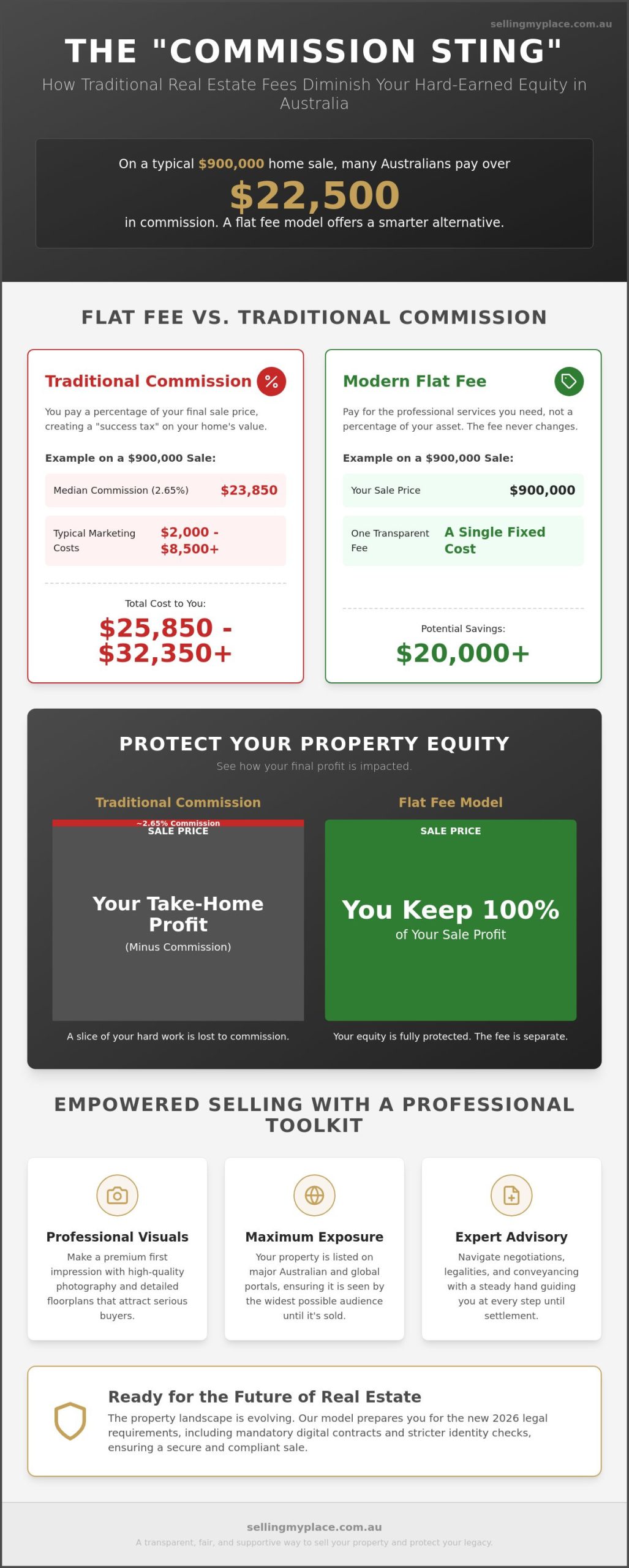
The Legalities and Safety of Selling Without an Agent
Selling a home without a traditional agent doesn’t mean you’re walking a legal tightrope alone. In fact, the most critical legal protections during a property transaction come from your solicitor or conveyancer, not the person putting up the “For Sale” sign. It’s a common worry that stepping away from the traditional model might leave you exposed, but flat fee real estate services are designed to provide a professional advisory infrastructure that keeps you fully compliant. Since June 2026, New South Wales has mandated the “2026 Edition Contract for Sale” for all transactions, and new Anti-Money Laundering (AML/CTF) laws require stricter identity checks across the country. Having a steady hand to guide you through these evolving regulations ensures your sale is as secure as it is profitable.
The extension of AML/CTF laws to the real estate sector means that identity verification is now more thorough than ever. It also requires that any significant financial transactions are conducted via traceable electronic means. Navigating these changes requires attention to detail, but it shouldn’t feel overwhelming. By using flat fee real estate services, you benefit from a partnership that prioritises your safety and legal standing while you focus on the emotional significance of your move.
Conveyancing and Contract Management
A qualified legal professional is your best safeguard. While you handle the heart of the home, your solicitor manages the technicalities of the contract and settlement. Our Real Estate Advisory Services bridge the gap, helping you understand each milestone without the pressure of a commission-driven agenda. We walk alongside you during the contract exchange to ensure every box is ticked. You can explore the details of this process in our guide on The Legal Journey: Conveyance and Advisory.
Managing Buyer Enquiries and Negotiations
Safety and professionalism are paramount when you’re meeting potential buyers. Vetting enquiries before an inspection is a simple, effective way to ensure only genuine, qualified parties enter your home. Many owners find they actually have a psychological advantage during negotiations; buyers often appreciate the honesty and directness of speaking with the person who knows the property best. Stay calm, stick to your researched price point, and remember that you’re the expert on your own lifestyle. If you’d like a partner to help you navigate these first conversations, you can organise a pre-sale consultation with our team today.
Selling Smarter with Kincade International Direct Sales
At Kincade International Direct Sales (KIDS), we have reimagined the selling process as a supportive partnership rather than a cold transaction. We understand that your home is more than just bricks and mortar; it is where your life has happened. By offering 0% commission flat fee real estate services, we provide the professional infrastructure you need while ensuring you keep every cent of your hard-earned profit. Our “listed until sold” promise is a cornerstone of this approach. It removes the artificial pressure of marketing deadlines, allowing you to wait for the right buyer who truly values your property’s unique story without the stress of a ticking clock.
This isn’t just about saving an average of $20,000 in commissions. It is about having a steady hand to guide you through the complexities of the 2026 property market. Whether you are navigating new identity verification laws or interpreting professional neighbourhood market reports, our Agent Advisory Service remains by your side until settlement. We combine the reach of a global marketing network with the intimacy of local expertise. This ensures your home is seen by the right people, whether they are living in the next suburb or searching from overseas.
A Comprehensive Marketing Infrastructure
The digital age has levelled the playing field for homeowners. To stand out, your listing needs to perform at a high level from the moment it goes live. We provide the essential tools for success, including professional photography and floorplans that highlight your home’s best features. Your property gains maximum exposure on major Australian and global portals, ensuring it doesn’t just sit on the market but actively attracts genuine interest. For a deeper look at how to position your home for success, see our Professional Residential Property Listing Services: The Modern Australian Seller’s Guide.
Expert Support Every Step of the Way
One of the biggest advantages of our partnership is access to expert pre-sale consulting. We help you identify high-ROI property improvements, such as simple landscaping or fresh paint, that can significantly boost your final sale price. You are never left to figure out the hard parts alone. When negotiations get complex or you need a second opinion on a buyer’s offer, an expert advisor is just a phone call away. This blend of professional authority and heartfelt support ensures you feel confident and protected throughout the entire journey. Ready to take control? Discover how we help you sell smarter and keep your profit.
Take the Next Step Toward a Commission-Free Sale
Selling your home is more than a financial transaction; it is the closing of one life milestone and the hopeful beginning of another. You deserve to walk away from that experience with your full equity intact, ready to fund your next adventure. By embracing flat fee real estate services, you choose a path of transparency and empowerment. You have seen how possible it is to maintain professional standards, from high-end photography to global portal exposure, without the traditional commission bite that can feel so disheartening.
It is important to remember that you aren’t walking this path alone. With professional visual marketing included and expert advisory support available throughout the process, you have the tools to navigate the 2026 property market with total confidence. This approach is about protecting your legacy and ensuring your hard work benefits your family’s future. If you are ready to keep 100% of your profit and sell on your own terms, we are here to act as your steady hand.
Maximise your sale profit with our professional flat-fee services and start your next journey on the best possible financial footing. You have the vision for your future; let’s make it a reality together.
Frequently Asked Questions
Is a flat fee real estate service the same as ‘For Sale By Owner’?
While it shares the spirit of independence, flat fee real estate services provide a professional marketing and advisory layer that a standard private sale lacks. It is a partnership where you handle the personal touches, like showing your home, while we provide the professional listing power and global reach. You get the autonomy of a private sale but with the “steady hand” of an expert guide to help you navigate the process with confidence.
Will my property be seen on the major Australian property portals?
Yes, your home will be showcased on the leading property websites that active buyers use every day. Because we act as your professional listing service, we ensure your property receives the same high-level exposure as any traditional agency listing. You don’t have to worry about being hidden; your property will be visible to thousands of potential buyers across the country and even overseas.
How much can I realistically save using a flat fee service?
Most Australian sellers save an average of $20,000 when selling an $800,000 property compared to a traditional commission model. With the national median commission sitting at approximately 2.65% in July 2026, those percentage points add up to a significant amount of money. This is hard-earned equity that stays in your bank account to help with your next mortgage, renovation, or retirement nest egg.
What happens if my property doesn’t sell within three months?
There are no stressful time limits or marketing deadlines to worry about with our partnership. Your property remains listed until it is sold, which means you can wait for the right buyer at the price you deserve without the pressure of a ticking clock. This approach removes the artificial urgency often felt in traditional agency agreements, allowing the process to unfold at a pace that suits your family’s needs.
Do I have to do my own negotiations with a flat fee service?
You’ll be the primary point of contact for enquiries and inspections, but you’re never left to negotiate in a vacuum. Our Agent Advisory Service provides the support you need to handle these conversations professionally. You get to speak directly to buyers about the home you know best, while having an expert in your corner to help when the price discussions or contract details get technical.
Can I still get professional photography and floorplans?
Professional visual marketing is a standard part of our infrastructure to ensure your home makes a premium first impression. You will receive high-quality photography and accurate floorplans that help potential buyers visualise their life in your space. These tools are essential for standing out in a digital-first market and are included to ensure your home is presented to the highest possible standard.
Is it legal to sell my home without a traditional real estate agent?
It is completely legal and increasingly common for Australians to sell their homes using flat fee real estate services. While you’re moving away from the old commission-based model, you’re still supported by a professional framework that ensures compliance with all property laws. You have the right to represent your own interests and protect your equity throughout the entire sale process.
How do I handle the legal paperwork and conveyancing?
You should engage a qualified conveyancer or solicitor to manage the formal legal paperwork and the final settlement. While we provide Real Estate Advisory Services and guidance through the contract exchange, your legal representative ensures the title transfer is handled correctly according to state regulations. For example, they will ensure you are using the mandatory 2026 Edition Contract for Sale required in certain states.
Legal Requirements for Selling a House Privately in Australia: The 2026 Seller’s Guide
What if the only thing standing between you and an extra $20,000 in your pocket was a stack of paperwork? It’s a common misconception that you need a traditional agent to manage the law, but in reality, you have every right to take the lead yourself. We understand that the thought of handling the legal requirements for selling a house privately in australia can feel a bit daunting. You’re likely worried about making a mistake with the Contract of Sale or getting tripped up by the new 2026 AML/CTF identity checks; it’s a lot to take in when you’re also trying to plan a major life transition.
It’s okay to feel that weight. After all, your home is your biggest asset and your family’s sanctuary. We’re here to act as your steady hand through this process. In this guide, you’ll discover exactly which documents you need to stay fully compliant with Australian law while skipping the high commission fees. We’ll walk you through state-specific rules, like the Victorian Section 32 and the latest Queensland disclosure regime, so you can reach settlement with a clear head and a genuine sense of pride.
Key Takeaways
- Confirm your right to sell without an agent, as Australian law treats agents as marketing intermediaries rather than a legal necessity for property transfers.
- Identify the specific legal requirements for selling a house privately in australia, including the crucial 2026 AML/CTF identity verification and ATO clearance protocols.
- Navigate the maze of state-specific disclosure documents, such as the Section 32 in Victoria or the Form 1 in South Australia, to ensure your contract is bulletproof.
- Avoid common compliance traps related to underquoting and consumer law by learning how to set honest price guides and accurate marketing materials.
- Understand the path to a successful settlement, including the exchange of contracts and the role of digital platforms like PEXA in finalising your sale.
Can You Legally Sell Your Own House in Australia?
The short answer is a resounding yes. There is absolutely no law in Australia that requires you to hire a real estate agent to sell your property. It’s your home, your equity, and ultimately, your choice. Many homeowners feel a bit of “legal jitters” when they first consider going it alone, but once you peel back the curtain, the process becomes much clearer. Real estate agents are effectively marketing and negotiation intermediaries; they aren’t legal necessities. While they might handle the “for sale” signs and the open homes, they don’t actually perform the legal transfer of land. That critical step is handled by a solicitor or a licensed conveyancer who ensures all the legal requirements for selling a house privately in australia are met with precision.
It’s helpful to remember that the “real” legal work happens during the conveyancing phase. This is the formal process of transferring the title from your name to the buyer’s. While an agent might facilitate the handshake, the solicitor handles the heavy lifting of the contract and settlement. You also need to be aware that the Australian Consumer Law (ACL) applies to you as a private seller just as it does to a large agency. This means you have a legal obligation to be honest and transparent in your dealings. If you keep things “above board” and follow the right protocols, selling your own home is a perfectly legal and highly rewarding path.
The Role of State vs. Federal Law
Property law in our country is a bit of a patchwork. Most of the rules regarding how land is transferred and what documents you need are governed by individual States and Territories. This is why the Australian property law landscape can feel a bit confusing if you’re looking for a single national rulebook. However, Federal law still plays a part through the ACL, which ensures that all property marketing is honest and covers things like misleading conduct. Even though you’re managing the sale yourself, you’ll still need a professional to handle the technical technicalities of conveyancing. This partnership ensures you remain compliant with state disclosure laws while the Federal rules keep the marketplace fair for everyone involved.
Why More Australians are Choosing Private Sales in 2026
The shift towards selling your own home has gained massive momentum lately. By mid-2026, we’ve seen a huge move towards digital transparency and flat-fee models that put the power back in the hands of the homeowner. Why pay a massive commission when you can access the same listing platforms and professional advisory services for a fraction of the cost? On average, sellers are saving around $20,000 per sale. That’s a significant amount of equity to keep in your pocket for your next chapter. It’s about having a “steady hand” to guide you through the compliance while you handle the personal touches. People want a partnership, not just a transaction. With the right support, managing the legal requirements for selling a house privately in australia becomes a manageable, empowering experience rather than a source of stress.
The Essential Legal Documents for a Private Sale
Once you’ve decided to take the reins, the next step is gathering your paperwork. Think of these documents as the structural integrity of your deal. The legal requirements for selling a house privately in australia aren’t meant to be hurdles; they’re safeguards for both you and your buyer. The most critical piece is the Contract of Sale. It’s often called the ‘holy grail’ of the transaction because it outlines everything from the price to the settlement date. Alongside this, you’ll need a Title Search. This proves you actually own what you’re selling and highlights any encumbrances, such as mortgages or easements, that might affect the transfer. Zoning certificates are also vital, as they show exactly what the land can and cannot be used for, which is a major factor for any buyer looking to renovate or develop.
In states like Victoria and South Australia, disclosure is king. You’ll need either a Section 32 or a Form 1. These statements are your way of telling the buyer, “Here is everything you need to know about this property.” Providing these documents isn’t just a courtesy; it’s a legal obligation. If you’re feeling a bit overwhelmed by the volume of paperwork, you might want to reach out for a chat with an advisor who can help you organise these essentials without the stress.
Preparing the Contract of Sale
In many parts of Australia, particularly New South Wales, you must have a contract ready before you even list the property online. It’s a common trap to wait for a buyer before starting the paperwork, but being prepared shows you’re a serious, reliable seller. Your contract should include all necessary certificates, such as pest and building reports or pool safety certificates if applicable. Accurate floorplans are also a legal necessity for the property description. They ensure the buyer knows exactly what they are purchasing, which reduces the risk of disputes later on. By having everything ready to go, you create a sense of calm and confidence that buyers find incredibly reassuring.
Vendor Disclosure Requirements
Honesty is your best policy when it comes to disclosure. You’re legally obligated to inform the buyer about certain things, like structural issues or illegal building works. If you stay silent on these “defects,” a buyer might have the legal right to pull out of the sale even after the contracts are signed. To help set a fair price and stay transparent, using professional Neighborhood Market Reports can be a game changer. These reports help you justify your price legally by showing comparable sales in your area. If you want to dive deeper into the specifics, the official guide on the private sale process in Victoria offers a great breakdown of how these disclosure statements protect both parties during the journey.
State-by-State Legal Nuances Across Australia
While the right to sell your own home is a national one, the specific “how-to” changes as soon as you cross a state border. It can feel like you’re learning a new language for every territory, but we’re here to help you translate. In New South Wales, the law is quite firm: you cannot even put a “for sale” sign in your front garden or list the property online until a full Contract of Sale is ready. Victoria, on the other hand, is famous for the Section 32 Vendor Statement. It’s a comprehensive disclosure that can feel like a mountain of paperwork, but it’s there to protect your legacy and the buyer’s future. Getting these details right is a core part of the legal requirements for selling a house privately in australia, ensuring you don’t face any hiccups later on.
Queensland has traditionally been a “buyer beware” state, but the new 2025 disclosure regime has shifted more responsibility onto the seller to be upfront about the property’s history. Meanwhile, over in Western Australia, they skip the standard contract for an “Offer and Acceptance” system. This process is unique but follows the same underlying principles of fairness and transparency. Each state has its own rhythm; once you understand the local beat, you can move forward with total confidence.
Cooling-Off Periods: A National Overview
The cooling-off period is your buyer’s “safety net,” and the length of this net depends on where you live. For example, Victoria offers three business days, while New South Wales and Queensland provide five. South Australians have a shorter two-day window. It’s important to know that in Western Australia, there is no mandatory cooling-off period unless you specifically write it into the contract. You can sometimes legally waive or shorten this period, such as through a Section 66W certificate in NSW, which is often used to speed up a sale when both parties are ready to commit without the extra wait.
Trust Accounts and Deposits
One question we often hear is, “Where does the deposit go if I don’t have an agent’s trust account?” It’s a fair concern. Usually, the 10% deposit is held in your solicitor’s or conveyancer’s trust account. This keeps the funds safe and independent until settlement day. Even “holding deposits” must be handled with care; your legal advisor will ensure these small initial sums are documented correctly to avoid any misunderstandings. By using a professional trust account, you ensure the legal requirements for selling a house privately in australia are met while providing peace of mind for everyone involved.
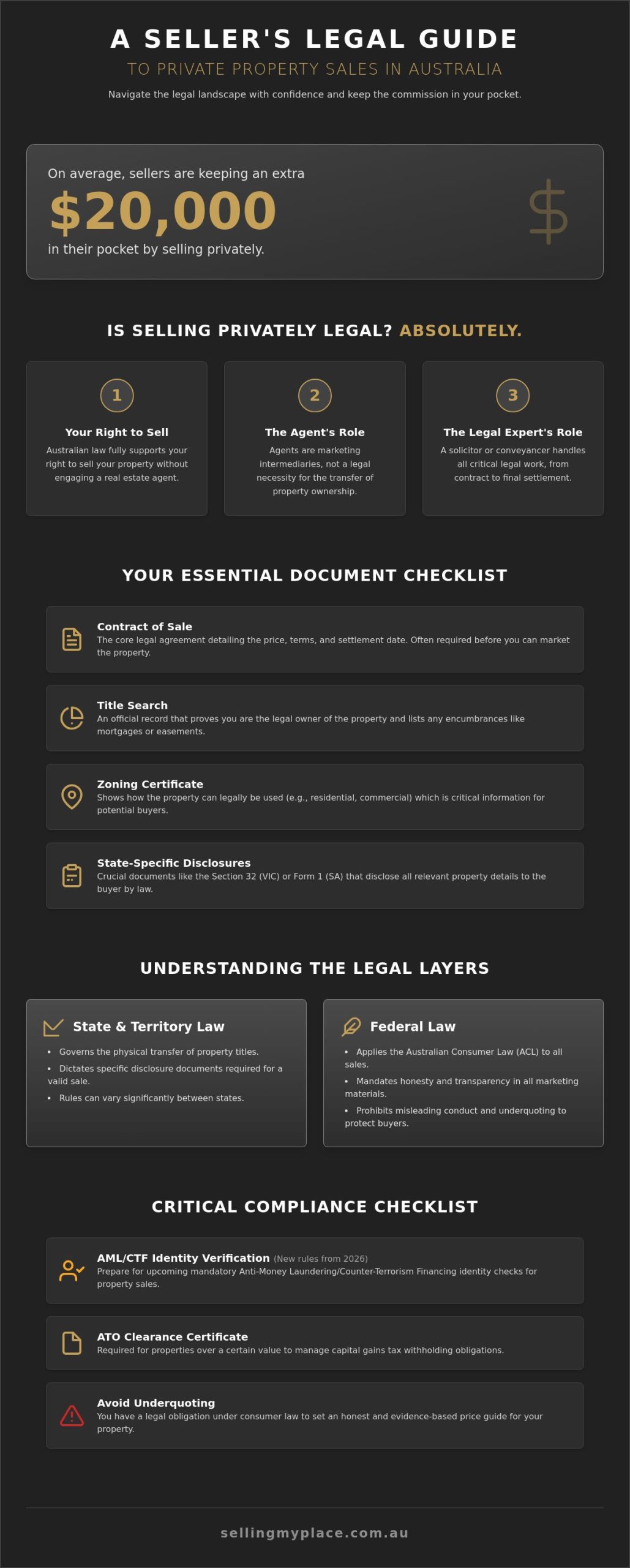
Compliance in Marketing: Underquoting and Consumer Law
Marketing your home is where your personal story meets the open market. It’s a joyful stage, but it’s also where Australian Consumer Law (ACL) watches most closely. When you are capturing the essence of your home, your Photography must be a true reflection of the property as it stands today. While we all want our homes to look their best, digitally removing a neighbouring power pole or hiding structural cracks crosses the line from “best foot forward” into deceptive conduct. There’s a subtle legal difference between “puffery”, those enthusiastic, subjective claims like “the most charming garden in the street”, and factual misrepresentation. If you state a home has a “newly renovated kitchen” when the cupboards were merely repainted, you risk breaching the legal requirements for selling a house privately in australia. Honesty isn’t just the best policy; it’s the law.
Avoiding the Underquoting Trap
The “Price Guide” trap is another area where private sellers often feel a bit of pressure. In the 2026 market, transparency isn’t just a buzzword; it’s a legal necessity. Underquoting occurs when a property is advertised at a price lower than your true estimated selling price or lower than a price you’ve already rejected. To stay on the right side of the law, you must document how you arrived at your price. Using professional market value guides ensures your range is grounded in recent, comparable sales data. If you receive a written offer that is higher than your current advertised price, you’re generally required to update your marketing to reflect this new market reality. It’s about keeping the process fair for every family looking for their next home.
Privacy and Data Laws
Beyond the price tag, you also have a duty to protect the people who walk through your front door. When you host an “Open for Inspection”, you’ll likely collect contact details for follow-ups. Handling this buyer data requires compliance with privacy laws and the Spam Act. You can’t just add every visitor to a generic marketing list without their consent. It’s best to have a simple sign-in sheet that clearly states how their information will be used. Ensuring your digital listing follows the specific terms of service of the platforms you use is equally important. If you’re feeling unsure about the fine print of marketing compliance, get in touch with our team for a pre-sale consultation to ensure your campaign is as safe as it is beautiful.
From Handshake to Settlement: The Legal Final Line
The journey from a simple handshake to the final settlement is often the most rewarding yet technically demanding phase of your sale. This is where the legal requirements for selling a house privately in australia reach their formal conclusion. It all begins with the exchange of contracts. Once both parties have signed and the deposit is safely held, the deal becomes legally binding. In our modern 2026 market, almost all of this happens through PEXA (Property Exchange Australia). This digital platform has revolutionised the way we settle, allowing for the instantaneous transfer of funds and title without the old school paper shuffle. It’s faster, more secure, and gives you that immediate peace of mind that the sale is truly complete.
Before the big day arrives, your buyer has the legal right to a final inspection. This usually happens in the few days leading up to settlement. It’s their chance to ensure the property is in the same condition as when they signed the contract. You’ll also need to work with your solicitor to calculate “adjustments”. These are the final tallies for council rates, water charges, and land tax, ensuring you only pay for the exact days you owned the home. It’s a precise process, but it ensures everyone walks away with a fair and transparent result.
Navigating the Settlement Period
The time between exchange and settlement is usually 30, 60, or 90 days, depending on what you’ve negotiated. While these dates are fixed in the contract, life can sometimes throw a curveball. A buyer might ask for a short extension due to bank delays, or in very rare cases, they might face a default. Knowing your rights and obligations during these weeks is vital for a smooth transition. Having professional Conveyance Advice on hand can turn a high-stress situation into a manageable one. It’s about having a “steady hand” ready so your settlement stays on track and your plans for the future remain secure.
The Kincade Advisory Advantage
We believe that selling your home yourself shouldn’t mean doing it alone. Our Sale by Owner support is designed to bridge the gap between your personal touch and the complex legal requirements for selling a house privately in australia. You get the expert backing of a seasoned advisor without the commission-driven pressure of a traditional agency. By following our final checklist, you can move toward settlement with total confidence. You’ve worked hard for your home’s equity, and we’re here to help you protect every cent as you move toward your next adventure.
Step Into Your Next Chapter with Confidence
Taking the lead on your own sale is an empowering way to protect your family’s future and your hard-earned equity. By now, you can see that the legal requirements for selling a house privately in australia are simply a matter of following the right protocols with a trusted partner by your side. From preparing the initial Contract of Sale to navigating the digital finality of a PEXA settlement, you have the roadmap to manage each step with total clarity. You aren’t just avoiding a transaction; you’re ensuring that the legacy of your home remains firmly in your hands.
We believe every homeowner deserves professional backing without the commission-driven pressure. Through our dedicated Agent Advisory Service, you’ll have a seasoned expert to guide you, ensuring your property is listed until it’s sold with absolutely no time limits. Our sellers save an average of $20,000 per sale, a significant sum that belongs in your pocket for your next adventure. You have the tools, the right, and a steady hand ready to support you.
Ready to sell smarter? Explore our commission-free listing packages today.
Your path to a successful, legally sound settlement is clear. We look forward to helping you achieve the result your home deserves.
Frequently Asked Questions
Do I need a solicitor for the final settlement?
Yes, you certainly do. While you have the right to manage your own marketing and negotiations, the actual transfer of the title must be handled by a legal professional. They use digital platforms to ensure the transaction meets all the legal requirements for selling a house privately in australia, protecting your interests during the final exchange of funds.
What special conditions should I consider for my contract?
Common conditions include “subject to finance,” “pest and building inspections,” or even a specific settlement date that suits your family’s move. These clauses provide a safety net for both parties. Your solicitor will help you draft these accurately to ensure they are legally enforceable and reflect the specific agreement you’ve reached with your buyer.
How do I list on Australia’s major property portals as a private seller?
While the leading property search websites generally only accept listings from licensed entities, you can gain access through a flat-fee advisory service. This allows your home to appear alongside every other listing in the country. It’s a clever way to ensure you get maximum exposure without the burden of traditional agency commissions.
Can a buyer pull out if they find a defect after signing?
If a significant defect was not disclosed in the contract or vendor statement, a buyer may have the legal right to rescind the contract. This is why thorough disclosure is so important. By being upfront about the property’s history, you reduce the risk of the deal falling through during the cooling-off period or leading to a dispute later on.
What is the difference between a holding deposit and a full deposit?
A holding deposit is a small sum often paid to show “good faith” while the contract is being finalised. However, it doesn’t legally secure the property. The full deposit, usually 10 per cent, is paid upon the exchange of contracts and is held in a solicitor’s trust account. This is the point where the deal becomes much more certain for everyone involved.
Can I sell my home privately if I still have an active mortgage?
Absolutely. Most Australian sellers have a mortgage when they decide to move. Your solicitor will simply coordinate a “discharge of mortgage” with your bank. On the day of settlement, the buyer’s funds are used to pay off your loan balance, and the remaining equity is transferred directly to you. It’s a routine part of the process.
How often should I update my price guide to stay compliant?
You should review your price guide whenever you receive new market information, such as a formal written offer that exceeds your current range. Staying compliant with the legal requirements for selling a house privately in australia means your advertised price must always reflect your genuine “estimated selling price.” Regular updates keep your marketing honest and your sale safe from underquoting claims.
Is a verbal offer legally binding in Australia?
No, a verbal offer is not legally binding in any Australian state or territory. For a property sale to be enforceable, the agreement must be in writing and signed by both the seller and the buyer. This protects you from buyers changing their minds at the last minute before the ink is dry on the contract.
Selling and Buying a House at the Same Time in Australia: The 2026 Strategy Guide
What if you didn’t have to choose between the heartache of losing your dream home and the financial weight of two mortgages? For most families, selling and buying a house at the same time australia feels like walking a high-stakes tightrope. It’s completely natural to feel a bit of “settlement anxiety” when you’re trying to time the market perfectly while the RBA cash rate sits at 4.35%. You’re not just moving boxes; you’re moving your entire life, and the fear of being caught between properties or facing bridging loan rates that can climb over 10% p.a. is enough to keep anyone awake at night.
We’re here to tell you that a seamless transition isn’t just a lucky break; it’s the result of a steady, well-prepared strategy. This guide will help you master the art of the simultaneous settlement, ensuring you don’t miss out on your next chapter just because your current place hasn’t sold yet. By protecting your equity and saving an average of $20,000 in commissions, you can create the financial breathing room needed to bid with confidence. We’ll walk you through the essential 2026 timeline for listing and bidding, helping you coordinate your next move with total peace of mind.
Key Takeaways
- Understand the mechanics of a simultaneous settlement to avoid the logistical nightmare of moving twice or paying for short-term rentals.
- Compare the “buy first” and “sell first” strategies to find the right balance between financial certainty and securing your next dream home.
- Master the practical tools, like bridging finance and “subject to sale” clauses, to navigate selling and buying a house at the same time australia with total confidence.
- Discover why organising your marketing assets early, including floorplans and photography, is the secret to a fast and profitable transition.
- Learn how a commission-free model can save you an average of $20,000, giving you the extra equity needed to outbid the competition.
The Great Australian Property Dilemma: Simultaneous Settlement Explained
Imagine the perfect moving day. You hand over the keys to your old place at 11:00 am, and by 2:00 pm, you’re unlocking the front door of your new home. This is a simultaneous settlement. It’s the process of settling both your sale and your purchase on the exact same day, often within hours of each other. While it sounds like a dream, managing the logistics of selling and buying a house at the same time australia requires a steady hand and a very clear plan.
In the broader Australian property market, most buyers aren’t just starting out; they’re trading up or downsizing. This creates a “chain” where your purchase depends on your sale, which might depend on someone else’s sale. If one bank is five minutes late or one signature is missing three houses down the line, the whole chain can stall. It’s a domino effect that can leave families sitting in a loaded removalist truck on a Friday afternoon with nowhere to go. It’s stressful, but it’s manageable with the right guidance.
You’re essentially balancing two major risks. If you buy first, you face the anxiety of paying two mortgages or high-interest bridging loans. If you sell first, you might find yourself in temporary rentals, moving your life twice and watching the market rise while you’re effectively homeless. Neither is ideal, which is why “marrying” your contracts through a skilled legal expert is the preferred path for many.
Why Timing is Everything in 2026
With the RBA cash rate holding at 4.35% as of July 2026, the stakes for your timing have never been higher. Market heat varies wildly between suburbs. Before you even think about listing, you must determine the market value of a home in Australia relative to your specific local area. Knowing your numbers gives you the confidence to negotiate settlement periods that suit your timeline, rather than being at the mercy of the buyer’s whims. The psychological shift from being a proud seller to a hungry buyer happens fast. Staying grounded in data helps keep that stress at bay.
The Role of the Conveyancer
Your conveyancer is the unsung hero of this process. They don’t just push paper; they coordinate with both your outgoing and incoming banks to ensure funds flow from one property to the next. To make this work, they look for consistent “Special Conditions” across both contracts. They’re on the lookout for common pitfalls, such as mismatched settlement times or incorrectly entered PEXA details, which can cause frustrating 24-hour delays. Getting professional conveyance advice early ensures your two separate transactions behave like one single, fluid move.
Buying First vs. Selling First: Which Strategy Suits You?
Choosing whether to buy your next home before you’ve sold your current one is perhaps the biggest fork in the road you’ll face. In the current 2026 climate, where the RBA cash rate remains steady at 4.35%, the financial implications of a wrong turn are significant. It’s a bit of a balancing act, really. Do you prioritise the peace of mind that comes with cash in the bank, or do you leap at that rare sun-drenched terrace before someone else snaps it up? For most families selling and buying a house at the same time australia, the answer depends on your local market’s temperature and your own appetite for risk.
One way to lower the heat is the “Off-Market” test. Before you commit to a purchase, you can float your property to a database of motivated buyers to gauge interest levels. This gives you a “real world” indication of what your home might fetch without the pressure of a full public campaign. By establishing a clear coordination plan early, you can align these initial feelers with your buying search, ensuring you aren’t flying blind when you start making offers.
Pros and Cons of the “Sell First” Method
Selling first is the gold standard for financial certainty. You’ll know exactly how much equity you’ve unlocked, which is vital when variable mortgage rates are hovering around 5.94% p.a. as of July 2026. The main drawback is the ticking clock. If you haven’t found a new home by settlement day, you might face the cost and hassle of temporary rentals and moving your furniture twice. To mitigate this, we often suggest negotiating a longer settlement of 90 or even 120 days. This gives you a generous three to four month window to shop as a “cash buyer,” which puts you in a much stronger position to negotiate on your next purchase.
Pros and Cons of the “Buy First” Method
The “Buy First” approach is for those who have found “the one” and simply cannot let it go. It removes the fear of being left out of the market, but it introduces the risk of the “fire sale.” If your current home doesn’t sell quickly, you might be forced to accept a lower price to meet your buying obligations. You’ll also likely need bridging finance, with interest rates starting in the mid-6% range but sometimes climbing over 10% p.a. To avoid this stress, it’s wise to utilise professional residential property listing services to ensure your home is presented perfectly and ready to hit the market the second your offer is accepted.
If you’re feeling a bit stuck on which path suits your family best, reaching out for personalised real estate advisory services can help clear the fog and help you move with confidence.
Financial and Legal Tools for a Smooth Transition
Navigating the paperwork while selling and buying a house at the same time australia can feel like learning a new language. You aren’t just signing a contract; you’re building a financial bridge between your past and your future. To do this safely, you need a toolkit that protects your equity and your sanity. While the theory of moving sounds simple, the legal reality involves specific clauses and financial instruments that ensure you aren’t left stranded if a settlement date shifts. It’s about creating a safety net that allows you to act decisively when the right opportunity appears.
If your cash is locked in your current home’s walls, a deposit bond is a clever alternative to a cash deposit. It is essentially a guarantee from an insurer to the seller that the 10% deposit will be paid at settlement. This saves you from having to liquidate other assets or take out a high-interest personal loan just to sign a contract. For many Australian upgraders, it’s a small fee for a significant amount of flexibility during those few weeks between contracts.
Mastering the “Subject to Sale” Offer
Many sellers are wary of “subject to sale” offers because they don’t want their property tied up indefinitely. To sweeten the deal, consider offering a slightly higher purchase price. This acts as a “waiting fee” for the seller, acknowledging the risk they take by pausing their campaign. You should also include a short “Sunset Clause,” typically 21 to 28 days. This allows the seller to keep their home on the market and gives them an “out” if they find an unconditional buyer, but it gives you the right of first refusal to go unconditional yourself. Showing the seller you have a property marketing plan in Australia already in place makes your offer far more credible. It proves you’re proactive and that your home is ready to sell at a moment’s notice.
Bridging Loans: The Costs You Need to Know
Bridging finance is often the only way to secure a new home before the old one sells. It works by calculating your “peak debt,” which is the total of both mortgages, and your “end debt,” which is what remains after your sale. Most lenders offer an interest-only period, which is your best friend during the transition because it keeps your monthly outgoings manageable while you wait for a buyer. However, with bridging rates starting around the mid-6% mark and some lenders charging over 10% p.a. as of July 2026, you need a solid “Plan B.” If your home doesn’t sell within the typical 6 to 12 month bridging window, the interest can compound quickly. Always factor these potential costs into your buying budget from day one to ensure your “steady hand” remains on the wheel.

The Step-by-Step Coordination Checklist
Think of this checklist as your flight plan. When you’re selling and buying a house at the same time australia, you can’t afford to wing it. Each step needs to be calculated to ensure you don’t end up grounded between properties. It’s about creating a sequence that builds momentum while protecting your financial interests at every turn.
- Step 1: Realism over optimism. Get a realistic market appraisal and “Subject to Sale” advice from an expert advisor. You need to know your “walk-away” price before you start dreaming about the next one.
- Step 2: Prepare your assets early. Organise your professional photography and floorplans before you even start looking at open homes. If you find your dream home on a Saturday, you want to be able to list your current place by Monday morning.
- Step 3: Secure dual pre-approval. Ensure you have pre-approval for both your long-term mortgage and any potential bridging finance. With the average mortgage rate sitting at 6.20% as of May 2026, knowing your borrowing capacity is vital.
- Step 4: Signal serious intent. List your property for sale. Vendors are much more likely to take your offer seriously if they can see your current home is already live on the market.
- Step 5: Build in a buffer. Work with your conveyancer to synchronise settlement dates, but try to negotiate a 2 to 3 day buffer. This gives you a safety net if there’s a minor technical delay with bank transfers or paperwork.
Pre-Sale Preparation
In 2026, buyers are savvy and visual. Professional photography is non-negotiable; it’s the digital front door to your home. Focus on the “low-cost, high-impact” rule by decluttering and tackling minor repairs that might catch a building inspector’s eye. This is also the perfect time to explore sale by owner strategies. By taking control of the process, you keep that average $20,000 commission saving in your own pocket, which can be a massive help when you’re trying to outbid competitors for your next home.
Negotiation Tactics for Simultaneous Moves
Don’t be afraid to ask for flexible terms. A “Licence to Occupy” can be a lifesaver if your sale settles a few days before your purchase, allowing you to stay put for a small fee. Alternatively, a “Rent-Back” agreement lets you become a temporary tenant in your old home while you finalise the new one. In Victoria, your legal rep might suggest a “Section 27” to release your deposit early, providing the cash flow needed for your new purchase. These are the “steady hand” moves that turn a stressful move into a managed transition.
If you’re ready to start your journey with a clear strategy and expert support, get in touch with our advisory team today for a personalised market report.
Maximising Your Equity: The KIDS Commission-Free Advantage
Most traditional real estate models assume you’ll part with a significant slice of your hard-earned equity as a matter of course. When you’re managing the complex dance of selling and buying a house at the same time australia, that 2% or 3% commission can feel like a heavy weight on your upgrade budget. On an average Australian home, this “commission sting” often reaches $20,000 or more. By choosing a flat-fee model, you’re essentially reclaiming that money and putting it back where it belongs. It’s not just a saving; it’s a strategic tool that gives you more leverage in a competitive market.
Reclaiming your equity allows you to approach your next purchase with a sense of calm confidence. Instead of worrying about how to bridge the gap between your sale price and your new purchase price, you have a tangible financial buffer. This is particularly vital in a market where every dollar counts toward outbidding the competition or securing a property in a preferred school zone. It turns a transactional process into a partnership where your family’s future is the priority.
Where Does the $20,000 Saving Go?
Upgrading is expensive, and the hidden costs can add up quickly. Stamp duty remains a major hurdle for many Australian families, often requiring tens of thousands of dollars in upfront cash. Having an extra $20,000 in your pocket can cover a substantial portion of this tax, making the jump to a larger home feel much more accessible. Alternatively, if you’ve decided to buy first, this saving acts as a perfect safety net for bridging finance. With bridging interest rates starting around the mid-6% mark as of July 2026, $20,000 can comfortably cover the interest costs for a full year while you wait for the right buyer. If your transition is smooth and settlement dates align, that money becomes an instant renovation fund, allowing you to paint, carpet, or landscape your new sanctuary the moment you get the keys.
Support Without the High Cost
One of the biggest fears of selling without a traditional commission-based agent is the feeling of being alone in a high-stakes environment. However, professional residential property listing services provide the expert advisory you need without the accompanying sales pressure. You get access to contract reviews and negotiation tips from seasoned pros who value your long-term stability over a quick result. This partnership approach ensures you stay in total control of your timeline. You won’t have an agent pushing you to accept a “cheap” offer just so they can move on to their next commission. Plus, a “list until sold” policy is a massive advantage for simultaneous buyers. It removes the pressure of a ticking clock, allowing you to wait for the price your home truly deserves while you focus on your next move. You still benefit from high-end photography and floorplans, ensuring your home has a global listing reach that attracts motivated buyers. It’s a steady, proactive way to move, led by heart and backed by expert competence.
Your Path to a Stress-Free Move
Moving house is one of life’s most significant transitions. It’s about finding a place where your family can grow and flourish, not just a change of address. While selling and buying a house at the same time australia involves many moving parts, it doesn’t have to be a source of constant anxiety. By synchronising your settlement dates and utilising smart financial tools like bridging finance or deposit bonds, you can navigate the 2026 market with total confidence. The secret lies in thorough preparation and protecting your hard-earned equity at every stage of the journey.
Why lose a large portion of your profit to traditional commission fees when you could be putting that money toward your new life? Our commission-free model helps sellers keep an average of $20,000 more of their profit. We provide an Expert Agent Advisory Service to guide your negotiations and offer no time limits on your listing, so you never feel rushed into a “fire sale” by a ticking clock. See how much equity you can save for your next move with our commission-free model and take the first step toward your dream home today. You’ve got this, and we’re here to help you every step of the way.
Frequently Asked Questions
Is it better to buy or sell first in Australia?
The “better” option depends entirely on your financial buffer and the current temperature of your local market. Selling first provides the ultimate peace of mind because you’ll know exactly how much cash you have for your next purchase, though you might need to budget for temporary accommodation. Buying first ensures you don’t miss out on a rare find, but it requires the stomach for potential bridging finance costs if your current home doesn’t sell as quickly as expected.
What is a simultaneous settlement?
A simultaneous settlement is when the sale of your existing property and the purchase of your new home occur on the exact same day. Your conveyancer coordinates with the banks so that the funds from your buyer flow directly toward your new purchase. It’s a popular strategy for families selling and buying a house at the same time australia because it avoids the need for double mortgages or moving into a rental between homes.
How does a bridging loan work when buying a second house?
A bridging loan is a short-term financial gap-filler that covers the “peak debt” of both your current and new mortgages. You generally pay interest-only on this loan until your first home sells, at which point the sale proceeds pay down the debt. With bridging rates starting in the mid-6% range and reaching over 10% p.a. in July 2026, it’s a tool that works best when you have a clear plan to sell quickly.
Can I make an offer “subject to the sale of my own home”?
You certainly can, though these offers are often viewed as less competitive in a hot market. To make your offer stand out, you might consider offering a slightly higher price or including a short “sunset clause” of 21 to 28 days. This gives the seller a timeframe they can count on while allowing you the chance to secure your dream home before your own sale is finalised.
What happens if my house doesn’t sell before the settlement of my new one?
If your sale falls through or stalls, you may need to rely on bridging finance to avoid defaulting on your purchase contract. This can be a stressful period, which is why we advocate for a realistic market appraisal before you start bidding. Having a “list until sold” feature on your listing provides a safety net, ensuring you aren’t pressured into a “fire sale” price just to meet a ticking clock.
How much can I save by selling my own home without a commission-based agent?
Sellers typically save an average of $20,000 by opting for a flat-fee model instead of a traditional percentage-based commission. When you’re selling and buying a house at the same time australia, this extra equity is a massive advantage. It can be used to cover your stamp duty, pay for a year’s worth of bridging interest, or even fund a kitchen renovation in your new place the moment you move in.
What are the risks of buying and selling at the same time?
The primary risks include the “chain effect,” where a delay in someone else’s settlement impacts your own, and the financial strain of managing two properties at once. There’s also the risk of “buyer’s remorse” if you feel forced to purchase a less-than-ideal home because your current one has already settled. Working with a dedicated advisory service helps manage these risks by aligning your timelines and contract conditions early in the piece.
How do I coordinate the moving day for two properties?
The best way to coordinate is to negotiate a 2 to 3 day buffer between settlements or use a “Licence to Occupy” agreement. This allows you to move your belongings out of your old home and into the new one without the frantic pressure of a four-hour window on a Friday afternoon. Your conveyancer can help draft these special conditions into your contracts to ensure a much smoother handover for your family.
The Power of Floorplans: Why Spatial Clarity Sells Australian Homes Faster
Imagine a potential buyer sitting on their lounge on a Tuesday night, scrolling through your listing. They love the kitchen’s stone benchtops and the sun-drenched deck, but they’re squinting at the screen trying to figure out if the third bedroom is close enough to the master for a nursery. Without professional floorplans, that uncertainty often turns into a skipped inspection. It’s a missed opportunity that happens more often than most sellers realise, especially when the national median dwelling value is sitting at $922,838 and every click counts.
We understand the frustration of listing fatigue when your home sits on the market while others seem to fly. It’s disheartening to host open homes only to see buyers walk out because the flow isn’t what they imagined from the photos. We’re here to help you move past the stress of high-stakes marketing and find a clearer path. In this guide, you’ll discover how a professional floorplan transforms your property listing from a simple gallery into a high-converting spatial narrative. We’ll explore the genuine ROI of spatial clarity, the essential details your plan must include to meet Australian Consumer Law standards, and how to present your home’s layout to attract truly serious buyers.
Key Takeaways
- Understand why professional floorplans act as the “rational logic” that bridges the gap between a beautiful photo and a firm offer.
- Learn how accurate dimensions and clear labelling of storage spaces help buyers visualise their life (and their furniture) in your home.
- Discover how providing spatial data can qualify potential buyers early, saving you from the frustration of wasted weekend inspections.
- Explore why professional measurements are vital for legal accuracy and how to achieve a high-end listing without the burden of traditional agency commissions.
Why Floorplans are the Secret Weapon of Successful Australian Property Listings
In the Australian property market, where the national median dwelling value reached $922,838 as of February 2026, every detail of a listing carries significant weight. While professional photography captures the heart, it’s the floorplan that satisfies the head. Essentially, What is a floor plan? It’s a scaled 2D or 3D bird’s-eye view that reveals the internal logic of a home, showing how rooms connect and where the boundaries of each space lie. For many local buyers, this is the most critical piece of information after the photos themselves. It provides a sense of transparency that photos alone can’t achieve, building an immediate bridge of trust between the seller and the purchaser.
Beyond just a simple drawing, a floorplan creates a spatial narrative. It tells the story of how a family will live, move, and grow within the walls. By offering this clarity, you’re not just selling a house; you’re providing the blueprint for a future lifestyle. This transparency is especially important given the strict Australian Consumer Law regulations regarding misleading advertising. Providing an accurate layout shows you’ve got nothing to hide and respect the buyer’s need for honest, practical data.
The Psychology of the Online Browser
When someone is scrolling through a listing, they’re doing more than just looking at colours and finishes. They’re trying to solve a puzzle. Without floorplans, the “cognitive load” of trying to piece together a kitchen’s relationship to the dining area based on separate photos can be exhausting. A clear layout allows a buyer to mentally “move in” before they’ve even stepped foot on the property. It turns a poetic description of a “sun-drenched living area” into a verifiable fact by showing the northern orientation and window placements. This clarity reduces anxiety and helps a family decide if their heavy heirloom dining table or that specific king-sized bed will actually fit.
Statistical Advantage in the 2026 Market
The 2026 market has seen a shift toward more cautious, data-driven buying. With interest rates for owner-occupiers averaging 5.50% in early 2026, purchasers aren’t likely to gamble their time on vague listings. Some industry reports suggest that properties featuring professional floorplans can sell up to 38% faster and may even command prices up to 6% higher than those without. In a cooling market where home values saw a 0.4% dip in June 2026, staying on a buyer’s shortlist is vital.
A well-executed layout ensures your home remains a contender long after the initial emotional spark of the photography has settled. It serves several practical purposes:
- It defines the flow between indoor and outdoor living spaces.
- It highlights the proximity of bedrooms to bathrooms for young families.
- It identifies “hidden” value like storage cupboards, laundries, or study nooks.
By providing this information upfront, you’re treating potential buyers as partners in the process. It’s the first step toward a successful, stress-free sale.
The Anatomy of a Perfect Floorplan: What Modern Buyers Expect to See
While we’ve established that floorplans are a vital part of your marketing toolkit, not all plans are created equal. A blurry, hand-drawn sketch scribbled on a napkin won’t cut it in today’s competitive market. Modern Australian buyers, particularly those looking at property values nearing the million-dollar mark, expect a level of technical precision that mirrors the quality of the home itself. They’re looking for a document that acts as a reliable reference point for their future life. This means including accurate room dimensions in metres or millimetres for every major living area and bedroom. It’s the difference between a buyer wondering if their king-sized bed will fit and them knowing for certain that it will.
Beyond simple wall placements, a high-quality plan must clearly label every space. Don’t leave people guessing. If there’s a tucked-away laundry, a walk-in linen cupboard, or a compact ensuite, mark it clearly. Buyers also look for permanent fixtures that dictate how they’ll use a room. Indicating the position of kitchen islands, baths, and built-in wardrobes helps them understand the functional flow of the house. To provide a truly complete picture, always include a site plan. This shows the home’s footprint in relation to the entire block, detailing driveways, garden spaces, and the distance to boundary lines.
Orientation and Natural Light
In our climate, the direction a house faces is everything. A professional floorplan must include a North-point indicator. This isn’t just a technicality; it’s a guide to how much sun will hit the living room in winter or how cool the bedrooms might stay in summer. By showing window placements and their relationship to alfresco areas, you highlight the home’s ventilation and light flow. It allows a buyer to visualise themselves enjoying a morning coffee in a sun-drenched nook or hosting a summer BBQ in a shaded outdoor zone. If you’re unsure how to best showcase your home’s unique layout, it’s often worth reaching out for a chat about your listing needs.
Gross Internal Area (GIA) vs. Total Area
Transparency is your best friend when it comes to square meterage. Buyers want to know exactly what they’re paying for, and being vague can lead to difficult conversations during the conveyance process. Gross Internal Area is the total floor space within the external walls. It’s important to distinguish this from the “total area,” which might include carports, open decking, or balconies. Providing these separate figures prevents any feeling of deception. With the Australian Consumer Law carrying heavy penalties for misleading conduct, including accurate spatial data isn’t just good marketing; it’s a necessary step to protect your sale and provide peace of mind to everyone involved.
Photography vs. Floorplans: Why You Need Both to Tell a Complete Story
If professional photography is the first spark of romance in a property search, the floorplan is the deep, meaningful conversation that follows. It’s a simple truth in the Australian market. Photos are designed to create an “emotional hook,” pulling a buyer in with beautiful light, polished floorboards, and the promise of a certain lifestyle. However, savvy purchasers are increasingly aware of the “wide-angle lens” trickery. They know a clever angle can make a modest study look like a grand master suite. To bridge this gap, floorplans provide the “rational logic” that validates those beautiful images with factual, indisputable data.
Think of your marketing as creating a digital twin of your home. When you pair high-quality images with an accurate layout, you’re providing a comprehensive view that respects the buyer’s intelligence. This synergy is more important than ever. In June 2025, New South Wales introduced legislation requiring mandatory disclosure when images in advertisements have been digitally altered to conceal faults. This reflects a broader national trend toward transparency. By providing a professional plan, you’re offering a grounding truth that reassures buyers your home is exactly what it claims to be. It turns a collection of pretty pictures into a cohesive, believable story.
Bridging the Gap Between Clicks and Inspections
A well-placed layout acts as a map for your photo gallery. Without it, a buyer might see a stunning parents’ retreat and then a separate shot of a kids’ wing, but have no idea how they relate to one another. Are they on opposite sides of the house? Is there a central lounge between them? When a buyer can reference the floorplan while scrolling through photos, they stay on your listing page significantly longer. This increased “time on page” is a key metric that property portals use to rank listings, potentially giving your home more visibility in a crowded market.
The Risk of Only Using Photos
Relying solely on photography is a gamble that often leads to high-volume but low-quality inspections. There is nothing more frustrating for a seller than hosting ten groups on a Saturday morning, only to find that half of them left disappointed because the layout didn’t suit their specific needs. Maybe they needed a home office far from the kitchen, or perhaps they required a ground-floor bathroom for an elderly relative. When you skip the spatial data, you’re inviting “tyre kickers” who could have been qualified earlier. To ensure your marketing strategy is as efficient as possible, it’s wise to look into Professional Residential Property Listing Services that prioritise this balance. Providing clarity upfront means the people walking through your front door are already half-convinced that your home is the right fit for their life.
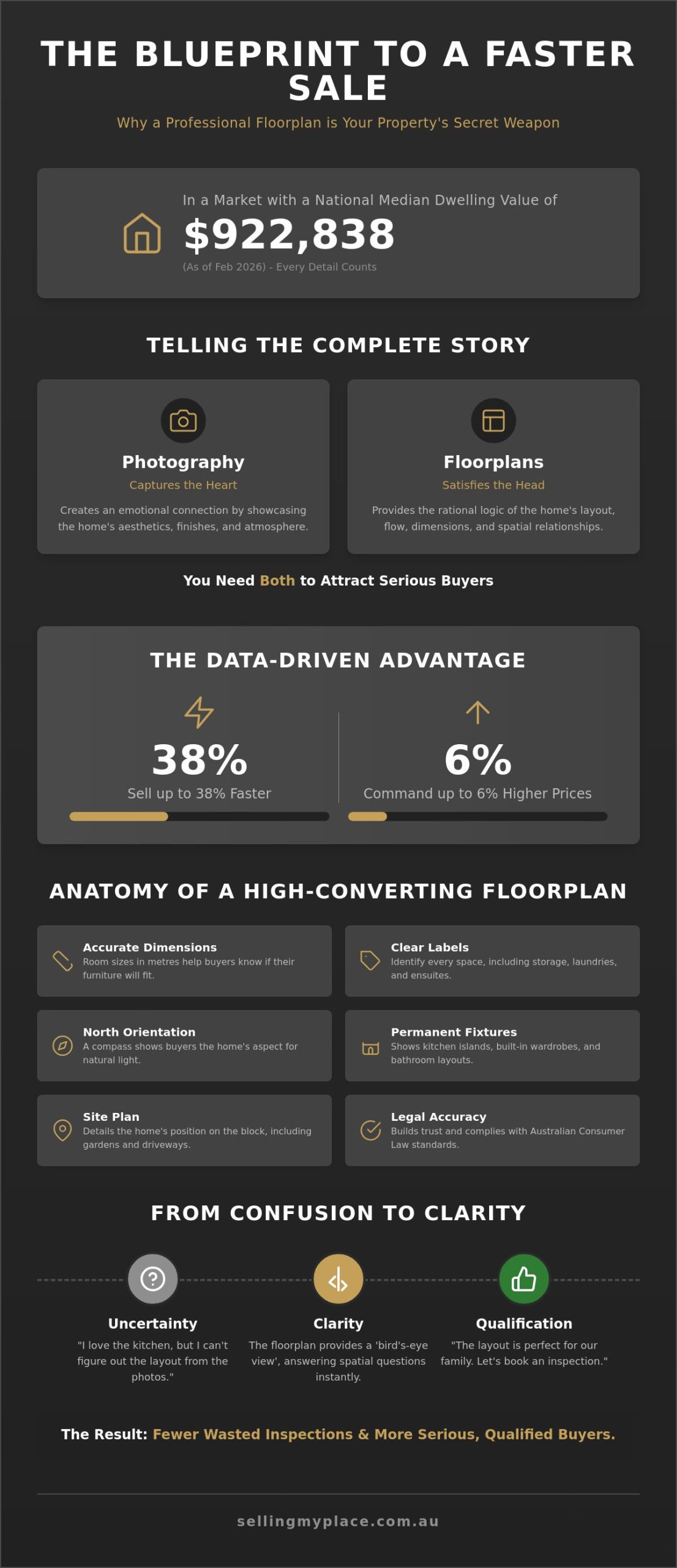
Qualifying Buyers Early: How Spatial Data Reduces Wasted Inspections
One of the most draining parts of selling property is the “tyre-kicker” effect. These are lovely people who adore your photography but realise within moments of arriving that the house simply doesn’t fit their life. It’s a waste of their Saturday and, more importantly, your time and energy. Using floorplans as a pre-screening tool solves this problem before the first doorbell rings. It allows potential purchasers to check if their oversized modular sofa fits the lounge or if the third bedroom is actually large enough for a home office. By providing this data upfront, you’re essentially handing them a checklist to qualify themselves.
This creates a “Serious Buyer” filter. When someone books a viewing after studying the layout, they’ve already done the mental heavy lifting. They aren’t wondering if the flow works; they’re already imagining how they’ll style the space. During the open for inspection, the floorplan becomes a natural talking point. It gives you a structured way to point out the subtle benefits of the home, such as the separation between the master suite and the guest wing, which might be hard to appreciate while walking through a crowded room. If you want to ensure your listing is working as hard as possible for you, consider reaching out for a chat about your property presentation.
Saving Time for the Private Seller
For those taking the “Sale by Owner” route, efficiency isn’t just a preference; it’s a necessity. You’re likely balancing work, family, and the sale itself, so every lead needs to be high-quality. A professional layout answers those repetitive questions about room sizes and storage before they’re even asked. It reduces the number of “just looking” calls and ensures your weekends are spent with people who are genuinely interested in your home’s specific configuration. If you’re managing the process yourself, it pays to learn How to Sell Your Own Home with a focus on these time-saving tools.
Empowering the Buyer’s Decision
A floorplan’s value doesn’t end when the inspection does. It becomes a vital reference point for buyers as they discuss the property with architects or builders about potential future renovations or extensions. It even plays a role in securing finance, as valuers often use these documents to verify the property’s living area during their assessment. Providing this level of detail empowers the buyer to move forward with confidence, knowing they have all the facts at their fingertips. A professional floorplan acts as a permanent, tangible reference that keeps your home at the forefront of a buyer’s mind long after they’ve left the driveway.
Professional Marketing Without the Commission: The Kincade Advantage
By now, it’s clear that spatial clarity isn’t just a “nice to have” feature; it’s a fundamental pillar of a successful sale. However, many homeowners worry that accessing high-end assets like professional floorplans requires signing away a significant portion of their equity through a 2-3% agency commission. We believe you shouldn’t have to choose between professional quality and your family’s financial future. Through Kincade International Direct Sales (KIDS), we’ve designed a model that provides those same elite marketing tools within a transparent, flat-fee structure. It’s about giving you the “big agency” look while keeping your hard-earned results in your own pocket.
While some might be tempted to save a few dollars with a DIY sketch or a basic smartphone app, the risks are substantial. Under the Australian Consumer Law, misleading or deceptive conduct in property advertising can lead to staggering penalties, with corporations facing fines up to $100 million. A professional measurement ensures that your Gross Internal Area is recorded with pinpoint accuracy, protecting you from legal disputes during the conveyance process. When your property is uploaded to our global marketing network, these precise details ensure your home stands out to serious buyers across the country and overseas, presented with the authority it deserves.
A Partnership Approach to Selling
We don’t just hand you a marketing bundle and walk away. Our “Steady Hand” philosophy means we act as your nurturing guide through the entire process. This starts with expert pre-sale property consulting to identify which features of your layout will most appeal to your local market. We then integrate your professional photography and floorplans into a listing that competes directly with the biggest agencies on the major property portals. It’s a collaborative effort where we provide the professional framework and you provide the heart and history of the home.
Your Next Steps to a Commission-Free Sale
Getting your home ready for the market is a significant life transition, and we’re here to make it as calm and organised as possible. When you choose one of our marketing bundles, we arrange for a professional to visit your home for a comprehensive measure-up and photo session. To prepare, simply ensure all rooms are tidy and clear of clutter so the technician can easily access every corner and wall. This small bit of preparation ensures your floorplans are as detailed and inviting as possible. If you’re ready to take control of your sale and move toward your next chapter with confidence, Discover our commission-free marketing packages today.
Take the Next Step Toward Your Successful Sale
Selling your home is one of life’s most significant transitions, and it deserves a strategy that respects both your heart and your hip pocket. We’ve explored how floorplans do more than just show wall placements; they qualify your buyers, reduce the stress of wasted inspections, and provide the legal transparency required in the modern Australian market. It’s about giving purchasers the confidence to say “yes” before they’ve even walked through your front door.
You don’t have to navigate this process alone or pay high marketing costs to get professional results. Our partners save an average of $20,000 in commissions while still receiving high-end photography and professional measurement as part of their bundle. With your property listed until sold and no time limits to worry about, you can move at a pace that feels right for your family. Save thousands and sell smarter with our flat-fee marketing packages. We’re here to ensure your next chapter starts with a sense of calm and a very successful result.
Your Questions About Spatial Marketing Answered
Do I really need a professional floorplan for a small apartment?
Yes, spatial clarity is arguably more important in smaller homes where every square metre counts toward the final sale price. Buyers looking at apartments often worry about whether their existing furniture will fit without making the space feel cramped. Professional floorplans help them visualise the layout of studios or one-bedroom units that can sometimes look identical in photos, giving your listing a distinct competitive edge.
Can I draw my own floorplan for a real estate listing?
While you can technically create a sketch yourself, it is not recommended due to the legal risks involved in property marketing. Accuracy is a strict requirement under Australian Consumer Law, and professional services provide the precision needed to avoid claims of misleading conduct. A DIY version often lacks the authority and exact millimetre-perfect measurements that serious purchasers and their solicitors expect to see.
What is the difference between a 2D and a 3D floorplan for selling?
A 2D plan is a flat, bird’s-eye view showing dimensions and room connections, while a 3D version adds depth and furniture visualisations to the mix. 2D versions are excellent for technical clarity and helping buyers plan their furniture placement. 3D versions are a wonderful tool for buyers who struggle with spatial awareness, as they help them “feel” the volume and height of the rooms more effectively.
How long does it take to get a professional floorplan created?
Most professional measures take about 30 to 60 minutes on-site, with the final digital files usually delivered within 24 to 48 hours. This quick turnaround ensures your marketing campaign isn’t delayed while you wait for assets. It is a small time investment that pays off significantly by ensuring your listing is comprehensive and ready for the portals from the very first day.
Will a floorplan help with my property valuation?
Yes, providing a detailed layout can assist a valuer in accurately calculating the Gross Internal Area (GIA) of your home. Valuers rely on precise data to compare your property with recent sales in the local area. Having this information ready shows you are a prepared and transparent seller, and it helps ensure no living space or utility area is overlooked during the formal assessment.
Should I include the garden and outdoor areas in my floorplan?
Absolutely, as including a site plan that shows the house in relation to the block is highly beneficial for the Australian lifestyle. Our way of living revolves around the indoor-outdoor flow, so marking alfresco areas, decks, and garden boundaries is essential. It helps buyers understand the total utility of the land and how they might use the backyard for future entertaining or play.
How much do floorplans typically cost when not included in a package?
Industry rates vary depending on the size and complexity of the home, but they are generally considered a very low-cost investment relative to the property’s value. While we include floorplans in our flat-fee bundles to provide the best possible value, standalone costs usually reflect the time taken for a professional measure-up and digital rendering. It is a small price to pay for the peace of mind that comes with professional accuracy.
Is a floorplan legally required to sell a house in Australia?
No, there is no national law that mandates a floorplan for a residential sale, but you are legally bound to be accurate if you choose to use one. Under the Australian Consumer Law, any visual representation must be a truthful and accurate reflection of the property. Providing a professional plan is the most reliable way to meet these transparency standards and protect yourself from potential disputes during the settlement process.
Property Marketing Plan Australia: A Comprehensive Guide for 2026 Home Sellers
What if the key to unlocking your home’s true value isn’t hidden behind hefty commission fees, but lies in a strategy you can lead yourself? We know that saying goodbye to a family home is one of life’s most significant transitions. It’s a time filled with memories and, quite naturally, a fair bit of stress about getting the result you deserve. You likely feel that a property marketing plan australia should be more than just a list of expensive portal ads. It should be a thoughtful reflection of your home’s unique story and its place in the community.
We agree that watching your hard-earned profits disappear into traditional agency pockets feels unsettling, especially when you’re the one who knows your local streets best. This guide is designed to empower you with the exact roadmap needed to achieve a professional-grade listing and maximise your sale price while keeping your equity where it belongs. We’ll explore how to organise high-impact photography, navigate the 2026 digital landscape, and present your home with a level of polish that rivals any traditional agency.
Key Takeaways
- Understand why a structured plan serves as the engine room of your sale, protecting your peace of mind and preventing expensive, ad-hoc mistakes.
- Learn to identify the non-negotiables for a professional listing, including the lifestyle-focused storytelling found in quality photography and floorplans.
- Discover how to design a high-impact property marketing plan australia that reaches the right buyers while bypassing traditional agency commissions.
- Explore the significant financial advantages of flat-fee solutions, allowing you to retain more of your home’s equity for your next chapter.
- Follow a practical, step-by-step roadmap to prepare your property, from researching local market reports to leveraging expert pre-sale consulting.
What is a Property Marketing Plan and Why Does Your Sale Depend on It?
Think of your marketing strategy as the engine room of your entire sale. It’s the central force that transforms a simple listing into a competitive event that draws people in. When you’re preparing to move on from a place filled with years of memories, the last thing you need is the uncertainty of ad-hoc decisions. A structured property marketing plan australia provides a sense of calm during what can be a whirlwind time. It ensures you aren’t just throwing money at advertisements and hoping for the best. Instead, you’re making calculated moves that protect your equity. Without a clear plan, it’s far too easy to fall into the trap of expensive, last-minute mistakes that quickly eat into your final profit.
The broader real estate business has evolved far beyond the days of just placing a grainy photo in a local office window. With the cooling market of 2026, where national home price growth has moderated to 5.8%, buyers are being much more selective. They aren’t just looking for a house; they’re looking for a lifestyle and a sense of security. A professional first impression isn’t just about looking “fancy.” It’s about psychology. When a listing looks polished and intentional, buyers subconsciously feel the home itself has been well-maintained. This builds the essential trust necessary for them to feel confident making a high-value offer.
The Shift from Traditional to Digital-First Selling
Success in 2026 requires digital precision. Industry data shows that roughly 90% of Australian property searches now begin on a mobile device. If your home doesn’t look stunning on a five-inch screen, you’ve lost most of your audience before they’ve even read the first sentence of your description. Moving beyond the “local agent window” means tapping into a national and even global buyer network. By prioritising digital infrastructure, you ensure your home is visible to the growing number of interstate buyers looking for value outside of the major capital city hubs.
Setting Your Marketing Objectives
Defining what success looks like goes much deeper than just the final sale price. Are you looking for a quick settlement to fund a sea-change, or is your priority squeezed into every last dollar of equity? Your property marketing plan australia should reflect these personal goals. You also need to identify your target buyer persona. A first-home buyer looking for a low-maintenance unit will respond to very different language and imagery than an investor or a growing family. By setting a clear timeline and specific goals, you can organise your preparations to align perfectly with your next big life transition.
The Essential Ingredients of a High-Performing Marketing Plan
Building on the strategic foundation we’ve established, it’s time to look at the specific tools that bring your home to life. A high-performing property marketing plan australia isn’t about doing everything; it’s about doing the right things with absolute precision. In a market where Sydney median values sit at $1,265,608 as of June 2026, the stakes are far too high for amateur snapshots or rushed descriptions. You need a suite of assets that project confidence and care, showing buyers that your home is a premium opportunity worth their attention.
Photography and Floorplans: Your Visual Handshake
First impressions are almost always digital. High-quality Photography is the single most effective investment you can make in your campaign. It acts as a visual handshake, welcoming potential buyers into your space before they even step through the front door. Coupled with accurate floorplans, these tools allow buyers to “move in” mentally. They start imagining where the sofa will go or how the morning light hits the kitchen bench. The Real Estate Institute of Australia often highlights that professional standards in presentation are vital for maintaining consumer trust in the property sector. By choosing professional-grade visuals, you aren’t just selling a building; you’re selling the future lifestyle that exists within its walls.
The words you choose are just as vital as the images. Rather than a dry list of features, your property copy should tell a story. Does the backyard host legendary summer barbecues? Is the study a quiet sanctuary for a home business? Focus on evocative, lifestyle-oriented language that highlights the stability and community your neighbourhood offers. If you find yourself stuck on how to frame your home’s best bits, our friendly advisors are always here to help you find the right words.
Digital Reach and Listing Portals
Visibility is the lifeblood of your sale. Your property marketing plan australia must ensure your home appears where buyers are actually looking. This means securing placement on the nation’s leading property portals. In 2026, these platforms use sophisticated algorithms to match your home with the right people. It’s also important to look for “listed until sold” options. These provide a safety net, ensuring you never feel pressured by a ticking clock or expiring ad. By leveraging global marketing networks, you can also reach international buyers and expats who are increasingly looking for a slice of the Australian dream, ensuring no stone is left unturned in your search for the perfect buyer.
Comparing Marketing Models: Traditional Agency vs. Flat-Fee Solutions
When you stand in your kitchen, picturing the next family who will share meals there, the financial reality of the sale is often at the back of your mind. However, choosing how to execute your property marketing plan australia is one of the most significant financial decisions you’ll make. Historically, the only path to a professional result was through a traditional agency, but that often comes with a heavy “commission tax” that can feel quite personal when you see the final numbers. In 2026, many homeowners are questioning why they should hand over a significant portion of their equity when they are the ones who have cared for the property for years.
The True Cost of a Commission-Based Sale
In Australia, the national median real estate commission sits at approximately 2.65%. On a national median dwelling value of $922,838, that represents a payment of over $24,455. This isn’t just a number on a page; it’s a deposit for your next home, a renovation fund, or a boost to your retirement savings. Beyond the cost, traditional models can sometimes create a conflict of interest. Because agents are often driven by volume, there is a natural pressure to close a deal within the standard 90-day agreement, even if waiting another week might have secured a better price. You can learn more about how the industry is changing in our guide on Understanding the Flat-Fee Real Estate Model.
The Benefits of the Flat-Fee Marketing Model
The flat-fee revolution is built on the belief that you should keep 100% of your sale profit. By paying a single upfront cost for professional tools, you remove the financial fog of commissions. This model offers a level of transparency that traditional agencies often struggle to match. You get the same high-end photography and accurate floorplans we discussed earlier, but you maintain full control over the process. There’s no pressure to accept a low offer just because an agent’s contract is nearing its end. Instead, you have the freedom to sell on your own terms, backed by the same digital reach used by the biggest firms in the country. Choosing a “Sale by Owner” approach no longer means selling alone; it means selling with professional support while keeping your hard-earned equity in your own pocket.
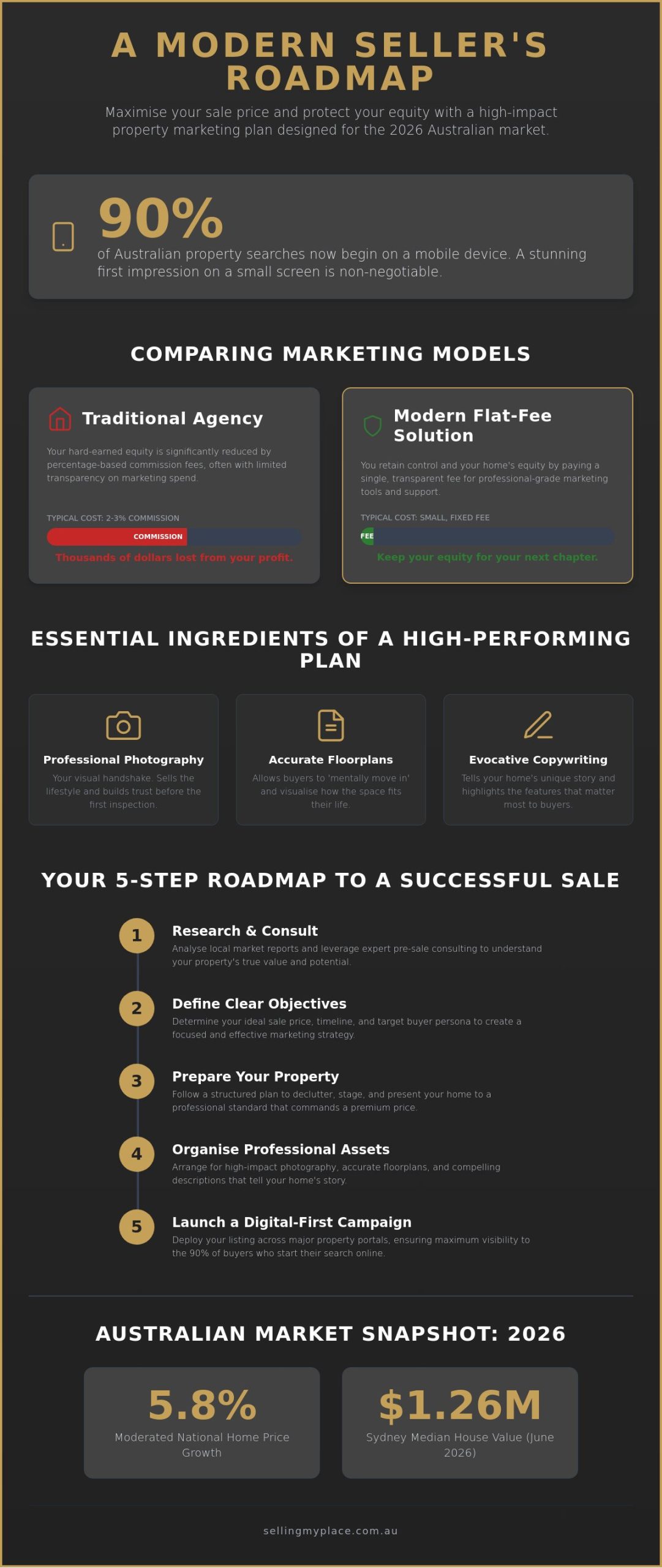
Designing Your Strategy: A Step-by-Step Guide for Australian Sellers
Moving from the “why” to the “how” is where the excitement really begins. Creating a tailored property marketing plan australia involves more than just ticking boxes; it’s about layering professional insights onto your intimate knowledge of your home. In a cooling market where buyer confidence can be fragile, a methodical approach ensures you don’t leave your result to chance. By following a clear, five-step roadmap, you can present a listing that feels both polished and deeply authentic.
- Step 1: Market Research. Start by grounding your expectations in reality. Use detailed reports to understand what similar homes in your street have actually sold for, rather than just looking at optimistic asking prices.
- Step 2: Pre-Sale Consulting. Identify high-value improvements that offer the best return. Sometimes, a simple garden tidy or a fresh coat of paint does more for your sale price than a major kitchen renovation.
- Step 3: Professional Visuals. As we’ve explored, high-end photography and floorplans are the foundations of your digital presence.
- Step 4: Global Launch. Push your listing across a digital infrastructure that reaches buyers across leading national property portals and overseas networks.
- Step 5: Expert Support. Manage enquiries and negotiations with the steady hand of an advisor to guide your decisions.
Researching Your Market Position
Setting the right price is a delicate balance of data and intuition. We recommend using Neighborhood Market Reports to see the full picture of your local area. In 2026, we’re seeing a distinct shift toward units due to affordability constraints, so understanding how your specific property category is performing is vital. Analysing recent sales helps you find your competitive edge. Are you the only four-bedroom home in the suburb with a north-facing backyard? Highlighting these specific strengths allows you to tap into the “buyer’s mindset” and justify a premium price point.
The Launch and Beyond
Timing your launch for maximum impact often means going live when buyer activity is highest, typically mid-week to build anticipation for weekend inspections. When the initial surge of enquiries begins, responding with professional warmth and clear information sets a positive tone for the entire negotiation. Once you’ve found the right buyer, the focus shifts to the paperwork. Securing early Conveyance Advice ensures your contract is ready to go, preventing any delays that could unsettle a nervous purchaser. Many sellers at this stage are also navigating the challenge of selling and buying a house at the same time in Australia, and having a clear strategy for both transactions is essential to avoiding costly settlement gaps. If you’re ready to start mapping out your specific timeline, get in touch with our team for a personalised consultation.
The Kincade Advantage: Professional Results Without the Commission
At Kincade, we believe the emotional significance of selling your home should be met with a partnership that values your legacy as much as you do. Our Kincade International Direct Sales (KIDS) model isn’t just a service; it’s a way to empower you to take the lead while we provide the professional-grade tools. You’ve already seen how a robust property marketing plan australia can be the difference between a good result and a great one. By removing the traditional agency commission from the equation, we ensure that the rewards of your hard work stay exactly where they belong: with your family.
What truly sets us apart is our “Steady Hand” approach. Through our Real Estate Advisory Services, you gain access to seasoned experts who act as your nurturing guides throughout the process. We don’t believe in the ticking clock of a standard 90-day agreement. Our “listed until sold” promise means we’re in this with you for the long haul, providing a sense of calm confidence that reduces the stress of high-stakes decision-making. You’re never just a number to us; you’re a partner in a shared mission to achieve the best possible outcome for your next life transition.
More Than Just a Listing
We provide a comprehensive ecosystem that goes far beyond a simple portal upload. From Pre-Sale Property Consulting that helps you polish your home’s presentation to vital Conveyance Advice that secures your legal standing, every piece of our service is designed to be protective and personal. Our global marketing network reaches across borders, finding buyers that a local shopfront agent might never encounter. This isn’t just about saving money; it’s about the emotional peace of mind that comes from being in total control of your story and your equity.
Join the Future of Australian Real Estate
Thousands of Australians are already realising that the old way of selling isn’t the only way. You can have the polished photography, the accurate floorplans, and the massive digital reach without the $20,000 commission bill. It’s about selling smarter, not harder. We’re here to provide the expert backing you need to step into this new chapter with clarity and pride. If you’re ready to see what’s possible, you can Start your commission-free sale journey with Kincade today and take the first step toward a more rewarding property experience.
Embrace a Smarter Path to Your Next Chapter
Selling your home is more than just a financial transaction; it’s the closing of one beautiful chapter and the start of another. By now, you understand that a high-impact property marketing plan australia doesn’t require you to sacrifice your hard-earned equity to traditional agency commissions. You have the power to combine professional-grade visuals and global digital reach with your own local expertise. Whether it’s through detailed market reports or the steady hand of our Agent Advisory Service, you are fully equipped to manage your sale with confidence and poise.
Our partners save an average of $20,000 per sale while remaining listed until sold with 0% commission. This isn’t just about the numbers; it’s about the freedom those savings provide for your family’s future. If you’re ready to embrace a smarter way to sell, we’re here to guide you every step of the way.
Discover how to save $20,000 on your home sale with Kincade
Your home has been a sanctuary for years, and you deserve a sale process that respects that legacy. We look forward to helping you move forward with clarity, support, and the best possible result for your family.
Frequently Asked Questions
How much does a professional property marketing plan cost in Australia?
The cost of a professional property marketing plan australia depends on the specific digital tools and visual assets you choose to prioritise. While traditional agency campaigns in 2026 often involve significant mark-ups on advertising, a flat-fee approach focuses on high-impact essentials. This allows you to invest in professional photography and premier portal listings without the added burden of agency overheads or unnecessary commission-based expenses.
Can I really sell my own home without a traditional real estate agent?
You can absolutely sell your own home successfully by using the same professional digital infrastructure that traditional agencies use. In the current 2026 market, the vast majority of buyers begin their search on mobile devices, meaning your listing can reach a national audience regardless of who is hosting the inspection. By taking control, you maintain a personal connection with potential buyers and ensure your home’s unique story is told with genuine warmth.
What is included in a flat-fee property marketing package?
A comprehensive flat-fee package typically includes the essential non-negotiables: professional photography, accurate floorplans, and listings on major Australian property portals. Beyond these visual assets, you also gain access to expert advisory services and neighbourhood market data. This ensures you have a professional-grade presentation and the strategic backing needed to manage enquiries and negotiations with total confidence from start to finish.
How do I get my property listed on major real estate portals if I sell privately?
Private sellers can access the country’s most frequented real estate portals by partnering with a licensed residential property listing service. These platforms generally restrict direct individual uploads, so a professional service acts as your essential gateway to the digital market. This ensures your home appears alongside every other listing in the marketplace, providing the visibility needed to attract serious buyers without the traditional gatekeeper fees.
Is professional photography really necessary for selling a home?
Professional photography is the single most important investment in your property marketing plan australia. With the majority of property searches now starting online, your home needs to stand out instantly on a screen. High-quality images build immediate trust and an emotional connection, whereas amateur photos can often lead buyers to overlook a property entirely, regardless of its actual value or local charm.
What happens if my property doesn’t sell within 90 days?
Unlike traditional agency agreements that often expire after 90 days, a “listed until sold” model provides you with ongoing support until the right buyer is found. This removes the artificial pressure to accept a lower offer just because a contract is nearing its end. It allows you to wait for the market to meet your expectations, providing peace of mind during the cooling market conditions seen across many capital cities in 2026.
Do I need a lawyer or conveyancer if I am selling the property myself?
You will still need a qualified conveyancer or solicitor to handle the legal aspects of the sale, such as preparing the contract of sale and managing the transfer of title. While you can manage the marketing and inspections yourself, these legal professionals ensure the transaction is compliant with state-specific regulations. It’s a vital step that protects your interests and ensures a smooth, secure settlement for both parties.
How do Neighborhood Market Reports help with my marketing plan?
Neighborhood Market Reports provide the objective data you need to set a realistic and competitive asking price. By looking at recent sales of similar properties in your specific street or suburb, you can identify your home’s unique competitive edge. This prevents the common mistake of overpricing, which can cause a listing to go stale, or underpricing, which leaves your hard-earned equity on the table during your life transition.
Mastering the Deal: Expert Property Sale Negotiation Tips for Australian Homeowners
What if the most powerful tool in your property sale isn’t a silver-tongued agent, but your own local knowledge and a calm, steady hand? Selling your family home is a massive life transition, and it’s entirely natural to feel a bit of a knot in your stomach when those first offers start landing on the kitchen table. With dwelling values in Sydney and Melbourne cooling as of June 2026, you might worry that savvy buyers hold all the cards. However, mastering a few key property sale negotiation tips can shift the balance back in your favour. It’s about more than just a price tag; it’s about protecting the heart and soul you’ve poured into your home.
We know that the fear of being lowballed or getting tangled in legal fine print can feel heavy, especially with the strict new identity verification laws that kicked in this July. You want to maximise your final sale price while keeping your hard-earned equity where it belongs. This guide will show you how to negotiate like a seasoned pro using proven strategies and expert advisory. We will walk you through how to handle offers directly, decode the contract essentials, and decide exactly when to say “yes” or “no” with complete confidence.
Key Takeaways
- Learn why the negotiation actually begins long before the first phone call and how your initial listing presentation dictates your bargaining power.
- Discover how to use Neighborhood Market Reports to anchor your value and implement essential property sale negotiation tips that justify your “walk-away” figure.
- Master the art of responding to lowball offers with calm confidence, using strategic silence to encourage buyers to refine their own position.
- Understand why the highest offer isn’t always the best deal and how expert conveyance advice ensures your contract terms protect your equity.
- See how a flat-fee advisory model removes traditional conflicts of interest, keeping the focus entirely on your family’s financial legacy.
Mastering the Art of the Deal: Why Property Sale Negotiation Starts Before the First Offer
Most people imagine property negotiation as a high-stakes phone call at the eleventh hour. In reality, it’s a thoughtful, multi-stage process that begins long before you greet your first visitor. If you wait until an offer is sitting on the kitchen bench to start considering negotiation theory and tactics, you have already missed the most critical opportunities to shape the narrative. Your home is a place of memories, but once it hits the market, it becomes a value proposition. Every interaction you have with a potential buyer is a brick in the wall of your eventual deal.
Your listing’s first impression sets the psychological ceiling for your entire campaign. When a buyer clicks through your photos, they are already deciding whether they are coming to “win” the home or “hunt” for a bargain. To protect your equity, you must make the psychological shift from “homeowner” to “vendor.” This detachment isn’t about loving your home less; it’s about respecting your financial future enough to remain objective. It’s much easier to hold your ground when you view the transaction as a partnership between your goals and the market’s reality.
Vendor authority is the grounded confidence gained when a seller replaces guesswork with professional preparation and verifiable market data.
The Power of Professional Presentation
Investing in top-tier Photography and clear Floorplans isn’t just about aesthetics. These tools act as your first line of defence against aggressive price-slashing. A polished listing signals that you are a serious, high-end seller who won’t be easily rattled. When a home is presented flawlessly, buyers find it much harder to “pick holes” or justify a lowball offer. It creates a perceived value that feels solid and non-negotiable, which is one of the most effective property sale negotiation tips for maintaining your asking price.
Establishing Your Position of Strength
Transparency is your best friend in a cooling market. By being open about the property’s condition from day one, you remove the buyer’s ability to “chip away” at the price during the cooling-off period. We recommend preparing an “evidence pack” including recent sales data and strata reports before your first open house. Engaging Real Estate Advisory Services early provides a steady hand to guide you through these initial steps. Using these property sale negotiation tips ensures you lead with facts rather than feelings, which is always the strongest position to hold during a sale.
Setting Your Ground: Data-Driven Pricing and the ‘Walk-Away’ Figure
Deciding on a price for your family home is one of the most emotionally charged moments of the selling process. It’s the point where your years of memories meet the cold reality of the current market. To navigate this successfully, you need to separate your pricing into three distinct categories. Your “dream price” is the ideal result if two buyers fall in love and start a bidding war; your “fair market value” is what the data suggests a reasonable buyer will pay; and your “walk-away figure” is the absolute bottom line where the sale no longer makes sense for your future. Having these figures clear in your mind before you even list the property provides a sense of calm that buyers will respect.
One of the most common mistakes we see is “over-quoting” to leave room for negotiation. In a cooling market, where Sydney dwelling values fell by 1.2% and Melbourne by 1.0% in June 2026, this strategy can backfire. Savvy buyers are often scared off by an unrealistic price tag, causing your property to languish on the market and lose its initial momentum. When a listing goes stale, you lose your leverage. Instead, use our Neighborhood Market Reports to justify your asking price with hard evidence. When you can show a buyer exactly why your home is valued at a certain level based on recent local sales, the conversation shifts from an emotional tug-of-war to a logical business discussion. Understanding how to determine market value of a home in Australia is the critical first step to anchoring your price with confidence in this changing landscape.
The most powerful word in any negotiation is a calm, data-backed “no.”
Understanding Local Market Dynamics
To set a firm ground, you must look closely at “Days on Market” (DOM) for similar properties in your street. If the average DOM is stretching out, you know you’ll need more patience. Similarly, keep a close eye on local auction clearance rates rather than national averages. While you are building your pricing strategy, it’s worth considering your broader Strategic Response Tactics to ensure you aren’t caught off guard by a quick offer. For those choosing a Sale by owner path, having this data at your fingertips is essential for commanding respect from buyers and their agents alike.
Defining Your Non-Negotiables
Negotiation is about more than just the final dollar amount. Before you open your doors, decide on your ideal settlement period and which chattels, like a specific designer light fitting or a custom outdoor kitchen, are included in the sale. Clearly identifying these non-negotiables early prevents them from becoming “deal-breakers” during the final heat of the deal. If you’re feeling unsure about how to balance your price expectations with the current market, you can always reach out for a chat about your goals with our advisory team.
Strategic Response Tactics: How to Handle Lowballs and Multiple Offers
Receiving a lowball offer can feel like a personal insult, especially when you’ve spent years maintaining your garden or raising a family within those walls. However, in the world of property, a low offer is often just a buyer “testing the waters” to see how you react. One of the most effective property sale negotiation tips is to never take the first number personally. It’s simply the opening line of a dialogue. By staying calm and grounded, you keep the power in your hands and signal that you aren’t easily rattled by aggressive tactics.
Sometimes, the best response is no response at all. When an offer is presented that doesn’t meet your expectations, try using the “Silence Technique.” After the buyer or their representative finishes speaking, wait for a few beats before responding. That brief, slightly uncomfortable silence often prompts the buyer to start justifying their price point or even hinting that they have “a bit more in the tank.” It shows you’re a serious seller who knows the true value of your home and won’t be pushed into a corner.
When it’s time to counter-offer, avoid round numbers. Proposing a specific figure like $952,500 instead of a flat $950,000 signals that you’ve performed a meticulous calculation of your equity, costs, and the current market. This “Power of 900” tactic makes your bottom line feel researched and firm, rather than plucked from thin air. It suggests to the buyer that there is very little “wiggle room” left because you’ve already done the hard maths.
Managing multiple offers requires a steady hand and absolute transparency to ensure you get a “fair go” from the market. Instead of playing buyers against each other in a way that feels “shonky,” invite all interested parties to submit their “best and final” offer by a set deadline. This creates a fair, competitive environment where the most committed buyer can step forward without feeling manipulated.
The Anatomy of a Counter-Offer
A successful counter-offer is a delicate balance of professional courtesy and firm boundaries. Start by acknowledging the buyer’s interest; everyone wants to feel heard. Then, apply the “Give and Get” rule. If you agree to lower your price slightly, ask for something in return, such as a shorter settlement period or a larger deposit. By applying these property sale negotiation tips, you ensure the transaction feels like a respectful partnership. For a deeper look at the legalities of this process, the Consumer Affairs Victoria negotiation guide offers excellent insights into making and receiving offers during a private sale.
Recognising a “Dud” Offer vs. a Serious Buyer
Not all offers are created equal, and some are best left on the table. A “dud” offer often comes with “strings attached” that can jeopardise your plans. Look out for these red flags in buyer behaviour:
- Vague or non-committal finance details that suggest they aren’t truly “ready to go.”
- Pushy, aggressive tactics designed to rattle your confidence.
- Unrealistic demands for immediate access or early possession before settlement.
A serious buyer usually presents a “clean” offer, meaning fewer conditions and a clear path to settlement. While a higher price tag is tempting, an offer subject to the sale of another property can often fall through. Sometimes, the bravest move is to walk away and wait for the person who truly values your home’s legacy.
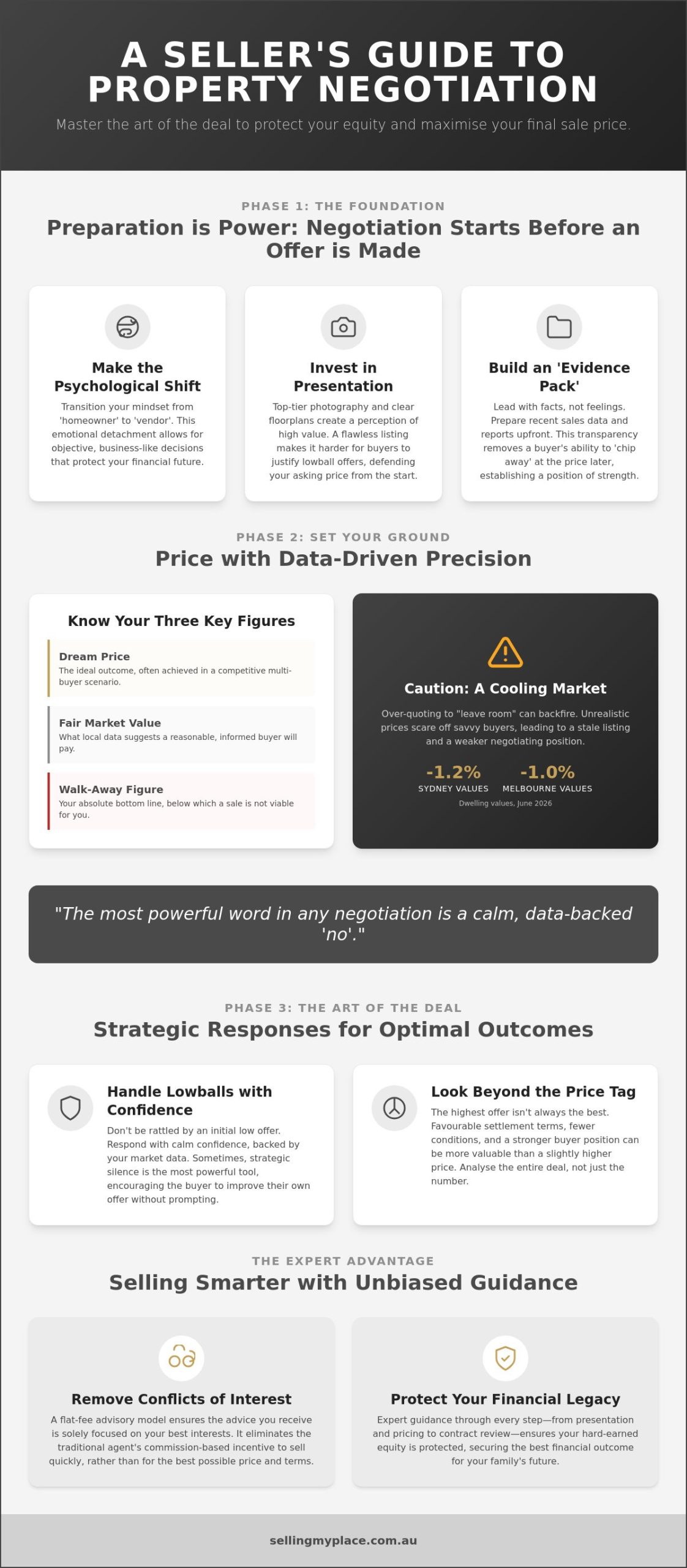
Beyond the Price Tag: Negotiating Settlement Terms and Conveyance Advice
While it’s easy to get swept up in the excitement of a high dollar figure, the highest offer isn’t always the best deal for your family’s future. A slightly lower price with an unconditional contract and a 60-day settlement might actually leave you in a better financial position than a record-breaking price riddled with complex clauses. These property sale negotiation tips are about more than just the final number; they are about protecting your equity and ensuring a smooth transition to your next chapter. When you look at an offer, look at the whole picture, not just the bottom line.
A 10% deposit remains the gold standard for a reason. It provides you with a significant safety net and ensures the buyer has enough “skin in the game” to see the transaction through. If a buyer pushes for a smaller deposit, you are well within your rights to ask for more favourable settlement terms in return. Aligning your settlement date with your next move is a masterstroke that can save you a fortune in bridging finance and the sheer exhaustion of moving twice. It’s these small, practical details that turn a good sale into a great one.
The Role of Expert Conveyancing
You should always have your contract reviewed by a professional before any serious negotiation begins. This proactive step allows you to understand which “Special Conditions” you can use as bargaining chips. For instance, you might offer a slightly longer cooling-off period in exchange for a higher price. Many modern Residential Property Listing Services now recommend integrating legal support early to avoid nasty surprises. If you’re feeling overwhelmed by the legal jargon, you can get in touch for expert conveyance advice to ensure your contract is watertight.
Handling Building and Pest Results
This is often the stage where a deal can wobble. If a report comes back with minor issues, you have a choice: negotiate a small price reduction or agree to fix the repairs yourself. Generally, a price reduction is cleaner for your bottom line as it prevents you from managing tradespeople during a stressful move. You can also stand your ground on known minor defects by using an “as-is” clause, provided these were disclosed early in the campaign. Whatever you decide, ensure any agreed repairs or credits are documented precisely in the final contract to protect your interests.
Selling Smarter: How Expert Advisory Services Protect Your Profit
The traditional real estate model has long relied on a percentage-based commission, which can often lead to a subtle misalignment of goals. When an agent’s payday depends on a quick turnover, the pressure to “just sign” can feel overwhelming. By choosing a flat-fee advisory model, you remove this conflict of interest entirely. Your advisor isn’t chasing a commission; they are focused on ensuring you achieve the best possible result for your unique circumstances. This shift allows you to implement property sale negotiation tips with the backing of a professional who is truly in your corner, without the $20,000 price tag often associated with high-end agencies.
Having a professional negotiator by your side provides a vital buffer between your emotions and the buyer’s tactics. While you focus on the heart of the move, your advisor handles the strategic heavy lifting. They help you move from that initial verbal agreement to a binding exchange of contracts with total clarity. This final stage is where the “fine print” matters most, especially with the new identity verification requirements. A steady hand ensures that every T is crossed and every I is dotted, protecting your equity until the moment the keys change hands.
The KIDS Advantage
Kincade International Direct Sales (KIDS) offers a unique partnership that combines global reach with the personal touch of a local expert. Unlike the transactional feel of a standard agency, the KIDS model is built on the belief that you should keep 100% of your sale profit. This extra capital can be the difference between a modest downsized apartment and the dream coastal retreat you’ve been planning for years. You receive the professional polish and marketing power of a top-tier firm while remaining the primary decision-maker in your home’s legacy.
Your Negotiation Checklist
Before you sign on the dotted line, take a moment to breathe and run through this final summary of essentials. Trusting your gut is just as important as trusting the data. If something feels “off” about an offer, it usually is. Here are the five key steps for a successful finish:
- Confirm your walk-away figure: Ensure the offer genuinely meets your financial needs for the next chapter.
- Verify the terms: Double-check that the settlement date and deposit amount align with your moving plans.
- Review the evidence: Use your Neighborhood Market Reports one last time to confirm the price reflects current local trends.
- Consult your advisor: Run the final figures and conditions past your Real Estate Advisory Services team.
- Check the contract: Ensure all agreed repairs or special conditions are clearly written into the binding document.
Selling your home is a significant milestone, and you deserve to feel empowered throughout the entire journey. By combining these property sale negotiation tips with a supportive advisory model, you can navigate the market with confidence and grace. Discover how we empower you to sell smarter and keep your profit.
Take Control of Your Financial Legacy
Selling your home is about so much more than a transaction; it’s the bridge to your next big adventure. By embracing these property sale negotiation tips, you’ve moved from being a passive observer to a confident decision-maker. You now understand that a successful sale is built on the foundation of professional presentation, anchored by robust local data, and secured through a firm grasp of contract terms. Protecting your equity isn’t just about the final figure; it’s about making sure the transition is as smooth and stress-free as possible for your family.
You don’t have to walk this path alone. With our global marketing network reach and a dedicated Agent Advisory Service in your corner, you can achieve a premium result while keeping your hard-earned profit. Our partners save an average of $20,000 in commissions by choosing a smarter, modern way to sell. It’s time to step into your future with clarity and confidence. Start your commission-free selling journey with Kincade today and see how a partnership-based approach changes everything. You’ve got this, and we’re here to help you every step of the way.
Frequently Asked Questions
Do I really need an agent to negotiate for me?
No, you aren’t legally required to use a traditional agent to handle your sale. Many homeowners find that they are the most passionate advocates for their property’s unique history and value. By using our Real Estate Advisory Services, you gain the strategic advantage of a professional negotiator while maintaining direct control over the final decision. This partnership ensures you aren’t pressured into a quick sale that doesn’t serve your family’s long-term interests.
How do I handle a buyer who keeps pushing for a lower price?
When a buyer persists with lower offers, refocus the conversation on objective market evidence. Reference your Neighborhood Market Reports to show how your price aligns with recent local sales. If the pressure continues, a calm “no” backed by data is your most effective tool. You might also offer to adjust a settlement term instead of the price, which often satisfies a buyer’s need to feel they’ve “won” a concession.
What is the most important “Special Condition” to include in my contract?
While every sale is unique, a well-defined settlement date that aligns with your next move is often the most valuable condition for a seller. It prevents the stress and cost of bridging finance or moving into temporary accommodation. You should also ensure there is a clear “sunset clause” on any finance conditions. This prevents a buyer from tying up your property for weeks without a firm commitment to proceed.
Can I change my mind after I have verbally accepted an offer?
Yes, a verbal agreement is generally not legally binding in Australia until the written contracts are signed by both parties and formally exchanged. While it’s important to act with integrity to keep a serious buyer engaged, you aren’t locked in until that physical exchange happens. This is why moving quickly from a verbal “yes” to a binding contract is one of the most vital property sale negotiation tips for protecting your sale.
How do I know if a buyer is actually pre-approved for finance?
You should request a formal letter of “pre-approval in principle” from the buyer’s financial institution. Don’t rely on a buyer’s word alone, as their borrowing capacity may have changed with recent interest rate shifts. With the new AML/CTF regulations that began in July 2026, your legal representative will already be conducting more thorough financial checks. This added layer of scrutiny helps ensure you’re only dealing with genuine, qualified purchasers.
What should I do if the building and pest report comes back with issues?
Don’t panic if a report identifies minor defects; almost every home has them. The best approach is usually to offer a small, fair price reduction rather than attempting to organise repairs yourself while you’re busy packing. This keeps the process moving forward without you having to manage tradespeople. Ensure any agreement is documented as a specific “special condition” in the contract so there are no further disputes before settlement.
Is it better to sell at auction or via private treaty for negotiation?
Private treaty often provides a better environment for nuanced negotiation, especially in the cooling markets we saw in June 2026. Unlike the high-pressure environment of an auction, a private sale allows you to discuss settlement dates and specific conditions that might be more important to you than the final dollar amount. It gives you the time to build a rapport with the buyer and find a middle ground that respects your home’s legacy.
How much can I actually save by negotiating the sale myself?
Australian homeowners often save an average of $20,000 by choosing a commission-free model. When you remove the traditional percentage-based fee, that equity stays in your pocket to fund your next life transition. These property sale negotiation tips empower you to handle the process with professional polish while ensuring your family receives the full benefit of your home’s capital growth. It’s a significant financial win that provides a much smoother start to your next chapter.
