Managing the Emotional Side of Selling a Home: A Practical Guide
What if the hardest part of selling your home isn’t the paperwork, but letting go of the life you’ve built there? A familiar kitchen, family gatherings and quiet routines can make a property feel like part of the family. That’s why managing the emotional side of selling a home can be challenging, especially when buyer feedback or negotiation starts to feel like a judgement of your memories rather than an opinion about the property.
If you’re feeling attached, uncertain or unsettled by each new milestone, you’re not being unreasonable. Selling is both a practical decision and a personal transition, and there’s no need to rush yourself through it. A useful starting point is to identify what matters most in the sale, then use those priorities to guide decisions when emotions run high.
This guide shares practical ways to create space between emotion and decision-making, from setting clear priorities before listing to keeping buyer feedback in perspective. You’ll also learn how a clear sale process and professional advice can help organise decisions and reduce avoidable uncertainty, so you can stay involved and feel more in control as you move towards your next chapter.
Key Takeaways
- Recognise that a home sale can bring up memories, identity and feelings about a major life change. Managing the emotional side of selling a home starts with noticing those feelings without letting them make decisions for you.
- Identify pressure points across your sale timeline, including buyer comments about presentation or condition, which can feel more personal than intended.
- If an offer surprises or disappoints you, pause before responding and return to the priorities you set for the sale.
- Use a simple reset: name the feeling, identify its trigger, take a moment, then choose a considered next step.
- Professional marketing and advisory support can add structure to sale tasks, helping you stay involved while reducing avoidable uncertainty.
Why managing the emotional side of selling a home matters
Selling a home can mean more than changing address. It may involve letting go of familiar routines, a sense of independence or a place that has held important family moments. At the same time, a sale can bring opportunity and relief. Whatever your reason for moving, your response is personal, and it can change as the process unfolds.
Managing the emotional side of selling a home means noticing what you feel while giving yourself room to make decisions at a considered pace. It doesn’t mean suppressing emotion or caring less about the property. It means separating a feeling from the decision in front of you, so a difficult moment doesn’t automatically dictate what happens next. For example, feeling hurt by a buyer’s comment doesn’t mean you need to change the asking price or reject an offer straight away.
Emotional steadiness in a property sale means acknowledging your feelings while choosing your next step with care.
Feelings can shift between preparing the property, welcoming people through for inspections, considering offers and reaching settlement. You might feel ready to move one day, then unexpectedly unsettled when a room is cleared or an offer arrives. Sadness or uncertainty can be part of a significant transition; by themselves, they don’t mean you should abandon a sale. Pause and consider whether the feeling is signalling a practical concern, a need for more information or simply the weight of change.
Why a home can feel like more than a property
A kitchen might bring back family dinners; a spare room may represent the independence of a first home or the years spent raising children. These associations are examples of place attachment, the emotional bond that forms between a person and a specific environment, such as a home. Selling can also be complicated by circumstances such as downsizing, separation, bereavement or relocation. But there’s no single story behind a sale, and not everyone experiences it as a loss.
Common feelings sellers may experience
Attachment, relief, uncertainty, excitement and sadness can all arise during a sale. They aren’t competing reactions: you can be looking forward to a new chapter and still miss the home you’re leaving. Rather than judging yourself for feeling one way or another, notice what’s present and when it appears. That small pause can help you respond thoughtfully, especially when a sale milestone brings an unexpected emotional shift.
How to recognise emotional triggers during a home sale
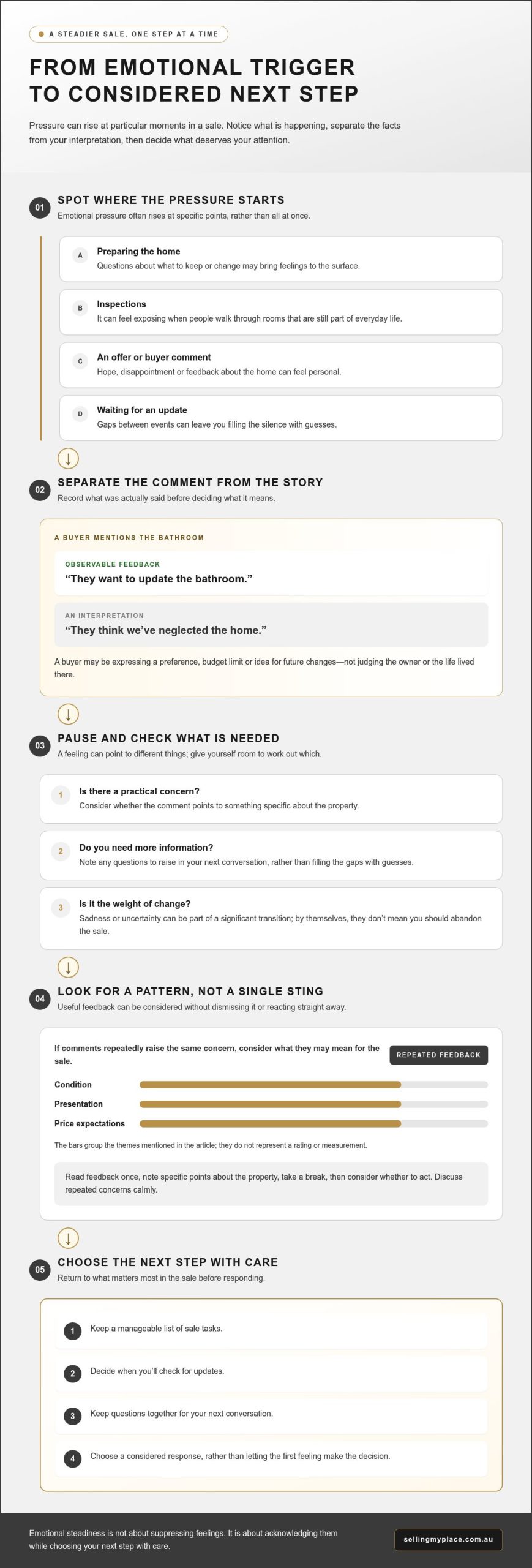
Emotional pressure often rises at particular points in a sale rather than arriving all at once. Preparing your home may bring up questions about what to keep or change. Inspections can feel exposing, as people walk through rooms that are still part of your everyday life. An offer may prompt hope, disappointment or difficult decisions, while waiting for updates can leave you filling the silence with guesses.
Knowing your likely pressure points helps you prepare for them. Notice what tends to unsettle you, when it happens and what decision, if any, needs to be made. For instance, if inspection feedback tends to feel personal, plan to read it once, note any specific points about the property and take a break before deciding whether to act. This is a practical part of managing the emotional side of selling a home: it creates a moment to respond thoughtfully instead of reacting to the first feeling.
When buyer feedback feels personal
A buyer’s comment about the kitchen, paintwork or price can sting, especially when you’ve cared for the home over many years. But a buyer is usually expressing a preference, budget limit or idea for future changes, not assessing your taste or the life you’ve lived there. Buyer feedback is about how a property suits their needs, not a judgement of its owner.
Try separating the observable comment from the meaning you’ve attached to it. “They want to update the bathroom” is feedback; “they think we’ve neglected the home” is an interpretation. Still, don’t dismiss useful information. If comments repeatedly raise the same concern about condition, presentation or price expectations, consider them calmly and discuss what they may mean for your sale.
Why waiting and change can heighten stress
There may be gaps between an inspection, an enquiry, an offer and the next update. Not knowing what will happen or when can make it tempting to check for news constantly. Meanwhile, keeping the home ready, managing family routines and making it available for inspections can add to the load. Recognising that combination can help you plan for the strain rather than blame yourself for feeling unsettled.
Focus on what’s within your control: prepare a manageable list of sale tasks, decide when you’ll check for updates, and keep questions for your next conversation in one place. A predictable check-in routine can give the process some shape without assuming how quickly a sale will progress. For practical structure as you prepare, discuss your property sale plans.
Handle offers and negotiation without losing perspective
An offer can feel like a verdict on a home you’ve cared for, especially if it’s lower than you hoped or arrives with conditions you didn’t expect. Taking a measured approach doesn’t mean you care less. It means giving the offer a fair assessment before deciding what to do next.
Try not to infer a buyer’s motives from the terms alone. A proposed price, preferred timing or condition tells you what they’re putting forward, not necessarily why. Focus first on the details in the offer and how they compare with your priorities and the information available to you. For more practical guidance, explore these property sale negotiation tips.
A practical pause before responding to an offer
Before replying, record the offer details and note any response deadline. Then take a breath and review the full picture rather than focusing only on the figure. Consider the proposed timing, conditions and how each fits your circumstances. If you’re finding it hard to assess the terms on your own, property sale advice can help you consider your options more clearly.
| Immediate reaction | Considered next step |
|---|---|
| “They don’t value our home.” | Write down the offer as presented, then assess its terms against relevant information. |
| “We need to accept or reject this now.” | Check the response deadline and use the time available to review your priorities. |
| “Those conditions must mean the buyer isn’t serious.” | Separate the stated conditions from assumptions about the buyer’s intentions. |
How to keep the decision grounded in your priorities
Return to the reasons you decided to sell. Perhaps timing matters because of a planned move, or certainty is more important to you than holding out for an imagined perfect result. Your priorities provide a useful reference point, but they don’t have to dictate a single answer. Assess an offer against its terms, your circumstances and the information available, rather than against an ideal outcome that may not be realistic.
Declining, accepting or negotiating can each be a considered choice. Before settling on a response, ask: Does this option support what matters most to us? What information would help us decide? Managing the emotional side of selling a home includes allowing those questions to guide the discussion, rather than letting disappointment or excitement make the decision on its own.
Practical ways to manage emotions before, during and after the sale
A simple reset can help you move from an immediate reaction to a considered response. Use it when a task feels overwhelming, a conversation becomes tense or a milestone brings up unexpected feelings:
- Name the feeling: Is it worry, frustration, sadness or relief?
- Identify the trigger: What happened just before the feeling surfaced?
- Pause: Give yourself a moment before replying or making a non-urgent decision.
- Choose a next step: Decide what information, conversation or practical action would help.
If your thoughts are racing, write down the facts separately from your interpretation. For instance, record “the inspection feedback mentioned the garden” as a fact, then note any assumptions you’re making about what it means. Revisit the decision when you feel more settled. This routine can make managing the emotional side of selling a home feel more deliberate, without expecting you to switch off your feelings.
Make room for priorities and questions
Keep a short list of what matters most in the sale, such as timing, household needs and the offer terms you need to understand. Add questions as they arise, then use the list to guide discussions rather than trying to hold every detail in your head. If you’re planning a sale by owner, this guide to selling your own home can help you think through the process and its practical steps.
Protect routines and relationships during the process
Keep familiar routines where you can, whether that’s a regular family meal, a walk or a quiet hour away from sale-related tasks. Agree with household members how you’ll share preparation jobs and discuss decisions. You might set aside a time to talk through sale matters, so they don’t take over every conversation or evening.
There’s no required way to say goodbye to a home. You may want to take photos, share a memory or simply focus on the move ahead. Make space for what feels right to you, without turning a farewell into another task to get perfect. After settlement, give yourself room to adjust; a change in routine can take time.
If distress persists, feels unmanageable or is affecting your day-to-day wellbeing, consider speaking with a qualified mental health professional. Practical property guidance can help organise sale tasks, while emotional support can address how the transition is affecting you. For guidance with the practical side of your sale, get in touch with our property advisory team.
How supportive guidance can make selling feel more manageable
A clear sale process won’t remove every difficult feeling, and it shouldn’t ask you to set those feelings aside. What it can do is make practical decisions easier to see: what needs attention now, what can wait and where you can get considered advice. That structure can reduce avoidable uncertainty while leaving you involved in decisions about your home.
What a steady, supportive sale process can provide
Professional marketing and advisory support can help organise the practical work of presenting a property and progressing a sale. Professional photography and floorplans give buyers useful ways to understand the home, while neighbourhood market reports provide context for discussions about the market. Pre-sale consulting and real estate advice can help you work through questions as they arise, rather than trying to solve every detail at once.
Kincade International Direct Sales provides flat-fee property marketing and advisory packages, with a 0% commission structure. The service includes residential listings, professional photography and floorplans, alongside pre-sale consulting and real estate advice. Owners remain involved in their sale while using a clear framework for marketing and sale tasks. Defined tasks and access to advice can help you approach each step with more information, without promising that the emotional parts will disappear.
As you consider your options, it may help to ask what would make the process feel clearer. Is it understanding the marketing plan, knowing what needs to happen before listing, or having advice available when you’re weighing a decision? Naming the question can make the next conversation more useful.
Choosing your next step at a pace that feels right
You don’t need to settle every detail at once. Identify the question creating the most uncertainty today, then review the proposed sale process before making commitments or major decisions. A clear explanation of the steps, marketing and advisory support can help you decide what suits your circumstances and how involved you want to be.
Taking time to understand your options is part of managing the emotional side of selling a home. If you’re ready to explore practical support for your sale, Talk through your next step.
Move forward with clarity and support
Selling a home can hold both personal meaning and practical decisions. Remember that feelings may shift throughout the process; noticing a trigger and pausing before you respond can help you make choices in line with your priorities. Managing the emotional side of selling a home isn’t about caring less. It’s about giving yourself room to consider each next step.
A clear sale process can help organise the practical details without pretending to remove every uncertainty. Kincade International Direct Sales’ flat-fee property marketing and advisory packages include professional photography and floorplans, as well as pre-sale consulting, so you can access practical support while remaining involved in your sale.
You don’t need to have every answer before taking the next step. Start with the question that matters most to you, then explore the marketing and advisory support available at a pace that feels right. Talk through your next step when you’re ready. With considered decisions and practical support, you can move towards what comes next with greater confidence.
Frequently Asked Questions
Is it normal to feel sad when selling a home?
Yes, sadness can be a natural response to leaving a home that holds memories or familiar routines. You might also feel relief, excitement or uncertainty, sometimes all at once. There’s no required way to feel, and your emotions don’t have to match anyone else’s. Notice when sadness arises and give yourself space to acknowledge it, while still considering the practical decisions in front of you.
How do I stop taking buyer feedback about my home personally?
Separate what the buyer actually said from the meaning you’re attaching to it. A comment about updating a bathroom may reflect the buyer’s preferences or plans, rather than a judgement of your care for the home. Write down the feedback plainly, then consider whether it raises a useful point about presentation, condition or price expectations. You can take relevant information seriously without treating it as a personal criticism.
Can emotions affect decisions when selling a home?
Yes, strong feelings can influence how you respond to feedback, offers or uncertainty. Disappointment might make an offer feel like an insult, while excitement could make it tempting to decide before weighing all the terms. Managing the emotional side of selling a home means noticing that reaction and pausing. Review the offer details, timing, conditions and your priorities before choosing whether to accept, decline or negotiate.
What should I do if I feel overwhelmed while selling my home?
Pause and work out what feels most difficult right now. Name the feeling, identify its trigger, then separate the known facts from assumptions or worst-case thoughts. Choose one manageable next step, such as writing down a question for your next sale discussion. Protect time for ordinary routines where possible. If distress persists, feels unmanageable or affects daily life, consider speaking with a qualified mental health professional.
How do I cope with selling a family home?
Give yourself permission to recognise what the home has meant to your family, without feeling you need to follow a particular farewell ritual. You might share stories, take photos or simply talk about the move together. If others are involved in the sale, agree how you’ll discuss decisions and divide practical tasks. People may respond differently, so making room for those differences can help the transition feel more considered.
How can I stay calm when negotiating a home sale?
Before responding, record the offer and review its terms, including timing and conditions. Compare them with your priorities and relevant information about the property, rather than guessing at the buyer’s motives or measuring the offer against a perfect outcome. If you feel surprised or disappointed, take a pause and seek measured advice if needed. A considered response may be to accept, decline or negotiate, depending on your circumstances.
Stress-Free Property Selling for Australian Owners
A calmer sale often starts with fewer competing decisions, not more. Avoiding stress when selling property isn’t about controlling every twist; it’s about knowing what needs attention now, what can wait and who can help. From preparing for inspections to weighing an offer or adjusting plans, it’s easy to feel pulled in several directions at once.
If you’re unsure where to begin, you’re not alone. Selling a home is a significant change, and practical tasks can sit alongside plenty of emotion. A clear plan can make the next step feel manageable, while realistic milestones help you stay focused without expecting everything to happen at once.
This guide will help you set priorities, organise the sale into a sensible sequence and feel more in control of decisions and communication. You’ll also learn how practical support, such as pre-sale consulting, listing services, photography and floorplans, can ease the workload while you remain involved in your sale. The aim is a steadier process, clearer choices and more confidence as plans unfold.
Key Takeaways
- Reduce uncertainty by separating what you can influence from the outcomes you can’t control.
- Make avoiding stress when selling property more achievable by turning broad goals into clear, manageable steps.
- Look for patterns in buyer feedback before making changes, rather than treating one comment as a verdict on your home.
- Agree on communication routines and share practical tasks to protect your time and energy during the sale.
- Consider how flat-fee, commission-free marketing and advisory support can clarify responsibilities while keeping you involved in decisions.
Why selling property can feel stressful, and what you can control
Selling a home is more than a set of practical jobs. It can mark a move, a change in household plans or the closing of a meaningful chapter, while requiring decisions about preparation, timing and offers. It’s understandable if the process feels demanding, especially when several important things need your attention at once.
Sale-related stress often grows from uncertainty, competing tasks and decisions with real consequences. You may be organising the property while keeping up with everyday responsibilities, responding to inspection arrangements and considering buyer feedback. The pressure can feel heavier when it’s unclear who is handling each task or what needs to happen next. Every owner’s circumstances are different, so there’s no single pace or plan that suits everyone.
Which parts of selling tend to create the most pressure?
Preparation can bring a long list of jobs, from deciding what needs attention to getting the home ready for photography and inspections. Deadlines, inspection availability and regular communication can add to the workload. Offers may feel especially weighty because they call for careful consideration, not an automatic response. When responsibilities aren’t clearly divided, even small tasks can blur into one overwhelming list.
What can sellers influence, and what must they allow for?
You can organise the work around your sale: gather relevant information, plan preparation, set out when you’re available and agree how decisions will be reviewed. A simple task list can clarify who is responsible for each job. Setting a regular time to consider updates can also stop every message from feeling urgent.
Some things remain outside your control. You can’t guarantee when buyers will be interested, how they’ll respond to the property or when an offer may come forward. Trying to predict every outcome can use energy without making the process more certain. Instead, focus on the choices in front of you and the information that helps you make them thoughtfully.
A clear plan won’t control every part of a property sale, but it can turn a complex process into a series of more manageable decisions. That’s a practical starting point for avoiding stress when selling property: know what you can act on, and allow room for what you can’t. Simple routines that support your wellbeing can help too; this overview of stress management techniques offers broader ideas for handling pressure.
How to make a property sale feel manageable with a simple plan
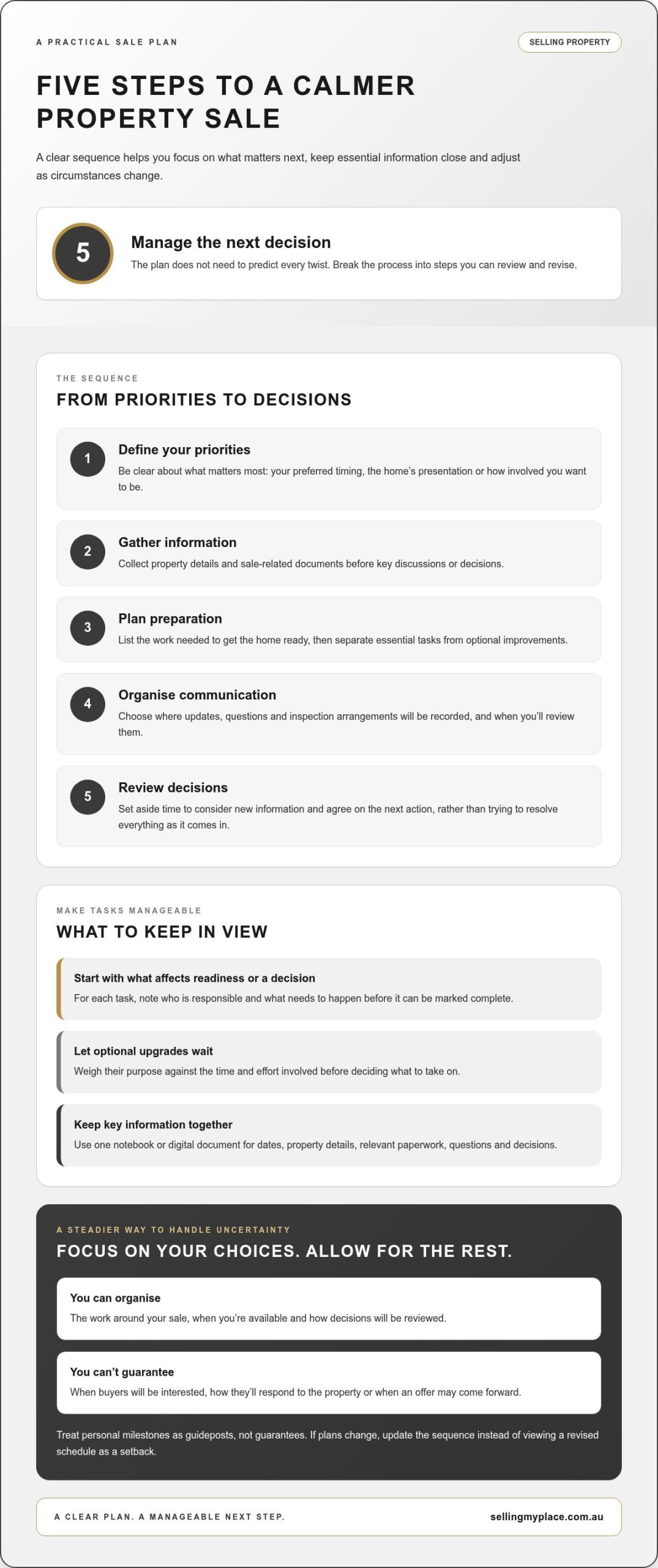
A useful plan doesn’t need to account for every twist. Its job is to show you what matters next, keep essential information close and make progress easier to see. To make avoiding stress when selling property more achievable, break the process into steps you can review and adjust as circumstances change.
Try this simple sequence:
- 1. Define your priorities. Be clear about what matters most, such as your preferred timing, the home’s presentation or how involved you want to be.
- 2. Gather information. Collect property details and sale-related documents before key discussions or decisions.
- 3. Plan preparation. List the work needed to get the home ready, then separate essential tasks from optional improvements.
- 4. Organise communication. Decide where updates, questions and inspection arrangements will be recorded, and when you’ll review them.
- 5. Review decisions. Set aside time to consider new information and agree on the next action, rather than trying to resolve everything as it comes in.
How should you prioritise sale tasks?
Start with tasks that affect readiness or a decision you need to make. For each job, note who is responsible and what needs to happen before it can be marked complete. Optional upgrades can wait until you’ve weighed their purpose against the time and effort involved. Set personal milestones for preparation, listing readiness and availability, but treat them as guideposts, not guarantees. If plans change, update the sequence instead of viewing a revised schedule as a setback.
What information can reduce uncertainty early?
Use one central place, such as a notebook or digital document, to keep dates, property details, relevant paperwork, questions and decisions. That way, important information isn’t scattered across messages and reminders. Market reports and comparable property information can help frame expectations, but they aren’t a promise of the price your home will achieve. For more context, read How to Determine the Market Value of a Home in Australia: The 2026 Seller’s Guide.
Small, specific tasks make a large goal easier to manage. “Prepare the home” can become a list of separate jobs, each with an owner and a realistic target date. This lets you see what’s done, what’s underway and what can wait, without expecting the sale to follow a perfectly smooth path. If you’re selling independently, How to Sell Your Own Home: A Step-by-Step Guide to Sale by Owner in Australia offers further guidance on the process.
When practical guidance would help you shape your sale plan, explore property sale support to clarify your next steps while staying involved in decisions.
How to handle uncertainty, feedback and offers without feeling overwhelmed
Feedback and offers can feel personal, particularly when you’ve invested time and care in your home. A steadier approach is to treat each response as information to assess, not as a verdict or a decision you need to make on the spot. This can make avoiding stress when selling property more achievable, even when the next step isn’t immediately clear.
How can you keep buyer feedback in perspective?
One buyer’s comment may reflect their preferences, budget or circumstances, rather than an objective judgement of your property. Record feedback and look for recurring themes. If several people mention the same practical issue, consider whether a change fits your sale plan. A single suggestion doesn’t automatically mean you should alter the home or its presentation.
Give yourself a little time before making emotionally charged changes. Pause, review what you’ve heard and discuss any possible adjustment with your adviser. This helps you respond deliberately, rather than letting one inspection shape the entire campaign.
How can you make offer decisions with a clearer head?
An expression of interest signals that a buyer may want to discuss the property, but it isn’t the same as a clear offer ready for your decision. The detail and effect of communications can vary, so clarify what the buyer is proposing and what, if anything, they’re asking you to agree to. You don’t need to treat interest as a commitment to proceed.
Before reviewing an offer, revisit your priorities and questions. Consider the whole proposal, not just the headline amount. You might want to understand any conditions, proposed timing, inclusions and response deadline. For legal questions about contract terms, use appropriate conveyance advice.
| Decision factor | Question to consider |
|---|---|
| Offer amount | How does it fit with your expectations and priorities? |
| Conditions | What does the buyer require before proceeding? |
| Timing | Does the proposed schedule work for your circumstances? |
| Inclusions | Is it clear what is included in the proposal? |
Use the table to organise your thinking, not to predict which offer will succeed. If something is unclear, ask for clarification before responding. For more ideas on weighing proposals and communicating your position, see Mastering the Deal: Expert Property Sale Negotiation Tips for Australian Homeowners.
A short pause can create room for a better decision. For structured guidance as you assess buyer responses, explore property sale advisory support.
How to protect your time, boundaries and energy during a sale
A property sale can bring a steady stream of messages, questions and practical jobs. Setting a few clear routines helps you stay informed without feeling that you need to be on call every moment. It’s a useful part of avoiding stress when selling property, especially when sale tasks sit alongside work, family commitments and the ordinary rhythm of home life.
What boundaries make sale communication easier?
Agree on one reliable channel for routine updates, then keep key decisions and agreed next steps in writing. Choose practical times to review messages, such as once in the morning and again later in the day, rather than checking continuously. Set a simple process for urgent questions too: clarify what counts as urgent and which channel should be used. Important matters can then be raised promptly without every update feeling like an emergency.
Be clear about who needs to take part in decisions. A household member might coordinate access for inspections, while another keeps the task list up to date. An adviser can help organise sale-related information or discuss marketing, while you retain the final say on decisions that matter to you. Shared responsibility works best when everyone knows what they’re handling.
How can you preserve your energy during the sale?
Keep ordinary routines where you can. Protecting time for work, meals, rest or family plans gives the sale a place in your week without allowing it to take over. Some flexibility will be needed for preparation and buyer access, so identify in advance where you can adapt and where you need notice. A shared calendar can help household members coordinate commitments and avoid last-minute confusion.
When can outside support ease the workload?
Notice which tasks are taking the most effort. You may find it difficult to organise listing details, arrange photography and floorplans, interpret neighbourhood market information or decide what to prepare before going to market. Residential property listing and advisory support can take defined tasks off your plate while leaving you involved in decisions. A flat-fee, commission-free marketing model can also make service costs more predictable. For more context, see Professional Residential Property Listing Services: The Modern Australian Seller’s Guide.
Support should make responsibilities clearer, not add pressure or speak over you. Choose the parts of the process where guidance would genuinely help, then agree how updates and decisions will be handled. To share the practical load while staying involved in your sale, explore property listing and advisory support.
How the right selling support can help you move forward calmly
Good support should make the moving parts of a sale easier to understand, not add another layer of pressure or take your voice out of decisions. You can stay involved in choices about your home while sharing specific tasks with people who understand the selling process. For owners focused on avoiding stress when selling property, the key is finding support that fits the way they want to sell.
What should useful property-selling support help with?
Practical marketing support can reduce the jobs you need to coordinate yourself. Kincade International Direct Sales provides residential property marketing on a flat-fee, commission-free basis, with listing support, professional photography, floorplans and neighbourhood market reports. Listings remain active until sold. These defined services can help you organise how your home is presented and promoted, without promising a particular price, buyer response or timeline.
Pre-sale consulting and advisory support can help you clarify priorities, make sense of the next steps and identify where guidance would be useful. That might mean planning what to prepare, understanding the marketing material or working out which decisions need your attention. The aim is to share practical responsibilities while keeping you informed and involved, not to guarantee a stress-free sale.
How can you take the next step without rushing?
Start with one simple prompt: what part of selling feels hardest to manage right now? Write down the concern, whether it’s organising the listing, preparing the home or knowing what to do next. Then note the kind of help that would make a real difference. A focused conversation is often easier than trying to solve every part of the sale at once.
Seeking information doesn’t mean you need to make an immediate commitment. It gives you a chance to understand what support involves and decide whether it suits your priorities. Take the time you need to consider your options and keep ownership of the decisions that matter to you.
Selling is a meaningful transition, and you don’t have to work out every detail alone. To explore a more manageable way to prepare for your sale, talk through your property-selling plans.
Take your next step with a clearer plan
A more manageable sale starts with focusing on what you can influence: set clear priorities, break preparation into practical tasks and give yourself space to review feedback and offers. Simple communication boundaries can protect your time, while the right support can make responsibilities easier to understand without taking decisions out of your hands. These are useful foundations for avoiding stress when selling property, even when plans need to change.
Kincade International Direct Sales provides commission-free property marketing and advisory support through a flat-fee model. Listing support includes professional photography, floorplans and neighbourhood market reports, with listings remaining active until sold. Clear, defined support can help you organise the practical parts of selling while staying involved in your sale.
You don’t need to have every detail worked out before exploring your options. Start by identifying the part of the process you’d most like help with, then take the next step at your own pace. Talk through your property-selling plans and explore a more manageable way to prepare for selling. With a clear plan and support that suits your needs, you can move forward with greater confidence.
Frequently Asked Questions
How can I reduce stress when selling my property?
Reduce pressure by making the sale easier to organise, one decision at a time. Write down your priorities, gather relevant property information and break preparation into manageable tasks with clear responsibilities. Keep dates, questions and decisions in one place, and set regular times to review updates instead of monitoring messages constantly. You can’t control buyer timing, but a practical plan can help you focus on informed choices and adjust as needed.
What is the most stressful part of selling a property?
There isn’t one most stressful part for every seller. Preparation, deadlines, inspections, communication and weighing offers can all feel demanding, particularly when they compete with everyday responsibilities. The pressure often increases when it’s unclear who is handling a task or what needs attention next. Identifying your personal pressure points helps you decide where a simple routine, clearer responsibilities or practical selling support could make the process feel more manageable.
Can I sell my property without feeling overwhelmed?
You may not be able to remove every challenge, but you can make the work feel more manageable. Start by separating essential tasks from optional improvements, then set realistic milestones for preparing and listing your home. Keep space in your plan for changes, and share practical responsibilities where possible. Selling involves uncertainty, so aim for steady progress rather than expecting every step to happen exactly as planned.
How do I stay calm when receiving an offer on my property?
Pause before responding and review the proposal against the priorities you set before an offer arrived. Consider the terms as well as the headline amount, including any conditions, timing, inclusions and response deadline. If something is unclear, seek clarification and take time to understand what you’re being asked to decide. An expression of interest may signal buyer interest, but it isn’t necessarily a complete offer or a commitment to proceed.
What happens if my property takes longer to sell than expected?
A longer sale process can be frustrating, but it doesn’t mean you need to make a rushed decision. Review buyer feedback for recurring themes, consider whether your marketing and sale plan still reflect your priorities, and discuss possible adjustments with an adviser. Kincade International Direct Sales keeps listings active until sold, with no time limit. Buyer interest and timing can’t be guaranteed.
Should I use a property adviser to reduce stress when selling?
A property adviser may help if you’re unsure what to do next, find planning the sale time-consuming or want support interpreting market information. Pre-sale consulting and advisory support can help clarify priorities and organise next steps, while you remain involved in decisions. Kincade International Direct Sales provides commission-free property marketing and advisory services through a flat-fee model. Consider which tasks you’d genuinely like help managing before deciding what support suits you.
How can I manage inspections and buyer feedback without losing my routine?
Set practical availability for inspections and agree how arrangements and updates will be communicated. A shared calendar or task list can help household members coordinate access and preparation without relying on one person to remember everything. Protect everyday routines where possible, while allowing some flexibility for sale-related commitments. After inspections, record feedback and look for patterns before making changes; one buyer’s comment isn’t necessarily a reason to alter your plans.
Does selling with support mean I lose control of the sale?
No. Useful support should clarify responsibilities and help with practical tasks while keeping you involved in important decisions. For example, listing support, professional photography, floorplans and neighbourhood market reports can assist with preparing and marketing your property, while advisory support can help you plan. Agree on how you’ll receive updates and which decisions you’ll make. A flat-fee, commission-free model is one option for owners who want practical support while retaining involvement.
Understanding the Cooling Off Period When Selling: The 2026 Australian Guide
What if the most dangerous moment in your property sale isn’t finding a buyer, but the days immediately after they sign? For Australian homeowners, understanding the cooling off period when selling is often the difference between celebrating a smooth exchange and watching a transaction suddenly unravel. While statutory cooling off rights protect purchasers from high-pressure commitments, vendors are bound the instant contracts are signed, leaving you carrying all the initial risk.
Selling a home is a deeply personal milestone, and it’s completely natural to feel uneasy when a buyer holds a statutory exit pass. It’s equally frustrating trying to decipher conflicting state rules, calculating clear business days versus weekends, or wondering how cooling off provisions actually interact with conditional finance clauses.
You don’t have to leave your sale proceeds to chance. In this 2026 guide, you’ll discover exactly where you and your buyer stand legally, how to secure unconditional contracts using waiver certificates or auction-style terms, and how expert conveyance advice safeguards your equity from exchange straight through to settlement.
Key Takeaways
- Mastering the legal landscape and understanding the cooling off period when selling reveals why statutory cancellation rights favour the purchaser, leaving vendors legally bound from day one.
- Statutory windows and cancellation penalties vary significantly across Australian states and territories, making the precise counting of clear business days essential for protecting your timeline.
- If a buyer exercises their right of rescission, vendors hold a statutory right to retain a specific forfeit from the initial deposit, provided formal notice procedures are met.
- Sellers can actively eliminate transaction uncertainty by requiring formal legal waiver certificates or adopting auction-style unconditional terms prior to exchange.
- Securing independent conveyance advice empowers you to structure protective contract conditions and maintain complete control over your equity without paying traditional agent commissions.
What Is the Cooling Off Period When Selling Residential Property in Australia?
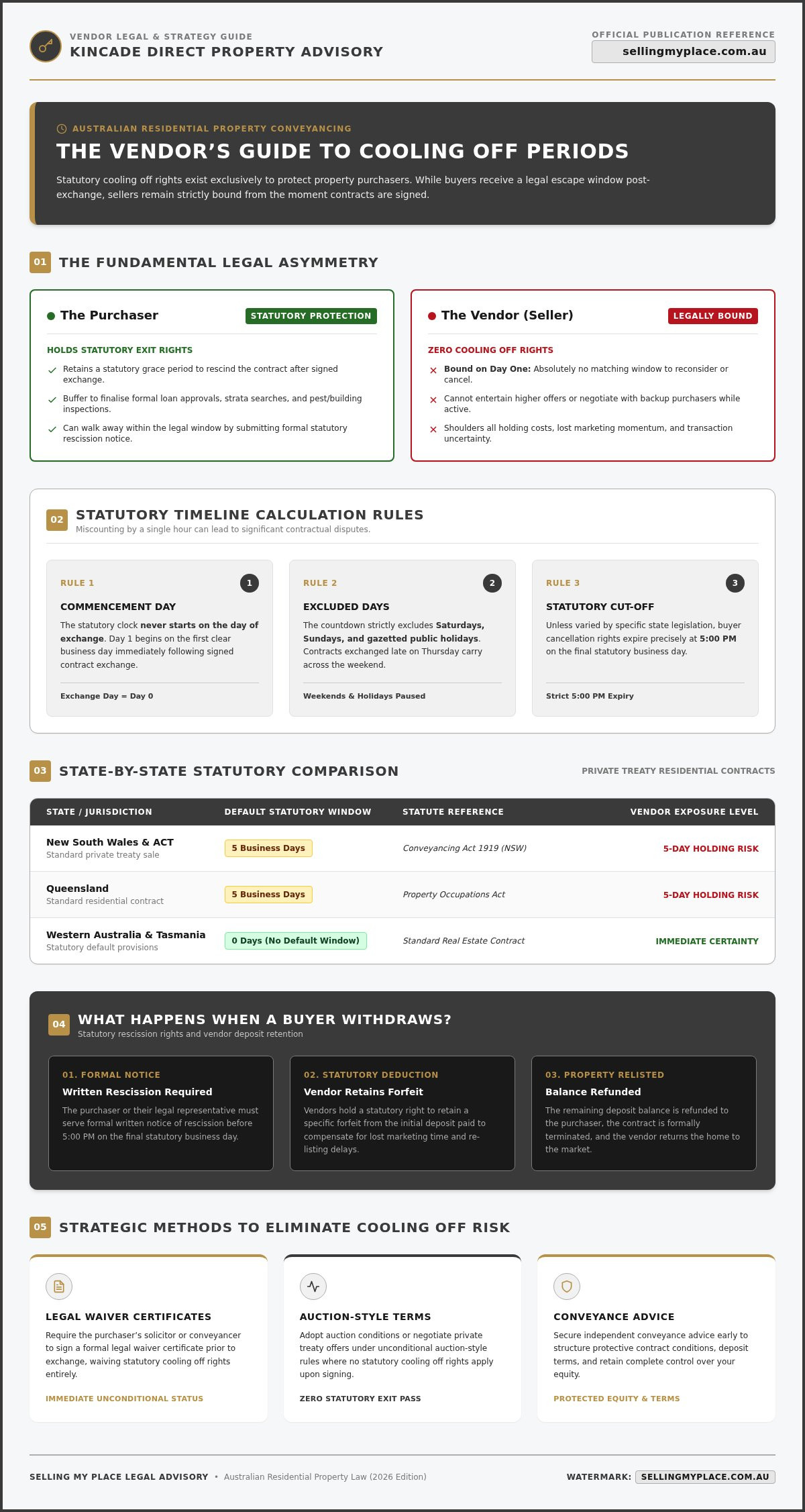
A cooling off period in Australian residential property transactions provides buyers a statutory grace period to withdraw, whereas sellers are legally bound upon contract exchange. When you sign a contract of sale as an owner, you commit entirely to the transaction; you do not receive a matching window to change your mind, reconsider an offer, or entertain a higher bid from another party. True mastery of the sales process begins with understanding the cooling off period when selling from the vendor’s perspective, replacing false assumptions of contractual security with proactive risk management.
Rooted in broader principles of consumer protection, such as the statutory safeguards outlined under a Cooling-off period (consumer rights) framework, this legislative mechanism intentionally balances power between commercial parties and private individuals. However, in private treaty property transactions, that balance tips heavily in the purchaser’s favour. The buyer retains an escape hatch. You, as the vendor, shoulder the ongoing holding costs, lost marketing momentum, and emotional uncertainty until that statutory window shuts.
Why Cooling Off Rights Exist Exclusively for Buyers
State governments instituted statutory cooling off protections to curb aggressive high-pressure sales tactics and prevent rash financial decisions during emotionally charged negotiations. The reprieve offers purchasers crucial breathing space to finalise formal loan approvals, review title covenants, or coordinate pest and building inspections without losing the property to a competing applicant. Vendors, by contrast, operate under no such sudden time pressure. Sellers typically spend weeks preparing documentation, setting reserve prices, and weighing market conditions, which is why Australian law provides no statutory right for vendors to reconsider once contracts are exchanged.
How Business Days and Commencing Hours Are Calculated
Calculating the exact expiration of a cooling off window requires strict attention to the calendar. Miscounting by a single hour can lead to significant disputes over contract validity. While specific statutory timeframes differ between states, the calculation rules follow consistent legal principles across the country:
- Commencement day: The statutory clock never starts on the day of exchange. Day one begins on the first business day immediately following signed contract exchange.
- Excluded days: The countdown excludes Saturdays, Sundays, and gazetted public holidays. A contract signed late on a Thursday afternoon frequently carries over the weekend into the following week.
- Statutory expiry time: Unless varied by specific state legislation, rights expire precisely at 5:00 PM on the final statutory business day.
Gaining clarity on these precise cut-offs ensures you know the exact minute your contract becomes unconditional, allowing you to plan your next transition with genuine confidence.
Cooling Off Periods Across Australia: State-by-State Rules and Penalties
State property acts establish differing statutory cooling off durations, ranging from zero days in Western Australia and Tasmania to five business days in New South Wales and Queensland. Because property law remains state-based rather than national, a private treaty offer structured in one jurisdiction carries fundamentally different default legal obligations than one signed across state borders. Truly understanding the cooling off period when selling requires knowing the precise statutory duration and financial deduction rules applicable to your property’s location.
Comparative Overview of Durations and Financial Forfeitures
If a buyer exercises their statutory right of withdrawal, legislation dictates whether they forfeit a financial sum to compensate you for lost market time. Here is how state statutes handle durations and statutory retention penalties:
- New South Wales and Australian Capital Territory: Provide 5 business days under the Conveyancing Act 1919 (NSW). For contracts exchanged on or after 1 June 2026, NSW requires an updated mandatory cooling off notice. In both jurisdictions, a withdrawing purchaser forfeits 0.25% of the total purchase price from their deposit. For off-the-plan contracts in NSW, this statutory window extends to 10 business days.
- Queensland: Operates under a 5 business day statutory window via the Property Occupations Act 2014 (Qld), with an identical 0.25% purchase price retention penalty.
- Victoria: Under Victoria’s private sale cooling-off rights within the Sale of Land Act 1962 (Vic), purchasers receive 3 clear business days. The statutory forfeit is the greater of $100 or 0.2% of the purchase price.
- South Australia and Northern Territory: South Australia provides 2 clear business days under the Land and Business (Sale and Conveyancing) Act 1994 (SA), requiring any deposit paid above $100 to be refunded. The Northern Territory provides 4 business days under the Law of Property Act 2000 (NT), refunding the full deposit without statutory penalty.
- Western Australia and Tasmania: Neither jurisdiction enforces an automatic statutory cooling off period for residential private treaty contracts. Any cancellation window exists only if negotiated as a special condition.
Exemptions Where No Cooling Off Period Applies
Statutory cancellation periods do not govern every transaction. Across all Australian jurisdictions, residential properties sold under the hammer at a public auction carry zero statutory cooling off rights. In Victoria, this exemption also extends to contracts signed within three clear business days before or after a scheduled public auction. Contracts signed on the day of an auction in NSW are similarly exempt, as are commercial assets, industrial developments, and rural holdings exceeding designated statutory hectarage.
Aligning these legal mechanisms with professional campaign execution ensures you maintain momentum while keeping full legal clarity. Vendors should cross-reference our guide on Professional Residential Property Listing Services to structure contracts properly from the start. If you want strategic oversight tailored to your jurisdiction before accepting private treaty offers, consider reaching out for professional real estate advisory guidance to protect your sale timeline.
What Happens When a Buyer Withdraws During the Cooling Off Window?
Having a buyer pull out of an exchanged contract can feel like a sudden gut punch. You have popped the champagne, begun visualising your upcoming move, and mentally banked the proceeds, only to have the transaction grind to a halt. When an agreement unravels, understanding the cooling off period when selling equips you to handle the legal aftermath calmly, retain your rightful statutory compensation, and relaunch your campaign without missing a beat.
The Legal Mechanics of a Contract Rescission
Walking away from a binding property contract requires rigorous procedural compliance. A purchaser cannot simply change their mind over a phone call or fire off a casual text message to announce their departure. For a rescission to hold legal validity across Australian jurisdictions, precise requirements must be met:
- Written instrument: The buyer or their legal representative must draft and sign a formal notice of rescission.
- Timely service: The notice must be served to the vendor, their nominated conveyance professional, or their licensed representative before the statutory clock runs out.
- Strict deadlines: If the statutory deadline passes by even a single minute without formal delivery, the contract converts automatically into an unconditional agreement.
Managing Deposit Funds and Retained Compensation
Once a valid notice arrives, the contract dissolves. The stakeholder holding the deposit (typically a conveyancer or trust account holder) calculates the statutory deduction applicable to your jurisdiction. If your property is in New South Wales or Queensland, the 0.25% termination fee is deducted directly from the initial holding deposit and transferred directly to you. In Victoria, the retained forfeit is the greater of $100 or 0.2% of the agreed purchase price. The stakeholder promptly refunds the remaining balance to the purchaser. While this statutory forfeit rarely replaces the emotional energy invested, it serves as direct compensation to offset your holding costs and immediate administrative delays.
Re-entering the Market Swiftly Without Losing Value
A cancelled contract does not mean your property is damaged goods. Momentum is everything in residential real estate, so your digital listings across national portals must immediately return to active status. Reach out straight away to runner-up buyers who submitted strong expressions of interest during initial opens; an experienced vendor knows how to leverage previous competition to reignite active bids. Frame the return simply as an administrative collapse tied to buyer circumstances rather than any fault of the home itself. Vendors managing their own journey should tap into established property sale negotiation tips to transform this temporary hiccup into a firm, unconditional offer from a better-qualified purchaser.
Strategic Methods for Sellers to Minimise or Eliminate Cooling Off Risks
You do not have to accept conditional vulnerability as an unavoidable part of selling your home. While statutes give buyers the right to a cooling off window, sophisticated vendors regularly negotiate contracts that neutralise or bypass these statutory delays altogether. Truly understanding the cooling off period when selling means treating contract conditions as active bargaining chips rather than passive formalities. By combining strategic negotiation with proven sale by owner principles, you retain total command over your transaction timeline.
Utilising Legal Waiver Certificates (Section 66W Equivalents)
The most absolute method to lock in a private treaty sale is requiring an unconditional legal waiver. In New South Wales, this is enacted via a Section 66W certificate, signed by the purchaser’s independent solicitor or conveyancer. Similar waiver instruments operate in Queensland and other jurisdictions. This document certifies that an independent legal practitioner explained the contract implications to the buyer and that they deliberately relinquish their cooling off rights. In competitive multi-offer situations, demanding an executed waiver certificate alongside the signed contract immediately separates uncommitted lookers from serious, qualified purchasers.
Rigorous Buyer Pre-Qualification Before Contract Signing
Unconditional certainty begins long before exchange papers hit the table. Screening prospective purchasers during initial discussions weed out buyers who intend to use statutory windows as casual thinking time. You can protect your momentum with three targeted requirements:
- Unconditional pre-approval: Ask to see formal, written finance documentation rather than vague, verbal pre-qualification claims.
- Substantial initial deposit: Insist on a meaningful holding deposit upon signing rather than a token sum; purchasers with substantial capital committed rarely walk away.
- Upfront due diligence: Encourage buyers to complete pest, building, and strata inspections prior to signing, eliminating standard rescission excuses.
Structuring Unconditional Contract Terms with Advisory Support
Partnering with seasoned property advisors ensures your contract is engineered for vendor protection from the outset. Rather than settling for open-ended finance clauses that drag on for weeks, specialized conveyance advice allows you to insert strict sunset clauses, tight five-day turnaround windows, and mandatory deposit forfeiture clauses. Ready to lock in a rock-solid sale while retaining your full equity? Speak with our property advisors to establish the right protective terms before you accept your next offer.
Maximising Sale Certainty and Profit: The Commission-Free Advisory Advantage
Traditional commission incentives often reward transaction speed over transaction security. A conventional agent, eager to bank a commission, may urge you to accept a conditional private treaty offer quickly, brushing aside the genuine risks of a cooling off cancellation. True mastery and understanding the cooling off period when selling means partnering with advisors whose goals mirror your own: achieving an unconditional contract with minimal friction. Accurate pricing plays a crucial role in preventing buyer second thoughts during this vulnerable window; consult our guide on how to determine market value of a home in australia to ensure your reserve aligns perfectly with buyer expectations.
Why Traditional Commission Models Increase Seller Vulnerability
Percentage-based commissions create an inherent conflict of interest. Agents are often motivated to slap an "under contract" banner on a listing as rapidly as possible, nudging owners into accepting conditional offers without adequate purchaser screening. When a buyer rescinds during the statutory window, the vendor carries the full burden of lost marketing momentum and emotional fatigue. By contrast, a flat-fee advisory model removes sales commission pressure entirely. The focus remains squarely on vetting genuine buyers, demanding strong contract terms, and protecting your equity.
Professional Support Without the Percentage Cut
Securing an unconditional sale does not require sacrificing your equity. Through an Agent Advisory Service, vendors access dedicated pre-sale property consulting, strategic buyer vetting, and professional conveyance advice tailored to Australian property acts. Sellers save an average of $20,000 in traditional real estate commissions while maintaining total command over their listing campaign. Retaining your full proceeds gives you the financial breathing room to negotiate firmly, rather than accepting weak conditional terms out of anxiety.
Next Steps to Secure Your Property Sale Confidently
Building transaction certainty begins well before your first open home. Work alongside experienced legal professionals to draft a comprehensive disclosure pack upfront, address potential building quirks early, and establish strict timeframes that discourage speculative offers. A thorough understanding the cooling off period when selling transforms what many consider an anxious waiting game into a well-managed legal milestone. Ready to take control of your sale and protect your net profit? Connect with the team at Kincade International Direct Sales to structure a confident, commission-free campaign.
Taking Charge of Your Property Sale and Future Equity
A successful property transition shouldn’t leave you sitting on edge, second-guessing whether a buyer will follow through. Thoroughly understanding the cooling off period when selling gives you the strategic upper hand, whether you negotiate upfront legal waiver certificates, establish strict contract timeframes, or retain statutory deposits should an uncommitted purchaser pull out.
You deserve professional support that safeguards your hard-earned wealth without cutting into your proceeds. With our dedicated Agent Advisory Service, you receive tailored pre-sale consulting and conveyance guidance backed by a listed until sold infrastructure across Australia with zero time restrictions. By eliminating traditional percentage models, sellers save an average of $20,000 in agency commissions while keeping full command of every negotiation.
Ready to achieve complete contract certainty? Take control of your sale and protect your equity with Selling My Place, and move forward into your next chapter with genuine peace of mind.
Frequently Asked Questions
Can a seller cancel a contract during the cooling off period in Australia?
No, sellers cannot cancel a contract during the cooling off period. In Australian residential property law, statutory cooling off rights protect purchasers exclusively. The moment you sign and exchange contracts, you are legally committed to completing the transaction under the agreed conditions. That is why understanding the cooling off period when selling is so vital; vendors hold no corresponding legal right to reconsider or entertain better offers once exchange occurs.
How much money does a buyer lose if they exercise their cooling off rights?
The financial forfeiture depends entirely on the state or territory governing the transaction. In New South Wales, Queensland, and the Australian Capital Territory, withdrawing buyers forfeit 0.25% of the total purchase price from their initial deposit. In Victoria, the penalty is the greater of $100 or 0.2% of the price. In South Australia, any deposit over $100 is refunded, while the Northern Territory enforces no statutory financial penalty.
Do cooling off periods apply when purchasing property at an Australian auction?
No, cooling off periods never apply to residential properties bought under auction conditions anywhere in Australia. When the hammer falls, the winning bidder must immediately sign the contract and pay the agreed deposit, creating an unconditional, legally binding agreement on the spot. In certain jurisdictions, this complete exemption also covers contracts exchanged within designated business days immediately preceding or following an advertised public auction.
What is the exact legal purpose of a Section 66W certificate?
A Section 66W certificate, commonly used under New South Wales conveyancing legislation and mirrored in other jurisdictions, legally waives a purchaser’s statutory cooling off entitlements. The certificate must be signed by the buyer’s independent solicitor or conveyancer, confirming they explained the legal effect of waiving these rights. For vendors, securing this executed certificate alongside an exchanged contract immediately locks in an unconditional, non-refundable sale.
How do public holidays and weekends impact statutory cooling off timeframes?
Public holidays and weekends pause the statutory countdown entirely across all Australian jurisdictions. The cooling off clock only ticks forward on official business days, starting from the first business day following contract exchange. If you exchange contracts on a Friday afternoon, Saturday and Sunday do not count toward the statutory tally. Similarly, gazetted public holidays extend the expiry deadline until precisely 5:00 PM on the final business day.
Is a subject to finance clause identical to a statutory cooling off period?
No, a subject to finance clause is fundamentally different from a statutory cooling off window. Cooling off is an unconditional statutory right enabling purchasers to walk away for any personal or financial reason by paying a nominal forfeit. Conversely, a finance clause is a negotiated contract condition. If a buyer’s lender formally rejects their application, the buyer can terminate the contract and receive a full deposit refund without statutory penalty deductions.
Can vendors legally refuse to grant a cooling off period to a buyer?
Vendors cannot unilaterally strip away statutory rights, but you can legally insist on unconditional terms before accepting an offer. Through strategic negotiation and professional conveyance advice, you can require purchasers to provide a formal legal waiver certificate, like a Section 66W, at exchange. When understanding the cooling off period when selling, establishing unconditional expectations upfront prevents uncommitted buyers from tying up your home under conditional statutory terms.
