
Laying your property’s imperfections bare on paper might feel counterintuitive when preparing to sell, but thorough pre-sale disclosure is actually your ultimate legal shield. Many homeowners worry that revealing an unapproved patio, historical pest damage, or registered drainage easements will derail an offer or diminish their return. In reality, fulfilling your seller’s disclosure obligations Australia wide ensures that once a deal is struck, it stays struck; protecting your equity against costly contract rescissions, delayed settlements, or protracted post-sale litigation.
We know that selling a home is as deeply personal as it is financial, and sorting through shifting statutory paperwork shouldn’t keep you awake at night. This 2026 guide clarifies your exact legal responsibilities, untangling mandatory reporting declarations from what traditional “buyer beware” principles still cover so you can negotiate with genuine confidence.
Ahead, we explore what constitutes a material defect across Australian jurisdictions, outline an essential pre-sale paperwork checklist, and show you how proactive transparency keeps you firmly in control of your successful property transition.
Key Takeaways
- Mastering seller’s disclosure obligations Australia wide protects your equity and prevents buyers from walking away before settlement.
- Distinguish between latent defects of title and visible property faults so you know exactly which council approvals, covenants, or notices require formal reporting.
- Understand the limits of caveat emptor and learn why upfront statutory compliance removes the threat of contract termination.
- Use our structured pre-sale audit checklist to compile your title searches, building permits, and planning certificates before welcoming your first buyer.
- Pairing independent pre-sale consulting with sound conveyance advice ensures total legal peace of mind while keeping your hard-earned sale proceeds intact.
Understanding Seller’s Disclosure Obligations in Australia: What the Law Demands
At its core, a seller’s disclosure obligation is a statutory legal duty requiring property owners to reveal specific defects, encumbrances, and regulatory restrictions to prospective purchasers before signing a binding contract. While selling a home marks a major lifestyle transition, the legal mechanics demand clear-headed precision. These statutory duties protect buyers from hidden legal impediments, ensuring fair dealing while creating an unassailable legal safeguard around the vendor’s hard-earned proceeds.
Historically, property transactions relied on the common law principle of caveat emptor, or “let the buyer beware”. Under that traditional doctrine, the burden rested almost entirely on the purchaser to uncover property faults. Today, comprehensive Vendor disclosure laws in Australia have shifted that balance. Modern legislation requires sellers to prepare formal disclosure documentation, such as a vendor statement or prescribed disclosure pack, alongside the standard contract. Meeting your seller’s disclosure obligations Australia wide does not compromise your bargaining position; upfront honesty builds genuine buyer trust and insulates you against costly post-contract disputes.
The Shift from Caveat Emptor to Mandatory Vendor Warranties
Prospective purchasers still carry a responsibility to conduct practical building and pest inspections, but they are no longer left entirely to their own devices. Contemporary property legislation holds vendors accountable for latent defects of title, unapproved structural alterations, and non-compliant building works. Under Australian legal standards, deliberate silence is treated just as seriously as active misrepresentation. Choosing not to disclose a known statutory notice or planning defect can unravel an agreement just as quickly as stating an outright falsehood.
Key Statutory Instruments Governing Australian Property Sales
Across the nation, property disclosure is governed by specific legislative instruments, from formal Section 32 statements to newly established pre-contract disclosure schemes. Beyond state property legislation, the Australian Consumer Law provides an overarching framework that penalises misleading or deceptive conduct during property negotiations. Standard contracts of sale routinely feature non-negotiable statutory warranties. Engaging pre-sale property consulting alongside professional conveyance advice ensures your documentation complies with the law before you welcome your very first buyer.
What Must You Legally Disclose? The Core Property Defect Categories
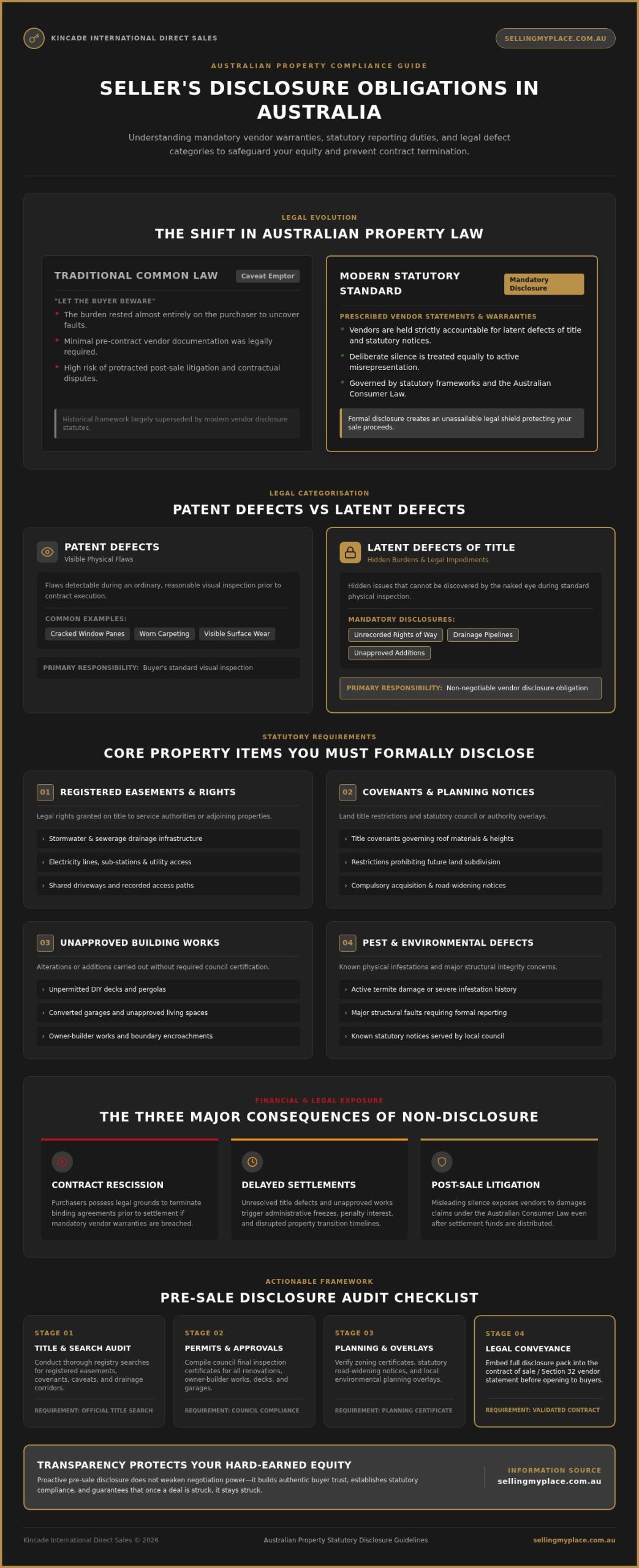
Untangling your legal responsibilities begins by distinguishing between two fundamental concepts: patent defects and latent defects. Patent defects are visible physical flaws, such as cracked window panes or worn carpets, which a buyer is expected to discover during an ordinary visual inspection. In contrast, latent defects are hidden issues that cannot be spotted by the naked eye. While latent physical faults generally fall on the buyer’s private building inspectors, latent defects of title, such as unrecorded rights of way or drainage pipelines, trigger non-negotiable seller’s disclosure obligations Australia wide.
Title Encumbrances, Easements, and Planning Restrictions
Every prospective buyer has the legal right to receive clear title to your land, free of unexpected burdens. You must formally disclose:
- Registered easements: Rights granted to service providers for stormwater drains, electricity lines, or shared access paths.
- Restrictive covenants: Legal agreements on title specifying roof materials, building heights, or restrictions preventing future subdivision.
- Planning notifications: Official zoning overlays, road-widening proposals, or compulsory acquisition notices issued by local councils or road authorities.
Structural Defects, Unapproved Works, and Pest Infestations
That DIY deck or converted garage might feel like a highlight, but missing council approvals pose substantial transaction risks. Australian courts expect vendors to disclose unpermitted additions, boundary encroachments, and owner-builder works. Similarly, active termite damage or structural subsiding must not be disguised or obscured behind fresh coats of paint. Investing early in professional Pre-Sale Property Consulting allows you to audit these vulnerabilities before listing, giving you clarity on what requires rectification or formal notice.
Environmental Hazards, Flooding Overlays, and Health Risks
Australian disclosure regulations increasingly demand proactive clarity regarding environmental exposures. If your property is situated within a declared flood inundation zone or bushfire hazard overlay, statutory documentation must accurately reflect this status. Sellers are also obligated to report known loose-fill asbestos insulation or historical chemical contamination. While the industry closely studies statutory agent’s disclosure obligations around sensitive matters such as serious crime history, private sellers must also ensure no material fact is suppressed. When you want complete peace of mind about what requires declaration, reach out for specialist conveyance guidance to protect your hard-earned sale proceeds from day one.
Caveat Emptor vs Statutory Disclosure: What Happens If You Fail to Disclose?
Failing to understand the boundary between traditional buyer diligence and mandatory legal transparency can prove devastating to your sale. While purchasers are expected to inspect physical qualities, statutory legislation strictly penalises sellers who conceal legal encumbrances, unapproved additions, or statutory notices. Overlooking these items strips away your transaction security.
| Area of Responsibility | Buyer Due Diligence (Caveat Emptor) | Mandatory Seller Disclosure |
|---|---|---|
| Physical Condition | Arranging independent building and pest reports for general wear, leaks, or age. | Declaring known structural orders, illegal building works, or concealed hazards. |
| Title & Boundaries | Surveying fence alignments and checking neighbourhood amenity. | Providing clear title searches, registered easements, covenants, and leases. |
| Statutory Compliance | Verifying future zoning suitability for personal plans. | Attaching council planning certificates, pool compliance, and safety switch status. |
Contract Rescission: The Immediate Danger Before Settlement
The most immediate hazard of breaching your seller’s disclosure obligations Australia wide is contract rescission. When statutory disclosure documents contain omissions or inaccurate statements, buyers frequently hold the legal right to terminate the contract at any time before settlement. The buyer receives their entire deposit back, often with interest. You are left with collapsed moving plans, lost conveyancing outlays, and a re-listing process that damages buyer perception and weakens negotiation leverage.
Post-Settlement Damages and Misleading Conduct Claims
Even if an oversight goes unnoticed before settlement day, liability does not necessarily end at the handover of keys. Buyers discovering concealed defects post-settlement can sue for significant financial compensation or damages under consumer protection laws. State tribunals and fair trading bodies take misleading conduct claims seriously, particularly regarding unapproved structural extensions or deliberate concealment of notices. Securing specialised Conveyance Advice early ensures every declaration is completely compliant, fully shielding your family’s equity long after the settlement dust settles.
Step-by-Step Pre-Sale Disclosure Preparation: The Seller’s Audit Checklist
Preparing your legal paperwork before listing your property transforms uncertainty into calm confidence. Rather than scrambling when a prospective buyer requests the contract, working through a methodical audit checklist ensures you satisfy every aspect of your seller’s disclosure obligations Australia wide.
- Step 1: Order title searches. Confirm registered ownership, boundaries, plan numbers, and any registered easements or covenants affecting the title.
- Step 2: Collect council planning certificates. Gather official zoning documentation, building permits, and final inspection certificates for any structures built on the land.
- Step 3: Collate improvement records. Retrieve owner-builder permits, certificates of currency for home warranty insurance, and trade warranties for major additions.
- Step 4: Verify mandatory safety compliance. Test interconnected smoke alarms, ensure safety switches (RCDs) are fitted, and obtain current pool barrier certificates if applicable.
- Step 5: Draft the statutory disclosure statement. Work with your legal advisor to incorporate all mandatory certificates and disclosures into the draft contract.
Assembling Your Legal and Property Documentation Pack
A complete disclosure pack leaves no room for confusion. Request water authority diagrams showing sewer mains and drainage lines early, alongside relevant land tax clearance certificates. If your property is part of a community title or strata scheme, assemble current body corporate inspection records, capital works fund forecasts, and insurance policies. Presenting organized documentation right away signals integrity and reassures serious buyers.
Handling Known Property Imperfections with Transparent Disclosures
Draft neutral, factual summaries regarding past repairs, minor boundary discrepancies, or historical issues. Being transparent about known defects prevents buyers from weaponizing building inspection discoveries to slash their offers later. Pairing open disclosure with sound Market Valuation Principles grounds your price expectations and keeps negotiations running smoothly.
Working with Conveyancers and Legal Advisors Early
Engage a conveyancer or property solicitor before marketing photography commences. Your legal partner verifies that mandatory statutory annexures and special conditions protect your interests. Confident documentation strengthens your position during discussions; explore our guide to Sale Negotiation Strategies to see how solid contracts lead to clean deals. To ensure your paperwork is watertight before launching your campaign, contact our team for dedicated conveyance advice.
Safeguarding Your Sale: How Professional Advisory and Conveyancing Protect Your Equity
Selling your home independently doesn’t mean standing alone against legal complexities. Taking charge of your own sale gives you genuine clarity and direct oversight across every stage of the transaction. When you blend professional listing presentation with sound legal advisory, satisfying your seller’s disclosure obligations Australia wide becomes a smooth, orderly milestone rather than a source of stress.
The Power of Independent Selling Supported by Expert Advisory
A common myth suggests that selling without a traditional agent heightens your legal vulnerability. In reality, traditional commission agents aren’t legal practitioners; their focus is closing a deal, not conducting forensic documentation audits. Partnering with dedicated real estate advisory services equips you with steady, step-by-step guidance when handling buyer inquiries and presenting mandatory documentation. Bringing in Pre-Sale Property Consulting early pinpoints potential compliance red flags, such as missing permits or uncertified safety fixtures, well before a buyer’s building inspector sets foot on the property.
Retaining Full Equity Without Sacrificing Contract Security
Surrendering substantial portions of your home’s equity to traditional agency commissions isn’t required to achieve an airtight, premium transaction. Transparent flat-fee models empower homeowners to showcase their property across leading real estate channels while keeping 100% of their net sale profits. You gain top-tier photography, floorplans, and national buyer reach, all supported by the rigorous conveyance advice needed to ensure statutory compliance.
Proactive preparation eliminates the fear of contract rescission and positions you for calm, authoritative discussions with serious purchasers. When you’re ready to take control of your property journey and secure your equity, connect directly with Kincade International Direct Sales to finalise your legal paperwork and launch your market-ready campaign with complete peace of mind.
Selling with Total Confidence: Protect Your Equity from Day One
Preparing your property for the market is about honouring your home’s story while establishing a clean, legally secure transaction. Meeting your seller’s disclosure obligations Australia wide does not just keep your contract watertight; it establishes genuine buyer trust, prevents last-minute settlement hurdles, and keeps you in complete control from the first inspection through to key handover.
You don’t need to surrender your hard-earned equity to traditional agency commissions to achieve thorough legal protection. Our transparent flat-fee listing model keeps 100% of your sale profit right where it belongs. Supported by comprehensive pre-sale property consulting that pinpoints compliance risks early, our dedicated agent advisory service provides tailored conveyance advice nationwide.
Protect your hard-earned equity and ensure complete legal compliance by booking your Pre-Sale Property Advisory Consultation today. Take this exciting next step with absolute clarity, knowing your property sale rests on unshakeable ground.
Frequently Asked Questions
Can a buyer pull out of an Australian property contract if I fail to disclose an easement?
Yes, a buyer can generally terminate the contract before settlement if you fail to disclose a registered easement. Easements affect property usage and legal title, making them mandatory disclosure items. If undisclosed, buyers can exercise statutory rescission rights, retrieve their deposit in full, and potentially seek compensation for wasted legal expenses. Ensuring all title encumbrances are accurately annexed to your draft contract avoids this costly disruption.
What is the difference between a latent defect and a patent defect in property law?
Patent defects are readily noticeable physical flaws discoverable through ordinary visual inspection, such as cracked window panes or visible surface damage. Latent defects are hidden issues that cannot be identified through standard viewing, such as structural issues behind plaster, unapproved drainage, or buried encumbrances. While buyers inspect physical condition, fulfilling your seller’s disclosure obligations Australia wide requires transparent declaration of latent defects affecting title, safety, or legal compliance.
Do I need to disclose unapproved renovations or DIY building works when selling my home?
Yes, you must declare unapproved structural alterations, extensions, or unpermitted building additions to prospective purchasers. Local councils enforce strict compliance standards, and transferring a home with illegal modifications exposes the incoming buyer to formal rectification orders. Failing to declare these works can entitle buyers to terminate the agreement before settlement or sue for rectification costs. Conducting early pre-sale property consulting helps you identify and document these additions safely.
Is it mandatory to disclose past termite damage if the infestation has been fully treated?
While past pest activity that caused no structural harm rarely triggers statutory title disclosures, concealing known damage or misleading buyers is strictly unlawful. If historical activity caused structural deterioration or if a buyer asks direct questions about pest history, hiding that reality invites legal action for misrepresentation. Providing historical treatment certificates alongside an open seller declaration builds buyer confidence and eliminates the threat of protracted post-settlement disputes.
What happens if a property defect is discovered between contract exchange and settlement?
The outcome depends on whether the defect breaches a statutory vendor warranty or a specific contractual condition. If you failed to reveal a mandatory legal defect, such as an unapproved structure or statutory council notice, the buyer may have the lawful right to rescind the contract immediately. For minor physical damage occurring after exchange, the buyer cannot easily terminate but may negotiate an agreed repair or price adjustment prior to settlement.
Are seller disclosure obligations identical across every Australian state and territory?
No, statutory disclosure regimes vary substantially between jurisdictions. Some regions operate under strict pre-contract disclosure schemes requiring formal vendor disclosure packs, while others place greater emphasis on material facts or formal Section 32 statements. Despite these procedural differences across borders, navigating seller’s disclosure obligations Australia wide fundamentally requires proactive honesty. Engaging dedicated conveyance advice ensures your contract documents comply with the exact legislation governing your property’s sale.
Can I sell my property privately and still satisfy all legal disclosure requirements?
Absolutely, selling your home directly does not alter your statutory disclosure responsibilities or diminish your legal protections. Private sellers are bound by the same property legislation as traditional agents, but retain total control over the process. By combining commission-free listing platforms with professional real estate advisory services and conveyance advice, you ensure all mandatory searches, title certificates, and vendor declarations are completely compliant while saving your hard-earned equity.