
Selling a tenanted property in Australia is possible, and the sale doesn’t automatically end the tenancy. If the buyer purchases the home with the tenancy in place, they take over the existing agreement. That can affect which buyers are interested and when a new owner can move in.
A sale doesn’t necessarily mean tenants must leave, even if you want to hand over the home vacant. Lease terms and notice rules matter, and they vary between states and territories. For a periodic tenancy, the timing may depend on whether the sale contract requires vacant possession and where the property is located.
This guide explains how fixed-term and periodic leases affect a sale, what to expect with buyer inspections and marketing photos, and when a periodic tenancy can be ended after a sale contract. A clear plan for notice, access and handover can make the process more predictable for everyone.
Key Takeaways
- You can sell a property while it’s tenanted, but the tenancy doesn’t automatically end when ownership changes.
- A buyer who takes over an existing lease must honour its terms, which can affect when they can move in.
- Inspection notice, access and open-home rules vary between states and territories, so plan viewings around the rules that apply to the property.
- Marketing photos can involve specific notice and privacy requirements, particularly when a tenant’s belongings may appear.
- For a periodic tenancy, vacant possession depends on the sale contract and the relevant state or territory’s notice requirements.
Buyer inspections and open-home access
Buyer access can help market a tenanted home, but it must comply with the lease and state or territory rules. Notice periods, inspection times and the tenant’s right to be present all matter.
Access for buyer inspections
Buyer inspections are visits that let prospective buyers view a rental property before deciding whether to make an offer. An open home allows several buyers to attend at a set time, while private inspections are arranged individually.
A tenanted sale may appeal to buyers seeking an investment, while some owner-occupiers may prefer vacant possession. There’s no reliable universal percentage for the effect on sale price or buyer numbers: the lease, buyer demand and whether the home is offered with vacant possession all influence the outcome.
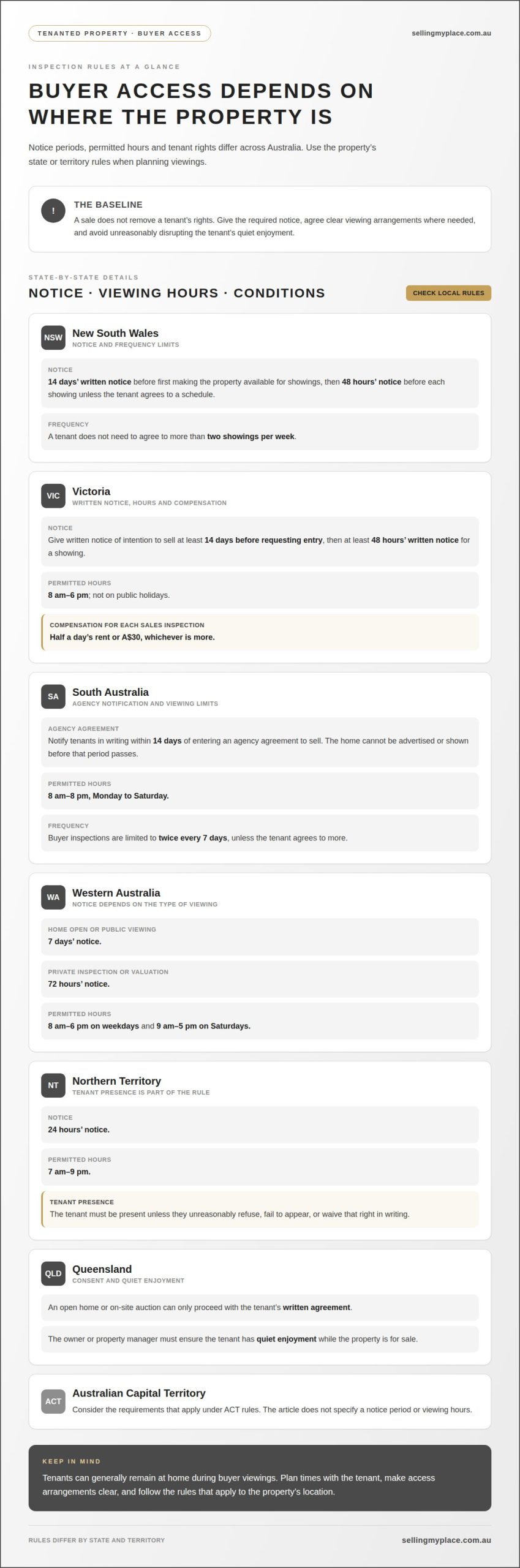
Plan viewing times with the tenant and make access arrangements clear. In NSW, a tenant doesn’t need to agree to more than two showings per week. A consistent schedule can reduce disruption while giving buyers an opportunity to assess the property.
Tenant quiet enjoyment
Quiet enjoyment means a tenant’s use of their home shouldn’t be unreasonably disrupted by sale-related visits. In Queensland, the owner or property manager must ensure the tenant has quiet enjoyment while the property is for sale.
In most Australian states and territories, tenants can remain at home during buyer viewings. In Queensland, an open home or on-site auction can only proceed with the tenant’s written agreement. Respecting these limits helps avoid conflict and protects the tenant’s rights.
Inspection hours and tenant presence
Permitted times differ by location. South Australian buyer inspections are between 8 am and 8 pm, Monday to Saturday. In Western Australia, sale-related access is limited to 8 am-6 pm on weekdays and 9 am-5 pm on Saturdays.
In Victoria, entry to show a property is allowed between 8 am and 6 pm, but not on public holidays. Northern Territory sale inspections must take place between 7 am and 9 pm, and tenants must be present unless they unreasonably refuse, fail to appear or waive that right in writing. These rules make scheduling and clear communication important.
Notice and tenant rights
Notice requirements depend on the state or territory. In NSW, the landlord or agent must give 14 days’ written notice before first making the property available for showings, then 48 hours’ notice before each showing unless the tenant agrees to a schedule. In Victoria, written notice of intention to sell must be given at least 14 days before requesting entry, followed by at least 48 hours’ written notice for a showing.
South Australian landlords must notify tenants in writing within 14 days of entering an agency agreement to sell, and cannot advertise or show the home before that period passes. Buyer inspections there are limited to twice every 7 days unless the tenant agrees to more. Western Australian landlords must give 7 days’ notice for a home open or public viewing, and 72 hours for a private inspection or valuation. Northern Territory landlords must give 24 hours’ notice. Queensland open homes require written tenant consent; ACT requirements should be considered under the rules applying there.
Victoria requires compensation for each sales inspection: half a day’s rent or A$30, whichever is more. Breaching access rules can lead to a tenant seeking an order to stop further entry; in NSW, they must apply to NCAT within 3 months of becoming aware of non-compliant entry.
Can you sell a property with tenants?
Yes. You can sell a residential property while tenants live there, but the sale doesn’t automatically end their agreement. Rules differ between states and territories, particularly for notice, fixed-term leases and vacant possession. The property’s location and lease type determine what owners and renters can do.
In Western Australia, a landlord may sell during a fixed-term or periodic tenancy. The lease continues unchanged until it ends, unless both parties agree otherwise. In the Northern Territory, the tenant’s right to live in the property continues after the sale and change of ownership. In Queensland, tenants on fixed-term agreements can’t be made to leave early simply because the home is sold.
New South Wales has specific notice periods for a proposed sale. A landlord must give at least 90 days’ notice to end a periodic tenancy or a fixed-term agreement longer than six months. For a fixed-term agreement of six months or less, the minimum is 60 days. These rules concern ending a tenancy for a proposed sale, not simply transferring ownership to a buyer.
Tenants may also have options to leave early. In NSW, a tenant who receives a landlord’s termination notice can give 14 days’ notice to leave early. If the landlord didn’t disclose the proposed sale before a fixed-term agreement began, the tenant can end it with 14 days’ notice without paying a break fee. In South Australia, a tenant not told of the sale intention may end the lease if a sale contract is signed within two months of the lease starting. A South Australian fixed-term tenant whose landlord ends the tenancy for a sales agency agreement may leave earlier with seven days’ notice.
Victoria also has sale-related notice rules. A renter who learns the landlord plans to sell can give at least 14 days’ written notice of their intention to leave. If the landlord wants vacant possession after selling, the landlord must give at least 90 days’ notice to vacate. The sale contract and the tenant’s agreement type both affect the timing.
Mortgagee repossession is a separate situation from an owner choosing to sell. In Queensland, a mortgagee seeking possession of a rental property must give the tenant at least two months to leave. For rooming accommodation, the minimum is 30 days. A mortgagee that consented to a tenancy can end a periodic agreement with two months’ notice, but can’t end a fixed-term agreement early unless the tenant agrees.
Before setting a vacant-possession date, match the contract timing to the tenancy rules in the property’s state or territory. If you’re weighing sale timing against the existing agreement, pre-sale property advice can help you plan the next steps.
Fixed-term leases and the buyer’s obligations
A fixed-term lease sets an agreed rental period, while a periodic agreement continues without a fixed end date. Both affect whether a buyer can take possession straight after settlement.
Fixed-term tenancy protections
A fixed-term tenancy protects the tenant’s right to occupy the rental home until the agreed end date, subject to the agreement and applicable rules. In the Northern Territory, a tenant can’t be forced to leave before the fixed term ends unless they breach the lease.
In Western Australia, the existing lease must also continue unchanged until it ends, unless both parties agree otherwise. Buyers need to factor in the tenant’s right to remain when considering possession. The sale itself isn’t a reason to end the agreement.
Fixed-term and periodic lease effects
A fixed-term agreement gives buyers a tenancy end date to factor into their plans; a periodic agreement has no fixed expiry date. In either case, the sale doesn’t cancel the rental agreement. Options for vacant possession depend on local rules and the tenancy type.
For example, a buyer hoping to move into a property with a fixed-term tenant may need to wait until the lease ends. A buyer purchasing it as an investment may instead take over the tenancy. The sale contract should state whether the property is being sold with tenants or with vacant possession, so the settlement arrangements match the agreed terms.
Lease transfer to the buyer
Yes, the tenancy generally continues after the sale, and the new owner takes on the existing agreement. In Queensland, a tenancy agreement doesn’t automatically end when a rental property is sold; the buyer takes on the agreement when they become the owner.
In Western Australia, the buyer must honour the fixed-term lease’s rent, conditions and bond arrangement through to its end date. In New South Wales, a tenant’s agreement for more than three years remains binding on the new landlord if it’s registered with the Registrar General.
After settlement, clear written communication helps tenants understand who owns the property and how to pay rent. If the tenancy continues, provide the buyer’s name and address and instructions for future rent payments. In Queensland, the tenant must receive an attornment notice with the new owner’s details and information about where rent is payable.
These obligations help buyers plan around the occupancy date and tenants understand which agreement still applies. Keep the lease, bond information and any agreed changes with the sale documents. Photos and inspection arrangements relate to marketing access, not to changing the lease or granting earlier possession.
Tenant consent for property photography
Tenants don’t have one Australia-wide right to refuse every inspection or photograph. Access and photography rules vary by state and territory, and the purpose of the visit matters. Separate permission to enter from consent to photograph a tenant’s belongings.
In New South Wales, interior photos or videos for marketing may be taken only once, within one of the specified 28-day periods. The relevant period is before marketing begins or before the tenancy agreement ends. This limits repeated photography inside an occupied home, so plan the shoot rather than arranging multiple sessions.
South Australia requires a landlord to give 7 days’ notice before entering to take photographs or video intended for publication. If the tenant’s possessions will be photographed, the tenant must also receive 7 days’ notice and give written consent. For example, a camera frame that includes a tenant’s furniture or personal items brings that consent requirement into focus.
Victoria requires at least 7 days’ written notice before a landlord or agent enters to take advertising photos or videos. That notice also applies to entry for a property valuation. The notice concerns entry; it doesn’t remove the need to respect the tenant’s home and belongings while preparing marketing material.
In Western Australia, tenants don’t have to agree to photographs of their belongings when the property is advertised for sale. They can choose whether images capturing their possessions are taken. For a sale campaign, distinguish photographs of the property itself from images showing a tenant’s personal items.
Before the photographer arrives, set out the proposed date, entry arrangements and intended use of the images in writing. Where consent is required, obtain it before photographing possessions. A written record can clarify what the tenant has agreed to, such as which rooms may be photographed and whether personal items may appear. Keep this separate from any entry notice.
Tenants may challenge photography that breaches applicable residential tenancies rules. In NSW, a tenant must apply to the Tribunal within 3 months of a breach involving published photos to seek an order about the images or compensation for financial loss. That makes careful control of publication as important as arranging the photo session.
For inspections, tenants’ rights also depend on local entry rules. A tenant can’t treat every sale-related visit as automatically forbidden, but an owner or agent must follow the applicable notice and access requirements. In South Australia, consent is specifically required to photograph a tenant’s possessions. Clear notice, limited access and written agreement where required help avoid disputes during the campaign.
Ending a periodic tenancy after a sale contract
A signed sale contract doesn’t mean a periodic tenant must leave immediately. If the buyer requires vacant possession, the landlord must give the notice required in that state or territory. The notice period depends on local rules and the contract terms.
In New South Wales, the timing depends on the sale stage and reason for ending the tenancy. A landlord must give at least 90 days’ notice to end a periodic tenancy for a proposed sale. After the property has been sold, the landlord must give at least 30 days’ notice to end the tenancy. These are distinct situations, so the contract stage matters.
Victoria’s process also ties notice to the sale contract. A landlord who wants the renter to leave because the property has been sold as vacant must give at least 90 days’ notice to vacate. The landlord must give that notice within 14 days of signing the contract of sale, or when all contract conditions have been met. A renter who learns of the planned sale may also give at least 14 days’ written notice of intention to vacate.
South Australia requires at least 60 days’ written notice when a sale contract requires vacant possession of premises with a periodic tenancy. After receiving the notice, the tenant can choose to leave earlier by giving 7 days’ notice. This gives the tenant an earlier exit option, while the landlord still needs to plan around the required notice period.
In Western Australia, a landlord can give a periodic tenant 30 days’ written notice once a sale contract is in place and a settlement date has been set. In the Northern Territory, a periodic tenant must receive 42 days’ written notice to vacate when the landlord wants the property vacated for sale.
Queensland requires at least 2 months’ notice after the contract of sale is signed if the buyer wants vacant possession of a property with a periodic tenancy. The notice clock therefore starts after signing, not simply when the owner decides to sell. Aligning the notice date with settlement helps prevent a mismatch between the tenant’s move-out date and the buyer’s expected possession.
Before giving notice, compare the proposed vacate date with the signed contract, any conditions and the settlement date. Notice requirements differ across Australia, and a prospective buyer’s preference for an empty home doesn’t itself shorten the applicable period. In NSW, allow an extra 7 working days for delivery when a termination notice is posted.
Planning a sale around a periodic tenancy? Discuss your property sale plans and how timing may shape the campaign.
Kincade International Direct Sales: Residential Property Listing Services
Kincade International Direct Sales can help owners prepare and market a residential property while they plan around an existing tenancy. Its Residential Property Listing Services include professional photography, floorplans and neighbourhood market reports, giving sellers practical tools to present the home to prospective buyers.
If you’re weighing sale timing, tenant arrangements and how to reach buyers, Pre-Sale Property Consulting can help you consider the campaign alongside the lease. The listing service uses a flat-fee model with no agency commission, and properties remain listed until sold with no time limit.
Explore the packages or get started through Kincade International Direct Sales at sellingmyplace.com.au.
Set your next move in motion
When selling a tenanted property in Australia, prepare a clear decision brief before settling on a campaign. Note your preferred handover outcome, how flexible your timing is, and what prospective buyers need to know about the tenancy. This keeps sale decisions focused on your priorities.
Also consider what comes after the sale. If you’re planning another purchase, include that goal in your broader property plans so the transition feels connected rather than rushed. Kincade International Direct Sales offers Buyer Representation for people preparing to take that next step, alongside residential property listing packages.
You don’t need every detail resolved before choosing a package. Reviewing your priorities, tenancy arrangements and campaign needs can help you decide which steps to take first.
Contact Kincade International Direct Sales to discuss your property plans, and take the next step with clarity.
Frequently Asked Questions
Can you sell a tenanted property in Australia without ending the lease?
Yes. You can sell while the rental agreement remains in force; the buyer takes over the tenancy rather than receiving an automatically vacant home. This may suit an investor, while an owner-occupier may need to plan around the tenant’s occupancy. Before marketing, decide whether the sale contract will transfer the property with tenants or require vacant possession. Align settlement arrangements with the lease and any lawful termination process.
Can a landlord end a tenancy to sell, and what notice periods and grounds apply by state?
A sale alone doesn’t end a tenancy; the applicable termination ground and local notice rules matter. NSW requires 90 days for a proposed sale on periodic agreements or fixed terms over six months, and 60 days for fixed terms of six months or less; after sale, 30 days applies. Victoria requires 90 days for vacant possession. SA requires 60 days for periodic tenancies sold with vacant possession; WA requires 30 days once a sale contract and settlement date exist. NT requires 42 days; Queensland requires two months after contract signing. ACT rules are territory-specific.
What steps should landlords take to sell a tenanted property in Australia?
Start by reviewing the signed agreement, including its type, terms and end date. Decide whether you’re selling with the tenancy continuing or seeking vacant possession, then coordinate the contract and timing accordingly. Keep written records of tenant communications and agreed arrangements for access or photography. At handover, provide the new owner with relevant tenancy information. In Queensland, this includes an attornment notice with the new owner’s details and rent-payment instructions. Engage a qualified conveyancer or solicitor for legal matters.