You don’t have to use a real estate agent to sell a home in Australia. Private sale is an option, but it puts the marketing, negotiations and sale process in your hands. If you’re wondering how to convince your partner to sell without an agent, a clear comparison of the responsibilities and trade-offs is a better starting point than pressure.
It’s understandable to want to protect your home’s value while keeping the sale manageable. This guide compares selling privately with using an agent, explains what sellers handle themselves and shows how buyer competition can inform price decisions.
We’ll also cover what Australian sellers should weigh when choosing how to market a property and assess offers, so you and your partner can have a practical conversation about price and the approach that suits you both.
Key Takeaways
- You can sell a home privately in Australia; consider the legal, marketing and negotiation tasks you’ll take on before deciding.
- Assess a suggested asking price against recent comparable sales, market conditions and buyer feedback.
- Compare the responsibilities of private selling and agent support to find an approach that works for both you and your partner.
- Buyer competition and how buyers perceive value can influence the price a property achieves.
- Explore Kincade International Direct Sales’ residential listing services and pre-sale property consulting if you want support with a private sale.
1. Do I have to use an agent to sell my property?
No. You can sell your property in Australia without appointing a real estate agent. The trade-off is responsibility: in NSW, a private seller manages the legal, financial and marketing tasks. Before advertising in NSW, the seller must have a contract of sale prepared. That practical workload is worth discussing alongside any potential savings.
If you’re working out how to convince your partner to sell without an agent, start by asking what matters most to them: pricing guidance, help reaching buyers or less day-to-day work. Then compare those priorities with the tasks involved in a private sale. A calm conversation about responsibilities and evidence is more useful than treating the decision as a contest.
Treat an agent’s price advice as one input, not a figure you must accept. Ask for the expected sale price in writing, supported by information about the property and market conditions. Compare it with recent sales of similar properties. Online valuation tools can add context, but should complement, not replace, comparable sales evidence.
Price advice should also explain what may happen after the property is listed. Low enquiry or buyer feedback suggesting a lower price may prompt an agent to recommend a change. Ask what evidence supports the recommendation and how a revised price fits the agreed strategy. The seller decides whether to accept an offer.
Agree on a marketing strategy before choosing an agent or private sale. Property promotion can include online listings, open homes, letterbox drops and newspaper advertisements. Discuss which channels suit the property and likely buyers. Review the photographs and description to ensure they present the home’s selling points clearly.
Property preparation and advertising both affect the work and spending involved. List likely tasks, such as preparing rooms for photography, arranging professional images, preparing floorplans and choosing paid promotion. With a traditional agent, request a written breakdown of fees and advertising costs. For a private sale, decide who will coordinate each task and compare flat-fee options with the costs of managing everything yourself.
Public marketing can reach more potential buyers and create opportunities for competing interest. That matters when buyers see value and are willing to make offers. However, reach alone doesn’t establish a fair price: compare the response with similar sales, buyer feedback and the property’s condition. A shared plan gives both partners clear evidence to review.
Set expectations about next steps. If an agent recommends another marketing channel or believes the asking price is too high, consider the advice and ask for the strategy and evidence behind it.
2. Comparing selling with and without an agent
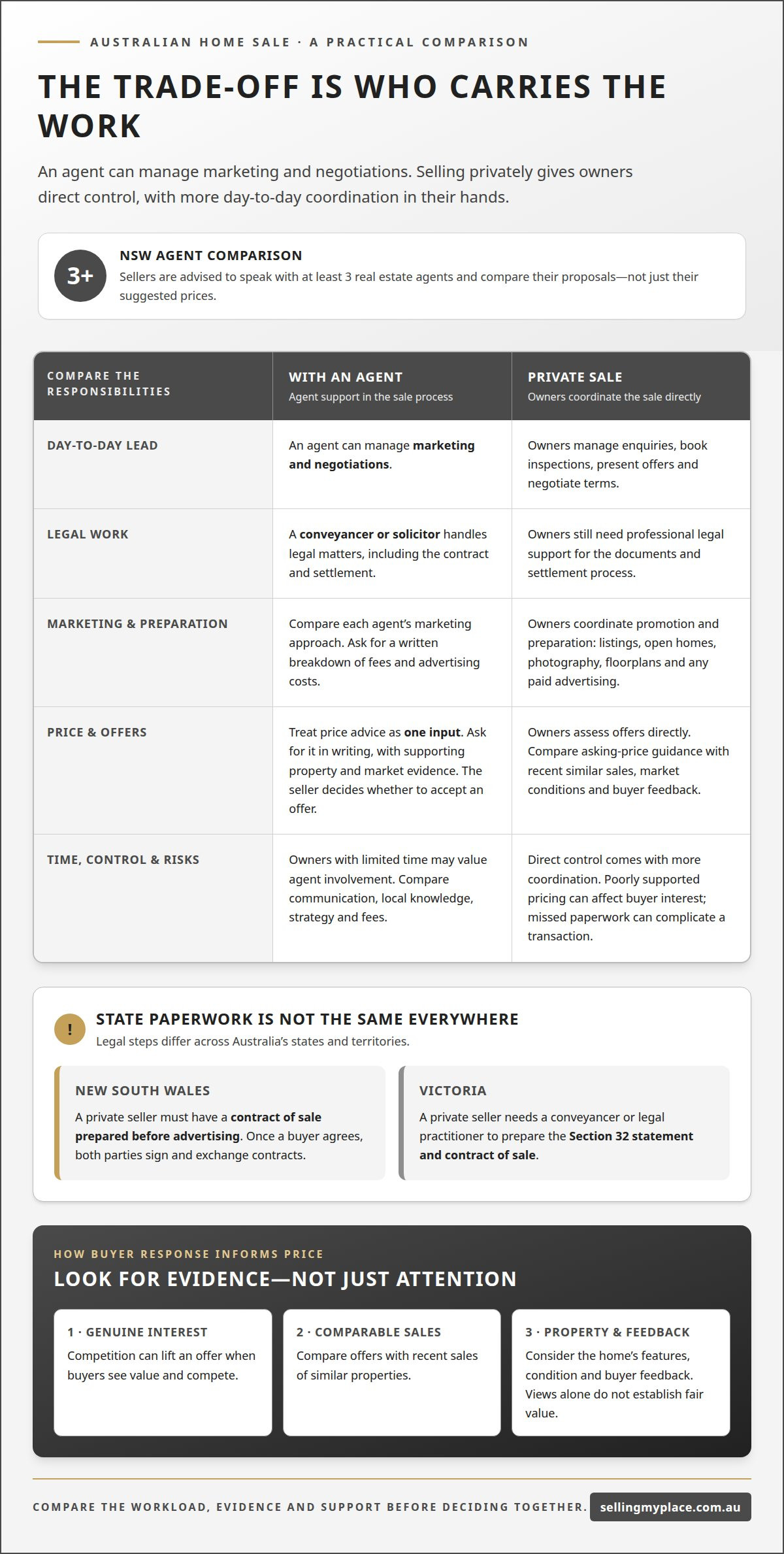
Compare the work involved, not just the commission. A real estate agent can manage marketing and negotiations, while a conveyancer or solicitor handles legal matters, including the contract and settlement. Private selling gives owners direct control, but the vendor must coordinate enquiries, inspections, offers and professional support.
Start with the reason for selling. If a move is tied to work, family or a settlement date, map sale tasks against those commitments. A vendor who can manage inspections and buyer calls may prefer a private sale; owners with limited time may value an agent’s involvement. Agree on what matters most: control, time, confidence in negotiations or the best practical outcome.
For an agent-led sale, compare proposals rather than choosing solely on the suggested price. In NSW, sellers are advised to speak with at least 3 real estate agents. Ask each to explain their marketing approach, local knowledge, communication and fees. These are examples, not a universal rate.
Private sale shifts daily coordination to the owners. Set a process for responding to enquiries, booking inspections, recording offers and negotiating terms. Keep a written record of buyer discussions, and use a conveyancer or solicitor for the contract and settlement. In Victoria, a seller using a private sale needs a conveyancer or legal practitioner to prepare the Section 32 statement and contract of sale.
Legal steps differ across Australia’s states and territories, so there isn’t one national checklist. In NSW, the seller needs a contract of sale prepared before advertising; once a buyer agrees, both parties sign and exchange contracts. Victorian vendors selling privately need the Section 32 statement and sale contract prepared by a conveyancer or legal practitioner.
Paperwork and disclosure duties depend on the property and jurisdiction. The Victorian Section 32 statement and contract are key examples; a conveyancer or solicitor can prepare and explain the documents relevant to the sale. Their costs depend on the property, transaction complexity and work required, with pricing provided after a quote request.
Private sellers handle enquiries by responding promptly, arranging inspections, presenting offers clearly and negotiating directly. That control also brings risks: a poorly supported asking price can affect buyer interest, missed paperwork can complicate a transaction, and in-person inspections require sensible arrangements for access and personal security. The question of how to convince your partner to sell without an agent is easier to discuss when you assign these tasks and compare them with agent support. For guidance on a sale-by-owner approach, discuss your property sale options.
3. Buyer competition and price discovery
A property’s price becomes clearer as buyers respond to its listing. Competition can push an offer above an agent’s appraisal range when buyers see value and compete. That depends on genuine interest, not simply the number of people who view the home. Compare offers with recent comparable sales and the property’s features before judging whether the price is fair.
Open homes and private inspections help buyers assess the property in person. A typical agent’s designated open-home time is 30 minutes per week, so ask how inspection arrangements suit the likely buyers and your household. A tidy, accessible home makes it easier for visitors to focus on its features. For private inspections, agree on appointment times and a consistent process for welcoming each buyer.
To attract competing buyers, coordinate the listing, photography, description and inspection schedule. Make the property’s strongest features easy to see, then give interested buyers a clear way to ask questions or submit an offer. Avoid creating urgency with claims that aren’t true. Accurate, respectful communication helps maintain good buyer relationships and keep genuine interest moving.
After each inspection, record buyer feedback by theme. Separate comments about price from observations about condition, layout or location. A repeated concern about the same repair may call for a practical response; one buyer’s preference may not represent the wider market. Ask for feedback as a specific figure rather than a broad range, then compare it with the asking price and evidence from similar sales.
Look at the pattern, not one reaction. If several buyers show interest but none makes an offer, review whether price, presentation or terms are causing hesitation. If buyers consistently identify a lower price point, consider whether recent comparable sales support that view. Any price adjustment should have a clear rationale, not simply respond to the loudest comment.
When offers arrive, assess more than the headline amount. Consider the conditions, timing and each buyer’s stated terms, then compare them with your priorities as sellers. A higher offer may not be the best fit if its conditions or timing don’t work. Keep a written record of offers and responses so you and your partner can discuss the same facts calmly and openly.
Price discovery is a process: present the home well, invite inspections, gather feedback and assess offers against market evidence. This helps distinguish genuine buyer competition from hopeful asking prices, giving both partners a grounded basis for deciding whether to negotiate, adjust the listing or wait for another buyer.
4. Australian use of agents in home sales
Australian home-selling figures can describe different things, so read them carefully. Less than one per cent of homes in Australia are sold without an agent. A separate estimate says typical agents represent about 90 per cent of agents. The first figure concerns sales; the second describes agents. They aren’t directly comparable, but they show why using an agent may feel familiar while private selling remains an option.
Rules vary by state. In NSW, an agent must have a written agency agreement with the seller before advertising or promoting the property. That agreement sets out the relationship and provides a practical point for reviewing the terms. Before signing, sellers should understand the proposed selling arrangement, marketing approach and fees.
Victoria has a specific requirement for price estimates in the sales authority. An agent’s estimated selling price must be recorded as a single price or a price range of up to 10 per cent. This gives sellers a written reference point for discussions about pricing. It also helps frame later conversations about buyer feedback and any proposed change.
Whichever approach you consider, assess an estate agent’s initial advice against evidence, not confidence alone. Ask how the suggested price relates to the home’s features and market conditions. Request the estimate in writing and clarify the marketing strategy, including how buyers will hear about the listing. During negotiations, the seller decides whether to accept an offer; the agent advises and communicates.
In NSW, sellers can check an agent’s current licence online or call 13 32 20. This is a straightforward step before entering an agency relationship. Ask about local knowledge, communication and the proposed promotion plan, then compare those answers with your priorities. A clear agreement about updates and buyer enquiries can make the working relationship easier to manage.
These details can help couples distinguish familiar practice from personal suitability. One partner may value an agent’s support with promotion and negotiation; the other may prefer direct control over buyer conversations. Compare the tasks involved in each option, then consider work schedules, inspection access and confidence handling offers. The right decision depends on which responsibilities you’re prepared to manage and what support matters most.
State requirements are a starting point, not a complete description of every sale. NSW’s written agency agreement rule and Victoria’s price-estimate requirement illustrate why sellers should understand their state’s process. Use those specifics to guide a practical discussion: what needs organising, who will handle each task and what evidence will inform the asking price?
5. What are the pros and cons of selling a home privately without a real estate agent in Australia?
A private sale gives owners direct control over the asking price, buyer conversations and inspection schedule. It can also avoid an agent’s commission, but advertising, photography and property preparation may still involve costs. Compare the expected savings with the time needed to coordinate each task. For example, decide who will answer enquiries during work and who can host inspections.
Pricing is one of the biggest responsibilities. Set an asking price using comparable sales, property condition and buyer response, rather than choosing a figure based on hope alone. An unrealistic price can reduce buyer interest; a price that’s too low may not reflect the home’s value. Record offers and feedback, then review the evidence together before changing the listing.
Private selling also means managing the process directly. Owners arrange advertising, respond to buyers, organise inspections, negotiate terms and keep sale paperwork moving. A shared task plan makes the workload visible: one partner might manage viewing appointments while the other records enquiries and offer details. If neither has time for these duties, agent support may be a better fit.
Legal preparation needs attention, too. Requirements differ across Australian states and territories, so sellers should arrange appropriate conveyancing or legal support for their property and location. In Victoria, a private seller needs a conveyancer or legal practitioner to prepare the Section 32 statement and contract of sale. Plan for professional assistance as part of the process, not as an afterthought.
Direct contact with buyers can help sellers understand their questions and negotiate personally. It also means managing access to the home and keeping communication organised. Set inspection arrangements that suit the household, keep valuables secure, and record each offer with its conditions and timing. These practical steps help keep a busy selling period organised and respectful of your privacy.
A private sale may suit owners who have time, confidence negotiating and a clear plan for marketing and paperwork. An agent may suit sellers who prefer help coordinating promotion and buyer discussions. Neither method guarantees the highest result. Compare the responsibilities with your work and family commitments and comfort with decision-making, then discuss which trade-offs feel manageable for both partners.
If you’re weighing a private sale against agent support, discuss your property sale options and the approach that fits your circumstances.
Treat that as an example, not an assumed saving: compare it with the costs and effort of managing the sale yourself. Without an agent, owners retain direct control but take on the coordination and decisions themselves.
Before choosing, agree on which responsibilities each partner can realistically take on and how you’ll keep decisions consistent. Consider who will manage buyer questions, inspections, offers and paperwork when other commitments compete for attention. A clear arrangement helps you judge whether direct control is worth the workload. If the plan depends on more time or confidence than either partner has, factor that into the comparison rather than relying on hoped-for savings alone.
Kincade International Direct Sales
Kincade International Direct Sales helps Australian homeowners consider a private sale with practical property marketing and advice. Its residential property listing services include professional photography, floorplans and neighbourhood market reports, helping owners prepare a listing and understand local conditions. Pre-sale property consulting can also help clarify your approach before you and your partner decide how to proceed.
The service uses a flat-fee model with 0% commission, and properties remain listed until sold, with no time limit. This may suit owners who want to sell privately while using structured marketing support. If you’re weighing that option against appointing an agent, discuss your circumstances and priorities with Kincade International Direct Sales.
Choose a path you can both stand behind
Make your next conversation about shared priorities, not winning the argument. Each partner can name what matters most, such as control over decisions, confidence in the asking price or time available for sale tasks. Then agree on the evidence you’ll use to assess your options and what would make you ready to proceed. If you’re discussing how to convince your partner to sell without an agent, start by listening to the concern behind their preference for an agent.
Kincade International Direct Sales offers residential property listings, buyer representation and pre-sale property consulting. These services can support different needs as you consider your next step, from preparing a sale to getting guidance around the process.
Contact Kincade International Direct Sales to talk through your property sale and the approach that may suit you both. A thoughtful decision, made together, is a strong place to begin.
Frequently Asked Questions
Do I have to use an agent to sell my property?
No. Australian homeowners can sell privately in every state and territory without appointing an agent. The sale still involves documents and legal steps, which differ by location. For example, NSW requires a contract of sale before a property is listed, while Victoria requires a Section 32 Vendor Statement before contracts are signed. A qualified conveyancer or solicitor can help with these legal requirements.
How much can Australian homeowners save by selling without an agent?
Treat the estimate as a comparison, not a promised saving for every property or sale. Traditional agent costs vary with the sale price and marketing campaign, so review the figures alongside the flat-fee option and the work involved in selling privately.
What are typical real estate agent commission rates and marketing fees in Australia?
These figures provide a comparison point; the cost of a traditional agent’s campaign depends on the agreed commission and marketing plan. Review both components separately, then compare them with a flat-fee option before deciding how to sell.