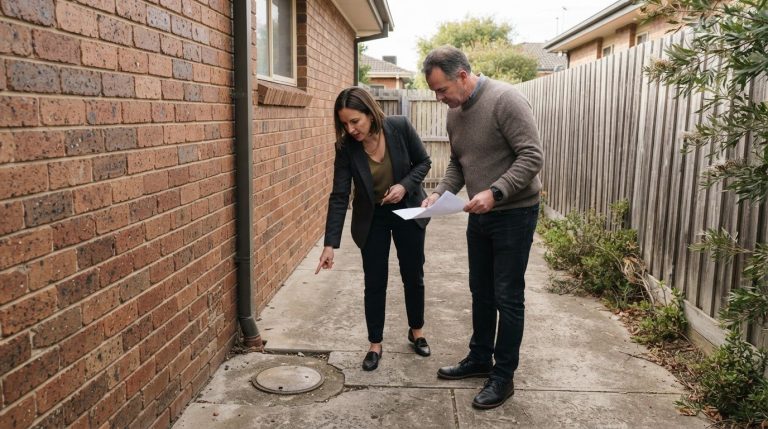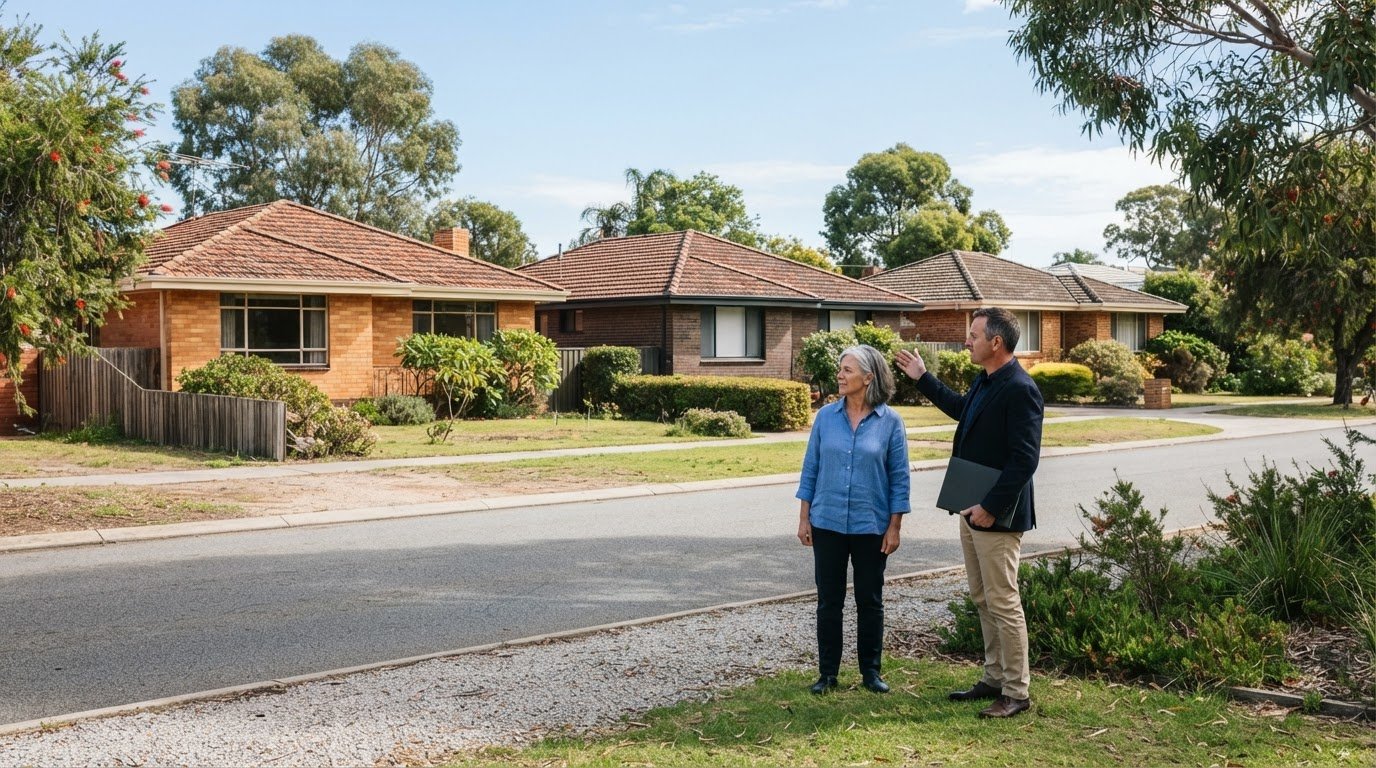
The right asking price isn’t a guess; it’s a reasoned estimate grounded in nearby sales and your home’s particular features. If you’re working out how to value your property for private sale, compare two or three real estate appraisals with similar properties sold within 1 km in the past six months. The closest matches help you judge what buyers may pay, while location trends and current market conditions add important context.
It’s understandable to want one clear figure, especially when an online estimate or suburb median seems to offer an easy answer. Treat these as reference points, not a final price: online estimates may miss your home’s condition, renovations, views or defects, while a suburb median covers a broad mix of properties.
This guide explains how comparable sales, property features, online estimates, median prices and market conditions work together to shape a sensible asking price. You’ll also learn why land size and condition matter, and how to weigh broad market figures against the details that make your property distinct.
Key Takeaways
- Use two or three appraisals alongside recent, nearby comparable sales to build a more grounded asking-price range.
- Treat online estimates as a starting point, since they can miss condition, renovations, views and property-specific issues.
- Use suburb median prices for broad market context, then weigh how your home differs from the typical property.
- Assess land size, condition and improvements carefully; renovations may influence value, but their impact depends on the property.
- Consider local demand, housing supply, interest rates and area changes when deciding whether market conditions support your price.
Comparable sales, property features and location trends
A practical asking price draws on recent sales, the property’s features and relevant local trends. An agent’s appraisal estimates a likely selling price; a formal property valuation typically involves an inspection and written report.
Comparing Recent Property Sales
A comparable sale is a nearby property sold recently that shares important features with the home being priced. Its sale price helps sellers assess what buyers have paid for a similar property and set an asking price supported by evidence.
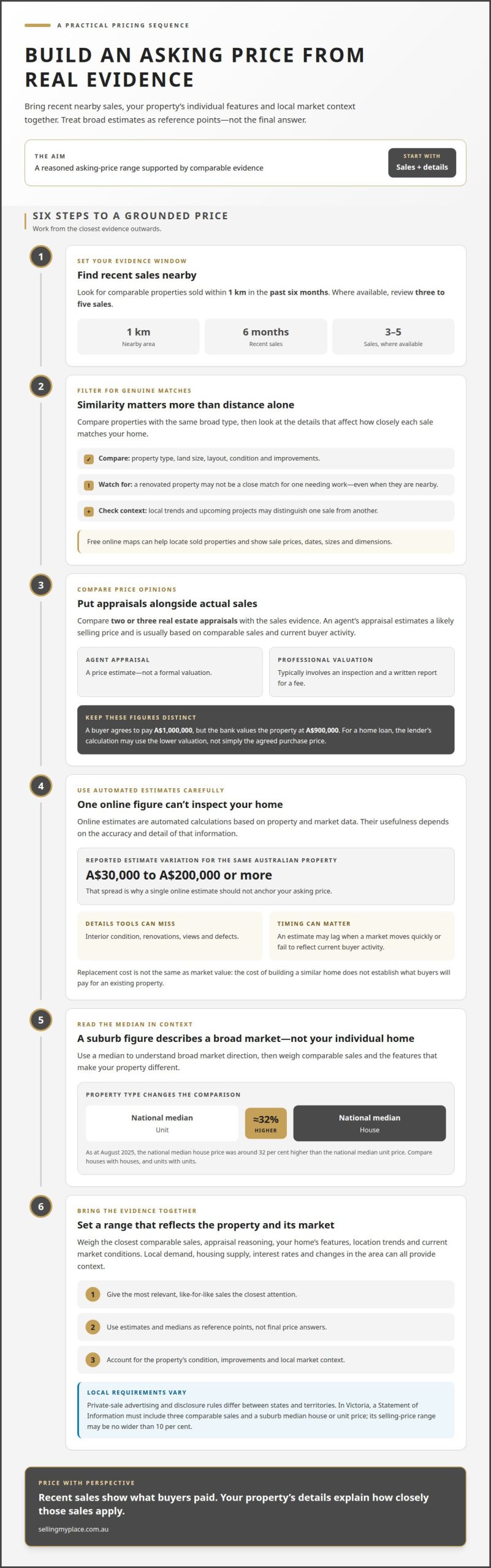
Look for comparable Australian properties within 1 km of the home, sold in the last six months. Where available, compare three to five sales. Similarity matters more than distance alone: consider property type, land size, layout, condition and improvements. A renovated home may not be a close match for one needing work, even if both are nearby.
Free online maps can help you locate sold properties and view their sale prices, dates, sizes and dimensions. Use these details to identify relevant examples, then consider whether local trends or upcoming projects distinguish one sale from another. Banks also consider comparable sales, property features and location trends when estimating value.
Keep houses and units in their own comparison groups. As at August 2025, Australia’s national median house price was around 32 per cent higher than the national median unit price. That broad difference reinforces the need to compare a house with houses, and a unit with units, rather than treating unlike properties as direct matches.
Appraisals, Valuations and Price Information
An agent’s appraisal is usually based on comparable sales and current buyer activity, but it is not a formal valuation. A professional valuation involves an inspection and a written report for a fee. Comparing two or three appraisals with actual sales evidence can help sellers understand the reasoning behind different price opinions.
State and territory requirements for private-sale price advertising and property disclosures vary. Sellers need to follow the rules applying to their jurisdiction and sale method; a requirement in one state should not be assumed to apply nationally. In Victoria, for example, a Statement of Information must include three comparable sales and a suburb median house or unit price. Its selling-price range may be no wider than 10 per cent.
Australian tools include free online maps with sold-property details and online property estimates. Maps help you locate sales evidence; estimates offer another reference point. Neither replaces consideration of the home’s features and local evidence. When an offer differs from your asking price, relevant sales and specific property differences can help you assess how well it reflects the available evidence.
Accuracy and limitations of online estimates
Online estimates offer a quick reference, but they can’t capture every detail that affects market value. Treat them as one input, then weigh the property’s condition, local evidence and bank valuation methods.
Limits of Online Estimates
An online estimate is an automated calculation based on property and market data, not an inspection. Its usefulness depends on the accuracy and detail of the information behind it. Estimates for the same Australian property can differ by A$30,000 to A$200,000 or more, so one figure shouldn’t anchor a seller’s asking price.
Automated tools can’t assess a home’s interior condition, renovations, views or defects. They may also lag when a market moves quickly, leaving an estimate behind current buyer activity. A broad estimate can differ from the eventual sale price if it doesn’t reflect local demand or the property’s individual features. That’s why an estimate needs context, not blind acceptance.
Replacement cost is another reference, but it isn’t the same as market value. The cost of building a similar home doesn’t establish what buyers will pay for an existing property. Land, location, condition and buyer demand all influence sale value. A fresh kitchen, for example, may improve appeal, but its cost alone doesn’t prove an equal increase in the home’s price.
Estimation Mistakes and Bank Valuations
Common estimating mistakes include relying on one online figure, overlooking property-specific details or treating replacement cost as a sale-price calculation. A sounder approach separates those inputs: use online tools as a broad guide, then consider comparable sales, the home’s features and current market conditions.
CommBank says banks use automated valuation models and recent market data to estimate a property’s value. For a home loan, a bank’s formal valuation may differ from a property price estimate because it assesses the property’s value, rather than just its market price. Banks may also arrange an in-person inspection by a professional valuer, particularly for home loan applications.
For example, a buyer agrees to pay A$1,000,000, but the bank values the property at A$900,000. The lender’s loan calculation may then use the lower valuation, not simply the agreed purchase price. Sellers should therefore distinguish a buyer’s offer from a lender’s assessment; each serves a different purpose.
For help connecting these valuation details with your sale preparations, explore pre-sale property consulting.
Using median prices to understand the market
For a private sale in Australia, estimate market value by using local median prices as context, then weighing comparable sales and your property’s features. A median helps show the market’s broad direction, but it doesn’t predict the price of an individual home.
Reading Median Prices
A median price is the midpoint of recorded property prices for a defined area and period. It helps sellers see the market’s general level, but doesn’t reveal the exact value of a particular home. Melbourne’s median house value was approximately A$989,000 as at January 2026, a useful local reference rather than an automatic asking figure.
Check that the median reflects the right property type and area. A suburb’s house median won’t describe a unit’s value, and a wider region may include streets with different buyer demand. Compare house data with houses, or unit data with units, before drawing conclusions.
Median figures can also shift as the mix of properties sold changes. If more large homes sell during a period, the median may rise without every home becoming more valuable. Treat the figure as a market signal, then test it against recent sales that resemble your property.
Market Conditions and Property Features
Market value reflects both the property and the conditions buyers face when considering it. Land size, bathrooms, layout, condition and location all help distinguish one home from another. For example, a median covering a suburb’s houses may not reflect a renovated home on a larger block.
Supply and borrowing conditions can influence how actively buyers compete. Australia’s national housing stock remained below its five-year average throughout 2025, while the Reserve Bank of Australia began cutting interest rates in late 2024 and cut the official cash rate three times in 2025. These factors describe broader conditions, not a guaranteed result for one sale.
Local factors matter too. Nearby services, transport, development and buyer interest can shape how a suburb compares with the wider market. A median provides the backdrop; property-specific evidence explains why a home may sit above or below it.
Estimating Market Value
To estimate a private-sale figure, start with the median for the right property type and area. Then compare recent sales and assess differences in land size, bathrooms, condition and other features. The median provides context, while closer property matches help establish a more relevant range.
Next, consider whether current conditions support the prices shown by past sales. A shift in buyer demand or available stock may change how useful older results are. For instance, a recent sale in a nearby street may offer stronger evidence than a broader suburb median, especially if its land and layout resemble yours.
Keep the evidence distinct: median prices describe an area, comparable sales show what buyers paid for similar homes, and property features explain the differences. Together, these details help you set an asking figure with a clear rationale, rather than relying on one headline number.
Assessing land size, property condition and renovation value
Property features, condition, renovations and location affect sale value by shaping how buyers compare a home with alternatives. Land size, layout, upkeep and improvements all contribute, while the suburb and current market conditions influence what buyers are prepared to pay. Assess these factors together, rather than treating one feature as the whole story.
Land can make a marked difference, even within one suburb. That isn’t a fixed adjustment for every block: shape, access, usable area and the home’s position also affect how buyers view the land. Compare properties with similar land before drawing conclusions from their sale prices.
Condition influences the price buyers consider alongside a property’s features. A home with sound, well-presented rooms may appeal differently from a similar home needing repairs. CommBank advises people to conduct their own investigations, including inspections and obtaining reports, to assess a property’s value. For a seller, these details help explain differences between the home and comparable properties, rather than assuming every nearby sale reflects the same condition.
Renovations can improve features and amenities, but spending doesn’t automatically translate into an equal increase in sale value. CommBank says renovations may increase a property’s value. Consider the purpose of the work: addressing visible wear may improve presentation, while extensive changes need to suit the home and local expectations.
A Queensland property valuation report may include land and title information, location details, a site description, town planning information, photographs, improvements and environmental matters. These details show how a formal assessment can look beyond the building itself. For example, the site description and planning information can give important context to the land and its permitted use.
To assess the likely effect of a feature, compare similar properties and isolate the difference. If two homes have similar layouts but different land sizes, that contrast helps frame the land’s possible influence. If one has newer improvements, consider their condition and relevance to buyers. Market conditions and suburb-level demand still matter, so treat each adjustment as evidence-based reasoning, not a universal formula.
An independent view can help organise those details into a coherent assessment. CommBank’s advice to inspect and obtain reports supports a fuller picture than relying on online figures alone. For private-sale pricing, the useful outcome is a clear explanation of how land, condition and improvements distinguish your home from the alternatives buyers are considering.
Factors influencing Australian property values
Australian property values reflect more than a home’s rooms or presentation. Buyer demand, available housing, borrowing conditions and local changes shape the market around each property. For a seller, the clearest estimate connects those wider forces with evidence about the home itself. A suburb may be popular, for example, but a property’s position, condition and features still distinguish it from nearby alternatives.
Supply and demand influence how buyers respond to properties for sale. When available homes are limited relative to active buyer interest, competition can strengthen; when buyers have more options, they can compare carefully. Conditions vary between suburbs and property types. A unit market can move differently from the detached-house market nearby, so treat broad Australian trends as context rather than a direct price adjustment.
Interest rates also affect buyer budgets and borrowing capacity, which can change how confidently buyers make offers. Their influence isn’t identical across locations or homes. Consider recent buyer interest alongside relevant sales, rather than assuming a national rate movement produces the same result everywhere. A property valuation should reflect the market relevant to that home, not just a headline about Australia’s housing market.
Local changes can matter too. Property assessments may consider past sale prices, market trends and forecasts, and upcoming projects in the area. A planned transport connection or nearby development may affect buyer perceptions, but its effect depends on the location and the property’s relationship to the project. Separate confirmed local changes from general expectations, then consider whether similar properties show corresponding buyer interest.
Features can interact with broader conditions. CommBank says solar panels can have a positive impact on a property’s value, with the effect varying by system size, system age and location. So “has solar” isn’t enough to make an accurate adjustment. A newer system in a location where buyers value lower energy use may be viewed differently from an older system elsewhere.
For a more accurate estimate, keep the evidence in two layers: first assess the home’s features and condition; then consider demand, supply, borrowing conditions and local changes. Check whether recent comparable sales reflect those same influences. If a nearby sale occurred under different market conditions, it may deserve less weight than a closer match sold in a more relevant period.
A formal valuation can provide an independent assessment for purposes requiring a professional report. For setting a private-sale asking price, however, the useful question is how current buyers are likely to compare your property with available alternatives. Get support assessing local market factors when you’re bringing that evidence together.
Kincade International Direct Sales
Kincade International Direct Sales helps owners connect pricing research with the practical work of preparing and marketing a private sale. Its Pre-Sale Property Consulting and Neighborhood Market Reports support a clearer view of local evidence and property details. Residential Property Listing Services then provide a way to bring the home to market.
This can be useful when you’ve formed an asking-price range but want support moving from valuation research to a sale plan. The service uses a flat-fee model, with listings continuing until sold and no time limits.
For guidance on your property sale, contact Kincade International Direct Sales.
Set your next move with confidence
Choosing an asking price is also the start of a plan: how you’ll present the property, respond to interest and decide which offers suit your priorities. As you consider how to value your property for a private sale, think beyond the figure itself. A clear rationale can help you discuss your expectations and make deliberate decisions as the sale progresses.
If you’d like support turning your pricing research into practical next steps, Kincade International Direct Sales offers Pre-Sale Property Consulting and Residential Property Listing Services. Buyer Representation is also available for buyers seeking guidance with property decisions. The right support depends on what you need to move forward; it should help you stay informed and in control.
Talk with Kincade International Direct Sales about your property plans, and take the next step at a pace that feels right for you.
Frequently Asked Questions
How Are Property Valuations Calculated?
A property valuation weighs evidence about the property, its location and the purpose of the assessment. A formal valuation typically involves an inspection and written report, while an estimate may use available market data. The valuer considers factors such as the land, improvements and relevant sales evidence. For a private sale, remember that a formal valuation and a buyer’s eventual offer serve different purposes.
How much is my property worth?
Your property’s value depends on its location, condition, land and features, as well as current buyer demand. Without details about the home and its local market, there isn’t enough evidence to calculate a reliable figure. Start by separating your preferred sale price from evidence of what similar homes have sold for. The gap between those figures can help frame a realistic asking price.
How can I find out what my house is worth?
Knowing how to value your property for private sale starts with bringing together evidence about the home and its likely buyers. Online estimates can provide an initial reference, while a professional valuation offers an inspected assessment and written report. Note what an estimate can’t see, such as interior condition or a particular view. Those details can help explain why a computer-generated figure differs from buyer interest.
How can I find recent comparable property sales in my suburb?
Use sold-property information on free online maps to locate completed sales and view sale dates, prices, sizes and dimensions. Focus on homes buyers would genuinely compare with yours, rather than properties that merely share a suburb name. Current listings can show what sellers are asking, but completed sales show what buyers paid. Keep those two kinds of evidence distinct when forming your view.
How should I adjust comparable sales for differences in size, land and features?
Compare each property feature by feature, then give more weight to sales with fewer meaningful differences. Consider land size, layout, condition, improvements and location together; a larger block may not be more useful if its shape or access limits its appeal. Avoid applying a fixed dollar adjustment to each feature. Instead, explain how each difference affects buyer appeal relative to the closest matches.
What are typical property prices and recent sales trends in my Australian suburb?
There isn’t one typical price that represents every home in an Australian suburb. Look at sales for the same property type, then consider whether recent results are rising, falling or mixed. A change in which homes sold can shift overall figures, even if similar properties haven’t moved in the same way. Compare like with like before using a suburb trend to guide your expectations.
How can I set an asking price and negotiate offers in a private sale?
Set an asking price you can explain with relevant sales and the features that distinguish your home. Before responding to an offer, consider both the amount and its conditions, including the proposed settlement timing. If an offer is below your expectations, identify the evidence supporting your position and make a considered counteroffer. Clear reasoning can keep negotiations focused and help you compare offers fairly.
What are the risks of overpricing or underpricing a property for private sale?
Overpricing may discourage buyers from enquiring or inspecting, leaving the property competing against more suitably priced options. Underpricing can mean accepting less than buyers may have been prepared to pay. If you’re deciding how to value your property for private sale, ground your asking figure in relevant evidence and consider buyer responses as the campaign progresses. Neither outcome follows automatically from one pricing decision.