
When buying property, the person negotiating for you should represent your interests, not the seller’s. If you’re wondering what a buyer’s agent is and whether you need one, the key distinction is simple: a buyer’s agent works for the buyer, while the seller’s agent represents the seller. You may value that support if you need help finding and assessing a property or negotiating with the selling agent.
A buyer’s agent can manage the search and purchase process or take on a focused task, such as bidding at auction. The right level of support depends on how much time and expertise you can bring to the search, and where you want professional help.
This guide explains what a buyer’s agent may do, common fee structures and how the role differs from a seller’s agent. It also covers what to consider when choosing representation, so you can decide whether it suits your plans for buying property in Australia.
Key Takeaways
- Define your property priorities and the support you need so the agent’s search and advice stay focused on your brief.
- Compare how fee structures work, what each engagement covers and whether the payment method could affect negotiation incentives.
- Assess an agent’s licence, potential conflicts of interest and experience handling the type of purchase you’re considering.
- Keep legal advice separate: a buyer’s agent can guide the property search and transaction process but can’t provide legal advice unless they’re a lawyer.
- Remember that a buyer’s agent negotiates for the buyer, while the seller’s agent represents the seller; that difference shapes whose interests each agent serves.
What is a buyer’s agent?
A buyer’s agent represents a property buyer, helping search for, assess and negotiate a purchase. The service may cover the full buying process or a specific task, such as bidding at auction. To decide whether you need one, consider which parts of the purchase you want professional support with.
In a full-service arrangement, the agent turns your brief into a property search, assesses potential matches and negotiates with selling agents on your behalf. They should understand the paperwork and steps involved in a property sale, while keeping the search aligned with your priorities, budget and intended use.
Services depend on the agreed engagement. They may include finding and evaluating properties, negotiating with the selling agent or representing you at auction. A search-only arrangement, an auction bid and end-to-end representation involve different tasks. Before appointing an agent, confirm in writing which work the fee covers.
Due diligence and negotiation support
Due diligence and negotiation support can help you assess a property and manage purchase discussions before committing. The agent may help evaluate whether a property fits your brief, understand sale paperwork and negotiate with the selling agent. The property’s appeal, price and sale terms all shape your decision, while the buyer’s agent’s role is to advocate for your interests.
When buyers use an agent
Buyers may engage an agent if they can’t search for or assess properties themselves, or want support negotiating with selling agents. A buyer’s agent can search for one property or an entire portfolio, depending on your needs. Investors may also use one to analyse rental yield and capital growth as part of deciding whether a property suits their investment aims.
Do you legally need a buyer’s agent to buy property in Australia? No. Buyers can manage a purchase themselves. A buyer’s agent is optional and can provide support with the search, evaluation or negotiation.
What are the pros and cons of using an agent instead of buying directly? An agent can take on property searching, evaluation and negotiation, which may help if you lack time or property knowledge. Managing the purchase yourself gives you control of those tasks, but means handling the search and discussions directly. Whether you need a buyer’s agent depends on the support you want during the purchase.
What services are included in a buyer’s agent’s fee? The scope depends on the engagement, which may cover a full property search and negotiation or a specific task such as auction bidding. Agreeing on the work in advance clarifies what support to expect.
What are the steps for working with an agent? You provide a brief describing the property you want and its intended use. The agent then searches, evaluates potential matches and negotiates or bids as agreed. For investors, the search may focus on one property or a portfolio.
For investors buying an investment property, a buyer’s agent’s cost is generally tax-deductible. The distinction between personal and investment purchases matters: investors may assess potential rental yield and capital growth, while a home buyer’s search is guided by their own needs and priorities.
Engagement fees and agent fee structures
Buyer’s agents may use different fee structures, and the engagement may also include separate expenses. The structure affects when you pay and how the fee relates to the purchase price.
Buyer’s agent fee structures
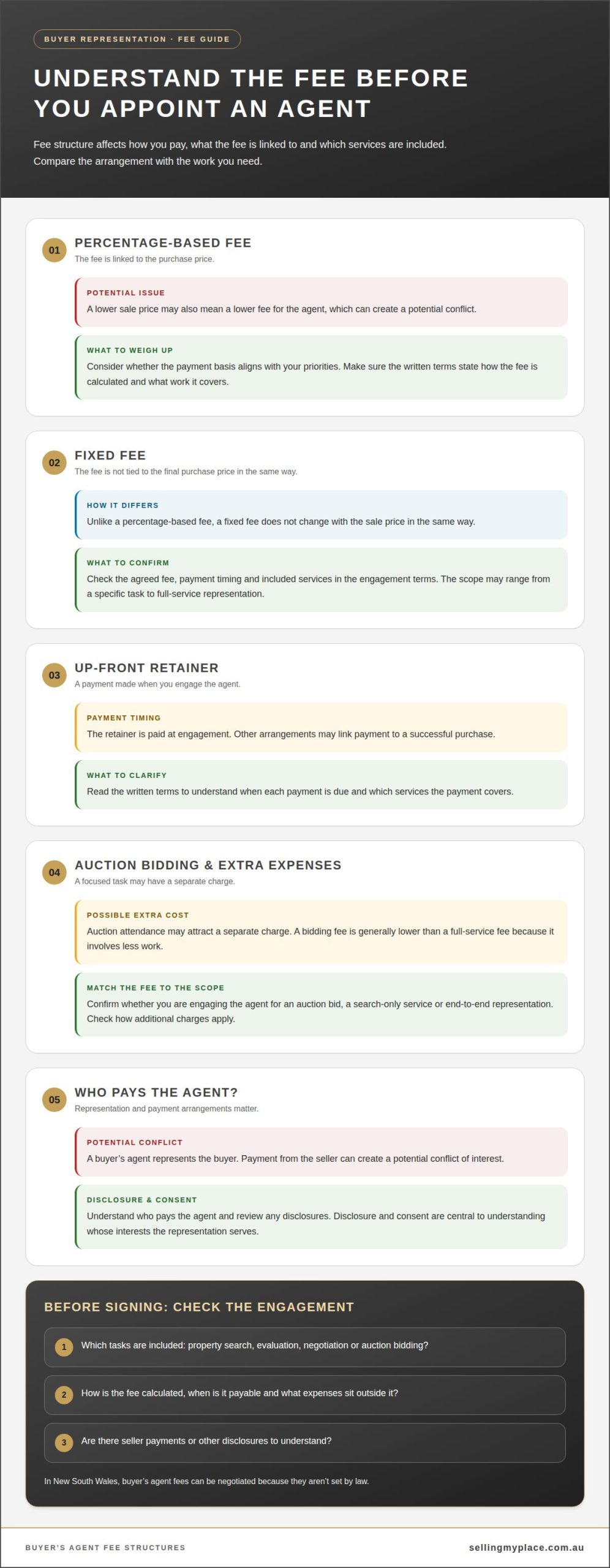
A fee structure sets how the buyer’s agent is paid for the agreed work. Common approaches include a fixed fee or a percentage of the purchase price; some agents also charge an up-front retainer when you engage them. In New South Wales, fees can be negotiated because they aren’t set by law. The structure determines the cost and payment terms.
With a percentage-based fee, the amount is linked to the purchase price. This can create a potential conflict: a lower sale price may also mean a lower fee for the agent. A fixed fee isn’t tied to the final price in the same way, while a retainer is paid at engagement. Consider how each arrangement aligns with your priorities and the agreed scope.
Payment timing and expenses
Payment timing is when the fee becomes due; expenses are costs that may sit outside it. An up-front retainer is paid when you engage the agent, while other arrangements may link payment to a successful purchase. The written terms should clarify payment timing and what’s included. Auction attendance may also attract a separate charge, so account for it.
Before signing, understand which tasks the fee covers and how any additional charges apply. An auction bid, for example, may be a narrower engagement than a full property search and negotiation service. A bidding fee is generally lower than a full-service fee because it involves less work. A clear scope distinguishes the agreed service from extra work.
Fees and commission
A fee is what the buyer pays for representation; commission is a payment calculated as a share of the purchase price. The distinction matters because a percentage-based fee can change with the sale price, whereas a fixed fee does not. In either case, the engagement terms should state the payment basis and services covered.
A buyer’s agent represents the buyer, so payment from the seller can raise a conflict of interest. Seller-paid fees can create a potential conflict of interest, so it is important to understand the payment arrangement and any disclosures. Disclosure and consent are therefore central to understanding who pays the agent and whose interests the representation serves.
To discuss how buyer representation with Kincade International Direct Sales can fit your purchase, consider the scope of support you need and the fee structure that matters to you.
Choosing and appointing a buyer’s agent
When choosing a buyer’s agent, assess their licence, any conflicts of interest and how well they fit your purchase brief. These checks help you appoint an advocate whose work matches the support you need.
Questions to ask an agent
Before appointing an agent, ask specific questions about representation, experience, conflicts and the agreed service. The answers help clarify who they act for and how their work will support your purchase.
- Who will the agent represent during negotiations?
- What services and tasks does the engagement cover?
- Does the agent have any conflicts of interest?
- How will they follow your property brief and keep you informed?
Clarify how the agent assesses properties and supports decisions about price. If your brief prioritises a particular location and property type, ask how those requirements guide the search and evaluation. Clear answers make it easier to judge whether the agent’s approach suits your needs.
Choosing a buyer’s agent
Choosing an agent involves checking their credentials and whether their approach aligns with your priorities. Licensing requirements differ across Australia, so check with the consumer protection agency for the state or territory where the property is located. In New South Wales, NSW Fair Trading says a buyer’s agent needs a real estate licence or Certificate of Registration to practise.
Check for conflicts of interest before appointing an agent. A buyer’s agent should represent the buyer, so raise any connection that could affect that role before the engagement begins. Because the agent may negotiate on your behalf, you need clarity about whose interests they serve.
Match the service scope to the work you want handled. A full search and negotiation engagement differs from hiring an agent only to bid at auction. Discussing your brief, the agent’s role and how they’ll communicate helps establish what you’re appointing them to do.
Before signing, read the engagement terms alongside the agreed property brief. Confirm the written scope reflects the service discussed, including the tasks covered and how decisions will be communicated. An investor’s brief may focus on one property or a portfolio; a home buyer’s can reflect their household’s priorities. This helps prevent mismatched expectations and gives the agent a clear basis for advocating for the purchase you want.
Choosing an agent is about fit, not simply the possibility of saving time or money. Questions about the work, licence checks and conflict disclosures help you decide who should represent you through the purchase.
Negotiation and following a client’s brief
A buyer’s agent uses your criteria to guide negotiations and any auction bidding. The brief defines which properties merit attention, what trade-offs matter and when you want to proceed. Clear instructions give the agent a practical basis for speaking with selling agents on your behalf.
For example, a brief might prioritise a particular property type, location and condition, whether you are searching in your local neighbourhood or researching distant markets such as homes for sale in Geneva IL. The agent can use those criteria to assess whether a listing is relevant, rather than pursuing every available property. If a home you like falls outside your agreed priorities, the agent can point out the difference before negotiations move forward.
Negotiation may involve communicating your position to the selling agent and discussing purchase terms. The buyer’s agent advocates for you, but doesn’t decide independently that you should buy a property. Your preferred terms and instructions remain central, including whether to continue negotiating if the seller’s position doesn’t suit.
Auction support can be engaged separately from a full property search. In that arrangement, the buyer’s agent bids for you at the auction, following your agreed criteria and instructions. Set your limit and discuss your bidding instructions with the agent beforehand. This gives them a clear boundary, rather than leaving decisions to the pressure of the auction room.
Your brief also helps distinguish firm requirements from preferences. A particular location might be essential, while a second living area is desirable but negotiable. That distinction gives the agent room to discuss suitable alternatives without losing sight of what matters most to you.
Communication matters when an offer or counteroffer could change your decision. The agent can explain the other party’s position and outline your options, so you can decide whether to proceed, change the terms or stop discussions. Your approval should guide decisions about an offer, rather than assumptions made during a fast-moving negotiation.
Fee arrangements and bidding instructions are separate parts of the engagement. A percentage-based fee may relate to the purchase price, but it doesn’t set your criteria or auction limit. Agreeing on the brief, the agent’s authority and how key updates will be handled helps keep negotiations aligned with your objectives.
For investors, the brief may focus on one property or a wider portfolio. The agent can keep the search and discussions tied to your stated aims, rather than treating every listing as a match. Specific criteria make the agent’s advocacy more focused and help you stay involved in important decisions.
Buyer’s agent role and how it differs from a seller’s agent
The key difference is who each agent represents: a buyer’s agent acts for the buyer, while the seller’s agent acts for the seller. That relationship determines whose interests guide their conversations about a property.
The buyer’s agent role
A buyer’s agent represents the purchaser and can make the search and purchase decisions more focused. For example, they can use your criteria to shortlist properties, discuss their suitability and communicate your position to the selling agent. This may suit a buyer with limited time or someone seeking professional support instead of managing every part of the search.
The agent’s role follows your agreed brief, not every opportunity in the public market. If you want a particular property type and location, those priorities guide which listings receive attention. If a property misses an important criterion, the agent can identify the gap before you spend time pursuing it.
A buyer’s agent also advocates for you during discussions with the seller’s agent. The two agents may discuss the same offer, but they have different clients and responsibilities. Your agent conveys your position; the seller’s agent communicates on behalf of the seller.
Differences from a seller’s agent
A seller’s agent represents the seller and works on that seller’s side of a transaction. A buyer’s agent represents the purchaser instead. This distinction matters because each agent’s advice and negotiation work serves their own client, even when both are discussing the same home. This principle of independent advocacy also extends to other major lifestyle acquisitions; for instance, yacht brokerages like Preferred Yachts provide dedicated buyer and seller representation to protect each party’s interests.
- Property search: A buyer’s agent can help the buyer identify and shortlist suitable properties. A seller’s agent represents the seller of a property being marketed.
- Negotiation: The buyer’s agent puts forward the buyer’s position. The seller’s agent represents the seller during discussions about the offer.
- Client interests: The buyer’s agent’s client is the purchaser. The seller’s agent’s client is the seller, not the buyer considering the listing.
When you speak directly with a seller’s agent, that agent doesn’t represent you. They may provide information about the property and sale, but their relationship is with the seller. A buyer’s agent gives you your own representative in the transaction.
This difference is especially useful to remember when one property attracts strong interest. The buyer’s agent can keep the buyer’s priorities at the centre of their decisions, while the seller’s agent represents the seller’s interests. To discuss representation for your purchase, get guidance on buyer representation.
Kincade International Direct Sales: Buyer Representation
Kincade International Direct Sales offers Buyer Representation for Australian property buyers seeking support with a purchase. If you want an agent to work to your brief and represent your interests, this can be a practical next step.
Buyer Representation can help bring your priorities into focus, from the properties considered to discussions with a selling agent. If you’re still shaping your plans, Pre-Sale Property Consulting and Neighborhood Market Reports can also inform your property decisions.
Whether you need help defining your search or want representation as you pursue a property, the next step is a conversation about your needs. Contact Kincade International Direct Sales to discuss buyer representation.
Make your next property move with clarity
A property decision should reflect the life you want to build, not just the details of a listing. If you’re still weighing what a buyer’s agent is and whether you need one, consider what support would help you move forward with confidence.
Kincade International Direct Sales offers Buyer Representation, Residential Property Listing Services and Pre-Sale Property Consulting. Whether you’re preparing to buy or planning a property sale, start by discussing your goals and identifying the support that fits. A clear starting point can make the decisions ahead feel more manageable.
Contact Kincade International Direct Sales to discuss your property plans. Take the next step when you’re ready, with your priorities guiding the conversation.
Frequently Asked Questions
How much does it cost?
Buyer’s agent fees depend on the agreed service and how payment is calculated. An agent may charge a fixed fee, a percentage of the purchase price or an initial retainer; auction bidding may be treated separately. Before engaging an agent, ask for the fee basis, payment timing and any separately charged work in writing. This makes it easier to compare the scope, not just the headline fee.
What does a buyer’s agent do in Australia?
A buyer’s agent can search for properties, assess how well they suit your brief and negotiate with the selling agent. The engagement may cover the whole search or one task, such as auction bidding. An investor buying a portfolio, for example, may want data analysis, while a time-poor home buyer may need help narrowing down listings. A buyer’s agent can’t give legal advice unless they’re a lawyer.
How much does a buyer’s agent cost in Australia, and how are fees charged?
Fee structures vary by engagement. The agreement may set a fixed fee or calculate payment as a percentage of the purchase price; some agents also request a retainer at the start. In New South Wales, fees can be negotiated because they aren’t set by law. Clarify whether the property search, negotiation and auction attendance are included before agreeing to the terms.
When is hiring a buyer’s agent worthwhile for Australian home buyers?
A buyer’s agent may be worthwhile if work, distance or limited property knowledge makes searching and assessing homes difficult. You might be able to attend inspections but want help negotiating, or need support finding suitable properties. The value depends on the tasks you want handled and the time you can give the search. If you’re comfortable managing those tasks yourself, full-service representation may not suit you.
How do I check a buyer’s agent’s licence, experience and conflicts of interest in my state?
Check licensing with the consumer protection agency in the state or territory where the property is located, and ask about potential conflicts. In New South Wales, NSW Fair Trading says a buyer’s agent needs a real estate licence or Certificate of Registration to practise. Assess experience against your purchase type by asking about relevant work, such as auction bidding or investment property searches.
What should I ask before signing a buyer’s agent agreement in Australia?
Ask what the engagement covers, how the fee is calculated, when payment is due and whether auction bidding or other work is charged separately. Clarify how the agent will follow your brief, communicate offers and seek your approval for decisions. Check how long the agreement runs and how either party can end it. The written terms should match the service discussed, so you know what you’re appointing the agent to do.
What risks or warning signs should I look for when choosing a buyer’s agent?
Pay attention to unclear fee terms, vague descriptions of the work or undisclosed interests connected to a property. A percentage-based fee can create a potential incentive issue because a lower purchase price may also reduce the agent’s fee. A buyer’s agent can’t receive payment from the seller while representing you unless both parties give fully informed consent beforehand. Make sure the agent’s role and any relevant interests are clearly explained.
How do buyer’s agents differ from selling agents and buyer’s advocates in Australia?
A buyer’s agent represents the purchaser; a selling agent represents the seller. Buyer’s advocate is another term for buyer-side representation. The important point is whose interests the person acts for. When you discuss an offer with a selling agent, for instance, that agent’s client is the seller. A buyer’s agent represents you, not the person selling the property.