
An off-market property isn’t automatically a bargain. In Melbourne, buyers can uncover these homes through relationships with local selling agents, a wider personal network and professional buyer representation, with finance pre-approval helping them act when a suitable property appears.
It’s easy to assume “off market” and “pre-market” mean the same thing, or that a private sale must come with a lower price. The distinction matters: an off-market home is sold without public advertising, while a pre-market home is usually shown to a small group before an expected public launch.
This guide explains how buyers can find off-market homes in Melbourne and Sydney, what separates off-market from pre-market listings, and why a seller might prefer a private sale. You’ll also see how privacy, personal circumstances and the prospect of avoiding a public campaign can shape a seller’s decision, so you can approach the search with clearer expectations.
Key Takeaways
- A buyer’s agent can use relationships with selling agents and broader networks to hear about homes before they reach public listings.
- Pre-market usually means a short first opportunity to buy before a public launch; a private off-market campaign may remain private.
- Privacy, personal circumstances and a preference for a less public sale can influence a seller’s choice of approach.
- In Sydney, a private sale doesn’t automatically mean a lower price: competition and the seller’s expectations still matter.
- Neighbourhood Market Reports can help put local property choices in context, while Buyer Representation can support a more focused search.
How can a buyer’s agent help you find off-market properties in Melbourne?
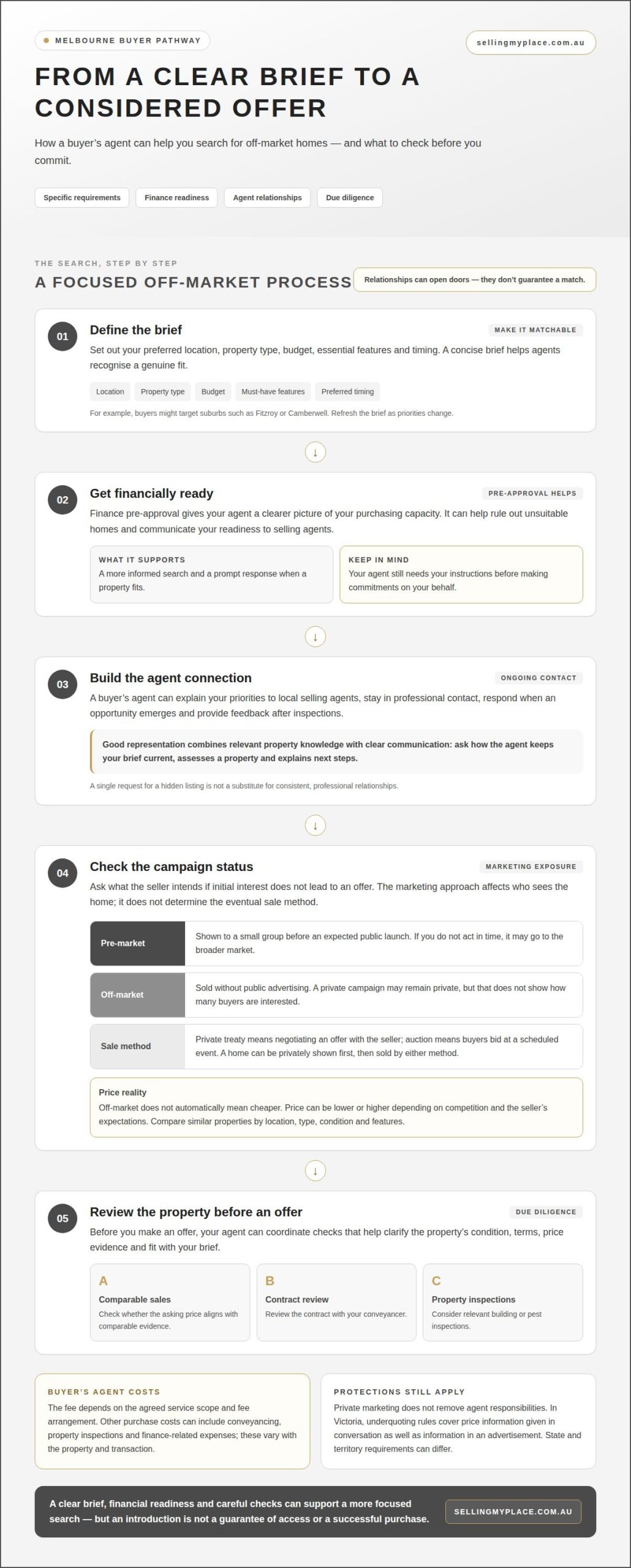
A buyer’s agent searches through selling-agent relationships and professional networks, then assesses whether each property suits your brief. For buyers targeting suburbs such as Fitzroy or Camberwell, that means sharing clear requirements, financial readiness and preferred timing with an advocate who can speak directly with local estate agents. An off-market property search is most useful when the brief is specific enough for agents to recognise a genuine match.
Relationships are built through regular, professional contact, not a single request for a hidden listing. A buyer’s agent can explain your priorities to selling agents, respond promptly when an opportunity emerges and give useful feedback after inspections. A concise brief covering location, property type, budget and essential features helps agents match a home to your needs. The agent can also refresh that brief as your priorities change.
When choosing representation, look for relevant property knowledge and clear communication with selling agents. Ask how the agent keeps your brief current, assesses a property and explains next steps. Strong relationships can lead to introductions, but they don’t guarantee access to a suitable home or a successful purchase. A sound process matters just as much as an introduction.
Finance pre-approval gives your buyer’s agent a clearer picture of your purchasing capacity. It can help them rule out unsuitable opportunities, communicate your readiness to selling agents and respond decisively when a property fits. Your agent still needs your instructions before making commitments on your behalf. Being prepared can help avoid delays when a seller is considering interest privately.
Consumer protections still apply when a home isn’t advertised. Australian state consumer laws apply to property agents whether or not a home is advertised. In Victoria, rules against underquoting cover price information given to a buyer in conversation, not just information in an advertisement. Private marketing doesn’t remove these responsibilities.
What fees and costs apply? A buyer’s agent’s fee depends on the agreed service scope and fee arrangement. Other purchase costs can include conveyancing, property inspections and finance-related expenses, which vary with the property and transaction.
What due diligence should the agent help complete? Before you make an offer, the agent can coordinate a review of comparable sales, the contract with your conveyancer, and relevant building or pest inspections. These checks help clarify the property’s condition, terms and fit with your brief, including whether the asking price aligns with comparable evidence.
Do practices differ between states and territories? Yes. Consumer laws apply across Australian states and territories, but specific requirements can differ. In Victoria, the rules also cover verbal price information. An agent working across state borders needs to understand the rules applying where each property is located. This matters when an off-market property search spans more than one jurisdiction.
Pre-market versus off-market properties
The difference is what happens after selected buyers see the home: a pre-market property is expected to reach public listings, while a private campaign stays off the public market. That distinction affects how buyers judge the time available and the likely audience for a sale.
Off-market and on-market sales
An on-market sale is publicly advertised, while an off-market sale proceeds without public advertising. Buyers can find public listings online, but private opportunities are introduced through agents or networks. The marketing method shapes who sees the property, not the legal form of the eventual sale.
A pre-market home is shown to a small group before an expected public launch. If a buyer doesn’t act in time, the property may go to the broader market. In a private campaign, the seller may keep marketing without moving to public listings. Ask what the seller intends if initial interest doesn’t lead to an offer.
This distinction can affect your decision. A pre-market viewing may provide an early opportunity, but waiting could mean competing with more buyers after launch. A private sale may have a smaller initial audience, but that doesn’t tell you how many buyers are interested or what the seller will accept.
Comparing sale methods
Off-market and on-market describe marketing exposure; private treaty and auction describe how the sale is conducted. In a private treaty, the buyer negotiates an offer with the seller. At auction, buyers bid against one another at a scheduled event.
These choices can occur at different stages. A seller may first show a home privately, then advertise it and proceed by private treaty or auction. The early marketing approach doesn’t determine the eventual sale method, so understand both before deciding how to proceed.
For example, if an advertised home is going to auction, your approach differs from negotiating directly with a seller. The sale method affects how an offer is made and when the seller considers it. Marketing status alone doesn’t answer those questions.
Prices of off-market properties
Privately marketed homes aren’t necessarily cheaper than publicly listed properties. Their prices can be lower or higher, depending on competition and the seller’s expectations. Limited exposure doesn’t automatically create a discount, and a pre-market price may not be the seller’s final position.
Compare similar properties by location, type, condition and features. A renovated home and one needing substantial work may be poor comparisons, even in the same area. Treat an asking price as a starting point for assessment, not proof of value.
For buyers and sellers weighing different approaches, discussing property sale options can help clarify which campaign suits their circumstances.
Why do sellers sell off-market?
For a seller, a private sale can offer more control over who sees the home and how it is presented. The reasons often reflect practical pressures or personal circumstances, rather than one preferred way to sell.
Reasons for choosing an off-market sale
An off-market sale lets a vendor test interest without starting with a public campaign. That can suit someone facing financial pressure, a change in personal circumstances or a preference to avoid the attention of a public sale.
Marketing costs can also influence the decision. A seller may weigh campaign spending against the chance of attracting more buyers through public advertising. A private approach may appeal if the vendor already has a likely buyer in mind or discretion matters more than broad exposure.
There’s no universal reason. One seller might want to manage a sale alongside a family change; another might prefer to avoid auction preparations and public competition. The choice reflects the vendor’s priorities, the property and the circumstances around the sale.
Reasons for choosing a quiet sale
A quiet sale limits public attention and can give a seller more control over access to the home. For example, a vendor who values privacy may prefer selected buyer enquiries over a publicly promoted campaign.
It can also reduce the disruption of preparing for open inspections. A public campaign may involve open inspections twice a week for six weeks, requiring the seller to keep the home ready for visitors. A private sale may help avoid that routine, which can matter for a busy household, family commitments or a home that’s difficult to prepare repeatedly.
Some sellers feel anxious about auctions, crowds or having neighbours and passers-by view their home. A quieter process can feel more manageable, particularly when the vendor wants conversations to focus on serious interest rather than public attention.
The trade-off is reach. A seller choosing privacy may expose the property to fewer buyers than a public campaign, which can affect competition. For a buyer, a quiet sale isn’t automatically a sign of urgency, a bargain or a seller willing to accept any asking price.
Seller circumstances can change. A vendor may begin privately, then decide to advertise if initial interest doesn’t lead to an acceptable offer. That possibility matters when buyers weigh whether to act promptly or wait for wider exposure. Each approach brings different considerations around privacy, preparation and buyer reach.
Ultimately, the vendor balances discretion and convenience against the potential benefits of a broader campaign. Understanding whether privacy, financial pressure or inspection demands are driving the choice helps buyers read the situation more clearly, without assuming the seller’s motivation or expected price.
Off-market and pre-market property listings in Sydney
Sydney buyers may encounter a home before its public launch or through a private campaign. Knowing how listings, price ranges and search bands work can help you judge opportunities without treating an early price as a final measure of value.
A selling agent may list a property before it’s ready to appear on public property websites. The period between listing and readiness can be about a week. During that window, an agent may speak with selected buyers. If the home is pre-market, it is expected to go to the broader market if a buyer doesn’t act in time. That timing gives interested buyers an early look, but doesn’t necessarily mean the seller will keep the sale private.
Sydney listings show how much prices vary by location and property type. These figures describe different sale contexts, so compare like with like rather than assuming every displayed range has the same meaning.
Search bands also appear across a mix of homes and apartments. Property type, location, size and condition all shape which comparisons are useful.
One concern is overpricing, sometimes associated with “buying the listing”: a seller chooses an agent based on an ambitious price estimate. A displayed range alone can’t establish that a home is fairly priced. The comparison matters more than the label attached to its marketing.
How can a buyer’s agent help estimate value? They can assess comparable sales, location, property type, size and condition, then weigh those against the seller’s asking price. For Sydney examples, that means treating a search band as a guide, not a substitute for property-specific analysis.
An off-market listing isn’t necessarily cheaper than a public listing. Its price may be lower or higher, depending on competition and the seller’s expectations. Whether considering a house in The Ponds or an apartment in Coogee, assess the evidence behind the asking price before deciding what the opportunity is worth. Beyond the property itself, researching neighbourhood amenities and local activities, such as pinnaclemartialarts.com.au, can help families determine whether a particular Sydney suburb suits their everyday lifestyle.
What an off-market property sale is
The phrase describes a marketing choice, not a separate kind of property ownership. For buyers, that distinction separates what an agent is doing to find an audience from the decisions involved in making an offer.
A private introduction can begin a conversation, but it doesn’t itself create an agreement to buy. The buyer and seller still need to settle the terms and proceed through the usual sale process. Treat an agent’s message as an invitation to consider the home, not as a substitute for written sale documents.
For example, a buyer may hear that a home could be available and ask to inspect it. That enquiry doesn’t mean the seller has accepted an offer or agreed to stop considering other interest. Clarify whether the seller is inviting offers, discussing a possible sale or simply gauging interest.
Marketing status can change. A seller who begins with private conversations may later choose broader advertising. Understand what the seller is currently considering and whether the opportunity remains private, rather than assuming an early approach guarantees exclusive access.
The label says nothing by itself about price, condition or competition. A buyer still needs to judge the home against relevant evidence and their own requirements. A quiet introduction may feel personal, but it shouldn’t replace a careful decision about the property and proposed terms.
For sellers, the choice is about how to introduce the home to potential buyers and how much public exposure to seek. Consider those priorities alongside the intended campaign to clarify which marketing approach fits the sale.
Sellers considering their next move can discuss property sale options before choosing how to present their home.
Kincade International Direct Sales: Neighborhood Market Reports
Kincade International Direct Sales offers Buyer Representation to support buyers searching for a home. Its Neighborhood Market Reports can help you put property choices in context when weighing a privately presented home against comparable properties.
For sellers, Pre-Sale Property Consulting can help clarify sale considerations before choosing an approach, while Residential Property Listing Services support owners preparing to market a home. The right next step depends on whether you’re buying, selling or still shaping your plans.
If you’d like to discuss your property goals, contact Kincade International Direct Sales.
Take the next step with a clear property plan
Before pursuing an off-market property, decide what matters most: the location, the features you can’t compromise on and the terms you’re prepared to consider. A clear brief gives a property professional a practical basis for assessing opportunities and keeping your search aligned with your plans.
If you’re buying, Kincade International Direct Sales offers Buyer Representation to support your search. If you’re preparing to sell, its Residential Property Listing Services and Pre-Sale Property Consulting can help you consider your options and plan the next stage. The right support depends on where you are in the property journey, whether you’re finding a home or preparing for a move.
You don’t need every detail settled before taking a first step. A conversation can help you clarify your priorities and decide what support would be useful.
Contact Kincade International Direct Sales to discuss your property goals and take the next step with confidence.
Frequently Asked Questions
What Does Off-Market Mean in Real Estate?
In real estate, off-market means a home is offered for sale without public advertising. A buyer might hear about it through a selling agent or buyer’s agent rather than an online listing. The term describes the marketing approach, not the property’s condition, contract or likely price. For example, a home discussed privately with selected buyers can still attract competing offers.
Do consumer protections still apply to off-market sales?
Yes. Australian state consumer laws apply to property agents whether or not a home is advertised. In Victoria, rules against underquoting cover price information given to a buyer in conversation, not just information in an advertisement. A private introduction doesn’t remove agent responsibilities. Buyers should still consider the price information, sale documents and property details carefully before deciding whether to proceed.
How can a buyer’s agent help you find off-market homes?
A buyer’s agent can share your property brief with selling agents and relevant professional contacts, then assess homes that match your requirements. A clear brief can distinguish a genuine fit from a property that misses an essential feature. The agent can also help coordinate inspections and discussions about an offer, so you can focus on whether the home suits your plans.
Off-Market vs On-Market: What’s the Difference?
An off-market home is offered without public advertising, while an on-market home is promoted to the broader public. That changes how buyers encounter the listing: one may come through an agent’s direct contact, while the other can be found through public advertisements. Neither approach establishes the home’s value or guarantees a particular level of buyer competition, so assess each property on its merits.
What Is an Off-Market Sale?
An off-market sale is a property sale conducted without publicly advertising the home. Private marketing does not by itself make a property purchase informal; buyers should review the sale documents and check who they are dealing with. For a buyer, the practical distinction is how the opportunity is introduced, not whether the transaction is informal. Review the property information and proposed contract terms as you would for any significant purchase.
What does off-market property mean in Australia?
In Australia, an off-market property is a home offered for sale without public advertising. It may be introduced directly to selected buyers, but “off market” doesn’t mean the property is unavailable to others or priced below market value. A seller can consider private interest while retaining the option of wider exposure. The phrase describes marketing status, not a special property category.
How do off-market property sales work in Australia?
A seller can authorise private marketing, and an agent may introduce the home to buyers who appear to fit. An interested buyer can arrange a viewing and discuss an offer with the seller. If they agree to proceed, the sale uses a normal contract of sale. Private marketing doesn’t remove the need to understand the property’s condition, price and contract terms.
Where can a buyer’s agent find off-market properties in Australia?
A buyer’s agent may hear about private opportunities through relationships with selling agents and wider professional networks. A buyer’s own connections can also surface a potential introduction, though the agent can help assess whether the property matches the search brief. In practice, a focused brief covering preferred locations, property type and essential features makes it easier to identify relevant opportunities across Australia.