
What if your sale price looks strong, but the amount left after settlement is much lower than you expected? When calculating total cost of selling property, the difference often comes down to expenses that vary with your approach, from agent fees and marketing to conveyancing and mortgage discharge costs.
It can be hard to tell which charges are essential, which are optional and whether a commission-based service or flat-fee approach offers better value. Comparing headline fees alone can be misleading. A more useful comparison includes everything each option covers and how the full set of costs affects your estimated proceeds.
This guide will help you build a property-specific estimate, compare selling approaches on equal terms and work out what may remain after settlement. It covers common expenses, less obvious items to check and costs that apply only in certain circumstances. You’ll also find out what to confirm with your conveyancer, lender, tax adviser or service provider, so you can plan with fewer surprises.
Key Takeaways
- When calculating total cost of selling property, group expenses by when they’re paid: before marketing, during the sale and at settlement.
- Use an itemised checklist and mark each cost as applicable, not applicable or awaiting a written quote.
- Compare commission and flat-fee options using the same sale scenario. Check inclusions, exclusions, payment timing and contract terms.
- Estimate potential proceeds by starting with your expected sale price, then subtracting relevant expenses and settlement deductions.
- Keep optional preparation spending separate from transaction costs, and verify unclear items with the relevant professional or provider.
How to approach calculating total cost of selling property
Start by separating the amount your property sells for from the costs and deductions associated with the sale. The sale price is the agreed amount, not necessarily what you retain. Your estimated net proceeds are what remains after applicable selling expenses and settlement deductions, including any loan payout. Tax outcomes depend on your circumstances, so treat tax as a separate consideration and seek advice from an Australian tax professional if needed.
Costs also fall due at different stages. You might pay some expenses before the property is listed, incur others during marketing, then have certain amounts accounted for at settlement. Timing and costs depend on your property, contract, selling method and personal circumstances. First identify what may apply, then confirm the figures and obligations with the relevant professionals and providers.
Selling costs versus sale price and net proceeds
Think of the sale price as the starting point for your estimate, not the final result. Sale-related expenses may include agent or flat-fee marketing charges, advertising, conveyancing, property preparation or an auctioneer if you choose to sell by auction. At completion, settlement may also involve paying out a mortgage and accounting for relevant adjustments under the contract.
For a working estimate, subtract expected selling costs and applicable settlement deductions from your assumed sale price. Keep the loan balance and any potential tax liability on separate lines. Both can affect what remains, but neither is the same as a marketing or transaction fee.
Which costs vary between Australian property sales?
Some costs are common to many sales, while others depend on the property and the approach you choose. Marketing inclusions can differ, for example. Check whether photography and floorplans are included or quoted separately. Styling, repairs, auction services and mortgage discharge costs may apply only in particular circumstances. Stamp duty, also called transfer duty, is generally a buyer’s cost, not a seller’s expense.
Conveyancing helps manage the transfer of property title. You can read more about the legal process of conveyancing, but the work and requirements for an Australian sale can vary by state or territory. Don’t rely on a single national fee schedule. Ask a conveyancer or solicitor for a current, itemised quote, and check the settlement terminology and requirements that apply to your transaction.
Make a property-specific list and mark each line as applicable, not applicable or awaiting a written quote. Ask providers to clarify inclusions, exclusions, payment timing and contract terms. You can compare a flat-fee marketing option with other sale approaches, but use the same assumptions and include the same non-agent costs. This gives you a fairer view of likely expenses and potential proceeds.
Which property-selling costs should you include in your estimate?
A reliable estimate reflects the costs that apply to your sale, not a standard list where every item is assumed. For calculating total cost of selling property, create a line for each category below and mark it applicable, not applicable or awaiting a written quote. Ask providers what’s included, what may be charged separately and when payment is due.
Marketing, preparation and professional support
Start with the sale method and the services you plan to use. If you’re comparing an agent with a flat-fee marketing option, check the fee basis and service scope side by side. Confirm whether photography, floorplans, listing exposure and advisory support are included or charged separately. Ask how long the listing remains active under the agreement, and verify the current inclusions and listing terms directly with the provider.
- Agent or marketing: Record the agreed commission or flat fee, any marketing charges, applicable GST and payment timing. Don’t compare headline fees without checking what’s included.
- Property preparation: Consider repairs, cleaning, styling, gardening or moving only if they suit the property and your plans. These are choices to assess after inspecting the home, not automatic selling costs.
- Professional support: Note any separate advice or services you intend to use. Request a written quote that sets out the scope.
Conveyancing, finance, tax and settlement items
Ask a conveyancer or solicitor to identify likely legal, contract and settlement charges for your transaction. Processes and requirements can vary by state or territory, so request a current, itemised estimate rather than relying on a general figure.
- Finance: If there’s a mortgage, ask your lender for a current payout figure and whether any discharge-related amounts apply. Use a figure that reflects your expected settlement timeframe.
- Settlement: Ask your conveyancer which adjustments or deductions may apply under your contract and how they’ll appear in the settlement statement.
- Tax: Don’t guess a potential capital gains tax amount. Your circumstances matter. Speak with a qualified tax adviser and consult the ATO’s guidance on calculating Capital Gains Tax.
Once you’ve gathered the relevant quotes and figures, you’ll have a more useful estimate for your property. If you’re considering a flat-fee marketing approach, you can ask about property marketing options and confirm which inclusions and terms apply to your sale.
How do commission and flat-fee selling approaches compare?
For a fair comparison, hold the sale scenario constant. Use the same property and estimated sale price, then keep conveyancing, finance, preparation and other applicable expenses identical for each option. Change only the selling service and the costs that genuinely differ. This makes calculating total cost of selling property more useful than comparing two headline fees in isolation.
With a commission-based arrangement, the fee is generally calculated as a percentage of the agreed sale price, so the amount changes if the final price changes. A flat fee is a set service charge under the provider’s written terms. For either option, confirm the fee basis, additional charges and payment timing in the agreement.
Compare the complete service, not just the headline fee
Ask what each option includes, such as professional photography, floorplans, listing exposure and advisory support. Check for exclusions and extra charges, as well as cancellation terms, listing duration and any conditions that could affect the final bill. Request the details in writing so you can compare like with like. A lower fee doesn’t automatically mean weaker service or better value. The right fit depends on the support and inclusions you need.
| Comparison point | Commission-based arrangement | Flat-fee arrangement |
|---|---|---|
| Fee basis | Percentage of the agreed sale price. Confirm how it’s calculated. | Set service charge. Confirm what the written terms cover. |
| Inclusions and exclusions | Record photography, floorplans, listing exposure and advice, plus anything charged separately. | Record the same items and note any exclusions or optional extras. |
| Payment timing | Check when the fee becomes payable and how payment is arranged. | Confirm payment timing and any conditions in the agreement. |
| Contract terms | Check cancellation provisions, listing duration and other conditions. | Check the same terms, including how long the listing remains active. |
How a flat-fee model fits into the calculation
Kincade International Direct Sales is one example of commission-free, flat-fee property marketing. Its service includes professional photography, floorplans, global property listings and advisory support. Confirm current inclusions and listing terms with the provider before using them in your estimate.
To compare estimated net proceeds, start with the same assumed sale price for both approaches. Subtract each option’s service and marketing charges, then deduct the same conveyancing, finance, preparation and settlement items that apply to your property. If the final sale price differs from your estimate, recalculate any percentage-based fee using the actual agreement terms. This is an informed comparison, not a guarantee of what you’ll retain.
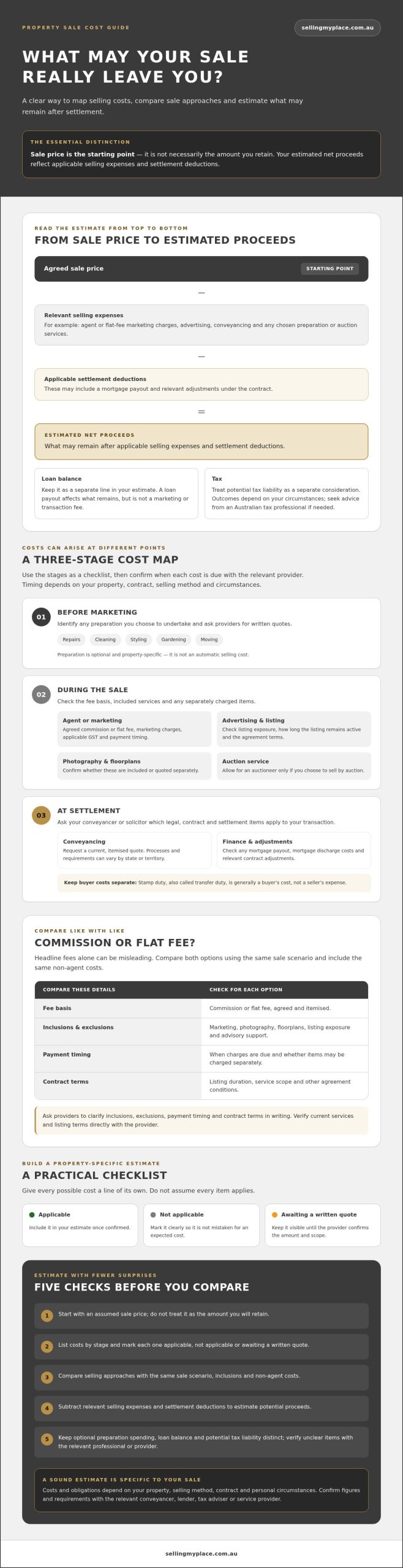
How to calculate your estimated selling costs step by step
A worksheet brings quotes and settlement details together in one estimate you can update as the sale progresses. Keep the assumed sale price separate from expenses, and label each figure as confirmed, estimated or unknown. Use A$ placeholders until you have figures for your property.
Gather the figures needed for a property-specific estimate
Collect written quotes and check what each covers, including marketing inclusions, conveyancing, any preparation work and your lender’s current payout information. Base your sale-price assumption on relevant market evidence rather than an unsupported online estimate. For help developing that assumption, see this guide to determining a home’s market value.
Build your worksheet
- Estimated sale price: A$[amount] | Status: [estimated/unknown]. Note the evidence and date behind your assumption.
- Agent or flat-fee service: A$[amount] | Status: [confirmed/estimated/unknown]. Record the fee basis and written agreement terms.
- Marketing and listing expenses: A$[amount] | Status: [confirmed/estimated/unknown]. List photography, floorplans, listing exposure and any separately quoted items.
- Conveyancing and transaction charges: A$[amount] | Status: [confirmed/estimated/unknown]. Use an itemised estimate for your state or territory and transaction.
- Property preparation: A$[amount] | Status: [confirmed/estimated/unknown]. Include only work you’ve decided is worthwhile, such as cleaning, repairs or styling.
- Finance payout and discharge items: A$[amount] | Status: [confirmed/estimated/unknown]. Enter the lender’s current payout figure and note any applicable charges.
- Settlement adjustments or other deductions: A$[amount] | Status: [confirmed/estimated/unknown]. Confirm relevant items with your conveyancer.
- Potential tax liability: A$[amount] | Status: [adviser to confirm]. Don’t treat this as a generic estimate. Ask a qualified tax adviser about your circumstances.
Estimated net proceeds = assumed sale price − selling expenses − applicable settlement deductions. Keep tax and loan figures clearly identified so you can see what’s confirmed and what still needs checking. Don’t treat an unknown as a confirmed charge. Flag it and follow up with the relevant provider.
To stress-test your estimate, repeat the calculation with more than one plausible sale-price assumption. Apply the same non-agent expenses to each scenario, changing only figures that genuinely depend on the sale price or agreed terms. These are planning scenarios, not promises of a result. The agreed sale terms can also affect the final outcome, so review these property sale negotiation tips.
Update the worksheet when quotes, the lender payout figure or sale assumptions change. For help reviewing property marketing options and inclusions, contact Kincade International Direct Sales.
How to manage selling costs and choose your next step
Once your worksheet is taking shape, make each line clear and verifiable. A low headline fee can look appealing, but it’s difficult to judge until you know what’s included, what may cost extra and when payment is due. Ask providers for written details, then update your estimate rather than relying on verbal assurances.
Reduce uncertainty without overlooking essential support
Request an itemised quote that identifies inclusions, exclusions, additional charges, payment timing and relevant contract terms. For marketing services, check the scope of professional photography, floorplans, listing exposure and advisory support. A clear comparison helps you decide whether the service suits your needs, rather than simply choosing the lowest quoted fee. For a closer look at what listing services can cover, read this residential property listing services guide.
Keep optional preparation spending separate in your worksheet. Cleaning, repairs or styling may be useful for your property, but they’re not automatic costs for every seller. Transaction and settlement items also need checking with the relevant professionals. Ask your conveyancer about the sale process and settlement figures, your lender for current payout information, and a qualified tax adviser about any tax questions that apply to your circumstances.
Choose a selling approach that fits your cost plan
Use the same worksheet to compare a commission-based arrangement with a flat-fee option. Keep your sale-price assumptions and non-agent expenses consistent, then compare the service fee, inclusions, exclusions, payment timing and contract terms. This gives you a more grounded view of estimated net proceeds than comparing headline charges alone. The aim of calculating total cost of selling property is to understand the whole picture, not to assume one method will suit every owner.
Kincade International Direct Sales is an option for owners considering commission-free marketing through a flat-fee model. Its service includes professional photography, floorplans, property listings and advisory support. Confirm current inclusions and listing terms directly before adding them to your estimate.
If you’d like to explore whether commission-free marketing fits your plans, discuss your property sale. Ask about the service scope and terms so you can assess the option without assuming a particular sale price or saving.
Make your next property-sale decision with confidence
Calculating total cost of selling property is easier with a property-specific estimate than with a headline fee or broad rule of thumb. List each expense and settlement deduction, mark what’s confirmed and what still needs a quote, then check relevant figures with your conveyancer, lender or tax adviser.
Before choosing a selling approach, compare the full service scope and written terms. Commission-free, flat-fee marketing may suit some sellers, but value depends on the inclusions and support you need. Kincade International Direct Sales describes professional photography, floorplans and advisory support as service inclusions. Confirm current inclusions and listing terms directly before comparing them with other options.
A clear estimate and a considered comparison can help you decide what to do next. The questions and answers below cover common points sellers may need to check.
Frequently Asked Questions
Is the agent commission the only major cost when selling a property?
No. Depending on your sale, the estimate may also include marketing, conveyancing, property preparation, finance-related amounts and settlement deductions. Some items may be included in a provider’s fee, while others are charged separately or are optional. Ask for written, itemised terms so you can see what each service covers. Then check which expenses actually apply to your property before comparing selling approaches or estimating your proceeds.
What costs should I include when calculating the total cost of selling property?
Start with the selling service and marketing, then check conveyancing, property preparation, moving, lender-related amounts and any tax questions that may apply. Not every seller will incur every cost, and some services may be bundled. Create an itemised list and label each figure as confirmed, estimated or not applicable. Verify transaction-specific charges with the relevant provider or professional instead of treating a general checklist as a final quote.
How do I calculate how much money I may keep after selling?
Begin with a realistic sale-price assumption, then subtract your selling expenses and relevant settlement deductions. Use verified figures where possible, and clearly mark estimates or unknowns. The result is an estimate, not a guaranteed amount. Your final proceeds may depend on the contract, lender’s payout information, transaction costs and personal tax circumstances. Confirm the final figures with your conveyancer and lender as settlement approaches.
Is a flat-fee property service cheaper than a commission-based agent?
It depends on the agreed fee, sale circumstances, service inclusions and any extra charges. Compare both approaches using the same sale-price assumption and identical non-agent expenses. Check the written terms for marketing, photography, floorplans, advisory support, listing duration and payment timing. Kincade International Direct Sales offers commission-free property marketing through a flat-fee model, with service inclusions to verify. A headline fee alone can’t establish overall value.
Can I deduct property selling costs from capital gains tax?
Tax treatment depends on the property, your ownership history and individual circumstances. Don’t assume every selling expense can be deducted or estimate your tax outcome from a general guide. Keep invoices and transaction records, then ask a qualified Australian tax adviser which costs may be relevant to your situation and what evidence you’ll need. This helps you avoid treating a general explanation as personal tax advice.
What happens if my selling-cost estimate changes before settlement?
Update your worksheet when you receive a revised quote, agree to additional work or obtain current lender or conveyancing information. Keep earlier figures and assumptions so you can track what changed and why. Before settlement, ask the relevant professionals to confirm outstanding amounts and explain any adjustments. An estimate is a planning tool, not a final proceeds statement, so don’t rely on an older version as the settlement figure.
Do selling costs vary between Australian states and territories?
Yes. Some conveyancing steps, transaction requirements and related charges may vary by state or territory, while other costs depend on your property and chosen services. A national guide can help you identify cost categories, but it can’t confirm every local requirement or charge. Ask a conveyancer familiar with the property’s jurisdiction to check which costs apply and when they’re payable. Request a current, itemised estimate for your transaction.
Ready to compare flat-fee marketing with your other selling options? Discuss your property-selling options with Kincade International Direct Sales and confirm the service inclusions and terms for your sale.