
What you get with a flat fee listing depends on the package: it may cover the property listing and marketing materials, while support with pricing, buyer enquiries, inspections and negotiations can vary. A fixed fee is different from a percentage-based commission, but the fee structure alone doesn’t determine what a home sells for. The final sale price depends on the property, its presentation, buyer interest and the negotiations.
It’s understandable to wonder whether choosing a lower-cost listing means giving up essential support, or whether a traditional commission brings enough extra help to justify the difference. The important comparison is what’s included, what tasks stay with you and how each fee is calculated. This guide explains the services flat fee packages can include, how their trade-offs compare with traditional commission, and what to weigh when deciding which approach fits your sale. With the details laid out clearly, you can focus on the right balance of support, control and value for your next move.
Key Takeaways
- Compare the flat fee with percentage-based commission against the expected sale price to see how each fee structure affects your costs.
- Look beyond online exposure: photography, floorplans, signboards and other marketing can affect the overall value of a package.
- Know which tasks you’ll handle yourself, especially pricing, buyer enquiries, inspections and negotiations.
- Review the listing term and what support is included so you can judge whether the package suits your preferred level of involvement.
- Consider professional listing support and market guidance if you want to manage costs while presenting your property with care.
What Is Flat Fee Real Estate, Exactly?
A flat-fee listing charges an agreed fixed amount for specified property marketing or listing services, rather than calculating the listing fee as a percentage of the sale price. What do you get with a flat fee listing depends on the agreement: the fee structure alone doesn’t tell you which tasks or support are included.
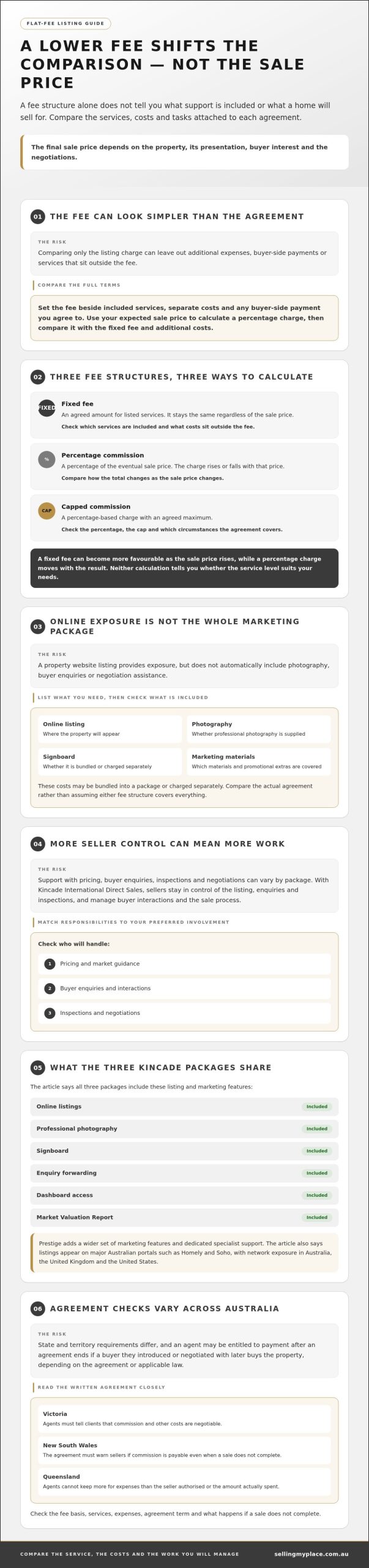
With a percentage commission, the charge rises or falls with the eventual sale price. A fixed fee stays the same regardless of the sale price, while a capped commission is percentage-based but has an agreed maximum. Compare the full terms, including any separate expenses and any buyer-side payment you agree to, rather than focusing on one figure.
| Option | How the charge is calculated | What to consider |
|---|---|---|
| Fixed fee | Agreed amount for listed services | Which services are included and what costs sit outside the fee |
| Percentage commission | Percentage of the eventual sale price | How the total changes as the sale price changes |
| Capped commission | Percentage, up to an agreed maximum | The percentage, cap and circumstances covered by the agreement |
For a simple comparison, calculate the percentage charge using your expected sale price, then set it beside the fixed fee and any additional costs. A fixed fee can become more favourable as the sale price rises, while a percentage charge moves with the result. Neither calculation tells you whether the service level suits your needs.
Australian requirements differ across states and territories, and the written agency agreement matters. Victoria requires agents to tell clients that commission and other costs are negotiable; in NSW, the agreement must warn sellers if commission is payable even when a sale doesn’t complete; Queensland agents can’t keep more for expenses than the seller authorised or the amount actually spent.
In any state or territory, read the agreement for the fee basis, services, expenses, term and what happens if a sale doesn’t complete. A real estate agent may also be entitled to payment after an agreement ends if a buyer they introduced or negotiated with later buys the property, depending on the agreement or applicable law.
To choose a package, compare its listing, marketing and support features with the work you want to manage. Kincade International Direct Sales offers three fixed-fee options, with features bundled into each package. Review the inclusions and listing terms, then select the package that matches your priorities.
Is a fixed fee cheaper than commission?
A flat-fee listing can be a cost-effective option, but compare the full package rather than the listing charge alone. Consider online exposure, photography, signboards, marketing materials and the work you’ll handle yourself.
Online listing and marketing costs
An online listing puts property details and images in front of buyers through property websites. A signboard adds visibility to people passing the home, while photography and other marketing materials shape how the listing appears. These costs may be bundled into a package or charged separately, so identify each item before comparing it with commission.
For a useful comparison, list the marketing materials you need, then note which are included and which you would organise yourself. A package with a fixed listing charge may still leave photography, signboards or promotional extras outside its scope. A commission-based service may handle different tasks, so compare the actual agreement rather than assuming either option covers everything.
Typical flat-fee MLS costs
MLS, or multiple listing service, is a US listing model, not the standard name for Australian property portals. While traditional agents in North America such as Christopher Seim actively manage client listings through full representation, flat-fee MLS services generally only place the property online. Kincade International Direct Sales lists properties on major Australian portals such as Homely and Soho. Its network also provides global exposure in Australia, the United Kingdom and the United States.
For Australian sellers, focus on where the listing will appear, what marketing is supplied and whether the fee covers support beyond publication. A listing sent to property websites provides exposure, but it doesn’t automatically include photography, buyer enquiries or negotiation assistance. The listing agreement defines the service, not the label attached to the package.
Flat-fee plan costs
Flat-fee packages vary in scope, so compare the specific features rather than assuming every service is the same. Kincade International Direct Sales offers three packages, each with online listings, professional photography, a signboard, enquiry forwarding, dashboard access and a Market Valuation Report. Prestige adds a wider set of marketing features and dedicated specialist support.
Also consider who handles the sale tasks. With Kincade International Direct Sales, you stay in control of your listing, enquiries and inspections. The service provides marketing and listing infrastructure, while you manage buyer interactions and the sale process. Consider how much time and involvement you’re comfortable taking on.
To compare fairly, write down the fee, included marketing, extra expenses and responsibilities for each option. Then consider how the service fits your sale, not only how it is priced. If you value structured listing support, explore a residential property listing service that includes professional marketing materials.
What are the pros and cons of flat fee MLS listings?
A flat-fee arrangement can reduce the listing-side charge, but the seller often takes on more work. In Australia, compare that practical responsibility with the support offered for marketing, buyer enquiries and negotiations.
Seller responsibilities and control
With an entry-only flat-fee MLS listing, the seller manages photography, pricing, buyer enquiries, showings and negotiations. That control lets you choose when inspections happen and how you respond to offers, but it also means coordinating each step yourself. For an Australian sale, distinguish the US term “MLS” from local property portals when reviewing the listing service.
Start by reviewing the Market Valuation Report and preparing the property for photography and inspections. When an offer arrives, consider its price, conditions and settlement timing before responding. Kincade International Direct Sales provides listing and marketing services; you remain in control of buyer interactions and decisions.
Potential seller savings
The potential saving comes from paying a fixed listing charge instead of a listing-side percentage that rises with the sale price. Compare both against the same expected sale price, then add marketing expenses and any buyer-side payment you agree to. A lower listing charge doesn’t itself establish the home’s sale price or the quality of its marketing.
Consider the value of your time as well as the fee. If you handle photos, enquiries and negotiations yourself, those responsibilities become part of the trade-off. A seller who wants guidance with presentation may prefer a package that includes professional photography, while a confident DIY seller may value greater control.
Technology can make seller tasks easier to organise, but it doesn’t remove them. A listing platform may support online changes or pass enquiries to the seller; the agreement determines the actual service. Before signing, identify who uploads photos, corrects property details and responds when buyers or their representatives make contact.
Presentation is one practical test. Prepare a room-by-room photo list, tidy visible surfaces and check that each image represents the property accurately. If you arrange photography yourself, you control the timing and selection. If professional photos are included, confirm how images are supplied for the online listing and other marketing materials.
Pricing requires active judgement. Use the Market Valuation Report included in every Kincade International Direct Sales package as one input when considering your price, alongside the property’s condition and buyer feedback. Asking prices are not the same as completed-sale evidence, and no listing service can guarantee a particular sale price.
Finally, keep the transaction organised. Record enquiries, confirm inspection arrangements, compare offer conditions and keep contract documents together. Flat-fee sellers generally deal directly with inquiring agents through contract and closing. Choose this route if you’re comfortable managing those tasks; choose more support if you want help through the sale process.
Basic listing price and duration
A flat-fee listing combines a fixed charge with a defined service period. In Australia, compare the written scope and listing term before weighing the fee against a percentage commission. The cost depends on the services selected, marketing materials, support level and payment timing; the price depends on the case and is given after a quote request.
In Australia, a property owner can sell privately in every state and territory. Kincade International Direct Sales acts as a licensed intermediary to list on Realestate.com.au and Domain, which do not allow individuals to list directly. Its flat-fee packages include listing and marketing features without agency commission.
Duration matters too. A limited listing agreement usually sets a listing term of 6 to 12 months. That is the period the agreement covers, not a promise that the property will sell within that time. Read the end date and any renewal or cancellation terms alongside the services and payment conditions.
To compare two offers, use the same expected sale price and service requirements. A percentage commission changes with the eventual sale price; a fixed fee remains the agreed amount. Then add any separate expenses shown in the agreement. This step-by-step comparison helps reveal whether a lower starting charge also means fewer included services.
- Listing scope: note whether the fee covers online publication, photos, floorplans and market information.
- Payment timing: identify what is payable upfront and what becomes payable when the sale proceeds.
- Term: record the start date, end date and process for ending or renewing the agreement.
- Extra costs: distinguish agreed expenses from the fixed listing charge.
Payment arrangements can differ. In October 2026, two of four published Australian agencies charged part of the fixed fee upfront and the remainder when the sale went through. That example shows why timing belongs in the cost comparison, alongside the total agreed fee and conditions for payment.
A listing term also affects your options if plans change. Check how the agreement treats expiry, cancellation and a buyer introduced during the term who purchases afterwards. An agent may be entitled to payment after an agreement ends in that situation, depending on the agreement or applicable law.
Before signing, write down the total fee, inclusions, separate expenses and dates. Compare those details with the level of real estate support you want, then make sure the agreement reflects the negotiation accurately. Clear terms make it easier to plan the sale and understand what the listing service covers.
Fixed-fee packages and what they include
A fixed-fee package groups agreed listing and marketing tasks for one set charge. Compare the written inclusions, optional extras and seller responsibilities before deciding whether it suits your sale.
Extra fees or upgrades can apply for services outside the agreed package, such as additional marketing or support. The price depends on the case and is given after a quote request; cost factors include the services selected and marketing required.
Photography, floorplans and online advertising may be included, but packages differ. Check each item in the agreement rather than assuming all three come with every flat fee.
Services included in fixed-fee packages
A package may cover the online listing, photos, floorplans, downloadable documents or customer support. Some plans also provide listing changes, direct buyer contact or agent support. Those items describe different levels of involvement: publication gives a property visibility, while practical assistance can reduce the tasks a seller handles themselves.
For example, a seller who has photos and floorplans ready may mainly need an online listing. Someone preparing to sell your home may value help with marketing materials or buyer enquiries. A realtor’s package description is less useful than the agreement’s specific list of services and responsibilities.
Optional upgrades and extra fees
Optional upgrades add services beyond the base package, while extra fees can apply to tasks excluded from its scope. Examples include additional promotion, photography or support with buyer enquiries. Their value depends on what the seller needs and which tasks the package already covers.
Compare each upgrade with the work it replaces. If you organise photos yourself, for instance, a photography add-on may not suit your plan. If marketing support matters, compare the total package scope rather than choosing solely by its headline fee.
Use a simple checklist to compare packages: online listing, photos, floorplans, listing changes, documents, buyer contact and agent support. Mark each item as included, optional or handled by you. This reveals whether a lower-cost basic package leaves important work in your hands.
Look at the specific features rather than relying on broad labels such as “full service”. Kincade International Direct Sales provides listing and marketing services, with you retaining control of the listing, enquiries and inspections. Its package descriptions set out what’s included.
Ask yourself which tasks you’re comfortable handling. A seller confident organising photography and responding to buyers may prefer more control; someone who wants help with marketing may favour a broader package. The right balance depends on your time, experience and priorities.
For a package comparison shaped around your sale, discuss your property listing needs and the marketing support that matters to you.
Kincade International Direct Sales: Residential Property Listing Services
Kincade International Direct Sales provides residential property listings with a commission-free flat-fee model for Australian owners who want marketing support without agency commission. Its service includes professional photography, floorplans and neighbourhood market reports, supported by a global marketing network and digital infrastructure. Properties remain listed until sold, with no time limits.
Your choice depends on the marketing and guidance you want. Kincade International Direct Sales offers Pre-Sale Property Consulting and Real Estate Advisory Services to help you prepare and make informed decisions, as well as Buyer Representation for people seeking guidance through a purchase. For buyers or investors exploring opportunities in overseas property markets, specialist agencies like upscalerealestate.ae provide guidance on purchasing ready and off-plan homes.
To compare the packages and choose the right level of marketing support, explore the options or get started through Kincade International Direct Sales.
Take the next step with confidence
Understanding what you get with a flat fee listing is an important part of choosing how to sell. Next, decide how involved you want to be, what marketing matters to you and how much guidance you’d like. Those priorities can help you select the package that fits your plans.
Kincade International Direct Sales offers Residential Property Listing Services for owners preparing to sell, Pre-Sale Property Consulting to help plan ahead, and Buyer Representation for people looking to purchase. Whether you’re weighing your options or ready to map out a sale, a conversation can help clarify which direction suits your circumstances.
Contact Kincade International Direct Sales to discuss your property plans and the support you’re looking for. A considered next step can make a major transition feel more organised and more your own.
Frequently Asked Questions
Do Flat Fee Listings Sell for Less Than Traditional Listings?
Not necessarily. The fee model alone doesn’t set the sale price. Buyer demand, property condition, presentation, pricing and negotiation all affect the result. Compare the marketing and support you’ll receive, and consider how confidently you can manage enquiries and offers yourself. Kincade International Direct Sales does not guarantee a sale or a specific sale price.
Can I negotiate a fixed fee?
Yes, fixed fees are negotiable in Australia. Victoria requires agents to tell clients that commission and other costs are negotiable. When discussing terms, focus on the services included, extra expenses, payment timing and agreement length. You can compare the proposed scope with the support you actually need, then negotiate the fee and terms together. Make sure any agreed changes appear in the written agreement before signing.
Does a flat fee MLS listing hurt your sale?
A flat fee doesn’t automatically harm a sale, but the service scope can affect how much work falls to you. MLS is a US listing term; Australian owners generally use property portals. Consider whether your arrangement covers the listing itself or also helps with presentation, buyer enquiries and offers. A seller who manages those tasks carefully may prefer the control, while someone wanting more assistance may value broader support.
How does a fixed fee work?
A fixed-fee arrangement sets an agreed charge for specified services, rather than calculating the listing fee as a percentage of the eventual sale price. The written agreement should describe the service, payment timing, duration and any separately authorised expenses. Before signing, match each included task to your sale plan. For example, note who will prepare listing details, respond to buyer enquiries and coordinate inspections.
How much do fixed-fee agents charge?
There isn’t one standard charge for every fixed-fee property service in Australia. The amount depends on the package scope, marketing materials, level of support and payment terms. Some services focus on publishing a listing; others include more marketing or assistance. Compare the total agreed charge and included work rather than relying on the label “fixed fee”. Put any negotiated changes in the written agreement.
Is a flat fee better than a commission?
Neither structure suits every seller. A flat fee can make the listing charge predictable, while percentage commission changes with the sale price. Your comparison should also account for included services and the tasks you’ll manage personally. For instance, sellers comfortable organising inspections and handling negotiations may prioritise cost control; those wanting more guidance may place greater value on support. Choose based on your preferred involvement and sale priorities.
What services are included in a flat-fee property listing in Australia?
In Australia, inclusions vary by package. Kincade International Direct Sales listings include online property portal placement, buyer-enquiry forwarding by SMS and email, dashboard access and a market valuation report. Signboard size and other marketing features vary between its packages. To assess what you get with a flat-fee listing, compare the written inclusions with the tasks you want handled, such as photography, floorplans or promotion.
How much does a flat-fee real estate listing cost in Australia?
The price depends on the case and is given after a quote request. Cost factors include the package scope, marketing materials and level of support. Compare the full written inclusions and payment terms, rather than judging the offer by its fee structure alone. Also distinguish the listing charge from other amounts you may agree to pay as part of selling, so you can plan your overall costs clearly.