What if the most dangerous moment in your property sale isn’t finding a buyer, but the days immediately after they sign? For Australian homeowners, understanding the cooling off period when selling is often the difference between celebrating a smooth exchange and watching a transaction suddenly unravel. While statutory cooling off rights protect purchasers from high-pressure commitments, vendors are bound the instant contracts are signed, leaving you carrying all the initial risk.
Selling a home is a deeply personal milestone, and it’s completely natural to feel uneasy when a buyer holds a statutory exit pass. It’s equally frustrating trying to decipher conflicting state rules, calculating clear business days versus weekends, or wondering how cooling off provisions actually interact with conditional finance clauses.
You don’t have to leave your sale proceeds to chance. In this 2026 guide, you’ll discover exactly where you and your buyer stand legally, how to secure unconditional contracts using waiver certificates or auction-style terms, and how expert conveyance advice safeguards your equity from exchange straight through to settlement.
Key Takeaways
- Mastering the legal landscape and understanding the cooling off period when selling reveals why statutory cancellation rights favour the purchaser, leaving vendors legally bound from day one.
- Statutory windows and cancellation penalties vary significantly across Australian states and territories, making the precise counting of clear business days essential for protecting your timeline.
- If a buyer exercises their right of rescission, vendors hold a statutory right to retain a specific forfeit from the initial deposit, provided formal notice procedures are met.
- Sellers can actively eliminate transaction uncertainty by requiring formal legal waiver certificates or adopting auction-style unconditional terms prior to exchange.
- Securing independent conveyance advice empowers you to structure protective contract conditions and maintain complete control over your equity without paying traditional agent commissions.
What Is the Cooling Off Period When Selling Residential Property in Australia?
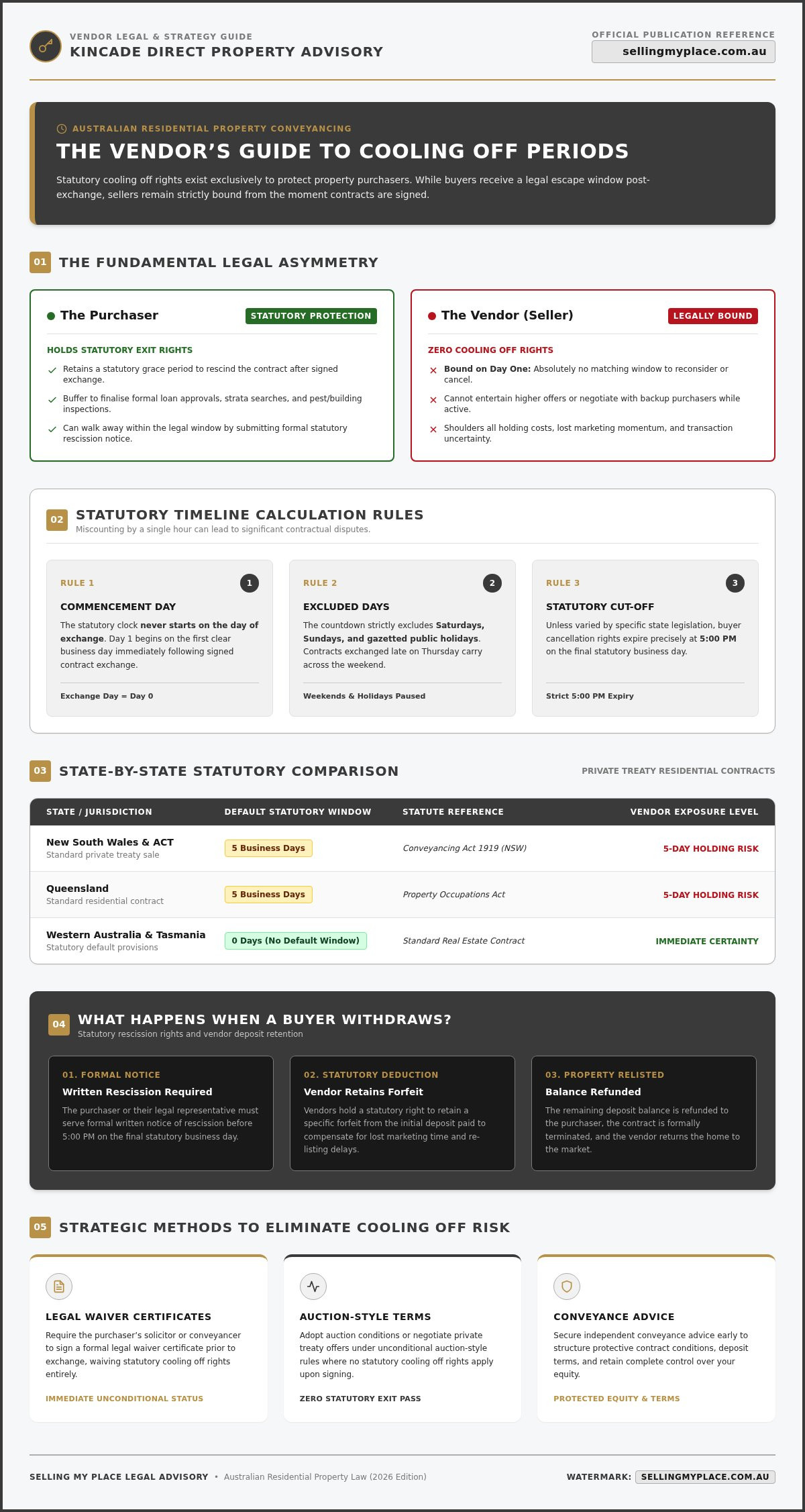
A cooling off period in Australian residential property transactions provides buyers a statutory grace period to withdraw, whereas sellers are legally bound upon contract exchange. When you sign a contract of sale as an owner, you commit entirely to the transaction; you do not receive a matching window to change your mind, reconsider an offer, or entertain a higher bid from another party. True mastery of the sales process begins with understanding the cooling off period when selling from the vendor’s perspective, replacing false assumptions of contractual security with proactive risk management.
Rooted in broader principles of consumer protection, such as the statutory safeguards outlined under a Cooling-off period (consumer rights) framework, this legislative mechanism intentionally balances power between commercial parties and private individuals. However, in private treaty property transactions, that balance tips heavily in the purchaser’s favour. The buyer retains an escape hatch. You, as the vendor, shoulder the ongoing holding costs, lost marketing momentum, and emotional uncertainty until that statutory window shuts.
Why Cooling Off Rights Exist Exclusively for Buyers
State governments instituted statutory cooling off protections to curb aggressive high-pressure sales tactics and prevent rash financial decisions during emotionally charged negotiations. The reprieve offers purchasers crucial breathing space to finalise formal loan approvals, review title covenants, or coordinate pest and building inspections without losing the property to a competing applicant. Vendors, by contrast, operate under no such sudden time pressure. Sellers typically spend weeks preparing documentation, setting reserve prices, and weighing market conditions, which is why Australian law provides no statutory right for vendors to reconsider once contracts are exchanged.
How Business Days and Commencing Hours Are Calculated
Calculating the exact expiration of a cooling off window requires strict attention to the calendar. Miscounting by a single hour can lead to significant disputes over contract validity. While specific statutory timeframes differ between states, the calculation rules follow consistent legal principles across the country:
- Commencement day: The statutory clock never starts on the day of exchange. Day one begins on the first business day immediately following signed contract exchange.
- Excluded days: The countdown excludes Saturdays, Sundays, and gazetted public holidays. A contract signed late on a Thursday afternoon frequently carries over the weekend into the following week.
- Statutory expiry time: Unless varied by specific state legislation, rights expire precisely at 5:00 PM on the final statutory business day.
Gaining clarity on these precise cut-offs ensures you know the exact minute your contract becomes unconditional, allowing you to plan your next transition with genuine confidence.
Cooling Off Periods Across Australia: State-by-State Rules and Penalties
State property acts establish differing statutory cooling off durations, ranging from zero days in Western Australia and Tasmania to five business days in New South Wales and Queensland. Because property law remains state-based rather than national, a private treaty offer structured in one jurisdiction carries fundamentally different default legal obligations than one signed across state borders. Truly understanding the cooling off period when selling requires knowing the precise statutory duration and financial deduction rules applicable to your property’s location.
Comparative Overview of Durations and Financial Forfeitures
If a buyer exercises their statutory right of withdrawal, legislation dictates whether they forfeit a financial sum to compensate you for lost market time. Here is how state statutes handle durations and statutory retention penalties:
- New South Wales and Australian Capital Territory: Provide 5 business days under the Conveyancing Act 1919 (NSW). For contracts exchanged on or after 1 June 2026, NSW requires an updated mandatory cooling off notice. In both jurisdictions, a withdrawing purchaser forfeits 0.25% of the total purchase price from their deposit. For off-the-plan contracts in NSW, this statutory window extends to 10 business days.
- Queensland: Operates under a 5 business day statutory window via the Property Occupations Act 2014 (Qld), with an identical 0.25% purchase price retention penalty.
- Victoria: Under Victoria’s private sale cooling-off rights within the Sale of Land Act 1962 (Vic), purchasers receive 3 clear business days. The statutory forfeit is the greater of $100 or 0.2% of the purchase price.
- South Australia and Northern Territory: South Australia provides 2 clear business days under the Land and Business (Sale and Conveyancing) Act 1994 (SA), requiring any deposit paid above $100 to be refunded. The Northern Territory provides 4 business days under the Law of Property Act 2000 (NT), refunding the full deposit without statutory penalty.
- Western Australia and Tasmania: Neither jurisdiction enforces an automatic statutory cooling off period for residential private treaty contracts. Any cancellation window exists only if negotiated as a special condition.
Exemptions Where No Cooling Off Period Applies
Statutory cancellation periods do not govern every transaction. Across all Australian jurisdictions, residential properties sold under the hammer at a public auction carry zero statutory cooling off rights. In Victoria, this exemption also extends to contracts signed within three clear business days before or after a scheduled public auction. Contracts signed on the day of an auction in NSW are similarly exempt, as are commercial assets, industrial developments, and rural holdings exceeding designated statutory hectarage.
Aligning these legal mechanisms with professional campaign execution ensures you maintain momentum while keeping full legal clarity. Vendors should cross-reference our guide on Professional Residential Property Listing Services to structure contracts properly from the start. If you want strategic oversight tailored to your jurisdiction before accepting private treaty offers, consider reaching out for professional real estate advisory guidance to protect your sale timeline.
What Happens When a Buyer Withdraws During the Cooling Off Window?
Having a buyer pull out of an exchanged contract can feel like a sudden gut punch. You have popped the champagne, begun visualising your upcoming move, and mentally banked the proceeds, only to have the transaction grind to a halt. When an agreement unravels, understanding the cooling off period when selling equips you to handle the legal aftermath calmly, retain your rightful statutory compensation, and relaunch your campaign without missing a beat.
The Legal Mechanics of a Contract Rescission
Walking away from a binding property contract requires rigorous procedural compliance. A purchaser cannot simply change their mind over a phone call or fire off a casual text message to announce their departure. For a rescission to hold legal validity across Australian jurisdictions, precise requirements must be met:
- Written instrument: The buyer or their legal representative must draft and sign a formal notice of rescission.
- Timely service: The notice must be served to the vendor, their nominated conveyance professional, or their licensed representative before the statutory clock runs out.
- Strict deadlines: If the statutory deadline passes by even a single minute without formal delivery, the contract converts automatically into an unconditional agreement.
Managing Deposit Funds and Retained Compensation
Once a valid notice arrives, the contract dissolves. The stakeholder holding the deposit (typically a conveyancer or trust account holder) calculates the statutory deduction applicable to your jurisdiction. If your property is in New South Wales or Queensland, the 0.25% termination fee is deducted directly from the initial holding deposit and transferred directly to you. In Victoria, the retained forfeit is the greater of $100 or 0.2% of the agreed purchase price. The stakeholder promptly refunds the remaining balance to the purchaser. While this statutory forfeit rarely replaces the emotional energy invested, it serves as direct compensation to offset your holding costs and immediate administrative delays.
Re-entering the Market Swiftly Without Losing Value
A cancelled contract does not mean your property is damaged goods. Momentum is everything in residential real estate, so your digital listings across national portals must immediately return to active status. Reach out straight away to runner-up buyers who submitted strong expressions of interest during initial opens; an experienced vendor knows how to leverage previous competition to reignite active bids. Frame the return simply as an administrative collapse tied to buyer circumstances rather than any fault of the home itself. Vendors managing their own journey should tap into established property sale negotiation tips to transform this temporary hiccup into a firm, unconditional offer from a better-qualified purchaser.
Strategic Methods for Sellers to Minimise or Eliminate Cooling Off Risks
You do not have to accept conditional vulnerability as an unavoidable part of selling your home. While statutes give buyers the right to a cooling off window, sophisticated vendors regularly negotiate contracts that neutralise or bypass these statutory delays altogether. Truly understanding the cooling off period when selling means treating contract conditions as active bargaining chips rather than passive formalities. By combining strategic negotiation with proven sale by owner principles, you retain total command over your transaction timeline.
Utilising Legal Waiver Certificates (Section 66W Equivalents)
The most absolute method to lock in a private treaty sale is requiring an unconditional legal waiver. In New South Wales, this is enacted via a Section 66W certificate, signed by the purchaser’s independent solicitor or conveyancer. Similar waiver instruments operate in Queensland and other jurisdictions. This document certifies that an independent legal practitioner explained the contract implications to the buyer and that they deliberately relinquish their cooling off rights. In competitive multi-offer situations, demanding an executed waiver certificate alongside the signed contract immediately separates uncommitted lookers from serious, qualified purchasers.
Rigorous Buyer Pre-Qualification Before Contract Signing
Unconditional certainty begins long before exchange papers hit the table. Screening prospective purchasers during initial discussions weed out buyers who intend to use statutory windows as casual thinking time. You can protect your momentum with three targeted requirements:
- Unconditional pre-approval: Ask to see formal, written finance documentation rather than vague, verbal pre-qualification claims.
- Substantial initial deposit: Insist on a meaningful holding deposit upon signing rather than a token sum; purchasers with substantial capital committed rarely walk away.
- Upfront due diligence: Encourage buyers to complete pest, building, and strata inspections prior to signing, eliminating standard rescission excuses.
Structuring Unconditional Contract Terms with Advisory Support
Partnering with seasoned property advisors ensures your contract is engineered for vendor protection from the outset. Rather than settling for open-ended finance clauses that drag on for weeks, specialized conveyance advice allows you to insert strict sunset clauses, tight five-day turnaround windows, and mandatory deposit forfeiture clauses. Ready to lock in a rock-solid sale while retaining your full equity? Speak with our property advisors to establish the right protective terms before you accept your next offer.
Maximising Sale Certainty and Profit: The Commission-Free Advisory Advantage
Traditional commission incentives often reward transaction speed over transaction security. A conventional agent, eager to bank a commission, may urge you to accept a conditional private treaty offer quickly, brushing aside the genuine risks of a cooling off cancellation. True mastery and understanding the cooling off period when selling means partnering with advisors whose goals mirror your own: achieving an unconditional contract with minimal friction. Accurate pricing plays a crucial role in preventing buyer second thoughts during this vulnerable window; consult our guide on how to determine market value of a home in australia to ensure your reserve aligns perfectly with buyer expectations.
Why Traditional Commission Models Increase Seller Vulnerability
Percentage-based commissions create an inherent conflict of interest. Agents are often motivated to slap an "under contract" banner on a listing as rapidly as possible, nudging owners into accepting conditional offers without adequate purchaser screening. When a buyer rescinds during the statutory window, the vendor carries the full burden of lost marketing momentum and emotional fatigue. By contrast, a flat-fee advisory model removes sales commission pressure entirely. The focus remains squarely on vetting genuine buyers, demanding strong contract terms, and protecting your equity.
Professional Support Without the Percentage Cut
Securing an unconditional sale does not require sacrificing your equity. Through an Agent Advisory Service, vendors access dedicated pre-sale property consulting, strategic buyer vetting, and professional conveyance advice tailored to Australian property acts. Sellers save an average of $20,000 in traditional real estate commissions while maintaining total command over their listing campaign. Retaining your full proceeds gives you the financial breathing room to negotiate firmly, rather than accepting weak conditional terms out of anxiety.
Next Steps to Secure Your Property Sale Confidently
Building transaction certainty begins well before your first open home. Work alongside experienced legal professionals to draft a comprehensive disclosure pack upfront, address potential building quirks early, and establish strict timeframes that discourage speculative offers. A thorough understanding the cooling off period when selling transforms what many consider an anxious waiting game into a well-managed legal milestone. Ready to take control of your sale and protect your net profit? Connect with the team at Kincade International Direct Sales to structure a confident, commission-free campaign.
Taking Charge of Your Property Sale and Future Equity
A successful property transition shouldn’t leave you sitting on edge, second-guessing whether a buyer will follow through. Thoroughly understanding the cooling off period when selling gives you the strategic upper hand, whether you negotiate upfront legal waiver certificates, establish strict contract timeframes, or retain statutory deposits should an uncommitted purchaser pull out.
You deserve professional support that safeguards your hard-earned wealth without cutting into your proceeds. With our dedicated Agent Advisory Service, you receive tailored pre-sale consulting and conveyance guidance backed by a listed until sold infrastructure across Australia with zero time restrictions. By eliminating traditional percentage models, sellers save an average of $20,000 in agency commissions while keeping full command of every negotiation.
Ready to achieve complete contract certainty? Take control of your sale and protect your equity with Selling My Place, and move forward into your next chapter with genuine peace of mind.
Frequently Asked Questions
Can a seller cancel a contract during the cooling off period in Australia?
No, sellers cannot cancel a contract during the cooling off period. In Australian residential property law, statutory cooling off rights protect purchasers exclusively. The moment you sign and exchange contracts, you are legally committed to completing the transaction under the agreed conditions. That is why understanding the cooling off period when selling is so vital; vendors hold no corresponding legal right to reconsider or entertain better offers once exchange occurs.
How much money does a buyer lose if they exercise their cooling off rights?
The financial forfeiture depends entirely on the state or territory governing the transaction. In New South Wales, Queensland, and the Australian Capital Territory, withdrawing buyers forfeit 0.25% of the total purchase price from their initial deposit. In Victoria, the penalty is the greater of $100 or 0.2% of the price. In South Australia, any deposit over $100 is refunded, while the Northern Territory enforces no statutory financial penalty.
Do cooling off periods apply when purchasing property at an Australian auction?
No, cooling off periods never apply to residential properties bought under auction conditions anywhere in Australia. When the hammer falls, the winning bidder must immediately sign the contract and pay the agreed deposit, creating an unconditional, legally binding agreement on the spot. In certain jurisdictions, this complete exemption also covers contracts exchanged within designated business days immediately preceding or following an advertised public auction.
What is the exact legal purpose of a Section 66W certificate?
A Section 66W certificate, commonly used under New South Wales conveyancing legislation and mirrored in other jurisdictions, legally waives a purchaser’s statutory cooling off entitlements. The certificate must be signed by the buyer’s independent solicitor or conveyancer, confirming they explained the legal effect of waiving these rights. For vendors, securing this executed certificate alongside an exchanged contract immediately locks in an unconditional, non-refundable sale.
How do public holidays and weekends impact statutory cooling off timeframes?
Public holidays and weekends pause the statutory countdown entirely across all Australian jurisdictions. The cooling off clock only ticks forward on official business days, starting from the first business day following contract exchange. If you exchange contracts on a Friday afternoon, Saturday and Sunday do not count toward the statutory tally. Similarly, gazetted public holidays extend the expiry deadline until precisely 5:00 PM on the final business day.
Is a subject to finance clause identical to a statutory cooling off period?
No, a subject to finance clause is fundamentally different from a statutory cooling off window. Cooling off is an unconditional statutory right enabling purchasers to walk away for any personal or financial reason by paying a nominal forfeit. Conversely, a finance clause is a negotiated contract condition. If a buyer’s lender formally rejects their application, the buyer can terminate the contract and receive a full deposit refund without statutory penalty deductions.
Can vendors legally refuse to grant a cooling off period to a buyer?
Vendors cannot unilaterally strip away statutory rights, but you can legally insist on unconditional terms before accepting an offer. Through strategic negotiation and professional conveyance advice, you can require purchasers to provide a formal legal waiver certificate, like a Section 66W, at exchange. When understanding the cooling off period when selling, establishing unconditional expectations upfront prevents uncommitted buyers from tying up your home under conditional statutory terms.