Paying for a vendor advocate doesn’t mean handing over the sale. In the vendor advocate vs selling privately decision, the key difference is who manages the process: an advocate advises you and monitors a selling agent, while selling privately means taking a more active role yourself. With an advocate, you still need a selling agent and pay the agent’s commission under the agency agreement.
It’s understandable to want control over a major sale while also seeking support with the details. The right approach depends on how involved you want to be, how comfortable you are handling the sale and whether you’d value help assessing an agent’s strategy and agreement.
This guide explains what a vendor advocate does, when the service may suit you and how it compares with selling privately. It covers responsibilities, fees and the involvement each option requires, helping you choose a clear, manageable path.
Key Takeaways
- A vendor advocate supports the seller by advising on the agent and campaign, while the selling agent manages the sale itself.
- Choose the approach that matches how involved you want to be, from making the decisions yourself to having guidance through the process.
- Understand how an advocate is paid, including whether the arrangement involves a direct fee or a share of the selling agent’s commission.
- Compare agent commission and marketing arrangements by looking at what each covers and how the proposed campaign fits your property.
- If you prefer a sale-by-owner approach, residential listing services and pre-sale property consulting can help with practical parts of preparing and marketing your property.
What Is a Vendor Advocate, and When Is One Worth It?
A vendor advocate advises the seller and monitors the sale, while a selling agent markets the property and deals with buyers. The distinction matters whether you appoint an advocate before choosing an agent or bring one into an existing campaign.
Advocate and selling agent roles
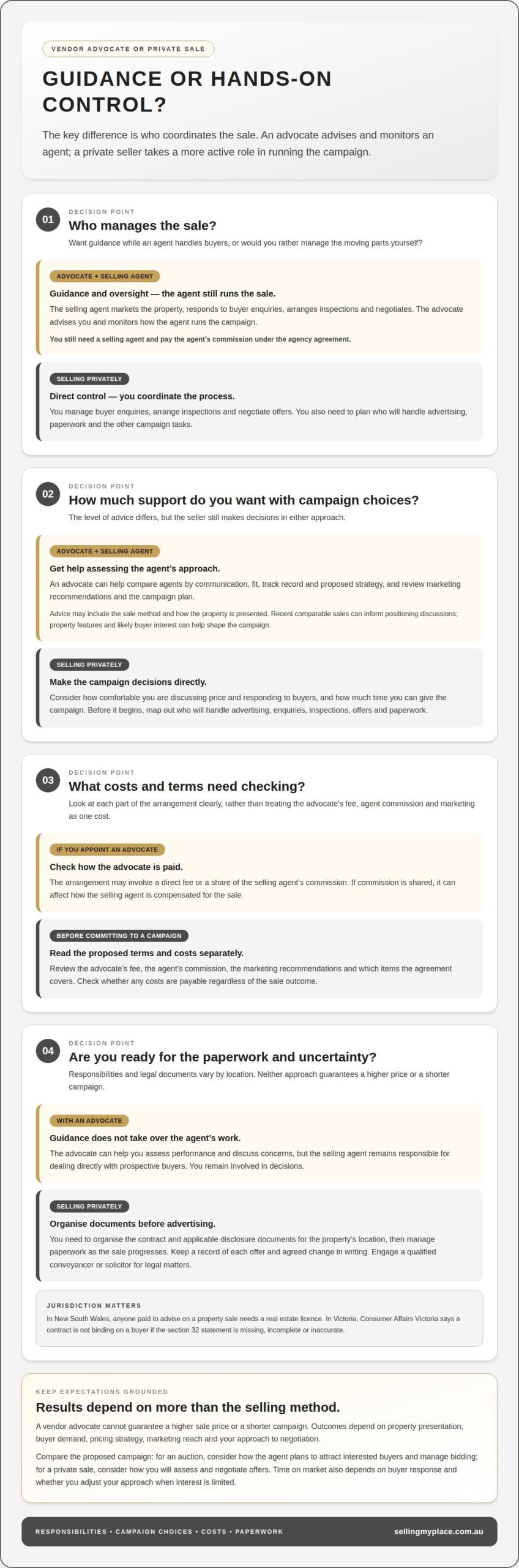
A selling agent handles marketing, buyer enquiries, inspections and negotiations. A vendor advocate advises you and monitors how the agent runs the campaign. You still need a selling agent if you appoint an advocate, and pay the agent’s commission under the agency agreement when the property sells.
For example, after appointing an agent, you might ask an advocate to review the agent’s communication, campaign progress and response to buyer interest. The advocate can help you assess performance and discuss concerns, but the selling agent remains responsible for dealing directly with prospective buyers. Consider whether you want independent guidance, rather than expecting the advocate to take over the agent’s work.
Marketing and sale method advice
An advocate can help compare agents based on communication, fit, track record and proposed strategy. They can also review marketing recommendations and the campaign plan, helping you understand each proposal before committing. A shortlist built around these factors can lead to a more considered choice than relying on familiarity alone.
Advice may also cover the sale method and how the marketing plan presents your property to buyers. Recent comparable sales can inform conversations about positioning, while the property’s features and likely buyer interest help shape the campaign. Rules differ between Australian jurisdictions: in New South Wales, anyone paid to advise on a property sale needs a real estate licence. In Victoria, Consumer Affairs Victoria says a contract is not binding on a buyer if the section 32 statement is missing, incomplete or inaccurate.
Fees and selling costs
A vendor advocate may be paid through a direct fee or a share of the selling agent’s commission. The arrangement affects how the advocate is compensated, so read the proposed terms alongside the agency agreement. If commission is shared, it can affect how the selling agent is compensated for the sale.
Consider the advocate’s fee separately from the agent’s commission and campaign marketing costs. Review the agent’s recommendations, which marketing items the agreement covers and whether any costs are payable regardless of the sale outcome. These details help you understand the full arrangement before appointing an advocate or proceeding directly with an agent.
Comparing vendor advocates with selling privately
These options differ in who coordinates the sale and how much you handle yourself. Your circumstances, available time and confidence negotiating with buyers all matter.
Choosing between advocacy and private selling
A vendor advocate provides advice and oversight, while a private sale puts you in charge of the process. You manage buyer enquiries, arrange inspections and negotiate offers yourself. Consider how comfortable you are discussing price and responding to buyers, as well as how much time you can give the campaign.
An advocate may suit sellers who want support assessing an agent’s approach. Selling privately may appeal if you prefer making decisions directly and staying involved at each step. Before appointing an agent or selling privately, map out who will handle advertising, enquiries, inspections, offers and paperwork. This simple division of responsibilities can reveal gaps before the campaign begins.
Sale price and time on market
A vendor advocate cannot guarantee a higher sale price or a shorter campaign than selling through an agent or privately. Results depend on factors such as property presentation, buyer demand, pricing strategy, marketing reach and your approach to negotiation.
Compare the proposed campaign rather than assuming one selling method will produce a better result. For an auction, consider how the agent plans to attract interested buyers and manage bidding. For a private sale, consider how you’ll assess and negotiate offers. Time on market also depends on buyer response and whether you adjust your approach when interest is limited.
Private sale requirements and paperwork
Legal requirements and sale documents vary across Australian states and territories. As a private seller, you need to organise the contract and applicable disclosure documents for the property’s location, then manage the paperwork and transaction as the sale progresses. Engage a qualified conveyancer or solicitor for legal matters.
Keep the process organised: identify the documents required, arrange them before advertising, and record each offer and agreed change in writing. Paperwork can affect whether a buyer is properly informed and how the transaction proceeds, so include document preparation in your campaign plan rather than leaving it until an offer arrives. Engage a qualified conveyancer or solicitor for legal matters.
Private selling gives homeowners direct control, but it also means taking responsibility for the campaign’s moving parts. An advocate offers guidance while an agent handles the sale; it doesn’t remove the need for an agent or the seller’s decisions. If a private route feels right, a sale-by-owner approach can be a practical starting point for organising the next steps.
Reasons a seller might use an advocate
A property sale can involve agent selection, campaign decisions, buyer conversations and practical arrangements. Most people sell a property once every ten or twenty years, so sellers may value guidance through unfamiliar steps. An advocate can help narrow the agent shortlist, review the proposed approach and give the seller one point of contact for questions.
That support may matter if you have limited time to research agents or coordinate sale details. Preparing marketing, considering commission, handling legal matters and managing practical tasks all take time. An advocate can help you work through decisions with the selling agent, rather than organising every conversation independently.
Support with agent selection and oversight
Agent selection is a key reason to consider advocacy. An advocate can compare agents based on communication, fit, track record and strategy, then help review the agency agreement and campaign proposal. This may suit sellers who are unsure how to assess an agent’s plan or want another perspective before making an appointment.
After appointment, the advocate can monitor the selling agent’s performance and help you raise concerns about campaign progress. For example, if the agreed marketing plan is underway but buyer interest is limited, you can discuss the situation with the advocate and agent. That conversation can clarify what has happened and which next steps are realistic.
Some sellers prefer support with sale details so they can focus on the outcome. An advocate may provide a more guided experience, while the selling agent remains responsible for marketing, buyer enquiries and negotiations. Advocacy adds advice and oversight, but you still need to make decisions and approve the agent’s work.
Practical help and realistic expectations
Some vendor advocates also offer property cleaning, preparation or clearing for a fee. If your home needs work before marketing, this support may help coordinate practical tasks alongside agent selection. Identify which jobs will most improve presentation and which can be left alone, rather than treating every suggested improvement as essential.
Advocacy may be less useful if you want to manage every part of the campaign yourself or already feel confident choosing and overseeing an agent. It also doesn’t remove the selling agent’s commission under the agency agreement. The right choice depends on whether the guidance and coordination suit your circumstances.
Keep expectations realistic: an advocate can help assess strategy and agent performance, but cannot control buyer demand or guarantee a particular sale result. Before appointing one, list the decisions where you want support, such as comparing agents, reviewing marketing or tracking campaign progress. This helps you judge whether the service meets your needs.
How much does a vendor advocate charge in Australia, and who pays the fee?
Vendor advocates in Australia may use different fee structures. An advocate may be paid through a direct fee or a share of the selling agent’s commission. Understand who receives each payment and how it relates to the agent’s commission before appointing an advocate.
Direct fees and commission sharing
With a direct-fee arrangement, you pay the advocate according to the agreed terms. Check how the fee is calculated, when it’s payable and what work it covers. For example, the agreement should state whether the fee covers agent selection, campaign advice or oversight after an agent is appointed.
With commission sharing, the advocate receives an agreed share of the selling agent’s commission. You still pay the agent’s commission under the agency agreement when the property sells. Ask how the share affects the amount paid to the agent and whether the advocate’s payment changes if the sale price or campaign outcome differs from expectations.
State rules can also matter. In New South Wales, a vendor advocate must be actively licensed to legally share a real estate agent’s commission. When comparing payment models, remember that a direct fee and a commission share are different arrangements, and commission-sharing requirements apply in that state.
What to review before agreeing
Before signing, read the advocate’s agreement alongside the selling agent’s agency agreement. Focus on these points:
- Payment method: Is the advocate paid a direct fee or through commission sharing?
- Payment trigger: When does the fee become due, such as on appointment or after settlement?
- Scope: Does the agreement cover agent selection, campaign advice, or ongoing performance reviews?
- Other costs: Are marketing expenses and the agent’s commission separate from the advocate’s fee?
These details reveal the full payment structure, beyond the headline fee. A direct fee is distinct from commission, while a shared commission links the advocate’s payment to the agent’s commission arrangement. Compare what each model pays for, not just the payment label.
The key question isn’t simply “How much?” but what guidance the fee covers and how payment works. If you want help choosing an agent, you may value a clearly defined advisory arrangement; if you want ongoing campaign oversight, consider what work the fee includes. Use the written terms to understand who pays, when payment is due and how it relates to the sale.
What are the typical real estate agent commission rates and marketing costs in Australia?
Real estate agent commission and marketing costs depend on the property, location, agent and campaign plan. No single figure applies to every Australian sale, so compare written proposals by what they cover, how payment is calculated and which costs are separate from commission.
Commission may be a percentage of the sale price or a fixed amount. The agency agreement should explain the calculation, when commission is payable and whether other charges are separate. A percentage-based fee changes with the final sale price; a fixed fee does not. Compare the full agreement, not just the headline rate.
Compare commission arrangements
Ask each agent to outline the proposed commission and the work it covers. Check whether the fee includes the services you expect and note any conditions tied to the agreement or sale. If an advocate shares commission, factor that in too: you still pay the selling agent’s commission under the agency agreement when the property sells.
Marketing costs are a separate part of a campaign budget. They may depend on the advertising channels chosen, the property’s presentation needs and the agent’s recommendations. An online listing, photography, floorplans and printed material may be proposed, but the package varies. Review each item and its purpose before agreeing to the spend.
Assess the marketing plan
Ask how each proposed item supports the campaign and reaches its intended buyers. Photography and floorplans, for example, can present the home clearly in listing material, while broader advertising may aim to reach more prospective buyers. The key question is whether the recommendation suits your property and marketing goals, not whether the plan contains the most items.
For a fair comparison, place agent proposals side by side and separate commission from marketing expenses. Check when each cost is payable, whether it’s due upfront or later, and what happens if the property doesn’t sell. Then consider the full campaign cost alongside the services and strategy offered.
A neighbourhood market report can put an agent’s pricing and campaign recommendations in context. Use recent comparable sales and property-specific details to discuss whether the proposed approach is realistic. This won’t set the commission or marketing budget, but it gives you a clearer basis for assessing the plan against your sale priorities.
To talk through the selling costs and listing approach for your property, discuss your sale options.
Kincade International Direct Sales
Kincade International Direct Sales can help Australian homeowners who want a practical alternative to appointing a traditional selling agent. Its residential property listing services support owners pursuing a sale-by-owner approach, while pre-sale property consulting and neighbourhood market reports can inform preparation and pricing decisions. Buyer representation is also available for people who need support on the purchasing side of a property move.
If you’re weighing advocacy against managing the sale yourself, these services offer a way to consider what support would help with your particular plans. You can contact Kincade International Direct Sales to discuss your property and the next step that suits you.
Choose a sale path that fits your next chapter
Before deciding, consider the role you want once your property is ready for market. Do you want to manage buyer conversations and campaign decisions yourself, or would advice and oversight make the process more manageable? Choosing between a vendor advocate and selling privately comes down to the level of involvement and support that suits your circumstances.
If you’re planning a sale, Kincade International Direct Sales offers Residential Property Listing Services, Buyer Representation and Pre-Sale Property Consulting. These options can support different points in a property move, whether you’re preparing to sell, exploring a sale-by-owner approach or buying your next home. You can discuss which direction aligns with your plans and the practical help you’re looking for.
Talk with Kincade International Direct Sales about your next step, and move forward with a clearer sense of what suits you.
Frequently Asked Questions
Do I still pay the selling agent’s commission?
Yes. If you appoint a selling agent, the agency agreement sets out the commission payable when the property sells. A vendor advocate’s fee is separate and may be a direct fee or a share of the agent’s commission. If you sell privately without an agent, there’s no selling-agent commission under an agency agreement, but you still need to account for marketing and sale costs.
How do you handle pricing?
Build a pricing view from comparable sales, your property’s condition and features, and current buyer interest. Supporting a valuation with at least three comparable prices gives you a practical basis for discussion. For example, compare homes with similar attributes and consider how differences affect their appeal. If you’re selling privately, keep the asking price and any changes consistent across your advertising and buyer conversations.
What does a vendor advocate do when selling a property in Australia?
A vendor advocate advises you during the sale and can support agent selection and campaign oversight. For example, they may help assess an agent’s proposed strategy, review the agreement or discuss campaign progress. They don’t replace the selling agent’s role in dealing directly with buyers. You remain involved in decisions, including whether to accept an offer or change the campaign.
What is the difference between a vendor advocate and a selling agent in Australia?
A selling agent markets the property and handles buyer enquiries and negotiations. A vendor advocate advises you about the agent and sale process. If an offer arrives, for example, the agent communicates with the buyer, while the advocate can help you consider the proposed terms. Their roles differ, even when both are involved in the same sale.
Can you sell a house privately in Australia without a real estate agent?
Yes. Australian homeowners can sell privately in every state and territory, but paperwork requirements vary by location. In New South Wales and the ACT, a contract of sale is required before listing. In Victoria, the section 32 vendor statement must be provided before contracts are signed. Engage a qualified conveyancer or solicitor to handle legal matters and prepare the required documents for your sale.
What are the pros and cons of using a vendor advocate versus selling privately?
A vendor advocate can advise on agent selection and campaign decisions, which may help if you want guidance through unfamiliar steps. Selling privately gives you direct control, but you take responsibility for advertising, buyer enquiries, inspections and negotiations. Consider a typical week during the campaign: if you can manage those tasks and respond promptly to buyers, private selling may suit you; if you want advice, advocacy may be a better fit.