Calculating the Total Cost of Selling Property in Australia (2026 Guide)
What if your sale price looks strong, but the amount left after settlement is much lower than you expected? When calculating total cost of selling property, the difference often comes down to expenses that vary with your approach, from agent fees and marketing to conveyancing and mortgage discharge costs.
It can be hard to tell which charges are essential, which are optional and whether a commission-based service or flat-fee approach offers better value. Comparing headline fees alone can be misleading. A more useful comparison includes everything each option covers and how the full set of costs affects your estimated proceeds.
This guide will help you build a property-specific estimate, compare selling approaches on equal terms and work out what may remain after settlement. It covers common expenses, less obvious items to check and costs that apply only in certain circumstances. You’ll also find out what to confirm with your conveyancer, lender, tax adviser or service provider, so you can plan with fewer surprises.
Key Takeaways
- When calculating total cost of selling property, group expenses by when they’re paid: before marketing, during the sale and at settlement.
- Use an itemised checklist and mark each cost as applicable, not applicable or awaiting a written quote.
- Compare commission and flat-fee options using the same sale scenario. Check inclusions, exclusions, payment timing and contract terms.
- Estimate potential proceeds by starting with your expected sale price, then subtracting relevant expenses and settlement deductions.
- Keep optional preparation spending separate from transaction costs, and verify unclear items with the relevant professional or provider.
How to approach calculating total cost of selling property
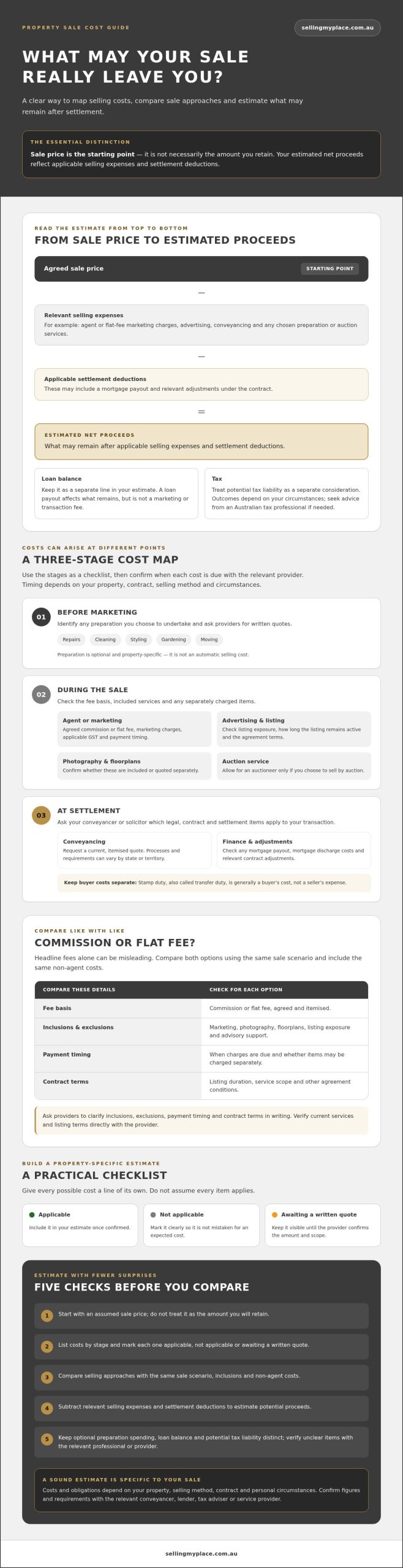
Start by separating the amount your property sells for from the costs and deductions associated with the sale. The sale price is the agreed amount, not necessarily what you retain. Your estimated net proceeds are what remains after applicable selling expenses and settlement deductions, including any loan payout. Tax outcomes depend on your circumstances, so treat tax as a separate consideration and seek advice from an Australian tax professional if needed.
Costs also fall due at different stages. You might pay some expenses before the property is listed, incur others during marketing, then have certain amounts accounted for at settlement. Timing and costs depend on your property, contract, selling method and personal circumstances. First identify what may apply, then confirm the figures and obligations with the relevant professionals and providers.
Selling costs versus sale price and net proceeds
Think of the sale price as the starting point for your estimate, not the final result. Sale-related expenses may include agent or flat-fee marketing charges, advertising, conveyancing, property preparation or an auctioneer if you choose to sell by auction. At completion, settlement may also involve paying out a mortgage and accounting for relevant adjustments under the contract.
For a working estimate, subtract expected selling costs and applicable settlement deductions from your assumed sale price. Keep the loan balance and any potential tax liability on separate lines. Both can affect what remains, but neither is the same as a marketing or transaction fee.
Which costs vary between Australian property sales?
Some costs are common to many sales, while others depend on the property and the approach you choose. Marketing inclusions can differ, for example. Check whether photography and floorplans are included or quoted separately. Styling, repairs, auction services and mortgage discharge costs may apply only in particular circumstances. Stamp duty, also called transfer duty, is generally a buyer’s cost, not a seller’s expense.
Conveyancing helps manage the transfer of property title. You can read more about the legal process of conveyancing, but the work and requirements for an Australian sale can vary by state or territory. Don’t rely on a single national fee schedule. Ask a conveyancer or solicitor for a current, itemised quote, and check the settlement terminology and requirements that apply to your transaction.
Make a property-specific list and mark each line as applicable, not applicable or awaiting a written quote. Ask providers to clarify inclusions, exclusions, payment timing and contract terms. You can compare a flat-fee marketing option with other sale approaches, but use the same assumptions and include the same non-agent costs. This gives you a fairer view of likely expenses and potential proceeds.
Which property-selling costs should you include in your estimate?
A reliable estimate reflects the costs that apply to your sale, not a standard list where every item is assumed. For calculating total cost of selling property, create a line for each category below and mark it applicable, not applicable or awaiting a written quote. Ask providers what’s included, what may be charged separately and when payment is due.
Marketing, preparation and professional support
Start with the sale method and the services you plan to use. If you’re comparing an agent with a flat-fee marketing option, check the fee basis and service scope side by side. Confirm whether photography, floorplans, listing exposure and advisory support are included or charged separately. Ask how long the listing remains active under the agreement, and verify the current inclusions and listing terms directly with the provider.
- Agent or marketing: Record the agreed commission or flat fee, any marketing charges, applicable GST and payment timing. Don’t compare headline fees without checking what’s included.
- Property preparation: Consider repairs, cleaning, styling, gardening or moving only if they suit the property and your plans. These are choices to assess after inspecting the home, not automatic selling costs.
- Professional support: Note any separate advice or services you intend to use. Request a written quote that sets out the scope.
Conveyancing, finance, tax and settlement items
Ask a conveyancer or solicitor to identify likely legal, contract and settlement charges for your transaction. Processes and requirements can vary by state or territory, so request a current, itemised estimate rather than relying on a general figure.
- Finance: If there’s a mortgage, ask your lender for a current payout figure and whether any discharge-related amounts apply. Use a figure that reflects your expected settlement timeframe.
- Settlement: Ask your conveyancer which adjustments or deductions may apply under your contract and how they’ll appear in the settlement statement.
- Tax: Don’t guess a potential capital gains tax amount. Your circumstances matter. Speak with a qualified tax adviser and consult the ATO’s guidance on calculating Capital Gains Tax.
Once you’ve gathered the relevant quotes and figures, you’ll have a more useful estimate for your property. If you’re considering a flat-fee marketing approach, you can ask about property marketing options and confirm which inclusions and terms apply to your sale.
How do commission and flat-fee selling approaches compare?
For a fair comparison, hold the sale scenario constant. Use the same property and estimated sale price, then keep conveyancing, finance, preparation and other applicable expenses identical for each option. Change only the selling service and the costs that genuinely differ. This makes calculating total cost of selling property more useful than comparing two headline fees in isolation.
With a commission-based arrangement, the fee is generally calculated as a percentage of the agreed sale price, so the amount changes if the final price changes. A flat fee is a set service charge under the provider’s written terms. For either option, confirm the fee basis, additional charges and payment timing in the agreement.
Compare the complete service, not just the headline fee
Ask what each option includes, such as professional photography, floorplans, listing exposure and advisory support. Check for exclusions and extra charges, as well as cancellation terms, listing duration and any conditions that could affect the final bill. Request the details in writing so you can compare like with like. A lower fee doesn’t automatically mean weaker service or better value. The right fit depends on the support and inclusions you need.
| Comparison point | Commission-based arrangement | Flat-fee arrangement |
|---|---|---|
| Fee basis | Percentage of the agreed sale price. Confirm how it’s calculated. | Set service charge. Confirm what the written terms cover. |
| Inclusions and exclusions | Record photography, floorplans, listing exposure and advice, plus anything charged separately. | Record the same items and note any exclusions or optional extras. |
| Payment timing | Check when the fee becomes payable and how payment is arranged. | Confirm payment timing and any conditions in the agreement. |
| Contract terms | Check cancellation provisions, listing duration and other conditions. | Check the same terms, including how long the listing remains active. |
How a flat-fee model fits into the calculation
Kincade International Direct Sales is one example of commission-free, flat-fee property marketing. Its service includes professional photography, floorplans, global property listings and advisory support. Confirm current inclusions and listing terms with the provider before using them in your estimate.
To compare estimated net proceeds, start with the same assumed sale price for both approaches. Subtract each option’s service and marketing charges, then deduct the same conveyancing, finance, preparation and settlement items that apply to your property. If the final sale price differs from your estimate, recalculate any percentage-based fee using the actual agreement terms. This is an informed comparison, not a guarantee of what you’ll retain.
How to calculate your estimated selling costs step by step
A worksheet brings quotes and settlement details together in one estimate you can update as the sale progresses. Keep the assumed sale price separate from expenses, and label each figure as confirmed, estimated or unknown. Use A$ placeholders until you have figures for your property.
Gather the figures needed for a property-specific estimate
Collect written quotes and check what each covers, including marketing inclusions, conveyancing, any preparation work and your lender’s current payout information. Base your sale-price assumption on relevant market evidence rather than an unsupported online estimate. For help developing that assumption, see this guide to determining a home’s market value.
Build your worksheet
- Estimated sale price: A$[amount] | Status: [estimated/unknown]. Note the evidence and date behind your assumption.
- Agent or flat-fee service: A$[amount] | Status: [confirmed/estimated/unknown]. Record the fee basis and written agreement terms.
- Marketing and listing expenses: A$[amount] | Status: [confirmed/estimated/unknown]. List photography, floorplans, listing exposure and any separately quoted items.
- Conveyancing and transaction charges: A$[amount] | Status: [confirmed/estimated/unknown]. Use an itemised estimate for your state or territory and transaction.
- Property preparation: A$[amount] | Status: [confirmed/estimated/unknown]. Include only work you’ve decided is worthwhile, such as cleaning, repairs or styling.
- Finance payout and discharge items: A$[amount] | Status: [confirmed/estimated/unknown]. Enter the lender’s current payout figure and note any applicable charges.
- Settlement adjustments or other deductions: A$[amount] | Status: [confirmed/estimated/unknown]. Confirm relevant items with your conveyancer.
- Potential tax liability: A$[amount] | Status: [adviser to confirm]. Don’t treat this as a generic estimate. Ask a qualified tax adviser about your circumstances.
Estimated net proceeds = assumed sale price − selling expenses − applicable settlement deductions. Keep tax and loan figures clearly identified so you can see what’s confirmed and what still needs checking. Don’t treat an unknown as a confirmed charge. Flag it and follow up with the relevant provider.
To stress-test your estimate, repeat the calculation with more than one plausible sale-price assumption. Apply the same non-agent expenses to each scenario, changing only figures that genuinely depend on the sale price or agreed terms. These are planning scenarios, not promises of a result. The agreed sale terms can also affect the final outcome, so review these property sale negotiation tips.
Update the worksheet when quotes, the lender payout figure or sale assumptions change. For help reviewing property marketing options and inclusions, contact Kincade International Direct Sales.
How to manage selling costs and choose your next step
Once your worksheet is taking shape, make each line clear and verifiable. A low headline fee can look appealing, but it’s difficult to judge until you know what’s included, what may cost extra and when payment is due. Ask providers for written details, then update your estimate rather than relying on verbal assurances.
Reduce uncertainty without overlooking essential support
Request an itemised quote that identifies inclusions, exclusions, additional charges, payment timing and relevant contract terms. For marketing services, check the scope of professional photography, floorplans, listing exposure and advisory support. A clear comparison helps you decide whether the service suits your needs, rather than simply choosing the lowest quoted fee. For a closer look at what listing services can cover, read this residential property listing services guide.
Keep optional preparation spending separate in your worksheet. Cleaning, repairs or styling may be useful for your property, but they’re not automatic costs for every seller. Transaction and settlement items also need checking with the relevant professionals. Ask your conveyancer about the sale process and settlement figures, your lender for current payout information, and a qualified tax adviser about any tax questions that apply to your circumstances.
Choose a selling approach that fits your cost plan
Use the same worksheet to compare a commission-based arrangement with a flat-fee option. Keep your sale-price assumptions and non-agent expenses consistent, then compare the service fee, inclusions, exclusions, payment timing and contract terms. This gives you a more grounded view of estimated net proceeds than comparing headline charges alone. The aim of calculating total cost of selling property is to understand the whole picture, not to assume one method will suit every owner.
Kincade International Direct Sales is an option for owners considering commission-free marketing through a flat-fee model. Its service includes professional photography, floorplans, property listings and advisory support. Confirm current inclusions and listing terms directly before adding them to your estimate.
If you’d like to explore whether commission-free marketing fits your plans, discuss your property sale. Ask about the service scope and terms so you can assess the option without assuming a particular sale price or saving.
Make your next property-sale decision with confidence
Calculating total cost of selling property is easier with a property-specific estimate than with a headline fee or broad rule of thumb. List each expense and settlement deduction, mark what’s confirmed and what still needs a quote, then check relevant figures with your conveyancer, lender or tax adviser.
Before choosing a selling approach, compare the full service scope and written terms. Commission-free, flat-fee marketing may suit some sellers, but value depends on the inclusions and support you need. Kincade International Direct Sales describes professional photography, floorplans and advisory support as service inclusions. Confirm current inclusions and listing terms directly before comparing them with other options.
A clear estimate and a considered comparison can help you decide what to do next. The questions and answers below cover common points sellers may need to check.
Frequently Asked Questions
Is the agent commission the only major cost when selling a property?
No. Depending on your sale, the estimate may also include marketing, conveyancing, property preparation, finance-related amounts and settlement deductions. Some items may be included in a provider’s fee, while others are charged separately or are optional. Ask for written, itemised terms so you can see what each service covers. Then check which expenses actually apply to your property before comparing selling approaches or estimating your proceeds.
What costs should I include when calculating the total cost of selling property?
Start with the selling service and marketing, then check conveyancing, property preparation, moving, lender-related amounts and any tax questions that may apply. Not every seller will incur every cost, and some services may be bundled. Create an itemised list and label each figure as confirmed, estimated or not applicable. Verify transaction-specific charges with the relevant provider or professional instead of treating a general checklist as a final quote.
How do I calculate how much money I may keep after selling?
Begin with a realistic sale-price assumption, then subtract your selling expenses and relevant settlement deductions. Use verified figures where possible, and clearly mark estimates or unknowns. The result is an estimate, not a guaranteed amount. Your final proceeds may depend on the contract, lender’s payout information, transaction costs and personal tax circumstances. Confirm the final figures with your conveyancer and lender as settlement approaches.
Is a flat-fee property service cheaper than a commission-based agent?
It depends on the agreed fee, sale circumstances, service inclusions and any extra charges. Compare both approaches using the same sale-price assumption and identical non-agent expenses. Check the written terms for marketing, photography, floorplans, advisory support, listing duration and payment timing. Kincade International Direct Sales offers commission-free property marketing through a flat-fee model, with service inclusions to verify. A headline fee alone can’t establish overall value.
Can I deduct property selling costs from capital gains tax?
Tax treatment depends on the property, your ownership history and individual circumstances. Don’t assume every selling expense can be deducted or estimate your tax outcome from a general guide. Keep invoices and transaction records, then ask a qualified Australian tax adviser which costs may be relevant to your situation and what evidence you’ll need. This helps you avoid treating a general explanation as personal tax advice.
What happens if my selling-cost estimate changes before settlement?
Update your worksheet when you receive a revised quote, agree to additional work or obtain current lender or conveyancing information. Keep earlier figures and assumptions so you can track what changed and why. Before settlement, ask the relevant professionals to confirm outstanding amounts and explain any adjustments. An estimate is a planning tool, not a final proceeds statement, so don’t rely on an older version as the settlement figure.
Do selling costs vary between Australian states and territories?
Yes. Some conveyancing steps, transaction requirements and related charges may vary by state or territory, while other costs depend on your property and chosen services. A national guide can help you identify cost categories, but it can’t confirm every local requirement or charge. Ask a conveyancer familiar with the property’s jurisdiction to check which costs apply and when they’re payable. Request a current, itemised estimate for your transaction.
Ready to compare flat-fee marketing with your other selling options? Discuss your property-selling options with Kincade International Direct Sales and confirm the service inclusions and terms for your sale.
How to Sell My Townhouse Privately in Australia: The 2026 Commission-Free Guide
Handing over A$20,000 of your hard-earned equity to a real estate agent just for a few weekend inspections feels less like a partnership and more like a ransom. If you’ve been wondering how to sell my townhouse privately australia, you aren’t alone in wanting a more transparent, cost-effective way to move on to your next chapter. It’s completely natural to feel a bit protective of your profit; after all, you’re the one who has diligently paid the strata levies and cared for the home all these years.
We know that the thought of managing body corporate disclosures and complex legal paperwork can feel a little daunting without a traditional agent by your side. You deserve to feel supported, not stressed, during such a significant life transition. This 2026 guide reveals how a professional, flat-fee advisory model allows you to bypass commissions while still accessing elite marketing that rivals the top agencies. We’ll walk you through the process of securing a premium price, handling the technicalities of townhouse sales, and ensuring a settlement that keeps your hard-earned equity exactly where it belongs: in your pocket.
Key Takeaways
- Learn how to sell my townhouse privately australia to protect your equity and avoid losing upwards of A$30,000 in traditional agent commissions and high marketing fees.
- Discover why the flat-fee advisory model is the smarter choice for 2026, debunking the myth that you need a traditional agent to achieve a premium sale price.
- Master the art of townhouse preparation by organising your strata reports and body corporate disclosures early to ensure a seamless, transparent settlement.
- Gain the confidence to manage enquiries and qualify buyers with professional poise, leveraging the same top-tier portals and global networks used by major agencies.
Why Selling Your Townhouse Privately Makes Financial Sense in 2026
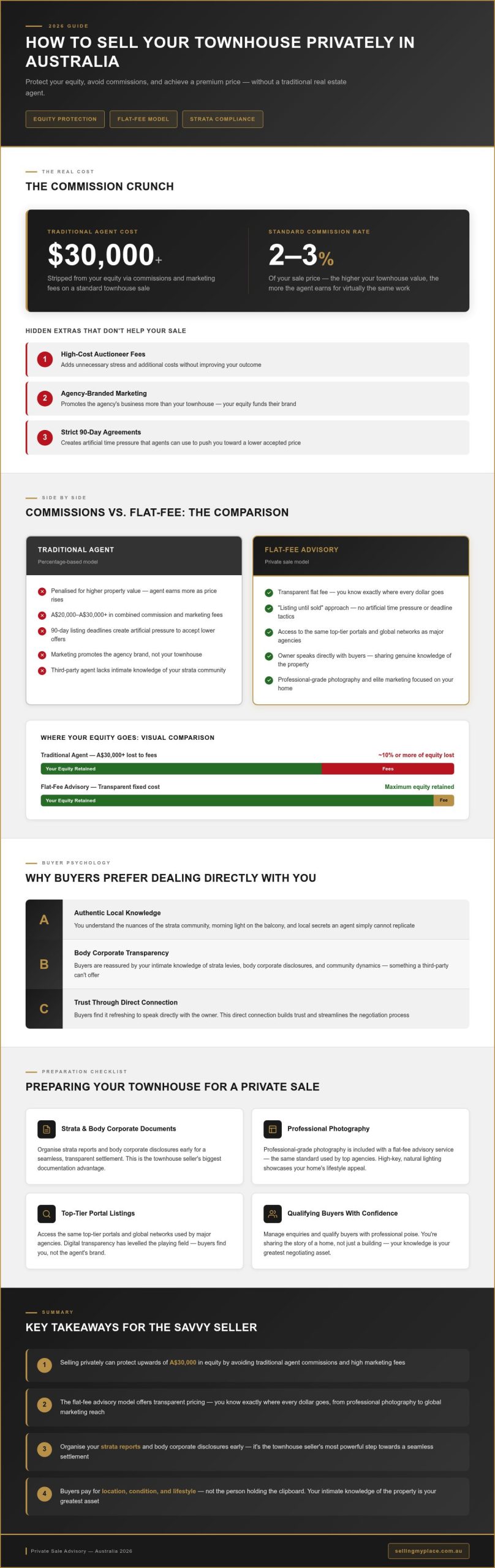
Taking the reins of your property sale isn’t just about the bottom line; it’s about honouring the years of labour and love you’ve poured into your home. When you decide to sell my townhouse privately australia, you’re essentially stepping into the driver’s seat of your financial future. In the current market, the traditional “Commission Crunch” is becoming harder to justify. A standard 2% to 3% agent fee, paired with bloated marketing budgets, can easily strip A$30,000 or more from your townhouse equity. That is a significant sum that could otherwise fund your next deposit or a comfortable retirement. By choosing a flat-fee advisory model, you’re paying for specific professional expertise rather than handing over a percentage of your wealth.
The shift we’re seeing in 2026 is driven by a desire for transparency. Buyers are often more comfortable dealing directly with the person who knows the property best: you. You understand the nuances of the strata community, the exact way the morning light hits the balcony, and the local secrets that an agent simply can’t replicate. This direct connection builds trust and streamlines the negotiation process, making the entire experience feel more like a partnership than a transaction.
The Changing Landscape of Australian Real Estate
Digital transparency has fundamentally levelled the playing field for homeowners. The Australian real estate market has moved away from the days when agents held all the keys to data and buyer access. Today’s “Savvy Seller” prioritises profit and authenticity over the impersonal branding of a traditional agency. Townhouses are the perfect property type for this transition because they are in high demand and come with clear documentation. When you sell my townhouse privately australia, you’re leveraging the fact that buyers are looking for the lifestyle your home offers, not the logo on a “For Sale” sign.
Protecting Your Equity: The Real Cost of Commissions
Traditional agency costs often include hidden extras that don’t actually help your sale. You might find yourself paying for:
- High-cost auctioneer fees that add unnecessary stress.
- Agency-branded marketing that promotes their business more than your townhouse.
- Strict 90-day agreements that create artificial time pressure.
A professional flat-fee model removes these hurdles. With a “listing until sold” approach, the ticking clock that agents often use to force a lower price simply disappears. You have the luxury of time and the support of experts who are committed to your success. Equity protection is the deliberate choice to retain the maximum possible value of your asset by eliminating unnecessary third-party percentages.
Commissions vs. Flat-Fees: The Townhouse Seller’s Comparison
Choosing between a traditional real estate agent and a flat-fee advisory model is often the difference between a stressful transaction and a strategic partnership. In the traditional model, you’re essentially penalised for the value of your asset. If your townhouse sells for more, the agent takes a larger slice of your equity, despite the amount of work remaining largely the same. It’s a structure that often feels disconnected from the actual service provided. When you decide to sell my townhouse privately australia, you replace this percentage-based uncertainty with a transparent flat fee. You know exactly where every dollar goes, from professional photography to the global marketing reach that puts your property in front of the right eyes.
There’s a persistent myth in our industry that agents somehow possess a “magic touch” that conjures higher prices. The reality is far more grounded. Data consistently shows that buyers pay for the property’s location, its condition, and the lifestyle it promises, not for the person holding the clipboard. In fact, many buyers find it refreshing to speak directly with the owner. Your intimate knowledge of the body corporate and the local community provides a level of reassurance that a third-party agent simply can’t offer. You aren’t just selling a building; you’re sharing the story of a home.
What You Gain with a Flat-Fee Advisory Service
A professional advisory model doesn’t mean you’re going it alone. You still receive the high-calibre tools required to compete with the biggest agencies. This includes professional-grade photography and floorplans that highlight the unique flow of your townhouse. You also benefit from strategic pre-sale consulting, helping you identify which small improvements will yield the highest return. By using professional residential property listing services, you ensure your home is positioned perfectly in the market without the heavy commission sting that usually follows. It’s about having a steady hand to guide you while you keep the average A$20,000 in savings that our clients typically enjoy.
Why Traditional Commissions are Outdated for Townhouses
Traditional commissions often suffer from a “standard effort” problem. An agent might put the same ten hours of work into a A$600,000 unit as they do a A$1.2 million townhouse, yet they expect to be paid double for the latter. It’s a logic that doesn’t quite hold up in the modern era. When you sell my townhouse privately australia, you maintain absolute control over your “Open for Inspection” schedule. This allows you to host viewings when your home looks its absolute best, rather than fitting into an agent’s busy Saturday morning. Embracing sale by owner strategies helps you build genuine rapport with buyers, answering their specific questions with honesty and heart.
If you’re feeling ready to take that first step toward a more rewarding sale process, we’re here to help you explore your options with a simple, no-pressure conversation.
Preparing Your Townhouse for a Premium Private Sale
Townhouses occupy a unique sweet spot in the Australian market, offering the perfect blend of space and low-maintenance living. When you prepare to sell my townhouse privately australia, your primary goal is to highlight this specific lifestyle. Buyers aren’t just looking at the floorboards; they’re looking for the security of a community and the ease of a lock-up-and-leave lifestyle. Using a professional pre-sale property consulting service helps you see your home through a buyer’s eyes. It allows you to identify small de-cluttering wins that make shared-wall spaces feel expansive and private, ensuring your home feels like a sanctuary from the moment they step inside.
Strata and Body Corporate: The Private Seller’s Checklist
Transparency is your greatest asset. Unlike a standalone house, a townhouse comes with a shared history of maintenance and management. Having a comprehensive strata report ready for inspection doesn’t just speed up a private treaty sale; it signals to buyers that you’re an organised, trustworthy partner. You should be prepared to disclose body corporate fees and any upcoming levies early to prevent “deal-breaker” surprises during the settlement process. It’s also vital to determine the market value of a home in Australia by looking specifically at similar strata-titled properties. This ensures your price reflects the value of both the dwelling and the common amenities like visitor parking or shared gardens.
Visual Marketing that Competes with the Big Brands
In the digital age, your online listing is your first chance to make a lasting impression. Vertical living can be tricky to capture on camera, which is why professional-grade photography is a non-negotiable. You want to showcase how natural light moves through the different levels, creating a sense of height and airiness. Floorplans are equally critical for townhouses; they help buyers visualise how their furniture and daily routines will fit across multiple floors. To round out your presentation, use neighborhood market reports to provide the hard data needed to justify your asking price. This turns a skeptical browser into a confident bidder who understands the true worth of your property.
If you’re unsure where to start with your property’s presentation, our team can provide the guidance you need to prepare your home for a premium result.
Navigating the Private Sale Process: From Listing to Settlement
Moving from the preparation phase to the active market is where your strategy truly comes to life. To sell my townhouse privately australia successfully, you need to be visible where the buyers are looking. This starts with a strategic listing on Australia’s major property portals alongside a global network that reaches beyond local borders. Once the enquiries start rolling in, your role shifts to managing buyer interests. Discerning intent is key. Discerning who is genuinely ready to purchase and who is simply exploring the market requires professional poise. When you choose to sell my townhouse privately australia, you aren’t just saving money; you’re taking control of the narrative.
Handling Inspections and Buyer Enquiries
Private inspections are your chance to build a genuine connection. Unlike the hurried, often impersonal “open homes” run by agencies, you can create a welcoming atmosphere that allows buyers to truly feel the space. You’re the best person to answer those specific questions about the townhouse complex, the quietness of the neighbours, or the efficiency of the body corporate. Staying calm and professional, what we call the “Steady Hand” approach, ensures you remain the expert guide in their journey, even during the high-stakes negotiation phase. Trust your instincts. You know this home better than anyone else ever could.
When an offer arrives, it’s time to put your strategy to the test. By using these property sale negotiation tips, you can hold your ground on price with confidence. Hold your ground. You don’t need a middleman to tell you what your home is worth. Once a price is agreed upon, your legal team takes over to manage the Section 32 and the Contract of Sale, ensuring all legalities are handled with precision.
The Legal Safety Net: Conveyance and Advisory
Many sellers worry about the paperwork, but you don’t actually need an agent to handle the legal transfer of property. Professional conveyance advice protects your interests during the settlement period, ensuring every detail is managed correctly. Details matter here. A private sale is legally identical to an agent-led sale once the contract is signed. This lead-up to settlement ensures a smooth handover and a 100% profit-retention result, leaving you free to focus on your next move with your equity fully intact.
Smarter Selling: The Kincade International Direct Sales Advantage
The Kincade International Direct Sales (KIDS) model isn’t about doing everything yourself; it’s about doing everything smarter. When you choose to sell my townhouse privately australia, you’re often looking for a middle ground between the high costs of traditional agencies and the vulnerability of a completely unassisted sale. Our approach provides exactly that. We offer the professional framework you need to succeed, from high-end marketing to expert guidance, all while ensuring you keep the average A$20,000 in equity that usually disappears into an agent’s pocket. This is about more than a transaction; it’s about protecting the financial foundation of your next life chapter.
More Than Just a Listing Portal
The biggest mistake some sellers make is assuming that “private sale” means “DIY.” There is a world of difference between simply putting a sign in the yard and using a professional advisory service. While we ensure your property reaches the right eyes through a global marketing network, we also provide the creative tools that make your home stand out. Professional photography and floorplans aren’t just “extras”; they are the primary way to elevate your townhouse above the sea of generic listings. We understand the emotional weight of moving on. That’s why we offer the peace of mind that comes with a “listed until sold” policy. You’ll never face the artificial pressure of a 90-day expiry or the stress of mounting re-listing fees. You sell on your terms, at your pace, with our steady hand guiding you through every enquiry.
Your Journey to a Commission-Free Sale Starts Here
Getting started is a straightforward, supportive process designed to put you at ease. We begin by providing comprehensive neighbourhood market reports, which give you the same data-driven insights that top-tier agents use to set their prices. This ensures your townhouse is positioned competitively from day one. Our onboarding process is designed to be thorough yet simple:
- A detailed review of your townhouse’s unique features and strata benefits.
- Access to high-resolution photography that captures your home’s best light.
- Strategic placement on Australia’s leading property portals and our global network.
- Ongoing advisory support to help you manage buyer negotiations with professional poise.
Our Agent Advisory Service acts as your secret weapon, offering pre-sale consulting to polish your presentation and conveyance advice to secure your settlement. You aren’t just a number in a database; you’re a partner in a mission to protect your family’s legacy. By choosing to sell my townhouse privately australia, you’re choosing transparency, control, and a significantly larger profit at the end of the day.
Ready to secure your equity? Contact Kincade International Direct Sales today for a confidential consultation.
Your Equity, Your Future: Taking the Next Step
Selling your home is more than just a transaction; it’s the culmination of years of care and the foundation of your next chapter. You’ve discovered how choosing to sell my townhouse privately australia allows you to keep an average of A$20,000 in your pocket while still accessing the elite marketing tools usually reserved for traditional agencies. By combining professional photography and a global reach with our Expert Agent Advisory Service, you gain a professional safety net that protects your interests from listing to settlement.
You deserve a sale process that prioritises your profit and provides the absolute transparency you’ve been looking for. It’s time to move forward with the calm confidence that comes from being in control of your own narrative. Why sacrifice your hard-earned equity when you can achieve a premium result on your own terms? Start your commission-free townhouse sale journey with Kincade International today. We’re here to help you protect your legacy and step into your future with the financial freedom you’ve earned.
Frequently Asked Questions
Is it legal to sell my townhouse privately in Australia?
Yes, it’s entirely legal to sell your townhouse privately in Australia. Every homeowner has the legal right to market and sell their own property without being forced to use a traditional real estate agent. While the marketing process changes, the legal requirements for transferring a title remain exactly the same. You’ll still need a solicitor or conveyancer to handle the final settlement, ensuring the transition is safe and legally binding for both parties.
How do I list my property on major Australian portals without an agent?
You can’t list directly as an individual, so you’ll need to partner with a licensed listing service. Kincade International provides the digital infrastructure to get your property onto the nation’s leading real estate websites. This professional bridge allows you to sell my townhouse privately australia while still accessing the same massive buyer audience as the big agencies. You maintain full control over the enquiries and inspections while we handle the technical listing requirements behind the scenes.
What paperwork do I need to sell my townhouse privately?
You’ll need a Contract of Sale and a Section 32, also known as a Vendor’s Statement, prepared by a legal professional. Because you’re selling a townhouse, you’ll also need specific body corporate or strata documents. These papers disclose the financial health of the complex, insurance details, and any upcoming levies. Having these organised early builds immense trust with potential buyers. It shows you’re a transparent and prepared seller, which often leads to a much smoother settlement process.
How do I handle the negotiation process without a real estate agent?
Negotiation is simply a professional conversation about value. We provide you with detailed neighbourhood market reports so you can justify your asking price with hard data. This removes the guesswork and emotional stress from the process. By staying calm and using our Agent Advisory Service for guidance, you can handle offers with professional poise. You don’t need a middleman to speak for you when you have the facts and a steady hand guiding your decisions.
Will I get a lower price if I sell my townhouse privately?
There’s no evidence that private sales result in lower prices. In fact, many buyers prefer the transparency of dealing directly with a knowledgeable owner. The final sale price is driven by the property’s location, condition, and the lifestyle it offers, not by who holds the clipboard. When you sell my townhouse privately australia, you often achieve a premium result because you can speak passionately about the home’s unique features and the local community.
How does the flat-fee model actually save me money?
The flat-fee model saves you money by replacing a percentage-based commission with a single, transparent cost for services. Instead of losing a slice of your equity, you only pay for what you actually use, like professional photography and listing services. Our clients save an average of A$20,000 per sale. This approach ensures your hard-earned wealth stays in your pocket, allowing you to move into your next home with significantly more financial freedom and security.
Can I still use a solicitor for the conveyancing if I sell privately?
Absolutely. Using a solicitor or conveyancer is a standard part of every property transaction in Australia, whether an agent is involved or not. They’re responsible for the legal transfer of the title and ensuring all funds are handled correctly. We provide conveyance advice to help you understand this stage of the journey. Your solicitor works for you to protect your legal interests, while we provide the marketing and advisory framework to find your buyer.
What happens if my townhouse doesn’t sell within 90 days?
With our model, your property stays listed until it’s sold. We don’t believe in the artificial pressure of 90-day agency agreements that often force owners to drop their price prematurely. If your townhouse takes a little longer to find the right buyer, your listing remains active at no extra cost. This allows you to wait for the premium price your home deserves, rather than rushing into a decision because a contract is about to expire.
Pricing Your Home: 2026 Guide for Australian Sellers
What if the secret to a premium sale price had nothing to do with a real estate agent’s “gut feeling” and everything to do with your own transparent market data? Selling your family home is a significant life transition, and it’s completely natural to feel a bit of a knot in your stomach when you see conflicting online estimates or worry about agent bias. You’ve worked hard to build your equity, and the last thing you want is to see it eroded by underpricing or swallowed up by traditional commissions. Understanding how to price your home for sale is about more than just picking a number; it’s about taking control of your financial legacy.
In this 2026 guide, you’ll learn the strategic art of pricing your property to attract premium buyers while bypassing high commissions to protect your family’s wealth. We’ll show you how to move past the confusion of automated valuations to find a realistic, competitive price range that reflects the true value of your home. By the end of this article, you’ll have a clear plan to sell for a flat fee, potentially saving $20,000 or more, and the confidence to stand firm in your own market research. Let’s explore how a steady hand and the right data can turn a stressful process into a rewarding new beginning.
Key Takeaways
- Understand the data sources behind digital estimates and why they provide a useful baseline but often miss your home’s unique renovations or views.
- Learn exactly how to price your home for sale by shifting your focus from optimistic “Asking” prices to verified “Sold” records in your local area.
- Discover the benefits of a specialised Neighbourhood Market Report to gain deeper insights into buyer demand and clearance rates that basic apps ignore.
- Follow a proven framework to establish a realistic price range that allows you to sell for a flat fee and protect an average of A$20,000 in family equity.
- See how professional marketing assets like floorplans and photography provide the visual evidence required to justify a premium price point to buyers.
Understanding the Science of How to Price Your Home for Sale
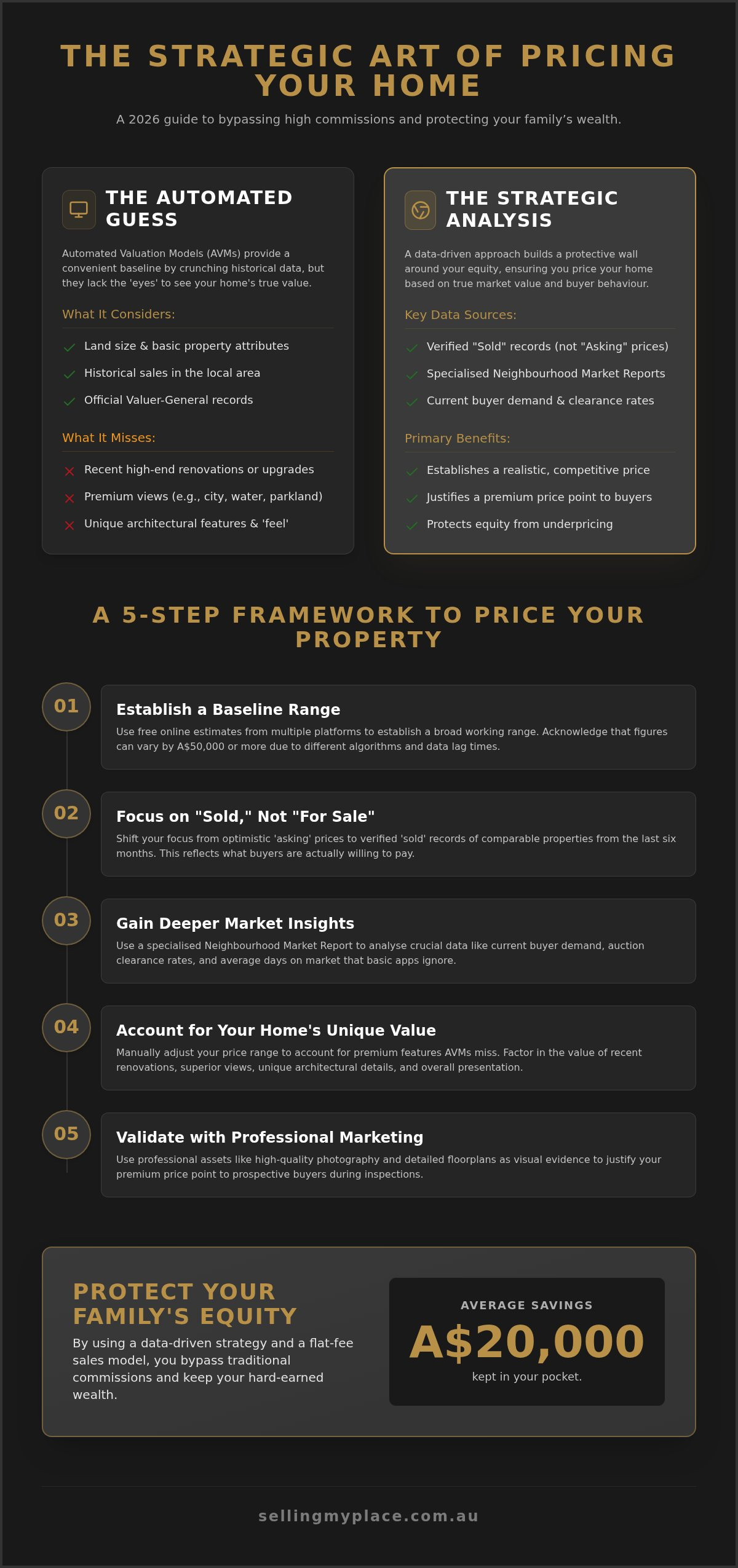
Most Australian sellers begin their journey by typing their address into a search bar and waiting for a magic number to appear. Behind those instant results sits an Automated Valuation Model, or AVM. Think of the AVM as a helpful, though slightly literal-minded, digital engine that crunches massive amounts of data from Valuer-General records, historical sales, and current listings to provide a snapshot of value. While these tools are incredibly convenient, they are essentially mathematical guesses based on the science of property valuation. To truly master the market, you need to understand that a computer cannot see your freshly sanded floorboards or feel the morning sun in your garden.
It is also vital to distinguish between the different “prices” you might encounter during this process. A bank valuation is almost always conservative because it is designed for lender risk management. An agent’s appraisal, on the other hand, can sometimes be inflated to encourage you to sign a listing agreement. A true market estimate is a realistic look at what a buyer will actually pay in today’s climate. By leaning into objective data, you are essentially building a protective wall around your family’s future, ensuring your equity isn’t eroded by unnecessary commissions or poor advice.
This reliance on objective data reflects a broader trend in asset management. Just as savvy owners use My Car Value to obtain accurate digital valuations for their vehicles, property sellers are increasingly using advanced metrics to safeguard their home equity against biased or outdated estimates.
The Data Points That Drive Your Estimate
Algorithms primarily look at “comparable sales,” which are properties similar to yours that have sold nearby, typically within the last six months. They weigh specific attributes like land size, the number of bedrooms, and the clarity of your floorplans to categorise your home against its neighbours. In 2026, buyer sentiment acts as a real-time filter that can either accelerate or dampen the cold hard facts found in historical data.
Why Estimates Vary Between Australian Platforms
You might notice that one major property portal gives you a figure that is A$50,000 higher than another. This happens because different platforms use proprietary algorithms and update their records at different intervals. There is often a notable lag time in official government sales data processing; it can take weeks for a settled price to appear in the Valuer-General’s database, meaning some sites are looking at older news than others.
This is where a “steady hand” approach becomes your greatest asset. Instead of getting frustrated by these discrepancies, use them to establish a working range. Learning how to price your home for sale involves looking at these variations with a calm, analytical eye. By understanding where the data comes from, you move from being a confused bystander to an empowered seller who knows exactly where their property sits in the local landscape.
The Limits of Algorithms: When a Digital Estimate Isn’t Enough
While the digital engines we explored in the previous section provide a convenient baseline, they often lack the “eyes” to see what truly makes your property a home. An algorithm can track square meterage and bedroom counts, but it cannot perceive the panoramic sunset views from your balcony or the way your architecturally designed high ceilings create a sense of sanctuary. Relying solely on a bot to decide how to price your home for sale carries a significant risk; you might set a reserve price that ignores the premium features buyers are actually willing to compete for.
Digital tools often struggle with the emotional resonance of a family home, which is why professional advisory services act as the vital bridge between cold data and market reality. When you are looking for an objective standard, it is helpful to consult the market value guidelines from the ATO, which emphasise the importance of an “unfettered” market where both parties act knowledgeably. Without this human layer of interpretation, you might find yourself anchored to a number that doesn’t reflect the true worth of your lifestyle or your legacy.
The Renovation Gap in Digital Data
If you have recently installed a designer kitchen or a sprawling spotted gum deck, do not be surprised if your free online estimate remains unchanged. These structural improvements are often “invisible” to algorithms until a new sale record is created. To protect your equity, you must manually adjust your expectations by looking at the cost of these upgrades and the value they add to the local lifestyle. Professional photography becomes your best friend here. It provides the visual evidence that justifies a higher price point to potential buyers before they even step through the front door.
Local Nuance and Street Appeal
Mastering how to price your home for sale requires a blend of data and local intuition. In many Australian suburbs, one side of a street can command a significantly higher price than the other due to school catchments, noise levels, or even the afternoon sun. Similarly, upcoming infrastructure like a new parkland or transport hub can boost value long before the data catches up; this is where the local expertise of firms like Elite Agents & Partners can help validate your research with on-the-ground reality.
Understanding these intricacies is a core part of how to determine market value of a home in australia. If you feel the digital estimates are missing the mark on your home’s unique charm, a quick chat with a professional advisor can help clarify the difference between a generic estimate and a strategic listing price.
Automated Estimates vs. Strategic Neighbourhood Market Reports
A generic online estimate is like looking at a weather forecast for the entire state when you really just want to know if it’s going to rain in your backyard. While the AVMs we discussed earlier provide a helpful starting point, they lack the granular detail required for a high-stakes sale. When you are mastering how to price your home for sale, the distinction between a generic guess and a specialised Neighbourhood Market Report is what ultimately protects your family equity. These strategic reports dive deep into the specific mechanics of your suburb, providing a level of clarity that basic apps simply cannot match.
Rather than just offering a single “magic number,” a strategic report analyses the current pulse of the market. For instance, as of June 2026, the median vendor discount across combined capitals sits at approximately 3.3%, while the median days on market is roughly 28 days. Understanding these figures in the context of your specific street allows you to spot emerging trends before the general public. If clearance rates are climbing in your pocket of the neighbourhood, you might have the leverage to aim for the higher end of your price range. This data-driven approach ensures you aren’t just guessing; you are making informed decisions based on the same intelligence used by industry professionals.
What Makes a Market Report “Strategic”?
A strategic report moves beyond the “what” and into the “why” of buyer psychology. It allows you to analyse the competition by seeing exactly what other sellers in your suburb are doing, from their initial asking prices to their final settlement figures. This transparency is a powerful tool during negotiations. When a potential buyer questions your price, you can point to concrete data regarding buyer demand and local supply to justify your position. It transforms a potentially emotional confrontation into a calm, professional conversation about market reality.
The Kincade Advantage: Human Advisory
Data is only as valuable as the person interpreting it. This is where our Agent Advisory Service provides a “steady hand” to guide your strategy. Unlike a traditional agent who might “buy the listing” by quoting an unrealistically high price just to get you to sign a contract, our advisors focus on objective truth. We help you interpret your Neighbourhood Market Report to find a price point that is both competitive and profitable. Because our model is built on a flat fee rather than a percentage, our only goal is to see you succeed. This partnership allows you to price your home more aggressively without the fear of losing A$20,000 or more to traditional commissions, keeping that hard-earned equity exactly where it belongs: in your pocket.
A Step-by-Step Framework to Price Your Property for a Commission-Free Sale
Moving from data collection to a live listing requires a methodical approach. It is not just about picking a number you like; it is about building a case that buyers cannot ignore. When you understand how to price your home for sale, you gain the upper hand in every conversation. This framework is designed to help you navigate the process with the calm confidence of a seasoned expert.
- Step 1: Gather your digital baseline. Collect at least three different free estimates from major Australian property portals. This gives you a spectrum of value and helps you identify any wild outliers.
- Step 2: Study the “Sold” reality. Look at properties similar to yours that have actually settled in the last six months. Ignore “Asking” prices on current listings; those are aspirations, not facts.
- Step 3: Factor in your commission edge. Traditional agents often charge between 2% and 3% in commission. Because you are selling commission-free, you have the flexibility to price more competitively while still protecting your bottom line.
- Step 4: Consult with a professional advisor. A human expert can validate your research and help you adjust for those “invisible” value-adders that algorithms miss.
- Step 5: Validate with visual marketing. Launch your listing with high-quality photography and detailed floorplans. These assets prove to the buyer that your price point is justified.
Setting Your “Sweet Spot” Price
There is a distinct psychology to property pricing in Australia. Pricing your home at A$995,000 often attracts more interest than a flat A$1,000,000 because it sits within a lower search bracket on most portals. You can also use your research to set a strategic “Offers Above” range, which encourages competitive interest without capping your potential. For more advice on handling the interest this creates, explore these property sale negotiation tips.
Protecting Your Equity
The goal is to maximise your “Real Net Profit.” This is the sale price minus your flat fee, rather than the sale price minus a massive commission. For example, selling a home for A$900,000 with a flat fee often puts more money in your pocket than selling for A$915,000 through a traditional agency. Keeping that extra A$20,000 in your mortgage offset account, especially with the RBA cash rate sitting at 4.35%, provides a significant long-term financial buffer for your family. If you are ready to finalise your strategy and protect your hard-earned equity, you can contact our advisory team for a personalised consultation.
Validating Your Price Point Through Professional Marketing and Advisory
Setting the right number is only half the battle. A price estimate, no matter how data-driven, is only as good as the marketing that supports it. When you are finalising how to price your home for sale, you must consider how that price is validated in the mind of the buyer. If a listing looks amateur, the buyer will naturally look for reasons to negotiate downwards. Conversely, a polished, professional presentation signals that the property is a premium offering, making your price point feel like a fair, well-researched value rather than a starting point for a haggle.
Visual Proof of Value
High-quality imagery is essential for achieving an “above estimate” result. In the digital-first world of 2026, your first open home happens on a smartphone screen. Professional photography captures the emotional essence of the space, while accurate floorplans provide the logical grounding serious buyers need to visualise their lives in your home. By mastering how to price your home for sale and backing it with visual evidence, you eliminate the guesswork that often leads to underpricing. This combination reduces buyer negotiation leverage; it is much harder to justify a lowball offer when the marketing clearly demonstrates the home’s worth and attention to detail.
Our global marketing network ensures your property isn’t just seen; it’s seen by the right people. By casting a wider net, we increase the likelihood of finding that one buyer who values your unique features as much as you do. This human connection is the ultimate validation of your pricing strategy, turning a digital estimate into a successful settlement.
The Commission-Free Path
Taking the commission-free path is about more than just saving money; it is about taking control of your property legacy. For many Australian families, the flat-fee model represents a significant shift in how wealth is preserved during a sale. When you bypass traditional commissions, you protect an average of A$20,000 in equity, providing a much-needed boost to your next chapter. It allows you to be more flexible in your negotiations without ever feeling like you are losing out.
If you are ready to move from being a curious browser to an empowered seller, understanding the mechanics of a sale by owner is your next logical step. You are the best person to represent your home’s value, and with a steady hand to guide you, the results can be truly transformative. It is time to step into the market with confidence, knowing your price is right and your future is protected.
Step Into Your Next Chapter with Confidence
You now have the tools to move beyond the uncertainty of automated guesses. By combining cold data with a “steady hand” advisory approach, you can navigate the complexities of the 2026 market with ease. We have explored why understanding how to price your home for sale is less about picking a lucky number and more about validating your property’s unique story through professional photography and floorplans. Success comes when you pair local intuition with verified market facts.
Remember that a strategic listing isn’t just about the final sale price; it’s about the “Real Net Profit” you keep at settlement. By choosing a flat-fee model, you can protect an average of A$20,000 in hard-earned equity that would otherwise be lost to traditional commissions. With our Expert Agent Advisory Service by your side, you aren’t just selling a property. You are actively securing your family’s financial legacy.
Ready to see the true potential of your property? Secure Your Strategic Neighbourhood Market Report and Sell Commission-Free today. Your home is your greatest asset, and you deserve a partner who values it as much as you do.
Frequently Asked Questions
Are free online property value estimates accurate in Australia?
Free online property value estimates serve as a helpful baseline but shouldn’t be viewed as a final figure. These tools use mathematical algorithms to process Valuer-General data and recent sales; however, they cannot perceive your home’s unique charm or recent internal upgrades. For a truly accurate outlook, these digital numbers need to be validated by a professional who understands the current street-level demand and specific neighbourhood nuances.
How is a property value estimate different from a bank valuation?
A property value estimate reflects what a buyer might pay in an open market, while a bank valuation is a conservative assessment used to manage lending risk. Banks often provide a lower figure to protect their interests in case of a forced sale. Understanding this distinction is vital when learning how to price your home for sale, as it prevents you from being discouraged by a lender’s cautious appraisal of your family’s equity.
Do I need a real estate agent to get an accurate appraisal?
You do not need a traditional real estate agent to receive an accurate appraisal of your property’s worth. While agents often provide quotes to secure a listing, independent Real Estate Advisory Services offer an objective perspective without the pressure of a commission-based contract. These services focus on providing a “steady hand” and raw data, allowing you to make decisions based on facts rather than a sales pitch.
Can I use a free estimate to set my house sale price?
Using a single free estimate to set your final sale price is risky because algorithms often lag behind real-time market shifts. These tools are excellent for establishing a working range, but they don’t account for the emotional appeal that drives premium offers. It is better to use the estimate as a foundation and then refine your strategy by looking at actual “Sold” results from the last six months in your local area.
How often should I check my property value estimate?
Checking your property value estimate once every quarter is generally sufficient to track long-term growth. However, if the Reserve Bank of Australia adjusts the cash rate, which currently stands at 4.35% as of August 2026, it is wise to look again. Major economic shifts or new local infrastructure projects can influence buyer demand and property values much faster than a standard yearly review might suggest.
Does adding solar panels or a deck increase my estimate immediately?
Physical improvements like solar panels or a new deck rarely trigger an immediate increase in automated digital estimates. These systems rely on settled sales data, which means your renovations won’t “show up” in the algorithm until a similar local home sells for a higher price. This is why professional photography is so important; it showcases these value-adders to human buyers even when the computer hasn’t caught up yet.
Why does my bank estimate differ from Domain or other major property portals?
Differences between bank estimates and property portals occur because each platform uses a proprietary algorithm and different data update cycles. Portals often incorporate recent listing activity and consumer interest, whereas banks prioritise settled government records to ensure their valuations remain conservative. This variation is why we recommend gathering multiple data points to find a realistic median range for your property before you finalise how to price your home for sale.
What is the best way to get a professional price guide without paying commission?
The most effective way to establish a professional price guide without commission is through a specialised Neighbourhood Market Report. These reports provide granular data on clearance rates and buyer demand that generic sites miss. When paired with an Agent Advisory Service, you receive the expert interpretation needed to finalise your listing price with confidence, ensuring you protect your equity while still attracting the right premium buyers.
Flat Fee vs Commission Real Estate: Which Model Saves You More in 2026?
If you sold your family home this year, would you be comfortable handing over tens of thousands of dollars in equity to an agent for just a few weekend inspections? It’s a question more Australian homeowners are asking as they weigh up the benefits of flat fee vs commission real estate in 2026. Selling a home is a significant life transition, and it’s natural to feel protective of the nest egg you’ve spent decades building. You deserve a result that reflects your hard work, yet the lack of transparency in traditional agency costs often leaves vendors feeling more like a transaction than a partner.
We understand that the pressure to accept a quick offer just to satisfy an agent’s commission can be incredibly stressful. This article explores the vital financial differences between these models to help you protect your equity and sell with confidence. We’ll show you how it’s possible to secure professional photography and expert advisory services while maximising your final sale price without the traditional ‘agent tax’. We’re going to compare these structures side by side to see which one truly puts your family’s financial future first.
Key Takeaways
- Understand the fundamental differences between flat fee vs commission real estate to identify which model best protects your family’s hard-earned equity.
- Learn how to spot the hidden costs of traditional agency marketing and why budget transparency is the key to a stress-free sale.
- Discover why high-end visual marketing and global reach are essential for attracting the right buyers without paying a premium ‘agent tax’.
- Unpack the ‘incentive myth’ to see how traditional commission structures can sometimes prioritise a quick sale over your best possible price.
- Explore how a partnership-based advisory service allows you to manage your property journey with a steady hand while keeping every cent of your profit.
Flat Fee vs Commission: Understanding the Choice for Australian Sellers
Selling your home is a deeply personal milestone, often marking the end of one chapter and the hopeful beginning of another. It’s a time filled with both excitement and a touch of trepidation, especially when you start looking at the costs involved. The decision between flat fee vs commission real estate is one of the most significant choices you’ll make in this journey. It isn’t just about numbers on a spreadsheet; it’s about how much of your hard-earned equity stays in your pocket to fund your next move. In Australia, we’re seeing a genuine shift as more homeowners look for a partnership that offers both professional authority and financial fairness.
What is Traditional Real Estate Commission?
The traditional model has long been the default for Australian suburbs. Under this structure, an agent takes a percentage of your final sale price at settlement. In the 2026 market, these rates typically sit between 2% and 3%. While a few percentage points might sound modest in a casual chat, the reality hits home when you apply it to Australian property values. On a $1,000,000 sale, you could be looking at a $30,000 bill just for the agent’s fee.
There’s also the matter of transparency. Many sellers are surprised to find that high marketing costs, such as premium portal listings and signage, are often charged on top of the commission. As property values rise, the agent’s pay cheque increases significantly, even if the amount of work required to sell the home remains the same. This ‘commission tax’ can feel particularly heavy when you realise it’s being carved directly out of your family’s future stability.
The Rise of the Flat-Fee Marketing Model
The flat-fee approach, often called a fee-for-service model, is gaining ground because it offers budget certainty from the very start. Instead of a percentage-based gamble, you pay a single, transparent fee for the professional tools and marketing required to find a buyer. Digital platforms have democratised the way we find homes, meaning your property can reach the same audience as a big-name agency without the overheads that drive up their fees.
Choosing a commission-free path doesn’t mean you’re left to manage a complex sale entirely on your own. Modern flat-fee services have evolved to include a “steady hand” to guide you. For instance, an Agent Advisory Service provides the expert coaching and local knowledge you need to negotiate with confidence. You get the professional marketing, like high-end photography and floorplans, while retaining 100% of your sale profit. It’s about empowering you to lead the sale of your own home, supported by experts who value your legacy as much as you do.
The Financial Reality: Comparing the Costs of Selling
When you look at your home, you see a lifetime of memories and a hard-earned nest egg. When a traditional agency looks at it, they often see a percentage. Understanding the financial mechanics of flat fee vs commission real estate is the first step in reclaiming control over your biggest asset. It’s about more than just a fee; it’s about the equity you’ve built through years of mortgage repayments and weekend renovations. Every dollar saved on commission is a dollar that stays with your family, helping you fund your next adventure or secure your retirement.
Commission Math: What You Really Pay
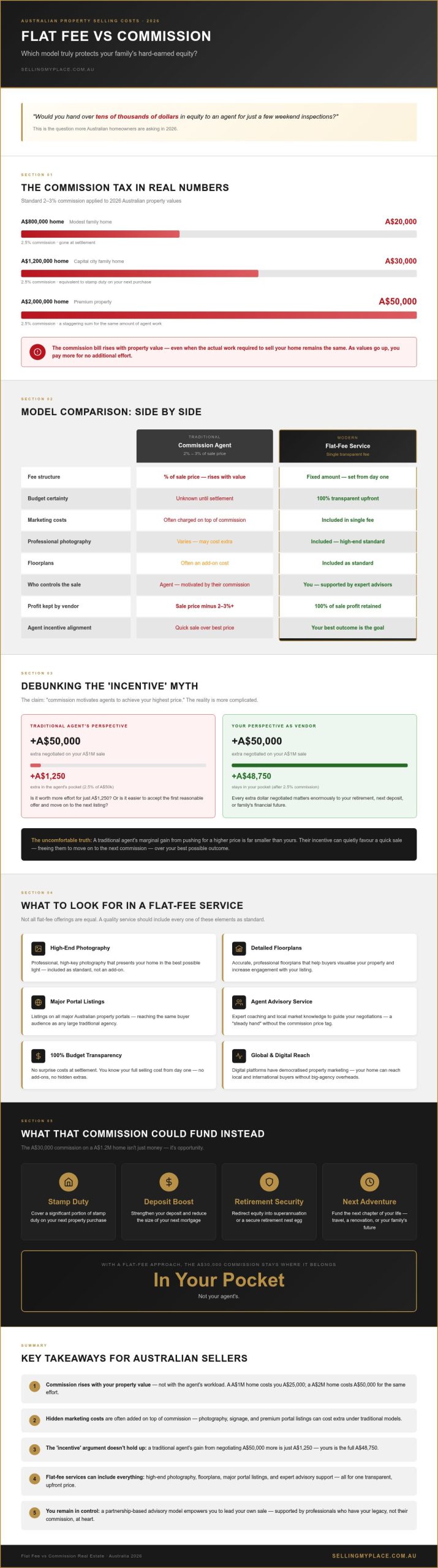
In the Australian market, a “standard” commission of 2% to 3% can feel like a small detail in a thick contract. However, the numbers tell a different story once you apply them to our 2026 property values. If you sell a modest home for A$800,000, a 2.5% commission takes A$20,000 from your pocket. For a family home in a capital city selling at A$1,200,000, that figure jumps significantly. A 2.5% commission on a A$1,200,000 home equals A$30,000 out of your pocket. For those selling premium properties at A$2,000,000, the commission bill hits a staggering A$50,000.
This “commission tax” has a compounding effect on your future. That A$30,000 isn’t just cash; it’s the stamp duty on your next purchase or a significant boost to your deposit. When you consider that many agents also charge extra for marketing on top of this fee, the financial burden becomes even heavier. It’s a high price to pay for a service that often doesn’t scale with the actual work performed.
The Flat-Fee Alternative: Transparency and Value
A flat-fee model replaces the guesswork with absolute certainty. You pay a single, upfront price for a comprehensive suite of professional tools. This typically includes high-end photography, detailed floorplans, and listings on major property portals. Because there’s no commission, you don’t have to worry about a surprise bill appearing on settlement day. You know exactly what your costs are from the moment you decide to list. This transparency allows you to plan your move with a sense of calm confidence.
Before you set your expectations, it helps to know how to determine the market value of a home in Australia. Once you have a realistic figure in mind, the savings offered by the flat fee vs commission real estate model become even clearer. You’re essentially choosing to invest in professional marketing while keeping 100% of the sale profit for yourself. If you’re ready to see how this approach could work for your unique situation, you might like to start a conversation about your property goals today.
Debunking the ‘Incentive’ Myth in Real Estate
One of the most common arguments in the traditional property industry is that a commission-based agent will work harder for you because their pay cheque depends on the final sale price. It sounds logical on the surface, doesn’t it? The idea is that the more you make, the more they make. However, when we look closer at the actual mechanics of the transaction, this “incentive” often doesn’t align with your best interests. The debate around flat fee vs commission real estate often centres on motivation, but true motivation should come from a duty of care to the client, not just a percentage of the loot.
The Reality of Agent Motivation
Let’s look at the numbers. Imagine your agent is negotiating an offer that is A$10,000 below your target price. If they push the buyer to find that extra A$10,000, you keep the bulk of that money. But for an agent on a 2.5% commission, that extra effort only nets them an additional A$250. When you consider the extra weeks of inspections, phone calls, and marketing coordination required to secure that higher figure, many agents find it more profitable to settle for the lower offer and move on to the next listing. This creates a subtle conflict of interest where a “quick sale” is prioritised over the “best sale.”
Taking control of your own negotiation ensures that your priorities remain front and centre. You don’t have to be a professional closer to achieve a great result; you just need the right preparation. Reading through expert property sale negotiation tips can give you the confidence to stand your ground when an offer doesn’t reflect your home’s true worth. It’s about empowerment rather than reliance on someone whose financial goals might differ from your own.
Expert Support Without the Percentage
Choosing a commission-free path doesn’t mean you’re navigating the stormy seas of the property market alone. In fact, professional advisory services often provide more practical value than a traditional agent’s “hustle.” Pre-sale property consulting helps you identify which small improvements will actually add value to your sale price, while neighbourhood market reports provide the data you need to price your home with authority. You aren’t just guessing; you’re making informed decisions based on local landscape knowledge.
This partnership-based approach offers a “steady hand” throughout the process. You get the professional marketing and global reach required to find the right buyer, but you keep the role of the decision-maker. When you’re deciding between flat fee vs commission real estate, remember that true advocacy doesn’t require a percentage of your equity. It requires a commitment to your family’s future and a transparent service that respects the legacy of the home you’re selling.
What to Look for in a Flat-Fee Property Service
Deciding between flat fee vs commission real estate is only half the battle. Once you’ve chosen to protect your equity, the next step is ensuring the service you partner with actually delivers the professional punch required to stand out in the 2026 Australian market. Not all flat-fee models are created equal. You aren’t just looking for a listing on a website; you’re looking for a comprehensive marketing engine that treats your home with the respect it deserves. A truly supportive service should feel like a partnership, offering a steady hand from the first photo to the final settlement.
Marketing Essentials for a Successful Sale
In our digital-first world, your home’s first inspection happens on a smartphone screen. If the visuals don’t captivate immediately, buyers will simply scroll past. This is why high-end photography and professional floorplans are non-negotiable. A detailed floorplan does more than show the layout; it allows a potential buyer to mentally move their furniture in, creating an emotional connection before they even step through the front door. It’s a small detail that significantly boosts engagement and helps buyers feel at home before they’ve even visited; to see this level of presentation in action, you can learn more about Zed Real Estate and their luxury marketing strategies.
Beyond the local suburb, you should consider where your buyers are coming from. High-value Australian homes often attract interest from expats and investors in the UK and the USA. A service that provides global marketing network coverage ensures your property isn’t just seen locally but reaches a worldwide audience. For a deeper look at how to present your home, our professional residential property listing services guide covers everything you need to know about modern marketing standards.
The Advisory Advantage
While the tools are important, the expert guidance behind them is what truly reduces stress. A professional pre-sale property consultation can reveal simple, cost-effective ways to enhance your home’s appeal, ensuring you don’t overspend on unnecessary renovations. Having access to conveyance advice and contract support means you aren’t left second-guessing the legalities of the sale. It provides that much-needed peace of mind during a high-stakes life transition, ensuring you feel protected at every turn.
One of the most liberating aspects of a quality flat-fee service is the absence of time limits. Traditional agencies often pressure you into lowering your price once a standard 90-day contract expires. A ‘listed until sold’ guarantee gives you the freedom to wait for the right buyer who truly values your home’s legacy. If you’re ready to showcase your property to a global audience while keeping your profit intact, you can book a consultation with our advisory team to discuss your property goals.
How to Sell Smarter with Kincade International Direct Sales
Choosing the right path for your property sale is a decision that impacts your family’s financial legacy. Many homeowners hesitate to step away from traditional agencies because they fear they’ll be left to handle the complexities alone. At Kincade International Direct Sales, we’ve designed the KIDS model to bridge this gap. It’s a 0% commission structure built on 100% transparency. We believe that you shouldn’t have to choose between professional expertise and keeping your hard-earned equity. By removing the percentage-based fee, we ensure that the average saving of A$20,000 stays exactly where it belongs: in your bank account.
Our approach isn’t about DIY; it’s about empowerment. When you weigh up flat fee vs commission real estate, the real differentiator is the level of support you receive throughout the journey. We provide a “steady hand” through our Agent Advisory Service, offering the professional authority you need to handle contracts and conveyance with total confidence. You lead the way, but you’re never walking the path by yourself. It’s a partnership that respects the emotional significance of your move while prioritising your financial stability.
A Partnership-Based Approach to Selling
We focus on your long-term goals rather than a quick transaction. The process begins with a comprehensive neighbourhood market report, giving you a grounded understanding of the local landscape. From there, we deploy a global marketing infrastructure that rivals any traditional agency. Your home is showcased with professional photography and floorplans, reaching potential buyers across Australia and international markets. This global exposure is vital in 2026, as it ensures your property’s legacy is seen by the widest possible audience, all while you retain full control of the final sale price. For those interested in how these international networks operate in major hubs, you can learn more about Kay & Co and their work in the London market.
Secure Your Profit Today
There has never been a better time to rethink the traditional real estate model. As property values continue to shift, the “commission tax” becomes an increasingly heavy burden for Australian families to carry. Choosing a flat-fee model is a proactive step toward protecting your home equity for your next life transition. Whether you’re downsizing for retirement or upscaling for a growing family, those saved tens of thousands of dollars make a world of difference to your future plans. You’ve done the hard work of building your home’s value; now it’s time to ensure you receive the full benefit of that effort.
If you’re ready to move forward with a sense of calm confidence and professional support, we’re here to guide you. You can contact the team at Kincade International Direct Sales to start your smarter sale journey and discover how our advisory-led model can help you achieve a premium result without the premium price tag.
Secure Your Financial Future and Your Home’s Legacy
Choosing how to list your property is a pivotal moment in your family’s journey. We’ve explored how the choice between flat fee vs commission real estate impacts your bottom line, noting that moving away from a percentage-based model can save you an average of A$20,000 per sale. You don’t have to sacrifice professional quality to achieve these savings. With global marketing network coverage and a professional Agent Advisory Service, you can maintain a steady hand throughout the negotiation while keeping every cent of your profit.
Selling your home should be a rewarding transition, not a source of financial stress. By choosing transparency and expert support, you’re protecting the equity you’ve worked so hard to build. It’s about more than just a transaction; it’s about setting yourself up for whatever comes next with confidence and peace of mind. You’ve spent years turning a house into a home, and you deserve a sale process that respects that effort.
Ready to take the first step toward a smarter sale? Book your expert pre-sale consultation and save thousands today. You deserve a partner who values your home and your future as much as you do.
Frequently Asked Questions
Is a flat-fee real estate model legal in all Australian states?
Yes, the flat-fee model is entirely legal and regulated across every Australian state and territory. It operates under the same property laws as traditional agencies; the primary difference is simply how the service is billed. You have the legal right to choose a fee-for-service arrangement that protects your equity rather than being locked into a percentage-based commission structure that can vary wildly between suburbs.
Will my property appear on the major Australian real estate portals with a flat fee?
Your property will be listed on all the leading Australian property portals where buyers actually look. A quality flat-fee service ensures your home receives the same digital visibility as any listing from a traditional high-street agency. This exposure is vital because the vast majority of Australian buyers begin their search online, making portal presence a non-negotiable part of any modern marketing strategy.
What happens if my property doesn’t sell within three months?
Unlike traditional 90-day agency agreements that often require expensive re-listing fees or contract renewals, our model includes no time limits on your listing. You have the freedom to wait for the right buyer who truly values your home’s legacy without the pressure of a ticking clock. This “listed until sold” approach provides a sense of calm confidence, ensuring you never feel forced to accept a lower offer.
Do I have to do my own property inspections with a flat-fee service?
Yes, hosting your own inspections is a key part of the flat-fee model. This approach allows you to share your genuine love for the home and your local insider knowledge directly with potential buyers. Most sellers find that buyers appreciate the personal touch and the honest information that only a homeowner can provide, often leading to a more relaxed and productive viewing experience for everyone involved.
Can I still get professional photography and floorplans with a flat-fee package?
Professional photography and high-end floorplans are standard inclusions in our comprehensive packages. We know that premium visual marketing is essential for a successful sale in the 2026 market. These tools ensure your home stands out on global listing networks, capturing the attention of serious buyers from the first click. You get the same professional polish as a traditional agency without the excessive marketing mark-ups.
How much can I realistically save by choosing flat fee vs commission?
Australian homeowners can save an average of A$20,000 per sale by choosing the flat fee vs commission real estate path. Because you aren’t handing over a percentage of your final sale price at settlement, you keep 100% of the profit you’ve built. These significant savings stay in your pocket, providing a much-needed boost for your next deposit, stamp duty costs, or your family’s future financial stability.
Is the flat-fee model suitable for high-value or luxury properties?
The flat-fee model is actually one of the smartest choices for luxury property owners. As house prices rise, a traditional 2% to 3% commission can quickly become a staggering financial burden that doesn’t reflect the actual work performed. Our model provides the global reach and sophisticated advisory services required for premium sales, ensuring your high-value asset is protected from the traditional “agent tax” while still reaching international buyers.
What kind of legal support do I get with Kincade International Direct Sales?
You receive dedicated Real Estate Advisory Services to guide you through the complexities of contracts and conveyance advice. Our Agent Advisory Service acts as a “steady hand” throughout the entire transaction, ensuring you feel supported during every legal milestone. You have professional experts in your corner to help you navigate the paperwork with total confidence, ensuring your family’s interests are always the top priority.
Preparing Your House for Sale: 2026 Australian Guide
What if the secret to a record-breaking sale price in 2026 isn’t that $50,000 kitchen renovation you’ve been agonising over, but rather the things you choose to take away? We understand that the thought of learning how to prepare your house for sale can feel completely overwhelming, especially when you’re balancing a busy family life with the fear of over-capitalising. It’s a high-stakes transition, and you want to ensure every dollar spent adds genuine value to your final result without draining your hard-earned equity.
Most homeowners believe they need to fix every minor imperfection to attract a buyer, yet the most successful sales often come down to strategic subtraction and polished digital presentation. You’re likely looking for a way to stand out in the local market without losing your sanity or your savings in the process. This guide will show you how to prioritise your efforts for maximum impact. We’ll walk through a clear, stress-free checklist that covers everything from clever decluttering to the importance of professional photography, ensuring your home is ready for its close-up while you stay focused on your family’s next chapter.
Key Takeaways
- Learn how to create a neutral canvas and a “hotel feel” so buyers can easily visualise their own lives within your home.
- Apply the Golden Rule of repairs by focusing only on what’s broken or dated, ensuring you don’t over-capitalise before the sale.
- Understand why professional photography and floorplans are non-negotiable for making a powerful first impression on a smartphone screen.
- Discover how to prepare your house for sale while keeping an average of $20,000 more of your equity through a flat-fee advisory model.
- Optimise your kerb appeal to ensure the first 30 seconds of an inspection build immediate confidence and emotional connection.
The Psychology of a Sale: Decluttering and Depersonalising
Selling a home is often one of the most emotional chapters of your life. It’s where you’ve raised kids, celebrated milestones, and built a sanctuary. However, when you’re looking at how to prepare your house for sale, the first step is a psychological shift: you’re no longer selling a “home”, you’re presenting a “property”. This transition can feel a bit bittersweet, but it’s the most effective way to ensure a buyer falls in love with the space just as much as you once did.
The core of this process is depersonalising. The goal is to create a neutral canvas. If a potential buyer sees your family portrait in the hallway or your collection of vintage cricket bats in the study, they’re subconsciously reminded that they are a guest in someone else’s space. We want them to feel like they’ve just walked into their own future. Utilising proven home staging techniques helps bridge this gap, turning your personal sanctuary into a space that speaks to the widest possible audience. It’s about helping them mentally “move in” before they’ve even made an offer.
Think of the last time you stayed in a high-end boutique hotel. It felt warm, inviting, and lived-in, yet it didn’t feel like it “belonged” to anyone specific. That’s the gold standard for your presentation. It often starts with strategic subtraction. Removing bulky furniture pieces that block the natural flow of a room can instantly make a lounge feel twice its actual size. It’s amazing how much more light a room can hold once you’ve cleared out that oversized armchair that’s been in the corner for a decade.
We know this is easier said than done if you’re still living there with toddlers or a golden retriever. The trick isn’t to be perfect 24/7; that’s simply not realistic. Instead, it’s about having a “five-minute flurry” plan. Keep a few large, stylish baskets handy to quickly sweep up toys or pet accessories before an inspection. This keeps the house “inspection-ready” without making daily life a chore.
Creating a Neutral Palette
Buyers are often looking for a fresh start. While you might love your feature wall in a bold terracotta, it can be a mental block for others. Neutral colours like soft greys, warm whites, or “greige” do more than just look clean; they reflect light and make rooms feel significantly more spacious. By removing highly specific personal collections, you’re clearing the mental noise. This allows a buyer to focus on the architectural bones of the house rather than your taste in decor. When you’re figuring out how to prepare your house for sale, remember that “less is more” applies to every surface, from the kitchen bench to the mantelpiece.
The “Deep Clean” Checklist
A superficial tidy-up won’t cut it in 2026. Buyers are savvy; they’ll look at the details to judge how well the home has been maintained overall. This isn’t just about appearances, it’s about building trust.
- The “Hidden” Inspection: Yes, people will open your pantry and linen cupboards. Organised, half-empty shelves suggest the house has ample storage, whereas a packed cupboard suggests the home is too small.
- Sparkle and Shine: Focus on windows, grout lines in the bathroom, and steam-cleaning the carpets. These are the high-impact areas that signal a “well-loved” and healthy home.
- The Scent Factor: Avoid heavy air fresheners, which can trigger suspicions of hidden mould or pet issues. Instead, rely on natural ventilation and perhaps a single, subtle scent like eucalyptus or freshly laundered linen to create a sense of calm.
Strategic Repairs: Where to Invest for the Best ROI
When you’re deciding how to prepare your house for sale, it’s easy to feel pressured into expensive, full-scale renovations. You might hear stories about new kitchens adding value, but the reality is often quite different. Our Golden Rule is simple: only fix what is visibly broken or painfully dated. You want to avoid over-capitalising, which happens when the cost of your repairs exceeds the actual value they add to the final sale price. Your goal is to protect your equity, not spend it all on a house you’re about to leave.
A fresh coat of paint remains the single most cost-effective way to transform an interior. It’s remarkable how a warm, neutral white can hide years of scuffs and instantly make a space feel “new” again. Pair this with a lighting upgrade by swapping out old, yellowing plastic fixtures for modern, warm LED globes. These small changes create a sense of polished consistency throughout the home. Instead of a $30,000 kitchen gut-job, consider a “refresh” by painting old cabinetry or replacing a dated splashback. These tactical updates resonate with buyers without draining your bank account.
The “Quick Fix” Hit List
Buyers often use small maintenance issues as a barometer for how well the rest of the house has been cared for. A leaky tap or a wonky cupboard door might seem minor to you, but to a nervous buyer, it signals a potential list of hidden headaches. Walk through your home with a critical eye and tackle the easy wins. Replace dated door handles and mismatched tapware for an instant modern lift. Ensure every light switch and power point is scrubbed clean and functions perfectly. If you’re feeling stuck on where to start, our expert advisory service can help you prioritise the repairs that truly move the needle.
Flooring and Window Treatments
Your floors and windows occupy a huge amount of visual real estate. You don’t always need to replace carpets; a professional deep clean can often restore their life and remove lingering “house smells”. However, if the carpet is threadbare or heavily stained, a budget-friendly replacement in a neutral tone is usually worth the investment. For window treatments, focus on light. Remove heavy, dark drapes that block the sun. Clean, modern blinds or simple sheer curtains can make a room feel airy and inviting. If you have original floorboards hidden under old lino, consider polishing them. It’s a classic Australian feature that adds character and value for a relatively modest outlay. Knowing how to prepare your house for sale is about making these smart, tactical choices that celebrate the home’s existing strengths.
Street Appeal: Making the First 30 Seconds Count
They say you never get a second chance to make a first impression. In the world of real estate, that impression is often formed before a buyer even steps out of their car. Kerb appeal is your home’s first handshake. It sets the emotional tone for the entire inspection. If the exterior looks neglected, buyers may subconsciously assume the internal maintenance has been ignored too. When considering how to prepare your house for sale, starting at the boundary line is just as vital as the work you do inside.
Pressure washing is one of the most satisfying and high-impact tasks you can undertake. It’s incredible how years of grime on driveways and paths can vanish, revealing the original colour of the concrete or pavers beneath. Similarly, your garden needs to look manicured rather than just “tidy”. This involves a few key steps:
- Sharp edging: Define the lines along your paths and lawn to create a professional, clean finish.
- Fresh mulch: Use a dark mulch to make your plants stand out and keep weeds at bay.
- Strategic pruning: Cut back any overgrown shrubs that block windows or obscure the home’s architecture.
This level of attention to detail reassures a buyer they’re walking into a home that’s been truly cherished. The front door then acts as the final psychological focal point of the exterior. It’s where the buyer stands while the agent prepares the keys, giving them a moment to scrutinise the details. A fresh coat of paint here is a small investment with a huge emotional payoff. Choose a colour that complements your home’s existing palette but adds a touch of sophisticated personality. Whether it’s a classic navy, a contemporary charcoal, or a crisp, welcoming white, it signals that the home is modern and cared for.
The Entryway Experience
Small details at the threshold create a sense of welcome. Ensure your house number is visible and matches the home’s style; it’s a minor touch that adds instant polish. A brand-new welcome mat and a couple of healthy potted plants can soften the entry. Don’t forget the evening “drive-by”. Check that exterior lighting is functional and clean, as many buyers will cruise past after work to see how the home looks at night.
Outdoor Living Spaces
Australians value the outdoors, so treat your verandah or deck as an extension of the house. Staging these areas is a core part of how to prepare your house for sale for our local market. A clean BBQ area or a fire pit setup helps buyers visualise a lifestyle of relaxed summer evenings. Finally, ensure the lawn is freshly mowed before every open home. It’s the final piece that makes the property feel complete.
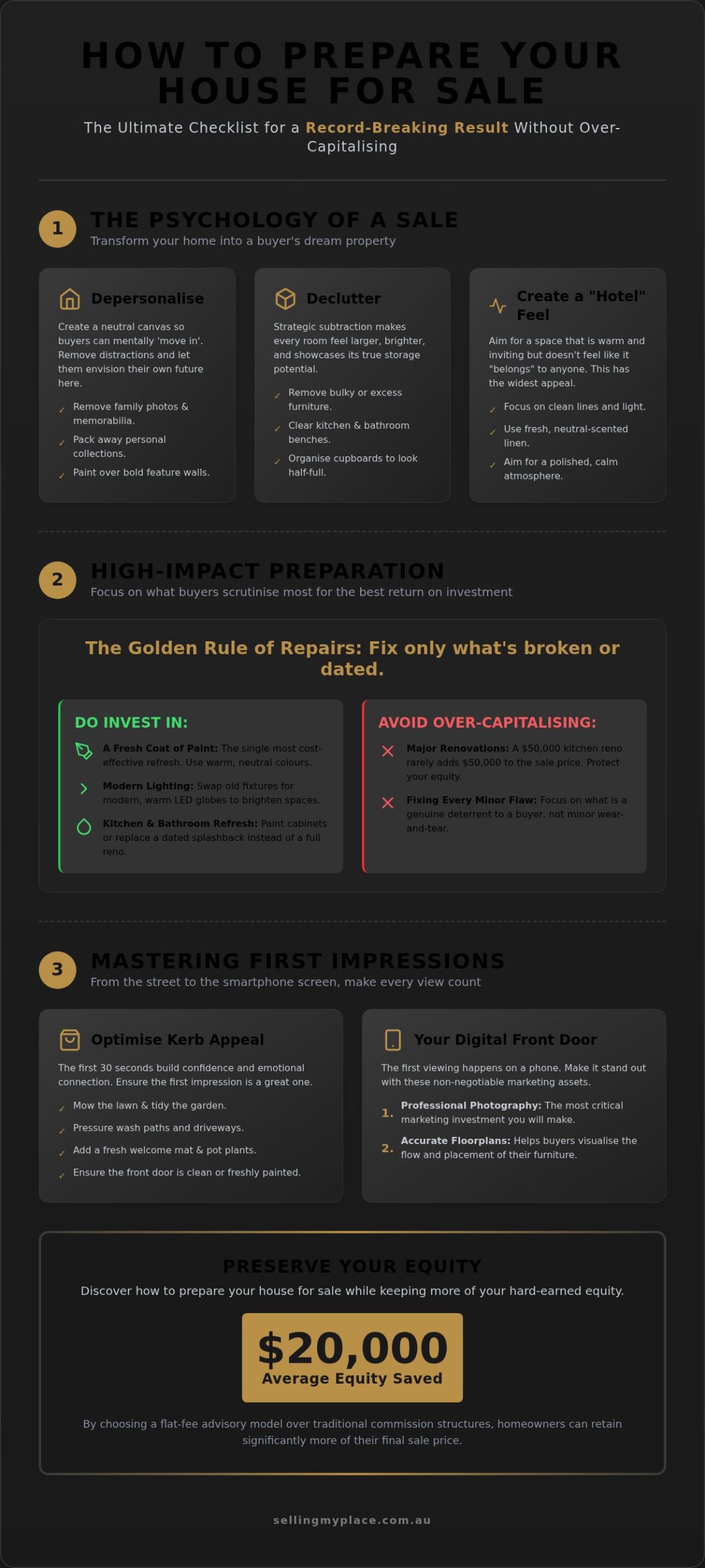
Visual Marketing: Your Digital Front Door
In 2026, the property market moves at the speed of a thumb-swipe. Before a potential buyer ever pulls up at your kerb, they’ve already walked through your hallways digitally. This makes your online listing the true “first inspection”. When you’re learning how to prepare your house for sale, understanding this digital-first reality is crucial. It’s no longer enough to have tidy rooms; you need images that stop the scroll and evoke an immediate emotional response. Your digital presentation needs to be as polished as the home itself.
Professional photography is a non-negotiable investment for any serious seller. It’s the difference between a house that sits on the market and one that sparks a bidding war. The camera sees differently than the human eye, picking up every stray power cord or smudge on a window. You’ll need to ensure the house is actually cleaner for the lens than it would be for a dinner party guest. High-definition sensors are notoriously unforgiving, so those “hidden” dust bunnies under the sofa or fingerprints on the stainless steel fridge might suddenly become the stars of the show. Think of the camera as a guest with perfect vision.
Photography: Capturing the Light
Timing is everything when it comes to capturing your home’s best side. We often recommend “Golden Hour” for exterior shots, that soft, honey-hued window just before sunset that makes every brick and leaf look magical. Inside, a professional photographer uses wide-angle lenses to capture the full volume of a room, helping buyers understand the layout without the “fish-eye” distortion of a cheap smartphone camera. Professional photos attract three times more clicks than DIY shots, ensuring your property gets the attention it deserves from the very first day it hits the portals.
The Role of Floorplans
While photos provide the “vibe”, floorplans provide the logic. They allow a buyer to “mentally move in” by measuring their existing furniture against your rooms. Accurate measurements build a bridge of trust, showing that you have nothing to hide and that the home’s proportions are exactly as described. This clarity is essential for buyers who are trying to narrow down their shortlist from their couch.
Use your floorplan to highlight flexible living zones or future renovation potential. Perhaps that sunroom could be a home office, or the master suite has space for an additional walk-in robe. By providing a comprehensive digital listing, you’re giving buyers the confidence to book a physical viewing. If you want to ensure your property stands out with high-end visual marketing and expert advice, reach out to our advisory team to discuss your listing needs.
The Financial Prep: Equity Preservation and Advisory
You’ve done the hard work of painting, decluttering, and polishing your home’s presentation. However, the final and perhaps most critical step in how to prepare your house for sale is securing your financial outcome. It’s easy to get caught up in the “vibe” of the sale and forget that at its heart, this is a major financial transition. Understanding the true cost of selling is vital. Traditional agency models often rely on a percentage-based commission, which can feel like a penalty for your home’s success. In 2026, many Australians are realising that they can achieve a record-breaking result without sacrificing a massive chunk of their hard-earned equity.
By opting for a Sale by owner approach, the average seller is able to keep an average of $20,000 more of their equity in their own pocket. That’s a significant sum that could go toward your next deposit, a well-deserved holiday, or your retirement fund. You don’t have to navigate this alone, though. Utilising a professional Agent Advisory Service allows you to access the same high-level strategy and staging advice used by top-tier agents, but within a much fairer financial framework. It’s about being the expert of your own home while having a steady, professional hand to guide you through the complexities.
Part of this “steady hand” approach includes getting your legal ducks in a row early. Seeking expert Conveyance Advice before you even hit the market is a smart move. It ensures your contract of sale is robust and ready to go the moment a buyer makes an offer, preventing unnecessary delays that can sometimes see a deal fall through. When you’re looking at how to prepare your house for sale, financial and legal readiness is just as important as a fresh coat of paint.
Determining Your Market Value
Setting the right price is a delicate balance of data and local insight. It’s important to look at actual recent sales in your specific pocket of the neighbourhood, rather than just the “asking” prices you see online. Emotion can often cloud our judgement when it comes to our own homes, so rely on hard numbers to set a realistic reserve. For a deeper dive into this process, read our guide on how to determine the market value of a home in Australia. This ensures you enter negotiations with confidence and a clear bottom line.
The Flat-Fee Advantage
The traditional commission model is often shrouded in mystery, but the flat-fee alternative is refreshingly transparent. Paying for your marketing and advisory services upfront is almost always smarter than paying a percentage of your final sale price at the end. It allows you to budget accurately and ensures that every extra dollar the market is willing to pay stays with you. At Kincade International Direct Sales, we empower you to take control of your sale journey while providing the professional tools—like photography and floorplans—you need to succeed. See how our flat-fee model can save you thousands on your next sale.
Your Next Chapter Starts with a Smart Strategy
Taking the first step toward selling your home is a significant life transition, and it’s completely natural to want everything to be perfect. As we’ve explored, knowing how to prepare your house for sale in 2026 isn’t about expensive renovations or chasing every minor flaw. It’s about strategic presentation, from the initial “hotel feel” of your decluttered lounge to the digital front door of your professional photography and floorplans. By focusing on high-impact repairs and kerb appeal, you create an emotional connection that resonates with buyers the moment they see your listing.
Beyond the aesthetics, protecting your equity is the most rewarding part of the process. With our Expert Agent Advisory Service and global marketing reach, you can navigate the market with local Australian expertise while saving an average of $20,000 in commissions. You have the power to be the expert of your own sale journey without the stress of traditional agency costs. Download our Full Seller’s Guide and start your commission-free journey today. We’re here to help you move forward with confidence and a steady hand.
Frequently Asked Questions
How much should I spend on preparing my house for sale?
You should aim to spend between 1% and 2% of your property’s estimated value on preparation. This range typically covers essential maintenance, professional cleaning, and cosmetic updates like fresh paint without the risk of over-capitalising. It’s about making smart, tactical improvements that protect your equity while ensuring the home presents at its absolute best for the first weekend of inspections.
Is it worth renovating the kitchen before selling?
A full kitchen renovation is rarely worth the investment just before a sale. Most buyers prefer to choose their own finishes, and you risk spending more on a new fit-out than you’ll actually recoup in the final price. Instead, we recommend a “refresh” by painting old cabinetry, replacing dated handles, or installing a modern splashback to provide a high-impact visual lift for a fraction of the cost.
Do I really need professional photography if I have a good smartphone?
Professional photography is a non-negotiable investment because your first inspection happens on a smartphone screen. While modern phones are impressive, they can’t match the wide-angle lenses and lighting expertise of a professional who knows how to capture a room’s true volume. High-quality images attract significantly more interest on property portals, which is a vital part of how to prepare your house for sale effectively.
How do I keep my house tidy for inspections while living in it?
The most effective strategy for living in an “inspection-ready” home is to use the “basket method” for quick tidying. Keep several large, stylish baskets handy to quickly sweep up toys, mail, or pet accessories before a potential buyer arrives. Focus on keeping high-impact areas like kitchen benches and bathroom vanities completely clear of daily clutter to maintain that polished, hotel-like feel without the stress.
What is the most important room to focus on when preparing to sell?
The kitchen is universally considered the most important room to get right for a successful sale. It acts as the emotional heart of the home and is often the space where buyers spend the most time scrutinising the details. If your kitchen feels clean, bright, and functional, it builds immediate confidence. Once the kitchen is polished, focus your attention on the main living area and the master bedroom.
Can I sell my house myself and still get a professional price?
Yes, you can absolutely achieve a professional price by selling the property yourself, especially when supported by expert advice. By using flat-fee marketing and an Agent Advisory Service, you reach the same audience as traditional agents while keeping an average of $20,000 more of your equity. This approach allows you to act as the expert on your own home while ensuring your digital presentation is world-class.
How long does it typically take to prepare a house for market?
Most homeowners should allow between two and four weeks to properly prepare their property for the market. This timeline provides enough space for deep cleaning, decluttering, and completing minor repairs without the process becoming overwhelming for the family. It also ensures you have plenty of time to book professional photography during the “Golden Hour” to make sure your online listing truly stands out from the competition.
What are the most common mistakes people make when preparing to sell?
The most common mistakes are over-capitalising on expensive renovations and neglecting the property’s street appeal. Many sellers spend thousands on internal upgrades that don’t offer a clear return, while forgetting that the front garden is the home’s first handshake. Another frequent error is failing to learn how to prepare your house for sale by depersonalising, which prevents buyers from mentally moving into the space during an inspection.
DIY Home Sale Checklist Australia: Sell Your Property Smarter in 2026
What if the secret to keeping an extra $20,000 or more from your property sale wasn’t finding a better agent, but simply becoming your own best advocate? It’s a bold thought, particularly when the national median dwelling value has climbed toward $922,838 in 2026. You likely feel a bit protective of your home’s equity, yet the idea of managing the legalities and marketing yourself can feel incredibly daunting. It’s completely natural to worry about pricing your sanctuary correctly or getting tangled in the logistics of a property market that feels increasingly complex. We understand that this isn’t just a transaction; it’s a significant life transition that deserves a steady, expert hand.
We’ve designed this DIY home sale checklist australia to give you the exact roadmap you need to sell smarter and stay empowered. You’ll learn how to bypass traditional commission structures while maintaining a professional-grade presence that attracts the right buyers. From mastering your initial listing to navigating the final settlement with total peace of mind, this guide ensures you have the tools to achieve a premium result on your own terms.
Key Takeaways
- Master the art of “soulful” presentation by using professional photography and floorplans to help buyers visualise their future in your home.
- Secure your legal interests by identifying state-specific disclosure requirements early, ensuring your Contract of Sale is robust and ready for settlement.
- Follow our comprehensive DIY home sale checklist australia to navigate the property market independently while maintaining a polished, professional-grade listing.
- Maximise your profit by comparing the traditional commission model against a transparent flat-fee approach that lets you keep 100% of your sale’s upside.
- Build buyer confidence through a welcoming, low-pressure inspection process and a methodical, “steady hand” approach to managing leads and negotiations.
Pre-Sale Preparation: Laying the Foundation for a Profitable Sale
Selling your home is more than just a financial transaction; it’s the closing of one chapter and the hopeful beginning of another. To ensure this transition is as rewarding as possible, you need to start with a clear-eyed assessment of your property. This is the first, vital step on any DIY home sale checklist australia. Instead of seeing your home through the lens of your own memories, try to view it through the objective, sometimes critical, eyes of a stranger. Walk through every room with a notepad in hand. Is there a leaky tap you’ve ignored for months? Does the hallway feel cramped because of that bulky sideboard?
Decluttering isn’t just about tidying; it’s about creating space for someone else’s dreams. When you depersonalise by removing family photos or niche collectibles, you’re inviting a potential buyer to visualise their own legacy within these walls. You don’t need a full renovation to see a boost in your sale price, either. Focus on high-impact, low-cost “quick wins.” A fresh coat of neutral paint can make a tired room feel modern and airy, while spreading fresh mulch in the garden beds suggests a well-maintained home. Before you set a price, secure a comprehensive neighbourhood market report to see how these small improvements align with current local buyer expectations.
Determining Your Realistic Market Value
Setting the right price is a delicate balance. While automated online estimates are a handy starting point, they often miss the nuances of your specific street or recent local infrastructure upgrades, like a new school or transport hub. A thorough Australian property market overview reveals that regional variations and buyer sentiment play huge roles in final outcomes. Look closely at the “sold” prices of comparable properties from the last three months rather than just the “asking” prices of current listings. Ultimately, Market Value is the quiet intersection where hard data meets the emotional appeal of a well-presented home.
The “First Impression” Exterior Checklist
Buyers often make up their minds before they even step through the front door. Kerb appeal is the primary engine that drives inspection bookings, so your exterior must look cared for and secure. Use this quick guide to ensure your home’s “face” is ready for its close-up:
- Ensure the entrance is welcoming with scrubbed paths and a clear, inviting doorway.
- Check the condition of the roof and gutters; buyers look for signs of neglect that might lead to future costs.
- Repair any leaning or broken fencing to reinforce the sense of security and privacy.
- Mow the lawns and trim any overgrown hedges to let the property’s natural light shine through.
By ticking these items off your DIY home sale checklist australia, you’re building a foundation of trust before the first “open for inspection” sign even goes up. It’s about showing the community that this home has been loved and is ready for its next family.
Legal Essentials and Compliance: Navigating the Australian Landscape
Once you’ve polished the kerb appeal, it’s time to look under the hood. The legal side of selling your own home might feel like a maze, but it’s really about creating a transparent, secure bridge between your family and the next. A critical item on your DIY home sale checklist australia is identifying the specific disclosure requirements for your state. In Victoria, for instance, you’ll need a comprehensive Section 32 statement. In other parts of the country, the terminology changes, but the spirit remains the same: you must be upfront about everything from zoning to land tax. Honesty isn’t just a virtue here; it’s your best legal defence.
Appointing a qualified conveyancer or solicitor early in the piece is one of the smartest moves you can make. They’ll act as your steady hand, ensuring that every building permit for that 2022 kitchen renovation is accounted for. Have you checked your smoke alarms lately? What about your swimming pool safety certification? These aren’t just boxes to tick; they’re essential protections for your legacy and the buyer’s peace of mind. While you’re busy with real estate photography preparation tips to make the home look its best, don’t let the paperwork fall behind. Having your certificates of occupancy and compliance ready to go shows buyers that you’re a serious, organised seller.
Preparing the Contract of Sale
Your Contract of Sale is the heart of the transaction. It needs to be watertight to prevent a buyer from finding a reason to rescind the deal later. Be incredibly specific about what’s staying and what’s going. If that heirloom chandelier in the dining room is coming with you, list it as an exclusion. It’s these small details that prevent heart-wrenching misunderstandings on settlement day. Seeking professional conveyance advice early ensures that your documentation is ready the moment a serious buyer shows interest. It’s about being proactive rather than reactive.
Understanding Your State Regulations
Every state has its own rhythm when it comes to cooling-off periods and digital protocols. By 2026, digital signatures and remote settlements have become the standard across Australia, making the process faster and more accessible than ever. You should also prepare a “due diligence” pack for prospective buyers. This pack, filled with your certificates, permits, and even recent utility bills, builds immediate trust. If you’re feeling a bit overwhelmed by the fine print, you can always reach out for a chat with our advisory team to help clear the air and keep your sale on track.
High-Impact Marketing: Presenting Your Home to the Global Market
Once the legal framework is secure, it’s time to invite the world into your home. In the digital-first property market of 2026, your online listing isn’t just a noticeboard; it’s a carefully curated experience that needs to resonate with buyers across the street and across the globe. A high-impact marketing strategy is a non-negotiable item on any DIY home sale checklist australia. You aren’t just selling three bedrooms and a backyard; you’re offering a slice of stability and a place for a new family to build their own legacy. This emotional connection starts with how you present the property’s “soul” to potential buyers who may be viewing from a different time zone.
In today’s market, expatriates and interstate investors are more active than ever, often making decisions based entirely on digital assets. Leveraging a global marketing network allows you to reach these high-intent buyers who value the security of the Australian property market. Your listing description should reflect this by highlighting the local community, nearby schools, and the long-term stability of the area. It’s about painting a picture of a lifestyle, not just listing a set of features.
The Visual Power of Professional Assets
While modern smartphones take lovely family photos, they often fail to capture the true scale and light of a room, which can inadvertently devalue your property in the eyes of serious buyers. Investing in professional photography ensures your home looks its absolute best, highlighting the architectural details that make it unique. Pair these images with accurate floorplans to help buyers plan their daily lives within your walls before they even visit. Professional visuals act as a 24/7 digital open house, allowing people to explore the flow of the home at their own pace. This transparency builds trust and significantly increases the time spent on your digital listing.
Choosing the Right Listing Platform
The traditional agency model often involves high marketing costs and restrictive time limits that put unnecessary pressure on your sale. A smarter alternative is a flat-fee listing service that keeps your property active until it’s sold, giving you the breathing room to find the perfect buyer. When you follow a DIY home sale checklist australia, you can bypass heavy commissions and instead focus your budget on targeted social media campaigns. Neighbourhood-specific targeting ensures your home appears in the feeds of people already looking to move into your specific area. By combining professional infrastructure with your own local knowledge, you create a listing that feels both authoritative and deeply personal.
The Sales Process: Managing Inspections and Mastering Negotiations
You’ve polished the gardens and launched a global marketing campaign; now comes the moment where the digital interest turns into a physical presence. Meeting potential buyers is often the most nerve-wracking stage for any owner-seller, but you hold a distinct advantage that no agent can replicate. Nobody knows the story of your home, the way the morning sun hits the kitchen bench, or the quietest spot in the garden better than you do. As a key part of your DIY home sale checklist australia, organising inspections should feel less like a high-stakes interrogation and more like welcoming a future neighbour. This low-pressure atmosphere allows buyers to relax and truly see themselves living in the space.
When the front door closes and the last visitor leaves, the “steady hand” approach becomes your greatest asset. Follow up with every lead within 24 hours using a professional yet personal touch. A simple phone call to ask for their honest feedback is often far more effective than a scripted sales pitch. When those conversations turn into serious interest, insist that all offers be submitted in writing. Always ask for a pre-approval letter or proof of finance to accompany the offer. This ensures you’re focusing your energy on qualified buyers who are ready to make a commitment to your property’s future.
Conducting Stress-Free Open Homes
Creating a welcoming environment is about engaging the senses without overwhelming them. Buyers are looking for a sanctuary, so your goal is to provide a calm, inviting experience. Consider these practical steps for your next open home:
- Maximise natural light by opening all curtains and blinds to showcase the home’s best angles.
- Ensure a flow of fresh air through the house, perhaps using subtle, natural scents like fresh eucalyptus or citrus.
- Prepare a “frequently asked questions” sheet that covers local school catchments, the best nearby parks, and average utility costs.
- Focus on building a partnership with visitors by answering questions honestly rather than using a “hard sell” tactic.
Closing the Deal with Confidence
Negotiation is where many sellers feel most vulnerable, but it’s simply a dialogue about value and legacy. Don’t take a low-ball offer personally; it’s often just a starting point for a buyer testing the waters. You can utilise these property sale negotiation tips to help you stay firm on your home’s true worth. Remember, our Agent Advisory Service is always available as a sounding board during these final talks to ensure you feel supported. Once you accept an offer, confirm the deposit is paid into a secure trust account immediately. If you need a hand navigating the final hurdles of the contract, reach out for expert guidance to ensure your settlement stays on track.
The Modern Alternative: Why a Flat-Fee Partnership Wins
Choosing to sell your property independently doesn’t mean you have to walk the path alone. Many homeowners feel they must choose between a high-commission agent or a stressful solo journey, but the modern reality is far more supportive. By following a DIY home sale checklist australia, you can embrace a partnership that gives you the best of both worlds: professional-grade infrastructure and the freedom to manage your own sale. This “Expert Backing” model means you keep the control while we provide the photography, floorplans, and global reach discussed earlier. It’s about having a steady hand beside you while you remain in the driver’s seat.
When you calculate the real cost of a 2% commission on a $1,000,000 property, you’re looking at giving away $20,000 of your hard-earned equity. Choosing a sale by owner approach with a transparent flat fee allows you to protect that profit entirely. It’s a smarter way to move forward, especially when you consider that your listing remains active until it’s sold. You won’t face the ticking clock or the aggressive pressure of a traditional agency campaign that might push you to accept a lower offer just to clear a monthly target. You set the pace, and you keep the reward.
Protecting Your Equity
Visualise that $20,000 for a moment. It could be the deposit for your next adventure, a significant boost to your retirement fund, or even the budget for a stunning new kitchen in your next home. Beyond the numbers, there’s a profound psychological benefit to dealing directly with buyers. You’re the one who knows the neighbourhood’s heartbeat and the house’s history. This personal connection, supported by a polished and professional image, builds a level of trust that a third party simply can’t manufacture. You’re protecting your legacy while ensuring your costs stay grounded.
Next Steps: Getting Started
Transitioning from “thinking about it” to seeing your home live on the major portals can happen in as little as 48 hours. The first step is often a pre-sale consultation to fine-tune your strategy and ensure every box on your DIY home sale checklist australia is ticked. This isn’t just about saving money; it’s about feeling empowered and in control of one of life’s biggest transitions. You have the local knowledge, and we have the tools to make it shine. Start your commission-free journey with Kincade International Direct Sales today.
Your Journey Toward a Smarter Sale Starts Now
Selling your home on your own terms is about more than just a transaction; it’s about honouring the life you’ve built while securing your financial future. By following this DIY home sale checklist australia, you’ve seen how professional marketing and legal clarity can turn a complex process into a manageable, rewarding journey. You don’t have to sacrifice a polished image to save on costs. With the right support, you can present a listing that rivals any traditional agency, ensuring your home’s unique story is told with authority and heart.
Imagine keeping an average of $20,000 in commissions while still benefiting from professional photography, accurate floorplans, and our expert Agent Advisory Service. You have the local heart and the neighbourhood knowledge; we simply provide the steady hand and digital infrastructure to help you succeed. It’s time to step into your sale with total confidence and a clear path forward. You’ve done the hard work of building a home, and now you’re ready to reap the full rewards.
Download Your Free Flat-Fee Selling Guide and Save Thousands
Your home deserves a champion who knows it best. We’re here to help you every step of the way, ensuring your next big move is your most successful and empowering one yet.
Frequently Asked Questions
Is it legal to sell my own home in Australia without a real estate agent?
Yes, it is completely legal to sell your own property in every Australian state and territory. You aren’t required by law to hire a real estate agent; however, you must still comply with state-specific disclosure laws and property regulations. By taking the “sale by owner” route, you maintain full control over the process while ensuring all legal obligations, such as providing a Section 32 in Victoria, are met through your solicitor or conveyancer.
How much can I actually save by using a DIY home sale checklist?
Homeowners typically save an average of $20,000 in commission fees by managing the sale themselves. When you follow a structured DIY home sale checklist australia, you bypass the traditional 2% to 3% agent commission entirely. This significant saving stays in your pocket, allowing you to invest more into your next home or retirement fund while still achieving a professional-grade result through our flat-fee infrastructure.
Will my property still appear on major real estate websites if I sell DIY?
Yes, your property will appear on Australia’s leading real estate portals when you use a residential property listing service. While these major sites generally don’t allow private individual listings directly, a flat-fee partner acts as the bridge to get your home in front of millions of active buyers. This ensures you receive the same digital exposure as any agency-listed property without the high marketing costs or commissions.
What happens if I struggle to negotiate with a buyer on my own?
You don’t have to navigate tough conversations alone; our Agent Advisory Service acts as your professional sounding board. If a negotiation feels stuck or you’re unsure how to handle a specific offer, you can lean on our expert advice to find the right way forward. This partnership ensures you have the “steady hand” of an expert guide to help you stay firm on your property’s true value and reach a successful agreement.
Do I still need a lawyer or conveyancer if I am selling the house myself?
Yes, you still need a qualified conveyancer or solicitor to handle the legal transfer of the property. While you manage the marketing and inspections, your legal representative ensures the Contract of Sale is watertight and handles the actual settlement process. This is a vital safeguard that protects both you and the buyer, ensuring all state-specific disclosure requirements and financial settlements are completed correctly and securely.
Can I sell my home DIY if I have an existing mortgage?
Absolutely, having an existing mortgage doesn’t prevent you from selling your home independently. During the settlement process, your conveyancer will coordinate with your bank to “discharge” the mortgage using the proceeds from the sale. You’ll just need to factor in your lender’s standard discharge fees, which typically range between $300 and $700, and ensure your bank is notified once a contract is signed and the settlement date is set.
How do I handle the deposit and legal paperwork without a traditional agent?
The deposit is typically held in the trust account of your chosen solicitor or conveyancer rather than an agent’s account. This provides a secure, legally regulated environment for the buyer’s funds until the settlement is finalised. Your legal representative will also manage the exchange of contracts and ensure all paperwork is filed with the relevant state authorities, giving you peace of mind that the transaction is handled with professional decorum.
What is the most important item on a DIY home sale checklist for a fast sale?
The most critical item on any DIY home sale checklist australia for a swift result is professional presentation. High-quality photography and accurate floorplans are non-negotiable in 2026, as they form the first impression for every digital buyer. When paired with a realistic price based on a neighbourhood market report, these professional assets build immediate trust and encourage serious buyers to book an inspection much sooner.
Agency Flat Fee vs Commission: The Australian Seller’s Guide for 2026
Why should your real estate agent’s pay cheque increase simply because your home’s value has grown? It’s a question many homeowners are asking as they look at the equity they’ve spent years building. When you’re selling a property in the Australian market, where property values are often substantial, a standard 2.1% commission can feel less like a fair fee and more like a significant slice of your hard-earned wealth. Choosing a flat fee real estate agent sydney families can trust is no longer about cutting corners; it’s about finding a smarter, more transparent way to protect your legacy while moving toward your next chapter.
We know that selling your home is about much more than a transaction; it’s an emotional transition that deserves a steady hand and a partnership built on trust. You might feel a bit of a sting at the thought of high commission rates, or perhaps you’re anxious that a lower fee could mean sacrificing professional quality. This guide, brought to you by Kincade International Direct Sales, will show you how to retain 100% of your sale profit while still accessing elite global marketing and expert advisory support. We’ll explore the 2026 transparency regulations and demonstrate how a fixed-fee model can save you an average of A$20,000, ensuring your equity stays exactly where it belongs.
Key Takeaways
- Learn how to keep 100% of your property sale profit by moving away from traditional percentage-based commissions. This simple shift helps you retain an average of A$20,000 in equity.
- Discover why partnering with a flat fee real estate agent sydney homeowners trust doesn’t mean sacrificing quality. You’ll still receive professional photography and access to a global marketing network.
- Understand the 2026 regulatory landscape and how a fixed fee provides the total transparency you deserve. You’ll know exactly what you’re paying for marketing and advisory services from day one.
- Explore how a dedicated Agent Advisory Service supports you through the entire process, from listing to settlement. This professional guidance ensures you feel protected during one of life’s biggest transitions.
- See how properties stay active until sold with no restrictive time limits. This model prioritises your long-term goals and family needs over a quick, transactional result.
The Shift Toward the Agency Flat Fee in Australian Real Estate
For decades, the traditional commission model was the only path for Australian sellers. But as we move through 2026, the landscape is changing. Homeowners are looking at their equity and asking why a percentage of their life’s work should be handed over for a standard service. This is why the search for a flat fee real estate agent sydney families can rely on has surged. It isn’t just about saving money; it’s about a fairer, more transparent exchange of value. People want to know they are paying for professional expertise, not just giving away a slice of their future.
There is a vital distinction to make between budget listing services and a professional flat fee agency. A budget service often leaves you to manage the complexities alone, which can be overwhelming during a major life transition. In contrast, a professional flat fee model provides a partnership. It offers the same high-end marketing and advisory support you expect from a traditional firm but decouples the cost from your home’s final sale price. Understanding what a real estate agent does helps clarify that the core tasks, such as professional photography and expert negotiation, don’t actually cost more just because your property is worth more.
The True Cost of a 2.5% Commission
When you look at the actual dollar amounts, the impact of the old commission model is staggering. With Sydney’s median house price now sitting around A$1.6 million, a 2.5% commission takes A$40,000 directly out of your pocket. That is a massive amount of money. It’s often the difference between being able to afford a dream home in a better suburb or having to settle for less. Many agents argue that a percentage-based fee provides an incentive to get a higher price, yet most sellers now see this as a myth. The real driver of a high sale price is professional marketing and a broad reach, both of which can be achieved without sacrificing your hard-earned equity.
Why “For Sale By Owner” is Evolving
The old “DIY” method of selling a home used to feel risky and unpolished. Today, that model has matured into a sophisticated Direct Sales approach. Thanks to modern digital infrastructure, you can now access the same global marketing networks that the big franchises use. This evolution means you can reach buyers across the country or even overseas with ease. You get the professional backing of high-end photography and floorplans, combined with an advisory service that acts as your steady hand during the process. It’s a grounded, reassuring way to sell that prioritises your family’s needs and your long-term stability.
What is an Agency Flat Fee and How Does It Work?
An agency flat fee is a straightforward, single payment that covers the professional marketing and sales support required to sell your home. Unlike a commission, which fluctuates based on your final sale price, this model is fixed and transparent. It represents a “Pay-for-Service” philosophy. You are paying for the actual work performed, such as professional photography and expert advisory, rather than giving away a percentage of your property’s wealth. This approach aligns perfectly with NSW Fair Trading regulations on agent agreements, ensuring you have total clarity from the moment your home goes live.
When you choose to work with a flat fee real estate agent sydney families often find that the entire process feels more collaborative. You aren’t waiting for a middleman to relay feedback from every single viewing. Because you know your home’s history and the local community better than anyone, leading your own viewings can create a more authentic connection with potential buyers. This directness often leads to faster sales. Buyers appreciate the honest, “straight from the source” information that only a homeowner can provide.
Professional Marketing Components
To stand out in the competitive 2026 market, your home needs to look spectacular. A professional flat fee model includes high-end photography and floorplans that capture the heart and flow of your property. Your listing isn’t just tucked away on a local site; it’s broadcast across global networks to reach interstate and international buyers. We also provide detailed neighbourhood market reports. These reports use real-time data to help you set a price that is both competitive and reflective of your home’s true value.
The Role of the Agent Advisory Service
Selling a home involves complex paperwork and high-stakes decisions. You don’t have to face this alone. An Agent Advisory Service acts as your professional guide, offering pre-sale consulting to ensure your home is presented in its best possible light. It’s the perfect blend of modern digital reach and expert human insight. If you’re curious about how this partnership could work for your specific suburb, you might like to reach out for a friendly chat about your goals.
Flat Fee vs. Commission: A Direct Comparison
Deciding between a traditional commission and a modern flat fee is about more than just numbers on a spreadsheet; it’s about understanding the true value of your home’s equity. In a fluctuating market, the traditional percentage model can feel like a moving target. If your property value increases, so does the agent’s pay cheque, despite the workload remaining largely the same. By choosing a flat fee real estate agent sydney sellers can lock in their costs early. This provides a level of financial certainty that is especially grounding during the high-stakes period of a property sale. When you know your costs are fixed, you can plan your next move with a calm confidence that isn’t possible under a commission-based structure.
It is vital to look at the net profit rather than just the sale price. For example, on a A$1.5 million sale, a 2.1% commission takes A$31,500 from your pocket. In contrast, a flat fee model allows you to retain a much larger portion of that wealth. From a tax perspective, while selling costs are often factored into Capital Gains Tax calculations for investment properties, for your family home, every dollar saved is pure cash in hand for your next deposit. The Real Estate Institute of Australia maintains high professional standards across the industry, but they don’t regulate fee structures, leaving you free to choose the model that best protects your legacy.
The “Incentive” Debate
Traditional agencies often claim that a percentage-based commission incentivises agents to work harder for a higher price. However, does a small fractional increase in an agent’s commission truly outweigh the owner’s natural passion? You are the best person to sell the lifestyle and heart of your home because you’ve lived it. A flat fee model empowers you to lead viewings while professional advisory services handle the heavy lifting of negotiation. This partnership ensures you have the skills of a seasoned expert behind you without the disproportionate cost of a commission.
Hidden Costs to Watch Out For
One of the biggest surprises for sellers is the “No Sale, No Fee” myth. In many traditional agreements, you still have to pay for Vendor Paid Advertising (VPA) even if the property doesn’t sell. These costs in Sydney can range from A$4,500 to A$10,000. When you add up the extras, the bill grows quickly:
- Auctioneer Fees: Often an additional A$500 to A$1,000 per event.
- Premium Portal Listings: Extra charges to stay at the top of search results.
- Administration Fees: Small “sundry” costs that bloat the final settlement statement.
An all-inclusive flat fee package removes these layers of complexity. It offers a transparent, single payment that covers your marketing and support, making the settlement process simple and stress-free.
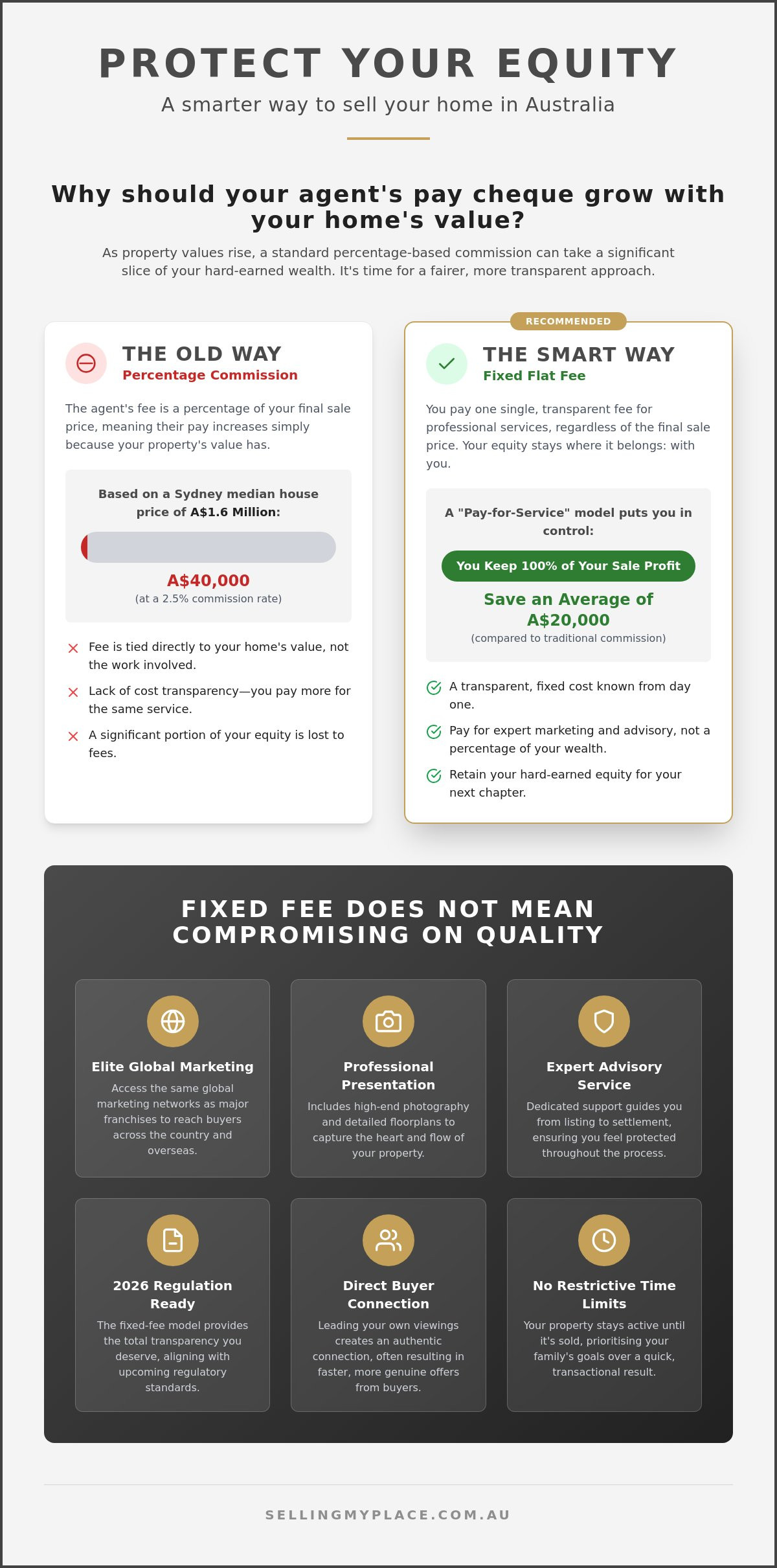
What to Look for in a Flat Fee Property Listing Service
Finding the right flat fee real estate agent sydney homeowners can trust involves looking far beyond a simple listing price. You’re searching for a partner who understands that your home is your most significant asset and a sanctuary of family memories. A truly professional service doesn’t just upload your property to a portal and leave you to it. It provides a comprehensive suite of tools designed to attract serious interest and protect your interests during the delicate journey toward settlement. It’s about combining the cost-effectiveness of a fixed fee with the sophisticated support of a seasoned expert.
When you evaluate potential partners, check for the absence of listing expiry dates or “pressure windows.” Traditional contracts often bind you to a 90-day limit, which can create a sense of desperation as the deadline looms. A partnership-based model keeps your property listed until it’s sold. This approach gives you the breathing room to wait for an offer that truly respects your home’s worth. It’s a grounded, reassuring way to sell that puts your needs ahead of an agency’s quarterly targets.
Evaluating the Marketing Package
Your online presentation is your digital kerb appeal. In the competitive 2026 market, professional photography is non-negotiable. It’s the first thing a buyer sees on their smartphone, and it must evoke an emotional connection immediately. Similarly, accurate floorplans are essential for qualifying buyers before they even step through your front door. They allow people to mentally place their furniture and imagine their daily lives in your space. Ensure your listing will appear on all major Australian property portals and reaches beyond our borders through a global marketing network to capture interstate and international interest.
The Advisory Advantage
The best services provide more than just digital space; they offer a “steady hand” through expert advisory. This includes receiving property sale negotiation tips from professionals who understand the nuances of the Australian market. You also need access to detailed reports that help you determine the market value of a home in Australia using real-time, local data. This expert backing ensures you aren’t navigating the complexities of conveyance or pre-sale consulting alone. If you’re ready to see how professional advisory can change your selling experience, you can contact our team for a personal consultation to discuss your property’s potential.
Maximising Your Sale Profit with the KIDS Direct Sales Model
The Kincade International Direct Sales (KIDS) model is designed for the savvy Australian seller who values both their hard-earned equity and professional support. When you choose a flat fee real estate agent sydney homeowners trust, you’re making a choice to protect your family’s financial legacy. Our 0% commission promise is the cornerstone of this approach. It ensures that every cent of the final sale price remains in your pocket. On average, our clients save A$20,000 per sale. That’s not just a statistic; it’s a significant amount of capital that can be reinvested into your next home or your children’s future.
We understand that the traditional “For Sale” sign represents more than a transaction. It’s a major life transition. That’s why we’ve built a digital infrastructure that rivals the largest global franchises, ensuring your home is seen by buyers across Australia and overseas. Unlike local boutique agencies that may have a limited reach, our network casts a wide net, while our Agent Advisory Service provides the grounded, personal guidance you need to navigate the process with calm confidence. It’s about having the best tools in the industry without the disproportionate price tag.
A Partnership, Not Just a Listing
Our advisors act as your professional back-office team, removing the stress of complex processes so you can focus on your move. This model is truly the logical conclusion of the Sale by owner evolution. It bridges the gap between doing everything yourself and paying an expensive commission. You’ll have a steady hand to help with everything from pre-sale property consulting to conveyance advice, ensuring you never feel alone in the journey. By decoupling the marketing cost from the sale price, we create a transparent partnership where our goals are perfectly aligned with yours.
Your Next Chapter Starts Here
Imagine the difference that saving A$20,000 on commission makes to your future buying power. It could be the extra room in your next house, a higher-quality renovation, or simply the peace of mind that comes with a larger financial buffer. You’re joining a community of empowered Australian homeowners who are moving away from outdated fee structures. The path to a successful sale is methodical and inviting. It starts with a detailed neighbourhood market report that gives you a clear picture of your property’s value. From there, we provide the professional photography and global visibility needed to reach the right buyer. Your next chapter is waiting, and we’re here to help you start it on the best possible financial footing.
Secure Your Financial Legacy and Your Next Move
Selling your home is a milestone that should leave you feeling empowered, not overcharged. We’ve explored how the traditional commission model often takes a disproportionate slice of your equity as property values rise. By choosing a flat fee real estate agent sydney families can trust, you ensure your hard-earned wealth stays exactly where it belongs. You’ve seen that a 0% commission approach doesn’t mean sacrificing quality; it means gaining a professional partner who provides high-end photography and global marketing without a “success tax” on your home’s value.
With an average saving of A$20,000 per sale, our model ensures you retain 100% of your profit to put toward your family’s future. Ready to take control of your sale? Discover how much you can save with a commission-free sale and keep every cent of your equity. Your next chapter deserves the best possible start. We’re here to provide the steady hand and professional guidance you need to make it happen with confidence.
Frequently Asked Questions
Is an agency flat fee better than a percentage commission?
Choosing an agency flat fee is often better for homeowners who wish to maintain control over their sale profits. Instead of paying a percentage that grows as your home’s value increases, you pay a fixed amount for the actual work performed. This model provides financial certainty and ensures you aren’t penalised for the growth of the Sydney property market. It’s a fairer way to pay for professional service without sacrificing your hard-earned equity.
What exactly is included in a property marketing flat fee?
A comprehensive marketing flat fee typically includes professional photography and high-quality floorplans to showcase your home’s best features. You also receive access to a global marketing network and major Australian property portals. Beyond digital listings, this fee covers dedicated Agent Advisory Services, providing the professional support needed to manage your sale from the initial listing through to settlement. It’s a complete package designed to give you a “steady hand” throughout the journey.
Will my property get the same exposure as a traditional listing?
Your property will receive identical exposure to traditional agency listings, appearing on all major property portals that Australian buyers use daily. Because we utilise a sophisticated digital infrastructure, your home is also broadcast through a global marketing network. This ensures you reach local, interstate, and international buyers, providing the same competitive visibility as any traditional firm without the high commission costs often associated with a flat fee real estate agent sydney search.
Do I have to do the house viewings myself with a flat fee model?
You typically lead the viewings yourself, which is a significant advantage because nobody knows the heart and history of your home better than you. Buyers often appreciate the authentic, direct communication that only a homeowner can provide. Our Agent Advisory Service supports you throughout this process, ensuring you feel confident and prepared to welcome potential buyers into your space. It’s a partnership that values your personal insight as the best selling tool available.
Can I still get professional negotiation help if I pay a flat fee?
Professional negotiation support is a core component of our service through the Agent Advisory Service. While you lead the viewings, our experts act as your professional “back-office” team, providing negotiation tips and guidance to help you secure the best possible offer. This partnership ensures you have seasoned real estate expertise on your side during the most critical stages of the deal. You get the benefit of expert advice without giving away a percentage of your sale price.
What happens if my property does not sell within three months?
Your property remains listed until it’s sold, as we don’t impose the restrictive 90-day time limits common in traditional agency contracts. This lack of “listing expiry” pressure allows you to wait for the right buyer and the right price without feeling rushed. It’s a patient, supportive approach that prioritises your family’s long-term goals over a quick, transactional result for an agent. We stay with you for as long as it takes to achieve your goal.
How much can I realistically save by using a commission-free service?
Sellers save an average of A$20,000 per sale by choosing a commission-free model over traditional percentage-based fees. On a median-priced Sydney home of A$1.6 million, a typical 2.1% commission would cost you over A$33,000. By partnering with a flat fee real estate agent sydney families can retain that equity, significantly increasing their buying power for their next property or life transition. It’s a meaningful saving that can change the course of your next chapter.
Is a flat fee service legal and licensed in Australia?
Flat fee services are fully legal and operate under the same Australian licensing requirements as traditional real estate agencies. We comply with all national and state regulations, including those set by NSW Fair Trading. You receive the same professional standards and legal protections you’d expect from any licensed property professional, ensuring a safe and transparent experience for your family. Our commitment is to provide a service that’s both highly competent and deeply rooted in professional duty.
The Rise of Commission-Free Real Estate: Why Australian Sellers are Reclaiming Their Equity in 2026
Why should a few weeks of marketing and a handful of open homes cost you the same as a brand-new car or two years of private school fees? If you’ve ever felt held to ransom by the traditional 2.65% national average commission, you’re certainly not alone. Many Australian families are tired of watching their hard-earned equity vanish into an agent’s pocket just as they’re trying to start their next chapter. The shift toward commission free real estate isn’t just a budget-friendly trend; it’s a movement where homeowners are finally taking back control of their most valuable asset.
It’s completely natural to feel a bit of anxiety about the legal conveyance or worry that selling your own home might look less than professional to savvy buyers. However, the landscape in 2026 has changed. You can now save an average of A$20,000 in fees while still showcasing your home with high-end photography and receiving expert guidance through the negotiation process. We’ll explore how modern tools and professional support are helping Australians navigate new disclosure laws and market shifts to secure a premium sale price without the premium commission.
Key Takeaways
- Understand how the 2026 shift toward digital transparency and flat-fee models empowers you to reclaim your home’s equity without sacrificing professional standards.
- See the breakdown of how traditional commissions can cost you tens of thousands of dollars and why a fixed-fee approach is often more aligned with your financial interests.
- Learn how commission free real estate models provide a steady hand throughout the process, offering expert support without the high-stakes pressure of a percentage-based fee.
- Discover the two non-negotiable tools for any modern seller: a comprehensive neighbourhood market report and high-quality visual storytelling to capture buyer attention.
- Explore how an advisory-led approach bridges the gap between risky DIY selling and expensive traditional agencies, ensuring your home’s legacy and your family’s future are protected.
What is Commission-Free Real Estate and Why is it Trending in Australia?
Commission-free real estate is a modern alternative to the traditional percentage-based agency model. Instead of paying a slice of your home’s final sale price, you engage a flat-fee marketing and advisory service. This shift is gaining momentum across Australia in 2026 because it offers substantial cost savings alongside the professional polish of a traditional agency. It’s about having a steady hand to guide you through the complexities of a sale without the steep price tag that usually follows.
Think about the numbers for a moment. With the national median commission rate sitting at roughly 2.65% as of June 2026, selling a home for A$900,000 means handing over nearly A$24,000 in commission alone. That is a significant portion of your equity that could be better spent on your next family home or your retirement fund. By choosing a commission free real estate model, you are essentially reclaiming that 2 to 3 per cent for your own future. It represents a fundamental change in how we value the work involved in a property transaction.
The Evolution of the Australian Property Market
Prop-tech has completely decentralised property data in recent years. It wasn’t long ago that agents held all the keys to market knowledge, but today, comprehensive data is accessible to every homeowner. National listing platforms have levelled the playing field, allowing sellers utilising modern, flat-fee services to reach the same pool of buyers as the biggest franchises in the country. This means full-service no longer has to be synonymous with high commission. You can still have professional photography, floorplans, and expert advisory services without the traditional percentage-based fee structure. The market has matured, and sellers are now more informed than ever before.
Equity Protection: The New Priority for Homeowners
Equity protection is the strategic preservation of your home’s value by minimising transactional costs and maximising the final net return on your sale. For many Australians, this represents a profound psychological shift. You aren’t just paying for a service; you’re protecting a life’s work. We see more families using these saved commissions to bolster their next deposit or secure a more comfortable lifestyle in retirement. It’s about ensuring that the value built through years of mortgage payments stays exactly where it belongs: with you. This movement is less about cutting corners and much more about valuing your own financial legacy.
The Hidden Costs of the Traditional Commission Model
Let’s look at the cold, hard numbers. In many Australian capital cities and growing regional hubs, a family home reaching the A$1,000,000 mark is now quite common. At a 2.5 per cent commission rate, you are signing away A$25,000 the moment the contract exchanges. But here is the kicker: that A$25,000 usually doesn’t even cover your marketing. Most traditional agencies will then ask for an additional A$5,000 to A$10,000 for “vendor-paid advertising” to cover photography and portal listings. Suddenly, your cost of selling has ballooned toward A$35,000 before you’ve even packed a single box.
This traditional model often creates a subtle conflict of interest. An agent’s primary goal is frequently a quick turnover so they can move on to the next listing. For them, the difference between selling your home for A$950,000 today or holding out for A$1,000,000 next week is only a few hundred dollars in their pocket. For you, that difference is A$50,000. It’s your mortgage, your children’s education, or your retirement travel. The high-pressure sales tactics often used to secure a quick listing or a fast sale can take a heavy emotional toll, leaving you feeling like a transaction rather than a partner. The same conflict of interest applies on the buying side, which is why many Australians are now turning to a flat fee buyer’s agent Australia wide to ensure their representative’s incentives are truly aligned with their own.
Commission vs. Net Profit: What Really Matters
The gross sale price of your home is essentially a vanity metric if a massive chunk of it is eaten by fees. What actually lands in your bank account is what defines your future stability. This is where Technological Disruption In Real Estate has been a total game-changer for homeowners. By choosing a model focused on commission free real estate, you gain budget certainty from day one. There are no surprises, no “extra” hidden costs, and no percentage-based penalties for your home’s success. It allows you to keep your focus on long-term financial health rather than transaction-day stress. If you’re curious about how this looks for your specific suburb, you might want to see how our flat-fee model works for local sellers.
The Myth of the ‘Magic’ Negotiator
Many people worry that they need a “star” agent to handle the heavy lifting of price talks. The truth is that effective negotiation isn’t magic; it’s math and preparation. Professional advisory services now provide the same rigorous negotiation frameworks used by top-tier firms. By arming yourself with a data-heavy neighbourhood market report, you can back your asking price with facts rather than just “agent intuition.” You become the most informed person in the room, empowered to protect your equity with a steady, confident hand. It’s about having the right tools to advocate for your home’s true value without the high-pressure environment of a traditional agency.
Comparing the Models: Traditional Agency vs. Pure DIY vs. KIDS Advisory
Choosing how to sell your home is a deeply personal decision that balances your financial goals with a need for peace of mind. In the Australian market, you generally face three distinct paths. The traditional agency model is the most familiar; it’s a hands-off experience where the agent handles the logistics, but it often lacks true personal empathy and comes with a price tag that can feel like a second mortgage. On the other end of the scale is the pure “sale by owner” or DIY route. While this is the lowest-cost option, it carries a high risk of legal errors or poor marketing that can inadvertently devalue your life’s work.
The third path is the hybrid advisory model, which we call the Kincade International Direct Sales (KIDS) approach. This model provides a commission free real estate experience that doesn’t leave you navigating the process alone. You receive professional marketing and expert guidance for a transparent flat fee, ensuring you have a steady hand to guide you through every milestone. Crucially, a “listing until sold” guarantee is essential in this model. It transforms the relationship from a temporary transaction into a genuine partnership, providing you with certainty regardless of how market conditions might shift during your campaign.
Why ‘Support’ is the Missing Ingredient in Most Flat-Fee Services
Most budget services simply place your home on a website and wish you luck, but real success requires a more nurturing touch. This is why pre-sale property consulting is so vital; it helps you maximise your home’s appeal before the very first buyer walks through the door. Professional photography and floorplans are also non-negotiable if you want to achieve a premium result in a competitive digital landscape. When you combine these visual tools with expert conveyance advice, the legal transition becomes just as smooth as the marketing campaign, reducing the stress that often accompanies high-stakes property deals.
The Global Reach Advantage
Australian property is increasingly viewed as a global asset, and your marketing should reflect that reality. A sophisticated digital presence now replaces the need for a local shopfront by placing your home directly into the pockets of qualified buyers across the globe. Unlike traditional local listings that might fade after a few weeks, modern digital infrastructure allows your property to maintain high visibility for as long as it takes to find the perfect buyer. This global network ensures that your home’s legacy is shared with a vast audience, far beyond the reach of a simple sign on the front lawn.
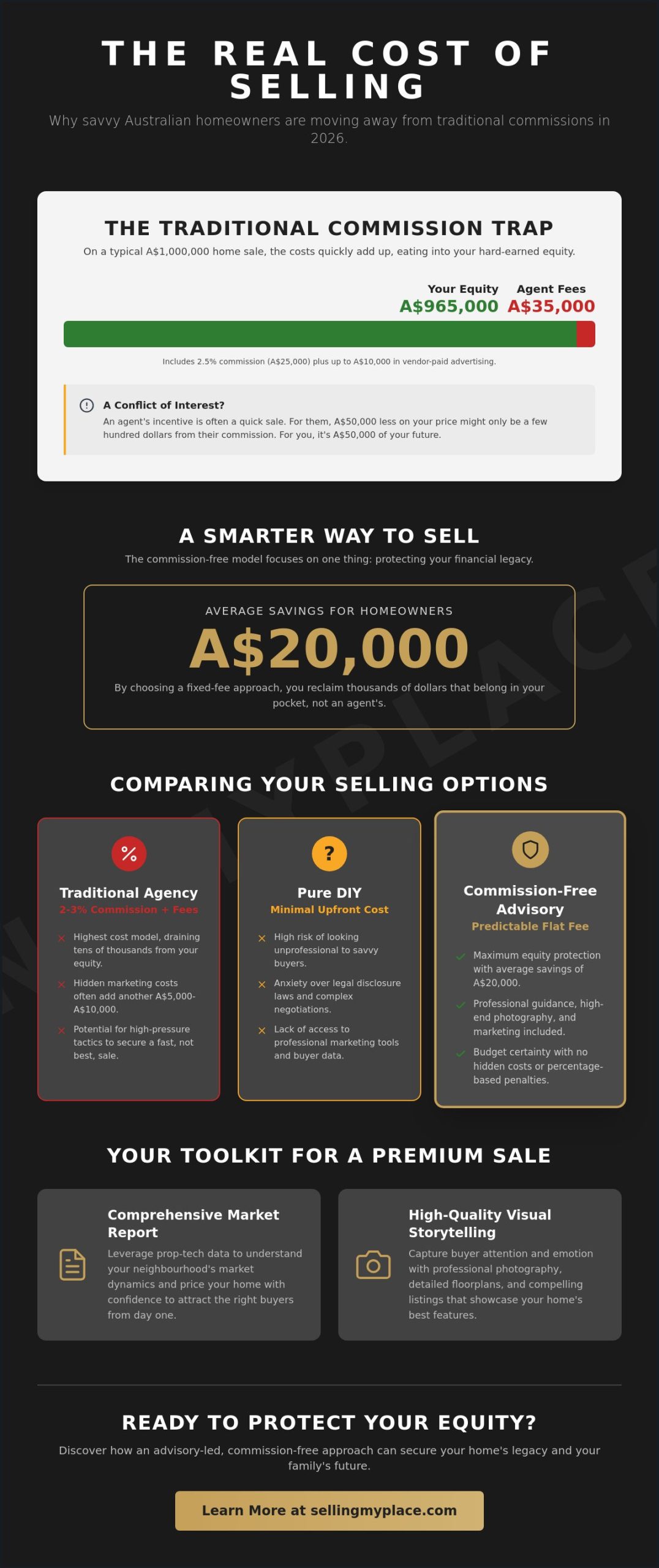
How to Succeed in the Commission-Free Market
Success in the commission free real estate market isn’t about cutting corners; it’s about allocating your resources where they actually drive results. Many sellers find that once they remove the heavy burden of a 2.65% commission, they have more room to invest in the things that truly matter. By following a structured, professional-grade checklist, you can move from listing to sold with a sense of calm confidence. It’s about being prepared, being professional, and being yourself.
- Step 1: Secure a comprehensive neighbourhood market report to set a realistic, data-backed price that stands up to buyer scrutiny. This is the foundation of any successful campaign.
- Step 2: Invest in professional visual storytelling, including photography and floorplans, to ensure your home stands out in a crowded digital landscape.
- Step 3: Organise your legal ducks in a row by seeking early conveyance advice to avoid last-minute contract hurdles.
- Step 4: Leverage professional real estate advisory services for pre-sale consulting and buyer representation to bridge the gap between DIY and traditional agency.
- Step 5: Master the warm hosting of open homes to build genuine, neighbourly connections with potential buyers who want to hear the real story of your home.
If you’re ready to start this journey with a professional edge, you can access our real estate advisory services to ensure every detail of your sale is handled with care.
The Power of Professional Presentation
Why would you risk devaluing your home’s online presence with grainy phone snaps? In 2026, your first open home happens on a smartphone screen. Professional photography captures the soul of a property, while floorplans perform a vital psychological task. They help buyers mentally move in by planning where their furniture will go before they even step through the front door. To truly shine, take the time to declutter and stage your rooms for a lifestyle-oriented sale. You aren’t just selling bricks and mortar; you’re selling the dream of a new beginning.
Navigating the Legalities with Confidence
It’s natural to feel a bit of anxiety when looking at an Australian property contract for the first time. However, the steps are quite logical once you have a steady hand to guide you. Handling enquiries and offers doesn’t have to be overwhelming if you have a clear framework for response. Having an advisor to review the fine print provides that essential layer of protection, ensuring your family’s interests are always the priority. This professional support allows you to focus on the emotional transition of moving while the technical details are managed with expert care.
Choosing Your Partner for a Smarter Sale
Selling your family home is far more than a simple legal transaction; it’s a major life transition that deserves a partner who values your journey. The industry is finally shifting toward a more empathetic, seller-centric experience that puts your needs ahead of an agent’s commission. By choosing a commission free real estate model, you aren’t just saving money. You are choosing to work with a team that respects the years of hard work you’ve put into your property. It’s about finding that perfect balance between professional results and personal control.
Kincade International Direct Sales (KIDS) was designed specifically to bridge the gap between the high costs of traditional agencies and the risks of going it alone. We believe that every Australian homeowner should have access to expert support without being held to ransom by percentage-based fees. This approach combines a sophisticated global marketing network with deep local expertise, ensuring your home is seen by the right buyers, whether they are just around the corner or on the other side of the world. Imagine what your next chapter looks like with an extra A$20,000 in your pocket. It could be the difference between a modest renovation and the dream kitchen you’ve always wanted.
The KIDS Difference: More Than Just a Listing
What sets our approach apart is the commitment to being a “steady hand” throughout the entire process. Our 0% commission structure and transparent flat fee provide the financial security you need to plan your future with confidence. Through our Real Estate Advisory Services, you receive the nurturing guidance of a seasoned expert who acts as your advocate during negotiations. We also understand that every sale happens on its own timeline. That’s why we offer a “listed until sold” commitment, removing the artificial pressure of expiring contracts and letting you focus on achieving the best possible outcome for your family.
Your Next Chapter Starts Here
As you prepare to hand over the keys, remember that your home’s legacy is a reflection of the life you’ve built there. We view our role as a partnership that values that legacy as much as the final sale price. Selling is an emotional milestone, and you deserve a supportive environment where your questions are answered with warmth and your decisions are backed by data. Your future is waiting, and it’s brighter when you keep your equity where it belongs.
Begin your commission-free journey with Kincade International Direct Sales today and discover how a smarter, more empathetic sale can change your life.
Step Into Your Future with Confidence
Reclaiming your equity is about more than just balancing the books; it is about protecting the legacy of your home. By moving away from high-pressure traditional commissions and embracing commission free real estate, you are choosing a path that prioritises your family’s financial stability. You now understand how a flat-fee model provides absolute budget certainty, and how professional advisory services provide the same negotiation strength as any high-street agency without the high-stakes stress.
With a global marketing network at your fingertips and an expert Agent Advisory Service to guide you through every milestone, a premium sale is well within your reach. Australian sellers are already seeing an average of A$20,000 stay in their pockets, providing a significant boost for their next deposit or retirement fund. It is time to start your next chapter with a steady hand by your side and your hard-earned equity intact.
Discover how to sell your home with 0% commission at Kincade International Direct Sales
Your home has been the heart of your life for years. Let’s make sure its sale sets you up for an even brighter future in the years to come.
Frequently Asked Questions
Is commission-free real estate legal in Australia?
Yes, selling your property through a commission-free model is perfectly legal across all Australian states and territories. Real estate commissions are not regulated by the government; they are simply a matter of contract between you and a service provider. This means you have the freedom to choose a flat-fee advisory model that protects your equity rather than a traditional percentage-based structure.
How much can I actually save by using a flat-fee real estate model?
While every property is unique, many Australian homeowners save an average of A$20,000 in fees by avoiding the national median commission rate of 2.65%. By opting for commission free real estate, you keep that significant sum of money in your own pocket. This extra capital can be life-changing when you are trying to secure your next family home or boost your retirement savings.
Will my property be listed on the major Australian real estate portals?
Yes, your home will be listed on the leading Australian property portals where the vast majority of buyers look for their next move. Professional listing services ensure your property receives the same level of digital visibility as any traditional agency listing. You won’t miss out on potential buyers just because you’ve chosen a more cost-effective way to sell.
Do I have to do all the negotiations myself if I sell commission-free?
Not at all. While you have the joy of meeting buyers and sharing the story of your home, you don’t have to handle the high-stakes price talks alone. Expert advisory services provide a steady hand during the negotiation process, acting as your professional representative to ensure you achieve the best possible result without the stress of direct confrontation.
What happens if my property doesn’t sell within the first month?
Unlike traditional agencies that might pressure you for a quick sale to move on to their next listing, a “listed until sold” approach gives you the gift of time. Your property remains active and supported without arbitrary time limits or the need for expensive campaign renewals. This allows you to wait for the buyer who truly values the legacy of your home.
Is the final sale price lower when you don’t use a traditional agent?
There is no evidence to suggest that commission free real estate results in a lower sale price. In fact, when you are armed with a detailed neighbourhood market report, you can negotiate from a position of data-backed strength. Because you aren’t paying a massive commission, your net profit is often significantly higher even if the gross sale price is identical.
What professional services are included in a flat-fee marketing package?
A high-quality package includes everything you need for a polished, professional campaign, such as high-end photography and detailed floorplans. These visual tools are essential for helping buyers mentally move into your space before they even visit. You receive the same premium marketing standards as a boutique agency, but with the transparency and certainty of a flat fee.
Can I still get help with the legal paperwork and conveyance?
Yes, professional conveyance advice is a vital part of a smarter sale process. You will have access to expert guidance to ensure all contracts, disclosures, and legal requirements are handled with absolute precision. This professional oversight reduces the risk of legal errors and ensures a smooth, calm transition of title to the new owners. If you are also purchasing your next property, working with a flat fee buyer’s agent in Australia can bring the same transparent, fixed-cost approach to the buying side of your transaction. If you want to maximise your result before going to market, our guide on how to prepare your house for sale in Australia walks you through every step of the pre-sale process.
Free Online Property Valuation: Myth vs. Reality for Australian Sellers
What if that glowing number on your smartphone screen is actually the reason you miss out on a life-changing sum of money? It is a common dilemma for many Australian families today. You want a quick answer, so you jump onto a site for a free online property valuation, only to find three different platforms giving you three vastly different figures. It is enough to make anyone feel a bit unsettled, especially when you are trying to plan your next big move while the RBA cash rate remains at 4.35%.
We know that the fear of underselling is heavy, and the thought of high agent commissions eating into your hard-earned profit only adds to the pressure. You deserve a price range that feels grounded in reality, not just an algorithm’s best guess. In this guide, we will show you how to use these digital estimates as a helpful conversation starter rather than the final word. You will learn how to decode the data to find a realistic price range and see why expert-backed insights are the secret to saving A$20,000 in commissions. We are going to give you the confidence to sell on your own terms, with a clear understanding of the “why” behind your home’s true value.
Key Takeaways
- Understand how a free online property valuation uses automated algorithms to pull data, and why it is just the start of your pricing journey.
- Discover why digital estimates often miss the mark by failing to account for your home’s unique features, like that stunning new kitchen or solar system.
- Learn how to bridge the “accuracy gap” using professional Neighborhood Market Reports that combine deep suburb analytics with real-time data.
- Master a simple two-step process to price your home accurately for a successful sale without needing a traditional commission-based agent.
- Find out how a flat-fee model can protect your equity, potentially keeping an extra A$20,000 in your pocket when you settle.
What is a Free Online Property Valuation and How Does it Work?
It is 9:00 PM on a Tuesday, and you are sitting on the sofa, curious about what your biggest asset might be worth in the current market. Within seconds of typing your address into a search bar, a digital number appears. This is the convenience of a free online property valuation, a tool that has become the first port of call for thousands of Australian homeowners. While it feels like a personalised calculation, it is actually powered by an Automated Valuation Model, or AVM.
Think of an AVM as a very fast, data-hungry mathematician. It does not walk through your front door or admire your garden; instead, it crunches massive amounts of information from public records, recent sales in your street, and broader suburb trends. It is important to clarify a legal distinction here: what you see on a screen is technically an “estimate” or a “market appraisal.” To understand the deeper principles of how professional assessments differ from these digital guesses, it helps to ask, What is property valuation? In a formal sense, a true valuation is a legally binding document prepared by a qualified professional, often for a bank or a court. Online tools are simply a helpful ballpark figure to get your head around the possibilities without the pressure of a knock on the door.
The Data Behind the Screen
Major property portals and Australian banks do not just guess these numbers. They pay for access to massive databases that track every “sold” sticker in the country. They look at the median price points of your suburb and the specific growth rates over the last quarter. However, there is a catch. The algorithm sees that your neighbour’s house sold for a lower price last month, but it does not know that house was a “renovator’s delight” with a leaking roof. If your home is a “modern masterpiece” with high-end finishes, the online tool might accidentally drag your estimate down based on the poor condition of the house next door.
Why Banks and Portals Offer These for Free
You might wonder why these large companies provide this service at no cost. The reality is that your interest is the currency. By providing a free online property valuation, portals and banks can identify who is thinking about selling or refinancing. It is a sophisticated form of lead generation that helps them offer you a mortgage or connect you with a commission-based agent. Additionally, a bank’s estimate is often quite conservative. They are looking at your home through the lens of risk, ensuring they do not lend more than the property is worth. This figure is frequently lower than the actual “selling” price you could achieve with the right marketing and a bit of heart.
The Accuracy Gap: Why Online Estimates Often Miss the Mark
Have you ever noticed that a free online property valuation often gives you a range so wide you could drive a road train through it? It is not uncommon to see a gap of A$200,000 or more between the “low” and “high” estimates. This happens because algorithms are excellent at math but terrible at nuance. They rely on historical data that is often six to twelve weeks old. In a fast-moving market where the RBA cash rate or new government grants are shifting buyer demand by the week, relying on three-month-old “sold” data is like trying to drive while looking only in the rearview mirror.
Then there is the issue of “outlier” sales. If a neighbour down the street had to sell urgently due to a personal crisis, that lower price point gets sucked into the database. The computer does not know it was a distressed sale; it simply sees a three-bedroom house in your postcode selling for less, which then drags your estimate down. It also cannot distinguish between the peace of a quiet, leafy cul-de-sac and a house three doors down that sits right on a noisy main road or directly under a flight path. These local details matter immensely to your final result.
The “Ghost in the Machine”: What AVMs Can’t See
A computer program has never walked across your polished spotted gum floorboards or felt the quality of your new Caesarstone benchtops. It does not know you have invested in a high-spec solar system or a council-approved granny flat that could fetch a premium. These “invisible” assets are often where the real value lies. Unique features like a heritage facade or a North-facing backyard that captures the winter sun are the emotional triggers that drive up prices, yet they remain invisible to a standard algorithm. If you want to see how your home’s specific features stack up against others, exploring real estate advisory services can provide the clarity a machine simply cannot.
Market Sentiment vs. Historical Data
Real estate is as much about psychology as it is about bricks and mortar. While portals focus on “settled” sales, the most accurate price indicators are often the “active” listings and the number of people attending open homes this weekend. Market Sentiment is the emotional pulse of buyers at a specific moment. A computer cannot feel the energy of a “hot” market where three buyers are fighting over one property. It only sees the final number months after the emotional dust has settled. This lag is why your “on the ground” reality might be far more lucrative than a free online property valuation suggests.
Online Estimates vs. Neighborhood Market Reports
While a free online property valuation is a fantastic starting point for your research, it is essentially a snapshot taken from a distance. It gives you a general idea of where you stand, but when you are preparing to list your family home, a snapshot isn’t enough. You need a high-definition map. This is where a professional Neighborhood Market Report changes the game. Unlike an instant algorithm, these reports are built to bridge the gap between raw data and a winning selling strategy. They don’t just tell you what happened three months ago; they tell you what is happening right now in your specific street.
At Kincade International Direct Sales (KIDS), our reports are designed to be a protective shield for your equity. We take the “raw data” that everyone else sees and add a layer of strategic insight. This means looking at your home through the eyes of a buyer. We don’t just provide a number; we provide a narrative that explains your property’s unique position in the local landscape. It is the difference between having a rough guess and having a professional “selling” document that commands respect from potential buyers.
What a Professional Report Includes
A truly comprehensive report goes far beyond a simple median price graph. It provides a detailed comparison of properties currently for sale, which are your direct competition for buyer attention this weekend. We look at historical growth patterns and, crucially, any future suburb infrastructure plans that might boost your property’s appeal. If the local council has just approved a new parkland or transport hub nearby, that adds tangible value that an algorithm simply misses. Additionally, we include accurate floorplans and professional photography to define the true scale and lifestyle potential of your home, ensuring that every square metre is accounted for.
The Value of Human Interpretation
Data is powerful, but it can also be overwhelming without a guide. A report is just paper until an expert advisor sits down with you to review what the numbers actually mean for your specific situation. This is the “steady hand” approach we pride ourselves on. Having a professional interpret the analytics gives you the ammunition you need to justify your asking price to potential buyers. When you can point to hard evidence of local trends and infrastructure, you gain the confidence to stand firm on your price during a commission-free sale. It is about turning information into empowerment. You can Learn more about our Neighborhood Market Reports to see how we help you move from a guess to a certainty.

How to Price Your Home for a Commission-Free Sale
Pricing your home is one of the most significant decisions you will make for your family’s future. It is not just about a number; it is about protecting the equity you have built over years of hard work. To get this right, you need to move beyond a single free online property valuation and become a temporary expert in your own backyard. If you are considering taking the reins yourself, understanding how to price your home for sale by owner with a data-driven approach is the critical foundation for protecting your family’s equity. We recommend a methodical five-step approach to find your “sweet spot.”
- Step 1: Gather at least three different online estimates to find a broad baseline range for your suburb.
- Step 2: Spend a Saturday morning attending three local “Open for Inspections” to see your competition in the flesh and compare their finishes to yours.
- Step 3: Use the “Add-Back” method to factor in your unique upgrades, like that high-spec kitchen or the council-approved deck.
- Step 4: Consult a professional for Pre-Sale Property Consulting to finalise your strategy with an objective eye.
- Step 5: Set a listing price that is competitive enough to invite multiple offers without leaving a cent on the table.
Be the Local Expert
Success in a private sale comes down to knowing the numbers better than the buyers do. Tracking “Days on Market” for your specific postcode is vital; it tells you exactly how fast the current pulse is moving. When you see “Price Withheld” on a recent sale, don’t worry. You can usually find the actual figure in the “Sold” section of major portals once the settlement period ends, or by asking an advisor who has access to the latest data. Aiming too high at the start often causes your listing to go stale, ultimately forcing a price drop that makes buyers wonder what is wrong with the property.
Using Data to Negotiate
When a buyer tries to “low-ball” you, it can feel like a personal affront to your home’s history. Stay grounded. This is where your Neighborhood Market Report becomes your best friend. By showing a buyer the hard evidence of similar sales and suburb growth, you move the conversation from emotion to logic. It is much harder for a buyer to argue with a free online property valuation when it is backed up by professional photography and detailed floorplans that prove your home’s true scale. Having these assets ready shows you are serious, prepared, and fully aware of your property’s worth in the current Australian market.
Maximise Your Profit with KIDS: Beyond the Valuation
A free online property valuation is a useful spark for your imagination, but it doesn’t provide the fuel needed to reach your financial destination. Once you have a sense of the numbers, the real work begins. At Kincade International Direct Sales (KIDS), we act as your seasoned partner, ensuring you don’t just find a buyer, but that you secure the best possible result for your family. We believe your home’s legacy belongs to you, not an agency’s bottom line. By moving away from the traditional model, you can keep your hard-earned equity exactly where it belongs: in your bank account.
The traditional agency commission model often feels like an invisible tax on your success. In many Australian suburbs, a standard commission can easily reach A$20,000 or more. That is money that could pay for your next move, a well-deserved holiday, or your children’s education. Before committing to any selling arrangement, it is worth reviewing a detailed flat fee vs commission real estate Australia comparison checklist so you can see exactly where your money goes under each model. With our Agency Flat Fee approach, that era of high costs is a thing of the past. We provide a Real Estate Advisory Service that acts as your secret weapon, offering professional guidance on strategy and conveyance advice without the predatory price tag. You get the expertise of a seasoned professional without the heavy financial burden.
Professional Tools, Personal Control
Selling your own home doesn’t mean you have to do it alone or settle for amateur results. Our flat-fee packages include high-end professional photography and detailed floorplans, ensuring your property stands out against the competition on every major portal. You maintain total control over the process, with the peace of mind that your home is “listed until sold.” There are no arbitrary time limits or high-pressure tactics to lower your price just to get a quick result for an agent. We also provide guidance through the legal journey with a steady, experienced hand, making the complex feel simple and safe. Our global marketing network further ensures that your place is seen by the right buyers, no matter where they are searching from.
Taking the Next Step
While a digital estimate is a great first step, it is merely the beginning of your A$20,000 saving journey. Transitioning from a free online property valuation to a successful sale requires more than just a ballpark figure; it requires a strategy. We invite you to have a heartfelt, no-obligation consultation with one of our seasoned experts to discuss your aspirations and your home’s unique story. It is time to move beyond the algorithm and start your selling journey with confidence and clarity. Get your professional Neighborhood Market Report and start selling smarter today.
Step Into Your Next Chapter with Confidence
Your home is more than just a set of coordinates on a map; it is the backdrop to your family’s history and the foundation of your future. While a free online property valuation provides a helpful ballpark figure to spark your interest, it cannot capture the heart of your property or the true value of your recent renovations. As we have explored, the real secret to a successful sale lies in combining that raw data with professional insight and a clear, commission-free strategy.
You deserve to keep your hard-earned equity. By choosing a smarter path, you can save an average of A$20,000 in commissions while still benefiting from an expert Agent Advisory Service. We ensure your home shines with professional photography and floorplans as standard, giving you the tools of a top-tier agency without the high costs. It is about having a steady hand to guide you through the complex legal and marketing steps, so you can focus on your next move. Empower your sale with a professional Neighborhood Market Report. You have worked hard for your home, and we are here to help you protect its value with warmth, honesty, and professional care.
Frequently Asked Questions
How accurate are free online property valuations in Australia?
Accuracy is a spectrum that depends heavily on your location and property type. In suburbs with high turnover and many similar homes, a free online property valuation is often quite close to the mark. However, for unique properties or those in areas with fewer sales, the margin for error increases. These tools rely on historical data, which means they can lag behind the real-time impact of the current 4.35% cash rate or sudden shifts in buyer demand.
Will an online valuation be the same as a bank appraisal?
No, they often tell different stories because they serve different masters. A bank’s assessment is typically more conservative because it is designed to protect the lender from risk. Online portals, on the other hand, aim to provide a “market” range to help you start your selling journey. For a definitive figure, a bank will often require a physical inspection by a certified valuer to verify the home’s condition and unique features in person.
Can I use an online property estimate to set my asking price?
Using an online estimate as your sole pricing strategy is a risky move. It provides a helpful baseline, but it doesn’t account for the “active” competition you will face at open homes this weekend. To set a price that invites competition without underselling, you need to combine digital data with a physical inspection of similar properties and a deep dive into the current emotional pulse of local buyers.
Do online valuations take renovations into account?
Algorithms are unfortunately blind to your beautiful new Caesarstone benchtops or that fresh coat of neutral paint. Most online tools only see the “bones” of the property found in public records, such as land size and the number of bedrooms. This is why your home may be worth significantly more than the computer suggests, especially if you have invested in high-quality internal upgrades, solar systems, or council-approved extensions.
Why is there such a big difference between different online valuation tools?
Variations occur because every platform uses a different proprietary algorithm and varying data sources. Some portals may have more recent “sold” data from their own listings, while others rely on government records that can take up to twelve weeks to update. This is why we recommend gathering a few different estimates to find a realistic “middle ground” before seeking professional advice to narrow the range and find your true “sweet spot.”
How often should I check my home’s online property value?
Checking your property’s value every three to six months is usually sufficient for most Australian homeowners. However, if the market is moving rapidly or if there have been significant changes to local infrastructure, a quarterly check-in helps you stay informed. It is a bit like tending to a garden; you don’t need to watch it every day, but regular attention ensures you are ready when the time comes to move on.
What is the difference between a valuation and a market report?
A formal valuation is a legally binding document often required for bank loans, whereas a Neighborhood Market Report is a strategic selling guide. Our reports bridge the gap by providing floorplans, professional photography, and deep suburb analytics that help you justify your price to potential buyers. It is about moving from a digital guess to a professional strategy that protects your hard-earned equity during a commission-free sale.
How can I increase my property’s value before selling?
You can boost your property’s appeal without spending a fortune on major construction. Simple cosmetic updates like tidy gardens, fresh paint, and professional photography that captures the lifestyle of the home make a massive difference. Providing clear floorplans is also vital; it ensures buyers understand the true scale of your home before they even walk through the door, building the confidence they need to make a strong offer.
