Fixed Fee Real Estate Agents in Australia: The 2026 Seller’s Buying Guide
Did you know that the average Australian homeowner now hands over roughly $20,000 in commissions just to sell their family home? It often feels like a success tax; after years of building equity and making memories, seeing a massive chunk of your hard-earned profit vanish into a percentage-based fee is understandably disheartening. You deserve to feel like a priority, not just another number in a high-volume office. While many are turning to fixed fee real estate agents australia wide to protect their equity, it’s only natural to worry that a lower fee might mean a lower level of care.
This guide is here to show you that you don’t have to choose between saving your money and receiving premium service. You’ll learn how to retain more of your sale profit while still securing world-class marketing and the steady hand of an expert advisor to sell for the highest possible price. We’ll walk you through the strategic benefits of this model, from professional-grade photography and floorplans to navigating the latest 2026 disclosure laws, ensuring you transition to your next chapter with confidence and a much fuller bank account.
Key Takeaways
- Understand how a flat-fee model protects your family’s equity, allowing you to save an average of $20,000 compared to traditional percentage-based commissions.
- Discover why professional-grade photography and a global marketing network are non-negotiable for capturing buyer attention in today’s crowded digital landscape.
- Learn how to identify the best fixed fee real estate agents australia has to offer by checking for ‘listed until sold’ guarantees and comprehensive pre-sale consulting.
- Identify the hidden costs often buried in traditional agency contracts, such as premium listing surcharges and auctioneer fees, to ensure you keep more of your profit.
- See how a partnership-based advisory service can provide the steady hand you need to navigate complex negotiations and settlement with total peace of mind.
The Evolution of Selling: Why Fixed Fee Real Estate is Dominating the Australian Market
For decades, the Australian property market operated under a “gatekeeper” model. You would hire an agent, they would handle the portal listings, and you would pay a slice of your home’s value at the end. But as we move through 2026, the scenery has shifted. A fixed fee model is simply a predetermined, transparent rate that stays the same regardless of what your home sells for. It’s a radical departure from the traditional commission-based approach, which often sees sellers in states like Queensland or Tasmania paying upwards of 3.25% plus GST. By opting for fixed fee real estate agents australia, homeowners are finally taking back control of their most significant financial asset.
Why is this shift happening so rapidly now? Because Australian sellers are prioritising equity protection over traditional prestige. In a climate where the national median commission rate is approximately 2.65%, the “Direct Sales” movement is gaining ground as the modern alternative to the agent-led gatekeeper. This isn’t just about saving money; it’s about a partnership. You aren’t just “another listing” in a high-volume agency. Instead, you are the decision-maker, supported by a professional advisory service that values your family’s future as much as you do.
The Death of the Percentage-Based Commission
Does it really take twice as much effort to sell a $2 million home as it does a $1 million home? Most savvy sellers don’t think so. The work involved in professional photography, floorplans, and digital marketing remains largely the same, yet a percentage-based commission punishes you for having a more valuable asset. There is also a psychological shift occurring. Sellers want total transparency over “hidden” incentives or quotas that might influence an agent’s advice. Technology has democratised the process, allowing homeowners to access the same high-traffic portals that were once the exclusive domain of traditional agencies through a flat-fee MLS style arrangement.
The Financial Logic: Protecting Your Home Equity
A flat fee preserves the “profit gap” by ensuring every extra dollar a buyer pays stays in your pocket rather than being split with an agency.
Think about what an extra $20,000 means for your next chapter. It’s not just a number on a spreadsheet; it is a larger deposit for your next family home, a significant boost to your retirement fund, or the freedom to renovate. It is important to realise that “low commission” isn’t the same as being commission-free. Even a “discounted” 1.5% rate on a median-priced home in Sydney or Melbourne can still strip away tens of thousands of dollars. Choosing a fixed-fee approach is a strategic move to treat your property sale as a legacy-building event rather than a costly transaction.
Decoding the Flat Fee Model: What Exactly Are You Paying For?
When you choose fixed fee real estate agents australia, you aren’t just buying a listing; you’re securing a comprehensive suite of professional tools designed to protect your equity. Unlike traditional models where marketing is often an additional, stress-inducing invoice, a high-quality flat-fee package bundles everything you need into one transparent price. This includes professional photography, detailed floorplans, and neighbourhood market reports that give you a realistic view of your local area. Perhaps the most reassuring part is the “Listed Until Sold” promise. It removes that nagging anxiety about time limits or losing your investment if the right buyer doesn’t appear in the first few weeks. Your property remains visible until the keys are handed over.
In 2026, the buyer for your home might not be just around the corner. They could be in London, New York, or Singapore. Digital infrastructure now allows your property to be seen on a global stage, reaching international portals that traditional local agencies often overlook. This global marketing network ensures your home isn’t just “on the market” but is actively being presented to a worldwide audience of qualified investors and families looking to relocate. It’s about casting the widest possible net to find the buyer who truly values what your home represents.
Professional Marketing vs. DIY
Visual storytelling is the heartbeat of a successful sale. High-end professional photography is non-negotiable; it’s the first thing a buyer sees on their screen at 10:00 PM. Accurate floorplans are equally vital, as they help potential buyers mentally place their furniture and reduce the number of “tyre-kickers” visiting your home. Citing standards often discussed by The Real Estate Institute of Australia, we know that professional presentation is what separates a quick sale from a stagnant listing. Market reports further empower you, providing the data needed to set a price that is both competitive and rewarding.
The Advisory Advantage
Beyond the photos and the portals, the real value lies in the human element. An Agent Advisory Service provides the expert backing you’d expect from a top-tier agency without the heavy commission. This includes pre-sale consulting to help you organise your home for maximum appeal. Small changes, like a fresh coat of paint or strategic decluttering, can lead to significantly higher prices. Additionally, having access to conveyance advice ensures you can navigate the legal landscape of Australian property sales with a steady hand. If you feel ready to discuss how this model fits your specific goals, you can speak with a property specialist today to explore your options.
Fixed Fee vs. Traditional Commission: A Financial Comparison for Savvy Sellers
When you sit down to calculate the potential return on your property, the “Value Gap” is often the most confronting figure on the page. In the traditional model, you’re effectively paying a success tax on your own home’s appreciation. If your property value has climbed significantly over the last few years, a percentage-based commission means your agent receives a pay rise for work that hasn’t actually become more difficult. By choosing fixed fee real estate agents australia wide, you’re making a conscious decision to keep that “Value Gap” where it belongs: in your bank account. This isn’t just about being frugal; it’s about strategic equity management.
Many sellers worry that a flat fee might lead to a lack of incentive. It’s a common myth that a commission-based agent will fight harder for every last dollar. However, if you look at the numbers, a 2% commission on an extra $10,000 in the sale price only nets the agent an additional $200. Is that enough to make them hold out for weeks? Often, the traditional incentive is actually geared toward a quick turnover rather than the absolute highest price. A fixed-fee partner, however, relies on your success and your glowing recommendation to fuel their business, creating a different, more transparent kind of motivation.
The Math of a $1,000,000 Sale
Let’s look at the cold, hard numbers for a typical Australian home valued at $1,000,000. A traditional agent charging a 2.5% commission plus GST will cost you $27,500 at settlement. In contrast, even a premium flat-fee package like the KIDS Prestige tier, which includes professional photography and global reach, costs roughly $2,000 plus GST. That is a staggering saving of over $25,000.
Visualise what that extra $25,000 could do for your family. It could be the budget for a brand-new kitchen in your next home, a significant contribution to your children’s education fund, or a well-deserved luxury holiday to celebrate your move. This financial breathing room provides a sense of calm confidence. You aren’t pressured to accept a lower offer just to “get it over with” because you know your overheads aren’t climbing every day your home is on the market.
Service Level Comparison
A common misconception is that a flat fee means “no service” or a “DIY” approach that leaves you stranded. In reality, the best fixed fee real estate agents australia has to offer provide a sophisticated advisory service that rivals any traditional agency. You aren’t dealing with a distant call centre; you have access to expert property specialists who guide you through the process. While you might handle the walkthroughs, you are empowered with expert property sale negotiation tips to ensure you never leave money on the table.
Traditional agencies often come with “hidden costs” that aren’t always clear at the start. These can include auctioneer fees, premium listing surcharges, and even advertising “kickbacks” that don’t actually benefit your sale. A fixed-fee model strips away this complexity. With the added benefit of “No Time Limits,” you can wait for the perfect buyer who sees the true value of your home, rather than being forced into a “fire sale” by an agent eager to move on to their next commission check.

How to Choose the Right Fixed Fee Partner: A Checklist for Australian Homeowners
Selecting a partner to sell your home is one of the most significant decisions you’ll make. It is a transition that carries both financial weight and deep emotional significance. While the cost savings of fixed fee real estate agents australia wide are a major drawcard, you must look beneath the surface to ensure your equity is truly protected. Is the agency offering a genuine partnership, or are they simply a digital portal? A true partner acts as a nurturing guide, providing a steady hand through the complexities of the sale while ensuring you feel supported at every turn.
The first thing to scrutinise is the “Hidden Extras” list. A comprehensive flat-fee service should include professional photography, floorplans, and listing fees as standard. If you’re being billed separately for every signboard or social media post, the “fixed” fee isn’t actually fixed. Furthermore, you must verify the exit strategy. Life is unpredictable, and you shouldn’t be penalised if the market takes a breath. Ensure your agreement is “Listed Until Sold” so you can wait for the perfect buyer without the pressure of expiring contracts or forfeited investment.
The “Red Flag” Checklist
Beware of “Upfront Only” models that offer no ongoing support once your listing is live. Selling a home is a journey, not a single event. You need a partner who stays with you until the settlement is finalised. Low-quality marketing is another major red flag; dark, amateur photos can devalue your home in the eyes of buyers. It is also wise to ask about the depth of their legal support and conveyance advice. Knowing that the paperwork is being handled by experts allows you to focus on your family’s next move with total peace of mind.
Evaluating the Digital Infrastructure
In 2026, buyers are more digitally savvy than ever. Your listing needs to be easily discoverable on major portals and international networks, not just hidden on a local site. Does the provider offer sophisticated market value determination tools to help you price your home accurately? Pricing is an art grounded in data, and having access to real-time neighbourhood reports is vital. Finally, consider how they manage leads. You want a system that captures every enquiry and manages buyer representation professionally, ensuring no opportunity is missed.
If you’re feeling overwhelmed by the options and want to ensure your home is in safe hands, book a consultation with our advisory team to see how we can protect your equity and simplify your sale.
Maximising Your Profit: The Kincade International Direct Sales (KIDS) Advantage
Choosing to sell your property is rarely just about the bricks and mortar. It’s about the memories you’ve made and the dreams you’re funding next. Kincade International Direct Sales (KIDS) understands this deeply. We combine sophisticated professional authority with a heartfelt warmth that ensures you never feel alone in the process. While other fixed fee real estate agents australia wide might offer a portal, we offer a partnership. Our approach is grounded in the belief that you should be the primary beneficiary of your home’s appreciation, not a third-party agency.
Our “Steady Hand” promise is about more than just a successful transaction; it’s about nurturing you through the emotional weight of a major life transition. We provide the calm confidence needed to reduce the stress of high-stakes decisions. By leveraging a global marketing network, we ensure your property isn’t just seen by locals, but by international buyers who often outmuscle the reach of traditional neighbourhood agencies. This direct sales model is the most transparent way to sell in 2026, putting you in the driver’s seat while we provide the expert support to ensure you never feel lost.
A Partnership, Not a Transaction
We treat your home sale as a legacy. It’s not just another listing on a spreadsheet to us. Our dedicated Agent Advisory Service is the cornerstone of your success, providing pre-sale consulting and conveyance advice that shields you from the usual pitfalls of the industry. Many Australian families have already saved their equity by making this switch, retaining an average of $20,000 that would have otherwise vanished into commissions. These aren’t just statistics; they are real stories of families who used those savings to fund their retirements, pay off debts, or help their children into their own first homes.
Your Next Steps to an Empowered Sale
Transitioning from “thinking of selling” to “sold” is simpler than you might imagine. It starts with choosing a professional property marketing package that includes everything we’ve discussed, from high-end visual storytelling to global exposure. You don’t have to navigate the complexities of negotiation or settlement alone. By choosing an empowered sale, you are choosing to respect the value of your own hard work and the equity you’ve built over the years. It’s time to take the first step toward a more rewarding property journey. You can organise your commission-free listing today and start the next chapter of your life with your equity fully intact.
Taking Control of Your Property Legacy
Selling your home is more than a financial transaction; it is the closing of one chapter and the hopeful beginning of another. You’ve seen how the shift toward fixed fee real estate agents australia wide is helping families protect their hard-earned equity, ensuring that an average of $20,000 stays exactly where it belongs. By choosing a model that prioritises professional visual storytelling and global marketing, you aren’t sacrificing quality for cost. Instead, you’re embracing a more transparent, modern way to sell that values your home’s legacy and your family’s future.
You don’t have to navigate this transition alone. With an expert Agent Advisory Service at your side and professional photography and floorplans included as standard, you can move forward with a steady hand guiding every negotiation. It’s about feeling empowered, respected, and ready for what comes next. We believe your hard work should benefit your next move, not an agency’s bottom line.
Protect your equity and sell commission-free with Kincade International Direct Sales today. We’re here to help you make your next move your best move yet.
Frequently Asked Questions
Are fixed fee real estate agents as good as commission-based agents?
Yes, fixed-fee agents provide a level of service that often exceeds traditional models because the focus is on a genuine partnership rather than a high-volume transaction. You receive the same professional marketing, high-end photography, and expert advisory services without the “success tax” on your home’s equity. This model empowers you to be the primary beneficiary of your property’s value while still having a steady hand to guide you through the complexities of the sale.
Do I have to pay the fixed fee upfront even if my property doesn’t sell?
Most fixed-fee structures involve an upfront payment to cover the costs of professional photography, floorplans, and portal listings. While this differs from the “no sale, no fee” commission model, it is paired with a “Listed Until Sold” guarantee. This means there are no time limits on your listing, ensuring you don’t lose your investment or feel pressured to accept a lower offer just because a contract is expiring.
What is included in a typical fixed fee real estate package in Australia?
A comprehensive package typically includes professional photography, detailed floorplans, a “For Sale” signboard, and access to neighbourhood market reports. Premium tiers often add global marketing network exposure to reach international buyers and a dedicated specialist for pre-sale consulting. These inclusions are designed to provide a “full service” experience that protects your equity while ensuring your home is presented with sophisticated authority to the widest possible audience.
How much can I actually save by using a fixed fee agent?
Australian sellers save an average of $20,000 per sale by choosing a flat-fee model over a traditional agency. This figure is calculated by comparing the cost of a fixed-fee package against the national median commission rate, which sits at approximately 2.65% as of 2026. On a million-dollar property, that saving represents a significant boost to your next deposit or retirement fund, rather than a payout to a third-party agent.
Will my property get the same exposure on Australia’s major real estate websites?
Your property receives the exact same visibility on the nation’s most popular property portals as any traditional listing. The best fixed fee real estate agents australia has to offer go even further by listing your home on international portals in the UK and USA. This ensures your home isn’t just seen by locals; it’s presented to a global network of qualified buyers looking to relocate to your area.
Who handles the property inspections and negotiations in a fixed fee model?
Homeowners usually manage their own property inspections, which allows for a more authentic and personal connection with potential buyers. You know your home’s story better than anyone else. When it’s time to talk numbers, you aren’t left stranded; an Agent Advisory Service provides the expert negotiation tips and support you need. This ensures you can navigate the final stages of the deal with calm confidence and professional backing.
Is the fixed fee model legal in all Australian states and territories?
Yes, the fixed-fee model is completely legal and increasingly popular across every state and territory in Australia. There are no regulated or mandatory commission fees in this country, meaning agents and sellers are free to agree on any pricing structure. Whether you are navigating the new 2025 disclosure laws in Queensland or selling in a metropolitan centre like Sydney, the flat-fee model is a legitimate and strategic choice.
What happens if I decide to take my property off the market?
You have the freedom to withdraw your listing at any time without the sting of “withdrawal fees” often found in traditional commission contracts. Since the marketing and listing services are typically paid for at the start, you own the campaign and can choose to pause or end it whenever your circumstances change. This flexibility reduces the stress of selling, allowing you to make decisions based on your family’s needs rather than an agency’s timeline.
Flat Fee Real Estate Services: How to Sell Your Australian Home Without the Commission Sting
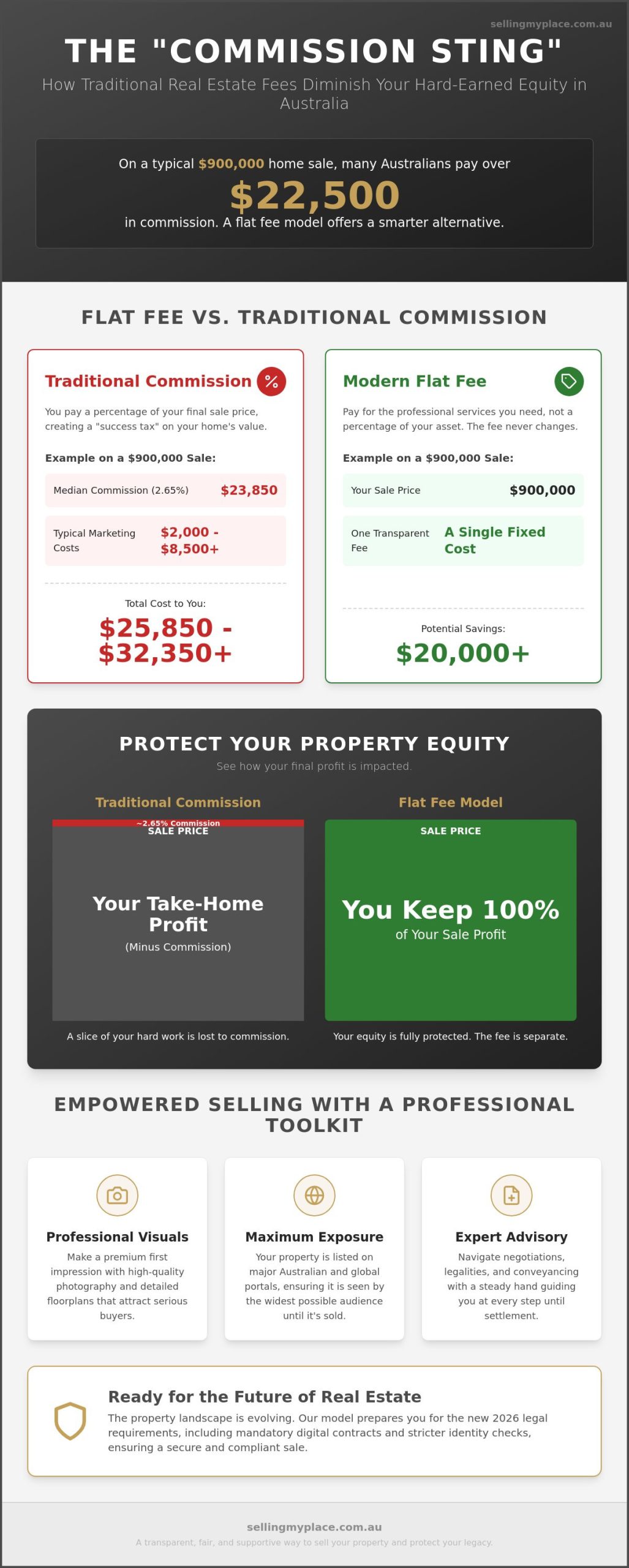
If you sold your family home for $900,000 this afternoon, would you feel comfortable handing over a $22,500 cheque to an agent just for the privilege of finding a buyer? For many Australians, that commission “sting” feels less like a fair fee and more like a loss of hard-earned equity. This is why flat fee real estate services are becoming the preferred choice for savvy homeowners who want to protect their legacy. We know that selling is a major life transition; it’s only natural to want a process that feels transparent, fair, and supportive.
In this guide, we’ll show you how to retain 100% of your sale profit while still accessing professional-grade marketing and expert guidance. You will learn how to navigate the new 2026 legal landscapes, such as mandatory digital contracts and stricter identity checks, with a steady hand to guide you. By decoupling professional infrastructure from the final sale price, you can achieve a premium result and professional photography without the unnecessary financial stress. It is about ensuring your hard work stays where it belongs: in your pocket for your next big move.
Key Takeaways
- Discover how to separate professional marketing costs from your sale price, ensuring you don’t pay more just because your home is worth more.
- Learn how flat fee real estate services empower you to keep 100% of your property’s equity, potentially saving you $20,000 or more in traditional commissions.
- Uncover the myths around property negotiation and find out how you can professionally showcase your own home to achieve a record-breaking result.
- Navigate the complexities of 2026 property laws and conveyancing with a “steady hand” advisory service that stays with you until the sold sign goes up.
- Explore how a global marketing network and professional photography can elevate your listing to attract the right buyers without the traditional “commission sting.”
What Are Flat Fee Real Estate Services in Australia?
Think of What Are Flat Fee Real Estate Services? as a modern partnership that puts you back in the driver’s seat of your property journey. Traditionally, selling a home meant signing away a percentage of your final sale price, often between 2% and 3%, regardless of how much work the agent actually performed. This model creates a “commission sting” that feels increasingly unfair as property values rise. A flat fee model is different; it is a professional alternative that decouples the cost of marketing from the value of your home. You pay for the specific services you need to reach buyers, rather than a slice of your family’s future equity.
Australian homeowners are embracing this shift because it offers a level of transparency that traditional agencies simply cannot match. By using flat fee real estate services, you gain access to the same high-end digital infrastructure used by major franchises, but without the hidden fees or tiered structures. It is a movement toward a “Sale by Owner” approach that is empowered by professional-grade tools. You aren’t just doing it yourself; you’re doing it with a steady hand guiding you through the process, ensuring every detail is handled with the care it deserves.
The Core Components of a Flat Fee Package
A truly professional flat fee offering isn’t just a listing on a website. It is a comprehensive suite of Residential Property Listing Services designed to make your home shine. The essentials include:
- Professional Visuals: High-quality photography and floorplans that ensure your property makes a premium first impression on every screen.
- Maximum Exposure: Your home is listed on major Australian and global property portals, keeping your listing active until the property is sold.
- Expert Advisory: Access to Pre-Sale Property Consulting and Real Estate Advisory Services to help you navigate negotiations and receive essential conveyance advice.
Flat Fee vs. Commission: A Quick Comparison
The national median real estate commission in Australia sits around 2.65% as of July 2026. On a $900,000 home, that is a staggering $23,850 gone in an instant. With flat fee real estate services, that cost is replaced by a single, set amount that doesn’t change based on your sale price. Why should it cost $25,000 more to facilitate the sale of a million-dollar home compared to a $500,000 one? It shouldn’t. Modern flat-fee providers also offer a “no time limit” advantage. While traditional agents might push for a quick sale to move on to their next commission, a flat-fee partnership allows you to wait for the right buyer at the right price, protecting your equity every step of the way.
How the Flat Fee Model Protects Your Property Equity
Imagine working for years to pay off your mortgage and maintain your home, only to see a significant portion of your capital gain disappear at the final hurdle. This is what we call the ‘Equity Gap’. In the current Australian market, where property values continue to climb, a percentage-based commission acts like a success tax on your hard work. If you sell a property for $1,000,000, a traditional 2.5% commission siphons off $25,000. Contrast this with a $500,000 sale where an agent might charge $12,500. Does it really take twice as much effort, or twice as many phone calls, to sell the more expensive home? Usually, the answer is no. By choosing flat fee real estate services, you ensure that the extra value created by market growth stays in your bank account rather than being handed over as an agency bonus.
Retaining 100% of your profit is not just about the numbers on a settlement statement; it is about your next chapter. That average saving of $20,000 translates directly into increased purchasing power for your next property purchase. It could be the deposit for an investment unit, the funds for a long-awaited renovation, or a significant boost to your retirement nest egg. It is your money, earned through your investment, and you deserve to keep it.
The Mathematical Reality of Selling Smarter
Many sellers are enticed by “no upfront cost” promises from traditional agents. However, these costs are simply deferred and often significantly higher once the commission is calculated at settlement. When you look at your “walk-away” figure, the difference between a flat fee and a 2.5% commission is stark. On a $900,000 sale, you are looking at roughly $22,500 in commission alone, plus marketing costs that can range from $2,000 to over $8,500. Understanding The Legalities and Safety of Selling property is the first step toward realising that you can achieve a professional result without these mounting expenses. If you’re curious about how this could work for your specific suburb, you might like to reach out for a friendly chat about your goals.
Maintaining Professional Standards Without the Price Tag
You might wonder if you are sacrificing quality by skipping the high-street agency. The reality is that the modern buyer lives online. Digital infrastructure has completely transformed how we reach global audiences, making the local shopfront largely redundant. To reach the right buyers in 2026, you need professional photography, accurate floorplans, and a strong presence on the major portals. Flat fee real estate services provide this professional-grade marketing as standard. When combined with professional neighbourhood market reports, you can set your price with total confidence, backed by real-time data rather than an agent’s anecdotal evidence. This partnership approach ensures your home is presented beautifully while your equity remains protected.
Flat Fee vs. Traditional Agents: Which Is Right for You?
Choosing between a traditional agent and flat fee real estate services often comes down to how much involvement you want in the sale of your most valuable asset. Traditional agencies frequently suggest that their presence is mandatory to secure a high sale price, but this is a common myth that overlooks the most passionate advocate for any property: the owner. Who better to explain the way the morning sun hits the breakfast nook or the quiet, community feel of the local cul-de-sac? While a traditional agent might handle dozens of listings simultaneously, you have a singular, dedicated focus on your own family’s legacy.
Transparency and control are the hallmarks of this modern approach. In a traditional model, marketing costs can feel like a “black hole” of expenses on top of the hefty commission. For instance, a standard marketing campaign in Melbourne can cost between $6,500 and $8,000, and it’s not always clear how that budget is being allocated. With a flat-fee partnership, you know exactly where your marketing budget is going. There is no pressure to drop your price just so an agent can meet a monthly quota or move on to their next commission. You maintain the final say on your listing without any outside agency pressure.
When to Choose a Flat Fee Service
This model is an ideal fit if you feel comfortable chatting with potential buyers and showing them through your home. It is for the homeowner who values expert Real Estate Advisory Services and Pre-Sale Property Consulting but doesn’t want to pay a “middleman” for tasks they can handle themselves. If you are focused on maximising every cent of your property’s value to fund your next big move, this path provides the professional-grade digital infrastructure you need while keeping you in total control of the narrative.
The Power of Professional Visuals
In the digital age, the “first inspection” almost always happens on a smartphone screen. This makes high-end visual marketing absolutely non-negotiable in the Australian market. Professional photography captures the soul and character of a home, while detailed floorplans allow buyers to mentally “move in” their furniture before they even step through the front door. To understand how these elements work together to attract premium interest, you can read more about Photography and Floorplans That Sell. By combining these professional standards with your personal touch, you create a compelling story that resonates deeply with the right buyers.
The Legalities and Safety of Selling Without an Agent
Selling a home without a traditional agent doesn’t mean you’re walking a legal tightrope alone. In fact, the most critical legal protections during a property transaction come from your solicitor or conveyancer, not the person putting up the “For Sale” sign. It’s a common worry that stepping away from the traditional model might leave you exposed, but flat fee real estate services are designed to provide a professional advisory infrastructure that keeps you fully compliant. Since June 2026, New South Wales has mandated the “2026 Edition Contract for Sale” for all transactions, and new Anti-Money Laundering (AML/CTF) laws require stricter identity checks across the country. Having a steady hand to guide you through these evolving regulations ensures your sale is as secure as it is profitable.
The extension of AML/CTF laws to the real estate sector means that identity verification is now more thorough than ever. It also requires that any significant financial transactions are conducted via traceable electronic means. Navigating these changes requires attention to detail, but it shouldn’t feel overwhelming. By using flat fee real estate services, you benefit from a partnership that prioritises your safety and legal standing while you focus on the emotional significance of your move.
Conveyancing and Contract Management
A qualified legal professional is your best safeguard. While you handle the heart of the home, your solicitor manages the technicalities of the contract and settlement. Our Real Estate Advisory Services bridge the gap, helping you understand each milestone without the pressure of a commission-driven agenda. We walk alongside you during the contract exchange to ensure every box is ticked. You can explore the details of this process in our guide on The Legal Journey: Conveyance and Advisory.
Managing Buyer Enquiries and Negotiations
Safety and professionalism are paramount when you’re meeting potential buyers. Vetting enquiries before an inspection is a simple, effective way to ensure only genuine, qualified parties enter your home. Many owners find they actually have a psychological advantage during negotiations; buyers often appreciate the honesty and directness of speaking with the person who knows the property best. Stay calm, stick to your researched price point, and remember that you’re the expert on your own lifestyle. If you’d like a partner to help you navigate these first conversations, you can organise a pre-sale consultation with our team today.
Selling Smarter with Kincade International Direct Sales
At Kincade International Direct Sales (KIDS), we have reimagined the selling process as a supportive partnership rather than a cold transaction. We understand that your home is more than just bricks and mortar; it is where your life has happened. By offering 0% commission flat fee real estate services, we provide the professional infrastructure you need while ensuring you keep every cent of your hard-earned profit. Our “listed until sold” promise is a cornerstone of this approach. It removes the artificial pressure of marketing deadlines, allowing you to wait for the right buyer who truly values your property’s unique story without the stress of a ticking clock.
This isn’t just about saving an average of $20,000 in commissions. It is about having a steady hand to guide you through the complexities of the 2026 property market. Whether you are navigating new identity verification laws or interpreting professional neighbourhood market reports, our Agent Advisory Service remains by your side until settlement. We combine the reach of a global marketing network with the intimacy of local expertise. This ensures your home is seen by the right people, whether they are living in the next suburb or searching from overseas.
A Comprehensive Marketing Infrastructure
The digital age has levelled the playing field for homeowners. To stand out, your listing needs to perform at a high level from the moment it goes live. We provide the essential tools for success, including professional photography and floorplans that highlight your home’s best features. Your property gains maximum exposure on major Australian and global portals, ensuring it doesn’t just sit on the market but actively attracts genuine interest. For a deeper look at how to position your home for success, see our Professional Residential Property Listing Services: The Modern Australian Seller’s Guide.
Expert Support Every Step of the Way
One of the biggest advantages of our partnership is access to expert pre-sale consulting. We help you identify high-ROI property improvements, such as simple landscaping or fresh paint, that can significantly boost your final sale price. You are never left to figure out the hard parts alone. When negotiations get complex or you need a second opinion on a buyer’s offer, an expert advisor is just a phone call away. This blend of professional authority and heartfelt support ensures you feel confident and protected throughout the entire journey. Ready to take control? Discover how we help you sell smarter and keep your profit.
Take the Next Step Toward a Commission-Free Sale
Selling your home is more than a financial transaction; it is the closing of one life milestone and the hopeful beginning of another. You deserve to walk away from that experience with your full equity intact, ready to fund your next adventure. By embracing flat fee real estate services, you choose a path of transparency and empowerment. You have seen how possible it is to maintain professional standards, from high-end photography to global portal exposure, without the traditional commission bite that can feel so disheartening.
It is important to remember that you aren’t walking this path alone. With professional visual marketing included and expert advisory support available throughout the process, you have the tools to navigate the 2026 property market with total confidence. This approach is about protecting your legacy and ensuring your hard work benefits your family’s future. If you are ready to keep 100% of your profit and sell on your own terms, we are here to act as your steady hand.
Maximise your sale profit with our professional flat-fee services and start your next journey on the best possible financial footing. You have the vision for your future; let’s make it a reality together.
Frequently Asked Questions
Is a flat fee real estate service the same as ‘For Sale By Owner’?
While it shares the spirit of independence, flat fee real estate services provide a professional marketing and advisory layer that a standard private sale lacks. It is a partnership where you handle the personal touches, like showing your home, while we provide the professional listing power and global reach. You get the autonomy of a private sale but with the “steady hand” of an expert guide to help you navigate the process with confidence.
Will my property be seen on the major Australian property portals?
Yes, your home will be showcased on the leading property websites that active buyers use every day. Because we act as your professional listing service, we ensure your property receives the same high-level exposure as any traditional agency listing. You don’t have to worry about being hidden; your property will be visible to thousands of potential buyers across the country and even overseas.
How much can I realistically save using a flat fee service?
Most Australian sellers save an average of $20,000 when selling an $800,000 property compared to a traditional commission model. With the national median commission sitting at approximately 2.65% in July 2026, those percentage points add up to a significant amount of money. This is hard-earned equity that stays in your bank account to help with your next mortgage, renovation, or retirement nest egg.
What happens if my property doesn’t sell within three months?
There are no stressful time limits or marketing deadlines to worry about with our partnership. Your property remains listed until it is sold, which means you can wait for the right buyer at the price you deserve without the pressure of a ticking clock. This approach removes the artificial urgency often felt in traditional agency agreements, allowing the process to unfold at a pace that suits your family’s needs.
Do I have to do my own negotiations with a flat fee service?
You’ll be the primary point of contact for enquiries and inspections, but you’re never left to negotiate in a vacuum. Our Agent Advisory Service provides the support you need to handle these conversations professionally. You get to speak directly to buyers about the home you know best, while having an expert in your corner to help when the price discussions or contract details get technical.
Can I still get professional photography and floorplans?
Professional visual marketing is a standard part of our infrastructure to ensure your home makes a premium first impression. You will receive high-quality photography and accurate floorplans that help potential buyers visualise their life in your space. These tools are essential for standing out in a digital-first market and are included to ensure your home is presented to the highest possible standard.
Is it legal to sell my home without a traditional real estate agent?
It is completely legal and increasingly common for Australians to sell their homes using flat fee real estate services. While you’re moving away from the old commission-based model, you’re still supported by a professional framework that ensures compliance with all property laws. You have the right to represent your own interests and protect your equity throughout the entire sale process.
How do I handle the legal paperwork and conveyancing?
You should engage a qualified conveyancer or solicitor to manage the formal legal paperwork and the final settlement. While we provide Real Estate Advisory Services and guidance through the contract exchange, your legal representative ensures the title transfer is handled correctly according to state regulations. For example, they will ensure you are using the mandatory 2026 Edition Contract for Sale required in certain states.
Buyer Advocates in Australia: How to Level the Playing Field in 2026
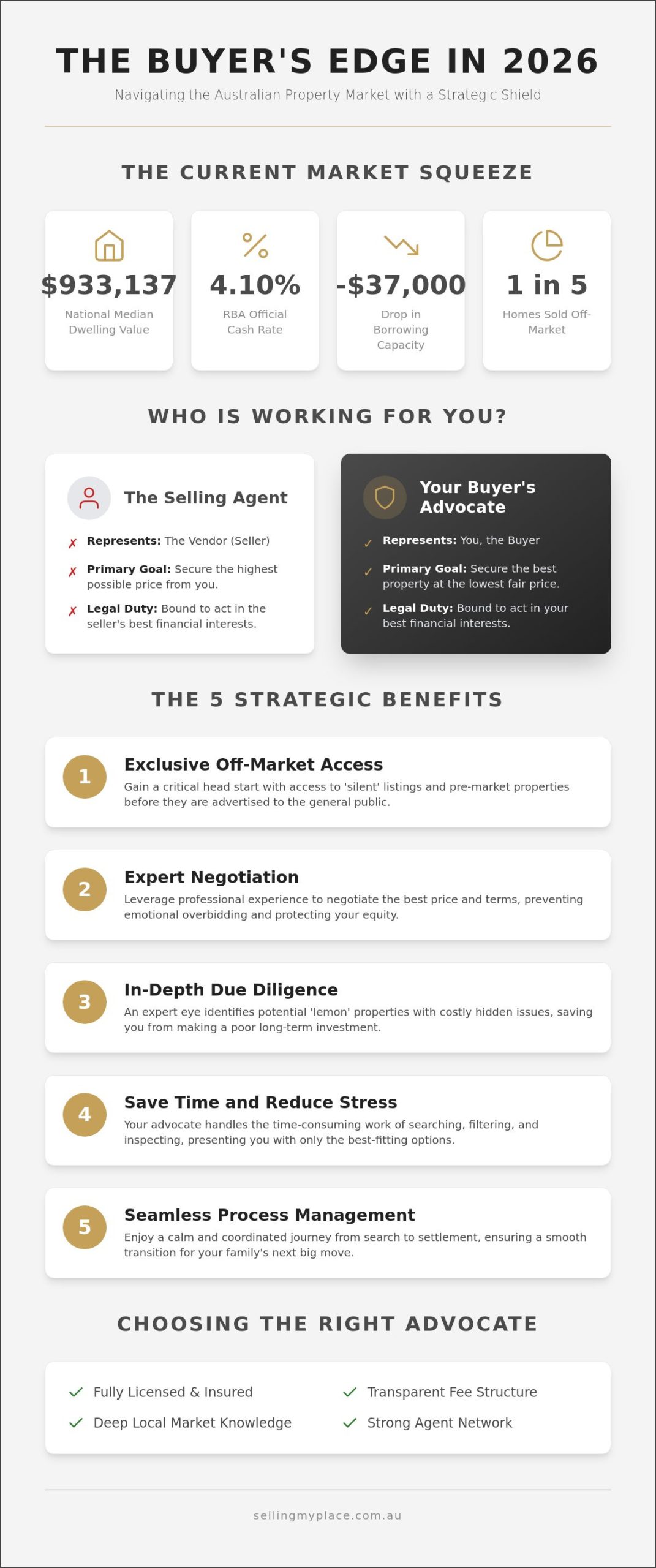
Did you know that nearly one in five Australian homes are sold before the public ever sees a ‘For Sale’ sign? In 2026, the property game isn’t just about who has the highest budget; it’s about who has the best map of the hidden market. Most people walk into an open home feeling like they’re already behind, and with the national median dwelling value sitting at $933,137, the stakes for your family’s future have never been higher. This is why more Australians are turning to professional buyer advocates to act as their steady hand and strategic shield.
It’s completely normal to feel a bit of a squeeze when the RBA cash rate is holding at 4.10% and every weekend feels like a marathon of inspecting properties that don’t quite fit the bill. You likely worry about overpaying in a competitive suburb or, worse, accidentally buying a ‘lemon’ with hidden structural issues. This guide will show you how to level the playing field, ensuring you secure a quality home at a fair price without the typical auction-day anxiety. We’ll explore the latest 2026 market trends, the power of off-market access, and how a seasoned expert protects your interests from the first search to the final settlement.
Key Takeaways
- Learn why professional buyer advocates have become a strategic necessity for navigating the competitive and fast-moving Australian property landscape of 2026.
- Discover how to gain exclusive access to ‘silent’ off-market listings, giving you a head start before a home even hits the public real estate portals.
- Understand how professional negotiation prevents emotional overbidding, protecting your hard-earned equity and saving you from costly ‘lemon’ properties.
- Identify the essential credentials and local, ‘street-by-street’ knowledge you must look for when choosing a representative to protect your interests.
- Explore how an integrated advisory service can bridge the gap between selling and buying, ensuring your family’s next big move is a seamless and calm transition.
What is a Buyer Advocate and Why are Australians Using Them?
Imagine walking into a high-stakes negotiation where the person across the table does this for a living, forty hours a week, while you only do it once every decade. That is the traditional reality of the Australian property market. A buyer advocate, often called a buyer’s agent, is a licensed real estate professional who represents your interests alone. While the selling agent is legally bound to get the highest possible price for the vendor, your advocate is there to secure the best property at the lowest price. The concept of Buyer brokerage has evolved significantly in recent years, moving from a niche service for the wealthy to a strategic necessity for everyday families. This isn’t just about convenience. It’s about ensuring a ‘fair go’ in a market where the rules of engagement are heavily weighted toward the seller. Most buyer advocates offer three primary levels of support: a comprehensive ‘top-to-bottom’ search and acquisition service, a ‘negotiation only’ package for a home you’ve already found, or simply acting as your calm, professional voice during the adrenaline-fueled environment of an auction.
The Difference Between a Selling Agent and a Buyer’s Advocate
It is a common mistake to think the friendly agent at an open home is there to help you. Legally, they have a ‘duty of care’ to the seller, meaning their primary goal is to extract every possible dollar from your pocket. Because of this inherent conflict of interest, an agent cannot legally represent both the buyer and the seller in the same transaction. A buyer advocate acts as your personal buffer. They filter out the sales spin and high-pressure tactics, allowing you to make decisions based on cold, hard data rather than the emotional pull of a well-styled lounge room. They are the steady hand that keeps the process grounded and focused on your long-term goals.
Why 2026 is the Year of the Represented Buyer
With the RBA cash rate sitting at 4.10% as of March 2026, borrowing capacity has tightened for almost everyone. A single average income earner has seen their budget drop by roughly $37,000 this year alone, according to recent market data. In this climate, there is simply no room for error. While digital property portals make it look easy to find a home, the sheer volume of data can be misleading. You need an expert to interpret those numbers and spot the difference between a genuine bargain and a ‘lemon’ hidden behind a fresh coat of paint. As of July 2026, new AUSTRAC regulations have also brought buyer advocates under stricter professional oversight, ensuring they operate with a level of transparency that matches their growing importance. A buyer advocate is your professional safeguard against emotional overspending.
The 5 Strategic Benefits of Professional Buyer Representation
Buying a home is often the most significant financial decision you will ever make. It is also one of the most emotional. While the previous section highlighted why the market feels tilted, let’s look at the specific ways buyer advocates act as your strategic equaliser. It starts with your most precious resource: time. Instead of spending every Saturday for six months criss-crossing the suburbs, an advocate handles the heavy lifting. They filter the noise, manage the ‘inbox fatigue’ that comes from endless property alerts, and present you with only the gems that actually fit your brief.
Beyond saving time, there is the vital role of due diligence. It’s easy to fall in love with a sun-drenched kitchen, but an expert eye looks for the things that could cost you tens of thousands later. They identify ‘lemons’, which are properties with structural issues, poor orientation, or problematic local developments, before you spend a cent on building and pest inspections. This proactive screening ensures you are only pursuing homes that represent a sound long-term investment for your family.
Accessing Off-Market and ‘Pre-Market’ Properties
Perhaps the greatest advantage is seeing what everyone else misses. The Real Estate Buyers Agents Association of Australia (REBAA) estimates that up to 20% of properties nationwide are sold off-market. These ‘silent’ sales happen because vendors value privacy or want to test the waters without a public campaign. Through deep-rooted local networks, advocates get the call before these homes hit the portals. If you want to understand the mechanics of this hidden world, our guide on what is an off-market property and how to find one explains how these opportunities are uncovered.
Auction Bidding and Emotional Detachment
Australian auctions are designed as high-pressure theatre. The rapid-fire calls and the crowd’s energy are carefully orchestrated to trigger emotional bidding. When you have a professional standing in your place, that theatre loses its power. A buyer advocate stays grounded, sticking strictly to a pre-determined limit based on comparable sales data, not adrenaline. Understanding the expert property sale negotiation tips used by the other side of the table can give you a significant edge when the hammer is about to fall.
Ultimately, having an expert in your corner ensures you never pay a cent more than market value. If you’re feeling overwhelmed by the search or worried about the high stakes of 2026, you might find it helpful to connect with a professional property advisor who can provide a steady hand for your next move. This partnership transforms a stressful transaction into a celebratory milestone for your family’s future.
Evaluating the Cost: Are Buyer Advocate Fees Worth It?
When you sit down to look at your budget, the idea of adding another line item for professional fees can feel daunting. It’s a valid concern. However, in the 2026 market, the question isn’t just about the cost of the service, but the cost of the mistakes you might make without it. Most buyer advocates in Australia work on either a percentage-based commission or a fixed flat-fee structure. While percentage fees are traditional, many families now prefer the transparency of a fixed fee, as it ensures the advocate’s only motivation is finding the right home, not increasing the purchase price to boost their own pay.
Think about the ‘Hidden Saving’. It is remarkably easy to over-bid by $50,000 in the heat of a negotiation or to settle for a property that requires significant remediation work down the track. Beyond the dollars, there is the immense value of your own time. If an advocate saves you five hours of research and inspections every week for three months, that is sixty hours of your life back. When you partner with a service like Kincade, you can also leverage the savings from our flat-fee selling model to essentially fund your buyer representation, creating a seamless and financially savvy transition from one home to the next.
Calculating the Return on Investment (ROI)
To truly see the value, you need to look at the ROI. This involves comparing the fee against the potential saving on the purchase price and the avoidance of high-risk properties. A professional appraisal is the cornerstone of this calculation. By understanding how to determine the market value of a home in Australia, you can see exactly where an advocate’s negotiation skills have shaved thousands off the asking price. It’s about data-led decisions rather than guesswork.
Common Misconceptions About Advocate Fees
A frequent myth is that buyer advocates are a luxury reserved for the high-end luxury market. In reality, they are often most valuable for everyday families who have the most to lose from a poor investment. Another common concern involves ‘kickbacks’. You should always ensure your advocate is completely independent and does not receive referral fees from developers or selling agencies. A flat-fee structure often provides the most transparent alignment of interests, ensuring your advocate is firmly on your side of the fence.
How to Choose the Right Advocate for Your Property Journey
Selecting the person who will guide your family toward its next home is a decision that deserves more than a cursory glance at a website. It is about finding a partnership built on trust and a shared vision for your future. In the Australian market, the first non-negotiable step is verifying that your representative holds a full real estate licence and maintains membership in professional bodies like the Real Estate Institute of Australia (REIA). While some digital platforms offer generic data, true buyer advocates possess deep, ‘street-by-street’ knowledge of your target suburbs. They should be able to tell you which pockets are prone to afternoon traffic noise and which side of a particular street holds its value better during a market dip. This level of local nuance is what separates a transactional service from a genuine advisory partnership.
We always suggest interviewing at least three different advocates before making your choice. This isn’t just about comparing fee structures; it is about finding a ‘steady hand’ whose personality meshes with your own. You need someone who prioritises your family’s long-term stability over the convenience of a quick transaction. A quality advocate is often the one who tells you to walk away from a property because it doesn’t meet your long-term needs, even if it means their search continues for another month. They act as your calm, professional shield in a process that can otherwise feel quite overwhelming.
Essential Questions to Ask During Your Consultation
During your initial consultation, move beyond the pleasantries and ask for specific operational details. How exactly do they access off-market properties? Is it through a genuine, decades-old network of local agents, or are they simply relying on the same email alerts as everyone else? In the 2026 climate, where auction dynamics can be unpredictable, ask for their specific strategy for bidding when competition is high. Finally, request recent case studies of purchases similar to your own brief. Seeing how they have navigated budgets and requirements like yours provides a clear window into their practical competence and negotiation style.
Vetting for Independence and Integrity
The most vital question you must ask is: ‘Do you receive any commissions or rebates from third parties?’ Absolute independence is the bedrock of professional advocacy. You must ensure they are not also acting as a selling agent for any properties they recommend, as this creates an immediate and legal conflict of interest. A partnership approach, much like our own philosophy at Kincade, focuses on your family’s legacy and community roots rather than a quick result. If you would like to experience this level of dedicated support for your next move, you can connect with our property advisory team to discuss how we can help you buy better.
The Kincade Advantage: Bridging the Gap Between Selling and Buying
A property journey isn’t just a set of two separate transactions; it is the closing of one chapter and the hopeful beginning of another. At Kincade International Direct Sales (KIDS), we view this transition through a lens of partnership and empathy. Most Australians find themselves caught in a stressful middle ground, trying to coordinate a sale while simultaneously hunting for their next home. We bridge this gap by acting as your seasoned guide for the entire process. Our Agent Advisory Service provides the same level of expert backing for purchasers as we do for our commission-free sellers. This ensures that the “steady hand” you relied on to sell your previous home is the same one helping you navigate the complexities of buyer advocates and the search for your next legacy property.
Our “Direct Sales” philosophy is built on empowerment. We provide you with the professional tools typically reserved for high-commission agencies, including professional photography, detailed floorplans, and comprehensive neighborhood market reports. This data-driven approach allows you to step into the market with a level of confidence that few unrepresented buyers ever achieve. Because Kincade maintains a broad national presence, we offer a perspective that goes beyond a single suburb. We understand how divergent market trends across the country can impact your local decisions, providing a birds-eye view that local-only agents simply cannot match.
A Holistic Approach to Your Property Legacy
The financial logic of our model is simple yet powerful. When you choose to sell commission-free with KIDS, you often save tens of thousands of dollars that would otherwise go toward agency fees. This retained equity can then be used to “fund” your professional buyer representation, essentially allowing the sale of your home to pay for the expert who secures your next one. This holistic approach reduces the financial friction of moving and provides immense peace of mind. Beyond the search, we offer dedicated support for conveyance advice and pre-sale consulting, ensuring every legal and strategic detail is handled with the seriousness it deserves. We invite you to view your next move not as a hurdle, but as a seamless and celebratory journey.
Next Steps: Embarking on Your Purchase with Confidence
Success in the 2026 property market requires more than just a deposit; it requires a team. Before you attend your next open home or scroll through another listing portal, it is vital to have your “team” ready. This includes your advocate, your conveyancer, and your real estate advisor. Getting started is as simple as a conversation. During a Kincade advisory session, we can help you map out your goals, assess the current market landscape, and determine the best strategy for your specific family needs. You don’t have to do this alone. Discover how Kincade’s expert advisory services can secure your next property and help you move forward with the calm confidence you deserve.
Your Future Home is Within Reach
The Australian property landscape of 2026 demands a new approach to buying. By now, you understand how the right representation can unlock off-market gems and protect your family from the emotional pitfalls of auction day. Choosing to work with professional buyer advocates isn’t just about finding a house; it’s about securing a sound financial foundation for your future. Whether you’re searching for your first home or your forever sanctuary, the peace of mind that comes from expert negotiation is invaluable.
When you pair our national expertise and global reach with a commission-free sale, you keep your hard-earned equity exactly where it belongs: in your pocket. Our clients save an average of $20,000 on commissions, providing the perfect launchpad for their next purchase. With our Expert Agent Advisory Service by your side, you can move forward with the calm confidence of a seasoned pro. Partner with Kincade for a smarter, commission-free property journey and let us help you turn the key to your next chapter. Your dream home is out there, and with the right team, you’ll find it sooner than you think.
Frequently Asked Questions
What is the typical fee for a buyer advocate in Australia?
In the Australian market, you will generally find two main fee structures: a percentage of the final purchase price or a fixed flat fee. These costs reflect the level of service provided, whether it is a full search or just auction bidding, and often vary between capital cities like Sydney and Perth. It is always best to ask for a clear breakdown during your initial consultation to ensure the structure aligns with your budget and provides the transparency you need.
Can a buyer advocate help me if I am buying in a different state?
Yes, they are often essential for interstate buyers who cannot physically attend every open home. An advocate acts as your “boots on the ground,” performing thorough inspections and providing objective feedback on the property and its location. They also help you navigate state-specific contract nuances, ensuring you feel as confident as a local throughout the entire process.
Do buyer advocates only work for property investors?
Not at all. While investors certainly value the data-driven approach, many families use buyer advocates to find their forever homes and manage the emotional stress of the search. Having a professional in your corner is just as important for a family home purchase as it is for an investment, as it protects your long-term equity and ensures you don’t overpay in a competitive market.
What happens if the buyer advocate finds a property I already saw online?
Their value remains significant even if you spotted the listing first. The advocate’s role shifts to professional evaluation and negotiation, where they perform a deep-dive appraisal to determine the home’s true market value. They will identify any potential “lemons” and handle the high-pressure bidding to ensure you secure the property at the best possible price, regardless of where the search began.
How does a buyer advocate get access to off-market listings?
Access to the “silent market” comes through deep-rooted, professional relationships with local real estate agents. Many vendors prefer to sell quietly to avoid public open homes or high marketing campaigns. Agents will often contact reputable buyer advocates first to see if they have a qualified client ready to buy, often resulting in a successful sale before the property is ever advertised to the general public.
Is a buyer advocate the same as a mortgage broker?
No, they perform very different roles in your property team. A mortgage broker focuses on your finance, helping you organise the right loan structure and securing your pre-approval. A buyer advocate focuses on the asset itself, handling the search, the due diligence, and the final price negotiation to ensure you buy the right property under the right conditions.
Can a buyer advocate help with the building and pest inspection process?
Yes, they typically coordinate the entire inspection process on your behalf. They work with trusted, independent inspectors to ensure the report is thorough and then sit down with you to explain what the findings mean in plain English. If issues are uncovered, your advocate can use that information as leverage to negotiate a price reduction or advise you to walk away if the risks are too high.
How to Determine the Market Value of a Home in Australia: The 2026 Seller’s Guide
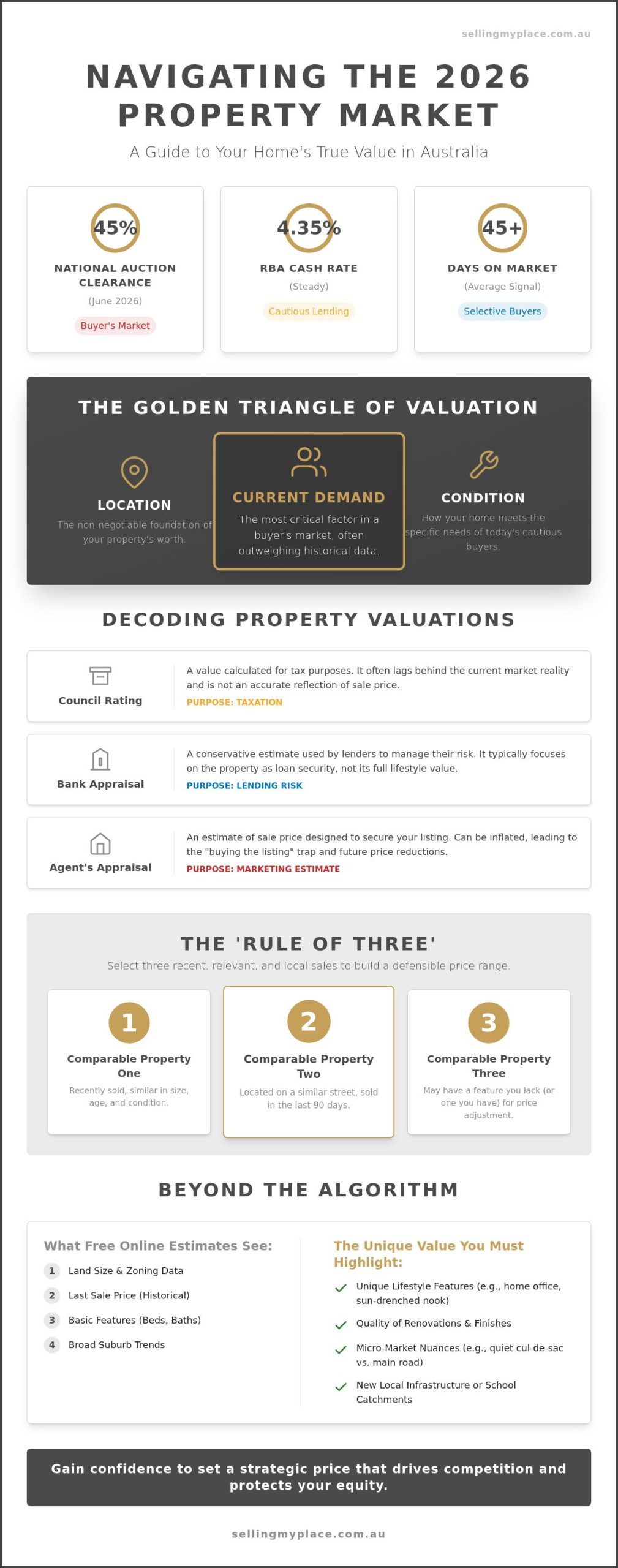
Did you know that national auction clearance rates have dipped to just 45 per cent as of June 2026? It’s a sobering figure that confirms we’ve moved into a buyer’s market, where the “set and forget” pricing of previous years simply won’t cut it anymore. We understand that selling your family home is far more than a transaction; it’s an emotional milestone that deserves a steady hand and a clear head. You might be wondering how to determine market value of a home in australia when the headlines are full of talk about interest rates and cooling prices. It’s completely natural to feel a bit of doubt when looking at free online estimates or to worry about leaving money on the table in this changing landscape.
You deserve to feel certain about your property’s worth, and we’re here to help you find that clarity. In this guide, you’ll master the data and expert strategies needed to accurately value your property and secure the best possible sale price without paying traditional commissions. We’ll walk you through decoding current market trends, understanding the “multi-speed” landscape across our capital cities, and building a defensible price range that gives you total confidence when it’s time to negotiate with buyers. Let’s work together to ensure your next chapter starts on the best possible footing.
Key Takeaways
- Understand the “Golden Triangle” of valuation to see why current buyer demand often outweighs historical data in a cooling property market.
- Learn how to use the “Rule of Three” to select accurate comparable properties that justify your asking price to both banks and savvy buyers.
- Discover how to determine market value of a home in Australia by identifying the unique lifestyle features that automated online estimates simply can’t capture.
- Gain the confidence to set a strategic price range that drives competition and protects your equity without the burden of high agency commissions.
What Exactly is ‘Market Value’ in the 2026 Australian Property Market?
At its heart, market value is a meeting of minds. It’s the price a willing buyer is prepared to pay, and a willing seller is prepared to accept, in an open and competitive market. In the 2026 climate, where the RBA cash rate remains steady at 4.35 per cent, this definition is more than academic; it’s the foundation of your financial legacy. Understanding how to determine market value of a home in australia requires looking past the four walls and into the psychology of the current buyer.
We often talk about the “Golden Triangle” of valuation: Location, Condition, and Current Demand. While you can’t change your street address, you can certainly influence how your home’s condition meets the specific demands of today’s cautious buyers. It’s vital to remember that not all figures are created equal. A council rating is for tax purposes and often lags behind reality. An Appraised value from a bank is usually conservative because they’re managing lending risk. An agent’s appraisal, meanwhile, is often just an estimate of what they think will get you to sign a contract.
The Difference Between Price and Value
There’s an old saying in property circles: price is what you pay, but value is what you get. Price is the hard number on the final contract, but value is the lifestyle the buyer envisions. Emotional triggers, like a sun-drenched breakfast nook or a quiet home office, can push a price well above a bank’s spreadsheet. However, with tighter lending criteria in 2026, those emotional ceilings are often capped by a buyer’s borrowing capacity. You need to find the sweet spot where a buyer’s heart and their bank’s valuation overlap.
Why Traditional Appraisals Can Be Biased
Many sellers unfortunately fall for the “buying the listing” trap. This happens when an agent quotes an inflated price just to secure your business, only to suggest a “price adjustment” three weeks later when the property fails to sell. It’s a stressful cycle that leaves money on the table. Taking a commission-free approach allows for a more objective view of your equity. This is why seeking expert real estate advisory early in the process is so beneficial. It provides a steady, unbiased hand to help you navigate the multi-speed market of 2026 without the pressure of a looming commission check.
Using Neighbourhood Market Reports to Build a Data-Driven Foundation
To get a real handle on how to determine market value of a home in australia today, you have to look beyond the ‘for sale’ signs on your street. You need a data-driven foundation. We start by looking at three vital signs: the median house price, average days on market (DOM), and current clearance rates. In July 2026, the national auction clearance rate has settled around 45 per cent. This tells us we are firmly in a buyer’s market. If properties in your suburb are sitting on the market for 45 days or more, it’s a signal that buyers are being cautious and selective. Understanding these numbers helps you set a price that attracts interest rather than one that causes your listing to go stale.
Neighbourhood Market Reports offer a level of detail that generic apps simply can’t match. They help you establish a baseline by looking at your specific property type. For instance, while Sydney’s overall clearance rate is 43.1 per cent, the rate for renovated family homes in your specific pocket might be much higher. It’s about finding the truth in the numbers. This methodical approach reduces the stress of the unknown, giving you a clear path forward.
Decoding Suburb Trends
Prices don’t exist in a vacuum. We often see a “ripple effect” where price growth in a central hub eventually pushes buyers into neighbouring suburbs. In 2026, we’re also seeing a huge impact from local infrastructure. New transport centres or school catchment changes can add significant value almost overnight. However, broad postcode data can be misleading. A home on a quiet cul-de-sac will always command a premium over one on a main road; even if they share the same suburb name. These micro-markets are where the real value is found.
The Limitations of Free Online Property Estimates
It’s tempting to rely on Automated Valuation Models (AVMs) that pop up on your phone. While these algorithms are a handy starting point, they have significant blind spots. They rely on historical data, which creates a “data lag” problem. In a cooling market like we’re seeing in mid-2026, six-month-old sales data might be completely irrelevant to today’s pricing strategy. This is why a free online property valuation is often more myth than reality. A computer can’t see your brand-new kitchen or feel the peace of your backyard. If you want a truly accurate picture of your equity, you might consider requesting a tailored report for your specific street to see what’s really happening on the ground.
The Comparative Method: Identifying and Analysing ‘Comps’ Like a Professional
While the broad suburb data we discussed earlier sets the stage, the real magic happens when you get down to the “comps” or comparable sales. This is where you move from generalities to the specific reality of your street. Understanding how to determine market value of a home in australia often boils down to a simple but effective strategy we call the “Rule of Three.” It’s a methodical way to ensure you aren’t just guessing based on a lucky sale from last year.
To use this rule, you need to identify three properties that have sold in the last 90 days, three that are currently listed, and three that failed to sell, such as those withdrawn or passed in at auction. The sold properties represent the “floor” of the market; the price buyers are actually paying. The active listings are your direct competition, showing you what buyers are seeing right now. Most importantly, the failed sales serve as a warning. In a market where national clearance rates are hovering around 45 per cent, these properties often reveal the exact price point where buyers simply walk away.
When selecting your comps, be honest about the criteria. A true comparable should share a similar land area, age, and level of renovation. If a neighbour’s house sold for a premium but features a brand-new swimming pool and a double garage while yours has a carport and an original kitchen, you must adjust your expectations. We recommend “adding” or “subtracting” value based on these features. For example, if a comp has an extra bathroom, you might subtract a nominal amount from their sale price to find a realistic baseline for your own home.
Where to Find Reliable Sales Data
Don’t rely solely on commercial property portals, as their data can sometimes be delayed or incomplete. Official government land registries provide the most accurate “sold” figures. Focus your search on a 1km radius from your front door and stick to sales within the last 90 days. To compare internal living spaces accurately, look for professional floorplans in the archived listings. This allows you to see if a “four-bedroom” home actually has a similar footprint to yours or if the rooms are significantly smaller.
Analysing the Competition
There is no substitute for getting out and visiting open homes in your area. This isn’t just about being a “nosy neighbour”; it’s about seeing exactly what a buyer experiences. Compare the “curb appeal” and the quality of the visual marketing. You’ll quickly start to notice why some properties in your street feel “stale” after a month on the market while others sell in a week. Often, it’s a combination of realistic pricing and a presentation that makes an emotional connection from the moment a buyer pulls up to the kerb.
Beyond the Algorithm: Expert Advisory and Property Nuance
Data provides the skeleton of your valuation, but the soul of your home’s worth often lies in details a computer simply cannot see. While we’ve discussed how to use suburb metrics and comparable sales, understanding how to determine market value of a home in australia also requires a seasoned eye for nuance. A property algorithm can’t see the way the afternoon sun hits your deck, the peace of a cul-de-sac location, or the high-end finish of a bespoke kitchen renovation. These intangibles are often what bridge the gap between a standard bank valuation and a premium sale price.
This is where Pre-Sale Property Consulting becomes invaluable. It’s about identifying value-add opportunities before you ever hit the market. Perhaps a minor cosmetic update or a professional styling session could shift the perceived value by tens of thousands of dollars. We believe that presentation, supported by high-quality photography, tells a story that data alone cannot. It creates an emotional connection, and in a multi-speed market, emotion is frequently the catalyst for a higher offer. Our Agent Advisory Service acts as that steady hand, providing the expert guidance you’d expect from a traditional agent but without the heavy commission-based pressure.
The Value of an Independent Perspective
Selling your home is a major life transition, and it’s okay to feel the weight of that responsibility. Getting professional guidance shouldn’t mean you’re locked into a traditional listing contract. Independent real estate advisory services are particularly vital for complex properties, such as those with strata titles, rural acreage, or unique architectural builds. Having an expert back your pricing strategy gives you the confidence to stand firm during negotiations, knowing your range is based on both hard data and professional insight. If you’re ready to see how these nuances apply to your specific property, reach out for a tailored consultation today.
Identifying “Hidden” Value Drivers
In 2026, buyer preferences have shifted significantly toward sustainability. We’re seeing that energy efficiency and clever solar orientation are no longer just nice-to-haves; they are major value drivers that can set your home apart. Similarly, being within a coveted school catchment zone remains a powerful lever, often adding a 10-15 per cent premium compared to a similar home just outside the boundary. Don’t overlook the scarcity factor either. If your home has a unique architectural heritage or a view that can’t be built out, its value isn’t just a number. It’s a reflection of its rarity in the local landscape.
From Valuation to Listing: Finalising Your Strategy to Maximise Profit
Once you’ve gathered your data and considered the unique charm of your home, it’s time to move from theory to reality. Setting the right listing price is the final, crucial step in how to determine market value of a home in australia. In the 2026 market, we find that a “Price Range” often performs better than a single “Fixed Price.” By offering a range, you invite a broader pool of buyers through the door. More feet on the carpet usually leads to more competitive offers, which is exactly what you need when national clearance rates are sitting below 50 per cent.
The psychology of pricing plays a massive role in your success. You might wonder why a property is listed at $995,000 instead of a round $1,000,000. It isn’t just an old retail trick; it’s about how buyers search online. Most property portals use price brackets. Pricing just under a major milestone ensures your home appears in more search results, capturing buyers at both the top of one bracket and the bottom of the next. It’s a small tweak that can significantly increase your listing’s visibility.
As you finalise your figure, remember to factor in your savings. Choosing flat-fee real estate models allows you to protect your equity from being eroded by high commissions. To back up your price during negotiations, prepare an “Evidence File.” This is a simple folder containing the comparable sales you identified earlier. When a buyer tries to lowball your price, you can calmly present the data that justifies your range. It shifts the conversation from opinion to fact.
The “Sale by Owner” Pricing Advantage
When you aren’t paying a 2 or 3 per cent commission, you gain a significant strategic edge. You can afford to be more competitive with your asking price to generate multiple offers quickly, or you can hold firm to maximise your final take-home profit. Learning how to price your home for sale by owner involves a high level of transparency. Don’t be afraid to share your Neighbourhood Market Report with serious buyers. It builds trust and shows them you’ve done your homework.
When to Adjust Your Price
The market will always give you feedback. We recommend the “21-Day Rule.” If you’ve had plenty of online views but no one is booking an inspection, you likely have a “marketing problem” related to your photos or description. However, if people are visiting the home but no offers are coming in, you likely have a “pricing problem.” In a multi-speed market, being prepared to refine your valuation based on real-time feedback is vital. Our Agent Advisory team can help you pivot your strategy if the local landscape shifts, ensuring you never stay stagnant on the market.
Step Into the Market with Absolute Confidence
Navigating a cooling market in 2026 doesn’t have to be a source of stress. By now, you’ve seen that understanding how to determine market value of a home in australia is a deliberate blend of hard data and the subtle, lifestyle-driven details that make your property unique. Whether it’s applying the “Rule of Three” to find accurate comps or setting a psychological price range that triggers buyer interest, you now have the tools to protect your equity and sell on your own terms.
You don’t have to walk this path alone. Our approach combines the precision of professional photography and floorplans with the “steady hand” of expert Agent Advisory, ensuring your listing looks and performs its best. By avoiding traditional agency commissions, our sellers save an average of $20,000; money that stays in your pocket for your next big move. Ready to take the next step? Get Your Professional Neighbourhood Market Report & Start Selling Smarter today. We’re here to support your transition with the care and expertise your family deserves.
Frequently Asked Questions
What is the most accurate way to value my home in Australia?
The most accurate way to value your home involves combining recent comparable sales data with professional independent advisory. While algorithms provide a helpful baseline, they can’t account for the unique features or the emotional appeal of your property. By looking at properties sold within a 1km radius in the last 90 days and adjusting for differences in condition and land size, you create a realistic price range that reflects what buyers are actually paying.
Is a bank valuation the same as market value?
A bank valuation is typically lower than the actual market value because it’s a conservative assessment designed to manage lending risk. Banks look at what they could recoup in a forced sale, whereas market value represents what a willing buyer would pay in an open, competitive environment. It’s common to see a gap between these two figures, especially for unique or highly desirable homes that attract emotional bidding from motivated families.
How much does a professional property appraisal cost?
Most real estate agents offer free appraisals as a way to win your listing, but these can sometimes be inflated to secure your business. If you require a sworn valuation from a certified practising valuer for legal or official purposes, you should expect to pay a fixed fee based on the property’s complexity. For sellers looking for objective guidance without the commission pressure, independent advisory services offer a balanced and cost-effective alternative to traditional models.
Can I determine my home’s value without a real estate agent?
You can absolutely learn how to determine market value of a home in australia without relying on a traditional real estate agent. By accessing professional Neighbourhood Market Reports and official land registry data, you can build a data-driven foundation yourself. Combining this data with independent pre-sale consulting allows you to set a price with confidence while maintaining total control over your sale and protecting your equity from high commissions.
How do recent sales in my street affect my property’s value?
Recent sales in your street are the strongest indicator of your property’s value because they represent the most relevant micro-market data. Buyers often compare your home directly with those nearby, so a high sale price next door can lift your property’s perceived value. Conversely, if several homes nearby have struggled to sell or were passed in at auction, it’s a signal that local demand might be cooling or price expectations are currently too high.
Does a renovation always increase my home’s market value?
A renovation doesn’t always guarantee an increase in market value, particularly if the cost of the work exceeds the added value. In 2026, buyers are specifically looking for functional improvements like energy efficiency or modernised kitchens rather than purely cosmetic changes. It’s wise to consult with an advisor before starting major works to ensure your investment aligns with what local buyers are actually prepared to pay a premium for in your specific suburb.
What should I do if my home valuation is lower than expected?
If your valuation comes in lower than expected, it’s a good time to objectively re-examine your comparable sales and current market feedback. Sometimes a lower figure is the result of temporary market cooling or a specific feature that buyers are currently avoiding. You might consider small, high-impact improvements to presentation or adjusting your timing to wait for a more favourable period in the multi-speed market cycle to ensure you don’t undersell your asset.
How often should I update my property’s market value estimate?
You should update your property’s market value estimate every 30 to 90 days, especially in a cooling climate like we’re seeing in mid-2026. Market conditions can shift quickly based on interest rate changes or local supply levels. Keeping your data fresh ensures your pricing strategy remains competitive and helps you avoid the trap of chasing the market down if prices in your suburb begin to soften during your listing period.
Mastering the Deal: Expert Property Sale Negotiation Tips for Australian Homeowners
What if the most powerful tool in your property sale isn’t a silver-tongued agent, but your own local knowledge and a calm, steady hand? Selling your family home is a massive life transition, and it’s entirely natural to feel a bit of a knot in your stomach when those first offers start landing on the kitchen table. With dwelling values in Sydney and Melbourne cooling as of June 2026, you might worry that savvy buyers hold all the cards. However, mastering a few key property sale negotiation tips can shift the balance back in your favour. It’s about more than just a price tag; it’s about protecting the heart and soul you’ve poured into your home.
We know that the fear of being lowballed or getting tangled in legal fine print can feel heavy, especially with the strict new identity verification laws that kicked in this July. You want to maximise your final sale price while keeping your hard-earned equity where it belongs. This guide will show you how to negotiate like a seasoned pro using proven strategies and expert advisory. We will walk you through how to handle offers directly, decode the contract essentials, and decide exactly when to say “yes” or “no” with complete confidence.
Key Takeaways
- Learn why the negotiation actually begins long before the first phone call and how your initial listing presentation dictates your bargaining power.
- Discover how to use Neighborhood Market Reports to anchor your value and implement essential property sale negotiation tips that justify your “walk-away” figure.
- Master the art of responding to lowball offers with calm confidence, using strategic silence to encourage buyers to refine their own position.
- Understand why the highest offer isn’t always the best deal and how expert conveyance advice ensures your contract terms protect your equity.
- See how a flat-fee advisory model removes traditional conflicts of interest, keeping the focus entirely on your family’s financial legacy.
Mastering the Art of the Deal: Why Property Sale Negotiation Starts Before the First Offer
Most people imagine property negotiation as a high-stakes phone call at the eleventh hour. In reality, it’s a thoughtful, multi-stage process that begins long before you greet your first visitor. If you wait until an offer is sitting on the kitchen bench to start considering negotiation theory and tactics, you have already missed the most critical opportunities to shape the narrative. Your home is a place of memories, but once it hits the market, it becomes a value proposition. Every interaction you have with a potential buyer is a brick in the wall of your eventual deal.
Your listing’s first impression sets the psychological ceiling for your entire campaign. When a buyer clicks through your photos, they are already deciding whether they are coming to “win” the home or “hunt” for a bargain. To protect your equity, you must make the psychological shift from “homeowner” to “vendor.” This detachment isn’t about loving your home less; it’s about respecting your financial future enough to remain objective. It’s much easier to hold your ground when you view the transaction as a partnership between your goals and the market’s reality.
Vendor authority is the grounded confidence gained when a seller replaces guesswork with professional preparation and verifiable market data.
The Power of Professional Presentation
Investing in top-tier Photography and clear Floorplans isn’t just about aesthetics. These tools act as your first line of defence against aggressive price-slashing. A polished listing signals that you are a serious, high-end seller who won’t be easily rattled. When a home is presented flawlessly, buyers find it much harder to “pick holes” or justify a lowball offer. It creates a perceived value that feels solid and non-negotiable, which is one of the most effective property sale negotiation tips for maintaining your asking price.
Establishing Your Position of Strength
Transparency is your best friend in a cooling market. By being open about the property’s condition from day one, you remove the buyer’s ability to “chip away” at the price during the cooling-off period. We recommend preparing an “evidence pack” including recent sales data and strata reports before your first open house. Engaging Real Estate Advisory Services early provides a steady hand to guide you through these initial steps. Using these property sale negotiation tips ensures you lead with facts rather than feelings, which is always the strongest position to hold during a sale.
Setting Your Ground: Data-Driven Pricing and the ‘Walk-Away’ Figure
Deciding on a price for your family home is one of the most emotionally charged moments of the selling process. It’s the point where your years of memories meet the cold reality of the current market. To navigate this successfully, you need to separate your pricing into three distinct categories. Your “dream price” is the ideal result if two buyers fall in love and start a bidding war; your “fair market value” is what the data suggests a reasonable buyer will pay; and your “walk-away figure” is the absolute bottom line where the sale no longer makes sense for your future. Having these figures clear in your mind before you even list the property provides a sense of calm that buyers will respect.
One of the most common mistakes we see is “over-quoting” to leave room for negotiation. In a cooling market, where Sydney dwelling values fell by 1.2% and Melbourne by 1.0% in June 2026, this strategy can backfire. Savvy buyers are often scared off by an unrealistic price tag, causing your property to languish on the market and lose its initial momentum. When a listing goes stale, you lose your leverage. Instead, use our Neighborhood Market Reports to justify your asking price with hard evidence. When you can show a buyer exactly why your home is valued at a certain level based on recent local sales, the conversation shifts from an emotional tug-of-war to a logical business discussion. Understanding how to determine market value of a home in Australia is the critical first step to anchoring your price with confidence in this changing landscape.
The most powerful word in any negotiation is a calm, data-backed “no.”
Understanding Local Market Dynamics
To set a firm ground, you must look closely at “Days on Market” (DOM) for similar properties in your street. If the average DOM is stretching out, you know you’ll need more patience. Similarly, keep a close eye on local auction clearance rates rather than national averages. While you are building your pricing strategy, it’s worth considering your broader Strategic Response Tactics to ensure you aren’t caught off guard by a quick offer. For those choosing a Sale by owner path, having this data at your fingertips is essential for commanding respect from buyers and their agents alike.
Defining Your Non-Negotiables
Negotiation is about more than just the final dollar amount. Before you open your doors, decide on your ideal settlement period and which chattels, like a specific designer light fitting or a custom outdoor kitchen, are included in the sale. Clearly identifying these non-negotiables early prevents them from becoming “deal-breakers” during the final heat of the deal. If you’re feeling unsure about how to balance your price expectations with the current market, you can always reach out for a chat about your goals with our advisory team.
Strategic Response Tactics: How to Handle Lowballs and Multiple Offers
Receiving a lowball offer can feel like a personal insult, especially when you’ve spent years maintaining your garden or raising a family within those walls. However, in the world of property, a low offer is often just a buyer “testing the waters” to see how you react. One of the most effective property sale negotiation tips is to never take the first number personally. It’s simply the opening line of a dialogue. By staying calm and grounded, you keep the power in your hands and signal that you aren’t easily rattled by aggressive tactics.
Sometimes, the best response is no response at all. When an offer is presented that doesn’t meet your expectations, try using the “Silence Technique.” After the buyer or their representative finishes speaking, wait for a few beats before responding. That brief, slightly uncomfortable silence often prompts the buyer to start justifying their price point or even hinting that they have “a bit more in the tank.” It shows you’re a serious seller who knows the true value of your home and won’t be pushed into a corner.
When it’s time to counter-offer, avoid round numbers. Proposing a specific figure like $952,500 instead of a flat $950,000 signals that you’ve performed a meticulous calculation of your equity, costs, and the current market. This “Power of 900” tactic makes your bottom line feel researched and firm, rather than plucked from thin air. It suggests to the buyer that there is very little “wiggle room” left because you’ve already done the hard maths.
Managing multiple offers requires a steady hand and absolute transparency to ensure you get a “fair go” from the market. Instead of playing buyers against each other in a way that feels “shonky,” invite all interested parties to submit their “best and final” offer by a set deadline. This creates a fair, competitive environment where the most committed buyer can step forward without feeling manipulated.
The Anatomy of a Counter-Offer
A successful counter-offer is a delicate balance of professional courtesy and firm boundaries. Start by acknowledging the buyer’s interest; everyone wants to feel heard. Then, apply the “Give and Get” rule. If you agree to lower your price slightly, ask for something in return, such as a shorter settlement period or a larger deposit. By applying these property sale negotiation tips, you ensure the transaction feels like a respectful partnership. For a deeper look at the legalities of this process, the Consumer Affairs Victoria negotiation guide offers excellent insights into making and receiving offers during a private sale.
Recognising a “Dud” Offer vs. a Serious Buyer
Not all offers are created equal, and some are best left on the table. A “dud” offer often comes with “strings attached” that can jeopardise your plans. Look out for these red flags in buyer behaviour:
- Vague or non-committal finance details that suggest they aren’t truly “ready to go.”
- Pushy, aggressive tactics designed to rattle your confidence.
- Unrealistic demands for immediate access or early possession before settlement.
A serious buyer usually presents a “clean” offer, meaning fewer conditions and a clear path to settlement. While a higher price tag is tempting, an offer subject to the sale of another property can often fall through. Sometimes, the bravest move is to walk away and wait for the person who truly values your home’s legacy.
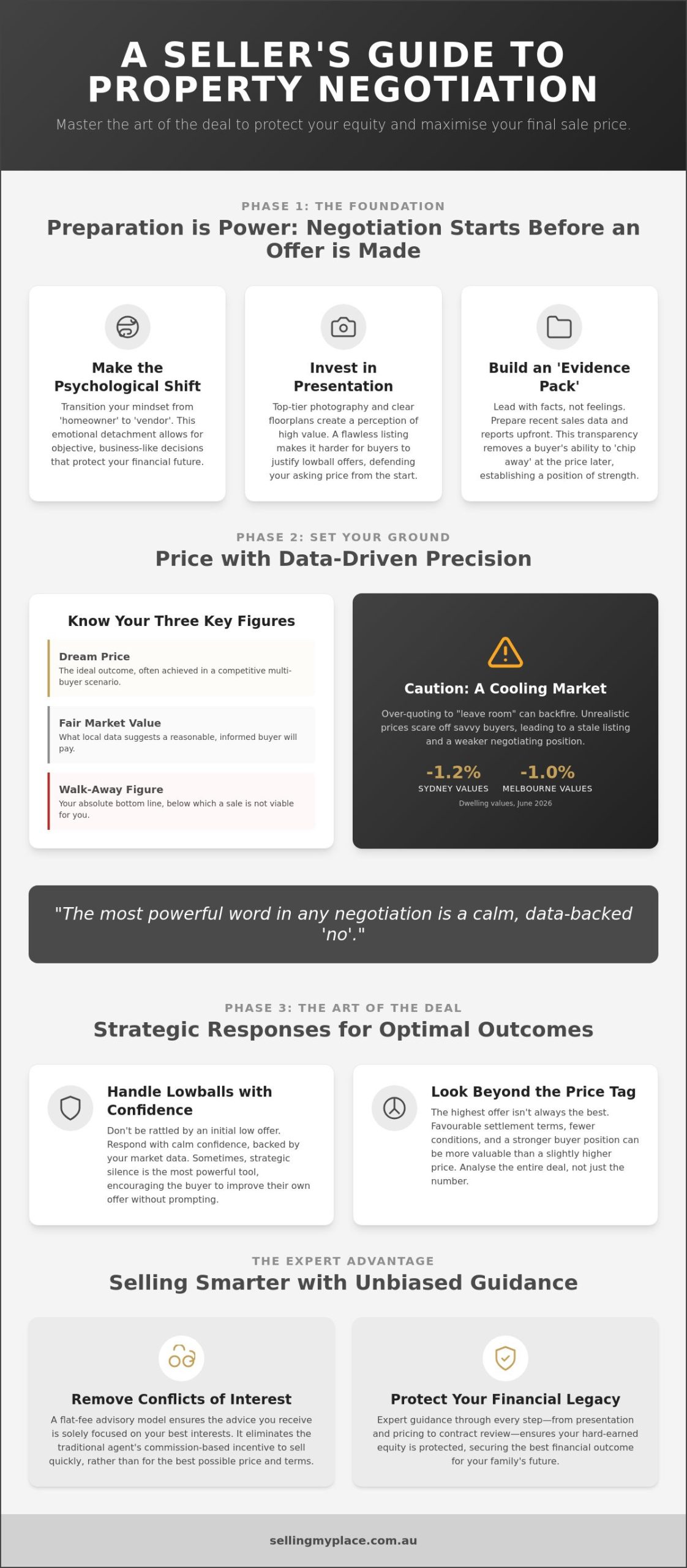
Beyond the Price Tag: Negotiating Settlement Terms and Conveyance Advice
While it’s easy to get swept up in the excitement of a high dollar figure, the highest offer isn’t always the best deal for your family’s future. A slightly lower price with an unconditional contract and a 60-day settlement might actually leave you in a better financial position than a record-breaking price riddled with complex clauses. These property sale negotiation tips are about more than just the final number; they are about protecting your equity and ensuring a smooth transition to your next chapter. When you look at an offer, look at the whole picture, not just the bottom line.
A 10% deposit remains the gold standard for a reason. It provides you with a significant safety net and ensures the buyer has enough “skin in the game” to see the transaction through. If a buyer pushes for a smaller deposit, you are well within your rights to ask for more favourable settlement terms in return. Aligning your settlement date with your next move is a masterstroke that can save you a fortune in bridging finance and the sheer exhaustion of moving twice. It’s these small, practical details that turn a good sale into a great one.
The Role of Expert Conveyancing
You should always have your contract reviewed by a professional before any serious negotiation begins. This proactive step allows you to understand which “Special Conditions” you can use as bargaining chips. For instance, you might offer a slightly longer cooling-off period in exchange for a higher price. Many modern Residential Property Listing Services now recommend integrating legal support early to avoid nasty surprises. If you’re feeling overwhelmed by the legal jargon, you can get in touch for expert conveyance advice to ensure your contract is watertight.
Handling Building and Pest Results
This is often the stage where a deal can wobble. If a report comes back with minor issues, you have a choice: negotiate a small price reduction or agree to fix the repairs yourself. Generally, a price reduction is cleaner for your bottom line as it prevents you from managing tradespeople during a stressful move. You can also stand your ground on known minor defects by using an “as-is” clause, provided these were disclosed early in the campaign. Whatever you decide, ensure any agreed repairs or credits are documented precisely in the final contract to protect your interests.
Selling Smarter: How Expert Advisory Services Protect Your Profit
The traditional real estate model has long relied on a percentage-based commission, which can often lead to a subtle misalignment of goals. When an agent’s payday depends on a quick turnover, the pressure to “just sign” can feel overwhelming. By choosing a flat-fee advisory model, you remove this conflict of interest entirely. Your advisor isn’t chasing a commission; they are focused on ensuring you achieve the best possible result for your unique circumstances. This shift allows you to implement property sale negotiation tips with the backing of a professional who is truly in your corner, without the $20,000 price tag often associated with high-end agencies.
Having a professional negotiator by your side provides a vital buffer between your emotions and the buyer’s tactics. While you focus on the heart of the move, your advisor handles the strategic heavy lifting. They help you move from that initial verbal agreement to a binding exchange of contracts with total clarity. This final stage is where the “fine print” matters most, especially with the new identity verification requirements. A steady hand ensures that every T is crossed and every I is dotted, protecting your equity until the moment the keys change hands.
The KIDS Advantage
Kincade International Direct Sales (KIDS) offers a unique partnership that combines global reach with the personal touch of a local expert. Unlike the transactional feel of a standard agency, the KIDS model is built on the belief that you should keep 100% of your sale profit. This extra capital can be the difference between a modest downsized apartment and the dream coastal retreat you’ve been planning for years. You receive the professional polish and marketing power of a top-tier firm while remaining the primary decision-maker in your home’s legacy.
Your Negotiation Checklist
Before you sign on the dotted line, take a moment to breathe and run through this final summary of essentials. Trusting your gut is just as important as trusting the data. If something feels “off” about an offer, it usually is. Here are the five key steps for a successful finish:
- Confirm your walk-away figure: Ensure the offer genuinely meets your financial needs for the next chapter.
- Verify the terms: Double-check that the settlement date and deposit amount align with your moving plans.
- Review the evidence: Use your Neighborhood Market Reports one last time to confirm the price reflects current local trends.
- Consult your advisor: Run the final figures and conditions past your Real Estate Advisory Services team.
- Check the contract: Ensure all agreed repairs or special conditions are clearly written into the binding document.
Selling your home is a significant milestone, and you deserve to feel empowered throughout the entire journey. By combining these property sale negotiation tips with a supportive advisory model, you can navigate the market with confidence and grace. Discover how we empower you to sell smarter and keep your profit.
Take Control of Your Financial Legacy
Selling your home is about so much more than a transaction; it’s the bridge to your next big adventure. By embracing these property sale negotiation tips, you’ve moved from being a passive observer to a confident decision-maker. You now understand that a successful sale is built on the foundation of professional presentation, anchored by robust local data, and secured through a firm grasp of contract terms. Protecting your equity isn’t just about the final figure; it’s about making sure the transition is as smooth and stress-free as possible for your family.
You don’t have to walk this path alone. With our global marketing network reach and a dedicated Agent Advisory Service in your corner, you can achieve a premium result while keeping your hard-earned profit. Our partners save an average of $20,000 in commissions by choosing a smarter, modern way to sell. It’s time to step into your future with clarity and confidence. Start your commission-free selling journey with Kincade today and see how a partnership-based approach changes everything. You’ve got this, and we’re here to help you every step of the way.
Frequently Asked Questions
Do I really need an agent to negotiate for me?
No, you aren’t legally required to use a traditional agent to handle your sale. Many homeowners find that they are the most passionate advocates for their property’s unique history and value. By using our Real Estate Advisory Services, you gain the strategic advantage of a professional negotiator while maintaining direct control over the final decision. This partnership ensures you aren’t pressured into a quick sale that doesn’t serve your family’s long-term interests.
How do I handle a buyer who keeps pushing for a lower price?
When a buyer persists with lower offers, refocus the conversation on objective market evidence. Reference your Neighborhood Market Reports to show how your price aligns with recent local sales. If the pressure continues, a calm “no” backed by data is your most effective tool. You might also offer to adjust a settlement term instead of the price, which often satisfies a buyer’s need to feel they’ve “won” a concession.
What is the most important “Special Condition” to include in my contract?
While every sale is unique, a well-defined settlement date that aligns with your next move is often the most valuable condition for a seller. It prevents the stress and cost of bridging finance or moving into temporary accommodation. You should also ensure there is a clear “sunset clause” on any finance conditions. This prevents a buyer from tying up your property for weeks without a firm commitment to proceed.
Can I change my mind after I have verbally accepted an offer?
Yes, a verbal agreement is generally not legally binding in Australia until the written contracts are signed by both parties and formally exchanged. While it’s important to act with integrity to keep a serious buyer engaged, you aren’t locked in until that physical exchange happens. This is why moving quickly from a verbal “yes” to a binding contract is one of the most vital property sale negotiation tips for protecting your sale.
How do I know if a buyer is actually pre-approved for finance?
You should request a formal letter of “pre-approval in principle” from the buyer’s financial institution. Don’t rely on a buyer’s word alone, as their borrowing capacity may have changed with recent interest rate shifts. With the new AML/CTF regulations that began in July 2026, your legal representative will already be conducting more thorough financial checks. This added layer of scrutiny helps ensure you’re only dealing with genuine, qualified purchasers.
What should I do if the building and pest report comes back with issues?
Don’t panic if a report identifies minor defects; almost every home has them. The best approach is usually to offer a small, fair price reduction rather than attempting to organise repairs yourself while you’re busy packing. This keeps the process moving forward without you having to manage tradespeople. Ensure any agreement is documented as a specific “special condition” in the contract so there are no further disputes before settlement.
Is it better to sell at auction or via private treaty for negotiation?
Private treaty often provides a better environment for nuanced negotiation, especially in the cooling markets we saw in June 2026. Unlike the high-pressure environment of an auction, a private sale allows you to discuss settlement dates and specific conditions that might be more important to you than the final dollar amount. It gives you the time to build a rapport with the buyer and find a middle ground that respects your home’s legacy.
How much can I actually save by negotiating the sale myself?
Australian homeowners often save an average of $20,000 by choosing a commission-free model. When you remove the traditional percentage-based fee, that equity stays in your pocket to fund your next life transition. These property sale negotiation tips empower you to handle the process with professional polish while ensuring your family receives the full benefit of your home’s capital growth. It’s a significant financial win that provides a much smoother start to your next chapter.
How to Sell Your Own Home: A Step-by-Step Guide to Sale by Owner in Australia
What if you could keep the A$20,000 you were prepared to pay in commissions and put it directly into your family’s future instead? It is a question more Australians are asking as they look to take the reins of their own property journey. Choosing a sale by owner approach isn’t just about saving money; it is about maintaining control over your most valuable asset while ensuring the process remains sophisticated and seamless.
We understand that selling a home is deeply personal and can feel quite daunting, especially with the weight of legal paperwork and the fear of underselling. You deserve to feel empowered and protected throughout this transition. This guide will show you how to master the private sale process, allowing you to retain 100% of your equity through professional marketing and expert advisory.
We will walk through the essential steps for a successful Australian sale, covering everything from the new July 2026 anti-money laundering regulations to the secrets of a high-impact listing. You’ll discover how to balance the technical details with a heartfelt approach, ensuring you have a steady hand to guide you toward a result you can truly celebrate.
Key Takeaways
- Learn how a sale by owner approach keeps your hard-earned equity in your pocket by replacing traditional commissions with a sophisticated, professional strategy.
- Identify high-impact improvements through a pre-sale consultation and use local market data to set a price that attracts genuine interest from the right buyers.
- Discover how to access the same digital infrastructure as the big agencies, ensuring your listing shines on Australia’s leading property portals.
- Gain the confidence to manage enquiries and qualify buyers effectively, keeping your inspection schedule focused on serious, high-intent contenders.
- Understand the critical legal milestones from the initial offer to the final settlement to ensure a smooth and protected transition for your family.
What is “Sale by Owner” and is it Right for Your Australian Property?
Selling a home is often the biggest financial and emotional transition a family makes. Traditionally, this meant handing the keys to an agent and watching a significant chunk of your equity disappear in commissions. However, a For Sale by Owner (FSBO) approach is changing that narrative across Australia. It is a commission-free alternative where you, the owner, lead the way. This isn’t about being on your own in a cold, transactional sense; it’s about stepping into a partnership where you control the story of your home while experts handle the heavy lifting of the digital infrastructure.
We’ve seen a clear shift from old-school high-commission models to modern flat-fee professional services. Why? Because homeowners realise they are the true experts on their property’s history, the best local coffee spots, and the way the afternoon sun hits the back deck. There’s a common myth that a private sale is only for lower-priced properties. That simply isn’t true. High-end homes benefit immensely from the direct, authentic connection between a seller and a buyer, ensuring no detail of the home’s legacy is lost in translation. Choosing a sale by owner strategy allows you to maintain total control while retaining 100% of your property’s equity.
The Financial Logic: Commission vs. Flat-Fee
The numbers tell a compelling story. According to research from June 2026, the national median commission for agents sits at roughly 2.65%. On a A$700,000 sale, that is A$18,550. It’s a massive sum that could be better used for your next deposit or retirement fund. By choosing a sale by owner model, you replace that variable percentage with a transparent flat fee. This allows you to reinvest those savings into premium marketing, like professional photography and floorplans, ensuring your home looks just as polished as any listing on the market. Plus, many of these arrangements offer “listed until sold” peace of mind, removing the ticking clock of a traditional 90-day agency agreement.
Is Your Mindset Ready for a Private Sale?
Success in a private sale often comes down to a steady hand and a genuine love for your community. Are you ready to be the primary advocate for your home? You don’t need to be a shark-like negotiator. In fact, most buyers find it refreshing to speak directly with the person who has actually lived in the house. Your passion is your greatest asset. When you combine that local insider knowledge with a professional support system, the stress of the process begins to melt away. It’s about feeling empowered, not overwhelmed, as you guide your family toward its next chapter.
Preparing Your Home: The 5 Essential Steps Before You List
Preparation is the bridge between a property that sits on the market and one that sells for a premium price. When you choose a sale by owner strategy, you aren’t just tidying up for a weekend open home; you are curateing an experience for a future family. This process requires a steady hand and a clear focus on where your efforts will yield the highest return. Before the first buyer walks through your front door, follow these five essential steps to ensure your home stands out in the competitive Australian market.
- Step 1: Conduct a Pre-Sale Property Consultation. Avoid the trap of over-capitalising on renovations. An expert review identifies high-ROI repairs, like a fresh coat of paint in a modern neutral or fixing that leaky tap, which can significantly boost buyer confidence.
- Step 2: Secure a Neighbourhood Market Report. You cannot price your home in a vacuum. Understanding the recent sales in your street and the median prices in your suburb is the only way to ground your expectations in reality.
- Step 3: Organise Professional Photography and Floorplans. Your digital first impression is your only first impression. High-quality visuals are non-negotiable for a professional-looking listing.
- Step 4: Declutter and Style. Depersonalising the space allows buyers to visualise their own lives unfolding within your walls. It’s about moving from “your home” to “their future.”
- Step 5: Finalise Your Pricing Strategy. Use the data from your market report to set a price that is competitive yet protective of your 100% equity goal.
The Power of Professional Photography and Floorplans
In the digital age, your home’s “open house” begins the moment a buyer scrolls past your listing on their phone. Using iPhone photos is perhaps the costliest mistake a private seller can make. Professional photography uses light and angles to tell a story, creating an emotional pull before the first inspection even begins. Equally vital are accurate floorplans. They don’t just show the layout; they help serious buyers plan their furniture placement and understand the flow of the home. This reduces “tyre-kicker” enquiries and ensures those who do book a viewing are already halfway to making an offer. If you want to see how professional visuals can transform your listing, consider booking a pre-sale property consultation to get your home camera-ready.
Leveraging Neighbourhood Market Reports
With the Reserve Bank of Australia holding the cash rate at 4.35% as of June 2026, buyers are more discerning than ever about value. A comprehensive market report is your shield against low-ball offers. It should include detailed data on properties currently for sale and those that have settled in the last six months. When a buyer questions your asking price, you won’t need to rely on emotion. Instead, you can point to concrete local data to justify your position. Your local insider knowledge, paired with these hard facts, makes you a more formidable negotiator than any generic agent who might be juggling twenty other listings at once.
Marketing Your Property to a Global Audience
Once your home is camera-ready, it is time to share your story with the world. Many people worry that a sale by owner approach limits their reach to just a “For Sale” sign on the front lawn. This couldn’t be further from the truth. In fact, a professional private sale strategy utilises the exact same digital infrastructure as the largest agencies in the country. You can place your home where the eyes already are: on major property portals like Realestate.com.au and Domain.com.au. Understanding how modern residential property listing services work can help you make the most of this digital reach without paying traditional agent commissions. To maximise your results, developing a structured property marketing plan in Australia ensures every channel works together to attract the right buyers at the right price.
The beauty of this modern approach is the “Listed Until Sold” philosophy. Traditional agency agreements often trap you in a 90-day window, creating a sense of frantic urgency that can lead to rushed decisions or underselling. Why put that pressure on your family? By removing the ticking clock, you maintain a position of strength. You can wait for the right buyer who truly values the legacy you’ve built, rather than settling for the first offer just to meet an agent’s deadline. It is about moving at a pace that respects the emotional weight of the transition.
Writing Descriptions That Sell
Your property description shouldn’t read like a dry inventory of bedrooms and bathrooms. Buyers can see those details in the data section. Instead, use this space to paint a picture of the lifestyle your home offers. Does the breakfast nook catch the soft morning sun? Is there a particular spot in the garden where the kookaburras gather at dusk? This heartfelt, evocative language creates an emotional bridge. To keep readers engaged on mobile devices, use short, punchy sentences and clear bullet points. It makes the information accessible for busy families scrolling through listings between school runs or work meetings.
The Global Connection
Australia remains a highly attractive destination for international buyers looking for stability and community. A robust digital marketing network ensures your residential property for sale is visible to expats and overseas investors alike. This global reach is a significant advantage, as it broadens your buyer pool beyond just the local neighbourhood. Managing these enquiries doesn’t have to be a headache, even with different time zones. By using integrated digital tools, you can respond to questions at your own pace, ensuring every potential buyer feels welcomed and informed, no matter where they are in the world.
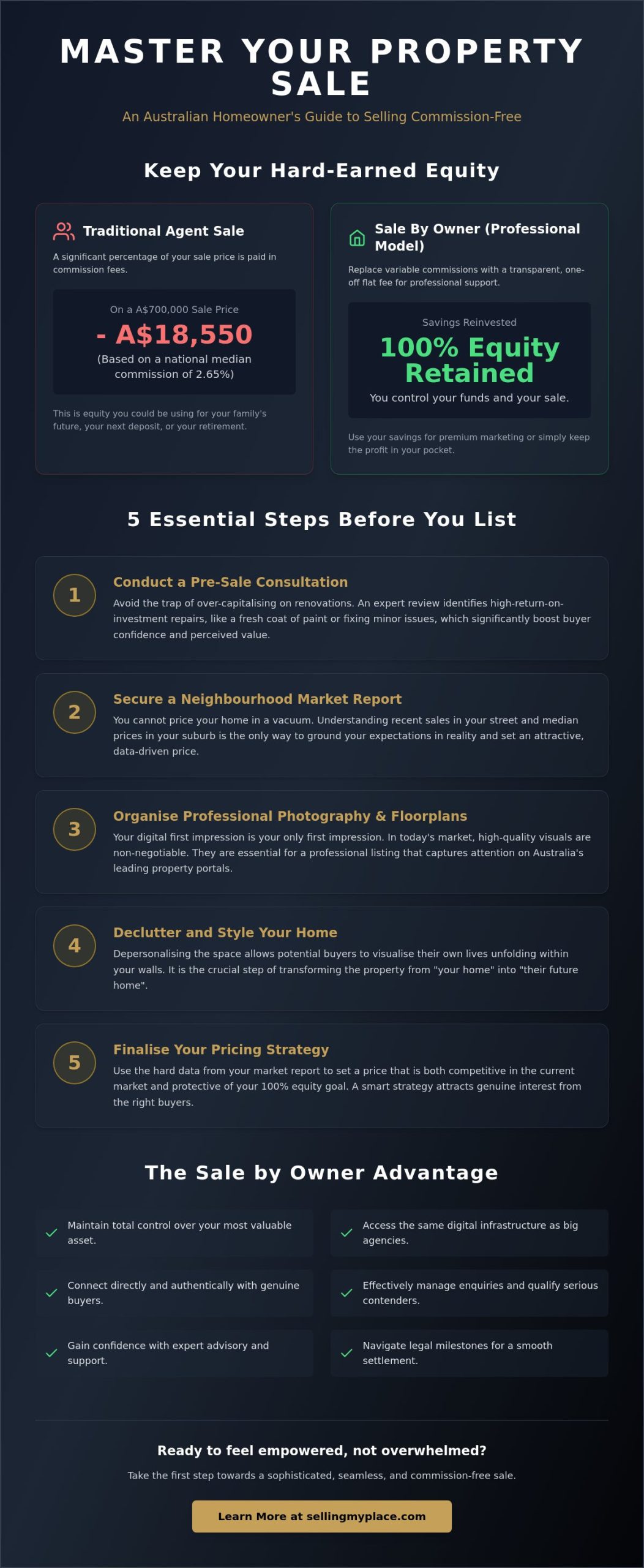
Handling Enquiries, Inspections, and the Art of Negotiation
Once the enquiries start rolling in, the process shifts from digital screens to your front doorstep. This is the moment where the “steady hand” approach becomes your greatest asset. Many homeowners worry that a sale by owner means they have to act like a high-pressure salesperson. In reality, the most successful private sales are built on neighbourly warmth and transparent communication. You aren’t “selling” so much as you are hosting a guest who might become the next custodian of your family home.
To protect your time and peace of mind, it is vital to qualify buyers before they arrive. Ask gentle but direct questions over the phone. Have they spoken to a lender? Are they familiar with the local area? This simple step ensures your inspection schedule is filled with genuine contenders rather than weekend tyre-kickers. It allows you to maintain a stress-free routine that suits your lifestyle, rather than rearranging your life for every casual enquiry.
What about the “money talk”? It’s the part people fear most. If a buyer asks about price, stay grounded in the data you gathered from your market report. You don’t need to feel awkward when you have facts on your side. Simply state your position with calm confidence, knowing you have the right to protect your property’s value. Negotiation is not a battle; it is a conversation about value and legacy. For a deeper dive into how to approach these conversations with confidence, our guide on property sale negotiation tips for Australian homeowners can help you prepare for every scenario.
Mastering the Private Inspection
Aim for a welcoming, grounded atmosphere when preparing for an inspection. Open the blinds to let in that beautiful Australian light and ensure the home feels fresh and inviting. Remember the “less is more” rule. Let buyers explore at their own pace. Stay nearby to answer questions about the local schools or the best nearby parks, but give them the space to imagine their own furniture in the rooms. After they leave, a quick, friendly follow-up text is a great way to gather honest feedback without being pushy.
Expert Backing: The Agent Advisory Service
You don’t have to navigate the complex world of offers alone. While you lead the inspections, having access to real estate advisory services provides a professional safety net. If a “lowball” offer arrives or a buyer’s representative gets aggressive, your advisor can help you interpret the situation and draft a strategic response. This support bridges the gap between a verbal offer and a legally binding contract, ensuring you never feel out of your depth. If you are ready to take the next step with professional support, explore our real estate advisory services to see how we can help you secure the best result.
The Legal Finish Line: Conveyancing and Settlement
Reaching the stage where you have accepted an offer is a moment for genuine celebration. It is the culmination of your hard work and the start of a new chapter for your family. However, the path from “Offer Accepted” to “Settlement Day” involves a series of technical milestones that require precision and a steady hand. While a sale by owner approach puts you in the driver’s seat, you aren’t expected to navigate the legal complexities of property law in isolation. This final phase is about ensuring a secure, transparent transfer of your most valuable asset.
In Australia, the legal transfer of property is a formal process that begins with the Contract of Sale. Depending on your state, specific disclosure requirements must be met before the sale is finalised. For instance, Victorian sellers must provide a Section 32 Vendor Statement, while those in South Australia require a Form 1. Since July 1, 2026, new federal Anti-Money Laundering (AML) laws also require all parties to provide identification documents for verification. Engaging a professional conveyancer or solicitor to handle these details ensures your interests are protected, turning a complex process into a calm and orderly transition. If you are also navigating the purchase of your next home at the same time, understanding the full strategy for selling and buying a house at the same time in Australia can help you coordinate both settlements without the stress of bridging finance or missed deadlines.
Navigating Conveyance Advice
One of the most effective ways to reduce stress is to organise your legal paperwork before the first buyer even walks through your front door. This proactive approach prevents last-minute hurdles and builds immediate trust with potential buyers. Common pitfalls, such as missing building permit disclosures or failing to secure an ATO Clearance Certificate for properties valued at A$750,000 or more, can cause significant delays. By seeking early conveyance advice, you can identify these requirements early, protecting your equity and ensuring the settlement process remains a smooth experience for everyone involved.
The Kincade Partnership: Why You Aren’t Selling Alone
Choosing a direct sales model means you lead the conversation about your home’s heart and history, while we provide the professional infrastructure to support your journey. You keep 100% of your profit and pay 0% in agent commissions. Instead, you benefit from a single, transparent flat fee that covers everything from high-end marketing to expert advisory. It is a partnership built on empathy, community roots, and the shared goal of seeing your family thrive. You have the local knowledge; we have the steady hand to help you cross the finish line with confidence.
Organise your professional property listing with Kincade today and take the first step toward a more empowered way to sell.
Stepping Into Your Next Chapter with Confidence
Selling your family home is a significant milestone that deserves both professional precision and a personal touch. You now have the roadmap to navigate the Australian market, from the initial pre-sale consultation to the final settlement. By combining your unique insider knowledge of your property with a high-impact digital presence, you can reach the right buyers without sacrificing your hard-earned equity.
Choosing a sale by owner path doesn’t mean you have to be a solo act. It is about taking control while having a steady hand to guide you through the technical details. Every package we offer includes professional photography and floorplans to ensure your home looks its absolute best. You also gain access to our Agent Advisory Service for expert negotiation support, helping you save an average of A$20,000 in agency commissions.
Start your commission-free sale journey with Kincade International Direct Sales
Your property’s legacy is in good hands because it is in your hands. We look forward to helping you secure a future that is as bright and stable as the home you have built.
Frequently Asked Questions
Is it legal to sell my own home in Australia without an agent?
Yes, it is perfectly legal to sell your property privately in every Australian state and territory. You aren’t required by law to engage a licensed real estate agent. You must, however, ensure you comply with state-specific disclosure requirements, such as providing a Section 32 in Victoria or a Form 1 in South Australia. Additionally, all sellers must now adhere to federal Anti-Money Laundering laws that came into effect on July 1, 2026.
How much can I actually save with a “Sale by owner” model?
The savings are often significant, typically ranging from A$15,000 to over A$30,000 depending on your property’s value. Since the national median commission for agents is approximately 2.65%, a sale by owner approach allows you to keep that entire amount as equity. By removing the commission, you can reinvest a small portion into premium marketing while keeping the vast majority of the profit for your family’s next move.
Will my property appear on Realestate.com.au and Domain if I sell privately?
Yes, your home will receive full exposure on Australia’s leading property portals. While these websites don’t allow individual private sellers to upload listings directly, professional service providers facilitate this for you. This ensures your home is visible to the millions of buyers who use these platforms every day. You get the same digital reach as a traditional agency without the high commission costs associated with their services.
How do I determine the right price for my home without an agent appraisal?
You can set a confident price by using a Neighbourhood Market Report to analyse recent settled sales in your street. With the RBA holding the cash rate at 4.35% as of June 2026, buyers are looking for genuine value. Basing your price on hard data rather than an emotional estimate helps you justify your position during negotiations. This evidence-based approach is often more accurate than a generic agent appraisal.
What happens if I can’t sell my property within 90 days?
There is no need to worry about a ticking clock. Unlike traditional agency agreements that often expire after 90 days, a professional private sale model typically operates on a “listed until sold” basis. This removes the frantic pressure to accept a low offer just to meet a deadline. You have the freedom to wait for the right buyer who truly appreciates the lifestyle and legacy your home offers.
Do I need a lawyer for a private house sale?
Yes, you must engage a qualified conveyancer or solicitor to handle the legal transfer of the property. While you lead the marketing and inspections, a legal professional is essential for preparing the contract of sale and managing the settlement process. They ensure all paperwork is compliant with state laws and that your equity is protected when the funds are transferred on settlement day. This provides a vital layer of security.
How do I handle negotiations if I’m not a salesperson?
You handle them with a steady hand and a focus on helpfulness. You don’t need to be a master negotiator; you just need to be the expert on your own home. If an offer feels complex or a buyer is being difficult, you can call upon real estate advisory services for expert support. This partnership ensures you have a professional advocate in your corner to help bridge the gap between an offer and a signed contract.
Can I still use professional photography if I’m selling the home myself?
Absolutely, and it is one of the most important steps for a successful sale. Every professional listing package should include high-end photography and floorplans to ensure your home stands out online. These visuals create the emotional pull that brings buyers to your door. By using the same professional tools as the big agencies, you ensure your private listing looks sophisticated, polished, and ready to achieve a premium result.
