How Long Does Settlement Take in Australia? Key Timing Factors
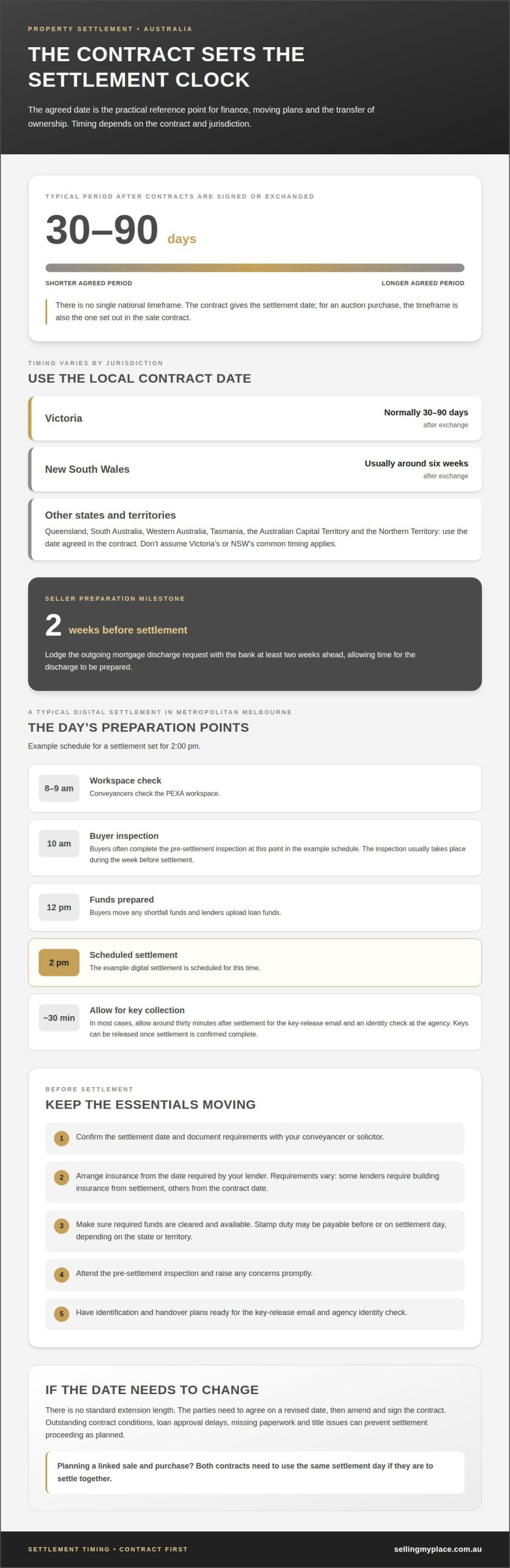
The settlement date in your contract matters more than how quickly the paperwork is completed on the day. In Australia, home settlement usually takes 30 to 90 days after contracts are signed or exchanged, depending on the contract; there’s no single national timeframe. So, how long settlement takes in Australia comes down first to the date agreed by the buyer and seller, as well as the requirements of the transaction.
Settlement is the legal process that transfers property ownership from the seller to the buyer, with the buyer’s lender involved if the purchase is financed. It’s natural to want a clear date for moving, handing over the keys or planning your next home. This article explains how long settlement takes in Australia, what happens during the process and how contract dates and state differences shape the timeline. You’ll also learn what can delay settlement and what may happen if it doesn’t go ahead as planned.
Key Takeaways
- Use the settlement date in the contract to plan your move; timing varies by state and transaction.
- Have finance, required documents and funds organised ahead of settlement to reduce avoidable hold-ups.
- Arrange insurance and a pre-settlement inspection as part of preparing for handover.
- If settlement can’t proceed as planned, the parties need to agree on any date change and amend the contract.
- For help preparing to sell or buy, Kincade International Direct Sales offers property consulting, buyer representation and residential property listing services.
Preparing for settlement
Preparation starts well before settlement day. The buyer’s conveyancer or solicitor typically coordinates with the lender and the seller’s representatives to bring the documents, funds and timing together. Buyers and sellers should keep communication flowing through their representatives, especially if the lender still needs information. A short settlement period doesn’t remove the need for credit assessment, valuation, conveyancing, identity checks, security documents or cleared funds.
Sellers should deal with an outgoing mortgage early. Lodge a discharge request with the bank at least two weeks before settlement to allow time for the mortgage discharge to be prepared. The seller pays property-related charges up to settlement day, and the buyer takes responsibility from then on. Adjustments may account for charges paid in advance, so information about rates, water and body corporate fees may be needed to calculate the amounts correctly.
Buyers should arrange insurance from the required date. Some lenders require building insurance from settlement, while others require it from the contract date, so confirm the start date with your lender. Stamp duty may also need to be paid before or on settlement day, depending on the state or territory. The buyer’s conveyancer or solicitor can coordinate the transfer and required settlement documents with the lender.
In metropolitan Melbourne, a typical digital settlement scheduled for 2:00 pm has several preparation points. Conveyancers check the PEXA workspace between 8:00 and 9:00 am. Buyers often complete the pre-settlement inspection at 10:00 am. Around 12:00 pm, buyers move any shortfall funds and lenders upload loan funds. The inspection usually takes place during the week before settlement, giving buyers a chance to confirm the property’s condition before handover.
The buyer’s conveyancer or solicitor and lender can complete and sign documents online or in person. Agreeing on the method in advance helps keep the paperwork moving. A practical buyer checklist includes:
- Confirm the settlement date and document requirements with the conveyancer or solicitor.
- Arrange insurance with a start date that meets the lender’s requirement.
- Make sure required funds are cleared and available for settlement.
- Attend the pre-settlement inspection and raise any concerns promptly.
- Plan for the key-release email and identity check at the agency.
In most cases, buyers should allow around thirty minutes after settlement for the key-release email and an identity check at the agency. Once settlement is confirmed as complete, the agent is authorised to release the keys. Having identification and handover plans ready makes the transition from legal completion to key collection more straightforward.
Typical settlement period
Across Australia, home settlement usually takes 30 to 90 days after contracts are signed or exchanged, depending on the contract. For an auction purchase, the settlement timeframe is set by the contract, so check the agreed date before planning your move.
Typical settlement periods across Australia
The settlement period is the time between signing or exchanging contracts and the agreed settlement date. Buyers and sellers use that date to coordinate finance, moving plans and the transfer of ownership. There’s no single official timeframe for every Australian property: the contract and jurisdiction shape the arrangement. A shorter period may be negotiated when the home is vacant and the buyer is ready to move in.
Settlement periods by state and territory
Settlement timing varies across New South Wales, Victoria, Queensland, South Australia, Western Australia, Tasmania, the Australian Capital Territory and the Northern Territory. In Victoria, contracts normally set a period of 30-90 days after exchange. NSW Fair Trading describes residential settlement in New South Wales as usually occurring around six weeks after exchange. For the other jurisdictions, the contract’s agreed date provides the timeframe; don’t assume Victoria’s or NSW’s common timing applies there.
Auction property settlement periods
An auction purchase follows the settlement date set out in the sale contract, not a separate national auction timetable. That date guides the parties as they arrange finance, conveyancing and moving plans. Buyers should make sure the proposed timing allows them to complete the purchase. The same principle applies if the auction property is vacant: a short settlement can be negotiated when both parties agree and the buyer is ready.
For buyers and sellers, the contract date is the practical reference point. A conveyancer can coordinate documents and settlement arrangements around it, while the parties can raise timing needs before agreeing to the contract. If a purchase and sale need to settle together, both contracts must use the same settlement day. This coordination matters because mismatched dates can disrupt plans for moving between properties.
To confirm how long settlement takes in Australia, identify the settlement date in the signed contract and note whether it runs from signing or exchange. Then arrange finance and conveyancing around that date. If you’re planning a sale and want to discuss your property timeline with Kincade International Direct Sales, talk through your sale plans.
Causes of settlement delays
In Australia, outstanding contract conditions, loan approval delays, missing paperwork and title issues can prevent settlement from proceeding as planned. Delays can affect the buyer’s payment of the purchase price, the seller’s handover plans and when the buyer can collect the keys. There’s no standard length for an extension: the parties agree on a revised date, then amend and sign the contract.
Finance is a common pressure point. The buyer’s lender must be ready to provide the loan funds, and cleared money is also needed for the balance of the purchase price. Late loan approval or an unresolved funding shortfall can leave the buyer unable to complete payment on the agreed day. Missing documents or title issues can also interrupt the legal transfer, even when both parties are otherwise ready—which is why many mortgage brokers use platforms such as DocChaser to streamline document collection and keep loan approvals on track.
Other contract conditions may need to be met before settlement can proceed. If a required document hasn’t been supplied, for example, the conveyancers may need time to resolve the gap and update the settlement arrangements. A statement of adjustments can also affect the final payment: it records agreed property-related amounts between the parties. The cause of the delay helps determine what needs to happen next.
- Loan or payment issue: confirm the lender’s position and whether funds can be made available.
- Missing paperwork: identify the outstanding document and arrange its completion.
- Title issue: resolve the matter affecting the ownership transfer before rescheduling.
- Unmet contract condition: establish what remains outstanding and how it affects the settlement date.
If settlement hasn’t completed by 4:30 pm AEST, the parties typically agree to rebook for the next business day. In South Australia, a minor issue may also result in a next-business-day rescheduling. The parties should agree on any change to the settlement date and amend and sign the contract, rather than relying on an informal conversation or assumption.
The financial consequences depend on the contract and jurisdiction. Contracts often allow a grace period of three business days before default interest becomes payable, although terms differ. This isn’t a guaranteed extension: it describes a common contract provision, and the exact wording matters. A delayed payment can affect the buyer’s obligations, while the seller may need to change moving or handover plans.
A property purchase involves linked steps, so one unresolved issue can hold up the whole transaction. Identify the obstacle, have the relevant parties address it, and agree in writing on any revised date. This gives the buyer, seller and their representatives a clear timeline for completing payment, transferring ownership and arranging key collection.
What Happens If Settlement Cannot Complete on the Day?
If finance isn’t ready by the agreed settlement date, the buyer may be unable to complete the purchase as planned. The buyer and seller can choose a different date, but both must agree and record the change properly.
Options when finance misses the settlement date
If a lender can’t provide funds in time, the buyer’s representative can discuss the delay with the seller’s representative and seek a revised date. The lender’s timing matters, but moving settlement also requires the parties’ agreement and completion of the transaction requirements. If settlement hasn’t completed by 4:30 pm AEST, the parties typically agree to rebook for the next business day.
Changing the agreed settlement date
Changing the settlement date requires agreement on a new date and an amendment to the contract of sale. Both parties must agree to the change, then amend and sign the contract. Either party can request a change, but neither can replace the agreed date unilaterally. Bringing settlement forward is also possible if both parties agree and their legal representatives and lenders can meet every requirement.
Start by identifying what’s preventing settlement. The lender may still need to provide funds, for example, or a required document may be incomplete. The representatives can then discuss whether the issue can be resolved by the existing date or whether a new one is needed. A clear written agreement gives the buyer, seller and lender the same reference point for next steps.
Timing affects more than the property handover. A revised date can shift moving arrangements and the point when responsibility for property-related charges changes. For example, council rates may need to be adjusted between seller and buyer using the final settlement date. The representatives can account for these adjustments when preparing the completion figures.
Don’t treat a grace period as automatic permission to settle late. Contracts often allow a grace period of three business days before default interest becomes payable, although terms differ. The contract and its conditions determine the consequences of delay. Buyers facing a funding shortfall should raise it promptly so the parties can consider the contract position and possible date changes.
Choosing a settlement date at the outset also calls for coordination. The buyer needs a date that allows the lender and legal representatives to complete the necessary work; the seller needs time to prepare for handover. A period of up to 90 days may form part of a contract’s settlement timeframe, but the specific date depends on what the parties agree. If a purchase is linked to another sale, matching both settlement dates can help coordinate the moves.
Contractual settlement dates and jurisdictional differences
There’s no single settlement period across Australia: the contract and jurisdiction determine the date. Read the contract of sale carefully. Its wording sets the timeframe and shows whether it runs from signing or exchange. That distinction matters when planning finance, moving arrangements and any linked sale or purchase.
Across Australia, home settlement usually takes 30 to 90 days after contracts are signed or exchanged, depending on the contract. In Victoria, contracts normally set 30-90 days after exchange. NSW Fair Trading describes residential settlement in New South Wales as usually occurring around six weeks after exchange. These are common timeframes, not one national rule that overrides the contract.
South Australia uses a different reference point: the settlement date is agreed by both parties and written into the contract. Settlement typically occurs 30 to 90 days after the contract of sale is signed, with 60 days the most common period. This makes the signed agreement especially important when coordinating a move or a purchase linked to another sale.
The method of completing the transfer can also vary by jurisdiction. South Australian property settlements have been conducted entirely electronically since August 2020, and electronic settlement usually takes between 15 minutes and 1 hour. In Victoria, most property transfers have been required to settle electronically since 2019. These electronic timeframes describe completion on settlement day, not the weeks between signing and settlement.
State rules can affect the steps around settlement. In Victoria, the seller is responsible for rates up to and including settlement day, while the buyer is responsible from the following day. Adjustments can account for council rates, water and body corporate fees paid in advance. Victoria also allows land transfer duty to be paid up to three months after settlement, but the buyer cannot receive title transfer until that duty is paid.
For a simultaneous settlement, the buyer and seller must negotiate the same settlement day for both contracts. If the dates differ, the linked transactions may not align as intended. A solicitor or conveyancer can explain the contract dates and coordinate transfer documents, while the parties agree on any date change before signing.
- Check whether the date runs from signing or exchange.
- Compare dates across linked contracts before committing to arrangements.
- Allow for jurisdiction-specific transfer, duty and adjustment requirements.
For help planning a sale around its contractual timeline, discuss your property sale plans.
Kincade International Direct Sales
Kincade International Direct Sales can support your property decisions as you plan around a settlement timeline. If you’re preparing to sell, Pre-Sale Property Consulting and Residential Property Listing Services can help with sale planning. If you’re buying, Buyer Representation can help you clarify your priorities, while Neighborhood Market Reports provide context as you consider your next move.
These services support your property decisions, while your conveyancer or solicitor and lender coordinate the legal and finance requirements of settlement. Keeping those responsibilities clear helps each part of the move stay with the right professional. To discuss your buying or selling plans, contact Kincade International Direct Sales.
Plan your next property move with confidence
Knowing how long settlement takes in Australia can help you plan your move. Next, consider how your buying or selling plans fit the contract timeline. Align your property goals with the settlement date and focus your next steps on the outcome you want. Sellers can start with Pre-Sale Property Consulting or Residential Property Listing Services; buyers can use Buyer Representation as they assess their options.
Kincade International Direct Sales can help you take those property decisions forward. Talk with Kincade International Direct Sales about your next property move and make a clear start on the plans ahead.
Frequently Asked Questions
What is settlement?
Settlement is when the sale is completed and ownership transfers from seller to buyer, or technically to the buyer’s lender when a home loan finances the purchase. The buyer pays the remaining purchase price, less any deposit already paid. After settlement, the buyer’s conveyancer or solicitor ensures the transfer is registered with the relevant state or territory authority, completing the formal change of ownership.
Can I change the settlement date after the contract has been signed?
Yes, but both parties must agree to change the date after signing. The contract of sale needs to be amended and signed to record the new date. If a buyer needs more time to organise funds, for example, they can request a change, but the seller must agree too. Keep moving arrangements and any connected sale or purchase aligned with the documented date.
Can a settlement date be brought forward?
Yes, the parties can agree to bring settlement forward if their legal representatives and lenders can complete every requirement by the new date. A buyer with finance ready and a seller able to hand over earlier could discuss an earlier date, for example. The agreement still needs to be recorded in the contract. Check that related arrangements, such as a linked property sale, can also move to match.
Do I need to be present on the day?
For a digital settlement, the buyer and seller don’t carry out the electronic transaction themselves. Their conveyancers or solicitors and lenders can complete and sign settlement documents online; documents can also be handled in person. Make sure requested information and funds are ready throughout the process. Once completion is confirmed, the agent is authorised to release the keys to the buyer.
How soon do sale proceeds clear after settlement?
Sale proceeds transferred through PEXA typically clear in the seller’s nominated account on the same business day, often within an hour of settlement. Consider this timing when planning payments or a linked purchase. The proceeds go to the nominated account, so the seller’s conveyancer can confirm that settlement has completed and the funds have been processed.
What happens at settlement day in South Australia?
In South Australia, the settlement is completed electronically, usually between 15 minutes and one hour. It is often scheduled around midday or early afternoon. The buyer pays the outstanding purchase amount, and the ownership transfer is completed. Buyers and sellers are typically notified within minutes after completion. The buyer’s conveyancer or solicitor then ensures registration with the relevant state authority.
How long does property settlement take in Australia?
Property settlement usually takes 30 to 90 days from contract signing or exchange, depending on the contract. The timeframe isn’t identical across the country: NSW Fair Trading describes residential settlement in New South Wales as usually occurring around six weeks after exchange, while Victoria commonly uses 30-90 days. The contract’s stated date is the key reference for organising your move and related arrangements.
What is the standard settlement period for buying a house in Australia?
There’s no single standard period for every Australian home purchase. A timeframe of 30 to 90 days is typical, but the contract and jurisdiction determine the agreed date. The buyer and seller can negotiate a shorter settlement when the home is vacant and the buyer is ready to move in. Consider how the proposed date fits finance, conveyancing and any linked sale before agreeing.
Buyer Advocates in Australia: How to Level the Playing Field in 2026
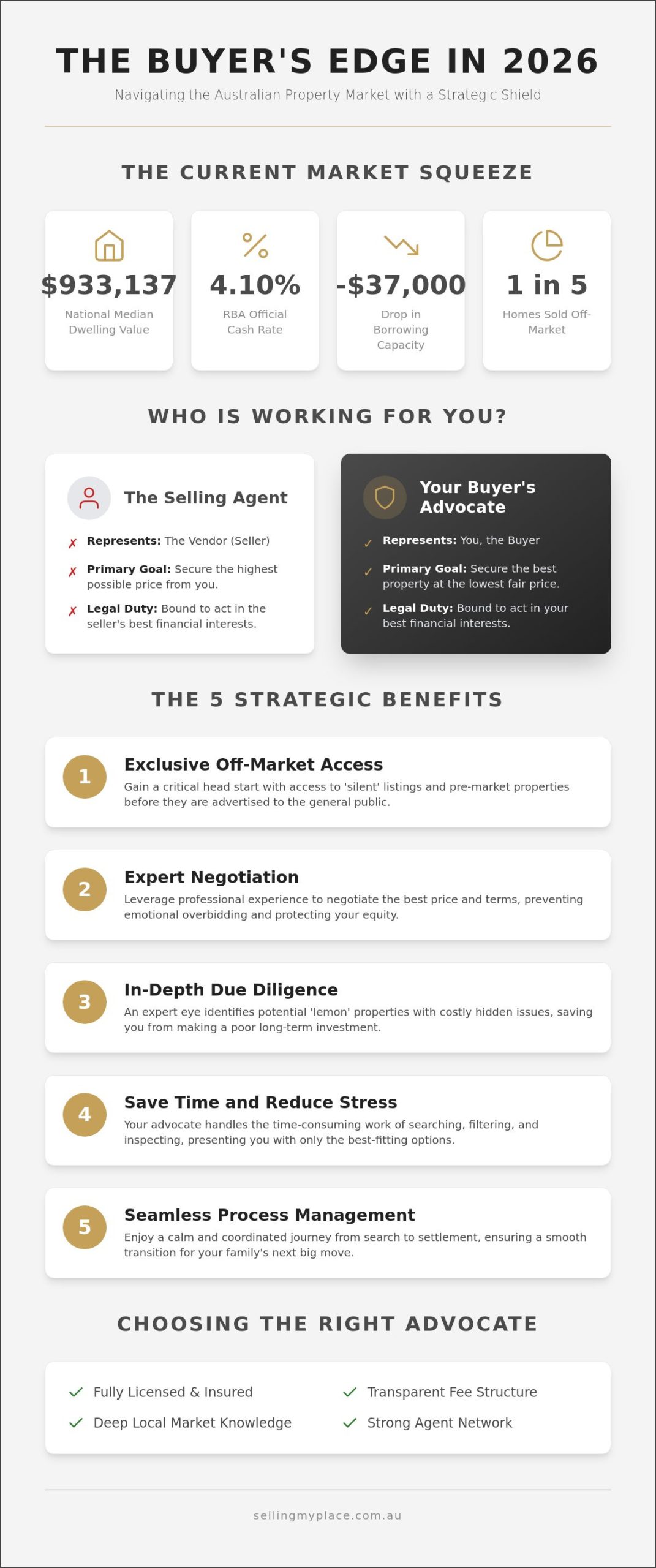
Did you know that nearly one in five Australian homes are sold before the public ever sees a ‘For Sale’ sign? In 2026, the property game isn’t just about who has the highest budget; it’s about who has the best map of the hidden market. Most people walk into an open home feeling like they’re already behind, and with the national median dwelling value sitting at $933,137, the stakes for your family’s future have never been higher. This is why more Australians are turning to professional buyer advocates to act as their steady hand and strategic shield.
It’s completely normal to feel a bit of a squeeze when the RBA cash rate is holding at 4.10% and every weekend feels like a marathon of inspecting properties that don’t quite fit the bill. You likely worry about overpaying in a competitive suburb or, worse, accidentally buying a ‘lemon’ with hidden structural issues. This guide will show you how to level the playing field, ensuring you secure a quality home at a fair price without the typical auction-day anxiety. We’ll explore the latest 2026 market trends, the power of off-market access, and how a seasoned expert protects your interests from the first search to the final settlement.
Key Takeaways
- Learn why professional buyer advocates have become a strategic necessity for navigating the competitive and fast-moving Australian property landscape of 2026.
- Discover how to gain exclusive access to ‘silent’ off-market listings, giving you a head start before a home even hits the public real estate portals.
- Understand how professional negotiation prevents emotional overbidding, protecting your hard-earned equity and saving you from costly ‘lemon’ properties.
- Identify the essential credentials and local, ‘street-by-street’ knowledge you must look for when choosing a representative to protect your interests.
- Explore how an integrated advisory service can bridge the gap between selling and buying, ensuring your family’s next big move is a seamless and calm transition.
What is a Buyer Advocate and Why are Australians Using Them?
Imagine walking into a high-stakes negotiation where the person across the table does this for a living, forty hours a week, while you only do it once every decade. That is the traditional reality of the Australian property market. A buyer advocate, often called a buyer’s agent, is a licensed real estate professional who represents your interests alone. While the selling agent is legally bound to get the highest possible price for the vendor, your advocate is there to secure the best property at the lowest price. The concept of Buyer brokerage has evolved significantly in recent years, moving from a niche service for the wealthy to a strategic necessity for everyday families. This isn’t just about convenience. It’s about ensuring a ‘fair go’ in a market where the rules of engagement are heavily weighted toward the seller. Most buyer advocates offer three primary levels of support: a comprehensive ‘top-to-bottom’ search and acquisition service, a ‘negotiation only’ package for a home you’ve already found, or simply acting as your calm, professional voice during the adrenaline-fueled environment of an auction.
The Difference Between a Selling Agent and a Buyer’s Advocate
It is a common mistake to think the friendly agent at an open home is there to help you. Legally, they have a ‘duty of care’ to the seller, meaning their primary goal is to extract every possible dollar from your pocket. Because of this inherent conflict of interest, an agent cannot legally represent both the buyer and the seller in the same transaction. A buyer advocate acts as your personal buffer. They filter out the sales spin and high-pressure tactics, allowing you to make decisions based on cold, hard data rather than the emotional pull of a well-styled lounge room. They are the steady hand that keeps the process grounded and focused on your long-term goals.
Why 2026 is the Year of the Represented Buyer
With the RBA cash rate sitting at 4.10% as of March 2026, borrowing capacity has tightened for almost everyone. A single average income earner has seen their budget drop by roughly $37,000 this year alone, according to recent market data. In this climate, there is simply no room for error. While digital property portals make it look easy to find a home, the sheer volume of data can be misleading. You need an expert to interpret those numbers and spot the difference between a genuine bargain and a ‘lemon’ hidden behind a fresh coat of paint. As of July 2026, new AUSTRAC regulations have also brought buyer advocates under stricter professional oversight, ensuring they operate with a level of transparency that matches their growing importance. A buyer advocate is your professional safeguard against emotional overspending.
The 5 Strategic Benefits of Professional Buyer Representation
Buying a home is often the most significant financial decision you will ever make. It is also one of the most emotional. While the previous section highlighted why the market feels tilted, let’s look at the specific ways buyer advocates act as your strategic equaliser. It starts with your most precious resource: time. Instead of spending every Saturday for six months criss-crossing the suburbs, an advocate handles the heavy lifting. They filter the noise, manage the ‘inbox fatigue’ that comes from endless property alerts, and present you with only the gems that actually fit your brief.
Beyond saving time, there is the vital role of due diligence. It’s easy to fall in love with a sun-drenched kitchen, but an expert eye looks for the things that could cost you tens of thousands later. They identify ‘lemons’, which are properties with structural issues, poor orientation, or problematic local developments, before you spend a cent on building and pest inspections. This proactive screening ensures you are only pursuing homes that represent a sound long-term investment for your family.
Accessing Off-Market and ‘Pre-Market’ Properties
Perhaps the greatest advantage is seeing what everyone else misses. The Real Estate Buyers Agents Association of Australia (REBAA) estimates that up to 20% of properties nationwide are sold off-market. These ‘silent’ sales happen because vendors value privacy or want to test the waters without a public campaign. Through deep-rooted local networks, advocates get the call before these homes hit the portals. If you want to understand the mechanics of this hidden world, our guide on what is an off-market property and how to find one explains how these opportunities are uncovered.
Auction Bidding and Emotional Detachment
Australian auctions are designed as high-pressure theatre. The rapid-fire calls and the crowd’s energy are carefully orchestrated to trigger emotional bidding. When you have a professional standing in your place, that theatre loses its power. A buyer advocate stays grounded, sticking strictly to a pre-determined limit based on comparable sales data, not adrenaline. Understanding the expert property sale negotiation tips used by the other side of the table can give you a significant edge when the hammer is about to fall.
Ultimately, having an expert in your corner ensures you never pay a cent more than market value. If you’re feeling overwhelmed by the search or worried about the high stakes of 2026, you might find it helpful to connect with a professional property advisor who can provide a steady hand for your next move. This partnership transforms a stressful transaction into a celebratory milestone for your family’s future.
Evaluating the Cost: Are Buyer Advocate Fees Worth It?
When you sit down to look at your budget, the idea of adding another line item for professional fees can feel daunting. It’s a valid concern. However, in the 2026 market, the question isn’t just about the cost of the service, but the cost of the mistakes you might make without it. Most buyer advocates in Australia work on either a percentage-based commission or a fixed flat-fee structure. While percentage fees are traditional, many families now prefer the transparency of a fixed fee, as it ensures the advocate’s only motivation is finding the right home, not increasing the purchase price to boost their own pay.
Think about the ‘Hidden Saving’. It is remarkably easy to over-bid by $50,000 in the heat of a negotiation or to settle for a property that requires significant remediation work down the track. Beyond the dollars, there is the immense value of your own time. If an advocate saves you five hours of research and inspections every week for three months, that is sixty hours of your life back. When you partner with a service like Kincade, you can also leverage the savings from our flat-fee selling model to essentially fund your buyer representation, creating a seamless and financially savvy transition from one home to the next.
Calculating the Return on Investment (ROI)
To truly see the value, you need to look at the ROI. This involves comparing the fee against the potential saving on the purchase price and the avoidance of high-risk properties. A professional appraisal is the cornerstone of this calculation. By understanding how to determine the market value of a home in Australia, you can see exactly where an advocate’s negotiation skills have shaved thousands off the asking price. It’s about data-led decisions rather than guesswork.
Common Misconceptions About Advocate Fees
A frequent myth is that buyer advocates are a luxury reserved for the high-end luxury market. In reality, they are often most valuable for everyday families who have the most to lose from a poor investment. Another common concern involves ‘kickbacks’. You should always ensure your advocate is completely independent and does not receive referral fees from developers or selling agencies. A flat-fee structure often provides the most transparent alignment of interests, ensuring your advocate is firmly on your side of the fence.
How to Choose the Right Advocate for Your Property Journey
Selecting the person who will guide your family toward its next home is a decision that deserves more than a cursory glance at a website. It is about finding a partnership built on trust and a shared vision for your future. In the Australian market, the first non-negotiable step is verifying that your representative holds a full real estate licence and maintains membership in professional bodies like the Real Estate Institute of Australia (REIA). While some digital platforms offer generic data, true buyer advocates possess deep, ‘street-by-street’ knowledge of your target suburbs. They should be able to tell you which pockets are prone to afternoon traffic noise and which side of a particular street holds its value better during a market dip. This level of local nuance is what separates a transactional service from a genuine advisory partnership.
We always suggest interviewing at least three different advocates before making your choice. This isn’t just about comparing fee structures; it is about finding a ‘steady hand’ whose personality meshes with your own. You need someone who prioritises your family’s long-term stability over the convenience of a quick transaction. A quality advocate is often the one who tells you to walk away from a property because it doesn’t meet your long-term needs, even if it means their search continues for another month. They act as your calm, professional shield in a process that can otherwise feel quite overwhelming.
Essential Questions to Ask During Your Consultation
During your initial consultation, move beyond the pleasantries and ask for specific operational details. How exactly do they access off-market properties? Is it through a genuine, decades-old network of local agents, or are they simply relying on the same email alerts as everyone else? In the 2026 climate, where auction dynamics can be unpredictable, ask for their specific strategy for bidding when competition is high. Finally, request recent case studies of purchases similar to your own brief. Seeing how they have navigated budgets and requirements like yours provides a clear window into their practical competence and negotiation style.
Vetting for Independence and Integrity
The most vital question you must ask is: ‘Do you receive any commissions or rebates from third parties?’ Absolute independence is the bedrock of professional advocacy. You must ensure they are not also acting as a selling agent for any properties they recommend, as this creates an immediate and legal conflict of interest. A partnership approach, much like our own philosophy at Kincade, focuses on your family’s legacy and community roots rather than a quick result. If you would like to experience this level of dedicated support for your next move, you can connect with our property advisory team to discuss how we can help you buy better.
The Kincade Advantage: Bridging the Gap Between Selling and Buying
A property journey isn’t just a set of two separate transactions; it is the closing of one chapter and the hopeful beginning of another. At Kincade International Direct Sales (KIDS), we view this transition through a lens of partnership and empathy. Most Australians find themselves caught in a stressful middle ground, trying to coordinate a sale while simultaneously hunting for their next home. We bridge this gap by acting as your seasoned guide for the entire process. Our Agent Advisory Service provides the same level of expert backing for purchasers as we do for our commission-free sellers. This ensures that the “steady hand” you relied on to sell your previous home is the same one helping you navigate the complexities of buyer advocates and the search for your next legacy property.
Our “Direct Sales” philosophy is built on empowerment. We provide you with the professional tools typically reserved for high-commission agencies, including professional photography, detailed floorplans, and comprehensive neighborhood market reports. This data-driven approach allows you to step into the market with a level of confidence that few unrepresented buyers ever achieve. Because Kincade maintains a broad national presence, we offer a perspective that goes beyond a single suburb. We understand how divergent market trends across the country can impact your local decisions, providing a birds-eye view that local-only agents simply cannot match.
A Holistic Approach to Your Property Legacy
The financial logic of our model is simple yet powerful. When you choose to sell commission-free with KIDS, you often save tens of thousands of dollars that would otherwise go toward agency fees. This retained equity can then be used to “fund” your professional buyer representation, essentially allowing the sale of your home to pay for the expert who secures your next one. This holistic approach reduces the financial friction of moving and provides immense peace of mind. Beyond the search, we offer dedicated support for conveyance advice and pre-sale consulting, ensuring every legal and strategic detail is handled with the seriousness it deserves. We invite you to view your next move not as a hurdle, but as a seamless and celebratory journey.
Next Steps: Embarking on Your Purchase with Confidence
Success in the 2026 property market requires more than just a deposit; it requires a team. Before you attend your next open home or scroll through another listing portal, it is vital to have your “team” ready. This includes your advocate, your conveyancer, and your real estate advisor. Getting started is as simple as a conversation. During a Kincade advisory session, we can help you map out your goals, assess the current market landscape, and determine the best strategy for your specific family needs. You don’t have to do this alone. Discover how Kincade’s expert advisory services can secure your next property and help you move forward with the calm confidence you deserve.
Your Future Home is Within Reach
The Australian property landscape of 2026 demands a new approach to buying. By now, you understand how the right representation can unlock off-market gems and protect your family from the emotional pitfalls of auction day. Choosing to work with professional buyer advocates isn’t just about finding a house; it’s about securing a sound financial foundation for your future. Whether you’re searching for your first home or your forever sanctuary, the peace of mind that comes from expert negotiation is invaluable.
When you pair our national expertise and global reach with a commission-free sale, you keep your hard-earned equity exactly where it belongs: in your pocket. Our clients save an average of $20,000 on commissions, providing the perfect launchpad for their next purchase. With our Expert Agent Advisory Service by your side, you can move forward with the calm confidence of a seasoned pro. Partner with Kincade for a smarter, commission-free property journey and let us help you turn the key to your next chapter. Your dream home is out there, and with the right team, you’ll find it sooner than you think.
Frequently Asked Questions
What is the typical fee for a buyer advocate in Australia?
In the Australian market, you will generally find two main fee structures: a percentage of the final purchase price or a fixed flat fee. These costs reflect the level of service provided, whether it is a full search or just auction bidding, and often vary between capital cities like Sydney and Perth. It is always best to ask for a clear breakdown during your initial consultation to ensure the structure aligns with your budget and provides the transparency you need.
Can a buyer advocate help me if I am buying in a different state?
Yes, they are often essential for interstate buyers who cannot physically attend every open home. An advocate acts as your “boots on the ground,” performing thorough inspections and providing objective feedback on the property and its location. They also help you navigate state-specific contract nuances, ensuring you feel as confident as a local throughout the entire process.
Do buyer advocates only work for property investors?
Not at all. While investors certainly value the data-driven approach, many families use buyer advocates to find their forever homes and manage the emotional stress of the search. Having a professional in your corner is just as important for a family home purchase as it is for an investment, as it protects your long-term equity and ensures you don’t overpay in a competitive market.
What happens if the buyer advocate finds a property I already saw online?
Their value remains significant even if you spotted the listing first. The advocate’s role shifts to professional evaluation and negotiation, where they perform a deep-dive appraisal to determine the home’s true market value. They will identify any potential “lemons” and handle the high-pressure bidding to ensure you secure the property at the best possible price, regardless of where the search began.
How does a buyer advocate get access to off-market listings?
Access to the “silent market” comes through deep-rooted, professional relationships with local real estate agents. Many vendors prefer to sell quietly to avoid public open homes or high marketing campaigns. Agents will often contact reputable buyer advocates first to see if they have a qualified client ready to buy, often resulting in a successful sale before the property is ever advertised to the general public.
Is a buyer advocate the same as a mortgage broker?
No, they perform very different roles in your property team. A mortgage broker focuses on your finance, helping you organise the right loan structure and securing your pre-approval. A buyer advocate focuses on the asset itself, handling the search, the due diligence, and the final price negotiation to ensure you buy the right property under the right conditions.
Can a buyer advocate help with the building and pest inspection process?
Yes, they typically coordinate the entire inspection process on your behalf. They work with trusted, independent inspectors to ensure the report is thorough and then sit down with you to explain what the findings mean in plain English. If issues are uncovered, your advocate can use that information as leverage to negotiate a price reduction or advise you to walk away if the risks are too high.
