Free Online Property Valuation: How Accurate Are They in 2026?
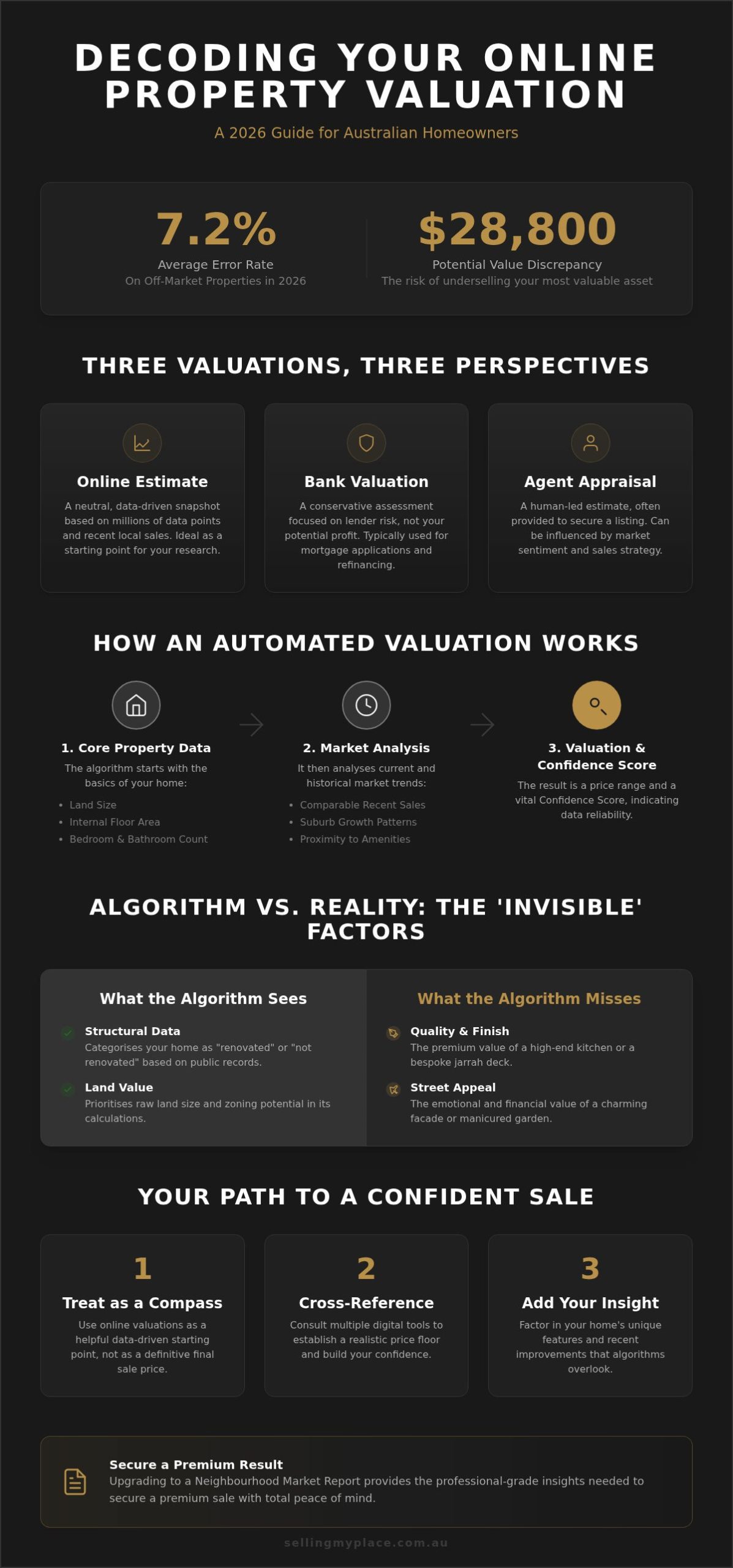
What if the number you just saw on a free online property valuation is actually $28,800 away from your home’s true worth? It’s a common scenario in 2026, where a 7.2% error rate on off-market properties can lead to significant confusion and the very real fear of underselling your most valuable asset. We understand the anxiety that comes with conflicting estimates; it’s hard to feel confident about your future when the digital data seems to change depending on which website you’re visiting.
You deserve to move forward with total clarity and a sense of calm. This guide will help you discover the truth behind automated property estimates and show you how to use that digital data to secure the best possible sale price for your Australian home. We’ll explore the latest 2026 accuracy benchmarks, explain why on-market data is more reliable than off-market guesses, and provide you with the tools to establish a realistic price range. By the end, you’ll have the confidence to manage your own sale and keep your hard-earned equity where it belongs.
Key Takeaways
- Learn how to treat a free online property valuation as a helpful data-driven compass rather than a definitive final sale price.
- Discover the specific “invisible factors” that algorithms often overlook, ensuring you don’t undervalue your home’s unique features or recent improvements.
- Master the technique of cross-referencing multiple digital tools to establish a realistic price floor and gain the confidence to lead your own sale journey.
- Understand how accurate market data allows you to sidestep traditional agent commissions and protect your family’s hard-earned equity.
- Explore how upgrading to a Neighborhood Market Report provides the professional-grade insights needed to secure a premium result with total peace of mind.
What is a Free Online Property Valuation?
When you’re standing in your kitchen, perhaps enjoying a morning flat white and thinking about the next chapter of your life, a free online property valuation is often the very first place your journey begins. It’s a digital starting line that offers a glimpse into your home’s potential without needing to tidy up for an unannounced visitor. While it feels like a simple search result, you’re actually interacting with a complex Automated Valuation Model (AVM). An AVM is a statistical tool that processes millions of data points to predict market value with mathematical precision.
It’s helpful to distinguish these estimates from other figures you might encounter. A bank valuation is typically conservative, focused on lender risk rather than your profit. A real estate appraisal is a human-led estimate, often influenced by the desire to secure a listing. An online estimate, however, acts as a neutral data-driven snapshot based on recent local sales and your property’s core characteristics. It provides a grounded starting point, helping you move from uncertainty toward a structured plan for your lifestyle transition.
The Role of Big Data in Australian Real Estate
Algorithms don’t just look at what happened yesterday; they analyse a decade of historical sales to identify long-term patterns in your suburb. In the Australian market, “Comparable Sales” (or “Comps”) are the lifeblood of these systems. The computer identifies properties similar to yours in land size, internal floor area, and bedroom count that have recently changed hands nearby. By weighing these “comps” against current market velocity, the algorithm calculates a price range. It’s a purely mathematical approach to a very personal asset, stripping away the noise to look at the cold, hard numbers.
Why Sellers Start with Online Estimates
The primary appeal of a free online property valuation is the lack of pressure. You can explore your options privately, without the intensity of a formal listing presentation or the feeling that you’re being pushed into a quick sale. Many homeowners use these tools to assess their equity, which is a vital step when deciding if you’re ready for a sea change or an investment upgrade. It’s about finding an objective figure to balance the deep emotional attachment we all have to our family homes. Having a realistic number in hand provides a sense of calm, allowing you to visualise your future state with confidence rather than guesswork.
The Science Behind the Screen: How Estimates are Calculated
Peering behind the digital curtain reveals a sophisticated engine room of data. When you request a free online property valuation, the algorithm begins by pulling the structural basics of your home: land size, internal floor area, and the all-important bedroom and bathroom count. These are the fixed variables, but the real intelligence lies in how the software weights recency. In our fast-moving 2026 market, a sale that settled yesterday carries significantly more weight than a similar property sold six months ago. This is because algorithms are programmed to track suburb-wide growth trends and “days on market” averages in real-time to sense the current heat of the local area.
However, these systems have a distinct blind spot. They see the box, but they don’t always see the beauty. While these models are highly advanced, research from the Brookings Institution highlights that automated systems can sometimes miss the mark when local nuances or unique architectural features aren’t perfectly captured in the raw data. If your home boasts a bespoke jarrah deck or a high-end kitchen renovation, the algorithm might categorise you simply as “renovated” without understanding the premium quality of the materials used.
Weighting Factors in the Algorithm
Software quantifies location proximity with ruthless efficiency. It measures the exact distance to amenities like train stations, parks, and schools, assigning a mathematical value to convenience. There’s often a tug-of-war between “Street Appeal” and “Land Value” in these calculations. While we might fall in love with a charming facade, the algorithm often prioritises the raw land size and zoning potential. Many tools now provide a “Confidence Score” alongside the estimate. This score is actually more important than the price itself; it tells you how much comparable data is available. A low score suggests the algorithm is guessing, while a high score means it has plenty of recent evidence to back its claim.
Data Sources: Where the Information Comes From
Most free online property valuation tools draw their power from government land registries and historical listing portals. This provides a solid foundation, but it’s not always instantaneous. There is often a lag time of several weeks between a sale occurring at auction and the official settlement data being processed by the state registry. To bridge this gap, some models incorporate user-submitted data. If you’ve recently updated your home, you can often “claim” your property on these portals to update the facts. If you’re feeling unsure about how your home’s specific upgrades are being weighed by the data, reaching out for a friendly chat can help provide the clarity you need to move forward.
Algorithm vs. Reality: Why Online Estimates Can Miss the Mark
While a free online property valuation provides a helpful ballpark, it fundamentally lacks the human eye required to judge quality. Algorithms are excellent at counting bricks and measuring land, but they’re terrible at feeling the atmosphere of a home. An Urban Institute study highlights how data-driven models can struggle with qualitative nuances, sometimes reinforcing local disparities because they cannot account for the tangible love and care poured into a property. We know your home is more than just a set of coordinates on a map; it’s a collection of memories and carefully chosen finishes that a computer simply cannot process.
Then there’s the “Outlier Effect.” If a neighbour sells their home in a desperate hurry, or if two emotional buyers get into a bidding war over a specific view, that single data point can skew the entire suburb average. A computer sees the price tag but doesn’t know the story behind it. Relying solely on a screen when setting your reserve price is a risky move. It doesn’t account for current buyer heat or the specific market sentiment on auction day. Without that human context, you might find yourself anchored to a number that doesn’t reflect the true competitive nature of the local market.
The Five Things an Algorithm Cannot See
The software often misses the sensory details that drive a buyer’s heart and ultimately their budget. These invisible factors often dictate whether a home sells for a standard price or a suburb record. They include:
- The specific orientation of the home and how natural light floods the living areas during a winter afternoon.
- Nuisance factors such as proximity to main roads or power lines which can dampen an otherwise strong valuation.
- The “wow factor” of high-end internal finishes and the quality of a professional renovation.
- The psychological pull created by expert Photography in attracting premium buyers to your listing.
- The functional flow and spatial clarity provided by accurate floorplans.
When Online Valuations are Most (and Least) Accurate
Accuracy is usually highest in “cookie-cutter” estates where every house is similar in age and style. In these areas, the algorithm has plenty of identical data points to work with. However, accuracy drops significantly for unique heritage homes or properties in rural areas with low transaction volumes. If the data is thin, the algorithm might “hallucinate,” generating a number that has completely lost touch with the ground reality. Recognising when the data is unreliable is the first step in protecting your equity and ensuring you don’t leave money on the table during your sale.
Using Your Valuation to Maximise Your Sale Price
Once you’ve received your free online property valuation, the real strategy begins. It’s helpful to view this number as your “floor” rather than your “ceiling.” It represents the minimum value the market expects based on raw data, but your goal is to build upon that foundation through smart presentation and timing. By cross-referencing estimates from three or four different digital tools, you can find a reliable median that filters out any single algorithm’s quirks. This balanced approach is a core part of how to determine the market value of a home in Australia, blending digital efficiency with a sensible reality check.
When you’re ready to list, consider whether a “Price Guide” or a “Fixed Price” better suits your suburb’s current energy. A guide often invites more conversation and competition, while a fixed price offers clarity for buyers who want to move quickly. The choice often depends on how much “buyer heat” is currently present in your specific street.
Bridging the Gap with a Neighborhood Market Report
A basic web search only tells you what has happened in the past. A Neighborhood Market Report acts as the “pro version” of a free online property valuation, telling you what is happening right now. It allows you to look closely at active competitor listings to see exactly what features buyers are prioritising this week. By identifying these “sweet spots” where demand is high but supply is low, you can position your home to stand out as the obvious choice for a premium buyer.
Pre-Sale Consulting: The Human Advantage
Data can’t tell you that a $500 tin of paint and a weekend of garden mulching might add $5,000 to your final result. Our Pre-Sale Property Consulting focuses on these high-return minor repairs that often yield a 10x return on investment. De-cluttering and staging also play a huge role in the psychological “buy-in” for visitors, making the space feel like their future home rather than someone else’s history. Professional advice transforms a static data point into a dynamic, profitable sale strategy.
Ready to see how your digital data stacks up against a professional sale strategy? Get in touch with our team today to start your commission-free journey with confidence.
The KIDS Approach: From Valuation to Commission-Free Success
Most websites treat a free online property valuation as a digital hook, designed to reel you in and hand you over to a traditional real estate agent. These agents then ask for a 2-3% commission, which can feel like a heavy price to pay for a service you’re increasingly equipped to handle yourself. We believe that once you have the data, you have the power. By choosing Residential Property Listing Services, you’re opting for a modern, commission-free alternative that puts you back in the driver’s seat of your own sale. It’s a partnership where we provide the tools and you keep the reward.
On average, our clients save $20,000 in commissions. That’s a significant sum that stays in your pocket, perhaps to fund your next deposit or simply to secure your family’s future. We also remove the ticking clock often associated with real estate listings. Our “Listed Until Sold” promise means you can test the market and wait for the right buyer without the stress of expiring contracts or mounting marketing fees. It’s a calmer, more methodical way to achieve a premium result. You shouldn’t feel rushed when making such a major life transition.
Keeping Your Equity Safe
The maths of a sale by owner is refreshingly simple: 0% commission equals 100% of the profit for you. While the idea of managing your own sale might seem daunting at first, you aren’t doing it alone. You’ll have access to professional advisory services to help you navigate the legalities, including essential Conveyance Advice to ensure the settlement process is smooth and secure. There’s a deep sense of peace that comes from being in total control of your financial legacy. You know your home better than anyone, so why not be the one to tell its story? It’s about protecting your equity and your family’s future with a steady hand.
Taking the Next Step
If you’ve spent time researching your free online property valuation and feel ready for something more substantial, it’s time to request a Neighborhood Market Report. This report moves you beyond the “just curious” phase and makes you truly market-ready. It provides the granular, local insights that algorithms often miss, giving you the professional edge needed to negotiate with confidence. We’re here to act as your seasoned guides, helping you translate data into a successful sale. Don’t just settle for a generic online number. Take the lead, secure your profit, and start your next chapter with the financial freedom you deserve.
Take Control of Your Next Chapter
Your home is likely your greatest financial asset, and moving on to your next adventure should be a time of excitement rather than anxiety. While a free online property valuation provides a useful digital compass, it’s the refined strategy and local expertise that ultimately lead you home. By combining the latest market data with professional pre-sale consulting, you ensure that no dollar of your hard-earned equity is left on the table. You’ve worked hard for your home; you deserve to keep the reward.
Choosing a commission-free path doesn’t mean going it alone. With our global marketing network and Expert Agent Advisory included in every package, you have a steady hand guiding you through every step of the process. Owners who partner with us save an average of $20,000 in commissions; money that belongs in your pocket for your future. It’s about more than just a sale; it’s about honouring your legacy and transitioning with total peace of mind. Are you ready to see what’s truly possible for your property?
Secure your equity and sell commission-free with Kincade International Direct Sales today and move forward with the confidence you deserve.
Frequently Asked Questions
How accurate are free online property valuations in Australia?
Accuracy depends on whether your home is currently listed. For properties on the market in 2026, the median error rate is often under 2%. However, for off-market homes, the discrepancy can climb significantly higher. These tools rely on “comparable sales” and public data, meaning they work best in suburbs with high turnover and many similar houses. In rural areas or for unique builds, the accuracy naturally starts to drop.
Why is there such a big difference between different online estimates?
Discrepancies exist because every platform uses a unique algorithm that weights data points differently. One website might prioritise government land registry data, while another focuses more on recent listing prices from real estate portals. These varied “recipes” for calculation mean you’ll often see a range of prices. It’s best to look at multiple sources to find a realistic median for your home’s potential value.
Can a bank valuation be lower than an online property estimate?
It’s very common for a bank valuation to come in lower than a digital estimate. This happens because banks are focused on risk mitigation rather than achieving a premium sale price. They want to know what the property would sell for in a forced sale scenario. An online estimate, by contrast, is trying to predict what a motivated buyer might pay in an open, competitive market.
How do I update the information used in my online property valuation?
You can usually update your property’s details by “claiming” the home on the specific website providing the estimate. This allows you to correct the number of bedrooms or bathrooms and add details about recent renovations. Updating these facts helps the free online property valuation tool refine its calculation. It ensures the algorithm isn’t working with outdated information from ten years ago when you first bought the place.
Do I still need a professional appraisal if I have an online estimate?
Yes, you should still seek expert advice before making a final decision on your sale price. An online tool can’t see the quality of your new stone benchtops or feel the natural light in your living room. A professional appraisal provides the human context that data misses. It helps you understand the “buyer heat” in your street and how to position your home for a premium result.
Will a free online valuation affect my credit score?
No, checking your property’s estimated value online will not affect your credit score in any way. These searches are considered “soft” enquiries that don’t involve a credit application. You can check as many different sites as you like without worrying about your financial standing. Only “hard” enquiries, which happen when a lender reviews your credit file for a loan, will show up on your report.
How often should I check my property value estimate?
Checking your estimate once every three months is usually enough to keep an eye on your equity. Property is a long-term asset, so watching the numbers too closely can be stressful. Suburb trends often take months to show up clearly in the data. A quarterly check-in gives you a grounded view of how your local market is performing without getting caught up in minor weekly fluctuations.
What is the best way to get a formal property valuation for a sale?
The most effective way to get a formal, actionable valuation for a sale is to request a Neighborhood Market Report. This provides a much deeper level of insight than a basic free online property valuation. It combines digital data with a detailed analysis of active competitors in your area. This professional approach gives you the confidence to manage your own sale and keep your hard-earned equity for yourself.
Free Online Property Valuation: Myth vs. Reality for Australian Sellers
What if that glowing number on your smartphone screen is actually the reason you miss out on a life-changing sum of money? It is a common dilemma for many Australian families today. You want a quick answer, so you jump onto a site for a free online property valuation, only to find three different platforms giving you three vastly different figures. It is enough to make anyone feel a bit unsettled, especially when you are trying to plan your next big move while the RBA cash rate remains at 4.35%.
We know that the fear of underselling is heavy, and the thought of high agent commissions eating into your hard-earned profit only adds to the pressure. You deserve a price range that feels grounded in reality, not just an algorithm’s best guess. In this guide, we will show you how to use these digital estimates as a helpful conversation starter rather than the final word. You will learn how to decode the data to find a realistic price range and see why expert-backed insights are the secret to saving A$20,000 in commissions. We are going to give you the confidence to sell on your own terms, with a clear understanding of the “why” behind your home’s true value.
Key Takeaways
- Understand how a free online property valuation uses automated algorithms to pull data, and why it is just the start of your pricing journey.
- Discover why digital estimates often miss the mark by failing to account for your home’s unique features, like that stunning new kitchen or solar system.
- Learn how to bridge the “accuracy gap” using professional Neighborhood Market Reports that combine deep suburb analytics with real-time data.
- Master a simple two-step process to price your home accurately for a successful sale without needing a traditional commission-based agent.
- Find out how a flat-fee model can protect your equity, potentially keeping an extra A$20,000 in your pocket when you settle.
What is a Free Online Property Valuation and How Does it Work?
It is 9:00 PM on a Tuesday, and you are sitting on the sofa, curious about what your biggest asset might be worth in the current market. Within seconds of typing your address into a search bar, a digital number appears. This is the convenience of a free online property valuation, a tool that has become the first port of call for thousands of Australian homeowners. While it feels like a personalised calculation, it is actually powered by an Automated Valuation Model, or AVM.
Think of an AVM as a very fast, data-hungry mathematician. It does not walk through your front door or admire your garden; instead, it crunches massive amounts of information from public records, recent sales in your street, and broader suburb trends. It is important to clarify a legal distinction here: what you see on a screen is technically an “estimate” or a “market appraisal.” To understand the deeper principles of how professional assessments differ from these digital guesses, it helps to ask, What is property valuation? In a formal sense, a true valuation is a legally binding document prepared by a qualified professional, often for a bank or a court. Online tools are simply a helpful ballpark figure to get your head around the possibilities without the pressure of a knock on the door.
The Data Behind the Screen
Major property portals and Australian banks do not just guess these numbers. They pay for access to massive databases that track every “sold” sticker in the country. They look at the median price points of your suburb and the specific growth rates over the last quarter. However, there is a catch. The algorithm sees that your neighbour’s house sold for a lower price last month, but it does not know that house was a “renovator’s delight” with a leaking roof. If your home is a “modern masterpiece” with high-end finishes, the online tool might accidentally drag your estimate down based on the poor condition of the house next door.
Why Banks and Portals Offer These for Free
You might wonder why these large companies provide this service at no cost. The reality is that your interest is the currency. By providing a free online property valuation, portals and banks can identify who is thinking about selling or refinancing. It is a sophisticated form of lead generation that helps them offer you a mortgage or connect you with a commission-based agent. Additionally, a bank’s estimate is often quite conservative. They are looking at your home through the lens of risk, ensuring they do not lend more than the property is worth. This figure is frequently lower than the actual “selling” price you could achieve with the right marketing and a bit of heart.
The Accuracy Gap: Why Online Estimates Often Miss the Mark
Have you ever noticed that a free online property valuation often gives you a range so wide you could drive a road train through it? It is not uncommon to see a gap of A$200,000 or more between the “low” and “high” estimates. This happens because algorithms are excellent at math but terrible at nuance. They rely on historical data that is often six to twelve weeks old. In a fast-moving market where the RBA cash rate or new government grants are shifting buyer demand by the week, relying on three-month-old “sold” data is like trying to drive while looking only in the rearview mirror.
Then there is the issue of “outlier” sales. If a neighbour down the street had to sell urgently due to a personal crisis, that lower price point gets sucked into the database. The computer does not know it was a distressed sale; it simply sees a three-bedroom house in your postcode selling for less, which then drags your estimate down. It also cannot distinguish between the peace of a quiet, leafy cul-de-sac and a house three doors down that sits right on a noisy main road or directly under a flight path. These local details matter immensely to your final result.
The “Ghost in the Machine”: What AVMs Can’t See
A computer program has never walked across your polished spotted gum floorboards or felt the quality of your new Caesarstone benchtops. It does not know you have invested in a high-spec solar system or a council-approved granny flat that could fetch a premium. These “invisible” assets are often where the real value lies. Unique features like a heritage facade or a North-facing backyard that captures the winter sun are the emotional triggers that drive up prices, yet they remain invisible to a standard algorithm. If you want to see how your home’s specific features stack up against others, exploring real estate advisory services can provide the clarity a machine simply cannot.
Market Sentiment vs. Historical Data
Real estate is as much about psychology as it is about bricks and mortar. While portals focus on “settled” sales, the most accurate price indicators are often the “active” listings and the number of people attending open homes this weekend. Market Sentiment is the emotional pulse of buyers at a specific moment. A computer cannot feel the energy of a “hot” market where three buyers are fighting over one property. It only sees the final number months after the emotional dust has settled. This lag is why your “on the ground” reality might be far more lucrative than a free online property valuation suggests.
Online Estimates vs. Neighborhood Market Reports
While a free online property valuation is a fantastic starting point for your research, it is essentially a snapshot taken from a distance. It gives you a general idea of where you stand, but when you are preparing to list your family home, a snapshot isn’t enough. You need a high-definition map. This is where a professional Neighborhood Market Report changes the game. Unlike an instant algorithm, these reports are built to bridge the gap between raw data and a winning selling strategy. They don’t just tell you what happened three months ago; they tell you what is happening right now in your specific street.
At Kincade International Direct Sales (KIDS), our reports are designed to be a protective shield for your equity. We take the “raw data” that everyone else sees and add a layer of strategic insight. This means looking at your home through the eyes of a buyer. We don’t just provide a number; we provide a narrative that explains your property’s unique position in the local landscape. It is the difference between having a rough guess and having a professional “selling” document that commands respect from potential buyers.
What a Professional Report Includes
A truly comprehensive report goes far beyond a simple median price graph. It provides a detailed comparison of properties currently for sale, which are your direct competition for buyer attention this weekend. We look at historical growth patterns and, crucially, any future suburb infrastructure plans that might boost your property’s appeal. If the local council has just approved a new parkland or transport hub nearby, that adds tangible value that an algorithm simply misses. Additionally, we include accurate floorplans and professional photography to define the true scale and lifestyle potential of your home, ensuring that every square metre is accounted for.
The Value of Human Interpretation
Data is powerful, but it can also be overwhelming without a guide. A report is just paper until an expert advisor sits down with you to review what the numbers actually mean for your specific situation. This is the “steady hand” approach we pride ourselves on. Having a professional interpret the analytics gives you the ammunition you need to justify your asking price to potential buyers. When you can point to hard evidence of local trends and infrastructure, you gain the confidence to stand firm on your price during a commission-free sale. It is about turning information into empowerment. You can Learn more about our Neighborhood Market Reports to see how we help you move from a guess to a certainty.

How to Price Your Home for a Commission-Free Sale
Pricing your home is one of the most significant decisions you will make for your family’s future. It is not just about a number; it is about protecting the equity you have built over years of hard work. To get this right, you need to move beyond a single free online property valuation and become a temporary expert in your own backyard. If you are considering taking the reins yourself, understanding how to price your home for sale by owner with a data-driven approach is the critical foundation for protecting your family’s equity. We recommend a methodical five-step approach to find your “sweet spot.”
- Step 1: Gather at least three different online estimates to find a broad baseline range for your suburb.
- Step 2: Spend a Saturday morning attending three local “Open for Inspections” to see your competition in the flesh and compare their finishes to yours.
- Step 3: Use the “Add-Back” method to factor in your unique upgrades, like that high-spec kitchen or the council-approved deck.
- Step 4: Consult a professional for Pre-Sale Property Consulting to finalise your strategy with an objective eye.
- Step 5: Set a listing price that is competitive enough to invite multiple offers without leaving a cent on the table.
Be the Local Expert
Success in a private sale comes down to knowing the numbers better than the buyers do. Tracking “Days on Market” for your specific postcode is vital; it tells you exactly how fast the current pulse is moving. When you see “Price Withheld” on a recent sale, don’t worry. You can usually find the actual figure in the “Sold” section of major portals once the settlement period ends, or by asking an advisor who has access to the latest data. Aiming too high at the start often causes your listing to go stale, ultimately forcing a price drop that makes buyers wonder what is wrong with the property.
Using Data to Negotiate
When a buyer tries to “low-ball” you, it can feel like a personal affront to your home’s history. Stay grounded. This is where your Neighborhood Market Report becomes your best friend. By showing a buyer the hard evidence of similar sales and suburb growth, you move the conversation from emotion to logic. It is much harder for a buyer to argue with a free online property valuation when it is backed up by professional photography and detailed floorplans that prove your home’s true scale. Having these assets ready shows you are serious, prepared, and fully aware of your property’s worth in the current Australian market.
Maximise Your Profit with KIDS: Beyond the Valuation
A free online property valuation is a useful spark for your imagination, but it doesn’t provide the fuel needed to reach your financial destination. Once you have a sense of the numbers, the real work begins. At Kincade International Direct Sales (KIDS), we act as your seasoned partner, ensuring you don’t just find a buyer, but that you secure the best possible result for your family. We believe your home’s legacy belongs to you, not an agency’s bottom line. By moving away from the traditional model, you can keep your hard-earned equity exactly where it belongs: in your bank account.
The traditional agency commission model often feels like an invisible tax on your success. In many Australian suburbs, a standard commission can easily reach A$20,000 or more. That is money that could pay for your next move, a well-deserved holiday, or your children’s education. Before committing to any selling arrangement, it is worth reviewing a detailed flat fee vs commission real estate Australia comparison checklist so you can see exactly where your money goes under each model. With our Agency Flat Fee approach, that era of high costs is a thing of the past. We provide a Real Estate Advisory Service that acts as your secret weapon, offering professional guidance on strategy and conveyance advice without the predatory price tag. You get the expertise of a seasoned professional without the heavy financial burden.
Professional Tools, Personal Control
Selling your own home doesn’t mean you have to do it alone or settle for amateur results. Our flat-fee packages include high-end professional photography and detailed floorplans, ensuring your property stands out against the competition on every major portal. You maintain total control over the process, with the peace of mind that your home is “listed until sold.” There are no arbitrary time limits or high-pressure tactics to lower your price just to get a quick result for an agent. We also provide guidance through the legal journey with a steady, experienced hand, making the complex feel simple and safe. Our global marketing network further ensures that your place is seen by the right buyers, no matter where they are searching from.
Taking the Next Step
While a digital estimate is a great first step, it is merely the beginning of your A$20,000 saving journey. Transitioning from a free online property valuation to a successful sale requires more than just a ballpark figure; it requires a strategy. We invite you to have a heartfelt, no-obligation consultation with one of our seasoned experts to discuss your aspirations and your home’s unique story. It is time to move beyond the algorithm and start your selling journey with confidence and clarity. Get your professional Neighborhood Market Report and start selling smarter today.
Step Into Your Next Chapter with Confidence
Your home is more than just a set of coordinates on a map; it is the backdrop to your family’s history and the foundation of your future. While a free online property valuation provides a helpful ballpark figure to spark your interest, it cannot capture the heart of your property or the true value of your recent renovations. As we have explored, the real secret to a successful sale lies in combining that raw data with professional insight and a clear, commission-free strategy.
You deserve to keep your hard-earned equity. By choosing a smarter path, you can save an average of A$20,000 in commissions while still benefiting from an expert Agent Advisory Service. We ensure your home shines with professional photography and floorplans as standard, giving you the tools of a top-tier agency without the high costs. It is about having a steady hand to guide you through the complex legal and marketing steps, so you can focus on your next move. Empower your sale with a professional Neighborhood Market Report. You have worked hard for your home, and we are here to help you protect its value with warmth, honesty, and professional care.
Frequently Asked Questions
How accurate are free online property valuations in Australia?
Accuracy is a spectrum that depends heavily on your location and property type. In suburbs with high turnover and many similar homes, a free online property valuation is often quite close to the mark. However, for unique properties or those in areas with fewer sales, the margin for error increases. These tools rely on historical data, which means they can lag behind the real-time impact of the current 4.35% cash rate or sudden shifts in buyer demand.
Will an online valuation be the same as a bank appraisal?
No, they often tell different stories because they serve different masters. A bank’s assessment is typically more conservative because it is designed to protect the lender from risk. Online portals, on the other hand, aim to provide a “market” range to help you start your selling journey. For a definitive figure, a bank will often require a physical inspection by a certified valuer to verify the home’s condition and unique features in person.
Can I use an online property estimate to set my asking price?
Using an online estimate as your sole pricing strategy is a risky move. It provides a helpful baseline, but it doesn’t account for the “active” competition you will face at open homes this weekend. To set a price that invites competition without underselling, you need to combine digital data with a physical inspection of similar properties and a deep dive into the current emotional pulse of local buyers.
Do online valuations take renovations into account?
Algorithms are unfortunately blind to your beautiful new Caesarstone benchtops or that fresh coat of neutral paint. Most online tools only see the “bones” of the property found in public records, such as land size and the number of bedrooms. This is why your home may be worth significantly more than the computer suggests, especially if you have invested in high-quality internal upgrades, solar systems, or council-approved extensions.
Why is there such a big difference between different online valuation tools?
Variations occur because every platform uses a different proprietary algorithm and varying data sources. Some portals may have more recent “sold” data from their own listings, while others rely on government records that can take up to twelve weeks to update. This is why we recommend gathering a few different estimates to find a realistic “middle ground” before seeking professional advice to narrow the range and find your true “sweet spot.”
How often should I check my home’s online property value?
Checking your property’s value every three to six months is usually sufficient for most Australian homeowners. However, if the market is moving rapidly or if there have been significant changes to local infrastructure, a quarterly check-in helps you stay informed. It is a bit like tending to a garden; you don’t need to watch it every day, but regular attention ensures you are ready when the time comes to move on.
What is the difference between a valuation and a market report?
A formal valuation is a legally binding document often required for bank loans, whereas a Neighborhood Market Report is a strategic selling guide. Our reports bridge the gap by providing floorplans, professional photography, and deep suburb analytics that help you justify your price to potential buyers. It is about moving from a digital guess to a professional strategy that protects your hard-earned equity during a commission-free sale.
How can I increase my property’s value before selling?
You can boost your property’s appeal without spending a fortune on major construction. Simple cosmetic updates like tidy gardens, fresh paint, and professional photography that captures the lifestyle of the home make a massive difference. Providing clear floorplans is also vital; it ensures buyers understand the true scale of your home before they even walk through the door, building the confidence they need to make a strong offer.
