Commission-free property selling: what fees might you pay
You don’t have to appoint a real estate agent to sell your property in Australia. Commission-free property selling is legitimate, and agent commissions and fees are negotiable. But “commission-free” doesn’t always mean cost-free: a flat fee or separate selling expenses may still apply.
It’s sensible to get a clear picture of the costs before making a decision about your home. To judge whether commission-free property selling is legitimate, look beyond the label and check what you pay for, what the fee covers and when it is due.
This guide explains how commissions and flat fees work, what selling privately involves and how an agency agreement may affect a fee if your property sells. Use it to compare options and decide which selling approach suits you.
Key Takeaways
- You can sell a property in Australia without appointing an agent, but selling privately still involves practical and legal work.
- Agent commissions and fees are negotiable; compare the commission, marketing costs and other charges together before agreeing.
- A flat-fee arrangement sets a dollar amount payable upon sale, regardless of the final sale price, so understand what the fee covers.
- Read the agency agreement closely: exclusivity, the sale period and how a buyer was introduced can affect whether commission is payable.
- Commission-free listing services can suit owners who want property marketing support without a percentage-based agency commission.
Negotiating commission and fees
In Australia, agent commissions and fees are negotiable, so discuss the terms before signing an authority. Compare the full cost as well as the selling approach, including who handles buyer negotiations and any auction arrangements.
Comparing total costs and sale prices
To compare total costs, weigh commission, advertising and other charges against the sale price achieved. A lower fee alone doesn’t tell you which option leaves you with more after costs.
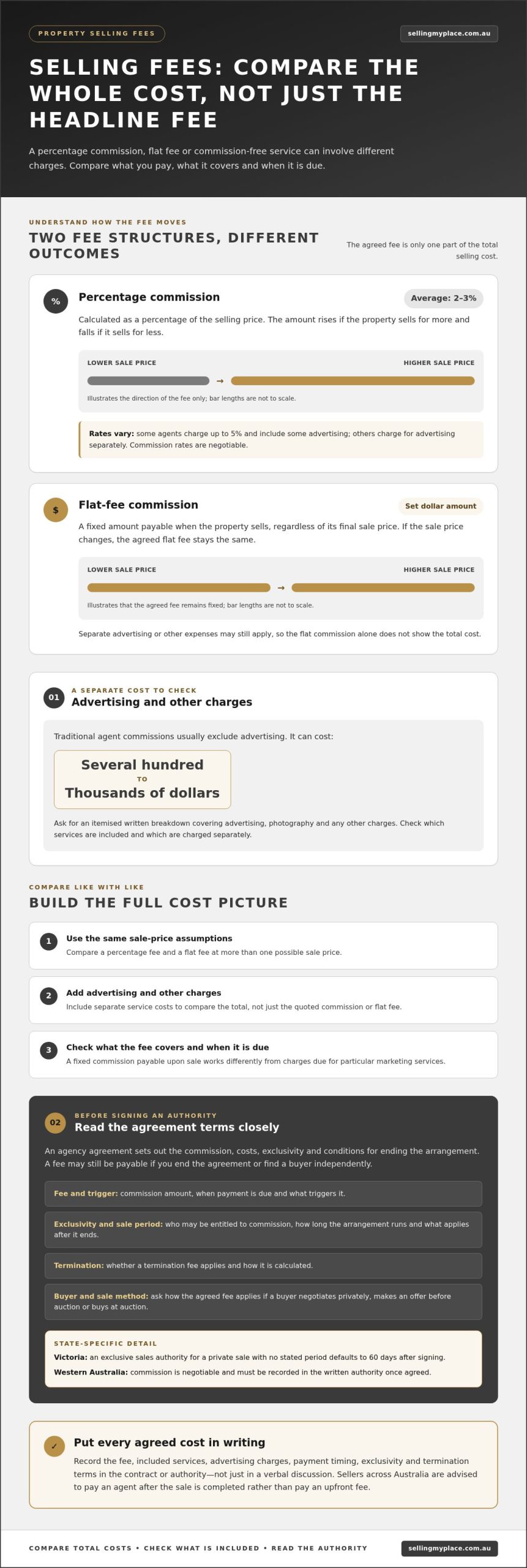
Australian agent commissions average two to three per cent of the selling price. Commission-free selling can reduce commission costs, but the final sale price depends on factors such as buyer demand, property presentation and negotiation, not the fee model alone.
Fees and advertising costs
Commission-free services may charge a flat fee or separate fees for services such as advertising. What you pay and what it covers depend on the arrangement, so compare each charge before deciding.
Traditional Australian agent commissions usually exclude advertising, which can cost from several hundred to thousands of dollars. Some agents charge up to five per cent and include some advertising; others charge for it separately. Ask for a written, itemised breakdown covering advertising, photography and other charges, then compare like with like.
Agency agreement terms
An agency agreement, also called an authority, sets out the commission, costs, exclusivity and conditions for ending the arrangement. Read these terms carefully: a fee may still be payable if you end the agreement or find a buyer independently.
Before signing, identify any termination fee, how it is calculated, the exclusive period and what happens when that period ends. In Victoria, an exclusive sales authority for a private sale with no stated period defaults to 60 days after signing. Get any agreed changes recorded in the contract or authority, not just discussed verbally.
Buyer negotiation and auctions
An agent may negotiate with buyers or conduct an auction, and those services can form part of the commission discussion. Ask how the agreed fee applies if a buyer negotiates privately, makes an offer before auction or buys at auction.
Treat examples as prompts for negotiation, not set rates.
Negotiating before you sign
Compare the proposed commission, advertising charges and payment timing before agreeing. In Western Australia, commission is negotiable and must be recorded in the written authority once agreed. Sellers across Australia are advised to pay an agent after the sale is completed, rather than pay an upfront fee.
Ask whether the fee changes if the sale method or marketing plan changes. A written breakdown makes it easier to compare commission with a flat-fee arrangement and identify which costs are payable at settlement.
Flat-fee commission structures
A flat-fee real estate commission is a set dollar amount payable when a property sells, regardless of its final sale price. It gives you a fixed figure to compare with a percentage-based charge. Separate expenses may still apply, so the commission alone doesn’t show the total cost.
If a property sells for more than the owner expected, a percentage commission rises with the sale price, while an agreed flat-fee commission stays the same. If the property sells for less, the flat fee doesn’t automatically fall. The fee structure determines how the cost changes with the final result.
To estimate likely proceeds, compare the flat fee with the percentage commission at more than one possible sale price, then add any advertising or other charges. Use the same sale-price assumptions for each option. This shows how the fees behave across different outcomes, rather than relying on one appealing figure.
Check what the flat fee covers before accepting the agreement. The authority should identify included services, separately charged advertising, when payment is due and what triggers it. A fixed commission payable upon sale, for instance, works differently from charges due for particular marketing services.
Check whether the fee applies under an exclusive arrangement. An exclusive authority can affect who is entitled to commission if you or another agent finds the buyer. The wording matters, including the agreement’s duration and any conditions that apply after it ends. A flat amount doesn’t remove the need to understand these terms.
“Flat fee” and “commission-free” aren’t always interchangeable. A flat-fee model has a set commission amount payable upon sale; a commission-free arrangement may charge for selling services in another way. The practical questions are what costs apply, what work they cover and when each charge is due.
Compare advertising as a separate item. Australian agent commissions usually don’t include advertising, which can cost from several hundred to thousands of dollars. A flat-fee agreement may also charge separately for advertising. Compare the total cost and included work instead of assuming one quoted fee covers every part of the sale.
Before signing, write down the fee, payment trigger, included services, advertising charges, exclusivity and termination terms. Then compare those terms with the sale approach you want. If you believe a flat-fee structure suits your plans, explore flat-fee property listing support as one way to consider the arrangement.
Selling property privately
You can sell without appointing an estate agent, but you take on more of the sale’s organisation. Australian state and territory rules still shape the legal work and any agency agreement already in place.
Checking licences and reputation
Checking a representative’s licence and conduct helps clarify who is responsible for the services offered. In Western Australia, an agent must hold a real estate agent licence or work as a registered sales representative employed and authorised by a licensed estate agent.
Review licensing information from the relevant state or territory consumer protection agency, then consider recent, independent feedback about the business and its conduct. Real estate laws are state and territory-based, so requirements differ. If you believe an agent has acted improperly or breached licensing obligations, you can complain to your local consumer protection agency.
There isn’t one Australia-wide licensing rule for every type of commission-free selling service. Legal requirements can vary by state and territory, so distinguish a property marketing service from an agent representing you in a sale.
Risks of commission-free services
A lower or absent percentage commission doesn’t automatically mean the same level of hands-on sales support. Depending on the service and agreement, you may need to take a more active role in handling buyer enquiries, inspections, offers or auction arrangements.
Your role can affect how quickly buyers receive information and how negotiations progress. If you manage an offer yourself, for example, understand its conditions, proposed settlement and any competing interest before responding. The agreement should make clear which tasks the service handles and which remain yours.
Existing agency paperwork matters too. In Western Australia, an agent may be entitled to a selling fee if your property sells privately or through another agent during the exclusive rights period. Read any current agreement before changing your selling method, especially the exclusivity and fee provisions.
Private selling still requires attention to the sale documents. In Victoria, a seller without an agent needs a conveyancer or legal practitioner to prepare the Section 32 statement and contract of sale. Those legal tasks are separate from marketing and buyer negotiations, so include them when considering the work involved.
An auction is another decision to weigh: under the chosen arrangement, the seller must organise the sale process and handle buyer interest. If you want to manage every step personally, private selling may suit you. If you prefer comprehensive marketing or hands-on sale support, examining how established agencies such as Steve Kooner & Associates present and manage listings provides a clear benchmark for what full-service representation delivers.
When commission may be payable
A commission-free arrangement doesn’t cancel an existing agency agreement or determine who earns a fee if an agent contributed to the sale. In Australia, the written authority and events leading to the transaction matter.
When commission becomes payable
Commission may be payable when an agent’s work is the effective cause of a completed sale, even if payment is disputed or the agency period has ended. The agreement and sale history help establish whether that connection exists.
An open listing or general authority lets a seller appoint multiple agencies, with commission payable to the agent who sells the property. Under an exclusive agency, the appointed agent may be paid even if the seller or another agent completes the sale. The authority’s terms determine how exclusivity works.
An agent claiming commission generally must show a causal connection between their efforts and the completed transaction, not merely that they introduced the buyer. Relevant events include the introduction, negotiations, offers and acceptance. A buyer’s first viewing alone, for example, may not establish that the agent caused a later sale.
Read the authority alongside the contract of sale, especially any clause defining what counts as a sale. Some authorities may define it to include a purchaser making an offer, even if the seller doesn’t accept it. In Victoria, an exclusive auction authority without a stated period defaults to 30 days after the auction date.
Take care when changing agents. A buyer introduced by one agent may later negotiate through another, potentially creating a dispute over which agent caused the sale. Keep records of viewings, offers and communications, and ensure the sale contract accurately identifies the agent involved.
Laws and disclosure rules
Australian real estate laws are administered by state and territory agencies, so the rules depend on where the property is located. Commission arrangements, licensing obligations and sale disclosures can differ between jurisdictions.
In Western Australia, a real estate agent must have a written contract with the seller to sell the property, and agreed commission must be recorded in the written authority. Changes to a signed authority must be made in writing, included on every copy and initialled by both seller and agent.
Agents must provide truthful, complete information relevant to a property, including its features, location, zoning, history, land use and price. The Australian Consumer Law applies to agents in Western Australia. A commission-free label doesn’t remove these disclosure duties when an agent is involved.
Before signing, compare the authority with any proposed contract of sale. Check the fee trigger, exclusivity, sale period and responsibilities for property information. If an agent’s conduct seems unfair or misleading, raise the concern with the agency first. Local consumer protection agencies handle complaints about improper conduct or licensing obligations.
How do commission-free property selling services make money?
“Commission-free” describes the commission structure, not necessarily a service with no charges. One model is a flat fee: a set dollar amount payable when the property sells, regardless of its final sale price. A service may also charge separately for advertising or other agreed work. The agreement explains which charges apply and when they’re due.
For example, a seller might agree to a fixed fee for listing support and pay advertising costs separately. Unlike a percentage commission, that fee doesn’t rise with the sale price. The seller’s total outlay still depends on the agreement and any additional services selected. Consider separate charges alongside the headline commission structure.
Advertising is a separate cost to examine. Australian real estate commissions usually don’t include advertising, which can cost from several hundred to thousands of dollars. A commission-free arrangement may also involve a marketing expense. Check what the advertising charge covers, how it is billed and whether it is payable if the property doesn’t sell.
Payment timing matters too. A flat fee may be payable upon sale, while an agreement may set separate payment terms for advertising or other work. Read the sections that describe each charge, the service it relates to and the event that triggers payment. Distinguish a fee due on completion from a marketing expense payable under different terms.
To understand how a service earns revenue, compare the agreement’s full list of charges with the work provided. Identify the listing service, marketing components, optional work and fee attached to each. Then compare that total with a percentage-based commission and separate advertising expenses. This makes the model clear without assuming that “zero commission” means zero cost.
Clear terms also help you judge whether the arrangement suits your sale. A service that charges a flat fee may offer a different balance of support and seller involvement than a traditional agency—for instance, full-service brokerages like Pinnacle Realty manage client consultations, active marketing and end-to-end negotiations on the seller’s behalf. Consider which tasks you expect the service to handle, and match them against the written inclusions. Ask about the relevant fee structure through commission-free property selling support.
Kincade International Direct Sales: Residential Property Listing Services
Kincade International Direct Sales offers residential property listing services for Australian owners considering a commission-free sale. Its model combines a flat-fee structure with professional photography, floorplans and neighbourhood market reports, helping sellers present their property and share it with buyers.
Listings remain active until sold, with no time limits or agency commission. This approach may suit owners who want marketing support while avoiding a percentage-based commission. Kincade International Direct Sales also provides pre-sale property consulting and buyer representation, which can help address other parts of a property decision.
If you’re weighing these options for your sale, contact Kincade International Direct Sales to discuss your property and visit sellingmyplace.com.au.
Make your next move with clarity
To decide whether commission-free property selling is legitimate, check that the written terms match the way you want to sell. Start with your priorities: how involved you want to be, which support matters most and which responsibilities you’re comfortable managing.
Consider what a good selling experience would look like for your household. You might value control over the process, help preparing the property or guidance with decisions. Let those preferences shape your choice instead of relying on the label alone.
Kincade International Direct Sales can help you explore the options that fit your property plans. Start a conversation about your property sale and consider a path forward that feels informed, practical and right for your next chapter.
Frequently Asked Questions
Do I have to use an agent to sell my property?
No. Australian homeowners can sell privately without appointing a real estate agent. You’ll take responsibility for presenting the property, responding to buyers, considering offers and coordinating the sale. The legal paperwork still needs attention: in Victoria, a private seller needs a conveyancer or legal practitioner to prepare the Section 32 statement and contract of sale. Decide how much of the process you want to manage yourself before choosing your selling approach.
How much do real estate agents charge?
There’s no single fixed commission rate across Australia, and sellers can negotiate the amount. Some agents charge up to five per cent, with some advertising included. Check how the rate is calculated, whether advertising is included and when payment is due.
What is an agent’s commission?
An agent’s commission is the agreed payment for helping sell a property, commonly calculated as a percentage of its final sale price. For example, an agreement might set a percentage rate or use tiers that change above a specified sale amount. The authority explains the commission terms and payment trigger. Don’t confuse commission with marketing expenses, which may be charged separately.
Are commission-free real estate agents legitimate and licensed in Australia?
Yes, commission-free property selling is legitimate in Australia, but a commission-free service isn’t necessarily a real estate agency. Kincade International Direct Sales acts as a licensed intermediary for property listings, not as a real estate agent. Private property owners can sell in every Australian state and territory. Licensing obligations depend on the work performed and local rules, so distinguish listing support from an agent representing you in a sale.
What steps are involved in selling a property commission-free in Australia?
Start by choosing your selling approach, then arrange the listing and legal documents in the right order for your state.
- Decide what marketing and buyer support you want.
- Arrange listing access and prepare accurate property details.
- Engage a qualified conveyancer or solicitor for legal matters.
- Prepare the required documents: NSW and ACT require a contract of sale before listing; in Victoria, provide a Section 32 Vendor Statement before contracts are signed.
- Manage buyer enquiries, offers and settlement arrangements.
Flat Fee Listings Compared on Cost, Services, and Savings
What you get with a flat fee listing depends on the package: it may cover the property listing and marketing materials, while support with pricing, buyer enquiries, inspections and negotiations can vary. A fixed fee is different from a percentage-based commission, but the fee structure alone doesn’t determine what a home sells for. The final sale price depends on the property, its presentation, buyer interest and the negotiations.
It’s understandable to wonder whether choosing a lower-cost listing means giving up essential support, or whether a traditional commission brings enough extra help to justify the difference. The important comparison is what’s included, what tasks stay with you and how each fee is calculated. This guide explains the services flat fee packages can include, how their trade-offs compare with traditional commission, and what to weigh when deciding which approach fits your sale. With the details laid out clearly, you can focus on the right balance of support, control and value for your next move.
Key Takeaways
- Compare the flat fee with percentage-based commission against the expected sale price to see how each fee structure affects your costs.
- Look beyond online exposure: photography, floorplans, signboards and other marketing can affect the overall value of a package.
- Know which tasks you’ll handle yourself, especially pricing, buyer enquiries, inspections and negotiations.
- Review the listing term and what support is included so you can judge whether the package suits your preferred level of involvement.
- Consider professional listing support and market guidance if you want to manage costs while presenting your property with care.
What Is Flat Fee Real Estate, Exactly?
A flat-fee listing charges an agreed fixed amount for specified property marketing or listing services, rather than calculating the listing fee as a percentage of the sale price. What do you get with a flat fee listing depends on the agreement: the fee structure alone doesn’t tell you which tasks or support are included.
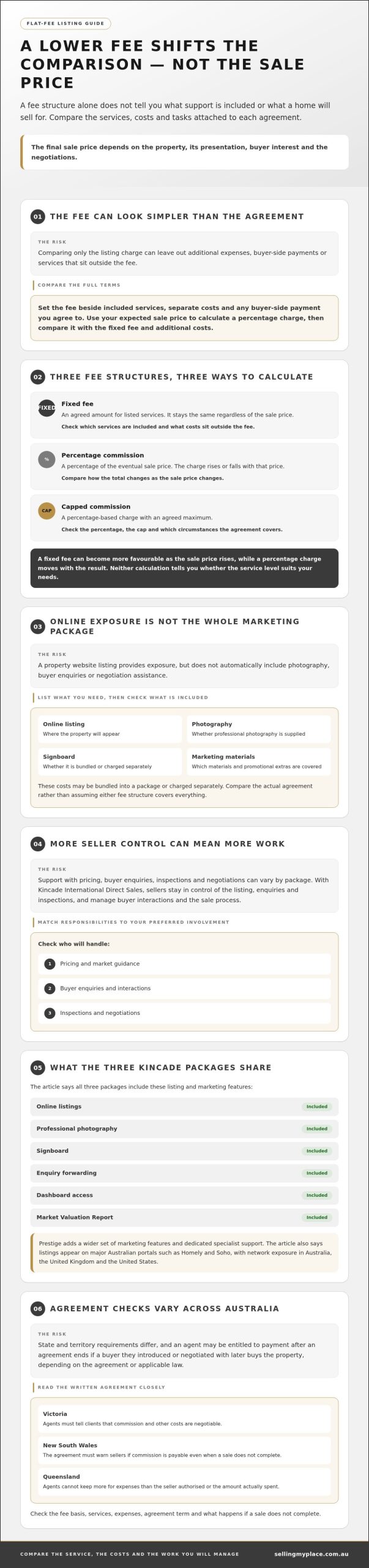
With a percentage commission, the charge rises or falls with the eventual sale price. A fixed fee stays the same regardless of the sale price, while a capped commission is percentage-based but has an agreed maximum. Compare the full terms, including any separate expenses and any buyer-side payment you agree to, rather than focusing on one figure.
| Option | How the charge is calculated | What to consider |
|---|---|---|
| Fixed fee | Agreed amount for listed services | Which services are included and what costs sit outside the fee |
| Percentage commission | Percentage of the eventual sale price | How the total changes as the sale price changes |
| Capped commission | Percentage, up to an agreed maximum | The percentage, cap and circumstances covered by the agreement |
For a simple comparison, calculate the percentage charge using your expected sale price, then set it beside the fixed fee and any additional costs. A fixed fee can become more favourable as the sale price rises, while a percentage charge moves with the result. Neither calculation tells you whether the service level suits your needs.
Australian requirements differ across states and territories, and the written agency agreement matters. Victoria requires agents to tell clients that commission and other costs are negotiable; in NSW, the agreement must warn sellers if commission is payable even when a sale doesn’t complete; Queensland agents can’t keep more for expenses than the seller authorised or the amount actually spent.
In any state or territory, read the agreement for the fee basis, services, expenses, term and what happens if a sale doesn’t complete. A real estate agent may also be entitled to payment after an agreement ends if a buyer they introduced or negotiated with later buys the property, depending on the agreement or applicable law.
To choose a package, compare its listing, marketing and support features with the work you want to manage. Kincade International Direct Sales offers three fixed-fee options, with features bundled into each package. Review the inclusions and listing terms, then select the package that matches your priorities.
Is a fixed fee cheaper than commission?
A flat-fee listing can be a cost-effective option, but compare the full package rather than the listing charge alone. Consider online exposure, photography, signboards, marketing materials and the work you’ll handle yourself.
Online listing and marketing costs
An online listing puts property details and images in front of buyers through property websites. A signboard adds visibility to people passing the home, while photography and other marketing materials shape how the listing appears. These costs may be bundled into a package or charged separately, so identify each item before comparing it with commission.
For a useful comparison, list the marketing materials you need, then note which are included and which you would organise yourself. A package with a fixed listing charge may still leave photography, signboards or promotional extras outside its scope. A commission-based service may handle different tasks, so compare the actual agreement rather than assuming either option covers everything.
Typical flat-fee MLS costs
MLS, or multiple listing service, is a US listing model, not the standard name for Australian property portals. While traditional agents in North America such as Christopher Seim actively manage client listings through full representation, flat-fee MLS services generally only place the property online. Kincade International Direct Sales lists properties on major Australian portals such as Homely and Soho. Its network also provides global exposure in Australia, the United Kingdom and the United States.
For Australian sellers, focus on where the listing will appear, what marketing is supplied and whether the fee covers support beyond publication. A listing sent to property websites provides exposure, but it doesn’t automatically include photography, buyer enquiries or negotiation assistance. The listing agreement defines the service, not the label attached to the package.
Flat-fee plan costs
Flat-fee packages vary in scope, so compare the specific features rather than assuming every service is the same. Kincade International Direct Sales offers three packages, each with online listings, professional photography, a signboard, enquiry forwarding, dashboard access and a Market Valuation Report. Prestige adds a wider set of marketing features and dedicated specialist support.
Also consider who handles the sale tasks. With Kincade International Direct Sales, you stay in control of your listing, enquiries and inspections. The service provides marketing and listing infrastructure, while you manage buyer interactions and the sale process. Consider how much time and involvement you’re comfortable taking on.
To compare fairly, write down the fee, included marketing, extra expenses and responsibilities for each option. Then consider how the service fits your sale, not only how it is priced. If you value structured listing support, explore a residential property listing service that includes professional marketing materials.
What are the pros and cons of flat fee MLS listings?
A flat-fee arrangement can reduce the listing-side charge, but the seller often takes on more work. In Australia, compare that practical responsibility with the support offered for marketing, buyer enquiries and negotiations.
Seller responsibilities and control
With an entry-only flat-fee MLS listing, the seller manages photography, pricing, buyer enquiries, showings and negotiations. That control lets you choose when inspections happen and how you respond to offers, but it also means coordinating each step yourself. For an Australian sale, distinguish the US term “MLS” from local property portals when reviewing the listing service.
Start by reviewing the Market Valuation Report and preparing the property for photography and inspections. When an offer arrives, consider its price, conditions and settlement timing before responding. Kincade International Direct Sales provides listing and marketing services; you remain in control of buyer interactions and decisions.
Potential seller savings
The potential saving comes from paying a fixed listing charge instead of a listing-side percentage that rises with the sale price. Compare both against the same expected sale price, then add marketing expenses and any buyer-side payment you agree to. A lower listing charge doesn’t itself establish the home’s sale price or the quality of its marketing.
Consider the value of your time as well as the fee. If you handle photos, enquiries and negotiations yourself, those responsibilities become part of the trade-off. A seller who wants guidance with presentation may prefer a package that includes professional photography, while a confident DIY seller may value greater control.
Technology can make seller tasks easier to organise, but it doesn’t remove them. A listing platform may support online changes or pass enquiries to the seller; the agreement determines the actual service. Before signing, identify who uploads photos, corrects property details and responds when buyers or their representatives make contact.
Presentation is one practical test. Prepare a room-by-room photo list, tidy visible surfaces and check that each image represents the property accurately. If you arrange photography yourself, you control the timing and selection. If professional photos are included, confirm how images are supplied for the online listing and other marketing materials.
Pricing requires active judgement. Use the Market Valuation Report included in every Kincade International Direct Sales package as one input when considering your price, alongside the property’s condition and buyer feedback. Asking prices are not the same as completed-sale evidence, and no listing service can guarantee a particular sale price.
Finally, keep the transaction organised. Record enquiries, confirm inspection arrangements, compare offer conditions and keep contract documents together. Flat-fee sellers generally deal directly with inquiring agents through contract and closing. Choose this route if you’re comfortable managing those tasks; choose more support if you want help through the sale process.
Basic listing price and duration
A flat-fee listing combines a fixed charge with a defined service period. In Australia, compare the written scope and listing term before weighing the fee against a percentage commission. The cost depends on the services selected, marketing materials, support level and payment timing; the price depends on the case and is given after a quote request.
In Australia, a property owner can sell privately in every state and territory. Kincade International Direct Sales acts as a licensed intermediary to list on Realestate.com.au and Domain, which do not allow individuals to list directly. Its flat-fee packages include listing and marketing features without agency commission.
Duration matters too. A limited listing agreement usually sets a listing term of 6 to 12 months. That is the period the agreement covers, not a promise that the property will sell within that time. Read the end date and any renewal or cancellation terms alongside the services and payment conditions.
To compare two offers, use the same expected sale price and service requirements. A percentage commission changes with the eventual sale price; a fixed fee remains the agreed amount. Then add any separate expenses shown in the agreement. This step-by-step comparison helps reveal whether a lower starting charge also means fewer included services.
- Listing scope: note whether the fee covers online publication, photos, floorplans and market information.
- Payment timing: identify what is payable upfront and what becomes payable when the sale proceeds.
- Term: record the start date, end date and process for ending or renewing the agreement.
- Extra costs: distinguish agreed expenses from the fixed listing charge.
Payment arrangements can differ. In October 2026, two of four published Australian agencies charged part of the fixed fee upfront and the remainder when the sale went through. That example shows why timing belongs in the cost comparison, alongside the total agreed fee and conditions for payment.
A listing term also affects your options if plans change. Check how the agreement treats expiry, cancellation and a buyer introduced during the term who purchases afterwards. An agent may be entitled to payment after an agreement ends in that situation, depending on the agreement or applicable law.
Before signing, write down the total fee, inclusions, separate expenses and dates. Compare those details with the level of real estate support you want, then make sure the agreement reflects the negotiation accurately. Clear terms make it easier to plan the sale and understand what the listing service covers.
Fixed-fee packages and what they include
A fixed-fee package groups agreed listing and marketing tasks for one set charge. Compare the written inclusions, optional extras and seller responsibilities before deciding whether it suits your sale.
Extra fees or upgrades can apply for services outside the agreed package, such as additional marketing or support. The price depends on the case and is given after a quote request; cost factors include the services selected and marketing required.
Photography, floorplans and online advertising may be included, but packages differ. Check each item in the agreement rather than assuming all three come with every flat fee.
Services included in fixed-fee packages
A package may cover the online listing, photos, floorplans, downloadable documents or customer support. Some plans also provide listing changes, direct buyer contact or agent support. Those items describe different levels of involvement: publication gives a property visibility, while practical assistance can reduce the tasks a seller handles themselves.
For example, a seller who has photos and floorplans ready may mainly need an online listing. Someone preparing to sell your home may value help with marketing materials or buyer enquiries. A realtor’s package description is less useful than the agreement’s specific list of services and responsibilities.
Optional upgrades and extra fees
Optional upgrades add services beyond the base package, while extra fees can apply to tasks excluded from its scope. Examples include additional promotion, photography or support with buyer enquiries. Their value depends on what the seller needs and which tasks the package already covers.
Compare each upgrade with the work it replaces. If you organise photos yourself, for instance, a photography add-on may not suit your plan. If marketing support matters, compare the total package scope rather than choosing solely by its headline fee.
Use a simple checklist to compare packages: online listing, photos, floorplans, listing changes, documents, buyer contact and agent support. Mark each item as included, optional or handled by you. This reveals whether a lower-cost basic package leaves important work in your hands.
Look at the specific features rather than relying on broad labels such as “full service”. Kincade International Direct Sales provides listing and marketing services, with you retaining control of the listing, enquiries and inspections. Its package descriptions set out what’s included.
Ask yourself which tasks you’re comfortable handling. A seller confident organising photography and responding to buyers may prefer more control; someone who wants help with marketing may favour a broader package. The right balance depends on your time, experience and priorities.
For a package comparison shaped around your sale, discuss your property listing needs and the marketing support that matters to you.
Kincade International Direct Sales: Residential Property Listing Services
Kincade International Direct Sales provides residential property listings with a commission-free flat-fee model for Australian owners who want marketing support without agency commission. Its service includes professional photography, floorplans and neighbourhood market reports, supported by a global marketing network and digital infrastructure. Properties remain listed until sold, with no time limits.
Your choice depends on the marketing and guidance you want. Kincade International Direct Sales offers Pre-Sale Property Consulting and Real Estate Advisory Services to help you prepare and make informed decisions, as well as Buyer Representation for people seeking guidance through a purchase. For buyers or investors exploring opportunities in overseas property markets, specialist agencies like upscalerealestate.ae provide guidance on purchasing ready and off-plan homes.
To compare the packages and choose the right level of marketing support, explore the options or get started through Kincade International Direct Sales.
Take the next step with confidence
Understanding what you get with a flat fee listing is an important part of choosing how to sell. Next, decide how involved you want to be, what marketing matters to you and how much guidance you’d like. Those priorities can help you select the package that fits your plans.
Kincade International Direct Sales offers Residential Property Listing Services for owners preparing to sell, Pre-Sale Property Consulting to help plan ahead, and Buyer Representation for people looking to purchase. Whether you’re weighing your options or ready to map out a sale, a conversation can help clarify which direction suits your circumstances.
Contact Kincade International Direct Sales to discuss your property plans and the support you’re looking for. A considered next step can make a major transition feel more organised and more your own.
Frequently Asked Questions
Do Flat Fee Listings Sell for Less Than Traditional Listings?
Not necessarily. The fee model alone doesn’t set the sale price. Buyer demand, property condition, presentation, pricing and negotiation all affect the result. Compare the marketing and support you’ll receive, and consider how confidently you can manage enquiries and offers yourself. Kincade International Direct Sales does not guarantee a sale or a specific sale price.
Can I negotiate a fixed fee?
Yes, fixed fees are negotiable in Australia. Victoria requires agents to tell clients that commission and other costs are negotiable. When discussing terms, focus on the services included, extra expenses, payment timing and agreement length. You can compare the proposed scope with the support you actually need, then negotiate the fee and terms together. Make sure any agreed changes appear in the written agreement before signing.
Does a flat fee MLS listing hurt your sale?
A flat fee doesn’t automatically harm a sale, but the service scope can affect how much work falls to you. MLS is a US listing term; Australian owners generally use property portals. Consider whether your arrangement covers the listing itself or also helps with presentation, buyer enquiries and offers. A seller who manages those tasks carefully may prefer the control, while someone wanting more assistance may value broader support.
How does a fixed fee work?
A fixed-fee arrangement sets an agreed charge for specified services, rather than calculating the listing fee as a percentage of the eventual sale price. The written agreement should describe the service, payment timing, duration and any separately authorised expenses. Before signing, match each included task to your sale plan. For example, note who will prepare listing details, respond to buyer enquiries and coordinate inspections.
How much do fixed-fee agents charge?
There isn’t one standard charge for every fixed-fee property service in Australia. The amount depends on the package scope, marketing materials, level of support and payment terms. Some services focus on publishing a listing; others include more marketing or assistance. Compare the total agreed charge and included work rather than relying on the label “fixed fee”. Put any negotiated changes in the written agreement.
Is a flat fee better than a commission?
Neither structure suits every seller. A flat fee can make the listing charge predictable, while percentage commission changes with the sale price. Your comparison should also account for included services and the tasks you’ll manage personally. For instance, sellers comfortable organising inspections and handling negotiations may prioritise cost control; those wanting more guidance may place greater value on support. Choose based on your preferred involvement and sale priorities.
What services are included in a flat-fee property listing in Australia?
In Australia, inclusions vary by package. Kincade International Direct Sales listings include online property portal placement, buyer-enquiry forwarding by SMS and email, dashboard access and a market valuation report. Signboard size and other marketing features vary between its packages. To assess what you get with a flat-fee listing, compare the written inclusions with the tasks you want handled, such as photography, floorplans or promotion.
How much does a flat-fee real estate listing cost in Australia?
The price depends on the case and is given after a quote request. Cost factors include the package scope, marketing materials and level of support. Compare the full written inclusions and payment terms, rather than judging the offer by its fee structure alone. Also distinguish the listing charge from other amounts you may agree to pay as part of selling, so you can plan your overall costs clearly.
Average conveyancing fees in Australia and what fixed-fee quotes include
A fixed-fee quote can make conveyancing costs easier to understand, but it may not include every expense. Conveyancing is the legal and administrative work involved in transferring property ownership. The total depends on whether you’re buying or selling, the property and the searches required.
It’s understandable to want a clear figure before making a major property decision. Buyers and sellers need different work, and government charges or third-party search costs may sit outside a quoted professional fee.
This guide explains what conveyancing covers, why costs vary for buyers and sellers, and how to compare fixed-fee quotes without overlooking possible extras. It also outlines what to look for in a quote to understand the costs before settlement.
Key Takeaways
- Separate the professional fee from disbursements and government charges to understand the full conveyancing cost.
- Compare the work required for a purchase with a sale, as the searches, documents and settlement tasks can differ.
- Look beyond the “fixed fee” label: identify which services are included and which third-party costs may be additional.
- Match your quote to the transaction, including whether the property is a house, unit or more complex sale.
- If you’re preparing to sell or buy, Kincade International Direct Sales offers residential property listing services, buyer representation and pre-sale property consulting.
Why Do Buyers and Sellers Pay Different Conveyancing Fees?
Buyers and sellers need different legal work, searches and settlement documents, so their quotes can differ. Separate the professional fee from third-party disbursements to see what each quote covers.
Professional Fees and Disbursements
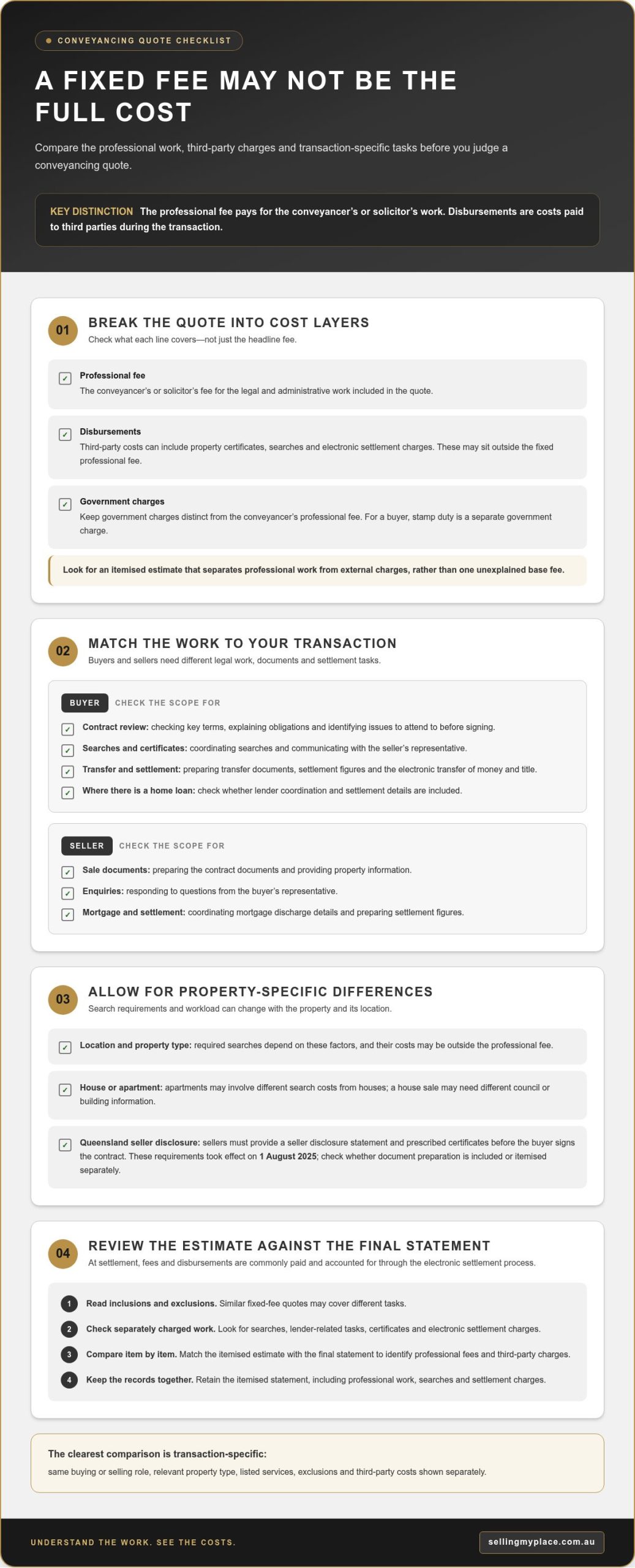
The professional fee pays for the conveyancer’s or solicitor’s work; disbursements are costs paid to third parties during the transaction. This distinction matters because a fixed professional fee may not include searches, certificates or electronic settlement charges.
The work varies depending on your role. A buyer’s conveyancer reviews the contract, coordinates title and property searches, works with the lender where relevant, and prepares for settlement. A seller’s conveyancer prepares sale documents, responds to enquiries and arranges discharge of existing mortgages.
Property type can change the workload. A house sale may require different council or building information. The quote should distinguish the conveyancer’s work from external charges, rather than presenting everything as one unexplained base fee.
Property Certificates and Search Fees
Property certificates and search fees are third-party disbursements that provide records about a property, its title or associated charges. Required searches depend on the property’s location and type, and their costs may sit outside the professional fee.
These charges help explain why apartments may involve different search costs from houses.
Are conveyancing fees tax deductible or included in the property’s cost base in Australia? Tax treatment depends on the property’s use and whether each cost is capital or relates to earning income. Keep the itemised statement, separating professional work, searches and settlement charges, so each amount can be assessed in the right context.
At settlement, conveyancing fees and disbursements are commonly paid and accounted for through the electronic settlement process. Compare the itemised estimate with the final statement to identify professional fees and third-party charges, such as certificates, searches or platform fees.
Services included in conveyancing fees
A conveyancer coordinates the legal and administrative work required to transfer property ownership. For a buyer, this can mean reviewing the contract and organising settlement; for a seller, it includes preparing sale documents and responding to enquiries.
Typical inclusions depend on the transaction and the quote’s scope. Read the service description alongside its exclusions, especially for searches, lender-related work and third-party charges. Similar fixed-fee quotes may cover different tasks, so check the listed services against whether you’re buying or selling.
What a Buyer’s Quote May Cover
For a purchase, conveyancing often starts with contract review. The conveyancer checks key terms, explains obligations and helps identify issues that need attention before signing. Once the contract is agreed, they coordinate searches and certificates, communicate with the seller’s representative and prepare transfer documents.
If a buyer has a home loan, the conveyancer also coordinates settlement details with the lender. They calculate the funds required, prepare settlement figures and arrange the electronic transfer of money and title. Stamp duty is a separate government charge, not the conveyancer’s professional fee, so the quote should distinguish legal work from the buyer’s wider purchase costs.
When reviewing a buyer’s quote, separate contract work from settlement coordination. Check whether the scope includes correspondence with the lender and preparation of transfer documents, or whether those tasks are charged separately. Property type can also affect which searches or certificates are needed.
What a Seller’s Quote May Cover
A seller’s conveyancer prepares the contract documents, provides property information and responds to questions from the buyer’s representative. They also coordinate mortgage discharge details where a loan is secured against the property, then prepare settlement figures showing adjustments and amounts payable.
In Queensland, sellers must provide a seller disclosure statement and prescribed certificates before the buyer signs the contract, under requirements effective from 1 August 2025. That work can affect what a seller’s quote includes. A Queensland seller can compare whether preparing those documents appears in the professional fee or as a separate item.
Third-Party and Settlement Charges
Some charges relate to the platform used to complete the transaction, rather than the conveyancer’s professional work. Check whether this amount is included in the quoted fee or listed separately as a disbursement, so it’s accounted for in your expected settlement costs.
Ask how the final statement separates professional work, certificates, searches and electronic settlement charges. This breakdown helps explain changes between the initial estimate and settlement, particularly if a lender, property type or required document adds work. Keep the quote and final statement together to make the transaction costs easier to review later.
If you’re preparing a property sale and need guidance alongside the legal process, conveyance advice for your sale can help you understand the roles involved.
Choosing a conveyancer or solicitor
The right professional depends on your state, transaction type and the legal work involved. Compare the service scope and total conveyancing costs, not just the headline charge.
Choosing a Conveyancer
A conveyancer focuses on the legal and administrative tasks involved in property transfers. Their experience with your state’s contracts, searches and settlement process matters because requirements and costs vary across Australia.
These figures are professional fees, not necessarily the total cost, which may also include searches, certificates and other disbursements.
Queensland has no separate licence for non-lawyer conveyancers, so conveyancing is handled by solicitors and law practices. Consider the professional’s legal practice and relevant property experience. In NSW, conveyancers must disclose costs upfront and transparently, helping you understand the stated scope and charges.
Compare quotes by checking the transaction covered, the work included and any exclusions. A straightforward house transfer may require different searches and documents from an apartment purchase. Where relevant, check whether the quote accounts for lender coordination, contract review, certificates and electronic settlement.
Online conveyancers in Australia typically charge professional fees 10-20% less than traditional practices. A lower fee alone doesn’t explain which services are included, so compare the scope alongside the price. The useful comparison is the work being done for your particular property and transaction.
Choosing a Solicitor
A solicitor can handle conveyancing as part of a broader legal practice. This may suit a transaction with additional legal issues, such as a complex contract or company involvement, where advice beyond routine transfer work is relevant.
Professional fees differ by state and practice.
These ranges help put quotes in context, but the transaction’s requirements influence the fee. A property with multiple titles, unusual contract terms or additional parties may need more review and coordination. Council and title searches also affect disbursements, which should be distinguished from the solicitor’s professional charge.
Read the quote for its named services, exclusions and likely third-party costs. Check whether it covers contract advice, lender communications, document preparation and settlement coordination. An itemised quote makes it easier to compare professional work with external charges, rather than judging conveyancing costs by one figure.
Choose a professional whose experience and quoted scope suit your transaction. A routine sale and a complex purchase require different work, so look for a clear outline of the legal tasks involved in your matter.
Comparing fixed-fee conveyancing quotes
A fixed fee sets out a defined professional charge, but the transaction’s full cost may include separate disbursements. Compare quotes for the same property type and service scope to see what each figure covers.
Factors Affecting Quotes
A conveyancing quote reflects the transaction’s complexity, required documents, property type and included work. A seller’s matter differs from a purchase, while an apartment may need strata information that a standard house does not. Multiple titles or lender coordination can add tasks, which is why similar-looking quotes may cover different work.
State-based charges affect the overall amount, even when the professional fee is fixed. In Victoria, transfer registration costs A$104.30 plus A$2.34 for every A$1,000 of the purchase price, capped at A$3,614. These government charges are separate from professional fees, so check whether a quote includes them or lists them separately.
Transaction timing and structure matter, too. Off-the-plan conveyancing can take months or years, depending on when construction is completed.
Comparing Quotes and Saving on Fees
Compare like with like: use the same transaction type, property details and requested services for each quote. Then separate the professional fee from searches, certificates, electronic settlement charges and government costs. This gives you a clearer estimate than comparing headline totals alone.
Check each inclusions list against the work your transaction needs. For a purchase, look for contract review, title searches, settlement coordination and lender communication where relevant. For a sale, check whether document preparation and mortgage discharge coordination are covered. A missing item can make a low initial fee difficult to compare.
Use an itemised quote to identify optional tasks and third-party charges. A search is not the same as professional work, and transfer registration is not the conveyancer’s fee. Comparing these categories separately helps you see where quotes differ and avoid paying for services your transaction doesn’t require.
Low-Cost Conveyancing Quotes
A low-cost quote may offer a narrower service scope or use an online process. Online conveyancers in Australia typically charge professional fees 10-20% less than traditional practices. That difference makes the listed services and exclusions especially important to compare, rather than assuming each quote covers the same work.
Check whether the quoted amount covers your actual transaction, including searches, titles and settlement tasks. If a seller’s quote excludes a required document, or a buyer’s leaves out lender coordination, the final total may differ from the initial fee. A clear breakdown shows what is included and charged separately.
Choose the quote that matches the work required, not simply the lowest amount. A standard purchase and an off-the-plan purchase involve different timeframes and coordination. Comparing quotes for the same transaction lets you assess professional fees and disbursements fairly.
Fixed conveyancing fees for buying and selling
Fixed-fee quotes can make the professional charge predictable, but buyers and sellers need different work. The quoted fee is only one part of the transaction’s total cost.
The total can include searches and statutory disbursements, while transfer registration, stamp duty and other government charges may sit outside the conveyancer’s fee. Check the quote’s inclusions before treating its fixed professional fee as the full amount required for settlement.
Why Buyer and Seller Quotes Differ
Buyers need contract review, title searches, transfer documents and coordination with their lender where a loan applies. A unit purchase may also require strata information. These tasks shape the quote, along with the property’s location and the number of titles involved.
Sellers have different responsibilities. Their conveyancer prepares sale documents, responds to buyer enquiries and coordinates discharge of an existing mortgage.
The difference between buying and selling estimates reflects different work and disbursements, not simply a different label on the quote. Sellers should check which documents and settlement tasks are included; buyers should look for searches and lender coordination where relevant.
What a Fixed Fee Covers
“Fixed fee” usually describes the professional charge for the work listed in the quote, rather than every cost associated with buying or selling. Search fees, certificates, registration charges and electronic settlement costs may be listed separately. For a fair comparison, match quotes for the same transaction type and property details.
Government charges can materially affect a buyer’s final budget. In Victoria, transfer registration costs A$104.30 plus A$2.34 for every A$1,000 of the purchase price, capped at A$3,614. Queensland transfer registration costs A$248.04 plus A$46.56 for every A$10,000 above A$180,000. These charges are distinct from professional fees.
For sellers, the fixed-fee scope may depend on the sale documents and settlement work required.
Before comparing totals, separate professional fees, disbursements and government charges in each quote. If you’re preparing to sell, get guidance on preparing your property sale alongside your conveyancing arrangements.
Kincade International Direct Sales: Residential Property Listing Services
Kincade International Direct Sales can help if you’re preparing to sell and want property marketing support alongside your conveyancing arrangements. Its Residential Property Listing Services use a flat-fee model and include professional photography. The packages also offer features such as floorplans and neighbourhood market reports to help owners present their home to buyers.
The service provides residential listings through a global marketing network, with no time limits and a 0% commission structure. Pre-Sale Property Consulting can help you plan the sale, while Buyer Representation supports people looking for guidance on a purchase. These services address marketing and property decisions, while legal transfer work remains part of conveyancing.
If you’re weighing up your next property move, you’re welcome to contact Kincade International Direct Sales or visit sellingmyplace.com.au.
Make your next property move with a clear plan
Use the average conveyancing fees in Australia in 2026 as a planning reference, then shape your next steps around your own property goals. A move is more than a transaction: it can mean choosing a home that fits your life or preparing a place that holds years of memories. Clarity about responsibilities and costs gives you more room to make those decisions thoughtfully.
If you’re preparing to sell, Kincade International Direct Sales offers Residential Property Listing Services and Pre-Sale Property Consulting to support your marketing decisions. Buyer Representation can help buyers approach their search with a clearer sense of what matters to them. These services complement, but do not replace, the legal work involved in conveyancing.
Take the next step at your pace. Contact Kincade International Direct Sales to discuss your property plans and find a considered way forward.
Frequently Asked Questions
What is conveyancing?
Conveyancing is the legal process of transferring property ownership from seller to buyer. It covers tasks such as reviewing the contract, preparing transfer documents and coordinating settlement. For example, a buyer’s conveyancer helps arrange registration of the transfer, while the seller’s representative handles documents needed to complete the sale. This work connects the contract, payment and title transfer so the change in ownership can be completed.
Are conveyancing fees paid upfront?
Conveyancing fees and disbursements are commonly paid at settlement and accounted for through the electronic settlement process. They’re often included in the settlement figures rather than paid as one upfront bill. Search costs or other arrangements may have different payment timing, so read the payment terms in the engagement documents. Keep the final statement with your property records for reference.
How do I get an accurate quote?
Give the conveyancer the details that shape the work: whether you’re buying or selling, the state, property type and transaction structure. Include relevant information about a loan, multiple titles or an owners corporation, as these can affect searches and settlement tasks. Ask for an itemised estimate that separates professional work from disbursements and government charges. A quote based on the actual contract is more useful than a generic estimate.
What goes wrong if I just pick the cheapest option?
The lowest headline fee may cover a narrower scope than another quote. Search fees, lender coordination or additional title work could be charged separately, making the final bill different from the initial comparison. A missing service can also leave you unsure who handles a task before settlement. Compare itemised inclusions and exclusions, not just the professional fee, and match each quote to the same transaction details.
What government fees do you pay on top in QLD?
Queensland buyers may pay transfer duty and Titles Queensland registration charges, separate from professional fees. Transfer registration is A$248.04 plus A$46.56 for every A$10,000 of the purchase price above A$180,000. From 1 July 2026, registering a new mortgage or releasing an existing mortgage costs A$248.04 each.
What are the average conveyancing fees in Australia in 2026 for sellers?
These Australia-wide estimates depend on the sale’s documents, searches and settlement work.
How much do conveyancers and property solicitors charge in each Australian state and territory?
Indicative professional-fee ranges vary by location and practitioner. These are professional fees, not total costs.
What is included in a fixed conveyancing fee, and what costs extra?
A fixed conveyancing fee generally covers the professional tasks listed in the quote, such as contract work, document preparation and settlement coordination. Search costs, certificates, government registration charges and electronic settlement platform fees may be additional. Check the itemised scope against your transaction, including whether lender-related work or property-specific searches are included or charged separately.
Seller’s Disclosure Obligations in Australia: The 2026 Homeowner’s Legal Guide
Laying your property’s imperfections bare on paper might feel counterintuitive when preparing to sell, but thorough pre-sale disclosure is actually your ultimate legal shield. Many homeowners worry that revealing an unapproved patio, historical pest damage, or registered drainage easements will derail an offer or diminish their return. In reality, fulfilling your seller’s disclosure obligations Australia wide ensures that once a deal is struck, it stays struck; protecting your equity against costly contract rescissions, delayed settlements, or protracted post-sale litigation.
We know that selling a home is as deeply personal as it is financial, and sorting through shifting statutory paperwork shouldn’t keep you awake at night. This 2026 guide clarifies your exact legal responsibilities, untangling mandatory reporting declarations from what traditional “buyer beware” principles still cover so you can negotiate with genuine confidence.
Ahead, we explore what constitutes a material defect across Australian jurisdictions, outline an essential pre-sale paperwork checklist, and show you how proactive transparency keeps you firmly in control of your successful property transition.
Key Takeaways
- Mastering seller’s disclosure obligations Australia wide protects your equity and prevents buyers from walking away before settlement.
- Distinguish between latent defects of title and visible property faults so you know exactly which council approvals, covenants, or notices require formal reporting.
- Understand the limits of caveat emptor and learn why upfront statutory compliance removes the threat of contract termination.
- Use our structured pre-sale audit checklist to compile your title searches, building permits, and planning certificates before welcoming your first buyer.
- Pairing independent pre-sale consulting with sound conveyance advice ensures total legal peace of mind while keeping your hard-earned sale proceeds intact.
Understanding Seller’s Disclosure Obligations in Australia: What the Law Demands
At its core, a seller’s disclosure obligation is a statutory legal duty requiring property owners to reveal specific defects, encumbrances, and regulatory restrictions to prospective purchasers before signing a binding contract. While selling a home marks a major lifestyle transition, the legal mechanics demand clear-headed precision. These statutory duties protect buyers from hidden legal impediments, ensuring fair dealing while creating an unassailable legal safeguard around the vendor’s hard-earned proceeds.
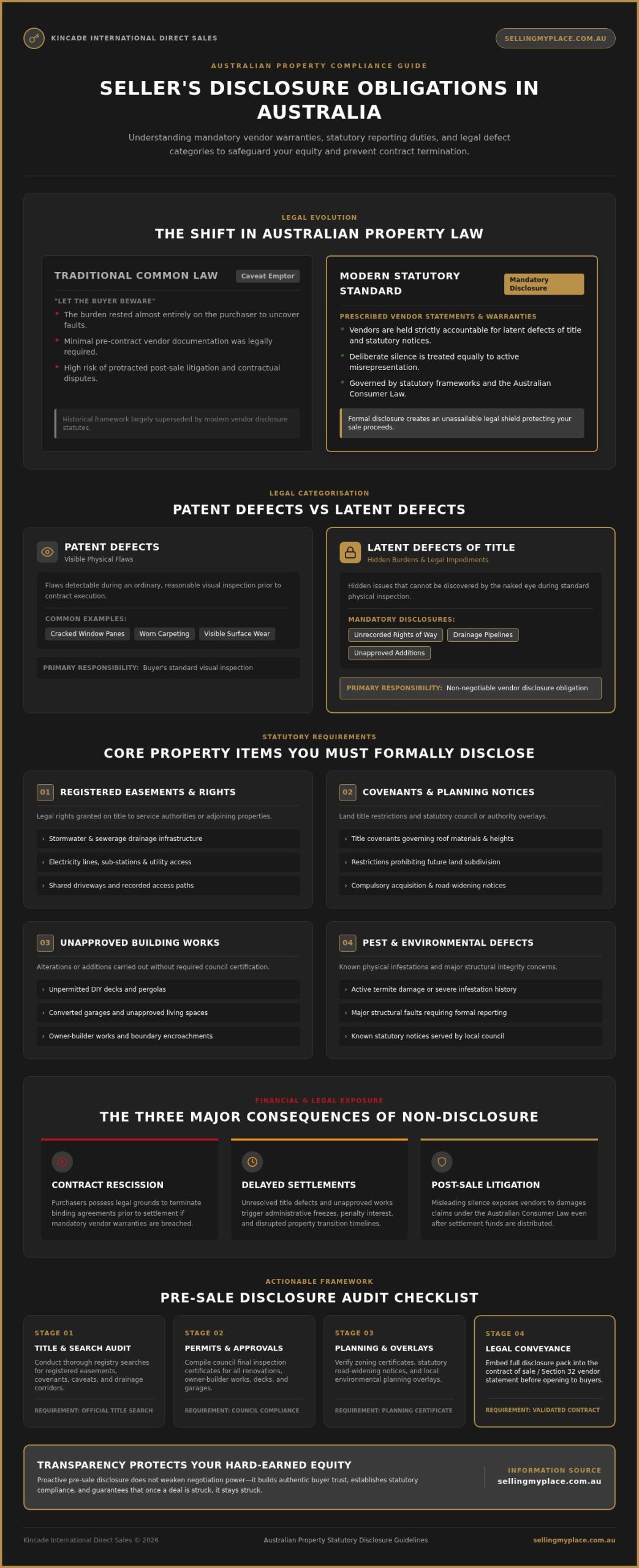
Historically, property transactions relied on the common law principle of caveat emptor, or “let the buyer beware”. Under that traditional doctrine, the burden rested almost entirely on the purchaser to uncover property faults. Today, comprehensive Vendor disclosure laws in Australia have shifted that balance. Modern legislation requires sellers to prepare formal disclosure documentation, such as a vendor statement or prescribed disclosure pack, alongside the standard contract. Meeting your seller’s disclosure obligations Australia wide does not compromise your bargaining position; upfront honesty builds genuine buyer trust and insulates you against costly post-contract disputes.
The Shift from Caveat Emptor to Mandatory Vendor Warranties
Prospective purchasers still carry a responsibility to conduct practical building and pest inspections, but they are no longer left entirely to their own devices. Contemporary property legislation holds vendors accountable for latent defects of title, unapproved structural alterations, and non-compliant building works. Under Australian legal standards, deliberate silence is treated just as seriously as active misrepresentation. Choosing not to disclose a known statutory notice or planning defect can unravel an agreement just as quickly as stating an outright falsehood.
Key Statutory Instruments Governing Australian Property Sales
Across the nation, property disclosure is governed by specific legislative instruments, from formal Section 32 statements to newly established pre-contract disclosure schemes. Beyond state property legislation, the Australian Consumer Law provides an overarching framework that penalises misleading or deceptive conduct during property negotiations. Standard contracts of sale routinely feature non-negotiable statutory warranties. Engaging pre-sale property consulting alongside professional conveyance advice ensures your documentation complies with the law before you welcome your very first buyer.
What Must You Legally Disclose? The Core Property Defect Categories
Untangling your legal responsibilities begins by distinguishing between two fundamental concepts: patent defects and latent defects. Patent defects are visible physical flaws, such as cracked window panes or worn carpets, which a buyer is expected to discover during an ordinary visual inspection. In contrast, latent defects are hidden issues that cannot be spotted by the naked eye. While latent physical faults generally fall on the buyer’s private building inspectors, latent defects of title, such as unrecorded rights of way or drainage pipelines, trigger non-negotiable seller’s disclosure obligations Australia wide.
Title Encumbrances, Easements, and Planning Restrictions
Every prospective buyer has the legal right to receive clear title to your land, free of unexpected burdens. You must formally disclose:
- Registered easements: Rights granted to service providers for stormwater drains, electricity lines, or shared access paths.
- Restrictive covenants: Legal agreements on title specifying roof materials, building heights, or restrictions preventing future subdivision.
- Planning notifications: Official zoning overlays, road-widening proposals, or compulsory acquisition notices issued by local councils or road authorities.
Structural Defects, Unapproved Works, and Pest Infestations
That DIY deck or converted garage might feel like a highlight, but missing council approvals pose substantial transaction risks. Australian courts expect vendors to disclose unpermitted additions, boundary encroachments, and owner-builder works. Similarly, active termite damage or structural subsiding must not be disguised or obscured behind fresh coats of paint. Investing early in professional Pre-Sale Property Consulting allows you to audit these vulnerabilities before listing, giving you clarity on what requires rectification or formal notice.
Environmental Hazards, Flooding Overlays, and Health Risks
Australian disclosure regulations increasingly demand proactive clarity regarding environmental exposures. If your property is situated within a declared flood inundation zone or bushfire hazard overlay, statutory documentation must accurately reflect this status. Sellers are also obligated to report known loose-fill asbestos insulation or historical chemical contamination. While the industry closely studies statutory agent’s disclosure obligations around sensitive matters such as serious crime history, private sellers must also ensure no material fact is suppressed. When you want complete peace of mind about what requires declaration, reach out for specialist conveyance guidance to protect your hard-earned sale proceeds from day one.
Caveat Emptor vs Statutory Disclosure: What Happens If You Fail to Disclose?
Failing to understand the boundary between traditional buyer diligence and mandatory legal transparency can prove devastating to your sale. While purchasers are expected to inspect physical qualities, statutory legislation strictly penalises sellers who conceal legal encumbrances, unapproved additions, or statutory notices. Overlooking these items strips away your transaction security.
| Area of Responsibility | Buyer Due Diligence (Caveat Emptor) | Mandatory Seller Disclosure |
|---|---|---|
| Physical Condition | Arranging independent building and pest reports for general wear, leaks, or age. | Declaring known structural orders, illegal building works, or concealed hazards. |
| Title & Boundaries | Surveying fence alignments and checking neighbourhood amenity. | Providing clear title searches, registered easements, covenants, and leases. |
| Statutory Compliance | Verifying future zoning suitability for personal plans. | Attaching council planning certificates, pool compliance, and safety switch status. |
Contract Rescission: The Immediate Danger Before Settlement
The most immediate hazard of breaching your seller’s disclosure obligations Australia wide is contract rescission. When statutory disclosure documents contain omissions or inaccurate statements, buyers frequently hold the legal right to terminate the contract at any time before settlement. The buyer receives their entire deposit back, often with interest. You are left with collapsed moving plans, lost conveyancing outlays, and a re-listing process that damages buyer perception and weakens negotiation leverage.
Post-Settlement Damages and Misleading Conduct Claims
Even if an oversight goes unnoticed before settlement day, liability does not necessarily end at the handover of keys. Buyers discovering concealed defects post-settlement can sue for significant financial compensation or damages under consumer protection laws. State tribunals and fair trading bodies take misleading conduct claims seriously, particularly regarding unapproved structural extensions or deliberate concealment of notices. Securing specialised Conveyance Advice early ensures every declaration is completely compliant, fully shielding your family’s equity long after the settlement dust settles.
Step-by-Step Pre-Sale Disclosure Preparation: The Seller’s Audit Checklist
Preparing your legal paperwork before listing your property transforms uncertainty into calm confidence. Rather than scrambling when a prospective buyer requests the contract, working through a methodical audit checklist ensures you satisfy every aspect of your seller’s disclosure obligations Australia wide.
- Step 1: Order title searches. Confirm registered ownership, boundaries, plan numbers, and any registered easements or covenants affecting the title.
- Step 2: Collect council planning certificates. Gather official zoning documentation, building permits, and final inspection certificates for any structures built on the land.
- Step 3: Collate improvement records. Retrieve owner-builder permits, certificates of currency for home warranty insurance, and trade warranties for major additions.
- Step 4: Verify mandatory safety compliance. Test interconnected smoke alarms, ensure safety switches (RCDs) are fitted, and obtain current pool barrier certificates if applicable.
- Step 5: Draft the statutory disclosure statement. Work with your legal advisor to incorporate all mandatory certificates and disclosures into the draft contract.
Assembling Your Legal and Property Documentation Pack
A complete disclosure pack leaves no room for confusion. Request water authority diagrams showing sewer mains and drainage lines early, alongside relevant land tax clearance certificates. If your property is part of a community title or strata scheme, assemble current body corporate inspection records, capital works fund forecasts, and insurance policies. Presenting organized documentation right away signals integrity and reassures serious buyers.
Handling Known Property Imperfections with Transparent Disclosures
Draft neutral, factual summaries regarding past repairs, minor boundary discrepancies, or historical issues. Being transparent about known defects prevents buyers from weaponizing building inspection discoveries to slash their offers later. Pairing open disclosure with sound Market Valuation Principles grounds your price expectations and keeps negotiations running smoothly.
Working with Conveyancers and Legal Advisors Early
Engage a conveyancer or property solicitor before marketing photography commences. Your legal partner verifies that mandatory statutory annexures and special conditions protect your interests. Confident documentation strengthens your position during discussions; explore our guide to Sale Negotiation Strategies to see how solid contracts lead to clean deals. To ensure your paperwork is watertight before launching your campaign, contact our team for dedicated conveyance advice.
Safeguarding Your Sale: How Professional Advisory and Conveyancing Protect Your Equity
Selling your home independently doesn’t mean standing alone against legal complexities. Taking charge of your own sale gives you genuine clarity and direct oversight across every stage of the transaction. When you blend professional listing presentation with sound legal advisory, satisfying your seller’s disclosure obligations Australia wide becomes a smooth, orderly milestone rather than a source of stress.
The Power of Independent Selling Supported by Expert Advisory
A common myth suggests that selling without a traditional agent heightens your legal vulnerability. In reality, traditional commission agents aren’t legal practitioners; their focus is closing a deal, not conducting forensic documentation audits. Partnering with dedicated real estate advisory services equips you with steady, step-by-step guidance when handling buyer inquiries and presenting mandatory documentation. Bringing in Pre-Sale Property Consulting early pinpoints potential compliance red flags, such as missing permits or uncertified safety fixtures, well before a buyer’s building inspector sets foot on the property.
Retaining Full Equity Without Sacrificing Contract Security
Surrendering substantial portions of your home’s equity to traditional agency commissions isn’t required to achieve an airtight, premium transaction. Transparent flat-fee models empower homeowners to showcase their property across leading real estate channels while keeping 100% of their net sale profits. You gain top-tier photography, floorplans, and national buyer reach, all supported by the rigorous conveyance advice needed to ensure statutory compliance.
Proactive preparation eliminates the fear of contract rescission and positions you for calm, authoritative discussions with serious purchasers. When you’re ready to take control of your property journey and secure your equity, connect directly with Kincade International Direct Sales to finalise your legal paperwork and launch your market-ready campaign with complete peace of mind.
Selling with Total Confidence: Protect Your Equity from Day One
Preparing your property for the market is about honouring your home’s story while establishing a clean, legally secure transaction. Meeting your seller’s disclosure obligations Australia wide does not just keep your contract watertight; it establishes genuine buyer trust, prevents last-minute settlement hurdles, and keeps you in complete control from the first inspection through to key handover.
You don’t need to surrender your hard-earned equity to traditional agency commissions to achieve thorough legal protection. Our transparent flat-fee listing model keeps 100% of your sale profit right where it belongs. Supported by comprehensive pre-sale property consulting that pinpoints compliance risks early, our dedicated agent advisory service provides tailored conveyance advice nationwide.
Protect your hard-earned equity and ensure complete legal compliance by booking your Pre-Sale Property Advisory Consultation today. Take this exciting next step with absolute clarity, knowing your property sale rests on unshakeable ground.
Frequently Asked Questions
Can a buyer pull out of an Australian property contract if I fail to disclose an easement?
Yes, a buyer can generally terminate the contract before settlement if you fail to disclose a registered easement. Easements affect property usage and legal title, making them mandatory disclosure items. If undisclosed, buyers can exercise statutory rescission rights, retrieve their deposit in full, and potentially seek compensation for wasted legal expenses. Ensuring all title encumbrances are accurately annexed to your draft contract avoids this costly disruption.
What is the difference between a latent defect and a patent defect in property law?
Patent defects are readily noticeable physical flaws discoverable through ordinary visual inspection, such as cracked window panes or visible surface damage. Latent defects are hidden issues that cannot be identified through standard viewing, such as structural issues behind plaster, unapproved drainage, or buried encumbrances. While buyers inspect physical condition, fulfilling your seller’s disclosure obligations Australia wide requires transparent declaration of latent defects affecting title, safety, or legal compliance.
Do I need to disclose unapproved renovations or DIY building works when selling my home?
Yes, you must declare unapproved structural alterations, extensions, or unpermitted building additions to prospective purchasers. Local councils enforce strict compliance standards, and transferring a home with illegal modifications exposes the incoming buyer to formal rectification orders. Failing to declare these works can entitle buyers to terminate the agreement before settlement or sue for rectification costs. Conducting early pre-sale property consulting helps you identify and document these additions safely.
Is it mandatory to disclose past termite damage if the infestation has been fully treated?
While past pest activity that caused no structural harm rarely triggers statutory title disclosures, concealing known damage or misleading buyers is strictly unlawful. If historical activity caused structural deterioration or if a buyer asks direct questions about pest history, hiding that reality invites legal action for misrepresentation. Providing historical treatment certificates alongside an open seller declaration builds buyer confidence and eliminates the threat of protracted post-settlement disputes.
What happens if a property defect is discovered between contract exchange and settlement?
The outcome depends on whether the defect breaches a statutory vendor warranty or a specific contractual condition. If you failed to reveal a mandatory legal defect, such as an unapproved structure or statutory council notice, the buyer may have the lawful right to rescind the contract immediately. For minor physical damage occurring after exchange, the buyer cannot easily terminate but may negotiate an agreed repair or price adjustment prior to settlement.
Are seller disclosure obligations identical across every Australian state and territory?
No, statutory disclosure regimes vary substantially between jurisdictions. Some regions operate under strict pre-contract disclosure schemes requiring formal vendor disclosure packs, while others place greater emphasis on material facts or formal Section 32 statements. Despite these procedural differences across borders, navigating seller’s disclosure obligations Australia wide fundamentally requires proactive honesty. Engaging dedicated conveyance advice ensures your contract documents comply with the exact legislation governing your property’s sale.
Can I sell my property privately and still satisfy all legal disclosure requirements?
Absolutely, selling your home directly does not alter your statutory disclosure responsibilities or diminish your legal protections. Private sellers are bound by the same property legislation as traditional agents, but retain total control over the process. By combining commission-free listing platforms with professional real estate advisory services and conveyance advice, you ensure all mandatory searches, title certificates, and vendor declarations are completely compliant while saving your hard-earned equity.
Using Property Market Reports to Price Smarter in 2026
What if the difference between a record-breaking sale and a property that sits idle isn’t the colour of your kitchen splashback, but how you interpret a few lines of data? In 2026, the market is moving at a unique pace; with median days on market averaging 49 days, the sellers who succeed look beyond the glossy photos. It’s natural to feel overwhelmed when you first learn how to use a property market report, especially when faced with spreadsheets that feel more like homework than a helping hand. You want to honour your home’s history while making a savvy financial move, but the fear of mispricing your asset is a heavy weight to carry.
We understand that selling is a major life transition, not just a transaction. This article will help you turn raw data into a strategic pricing roadmap, giving you the confidence to set a competitive asking price. We’ll explore which data points truly drive value and how to use this evidence to justify your price to buyers. By the end, you’ll have the tools to be your own expert, ensuring you keep every cent of your profit. Whether you are looking for stability or a fresh start, we are here to provide the steady hand you need.
Key Takeaways
- Move beyond guesswork by learning how to anchor your sale in professional-grade data that reflects the actual state of the 2026 market.
- Discover exactly how to use a property market report to decode metrics like Days on Market, ensuring you set a price that attracts genuine interest from day one.
- Master the ‘Rule of Three’ to find perfect comparable properties, helping you build a data-backed justification for your home’s unique value.
- Learn to create an ‘Evidence Bundle’ that empowers you to handle negotiations with calm confidence and successfully defend your price against low-ball offers.
- Understand how to leverage professional neighbourhood insights to bypass expensive commissions and keep more of your hard-earned equity in your own pocket.
Understanding the Power of a Property Market Report
A property market report is a sophisticated synthesis of historical sales, current listings, and broader suburb trends. Think of it as a bridge between the emotional value you place on your family home and the practical reality of what a buyer is willing to pay. While many people think these documents are just for buyers looking for a bargain, sellers actually need this data far more in the current 2026 market. With the market often described as being in a “holding pattern” as we watch interest rate decisions, having a clear view of Understanding Real Estate Economics is vital to your success.
Data provides a “steady hand” during what is naturally an emotional process. It moves you away from the stress of “gut feel” and into a position of calm confidence. You might have seen Automated Valuation Models (AVMs) online; those quick, computer-generated estimates that often vary by tens of thousands of dollars. While they are a starting point, they lack the nuance of a professional report. A professional document provides a strategic roadmap rather than a random guess, ensuring you don’t leave money on the table or scare off buyers with an unrealistic figure.
The Anatomy of a Modern Property Report
A truly useful report goes beyond a simple price range. It breaks down the sales history of your immediate area, identifies comparable properties, and analyses suburb demographics. One of the most critical things to remember is that “Sold” data is significantly more valuable than “Asking Price” data. An asking price is often a reflection of a seller’s hope; a sold price is a reflection of market truth. Most high-quality reports draw from professional-grade digital infrastructure like RP Data or CoreLogic, which are the same tools used by the country’s top-tier agencies and official government records.
Breaking the ‘Agent Myth’
For a long time, there was a belief that only real estate agents held the “secret” keys to market data. That simply isn’t true anymore. Transparency is the future of Australian real estate. By accessing these same professional insights, you can accurately determine the market value of a home in Australia without needing a traditional agent. Learning how to use a property market report allows you to act as your own expert. It removes the need for expensive commissions and puts the power back into your hands, where it belongs. You aren’t just selling a house; you’re managing a major life transition with the best evidence available.
Decoding the Data: Key Metrics Every Seller Must Know
Looking at a spreadsheet for the first time can feel a bit like reading a different language. However, once you grasp the core metrics, the fog starts to lift. Learning how to use a property market report begins with the Median Suburb Price. It’s a helpful benchmark for your general area, but please don’t treat it as a bible for your specific home. Your property has its own soul and unique features; a median price doesn’t account for that stunning new deck or the quietness of your particular street.
Then we have Auction Clearance Rates and Vendor Discounting. These metrics reveal the “heat” of the local market. If clearance rates are high, an auction might be your best bet to drive competition. On the flip side, vendor discounting tells you how much other sellers are dropping their prices to get a deal across the line. If you notice discounting is on the rise, it’s a signal to be more realistic with your initial figure. It’s about being proactive rather than reactive. If you’re feeling stuck on these numbers, our team is always happy to discuss your specific report.
Reading Between the Lines of ‘Days on Market’
Days on Market (DOM) is perhaps the most telling indicator of buyer urgency. A short DOM suggests a “seller’s market” where buyers are tripping over themselves to sign a contract. A long DOM, perhaps approaching the 2026 average of 49 days seen in similar global markets, often points to a “cooling” phase. This metric carries a heavy psychological weight. When a property sits on the market for too long, buyers begin to wonder if something is wrong, even if the house is perfect. Knowing how to use a property market report allows you to identify these shifts before the evening news catches up.
Supply and Demand Indicators
You also need to look at stock levels. Are you competing with five other homes or fifty? High stock levels mean you need to work harder to stand out, perhaps through better photography or more flexible viewing times. Don’t forget about rental yields, either. Even if you’re selling to a family, high yields attract investors, which broadens your pool of potential buyers and adds another layer of demand. Sometimes, a “micro-market” trend might emerge where houses on one side of a park sell faster than the other. These tiny details are what turn a standard sale into a strategic success, helping you protect your family’s future wealth.
From Data to Dollars: Setting Your Asking Price
Now that you’ve grasped the core metrics, it’s time to translate those numbers into a figure that works for your family’s future. Selecting your “comps,” or comparable properties, is where the art meets the science. You aren’t just looking for any house that sold nearby; you are looking for three to five properties that mirror your own in land size, bedroom count, and the quality of the finish. This is the heart of how to use a property market report effectively. It allows you to move past the generic estimates of a computer and into a “Street-Smart” valuation that reflects the real world.
We often recommend the “Rule of Three” when analysing these comps. Look at three recently sold homes to see what buyers actually paid, three currently listed homes to see who you’re competing against, and three failed listings. Those failed listings are often the best teachers; they show you exactly where the market said “no” to a price. While it’s tempting to add a 5% “buffer” to your price for negotiation room, this can often lose you money. In a market where 24.5% of homes might sell above list price if priced correctly, an unrealistic starting point can make your home go stale, leading to a lower eventual sale price than if you’d been sharp from day one.
The Comparison Framework
When matching your home to others, be honest about the “X-Factor.” Does your neighbour have a better view? Is your kitchen renovation more modern? You must adjust your price up or down for these differences. It’s also vital to ignore “outlier” sales, such as a property sold to a developer at a massive premium that doesn’t fit the local pattern. By filtering this data accurately, you gain the upper hand to sell your own home with a genuine competitive edge. You become the most informed person in the room, which is a very powerful place to be.
The ‘Sweet Spot’ Strategy
Psychological pricing plays a huge role in how buyers search online. There is a significant difference between listing at $995,000 and $1,000,000, as it often places you in different search result brackets. Testing the market is a dynamic process; if your report feedback suggests buyer interest is low after the first two weeks, you must be prepared to review your position. Ultimately, true market value is the quiet intersection where hard data meets the emotional spark of a buyer who can finally see their future in your hallway.

Using Your Report as a Negotiation Tool with Buyers
Negotiation can often feel like a high-stakes standoff, particularly when it’s your own family home on the line. However, knowing how to use a property market report as a communication tool changes the dynamic entirely. Instead of a “he said, she said” scenario, you can present a serious buyer with what we call an Evidence Bundle. This is essentially a curated selection of the data you’ve already analysed, shared openly to build trust. When a buyer sees that your price isn’t just a hopeful number but is anchored in actual sold data, the conversation shifts from conflict to collaboration.
This transparency is your best defence against a low-ball offer. If a buyer suggests a figure well below your asking price, you don’t need to get defensive or emotional. You simply point to the “Sold” section of your report. You might say, “I understand you’re looking for a bargain, but the data shows three similar homes on this street sold for a higher price per square metre in the last quarter.” It’s about maintaining a steady hand and letting the evidence do the heavy lifting for you. If you need a hand preparing this data, you can always reach out to our advisory team for a chat.
Handling Objections with Facts
Buyers in 2026 are often cautious, sometimes citing headlines about “market crashes” to justify a lower bid. This is where your clearance rate data becomes invaluable. If your local clearance rates are holding steady, you can gently correct their assumption with local facts rather than opinions. Similarly, if you are justifying a premium price for a premium position, use the land value data in your report to show the scarcity of your block size. Combining these hard facts with proven property sale negotiation tips allows you to stay in control of the narrative without ever sounding pushy.
Creating a Transparent Sales Environment
There is a quiet power in being a “Smarter Seller” rather than a traditional salesperson. When you show a buyer the low stock levels in your neighbourhood market report, you aren’t manufacturing urgency; you are simply showing them the current reality of supply and demand. Buyers are far more likely to sign a contract when they feel they have all the information. By explaining how to use a property market report to them, you position yourself as a trusted guide. It’s a neighborly approach that says: “The data supports this price, and here is why.” This level of honesty often reduces the stress for both parties and leads to a much smoother transition for everyone involved.
Maximising Your Profit with Professional Neighbourhood Market Reports
While generic online estimates can provide a rough starting point, they are often a blunt instrument in a market that requires a scalpel. These automated tools use broad algorithms that simply cannot account for the subtle nuances of Australian residential homes, such as the quietness of a particular cul-de-sac or the bespoke quality of a recent renovation. This is where a professional neighbourhood market report proves its worth. By using the same professional-grade digital infrastructure as the country’s top agencies, you ensure your pricing strategy is built on solid ground rather than digital guesswork.
The KIDS Advantage
Our Residential Property Listing Services are designed to bridge the gap between high-level data and global marketing. By choosing a flat-fee model, the average seller saves $20,000 in commissions that would otherwise eat into their family’s equity. We believe this is the most protective way to sell; it allows you to keep 100% of your hard-earned profit while still accessing the professional tools usually reserved for traditional agencies. It’s about empowering you to be the expert of your own home, backed by a team that values your legacy as much as you do.
Data is a powerful map, but sometimes you need a guide to help you read the terrain. That’s why we include an Expert Agent Advisory Service to help you interpret your specific report. Whether you’re unsure about a particular comparable sale or need to refine your “sweet spot” price, having a seasoned professional to talk to provides that essential steady hand. Learning how to use a property market report becomes much simpler when you have a partner who can help you spot the micro-market trends that others might miss.
Your Next Steps to a Successful Sale
Before your property goes live on the global market, it’s helpful to run through a final check to ensure your data and presentation are perfectly aligned. Taking control of your equity means being prepared for every buyer interaction with confidence and clarity. Here is a brief roadmap for your next steps:
- Request your professional neighbourhood market report to get the most recent “Sold” data.
- Organise professional photography and floorplans that highlight the features your data-backed price reflects.
- Review your comparable sales once more to ensure they are within the last six months.
- Prepare your “Evidence Bundle” so you can show buyers exactly how to use a property market report to understand your home’s value.
By following this methodical approach, you aren’t just putting a sign in the ground. You are launching a strategic campaign that celebrates your home’s history while securing your financial future. It’s a celebratory moment, and we’re here to ensure you feel supported every step of the way.
Taking the Next Step Toward Your Successful Sale
Selling your home is more than a simple trade; it is the closing of one chapter and the hopeful start of another. By now, you understand that a successful sale in 2026 relies on more than just luck or a “gut feeling”. It requires a strategic alignment with the market truth found in your data. Mastering how to use a property market report gives you the upper hand, allowing you to defend your price with evidence and negotiate with a sense of calm authority. You’ve learned how to filter out the noise of generic estimates and focus on the “Sold” data that truly reflects your home’s worth.
You don’t have to walk this path alone. You can maximise your profit and sell smarter with a KIDS flat-fee package today. Our service ensures you keep 100% of your sale profit while providing the professional neighbourhood market reports and expert advisory support you need at every step. This is your opportunity to take control of your equity and move forward with total peace of mind. We are here to provide the steady hand you deserve as you step into your next adventure.
Frequently Asked Questions
How accurate are free online property valuation reports in Australia?
Free online reports, often called Automated Valuation Models, are general estimates based on broad algorithms. They can vary significantly because they don’t account for the “X-factor” of your specific home, such as a high-quality renovation or a quiet street position. A professional neighbourhood market report is much more reliable. It uses agency-grade digital infrastructure and historical sold data to give you a clearer picture of your home’s actual value in the 2026 market.
What is the difference between a market report and a bank valuation?
A market report reflects what a buyer might pay based on comparable sales and current trends. A bank valuation is a conservative assessment used for lending risk. Banks often value properties lower than the market price to protect their own mortgage interest. In contrast, a market report helps you set a strategic asking price to maximise your profit. It focuses on the potential sale price rather than just a minimum security value.
Should I share my property market report with potential buyers?
Sharing a report can build trust and transparency with serious buyers. It creates an “Evidence Bundle” that justifies your asking price. When buyers see the data you used, they feel more confident that your figure isn’t just a guess. Learning how to use a property market report as a negotiation tool helps you counter low-ball offers by showing the reality of recent local sales in a professional, non-confrontational way.
How often should I update my property market research during a sale?
You should update your research every 30 days or if a major economic shift occurs, such as an interest rate change. In 2026, the market can shift quickly. Keeping your data fresh ensures you aren’t basing your decisions on outdated sales that no longer reflect current buyer sentiment or stock levels. Regular updates allow you to stay proactive and maintain a “steady hand” throughout the entire sale process.
What are ‘comparable sales’ and how many do I need?
Comparable sales are properties similar to yours in land size, bedroom count, and quality that sold within the last six months. We recommend finding three to five properties that closely mirror your home. This gives you a statistically significant sample size to accurately determine your property’s value. It ensures your pricing isn’t skewed by a single outlier sale, providing a much more reliable foundation for your own sale by owner strategy.
Can a property report help me decide whether to sell by auction or private treaty?
Absolutely. By looking at auction clearance rates in your report, you can gauge the “heat” of the local market. High clearance rates suggest an auction might drive healthy competition. Conversely, if clearance rates are low, a private treaty allows more time for thoughtful negotiation. Your report provides the evidence needed to choose the most effective sale method for your specific circumstances, helping you feel supported and in control.
Why is the ‘median price’ in my report different from what I think my home is worth?
The median price is the middle point of all sales in an area, meaning it includes everything from unrenovated cottages to luxury builds. It is a benchmark for the suburb’s general performance, not a specific valuation of your home. Understanding how to use a property market report involves looking beyond the median to find the specific “comps” that match your home’s unique features, lifestyle appeal, and the legacy you have built there.
What happens if the report data contradicts my expectations?
If the data is lower than expected, it’s a signal to review your strategy before going live. It might mean the market has cooled or your expectations were based on outdated figures. Using a professional report allows you to adjust your price proactively. This prevents your home from sitting on the market too long and becoming “stale” in the eyes of buyers. It’s about making informed decisions that protect your family’s future equity.
How to Maximise Your Property Sale Price: The 2026 Australian Seller’s Guide
What if the secret to a record-breaking home sale wasn’t about finding the right agent, but about reclaiming the equity you’ve worked decades to build? Knowing how to maximise property sale price in 2026 requires a shift in perspective, moving away from traditional commission models that can quietly erode your hard-earned profit. With the national median real estate commission sitting at approximately 2.65 per cent, many Australian families are understandably anxious about losing a significant portion of their wealth just as they’re preparing for their next big chapter.
We understand that selling your home is about much more than a simple transaction; it’s the culmination of years of memories and a foundation for your future stability. It’s perfectly normal to feel some uncertainty about which renovations truly add value or how to present your home to stand out. This guide offers a clear, strategic framework to elevate your property’s value through professional presentation and smarter marketing. You’ll discover how to maintain a steady hand throughout the process, ensuring a smooth transition while keeping one hundred per cent of your sale profit. We’ll walk through the essentials of high-end photography, the power of accurate floorplans, and the professional advisory steps that lead to a truly exceptional result.
Key Takeaways
- Focus on your net sale price rather than just the offer figure to ensure high commissions don’t eat into your hard-earned equity.
- Discover how to maximise property sale price by prioritising a digital-first presentation that includes professional photography and high-definition floorplans.
- Understand the critical importance of the first 14 days on the market and why data-driven pricing beats relying on a gut feeling.
- Learn to maintain a steady hand during negotiations, giving you the confidence to decline low-ball offers while keeping serious buyers interested.
- Explore how a flat-fee marketing model provides the same global reach and professional tools as traditional agencies while saving you an average of $20,000.
Beyond the Offer: Understanding Net Profit and the Commission Trap
When you see a ‘Sold’ sticker on a signboard, it’s easy to get swept up in the headline figure. However, the number that truly dictates your next move is the net sale price. This is the final amount that lands in your bank account after every cost, fee, and tax has been settled. If you are exploring how to maximise property sale price, you must look beyond the offer and focus on your equity. The Commission Trap is the loss of equity to percentage-based fees that remain high regardless of the actual effort or time an agent spends on your sale.
The Real Math of a Property Sale
A typical sale involves several layers of expense that can quickly stack up. There is the marketing campaign, legal fees for conveyancing, and the agent’s commission. With the national median commission sitting at 2.65 per cent in 2026, a family selling a house for $800,000 could be looking at over $21,000 in commission alone, plus GST. A big part of this process involves understanding property valuation and how it differs from a purely emotional price tag.
This is why many savvy Australians are shifting toward a 0 per cent commission mindset. By choosing a flat-fee model, sellers are saving an average of $20,000 per sale. Visualise that extra $20,000 as part of your next home deposit or a boost to your retirement nest egg. It’s about protecting your legacy rather than funding an agent’s marketing. When you keep your equity, you’re not just making a sale; you’re securing your family’s future.
Shifting from Transactional to Strategic Selling
You’ve lived in the home. You know where the morning light hits the breakfast nook and which local park is best for a weekend stroll. This emotional intelligence is a powerful tool that no external agent can truly replicate. When you represent your own home, you’re not just selling bricks and mortar; you’re sharing a lifestyle. You are the expert on your own home’s story.
By moving away from a transactional approach, you can maintain a professional centre of operations for your sale. Professional advisory services now provide the technical support once exclusive to traditional agents. This setup ensures you have a steady hand to guide you through the complexities of the market while you remain the primary voice for your property. It’s a partnership that values your family’s needs over a quick result, helping you learn how to maximise property sale price through genuine connection and professional presentation.
The Visual Edge: Professional Presentation That Drives Premium Offers
Your digital storefront has officially replaced the traditional kerb appeal as the most critical factor in a successful sale. In 2026, a buyer’s journey doesn’t begin at your front gate; it starts with a thumb-scroll on a smartphone. This “First Click” psychology means you have roughly three seconds to capture a buyer’s imagination. Learning how to maximise property sale price begins with understanding that your online listing is a high-stakes invitation into a future lifestyle. While you focus on the visual appeal, remember that a higher sale price also interacts with your Australian taxation obligations for sellers, making it vital to protect your equity through smart presentation choices.
Why Professional Photography is an Investment, Not a Cost
Professional photography is the engine room of your marketing strategy. High-quality images, particularly those captured during the “golden hour” when Australian light is at its softest, can significantly increase digital engagement. It isn’t just about documenting rooms; it’s about capturing the soul of the home. A professional lens highlights the texture of your stone benchtops and the way light spills across the timber floors, creating an emotional hook that stock-standard photos simply miss. If you’re unsure where to start with your home’s presentation, a quick chat about tailored pre-sale advice can provide the clarity you need.
The Floorplan Factor: Helping Buyers Visualise Their Future
Modern buyers are analytical. They want to know if the third bedroom can double as a quiet home office or if the kitchen flows naturally to the alfresco area. Integrating accurate floorplans into your listing allows potential purchasers to “move in” mentally before they even book an inspection. This transparency builds trust and filters for the most serious enquiries, saving you time and energy. It’s a simple tool that demonstrates the true flexibility of your floor space, which is a key driver in how to maximise property sale price.
Preparing for the Camera: A Premium Checklist
To achieve a high-end look, your home needs to feel like a sanctuary. This involves strategic visual storytelling that highlights hidden value, such as ample storage or premium finishes. Use this room-by-room approach to ensure your property is camera-ready:
- Kitchen: Clear all appliances from benchtops, add a single bowl of fresh citrus or a bunch of herbs for a pop of colour.
- Living Areas: Plump all cushions, remove personal photographs, and ensure rugs are perfectly aligned.
- Bedrooms: Use crisp, neutral linen and ensure all bedside lamps are working to create a warm, inviting glow.
- Outdoor Spaces: Pressure-wash the paths, trim the lawn edges, and set the outdoor table to suggest a relaxed weekend lunch.
By treating your home as a professional set, you’re not just selling a house; you’re offering a dream that buyers are willing to pay a premium to secure.
Data-Driven Pricing: Mastering Market Reports for a Record Result
While professional photography and floorplans draw the eye, it’s the data that ultimately seals the deal. Many owners rely on a gut feel based on what they believe their home is worth, but this can be a costly mistake in a fluctuating market. To truly learn how to maximise property sale price, you need to lean on cold, hard facts rather than emotional attachment. Neighbourhood Market Reports provide a clear window into what buyers are actually paying right now, allowing you to find that sweet spot where value meets demand.
Analysing comparable sales correctly is an art form. It’s not just about the number of bedrooms; you must consider the land size, the home’s orientation to the sun, and the quality of internal finishings. Does your kitchen have stone benchtops or laminate? Is the backyard north-facing? These details matter. Start your journey by securing a free property value estimate to establish a realistic baseline for your strategy. This ensures you enter the market with a steady hand and a clear head.
Understanding the 2026 Market Dynamics
In 2026, interest rates and local supply levels play a significant role in buyer sentiment. If there are several similar homes on the market in your area, your pricing must be sharper to stand out. We often suggest an Anchor Pricing strategy. This involves setting a price that feels accessible enough to invite competition, which frequently drives the final result higher than a static, premium-only price tag. Identifying your target buyer profile, such as young families or downsizers, allows you to price the home in a way that resonates with their specific budget and lifestyle aspirations.
Leveraging Professional Advisory Services
It’s understandably difficult to be objective about a home where you’ve built a life. This is where a professional Agent Advisor becomes your greatest asset. They provide the necessary distance to make rational decisions, acting as a nurturing guide through the complexities of the sale. Pre-sale consulting can pinpoint exactly which repairs will offer the highest return on investment, ensuring you don’t spend money on renovations that buyers won’t value. By listening to real-time feedback from initial enquiries, you can adjust your position quickly. This is vital because the first 14 days on the market are when buyer interest is at its absolute peak; if you overprice during this window, you risk your listing becoming stale, which is the opposite of how to maximise property sale price.
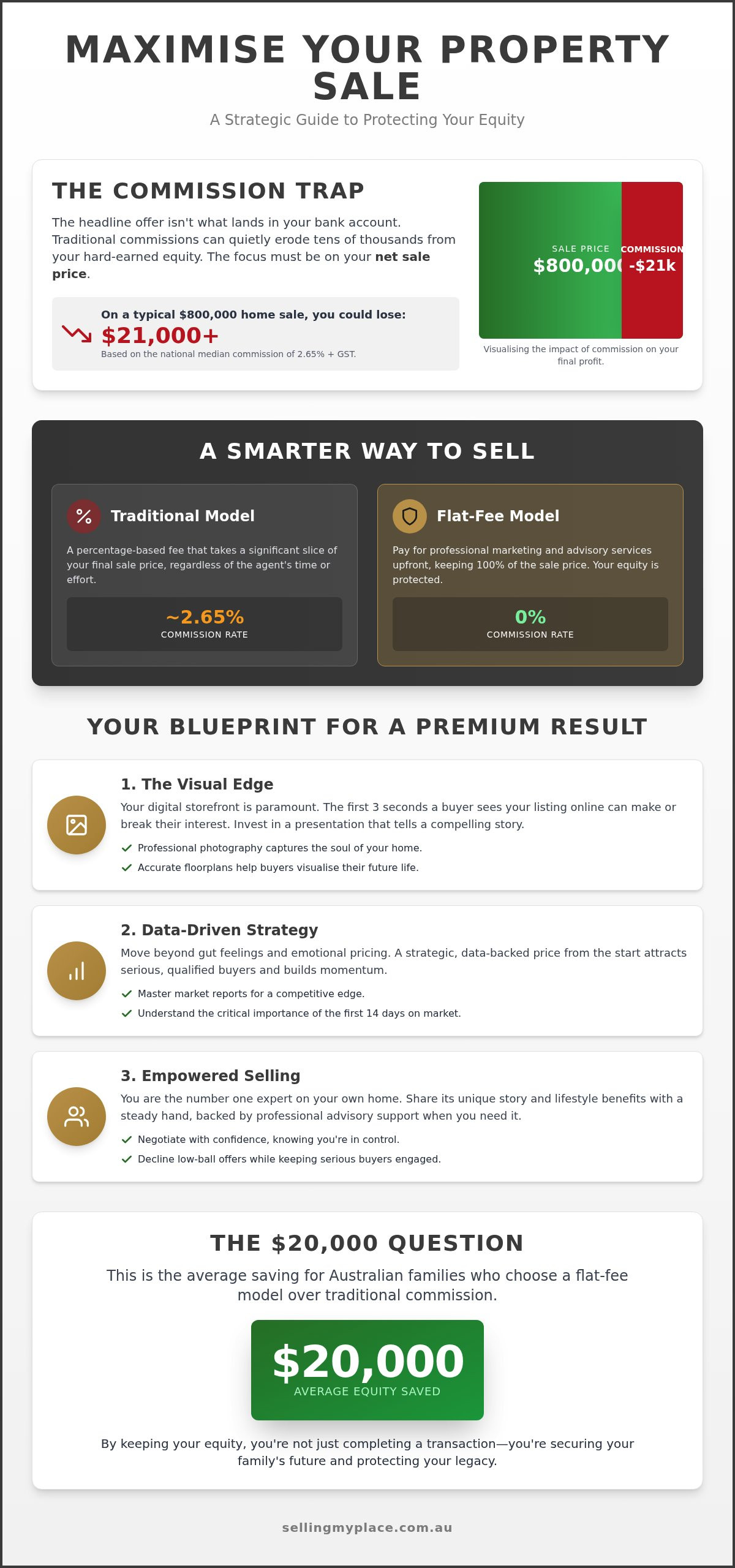
The Art of the Deal: Negotiation Tactics for Independent Sellers
Negotiation often feels like the most daunting part of the process, but it’s actually where your deep connection to the home becomes your greatest strength. To understand how to maximise property sale price, you must learn to separate your emotional memories from the financial transaction. By staying the “steady hand” during offers, you project a sense of calm confidence that reassures buyers and protects your position. It’s about being firm on value while remaining warm and accessible in your communication.
One of the most powerful tools in your kit is the word “No.” It might feel counterintuitive, but declining a low-ball offer doesn’t have to mean losing the buyer. Instead, it’s an opportunity to re-anchor the conversation to the data-driven value you’ve already established. If you need more granular strategies for these high-stakes moments, our property sale negotiation tips offer deep-dive tactics to help you navigate every counter-offer with ease.
Handling Enquiries and Filtering Buyers
Not every enquiry leads to a contract, and that’s perfectly fine. Your goal is to identify the most serious contenders early on so you can focus your energy where it matters most. Start by asking gentle, qualifying questions: “Has your finance been pre-approved?” or “What is your ideal settlement timeframe?” These conversations help you filter out the “tyre-kickers” while building genuine rapport. It’s about being the helpful, local expert without oversharing. If a buyer seems hesitant, a proactive follow-up call a few days after an inspection can often turn a “maybe” into a formal offer.
Closing the Sale: From Offer to Settlement
Once an offer is on the table, creating a gentle sense of urgency can help bring things to a head. Using “best and final” deadlines when you have multiple interested parties ensures everyone puts their best foot forward. After the price is agreed, the focus shifts to the technicalities. Professional conveyance advice is essential here to ensure your contract is legally sound and protects your hard-earned equity. Managing building and pest inspection results with confidence is also key; don’t let a minor maintenance issue derail your result. If you’re feeling overwhelmed by the back-and-forth, reach out for professional advisory support to ensure every detail of your sale is handled with care. This methodical approach ensures a smooth transition to settlement, allowing you to move forward with total peace of mind.
Empowered Selling: How Kincade International Direct Sales Maximises Your Equity
For many Australian families, the choice often feels like a compromise between a “cheap” private sale and an expensive agency experience. We believe you shouldn’t have to choose. The KIDS philosophy is built on the idea that every homeowner deserves access to professional tools and a global reach without the burden of a percentage-based commission. By providing a flat-fee marketing infrastructure, we empower you to take control of your future. Learning how to maximise property sale price is ultimately about combining your local heart with our global digital network, ensuring your home is seen by the right buyers at the right time.
One of the most significant advantages of this approach is the “Listed Until Sold” benefit. Traditional agents often push for a quick result to meet their own monthly targets, which can lead to unnecessary pressure to drop your price. With our model, there are no arbitrary time limits or mounting costs. You have the freedom to wait for the offer that truly reflects your home’s value, allowing you to maintain a steady hand throughout the entire process. Your property is positioned on a global stage through an integrated digital network that mirrors the marketing power of any premium agency, but with the equity staying exactly where it belongs: in your bank account.
A Partnership, Not a Commission
We see our role as a dedicated partner in your transition. Our Agent Advisory Service is designed to support you through every complex decision, from interpreting market data to navigating the final stages of a contract. We provide professional photography and high-definition floorplans that make your listing indistinguishable from an agent-led sale, ensuring you capture that critical “First Click” we discussed earlier. When you consider the average saving of $20,000 per sale, it becomes clear why sale by owner is becoming the smartest financial move for modern Australians who value their legacy and financial independence.
Taking the Next Step Toward Your Sale
Getting started is a straightforward process that begins with choosing a marketing package tailored to your needs. You’ll receive the same high-end presentation tools and professional advisory support used by the country’s top-performing listings. There is a profound sense of peace of mind that comes from knowing you are protected by a commission-free structure. You’ve done the hard work of maintaining and loving your home; now it’s time to ensure you reap the full rewards of that effort. If you’re ready to learn more about how to maximise property sale price while protecting your hard-earned equity, we’re here to guide you every step of the way. Enquire today to see how much commission you could save.
Securing Your Legacy and Your Next Big Chapter
Selling your home is a significant life transition, and it’s one you shouldn’t have to navigate with the weight of high commissions pulling at your profit. By focusing on professional-grade presentation and data-driven pricing, you’ve already taken the most important steps in learning how to maximise property sale price. The true measure of success isn’t just the figure on the contract; it’s the net equity that remains in your pocket once the dust has settled. Protecting that hard-earned wealth allows you to step into your next adventure with total financial confidence.
You don’t have to do this alone. With the support of our expert Agent Advisory Service, professional photography, and detailed floorplans, you can achieve a record-breaking result while saving an average of $20,000 in commissions. This partnership-based approach ensures you remain the steady hand in your sale while enjoying the global reach of a premium marketing infrastructure. It’s time to claim the full value of your home and your hard work. Maximise your sale profit with our commission-free listing packages and start your journey today. Your future self will certainly thank you for the extra equity.
Frequently Asked Questions
How much can I actually save by not using a traditional real estate agent?
You can save an average of $20,000 by choosing a flat-fee model over a traditional commission-based agent. Since the national median commission in Australia for 2026 is approximately 2.65 per cent, the costs of selling a standard family home can quickly escalate into the tens of thousands. By eliminating the percentage-based fee, you keep one hundred per cent of your sale profit. This extra equity provides a significant boost for your next deposit or retirement plans.
Will buyers be put off if I am selling the property myself?
Buyers are rarely put off by a direct sale if the listing is presented professionally. In fact, many purchasers appreciate the opportunity to speak directly with the person who knows the home’s history and lifestyle benefits best. When you utilise professional photography and floorplans, your listing is indistinguishable from one led by a traditional agency. This professional edge builds immediate trust and ensures that the focus remains entirely on the value of your property.
How do I know what my house is worth without an agent’s appraisal?
You can determine your home’s value by utilising comprehensive Neighbourhood Market Reports and data-driven property estimates. These reports look at actual recent sales of comparable properties in your area, considering land size, orientation, and internal finishes. Our Agent Advisory Service provides the objectivity needed to interpret this data without the emotional bias owners often feel. This methodical approach is a key part of how to maximise property sale price by finding the market’s sweet spot.
What is the most cost-effective renovation to increase my sale price?
The most cost-effective improvements often involve enhancing “First Click” appeal rather than major structural changes. Pre-sale property consulting can help you identify high-return tasks like professional painting, garden tidying, or updating lighting fixtures. These small but strategic updates ensure your home looks its best for the camera. By focusing on visual storytelling and presentation, you create an emotional hook that drives premium offers without the stress of a full-scale renovation project.
Can I still get my property on Australia’s major real estate websites without an agent?
Yes, your property will be featured on Australia’s leading property search websites through our integrated digital network. While individuals cannot typically list directly on these major national portals, our flat-fee infrastructure provides the necessary professional gateway. This ensures your home reaches a broad audience of active buyers, giving you the same marketing power as a high-end agency. You get the visibility you need to drive competition while maintaining total control over your equity and the sale process.
How does the Kincade Agent Advisory Service help with negotiations?
Our Agent Advisory Service acts as a steady hand, providing the technical expertise and distance required during high-stakes discussions. We help you qualify buyers by asking the right questions about their finance and settlement needs, which filters out less serious enquiries. When an offer arrives, we provide the strategic guidance to help you navigate counter-offers. This support ensures you feel empowered to hold firm on your price and achieve a record-breaking result.
What happens if my property doesn’t sell within the first month?
If your property doesn’t sell immediately, you are protected by our “Listed Until Sold” philosophy. Unlike traditional agencies that may pressure you to drop your price to meet their internal targets, we have no arbitrary time limits. This removes the stress of a ticking clock, allowing you to wait for the buyer who truly values your home. You can adjust your strategy based on real-time feedback while knowing your marketing presence remains active and professional.
Is professional photography really necessary for a private sale?
Professional photography is absolutely non-negotiable if you want to understand how to maximise property sale price. In a digital-first market, your photos are your first and most important point of contact with potential buyers. High-quality images captured in the right light highlight the lifestyle and “soul” of the home, which amateur smartphone snaps simply cannot replicate. This investment ensures your property stands out in a crowded market and attracts the serious, premium offers you deserve.
Flat Fee Property Listing Australia: The 2026 Guide to Protecting Your Equity
The equity you’ve built in your home over the years is more than just a number; it’s your hard-earned security and your family’s legacy. Yet, as we move through 2026, many Australian homeowners still feel held to ransom by commission rates that swallow tens of thousands of dollars. It’s frustrating to watch a significant slice of your profit vanish simply because property values have risen. You aren’t alone if you’re questioning why a flat fee property listing australia model isn’t already the standard. You’ve done the hard work of maintaining the garden and paying the mortgage, so it feels only right that you keep the rewards of that effort.
We understand the anxiety that comes with changing the status quo, especially when you’re worried about whether a different approach might impact your final sale price. This guide is here to show you that you don’t have to choose between professional excellence and fair pricing. We’ll explore how to secure a high-calibre listing, complete with professional photography and floorplans, while leaning on expert advisory services for those tricky negotiations. You’ll learn exactly how to bypass hidden marketing blowouts and maintain 100% of your sale profit. We’re going to break down the 2026 landscape so you can move forward with a steady hand and total confidence.
Key Takeaways
- Discover how to decouple service costs from your home’s final price, ensuring you protect your hard-earned equity and avoid traditional commission traps.
- Learn the importance of professional-grade assets, like high-end photography and floorplans, in capturing the attention of the modern digital buyer.
- Understand how expert real estate advisory services provide a steady hand during complex negotiations, ensuring you never have to navigate the sale alone.
- Identify data-driven pricing strategies and simple pre-sale improvements that help you secure a premium result while keeping your profit.
- Explore why a flat fee property listing australia combined with global marketing reach is the smartest way to manage your next major life transition.
Rethinking Real Estate: What is a Flat Fee Property Listing in Australia?
A flat fee property listing is a transparent service where you pay a single fixed price for marketing and professional support. Unlike traditional models, the fee is decoupled from your home’s final sale price, protecting your hard-earned equity from being eroded by rising commissions. This model functions as a performance-oriented partnership between the seller and the marketing provider. By choosing a flat fee property listing australia, you remove the “commission tax” that often penalises homeowners in high-growth markets. It is a straightforward way to keep your profit where it belongs; in your bank account.
As we explore Rethinking Real Estate: What is a Flat Fee Property Listing in Australia?, it becomes clear that this model is about transparency and fairness. It’s a shift away from the “black box” of traditional real estate, where marketing costs and agent bonuses can feel opaque and overwhelming.
The Evolution of the Australian Property Market
Property values in 2026 have continued to show resilience, with the national median dwelling value reaching $922,838 in early February. For many Australian families, this growth represents a significant life milestone, yet it comes with a hidden sting. When commissions are percentage-based, every dollar your home gains in value results in a larger bill from your agent. This has sparked a significant shift toward “sell my home no commission” searches as owners seek more control over their financial outcomes. We are seeing a rapid local adoption of fixed-fee models that have already dominated the UK and USA landscapes for years, providing a more stable and predictable path for sellers.
Commission vs. Flat Fee: A Financial Comparison
There is a common “Incentive Myth” that suggests a percentage-based commission makes an agent work harder. In reality, the difference between a good sale and a great sale might only mean a few hundred extra dollars for the agent’s pocket, but it represents thousands of dollars for your family’s future. Consider the following points:
- The Real Cost: On a $1M home, a 2% commission takes $20,000 from your equity. A flat fee model allows you to access professional residential property listing services for a fraction of that cost.
- Budget Certainty: Knowing your exact selling costs before you even go to market offers a sense of calm confidence.
- Marketing Quality: You receive professional-grade assets without the fear of hidden marketing blowouts that often surprise sellers at the end of a campaign.
Decoupling the service fee from the sale price ensures that your interests are truly aligned. It allows you to plan your next move with a steady hand, knowing that your hard-earned equity is protected. This isn’t just about saving money; it’s about valuing the legacy you’ve built in your home.
The Mechanics of a Professional Flat Fee Listing Service
Understanding the inner workings of a flat fee property listing australia service helps demystify the process and build confidence. It is a structured, four-step journey designed to put you in the driver’s seat while providing a sturdy framework of professional support. We begin with expert pre-sale consulting. This isn’t just a chat about price; it’s a deep dive into your property’s unique story and its position in the current market. Identifying those special features that make a house a home allows for a targeted strategy that resonates with the right buyers.
Once the strategy is set, we move to professional asset creation. This includes high-end photography and accurate floorplans, ensuring your property stands out for all the right reasons. Your home is then listed across major Australian portals and a sophisticated global marketing network. Finally, we assist with managing enquiries. Having access to real estate advisory services for negotiation and conveyance advice ensures you have a seasoned partner by your side until the keys are handed over. This comprehensive approach ensures no detail is missed.
Why Visual Marketing is Non-Negotiable
In a digital-first world, your online presentation is your only first impression. High-quality professional photography is essential for stopping the scroll on busy portals. It’s about more than just a pretty picture; it’s about inviting a buyer to imagine their life within your walls. Accurate floorplans are equally vital. They provide the spatial context that serious, qualified buyers need, effectively reducing the number of “tyre-kickers” who might otherwise waste your time. This level of professional presentation is a key component of Maximising Your Profit: A Roadmap for Australian Sellers, as it signals value and quality to the market.
Global Reach for Local Australian Properties
The days of relying on a local high-street office window to sell your home are long gone. By 2026, the primary driver of property sales is digital infrastructure. This allows local Australian properties to reach interstate investors and international buyers with ease. One of the most reassuring aspects of this model is the “listed until sold” advantage. Traditional time limits on listings can create unnecessary pressure and anxiety for families. By removing these relics of the past, you can wait for the right offer that truly reflects your home’s worth. If you’re ready to see how this modern approach can work for you, reach out to our team for a chat about your goals.
Expert Backing: The Role of Real Estate Advisory Services
Selling your family home is one of the most significant transitions you’ll ever make. It’s a time filled with memories and, naturally, a bit of trepidation. A common misconception is that choosing a flat fee property listing australia means you’re going it alone, but that couldn’t be further from the truth. Instead, you’re simply choosing a different kind of expert. By utilising real estate advisory services, you gain access to a seasoned partner who provides the professional oversight you need without the hefty commission price tag. It’s about having a steady hand to guide you through the complexities of the market.
This partnership often begins long before the first “for sale” sign goes up. Pre-sale consulting is a vital step that helps you avoid the trap of over-capitalising on renovations. We’ve all seen it; a homeowner spends $40,000 on a designer kitchen only to find it adds half that to the sale price. An advisor helps you identify the high-impact, low-cost “quick wins” that actually move the needle. This grounded, practical approach ensures your equity stays in your pocket rather than being sunk into unnecessary upgrades that don’t offer a return on investment.
Negotiation Strategies for the Empowered Seller
Dealing with potential buyers can feel like a bit of a rollercoaster, especially when emotions are running high. It’s easy to take a low offer personally or feel pressured to make a snap decision during a tense phone call. An advisory service acts as your buffer, helping you maintain an objective stance. With a large majority of property professionals expecting dwelling values to rise throughout 2026, you need to be firm on your home’s worth. We help you use data-driven Neighborhood Market Reports to justify your asking price with cold, hard facts. This empowers you to negotiate with calm confidence rather than relying on a “gut feeling” or an agent’s agenda.
Navigating the Legal Landscape
The legal transition of a property is where many sellers feel the most stress. Managing contracts and required disclosures requires an eye for detail and a thorough understanding of current regulations. This is where conveyance advice becomes indispensable. It’s about ensuring the paperwork is as solid as the foundations of your home. By having a clear roadmap for the settlement process, you can focus on your next chapter while we help ensure the legal journey is seamless. Think of it as professional decorum paired with a genuine sense of duty to your family’s financial future.
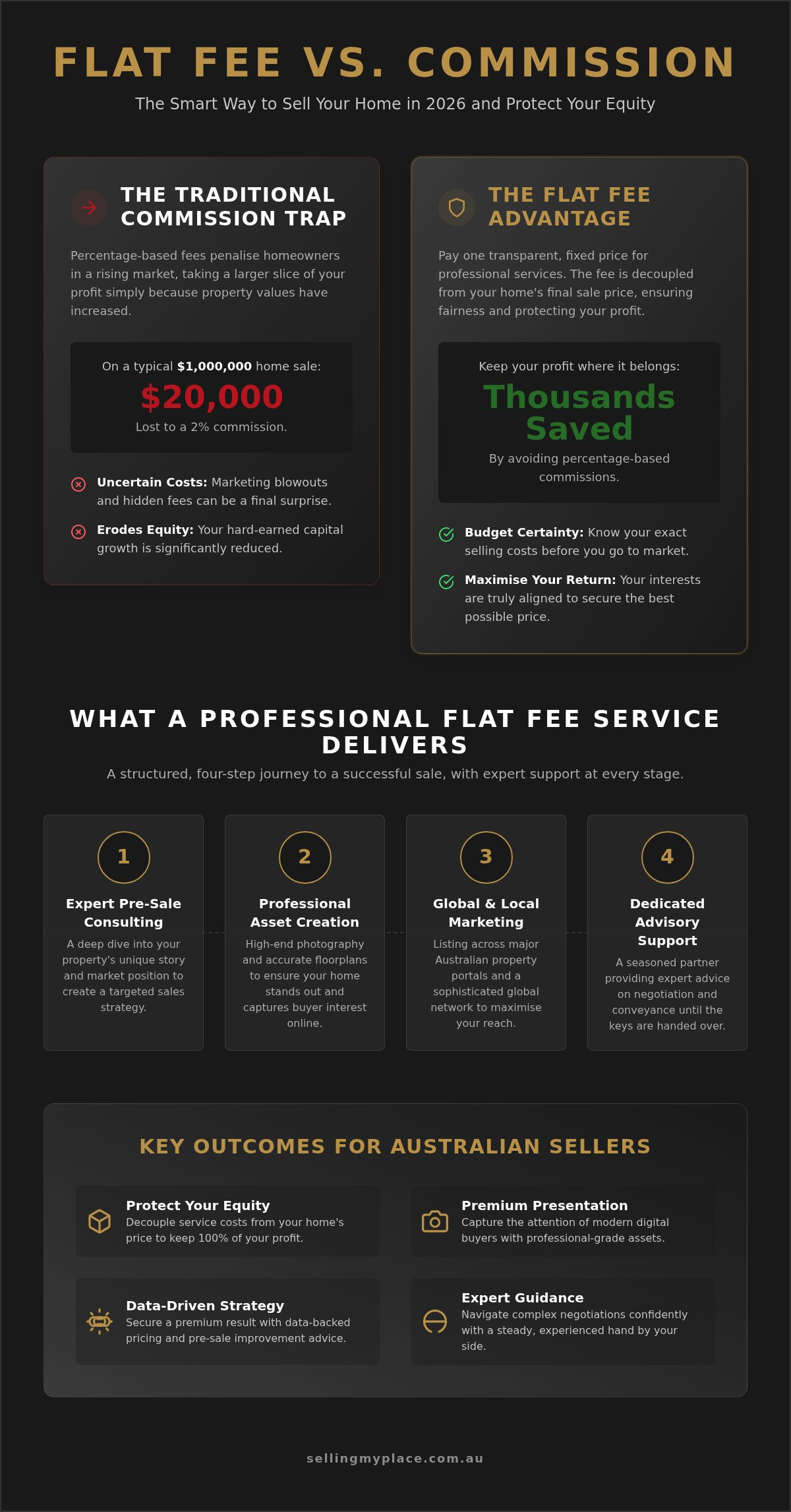
Maximising Your Profit: A Roadmap for Australian Sellers
Achieving a premium result is about more than just putting a sign in the front yard. It’s a methodical process that combines careful presentation with precise, objective data. When you opt for a flat fee property listing australia, you’re choosing a model that rewards your attention to detail and your intimate knowledge of your home. By focusing on high-impact minor repairs and curb appeal, you ensure the first impression is one of care and stability. This isn’t just about aesthetics; it’s about signalling to the market that your home has been a well-loved sanctuary for your family.
Utilising a flat fee property listing australia framework allows you to be the primary advocate for your property. You know which window catches the morning sun and which local park is best for a weekend stroll. Engaging with buyers directly allows you to convey these lifestyle benefits with a warmth and authenticity that no third party can replicate. To ensure your equity is fully protected, it’s wise to keep your marketing active until the final settlement. This provides a vital backup plan should circumstances change, giving you total peace of mind throughout the transition.
Preparing Your Home for the Professional Lens
Decluttering is your first essential step. It allows the space to breathe and lets buyers project their own lives onto the canvas you’ve created. When it comes to photography, the “Golden Hour” is particularly important in the Australian climate. This brief window of soft, warm light just before sunset can make your outdoor entertaining areas feel like a private oasis. Industry observations suggest that a well-prepared home can increase click-through rates by up to 40% compared to properties that appear cluttered or poorly lit. Small touches, like fresh mulch in the garden or a clean driveway, go a long way in stopping the scroll on a smartphone screen.
Setting the Right Price with Data
Setting the right price is perhaps the most critical decision you’ll make in your selling journey. It’s vital to determine the market value of a home in Australia using recent comparable sales rather than an agent’s “gut feeling”. Avoiding the overpricing trap is essential; a price that is too high can lead to a stale listing, which often results in a lower final sale price as buyers become wary. Transparency in your initial listing price builds immediate trust with the community and attracts genuine, qualified buyers who are ready to act. If you’re ready to take the next step in your property journey, get in touch with us today to discuss your personalised roadmap.
Why Kincade International Direct Sales is the Smarter Choice
Choosing the right partner for your property journey is about finding a balance between cutting-edge digital reach and a genuine, human connection. Kincade International Direct Sales (KIDS) provides exactly that. We don’t just list your home; we integrate it into a sophisticated global marketing network that ensures your property is seen by the right eyes, whether they’re across the street or on the other side of the world. By opting for a flat fee property listing australia through our model, you’re embracing a partnership approach that treats your sale as a significant life transition, not just another line in a ledger. We’re here to ensure your story is told with the respect and professional polish it deserves.
Security is at the heart of everything we do. This is why we offer a “listed until sold” guarantee, providing you with a sense of stability and peace of mind, regardless of how the market fluctuates in 2026. You won’t find arbitrary time limits here. Instead, you’ll find a comprehensive suite of professional assets included as standard in our packages. From high-end photography and accurate floorplans to the expert advisory services we’ve discussed, every element is designed to showcase your home’s true value while keeping your equity where it belongs. It’s a thorough, attentive service that leaves nothing to chance.
A Legacy of Expert Support
Experience matters when the stakes are this high. We leverage over 25 years of industry knowledge to guide you through every twist and turn of the selling process. This isn’t just about technical expertise; it’s about the emotional intelligence required to understand the weight of selling a family home. We know that behind every contract is a family looking toward their next chapter. We act as your “steady hand,” providing a reassuring presence that reduces the stress of complex negotiations and legal requirements. You can move forward with calm confidence, knowing you have a seasoned advisor in your corner who values long-term relationships over quick results.
Take Control of Your Property Future
The financial impact of choosing a flat fee property listing australia is profound. When you save an average of $20,000 in unnecessary commissions, that money stays with you to fund your next purchase, renovate your new space, or simply bolster your family’s financial security. You’re joining a growing movement of empowered Australian sellers who are choosing transparency and fairness over outdated traditions. It’s time to take control of your property future. Starting your journey with a professional listing is a simple, straightforward process that prioritises your needs and your legacy. We’re ready to help you make your next move your best move yet.
Your Path to a Smarter, More Profitable Sale
Your home is likely your most significant asset. As we navigate the 2026 property market, protecting the equity you’ve built should be your top priority. We’ve explored how a flat fee property listing australia allows you to maintain control while accessing the same high-calibre marketing tools used by the country’s top agencies. By choosing a partnership based on transparency rather than a percentage, you ensure your profit stays exactly where it belongs; with your family.
Securing a professional result doesn’t have to mean sacrificing your hard-earned gains to unnecessary commissions. With Kincade, you’ll save an average of $20,000 in fees while benefiting from professional photography, accurate floorplans, and our dedicated Agent Advisory Service. This isn’t just about a transaction; it’s about a steady hand guiding you through a major life transition with heart and expertise. You’ve done the hard work of building your home’s value, so let’s make sure you keep it.
Keep 100% of your profit and list with Kincade today to start your journey with a partner who values your legacy as much as you do.
Frequently Asked Questions
Is a flat fee property listing legal in all Australian states?
Yes, the flat fee model is completely legal across all Australian states and territories. Real estate commissions are not regulated by the government, meaning you have the freedom to negotiate how you pay for marketing and support. Choosing a flat fee property listing australia ensures you are operating within a transparent framework that prioritises your equity. It’s a modern approach that complies with national property laws while giving you more control over your financial outcome.
Do I still get my property listed on the major real estate websites?
Absolutely, your home will be featured on the major Australian property portals where the vast majority of buyers begin their search. We provide the digital infrastructure needed to ensure your listing looks professional and reaches a wide audience. Beyond local sites, our global marketing network helps your property gain visibility with interstate and international investors. You get the same premium digital exposure as a traditional agency listing without the high commission costs attached.
What happens if my property doesn’t sell within a few months?
We offer a “listed until sold” guarantee, which means there are no arbitrary time limits on your marketing campaign. If your property takes a little longer to find the right buyer, your listing stays active without additional listing fees. This removes the pressure to drop your price prematurely and provides a sense of stability. We’re committed to a long-term partnership, ensuring your home remains visible until the keys are successfully handed over to the new owners.
Who handles the actual property inspections and open houses?
As the person who knows your home best, you’ll handle the property inspections and open houses. This allows you to share the authentic story of your neighbourhood and the unique features of your property directly with buyers. While you host the visits, our Real Estate Advisory Services are always available to provide guidance on how to present your home effectively. Most owners find that buyers appreciate the direct, honest communication that comes from dealing with the homeowner.
Can I still use a solicitor or conveyancer for the legal paperwork?
Yes, you should always engage a qualified solicitor or conveyancer to manage the legal aspects of your sale. While we provide expert conveyance advice to help you understand the process, the actual preparation of the contract and the settlement must be handled by a legal professional. This ensures that your interests are fully protected throughout the legal journey. We work alongside your chosen representative to make sure the transition of your property is as seamless as possible.
How does the Agent Advisory Service actually help me during the sale?
Our Agent Advisory Service acts as your “steady hand” throughout the entire process, offering professional backing without the commission. We provide pre-sale consulting to help you identify high-impact improvements and use Neighborhood Market Reports to help you set a data-driven price. When it comes to negotiations, we’re there to offer strategic advice, helping you navigate complex conversations with buyers. It’s about giving you the confidence of a seasoned expert while you maintain control of the sale.
Will buyers be put off if they see I am selling without a traditional agent?
In 2026, savvy Australian buyers are becoming increasingly comfortable with direct sales models. They often prefer the transparency and direct communication that comes from dealing with the owner. As long as your property is presented professionally with high-quality assets, buyers will focus on the value of the home itself. Our professional photography and floorplans ensure your listing looks identical to a traditional agency ad, maintaining the decorum and authority expected in a high-stakes transaction.
What is included in the professional photography and floorplan package?
Our comprehensive package includes high-end photography designed to capture your home’s best features and stop the scroll on major portals. You’ll also receive accurate floorplans, which are essential for helping buyers understand the spatial layout of your property before they visit. These assets are produced to a professional standard, ensuring your home looks its absolute best. Providing this level of detail helps attract serious, qualified buyers and signals that you are committed to a high-quality, professional sale process.
Mistakes to Avoid When Selling Your Own Home: The 2026 Australian Seller’s Guide
What if the most expensive part of selling your home wasn’t the fresh coat of paint or the professional photography, but the signature you put on a standard agency contract? In a 2026 market where the national median house price sits at $989,000, handing over a massive chunk of your equity to an agent can feel like a step backwards for your family’s future. It’s a significant life transition, and we understand the pressure to get everything right while identifying the common mistakes to avoid when selling your own home. You might be worried about underpricing your sanctuary or feeling overwhelmed by the logistics of legal paperwork and buyer enquiries.
We believe you shouldn’t have to choose between professional results and your bank balance. This guide serves as your steady hand, helping you master the art of commission-free selling with total confidence. By sidestepping these costly errors, you can save upwards of $20,000 in commissions and achieve a professional-grade result independently. We’re going to explore everything from understanding the current 4.35% cash rate environment to managing a smooth, stress-free settlement process that keeps your family’s future secure.
Key Takeaways
- Learn how to separate your heart from your house to make the objective, professional decisions that today’s buyers expect.
- Identify the critical mistakes to avoid when selling your own home, particularly the pricing traps that can stall your progress in the first fortnight.
- Discover why professional photography and floorplans are essential investments that protect your equity rather than just additional costs.
- Understand the fundamentals of Australian contract requirements and negotiation strategies to ensure a secure and legally sound settlement.
- Find out how a flat-fee advisory service provides a protective safety net, giving you agency-level tools without the high commissions.
The Professional Mindset: Why Most Private Sales Fail Before They Start
Success in the current market isn’t about doing things on the cheap; it’s about doing things professionally without the weight of an unnecessary commission. One of the primary mistakes to avoid when selling your own home is confusing “saving money” with “cutting corners.” When you decide to sell independently, you aren’t just a homeowner anymore. You are a project manager overseeing a high-stakes transaction. This requires a mental shift from seeing your house as a sanctuary filled with memories to viewing it as a product on a shelf. In a cooling market where national prices saw a slight decline of 0.3% in July 2026, this objectivity is your greatest asset.
Many Australians fall into the “Emotional Attachment Trap.” It’s natural to value your home based on the years of life lived within its walls, but buyers only see the square metres and the school catchment. If you can’t look at your property through the eyes of a stranger, you risk making defensive decisions during negotiations. Professionalism means being prepared for honest, sometimes blunt, feedback from potential buyers and using it to refine your strategy rather than taking it personally.
The Myth of the “Magic” Real Estate Agent
There is a persistent belief that agents possess a “secret database” of buyers that private sellers simply cannot access. The truth is much simpler. Modern buyers follow properties, not people. The real drivers of the Australian market are the major national property portals and digital search engines. When your home is listed on these platforms with professional-grade photography and clear floorplans, you are visible to every active buyer in the country. Choosing a For Sale By Owner (FSBO) model allows you to tap into these same networks. By using professional advisory services, you gain the infrastructure of a global agency without the transactional feel of a traditional commission-based relationship.
Setting Your “Sale by Owner” Strategy
One of your biggest advantages is time. Traditional agencies often demand 90-day exclusive contracts to create artificial urgency, but selling independently allows you to “list until sold.” With the Reserve Bank holding the cash rate at 4.35% as of August 2026, buyers are more cautious and may take longer to secure finance. You can afford to wait for the right offer that respects your property’s value. To make this work, you must be organised from day one. This includes:
- Documentation: Have your Contract of Sale and disclosure documents ready before the first open home.
- Communication: Set up a professional email or phone line specifically for enquiries to keep your personal life separate.
- Market Knowledge: Study local results so you can address the common mistakes to avoid when selling your own home before they impact your bottom line.
Pricing Pitfalls: Avoiding the “Hope and Pray” Valuation
Setting the price for your home is often the most emotional hurdle you’ll face. It’s easy to fall into the trap of “sentiment pricing,” where you value the property based on what you need for your next deposit or the memory of your renovations. However, the market is indifferent to your goals. One of the most critical mistakes to avoid when selling your own home is ignoring the market reality of 2026. With the national median house price sitting at $989,000 and the cash rate holding at 4.35%, buyers are incredibly discerning. They aren’t just looking for a home; they’re looking for value that aligns with their specific borrowing capacity.
If you set your price too high initially, you trigger the “anchor effect.” This creates a psychological barrier that scares off motivated buyers during the first fortnight, which is typically your most active period. Many sellers rely on automated valuation models (AVMs) found on bank websites, but these are often outdated or lack the nuance of your specific street. To establish a credible price floor, you need deep, localised data. Utilising comprehensive Neighborhood Market Reports ensures you’re making decisions based on actual local sales rather than computer-generated guesses.
Interpreting Comparative Market Analysis (CMA)
A true comparative analysis goes beyond looking at what the house next door sold for last year. You must account for land size, block orientation, and the quality of recent finishes. In August 2026, you also need to factor in local supply levels. If three similar houses just hit the market in your suburb, your pricing strategy must adapt. Aim for the “sweet spot”: a price that invites competition. When multiple buyers see genuine value, they’ll compete; this often pushes the final result higher than a static, over-optimistic listing price ever could.
The Hidden Cost of Underpricing
The fear of leaving money on the table keeps many private sellers awake at night. While overpricing kills momentum, underpricing can feel like a loss of hard-earned equity. Using professional appraisals helps validate your listing price and provides a shield against low-ball offers. If a buyer comes in with an offer that feels disrespectful, don’t take it personally. Use your data to justify your position and stay firm. If you’re feeling unsure about your property’s current worth, you might find it helpful to chat with a property advisor who can provide a grounded perspective on your local market.
Marketing Blunders: When “DIY” Visuals Devalue Your Equity
In the digital-first market of 2026, your property’s first open home doesn’t happen on a Saturday morning. It happens on a smartphone screen at 10 pm. One of the most damaging mistakes to avoid when selling your own home is assuming that a modern smartphone camera is “good enough” for your listing. While the latest iPhone takes great family snaps, it cannot replicate the wide-angle lenses, professional lighting, and post-production expertise required to capture a room’s true dimensions. This “iPhone Effect” often leads to dark, cramped, or distorted images that devalue your equity instantly. Industry observations suggest that poor visuals can result in a final sale price that is $50,000 lower than a property with high-quality marketing.
Viewing professional photography as an investment rather than a cost is a hallmark of a successful private seller. You have roughly two seconds to capture a buyer’s attention before they scroll past your home. If that hero image doesn’t spark an emotional connection, the buyer is gone. You aren’t just selling bricks and mortar; you are selling a future lifestyle. Professional imagery highlights the warmth of the sun in the living room and the flow of the kitchen, inviting that “first click” that leads to a physical inspection.
The Power of Professional Floorplans
A high-definition floorplan is no longer optional. It allows buyers to “mentally move in” by understanding the spatial logic of your home before they even step through the door. Does the master bedroom have enough space for a king-sized bed? Is the home office tucked away from the noise of the kitchen? A floorplan answers these questions immediately. In 2026, buyers also expect to see site plans and orientation to judge natural light. This transparency filters out “tyre-kickers” whose needs don’t match your layout, ensuring that every person who walks through your door is a genuine contender.
Staging and Presentation: Beyond the Declutter
Presentation is about depersonalisation. You want buyers to see their own lives in the space, not yours. Remove the family photos and the collection of fridge magnets to create a blank canvas. Focus on high-ROI cosmetic repairs, like a fresh coat of neutral paint or updated cabinet handles, rather than overcapitalised renovations that you won’t recoup. Finally, think about the lifestyle narrative. On inspection day, ensure the temperature is perfect, the lighting is soft, and there’s a subtle, welcoming scent. You’re creating a feeling of stability and home that resonates on a deep, emotional level.
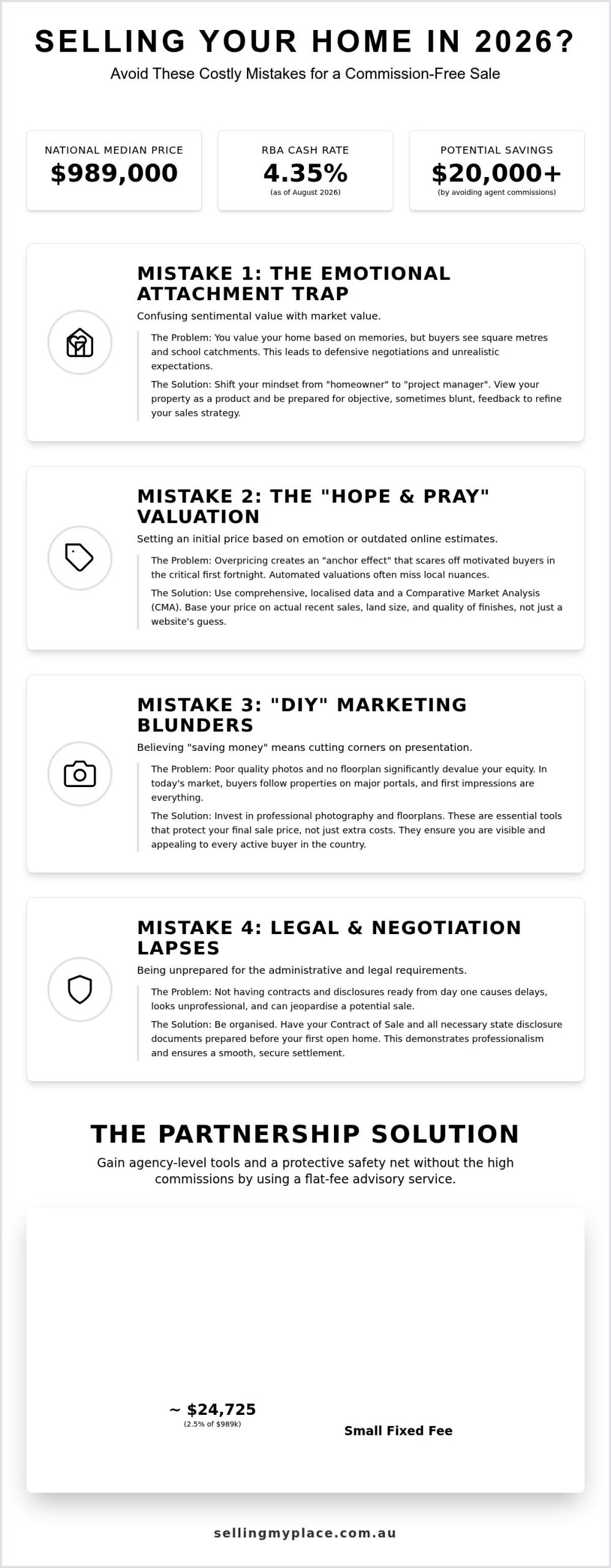
Negotiation and Legal Lapses: Protecting Your Settlement
Once your marketing has successfully drawn in the right crowd, the journey moves from presentation to persuasion. One of the most frequent mistakes to avoid when selling your own home is the urge to fill the silence during a negotiation. It is a natural human reaction to keep talking when we feel nervous, but in real estate, the first person to speak often reveals their position too early. Instead of rushing to justify your price, let the buyer’s offer hang in the air for a moment. This grounded, calm approach demonstrates that you are confident in your property’s value and aren’t pressured by the clock.
Legal paperwork often feels like the most daunting part of the process, yet it is simply the framework that keeps your equity safe. Your Contract of Sale is the foundation of the entire deal. In 2026, compliance is stricter than ever; for instance, the Seller Disclosure Scheme requires absolute transparency to prevent a buyer from terminating the contract later. This is where professional guidance becomes your safety net. To ensure your paperwork is water-tight before the first offer arrives, it is wise to reach out for professional conveyance advice that protects your family’s interests.
Mastering the Private Treaty Negotiation
- Qualify the buyer: Before you spend hours negotiating, ask for a letter of pre-approval. With the cash rate at 4.35%, you need to know their lender is actually ready to move.
- Handle the “Building and Pest” hurdle: If a report identifies a minor issue, don’t get defensive. Use it as a tool for transparency; sometimes a small price adjustment is better than losing a motivated buyer during the cooling-off period.
- Close the gap: Use professional counter-offers. Instead of a flat “no,” try “I can’t accept that price, but I can meet you halfway if we settle in 30 days.”
A “Subject to Finance” clause is a contractual condition that grants the buyer a specific timeframe, usually 14 days, to secure formal mortgage approval, which effectively puts your settlement timeline on hold until the bank gives the final green light.
The Legal Roadmap to Settlement
In the 2026 landscape, the exchange of contracts has become a streamlined, digital experience. Ensuring your Section 32 or relevant state disclosure documents are current is non-negotiable; an out-of-date certificate can stall a settlement for weeks or even provide a legal loophole for a buyer to exit. Most Australian settlements now occur through PEXA, a secure digital platform that allows for the simultaneous exchange of funds and property titles. This technology removes the old-fashioned stress of bank cheques and physical meetings, providing you with real-time confirmation that your sale is officially complete.
The Partnership Solution: Selling Smarter with Kincade
Selling your home independently doesn’t mean you have to walk the path alone. The Direct Sales model represents the future of the Australian property market because it empowers you to maintain total control while utilising the sophisticated infrastructure of a global agency. Many homeowners believe they must choose between a high-commission agent or a cheap DIY approach. We offer a Goldilocks solution that provides professional-grade results without the transactional feel of traditional real estate. By choosing this partnership, you sidestep the most common mistakes to avoid when selling your own home while keeping 100% of your hard-earned profit.
The flat-fee advantage is simple: you gain access to the same tools the big agencies use, but you don’t pay for their high overheads or franchise fees. We’ve seen that the average owner can retain a significant portion of their equity that would otherwise be lost to commission. This is money that stays in your pocket, where it belongs, to fund your next move or secure your family’s future. Our Agent Advisory Service acts as your steady hand, providing the calm confidence you need when faced with complex decisions or high-stakes negotiations.
Pre-Sale Consulting: Your Competitive Edge
Success starts long before the first open home. Our pre-sale property consulting provides customised advice on how to present your home to the 2026 market. We help you identify which features will resonate with local buyers and which specific aspects of your property deserve the spotlight. By leveraging deep neighbourhood data, you can justify a premium price with hard evidence rather than guesswork. You also benefit from a global marketing network that ensures your listing remains active and visible until the right buyer is found, reaching far beyond the limits of a traditional local agency office.
Next Steps: From Listing to Sold
Getting started is a straightforward, supportive process. You can begin with a professional marketing package today, which includes the high-definition photography and floorplans we discussed earlier. We understand that life transitions don’t always follow a 90-day schedule. That’s why we offer a No Time Limit guarantee; your listing stays active until it’s sold, giving you peace of mind in a shifting market. It’s about protecting your equity and your sanity. Take a moment to consider the impact of those significant savings on your lifestyle. When you’re ready to move forward with a professional, heart-led approach, Kincade International Direct Sales is here to guide you every step of the way.
Your Path to a Confident, Commission-Free Sale
Stepping away from the traditional agency model is more than just a financial decision; it’s about taking ownership of your family’s legacy. By prioritising objective data over sentiment and professional marketing over DIY efforts, you ensure your property stands out in the 2026 market. We’ve walked through the essential mistakes to avoid when selling your own home, giving you a roadmap to navigate everything from the first enquiry to the final digital settlement with PEXA.
You don’t have to choose between saving money and receiving expert support. With Kincade, you keep the entirety of your sale price because there is no commission, ever. You’ll benefit from being listed until sold with no time limits, supported by our expert Agent Advisory Service every step of the way. This partnership gives you the professional infrastructure of a global agency while keeping you firmly in the driver’s seat. It’s a grounded, calm approach to one of life’s biggest transitions.
Save $20,000 in commissions—start your professional listing today with Kincade International. We’re ready to act as your steady hand and help you achieve the result your home deserves.
Frequently Asked Questions
Is it legal to sell my own home in Australia without an agent?
It is perfectly legal in every Australian state and territory to sell your own residential property. You have the right to represent yourself and manage the transaction from listing to settlement. While you must follow specific state-based disclosure laws, there is no requirement to engage a commission-based agent. Many owners find that acting as their own advocate provides a more transparent and rewarding experience during this major life transition.
How much can I actually save by selling my own home?
By choosing a commission-free model, the average Australian seller can save approximately $20,000. This calculation is based on standard agency commission rates applied to current national property values. Because you aren’t paying for an agent’s overheads or franchise fees, you retain 100% of the equity you’ve built in your home. This substantial sum can then be used for your next deposit, renovations, or family savings.
What is the biggest mistake people make when pricing their own home?
The most common error is setting a price based on personal sentiment or the memory of your renovations rather than current market data. This is one of the primary mistakes to avoid when selling your own home, as an inflated anchor price can stall your campaign in the first fortnight. Relying on accurate neighbourhood market reports allows you to set a credible price floor that invites competition and protects your equity.
Do I still need a solicitor if I am selling the property myself?
Yes, while you are managing the marketing and enquiries, you still require a qualified solicitor or conveyancer to handle the legal transfer of title. They prepare the Contract of Sale and ensure your disclosure documents comply with state laws, such as the Seller Disclosure Scheme. This professional oversight ensures your settlement through digital platforms like PEXA is secure, legal, and stress-free for both you and the buyer.
How do I handle open homes and inspections as a private seller?
Managing inspections is about creating a welcoming, professional atmosphere that allows buyers to imagine their own life in your home. You can choose between scheduled open homes or private viewings, which often attract more qualified buyers. It is helpful to use a digital sign-in process to capture attendee details for follow-up. This direct interaction allows you to share your local knowledge and answer questions with genuine heart and authority.
Will my property appear on the major real estate websites if I sell privately?
Yes, your property will appear on the most prominent national real estate portals and search engines used by millions of Australians daily. These digital platforms are the primary destination for active buyers, and our listing service ensures you have a professional presence there. By appearing alongside every other home on the market, you capture the same high-intent audience as a traditional agent, without the associated commission costs.
What happens if I can’t find a buyer right away?
If a buyer isn’t found immediately, we offer a listed until sold guarantee with no time limits. This provides a significant advantage in the 2026 market, where the 4.35% cash rate means buyers are often more cautious and may take longer to secure finance. Unlike traditional 90-day agency contracts, our model allows you to remain patient and wait for an offer that truly reflects your property’s value.
Can I still get professional photography if I don’t use a commission-based agent?
Absolutely, and it is a non-negotiable step for a successful sale. High-quality imagery and floorplans are included in our marketing services because they help you sidestep common mistakes to avoid when selling your own home. Professional photography captures the true dimensions and light of your property in a way a smartphone cannot. This ensures your home makes a powerful first impression on those crucial digital portals where most buyer journeys begin.
Best For Sale By Owner Sites Australia: 2026 Guide
If you could keep an extra A$20,000 from your home sale simply by changing who hits the ‘publish’ button, why wouldn’t you? Selling a family home is a deeply personal transition, and it’s only natural to feel protective of the equity you’ve spent years building. You likely want to avoid hefty agent commissions, but the fear of underselling or getting tangled in complex legal paperwork is enough to make anyone feel a little unsettled. It’s a significant life event, and you deserve to feel supported rather than just processed through a system.
The good news is that selling privately in 2026 has evolved into a sophisticated partnership. This guide will help you identify the best for sale by owner websites australia currently offers, ensuring you find a platform that provides professional-quality listings and genuine expert advisory. We’ll explore how to secure a premium presence on major portals while maintaining the “steady hand” support needed for a stress-free settlement. By the end of this article, you’ll know exactly how to maximise your profit while keeping the heart of your home’s legacy intact.
Key Takeaways
- Understand how the best for sale by owner websites australia have evolved from simple DIY tools into professional platforms that empower you to sell with total confidence.
- Identify why “Listed Until Sold” guarantees and global marketing reach are non-negotiable features for any private seller in the current market.
- Learn how a pre-sale property consultation can uncover small, high-impact improvements that help you secure a much higher price for your home.
- Discover the importance of using a Neighbourhood Market Report to price your home with precision, protecting your equity from the risk of underselling.
- Gain insights into the partnership-based model that offers 0% commission while providing the “steady hand” guidance needed for a smooth settlement.
What are For Sale By Owner (FSBO) Websites?
For many Australian families, the home is more than just bricks and mortar; it’s a sanctuary and a significant part of their financial legacy. Traditionally, selling that legacy meant handing over a substantial slice of equity to a real estate agent in the form of commissions. However, the rise of For Sale By Owner (FSBO) platforms has completely changed the conversation. These websites act as a vital bridge, allowing you to list your property directly on major property portals. This isn’t just a basic ‘do it yourself’ project anymore. It represents a shift toward ’empowered selling’ where you maintain the lead role while being supported by professional-grade tools and infrastructure.
Choosing to use for sale by owner websites australia means you’re prioritising transparency and personal connection. In 2026, the movement toward direct transactions has reached a significant tipping point. Homeowners are increasingly savvy, recognising that they are often the best advocates for their own properties. They know the local coffee spots, the friendly neighbours, and the way the afternoon sun hits the back deck. The core promise of this model is simple. You maintain total control over every decision and keep 100% of the sale profit, which frequently results in savings of A$20,000 or more compared to traditional agency fees.
How the FSBO Model Works in Australia
Under Australian law, individuals generally cannot list directly on the biggest real estate portals without a real estate license. FSBO websites solve this hurdle by acting as the licensed entity that facilitates your listing on your behalf. You pay a transparent flat fee rather than a percentage-based commission; this shift significantly reduces your upfront risk and long-term costs. Instead of wondering if an agent’s high marketing expenses will eventually pay off, you invest in a platform that enables direct communication with buyers. You’re the one telling the story of your home, which often resonates much more deeply with potential new owners who value a genuine, personal touch.
Why 2026 is the Year to Sell Smarter
The digital infrastructure available today has made professional marketing accessible to everyone. High-quality photography and detailed floorplans are no longer exclusive to traditional agencies. As Sale by owner becomes a mainstream choice, buyers have also become more comfortable dealing directly with the person who knows the property best. This direct connection fosters trust and often speeds up the transaction process. By using for sale by owner websites australia, you’re joining a community of homeowners who value stability, legacy, and the financial freedom that comes from a commission-free sale.
Evaluating the Best FSBO Platforms: Key Features to Look For
When you start comparing for sale by owner websites australia, it’s easy to get overwhelmed by flashy packages and tech-heavy dashboards. However, selling a home is a deeply human experience, not just a digital transaction. A platform should feel like a partner, providing a steady hand to guide you through the process rather than just a software interface. The most reliable services offer a ‘Listed Until Sold’ guarantee. This is essential because it removes the pressure of a ticking clock. You shouldn’t have to worry about recurring monthly fees or your listing disappearing before you’ve found the perfect buyer for your family’s legacy.
There is also a significant difference between a basic listing site and a full-service marketing partner. A basic site might get you onto a portal, but it leaves you to manage the complexities of negotiation and settlement alone. A true partner provides human advisory services. Having an expert to call when a negotiation gets tricky or when you’re unsure about a contract clause can save you thousands of dollars and hours of stress. It’s about finding a balance between the autonomy of a private sale and the security of professional expertise.
Portal Access: Beyond the Big Two
While appearing on realestate.com.au and Domain is the baseline, the best platforms look further afield. Australia’s property market is increasingly interconnected with the rest of the world. High-value residential properties often attract interest from expats and international investors. Why limit your reach to a local audience when you can tap into a global marketing network? Ensuring your property has high-tier placement on these portals is just as vital. A listing buried on page ten is a listing that isn’t working for you. Visibility is the currency of a successful sale, and your platform choice should guarantee you’re seen by the right people at the right time.
Professional Marketing Assets
First impressions happen in a heartbeat. In 2026, buyers are more visually driven than ever, making professional Photography and floorplans non-negotiable. A professional floorplan allows a buyer to mentally move their furniture into your home before they’ve even stepped through the front door. It provides a sense of scale and flow that photos alone cannot capture. Look for packages that include these assets as standard. When your listing looks like a high-end agency production, you command more respect and, ultimately, a higher price. If you’re feeling unsure about which marketing tools will best highlight your home’s unique character, you can always reach out for a quick chat about your specific needs.
The Gap Between ‘Listed’ and ‘Sold’: The Advisory Advantage
While clicking ‘publish’ on a digital portal is a significant milestone, it’s rarely the finish line. Many for sale by owner websites australia provide the technical keys to the digital front door, but they often leave you standing on the doorstep when it comes to the complex human interactions that follow. A professional listing attracts interest; however, an expert advisory service is what turns that interest into a successful settlement. This is the ‘Advisory Advantage.’ It bridges the gap between simply being visible and actually being sold. Think of it as having a seasoned mentor by your side, someone who understands that this isn’t just a transaction. It’s a major life transition that deserves a steady hand.
Navigating the emotional landscape of selling a family home requires more than just a software dashboard. It’s easy to feel overwhelmed by the volume of enquiries or the pressure of a fast-moving market. Pre-sale property consulting helps you identify small but vital value-add opportunities before you even launch. Whether it’s a minor repair or a styling tweak, these insights ensure you aren’t leaving money on the table. This partnership approach reduces the stress of complex property transitions, giving you the confidence to move forward with your next chapter while feeling completely protected.
Agent Advisory Services: Your Secret Weapon
An Agent Advisory Service acts as your professional backbone in a competitive market. It provides the support you need to manage tricky enquiries and vet potential buyers effectively, ensuring your time is spent on genuine leads. One of the most critical steps is learning how to determine the market value of a home in Australia using real-time expert data. Without this grounded perspective, you might risk pricing yourself out of the market or, worse, underselling your most valuable asset. The right for sale by owner websites australia will offer this human-led guidance as a standard part of their partnership.
Negotiation and Closing the Deal
When it comes to the final stages, mastering the art of negotiating your property sale is what secures your hard-earned equity. Advisory services help you separate the serious offers from the casual browsers, ensuring you remain in the driver’s seat without feeling alone. You’ll have access to strategies that protect your interests during the high-stakes closing phase. By having an expert to bounce ideas off, you can approach the negotiating table with calm confidence. You’ll know exactly when to hold firm and when to move, ensuring a smooth path to a stress-free settlement.
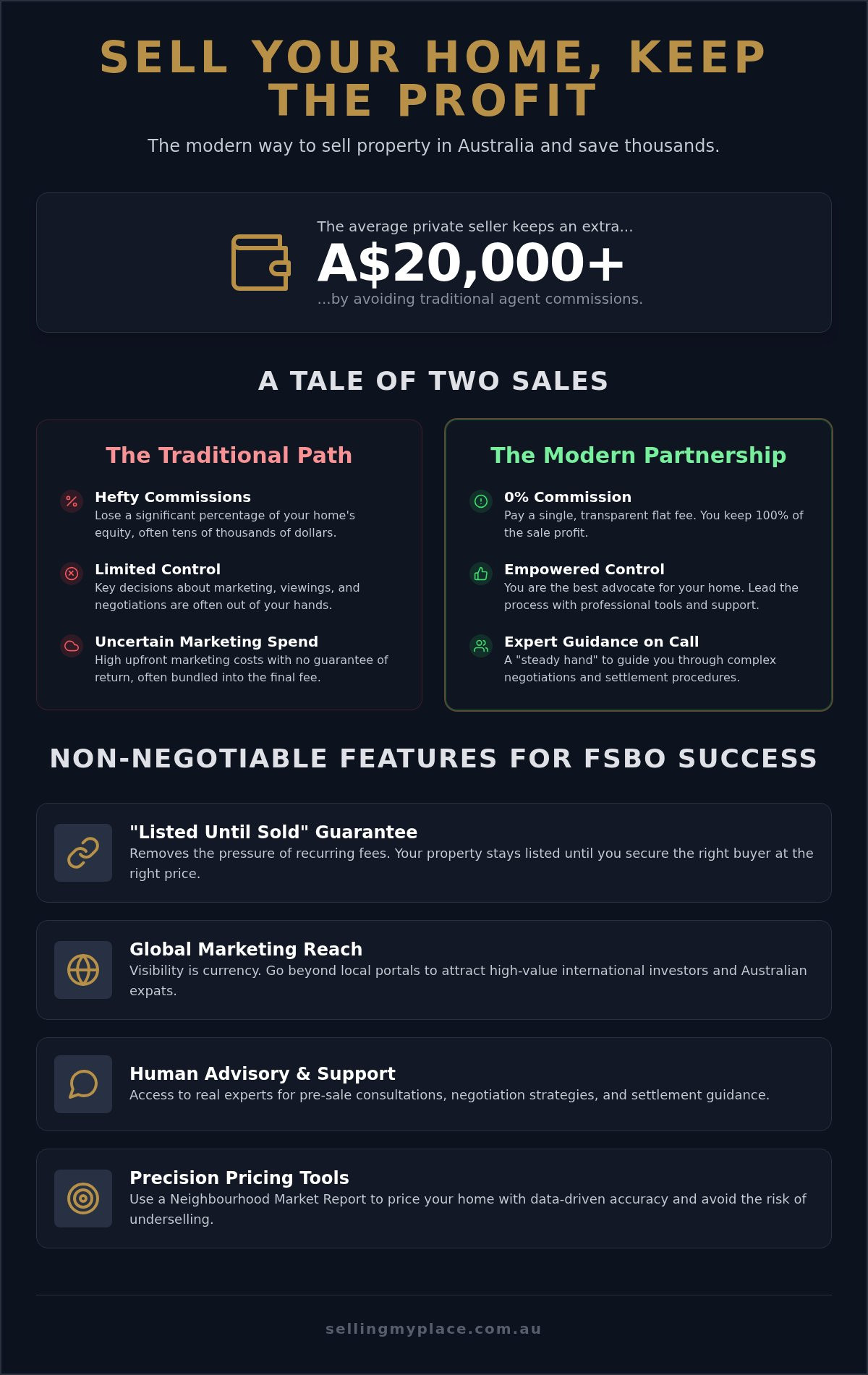
Preparing Your Property for a Private Sale Success
Success in the private sale market isn’t just about being seen; it’s about being ready. When you use for sale by owner websites australia, the quality of your preparation directly correlates to the speed and profit of your sale. Think of this phase as a deliberate, five-step launch sequence designed to protect your equity and ensure a smooth transition for your family. It begins with a thorough Pre-Sale Property Consultation. This isn’t just a casual walk-through. It’s a strategic assessment to identify minor repairs or styling adjustments that could significantly boost your property’s appeal. By addressing these early, you remove potential hurdles that buyers might use to negotiate your price down later.
- Step 1: Conduct a Pre-Sale Property Consultation to identify high-impact, low-cost repairs.
- Step 2: Secure a detailed Neighbourhood Market Report to pin down an accurate, data-backed price.
- Step 3: Organise professional photography and floorplans to ensure your home stands out against agency listings.
- Step 4: Prepare your legal documentation and seek early conveyance advice to avoid settlement delays.
- Step 5: Launch your listing simultaneously across national and global networks for maximum impact.
Pricing Strategy and Market Data
One of the biggest challenges for private sellers is justifying their asking price to skeptical buyers. In 2026, buyers are more informed than ever, and they’ll challenge you if your price feels like a “guess.” This is where a Neighbourhood Market Report becomes your most powerful tool. It provides specific, local data that allows you to stand your ground with confidence. Avoiding the overpricing trap is vital; a listing that sits on the market for too long becomes stale, leading buyers to wonder what’s wrong with the home. By using for sale by owner websites australia that provide real-time market data, you can set a price that is both ambitious and defensible.
The Legal Essentials: Conveyance and Contracts
The legal side of property can feel daunting, but it doesn’t have to be. Seeking professional Conveyance Advice before your first open home is a wise move. Each Australian state has its own specific regulations regarding private sales, and being prepared ensures you don’t hit a wall during the final stages. Having your contract of sale ready to go shows buyers that you’re a serious, professional seller. It fosters trust and keeps the momentum going once you’ve found the right person for your home. If you’re feeling unsure about the legal requirements in your specific area, get in touch for a supportive chat to help clarify your next steps.
Selling Smarter with Kincade International Direct Sales
Kincade International Direct Sales (KIDS) redefines what’s possible for the modern seller by moving beyond the limitations of traditional for sale by owner websites australia. We don’t just provide a platform; we offer a sophisticated partnership that prioritises your family’s financial legacy. By combining a 0% commission model with professional agency-grade tools, we empower you to take the lead while we provide the infrastructure. This approach results in an average saving of A$20,000, a significant sum that can fundamentally change the trajectory of your next move. Whether that means a larger deposit for your next home or extra security for your retirement, that equity belongs in your pocket.
Our philosophy is built on the idea of being a “steady hand” throughout your transition. We understand that selling a home is often tied to major life changes, and the process should feel supportive rather than stressful. You shouldn’t have to choose between saving money and receiving professional guidance. By bridging this gap, we’ve become the preferred choice for Australian families who value transparency, stability, and the respect their property deserves. It’s about selling smarter, not just selling alone.
Our Comprehensive Marketing Package
Your home’s first impression should be nothing short of exceptional. Our marketing package ensures this by including professional photography and detailed floorplans as standard features. These assets don’t just make your listing look better; they build immediate credibility with serious buyers. Your property will be launched across both national and global networks, ensuring you reach the widest possible audience, including international investors looking for a slice of the Australian lifestyle. With our ‘Listed Until Sold’ promise, you’ll never feel the pressure of a looming deadline or recurring fees. Plus, our dedicated Agent Advisory Service is always available to help you navigate the nuances of buyer enquiries and market fluctuations.
Take the First Step Toward an Empowered Sale
If you’re ready to step away from high marketing costs and reclaim your equity, the path forward is clear. Preparing for your property’s debut on the national stage is a collaborative process that starts with understanding your unique goals. We invite you to begin with a personalised consultation, where we can discuss how to best highlight your home’s character and value. You have the local knowledge and the heart; we provide the professional reach and the expert backing. Together, we can ensure your sale is a successful, celebratory milestone for your family. Enquire about our professional listing and advisory packages today and discover the difference of an empowered sale.
Your Path to a Successful Private Sale
Choosing to sell your home privately is a powerful decision that puts your family’s financial future first. The landscape of for sale by owner websites australia has transformed into a professional ecosystem where you no longer have to sacrifice expert support to save on costs. By combining high-end marketing assets like professional photography and floorplans with a dedicated Agent Advisory Service, you can navigate the complexities of the 2026 market with total confidence. It’s about having that steady hand to guide you through negotiations while ensuring you keep every cent of your hard-earned equity.
The transition to your next chapter should be celebratory rather than stressful. With an average saving of A$20,000 per sale and a 0% commission structure, you’re not just selling a property; you’re protecting your legacy. Our team is here to ensure you feel supported at every turn, from the first listing to the final settlement. Secure your commission-free sale with our expert advisory team and take the first step toward a more rewarding selling experience. You’ve built the home; now it’s time to reap the full rewards of your investment.
Frequently Asked Questions
Are for sale by owner websites legal in Australia?
Yes, selling your own property is completely legal in every Australian state and territory. While traditional agents often suggest otherwise, you have the right to represent yourself in the sale of your own asset. The best for sale by owner websites australia act as a licensed bridge, allowing you to access professional marketing tools while you remain the primary point of contact for all potential buyers.
Can I list my property on realestate.com.au and Domain without an agent?
You cannot list directly on these major portals as a private individual, but you can certainly do so through a dedicated FSBO platform. These services hold the required corporate real estate licenses to place your property alongside agency listings. This ensures your home receives the same visibility as any other property on the market, allowing you to reach millions of active buyers across the country.
How much can I actually save by selling my own home privately?
Most Australian homeowners save an average of A$20,000 by choosing a commission-free model. This figure is based on avoiding the typical 2% to 3% commission that traditional agents charge on the final sale price. When you factor in the removal of high upfront marketing fees, the total amount of equity you keep for your family’s next move becomes a significant financial advantage.
What happens if my property doesn’t sell within a few months?
If you choose a platform with a “Listed Until Sold” guarantee, your listing remains active without any additional time limits or recurring monthly fees. This provides a sense of calm confidence, as you aren’t pressured by a ticking clock or mounting costs. You can wait for the right buyer who truly values your home’s legacy, rather than feeling forced to accept a lower offer just to close a deal.
Do I need a lawyer or conveyancer if I use an FSBO website?
Yes, professional conveyance advice is a vital part of a successful settlement. While you handle the marketing and buyer enquiries, a legal expert ensures the contract of sale is prepared correctly and the transfer of title is handled according to state regulations. Integrating professional legal support with the right for sale by owner websites australia ensures your transaction is both profitable and legally secure.
How do I handle property inspections and open homes myself?
Managing inspections is quite straightforward and allows you to set times that actually suit your family’s schedule. You are the best person to answer specific questions about the local community, the friendly neighbours, or the best nearby schools. Most buyers actually find it refreshing to speak directly with the owner, as it fosters a more transparent and honest conversation about the property’s history.
Will buyers take me seriously if I am not using a traditional real estate agent?
Buyers will absolutely take you seriously if your property is presented with professional-grade marketing. When your listing includes high-quality photography and detailed floorplans, it looks identical to an agency production on the major portals. In the 2026 market, savvy buyers value direct communication and often prefer the lack of “agent speak” when negotiating their future home.
What is the difference between a listing service and a property advisory service?
A basic listing service simply puts your property on the internet and leaves the rest to you. In contrast, a property advisory service provides a “steady hand” throughout the entire journey. This includes expert guidance on pricing strategy, help with vetting potential buyers, and support during the negotiation phase. It turns a solo DIY project into a professional partnership that prioritises your peace of mind.
Mastering the Deal: Expert Property Sale Negotiation Tips for Australian Homeowners
What if the most powerful tool in your property sale isn’t a silver-tongued agent, but your own local knowledge and a calm, steady hand? Selling your family home is a massive life transition, and it’s entirely natural to feel a bit of a knot in your stomach when those first offers start landing on the kitchen table. With dwelling values in Sydney and Melbourne cooling as of June 2026, you might worry that savvy buyers hold all the cards. However, mastering a few key property sale negotiation tips can shift the balance back in your favour. It’s about more than just a price tag; it’s about protecting the heart and soul you’ve poured into your home.
We know that the fear of being lowballed or getting tangled in legal fine print can feel heavy, especially with the strict new identity verification laws that kicked in this July. You want to maximise your final sale price while keeping your hard-earned equity where it belongs. This guide will show you how to negotiate like a seasoned pro using proven strategies and expert advisory. We will walk you through how to handle offers directly, decode the contract essentials, and decide exactly when to say “yes” or “no” with complete confidence.
Key Takeaways
- Learn why the negotiation actually begins long before the first phone call and how your initial listing presentation dictates your bargaining power.
- Discover how to use Neighborhood Market Reports to anchor your value and implement essential property sale negotiation tips that justify your “walk-away” figure.
- Master the art of responding to lowball offers with calm confidence, using strategic silence to encourage buyers to refine their own position.
- Understand why the highest offer isn’t always the best deal and how expert conveyance advice ensures your contract terms protect your equity.
- See how a flat-fee advisory model removes traditional conflicts of interest, keeping the focus entirely on your family’s financial legacy.
Mastering the Art of the Deal: Why Property Sale Negotiation Starts Before the First Offer
Most people imagine property negotiation as a high-stakes phone call at the eleventh hour. In reality, it’s a thoughtful, multi-stage process that begins long before you greet your first visitor. If you wait until an offer is sitting on the kitchen bench to start considering negotiation theory and tactics, you have already missed the most critical opportunities to shape the narrative. Your home is a place of memories, but once it hits the market, it becomes a value proposition. Every interaction you have with a potential buyer is a brick in the wall of your eventual deal.
Your listing’s first impression sets the psychological ceiling for your entire campaign. When a buyer clicks through your photos, they are already deciding whether they are coming to “win” the home or “hunt” for a bargain. To protect your equity, you must make the psychological shift from “homeowner” to “vendor.” This detachment isn’t about loving your home less; it’s about respecting your financial future enough to remain objective. It’s much easier to hold your ground when you view the transaction as a partnership between your goals and the market’s reality.
Vendor authority is the grounded confidence gained when a seller replaces guesswork with professional preparation and verifiable market data.
The Power of Professional Presentation
Investing in top-tier Photography and clear Floorplans isn’t just about aesthetics. These tools act as your first line of defence against aggressive price-slashing. A polished listing signals that you are a serious, high-end seller who won’t be easily rattled. When a home is presented flawlessly, buyers find it much harder to “pick holes” or justify a lowball offer. It creates a perceived value that feels solid and non-negotiable, which is one of the most effective property sale negotiation tips for maintaining your asking price.
Establishing Your Position of Strength
Transparency is your best friend in a cooling market. By being open about the property’s condition from day one, you remove the buyer’s ability to “chip away” at the price during the cooling-off period. We recommend preparing an “evidence pack” including recent sales data and strata reports before your first open house. Engaging Real Estate Advisory Services early provides a steady hand to guide you through these initial steps. Using these property sale negotiation tips ensures you lead with facts rather than feelings, which is always the strongest position to hold during a sale.
Setting Your Ground: Data-Driven Pricing and the ‘Walk-Away’ Figure
Deciding on a price for your family home is one of the most emotionally charged moments of the selling process. It’s the point where your years of memories meet the cold reality of the current market. To navigate this successfully, you need to separate your pricing into three distinct categories. Your “dream price” is the ideal result if two buyers fall in love and start a bidding war; your “fair market value” is what the data suggests a reasonable buyer will pay; and your “walk-away figure” is the absolute bottom line where the sale no longer makes sense for your future. Having these figures clear in your mind before you even list the property provides a sense of calm that buyers will respect.
One of the most common mistakes we see is “over-quoting” to leave room for negotiation. In a cooling market, where Sydney dwelling values fell by 1.2% and Melbourne by 1.0% in June 2026, this strategy can backfire. Savvy buyers are often scared off by an unrealistic price tag, causing your property to languish on the market and lose its initial momentum. When a listing goes stale, you lose your leverage. Instead, use our Neighborhood Market Reports to justify your asking price with hard evidence. When you can show a buyer exactly why your home is valued at a certain level based on recent local sales, the conversation shifts from an emotional tug-of-war to a logical business discussion. Understanding how to determine market value of a home in Australia is the critical first step to anchoring your price with confidence in this changing landscape.
The most powerful word in any negotiation is a calm, data-backed “no.”
Understanding Local Market Dynamics
To set a firm ground, you must look closely at “Days on Market” (DOM) for similar properties in your street. If the average DOM is stretching out, you know you’ll need more patience. Similarly, keep a close eye on local auction clearance rates rather than national averages. While you are building your pricing strategy, it’s worth considering your broader Strategic Response Tactics to ensure you aren’t caught off guard by a quick offer. For those choosing a Sale by owner path, having this data at your fingertips is essential for commanding respect from buyers and their agents alike.
Defining Your Non-Negotiables
Negotiation is about more than just the final dollar amount. Before you open your doors, decide on your ideal settlement period and which chattels, like a specific designer light fitting or a custom outdoor kitchen, are included in the sale. Clearly identifying these non-negotiables early prevents them from becoming “deal-breakers” during the final heat of the deal. If you’re feeling unsure about how to balance your price expectations with the current market, you can always reach out for a chat about your goals with our advisory team.
Strategic Response Tactics: How to Handle Lowballs and Multiple Offers
Receiving a lowball offer can feel like a personal insult, especially when you’ve spent years maintaining your garden or raising a family within those walls. However, in the world of property, a low offer is often just a buyer “testing the waters” to see how you react. One of the most effective property sale negotiation tips is to never take the first number personally. It’s simply the opening line of a dialogue. By staying calm and grounded, you keep the power in your hands and signal that you aren’t easily rattled by aggressive tactics.
Sometimes, the best response is no response at all. When an offer is presented that doesn’t meet your expectations, try using the “Silence Technique.” After the buyer or their representative finishes speaking, wait for a few beats before responding. That brief, slightly uncomfortable silence often prompts the buyer to start justifying their price point or even hinting that they have “a bit more in the tank.” It shows you’re a serious seller who knows the true value of your home and won’t be pushed into a corner.
When it’s time to counter-offer, avoid round numbers. Proposing a specific figure like $952,500 instead of a flat $950,000 signals that you’ve performed a meticulous calculation of your equity, costs, and the current market. This “Power of 900” tactic makes your bottom line feel researched and firm, rather than plucked from thin air. It suggests to the buyer that there is very little “wiggle room” left because you’ve already done the hard maths.
Managing multiple offers requires a steady hand and absolute transparency to ensure you get a “fair go” from the market. Instead of playing buyers against each other in a way that feels “shonky,” invite all interested parties to submit their “best and final” offer by a set deadline. This creates a fair, competitive environment where the most committed buyer can step forward without feeling manipulated.
The Anatomy of a Counter-Offer
A successful counter-offer is a delicate balance of professional courtesy and firm boundaries. Start by acknowledging the buyer’s interest; everyone wants to feel heard. Then, apply the “Give and Get” rule. If you agree to lower your price slightly, ask for something in return, such as a shorter settlement period or a larger deposit. By applying these property sale negotiation tips, you ensure the transaction feels like a respectful partnership. For a deeper look at the legalities of this process, the Consumer Affairs Victoria negotiation guide offers excellent insights into making and receiving offers during a private sale.
Recognising a “Dud” Offer vs. a Serious Buyer
Not all offers are created equal, and some are best left on the table. A “dud” offer often comes with “strings attached” that can jeopardise your plans. Look out for these red flags in buyer behaviour:
- Vague or non-committal finance details that suggest they aren’t truly “ready to go.”
- Pushy, aggressive tactics designed to rattle your confidence.
- Unrealistic demands for immediate access or early possession before settlement.
A serious buyer usually presents a “clean” offer, meaning fewer conditions and a clear path to settlement. While a higher price tag is tempting, an offer subject to the sale of another property can often fall through. Sometimes, the bravest move is to walk away and wait for the person who truly values your home’s legacy.
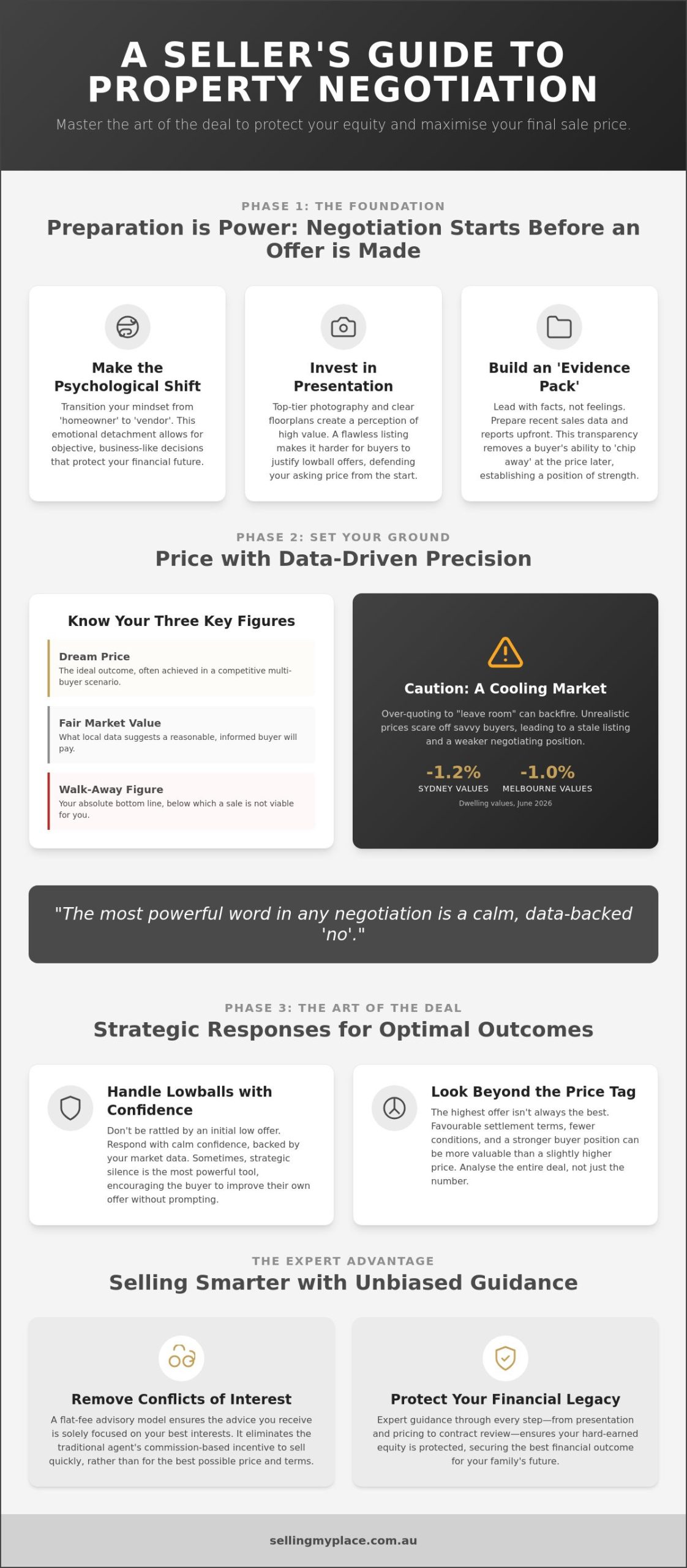
Beyond the Price Tag: Negotiating Settlement Terms and Conveyance Advice
While it’s easy to get swept up in the excitement of a high dollar figure, the highest offer isn’t always the best deal for your family’s future. A slightly lower price with an unconditional contract and a 60-day settlement might actually leave you in a better financial position than a record-breaking price riddled with complex clauses. These property sale negotiation tips are about more than just the final number; they are about protecting your equity and ensuring a smooth transition to your next chapter. When you look at an offer, look at the whole picture, not just the bottom line.
A 10% deposit remains the gold standard for a reason. It provides you with a significant safety net and ensures the buyer has enough “skin in the game” to see the transaction through. If a buyer pushes for a smaller deposit, you are well within your rights to ask for more favourable settlement terms in return. Aligning your settlement date with your next move is a masterstroke that can save you a fortune in bridging finance and the sheer exhaustion of moving twice. It’s these small, practical details that turn a good sale into a great one.
The Role of Expert Conveyancing
You should always have your contract reviewed by a professional before any serious negotiation begins. This proactive step allows you to understand which “Special Conditions” you can use as bargaining chips. For instance, you might offer a slightly longer cooling-off period in exchange for a higher price. Many modern Residential Property Listing Services now recommend integrating legal support early to avoid nasty surprises. If you’re feeling overwhelmed by the legal jargon, you can get in touch for expert conveyance advice to ensure your contract is watertight.
Handling Building and Pest Results
This is often the stage where a deal can wobble. If a report comes back with minor issues, you have a choice: negotiate a small price reduction or agree to fix the repairs yourself. Generally, a price reduction is cleaner for your bottom line as it prevents you from managing tradespeople during a stressful move. You can also stand your ground on known minor defects by using an “as-is” clause, provided these were disclosed early in the campaign. Whatever you decide, ensure any agreed repairs or credits are documented precisely in the final contract to protect your interests.
Selling Smarter: How Expert Advisory Services Protect Your Profit
The traditional real estate model has long relied on a percentage-based commission, which can often lead to a subtle misalignment of goals. When an agent’s payday depends on a quick turnover, the pressure to “just sign” can feel overwhelming. By choosing a flat-fee advisory model, you remove this conflict of interest entirely. Your advisor isn’t chasing a commission; they are focused on ensuring you achieve the best possible result for your unique circumstances. This shift allows you to implement property sale negotiation tips with the backing of a professional who is truly in your corner, without the $20,000 price tag often associated with high-end agencies.
Having a professional negotiator by your side provides a vital buffer between your emotions and the buyer’s tactics. While you focus on the heart of the move, your advisor handles the strategic heavy lifting. They help you move from that initial verbal agreement to a binding exchange of contracts with total clarity. This final stage is where the “fine print” matters most, especially with the new identity verification requirements. A steady hand ensures that every T is crossed and every I is dotted, protecting your equity until the moment the keys change hands.
The KIDS Advantage
Kincade International Direct Sales (KIDS) offers a unique partnership that combines global reach with the personal touch of a local expert. Unlike the transactional feel of a standard agency, the KIDS model is built on the belief that you should keep 100% of your sale profit. This extra capital can be the difference between a modest downsized apartment and the dream coastal retreat you’ve been planning for years. You receive the professional polish and marketing power of a top-tier firm while remaining the primary decision-maker in your home’s legacy.
Your Negotiation Checklist
Before you sign on the dotted line, take a moment to breathe and run through this final summary of essentials. Trusting your gut is just as important as trusting the data. If something feels “off” about an offer, it usually is. Here are the five key steps for a successful finish:
- Confirm your walk-away figure: Ensure the offer genuinely meets your financial needs for the next chapter.
- Verify the terms: Double-check that the settlement date and deposit amount align with your moving plans.
- Review the evidence: Use your Neighborhood Market Reports one last time to confirm the price reflects current local trends.
- Consult your advisor: Run the final figures and conditions past your Real Estate Advisory Services team.
- Check the contract: Ensure all agreed repairs or special conditions are clearly written into the binding document.
Selling your home is a significant milestone, and you deserve to feel empowered throughout the entire journey. By combining these property sale negotiation tips with a supportive advisory model, you can navigate the market with confidence and grace. Discover how we empower you to sell smarter and keep your profit.
Take Control of Your Financial Legacy
Selling your home is about so much more than a transaction; it’s the bridge to your next big adventure. By embracing these property sale negotiation tips, you’ve moved from being a passive observer to a confident decision-maker. You now understand that a successful sale is built on the foundation of professional presentation, anchored by robust local data, and secured through a firm grasp of contract terms. Protecting your equity isn’t just about the final figure; it’s about making sure the transition is as smooth and stress-free as possible for your family.
You don’t have to walk this path alone. With our global marketing network reach and a dedicated Agent Advisory Service in your corner, you can achieve a premium result while keeping your hard-earned profit. Our partners save an average of $20,000 in commissions by choosing a smarter, modern way to sell. It’s time to step into your future with clarity and confidence. Start your commission-free selling journey with Kincade today and see how a partnership-based approach changes everything. You’ve got this, and we’re here to help you every step of the way.
Frequently Asked Questions
Do I really need an agent to negotiate for me?
No, you aren’t legally required to use a traditional agent to handle your sale. Many homeowners find that they are the most passionate advocates for their property’s unique history and value. By using our Real Estate Advisory Services, you gain the strategic advantage of a professional negotiator while maintaining direct control over the final decision. This partnership ensures you aren’t pressured into a quick sale that doesn’t serve your family’s long-term interests.
How do I handle a buyer who keeps pushing for a lower price?
When a buyer persists with lower offers, refocus the conversation on objective market evidence. Reference your Neighborhood Market Reports to show how your price aligns with recent local sales. If the pressure continues, a calm “no” backed by data is your most effective tool. You might also offer to adjust a settlement term instead of the price, which often satisfies a buyer’s need to feel they’ve “won” a concession.
What is the most important “Special Condition” to include in my contract?
While every sale is unique, a well-defined settlement date that aligns with your next move is often the most valuable condition for a seller. It prevents the stress and cost of bridging finance or moving into temporary accommodation. You should also ensure there is a clear “sunset clause” on any finance conditions. This prevents a buyer from tying up your property for weeks without a firm commitment to proceed.
Can I change my mind after I have verbally accepted an offer?
Yes, a verbal agreement is generally not legally binding in Australia until the written contracts are signed by both parties and formally exchanged. While it’s important to act with integrity to keep a serious buyer engaged, you aren’t locked in until that physical exchange happens. This is why moving quickly from a verbal “yes” to a binding contract is one of the most vital property sale negotiation tips for protecting your sale.
How do I know if a buyer is actually pre-approved for finance?
You should request a formal letter of “pre-approval in principle” from the buyer’s financial institution. Don’t rely on a buyer’s word alone, as their borrowing capacity may have changed with recent interest rate shifts. With the new AML/CTF regulations that began in July 2026, your legal representative will already be conducting more thorough financial checks. This added layer of scrutiny helps ensure you’re only dealing with genuine, qualified purchasers.
What should I do if the building and pest report comes back with issues?
Don’t panic if a report identifies minor defects; almost every home has them. The best approach is usually to offer a small, fair price reduction rather than attempting to organise repairs yourself while you’re busy packing. This keeps the process moving forward without you having to manage tradespeople. Ensure any agreement is documented as a specific “special condition” in the contract so there are no further disputes before settlement.
Is it better to sell at auction or via private treaty for negotiation?
Private treaty often provides a better environment for nuanced negotiation, especially in the cooling markets we saw in June 2026. Unlike the high-pressure environment of an auction, a private sale allows you to discuss settlement dates and specific conditions that might be more important to you than the final dollar amount. It gives you the time to build a rapport with the buyer and find a middle ground that respects your home’s legacy.
How much can I actually save by negotiating the sale myself?
Australian homeowners often save an average of $20,000 by choosing a commission-free model. When you remove the traditional percentage-based fee, that equity stays in your pocket to fund your next life transition. These property sale negotiation tips empower you to handle the process with professional polish while ensuring your family receives the full benefit of your home’s capital growth. It’s a significant financial win that provides a much smoother start to your next chapter.
