You don’t have to appoint a real estate agent to sell your property in Australia. Commission-free property selling is legitimate, and agent commissions and fees are negotiable. But “commission-free” doesn’t always mean cost-free: a flat fee or separate selling expenses may still apply.
It’s sensible to get a clear picture of the costs before making a decision about your home. To judge whether commission-free property selling is legitimate, look beyond the label and check what you pay for, what the fee covers and when it is due.
This guide explains how commissions and flat fees work, what selling privately involves and how an agency agreement may affect a fee if your property sells. Use it to compare options and decide which selling approach suits you.
Key Takeaways
- You can sell a property in Australia without appointing an agent, but selling privately still involves practical and legal work.
- Agent commissions and fees are negotiable; compare the commission, marketing costs and other charges together before agreeing.
- A flat-fee arrangement sets a dollar amount payable upon sale, regardless of the final sale price, so understand what the fee covers.
- Read the agency agreement closely: exclusivity, the sale period and how a buyer was introduced can affect whether commission is payable.
- Commission-free listing services can suit owners who want property marketing support without a percentage-based agency commission.
Negotiating commission and fees
In Australia, agent commissions and fees are negotiable, so discuss the terms before signing an authority. Compare the full cost as well as the selling approach, including who handles buyer negotiations and any auction arrangements.
Comparing total costs and sale prices
To compare total costs, weigh commission, advertising and other charges against the sale price achieved. A lower fee alone doesn’t tell you which option leaves you with more after costs.
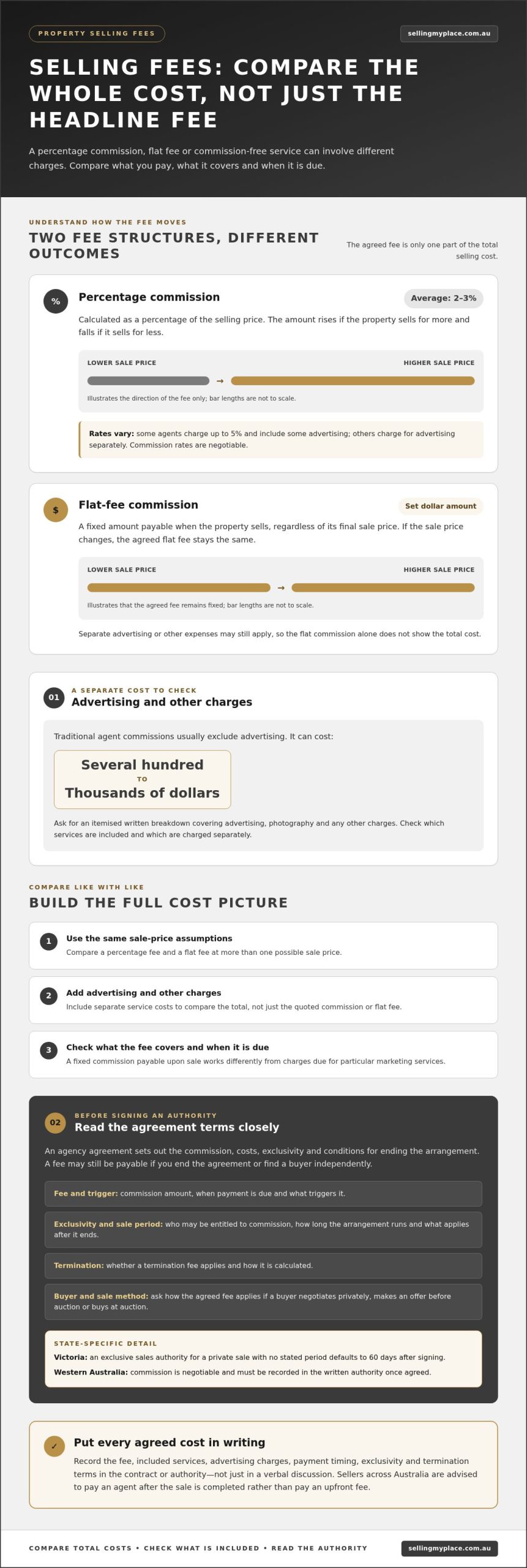
Australian agent commissions average two to three per cent of the selling price. Commission-free selling can reduce commission costs, but the final sale price depends on factors such as buyer demand, property presentation and negotiation, not the fee model alone.
Fees and advertising costs
Commission-free services may charge a flat fee or separate fees for services such as advertising. What you pay and what it covers depend on the arrangement, so compare each charge before deciding.
Traditional Australian agent commissions usually exclude advertising, which can cost from several hundred to thousands of dollars. Some agents charge up to five per cent and include some advertising; others charge for it separately. Ask for a written, itemised breakdown covering advertising, photography and other charges, then compare like with like.
Agency agreement terms
An agency agreement, also called an authority, sets out the commission, costs, exclusivity and conditions for ending the arrangement. Read these terms carefully: a fee may still be payable if you end the agreement or find a buyer independently.
Before signing, identify any termination fee, how it is calculated, the exclusive period and what happens when that period ends. In Victoria, an exclusive sales authority for a private sale with no stated period defaults to 60 days after signing. Get any agreed changes recorded in the contract or authority, not just discussed verbally.
Buyer negotiation and auctions
An agent may negotiate with buyers or conduct an auction, and those services can form part of the commission discussion. Ask how the agreed fee applies if a buyer negotiates privately, makes an offer before auction or buys at auction.
Treat examples as prompts for negotiation, not set rates.
Negotiating before you sign
Compare the proposed commission, advertising charges and payment timing before agreeing. In Western Australia, commission is negotiable and must be recorded in the written authority once agreed. Sellers across Australia are advised to pay an agent after the sale is completed, rather than pay an upfront fee.
Ask whether the fee changes if the sale method or marketing plan changes. A written breakdown makes it easier to compare commission with a flat-fee arrangement and identify which costs are payable at settlement.
Flat-fee commission structures
A flat-fee real estate commission is a set dollar amount payable when a property sells, regardless of its final sale price. It gives you a fixed figure to compare with a percentage-based charge. Separate expenses may still apply, so the commission alone doesn’t show the total cost.
If a property sells for more than the owner expected, a percentage commission rises with the sale price, while an agreed flat-fee commission stays the same. If the property sells for less, the flat fee doesn’t automatically fall. The fee structure determines how the cost changes with the final result.
To estimate likely proceeds, compare the flat fee with the percentage commission at more than one possible sale price, then add any advertising or other charges. Use the same sale-price assumptions for each option. This shows how the fees behave across different outcomes, rather than relying on one appealing figure.
Check what the flat fee covers before accepting the agreement. The authority should identify included services, separately charged advertising, when payment is due and what triggers it. A fixed commission payable upon sale, for instance, works differently from charges due for particular marketing services.
Check whether the fee applies under an exclusive arrangement. An exclusive authority can affect who is entitled to commission if you or another agent finds the buyer. The wording matters, including the agreement’s duration and any conditions that apply after it ends. A flat amount doesn’t remove the need to understand these terms.
“Flat fee” and “commission-free” aren’t always interchangeable. A flat-fee model has a set commission amount payable upon sale; a commission-free arrangement may charge for selling services in another way. The practical questions are what costs apply, what work they cover and when each charge is due.
Compare advertising as a separate item. Australian agent commissions usually don’t include advertising, which can cost from several hundred to thousands of dollars. A flat-fee agreement may also charge separately for advertising. Compare the total cost and included work instead of assuming one quoted fee covers every part of the sale.
Before signing, write down the fee, payment trigger, included services, advertising charges, exclusivity and termination terms. Then compare those terms with the sale approach you want. If you believe a flat-fee structure suits your plans, explore flat-fee property listing support as one way to consider the arrangement.
Selling property privately
You can sell without appointing an estate agent, but you take on more of the sale’s organisation. Australian state and territory rules still shape the legal work and any agency agreement already in place.
Checking licences and reputation
Checking a representative’s licence and conduct helps clarify who is responsible for the services offered. In Western Australia, an agent must hold a real estate agent licence or work as a registered sales representative employed and authorised by a licensed estate agent.
Review licensing information from the relevant state or territory consumer protection agency, then consider recent, independent feedback about the business and its conduct. Real estate laws are state and territory-based, so requirements differ. If you believe an agent has acted improperly or breached licensing obligations, you can complain to your local consumer protection agency.
There isn’t one Australia-wide licensing rule for every type of commission-free selling service. Legal requirements can vary by state and territory, so distinguish a property marketing service from an agent representing you in a sale.
Risks of commission-free services
A lower or absent percentage commission doesn’t automatically mean the same level of hands-on sales support. Depending on the service and agreement, you may need to take a more active role in handling buyer enquiries, inspections, offers or auction arrangements.
Your role can affect how quickly buyers receive information and how negotiations progress. If you manage an offer yourself, for example, understand its conditions, proposed settlement and any competing interest before responding. The agreement should make clear which tasks the service handles and which remain yours.
Existing agency paperwork matters too. In Western Australia, an agent may be entitled to a selling fee if your property sells privately or through another agent during the exclusive rights period. Read any current agreement before changing your selling method, especially the exclusivity and fee provisions.
Private selling still requires attention to the sale documents. In Victoria, a seller without an agent needs a conveyancer or legal practitioner to prepare the Section 32 statement and contract of sale. Those legal tasks are separate from marketing and buyer negotiations, so include them when considering the work involved.
An auction is another decision to weigh: under the chosen arrangement, the seller must organise the sale process and handle buyer interest. If you want to manage every step personally, private selling may suit you. If you prefer comprehensive marketing or hands-on sale support, examining how established agencies such as Steve Kooner & Associates present and manage listings provides a clear benchmark for what full-service representation delivers.
When commission may be payable
A commission-free arrangement doesn’t cancel an existing agency agreement or determine who earns a fee if an agent contributed to the sale. In Australia, the written authority and events leading to the transaction matter.
When commission becomes payable
Commission may be payable when an agent’s work is the effective cause of a completed sale, even if payment is disputed or the agency period has ended. The agreement and sale history help establish whether that connection exists.
An open listing or general authority lets a seller appoint multiple agencies, with commission payable to the agent who sells the property. Under an exclusive agency, the appointed agent may be paid even if the seller or another agent completes the sale. The authority’s terms determine how exclusivity works.
An agent claiming commission generally must show a causal connection between their efforts and the completed transaction, not merely that they introduced the buyer. Relevant events include the introduction, negotiations, offers and acceptance. A buyer’s first viewing alone, for example, may not establish that the agent caused a later sale.
Read the authority alongside the contract of sale, especially any clause defining what counts as a sale. Some authorities may define it to include a purchaser making an offer, even if the seller doesn’t accept it. In Victoria, an exclusive auction authority without a stated period defaults to 30 days after the auction date.
Take care when changing agents. A buyer introduced by one agent may later negotiate through another, potentially creating a dispute over which agent caused the sale. Keep records of viewings, offers and communications, and ensure the sale contract accurately identifies the agent involved.
Laws and disclosure rules
Australian real estate laws are administered by state and territory agencies, so the rules depend on where the property is located. Commission arrangements, licensing obligations and sale disclosures can differ between jurisdictions.
In Western Australia, a real estate agent must have a written contract with the seller to sell the property, and agreed commission must be recorded in the written authority. Changes to a signed authority must be made in writing, included on every copy and initialled by both seller and agent.
Agents must provide truthful, complete information relevant to a property, including its features, location, zoning, history, land use and price. The Australian Consumer Law applies to agents in Western Australia. A commission-free label doesn’t remove these disclosure duties when an agent is involved.
Before signing, compare the authority with any proposed contract of sale. Check the fee trigger, exclusivity, sale period and responsibilities for property information. If an agent’s conduct seems unfair or misleading, raise the concern with the agency first. Local consumer protection agencies handle complaints about improper conduct or licensing obligations.
How do commission-free property selling services make money?
“Commission-free” describes the commission structure, not necessarily a service with no charges. One model is a flat fee: a set dollar amount payable when the property sells, regardless of its final sale price. A service may also charge separately for advertising or other agreed work. The agreement explains which charges apply and when they’re due.
For example, a seller might agree to a fixed fee for listing support and pay advertising costs separately. Unlike a percentage commission, that fee doesn’t rise with the sale price. The seller’s total outlay still depends on the agreement and any additional services selected. Consider separate charges alongside the headline commission structure.
Advertising is a separate cost to examine. Australian real estate commissions usually don’t include advertising, which can cost from several hundred to thousands of dollars. A commission-free arrangement may also involve a marketing expense. Check what the advertising charge covers, how it is billed and whether it is payable if the property doesn’t sell.
Payment timing matters too. A flat fee may be payable upon sale, while an agreement may set separate payment terms for advertising or other work. Read the sections that describe each charge, the service it relates to and the event that triggers payment. Distinguish a fee due on completion from a marketing expense payable under different terms.
To understand how a service earns revenue, compare the agreement’s full list of charges with the work provided. Identify the listing service, marketing components, optional work and fee attached to each. Then compare that total with a percentage-based commission and separate advertising expenses. This makes the model clear without assuming that “zero commission” means zero cost.
Clear terms also help you judge whether the arrangement suits your sale. A service that charges a flat fee may offer a different balance of support and seller involvement than a traditional agency—for instance, full-service brokerages like Pinnacle Realty manage client consultations, active marketing and end-to-end negotiations on the seller’s behalf. Consider which tasks you expect the service to handle, and match them against the written inclusions. Ask about the relevant fee structure through commission-free property selling support.
Kincade International Direct Sales: Residential Property Listing Services
Kincade International Direct Sales offers residential property listing services for Australian owners considering a commission-free sale. Its model combines a flat-fee structure with professional photography, floorplans and neighbourhood market reports, helping sellers present their property and share it with buyers.
Listings remain active until sold, with no time limits or agency commission. This approach may suit owners who want marketing support while avoiding a percentage-based commission. Kincade International Direct Sales also provides pre-sale property consulting and buyer representation, which can help address other parts of a property decision.
If you’re weighing these options for your sale, contact Kincade International Direct Sales to discuss your property and visit sellingmyplace.com.au.
Make your next move with clarity
To decide whether commission-free property selling is legitimate, check that the written terms match the way you want to sell. Start with your priorities: how involved you want to be, which support matters most and which responsibilities you’re comfortable managing.
Consider what a good selling experience would look like for your household. You might value control over the process, help preparing the property or guidance with decisions. Let those preferences shape your choice instead of relying on the label alone.
Kincade International Direct Sales can help you explore the options that fit your property plans. Start a conversation about your property sale and consider a path forward that feels informed, practical and right for your next chapter.
Frequently Asked Questions
Do I have to use an agent to sell my property?
No. Australian homeowners can sell privately without appointing a real estate agent. You’ll take responsibility for presenting the property, responding to buyers, considering offers and coordinating the sale. The legal paperwork still needs attention: in Victoria, a private seller needs a conveyancer or legal practitioner to prepare the Section 32 statement and contract of sale. Decide how much of the process you want to manage yourself before choosing your selling approach.
How much do real estate agents charge?
There’s no single fixed commission rate across Australia, and sellers can negotiate the amount. Some agents charge up to five per cent, with some advertising included. Check how the rate is calculated, whether advertising is included and when payment is due.
What is an agent’s commission?
An agent’s commission is the agreed payment for helping sell a property, commonly calculated as a percentage of its final sale price. For example, an agreement might set a percentage rate or use tiers that change above a specified sale amount. The authority explains the commission terms and payment trigger. Don’t confuse commission with marketing expenses, which may be charged separately.
Are commission-free real estate agents legitimate and licensed in Australia?
Yes, commission-free property selling is legitimate in Australia, but a commission-free service isn’t necessarily a real estate agency. Kincade International Direct Sales acts as a licensed intermediary for property listings, not as a real estate agent. Private property owners can sell in every Australian state and territory. Licensing obligations depend on the work performed and local rules, so distinguish listing support from an agent representing you in a sale.
What steps are involved in selling a property commission-free in Australia?
Start by choosing your selling approach, then arrange the listing and legal documents in the right order for your state.
- Decide what marketing and buyer support you want.
- Arrange listing access and prepare accurate property details.
- Engage a qualified conveyancer or solicitor for legal matters.
- Prepare the required documents: NSW and ACT require a contract of sale before listing; in Victoria, provide a Section 32 Vendor Statement before contracts are signed.
- Manage buyer enquiries, offers and settlement arrangements.