How to Price Your House for Private Sale: Australian Guide
What if the asking price that feels safest is the one that puts buyers off, or leaves money on the table? If you’re working out how to price your house for sale privately, conflicting online estimates and well-meant opinions can make it hard to know where to start. You want a credible price that attracts serious interest without undervaluing a home you’ve cared for.
A steadier approach is to use evidence to set a realistic range, then pay attention to how buyers respond. Comparable sales help anchor your expectations, while enquiries and inspection feedback show whether your asking price is connecting with the market. You don’t have to rely on guesswork or a single online estimate.
This guide explains how to research comparable properties, weigh up your home’s features and set an evidence-led asking price for a private sale in Australia. You’ll also learn how to read buyer feedback, recognise when your strategy may need a review and adjust your price thoughtfully.
Key Takeaways
- Learn how to price your house for sale privately by using recent completed sales to develop a credible asking range.
- Compare a fixed price, a price range and expressions of interest to choose an approach buyers can understand.
- Track enquiries, inspections, questions and offers to see how buyers are responding.
- Before changing your price, consider whether weak interest could also relate to marketing, presentation or timing.
- Prepare a simple pricing rationale and review plan to support clear, consistent communication with buyers.
How to price your house for sale privately without guesswork
Setting a price for a major asset can feel like a lot to carry, particularly when you’re selling privately without a traditional agent guiding the decision. Online estimates and informal opinions can provide a starting point, but they may differ and may not reflect your home’s condition or what buyers are considering now.
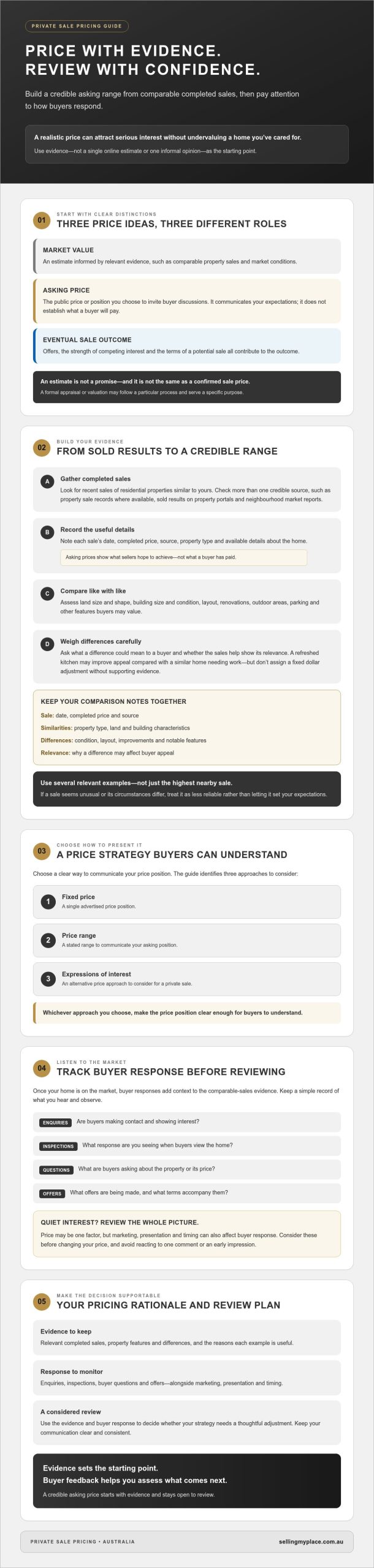
To work out how to price your house for sale privately, treat price as a decision informed by several kinds of evidence, not a single definitive number. An estimate helps you consider a possible value. Your asking price is the public position you choose to invite buyer discussions. The price buyers may be willing to pay can depend on comparable sales, your property’s condition and features, current competition and buyer feedback once your home is on the market.
What is the difference between market value and asking price?
Market value is an estimate informed by relevant evidence, such as sales of comparable properties and market conditions. A formal appraisal or valuation may follow a particular process and serve a specific purpose. For general background, see Appraised value. An estimate, however, isn’t the same as a confirmed sale price.
Your asking price is the figure or price position you advertise as the starting point for buyer discussions. It communicates your expectations, but doesn’t establish what a buyer will pay. Offers, the strength of competing interest and the terms of a potential sale all contribute to the eventual outcome. Keep these distinctions clear and you can use estimates as evidence without treating them as promises.
Why can private-sale pricing feel difficult?
There’s a balance to strike: you want to pursue a strong result while setting a price that encourages genuine buyers to take a closer look. It can be harder to judge objectively when a home holds years of family memories or you’ve invested time and care in improvements. Those things matter to you, but buyers may weigh them differently.
A credible asking price starts with evidence and stays open to review. Consider comparable sales alongside your property’s presentation and condition, then watch how buyers respond. If interest is quieter than expected, don’t assume price is the only cause. Marketing, presentation and timing may also affect the response. A calm review helps you decide what the evidence suggests instead of reacting to one comment or an early impression.
Private selling doesn’t mean you have to make the decision without support. Neighbourhood market reports and pre-sale property consulting can provide useful context as you assess your options, while the pricing decision remains yours. Next, build a clearer range from completed sales and compare those homes carefully with your own.
Build an evidence-based asking price from comparable Australian sales
A useful asking range comes from a repeatable process, not from picking the highest nearby sale or averaging a handful of online estimates. Gather completed sales, choose properties that genuinely resemble yours, assess the meaningful differences, then use the evidence to form a range you can explain.
How do you find useful comparable property sales?
Start with recent completed sales of residential properties similar to yours. Search more than one credible source, such as property sale records where available, property portals showing sold results and neighbourhood market reports. Record each sale date, price, property type and the details available about the home. Asking prices can provide context, but they show what sellers hope to achieve, not what a buyer has paid.
Look for several relevant examples rather than relying on one sale. A result may be unusual because the property has distinctive features or the sale circumstances differ from a typical transaction. If you can’t tell why a sale stands apart, mark it as less reliable rather than letting it set your expectations.
How should you adjust for differences between homes?
Compare like with like, then note where your home differs. Consider land size and shape, building size and condition, layout, renovations, outdoor areas, parking and other features buyers may value. A refreshed kitchen, for instance, may improve appeal compared with a similar home needing work. That doesn’t mean you can assign a fixed dollar adjustment without supporting evidence.
Ask what each difference could mean to a buyer, and whether the sales you’re comparing help show its relevance. A practical comparison table can keep your reasoning clear:
- Sale: date, completed price and source.
- Similarities: property type, land and building characteristics.
- Differences: condition, layout, improvements and notable features.
- Relevance: why the difference may affect buyer appeal.
Once you’ve assessed several sales, use the closest matches to develop a considered range rather than a falsely precise figure. Keep your sources and dates with your notes so you can revisit the evidence if circumstances change. For more on the underlying valuation process, read this guide to determining a home’s market value in Australia.
Neighbourhood market reports and pre-sale property consulting can offer useful context as you work through the comparisons. If you’d like support reviewing your pricing evidence, you can ask about property pricing advice. Your final range should reflect the evidence for your home and remain open to review as buyer responses come in.
Choose a private-sale price strategy buyers can understand
Once you’ve developed a price range from comparable sales, decide how to present your position to buyers. A fixed asking price, a range and expressions of interest each communicate something different. The right fit depends on your evidence, sale goals and how clearly the format will guide buyer discussions. No single approach suits every home.
| Approach | Clarity | Flexibility | Possible buyer interpretation |
|---|---|---|---|
| Fixed asking price | Gives buyers a clear reference point. | Can leave room to consider offers, depending on your wording. | May be read as the amount you expect, or as a price open to discussion. |
| Price range | Shows a price bracket rather than one figure. | Signals some flexibility within the stated range. | Buyers may focus on the lower end, so make the range clear and evidence-backed. |
| Expressions of interest | Doesn’t state a specific asking figure. | Lets buyers put forward offers for you to consider. | Some buyers may be unsure what level of offer you’re seeking. |
Should you use a fixed price or a price range?
A fixed price offers a straightforward reference point, which can help buyers decide whether to enquire. A range can communicate flexibility, but make sure its wording is honest and doesn’t imply a level of certainty you can’t support. Neither format guarantees a particular offer or final sale price. Before advertising, check the requirements that apply to property price advertising where you’re selling, as rules can vary between jurisdictions and circumstances.
How should you account for your sale goals?
Your timeframe, next move and minimum acceptable outcome all matter. Decide privately what result you could accept after considering your plans, but don’t confuse that confidential negotiation threshold with the public asking price. Your advertised position should be supported by your sales evidence and communicated consistently across your marketing. For ideas on managing offers and conversations, read these property sale negotiation tips.
Your price format should be clear, evidence-backed and consistent across every advertisement. That consistency helps buyers understand your position and gives you a steady basis for responding to enquiries and offers. Choosing how to price your house for sale privately isn’t just about selecting a figure. It’s also about presenting it in a way that suits your sale goals and leaves room for considered discussion.
Test your asking price and adjust it using buyer feedback
A price strategy needs a way to check how it’s landing with buyers. If you’re working out how to price your house for sale privately, record what happens after launch rather than relying on a single reaction or a quiet day. Buyer response can help you assess your asking price, but it may also point to issues with marketing, presentation or timing.
Keep a simple log of:
- Enquiries and the questions buyers ask
- Inspection attendance and follow-up interest
- Repeated comments about value or property features
- Offers, including how well their terms align with your expectations
What does buyer feedback say about your asking price?
Look for patterns, not verdicts. One buyer’s view may reflect their own preferences, while similar comments from several interested people could suggest a wider concern about value, condition or a feature of the home. Compare inspection interest and offer quality with the response you hoped your campaign would attract. Keep notes factual, protect buyers’ privacy and follow any requirements that apply to handling their information.
Limited enquiries don’t automatically mean the price is wrong. First check whether your advertising is reaching buyers and explaining the property clearly. Consider whether the photography, floorplan and listing details present the home accurately, and whether inspection feedback raises a presentation issue. Separating these factors helps you avoid changing the price to solve a problem that may lie elsewhere.
When should you review or change the price?
Choose a review point before advertising begins. This gives you a basis for assessing meaningful buyer response rather than reacting to one slow day. At that point, revisit your enquiry and inspection log, check your listing’s exposure and presentation, then compare your asking position with current evidence from relevant completed sales.
If the evidence supports a change, decide on a clear update rather than making repeated small adjustments that could leave buyers uncertain about your position. Make sure the revised price is consistent wherever the property is advertised, and explain it plainly in buyer conversations. A simple sequence can keep the decision grounded:
- Check exposure: Is the listing clear and reaching its intended audience?
- Gather feedback: What themes appear across enquiries and inspections?
- Revisit evidence: Do comparable sales still support your asking position?
- Communicate consistently: If you update the price, reflect the change across your advertising.
A measured review can help you respond to the market without losing sight of your goals. If you’d like support interpreting buyer feedback or reviewing your pricing approach, contact the advisory team.
Prepare to sell privately with a price you can confidently support
A well-considered asking price is easier to stand behind when your evidence, advertising and buyer communication tell a consistent story. Before your home goes live, make sure you can explain how you arrived at your price and have a plan for reviewing it once buyers respond. This brings your work on how to price your house for sale privately into a practical plan.
What should you have ready before advertising your home?
Gather your notes in one place so you can refer to them throughout the sale. Your preparation checklist should include:
- A documented price range, supported by relevant completed sales and a brief explanation of how you assessed differences between those homes and yours.
- Your confidential minimum, considered in light of your next move and sale goals. Keep this separate from your advertised price.
- An agreed review plan, including when you’ll assess enquiries, inspections and offers rather than reacting to every quiet spell.
- Accurate listing information, with property details checked and presentation, photography and floorplan reviewed for accuracy.
Clear marketing helps buyers understand what’s being offered, while accurate information and consistent responses help set sensible expectations. For a broader view of the owner-led process, use this step-by-step guide to selling your own home.
Where can private sellers get support with pricing and marketing?
You remain responsible for deciding your asking price, but you don’t have to gather every piece of context alone. Neighbourhood market reports can help you review relevant sales, while pre-sale property consulting can provide guidance as you consider your approach. These resources can inform your judgement, but they shouldn’t be treated as guaranteed valuations or promises about what a buyer will offer.
Kincade International Direct Sales provides flat-fee marketing and advisory support for private residential sales. Services include property listings, professional photography, floorplans, neighbourhood market reports, pre-sale consulting and conveyance advice. This support can complement your pricing decisions, but it doesn’t replace your own assessment or guarantee a particular sale price.
With your evidence gathered, your price rationale recorded and a review plan in place, you can move into the sale with a clearer sense of direction. If you’re ready to explore practical help with your private sale, discuss private-sale support.
Move forward with a pricing plan you can support
Choosing how to price your house for sale privately doesn’t have to come down to guesswork. Use relevant completed sales to build a realistic range, choose an asking format buyers can understand, then review enquiries, inspections and offers against your plan. If the response is quieter than expected, check your marketing and presentation as well as the price before deciding what to change.
A clear rationale helps you communicate consistently and make considered decisions during an important transition. Practical support can help, too. Kincade International Direct Sales offers flat-fee property marketing with no agency commission. Professional photography, floorplans and neighbourhood market reports are available, and its Agent Advisory Service provides pre-sale consulting to complement your pricing decisions.
If you’re ready to take the next step, discuss your private-sale plans with the team. Sound evidence and a thoughtful review plan can help you approach your sale with greater confidence and make decisions that suit your circumstances.
Frequently Asked Questions
How do I price my house for sale privately in Australia?
To work out how to price your house for sale privately, use recent completed sales of similar homes as your starting point. Compare property type, land, layout, condition and features, then account for differences when forming a realistic asking range. Choose an advertising format buyers can understand and decide in advance when you’ll review their response. Online estimates can help with initial research, but shouldn’t be your only evidence.
Should I price my house above market value when selling privately?
Only set an asking price above your evidence-based estimate if you have a clear reason and understand the risk. Buyers may compare your home with other available properties, and a price that seems out of step could reduce enquiries or delay useful feedback. Decide privately what offers you’d consider, but keep the public asking price credible and supportable. Don’t assume that starting high will necessarily lead to a higher final offer.
How do I find comparable sales for my home?
Search property portals, sale records where available and neighbourhood market reports for completed sales of homes that resemble yours. Compare the property type, land and building characteristics, condition, layout and notable features. Note the source and sale date for each result, and look across several examples rather than relying on one unusual sale. Advertised prices can offer context, but they show seller expectations, not completed transactions.
Can I use an online property valuation to set my asking price?
Use an online valuation as an initial reference, not as a definitive asking price. Automated estimates may not reflect a home’s condition, renovations, layout or features, and different tools can produce different results. Check the estimate against recent completed sales of comparable properties and consider whether the information used is current and accurate. Your asking price should reflect the wider evidence and buyer response, not one online figure alone.
How often should I review my asking price when selling privately?
Set a review point before advertising, then assess the asking price once you have meaningful campaign evidence to consider. Review enquiries, inspection attendance, repeated feedback and offer quality alongside your listing’s exposure and presentation. If interest is limited, don’t assume price is the only issue. Revisit comparable sales and check the marketing before deciding whether an adjustment is warranted. Review again if market conditions or your sale circumstances change.
Should I advertise a fixed price or a price range?
A fixed price gives buyers a clear reference point, while a range can signal flexibility but may lead some buyers to focus on its lower end. Neither approach guarantees a particular offer. Choose the format that best fits your evidence and sale goals, and make the wording clear and consistent wherever the property is advertised. Check the price advertising requirements that apply to your circumstances, as requirements can differ across Australia.
Can I change the asking price after listing my house privately?
In general, you can review and update your advertised asking price during a private sale. Before changing it, consider buyer feedback, listing exposure, presentation and comparable sales rather than reacting to one quiet day. Check any applicable requirements and the terms of the platforms carrying your listing. If you decide to make an update, revise the price consistently across your advertising and communicate the change clearly to interested buyers.
How Do I Get a Comprehensive Market Analysis for My Home Before Selling It?
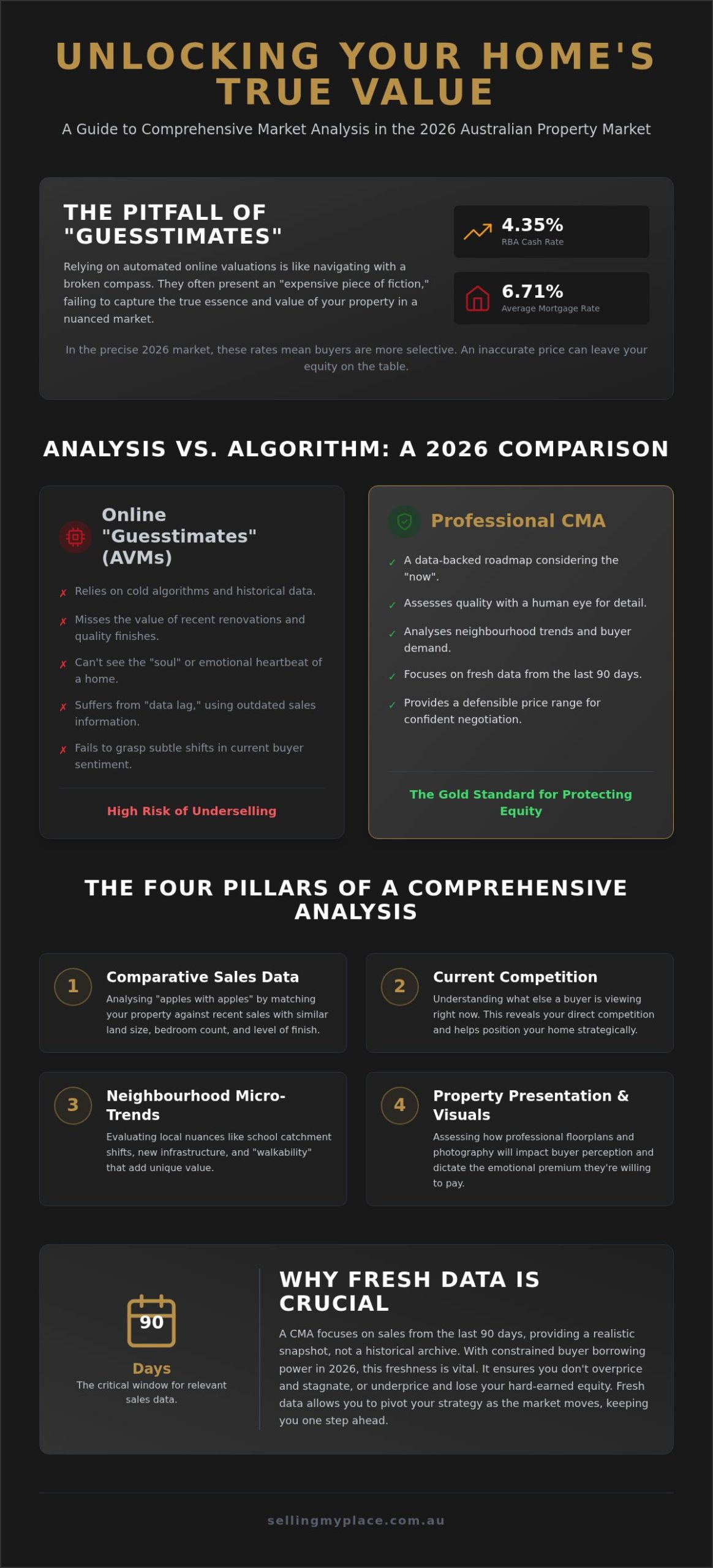
The “guesstimate” you found online is likely the most expensive piece of fiction you’ll ever read. Selling a home is one of the most significant transitions your family will ever navigate, and it’s natural to feel a bit of a squeeze in the current climate. With the RBA cash rate at 4.35% and mortgage rates averaging 6.71%, the 2026 market has become a space where precision matters more than ever. You’ve likely encountered conflicting data from various websites, leaving you asking, how do i get a comprehensive market analysis for my home before selling it? It’s a valid concern, especially when you want to avoid leaving your equity to chance or high-pressure sales tactics.
We’re here to show you that securing a professional, unbiased market analysis is the key to protecting your legacy and ensuring a premium sale price. We’ll explore how to obtain a defensible price range and a clear strategy to maximise your profit, giving you the steady hand you need to negotiate with absolute confidence. By moving away from transactional noise and toward data-driven clarity, you can approach your sale with the peace of mind that your home’s value is fully protected.
Key Takeaways
- Learn why a detailed Comparative Market Analysis (CMA) is the essential gold standard for protecting your property equity, offering far greater precision than basic council valuations or automated estimates.
- Understand the “Four Pillars” of accurate pricing, including how to analyse “apples with apples” sales data and evaluate the current local competition through the eyes of a selective buyer.
- Discover the specific steps for how do i get a comprehensive market analysis for my home before selling it? to bypass the “data lag” issues often found in common online valuation tools.
- Gain a practical, step-by-step strategy for gathering raw market data and conducting your own local research to ensure your home is positioned for a premium result in a balanced market.
- See how professional Neighbourhood Market Reports provide the depth of a traditional agency appraisal while maintaining a commission-free environment that puts your family’s financial interests first.
What is a Comprehensive Market Analysis (CMA) for Property?
A Comprehensive Market Analysis, or CMA, is far more than a simple price tag. It’s a detailed report that aligns your home with similar properties that have recently sold and those currently competing for attention on the market. While council valuations provide a baseline for rates, they often lag behind real-world desirability and don’t account for the emotional heartbeat of a home. A CMA is considered the gold standard because it looks at the “now”, examining neighbourhood trends, specific property features, and current buyer demand metrics. Many owners start their journey by asking, how do i get a comprehensive market analysis for my home before selling it? to ensure they aren’t underselling their most valuable asset. A CMA is a data-backed roadmap for a successful, high-profit property sale.
To get the full picture, an analysis must dive into the local nuances that make your street unique. This includes looking at recent infrastructure changes, school catchment shifts, and the specific “walkability” of your pocket. It’s about more than just square metres; it’s about how your home fits into the current lifestyle aspirations of Australian buyers. By looking at these layers, you move from a “guesstimate” to a position of professional authority. For homeowners in Western Australia, referencing the detailed local feedback found on regalgateway.com illustrates how specific area knowledge can validate a property’s true market standing.
CMA vs. Online Guesstimates
Automated valuation models, or AVMs, rely on cold algorithms that often miss the soul of a property. These “instant” tools see a three-bedroom house on a 600-square-metre block, but they can’t see the high-end stone benchtops or the clever way you’ve opened up the living area. Relying on an AVM is risky because it often ignores recent internal renovations that significantly boost value. For a true reflection of your home’s worth, understanding property comparables requires a human eye to assess quality and finish. In the 2026 market, human expertise is vital for interpreting subtle shifts in buyer sentiment that a machine simply cannot grasp.
Why Timing Matters in the 2026 Australian Market
With the RBA cash rate holding at 4.35%, buyer borrowing power is more constrained than in previous years. This makes the “freshness” of your data critical. A CMA focuses on sales from the last 90 days, providing a realistic snapshot rather than a historical archive. This helps you navigate the current property cycle, which can often feel like a bit of a rollercoaster. When buyers are being more selective, having a clear view of the immediate landscape ensures you don’t overprice and stagnate, or underprice and lose out on your hard-earned equity. Fresh data allows you to pivot your strategy as the market moves, keeping you one step ahead of the competition. This emphasis on data-driven strategy is also essential in global luxury hubs, where specialists like vincentlim.sg provide similar precision for premium estates in Singapore.
The Four Pillars of a Truly Comprehensive Analysis
A truly robust analysis stands on four foundational pillars. When you’re wondering, how do i get a comprehensive market analysis for my home before selling it?, it’s vital to look beyond just the final sale price of the house next door. Pillar 1 is Comparative Sales Data. This involves looking at “apples with apples” by matching your property against others with similar land size, bedroom count, and level of finish. Pillar 2 shifts the focus to Current Competition. In a more balanced 2026 market, understanding what else a buyer is viewing right now is as important as what sold last month. Pillar 3 covers Neighbourhood Micro-Trends. This includes everything from new school catchment boundaries to local infrastructure projects that could boost long-term value. Finally, Pillar 4 addresses Property Presentation and Visuals. This is often the most overlooked part of an analysis, yet it dictates the emotional premium a buyer is willing to pay.
The Role of Professional Floorplans and Photography
Professional visuals are not just marketing fluff; they are essential data points. Accurate floorplans allow potential buyers to “mentalise” the space, imagining where their own furniture will sit. This creates an early emotional attachment that often translates into stronger offers. High-end photography significantly lifts click-through rates on listing portals, ensuring your home isn’t lost in the digital crowd. When these elements are included in your initial strategy, they provide a clearer picture of how your home will be perceived relative to the competition. It’s about building a narrative of quality that data alone cannot convey.
Analysing Neighbourhood Market Reports
A professional neighbourhood report is the key to answering how do i get a comprehensive market analysis for my home before selling it? while ensuring your equity remains protected. These reports should give you a clear-eyed view of local activity, including median prices, clearance rates, and days on market. Interpreting “days on market” is particularly useful for gauging buyer urgency. If the median is 61 days, as seen in recent data, a home selling in 14 days suggests high demand for that specific pocket. Understanding these nuances helps you how to determine the market value of a home in Australia with precision.
If you’re feeling overwhelmed by the sheer volume of data, our team can help you secure a tailored report that organises these pillars into a clear action plan. This ensures you aren’t just guessing, but are instead guided by a steady hand and local expertise.
Professional CMA vs. Free Online Valuation Tools: A 2026 Comparison
It’s incredibly tempting to rely on the “instant” valuation buttons found on major property portals. These Automated Valuation Models (AVMs) offer a quick fix for curiosity, but they typically provide low to medium accuracy at best. When you’re asking, how do i get a comprehensive market analysis for my home before selling it?, it’s important to recognise that a computer algorithm can’t walk through your front door. A professional CMA offers high-level precision because it accounts for the specific condition and unique charm of your property, whereas a generic tool treats every house on the street as a uniform data point.
The most significant hurdle with online tools is the “Data Lag” issue. Most automated sites pull information from settled sales records, which can be up to six months old by the time they appear. In the dynamic 2026 market, where buyer sentiment can shift following a single RBA announcement, six-month-old data is effectively ancient history. Relying on outdated figures can lead to a pricing strategy that is completely out of step with current reality. The cost of this error is high; for many Australian sellers, a mere 5% valuation mistake can result in leaving $50,000 or more on the table. That is a significant portion of your hard-earned equity to lose simply for the sake of a “free” estimate.
When an Online Estimate is “Enough”
There are certainly times when a quick online guesstimate serves a purpose. If you’re in the very early stages of a long-term plan or own a highly generic unit in a large complex where dozens of identical properties have sold recently, an AVM can give you a rough ballpark. However, you should never use these basic tools to make a final list-price decision. A better approach is to use multiple data sources to create a broad “valuation range” while acknowledging that the final figure requires a much deeper dive into current local demand.
The “Human Touch” in Property Valuation
A seasoned expert brings a level of intuition that no machine can replicate. An algorithm might see a standard block of land, but it won’t understand the premium value of a north-facing backyard that captures the winter sun or the quiet safety of a specific cul-de-sac. These are the emotional factors that drive buyers to push their budgets further. If you’re serious about protecting your financial future, it’s a wise move to organise a professional consultation. This ensures you have a steady hand guiding your strategy, allowing you to interpret the nuances of the 2026 landscape with absolute certainty.
Step-by-Step: How to Organise Your Own Market Analysis
Taking control of your property sale starts with a clear understanding of the ground you’re standing on. You don’t need to wait for an agent to tell you what your home is worth; in fact, doing your own groundwork is the best way to ensure you aren’t being “bought” with an inflated appraisal. If you’re asking, how do i get a comprehensive market analysis for my home before selling it?, the first step is to gather raw data from leading Australian property portals. Focus specifically on the “Sold” sections rather than current listings. Look for properties within a one-kilometre radius that have settled in the last 90 days. This gives you a baseline of what buyers are actually paying in a market where the RBA cash rate sits at 4.35%.
Attending Open Homes as a “Secret Shopper”
Data on a screen only tells half the story. To truly understand your competition, you must see how other homes present in person. When you visit local open homes, look past the styling and focus on the level of finish, the flow of natural light, and the general maintenance. Pay close attention to the buyer foot traffic; are people lingering or doing a quick five-minute lap? Ask the listing agent direct questions to gauge interest levels, such as “How many contracts have been requested?” or “What has the feedback been on the price guide?” This real-world analysis helps you see your own home through the selective eyes of a 2026 buyer.
Once you’ve gathered your personal observations, it’s time to add a layer of professional suburb-level data. Securing a Neighbourhood Market Report provides the deep metrics, like clearance rates and median price shifts, that individual portal searches might miss. The final step in this process is to consult an independent agent advisory service. This allows you to synthesise all your findings with the help of a seasoned expert who has no commission bias, ensuring your strategy is built on facts rather than a sales pitch.
Synthesising the Data
To make sense of everything you’ve found, create a simple comparison spreadsheet. List the “sold” properties you’ve researched and adjust your estimated price based on the differences. If a house sold for A$950,000 but had a larger block than yours, you might adjust downwards. Conversely, if your home features an extra bathroom or a modern kitchen renovation that the “comp” lacked, you can justify a higher range. This methodical approach gives you a defensible price that stands up during negotiations. For those looking to take full control of the process, our Sale by owner guide offers a clear path forward. If you’re ready to move from research to action, you can request your expert advisory session here to finalise your strategy with absolute confidence.
How Selling My Place Empowers You with Expert Market Insights
Most traditional real estate models are built on a transactional foundation where the agent’s commission is the primary driver. This can often lead to a conflict of interest, especially when you are trying to determine an honest value for your family home. We take a different path. By using the Kincade International Direct Sales model, we offer a commission-free alternative that puts you back in the driver’s seat. If you have been wondering, how do i get a comprehensive market analysis for my home before selling it? without the sales pressure, our approach provides the answer. We provide Neighbourhood Market Reports that offer the same analytical depth and data precision as a high-end agency, but within a flat-fee structure that protects your equity.
Our Agent Advisory Service acts as the steady hand you need during this major life transition. We provide expert pre-sale consulting to help you synthesise complex data into a clear, actionable strategy. This isn’t just about listing a property; it’s about a partnership where you have access to professional visuals, floorplans, and global marketing networks. On average, owners who take control of their sale through our model achieve a saving of A$20,000. That is a significant sum that stays in your pocket, helping to secure your family’s financial future rather than being absorbed by high marketing costs and agency commissions.
A Partnership Approach to Selling
We see ourselves as a nurturing guide rather than a middleman. Our philosophy is simple: we provide the professional tools and expert backing, and you keep the profit. One of the most reassuring aspects of our service is the “listed until sold” commitment. There are no arbitrary time limits or mounting fees to worry about, which reduces the stress of the 2026 market. You can take the time to find the right buyer who truly values your home’s legacy. For a deeper look at how we’ve modernised the process, explore our guide on Professional Residential Property Listing Services.
Next Steps: Secure Your Equity
Accurate analysis is the very first step in protecting your family’s legacy. When you have a clear-eyed view of your home’s worth, you can negotiate from a position of calm confidence. We invite you to reach out for a no-obligation chat about your property goals and the unique features of your local area. It’s about ensuring you have the right information at the right time. Get your comprehensive market analysis and start selling smarter today to ensure your next move is your best one yet.
Take the Lead on Your Property Journey
A true market analysis is about more than just numbers on a page; it’s about the security of your family’s future and the legacy of your home. You’ve seen how professional photography and floorplans elevate perceived value, and why human expertise consistently outshines cold, outdated algorithms. By moving away from “guesstimates” and toward data-driven clarity, you position yourself to capture the best possible result in a shifting market. When you ask, how do i get a comprehensive market analysis for my home before selling it?, you’re really seeking a path that respects your hard-earned equity and provides a sense of calm during a major life transition.
Our Agent Advisory Service provides that steady hand, helping you save an average of A$20,000 in commissions while navigating the 2026 property landscape with ease. You don’t have to do this alone, but you also don’t have to give away your profit to get professional results. Secure your comprehensive market analysis and sell commission-free to start your next chapter on the strongest possible footing. You have the tools, the data, and the community support to achieve a premium result on your own terms. We look forward to helping you move forward with confidence.
Frequently Asked Questions
How long does a comprehensive market analysis take to complete?
A thorough Neighbourhood Market Report typically takes between 24 and 48 hours to compile. This timeframe allows our Agent Advisory Service to move beyond basic automated data and manually verify recent local sales. We focus on the last 90 days of activity to ensure accuracy in the current 2026 market. While instant online tools take seconds, they lack the human oversight required to protect your equity and account for your home’s unique features.
Can I get a market analysis if I am not ready to sell yet?
Absolutely, and in fact, we encourage it. Understanding your property’s position is a vital part of long-term financial planning. Many of our clients ask, how do i get a comprehensive market analysis for my home before selling it? simply to track their equity or decide on future renovations. Having this data early allows you to move with a steady hand when the time eventually comes to list, ensuring you aren’t rushed into high-stakes decisions.
How does a CMA differ from a formal bank valuation for a mortgage?
A CMA focuses on the likely selling price in the open market, while a bank valuation is often more conservative. Banks look at “forced sale” scenarios to mitigate their own risk, which is why their figures are frequently lower. In contrast, a comprehensive analysis accounts for emotional buyer triggers, high-end photography, and professional floorplans. It aims to find the “premium” price you can achieve through strategic marketing rather than a baseline figure for lending purposes.
Is a market analysis free when using a flat-fee service?
Our Neighbourhood Market Reports are included as part of our flat-fee property marketing and advisory packages. Unlike traditional agencies that offer “free” appraisals to secure a high-commission listing, our reports are provided within a transparent, 0% commission structure. This ensures the advice you receive is completely unbiased. You get the depth of a professional agency analysis without the hidden costs or the pressure to sign a restrictive, commission-based contract.
What happens if the market analysis price is lower than I expected?
If a report shows a lower figure, it’s an opportunity to adjust your strategy before going live. Our Agent Advisory Service helps you interpret the data, looking at whether the result is due to temporary market shifts or specific presentation issues. We might suggest focusing on pre-sale property consulting to lift the home’s appeal. It’s better to face the reality of the 2026 market early than to stagnate on the portals with an unrealistic price.
Do I need a new market analysis if I don’t sell within three months?
Yes, we recommend refreshing your data every 90 days to stay aligned with the current RBA cash rate and local demand. In a fluctuating environment, a report from six months ago is effectively ancient history. A fresh analysis ensures your pricing remains defensible and competitive. Because our model allows you to stay “listed until sold” with no time limits, keeping your market insights up to date is a vital part of a successful long-term sale strategy.
How accurate are market reports in a fluctuating interest rate environment?
Market reports are highly accurate when they prioritise recent “settled” sales and current clearance rates. In a 2026 climate where mortgage rates average 6.71%, buyer borrowing power can change quickly. A comprehensive analysis accounts for these shifts by looking at the most recent 90 days of data. This human-led interpretation helps you understand how interest rate movements are impacting local buyer urgency, providing a much more reliable guide than a static, automated estimate.
Can home styling and presentation change my market analysis results?
Presentation can significantly shift the “emotional premium” a buyer is willing to pay. While the raw data provides a baseline, professional photography and floorplans help buyers mentalise the space, often leading to offers at the higher end of your valuation range. A home that is styled to highlight natural light and flow will consistently outperform a poorly presented “comp”. Our advisory service includes pre-sale consulting specifically to help you maximise these visual data points.
Free Online Property Valuation: How Accurate Are They in 2026?
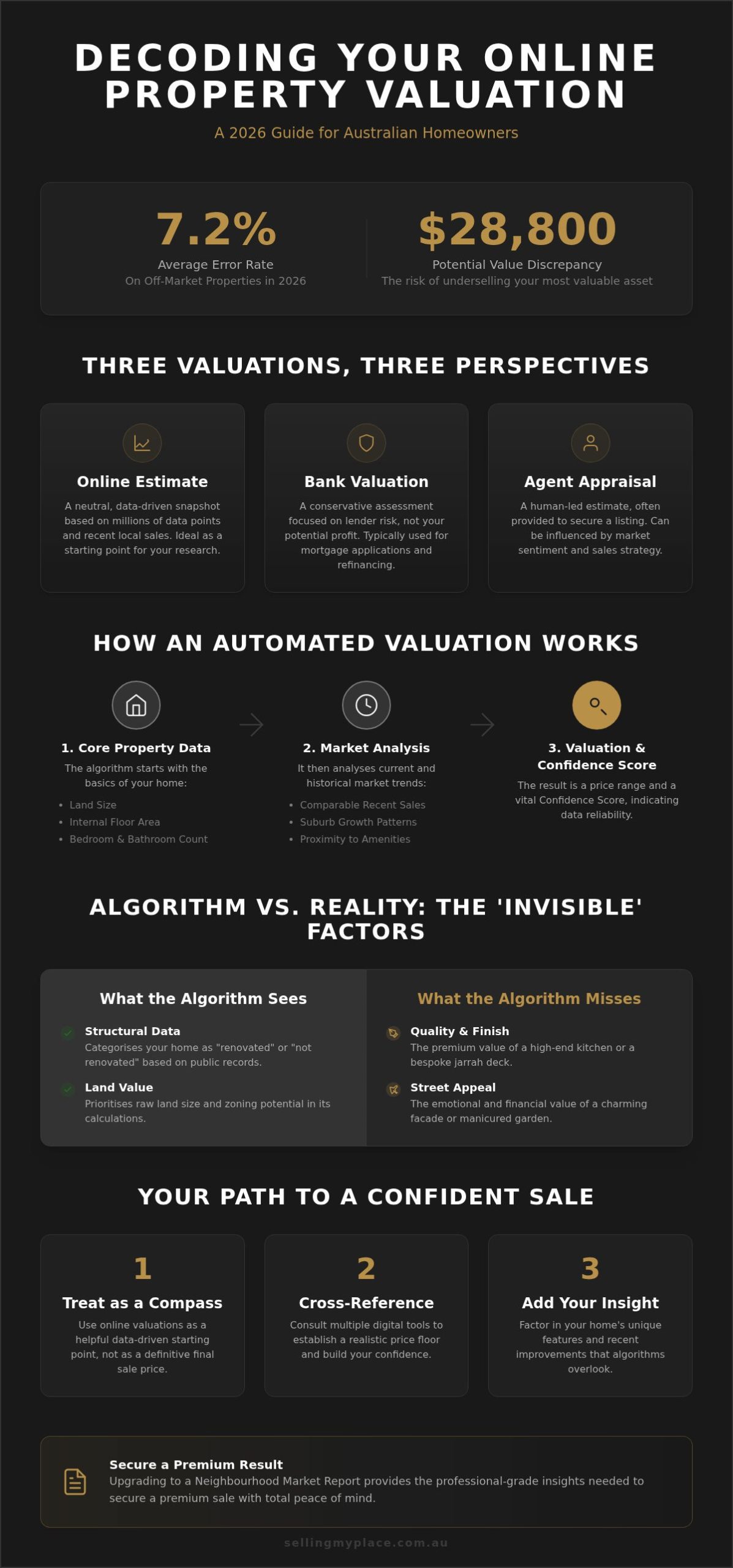
What if the number you just saw on a free online property valuation is actually $28,800 away from your home’s true worth? It’s a common scenario in 2026, where a 7.2% error rate on off-market properties can lead to significant confusion and the very real fear of underselling your most valuable asset. We understand the anxiety that comes with conflicting estimates; it’s hard to feel confident about your future when the digital data seems to change depending on which website you’re visiting.
You deserve to move forward with total clarity and a sense of calm. This guide will help you discover the truth behind automated property estimates and show you how to use that digital data to secure the best possible sale price for your Australian home. We’ll explore the latest 2026 accuracy benchmarks, explain why on-market data is more reliable than off-market guesses, and provide you with the tools to establish a realistic price range. By the end, you’ll have the confidence to manage your own sale and keep your hard-earned equity where it belongs.
Key Takeaways
- Learn how to treat a free online property valuation as a helpful data-driven compass rather than a definitive final sale price.
- Discover the specific “invisible factors” that algorithms often overlook, ensuring you don’t undervalue your home’s unique features or recent improvements.
- Master the technique of cross-referencing multiple digital tools to establish a realistic price floor and gain the confidence to lead your own sale journey.
- Understand how accurate market data allows you to sidestep traditional agent commissions and protect your family’s hard-earned equity.
- Explore how upgrading to a Neighborhood Market Report provides the professional-grade insights needed to secure a premium result with total peace of mind.
What is a Free Online Property Valuation?
When you’re standing in your kitchen, perhaps enjoying a morning flat white and thinking about the next chapter of your life, a free online property valuation is often the very first place your journey begins. It’s a digital starting line that offers a glimpse into your home’s potential without needing to tidy up for an unannounced visitor. While it feels like a simple search result, you’re actually interacting with a complex Automated Valuation Model (AVM). An AVM is a statistical tool that processes millions of data points to predict market value with mathematical precision.
It’s helpful to distinguish these estimates from other figures you might encounter. A bank valuation is typically conservative, focused on lender risk rather than your profit. A real estate appraisal is a human-led estimate, often influenced by the desire to secure a listing. An online estimate, however, acts as a neutral data-driven snapshot based on recent local sales and your property’s core characteristics. It provides a grounded starting point, helping you move from uncertainty toward a structured plan for your lifestyle transition.
The Role of Big Data in Australian Real Estate
Algorithms don’t just look at what happened yesterday; they analyse a decade of historical sales to identify long-term patterns in your suburb. In the Australian market, “Comparable Sales” (or “Comps”) are the lifeblood of these systems. The computer identifies properties similar to yours in land size, internal floor area, and bedroom count that have recently changed hands nearby. By weighing these “comps” against current market velocity, the algorithm calculates a price range. It’s a purely mathematical approach to a very personal asset, stripping away the noise to look at the cold, hard numbers.
Why Sellers Start with Online Estimates
The primary appeal of a free online property valuation is the lack of pressure. You can explore your options privately, without the intensity of a formal listing presentation or the feeling that you’re being pushed into a quick sale. Many homeowners use these tools to assess their equity, which is a vital step when deciding if you’re ready for a sea change or an investment upgrade. It’s about finding an objective figure to balance the deep emotional attachment we all have to our family homes. Having a realistic number in hand provides a sense of calm, allowing you to visualise your future state with confidence rather than guesswork.
The Science Behind the Screen: How Estimates are Calculated
Peering behind the digital curtain reveals a sophisticated engine room of data. When you request a free online property valuation, the algorithm begins by pulling the structural basics of your home: land size, internal floor area, and the all-important bedroom and bathroom count. These are the fixed variables, but the real intelligence lies in how the software weights recency. In our fast-moving 2026 market, a sale that settled yesterday carries significantly more weight than a similar property sold six months ago. This is because algorithms are programmed to track suburb-wide growth trends and “days on market” averages in real-time to sense the current heat of the local area.
However, these systems have a distinct blind spot. They see the box, but they don’t always see the beauty. While these models are highly advanced, research from the Brookings Institution highlights that automated systems can sometimes miss the mark when local nuances or unique architectural features aren’t perfectly captured in the raw data. If your home boasts a bespoke jarrah deck or a high-end kitchen renovation, the algorithm might categorise you simply as “renovated” without understanding the premium quality of the materials used.
Weighting Factors in the Algorithm
Software quantifies location proximity with ruthless efficiency. It measures the exact distance to amenities like train stations, parks, and schools, assigning a mathematical value to convenience. There’s often a tug-of-war between “Street Appeal” and “Land Value” in these calculations. While we might fall in love with a charming facade, the algorithm often prioritises the raw land size and zoning potential. Many tools now provide a “Confidence Score” alongside the estimate. This score is actually more important than the price itself; it tells you how much comparable data is available. A low score suggests the algorithm is guessing, while a high score means it has plenty of recent evidence to back its claim.
Data Sources: Where the Information Comes From
Most free online property valuation tools draw their power from government land registries and historical listing portals. This provides a solid foundation, but it’s not always instantaneous. There is often a lag time of several weeks between a sale occurring at auction and the official settlement data being processed by the state registry. To bridge this gap, some models incorporate user-submitted data. If you’ve recently updated your home, you can often “claim” your property on these portals to update the facts. If you’re feeling unsure about how your home’s specific upgrades are being weighed by the data, reaching out for a friendly chat can help provide the clarity you need to move forward.
Algorithm vs. Reality: Why Online Estimates Can Miss the Mark
While a free online property valuation provides a helpful ballpark, it fundamentally lacks the human eye required to judge quality. Algorithms are excellent at counting bricks and measuring land, but they’re terrible at feeling the atmosphere of a home. An Urban Institute study highlights how data-driven models can struggle with qualitative nuances, sometimes reinforcing local disparities because they cannot account for the tangible love and care poured into a property. We know your home is more than just a set of coordinates on a map; it’s a collection of memories and carefully chosen finishes that a computer simply cannot process.
Then there’s the “Outlier Effect.” If a neighbour sells their home in a desperate hurry, or if two emotional buyers get into a bidding war over a specific view, that single data point can skew the entire suburb average. A computer sees the price tag but doesn’t know the story behind it. Relying solely on a screen when setting your reserve price is a risky move. It doesn’t account for current buyer heat or the specific market sentiment on auction day. Without that human context, you might find yourself anchored to a number that doesn’t reflect the true competitive nature of the local market.
The Five Things an Algorithm Cannot See
The software often misses the sensory details that drive a buyer’s heart and ultimately their budget. These invisible factors often dictate whether a home sells for a standard price or a suburb record. They include:
- The specific orientation of the home and how natural light floods the living areas during a winter afternoon.
- Nuisance factors such as proximity to main roads or power lines which can dampen an otherwise strong valuation.
- The “wow factor” of high-end internal finishes and the quality of a professional renovation.
- The psychological pull created by expert Photography in attracting premium buyers to your listing.
- The functional flow and spatial clarity provided by accurate floorplans.
When Online Valuations are Most (and Least) Accurate
Accuracy is usually highest in “cookie-cutter” estates where every house is similar in age and style. In these areas, the algorithm has plenty of identical data points to work with. However, accuracy drops significantly for unique heritage homes or properties in rural areas with low transaction volumes. If the data is thin, the algorithm might “hallucinate,” generating a number that has completely lost touch with the ground reality. Recognising when the data is unreliable is the first step in protecting your equity and ensuring you don’t leave money on the table during your sale.
Using Your Valuation to Maximise Your Sale Price
Once you’ve received your free online property valuation, the real strategy begins. It’s helpful to view this number as your “floor” rather than your “ceiling.” It represents the minimum value the market expects based on raw data, but your goal is to build upon that foundation through smart presentation and timing. By cross-referencing estimates from three or four different digital tools, you can find a reliable median that filters out any single algorithm’s quirks. This balanced approach is a core part of how to determine the market value of a home in Australia, blending digital efficiency with a sensible reality check.
When you’re ready to list, consider whether a “Price Guide” or a “Fixed Price” better suits your suburb’s current energy. A guide often invites more conversation and competition, while a fixed price offers clarity for buyers who want to move quickly. The choice often depends on how much “buyer heat” is currently present in your specific street.
Bridging the Gap with a Neighborhood Market Report
A basic web search only tells you what has happened in the past. A Neighborhood Market Report acts as the “pro version” of a free online property valuation, telling you what is happening right now. It allows you to look closely at active competitor listings to see exactly what features buyers are prioritising this week. By identifying these “sweet spots” where demand is high but supply is low, you can position your home to stand out as the obvious choice for a premium buyer.
Pre-Sale Consulting: The Human Advantage
Data can’t tell you that a $500 tin of paint and a weekend of garden mulching might add $5,000 to your final result. Our Pre-Sale Property Consulting focuses on these high-return minor repairs that often yield a 10x return on investment. De-cluttering and staging also play a huge role in the psychological “buy-in” for visitors, making the space feel like their future home rather than someone else’s history. Professional advice transforms a static data point into a dynamic, profitable sale strategy.
Ready to see how your digital data stacks up against a professional sale strategy? Get in touch with our team today to start your commission-free journey with confidence.
The KIDS Approach: From Valuation to Commission-Free Success
Most websites treat a free online property valuation as a digital hook, designed to reel you in and hand you over to a traditional real estate agent. These agents then ask for a 2-3% commission, which can feel like a heavy price to pay for a service you’re increasingly equipped to handle yourself. We believe that once you have the data, you have the power. By choosing Residential Property Listing Services, you’re opting for a modern, commission-free alternative that puts you back in the driver’s seat of your own sale. It’s a partnership where we provide the tools and you keep the reward.
On average, our clients save $20,000 in commissions. That’s a significant sum that stays in your pocket, perhaps to fund your next deposit or simply to secure your family’s future. We also remove the ticking clock often associated with real estate listings. Our “Listed Until Sold” promise means you can test the market and wait for the right buyer without the stress of expiring contracts or mounting marketing fees. It’s a calmer, more methodical way to achieve a premium result. You shouldn’t feel rushed when making such a major life transition.
Keeping Your Equity Safe
The maths of a sale by owner is refreshingly simple: 0% commission equals 100% of the profit for you. While the idea of managing your own sale might seem daunting at first, you aren’t doing it alone. You’ll have access to professional advisory services to help you navigate the legalities, including essential Conveyance Advice to ensure the settlement process is smooth and secure. There’s a deep sense of peace that comes from being in total control of your financial legacy. You know your home better than anyone, so why not be the one to tell its story? It’s about protecting your equity and your family’s future with a steady hand.
Taking the Next Step
If you’ve spent time researching your free online property valuation and feel ready for something more substantial, it’s time to request a Neighborhood Market Report. This report moves you beyond the “just curious” phase and makes you truly market-ready. It provides the granular, local insights that algorithms often miss, giving you the professional edge needed to negotiate with confidence. We’re here to act as your seasoned guides, helping you translate data into a successful sale. Don’t just settle for a generic online number. Take the lead, secure your profit, and start your next chapter with the financial freedom you deserve.
Take Control of Your Next Chapter
Your home is likely your greatest financial asset, and moving on to your next adventure should be a time of excitement rather than anxiety. While a free online property valuation provides a useful digital compass, it’s the refined strategy and local expertise that ultimately lead you home. By combining the latest market data with professional pre-sale consulting, you ensure that no dollar of your hard-earned equity is left on the table. You’ve worked hard for your home; you deserve to keep the reward.
Choosing a commission-free path doesn’t mean going it alone. With our global marketing network and Expert Agent Advisory included in every package, you have a steady hand guiding you through every step of the process. Owners who partner with us save an average of $20,000 in commissions; money that belongs in your pocket for your future. It’s about more than just a sale; it’s about honouring your legacy and transitioning with total peace of mind. Are you ready to see what’s truly possible for your property?
Secure your equity and sell commission-free with Kincade International Direct Sales today and move forward with the confidence you deserve.
Frequently Asked Questions
How accurate are free online property valuations in Australia?
Accuracy depends on whether your home is currently listed. For properties on the market in 2026, the median error rate is often under 2%. However, for off-market homes, the discrepancy can climb significantly higher. These tools rely on “comparable sales” and public data, meaning they work best in suburbs with high turnover and many similar houses. In rural areas or for unique builds, the accuracy naturally starts to drop.
Why is there such a big difference between different online estimates?
Discrepancies exist because every platform uses a unique algorithm that weights data points differently. One website might prioritise government land registry data, while another focuses more on recent listing prices from real estate portals. These varied “recipes” for calculation mean you’ll often see a range of prices. It’s best to look at multiple sources to find a realistic median for your home’s potential value.
Can a bank valuation be lower than an online property estimate?
It’s very common for a bank valuation to come in lower than a digital estimate. This happens because banks are focused on risk mitigation rather than achieving a premium sale price. They want to know what the property would sell for in a forced sale scenario. An online estimate, by contrast, is trying to predict what a motivated buyer might pay in an open, competitive market.
How do I update the information used in my online property valuation?
You can usually update your property’s details by “claiming” the home on the specific website providing the estimate. This allows you to correct the number of bedrooms or bathrooms and add details about recent renovations. Updating these facts helps the free online property valuation tool refine its calculation. It ensures the algorithm isn’t working with outdated information from ten years ago when you first bought the place.
Do I still need a professional appraisal if I have an online estimate?
Yes, you should still seek expert advice before making a final decision on your sale price. An online tool can’t see the quality of your new stone benchtops or feel the natural light in your living room. A professional appraisal provides the human context that data misses. It helps you understand the “buyer heat” in your street and how to position your home for a premium result.
Will a free online valuation affect my credit score?
No, checking your property’s estimated value online will not affect your credit score in any way. These searches are considered “soft” enquiries that don’t involve a credit application. You can check as many different sites as you like without worrying about your financial standing. Only “hard” enquiries, which happen when a lender reviews your credit file for a loan, will show up on your report.
How often should I check my property value estimate?
Checking your estimate once every three months is usually enough to keep an eye on your equity. Property is a long-term asset, so watching the numbers too closely can be stressful. Suburb trends often take months to show up clearly in the data. A quarterly check-in gives you a grounded view of how your local market is performing without getting caught up in minor weekly fluctuations.
What is the best way to get a formal property valuation for a sale?
The most effective way to get a formal, actionable valuation for a sale is to request a Neighborhood Market Report. This provides a much deeper level of insight than a basic free online property valuation. It combines digital data with a detailed analysis of active competitors in your area. This professional approach gives you the confidence to manage your own sale and keep your hard-earned equity for yourself.
Free Property Valuation Australia: The 2026 Seller’s Guide to Accuracy and Profit
What if the “flattery pricing” you’re hearing from local agents is actually the biggest risk to your family’s financial future? It is a stressful position to be in, standing at the crossroads of a major life transition while staring at three different online estimates that don’t seem to agree. You want a realistic figure, not a sales pitch, because underpricing your home could mean waving goodbye to years of hard-earned equity. We understand that a home is more than just a title deed; it’s your sanctuary and your legacy.
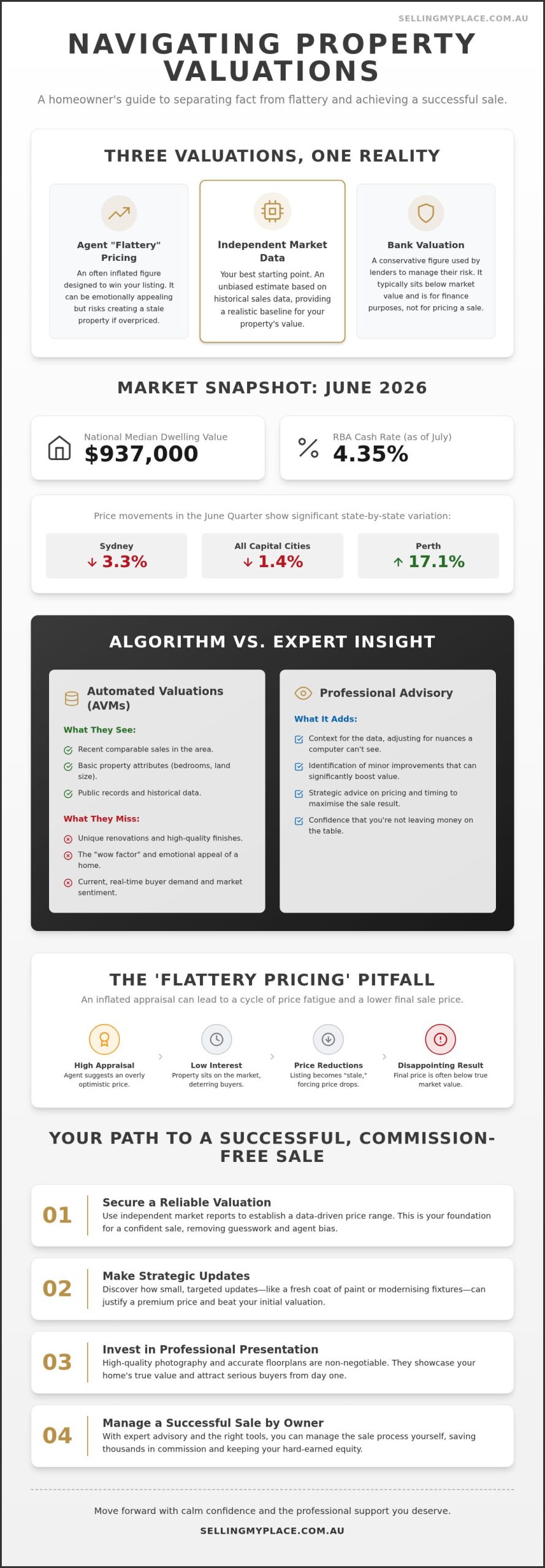
This guide is designed to help you secure a reliable free property valuation and transform that raw data into a strategic, commission-free sale. With the national median dwelling value sitting at $937,000 as of June 2026, and major cities like Sydney seeing recent price corrections, having a steady hand to guide you is more important than ever. We’ll walk you through how to identify a truly accurate price range, ways to boost your property’s appeal before listing, and the steps to keep your full profit without losing a cent to traditional agency fees. It’s about moving forward with calm confidence and the professional support you deserve.
Key Takeaways
- Understand why a free property valuation serves as a vital health check for your home’s equity, helping you separate a bank’s lending figures from your actual selling potential.
- Learn to distinguish between automated data and professional insights so you don’t leave money on the table when your unique home improvements aren’t captured by an algorithm.
- Guard yourself against “flattery pricing” and the common agent trap that often leads to price fatigue and disappointing final results.
- Discover how small, strategic updates and professional photography can help you justify a premium price and beat your initial valuation.
- Master the transition from data to dollars by using independent market reports and expert advisory to manage your own successful, commission-free sale.
What is a Free Property Valuation and Why is it Your Best Starting Point?
Think of a free property valuation as a vital health check for your most significant asset. It isn’t just a random figure on a screen; it’s the foundation of your future financial security. To move forward with clarity, you first need a solid grasp of what property valuation is and how it differs from the conservative estimates your bank might provide. While a bank’s report is designed to protect their lending risk, a market-focused valuation looks at the heartbeat of local demand. It’s about what a real person is willing to pay to call your house “home.”
The 2026 Australian property market has been a tale of two stories. With the RBA cash rate holding at 4.35% as of July, we’ve seen Sydney house prices dip by 3.3% in the June quarter while Perth has surged by a staggering 17.1%. This volatility means that an estimate from even six months ago is likely out of date. Regular check-ins via a free property valuation are no longer just a curiosity; they’re a necessity for any homeowner who wants to make an informed choice. It helps you answer the big questions. Should you invest in that kitchen renovation now, or is the market appetite strong enough to sell immediately and move on?
The Benefits of Knowing Your Home’s Worth Early
Getting an early handle on your property’s value allows you to plan your next move with a clear head. Whether you’re looking to downsize to a quiet suburb or upgrade for more space, you need to know your “walk-away” figure. This is the actual cash you’ll have left in your pocket after all costs are settled. It stops the guesswork and the midnight worrying. When you understand the specific trends in your street, you can spot opportunities that broader city-wide reports might miss.
How Kincade Supports Your Discovery Phase
We believe in empowering you with data that isn’t tied to a high-pressure sales pitch. Our Neighbourhood Market Reports provide a transparent look at what homes in your area are actually fetching, focusing on settled sale prices rather than ambitious listing figures. This independent perspective is vital. It’s about providing a steady hand and professional backing without the weight of a traditional agency commission. By using our Pre-Sale Property Consulting, you can prepare for a successful “sale by owner” experience. You’ll have the floorplans, photography, and advisory support needed to showcase your home’s true value while keeping your equity where it belongs: with your family.
AVMs vs. Professional Appraisals: Which One Should You Trust?
Most homeowners start their journey with a free property valuation generated by a computer. It’s incredibly convenient; you type in your address and get a number in seconds. This is what we call an Automated Valuation Model, or AVM. While these tools are a fantastic starting point for understanding your general equity, they operate by looking through a rear-view mirror. They rely on historical data and public records to provide a snapshot, which can sometimes lag behind the actual pulse of your neighbourhood.
An AVM is often spot on for suburban blocks where every house is similar. However, it can miss the mark significantly if you’ve recently added a third bathroom or spent your weekends perfecting a native garden. A computer simply cannot see the “soul” of a home. Relying solely on an algorithm in a shifting market, like we’ve seen in the June quarter of 2026 with capital city prices falling by 1.4% overall, can be risky. You need a steady hand to interpret those numbers and adjust for the nuances of your specific property.
Understanding Automated Valuation Models (AVMs)
AVMs pull data from three main pillars: recent sales of similar properties, land size, and basic property features like bedroom count. It is a helpful way to estimate the market value of your home quickly. But remember, these models don’t know if a house two doors down sold for less because it was in original 1970s condition. In rapidly changing cycles, such as the current 2026 downturn in Sydney and Melbourne, using multiple digital sources is the best way to find a realistic consensus value before you take the next step.
The Human Element: Professional Advisory Appraisals
A computer doesn’t feel the “wow factor” of a light-filled living room or a perfectly positioned deck. A professional advisor does. This human oversight is what separates a generic estimate from a strategic price point. This is where Kincade’s Advisory Service adds genuine value. We look at the emotional pull of your home and consider current buyer sentiment, which is vital given that auction clearance rates have dipped to 52.4% recently.
Don’t be seduced by the highest number you see on a screen or hear from a pushy agent. An inflated figure might feel good for a day, but it can lead to “price fatigue” if the market doesn’t agree, eventually forcing a lower final result. Accuracy is what protects your profit and your family’s legacy. If you’re feeling unsure about the conflicting numbers you’ve seen online, you might find it helpful to chat with a local expert who can help you make sense of the data without the pressure of a commission-based sales pitch.
Avoiding the “Agent Trap”: Why Free Appraisals Can Be Costly
It’s a lovely feeling when an agent walks through your front door and suggests a figure that exceeds your wildest expectations. However, this is often the moment where many Australian sellers unknowingly fall into the “agent trap.” In the industry, we call this “buying the listing.” It happens when an agent provides an inflated estimate simply to win your business, knowing full well the property will likely sell for less. While it feels good in the lounge room, it can be a costly mistake once the campaign begins.
When a home is launched at an unrealistic price, it often sits on the market for weeks without a serious offer. In the current 2026 climate, where buyers are increasingly selective and properties are taking longer to sell, this lead to “price fatigue.” Potential buyers start to wonder what is wrong with the home because it hasn’t sold yet. Eventually, the seller is forced to make significant price reductions, often ending up with a lower final result than if they had priced it accurately from the start. The psychological stress of adjusting your expectations mid-campaign is immense, especially when your family’s future plans are hanging in the balance.
The Conflict of Interest in Traditional Appraisals
The core of the problem lies in the traditional commission-based model. An agent who is chasing a percentage-based fee is naturally incentivised to tell you what you want to hear to secure your signature. That “free” agent appraisal isn’t truly free if it costs you $50,000 in lost equity due to a botched pricing strategy. To spot a realistic appraisal, look for an advisor who backs their claims with hard data from recent settled sales in your street, rather than just pointing to ambitious asking prices of homes that are still sitting on the market.
The Kincade Alternative: Data Without the Pressure
We take a different path. Because Kincade operates on a 0% commission structure, our advice is never clouded by the need to “win” a listing at any cost. Our focus is entirely on your success and helping you keep 100% of your profit. We believe in empowering you with factual strength. By using a professional market value determination, you can set a strategy based on reality. This independent free property valuation approach allows you to negotiate with buyers from a position of confidence. You aren’t just guessing a number; you are presenting a case for your home’s value that is supported by professional photography, floorplans, and a deep understanding of the local landscape. It’s about being a “steady hand” in your own sale, ensuring your hard-earned equity stays exactly where it belongs.
Maximising Your Result: How to Beat Your Current Valuation
Once you’ve received your free property valuation, it’s natural to feel either a sense of relief or a slight twinge of disappointment. However, that number is simply a starting point based on current market conditions and historical data. It isn’t a fixed destiny. You have the power to influence how buyers perceive your home’s worth. By focusing on both the visible and invisible elements of your property, you can push your final sale price toward the top end of your valuation range, or even beyond it. It’s about taking a proactive approach to your family’s equity.
Start with a “kerb appeal” audit. Buyers in 2026 are looking for stability and pride of ownership. Simple acts like pressure-cleaning the driveway, refreshing the mulch in your garden beds, or painting a tired front fence can add thousands to the perceived value. These aren’t just cosmetic changes; they signal to a buyer that the home has been loved and maintained. When a property looks cared for from the street, it sets a positive emotional tone before the front door even opens.
Pre-Sale Consulting and Presentation
In a digital-first market, your home’s first “showing” happens on a smartphone screen. This is why professional photography is non-negotiable. High-quality images captured with a steady hand can highlight the lifestyle your home offers, rather than just the dimensions of the rooms. Similarly, a clear floorplan is essential for the “mental move-in” process. It allows buyers to visualise where their favourite sofa will sit or how the kids’ rooms connect to the main living area. Addressing small DIY fixes, such as leaky taps or cracked tiles, prevents buyers from mentally “discounting” your valuation before they’ve even stepped inside.
Don’t overlook the “invisible” value. In 2026, energy efficiency is a high priority for Australian families facing rising living costs. If you have solar panels, double-glazed windows, or a high-star energy rating, make sure these are documented. Having a tidy folder of maintenance logs and appliance certificates gives buyers the calm confidence they need to make a premium offer. It shows you’ve been a diligent steward of the property, which reduces their perceived risk.
Strategic Marketing to the Right Audience
Your free property valuation also helps you identify the most likely buyer for your home. If your property sits in a price bracket favoured by first-home buyers, your marketing should focus on lifestyle, proximity to parks, and community roots. If it’s an executive residence, highlight the luxury finishes and proximity to business hubs. At Kincade, we use a global marketing network to reach buyers that local agents often miss. This broader reach, combined with highlighting lifestyle features that an algorithm cannot measure, ensures your home is presented to those who will value it most.
If you want to ensure you aren’t leaving money on the table, you can book a pre-sale consultation with our team to create a tailored plan that maximises your profit and protects your legacy.
Taking the Next Step: From Valuation to a Successful Sale
Once you’ve secured your free property valuation, the path forward often feels like the most daunting part of the journey. You have the data, but how do you translate those numbers into a successful result? It’s about moving from curiosity to a clear, actionable strategy. We view this transition not as a series of transactions, but as a partnership designed to protect your family’s financial legacy. By following a structured roadmap, you can replace the typical stress of selling with a sense of grounded control.
- Step 1: Secure your independent Neighbourhood Market Report. This document provides the factual bedrock for your sale, showing you exactly what buyers are paying for homes like yours without any agent-driven bias.
- Step 2: Consult with a Kincade advisor. Data is only half the story; the other half is interpretation. Our advisors help you read between the lines of your report to plan a “sale by owner” strategy that fits your specific timeline and goals.
- Step 3: Organise professional marketing assets. This is where you justify your price. High-quality photography and detailed floorplans ensure your home’s true worth is visible to every potential buyer from the first click.
- Step 4: List with confidence. Armed with facts and professional support, you can launch your property knowing you are keeping 100% of the sale profit. On average, our clients save $20,000 in commissions, which is a significant boost to any future plans.
Your Partnership with Kincade International
We pride ourselves on being the “steady hand” throughout your entire step-by-step selling process. Selling a home involves complex moving parts, from initial pricing to final settlement. This is why we facilitate access to conveyance advice, ensuring the legal transition is as smooth as the marketing campaign. By removing the traditional agent commission, we empower you to fund your next chapter, whether that’s a coastal downsize or a larger family sanctuary. You deserve to realise the full value of your hard-earned equity.
Ready to See What Your Place is Worth?
The Australian property market in 2026 requires a more sophisticated approach than simply putting a sign in the front yard. You have the expertise, the data, and the professional support of a global network at your fingertips. It is time to step away from the “agent trap” and take back control of your sale. Our flat-fee packages are designed to put the owner back in the driver’s seat, providing all the tools of a high-end agency without the high-end costs. You’ve worked hard for your home; now, let’s make sure that hard work pays off for you. Get your professional property advice today.
Secure Your Financial Legacy Today
Navigating the 2026 property market doesn’t have to be a source of stress. You now have the tools to distinguish between a basic free property valuation and the strategic advisory needed to secure a premium result. By moving past the “agent trap” and focusing on factual data, you’re not just selling a house; you’re protecting your family’s future. Whether it’s through a “kerb appeal” audit or leveraging global marketing exposure, you have the power to command the price your home truly deserves.
At Kincade, we’re here to act as your steady hand. Our 0% commission model means you keep 100% of your profit, allowing you to save an average of $20,000 in fees. With our Expert Advisory Service included, you’ll have professional guidance at every turn, from the first market report to the final settlement. It’s time to move forward with calm confidence and the support of a partner who values your legacy as much as you do.
Start your commission-free selling journey with Kincade today and take the first step toward a more profitable, stress-free move. We can’t wait to help you write your next chapter.
Common Questions About Property Valuation
Is a free online property valuation really accurate?
A digital estimate is a solid starting point, but it isn’t a definitive final price. These tools use Automated Valuation Models that look at historical data and public records. They often miss unique features, such as a bespoke native garden or a high-end kitchen renovation, which can add significant appeal. For a more precise figure, it’s best to pair digital data with professional advisory to account for the current “soul” of your home and buyer sentiment.
How often should I check my home’s estimated market value?
Checking your value every three to six months is a wise habit in the 2026 market. With national house prices showing quarterly shifts and interest rates holding steady, staying updated helps you make better decisions about when to sell or renovate. Regular digital check-ins ensure you aren’t basing your family’s financial future on outdated figures from 2025.
Do I need a real estate agent to get a property appraisal in Australia?
No, you don’t need a commission-based agent to understand what your home is worth. You can access independent Neighbourhood Market Reports and professional advisory services that provide factual, data-driven insights. This allows you to avoid the “flattery pricing” often used by agents to secure a listing, giving you a clearer, more honest view of your equity.
What is the difference between a bank valuation and a market appraisal?
A bank valuation is a conservative estimate used to manage lending risk, while a market appraisal focuses on what a buyer is likely to pay. Banks often value properties lower to protect their interests. A market-focused free property valuation considers lifestyle appeal and local demand, giving you a more realistic selling range for your next chapter.
Can I use a free valuation to set my reserve price at auction?
It isn’t recommended to use a basic online estimate as your sole guide for a reserve price. While it gives you a ballpark figure, a reserve should be based on recent settled sales and current auction clearance rates, which were around 52.4% in late July 2026. Professional advisory helps you set a strategic reserve that reflects real-time market conditions rather than just historical averages.
How much can I save by selling my own home after getting a valuation?
Australian homeowners typically save an average of $20,000 in commissions by managing their own sale. By using a free property valuation as your foundation and opting for a flat-fee advisory model, you keep 100% of your equity. This significant saving provides a much-needed boost when you’re looking to fund a downsize or upgrade to a new area.
Does solar or energy efficiency really increase my home value in 2026?
Yes, energy efficiency is a major drawcard for 2026 buyers who are increasingly conscious of rising living costs. Features like high-star energy ratings, solar panels, and double-glazing add tangible value that standard algorithms often overlook. Highlighting these “invisible” benefits in your marketing can help you justify a higher price point than a standard valuation suggests.
What documents do I need to prepare for a professional property advisory session?
Having your most recent rates notice, a list of major renovations, and any building or pest reports ready is very helpful. If you have warranties for appliances or solar installation certificates, include those as well. This information allows an advisor to provide a more nuanced and accurate assessment of your home’s true market potential, ensuring every detail is accounted for.
How to Determine the Market Value of a Home in Australia: The 2026 Seller’s Guide
Did you know that national auction clearance rates have dipped to just 45 per cent as of June 2026? It’s a sobering figure that confirms we’ve moved into a buyer’s market, where the “set and forget” pricing of previous years simply won’t cut it anymore. We understand that selling your family home is far more than a transaction; it’s an emotional milestone that deserves a steady hand and a clear head. You might be wondering how to determine market value of a home in australia when the headlines are full of talk about interest rates and cooling prices. It’s completely natural to feel a bit of doubt when looking at free online estimates or to worry about leaving money on the table in this changing landscape.
You deserve to feel certain about your property’s worth, and we’re here to help you find that clarity. In this guide, you’ll master the data and expert strategies needed to accurately value your property and secure the best possible sale price without paying traditional commissions. We’ll walk you through decoding current market trends, understanding the “multi-speed” landscape across our capital cities, and building a defensible price range that gives you total confidence when it’s time to negotiate with buyers. Let’s work together to ensure your next chapter starts on the best possible footing.
Key Takeaways
- Understand the “Golden Triangle” of valuation to see why current buyer demand often outweighs historical data in a cooling property market.
- Learn how to use the “Rule of Three” to select accurate comparable properties that justify your asking price to both banks and savvy buyers.
- Discover how to determine market value of a home in Australia by identifying the unique lifestyle features that automated online estimates simply can’t capture.
- Gain the confidence to set a strategic price range that drives competition and protects your equity without the burden of high agency commissions.
What Exactly is ‘Market Value’ in the 2026 Australian Property Market?
At its heart, market value is a meeting of minds. It’s the price a willing buyer is prepared to pay, and a willing seller is prepared to accept, in an open and competitive market. In the 2026 climate, where the RBA cash rate remains steady at 4.35 per cent, this definition is more than academic; it’s the foundation of your financial legacy. Understanding how to determine market value of a home in australia requires looking past the four walls and into the psychology of the current buyer.
We often talk about the “Golden Triangle” of valuation: Location, Condition, and Current Demand. While you can’t change your street address, you can certainly influence how your home’s condition meets the specific demands of today’s cautious buyers. It’s vital to remember that not all figures are created equal. A council rating is for tax purposes and often lags behind reality. An Appraised value from a bank is usually conservative because they’re managing lending risk. An agent’s appraisal, meanwhile, is often just an estimate of what they think will get you to sign a contract.
The Difference Between Price and Value
There’s an old saying in property circles: price is what you pay, but value is what you get. Price is the hard number on the final contract, but value is the lifestyle the buyer envisions. Emotional triggers, like a sun-drenched breakfast nook or a quiet home office, can push a price well above a bank’s spreadsheet. However, with tighter lending criteria in 2026, those emotional ceilings are often capped by a buyer’s borrowing capacity. You need to find the sweet spot where a buyer’s heart and their bank’s valuation overlap.
Why Traditional Appraisals Can Be Biased
Many sellers unfortunately fall for the “buying the listing” trap. This happens when an agent quotes an inflated price just to secure your business, only to suggest a “price adjustment” three weeks later when the property fails to sell. It’s a stressful cycle that leaves money on the table. Taking a commission-free approach allows for a more objective view of your equity. This is why seeking expert real estate advisory early in the process is so beneficial. It provides a steady, unbiased hand to help you navigate the multi-speed market of 2026 without the pressure of a looming commission check.
Using Neighbourhood Market Reports to Build a Data-Driven Foundation
To get a real handle on how to determine market value of a home in australia today, you have to look beyond the ‘for sale’ signs on your street. You need a data-driven foundation. We start by looking at three vital signs: the median house price, average days on market (DOM), and current clearance rates. In July 2026, the national auction clearance rate has settled around 45 per cent. This tells us we are firmly in a buyer’s market. If properties in your suburb are sitting on the market for 45 days or more, it’s a signal that buyers are being cautious and selective. Understanding these numbers helps you set a price that attracts interest rather than one that causes your listing to go stale.
Neighbourhood Market Reports offer a level of detail that generic apps simply can’t match. They help you establish a baseline by looking at your specific property type. For instance, while Sydney’s overall clearance rate is 43.1 per cent, the rate for renovated family homes in your specific pocket might be much higher. It’s about finding the truth in the numbers. This methodical approach reduces the stress of the unknown, giving you a clear path forward.
Decoding Suburb Trends
Prices don’t exist in a vacuum. We often see a “ripple effect” where price growth in a central hub eventually pushes buyers into neighbouring suburbs. In 2026, we’re also seeing a huge impact from local infrastructure. New transport centres or school catchment changes can add significant value almost overnight. However, broad postcode data can be misleading. A home on a quiet cul-de-sac will always command a premium over one on a main road; even if they share the same suburb name. These micro-markets are where the real value is found.
The Limitations of Free Online Property Estimates
It’s tempting to rely on Automated Valuation Models (AVMs) that pop up on your phone. While these algorithms are a handy starting point, they have significant blind spots. They rely on historical data, which creates a “data lag” problem. In a cooling market like we’re seeing in mid-2026, six-month-old sales data might be completely irrelevant to today’s pricing strategy. This is why a free online property valuation is often more myth than reality. A computer can’t see your brand-new kitchen or feel the peace of your backyard. If you want a truly accurate picture of your equity, you might consider requesting a tailored report for your specific street to see what’s really happening on the ground.
The Comparative Method: Identifying and Analysing ‘Comps’ Like a Professional
While the broad suburb data we discussed earlier sets the stage, the real magic happens when you get down to the “comps” or comparable sales. This is where you move from generalities to the specific reality of your street. Understanding how to determine market value of a home in australia often boils down to a simple but effective strategy we call the “Rule of Three.” It’s a methodical way to ensure you aren’t just guessing based on a lucky sale from last year.
To use this rule, you need to identify three properties that have sold in the last 90 days, three that are currently listed, and three that failed to sell, such as those withdrawn or passed in at auction. The sold properties represent the “floor” of the market; the price buyers are actually paying. The active listings are your direct competition, showing you what buyers are seeing right now. Most importantly, the failed sales serve as a warning. In a market where national clearance rates are hovering around 45 per cent, these properties often reveal the exact price point where buyers simply walk away.
When selecting your comps, be honest about the criteria. A true comparable should share a similar land area, age, and level of renovation. If a neighbour’s house sold for a premium but features a brand-new swimming pool and a double garage while yours has a carport and an original kitchen, you must adjust your expectations. We recommend “adding” or “subtracting” value based on these features. For example, if a comp has an extra bathroom, you might subtract a nominal amount from their sale price to find a realistic baseline for your own home.
Where to Find Reliable Sales Data
Don’t rely solely on commercial property portals, as their data can sometimes be delayed or incomplete. Official government land registries provide the most accurate “sold” figures. Focus your search on a 1km radius from your front door and stick to sales within the last 90 days. To compare internal living spaces accurately, look for professional floorplans in the archived listings. This allows you to see if a “four-bedroom” home actually has a similar footprint to yours or if the rooms are significantly smaller.
Analysing the Competition
There is no substitute for getting out and visiting open homes in your area. This isn’t just about being a “nosy neighbour”; it’s about seeing exactly what a buyer experiences. Compare the “curb appeal” and the quality of the visual marketing. You’ll quickly start to notice why some properties in your street feel “stale” after a month on the market while others sell in a week. Often, it’s a combination of realistic pricing and a presentation that makes an emotional connection from the moment a buyer pulls up to the kerb.

Beyond the Algorithm: Expert Advisory and Property Nuance
Data provides the skeleton of your valuation, but the soul of your home’s worth often lies in details a computer simply cannot see. While we’ve discussed how to use suburb metrics and comparable sales, understanding how to determine market value of a home in australia also requires a seasoned eye for nuance. A property algorithm can’t see the way the afternoon sun hits your deck, the peace of a cul-de-sac location, or the high-end finish of a bespoke kitchen renovation. These intangibles are often what bridge the gap between a standard bank valuation and a premium sale price.
This is where Pre-Sale Property Consulting becomes invaluable. It’s about identifying value-add opportunities before you ever hit the market. Perhaps a minor cosmetic update or a professional styling session could shift the perceived value by tens of thousands of dollars. We believe that presentation, supported by high-quality photography, tells a story that data alone cannot. It creates an emotional connection, and in a multi-speed market, emotion is frequently the catalyst for a higher offer. Our Agent Advisory Service acts as that steady hand, providing the expert guidance you’d expect from a traditional agent but without the heavy commission-based pressure.
The Value of an Independent Perspective
Selling your home is a major life transition, and it’s okay to feel the weight of that responsibility. Getting professional guidance shouldn’t mean you’re locked into a traditional listing contract. Independent real estate advisory services are particularly vital for complex properties, such as those with strata titles, rural acreage, or unique architectural builds. Having an expert back your pricing strategy gives you the confidence to stand firm during negotiations, knowing your range is based on both hard data and professional insight. If you’re ready to see how these nuances apply to your specific property, reach out for a tailored consultation today.
Identifying “Hidden” Value Drivers
In 2026, buyer preferences have shifted significantly toward sustainability. We’re seeing that energy efficiency and clever solar orientation are no longer just nice-to-haves; they are major value drivers that can set your home apart. Similarly, being within a coveted school catchment zone remains a powerful lever, often adding a 10-15 per cent premium compared to a similar home just outside the boundary. Don’t overlook the scarcity factor either. If your home has a unique architectural heritage or a view that can’t be built out, its value isn’t just a number. It’s a reflection of its rarity in the local landscape.
From Valuation to Listing: Finalising Your Strategy to Maximise Profit
Once you’ve gathered your data and considered the unique charm of your home, it’s time to move from theory to reality. Setting the right listing price is the final, crucial step in how to determine market value of a home in australia. In the 2026 market, we find that a “Price Range” often performs better than a single “Fixed Price.” By offering a range, you invite a broader pool of buyers through the door. More feet on the carpet usually leads to more competitive offers, which is exactly what you need when national clearance rates are sitting below 50 per cent.
The psychology of pricing plays a massive role in your success. You might wonder why a property is listed at $995,000 instead of a round $1,000,000. It isn’t just an old retail trick; it’s about how buyers search online. Most property portals use price brackets. Pricing just under a major milestone ensures your home appears in more search results, capturing buyers at both the top of one bracket and the bottom of the next. It’s a small tweak that can significantly increase your listing’s visibility.
As you finalise your figure, remember to factor in your savings. Choosing flat-fee real estate models allows you to protect your equity from being eroded by high commissions. To back up your price during negotiations, prepare an “Evidence File.” This is a simple folder containing the comparable sales you identified earlier. When a buyer tries to lowball your price, you can calmly present the data that justifies your range. It shifts the conversation from opinion to fact.
The “Sale by Owner” Pricing Advantage
When you aren’t paying a 2 or 3 per cent commission, you gain a significant strategic edge. You can afford to be more competitive with your asking price to generate multiple offers quickly, or you can hold firm to maximise your final take-home profit. Learning how to price your home for sale by owner involves a high level of transparency. Don’t be afraid to share your Neighbourhood Market Report with serious buyers. It builds trust and shows them you’ve done your homework.
When to Adjust Your Price
The market will always give you feedback. We recommend the “21-Day Rule.” If you’ve had plenty of online views but no one is booking an inspection, you likely have a “marketing problem” related to your photos or description. However, if people are visiting the home but no offers are coming in, you likely have a “pricing problem.” In a multi-speed market, being prepared to refine your valuation based on real-time feedback is vital. Our Agent Advisory team can help you pivot your strategy if the local landscape shifts, ensuring you never stay stagnant on the market.
Step Into the Market with Absolute Confidence
Navigating a cooling market in 2026 doesn’t have to be a source of stress. By now, you’ve seen that understanding how to determine market value of a home in australia is a deliberate blend of hard data and the subtle, lifestyle-driven details that make your property unique. Whether it’s applying the “Rule of Three” to find accurate comps or setting a psychological price range that triggers buyer interest, you now have the tools to protect your equity and sell on your own terms.
You don’t have to walk this path alone. Our approach combines the precision of professional photography and floorplans with the “steady hand” of expert Agent Advisory, ensuring your listing looks and performs its best. By avoiding traditional agency commissions, our sellers save an average of $20,000; money that stays in your pocket for your next big move. Ready to take the next step? Get Your Professional Neighbourhood Market Report & Start Selling Smarter today. We’re here to support your transition with the care and expertise your family deserves.
Frequently Asked Questions
What is the most accurate way to value my home in Australia?
The most accurate way to value your home involves combining recent comparable sales data with professional independent advisory. While algorithms provide a helpful baseline, they can’t account for the unique features or the emotional appeal of your property. By looking at properties sold within a 1km radius in the last 90 days and adjusting for differences in condition and land size, you create a realistic price range that reflects what buyers are actually paying.
Is a bank valuation the same as market value?
A bank valuation is typically lower than the actual market value because it’s a conservative assessment designed to manage lending risk. Banks look at what they could recoup in a forced sale, whereas market value represents what a willing buyer would pay in an open, competitive environment. It’s common to see a gap between these two figures, especially for unique or highly desirable homes that attract emotional bidding from motivated families.
How much does a professional property appraisal cost?
Most real estate agents offer free appraisals as a way to win your listing, but these can sometimes be inflated to secure your business. If you require a sworn valuation from a certified practising valuer for legal or official purposes, you should expect to pay a fixed fee based on the property’s complexity. For sellers looking for objective guidance without the commission pressure, independent advisory services offer a balanced and cost-effective alternative to traditional models.
Can I determine my home’s value without a real estate agent?
You can absolutely learn how to determine market value of a home in australia without relying on a traditional real estate agent. By accessing professional Neighbourhood Market Reports and official land registry data, you can build a data-driven foundation yourself. Combining this data with independent pre-sale consulting allows you to set a price with confidence while maintaining total control over your sale and protecting your equity from high commissions.
How do recent sales in my street affect my property’s value?
Recent sales in your street are the strongest indicator of your property’s value because they represent the most relevant micro-market data. Buyers often compare your home directly with those nearby, so a high sale price next door can lift your property’s perceived value. Conversely, if several homes nearby have struggled to sell or were passed in at auction, it’s a signal that local demand might be cooling or price expectations are currently too high.
Does a renovation always increase my home’s market value?
A renovation doesn’t always guarantee an increase in market value, particularly if the cost of the work exceeds the added value. In 2026, buyers are specifically looking for functional improvements like energy efficiency or modernised kitchens rather than purely cosmetic changes. It’s wise to consult with an advisor before starting major works to ensure your investment aligns with what local buyers are actually prepared to pay a premium for in your specific suburb.
What should I do if my home valuation is lower than expected?
If your valuation comes in lower than expected, it’s a good time to objectively re-examine your comparable sales and current market feedback. Sometimes a lower figure is the result of temporary market cooling or a specific feature that buyers are currently avoiding. You might consider small, high-impact improvements to presentation or adjusting your timing to wait for a more favourable period in the multi-speed market cycle to ensure you don’t undersell your asset.
How often should I update my property’s market value estimate?
You should update your property’s market value estimate every 30 to 90 days, especially in a cooling climate like we’re seeing in mid-2026. Market conditions can shift quickly based on interest rate changes or local supply levels. Keeping your data fresh ensures your pricing strategy remains competitive and helps you avoid the trap of chasing the market down if prices in your suburb begin to soften during your listing period.
