Fixed Fee Agency in Australia: A Seller’s Guide for 2026
What if the fee you pay to sell your home didn’t rise with the sale price? An agency flat fee sets the charge for agreed services in advance, rather than calculating it as a percentage of the sale price. But the fee alone won’t tell you what support you’ll receive or which parts of the sale you’ll manage yourself.
To compare options, look at the service scope as well as the fee: what marketing is included, what advice is available and what responsibilities remain yours. This guide explains how flat fees differ from commission and what to weigh before choosing a selling approach. Kincade International Direct Sales provides commission-free residential property marketing with professional photography, floorplans, neighbourhood market reports and a dedicated Agent Advisory Service. These services can help you prepare and promote your property while retaining control of your sale.
Key Takeaways
- An agency flat fee sets the fee basis, but the agreed service scope determines what support you receive.
- Compare listing exposure, campaign materials, advice and sale support, as well as the tasks you’ll handle yourself.
- Decide how involved you want to be, then match the fee model and service scope to your marketing priorities.
- Kincade International Direct Sales combines commission-free residential marketing with global listing exposure, photography, floorplans and neighbourhood market reports.
- Read the written service scope and responsibilities to understand the trade-offs and retain greater control over your sale.
What does an agency flat fee mean for an Australian home seller?
An agency flat fee is a set charge for an agreed property selling service, rather than a fee calculated as a percentage of the final sale price. The amount is fixed under the arrangement, but the term alone doesn’t explain which services are included or what you’ll need to manage.
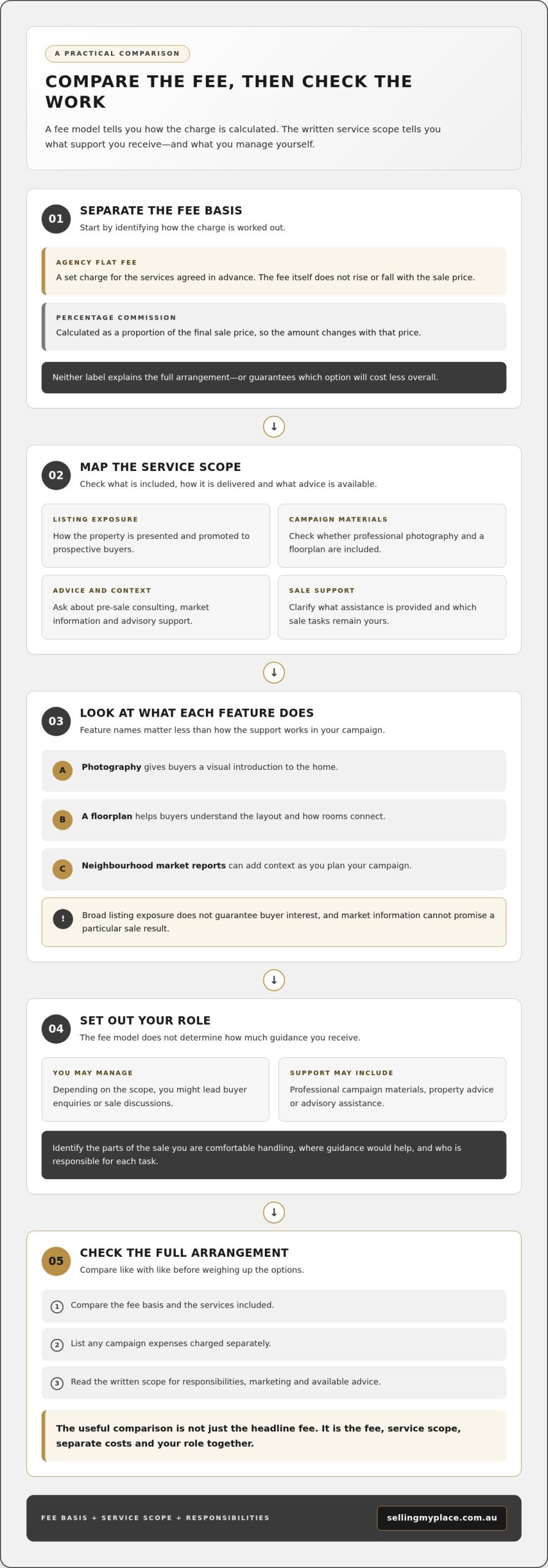
Separate the fee basis from the service scope. The fee basis tells you how the charge is calculated; the service scope sets out what you receive. Two services can both use a flat fee while offering different listing exposure, campaign materials and advice. Comparing both helps you understand the cost and the practical support behind it.
How does a flat fee differ from commission?
Commission is generally calculated as a proportion of the property’s sale price, so the amount changes with the final result. A flat fee is a set charge for services agreed in advance. Neither label defines the full arrangement: inclusions and responsibilities depend on the written scope. A real estate agent may support different parts of a property transaction, so compare the work provided as well as the way the fee is calculated.
For a useful comparison, list the fee, included listing and marketing assistance, available advice and any campaign expenses charged separately. This makes it easier to compare like with like instead of assuming every flat-fee or commission arrangement works the same way.
Does a flat fee mean selling without support?
No. The fee model doesn’t determine how much guidance you receive. Some arrangements combine owner involvement with professional marketing or advisory assistance. Depending on the service scope, you might lead buyer enquiries or sale discussions while receiving support with campaign materials and property advice.
Before choosing, identify the parts of the sale you’re comfortable handling and where professional guidance would be useful. An owner-led sale can still draw on campaign resources and advice. Be clear about who handles each task so you know what to expect.
In Australia, an agency flat fee can suit sellers who want a set-fee structure and a defined level of support. Check that the written scope explains the services, marketing plan and your role. The next step is to look at the practical service categories that may form part of a property campaign.
What can an agency flat fee include beyond a property listing?
A listing is one part of a property campaign. To assess an agency flat fee, consider how the property will be presented, where it will be promoted, what advice is available and which tasks remain yours. Use this checklist to compare the actual service scope rather than relying on feature names alone.
- Listing: What exposure is provided, and how is the property listing prepared and presented to prospective buyers?
- Campaign materials: Are professional photography and a floorplan included in the marketing support?
- Advice: Is pre-sale consulting or market context available as you prepare?
- Sale support: What advisory or conveyance-related assistance is provided, and which sale tasks will you manage?
Look at how each feature is delivered, not just whether it appears in a package description. For example, clarify how photography and floorplans will be used in the listing, and how market information can inform your campaign. A clear scope helps you understand what support is available from preparation through to buyer interest.
Which marketing services should sellers look for?
Professional photography gives buyers a visual introduction to the home, while a floorplan helps them understand its layout and how rooms connect. Together, these materials make it easier to assess a listing before arranging a viewing. Listing exposure determines how the property is presented to potential buyers, but broad reach does not guarantee buyer interest. Neighbourhood market reports can add context as you plan your campaign, but they can’t promise a particular sale result.
What advisory support can make the process easier?
Pre-sale consulting can help owners plan and organise their sale. An Agent Advisory Service provides guidance while you remain involved in decisions and tasks. Conveyance advice can help you understand aspects of the sale process, but it isn’t a substitute for legal advice.
Kincade International Direct Sales combines global listing exposure, professional photography, floorplans, neighbourhood market reports and advisory support in a commission-free residential marketing service. This combination supports owners who want to stay hands-on while drawing on campaign resources and practical guidance.
For related information on preparing a campaign, view the ways our team can support your selling plans.
Agency flat fee vs commission: how can sellers compare the models?
A useful comparison looks beyond the headline fee to the included support, your responsibilities and how the final charge is calculated. Percentage commission changes with the sale price. An agency flat fee is set for the agreed services, so the fee itself doesn’t rise or fall with the sale price. Neither model is automatically cheaper overall: the result depends on the agreement, any separate campaign costs and the sale itself.
Use this table as a starting point. The details depend on the written arrangement, rather than being standard inclusions attached to a fee label.
| What to compare | Percentage commission | Flat fee |
|---|---|---|
| Fee basis | Calculated as a proportion of the final sale price, so the amount changes with that price. | A set charge for the services agreed, rather than a proportion of the sale price. |
| Service scope | Depends on the written arrangement; the commission basis alone doesn’t define what’s included. | Also depends on the agreed scope. A set fee doesn’t automatically mean a particular package. |
| Marketing materials | Photography, floorplans and other campaign materials are agreement-specific. | These are agreement-specific too. Compare the materials and how they’ll be delivered. |
| Advice and support | Advisory access and sale support depend on the service arrangement. | Check what guidance is part of the agreed service, rather than assuming it from the fee structure. |
| Seller responsibilities | Clarify which tasks the owner handles and which are supported through the service. | Make the same distinction; a flat fee doesn’t automatically mean more or less owner involvement. |
What should the fee comparison table show?
Keep fee calculation, service scope and responsibilities as separate questions. A written comparison should show whether marketing materials are included, what advisory access involves and which tasks remain yours. Note any campaign costs outside the service fee so you can compare the overall arrangements. Treat details not specified in the agreement as separate questions, rather than assuming they are included.
How do responsibilities differ between selling models?
Whatever the fee basis, owners are commonly involved in preparing property information and making decisions about the sale. The level of support with campaign preparation, buyer communication or advice can vary independently of whether the fee is fixed or commission-based. Decide how involved you want to be, then compare your preferred role with the responsibilities set out in each written arrangement.
Once the fee and responsibilities are clear, consider how sale decisions and buyer discussions may unfold. Our property sale negotiation guide offers related guidance for Australian homeowners.
How can you decide whether an agency flat fee suits your sale?
The right fit depends on how involved you want to be, where guidance would help and what matters most in your marketing. A fee label can’t answer those questions. Use these steps to weigh your priorities before settling on an arrangement.
- Decide how hands-on you want to be. Consider the sale tasks you’re comfortable managing, such as preparing property information and making decisions as offers come in. If you prefer structured professional guidance at key points, include that in your priorities.
- Identify where support would help. Think about whether you’d value pre-sale advice, campaign guidance or conveyance advice. Pinpoint the stages where assistance would be useful, while keeping responsibility for your decisions clear.
- Set your marketing priorities. Consider the listing exposure, photography, floorplans and neighbourhood information that would help present your property. Check how each element fits into the campaign rather than focusing on a feature name alone.
- Compare the written arrangements. Review the fee basis alongside the service scope, delivery and seller responsibilities. This gives you a clearer view of what you’ll receive and what you’ll take on, whether the fee is flat or commission-based.
What level of involvement do you want in the sale?
Some owners are comfortable coordinating more of the sale themselves; others prefer a more guided experience. Your preferred level of involvement is separate from the fee structure. A flat fee doesn’t automatically mean you’ll manage everything, just as commission alone doesn’t define the support you receive. For a closer look at owner involvement, read our guide to selling your own home.
How can you assess the likely service fit?
Match the marketing resources to your needs. Photography gives buyers a visual introduction to the property, a floorplan clarifies its layout, and neighbourhood market information adds context. Then consider how advisory support fits into your preparation and sale decisions. Our residential property listing services guide provides a wider overview of listing support.
An agency flat fee may suit your plans when the agreed services and responsibilities match the way you want to sell. To explore Kincade International Direct Sales’ commission-free marketing and advisory support, read more about our property sale services.
How Kincade International Direct Sales supports a commission-free sale
Selling a home is a significant transition, and a clear plan can make each step more manageable. Kincade International Direct Sales combines commission-free residential property marketing with advisory support, giving owners campaign resources while they remain involved in their sale. Its flat-fee model provides agreed listing and professional services without an agency commission tied to the final sale price.
The service includes global listing exposure, professional photography, floorplans and neighbourhood market reports. Listing exposure presents the property to prospective buyers, photography helps showcase its features, and a floorplan makes the layout easier to understand. Neighbourhood market reports give owners context as they consider their campaign and sale decisions.
What support can owners expect during a sale?
A dedicated Agent Advisory Service includes pre-sale consulting and conveyance advice to guide owners as they prepare and work through the sale. This support can sit alongside your own involvement, so you can draw on advice while retaining control of decisions. Listings remain active until sold, with no time limit. This does not guarantee a sale, a particular price or a timeframe; the outcome depends on the property and market conditions.
How does commission-free marketing protect seller choice?
Without agency commission, the service does not charge a percentage of the sale price as agency commission. Owners can retain greater control over the selling process and their sale proceeds while using professional marketing and advisory resources. The practical value depends on how the service scope supports your priorities, not on the fee label alone.
If you’re weighing up how much involvement suits you and what guidance would be useful, explore Kincade International Direct Sales’ commission-free property marketing.
Choose a selling approach that fits your plans
The right agency flat fee arrangement involves more than a set charge. Compare the written service scope, marketing materials, advisory support and responsibilities you’ll take on, then weigh these against a commission-based model. Choose the approach that aligns with how involved you want to be and the support you value throughout the sale.
Kincade International Direct Sales provides commission-free residential property marketing and advisory services, including professional photography, floorplans and neighbourhood market reports. Listings remain active until sold, with no time limit. The services support your campaign while you retain control of the selling process, but they can’t guarantee a particular price or timeframe.
Discuss your property sale with Kincade International Direct Sales to explore a flat-fee marketing and advisory approach that fits your plans.
Frequently Asked Questions
What is an agency flat fee?
An agency flat fee is a set service charge agreed for property-selling support, rather than a fee calculated as a proportion of the final sale price. The fixed amount applies to the services in the arrangement, but the term alone doesn’t describe what they include. Read the written scope to understand the marketing, advice and sale support provided, and which responsibilities remain with you as the homeowner.
Is an agency flat fee cheaper than commission?
Not necessarily. The overall comparison depends on the agreed fee, the services included, any separate campaign costs and the final sale outcome. A percentage commission changes with the sale price, while a flat fee is set for agreed services. Compare the total arrangement and support you’ll receive instead of assuming one model is always less expensive. Your preferred level of involvement also matters.
What services are usually included in an agency flat fee?
Services depend on the agreement and may include property listing support, marketing materials such as photography and floorplans, market information, pre-sale consulting or other advisory assistance. Some arrangements also include conveyance advice or guidance during the sale. There’s no universal package attached to a flat fee, so read the service scope carefully. Check what’s delivered, how it fits into your campaign and which tasks you’ll manage yourself.
Can I sell my home myself with a flat-fee agency?
Yes. An owner-led sale can sit alongside professional marketing or advisory support. You might stay closely involved in sale decisions while using resources such as photography, floorplans or pre-sale guidance. Understand how responsibilities are divided before you begin. A flat-fee structure doesn’t mean you must manage every part alone, or that the service takes over the entire process.
Do flat-fee property services include professional photography and floorplans?
Inclusions vary by arrangement. Kincade International Direct Sales includes professional photography and floorplans as part of its commission-free residential marketing service. Photography gives buyers a visual introduction to a property, while a floorplan helps them understand its layout. Neighbourhood market reports add campaign context. These materials can support how a home is presented, but they don’t guarantee buyer interest or a particular sale result.
Does a commission-free property listing guarantee my home will sell?
No. A commission-free listing, like any other fee arrangement, can’t guarantee a buyer, a particular sale price or a timeframe for selling. Kincade International Direct Sales keeps listings active until sold, with no time limit, but that isn’t a promise that a sale will occur. Marketing materials and advisory support can help owners prepare and present a campaign, while the outcome depends on the property and market conditions.
How do I decide whether a flat-fee service is right for me?
Start by deciding how involved you want to be and where you’d value guidance. Then compare the written service scope, including listing exposure, photography, floorplans, market information and advisory support. Understand which responsibilities remain yours and how the fee is calculated. Comparing those details with a commission-based arrangement can help you choose an approach that suits your priorities and feels manageable.
DIY Home Sale Checklist Australia: Sell Your Property Smarter in 2026
What if the secret to keeping an extra $20,000 or more from your property sale wasn’t finding a better agent, but simply becoming your own best advocate? It’s a bold thought, particularly when the national median dwelling value has climbed toward $922,838 in 2026. You likely feel a bit protective of your home’s equity, yet the idea of managing the legalities and marketing yourself can feel incredibly daunting. It’s completely natural to worry about pricing your sanctuary correctly or getting tangled in the logistics of a property market that feels increasingly complex. We understand that this isn’t just a transaction; it’s a significant life transition that deserves a steady, expert hand.
We’ve designed this DIY home sale checklist australia to give you the exact roadmap you need to sell smarter and stay empowered. You’ll learn how to bypass traditional commission structures while maintaining a professional-grade presence that attracts the right buyers. From mastering your initial listing to navigating the final settlement with total peace of mind, this guide ensures you have the tools to achieve a premium result on your own terms.
Key Takeaways
- Master the art of “soulful” presentation by using professional photography and floorplans to help buyers visualise their future in your home.
- Secure your legal interests by identifying state-specific disclosure requirements early, ensuring your Contract of Sale is robust and ready for settlement.
- Follow our comprehensive DIY home sale checklist australia to navigate the property market independently while maintaining a polished, professional-grade listing.
- Maximise your profit by comparing the traditional commission model against a transparent flat-fee approach that lets you keep 100% of your sale’s upside.
- Build buyer confidence through a welcoming, low-pressure inspection process and a methodical, “steady hand” approach to managing leads and negotiations.
Pre-Sale Preparation: Laying the Foundation for a Profitable Sale
Selling your home is more than just a financial transaction; it’s the closing of one chapter and the hopeful beginning of another. To ensure this transition is as rewarding as possible, you need to start with a clear-eyed assessment of your property. This is the first, vital step on any DIY home sale checklist australia. Instead of seeing your home through the lens of your own memories, try to view it through the objective, sometimes critical, eyes of a stranger. Walk through every room with a notepad in hand. Is there a leaky tap you’ve ignored for months? Does the hallway feel cramped because of that bulky sideboard?
Decluttering isn’t just about tidying; it’s about creating space for someone else’s dreams. When you depersonalise by removing family photos or niche collectibles, you’re inviting a potential buyer to visualise their own legacy within these walls. You don’t need a full renovation to see a boost in your sale price, either. Focus on high-impact, low-cost “quick wins.” A fresh coat of neutral paint can make a tired room feel modern and airy, while spreading fresh mulch in the garden beds suggests a well-maintained home. Before you set a price, secure a comprehensive neighbourhood market report to see how these small improvements align with current local buyer expectations.
Determining Your Realistic Market Value
Setting the right price is a delicate balance. While automated online estimates are a handy starting point, they often miss the nuances of your specific street or recent local infrastructure upgrades, like a new school or transport hub. A thorough Australian property market overview reveals that regional variations and buyer sentiment play huge roles in final outcomes. Look closely at the “sold” prices of comparable properties from the last three months rather than just the “asking” prices of current listings. Ultimately, Market Value is the quiet intersection where hard data meets the emotional appeal of a well-presented home.
The “First Impression” Exterior Checklist
Buyers often make up their minds before they even step through the front door. Kerb appeal is the primary engine that drives inspection bookings, so your exterior must look cared for and secure. Use this quick guide to ensure your home’s “face” is ready for its close-up:
- Ensure the entrance is welcoming with scrubbed paths and a clear, inviting doorway.
- Check the condition of the roof and gutters; buyers look for signs of neglect that might lead to future costs.
- Repair any leaning or broken fencing to reinforce the sense of security and privacy.
- Mow the lawns and trim any overgrown hedges to let the property’s natural light shine through.
By ticking these items off your DIY home sale checklist australia, you’re building a foundation of trust before the first “open for inspection” sign even goes up. It’s about showing the community that this home has been loved and is ready for its next family.
Legal Essentials and Compliance: Navigating the Australian Landscape
Once you’ve polished the kerb appeal, it’s time to look under the hood. The legal side of selling your own home might feel like a maze, but it’s really about creating a transparent, secure bridge between your family and the next. A critical item on your DIY home sale checklist australia is identifying the specific disclosure requirements for your state. In Victoria, for instance, you’ll need a comprehensive Section 32 statement. In other parts of the country, the terminology changes, but the spirit remains the same: you must be upfront about everything from zoning to land tax. Honesty isn’t just a virtue here; it’s your best legal defence.
Appointing a qualified conveyancer or solicitor early in the piece is one of the smartest moves you can make. They’ll act as your steady hand, ensuring that every building permit for that 2022 kitchen renovation is accounted for. Have you checked your smoke alarms lately? What about your swimming pool safety certification? These aren’t just boxes to tick; they’re essential protections for your legacy and the buyer’s peace of mind. While you’re busy with real estate photography preparation tips to make the home look its best, don’t let the paperwork fall behind. Having your certificates of occupancy and compliance ready to go shows buyers that you’re a serious, organised seller.
Preparing the Contract of Sale
Your Contract of Sale is the heart of the transaction. It needs to be watertight to prevent a buyer from finding a reason to rescind the deal later. Be incredibly specific about what’s staying and what’s going. If that heirloom chandelier in the dining room is coming with you, list it as an exclusion. It’s these small details that prevent heart-wrenching misunderstandings on settlement day. Seeking professional conveyance advice early ensures that your documentation is ready the moment a serious buyer shows interest. It’s about being proactive rather than reactive.
Understanding Your State Regulations
Every state has its own rhythm when it comes to cooling-off periods and digital protocols. By 2026, digital signatures and remote settlements have become the standard across Australia, making the process faster and more accessible than ever. You should also prepare a “due diligence” pack for prospective buyers. This pack, filled with your certificates, permits, and even recent utility bills, builds immediate trust. If you’re feeling a bit overwhelmed by the fine print, you can always reach out for a chat with our advisory team to help clear the air and keep your sale on track.
High-Impact Marketing: Presenting Your Home to the Global Market
Once the legal framework is secure, it’s time to invite the world into your home. In the digital-first property market of 2026, your online listing isn’t just a noticeboard; it’s a carefully curated experience that needs to resonate with buyers across the street and across the globe. A high-impact marketing strategy is a non-negotiable item on any DIY home sale checklist australia. You aren’t just selling three bedrooms and a backyard; you’re offering a slice of stability and a place for a new family to build their own legacy. This emotional connection starts with how you present the property’s “soul” to potential buyers who may be viewing from a different time zone.
In today’s market, expatriates and interstate investors are more active than ever, often making decisions based entirely on digital assets. Leveraging a global marketing network allows you to reach these high-intent buyers who value the security of the Australian property market. Your listing description should reflect this by highlighting the local community, nearby schools, and the long-term stability of the area. It’s about painting a picture of a lifestyle, not just listing a set of features.
The Visual Power of Professional Assets
While modern smartphones take lovely family photos, they often fail to capture the true scale and light of a room, which can inadvertently devalue your property in the eyes of serious buyers. Investing in professional photography ensures your home looks its absolute best, highlighting the architectural details that make it unique. Pair these images with accurate floorplans to help buyers plan their daily lives within your walls before they even visit. Professional visuals act as a 24/7 digital open house, allowing people to explore the flow of the home at their own pace. This transparency builds trust and significantly increases the time spent on your digital listing.
Choosing the Right Listing Platform
The traditional agency model often involves high marketing costs and restrictive time limits that put unnecessary pressure on your sale. A smarter alternative is a flat-fee listing service that keeps your property active until it’s sold, giving you the breathing room to find the perfect buyer. When you follow a DIY home sale checklist australia, you can bypass heavy commissions and instead focus your budget on targeted social media campaigns. Neighbourhood-specific targeting ensures your home appears in the feeds of people already looking to move into your specific area. By combining professional infrastructure with your own local knowledge, you create a listing that feels both authoritative and deeply personal.
The Sales Process: Managing Inspections and Mastering Negotiations
You’ve polished the gardens and launched a global marketing campaign; now comes the moment where the digital interest turns into a physical presence. Meeting potential buyers is often the most nerve-wracking stage for any owner-seller, but you hold a distinct advantage that no agent can replicate. Nobody knows the story of your home, the way the morning sun hits the kitchen bench, or the quietest spot in the garden better than you do. As a key part of your DIY home sale checklist australia, organising inspections should feel less like a high-stakes interrogation and more like welcoming a future neighbour. This low-pressure atmosphere allows buyers to relax and truly see themselves living in the space.
When the front door closes and the last visitor leaves, the “steady hand” approach becomes your greatest asset. Follow up with every lead within 24 hours using a professional yet personal touch. A simple phone call to ask for their honest feedback is often far more effective than a scripted sales pitch. When those conversations turn into serious interest, insist that all offers be submitted in writing. Always ask for a pre-approval letter or proof of finance to accompany the offer. This ensures you’re focusing your energy on qualified buyers who are ready to make a commitment to your property’s future.
Conducting Stress-Free Open Homes
Creating a welcoming environment is about engaging the senses without overwhelming them. Buyers are looking for a sanctuary, so your goal is to provide a calm, inviting experience. Consider these practical steps for your next open home:
- Maximise natural light by opening all curtains and blinds to showcase the home’s best angles.
- Ensure a flow of fresh air through the house, perhaps using subtle, natural scents like fresh eucalyptus or citrus.
- Prepare a “frequently asked questions” sheet that covers local school catchments, the best nearby parks, and average utility costs.
- Focus on building a partnership with visitors by answering questions honestly rather than using a “hard sell” tactic.
Closing the Deal with Confidence
Negotiation is where many sellers feel most vulnerable, but it’s simply a dialogue about value and legacy. Don’t take a low-ball offer personally; it’s often just a starting point for a buyer testing the waters. You can utilise these property sale negotiation tips to help you stay firm on your home’s true worth. Remember, our Agent Advisory Service is always available as a sounding board during these final talks to ensure you feel supported. Once you accept an offer, confirm the deposit is paid into a secure trust account immediately. If you need a hand navigating the final hurdles of the contract, reach out for expert guidance to ensure your settlement stays on track.
The Modern Alternative: Why a Flat-Fee Partnership Wins
Choosing to sell your property independently doesn’t mean you have to walk the path alone. Many homeowners feel they must choose between a high-commission agent or a stressful solo journey, but the modern reality is far more supportive. By following a DIY home sale checklist australia, you can embrace a partnership that gives you the best of both worlds: professional-grade infrastructure and the freedom to manage your own sale. This “Expert Backing” model means you keep the control while we provide the photography, floorplans, and global reach discussed earlier. It’s about having a steady hand beside you while you remain in the driver’s seat.
When you calculate the real cost of a 2% commission on a $1,000,000 property, you’re looking at giving away $20,000 of your hard-earned equity. Choosing a sale by owner approach with a transparent flat fee allows you to protect that profit entirely. It’s a smarter way to move forward, especially when you consider that your listing remains active until it’s sold. You won’t face the ticking clock or the aggressive pressure of a traditional agency campaign that might push you to accept a lower offer just to clear a monthly target. You set the pace, and you keep the reward.
Protecting Your Equity
Visualise that $20,000 for a moment. It could be the deposit for your next adventure, a significant boost to your retirement fund, or even the budget for a stunning new kitchen in your next home. Beyond the numbers, there’s a profound psychological benefit to dealing directly with buyers. You’re the one who knows the neighbourhood’s heartbeat and the house’s history. This personal connection, supported by a polished and professional image, builds a level of trust that a third party simply can’t manufacture. You’re protecting your legacy while ensuring your costs stay grounded.
Next Steps: Getting Started
Transitioning from “thinking about it” to seeing your home live on the major portals can happen in as little as 48 hours. The first step is often a pre-sale consultation to fine-tune your strategy and ensure every box on your DIY home sale checklist australia is ticked. This isn’t just about saving money; it’s about feeling empowered and in control of one of life’s biggest transitions. You have the local knowledge, and we have the tools to make it shine. Start your commission-free journey with Kincade International Direct Sales today.
Your Journey Toward a Smarter Sale Starts Now
Selling your home on your own terms is about more than just a transaction; it’s about honouring the life you’ve built while securing your financial future. By following this DIY home sale checklist australia, you’ve seen how professional marketing and legal clarity can turn a complex process into a manageable, rewarding journey. You don’t have to sacrifice a polished image to save on costs. With the right support, you can present a listing that rivals any traditional agency, ensuring your home’s unique story is told with authority and heart.
Imagine keeping an average of $20,000 in commissions while still benefiting from professional photography, accurate floorplans, and our expert Agent Advisory Service. You have the local heart and the neighbourhood knowledge; we simply provide the steady hand and digital infrastructure to help you succeed. It’s time to step into your sale with total confidence and a clear path forward. You’ve done the hard work of building a home, and now you’re ready to reap the full rewards.
Download Your Free Flat-Fee Selling Guide and Save Thousands
Your home deserves a champion who knows it best. We’re here to help you every step of the way, ensuring your next big move is your most successful and empowering one yet.
Frequently Asked Questions
Is it legal to sell my own home in Australia without a real estate agent?
Yes, it is completely legal to sell your own property in every Australian state and territory. You aren’t required by law to hire a real estate agent; however, you must still comply with state-specific disclosure laws and property regulations. By taking the “sale by owner” route, you maintain full control over the process while ensuring all legal obligations, such as providing a Section 32 in Victoria, are met through your solicitor or conveyancer.
How much can I actually save by using a DIY home sale checklist?
Homeowners typically save an average of $20,000 in commission fees by managing the sale themselves. When you follow a structured DIY home sale checklist australia, you bypass the traditional 2% to 3% agent commission entirely. This significant saving stays in your pocket, allowing you to invest more into your next home or retirement fund while still achieving a professional-grade result through our flat-fee infrastructure.
Will my property still appear on major real estate websites if I sell DIY?
Yes, your property will appear on Australia’s leading real estate portals when you use a residential property listing service. While these major sites generally don’t allow private individual listings directly, a flat-fee partner acts as the bridge to get your home in front of millions of active buyers. This ensures you receive the same digital exposure as any agency-listed property without the high marketing costs or commissions.
What happens if I struggle to negotiate with a buyer on my own?
You don’t have to navigate tough conversations alone; our Agent Advisory Service acts as your professional sounding board. If a negotiation feels stuck or you’re unsure how to handle a specific offer, you can lean on our expert advice to find the right way forward. This partnership ensures you have the “steady hand” of an expert guide to help you stay firm on your property’s true value and reach a successful agreement.
Do I still need a lawyer or conveyancer if I am selling the house myself?
Yes, you still need a qualified conveyancer or solicitor to handle the legal transfer of the property. While you manage the marketing and inspections, your legal representative ensures the Contract of Sale is watertight and handles the actual settlement process. This is a vital safeguard that protects both you and the buyer, ensuring all state-specific disclosure requirements and financial settlements are completed correctly and securely.
Can I sell my home DIY if I have an existing mortgage?
Absolutely, having an existing mortgage doesn’t prevent you from selling your home independently. During the settlement process, your conveyancer will coordinate with your bank to “discharge” the mortgage using the proceeds from the sale. You’ll just need to factor in your lender’s standard discharge fees, which typically range between $300 and $700, and ensure your bank is notified once a contract is signed and the settlement date is set.
How do I handle the deposit and legal paperwork without a traditional agent?
The deposit is typically held in the trust account of your chosen solicitor or conveyancer rather than an agent’s account. This provides a secure, legally regulated environment for the buyer’s funds until the settlement is finalised. Your legal representative will also manage the exchange of contracts and ensure all paperwork is filed with the relevant state authorities, giving you peace of mind that the transaction is handled with professional decorum.
What is the most important item on a DIY home sale checklist for a fast sale?
The most critical item on any DIY home sale checklist australia for a swift result is professional presentation. High-quality photography and accurate floorplans are non-negotiable in 2026, as they form the first impression for every digital buyer. When paired with a realistic price based on a neighbourhood market report, these professional assets build immediate trust and encourage serious buyers to book an inspection much sooner.
Zero Commission Real Estate Australia: The 2026 Seller’s Buying Guide
Did you know the average Australian homeowner hands over more than $20,000 in commission just to see a “Sold” sticker on their front fence? It’s a staggering figure that often feels like an unavoidable tax on your hard work and years of memories. When you’re facing a major life transition, the last thing you need is the stress of losing a significant portion of your equity to traditional fees. If you’ve been looking into zero commission real estate australia, you’re likely searching for a way to protect your profit without sacrificing the professional quality your property deserves.
We understand that the thought of selling privately can feel a bit daunting, especially when you’re worried about missing out on premium buyers or feeling pressured by agents to settle for a quick result. You deserve a partnership that values your legacy as much as you do. In this guide, we’ll show you how to replace outdated commission structures with a sophisticated flat-fee model that provides global marketing and expert advisory support. We will walk through the steps to help you attract the right buyers, manage negotiations with confidence, and ultimately keep 100% of your sale profit where it belongs; in your family’s pocket.
Key Takeaways
- Learn how to retain your hard-earned home equity by moving away from traditional percentage-based commissions that can cost over $35,000 on a typical family home.
- Discover the step-by-step process of using zero commission real estate australia to access global marketing and professional digital infrastructure for a single, transparent flat fee.
- Understand the difference between a transactional agent and an advisory partnership that prioritises your family’s needs through expert pre-sale consulting.
- Identify the essential features of a premium provider, such as “until sold” guarantees and the inclusion of high-end photography and floorplans as standard.
- Gain the confidence to manage your own sale with a “steady hand” guide supporting you through every negotiation and settlement milestone.
Calculating the True Cost of Real Estate Commission in Australia
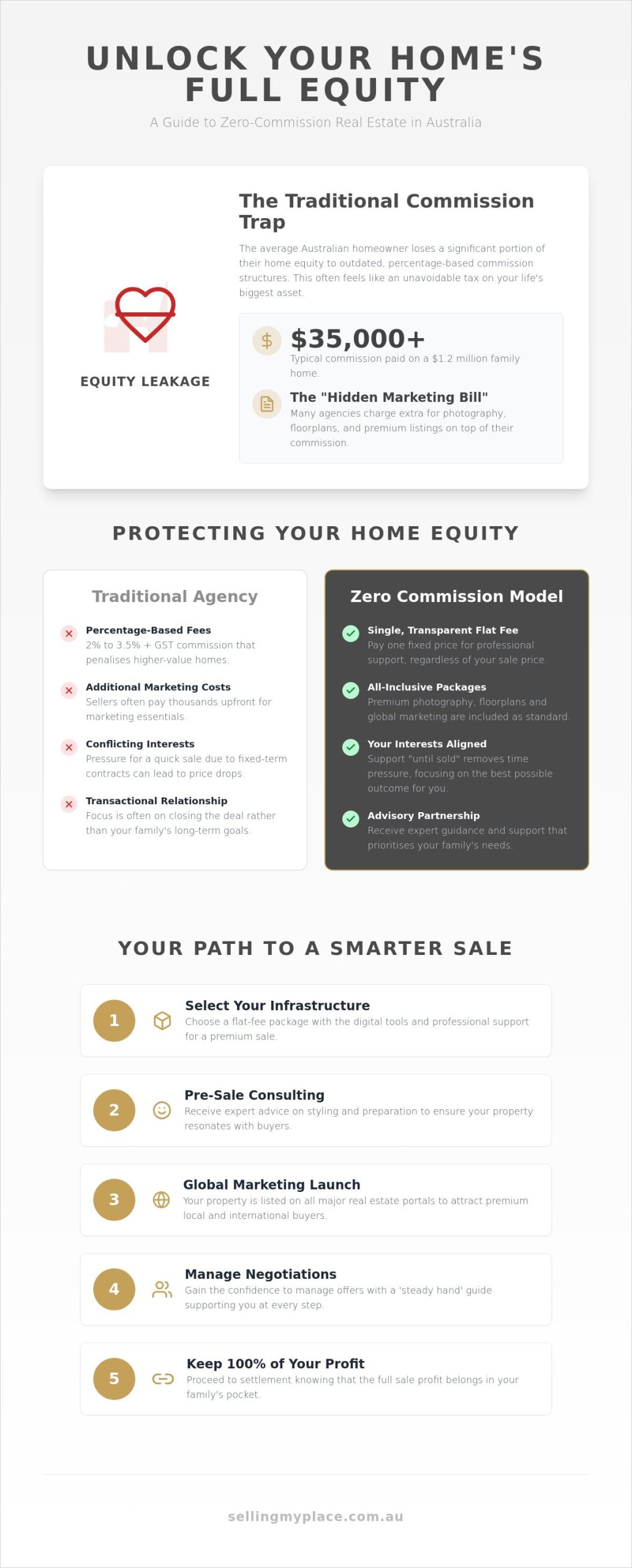
Selling a family home is one of life’s most significant transitions; it’s a moment filled with both nostalgia and the excitement of a new chapter. However, as many Australian families discover in 2026, the traditional path to a sale comes with a heavy price tag. Most agents across the country still operate on a percentage-based commission, typically ranging between 2% and 3.5% plus GST. While these numbers might sound small on paper, their impact on your final settlement is profound. For a family home valued at $1.2 million, a standard commission can easily exceed $35,000. That is money that could have funded a renovation, a retirement nest egg, or a deposit for your children’s first home.
The financial strain doesn’t always end with the commission. Many sellers are surprised to find a “Hidden Marketing Bill” on their initial agreement. It’s common practice for traditional agencies to charge for professional photography, floorplans, and premium portal listings as an additional upfront cost, separate from their success fee. This results in what we call equity leakage, where the very people who built the value of the home see their profits chipped away by multiple layers of transactional costs. This growing awareness is exactly why zero commission real estate australia has moved from a niche alternative to a mainstream choice for savvy homeowners who value transparency.
Understanding the legal landscape is also vital. The framework of Australian property law ensures that you have the right to choose how your property is represented, yet traditional contracts often lock you into restrictive terms. By looking closer at the math, it becomes clear that the traditional model may no longer serve the best interests of the modern seller who wants a partnership rather than just a transaction.
The ‘Success Fee’ Trap: Why Percentages Hurt Sellers
The logic of a percentage-based fee often falls apart when applied to premium properties. Does it truly take twice as much effort for an agent to sell a $2 million home compared to a $1 million home? Usually, the answer is no. High-value homeowners are essentially being penalised for their property’s worth. Choosing a Sale by owner or a flat-fee advisory model is a more equitable way to ensure you retain control over your equity while still receiving professional support. It allows you to treat your sale as an investment in marketing rather than a cost of doing business.
Identifying Indirect Costs in Traditional Agency Agreements
Beyond the literal dollars, there are indirect costs to consider. Traditional exclusive authority periods often put sellers on a ticking clock. This time pressure can lead to agents suggesting price drops just to secure a quick sale before their contract expires. Additionally, some agencies prioritise their own brand recognition, using your beautiful home as a backdrop for their marketing rather than focusing purely on your property’s unique features. A flat-fee partnership removes these conflicting interests, keeping the focus entirely on your family’s needs and the legacy you’ve built.
How Zero Commission Real Estate Models Work: A 2026 Buying Guide
Adopting a zero commission real estate australia model doesn’t mean you are left to manage the complexities of a property sale on your own. It is a structured, professional partnership that decouples the high-impact marketing your home needs from the outdated percentage-based fees that eat into your equity. This modern approach follows a clear, methodical path designed to provide you with the same professional reach as a traditional agency, but with far greater transparency and control.
The process typically unfolds in five essential steps:
- Step 1: Selecting your infrastructure. You begin by choosing a flat-fee package that provides the digital tools and professional support required for a premium sale. This shifts the focus from a “cost of sale” to a strategic investment in your property’s visibility.
- Step 2: Pre-sale consulting. Before a single photo is taken, expert guidance helps you prepare your home. This might involve advice on minor repairs or styling to ensure your property resonates emotionally with potential buyers.
- Step 3: Launching to major portals. Your home is listed on Australia’s leading property search websites and high-traffic search platforms. This ensures you aren’t missing out on the primary national buyer pool.
- Step 4: Managing enquiries. While you host the inspections, a dedicated advisory service remains by your side to help manage buyer questions and filter enquiries, ensuring you only spend time with serious prospects.
- Step 5: Finalising the deal. Once you’ve found the right buyer, professional conveyance advice ensures the legal transition is handled with precision and care.
If you’re feeling unsure about how to start this transition, you can always reach out for a confidential chat to see which path best suits your family’s needs.
The Digital Infrastructure: Beyond Just a Listing
In the 2026 market, simply being “online” isn’t enough. Modern zero commission real estate australia providers use sophisticated syndication to ensure your property appears across a global marketing network. Using professional Residential Property Listing Services allows you to maintain a high-profile presence without the pressure of a ticking clock. A critical feature to look for is an “Until Sold” guarantee. This ensures your listing remains active without additional fees if the market fluctuates, providing a sense of calm confidence throughout the process.
Professional Marketing: Why Quality Photography and Floorplans are Non-Negotiable
First impressions happen in a split second on a smartphone screen. Professional photography is essential because it directly impacts click-through rates; a poorly lit photo can cost you thousands in perceived value. Similarly, accurate floorplans are vital for attracting serious buyers. They allow potential purchasers to visualise their life in the space before they even arrive, which significantly reduces “tyre-kicker” enquiries and ensures your inspection time is spent with people who are truly ready to commit.
Commission-Free vs. Traditional Agents: Protecting Your Home Equity
Choosing how to sell your home is a deeply personal decision. It’s about more than just a sign on the lawn; it’s about who you trust to guide you through a major life transition. Traditionally, this has meant hiring a transactional agent who works on a percentage. However, in 2026, many Australian families are realising that this model often creates a conflict of interest. A traditional agent might feel like a high-pressure salesperson, pushing for a quick result to move on to their next listing. In contrast, zero commission real estate australia offers an advisory partnership. This approach provides a steady hand to guide you, ensuring you feel protected and supported rather than just another number in a database.
One of the most persistent myths is that you need a traditional agent to negotiate effectively. The truth is that no one knows the warmth of your sun-drenched kitchen or the history of your garden better than you do. When you pair that local, personal knowledge with professional advisory support, you become a formidable negotiator. By removing the middleman who is often just as motivated by their own commission as they are by your price, you reclaim the power to make decisions that truly serve your family’s future. It allows you to invest more in high-quality marketing while still keeping the lion’s share of your equity.
Comparing the Financial Outcome: The $20,000 Difference
The numbers tell a compelling story. In the current 2026 market, the national median commission sits around 2.65%. On a typical Australian sale, switching to a flat-fee model results in an average saving of $20,000. For many, this isn’t just extra money. It’s a significant sum that can be used as a deposit for a downsizing move, a way to clear the remaining mortgage on a new property, or a gift to help the next generation get a head start. It’s about ensuring your hard-earned equity stays within your family circle where it can do the most good.
The Advisory Advantage: Why Expert Backing Beats Pure DIY
While some see commission-free models as doing it yourself, the most successful sellers use an advisory model. This isn’t about being left alone. It’s about having access to professional property sale negotiation tips and pre-sale consulting. An expert advisor can identify small, cost-effective repairs or styling changes that can lead to massive price gains. This professional backing ensures your home is presented with the same polish as a top-tier agency listing, but without the high-pressure tactics that often accompany traditional sales. You get the expertise you need with the respect you deserve.
What to Look for in a Zero Commission Real Estate Provider
Selecting the right partner for your property journey is about finding a balance between robust digital tools and genuine human support. Not all providers in the zero commission real estate australia space are created equal. Some might offer a low entry price but then surprise you with hidden costs or restrictive timeframes that add unnecessary stress to your life. When you are moving house, you need a steady hand to guide you, not a ticking clock that pressures your decisions. It is essential to choose a service that feels like a protective partnership rather than a purely transactional arrangement.
A premium provider should treat your sale as a shared mission. This means looking beyond the basic listing and verifying that professional photography and floorplans are included as standard. Your home’s legacy deserves to be captured with the same care you put into maintaining it; phone photos simply won’t suffice in a competitive market. You should also ensure there is a real person available to talk through the nuances of a negotiation. Having a professional advisor to bounce ideas off can be the difference between a good result and an exceptional one for your family’s future.
Access to high-quality data is another non-negotiable feature. You need detailed Neighborhood Market Reports to understand the local landscape and set a price that attracts premium buyers. If you are ready to see how a professional advisory model can protect your equity while providing global reach, book a consultation with our team today to discuss your specific needs.
Listing Longevity: Avoiding the Time Limit Pressure
Traditional agents often push for “exclusive authority” periods, usually around 90 days. This creates a high-pressure environment where you might feel forced to drop your price just to secure a sale before the contract expires. In the current 2026 property cycle, a “list until sold” policy is vital. It allows you to wait for the right buyer who truly appreciates your home’s value, ensuring you never feel rushed into a decision that doesn’t serve your long-term goals.
Comprehensive Support: Conveyance Advice and Market Data
Private selling doesn’t mean you have to navigate the legalities alone. Look for a provider that offers conveyance advice as part of their service suite. This provides a vital safety net, ensuring all your paperwork is in order and the settlement process is seamless. When you combine this legal peace of mind with recent comparable sales data, you can set a winning price with confidence. It’s about having the tools of an expert while remaining the captain of your own ship, supported by a team that values your stability and peace of mind.
Selling Smarter with Kincade International Direct Sales
Kincade International Direct Sales (KIDS) represents the pinnacle of zero commission real estate australia. It is a service built on the belief that selling your home should be a rewarding milestone rather than a source of financial depletion or emotional exhaustion. We don’t just offer a platform; we provide a sophisticated blend of professional authority and heartfelt warmth. By choosing KIDS, you are stepping into a partnership with a seasoned, multi-generational expert who acts as a nurturing guide through every stage of your property journey. We understand that your home is more than just bricks and mortar; it is a legacy you’ve built for your family’s future.
Our dedicated Agent Advisory Service is a unique differentiator in the Australian market. While other providers might leave you to manage the intricacies of a sale alone, we provide a “steady hand” to support you. This means you have access to professional expertise when it matters most, particularly during the high-stakes moments of negotiation and settlement. We combine this personal touch with a level of global reach that traditional local agents simply cannot match. Why limit your property to a single suburb’s database when you can showcase it to the entire world? We ensure your home is seen by the right buyers, regardless of where they are currently located.
A Global Marketing Network for Australian Homes
In a world that never sleeps, your property’s marketing shouldn’t either. Kincade connects Australian residential properties with an expansive international audience, ensuring your home is visible to expatriates and global investors alike. Our digital infrastructure works 24/7 across multiple time zones, syndicating your listing through a global network that operates with quiet efficiency. This constant visibility means your home is always working for you, attracting interest while you focus on your daily life and family needs. It is a modern, high-impact approach that respects the value of your time and your equity.
The Partnership Approach: Your Steady Hand in the Sale
We pride ourselves on being more than a transactional service; we are your advocates. Our approach is rooted in empathy, aimed at reducing the stress often associated with major life transitions. We take the time to ensure you feel understood and protected, providing the professional decorum you expect from an expert alongside the welcoming accessibility of a trusted neighbour. Whether you are downsizing, upgrading, or moving to a new community, we are here to ensure you walk away with your profit and your peace of mind intact. Discover how much equity you can save with a Kincade flat-fee package.
Your Path to a More Profitable Property Future
The Australian real estate landscape has evolved, and you now have the power to choose a path that prioritises your family’s equity. By moving away from traditional percentage-based fees, you aren’t just saving money; you’re protecting the hard-earned legacy of your home. We’ve explored how zero commission real estate australia allows you to retain your full sale profit while still accessing world-class digital infrastructure. With an average seller saving of $20,000 per transaction, the financial benefit to your next chapter is undeniable.
You don’t have to navigate this complex process on your own. Our model ensures you receive professional photography and floorplans as standard, backed by a dedicated Agent Advisory Service that acts as your steady hand during negotiations. It’s about combining global marketing reach with a heartfelt, partnership-based approach that reduces stress and honours your transition. If you’re ready to reclaim control of your property journey, we are here to guide you every step of the way.
Start Selling Smarter and Keep 100% of Your Profit
We look forward to helping you achieve a result that truly reflects the value of your home and the bright future ahead for your family.
Frequently Asked Questions
Is zero commission real estate legal in Australia?
Yes, zero commission real estate australia is entirely legal across all states and territories. Australian property law allows homeowners to represent themselves in a sale; you aren’t legally required to use a commission-based agent. By choosing this path, you maintain full control over your equity while still meeting all statutory requirements for a valid property transfer.
Will my property appear on the major Australian property portals?
Absolutely. Your property will be listed on Australia’s most prominent real estate websites and highest-traffic search platforms. We ensure your home reaches the widest possible audience by syndicating your listing to these leading national portals and international networks. This ensures you don’t miss out on premium buyers who are actively searching for their next home online.
How do I handle negotiations without a traditional real estate agent?
You handle negotiations with the backing of a dedicated advisory service. While you have the heartfelt, local knowledge of your home’s best features, an expert advisor provides the strategic guidance to manage offers. This partnership approach ensures you feel confident and protected during the process, avoiding the high-pressure tactics often used by transactional agents.
What professional marketing materials are included in a flat-fee package?
A premium flat-fee package includes professional photography and accurate floorplans as standard. These materials are essential for creating a polished first impression on digital portals. High-quality imagery captures the unique character of your home; while floorplans help serious buyers visualise their lifestyle in the space, significantly improving the quality of the enquiries you receive.
Can I still sell my house if I have a busy schedule and cannot do all the work?
Yes, the model is designed to fit into your daily life. While you conduct the inspections, the digital infrastructure and advisory support manage the time-consuming tasks like syndicating the listing and filtering initial enquiries. This means you can focus on your family and work while your property’s marketing operates 24/7 in the background.
What happens if my property doesn’t sell within three months?
If your property doesn’t sell quickly, our “until sold” policy ensures your listing remains active without any additional re-listing fees. We understand that the property cycle can fluctuate; so we don’t believe in putting a 90-day time limit on your success. This reduces the stress of a sale and allows you to wait for the right buyer who truly values your home.
Do I need a solicitor if I am selling my house without a commission-based agent?
Yes, you will still need a qualified solicitor or conveyancer to handle the legal transfer of the property. While the zero commission real estate australia model manages the marketing and advisory side of the sale, the legal documentation and settlement must be processed by a legal professional to ensure a secure and compliant transaction for both parties.
How much can I realistically save by using a zero commission real estate model?
Homeowners typically retain the full amount of what would have been a percentage-based fee, often resulting in savings of tens of thousands of dollars. Based on current 2026 market rates, this allows you to keep your hard-earned equity for your next life transition rather than paying it out as a transactional cost. It is a practical way to ensure your financial stability as you move into your new community.
Private Property Sale Contract Australia: A Guide for Independent Sellers
What if the only thing standing between you and a successful, commission-free sale isn’t a lack of expertise, but a simple stack of paperwork? Selling your family home is a deeply personal milestone, and it’s completely natural to feel a flutter of nerves when navigating a private property sale contract australia for the first time. You might worry that without a traditional agent, you’re leaving yourself open to legal pitfalls or that the state-specific terminology is just too dense to untangle. We understand that this isn’t just a transaction; it’s the start of your next chapter, and you want to ensure every detail is handled with care and precision.
The good news is that you don’t need to pay a premium for professional protection. You can take full control of your journey while staying firmly on the right side of the law. This guide will walk you through the essential components of a valid agreement, from the latest 2026 NSW cooling-off notices to the mandatory Queensland disclosure statements. We’ll preview exactly how to organise your documentation and understand your local obligations, so you can move forward with the calm confidence of a seasoned pro and keep your hard-earned equity where it belongs.
Key Takeaways
- Learn why the timing of your paperwork is vital, particularly in states like NSW where you must have your contract ready before you even list the property for sale.
- Master the essential components of a private property sale contract australia to ensure your legal names and Title References are documented correctly from the start.
- Navigate complex state-specific disclosure rules, such as Victoria’s Section 32, to protect your interests and provide complete transparency to your buyer.
- Gain the confidence to manage initial offers and holding deposits independently, allowing you to negotiate special conditions without a middleman.
- Discover how expert advisory support can bridge the gap between signing the contract and reaching a successful settlement day.
What is a Private Property Sale Contract in Australia?
Think of your sales contract as the legal roadmap for your entire selling journey. It is far more than just a formal piece of paper; it is the foundation of your legacy and the document that ensures your home’s transition is handled with the respect it deserves. In the Australian property market, this agreement establishes the ground rules between the Vendor (that’s you, the seller) and the Purchaser (the buyer). While it might feel like a final step, a private property sale contract australia is actually your very first priority. In states like New South Wales, it’s a legal requirement to have this document prepared before you even put your home on the market. Having it ready to go gives you a “steady hand” during negotiations, projecting a sense of professional authority that puts buyers at ease and reduces your own stress levels.
This document initiates the formal conveyancing process, which is the legal transfer of land title from one person to another. By preparing early, you aren’t just ticking a box; you’re taking control of the narrative. You’ll know exactly what you’re offering, what stays with the property, and what the timeline looks like, long before the first viewer walks through your front door.
Private Treaty vs. Auction Contracts
Most independent sellers choose a Private Treaty sale because it offers a more personal, measured pace. Unlike an auction where the hammer falls and the deal is final, a private treaty allows you to invite offers and negotiate on your own terms. This method provides a wonderful emotional benefit: you maintain control over who buys your home and under what conditions. It’s a partnership-based approach that feels less like a high-stakes gamble and more like a thoughtful consultation. You have the flexibility to adjust settlement dates or include specific clauses that an auction simply wouldn’t permit.
The Cooling-Off Period Explained
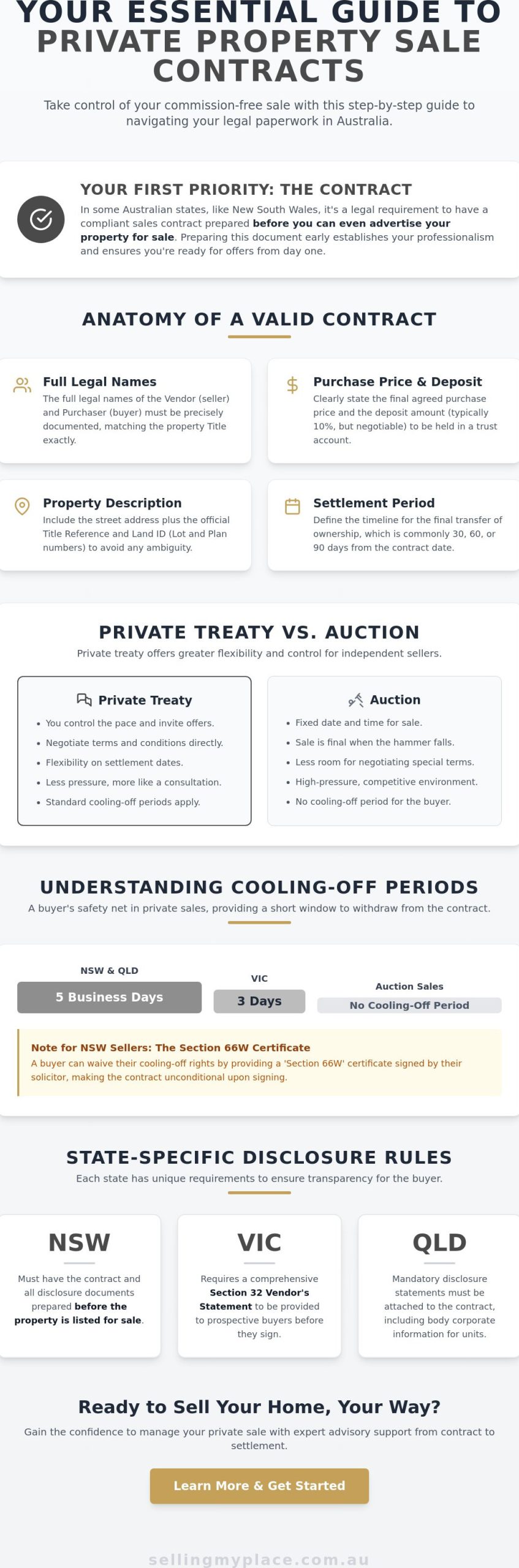
The cooling-off period is a standard feature of most private sales across Australia, acting as a short safety net for the buyer. Typically, this lasts between 3 and 5 business days, depending on your state. For instance, buyers in New South Wales and Queensland generally enjoy 5 business days, while those in Victoria have 3. It’s vital to remember that these rights don’t apply at auctions or if a property is passed in but sold on the same day. In some cases, particularly in NSW, a buyer might provide a “Section 66W” certificate. This document, signed by their solicitor, waives the cooling-off period entirely, making the contract unconditional from the moment it’s signed. Understanding these nuances helps you manage your expectations and stay grounded during the final stages of the deal.
Essential Components of a Valid Sales Contract
Precision is your best friend when drafting a private property sale contract australia. While the document marks the financial end of your time in a home, it’s also the legal shield that protects your interests until the keys change hands. To ensure the agreement is binding and robust, you must start with the basics: the full legal names of all parties. It sounds simple, but ensuring these match the Title exactly is crucial. If you’re selling as a couple or through a trust, every detail must be mirrored in the contract. You’ll also need to clearly state the agreed purchase price and the deposit requirements, which is typically 10% of the sale price held in a trust account, though this can be negotiated to suit both you and your buyer.
The property itself needs a flawless description. This goes beyond the street address. You must include the Title Reference and Land ID (Lot and Plan numbers) to ensure there’s no ambiguity about what’s being sold. Finally, the settlement timeframe, whether it’s 30, 60, or 90 days, provides the heartbeat of the transaction, giving both parties a clear date to work toward. Gaining a deep understanding of the nuances of the private sale process ensures you don’t miss these critical details, allowing the transition to feel like a shared success rather than a legal hurdle.
Mandatory Disclosure Documents
Transparency is the cornerstone of a stress-free sale. In Australia, you’re legally required to provide specific documents that prove you have the right to sell and inform the buyer about the land’s status. A current Title Search is non-negotiable; it’s the proof of your ownership. You’ll also need Zoning Certificates, such as a Section 10.7 in NSW, which tells the buyer what the land can actually be used for. Don’t forget to highlight any easements or covenants. If there’s a shared driveway or a restriction on building heights, disclosing this early prevents a buyer from pulling out later. These documents aren’t just red tape. They’re tools that build trust and protect you from future claims of non-disclosure.
Chattels and Fixtures: What Stays and What Goes?
The backbone of a solid private property sale contract australia is accuracy, especially regarding the physical items in the home. Disputes often arise over “grey area” items like dishwashers, custom-made curtains, or that heirloom light fitting in the dining room. As a rule of thumb, fixtures are items “fixed” to the property (like a built-in oven), while chattels are moveable (like a fridge). To avoid settlement day surprises, be explicit. If you plan to take the designer pendant lights with you, list them as exclusions. If the garden shed stays, list it as an inclusion. If you’re feeling unsure about how to categorise your belongings, you can always reach out for a guiding hand to clarify these final details.
State-Specific Requirements and Disclosure Rules
Navigating a private property sale contract australia requires an understanding that our states don’t always play by the same rules. It’s like a neighbourly chat where the dialect changes just slightly as you cross the border. While the heart of the transaction remains the same, the legal requirements for disclosure vary significantly depending on where your property is located. In New South Wales, the law is quite firm: you must have a draft contract prepared before you even put up a “For Sale” sign or share a photo online. This isn’t just about red tape; it’s about ensuring every potential buyer has the full story from the very first minute, protecting you from claims that you’ve withheld vital information.
Down in Victoria, the Section 32 Vendor Statement is your most important companion. This document discloses everything from land tax and rates to building permits and encumbrances. Failure to include a complete and accurate Section 32 can be a deal-breaker. Checking the latest private sale contract requirements will help you stay on top of these local nuances and ensure your paperwork is beyond reproach. Queensland sellers typically use standard REIQ contracts, but these must include a specific “Warning Statement” to be valid. Meanwhile, in Western Australia, the process revolves around the “Offer and Acceptance” (O&A) system, where the contract is formed when you formally accept a buyer’s written offer on a prescribed form.
The Consequences of Non-Disclosure
What happens if a document is missing or a detail is incorrect? It’s not just a minor hiccup. A missing disclosure can give a buyer the legal right to rescind the contract, meaning they can walk away and take their deposit with them, often right up until the day of settlement. You could also face legal penalties for providing misleading information, even if it was an honest mistake. Essentially, vendor disclosure serves as a vital legal safeguard that protects the seller from future disputes by ensuring total transparency from the outset.
Navigating Regional Variations
Because these rules are so specific to each state, hiring a local expert is a wise move even if you are managing the marketing yourself. State laws even impact how you can handle an “off-market” listing or a pre-sale consultation. Seeking professional Conveyance Advice is the best way to ensure your specific sale is compliant with local regulations. This regional expertise provides the steady hand you need to manage the complexities of the private property sale contract australia, giving you the freedom to focus on finding the right buyer for your home’s next chapter.
Managing the Contract Process Without a Traditional Agent
Taking the reins of your home sale is an empowering choice. You don’t need a middleman to facilitate a genuine conversation between two parties who both want the same thing: a fair and transparent transition. When an offer comes in, it is often accompanied by a small holding deposit. This isn’t a legal requirement, but it is a lovely way for a buyer to say, “We are serious about your home.” Because you have already prepared your private property sale contract australia, you can respond with speed and clarity. This is particularly effective for off-market property buyers who appreciate a streamlined, professional approach without the usual fanfare. It shows you’re ready to do business.
Today, the process is smoother than ever thanks to eConveyancing platforms and digital signature tools. You can exchange documents in minutes, keeping the momentum high while you and the buyer are still in that “celebratory” mindset. If the technical side feels like a lot to juggle, you can always book a consultation with a property advisor to ensure your digital exchange is as secure as a traditional handshake. This modern approach doesn’t just save time; it provides a clear, digital audit trail that protects everyone involved.
Common Special Conditions to Consider
Negotiation is really just a series of “what ifs” that help both parties feel secure. Most buyers will request a “Subject to Finance” clause, giving them a window; typically 14 days; to finalise their mortgage approval. You will also frequently see “Subject to Building and Pest Inspection.” These aren’t hurdles to be feared. They are simply steps that give the buyer the peace of mind they need to commit. For your own protection, you might consider a sunset clause. This ensures that if the buyer doesn’t meet their conditions by a specific date, you are free to return the property to the market without delay.
The Exchange of Contracts
The term “exchange” is exactly what it sounds like. Two identical copies of the private property sale contract australia are signed; one by you and one by the purchaser; and then physically or digitally swapped. This is the pivotal moment when your home moves from being “Under Offer” to “Sold.” It is also when the full deposit, usually 10%, is paid. This money isn’t paid directly to your bank account just yet. Instead, it is held safely in a regulated trust account by a solicitor or conveyancer, acting as a stakeholder until the final settlement day arrives.
Moving from Contract to Settlement with Expert Support
Once the ink is dry on your private property sale contract australia, you enter the home stretch. This period, typically spanning 30 to 90 days, is a time of transition and preparation. You’ll likely host a building and pest inspector; remember, they are simply doing their job to ensure the buyer feels as secure in their decision as you do. Then comes the final pre-settlement walkthrough, usually occurring 24 to 48 hours before the keys change hands. It’s a final chance for the buyer to see that the home is in the same condition as when they signed. Approach this with a spirit of hospitality; it’s the final handover of your property’s legacy to its new keepers.
You don’t have to walk this path entirely alone. While you’ve chosen the independent route, our Real Estate Advisory Services act as a vital bridge, providing the expertise of a seasoned guide without the intrusive pressure of traditional commissions. This “steady hand” approach ensures that if a minor hiccup arises during the settlement period, you have a professional partner to consult. It’s about having the best of both worlds: the freedom of a private sale and the security of expert backing. This Agent Advisory Service ensures you stay grounded and confident until the final cent is transferred.
The financial benefit of a commission-free sale is often the difference between a good result and a life-changing one. By managing your own private property sale contract australia, you retain tens of thousands of dollars that would otherwise disappear into high marketing costs and agency fees. It’s a celebratory moment when you realise that your personal effort has directly contributed to your family’s next chapter. There is a deep sense of pride in navigating this process yourself, knowing you’ve protected your equity through a successful, self-managed outcome.
Professional Advisory vs. High Commissions
Why pay 2% or 3% of your home’s value when a flat-fee model offers a much better return on investment? By opting for Pre-Sale Property Consulting and professional Floorplans, you present your home in its best light while keeping your hard-earned equity. It’s a strategic choice that values your financial future over an agent’s overheads. Our philosophy is simple: we provide the professional backing you need without the hefty price tag, ensuring you feel supported but always in the driver’s seat.
Your Next Steps to a Successful Sale
Preparation is the key to a calm and efficient settlement. Start by organising your paperwork early to avoid last-minute dashes to the solicitor. Combining savvy Sale by owner strategies with high-quality photography and professional listing services ensures you attract the right buyers from the start. You’ve got the tools, the knowledge, and the heart to make this happen. Ready to take the lead? Start your commission-free journey today and see how rewarding a self-managed sale can truly be.
Your Path to a Confident and Profitable Sale
Taking the lead on your home sale is a powerful way to honour the life you’ve built within its walls. You’ve now gained a clear understanding of how to navigate state-specific disclosure rules, identify the essential components of a valid agreement, and manage the transition from offer to settlement. Successfully handling a private property sale contract australia is the final piece of the puzzle that allows you to step into your next chapter with your equity fully intact. It’s about more than just paperwork; it’s about the pride that comes from a job well done.
You don’t have to navigate the final steps alone. With average seller savings of $20,000 and our Expert Agent Advisory Service included in every package, you can bypass hidden commissions and restrictive time limits entirely. We’re here to provide the steady hand and professional support you need to ensure your journey is as smooth and rewarding as possible. Sell your home smarter and keep 100% of your profit with our flat-fee packages. You have the knowledge and the heart to make this a success, and we’re excited to see you flourish in your next adventure.
Frequently Asked Questions
Can I write my own property sale contract in Australia?
You can technically draft your own agreement, but it’s a bit like performing surgery on yourself. A private property sale contract australia must adhere to strict state legislation, such as the 2026 Law Society edition in NSW, to be legally binding. Most independent sellers use a solicitor or conveyancer to ensure all prescribed documents are included. This professional touch protects you from a buyer rescinding the deal later due to a technicality.
How much does it cost to have a contract of sale prepared?
The cost of preparing your documentation depends on the complexity of your land and the required disbursements. Disbursements are the fees paid to government agencies for title searches, zoning certificates, and drainage diagrams. While we don’t quote specific legal fees, you’ll find that investing in professional contract preparation is a small fraction of the cost you’d save by avoiding traditional agent commissions. It’s an investment in your peace of mind.
What is the difference between a contract of sale and a vendor statement?
Think of the contract as the “how” and the vendor statement as the “what.” The contract outlines the agreed price, names, and the timeline for the transition. The vendor statement, known as a Section 32 in Victoria, discloses the property’s history; things like rates, building permits, and any easements. Both documents are essential for a transparent transaction, ensuring the buyer has all the facts before they commit to the purchase.
Does a private sale contract need to be witnessed by a lawyer?
A lawyer doesn’t need to witness your signature, but an independent adult usually must. This person should be someone who isn’t a party to the sale. With the recent shift toward digital platforms, many contracts are now signed electronically using secure verification methods. This modern approach makes the process much more accessible for families managing their own sale, allowing you to sign from the comfort of your own living room.
What happens if a buyer pulls out of a private sale contract?
If a buyer pulls out during the cooling-off period, they’ll typically forfeit a small penalty, such as 0.25% of the purchase price in NSW or Queensland. However, once the contract becomes unconditional, the consequences are much more serious. They would likely lose their entire 10% deposit. You may also have the legal right to seek further compensation if the property eventually sells for a lower price than the original agreed amount.
Can I sell my house privately if I still have a mortgage?
Yes, selling with an existing mortgage is a very common part of the Australian property landscape. Your conveyancer or solicitor will coordinate a “discharge of mortgage” with your bank. On settlement day, the bank is paid the outstanding balance directly from the sale proceeds. The remaining equity is then transferred to your account. It’s a seamless process that your legal team manages behind the scenes while you focus on your move.
Is a verbal offer legally binding in Australian real estate?
No, a verbal offer is never legally binding in any Australian state or territory. Even if you’ve agreed on a price and shaken hands, nothing is final until a written private property sale contract australia is signed by both parties and formally exchanged. This requirement for a written agreement is a vital protection for you, ensuring there’s no confusion about the terms or conditions before the deal becomes official.
What is the standard settlement period for a private property sale?
There is no single “standard” timeframe, but 30, 60, or 90 days are the most frequent choices. In New South Wales, a 42-day settlement is quite traditional, but the beauty of a private sale is the flexibility it offers. You can choose a date that aligns with your family’s needs, whether you want a quick 21-day turnaround or a longer period to organise your next home. It’s all about what works best for your transition.
The Rise of Commission-Free Real Estate: Why Australian Sellers are Reclaiming Their Equity in 2026
Why should a few weeks of marketing and a handful of open homes cost you the same as a brand-new car or two years of private school fees? If you’ve ever felt held to ransom by the traditional 2.65% national average commission, you’re certainly not alone. Many Australian families are tired of watching their hard-earned equity vanish into an agent’s pocket just as they’re trying to start their next chapter. The shift toward commission free real estate isn’t just a budget-friendly trend; it’s a movement where homeowners are finally taking back control of their most valuable asset.
It’s completely natural to feel a bit of anxiety about the legal conveyance or worry that selling your own home might look less than professional to savvy buyers. However, the landscape in 2026 has changed. You can now save an average of A$20,000 in fees while still showcasing your home with high-end photography and receiving expert guidance through the negotiation process. We’ll explore how modern tools and professional support are helping Australians navigate new disclosure laws and market shifts to secure a premium sale price without the premium commission.
Key Takeaways
- Understand how the 2026 shift toward digital transparency and flat-fee models empowers you to reclaim your home’s equity without sacrificing professional standards.
- See the breakdown of how traditional commissions can cost you tens of thousands of dollars and why a fixed-fee approach is often more aligned with your financial interests.
- Learn how commission free real estate models provide a steady hand throughout the process, offering expert support without the high-stakes pressure of a percentage-based fee.
- Discover the two non-negotiable tools for any modern seller: a comprehensive neighbourhood market report and high-quality visual storytelling to capture buyer attention.
- Explore how an advisory-led approach bridges the gap between risky DIY selling and expensive traditional agencies, ensuring your home’s legacy and your family’s future are protected.
What is Commission-Free Real Estate and Why is it Trending in Australia?
Commission-free real estate is a modern alternative to the traditional percentage-based agency model. Instead of paying a slice of your home’s final sale price, you engage a flat-fee marketing and advisory service. This shift is gaining momentum across Australia in 2026 because it offers substantial cost savings alongside the professional polish of a traditional agency. It’s about having a steady hand to guide you through the complexities of a sale without the steep price tag that usually follows.
Think about the numbers for a moment. With the national median commission rate sitting at roughly 2.65% as of June 2026, selling a home for A$900,000 means handing over nearly A$24,000 in commission alone. That is a significant portion of your equity that could be better spent on your next family home or your retirement fund. By choosing a commission free real estate model, you are essentially reclaiming that 2 to 3 per cent for your own future. It represents a fundamental change in how we value the work involved in a property transaction.
The Evolution of the Australian Property Market
Prop-tech has completely decentralised property data in recent years. It wasn’t long ago that agents held all the keys to market knowledge, but today, comprehensive data is accessible to every homeowner. National listing platforms have levelled the playing field, allowing sellers utilising modern, flat-fee services to reach the same pool of buyers as the biggest franchises in the country. This means full-service no longer has to be synonymous with high commission. You can still have professional photography, floorplans, and expert advisory services without the traditional percentage-based fee structure. The market has matured, and sellers are now more informed than ever before.
Equity Protection: The New Priority for Homeowners
Equity protection is the strategic preservation of your home’s value by minimising transactional costs and maximising the final net return on your sale. For many Australians, this represents a profound psychological shift. You aren’t just paying for a service; you’re protecting a life’s work. We see more families using these saved commissions to bolster their next deposit or secure a more comfortable lifestyle in retirement. It’s about ensuring that the value built through years of mortgage payments stays exactly where it belongs: with you. This movement is less about cutting corners and much more about valuing your own financial legacy.
The Hidden Costs of the Traditional Commission Model
Let’s look at the cold, hard numbers. In many Australian capital cities and growing regional hubs, a family home reaching the A$1,000,000 mark is now quite common. At a 2.5 per cent commission rate, you are signing away A$25,000 the moment the contract exchanges. But here is the kicker: that A$25,000 usually doesn’t even cover your marketing. Most traditional agencies will then ask for an additional A$5,000 to A$10,000 for “vendor-paid advertising” to cover photography and portal listings. Suddenly, your cost of selling has ballooned toward A$35,000 before you’ve even packed a single box.
This traditional model often creates a subtle conflict of interest. An agent’s primary goal is frequently a quick turnover so they can move on to the next listing. For them, the difference between selling your home for A$950,000 today or holding out for A$1,000,000 next week is only a few hundred dollars in their pocket. For you, that difference is A$50,000. It’s your mortgage, your children’s education, or your retirement travel. The high-pressure sales tactics often used to secure a quick listing or a fast sale can take a heavy emotional toll, leaving you feeling like a transaction rather than a partner. The same conflict of interest applies on the buying side, which is why many Australians are now turning to a flat fee buyer’s agent Australia wide to ensure their representative’s incentives are truly aligned with their own.
Commission vs. Net Profit: What Really Matters
The gross sale price of your home is essentially a vanity metric if a massive chunk of it is eaten by fees. What actually lands in your bank account is what defines your future stability. This is where Technological Disruption In Real Estate has been a total game-changer for homeowners. By choosing a model focused on commission free real estate, you gain budget certainty from day one. There are no surprises, no “extra” hidden costs, and no percentage-based penalties for your home’s success. It allows you to keep your focus on long-term financial health rather than transaction-day stress. If you’re curious about how this looks for your specific suburb, you might want to see how our flat-fee model works for local sellers.
The Myth of the ‘Magic’ Negotiator
Many people worry that they need a “star” agent to handle the heavy lifting of price talks. The truth is that effective negotiation isn’t magic; it’s math and preparation. Professional advisory services now provide the same rigorous negotiation frameworks used by top-tier firms. By arming yourself with a data-heavy neighbourhood market report, you can back your asking price with facts rather than just “agent intuition.” You become the most informed person in the room, empowered to protect your equity with a steady, confident hand. It’s about having the right tools to advocate for your home’s true value without the high-pressure environment of a traditional agency.
Comparing the Models: Traditional Agency vs. Pure DIY vs. KIDS Advisory
Choosing how to sell your home is a deeply personal decision that balances your financial goals with a need for peace of mind. In the Australian market, you generally face three distinct paths. The traditional agency model is the most familiar; it’s a hands-off experience where the agent handles the logistics, but it often lacks true personal empathy and comes with a price tag that can feel like a second mortgage. On the other end of the scale is the pure “sale by owner” or DIY route. While this is the lowest-cost option, it carries a high risk of legal errors or poor marketing that can inadvertently devalue your life’s work.
The third path is the hybrid advisory model, which we call the Kincade International Direct Sales (KIDS) approach. This model provides a commission free real estate experience that doesn’t leave you navigating the process alone. You receive professional marketing and expert guidance for a transparent flat fee, ensuring you have a steady hand to guide you through every milestone. Crucially, a “listing until sold” guarantee is essential in this model. It transforms the relationship from a temporary transaction into a genuine partnership, providing you with certainty regardless of how market conditions might shift during your campaign.
Why ‘Support’ is the Missing Ingredient in Most Flat-Fee Services
Most budget services simply place your home on a website and wish you luck, but real success requires a more nurturing touch. This is why pre-sale property consulting is so vital; it helps you maximise your home’s appeal before the very first buyer walks through the door. Professional photography and floorplans are also non-negotiable if you want to achieve a premium result in a competitive digital landscape. When you combine these visual tools with expert conveyance advice, the legal transition becomes just as smooth as the marketing campaign, reducing the stress that often accompanies high-stakes property deals.
The Global Reach Advantage
Australian property is increasingly viewed as a global asset, and your marketing should reflect that reality. A sophisticated digital presence now replaces the need for a local shopfront by placing your home directly into the pockets of qualified buyers across the globe. Unlike traditional local listings that might fade after a few weeks, modern digital infrastructure allows your property to maintain high visibility for as long as it takes to find the perfect buyer. This global network ensures that your home’s legacy is shared with a vast audience, far beyond the reach of a simple sign on the front lawn.
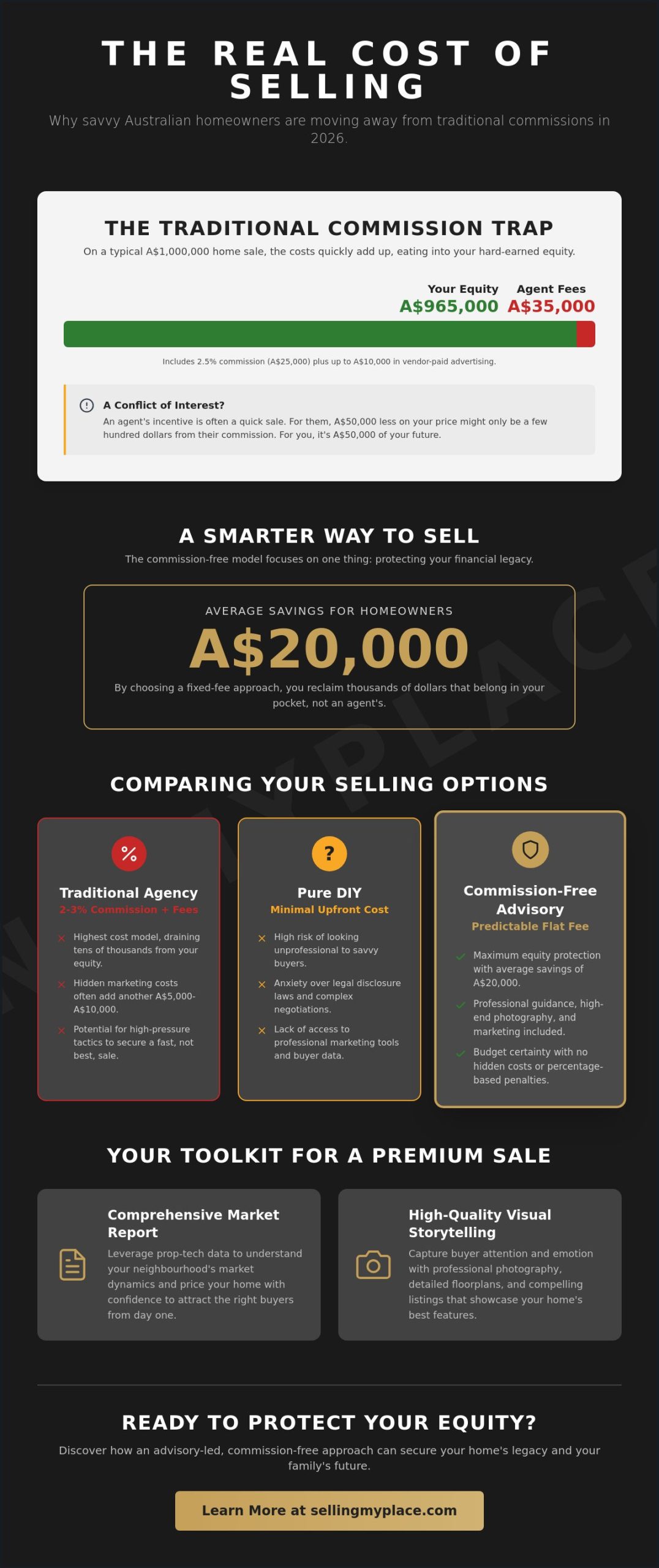
How to Succeed in the Commission-Free Market
Success in the commission free real estate market isn’t about cutting corners; it’s about allocating your resources where they actually drive results. Many sellers find that once they remove the heavy burden of a 2.65% commission, they have more room to invest in the things that truly matter. By following a structured, professional-grade checklist, you can move from listing to sold with a sense of calm confidence. It’s about being prepared, being professional, and being yourself.
- Step 1: Secure a comprehensive neighbourhood market report to set a realistic, data-backed price that stands up to buyer scrutiny. This is the foundation of any successful campaign.
- Step 2: Invest in professional visual storytelling, including photography and floorplans, to ensure your home stands out in a crowded digital landscape.
- Step 3: Organise your legal ducks in a row by seeking early conveyance advice to avoid last-minute contract hurdles.
- Step 4: Leverage professional real estate advisory services for pre-sale consulting and buyer representation to bridge the gap between DIY and traditional agency.
- Step 5: Master the warm hosting of open homes to build genuine, neighbourly connections with potential buyers who want to hear the real story of your home.
If you’re ready to start this journey with a professional edge, you can access our real estate advisory services to ensure every detail of your sale is handled with care.
The Power of Professional Presentation
Why would you risk devaluing your home’s online presence with grainy phone snaps? In 2026, your first open home happens on a smartphone screen. Professional photography captures the soul of a property, while floorplans perform a vital psychological task. They help buyers mentally move in by planning where their furniture will go before they even step through the front door. To truly shine, take the time to declutter and stage your rooms for a lifestyle-oriented sale. You aren’t just selling bricks and mortar; you’re selling the dream of a new beginning.
Navigating the Legalities with Confidence
It’s natural to feel a bit of anxiety when looking at an Australian property contract for the first time. However, the steps are quite logical once you have a steady hand to guide you. Handling enquiries and offers doesn’t have to be overwhelming if you have a clear framework for response. Having an advisor to review the fine print provides that essential layer of protection, ensuring your family’s interests are always the priority. This professional support allows you to focus on the emotional transition of moving while the technical details are managed with expert care.
Choosing Your Partner for a Smarter Sale
Selling your family home is far more than a simple legal transaction; it’s a major life transition that deserves a partner who values your journey. The industry is finally shifting toward a more empathetic, seller-centric experience that puts your needs ahead of an agent’s commission. By choosing a commission free real estate model, you aren’t just saving money. You are choosing to work with a team that respects the years of hard work you’ve put into your property. It’s about finding that perfect balance between professional results and personal control.
Kincade International Direct Sales (KIDS) was designed specifically to bridge the gap between the high costs of traditional agencies and the risks of going it alone. We believe that every Australian homeowner should have access to expert support without being held to ransom by percentage-based fees. This approach combines a sophisticated global marketing network with deep local expertise, ensuring your home is seen by the right buyers, whether they are just around the corner or on the other side of the world. Imagine what your next chapter looks like with an extra A$20,000 in your pocket. It could be the difference between a modest renovation and the dream kitchen you’ve always wanted.
The KIDS Difference: More Than Just a Listing
What sets our approach apart is the commitment to being a “steady hand” throughout the entire process. Our 0% commission structure and transparent flat fee provide the financial security you need to plan your future with confidence. Through our Real Estate Advisory Services, you receive the nurturing guidance of a seasoned expert who acts as your advocate during negotiations. We also understand that every sale happens on its own timeline. That’s why we offer a “listed until sold” commitment, removing the artificial pressure of expiring contracts and letting you focus on achieving the best possible outcome for your family.
Your Next Chapter Starts Here
As you prepare to hand over the keys, remember that your home’s legacy is a reflection of the life you’ve built there. We view our role as a partnership that values that legacy as much as the final sale price. Selling is an emotional milestone, and you deserve a supportive environment where your questions are answered with warmth and your decisions are backed by data. Your future is waiting, and it’s brighter when you keep your equity where it belongs.
Begin your commission-free journey with Kincade International Direct Sales today and discover how a smarter, more empathetic sale can change your life.
Step Into Your Future with Confidence
Reclaiming your equity is about more than just balancing the books; it is about protecting the legacy of your home. By moving away from high-pressure traditional commissions and embracing commission free real estate, you are choosing a path that prioritises your family’s financial stability. You now understand how a flat-fee model provides absolute budget certainty, and how professional advisory services provide the same negotiation strength as any high-street agency without the high-stakes stress.
With a global marketing network at your fingertips and an expert Agent Advisory Service to guide you through every milestone, a premium sale is well within your reach. Australian sellers are already seeing an average of A$20,000 stay in their pockets, providing a significant boost for their next deposit or retirement fund. It is time to start your next chapter with a steady hand by your side and your hard-earned equity intact.
Discover how to sell your home with 0% commission at Kincade International Direct Sales
Your home has been the heart of your life for years. Let’s make sure its sale sets you up for an even brighter future in the years to come.
Frequently Asked Questions
Is commission-free real estate legal in Australia?
Yes, selling your property through a commission-free model is perfectly legal across all Australian states and territories. Real estate commissions are not regulated by the government; they are simply a matter of contract between you and a service provider. This means you have the freedom to choose a flat-fee advisory model that protects your equity rather than a traditional percentage-based structure.
How much can I actually save by using a flat-fee real estate model?
While every property is unique, many Australian homeowners save an average of A$20,000 in fees by avoiding the national median commission rate of 2.65%. By opting for commission free real estate, you keep that significant sum of money in your own pocket. This extra capital can be life-changing when you are trying to secure your next family home or boost your retirement savings.
Will my property be listed on the major Australian real estate portals?
Yes, your home will be listed on the leading Australian property portals where the vast majority of buyers look for their next move. Professional listing services ensure your property receives the same level of digital visibility as any traditional agency listing. You won’t miss out on potential buyers just because you’ve chosen a more cost-effective way to sell.
Do I have to do all the negotiations myself if I sell commission-free?
Not at all. While you have the joy of meeting buyers and sharing the story of your home, you don’t have to handle the high-stakes price talks alone. Expert advisory services provide a steady hand during the negotiation process, acting as your professional representative to ensure you achieve the best possible result without the stress of direct confrontation.
What happens if my property doesn’t sell within the first month?
Unlike traditional agencies that might pressure you for a quick sale to move on to their next listing, a “listed until sold” approach gives you the gift of time. Your property remains active and supported without arbitrary time limits or the need for expensive campaign renewals. This allows you to wait for the buyer who truly values the legacy of your home.
Is the final sale price lower when you don’t use a traditional agent?
There is no evidence to suggest that commission free real estate results in a lower sale price. In fact, when you are armed with a detailed neighbourhood market report, you can negotiate from a position of data-backed strength. Because you aren’t paying a massive commission, your net profit is often significantly higher even if the gross sale price is identical.
What professional services are included in a flat-fee marketing package?
A high-quality package includes everything you need for a polished, professional campaign, such as high-end photography and detailed floorplans. These visual tools are essential for helping buyers mentally move into your space before they even visit. You receive the same premium marketing standards as a boutique agency, but with the transparency and certainty of a flat fee.
Can I still get help with the legal paperwork and conveyance?
Yes, professional conveyance advice is a vital part of a smarter sale process. You will have access to expert guidance to ensure all contracts, disclosures, and legal requirements are handled with absolute precision. This professional oversight reduces the risk of legal errors and ensures a smooth, calm transition of title to the new owners. If you are also purchasing your next property, working with a flat fee buyer’s agent in Australia can bring the same transparent, fixed-cost approach to the buying side of your transaction. If you want to maximise your result before going to market, our guide on how to prepare your house for sale in Australia walks you through every step of the pre-sale process.
Free Online Property Valuation: Myth vs. Reality for Australian Sellers
What if that glowing number on your smartphone screen is actually the reason you miss out on a life-changing sum of money? It is a common dilemma for many Australian families today. You want a quick answer, so you jump onto a site for a free online property valuation, only to find three different platforms giving you three vastly different figures. It is enough to make anyone feel a bit unsettled, especially when you are trying to plan your next big move while the RBA cash rate remains at 4.35%.
We know that the fear of underselling is heavy, and the thought of high agent commissions eating into your hard-earned profit only adds to the pressure. You deserve a price range that feels grounded in reality, not just an algorithm’s best guess. In this guide, we will show you how to use these digital estimates as a helpful conversation starter rather than the final word. You will learn how to decode the data to find a realistic price range and see why expert-backed insights are the secret to saving A$20,000 in commissions. We are going to give you the confidence to sell on your own terms, with a clear understanding of the “why” behind your home’s true value.
Key Takeaways
- Understand how a free online property valuation uses automated algorithms to pull data, and why it is just the start of your pricing journey.
- Discover why digital estimates often miss the mark by failing to account for your home’s unique features, like that stunning new kitchen or solar system.
- Learn how to bridge the “accuracy gap” using professional Neighborhood Market Reports that combine deep suburb analytics with real-time data.
- Master a simple two-step process to price your home accurately for a successful sale without needing a traditional commission-based agent.
- Find out how a flat-fee model can protect your equity, potentially keeping an extra A$20,000 in your pocket when you settle.
What is a Free Online Property Valuation and How Does it Work?
It is 9:00 PM on a Tuesday, and you are sitting on the sofa, curious about what your biggest asset might be worth in the current market. Within seconds of typing your address into a search bar, a digital number appears. This is the convenience of a free online property valuation, a tool that has become the first port of call for thousands of Australian homeowners. While it feels like a personalised calculation, it is actually powered by an Automated Valuation Model, or AVM.
Think of an AVM as a very fast, data-hungry mathematician. It does not walk through your front door or admire your garden; instead, it crunches massive amounts of information from public records, recent sales in your street, and broader suburb trends. It is important to clarify a legal distinction here: what you see on a screen is technically an “estimate” or a “market appraisal.” To understand the deeper principles of how professional assessments differ from these digital guesses, it helps to ask, What is property valuation? In a formal sense, a true valuation is a legally binding document prepared by a qualified professional, often for a bank or a court. Online tools are simply a helpful ballpark figure to get your head around the possibilities without the pressure of a knock on the door.
The Data Behind the Screen
Major property portals and Australian banks do not just guess these numbers. They pay for access to massive databases that track every “sold” sticker in the country. They look at the median price points of your suburb and the specific growth rates over the last quarter. However, there is a catch. The algorithm sees that your neighbour’s house sold for a lower price last month, but it does not know that house was a “renovator’s delight” with a leaking roof. If your home is a “modern masterpiece” with high-end finishes, the online tool might accidentally drag your estimate down based on the poor condition of the house next door.
Why Banks and Portals Offer These for Free
You might wonder why these large companies provide this service at no cost. The reality is that your interest is the currency. By providing a free online property valuation, portals and banks can identify who is thinking about selling or refinancing. It is a sophisticated form of lead generation that helps them offer you a mortgage or connect you with a commission-based agent. Additionally, a bank’s estimate is often quite conservative. They are looking at your home through the lens of risk, ensuring they do not lend more than the property is worth. This figure is frequently lower than the actual “selling” price you could achieve with the right marketing and a bit of heart.
The Accuracy Gap: Why Online Estimates Often Miss the Mark
Have you ever noticed that a free online property valuation often gives you a range so wide you could drive a road train through it? It is not uncommon to see a gap of A$200,000 or more between the “low” and “high” estimates. This happens because algorithms are excellent at math but terrible at nuance. They rely on historical data that is often six to twelve weeks old. In a fast-moving market where the RBA cash rate or new government grants are shifting buyer demand by the week, relying on three-month-old “sold” data is like trying to drive while looking only in the rearview mirror.
Then there is the issue of “outlier” sales. If a neighbour down the street had to sell urgently due to a personal crisis, that lower price point gets sucked into the database. The computer does not know it was a distressed sale; it simply sees a three-bedroom house in your postcode selling for less, which then drags your estimate down. It also cannot distinguish between the peace of a quiet, leafy cul-de-sac and a house three doors down that sits right on a noisy main road or directly under a flight path. These local details matter immensely to your final result.
The “Ghost in the Machine”: What AVMs Can’t See
A computer program has never walked across your polished spotted gum floorboards or felt the quality of your new Caesarstone benchtops. It does not know you have invested in a high-spec solar system or a council-approved granny flat that could fetch a premium. These “invisible” assets are often where the real value lies. Unique features like a heritage facade or a North-facing backyard that captures the winter sun are the emotional triggers that drive up prices, yet they remain invisible to a standard algorithm. If you want to see how your home’s specific features stack up against others, exploring real estate advisory services can provide the clarity a machine simply cannot.
Market Sentiment vs. Historical Data
Real estate is as much about psychology as it is about bricks and mortar. While portals focus on “settled” sales, the most accurate price indicators are often the “active” listings and the number of people attending open homes this weekend. Market Sentiment is the emotional pulse of buyers at a specific moment. A computer cannot feel the energy of a “hot” market where three buyers are fighting over one property. It only sees the final number months after the emotional dust has settled. This lag is why your “on the ground” reality might be far more lucrative than a free online property valuation suggests.
Online Estimates vs. Neighborhood Market Reports
While a free online property valuation is a fantastic starting point for your research, it is essentially a snapshot taken from a distance. It gives you a general idea of where you stand, but when you are preparing to list your family home, a snapshot isn’t enough. You need a high-definition map. This is where a professional Neighborhood Market Report changes the game. Unlike an instant algorithm, these reports are built to bridge the gap between raw data and a winning selling strategy. They don’t just tell you what happened three months ago; they tell you what is happening right now in your specific street.
At Kincade International Direct Sales (KIDS), our reports are designed to be a protective shield for your equity. We take the “raw data” that everyone else sees and add a layer of strategic insight. This means looking at your home through the eyes of a buyer. We don’t just provide a number; we provide a narrative that explains your property’s unique position in the local landscape. It is the difference between having a rough guess and having a professional “selling” document that commands respect from potential buyers.
What a Professional Report Includes
A truly comprehensive report goes far beyond a simple median price graph. It provides a detailed comparison of properties currently for sale, which are your direct competition for buyer attention this weekend. We look at historical growth patterns and, crucially, any future suburb infrastructure plans that might boost your property’s appeal. If the local council has just approved a new parkland or transport hub nearby, that adds tangible value that an algorithm simply misses. Additionally, we include accurate floorplans and professional photography to define the true scale and lifestyle potential of your home, ensuring that every square metre is accounted for.
The Value of Human Interpretation
Data is powerful, but it can also be overwhelming without a guide. A report is just paper until an expert advisor sits down with you to review what the numbers actually mean for your specific situation. This is the “steady hand” approach we pride ourselves on. Having a professional interpret the analytics gives you the ammunition you need to justify your asking price to potential buyers. When you can point to hard evidence of local trends and infrastructure, you gain the confidence to stand firm on your price during a commission-free sale. It is about turning information into empowerment. You can Learn more about our Neighborhood Market Reports to see how we help you move from a guess to a certainty.

How to Price Your Home for a Commission-Free Sale
Pricing your home is one of the most significant decisions you will make for your family’s future. It is not just about a number; it is about protecting the equity you have built over years of hard work. To get this right, you need to move beyond a single free online property valuation and become a temporary expert in your own backyard. If you are considering taking the reins yourself, understanding how to price your home for sale by owner with a data-driven approach is the critical foundation for protecting your family’s equity. We recommend a methodical five-step approach to find your “sweet spot.”
- Step 1: Gather at least three different online estimates to find a broad baseline range for your suburb.
- Step 2: Spend a Saturday morning attending three local “Open for Inspections” to see your competition in the flesh and compare their finishes to yours.
- Step 3: Use the “Add-Back” method to factor in your unique upgrades, like that high-spec kitchen or the council-approved deck.
- Step 4: Consult a professional for Pre-Sale Property Consulting to finalise your strategy with an objective eye.
- Step 5: Set a listing price that is competitive enough to invite multiple offers without leaving a cent on the table.
Be the Local Expert
Success in a private sale comes down to knowing the numbers better than the buyers do. Tracking “Days on Market” for your specific postcode is vital; it tells you exactly how fast the current pulse is moving. When you see “Price Withheld” on a recent sale, don’t worry. You can usually find the actual figure in the “Sold” section of major portals once the settlement period ends, or by asking an advisor who has access to the latest data. Aiming too high at the start often causes your listing to go stale, ultimately forcing a price drop that makes buyers wonder what is wrong with the property.
Using Data to Negotiate
When a buyer tries to “low-ball” you, it can feel like a personal affront to your home’s history. Stay grounded. This is where your Neighborhood Market Report becomes your best friend. By showing a buyer the hard evidence of similar sales and suburb growth, you move the conversation from emotion to logic. It is much harder for a buyer to argue with a free online property valuation when it is backed up by professional photography and detailed floorplans that prove your home’s true scale. Having these assets ready shows you are serious, prepared, and fully aware of your property’s worth in the current Australian market.
Maximise Your Profit with KIDS: Beyond the Valuation
A free online property valuation is a useful spark for your imagination, but it doesn’t provide the fuel needed to reach your financial destination. Once you have a sense of the numbers, the real work begins. At Kincade International Direct Sales (KIDS), we act as your seasoned partner, ensuring you don’t just find a buyer, but that you secure the best possible result for your family. We believe your home’s legacy belongs to you, not an agency’s bottom line. By moving away from the traditional model, you can keep your hard-earned equity exactly where it belongs: in your bank account.
The traditional agency commission model often feels like an invisible tax on your success. In many Australian suburbs, a standard commission can easily reach A$20,000 or more. That is money that could pay for your next move, a well-deserved holiday, or your children’s education. Before committing to any selling arrangement, it is worth reviewing a detailed flat fee vs commission real estate Australia comparison checklist so you can see exactly where your money goes under each model. With our Agency Flat Fee approach, that era of high costs is a thing of the past. We provide a Real Estate Advisory Service that acts as your secret weapon, offering professional guidance on strategy and conveyance advice without the predatory price tag. You get the expertise of a seasoned professional without the heavy financial burden.
Professional Tools, Personal Control
Selling your own home doesn’t mean you have to do it alone or settle for amateur results. Our flat-fee packages include high-end professional photography and detailed floorplans, ensuring your property stands out against the competition on every major portal. You maintain total control over the process, with the peace of mind that your home is “listed until sold.” There are no arbitrary time limits or high-pressure tactics to lower your price just to get a quick result for an agent. We also provide guidance through the legal journey with a steady, experienced hand, making the complex feel simple and safe. Our global marketing network further ensures that your place is seen by the right buyers, no matter where they are searching from.
Taking the Next Step
While a digital estimate is a great first step, it is merely the beginning of your A$20,000 saving journey. Transitioning from a free online property valuation to a successful sale requires more than just a ballpark figure; it requires a strategy. We invite you to have a heartfelt, no-obligation consultation with one of our seasoned experts to discuss your aspirations and your home’s unique story. It is time to move beyond the algorithm and start your selling journey with confidence and clarity. Get your professional Neighborhood Market Report and start selling smarter today.
Step Into Your Next Chapter with Confidence
Your home is more than just a set of coordinates on a map; it is the backdrop to your family’s history and the foundation of your future. While a free online property valuation provides a helpful ballpark figure to spark your interest, it cannot capture the heart of your property or the true value of your recent renovations. As we have explored, the real secret to a successful sale lies in combining that raw data with professional insight and a clear, commission-free strategy.
You deserve to keep your hard-earned equity. By choosing a smarter path, you can save an average of A$20,000 in commissions while still benefiting from an expert Agent Advisory Service. We ensure your home shines with professional photography and floorplans as standard, giving you the tools of a top-tier agency without the high costs. It is about having a steady hand to guide you through the complex legal and marketing steps, so you can focus on your next move. Empower your sale with a professional Neighborhood Market Report. You have worked hard for your home, and we are here to help you protect its value with warmth, honesty, and professional care.
Frequently Asked Questions
How accurate are free online property valuations in Australia?
Accuracy is a spectrum that depends heavily on your location and property type. In suburbs with high turnover and many similar homes, a free online property valuation is often quite close to the mark. However, for unique properties or those in areas with fewer sales, the margin for error increases. These tools rely on historical data, which means they can lag behind the real-time impact of the current 4.35% cash rate or sudden shifts in buyer demand.
Will an online valuation be the same as a bank appraisal?
No, they often tell different stories because they serve different masters. A bank’s assessment is typically more conservative because it is designed to protect the lender from risk. Online portals, on the other hand, aim to provide a “market” range to help you start your selling journey. For a definitive figure, a bank will often require a physical inspection by a certified valuer to verify the home’s condition and unique features in person.
Can I use an online property estimate to set my asking price?
Using an online estimate as your sole pricing strategy is a risky move. It provides a helpful baseline, but it doesn’t account for the “active” competition you will face at open homes this weekend. To set a price that invites competition without underselling, you need to combine digital data with a physical inspection of similar properties and a deep dive into the current emotional pulse of local buyers.
Do online valuations take renovations into account?
Algorithms are unfortunately blind to your beautiful new Caesarstone benchtops or that fresh coat of neutral paint. Most online tools only see the “bones” of the property found in public records, such as land size and the number of bedrooms. This is why your home may be worth significantly more than the computer suggests, especially if you have invested in high-quality internal upgrades, solar systems, or council-approved extensions.
Why is there such a big difference between different online valuation tools?
Variations occur because every platform uses a different proprietary algorithm and varying data sources. Some portals may have more recent “sold” data from their own listings, while others rely on government records that can take up to twelve weeks to update. This is why we recommend gathering a few different estimates to find a realistic “middle ground” before seeking professional advice to narrow the range and find your true “sweet spot.”
How often should I check my home’s online property value?
Checking your property’s value every three to six months is usually sufficient for most Australian homeowners. However, if the market is moving rapidly or if there have been significant changes to local infrastructure, a quarterly check-in helps you stay informed. It is a bit like tending to a garden; you don’t need to watch it every day, but regular attention ensures you are ready when the time comes to move on.
What is the difference between a valuation and a market report?
A formal valuation is a legally binding document often required for bank loans, whereas a Neighborhood Market Report is a strategic selling guide. Our reports bridge the gap by providing floorplans, professional photography, and deep suburb analytics that help you justify your price to potential buyers. It is about moving from a digital guess to a professional strategy that protects your hard-earned equity during a commission-free sale.
How can I increase my property’s value before selling?
You can boost your property’s appeal without spending a fortune on major construction. Simple cosmetic updates like tidy gardens, fresh paint, and professional photography that captures the lifestyle of the home make a massive difference. Providing clear floorplans is also vital; it ensures buyers understand the true scale of your home before they even walk through the door, building the confidence they need to make a strong offer.
