Is Home Staging Worth It in Australia? Weighing Costs and Sales
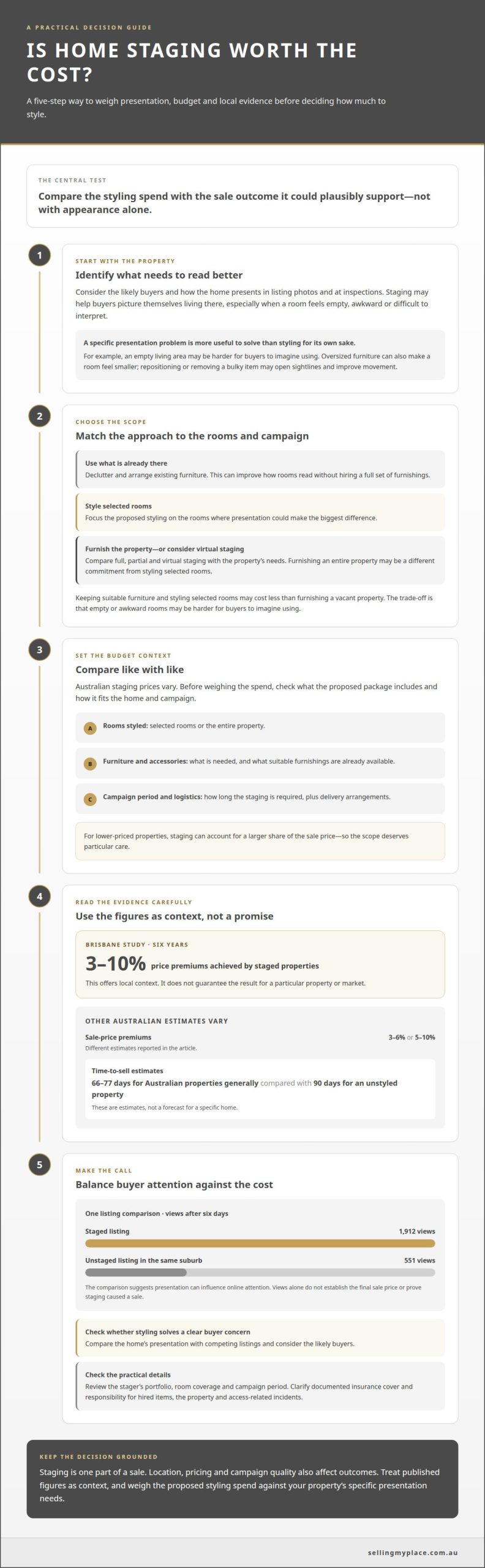
Home staging can be worth the cost in Australia when the likely sale uplift outweighs the styling spend. If you’re asking whether home staging is worth it in Australia, a six-year Brisbane study offers useful local context: staged properties achieved price premiums of 3 to 10 per cent. Those results can inform your decision, though the value of staging depends on the property and its market.
It’s understandable to weigh the upfront cost carefully, especially when selling involves plenty of decisions. To decide whether home staging is worth it in Australia, consider whether presentation could help buyers connect with your home, not just whether styled rooms look appealing.
This article explains Australian staging costs and how staged listings compare with unstaged sales, including what the Brisbane findings can and can’t tell you. You’ll have a clearer basis for deciding whether staging suits your property and sale plans.
Key Takeaways
- Judge staging by its potential to improve buyer appeal and the likely sale outcome, not by appearance alone.
- Compare the cost of full, partial and virtual staging with the needs of your property and campaign.
- Staged and unstaged listings can attract different levels of buyer attention, but presentation is only one part of a sale.
- A six-year Brisbane study found staged properties achieved price premiums of 3 to 10 per cent, offering local context rather than a guaranteed result.
- Use pre-sale advice and neighbourhood market insights to decide where presentation could make the biggest difference.
Why Property Styling Costs Matter So Much in 2026
Staging is a selling expense to weigh against possible changes to sale price and time on market. Estimates vary across Australia, so consider your property’s likely buyers and what needs to improve in its presentation.
Sale price and time-to-sell outcomes
Staging presents a property to help buyers picture themselves living there; its potential value lies in buyer appeal. Australian estimates of sale-price premiums vary: one range is 3-6%, while another is 5-10%.
Time-to-sell estimates vary too, from 66 to 77 days for Australian properties generally, compared with 90 days for an unstyled property. These figures provide context, not a forecast for a specific estate. A quicker sale may also reduce the time a home needs to stay ready for inspections.
Costs for lower-priced properties
For lower-priced properties, staging can account for a larger share of the sale price.
That makes the scope important. Keeping suitable furniture and styling selected rooms may cost less than furnishing a vacant apartment. The trade-off is presentation: buyers may find empty or awkward rooms harder to imagine using.
Australian staging price ranges
Australian staging prices range from styling selected rooms to furnishing an entire property.
These amounts help frame your budget, but the property’s size, existing furnishings and campaign length also affect the scope. Compare the proposed inclusions with the rooms buyers will see to judge whether the cost is worthwhile.
Anecdotal price comparisons and premiums
Anecdotal comparisons show how presentation may influence buyer attention, but they cannot isolate staging from location, pricing or marketing. One comparison recorded 1,912 views for a staged listing and 551 for an unstaged listing after six days.
For a A$750,000 property, a hypothetical 2% uplift equals A$15,000; a 2.5% uplift equals A$18,750. LJ Hooker reported a potential 7.5-12.5% sale-price boost from styling. These examples illustrate possible outcomes, not a guaranteed return.
Are home staging costs tax deductible in Australia? There is no single answer: tax treatment can depend on the property’s use and your circumstances. Keep staging costs separate from your estimated sale price when assessing the financial outcome.
What are the risks or downsides of staging a home for sale? The main risk is spending more than the sale outcome justifies. Styling can also look generic or misrepresent a property, so match the furniture and presentation to the home and its likely buyers.
Comparison of staged and unstaged listings
Staged listings use furniture and styling to show how rooms might work for everyday living; unstaged listings show the property as it is. This difference can shape buyers’ first impressions online and at inspections, although sale outcomes also depend on location, price and campaign quality.
In one Australian comparison, a professionally staged listing received 1,912 views after six days, while an unstaged listing in the same suburb received 551. The gap suggests presentation can influence online attention, where buyers often make quick decisions about which homes to inspect. Views alone, however, don’t establish the final sale price or prove staging caused a sale.
Time on market offers another comparison. One estimate puts styled Australian homes at an average of 33 days to sell, while a separate figure reports 66% of staged homes selling within their first two weeks. These measures use different timeframes, so they shouldn’t be treated as directly interchangeable. They do show why sellers may consider presentation when planning a campaign.
Choose a stager whose work suits the home, rather than simply opting for the most elaborate look. A portfolio can show whether their furniture choices suit similar floorplans and buyer groups. Reviews may indicate how clients describe communication, installation and removal. Compare the proposed room coverage and campaign period with your property’s needs, and clarify the scope before selling begins.
Insurance matters, too. Staging brings furniture into the property and involves moving it through rooms, so documented cover for relevant risks can clarify responsibilities if damage occurs. The arrangement should specify who is responsible for hired items, the property and access-related incidents. These practical details matter as much as the visual result.
For an unstaged home, decluttering and arranging existing furniture can improve how rooms read without hiring a full set of furnishings. Oversized furniture can make a room feel smaller; removing or repositioning a bulky item may open sightlines and improve movement. Staging is most useful when it solves a specific presentation problem, such as an empty living area that feels difficult to interpret.
To judge the likely value, compare the home’s presentation with competing listings and consider whether styling addresses a clear buyer concern. A property sale planning discussion can help connect presentation choices with the wider campaign.
Home staging costs in Australia
Staging costs vary with the home, furniture needed and campaign period. To decide whether it is worthwhile, compare similar inclusions and consider the presentation your property needs.
Costs by city and property type
Australian estimates differ by location, property size and campaign length, so local examples can help frame your budget.
For sellers asking, “Is home staging worth it in Australia?”, these differences show why property type and location matter alongside average costs.
Factors affecting staging costs
The main cost drivers are the rooms styled, the furniture and accessories needed, the campaign duration and delivery logistics.
Timing and distance can affect the total. Partial staging can reduce expenses by 30-50% compared with full vacant staging.
Furniture rental costs
Furniture rental is generally part of a staging arrangement, along with delivery, placement and the hire period.
Furniture rental can help present a home in listing photos, while the right setup for inspections depends on your needs. Choose an approach based on whether buyers need to see physical furniture during visits or a visual guide to an empty room’s potential.
Brisbane study of staged property sales
A six-year Brisbane study by Cape Cod Residential and the Interior Design Association examined 144 staged properties. It found an average price premium of A$69,017, with premiums ranging from 3 to 10 per cent. For a seller weighing presentation costs, those figures offer local evidence of how staged sales performed across the study period.
The reported average gives a dollar-based view alongside the percentage range. A$69,017 is a study-wide average, not a predicted uplift for every home. The actual amount represented by a percentage premium depends on the sale price. This distinction matters: a seller’s budget decision should relate to their property and likely buyer market, not simply the study average.
The upper end is notable, but the study’s distribution adds useful context. Thirty per cent of staged homes achieved a premium above A$100,000. That finding shows high premiums occurred for a portion of the properties, rather than describing every staged sale. It also makes the range more informative than focusing only on the highest result.
Timing was another reported outcome: 49% of the 144 properties sold in the first week, and 87% sold within four weeks. Those figures describe the staged properties in the study. They do not give an unstaged comparison, so they show how quickly these homes sold, rather than proving staging alone shortened each sale campaign.
For a Brisbane owner, the findings are most useful as a decision-making reference. Consider whether rooms need a clearer purpose, whether likely buyers value a furnished setting and how the staging scope fits the campaign. For example, a vacant living area may be difficult to interpret in photographs; selective furniture can make its use easier to picture.
The study’s price premiums also need to be weighed against the cost of styling. Compare the expected sale range with the staging quote, including the rooms covered and hire period. Then consider the property’s condition, location and presentation against similar homes. The study’s 3 to 10 per cent range can frame the discussion, but should not be treated as a promised return.
Brisbane’s results add a local perspective to the wider question of whether staging makes financial sense. The study found that staged properties recorded substantial premiums and relatively quick sales over its six-year period. For an individual seller, the practical next step is to relate those findings to their property, target buyers and campaign budget, rather than aim for the study’s highest outcome.
Which Australian property types benefit most from staging?
Staging is most useful when presentation helps buyers understand a home’s layout, scale or purpose. Both the property type and what feels unclear in its current condition matter. For example, furniture in an empty living room can show how a lounge and dining area might fit together.
Vacant apartments can benefit because bare rooms offer few visual clues about their function. A dining nook beside the kitchen, or a compact bedroom furnished with a bed and side table, can help buyers assess the space. Staging can also make listing photographs easier to interpret, particularly in an open-plan apartment.
Family homes may benefit when rooms could serve several purposes. Arranging a spare bedroom as a study, for instance, gives buyers a clear example of how the space might work. In a larger home, consistent styling can connect living areas and bedrooms without making every room feel identical.
Unusual layouts and small rooms call for especially careful furniture choices. Oversized pieces can make a room appear smaller, while well-proportioned furniture can clarify circulation and likely use. In a narrow living area, arranging seating to preserve a clear walkway can show how the room functions day to day.
Staging can also help when existing furnishings distract from a property’s features. Personal collections, crowded surfaces or furniture blocking sightlines can draw attention away from the room. A pared-back presentation can refocus attention on built-in storage, window placement or an open connection to the garden.
Buyer feedback offers one reason to consider this approach: 82% of buyers said staging helped them visualise living in a home. That finding speaks to the value of making a property’s potential easier to picture, rather than proving every home needs full staging. A furnished townhouse and a vacant apartment may need different approaches.
High-end homes may benefit from carefully coordinated presentation across entertaining and private spaces. But a larger property doesn’t automatically need hired furniture in every room. The key question is whether presentation makes the home’s design and lifestyle clearer to likely buyers, from the main living space to a quiet retreat or guest room.
An occupied home may need styling in selected rooms rather than replacement of all existing furnishings. Assess what already works, what competes for attention and which spaces seem difficult to use. This connects the plan to the property’s strongest features and likely buyers.
For tailored guidance on preparing a specific home for sale, discuss your property’s presentation needs.
Kincade International Direct Sales: Pre-Sale Property Consulting
Kincade International Direct Sales offers Pre-Sale Property Consulting to help owners plan a sale and decide where preparation could make a difference. If you’re weighing staging against other priorities, advice can help connect your home’s presentation with likely buyers and the market.
Neighbourhood market reports and Real Estate Advisory Services can inform decisions about positioning a property, while Residential Property Listing Services support the sale campaign. This guidance can help you consider whether full staging, selective styling or using existing furnishings best suits your plans. Keep the decision grounded in your property and its market, rather than assuming every home needs the same approach.
If you’re preparing to sell and would value a considered view of your next steps, explore Kincade International Direct Sales’ packages.
Make your next sale decision with confidence
Whether home staging is worth it in Australia depends on how well the presentation plan fits your property, likely buyers and wider selling strategy. Treat styling as one part of preparing a home, not a substitute for clear positioning or a well-managed sale.
Before committing, consider what you want buyers to notice first and whether furniture or simpler presentation changes would help them see the home’s potential. A considered plan keeps attention on choices that support your priorities while allowing for the practical demands of a major move.
Kincade International Direct Sales also offers Buyer Representation for people navigating a purchase, alongside services for owners preparing to sell. If you’re weighing your next move, talk with Kincade International Direct Sales about your property plans.
With a clear view of your goals, you can take the next step feeling more prepared and in control.
Frequently Asked Questions
Partial vs Full Staging: Which Is Worth the Cost?
Partial staging can suit an occupied home with furnishings that already work, while full staging can help present a vacant property consistently. The better fit depends on which rooms need attention and what buyers may struggle to picture. For example, keep a dining table that fits well, but add furniture to an empty living area. This focuses spending where presentation can clarify a room’s function.
Can home staging increase my sale value?
Yes, staging can contribute to a higher sale value by helping buyers understand a home’s use and appeal. To assess the financial case, compare your target sale outcome with the full styling expense, including the hire period and selected rooms. Stronger presentation may support buyer interest, but the property’s condition, location, pricing and competition also influence offers.
Do staged properties really attract more views online?
Staged homes can attract more online views: a comparison of two similar listings in the same suburb found higher view counts for the staged property. Photos are often a buyer’s first encounter with a home, so clear layouts and appropriately scaled furniture can make a listing easier to assess. The cover image, asking price and listing exposure also affect whether people click through.
What Are the Rooms That Should Be Staged Always?
No room must always be staged. Prioritise spaces where buyers need help understanding the layout or purpose. Living areas, kitchens and the main bedroom often shape a buyer’s impression because they show everyday use. If the kitchen is already clear and functional, styling may add little. An empty second bedroom, by contrast, could be shown as a guest room or study to illustrate its flexibility.
What are the benefits of staging your property?
Staging can make room proportions, circulation and possible uses easier to understand in listing photos and at inspections. It can also create a considered visual thread that helps buyers move between spaces without distractions. A dining setting, for instance, can show how an open-plan area works, while a desk can demonstrate a spare room’s potential without changing its layout.
What do Australian Real Estate Agents think?
There is no single view shared by every Australian real estate agent. Advice depends on the home, its likely buyers and how it compares with competing listings. An agent may see value in staging a vacant property with confusing room proportions, while recommending decluttering and existing furniture for a well-presented occupied home. Focus the discussion on the specific presentation gaps staging would address.
What’s Typically Included in Sydney Staging Packages?
A Sydney staging package may involve temporarily furnishing the property with furniture, art and homewares, then setting it up for listing photos and buyer inspections. The scope matters: rooms covered, hire duration and whether the home needs furnishing from scratch all affect what the package delivers.
How much does home staging cost in Australia?
These options meet different needs: physical furniture supports inspections, while virtual styling changes listing images without furnishing rooms for visits.
Selling a Tenanted Property in Australia: Lease Rules
Selling a tenanted property in Australia is possible, and the sale doesn’t automatically end the tenancy. If the buyer purchases the home with the tenancy in place, they take over the existing agreement. That can affect which buyers are interested and when a new owner can move in.
A sale doesn’t necessarily mean tenants must leave, even if you want to hand over the home vacant. Lease terms and notice rules matter, and they vary between states and territories. For a periodic tenancy, the timing may depend on whether the sale contract requires vacant possession and where the property is located.
This guide explains how fixed-term and periodic leases affect a sale, what to expect with buyer inspections and marketing photos, and when a periodic tenancy can be ended after a sale contract. A clear plan for notice, access and handover can make the process more predictable for everyone.
Key Takeaways
- You can sell a property while it’s tenanted, but the tenancy doesn’t automatically end when ownership changes.
- A buyer who takes over an existing lease must honour its terms, which can affect when they can move in.
- Inspection notice, access and open-home rules vary between states and territories, so plan viewings around the rules that apply to the property.
- Marketing photos can involve specific notice and privacy requirements, particularly when a tenant’s belongings may appear.
- For a periodic tenancy, vacant possession depends on the sale contract and the relevant state or territory’s notice requirements.
Buyer inspections and open-home access
Buyer access can help market a tenanted home, but it must comply with the lease and state or territory rules. Notice periods, inspection times and the tenant’s right to be present all matter.
Access for buyer inspections
Buyer inspections are visits that let prospective buyers view a rental property before deciding whether to make an offer. An open home allows several buyers to attend at a set time, while private inspections are arranged individually.
A tenanted sale may appeal to buyers seeking an investment, while some owner-occupiers may prefer vacant possession. There’s no reliable universal percentage for the effect on sale price or buyer numbers: the lease, buyer demand and whether the home is offered with vacant possession all influence the outcome.
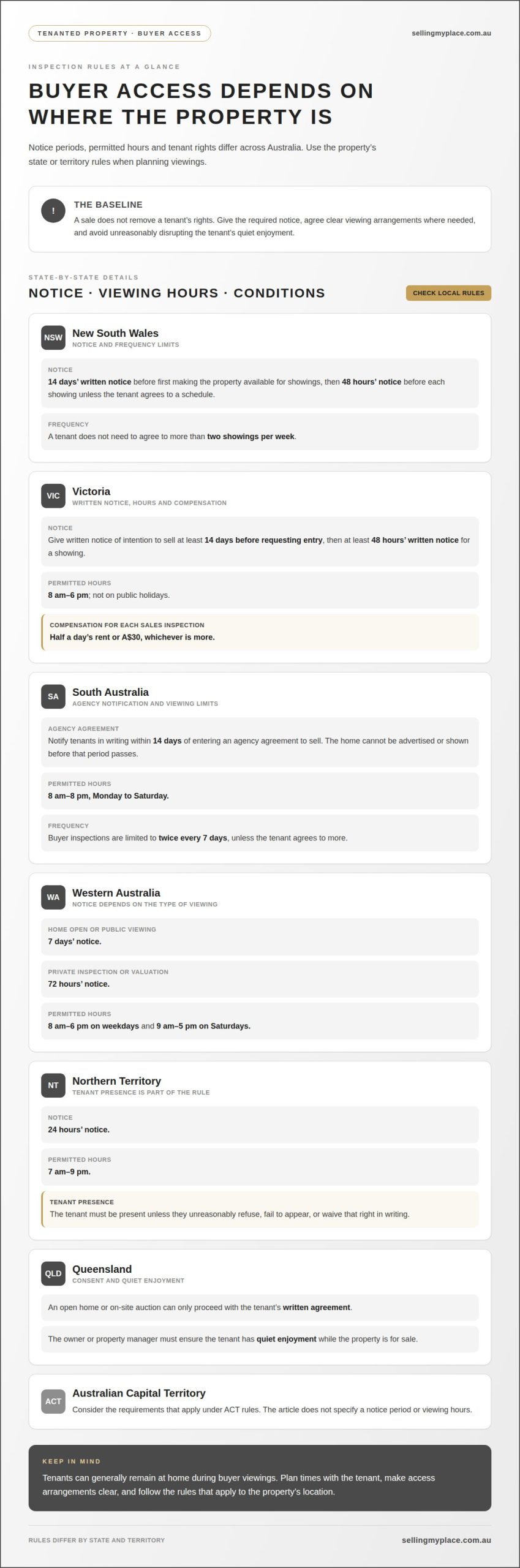
Plan viewing times with the tenant and make access arrangements clear. In NSW, a tenant doesn’t need to agree to more than two showings per week. A consistent schedule can reduce disruption while giving buyers an opportunity to assess the property.
Tenant quiet enjoyment
Quiet enjoyment means a tenant’s use of their home shouldn’t be unreasonably disrupted by sale-related visits. In Queensland, the owner or property manager must ensure the tenant has quiet enjoyment while the property is for sale.
In most Australian states and territories, tenants can remain at home during buyer viewings. In Queensland, an open home or on-site auction can only proceed with the tenant’s written agreement. Respecting these limits helps avoid conflict and protects the tenant’s rights.
Inspection hours and tenant presence
Permitted times differ by location. South Australian buyer inspections are between 8 am and 8 pm, Monday to Saturday. In Western Australia, sale-related access is limited to 8 am-6 pm on weekdays and 9 am-5 pm on Saturdays.
In Victoria, entry to show a property is allowed between 8 am and 6 pm, but not on public holidays. Northern Territory sale inspections must take place between 7 am and 9 pm, and tenants must be present unless they unreasonably refuse, fail to appear or waive that right in writing. These rules make scheduling and clear communication important.
Notice and tenant rights
Notice requirements depend on the state or territory. In NSW, the landlord or agent must give 14 days’ written notice before first making the property available for showings, then 48 hours’ notice before each showing unless the tenant agrees to a schedule. In Victoria, written notice of intention to sell must be given at least 14 days before requesting entry, followed by at least 48 hours’ written notice for a showing.
South Australian landlords must notify tenants in writing within 14 days of entering an agency agreement to sell, and cannot advertise or show the home before that period passes. Buyer inspections there are limited to twice every 7 days unless the tenant agrees to more. Western Australian landlords must give 7 days’ notice for a home open or public viewing, and 72 hours for a private inspection or valuation. Northern Territory landlords must give 24 hours’ notice. Queensland open homes require written tenant consent; ACT requirements should be considered under the rules applying there.
Victoria requires compensation for each sales inspection: half a day’s rent or A$30, whichever is more. Breaching access rules can lead to a tenant seeking an order to stop further entry; in NSW, they must apply to NCAT within 3 months of becoming aware of non-compliant entry.
Can you sell a property with tenants?
Yes. You can sell a residential property while tenants live there, but the sale doesn’t automatically end their agreement. Rules differ between states and territories, particularly for notice, fixed-term leases and vacant possession. The property’s location and lease type determine what owners and renters can do.
In Western Australia, a landlord may sell during a fixed-term or periodic tenancy. The lease continues unchanged until it ends, unless both parties agree otherwise. In the Northern Territory, the tenant’s right to live in the property continues after the sale and change of ownership. In Queensland, tenants on fixed-term agreements can’t be made to leave early simply because the home is sold.
New South Wales has specific notice periods for a proposed sale. A landlord must give at least 90 days’ notice to end a periodic tenancy or a fixed-term agreement longer than six months. For a fixed-term agreement of six months or less, the minimum is 60 days. These rules concern ending a tenancy for a proposed sale, not simply transferring ownership to a buyer.
Tenants may also have options to leave early. In NSW, a tenant who receives a landlord’s termination notice can give 14 days’ notice to leave early. If the landlord didn’t disclose the proposed sale before a fixed-term agreement began, the tenant can end it with 14 days’ notice without paying a break fee. In South Australia, a tenant not told of the sale intention may end the lease if a sale contract is signed within two months of the lease starting. A South Australian fixed-term tenant whose landlord ends the tenancy for a sales agency agreement may leave earlier with seven days’ notice.
Victoria also has sale-related notice rules. A renter who learns the landlord plans to sell can give at least 14 days’ written notice of their intention to leave. If the landlord wants vacant possession after selling, the landlord must give at least 90 days’ notice to vacate. The sale contract and the tenant’s agreement type both affect the timing.
Mortgagee repossession is a separate situation from an owner choosing to sell. In Queensland, a mortgagee seeking possession of a rental property must give the tenant at least two months to leave. For rooming accommodation, the minimum is 30 days. A mortgagee that consented to a tenancy can end a periodic agreement with two months’ notice, but can’t end a fixed-term agreement early unless the tenant agrees.
Before setting a vacant-possession date, match the contract timing to the tenancy rules in the property’s state or territory. If you’re weighing sale timing against the existing agreement, pre-sale property advice can help you plan the next steps.
Fixed-term leases and the buyer’s obligations
A fixed-term lease sets an agreed rental period, while a periodic agreement continues without a fixed end date. Both affect whether a buyer can take possession straight after settlement.
Fixed-term tenancy protections
A fixed-term tenancy protects the tenant’s right to occupy the rental home until the agreed end date, subject to the agreement and applicable rules. In the Northern Territory, a tenant can’t be forced to leave before the fixed term ends unless they breach the lease.
In Western Australia, the existing lease must also continue unchanged until it ends, unless both parties agree otherwise. Buyers need to factor in the tenant’s right to remain when considering possession. The sale itself isn’t a reason to end the agreement.
Fixed-term and periodic lease effects
A fixed-term agreement gives buyers a tenancy end date to factor into their plans; a periodic agreement has no fixed expiry date. In either case, the sale doesn’t cancel the rental agreement. Options for vacant possession depend on local rules and the tenancy type.
For example, a buyer hoping to move into a property with a fixed-term tenant may need to wait until the lease ends. A buyer purchasing it as an investment may instead take over the tenancy. The sale contract should state whether the property is being sold with tenants or with vacant possession, so the settlement arrangements match the agreed terms.
Lease transfer to the buyer
Yes, the tenancy generally continues after the sale, and the new owner takes on the existing agreement. In Queensland, a tenancy agreement doesn’t automatically end when a rental property is sold; the buyer takes on the agreement when they become the owner.
In Western Australia, the buyer must honour the fixed-term lease’s rent, conditions and bond arrangement through to its end date. In New South Wales, a tenant’s agreement for more than three years remains binding on the new landlord if it’s registered with the Registrar General.
After settlement, clear written communication helps tenants understand who owns the property and how to pay rent. If the tenancy continues, provide the buyer’s name and address and instructions for future rent payments. In Queensland, the tenant must receive an attornment notice with the new owner’s details and information about where rent is payable.
These obligations help buyers plan around the occupancy date and tenants understand which agreement still applies. Keep the lease, bond information and any agreed changes with the sale documents. Photos and inspection arrangements relate to marketing access, not to changing the lease or granting earlier possession.
Tenant consent for property photography
Tenants don’t have one Australia-wide right to refuse every inspection or photograph. Access and photography rules vary by state and territory, and the purpose of the visit matters. Separate permission to enter from consent to photograph a tenant’s belongings.
In New South Wales, interior photos or videos for marketing may be taken only once, within one of the specified 28-day periods. The relevant period is before marketing begins or before the tenancy agreement ends. This limits repeated photography inside an occupied home, so plan the shoot rather than arranging multiple sessions.
South Australia requires a landlord to give 7 days’ notice before entering to take photographs or video intended for publication. If the tenant’s possessions will be photographed, the tenant must also receive 7 days’ notice and give written consent. For example, a camera frame that includes a tenant’s furniture or personal items brings that consent requirement into focus.
Victoria requires at least 7 days’ written notice before a landlord or agent enters to take advertising photos or videos. That notice also applies to entry for a property valuation. The notice concerns entry; it doesn’t remove the need to respect the tenant’s home and belongings while preparing marketing material.
In Western Australia, tenants don’t have to agree to photographs of their belongings when the property is advertised for sale. They can choose whether images capturing their possessions are taken. For a sale campaign, distinguish photographs of the property itself from images showing a tenant’s personal items.
Before the photographer arrives, set out the proposed date, entry arrangements and intended use of the images in writing. Where consent is required, obtain it before photographing possessions. A written record can clarify what the tenant has agreed to, such as which rooms may be photographed and whether personal items may appear. Keep this separate from any entry notice.
Tenants may challenge photography that breaches applicable residential tenancies rules. In NSW, a tenant must apply to the Tribunal within 3 months of a breach involving published photos to seek an order about the images or compensation for financial loss. That makes careful control of publication as important as arranging the photo session.
For inspections, tenants’ rights also depend on local entry rules. A tenant can’t treat every sale-related visit as automatically forbidden, but an owner or agent must follow the applicable notice and access requirements. In South Australia, consent is specifically required to photograph a tenant’s possessions. Clear notice, limited access and written agreement where required help avoid disputes during the campaign.
Ending a periodic tenancy after a sale contract
A signed sale contract doesn’t mean a periodic tenant must leave immediately. If the buyer requires vacant possession, the landlord must give the notice required in that state or territory. The notice period depends on local rules and the contract terms.
In New South Wales, the timing depends on the sale stage and reason for ending the tenancy. A landlord must give at least 90 days’ notice to end a periodic tenancy for a proposed sale. After the property has been sold, the landlord must give at least 30 days’ notice to end the tenancy. These are distinct situations, so the contract stage matters.
Victoria’s process also ties notice to the sale contract. A landlord who wants the renter to leave because the property has been sold as vacant must give at least 90 days’ notice to vacate. The landlord must give that notice within 14 days of signing the contract of sale, or when all contract conditions have been met. A renter who learns of the planned sale may also give at least 14 days’ written notice of intention to vacate.
South Australia requires at least 60 days’ written notice when a sale contract requires vacant possession of premises with a periodic tenancy. After receiving the notice, the tenant can choose to leave earlier by giving 7 days’ notice. This gives the tenant an earlier exit option, while the landlord still needs to plan around the required notice period.
In Western Australia, a landlord can give a periodic tenant 30 days’ written notice once a sale contract is in place and a settlement date has been set. In the Northern Territory, a periodic tenant must receive 42 days’ written notice to vacate when the landlord wants the property vacated for sale.
Queensland requires at least 2 months’ notice after the contract of sale is signed if the buyer wants vacant possession of a property with a periodic tenancy. The notice clock therefore starts after signing, not simply when the owner decides to sell. Aligning the notice date with settlement helps prevent a mismatch between the tenant’s move-out date and the buyer’s expected possession.
Before giving notice, compare the proposed vacate date with the signed contract, any conditions and the settlement date. Notice requirements differ across Australia, and a prospective buyer’s preference for an empty home doesn’t itself shorten the applicable period. In NSW, allow an extra 7 working days for delivery when a termination notice is posted.
Planning a sale around a periodic tenancy? Discuss your property sale plans and how timing may shape the campaign.
Kincade International Direct Sales: Residential Property Listing Services
Kincade International Direct Sales can help owners prepare and market a residential property while they plan around an existing tenancy. Its Residential Property Listing Services include professional photography, floorplans and neighbourhood market reports, giving sellers practical tools to present the home to prospective buyers.
If you’re weighing sale timing, tenant arrangements and how to reach buyers, Pre-Sale Property Consulting can help you consider the campaign alongside the lease. The listing service uses a flat-fee model with no agency commission, and properties remain listed until sold with no time limit.
Explore the packages or get started through Kincade International Direct Sales at sellingmyplace.com.au.
Set your next move in motion
When selling a tenanted property in Australia, prepare a clear decision brief before settling on a campaign. Note your preferred handover outcome, how flexible your timing is, and what prospective buyers need to know about the tenancy. This keeps sale decisions focused on your priorities.
Also consider what comes after the sale. If you’re planning another purchase, include that goal in your broader property plans so the transition feels connected rather than rushed. Kincade International Direct Sales offers Buyer Representation for people preparing to take that next step, alongside residential property listing packages.
You don’t need every detail resolved before choosing a package. Reviewing your priorities, tenancy arrangements and campaign needs can help you decide which steps to take first.
Contact Kincade International Direct Sales to discuss your property plans, and take the next step with clarity.
Frequently Asked Questions
Can you sell a tenanted property in Australia without ending the lease?
Yes. You can sell while the rental agreement remains in force; the buyer takes over the tenancy rather than receiving an automatically vacant home. This may suit an investor, while an owner-occupier may need to plan around the tenant’s occupancy. Before marketing, decide whether the sale contract will transfer the property with tenants or require vacant possession. Align settlement arrangements with the lease and any lawful termination process.
Can a landlord end a tenancy to sell, and what notice periods and grounds apply by state?
A sale alone doesn’t end a tenancy; the applicable termination ground and local notice rules matter. NSW requires 90 days for a proposed sale on periodic agreements or fixed terms over six months, and 60 days for fixed terms of six months or less; after sale, 30 days applies. Victoria requires 90 days for vacant possession. SA requires 60 days for periodic tenancies sold with vacant possession; WA requires 30 days once a sale contract and settlement date exist. NT requires 42 days; Queensland requires two months after contract signing. ACT rules are territory-specific.
What steps should landlords take to sell a tenanted property in Australia?
Start by reviewing the signed agreement, including its type, terms and end date. Decide whether you’re selling with the tenancy continuing or seeking vacant possession, then coordinate the contract and timing accordingly. Keep written records of tenant communications and agreed arrangements for access or photography. At handover, provide the new owner with relevant tenancy information. In Queensland, this includes an attornment notice with the new owner’s details and rent-payment instructions. Engage a qualified conveyancer or solicitor for legal matters.
List Your Property on Domain.com.au: A Guide for Sellers
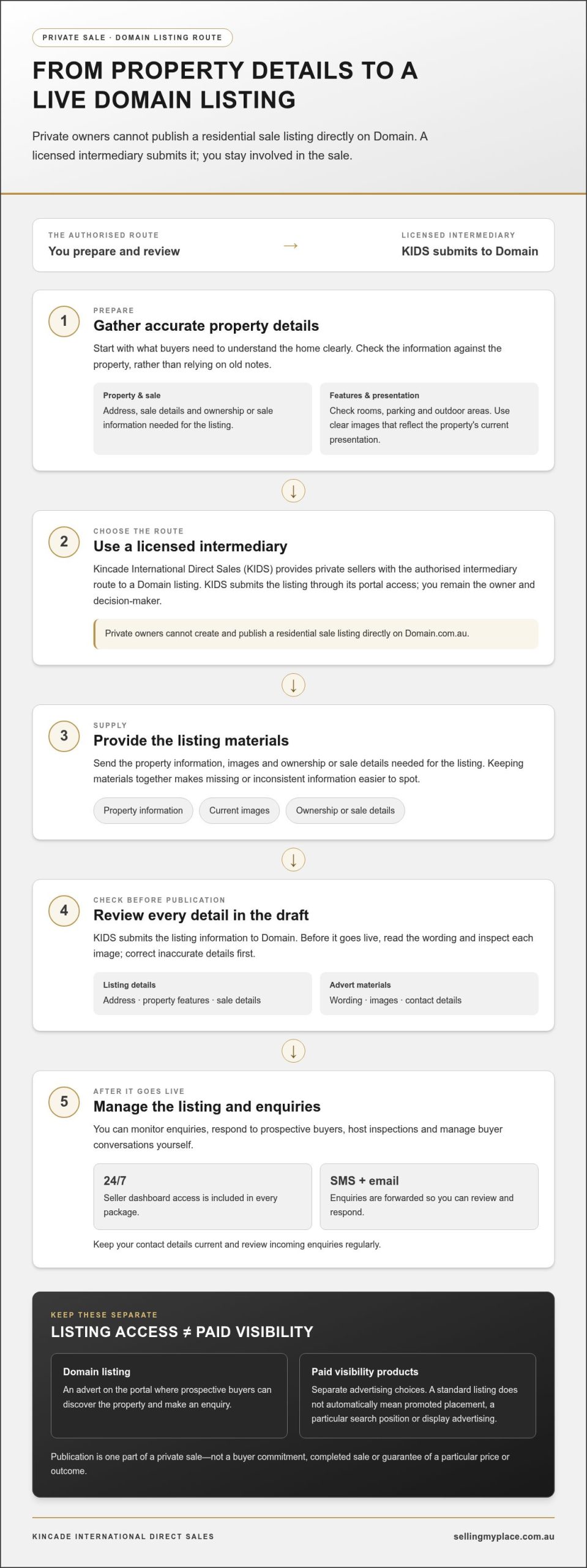
Want to sell privately but still reach buyers on Domain? The key to understanding how to get my property on domain.com.au is knowing that private owners can’t publish a residential sale listing directly. Domain requires a licensed intermediary to submit the listing, so it helps to understand the authorised route before preparing your advert.
Getting an authorised listing published and choosing how it appears in search results are separate steps. Kincade International Direct Sales (KIDS) acts as a licensed intermediary, giving private sellers a route to Domain exposure while they retain control of the sale. You manage your listing and enquiries, with enquiry forwarding and a 24/7 seller dashboard included in every package.
This guide explains the listing process, what information to organise and how portal listings differ from paid visibility products. It also covers the KIDS package options, including professional photography and, in some packages, a floorplan redraw and social media advertising. With accurate property details and a careful review of the advert, you can approach online exposure with more confidence and stay involved throughout.
Key Takeaways
- Separate the authorised listing route from any decision to pay for greater visibility.
- Prepare accurate property details, a clear description, quality images and information about inclusions before the listing is submitted.
- Organise relevant sale documents and engage a qualified conveyancer or solicitor for legal advice and documents.
- Kincade International Direct Sales (KIDS) provides private sellers with a licensed intermediary route to list on Domain.
- Compare the Classic, Signature and Prestige fixed-fee packages by their inclusions, support and presentation features.
Can a private owner get a property on Domain.com.au directly?
No. Private individuals can’t create and publish a residential sale listing directly on Domain.com.au. A licensed intermediary must submit it. The intermediary uses its authorised portal access to publish the listing, while the seller retains control of key decisions about the sale.
Owning a home and deciding to sell it doesn’t automatically provide the portal permissions needed to upload a listing. The route for how to get my property on domain.com.au as a private seller is to use a licensed intermediary, rather than trying to publish the advert through an individual account.
Why Domain listings use an authorised intermediary
Domain’s help resources describe listing tasks through an agent-facing system, including Agent Admin tools for creating and managing listings. These tools explain how a property advert can be managed once it is in the portal, but private owners can’t publish directly. Domain Group operates Domain Group’s real estate portal as part of its property platform. A seller’s authority to decide how a home is marketed is separate from the portal access needed to publish its listing.
Kincade International Direct Sales (KIDS) acts as a licensed intermediary for Domain listings. It provides the authorised portal route for a private seller’s listing without taking over decisions about the sale. You remain the owner and decision-maker, while KIDS submits the listing through its intermediary access.
What getting listed on Domain does, and does not, mean
A Domain listing is an advertisement that presents your property details to people browsing the portal. It gives prospective buyers a way to discover the property and make an enquiry. It is not an offer, a buyer commitment or a completed sale.
What happens after publication depends on the conversations between you and prospective buyers. Enquiries may lead to discussions and negotiations, but neither follows automatically from a listing. Publication also cannot guarantee a particular sale price or outcome. Portal exposure is one part of a private sale, not the whole process.
Listing access and paid visibility products are different things. A standard listing does not automatically mean promoted placement, a particular search position or display advertising. Those are separate advertising choices. Understand what the listing package includes and distinguish that from any separate visibility product. This helps you decide what you need without mistaking publication for an upgrade.
How to get your property on Domain.com.au: the private seller’s steps
For a private owner, the process is easier to manage when you separate preparing the advert from submitting it to the portal. If you’re asking how to get my property on domain.com.au, the practical steps are to organise accurate property information, use a licensed intermediary to submit the listing, review it carefully and then manage the listing and buyer enquiries.
- Prepare the property details. Gather the address, sale details and a clear description of the home. Check features such as rooms, parking and outdoor areas against the property itself, rather than relying on old notes.
- Choose the listing route. Kincade International Direct Sales (KIDS) provides a licensed intermediary route for private sellers who want a Domain listing.
- Supply the materials. Provide the property information, images and ownership or sale details needed for the listing. Keeping these together makes it easier to spot missing or inconsistent information.
- Review the draft. Check the wording, images and contact details before publication. Correct inaccurate details before the listing goes live.
- Manage the listing. Monitor enquiries and respond to prospective buyers in a way that suits your sale plans. You can also host inspections and manage buyer conversations yourself.
Prepare the property information before starting
Consider what a buyer needs to understand at a glance. A useful description presents the home’s features clearly and accurately, without overstating them. Images should show the property being marketed and reflect its current presentation. If a feature has changed, update the description or provide current images rather than leaving buyers with an outdated impression.
Gather the ownership and sale information needed for the listing process, too. Having it ready helps the intermediary prepare the submission and identify details that need your attention. This is a practical preparation step, not a replacement for sale documents or professional legal advice.
Submit, review and manage the listing
Once you’ve supplied the materials, KIDS submits the listing information to Domain through its licensed intermediary access. Before publication, read every line and inspect each image. Check the address, property features, sale details and contact information closely. Small errors can confuse buyers and create extra work later.
After publication, the 24/7 seller dashboard included in every package lets you manage your listing, while enquiries are forwarded by SMS and email. Keep your contact details current and review incoming enquiries regularly so you can respond thoughtfully and maintain an accurate picture of the property.
A private owner gets a Domain listing live by preparing accurate property information, supplying it to a licensed intermediary and reviewing the advert before publication. If you’d like support with the authorised submission route, discuss your Domain listing process with KIDS.
Domain listing versus upgrades: what private sellers should understand
Getting a property published on Domain and paying to promote it are separate decisions. The first is about having a listing on the portal. The second concerns advertising products that may affect how a listing is displayed or seen. Domain’s upgrade guidance describes products for agents and advertisers, so it is useful to understand the distinction between a listing and a promotional campaign.
That distinction matters when you’re working out how to get my property on domain.com.au. Start with the listing route and what your selected package includes. Treat promoted placement as a separate advertising choice, not a condition for appearing on the site or a promise of more buyer interest.
| Option | What it means | What to keep in mind |
|---|---|---|
| Standard listing presence | The property advert is published on Domain for users to view. | Publication alone doesn’t promise a promoted position or a particular place in search results. |
| Paid visibility products | Domain’s agent-focused guidance describes listing upgrades that can influence search-result order or presentation. Examples include Top Spot and other advertising tiers. | These are distinct from getting the property listed. A promoted position is not the same as a standard listing. |
| Display advertising | Separate advertising products can promote a property or reach potential buyers through digital channels. Domain’s materials include eBrochures and Audience Boost. | Display advertising is a campaign option, not the same thing as a standard listing, and doesn’t guarantee enquiries or a sale. |
What Domain upgrades and display products are for
Domain’s agent-focused help content describes upgrades as ways to change a listing’s position or presentation within the portal. It also outlines display products that promote property advertising through other digital placements. These descriptions help explain the difference between a listing and a campaign. They are not a promise of access, a guaranteed ranking or a requirement to upgrade.
Think about exposure without overpromising
A clear, complete listing helps buyers understand what’s being offered. Accurate details, considered wording and strong presentation give the advert a solid foundation, whether or not additional advertising is used. A promoted placement may create a visibility opportunity, but it can’t create buyer demand or determine what someone will offer.
No placement guarantees a sale or a particular sale price. Enquiries, negotiations and the final outcome depend on factors beyond where an advert appears. Focus first on getting the listing information right and understanding what your selected package includes. Any upgrade decision is separate and should be considered on its own merits.
What to prepare before your Domain property listing goes live
Preparation makes it easier to create an accurate, clear listing that is ready for buyer enquiries. If you’re working out how to get my property on domain.com.au, treat the pre-publication review as a chance to catch missing details before they reach prospective buyers. Gather your property information, images, contact preferences and relevant sale documents, then check them against one another.
Check listing details and presentation
Read the description as a buyer would. Does it explain the home clearly, and do the stated features match the property? Check every detail against what’s actually being offered, including fixtures and other inclusions. Choose clear, current photographs that accurately represent the property. The aim is an honest, helpful impression, not a presentation that leaves buyers expecting something different.
- Property details: Check the address, sale information and description for accuracy and consistency.
- Features and inclusions: Verify room details, parking, outdoor areas and anything else mentioned in the advert. Be precise about what stays with the property.
- Images: Review every photograph for clarity and make sure it shows the property being marketed as it is now.
- Contact preferences: Confirm the contact details and preferred way for enquiries to reach you. Decide who will monitor messages and respond to interested buyers.
- Supporting information: Keep relevant ownership and sale information organised, and note any questions to resolve before the advert is submitted.
Make one final pass through the draft once the wording and images are together. A room described as having a particular feature should be represented accurately, and an inclusion named in the description should match what you intend to offer. These checks help reduce avoidable misunderstandings later.
Keep legal documents with the right professional
Preparing advertising information and preparing legal sale documents are separate tasks. Requirements vary between Australian states and territories, so don’t treat a listing checklist as legal guidance or assume one process applies everywhere. Engage a qualified conveyancer or solicitor to advise on and prepare or review the contracts and other documents relevant to your sale.
Kincade International Direct Sales (KIDS) supports the listing process as a licensed intermediary, but doesn’t provide legal advice, contracts or conveyancing services. Keeping that distinction clear helps you organise the right support: KIDS can submit the listing, while your conveyancer or solicitor handles legal matters.
Before approving the advert, check that the property details, images and contact preferences are correct, and address document questions with your legal professional. Get support preparing your Domain property listing with KIDS.
Get your property on Domain through Kincade International Direct Sales
If you’re weighing up how to get your property listed on Domain as a private seller, Kincade International Direct Sales (KIDS) provides the licensed intermediary route. KIDS submits private property listings to Domain, while you retain control of your listing details and buyer enquiries. You handle the sale decisions and inspections; KIDS provides the portal access and marketing package.
KIDS offers three fixed-fee packages, each priced ex GST: Classic at $799, Signature at $999 and Prestige at $1,999. The listed features are bundled into the selected package, so compare the inclusions that matter to you, such as photography, signboard size, support and advertising. Every package includes listing on Domain, Realestate.com.au and local portals, enquiry forwarding by SMS and email, 24/7 seller dashboard access and a Market Valuation Report.
What the KIDS listing pathway provides
Classic includes professional photography, a 600 × 900 mm For Sale signboard, email expert support, a dedicated website and URL, and international network access. Signature includes everything in Classic, with a larger 1200 × 1800 mm signboard and email and phone expert support. Signature also includes a dedicated property website and URL.
Prestige includes everything in Signature, plus 15-20 professional photographs, a floorplan redraw, a Facebook and Instagram ad campaign, 50 premium A4 property brochures, a 1-on-1 dedicated specialist, a James Edition listing and a 1200 × 1800 mm photo signboard. It also includes priority access to the Kincade Global Network in the United Kingdom and the United States. These are package inclusions, not a promise of a particular search position or sale result.
KIDS acts as a licensed intermediary for listing purposes, not as a real estate agent. You retain control of your listing, enquiries and sale decisions through the 24/7 dashboard. Your listing remains active until sold, withdrawn or two years from the commencement date.
Choose a package and take the next step
Consider the presentation and support that suit your plans, then compare the package inclusions as a whole. Classic provides professional photography and email support; Signature adds phone support and a larger signboard; Prestige includes the broader marketing and specialist features listed above. All package prices are ex GST, with no commission payable to KIDS.
This route keeps you close to the process: KIDS provides licensed intermediary access, while you retain control of the listing and buyer conversations. A Domain listing can present your property to portal users, but it can’t guarantee a sale or a particular price.
If you’re ready to explore the listing route, talk with the team about getting your property on Domain. You can also select “Explore Packages” or “Get Started” on the KIDS website to review the fixed-fee options.
Take the next step towards your sale
Knowing how to get my property on domain.com.au helps make the first part of selling more manageable. Focus on what matters to you: how your home is presented, how you want to handle buyer conversations and what support you need. A clear plan gives you room to make informed decisions rather than feeling rushed.
You don’t need every detail settled before comparing package options. Review the inclusions, organise your property information and consider how you want to manage enquiries and inspections. The KIDS packages combine a fixed fee with portal listings and marketing features, while you remain in control of the sale.
Talk with the team about listing your property on Domain and take a clear, confident step towards putting your sale plans in motion.
Frequently Asked Questions
Can I list my property on Domain.com.au without an agent?
You can sell privately without appointing a traditional real estate agent, but you can’t publish a residential sale listing on Domain through an individual account. A licensed intermediary can submit it for you. Kincade International Direct Sales (KIDS) provides this route, so you can make your own sale decisions while using an authorised listing pathway. Selling privately and uploading directly to a property portal aren’t the same thing.
Is it legal to sell my property privately in Australia?
Yes. Australian property owners can sell privately in every state and territory. Selling without a traditional agent doesn’t remove your responsibilities as a vendor, and the paperwork can vary depending on where the property is located. Before marketing the home, speak with a qualified conveyancer or solicitor about the documents and steps that apply to your sale. They can advise on your circumstances.
Does getting listed on Domain guarantee that my property will sell?
No. A Domain listing advertises the property to portal users, but it can’t ensure that a buyer will enquire, make an offer or proceed to a completed sale. Listing views may not translate into an offer that suits you. Consider each enquiry on its merits, and seek appropriate professional advice for legal matters. Portal exposure is one part of selling, not a promised outcome.
Can I edit my property listing after it goes live?
Yes, sellers using KIDS can edit listing details through the 24/7 seller dashboard. If something changes, such as an inclusion or a contact preference, keeping the information current helps avoid confusion for prospective buyers. You can also use the dashboard to manage enquiries. Review edits carefully so the advert remains consistent across its description, features and images.
Do I need a Domain upgrade to have my property listed?
No. A paid visibility upgrade isn’t a prerequisite for a listing to appear on Domain. Upgrades and display advertising are separate choices from getting the property submitted and published. If you’re considering promoted placement, distinguish the advertising product from the standard listing and remember that it cannot guarantee a buyer or a particular sale price.
What documents should I have ready before listing my property?
Requirements depend on the state or territory. In NSW and the ACT, a Contract of Sale is required before listing. In Victoria, a Section 32 Vendor Statement must be provided before contracts are signed. These are examples, not a complete national checklist. Engage a qualified conveyancer or solicitor to identify and prepare the documents for your property.
Property settlement process: what happens and what to pay
Settlement is the legal and financial handover that transfers a property from seller to buyer. In Australia, it usually takes place 30 to 90 days after the contract is signed or exchanged, depending on the contract. This guide explains the property settlement process, including what happens when ownership changes hands.
It’s natural to think of settlement as the finish line. It’s also when the final funds, property-related adjustments and ownership documents come together. Knowing what each part means can make this major transition easier to manage.
Here, you’ll learn how to prepare, what to check before settlement, which costs may be adjusted between buyer and seller, and how agreed contract changes can affect the process. You’ll also find out what happens on settlement day and what follows once the property is yours.
Key Takeaways
- Settlement transfers legal ownership and finalises the financial side of a property sale; the date is set out in the contract.
- In Australia, settlement usually takes place 30 to 90 days after the contract is signed or exchanged, depending on the contract.
- Arrange the final inspection before settlement day so there’s time to raise concerns about the property’s condition or agreed repairs.
- Review the adjustment statement carefully: it divides property-related charges between seller and buyer, with responsibility changing at settlement.
- Prepare for the handover by organising insurance, moving arrangements and any required contract changes with the other party’s agreement.
Pre-settlement inspections
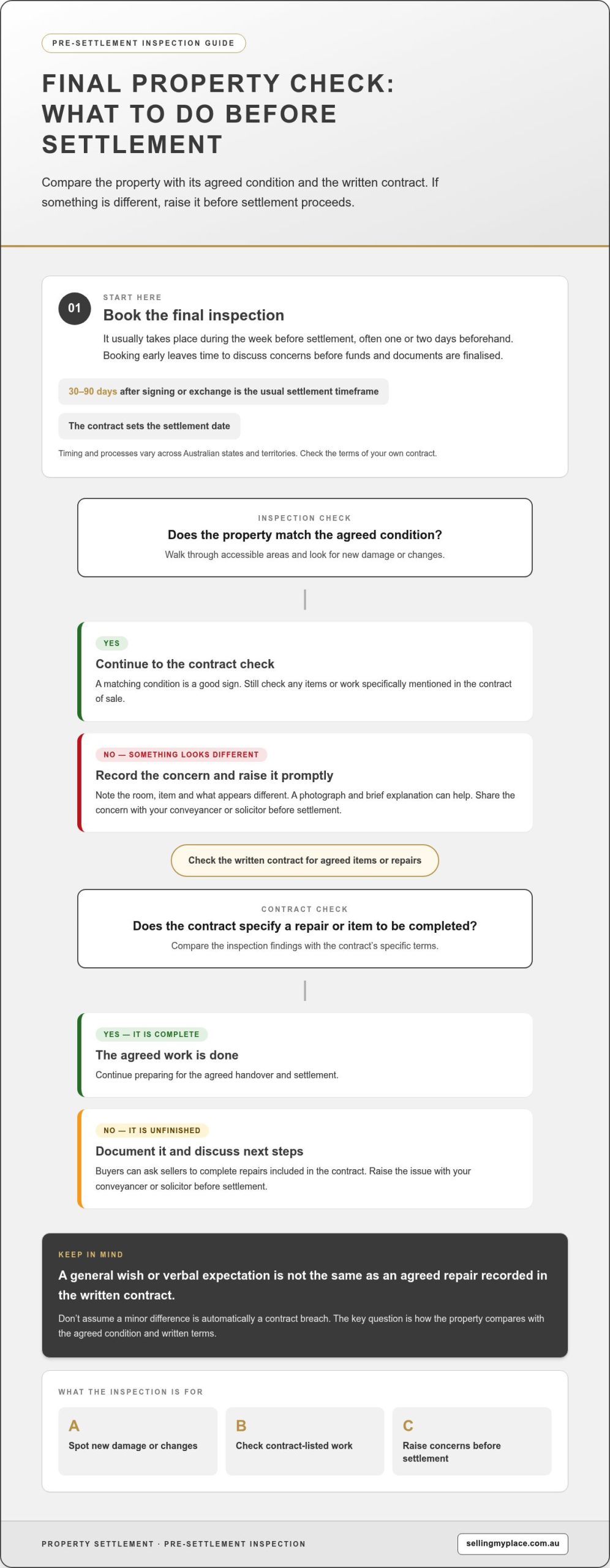
A pre-settlement inspection gives the buyer a final chance to compare the property’s condition with what was agreed at purchase. It’s a practical check before the contract of sale is finalised, not a replacement for earlier inspections or enquiries. For example, the buyer can look for new damage and check whether repairs promised in the contract are complete.
Settlement rules and timelines vary across Australian states and territories, and the contract sets the settlement date. Regional processes also affect how ownership transfers, so buyers should check the terms of their own contract rather than assume another territory’s timing applies.
In Australia, settlement usually takes place 30 to 90 days after the contract is signed or exchanged, depending on the contract terms. Across the country, the process typically takes 1 to 3 months to complete fully.
The final inspection usually takes place during the week before settlement, often one or two days beforehand. Booking it ahead of settlement day leaves time to raise concerns with a conveyancer or solicitor and discuss next steps before funds and documents are finalised.
Use the inspection to compare the property with the agreed condition and the contract’s specific terms. A focused check can cover:
- Walk through each accessible area and look for damage that wasn’t present when you agreed to buy.
- Check items or work specifically mentioned in the contract of sale, such as a repair the seller agreed to complete.
- Record any concern clearly, noting the room, item and what appears different.
- Raise issues promptly with your conveyancer or solicitor, before settlement proceeds.
During the process, buyers can ask sellers to complete unfinished repairs included in the contract. For instance, if the contract specifies a repair to a particular area, the buyer can check during the final inspection whether it’s been completed. The written contract matters: a general wish or verbal expectation isn’t the same as an agreed repair recorded in it.
If the inspection reveals a concern, describe it precisely and share it with your conveyancer or solicitor before settlement. A photograph, location and brief explanation can make the issue easier to understand. Don’t assume a minor difference is automatically a contract breach. The key question is how the property compares with the agreed condition and written terms.
For buyers, the inspection is the final practical opportunity to identify a change before ownership transfers. Sellers can help make the handover clear by completing contractually agreed repairs before the appointment. Arrange the inspection early enough for both sides to discuss any concerns before settlement day.
What steps should be taken to prepare for a property settlement?
Preparing for settlement means coordinating the contract, funds, insurance and handover in advance. Buyers and sellers each have tasks that help the agreed transfer proceed smoothly.
Preparing documents and funds
Settlement documents record the agreed transaction details and support the transfer of funds and ownership. The buyer’s conveyancer or solicitor handles legal requirements and enquiries after the contract is signed. Settlement agents coordinate with the buyer and lender to arrange payment to the seller.
Keep the contract of sale and settlement correspondence organised, and respond promptly to requests from your conveyancer. Buyers should understand how the deposit already paid relates to the purchase price and the remaining balance. Clear records help distinguish amounts paid from the funds still needed to complete settlement.
Preparing funds and insurance
Preparing funds means arranging access to the amount needed to complete the purchase, including the balance due at settlement. In Australia, the deposit is normally paid upfront to secure the property. Account separately for the remaining amount and other settlement costs.
Buyers should arrange building and contents insurance from the purchase date. The property and its contents need cover during the transaction, not just after moving in. Keep lender communications and payment instructions together so funds can be arranged with the lender and conveyancer ahead of settlement.
Getting ready for settlement day
Settlement day brings together the practical handover and the transfer of funds and documents. Buyers generally don’t need to attend in person because their conveyancer or solicitor handles settlement. The settlement agent works with the buyer and lender to transfer funds to the seller, while the relevant government agency registers the ownership transfer.
Sellers living in the property need to move out in time to hand over the keys after settlement. They should notify their gas and electricity providers when ownership changes. Conveyancers write to councils and water authorities to help update property accounts as part of the changeover.
Before settlement day, align your moving plans with the settlement date in the contract. For example, a buyer can arrange access and key collection with the agent once settlement is complete and registration has taken place. Sellers can schedule removal and utility notifications around the agreed handover, rather than assume keys can be exchanged earlier.
- Buyers: organise building and contents insurance from the purchase date, and keep lender and conveyancer communications accessible.
- Sellers: plan to vacate in time for key handover, then notify gas and electricity providers of the ownership change.
- Both parties: keep settlement documents together and promptly address requests affecting the agreed purchase price or transfer.
For owners preparing a sale, settlement and sale preparation guidance can help clarify the steps leading to handover.
Settlement adjustments and outgoing payments
Settlement brings together the remaining purchase price, lender funds and adjustments for property-related charges. Reviewing how each amount is calculated helps buyers understand what will be transferred to the seller.
Adjusting settlement amounts
Settlement adjustments divide property-related charges between the seller and buyer. The seller is responsible up to settlement day, and the buyer is responsible from then on. These adjustments affect the amount each party pays or receives at settlement.
Depending on the transaction, adjustments can include council rates, water charges and body corporate fees. Stamp duty, stamp duty concessions and the First Home Owner Grant may also feature in settlement calculations. The adjustment statement shows how relevant amounts are allocated across the ownership period.
Before authorising your conveyancer or solicitor to proceed with final settlement, review the pre-settlement adjustment statement. Check the listed charges, the dates used to divide them and the resulting amount payable. After settlement, responsibility for ongoing costs, rates and charges transfers to the buyer.
Lender funds and seller payment
Lender funds and the buyer’s available funds are combined to pay the seller at settlement. The full amount due must be accounted for before ownership can transfer.
On settlement day, the buyer’s conveyancer or solicitor and lender coordinate the transfer of funds to the seller. The buyer pays the balance of the purchase price after accounting for the deposit and any settlement adjustments. The lender draws down the buyer’s loan, and the settlement payment is debited from the loan account.
Once settlement is complete, the buyer should receive settlement details, including a statement of adjustment showing how funds were distributed. Keep this record with the contract and other purchase documents. It provides a clear account of final payments and the charges allocated to each party.
Settlement costs and fees
Australian property settlement costs can include stamp duty, council rates, water charges and body corporate fees, alongside adjustments and other transaction payments. The charges depend on the property, location, contract and applicable concessions. The settlement statement records the amounts due.
In Victoria, land transfer duty is usually paid at settlement, but buyers have up to three months after settlement to pay. Stamp duty and other adjustments should not be treated as interchangeable: duty relates to the transfer, while adjustments divide property charges between seller and buyer.
To understand the total outgoing amount, compare the purchase price balance with each listed adjustment and payment. Ask your conveyancer or solicitor to explain any entry you can’t reconcile before authorising the final transfer. This clarifies the funds required and the amount going to the seller.
Meaning of property settlement
Property settlement is the legal and financial step that transfers ownership from seller to buyer. It completes the transaction after the parties have agreed on a purchase, paid the deposit, signed and exchanged the contract, and completed any cooling-off period. The contract sets the settlement date, tying this milestone to the agreement rather than simply to moving day. A property settlement process explained through these milestones separates signing from the actual transfer of ownership.
The settlement period starts when the contract of sale is signed and ends on the scheduled settlement day. During this time, the buyer’s solicitor or conveyancer handles legal requirements and makes enquiries about the property. The buyer and seller remain bound by the contract, but ownership has not yet changed hands. Signing creates agreed obligations; settlement completes the transfer.
On settlement day, the remaining purchase funds are transferred, documents are exchanged and ownership is registered through the relevant government agency in the buyer’s state or territory. The seller receives the funds due, and the buyer becomes the new owner once registration is complete. In Victoria, for example, the transfer of land document transfers ownership from seller to buyer.
Settlement also addresses interests affecting the title. Transfer documents can provide for third-party rights, including caveats and previous mortgages, to be removed or released so clear title can pass to the buyer. A mortgage doesn’t disappear simply because the purchase price has been paid. The required documents and funds must deal with the existing interest as part of the transaction.
Registered ownership details also matter when more than one person buys a property. In Victoria, joint owners hold the property jointly, and if one owner dies, ownership automatically passes to the surviving owner or owners. Tenants in common, by contrast, can hold equal or unequal shares and dispose of their interest as they see fit. These ownership forms shape what the title records.
Settlement is more than a payment or key handover. It brings together the agreed price, transfer documents, title interests and registration. In Victoria, the buyer pays the balance, receives the property title and becomes the registered owner at settlement, taking possession unless otherwise arranged. The practical handover follows the legal change, though its timing depends on the parties’ arrangements.
For buyers, the clearest way to understand the process is to separate three events: contract, settlement and registration. The contract records what the parties agreed; settlement completes the financial and document exchange; registration records the buyer as owner. With the property settlement process explained through these distinct stages, it’s clear why paying a deposit or signing the contract doesn’t itself transfer ownership.
That distinction is central to property settlement: the seller’s obligations are completed, the buyer’s payment is finalised, and the ownership record changes. The state or territory’s registration process and the contract terms determine how the transfer is recorded and what follows for possession.
What are the steps in the Australian property settlement process?
The process moves from a signed contract to payment, registration and handover. The contract sets the settlement date, while the buyer’s conveyancer or solicitor coordinates legal enquiries and documents. With the property settlement process explained in stages, it’s easier to see how each task leads to the transfer.
In Australia, settlement usually occurs 30 to 90 days after the contract is signed or exchanged, depending on its terms. In New South Wales, most settlements take place 42 days after contracts are exchanged. The agreed date gives both parties and their representatives a timetable for completing the remaining tasks.
- The contract is signed or exchanged. The settlement period begins, and the buyer’s conveyancer or solicitor handles legal requirements and enquiries about the property. Outstanding contract conditions need attention because they can affect whether the transaction is ready to proceed.
- Documents and funding are prepared. The conveyancer arranges transfer documents, including provisions for removing or releasing third-party rights such as caveats and previous mortgages. The buyer, lender and conveyancer coordinate the funds required to pay the seller. Loan approval delays or missing paperwork can hold things up.
- Final amounts are brought together. The conveyancer arranges stamp duty to be paid at the same time as settlement. Adjustments account for relevant property charges, such as council rates, water charges and body corporate fees. The buyer’s funds and lender’s contribution are coordinated for the final transfer.
- Settlement takes place. The buyer’s and seller’s representatives, along with their lenders, complete the financial and document exchange. In Australia, the process normally takes about an hour. Buyers generally don’t need to attend in person because their conveyancer or solicitor handles the transaction.
- Ownership is registered and possession follows. The transfer is registered through the relevant government agency in the buyer’s state or territory. Once settlement is complete and the buyer is registered with the Land Titles Office, they can collect the keys from the agent. In Victoria, the buyer becomes the registered owner and takes possession unless otherwise arranged.
Some purchases involve linked transactions. In a simultaneous settlement, the buyer sells one property and buys another on the same day, using the sale proceeds to fund the purchase. Because the transactions depend on each other, a delay in the sale can affect the purchase, so representatives coordinate both settlements.
Outstanding contract conditions, loan approval delays, missing paperwork or title issues can delay settlement. If a delay arises, the parties’ conveyancers manage the necessary communication and next steps. After settlement, the buyer should receive details, including a statement of adjustment confirming how funds were distributed.
Understanding the property settlement process explained as a sequence helps clarify what to expect: contract requirements come first, then funding and documents, followed by settlement and registration. If you’re preparing to sell, discuss your property sale plans and the steps that lead to settlement.
Kincade International Direct Sales: Residential Property Listing Services
Kincade International Direct Sales offers Residential Property Listing Services for Australian owners preparing to bring a home to market. Its commission-free marketing service includes professional photography, floorplans and neighbourhood market reports, with listings remaining active until sold and no time limits.
Turn to the service when you’re planning a sale and want to organise how your property is presented to buyers. Pre-Sale Property Consulting can help you consider the preparation and marketing approach, while Buyer Representation supports people looking for help on the purchasing side. Neighbourhood Market Reports can also provide local context as you consider your next move.
For a measured next step, contact Kincade International Direct Sales or visit sellingmyplace.com.au.
Take your next property move with confidence
With the property settlement process explained, you can look beyond the handover and start planning what comes next. A sale or purchase is also a chance to make considered decisions about timing, presentation and the support that suits your plans.
If you’re preparing to sell, Kincade International Direct Sales’ Residential Property Listing Services and Pre-Sale Property Consulting can support your planning. If you’re buying, Buyer Representation offers support on the purchasing side. The right next step is the one that helps you move forward with clarity and keep your priorities in view.
Contact Kincade International Direct Sales to discuss your property plans and where to begin.
Take it one decision at a time. A considered move can help you make a confident start on what comes next.
Frequently Asked Questions
What is settlement?
Settlement is the point in a property sale when the financial and legal handover is completed. The seller receives the amount due, and the buyer’s ownership transfer is registered through the relevant state or territory agency. Signing a contract alone, for example, doesn’t make the buyer the registered owner. Settlement completes the transaction, while registration records the new ownership and possession follows the parties’ arrangements.
Can I move in straight away after settlement?
You can usually take possession after settlement if the contract doesn’t make different arrangements. In Victoria, the buyer takes possession at settlement unless otherwise agreed. Before organising removalists, confirm when keys can be collected and whether the seller has vacated. For instance, settlement may be complete while the practical key handover is still being arranged through the agent. Plan your move-in to match the possession terms in your contract.
When do I pay my deposit and stamp duty?
The deposit is normally paid upfront to secure the property, following the payment arrangements for your purchase. Stamp duty is commonly arranged by the conveyancer for payment at settlement. In Victoria, land transfer duty is usually paid then, although buyers have up to three months after settlement to pay. Keep the deposit receipt and settlement figures together to distinguish the initial payment from later amounts due.
What is property settlement in Australia?
In Australia, property settlement is the legal and financial completion of a property transaction between buyer and seller. It follows the signed and exchanged contract, deposit payment and completion of any cooling-off period. The contract sets the agreed settlement date. For example, the buyer may have paid a deposit but still needs settlement and registration before becoming the registered owner.
What happens on settlement day when buying property in Australia?
On settlement day, the buyer’s and seller’s representatives coordinate funds and documents to complete the transaction. The buyer’s lender contributes the loan funds, and the seller receives the amount due. The ownership transfer is then registered through the relevant government agency in the buyer’s state or territory. Buyers generally don’t attend in person; their conveyancer or solicitor handles the arrangements and communicates when settlement is complete.
What are the buyer’s and seller’s responsibilities before settlement?
Before settlement, the buyer needs to organise the required funds, arrange building and contents insurance from the purchase date, and complete a final inspection. The seller must meet the contract terms and, if living in the property, move out in time for key handover after settlement. Sellers should also notify gas and electricity providers when ownership changes. Both parties should address outstanding contract requirements promptly.
What is a settlement agent or conveyancer, and what do they do?
A conveyancer manages property transfer matters, including legal requirements and enquiries after the buyer signs the contract. A settlement agent works with the buyer and lender to arrange the transfer of funds to the seller on settlement day. Together, their roles help coordinate documents, payments and registration. For example, a buyer’s conveyancer can explain an entry in the adjustment statement, while the lender arranges its contribution to settlement funds.
What happens if settlement is delayed or fails in Australia?
Outstanding contract conditions, loan approval delays, missing paperwork or title issues can delay settlement. In New South Wales, interest may be charged if the buyer can’t pay all settlement costs by the settlement date. The parties can change settlement terms if they both agree.
What a Conveyancer Does for a Seller and What It Costs
A property sale isn’t finished when an offer is accepted. The seller’s conveyancer manages the legal work needed to transfer ownership, from preparing the contract to coordinating settlement and finalising the handover. Understanding what a conveyancer does for a seller also means knowing how their work fits across the pre-contract, pre-completion and post-completion stages.
Selling a home involves plenty to organise, and the legal details matter as much as the practical ones. A conveyancer helps manage contracts and disclosure requirements, handle buyer enquiries, coordinate with the seller’s lender and arrange settlement. Their fees and other transaction costs are also worth understanding early.
A conveyancer’s role has limits. Building inspections, for instance, are handled separately, and conveyancing requirements vary across Australian states and territories. Internationally, closing procedures also differ by region; for instance, US sellers often turn to dedicated agencies like County Properties for personalised transaction guidance. Understanding the process and its costs can help you approach a sale with more confidence and fewer surprises.
Key Takeaways
- A seller’s conveyancer manages the legal transfer, from preparing sale documents to completing post-settlement notifications.
- Disclosure and contract requirements vary between states, so getting the paperwork right can help prevent delays and disputes.
- Settlement involves coordinating with the buyer’s conveyancer and, where relevant, the seller’s lender to finalise funds and transfer ownership.
- Conveyancing fees and disbursements depend on the work involved; an itemised cost breakdown helps clarify what you’ll pay.
- Separate legal support from sale preparation with property marketing and pre-sale advice tailored to your selling plans.
Conveyancer and solicitor roles in property sales
A seller’s conveyancer manages the legal work that transfers a property to its buyer. In Australia, conveyancing generally has three stages: pre-contract, pre-completion and post-completion.
Conveyancer and solicitor responsibilities
A conveyancer specialises in property transactions, while a solicitor can handle conveyancing and broader legal matters. In NSW, licensed conveyancers and solicitors are both qualified to do conveyancing work. A solicitor’s broader legal knowledge may help if a sale raises issues beyond the transfer itself. For a seller, understanding what a conveyancer does means knowing who prepares the sale documents, checks details and coordinates the legal steps with the other parties.
Property information and supporting certificates
Property information and certificates help describe the land and identify matters that could affect a sale. In NSW, a Section 10.7 certificate is among the documents listed for selling a property under the Conveyancing Act 1919. A seller’s conveyancer can review title details and arrange searches with government departments and local authorities. For example, information in a certificate or search may need to be considered when preparing the Contract of Sale, so the buyer receives relevant details before proceeding.
Sale documents and seller-provided information
Sale documents set out the property, agreed terms and information required for the transaction. In NSW, the Contract of Sale is a central document, and the Conveyancing Act 1919 specifies documents required to sell a property, including a Section 10.7 certificate. The conveyancer prepares or reviews the contract and checks that property details align with available records. The seller can help by providing relevant ownership and mortgage information, along with documents about the property that support accurate contract preparation.
Ownership transfer and appointment timing
Legal ownership transfers through the conveyancing process at settlement, when the title documents are dealt with. The seller’s conveyancer handles the legal work needed to transfer the property to the purchaser, then completes relevant post-settlement notifications. Appointing a conveyancer before marketing or contract preparation gives them time to review property information and prepare documents. This can help identify missing details before a buyer is ready to sign, rather than during a time-sensitive exchange.
The three stages provide a useful map of the work. Before the contract, the conveyancer prepares documents and checks property details. Before completion, they coordinate outstanding legal and financial requirements with the buyer’s representative. After completion, they attend to relevant notifications. In NSW, this work can include checking the contract, arranging searches, calculating settlement adjustments and attending settlement. The exact tasks depend on the property and sale, but each stage supports the same outcome: transferring ownership with the legal paperwork in order.
Risks of incomplete contracts and missed disclosure obligations
An incomplete contract or missed disclosure can complicate a sale and lead to disputes between buyers and sellers. Documents and disclosure rules vary across Australia, so the conveyancing process must reflect the property’s state or territory.
Preparing the contract and vendor’s statement
The seller’s conveyancer prepares or reviews the contract and the disclosure documents required for the property’s location. In Victoria, the Section 32 Vendor Statement gives prospective buyers key property information. In Queensland, the seller disclosure statement is Form 2, with prescribed certificates.
These documents help buyers understand the property before signing. Since 1 August 2025, Queensland sellers must give buyers Form 2 and prescribed certificates before the contract is signed. A conveyancer helps organise the required material and prepare the contract so the sale terms and disclosure documents are consistent.
Contract review and seller disclosures
Contract review means checking the proposed terms and disclosure material for accuracy, completeness and potential issues. In Victoria, the seller must provide prospective buyers with a Section 32 legal document containing key property information. Queensland’s Property Law Act 2023 introduced mandatory seller disclosure and stricter compliance obligations.
NSW property disclosure is contract-based, unlike the named disclosure documents used in Victoria and Queensland. A conveyancer reviews the contract and relevant information, then advises the seller about their obligations and any points needing attention. This review matters because buyers rely on the documents to understand what they are agreeing to purchase.
Contract terms, conditions and deadlines
Contract advice explains what each term requires and how a proposed condition could affect the sale. A conveyancer can advise on special conditions, the buyer’s cooling-off rights and the seller’s right to withdraw. A lawyer may also help if questions extend beyond conveyancing or involve broader legal issues.
Once the parties agree on terms, dates and conditions need to be tracked throughout the sale. For example, a requested extension changes the timing the parties are working towards, while a condition may require a particular action before proceeding. The conveyancer manages these communications and explains the legal implications before the seller responds.
Buyer enquiries, inspections and contract changes
The seller’s conveyancer handles legal communication with the buyer, including questions about title and requests to extend dates. If the buyer proposes a contract change, the conveyancer explains its effect and helps the seller consider a response before the revised terms are documented.
Building inspections are separate: conveyancers don’t arrange or carry out structural, pest or drug residue testing. A buyer may seek a building and pest condition in the contract, and a conveyancer can help ensure suitable wording is included. For support with the broader sale plan, explore property sale advice.
Arranging settlement and coordinating with the seller’s financial institution
Settlement is when the sale funds and ownership transfer are completed. The seller’s conveyancer coordinates the financial and title steps with the buyer’s conveyancer and, if the property has a mortgage, with the lender.
Settlement adjustments for rates and levies
Settlement adjustments divide property charges between the seller and buyer according to their agreed responsibilities at settlement. Using the relevant account details and settlement date, the conveyancer calculates adjustments for council rates, water usage and body corporate levies.
For example, if council rates cover a period beyond settlement, the settlement statement accounts for the buyer’s share after ownership changes. Water charges and body corporate levies may also need adjustments. These calculations account for ongoing property expenses alongside the purchase funds, rather than leaving an amount unresolved after the transfer.
The conveyancer prepares a settlement statement showing the payments needed to complete the sale and tells the buyer’s conveyancer which amounts are due at settlement. Reviewing the statement against the contract of sale and available rates or levy information can help identify an incorrect charge before funds are transferred.
Financial institution coordination
If the property is mortgaged, the seller’s conveyancer liaises with the existing mortgagee to arrange discharge of the mortgage. They can request a loan payout figure from the lender, establishing the amount needed to repay the debt from the sale proceeds.
This coordination connects the lender’s payout process with settlement and the title transfer. The conveyancer checks the payout information and includes the relevant payment in the settlement arrangements. This addresses the lender’s interest in the property as part of completing the sale, rather than leaving it as a separate task after ownership has transferred.
The conveyancer also checks the buyer’s deposit and coordinates with the buyer’s representative about payments needed for settlement. The contract of sale sets the agreed terms, while the settlement statement brings together the financial amounts due. If the seller has a mortgage, the payout figure is an important part of working out how the sale funds will be allocated.
Electronic settlement and title registration
Electronic settlement uses an electronic conveyancing workspace to coordinate funds and title documents between the parties. The seller’s conveyancer can facilitate settlement in the workspace and advise the seller when completion occurs.
At settlement, funds are exchanged and the legal title transfer proceeds. In Victoria, the change of ownership is registered with Land Use Victoria. The conveyancer prepares or coordinates the title transfer documents and checks that the settlement arrangements reflect the agreed transaction.
After completion, the seller’s conveyancer can notify relevant authorities of the change of ownership and pay outstanding rates and taxes. These final checks close out the seller’s responsibilities connected with the property. The buyer receives legal ownership, while the seller can see how the sale proceeds were applied, including any mortgage payout and settlement adjustments.
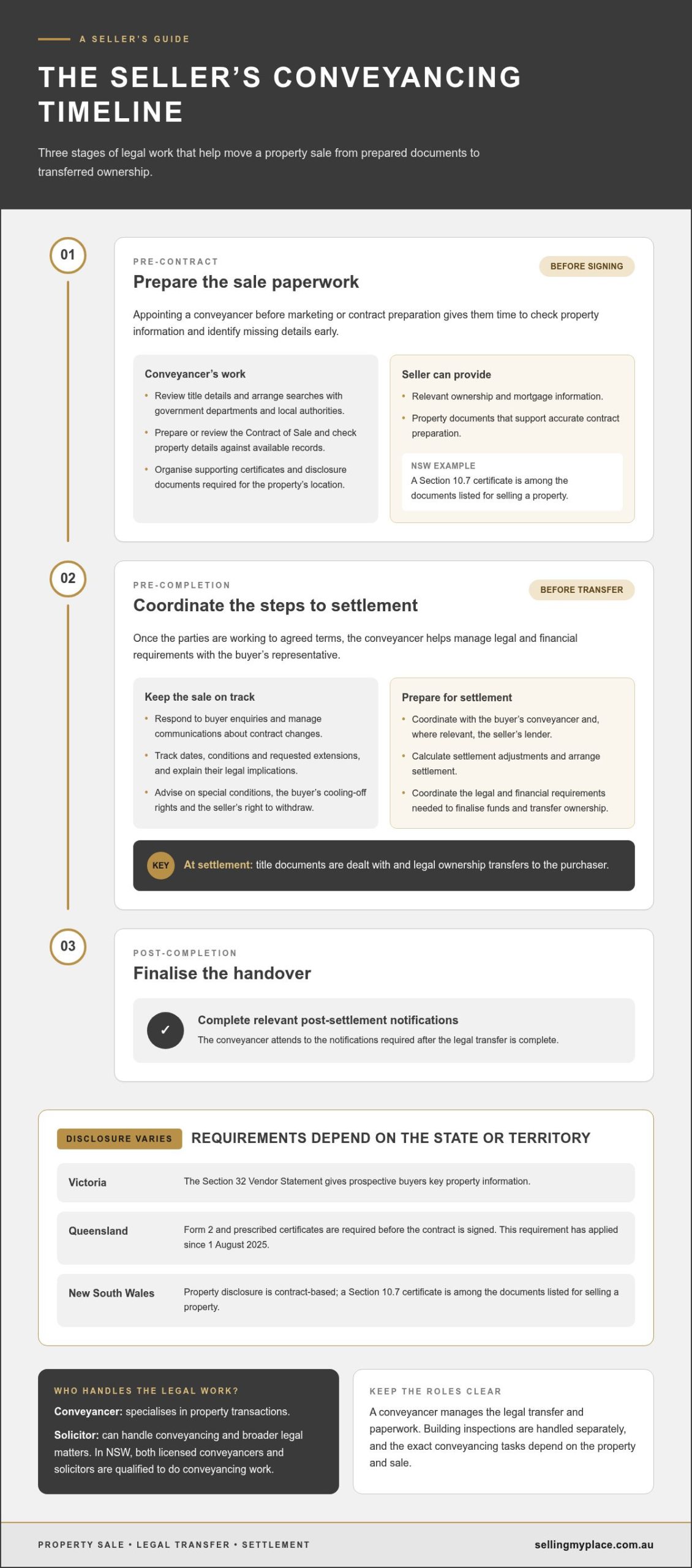
How does a conveyancer handle buyer enquiries, inspections and contract changes?
The seller’s conveyancer manages legal communication with the buyer and their representative during the sale. They respond to questions about title, consider requests to change dates and explain how proposed contract changes affect the seller’s position.
Buyer enquiries may concern the title, contract wording or details that need clarification before the transaction proceeds. The conveyancer checks each question against the sale documents, then communicates the response to the buyer’s conveyancer. For example, if the buyer asks about a title detail, the seller’s conveyancer can review the relevant information and explain what it means for the transaction. This keeps legal questions in the right channel and gives the seller a clearer basis for deciding how to respond.
Date changes need careful attention because a requested extension can affect the timing agreed by the parties. The conveyancer assesses the request, explains its effect and relays the seller’s response. If the seller agrees, the conveyancer helps document the variation so both parties have a clear record of the updated arrangement. A casual conversation should not be treated as a settled contract change; the conveyancer can clarify what has been agreed and what needs formal documentation.
Inspections are separate from legal enquiries. Conveyancers don’t organise or carry out building inspections, including structural, pest or drug residue testing. Those inspections concern the property’s physical condition, while conveyancing concerns the legal transaction. A buyer may ask for a building and pest inspection condition in the contract. The conveyancer can help ensure the contract wording is suitable, so the parties understand how the condition relates to the sale.
Contract changes may follow a buyer’s request, a question about a condition or a change to a proposed date. The conveyancer explains the legal effect before the seller responds. For instance, a buyer might seek more time to meet a condition or ask to change the wording. The seller can then consider the request with a clear view of its impact, rather than relying on an informal summary or assuming the change has no practical consequence.
Throughout these exchanges, the conveyancer acts for the seller, not as a neutral negotiator for both parties. Their role is to communicate the seller’s position, explain the contract’s implications and help document agreed changes. This distinction matters when a buyer’s request could alter a condition, deadline or obligation. The seller makes the commercial decision; the conveyancer provides legal guidance and helps ensure the response is accurately reflected in the transaction documents.
Keep relevant messages and documents together for the conveyancer, including buyer requests, inspection-related conditions and proposed date changes. A clear record helps them compare each request with the current contract and respond consistently. If a buyer raises several points at once, the conveyancer can separate legal questions from inspection arrangements and contract negotiations, then address each through the appropriate channel.
When should a seller appoint a conveyancer, and what should they provide?
Appointing a conveyancer before preparing the sale contract gives them time to organise the legal work and review property information. Sellers in Australia aren’t legally required to use one, but professional conveyancing is recommended because the transfer involves detailed documents and deadlines.
Early involvement is especially useful when the property needs searches, disclosure documents or mortgage discharge arrangements. In NSW, a conveyancer must be licensed with NSW Fair Trading, or the work must be done by a practising legal practitioner. In Queensland, paid conveyancing work must be carried out by a solicitor with a current practising certificate, or by supervised support staff in a law firm.
When you engage a conveyancer, provide details that help establish who owns the property and what may affect its sale. Useful records include:
- Ownership and title information, including the names of all registered owners.
- Mortgage details and the lender’s contact information, if the property has a loan.
- Available council rates, water charges and body corporate levy notices.
- Existing property documents and information relevant to buyer disclosure.
- Your contact details and identification for identity and authority checks.
For example, if two people appear on the title, the conveyancer needs to account for both when preparing sale documents. Mortgage details help them coordinate with the lender, while current rates or levy notices support settlement calculations.
Share information promptly, even if you’re unsure whether a document matters. The conveyancer can assess how it relates to the contract, searches or disclosure requirements in your state. In NSW, property disclosure is contract-based; in Victoria, the seller provides a Section 32 Vendor Statement. Queensland sellers provide Form 2 and prescribed certificates before the buyer signs.
Ask for an itemised estimate before work begins. In NSW, conveyancers and solicitors generally disclose certain conveyancing costs before or when retained. Request an itemised statement of likely costs before work starts. Disbursements may include title searches and authority certificate fees, so ask which professional fees and property-related charges are included in the estimate.
Understanding what a conveyancer does for a seller helps you appoint them at a useful point: before contract preparation, not after a buyer is waiting. For help planning your sale and organising the next steps, discuss your property sale plans.
Kincade International Direct Sales: Residential Property Listing Services
Kincade International Direct Sales helps Australian homeowners prepare and market a residential property through its Residential Property Listing Services. While your conveyancer manages the legal transfer, Kincade supports the separate task of presenting your home to buyers.
Its flat-fee marketing model includes professional photography, floorplans and neighbourhood market reports, with listings remaining active until sold and no time limits. Pre-Sale Property Consulting can help you plan the sale before launch, while Buyer Representation supports people looking to purchase. These services complement conveyancing; they don’t replace the legal work of preparing contracts or transferring ownership.
If you’re planning a sale, explore Kincade International Direct Sales’ fixed-fee packages at sellingmyplace.com.au.
Take the next step towards your property plans
Knowing what a conveyancer does for a seller helps you distinguish the legal transfer from the decisions that shape your sale. Next, clarify the outcome you want, the support you need and how you’ll present the property to potential buyers. Keeping those choices aligned can make the move from planning to market more considered.
Kincade International Direct Sales offers Residential Property Listing Services and Pre-Sale Property Consulting for owners preparing to sell. If your plans also include buying another home, its Buyer Representation can support that part of your next move. The right focus depends on where you are in the process, whether you’re weighing up your sale approach or getting the property ready for market.
For a considered conversation about your plans, contact Kincade International Direct Sales. Take the next step at your own pace, with a clearer path ahead.
Frequently Asked Questions
What is conveyancing and how does it work?
Conveyancing is the legal process of transferring land ownership from one party to another. A sale involves coordinating legal documents and transaction details between the parties. The work spans preparing the sale, managing contract and settlement arrangements, and finalising the transfer. For example, details agreed in the contract inform the checks and payments needed to complete the transaction.
How long is the conveyancing process?
Most conveyancing processes in NSW take 42 days, or around six weeks. The timeline depends on the contract’s settlement date and how quickly required documents, searches and lender arrangements are completed. A title issue or late information can affect the sequence of work, so the agreed dates in the contract provide the practical reference point. Conveyancing timeframes differ across Australia and between individual sales.
What is a conveyancer and why are they essential in 2026?
A conveyancer is a licensed professional who specialises in property transaction advice and information; they may or may not be a solicitor. Using one is not legally required in Australia, but professional help is recommended because contracts, disclosure material and settlement require careful coordination. In 2026, sellers also need to account for state-specific disclosure rules, such as Queensland’s Form 2 process, when preparing a sale.
What does a conveyancer do for a seller in Australia?
A seller’s conveyancer handles the legal work needed to transfer the property and supports the seller through the transaction. Understanding what a conveyancer does for a seller means looking beyond paperwork: they also communicate with the buyer’s representative, explain the legal implications of requests and coordinate relevant checks. For instance, if a buyer asks to change a contract date, the conveyancer explains the effect before the seller decides.
What documents does a seller’s conveyancer prepare and review?
A seller’s conveyancer prepares or reviews the Contract of Sale and checks property records and disclosure material relevant to the state. The particular documents differ: NSW sales include a Section 10.7 certificate among required documents, while Victoria uses a Section 32 Vendor Statement. In Queensland, Form 2 and prescribed certificates form part of seller disclosure. Sellers can help by sharing ownership, mortgage and property records early.
How does a conveyancer prepare the contract of sale for an Australian property?
A conveyancer prepares the contract using information about the property, its ownership and the proposed sale terms. They review title details and relevant searches, then consider whether the contract accurately describes the property and records the parties’ agreement. For example, the seller’s proposed settlement date or a buyer-requested condition needs clear wording. State requirements also shape the supporting material, so a NSW contract differs from disclosure documents used in Victoria or Queensland.
What are the steps in the conveyancing process for a property seller in Australia?
The process generally moves through pre-contract, pre-completion and post-completion stages. First, the seller’s representative gathers property information and prepares sale documents. After the buyer and seller enter the contract, the parties deal with enquiries, required checks and settlement arrangements. At settlement, funds and the title transfer are coordinated. Afterwards, the seller’s representative can manage relevant ownership notifications. State rules and the agreed contract shape the details at each stage.
What does a seller’s conveyancer do at settlement, including calculating adjustments and paying out the mortgage?
At settlement, the conveyancer coordinates the seller’s financial and title requirements with the buyer’s representative. They calculate adjustments for council rates, water usage and body corporate levies, then include those amounts in the settlement statement. If there is a mortgage, they obtain the lender’s payout figure and arrange for the loan to be paid from the sale proceeds. The remaining funds are distributed according to the settlement arrangements.
How to Write a Property Description That Sells: A Practical Australian Guide
What makes a buyer pause on one listing and scroll past another? Learning how to write a property description that sells isn’t about piling on superlatives. It’s about helping the right buyer picture daily life in the home and giving them a clear, honest sense of what they’ll find at an inspection.
It can be tricky to choose a distinctive angle, decide which details deserve space and keep the language appealing without overpromising. The strongest descriptions make a home’s real advantages easy to understand, whether that’s a practical layout, useful storage or a sunlit living area.
This guide shows you how to turn verified details into a concise, buyer-focused listing that’s easy to scan online. You’ll learn what to prioritise, how to replace tired clichés and why accuracy matters across both words and images. In Australia, property advertising must not create a misleading impression, so compelling copy should also be truthful.
Key Takeaways
- Learn how to write a property description that sells by connecting verified features with the lifestyle they can support.
- Prepare before drafting: consider who the home’s features may suit, gather accurate property facts and choose the details that matter most.
- Use a flexible structure to lead with the home’s strongest appeal, then add useful specifics and a clear inspection invitation.
- Replace clichés and inflated claims with precise, easy-to-scan language.
- Bring the description, professional photography and listing details together so they present a consistent, accurate picture of the property.
Why a well-written property description matters to Australian buyers
A property description connects confirmed features to the lifestyle they may support. It helps buyers understand not just what a home contains, but how its layout and practical details could work for everyday life. The aim is to help suitable buyers decide whether the property deserves a closer look.
Photographs show what rooms and outdoor spaces look like; the description adds context. Explain how living areas connect, where storage is located or what a flexible room could be used for, as long as those details are accurate. Together, words and images help buyers build a fuller picture before arranging an inspection. This is one part of the wider real estate business, where marketing communicates a property’s features to potential buyers.
An effective property description is specific, accurate and centred on benefits that matter to buyers. Relevant detail is more persuasive than hype. Calling a home “perfect” or “unmissable” doesn’t explain what makes it worth seeing. If it’s accurate, saying the kitchen opens onto a covered outdoor area gives buyers something concrete to consider and sets a realistic expectation.
What buyers need from a property listing description
Online readers are deciding whether a home fits their needs before making time for an inspection. Make the essentials easy to understand: the confirmed features, how the rooms are arranged and what practical advantages follow from that layout. A clear description helps buyers assess whether the home offers space for working from home, a separate area for guests or an outdoor setting they’ll use. For investors evaluating rental potential, transparent details about layout and amenities also make it easier to judge suitability for executive or leisure stays through short-term letting specialists like Home Vacay.
Keep facts distinct from promotional phrasing. “Three bedrooms and a separate study” is verifiable; “ideal for every family” assumes what buyers want. Give readers enough context to decide whether to explore further, without suggesting that one type of buyer will suit every home.
Why accuracy makes persuasive copy more convincing
Specific, supportable details give buyers a sound basis for interest and help avoid a mismatch between the listing and the inspection. If a description promises generous storage, for instance, buyers should be able to identify the storage when they visit. Vague praise can create expectations the property doesn’t meet.
In Australia, misleading or deceptive conduct in trade or commerce is prohibited under section 18 of the Australian Consumer Law. Review the overall impression created by the words and images, not just whether each sentence sounds appealing. Avoid unsupported superlatives, assumptions about how buyers will feel and claims you can’t substantiate. A truthful description won’t promise a sale, but it can help attract interest from people whose needs align with the property.
Before drafting, identify the right buyer and gather the property facts
Preparation makes the writing clearer and the final listing more dependable. Before reaching for a catchy opening, consider who the home’s features may suit, collect relevant details, choose what deserves emphasis and verify every claim. This turns scattered notes into a useful brief, so the description focuses on the property rather than guesswork.
Build a buyer profile from the home’s real strengths
Start with the home, not a stereotype of its future owner. A flexible room might work as a study or guest space; a low-maintenance outdoor area may appeal to someone who wants room to relax without extensive upkeep. These are possibilities, not promises. Prioritise relevant facts over trying to appeal to everyone, and connect each genuine feature to a practical benefit without assuming who will buy.
Use this preparation process to move from broad impressions to a focused writing brief:
- Define likely buyers. Consider which needs the home’s confirmed layout and features may meet. Keep the audience open to different routines and household types.
- Gather the facts. Note room uses, inclusions, improvements and other features buyers may need to understand before inspecting.
- Choose priorities. Select the strongest practical benefits, such as connected living areas or useful storage, rather than giving every detail equal weight.
- Verify details. Check measurements, dates, specifications and improvement claims against reliable records or other dependable information before publication.
Create a verified fact sheet before you write
Keep confirmed information separate from personal impressions and details that still need checking. “The living area opens onto a covered deck” is factual if verified; “the perfect spot for entertaining” is an opinion about how a buyer may use it. For clear, reader-focused wording, the Australian Government Writing Handbook offers a useful reference. This distinction keeps the copy engaging without blurring fact and promotion.
Group details on a fact sheet under headings such as layout, inclusions, improvements and outdoor features. Mark anything that needs confirmation and leave it out of the draft until checked. Prioritise facts that help buyers understand the home and decide whether an inspection makes sense. A room’s actual use, what’s included in the sale and verified specifications are usually more useful than decorative adjectives.
This groundwork is the practical starting point for how to write a property description that sells: choose a relevant audience, build the story from accurate details and edit out assumptions. If you’re preparing your sale, explore pre-sale property support as part of planning your listing.
How to structure a property description buyers can scan
A useful listing guides readers from first impression to practical detail without making them search for the essentials. Try this sequence: opening hook, strongest features, useful specifics, then a simple invitation to inspect or enquire. Treat it as a framework, not a formula. The order depends on the home’s verified strengths, and the aim is to make important information easy to absorb on a phone screen.
Short paragraphs give readers space between ideas. Give each sentence a clear job: introduce a feature, explain why it may matter or clarify a relevant detail. Don’t cram every inclusion into one long paragraph. Buyers have different priorities, so broad Australian housing market statistics may provide context, but the description should stay focused on this particular property.
Write an opening that earns the next few seconds
Lead with a distinctive, verifiable feature or combination of features, rather than a generic claim. If a home has a separate studio and a private courtyard, for example, those confirmed details give readers a reason to continue. The opening should orient them to the property, not repeat the listing headline or rely on phrases such as “something special”. If you use a broad claim, show what supports it in the next sentence.
Turn features into clear, specific benefits
Pair each selected feature with a practical use, while letting buyers decide what suits them. A built-in desk nook may offer a place to work or study; describe it plainly rather than promising a better work-life balance. Use sensory language only when it reflects what buyers can genuinely experience. Follow with useful details and a calm invitation to arrange an inspection or make an enquiry.
Here’s a template, not a description of a real property. Replace each prompt with details you’ve verified:
- Opening: Introduce the home through its most distinctive confirmed feature.
- Key appeal: Describe the strongest practical features and how they may be useful.
- Specifics: Add relevant information about layout, inclusions or other confirmed details.
- Next step: Invite interested buyers to arrange an inspection or enquire.
Keep the structure adaptable. A home with a standout layout might lead with how its rooms connect; another may be better introduced through a confirmed feature that sets it apart. Put the most buyer-relevant information early, then add context rather than repeating the same selling point in different words. That’s the practical heart of how to write a property description that sells: make each line clear, useful and grounded in the home itself.
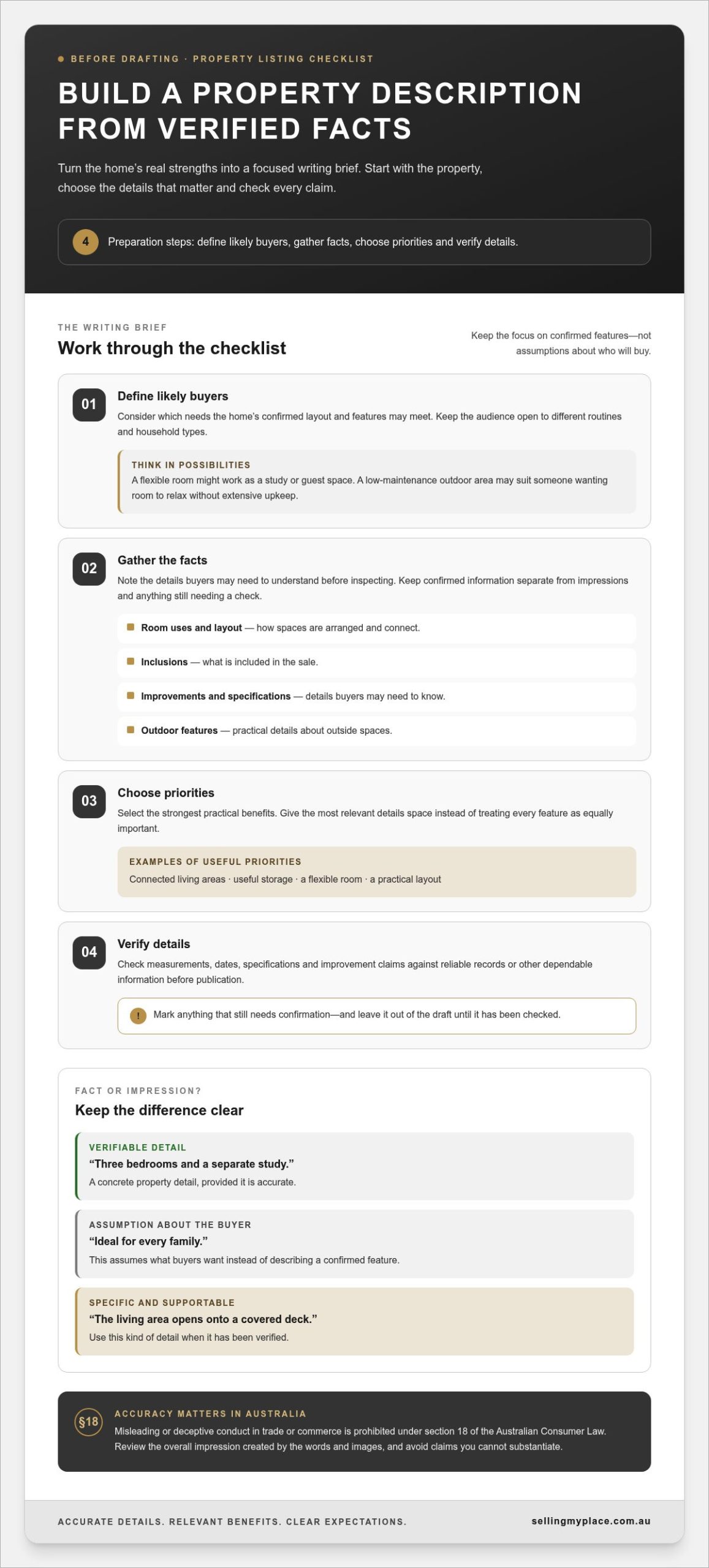
Edit property description wording for clarity, accuracy and appeal
A first draft captures what you want buyers to notice. Editing helps you decide what they need to know. Read each sentence with a buyer’s questions in mind: does it add a verified detail, explain a practical benefit or help someone understand the home? If it does none of those things, trim it.
Replace clichés and vague adjectives with evidence
Words such as “stunning”, “spacious” and “perfect” can sound positive, but without supporting detail they leave buyers guessing. Replace them with an observable feature: instead of “a spacious kitchen”, describe its confirmed bench space, storage or connection to another room. Use comparisons only when you can explain the basis and support them fairly. Specific wording helps readers picture the home without asking them to take your praise on trust.
Use this paired checklist as you revise:
- Keep: Verifiable details, clear descriptions of layout and inclusions, and benefits that follow naturally from those facts.
- Cut: Repeated points, familiar clichés, strings of similar adjectives and inflated claims the property’s features don’t support.
For example, if two sentences both say the living area is “light-filled” and “bright”, keep the stronger one and use the space for a different useful detail. A precise fact gives buyers more to consider than another layer of praise. Likewise, instead of saying “perfect for entertaining”, explain what supports that impression, such as a confirmed connection between the dining area and an outdoor space, or leave the claim out.
Comparisons need care, too. Say a home is “larger than others nearby” only if you have a sound, like-for-like basis for the claim. Otherwise, focus on the property’s own measurable or observable features. That keeps the description persuasive without stretching what it promises.
If you’re refining your listing alongside a broader sale plan, explore property listing support.
Run a final accuracy and readability check
Before publishing, compare every factual statement with the property information and listing details. Check that room names, inclusions, measurements, dates and specifications are consistent, and that the wording doesn’t imply a feature the home doesn’t have. Then review spelling, punctuation, tense and paragraph breaks. Short blocks of text are easier to follow on a phone.
Read the draft aloud. You’ll often hear repeated ideas, awkward phrases or sentences that try to do too much. A trusted reader can flag anything unclear, but keep your own perspective in the final copy. A useful edit sharpens the message without flattening your voice.
This final pass is central to how to write a property description that sells: retain what’s distinctive and supportable, remove what’s vague, and make sure the finished words match the home buyers will see.
Publish your property description with clear photos and listing details
Before the listing goes live, review the full presentation as a buyer would encounter it. The description, photographs and listing details should tell one consistent story: the words explain what matters, the photos show the home, and the listing information helps buyers understand what’s being offered. A polished description can’t do its job if key details are hard to find or images create a different impression.
Make the description and listing presentation work together
Compare each claim in the copy with what the photographs show. If you describe a room as a study, make sure the wording doesn’t imply it’s a separate bedroom. If the description highlights an outdoor area, check that the images give buyers a clear view of the space. Each element should support an accurate overall picture.
Professional photography is included in every Kincade International Direct Sales package. Use the copy to add context rather than narrate what’s already obvious in a photograph. A photo may show a dining area, for instance, while a concise sentence can explain how it connects to another part of the home, if that layout detail is accurate.
Before publishing, check that essential listing details are complete and consistent with the description. Keep room uses, inclusions and other relevant facts easy to locate. Don’t bury a key qualification in promotional wording or repeat the same feature in the description, headline and listing fields when it’s already clear. Buyers should be able to scan the page and understand the home without piecing together conflicting details.
Manage enquiries after the listing goes live
Good presentation is only one part of publishing. Sellers also need a practical way to follow up on interest once the listing is online. Kincade International Direct Sales (KIDS) is a licensed intermediary for listing purposes, not a real estate agent. Every package includes a listing on major property portals such as Homely and Soho, enquiry forwarding by SMS and email, 24/7 seller dashboard access and a Market Valuation Report.
Use the dashboard and forwarded enquiries to keep track of buyer interest. Note any questions that point to unclear listing details, and make sure your responses align with the information shown in the listing. If a detail needs correcting, update the relevant listing information so the copy and other materials continue to match. KIDS listings remain active until sold or withdrawn, or for two years from the commencement date, whichever occurs first.
The packages are fixed-fee and commission-free: Classic is $799 ex GST, Signature is $999 ex GST, and Prestige is $1,999 ex GST. Signature and Prestige include a dedicated property website and URL; Prestige also includes 15-20 professional photographs, a floorplan redraw, a Facebook and Instagram ad campaign, 50 premium A4 brochures, a dedicated specialist and a James Edition listing. All listed package features are included in the flat fee. KIDS does not guarantee a sale or sale price. Sellers remain in control of their listing and enquiries, while KIDS provides the listing platform and included marketing features.
Taking care with how to write a property description that sells also means checking how it works in the live listing, not just on the page where you drafted it. For support with listing your property and managing buyer enquiries, explore listing support with KIDS.
Take the next step with confidence
Your property description is part of the way you introduce a home and invite the right people to take a closer look. Before publishing, ask whether buyers can understand the home’s appeal, find the details that matter and see a clear path to enquire.
That’s the heart of how to write a property description that sells. It’s not about finding the loudest phrase or promising a particular result. It’s about presenting a home with care, so interested buyers can make an informed choice about whether it could suit them. A thoughtful listing gives you a clear starting point for the conversations that follow.
Ready to prepare your listing? Explore listing support with KIDS and take the next step with a clear picture of what your home has to offer.
Frequently Asked Questions
How long should a property description be?
There’s no single ideal length. Include enough detail to help buyers understand the home without making them sift through unnecessary copy. Remove sentences that repeat a feature or add no new information. Preview the listing in its intended format, as text may appear differently on a phone, and check the platform’s current field limits before you publish.
Should I write a property description in first person or third person?
Either voice can work, provided it stays natural and consistent. First person can add a personal touch, such as explaining why an owner values a particular feature. Third person often keeps attention on the property itself. Avoid turning personal opinion into a claim about buyers: “we love the garden” is clearly an owner’s view, while “every buyer will love the garden” assumes a reaction you can’t guarantee.
Can I use emotional language in a property description?
Yes, as long as the feeling comes from real features rather than replacing useful information. You might describe morning light in a room if that reflects the home’s actual conditions, then give readers a concrete detail about the room or its layout. Keep emotional phrasing measured, and don’t promise buyers will feel at home or enjoy a particular lifestyle. The property’s facts should carry the description.
What words should I avoid in a property description?
Be wary of sweeping superlatives and familiar phrases that could fit almost any listing. “Perfect”, “stunning” and “one of a kind” tell buyers little unless you explain the specific, supportable feature behind the claim. Remove language that implies a room or inclusion has a use or status it doesn’t have. Replacing broad praise with a precise description gives readers something tangible to assess.
Should I include the property’s flaws in the description?
Describe the home honestly and don’t use positive wording to disguise a concern or create a false impression. How to handle a defect or other potentially important information can depend on the circumstances and applicable requirements, so marketing copy isn’t a substitute for legal guidance. For questions about disclosure obligations or sale documents, seek advice from a qualified conveyancer or solicitor. KIDS does not provide legal advice, contracts or conveyancing services.
Can I update a property description after the listing goes live?
Whether and how you can edit a live listing depends on the platform and listing arrangement. If you revise the copy, check that the change matches the property information, photographs and other listing fields, then review the published version to make sure it displays as intended. KIDS sellers can use the 24/7 seller dashboard to manage their listing and buyer enquiries as details or communication needs change.
Pricing Your Home for Private Sale in Australia: 2026 Guide
What if the right asking price isn’t one perfect figure, but a defensible range you can refine as buyers respond? Working out how to price your home for private sale can feel daunting when comparable sales are hard to find, online estimates disagree and the stakes are personal.
In 2026, market conditions are shifting: Australian home prices had fallen for six consecutive months by September, according to atRealty. That makes current, relevant evidence especially important. Price too high and buyers may look elsewhere; price too low and you could leave value on the table. An online estimate alone won’t resolve either risk.
This guide explains how to build an asking-price range from comparable sales, choose a pricing and negotiation strategy, and decide when buyer feedback calls for a review. It also covers how neighbourhood market reports and pre-sale advice can support an evidence-led approach throughout your private-sale campaign.
Key Takeaways
- Learn how to price your home for private sale by building a realistic asking-price range from relevant evidence, not guesswork.
- Use settled sales to assess what buyers have paid, then account for the differences between those homes and yours.
- Compare firm, range-based and competitive asking-price strategies, and weigh the risks before choosing an approach.
- Set review points before your campaign begins, then assess patterns in enquiry, inspections, feedback and comparable sales before adjusting.
- Bring pricing evidence together with pre-sale planning and marketing support, including neighbourhood market reports and a flat-fee model without agency commissions.
How to price your home for private sale: start with a defensible range
Choosing a price is a balance: you want to protect the value of your home while giving suitable buyers a reason to take a closer look. The asking price is your public starting point for attracting interest and negotiating. It isn’t a guaranteed sale result. Your decision should reflect both the evidence and your circumstances.
A defensible asking-price range is an evidence-based guide, not a promise. It gives you reasoned boundaries for pricing and negotiation, while recognising that the eventual result depends on the buyer, the property and the terms you agree.
What does an asking price mean in a private sale?
In a private sale, you negotiate the price and terms directly with a prospective buyer, or with support you’ve engaged. The advertised figure starts that conversation; it isn’t automatically the amount a buyer will pay. The final agreed sale price is the amount recorded in the sale contract once you and the buyer reach agreement.
Market value is different. It’s an informed view of what a property could reasonably sell for, based on relevant evidence and its characteristics. It helps guide your decision, but it isn’t the same as an advertised price or a guaranteed outcome. The private sale process describes the broad approach of selling without a traditional agent. Within that process, supported by Kincade International Direct Sales, you choose how to present and negotiate your price.
Your strategy should reflect the evidence and your priorities, including how much flexibility you want in negotiations. There’s no single approach that suits every home or seller.
Why a range is more useful than one unsupported figure
A single figure can suggest more certainty than the evidence supports. A range makes that uncertainty visible and helps you decide where to begin, which offers merit consideration and when new information might justify a change. Each boundary should have a reason behind it, rather than being chosen simply because it feels comfortable.
For example, if a home has a feature that makes comparisons difficult, a range can acknowledge that uncertainty while keeping the decision grounded in evidence. You don’t have to advertise a range: it can be a private planning tool to help you choose one public asking figure and prepare for negotiation.
To make the range useful, connect it to comparable settled sales, your property’s features and condition, and the circumstances of your sale. Asking prices show what sellers hope to achieve, not what buyers have agreed to pay. In the next section, you’ll build your range from comparable evidence. For a deeper look at valuation principles, consult a guide to determining your home’s market value, then weigh that context alongside property-specific sales evidence.
Build your private-sale price range from comparable evidence
A sound price range starts with what buyers have actually paid for homes like yours, not simply what other sellers hope to receive. Recent, genuinely comparable settled sales provide a stronger pricing anchor than asking prices alone. Advertised prices reveal a seller’s expectations; they don’t confirm that a buyer agreed to pay that amount.
Use this process to turn market information into a reasoned range:
- Gather recent settled sales. Look for completed sales rather than relying on current listings. Note the sale date and check that the evidence reflects the market conditions you’re selling into.
- Select the closest comparisons. Prioritise homes with a similar property type, size, layout, condition and features. A nearby property isn’t automatically a useful comparison if its design or presentation differs substantially.
- Assess the differences. Consider how renovations, outdoor space, parking, natural light, aspect and overall condition may affect buyer appeal. Describe each difference and its likely direction of influence instead of applying a made-up standard percentage or dollar adjustment.
- Form a supported range. Use the strongest comparisons to establish sensible lower and upper boundaries. Give each end a clear rationale, and set weaker or less similar sales aside rather than letting them distort your view.
Choose comparable sales that genuinely help
Start with homes that match yours in the ways buyers are likely to notice: property type, floor area, bedroom and bathroom layout, condition and key features. Then consider whether they sold in a similar market context. If close comparisons are scarce, broaden your search cautiously, perhaps to a different property type or a less recent sale, and note why that evidence is less certain. Don’t force a poor match just to fill a list.
Keep a simple record of each sale’s relevant features alongside its settled price. This makes it easier to see whether your range is supported by a consistent group of homes or rests on one unusual result. For wider context, the Real Estate Institute of Australia market insights can help you follow broader residential market information. National or state trends, however, can’t replace property-level comparisons.
Use online estimates and professional input with care
Automated estimates are useful starting points, but an online tool may not account for your home’s condition, recent improvements or distinctive features. Compare estimates from several sources. If they differ substantially, investigate what information or assumptions may explain the gap. Don’t simply average the figures and treat the result as a valuation.
Neighbourhood market reports and pre-sale consulting can add context as you assess sales and property differences. A fuller guide to neighbourhood market reports can help explain how broader local data fits alongside comparable sales. Kincade International Direct Sales also provides pricing and private-sale advice as part of its advisory support.
Choose an asking-price strategy without overpricing or underpricing
Once you have a supported range, decide how to present your price to buyers. The right approach depends on your evidence, how much flexibility you have and the conditions of your campaign. A figure below your estimate isn’t automatically a smarter move: it may attract attention, but it can also expose you to offers that don’t meet your acceptable outcome.
When deciding how to price your home for private sale, consider three common approaches:
- Firm asking price: State one figure grounded in your sales evidence. This gives buyers a clear reference point, while still leaving room to negotiate if you choose.
- Price range: Where appropriate, a range can signal flexibility and acknowledge uncertainty. Its boundaries should be meaningful, and you should be prepared to explain the basis for them.
- Competitive asking price: Set an attractive, evidence-supported figure to encourage enquiries from qualified buyers. Pricing below your estimate is a deliberate tactic with trade-offs, not a requirement for every private sale.
Think about your priorities before choosing. If you have room to negotiate, a firm figure may give you a useful opening position. If you need a particular outcome or have limited flexibility, make sure your advertised approach doesn’t invite offers you’re unwilling to consider. Campaign conditions matter too: buyer interest and relevant settled sales may shift, so keep your decision anchored to evidence rather than assumptions about how buyers will react.
When a competitive asking price may help
A compelling price can prompt suitable buyers to enquire, especially when it aligns with comparable evidence and the home’s presentation. But a figure chosen solely to generate attention can create pressure to consider offers below your acceptable level. Decide your boundaries in advance. Strong enquiry or interest from more than one buyer may affect negotiations, but it doesn’t guarantee competing offers or a particular sale result.
How to avoid an asking price that stalls interest
Limited qualified enquiries or repeated buyer comments that the price feels too high may point to a mismatch, particularly if your campaign is reaching its intended audience. First check the presentation: unclear photos, incomplete property details or difficulty arranging an inspection can also weaken interest. Look for patterns across feedback and activity rather than treating one person’s reaction as proof that the price is wrong.
If the evidence suggests a change is warranted, review your comparable sales and campaign response before revising the figure. A considered adjustment can be more effective than a rushed reduction after a quiet viewing or a single low offer.
Before advertising, check the current price-advertising requirements for your state or territory. Rules and guidance can differ, including how prices or ranges may be presented. Use the relevant government or consumer regulator’s current guidance to make sure your chosen strategy is appropriate for the property’s location.
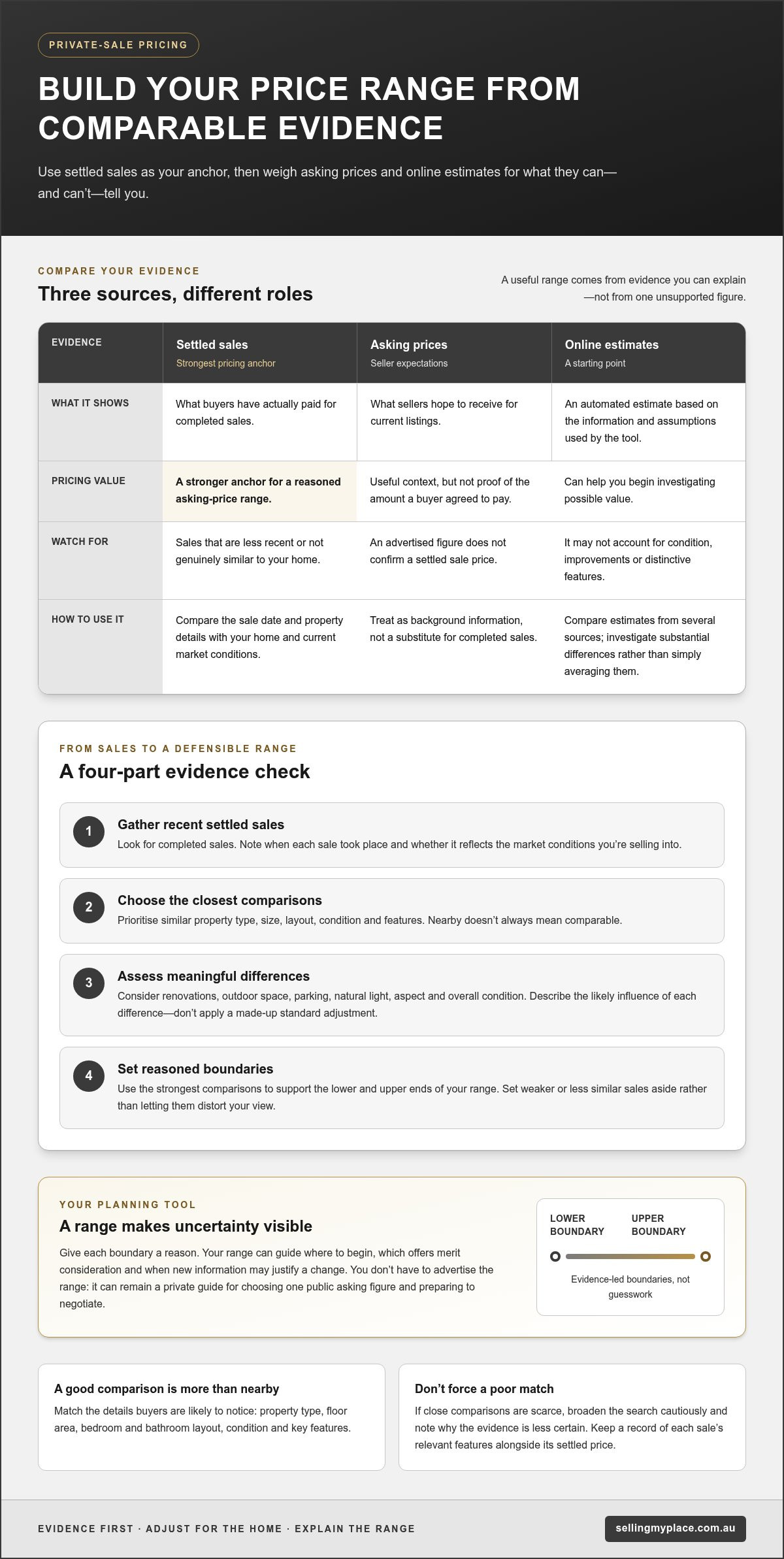
Review and adjust your private-sale price using campaign evidence
Before your listing goes live, decide when you’ll review its performance. A planned check-in helps you avoid changing the price in response to one buyer’s comment or a quiet inspection. You might review after a set period or once you’ve gathered enough enquiry and viewing feedback to spot patterns. Choose a schedule that suits your campaign, then stick to it unless genuinely new evidence calls for an earlier review.
At each check-in, assess the whole picture: the number and quality of enquiries, inspection attendance, recurring feedback and any new comparable sales. One signal on its own rarely tells the full story. A listing might attract plenty of casual questions but few serious inspections, or have steady attendance alongside repeated concerns about price. Those patterns point to different things to investigate.
Read buyer responses without overreacting
Separate general interest from serious engagement. A buyer who asks about availability is at an earlier stage than someone who inspects, asks detailed questions and discusses terms. Record what people say and do, including whether they return for another look or make an offer. One person’s view is useful feedback, not a verdict on your home’s value.
Look for repeated, specific comments. If several prospective buyers independently raise the same concern about price, compare that pattern with your original sales evidence and any new settled sales. If their comments focus on a feature or presentation issue instead, a price change may not address the real obstacle.
Make a measured price review
Before revisiting the figure, check that the listing is accurate and the marketing materials show the property clearly. Confirm that key details are complete, photographs and floorplans represent the home well, and inspection arrangements are straightforward. If those basics need attention, improve them before deciding that the asking price is the problem.
When sustained campaign evidence conflicts with your initial assumptions, return to your price range. Ask whether the comparable sales still support it and whether buyer feedback consistently sits outside your expectations. A revised asking price should recognise what the evidence suggests while respecting your priorities and acceptable terms. If you keep the price unchanged, record why. If you adjust it, note what information supports the decision.
Keep a simple review log with the date, enquiry and inspection patterns, recurring comments, comparable sales considered, presentation checks and your decision. This creates a clear record of how your view developed, rather than leaving you to rely on memory during a stressful campaign. Once interest turns into an offer, a guide to property sale negotiation can help you consider the proposed price alongside conditions and timing.
Kincade International Direct Sales provides private-sale campaign and pricing advice to help you review buyer feedback and your approach.
Set your private-sale price with Selling My Place support
Pricing evidence is most useful when it informs the whole sale plan. Bring your comparable sales, proposed asking-price range and preferred negotiation approach together with a clear plan for presenting the home and reviewing buyer response. Pre-sale consulting and neighbourhood market reports can help you examine your assumptions and form a considered view before your property is advertised.
Kincade International Direct Sales supports Australian homeowners with flat-fee property marketing and advisory packages, without agency commissions. The service combines listing support with practical advice, while keeping the asking price grounded in evidence rather than presenting any figure as a guaranteed result.
What professional private-sale support can contribute
Pre-sale consulting and the Agent Advisory Service can help you review pricing assumptions alongside your sale preparation. Professional photography and floorplans give buyers a clearer picture of the home and its layout, while neighbourhood market reports provide relevant context for weighing your comparisons. Conveyance advice is also available as part of the advisory support, helping you consider the transaction process without treating this article as legal advice.
As you prepare to list, keep the key decisions connected. A price supported by sales evidence still needs marketing that accurately represents the property, and a well-presented listing is more useful when you’ve decided how you’ll assess enquiries and offers. Organise your plan around these practical elements:
- Evidence: Keep a record of the settled sales and property features that inform your pricing view.
- Range: Set reasoned lower and upper boundaries, and decide which figure or format to advertise.
- Strategy: Be clear about your flexibility, priorities and approach to negotiating with interested buyers.
- Review points: Choose when you’ll assess enquiry quality, inspections, feedback and any new comparable sales.
Take the next step with a clear pricing plan
Knowing how to price your home for private sale doesn’t mean predicting the final agreed price. It means making a considered starting decision, understanding the evidence behind it and being ready to review the plan as the campaign unfolds. A flat-fee model gives sellers access to listing and professional services without agency commissions, while keeping the sale decision in their hands. Residential listings remain active until sold, with no time limits.
Kincade International Direct Sales brings the pricing plan together with flat-fee marketing and advisory support, so you can make informed decisions without agency commissions or a promised sale price.
Move forward with a pricing plan you can stand behind
Deciding how to price your home for private sale is an important step, but it doesn’t mean you have to predict the future. Treat your asking price as a considered starting point, then let credible evidence and buyer response inform your next decisions. A written plan can help you stay steady: note what supports your price, what you’re willing to negotiate and what campaign signals would prompt a review.
That clarity can make the next stage feel more manageable. Kincade International Direct Sales brings flat-fee marketing and advisory support together, from professional photography and floorplans to neighbourhood market reports, pre-sale consulting and conveyance advice. There’s no agency commission, and the focus is on helping you make informed choices without promising a particular sale price.
Ready to turn your sales evidence into a practical private-sale pricing plan? Talk with Kincade International Direct Sales about the flat-fee marketing and advisory support available for your campaign.
Frequently Asked Questions
Can I change my asking price after listing my home privately?
Yes, you can generally revise your asking price during a private-sale campaign, but check any applicable state or territory requirements before updating your advertising. Make the change consistently wherever the property is promoted, and note the date and reasoning. For instance, a fresh settled sale or a clear pattern in buyer feedback may support a review. A change is a pricing decision, not a guarantee of increased interest or a particular offer.
Should I price my home above market value to leave room for negotiation?
Not automatically. A higher asking price may give you negotiating room, but if buyers see it as out of step with comparable properties, some may not enquire. Decide first what terms and outcome you could accept, then consider whether your starting figure is supported by the evidence and leaves realistic scope to negotiate. If you choose a higher figure, be prepared to explain its basis and review the response rather than assuming buyers will bargain it down.
Is an online property estimate accurate enough to set my asking price?
Use an online estimate as a prompt for further research, not as your only pricing basis. Automated tools may rely on recorded property details and sales data that don’t reflect renovations, condition, layout or features that make your home distinctive. If two estimates differ, check whether their property information or comparable sales differ too. When working out how to price your home for private sale, test any estimate against relevant settled sales and the specific characteristics buyers will see.
How do I price a home when there are few comparable recent sales?
Start with the closest settled sales you can find, even if the matches aren’t exact. Note where each comparison differs, such as property type, size, condition or sale date. You can widen the search to less recent or less similar sales, but treat those as supporting context rather than equal evidence. If your property is unusual, a market report or pre-sale advice can help you build a reasoned range from the available information.
Can a buyer offer less than the advertised price in a private sale?
Yes. An advertised price is an invitation for buyers to consider the property, not a requirement that they offer that amount. A buyer can propose a lower figure or different terms, and you can accept, decline or make a counteroffer. Consider the complete offer, including conditions and proposed timing, rather than focusing on price alone. Keep your preferred terms and minimum acceptable outcome clear before responding, and have the agreed details documented appropriately.
Do Australian states and territories have different rules for property price advertising?
Yes, requirements can differ between states and territories, and some rules apply to agents rather than private sellers. Don’t assume a rule described for an agent applies to your own listing. Before publishing or changing a price, check current guidance from the relevant state or territory consumer affairs or fair trading authority, especially if you plan to advertise a price range.
Sell Property Zero Commission: A Smarter Australian Selling Guide
What if avoiding percentage-based agent commission didn’t mean managing every part of your sale alone? If you’re exploring how to sell property zero commission, it’s worth understanding what “zero” covers, whether a flat fee includes the marketing you need and how much support is available when buyers have questions.
Zero commission doesn’t mean selling is free. It usually means paying a set fee for an agreed service instead of a percentage of the sale price. The useful comparison isn’t just the fee structure: look at what’s included and how comfortable you are handling buyer conversations, negotiations and practical sale tasks.
A flat-fee approach can offer a middle ground between traditional commission-based representation and managing everything yourself. Kincade International Direct Sales combines professional photography, floorplans and neighbourhood market reports with Agent Advisory Service support, pre-sale consulting and conveyance advice. This gives sellers professional resources while retaining control over key decisions.
In this guide, you’ll learn how zero-commission selling works, what to look for in a flat-fee service and how to weigh marketing and support against the tasks you’re prepared to manage. You can then choose an approach that fits your priorities, not just its fee structure.
Key Takeaways
- To sell property zero commission, understand that a flat fee replaces percentage-based agency commission, but other sale costs may still apply.
- Compare the service scope, marketing materials, advisory support and listing duration, not just the fee structure.
- Professional photography and floorplans can help present your home clearly, while a digital listing network can provide exposure without guaranteeing a sale.
- Decide how involved you want to be and how much time you can give to buyer communication and sale tasks.
- Consider whether photography, floorplans, neighbourhood market reports and advisory support offer the balance of control and assistance you want.
What does sell property zero commission actually mean?
In plain English, zero commission means no percentage-based agency commission is charged on the property’s sale price. Instead of paying an agent a share of the final amount, a seller may use a service with an agreed flat fee for defined marketing or advisory support. The phrase describes how the service is charged, not whether selling a home is entirely cost-free.
Zero-commission property selling means marketing a home without a percentage-based agency commission, usually through a fixed-fee service with a defined scope. It doesn’t guarantee a sale or a particular sale price. The service can help you promote the property and access advice, but the outcome still depends on factors such as buyer interest, the property and your sale decisions. For context on how agent compensation can differ, see Real estate broker commissions and flat-fee services.
If you’re working out how to sell property zero commission, separate the marketing and advisory arrangement from the legal work involved in transferring a home. Property marketing can cover materials and listing support; conveyancing concerns the legal sale process and is a distinct part of the transaction. The two may happen alongside each other, but don’t assume one service fee covers both.
How is zero commission different from no-cost selling?
“Zero commission” refers to the absence of a sale-price percentage charged as agency commission. A marketing or advisory service may still charge a flat fee for agreed work. Sellers may also have separate expenses connected with preparing, marketing or legally transferring a property. The useful question is not whether a service sounds free, but what its fee covers and what remains separate.
Compare the written inclusions and fee terms rather than relying on labels. Look for details on the marketing materials, advisory support and listing period covered, as well as work or expenses outside the service scope. This gives you a clearer view of the arrangement before deciding how you want to sell.
What does a flat-fee property service change?
A percentage commission changes with the final sale price; a flat fee is set for defined services rather than calculated as a share of the result. This can make the service charge easier to understand in advance, but the fee structure alone doesn’t tell you how much practical help you’ll receive. Scope matters just as much as price: listing support, photography, floorplans and advice can all differ between services.
The model can also change how involved you are. With a commission-based agent, the arrangement may include representation across parts of the sale; with a flat-fee service, you may retain more control and take a more active role. Neither structure suits every seller. Consider the tasks you’re comfortable handling and the support you value before weighing the options.
Keep the legal conveyancing process in view, too. A marketing or advisory fee doesn’t automatically include the preparation or handling of sale documents. Conveyance advice can help you understand that part of the journey, while the legal work itself remains distinct. Knowing where one service ends and another begins helps you budget and plan with fewer surprises.
What can a zero-commission property marketing service include?
A flat-fee arrangement describes how the service is charged, but its inclusions determine what practical help you receive. A commission-free marketing service can bring together listing exposure, presentation materials and advice, allowing you to retain a role in decisions while getting professional support. The right mix depends on what you want help with and which selling tasks you’re comfortable managing yourself.
A digital listing network can put a property in front of potential buyers through online marketing channels. Kincade International Direct Sales uses a global digital marketing network, but exposure isn’t a promise that a particular buyer will see the listing or that the property will sell. Professional photography and floorplans add useful context: images show the home’s presentation, while a plan helps people understand room layout and flow.
How do listing materials support a property sale?
Photos help prospective buyers form an initial impression of spaces, finishes and features. A floorplan adds another layer by showing how rooms connect, which can be difficult to judge from images alone. Clear listing information helps people assess whether the home’s layout and features may suit their needs before arranging a closer look. These materials support informed consideration; they don’t guarantee interest or an offer.
Neighbourhood market reports can add context as you prepare for sale and discuss pricing. They’re one input for understanding the market, not a promise of what a buyer will pay. For wider industry context, Real Estate Institute of Australia (REIA) insights can help readers explore information about Australia’s property sector and market.
What role does professional advice play?
Pre-sale consulting provides guidance before a home goes to market, helping you think through preparation and sale decisions. The Agent Advisory Service offers support as you weigh choices, while leaving you in control of how you proceed. Buyer representation has a different focus: it relates to representing a buyer, rather than marketing a seller’s property.
Conveyance advice is also distinct from listing and buyer-facing activity. It relates to the legal side of a property transfer, while marketing services focus on presenting and promoting the home. Advice can help clarify the process, but it isn’t the conveyancing work itself.
Use this table to compare what each feature can contribute and the questions it may help you answer:
| Service feature | Potential seller benefit | Question it helps answer |
|---|---|---|
| Digital listing network | Online exposure across a marketing network | Where may buyers encounter the listing? |
| Photography and floorplans | Visual detail and a clearer sense of layout | How can buyers understand the home’s presentation and flow? |
| Neighbourhood market reports | Context for preparation and pricing discussions | What market information can inform my decisions? |
| Pre-sale consulting and Agent Advisory Service | Guidance for planning and decisions | Where would professional input be useful? |
| Conveyance advice | Guidance distinct from marketing activity | What legal-transfer questions should I understand? |
If you’re considering how to sell property zero commission, compare the actual support and deliverables with the tasks you’ll take on. Commission-free property marketing support brings together marketing resources and advisory assistance for sellers who want to retain control.
Zero commission versus traditional commission: how should you compare?
A percentage-based commission ties the agency fee to the property’s sale price. A flat-fee model uses an agreed charge for defined services instead. Neither structure tells the whole story: services with different fee models may also differ in marketing, advice and how much of the sale you manage yourself.
The fee structure alone can’t tell you which selling service is right; compare the support, deliverables and seller responsibilities that come with it. This matters because a lower or more predictable fee may still leave you with tasks you’d rather have help handling. Equally, paying a percentage doesn’t automatically mean every service or level of support is included.
Which selling model fits your preferred level of involvement?
Start with an honest assessment of your time and confidence. If you’re comfortable coordinating parts of the sale and making direct decisions, a flat-fee service may suit your preference for control, especially when paired with defined marketing and advisory support. If you want someone to take a more hands-on role, clarify what that representation involves. Traditional agents’ services can vary, so don’t assume every commission arrangement includes the same tasks or support.
More control can mean more participation. Depending on the service structure, you may have a greater role in responding to enquiries, communicating with interested buyers or making decisions during negotiations. Think about when you’d welcome professional guidance and when you’d rather manage things directly. The best fit should reflect your comfort level, not just how the fee is calculated.
What should you compare beyond the fee structure?
Set the service details side by side. Compare the included marketing deliverables, the reach of the listing network, access to advice and how long the property remains listed. Then clarify how buyer enquiries, negotiations and sale decisions are handled. These practical details show what you’re paying for and where your own time may be needed. For more context on listing support, see Professional Residential Property Listing Services: The Modern Australian Seller’s Guide.
A useful comparison separates the fee basis from the working arrangement:
| Model | Fee basis | Seller role | Support structure |
|---|---|---|---|
| Traditional commission | Percentage linked to the sale price | Depends on the agreed representation and service scope | Can involve agent support, but inclusions and responsibilities vary |
| Flat-fee marketing and advisory | Agreed fee for defined services | May retain more direct control and take an active role | Can combine marketing materials with advisory support; clarify how enquiries and decisions are handled |
For a like-for-like comparison, write down the service inclusions and responsibilities before weighing the fee. A service may, for example, include professional photography, floorplans, advisory access and a listing that remains active until sold without time limits. Match each inclusion against what matters to you, then note any tasks you’d handle yourself. That gives you a clearer picture of the trade-off between hands-on assistance, seller control and the practical work of bringing a property to market.
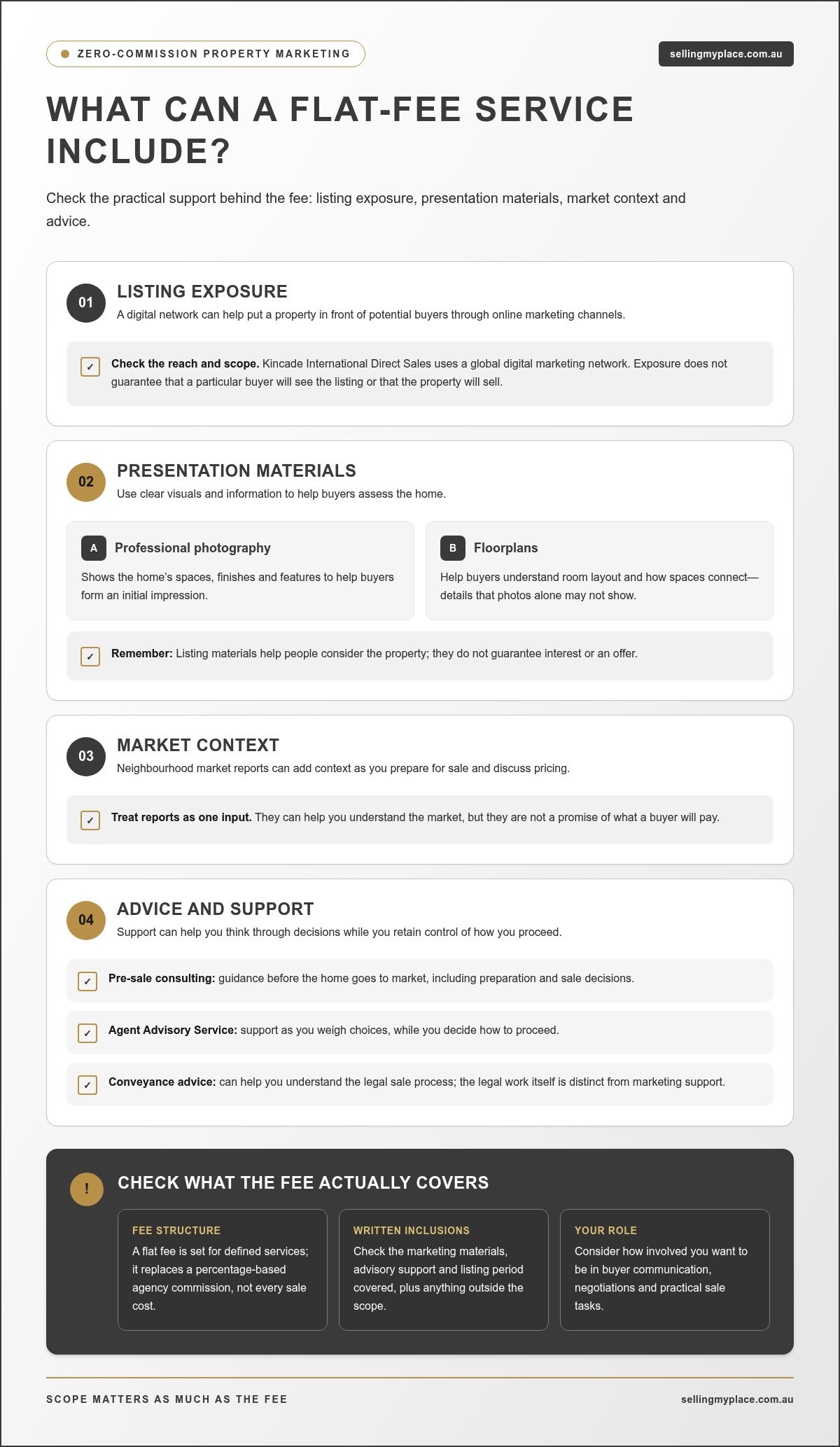
How can you decide whether selling property zero commission suits you?
The right selling approach should fit your time, confidence and appetite for direct involvement. Before deciding whether to sell property zero commission, map out the tasks you’re happy to manage and where professional guidance would make the process more manageable.
- Start with your involvement and available time. Consider how much time you can set aside for preparing the property, responding to buyer enquiries and keeping sale tasks moving. Greater control can be appealing, but it often comes with more direct participation.
- List the support you value most. Write down the marketing materials, advice and communication support you want. You might prioritise photography and floorplans, guidance before launch, help thinking through buyer conversations or advice as you weigh sale decisions.
- Compare the arrangements in writing. Set out each option’s fee basis, included services, listing terms and any responsibilities you’ll take on. A written comparison makes differences easier to spot than a headline label alone.
- Separate the stages of the sale. Preparation, marketing, negotiation and conveyancing each need attention, but they aren’t the same task. Decide where you’ll lead, where advisory support would help and how you’ll handle the legal transfer process.
What should you clarify before choosing a service?
Look for clear descriptions of which marketing materials and advisory services the flat fee covers, how long the listing stays active and what ongoing support means in practice. Then consider your own capacity: would you feel comfortable handling buyer communication and making sale decisions, or would guidance at key moments help you feel more assured?
For a service that keeps a listing active until sold without time limits, that duration can be an important part of your comparison. Listing duration alone doesn’t tell you how buyer enquiries or negotiations are managed. Add those responsibilities to your written notes so you understand the working arrangement as well as its timeline.
How can you prepare for the sale without taking on every task alone?
Divide your plan into seller-led decisions and tasks supported by marketing or advisory services. You might lead on presentation choices and decisions about an offer, while using professional photography, floorplans and pre-sale consulting to support preparation. The Agent Advisory Service can also provide input as you consider your next steps.
Plan how you’ll respond to buyer enquiries and approach negotiations before the first conversation arises. A step-by-step guide to sale by owner in Australia can help you map the process, while a guide to property sale negotiation can help you think through buyer discussions. Conveyancing remains a distinct part of the transaction, so include it in your planning rather than treating marketing support as a substitute.
Commission-free property marketing and advisory support combines marketing resources with guidance for sellers who want to stay involved in the sale.
How Selling My Place supports a zero-commission property sale
Selling a home involves more than choosing a fee model. You need a clear way to present the property, reach prospective buyers and make considered decisions as the sale progresses. Kincade International Direct Sales’ flat-fee marketing and advisory service offers a middle ground: you retain control of key choices while accessing professional marketing materials and guidance.
The service brings together professional photography, floorplans, neighbourhood market reports and a global digital marketing network. Each supports a different part of the sale: photography and plans help present the home, market reports provide context for preparation and pricing discussions, and the network supports digital marketing exposure. Exposure can’t guarantee buyer interest or a sale, but these resources give you practical tools for putting your property forward.
What support can sellers access through the service?
Listings can remain active until sold without time limits, giving sellers an ongoing listing rather than a set end date. This doesn’t guarantee a sale or a particular timeframe. Agent Advisory Service support, including pre-sale consulting, can help you consider decisions before the property goes to market and as you work through the sale. Conveyance advice relates to the transfer process, distinct from marketing and buyer-facing activity.
The balance is intentional: you stay involved in decisions, with professional resources to support the work around them. For example, use photography and floorplans to present the property clearly, then draw on neighbourhood market information as you prepare for pricing discussions. Advisory support can help you think through your approach while you remain responsible for the choices that matter to you.
As you consider the support, think about which parts of the sale you want to lead and where guidance would be useful:
- Property presentation: professional photography and floorplans help show the home’s features and layout.
- Market context: neighbourhood market reports offer information to consider during sale preparation and pricing discussions.
- Digital marketing: a global digital marketing network supports the listing’s exposure without promising a specific audience or result.
- Sale guidance: Agent Advisory Service support, pre-sale consulting and conveyance advice address different decisions and stages.
What is a sensible next step for an interested seller?
Before discussing your options, jot down a few details: the property you’re selling, your preferred timing and how involved you want to be. Note the marketing and advice you value most, too. This gives the conversation a useful starting point and helps you focus on whether the service scope and flat-fee structure fit your priorities, rather than judging by the fee label alone.
For sellers considering how to sell property zero commission, a practical discussion can help clarify the model and the support available. Talk through your property sale with our team.
Choose a selling approach that feels right for you
A property sale is a significant transition, and the process should feel workable for your circumstances, not simply appealing on paper. Before you decide how to sell property zero commission, think about what would help you feel informed and in control: a clear view of the service scope, room to make your own decisions and professional guidance where you’d value it.
Your next step can be a practical conversation about your property, timing and preferred level of involvement. Talk through how the flat-fee model works, what support it includes and whether the balance suits the way you want to sell. Arriving with a few priorities in mind can make that discussion more useful, whether you’re ready to move ahead or still weighing your options.
Talk through your property sale with our team to discuss a sale plan that fits your priorities. You don’t need every detail settled before you begin; a clear conversation can help you identify your next steps.
Frequently Asked Questions
Is selling property with zero commission really free?
No, not necessarily. Zero commission means no percentage-based agency commission is charged, not that selling has no costs. A flat-fee service may charge for defined marketing and advisory work, while other sale-related expenses can remain separate. If you plan to sell property zero commission, compare written inclusions, fee terms and your responsibilities before deciding. This helps you understand what the arrangement covers rather than relying on the label alone.
Can I sell my property without an agent and still get professional support?
Yes. You can take a more active role in the sale while using a property marketing and advisory service for professional assistance. For example, photography and floorplans can help present your home, while pre-sale consulting can support decisions before launch. You’ll still have responsibilities, such as making sale decisions and handling agreed tasks. This differs from traditional full-service representation, and the support offered varies between arrangements.
How much can I save by selling property with zero commission?
There’s no single saving that applies to every seller. The difference depends on your sale price, the fee structure and which services are included in each arrangement. Compare the full written scope and fee terms with the commission-based option you’re considering, including any tasks you’ll manage yourself. A lower fee alone doesn’t show which model is the better fit; the value of the support and your preferred involvement matter too.
What happens if my property does not sell straight away?
What happens next depends on the listing duration and ongoing service terms. With Kincade International Direct Sales, a property can remain listed until sold without time limits. That means there’s no set time limit on the listing, not a guarantee that a sale will occur. Review the service terms to understand how continued listing and support work if the sale takes longer than expected.
Do zero-commission property services include photography and floorplans?
Inclusions vary, so look at the stated deliverables rather than assuming every service provides the same materials. Kincade International Direct Sales provides professional photography and floorplans. Photos give prospective buyers a visual impression of the home, while a floorplan helps them understand how rooms connect and how the layout works. These tools can make property information clearer, but they don’t guarantee more enquiries, a higher sale price or a faster result.
Is a flat-fee service better than paying a traditional property commission?
It depends on your priorities, how involved you want to be and the support you need. A flat fee changes how the service charge is structured compared with percentage-based commission, but it doesn’t determine the service scope or your responsibilities. Compare marketing deliverables, advisory access, listing duration and the tasks you’ll handle yourself. The better fit is the arrangement that aligns with your comfort level and sale priorities, not simply the fee label.
Can I negotiate the sale price when using a zero-commission service?
Yes. As the seller, you make decisions about offers and the sale outcome you’re prepared to accept. The support available during buyer discussions depends on the service arrangement. Kincade International Direct Sales offers advisory support and buyer representation, which is a distinct service for buyers. Before negotiations begin, consider your priorities and how you’ll communicate them clearly. Preparing in advance can help you approach offer discussions thoughtfully, without guaranteeing a particular result.
What Happens After Accepting an Offer on a House in Australia?
Accepting an offer is an important milestone, but it is only the beginning of the next stage of your sale. If you’re wondering what happens after accepting an offer on a house, you may be asking whether the deal is binding, what the buyer still needs to do and which deadlines matter.
In Australia, the next steps depend on the contract of sale and the rules in your state or territory. An accepted offer is not always the same as an unconditional, legally binding sale. Signing or exchanging the contract, any cooling-off rights and the agreed conditions all matter. The buyer’s finance approval and building or pest inspections may also affect progress, depending on the contract.
This guide covers the steps from acceptance to settlement, including how to prepare, track conditions and manage key dates. It also explains what can vary across Australia, so you can stay organised, follow the agreed terms and prepare for handover.
Key Takeaways
- Follow the contract-led steps from acceptance through to settlement.
- Check the signed contract for conditions, agreed terms and key dates. Requirements can differ between Australian states and territories.
- Track any finance or inspection conditions in the contract, including the deadlines and actions they require.
- Organise documents, confirm agreed property inclusions and access arrangements, and keep communication with your conveyancer or solicitor in one place.
- Plan your move and handover ahead of settlement, including keys, mail redirection and utility arrangements.
What accepting a house offer means for you as the seller
Hearing that a buyer wants your home can bring real relief after all the preparation and decisions involved in selling. Enjoy the milestone, then focus on what comes next: acceptance starts a contract-led process, but it is not settlement and does not automatically mean the sale is complete.
If you’re asking what happens after accepting an offer on a house, first distinguish an informal conversation from the legal paperwork. A buyer might make an offer verbally or in writing, and you might indicate that you agree with the price and terms. But don’t assume that a verbal agreement has the same effect as a properly completed contract of sale. The form of acceptance, signing or exchange process, and legal effect depend on the transaction and the rules in your state or territory.
The contract records the terms that matter, including the agreed price, deposit, settlement date, included items and any conditions. Once it takes legal effect, both parties generally need to follow those terms. Conditions can affect what happens next. For example, a finance or inspection clause may set out steps the buyer must complete before the sale becomes unconditional. The wording of the contract and applicable local rules determine the parties’ rights and obligations, so rely on the actual terms rather than a general rule of thumb.
Does accepting an offer make the house sale final?
Not necessarily. A sale may become legally binding once the required contract process is complete, but an accepted offer alone does not guarantee that the property will reach settlement. If the contract includes conditions, the buyer may need to satisfy them, or the contract may explain what happens if they are not met. Read the signed terms carefully and ask the conveyancer or solicitor handling your transaction to explain anything that is unclear.
What should a seller do straight after acceptance?
Keep the written offer and every version of the signed contract together. Make a clear record of the agreed dates, conditions and next steps, so you have one reliable reference if details are later discussed by phone or email. Contact your conveyancer or solicitor promptly to understand the contract process and coordinate the work they are handling.
- Save the paperwork: Store the written offer, signed contract and related messages together.
- Note the key dates: Record the contract deadlines and settlement date, plus who is responsible for each action.
- Keep communication clear: Share relevant documents with your conveyancer or solicitor. Keep important updates about the contract in writing.
These simple steps can prevent crossed wires as the sale progresses. Treat acceptance as the start of the agreed process, not a signal that every detail is settled. Let the written terms guide what happens next.
The contract, conditions and conveyancing steps after acceptance
Once the offer is accepted, use the contract as your working guide rather than relying on a handshake or a summary of what was discussed. It sets out the sale terms, conditions and dates that can affect progress. Review the completed contract, identify the next actions, share relevant documents and keep a reliable record of deadlines and communications.
- Check the completed contract. Make sure you have the latest version, signed or otherwise completed through the process that applies to your sale. Confirm that the written price, deposit, settlement date, inclusions and special conditions match the agreed terms.
- Mark each condition and date. Record what needs to happen, who is responsible and when a response or document is due. A finance condition or building and pest inspection condition might be included, but neither is automatic in every sale.
- Share the paperwork. Send the complete contract and relevant sale documents to the conveyancer or solicitor assisting you. Keep copies of important communications, especially updates about a condition or an agreed change.
- Track progress and follow up. Use a calendar or checklist to monitor deadlines. If a due date is approaching and you have not received an update, follow up with the person handling that step rather than assuming it is complete.
The buyer is generally responsible for arranging their own finance and inspections, subject to the contract. As the seller, you need to meet your contractual obligations and provide information or access where agreed. An offer may also depend on the buyer selling an existing property if the contract includes that condition. Read the clause itself, since its wording determines what happens next.
There is no identical process across Australia. Contract formation, cooling-off rights and conveyancing steps can vary between states and territories, and the contract may set out additional requirements for your transaction. For vendors navigating regional markets, local agencies such as Ollie James Real Estate can provide helpful insight into regional sale practices and timing. Always ensure you rely on the terms and procedures that apply to your specific sale.
Which contract dates and conditions should sellers track?
Use the signed contract to confirm exact dates and wording. Record condition deadlines, required documents, agreed access arrangements and responses expected from either party. A shared calendar or written checklist makes responsibilities easier to follow, particularly when several people are coordinating the sale. If a clause is unclear, raise it promptly with your conveyancer or solicitor.
What does a conveyancer or solicitor do after acceptance?
Your conveyancer or solicitor helps progress transaction documents and communicates with the other parties about conveyancing. Give them the full signed contract and relevant sale documents, and keep them informed of any agreed changes. Their support helps coordinate the transaction, but you still need to follow the contract and complete your own tasks.
For practical guidance alongside the paperwork, sale-process advisory support can help you stay organised as the transaction moves forward.
Buyer finance and inspections: what sellers can expect
Some buyers need time after signing to confirm finance or arrange property inspections. Others make an offer without these conditions, or may already have completed some checks. What happens after accepting an offer on a house therefore depends on the terms in your contract, not on a universal checklist that every buyer must follow.
Distinguish between a contract with conditions still to be met and one that has become unconditional. If a finance or inspection condition applies, the buyer’s next steps may affect whether the transaction proceeds under the agreed terms. Once applicable conditions are satisfied or dealt with, the contract may move to an unconditional stage. The timing and legal effect depend on the contract and the rules in your state or territory.
While the buyer completes any agreed steps, keep your own actions practical and measured:
- Provide access for inspections as agreed and keep arrangements in writing.
- Note contract dates and pass relevant updates to your conveyancer or solicitor promptly.
- Keep messages, notices and documents about conditions together, including requests and proposed changes.
- Do not assume a delay or inspection finding means the sale has ended. Check the contract and get guidance on the next step.
What happens if the buyer’s finance is delayed or declined?
First, check whether the contract includes a finance condition and what it says about the buyer’s obligations, timing and any required notice. A lender taking longer than expected does not automatically end the sale, and a declined application does not automatically give you the right to terminate or keep the deposit. Record any notice or update, then discuss the contract steps promptly with your conveyancer or solicitor.
Keep communication calm and factual. If the buyer says their lender has not provided an answer, note when you received the update and share it with the person handling your conveyancing. Do not assume an extension, termination or entitlement to the deposit based on a phone call alone. Handle any change to the agreed process in line with the contract and applicable rules.
How should sellers handle building or pest inspections?
Findings can range from routine maintenance observations to issues the buyer wants clarified. Respond through the agreed communication process and avoid promising repairs or changing terms informally. If a report leads to a proposed variation, ask your conveyancer or solicitor how it relates to the contract before agreeing to anything.
Contract wording and relevant procedures can differ across Australia. Keep the signed terms close, meet your agreed obligations and get advice on a specific notice or request rather than relying on another sale’s experience. A pause in progress may simply mean a condition is still being dealt with.
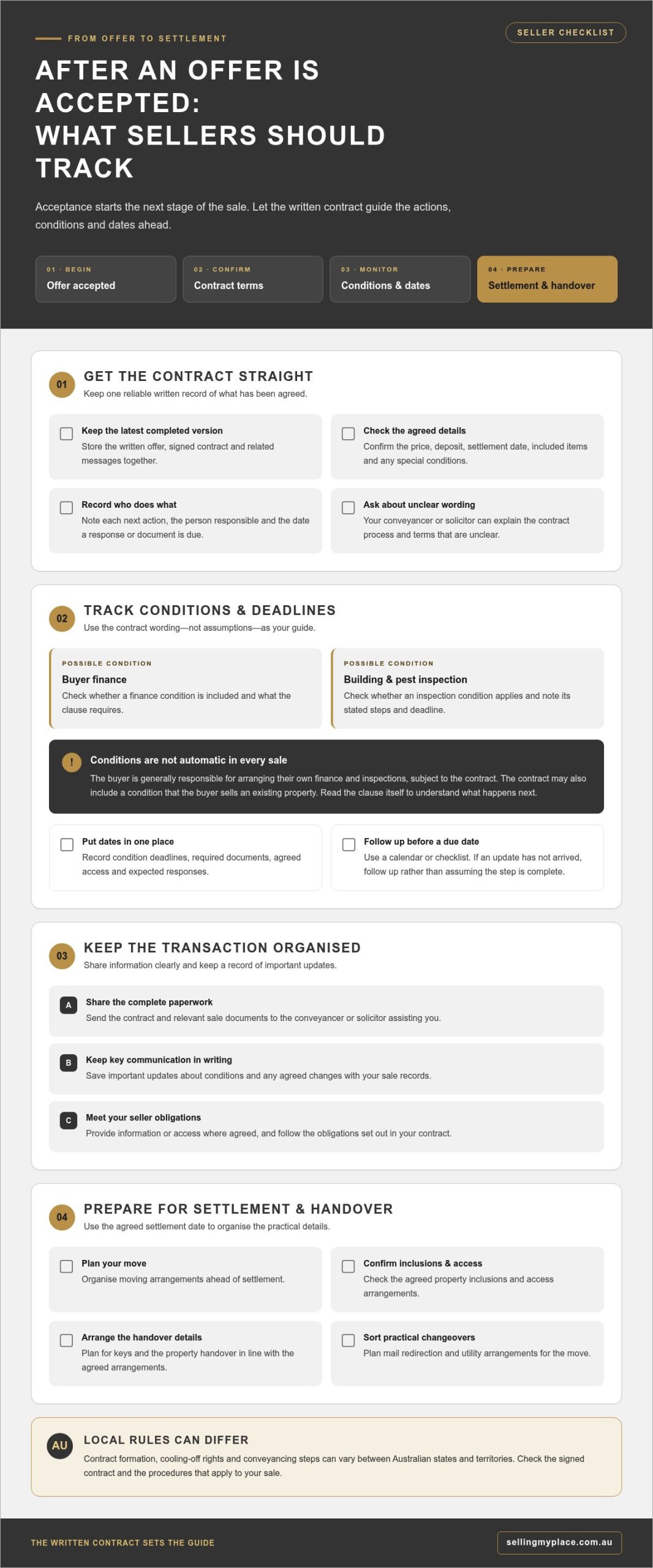
A practical seller checklist for the weeks before settlement
As settlement approaches, small details can take up more headspace than expected. A clear checklist helps you keep documents, property arrangements and moving plans together, with the contract and your conveyancer or solicitor as your reference points. The weeks before handover can vary between sales, so organise around your confirmed settlement arrangements rather than assuming every transaction follows the same timetable.
For sellers wondering what happens after accepting an offer on a house, preparing early can help avoid last-minute scrambles. Start with the records and commitments connected to your sale:
- Sale documents: Keep the contract, any schedule of inclusions and relevant correspondence together. Add transaction documents requested by your conveyancer or solicitor.
- Written commitments: Save records of agreed repairs, access arrangements or other promises made during the sale. Make sure everyone involved has the same written details.
- Questions and deadlines: Note document requests and dates. Ask your conveyancer or solicitor to clarify anything you do not understand.
- Moving arrangements: Plan removal, mail redirection, address changes and utility arrangements around the settlement date and handover instructions.
Keep the checklist practical and up to date. If an arrangement changes, update your records and tell the people involved rather than relying on memory or an old message thread.
What documents and property details should you organise?
Gather documents relevant to your sale, including the signed contract, inclusion list, correspondence and anything specifically requested for the transaction. Check which items stay with the property, such as fixtures or appliances, and distinguish them from belongings you plan to take. If a document request or deadline is unclear, ask your conveyancer or solicitor what is needed and when.
Keep a brief record of agreed work or access as well. Note what was agreed, who is arranging it and any timing discussed. That gives everyone a shared reference if questions come up before handover.
How can you prepare for the final inspection and move?
The buyer may have a final inspection under the contract or the process used in your state or territory. Check the relevant terms and arrangements rather than assuming an inspection is automatic or has the same scope everywhere. Before handover, review the agreed inclusions and leave the property in the condition required by the contract. If you are unsure what that means for a particular item, raise it with your conveyancer or solicitor.
Coordinate removal and utility changes with the confirmed settlement arrangements. Plan mail redirection, address updates and utility changes around the move and handover. Keep keys and any agreed access items ready for the handover process.
For practical guidance while organising your sale and preparing for settlement, get support with your property sale.
Settlement day and what comes next for the seller
Settlement is the final milestone in the sale, but the arrangements depend on your contract and the process used for the transaction. Your conveyancer or solicitor will generally coordinate the required documents and communicate with the other parties about readiness. If settlement is completed electronically, they will also coordinate through the relevant electronic settlement process.
In plain terms, settlement is when the sale is completed under the contract, the buyer pays the balance and ownership is transferred. Where relevant, the process also includes paying out the seller’s mortgage. The sale proceeds are then distributed according to the transaction arrangements.
What happens on settlement day?
The general sequence is to confirm the parties are ready, complete settlement and follow the agreed handover arrangements. Your conveyancer or solicitor can update you on progress and confirm when settlement has occurred. The precise steps and timing can vary across Australia, so use your contract and transaction updates rather than assuming every sale follows the same procedure.
Hand over keys and possession as set out in the contract and related arrangements. Do not assume the buyer receives the keys at a particular time simply because settlement is scheduled for that day. Follow the instructions from the people coordinating the transaction and have the agreed handover items ready.
If you are unsure whether settlement has been completed, wait for confirmation from your conveyancer or solicitor before treating the property as handed over. If arrangements change or a delay arises, ask how it affects the agreed handover. This can prevent confusion on a day when you may also be managing a move or saying goodbye to your home.
Where can sellers get practical support through the sale?
A well-organised sale involves more than preparing the property for buyers. Owners also need to manage information, communications and transaction steps as the sale progresses. Property advice can help you approach those tasks with a clearer plan, while your conveyancer or solicitor coordinates the legal and settlement documentation.
Kincade International Direct Sales supports residential owners with property marketing and advisory guidance, including professional photography, floorplans and pre-sale consulting. Its flat-fee, commission-free model gives owners an alternative to a traditional agency commission. Advisory guidance can help you stay organised through the process, while legal and conveyancing matters remain with the professionals handling your transaction.
Settlement completes the agreed sale and marks the handover stage, subject to the contract and local process. If you are planning a residential sale and want practical support with property marketing and your next steps, discuss sale support with Kincade International Direct Sales.
Take your next property step with confidence
The offer is one milestone in a bigger transition. As you look ahead, make room to plan what comes next, whether you are coordinating a move, preparing for a new home or checking that the sale is progressing as agreed. A steady plan can make the change feel more manageable.
Understanding what happens after accepting an offer on a house also means knowing when to pause and seek clarity. Use your signed terms as the reference point, and direct questions about your obligations or the conveyancing process to the professional handling your transaction. You can also get practical guidance with the sale planning and property marketing involved.
Kincade International Direct Sales supports residential owners with property marketing and advisory options, including a flat-fee, commission-free model. If you are planning a sale and want support with marketing and your next steps, talk with us about selling your property.
With preparation and the right support, you can move into the next chapter feeling more settled and ready for what is ahead.
Frequently Asked Questions
Can I change my mind after accepting an offer on my house?
Possibly, but it depends on whether a contract has taken legal effect, what it says and the rules that apply where the property is located. Once a contract is binding, withdrawing may have serious consequences. Do not cancel arrangements or tell the buyer the sale is off based only on a conversation. Review the signed documents and speak promptly with your conveyancer or solicitor before taking action.
When does a house offer become legally binding in Australia?
There is no single trigger that applies to every Australian sale. The legal effect depends on how the offer and acceptance are documented, the contract terms and the jurisdiction. A verbal agreement is not a substitute for checking the paperwork. Ask your conveyancer or solicitor to explain when your contract takes effect, which conditions apply and whether any deadlines have started. Do not rely on a process described for another state or territory.
Is there a cooling-off period after accepting an offer on a house?
It depends on the state or territory, the contract and the circumstances of the sale. Cooling-off rights can have exceptions, so do not assume a period applies simply because an offer has been accepted. Check the contract for relevant terms and promptly seek guidance specific to your location. If you are unsure whether the agreement is binding or a deadline is close, raise that with your conveyancer or solicitor.
How long does it take to settle after accepting an offer?
There is no single settlement timeframe for every Australian house sale. If you are wondering what happens after accepting an offer on a house, check the settlement date recorded in the signed contract. The parties may agree to different arrangements, and finance, documents or other contract conditions can affect progress. If circumstances change, ask your conveyancer or solicitor how the agreed date and next steps are affected.
What happens if the buyer cannot get finance approval?
Check whether the contract includes a finance condition, what deadline applies and how the buyer must give notice. The outcome depends on those terms and the relevant rules, so do not assume the contract automatically ends or continues. Keep the buyer’s updates and any formal notices in writing. Before responding or agreeing to a change, ask your conveyancer or solicitor to explain the steps available under your contract.
Can I accept another offer after accepting one?
Do not treat a later offer as replacing an agreement already in place. Your obligations depend on whether the first contract has taken legal effect, its terms and the law that applies. Before making a commitment or telling another buyer their offer is accepted, refer the situation to your conveyancer or solicitor. This helps you understand how the existing agreement affects what you can do next.
What should I do with utilities when selling my house?
Plan utility changes around the contract’s settlement and possession arrangements, rather than cancelling services as soon as an offer is accepted. Essential services may need to remain available for agreed access, inspections or handover. Note meter readings, account responsibility and changeover arrangements as you prepare to move. Your conveyancer or solicitor can clarify transaction dates, and you can arrange account updates or closure with the relevant providers.
Stress-Free Property Selling for Australian Owners
A calmer sale often starts with fewer competing decisions, not more. Avoiding stress when selling property isn’t about controlling every twist; it’s about knowing what needs attention now, what can wait and who can help. From preparing for inspections to weighing an offer or adjusting plans, it’s easy to feel pulled in several directions at once.
If you’re unsure where to begin, you’re not alone. Selling a home is a significant change, and practical tasks can sit alongside plenty of emotion. A clear plan can make the next step feel manageable, while realistic milestones help you stay focused without expecting everything to happen at once.
This guide will help you set priorities, organise the sale into a sensible sequence and feel more in control of decisions and communication. You’ll also learn how practical support, such as pre-sale consulting, listing services, photography and floorplans, can ease the workload while you remain involved in your sale. The aim is a steadier process, clearer choices and more confidence as plans unfold.
Key Takeaways
- Reduce uncertainty by separating what you can influence from the outcomes you can’t control.
- Make avoiding stress when selling property more achievable by turning broad goals into clear, manageable steps.
- Look for patterns in buyer feedback before making changes, rather than treating one comment as a verdict on your home.
- Agree on communication routines and share practical tasks to protect your time and energy during the sale.
- Consider how flat-fee, commission-free marketing and advisory support can clarify responsibilities while keeping you involved in decisions.
Why selling property can feel stressful, and what you can control
Selling a home is more than a set of practical jobs. It can mark a move, a change in household plans or the closing of a meaningful chapter, while requiring decisions about preparation, timing and offers. It’s understandable if the process feels demanding, especially when several important things need your attention at once.
Sale-related stress often grows from uncertainty, competing tasks and decisions with real consequences. You may be organising the property while keeping up with everyday responsibilities, responding to inspection arrangements and considering buyer feedback. The pressure can feel heavier when it’s unclear who is handling each task or what needs to happen next. Every owner’s circumstances are different, so there’s no single pace or plan that suits everyone.
Which parts of selling tend to create the most pressure?
Preparation can bring a long list of jobs, from deciding what needs attention to getting the home ready for photography and inspections. Deadlines, inspection availability and regular communication can add to the workload. Offers may feel especially weighty because they call for careful consideration, not an automatic response. When responsibilities aren’t clearly divided, even small tasks can blur into one overwhelming list.
What can sellers influence, and what must they allow for?
You can organise the work around your sale: gather relevant information, plan preparation, set out when you’re available and agree how decisions will be reviewed. A simple task list can clarify who is responsible for each job. Setting a regular time to consider updates can also stop every message from feeling urgent.
Some things remain outside your control. You can’t guarantee when buyers will be interested, how they’ll respond to the property or when an offer may come forward. Trying to predict every outcome can use energy without making the process more certain. Instead, focus on the choices in front of you and the information that helps you make them thoughtfully.
A clear plan won’t control every part of a property sale, but it can turn a complex process into a series of more manageable decisions. That’s a practical starting point for avoiding stress when selling property: know what you can act on, and allow room for what you can’t. Simple routines that support your wellbeing can help too; this overview of stress management techniques offers broader ideas for handling pressure.
How to make a property sale feel manageable with a simple plan
A useful plan doesn’t need to account for every twist. Its job is to show you what matters next, keep essential information close and make progress easier to see. To make avoiding stress when selling property more achievable, break the process into steps you can review and adjust as circumstances change.
Try this simple sequence:
- 1. Define your priorities. Be clear about what matters most, such as your preferred timing, the home’s presentation or how involved you want to be.
- 2. Gather information. Collect property details and sale-related documents before key discussions or decisions.
- 3. Plan preparation. List the work needed to get the home ready, then separate essential tasks from optional improvements.
- 4. Organise communication. Decide where updates, questions and inspection arrangements will be recorded, and when you’ll review them.
- 5. Review decisions. Set aside time to consider new information and agree on the next action, rather than trying to resolve everything as it comes in.
How should you prioritise sale tasks?
Start with tasks that affect readiness or a decision you need to make. For each job, note who is responsible and what needs to happen before it can be marked complete. Optional upgrades can wait until you’ve weighed their purpose against the time and effort involved. Set personal milestones for preparation, listing readiness and availability, but treat them as guideposts, not guarantees. If plans change, update the sequence instead of viewing a revised schedule as a setback.
What information can reduce uncertainty early?
Use one central place, such as a notebook or digital document, to keep dates, property details, relevant paperwork, questions and decisions. That way, important information isn’t scattered across messages and reminders. Market reports and comparable property information can help frame expectations, but they aren’t a promise of the price your home will achieve. For more context, read How to Determine the Market Value of a Home in Australia: The 2026 Seller’s Guide.
Small, specific tasks make a large goal easier to manage. “Prepare the home” can become a list of separate jobs, each with an owner and a realistic target date. This lets you see what’s done, what’s underway and what can wait, without expecting the sale to follow a perfectly smooth path. If you’re selling independently, How to Sell Your Own Home: A Step-by-Step Guide to Sale by Owner in Australia offers further guidance on the process.
When practical guidance would help you shape your sale plan, explore property sale support to clarify your next steps while staying involved in decisions.
How to handle uncertainty, feedback and offers without feeling overwhelmed
Feedback and offers can feel personal, particularly when you’ve invested time and care in your home. A steadier approach is to treat each response as information to assess, not as a verdict or a decision you need to make on the spot. This can make avoiding stress when selling property more achievable, even when the next step isn’t immediately clear.
How can you keep buyer feedback in perspective?
One buyer’s comment may reflect their preferences, budget or circumstances, rather than an objective judgement of your property. Record feedback and look for recurring themes. If several people mention the same practical issue, consider whether a change fits your sale plan. A single suggestion doesn’t automatically mean you should alter the home or its presentation.
Give yourself a little time before making emotionally charged changes. Pause, review what you’ve heard and discuss any possible adjustment with your adviser. This helps you respond deliberately, rather than letting one inspection shape the entire campaign.
How can you make offer decisions with a clearer head?
An expression of interest signals that a buyer may want to discuss the property, but it isn’t the same as a clear offer ready for your decision. The detail and effect of communications can vary, so clarify what the buyer is proposing and what, if anything, they’re asking you to agree to. You don’t need to treat interest as a commitment to proceed.
Before reviewing an offer, revisit your priorities and questions. Consider the whole proposal, not just the headline amount. You might want to understand any conditions, proposed timing, inclusions and response deadline. For legal questions about contract terms, use appropriate conveyance advice.
| Decision factor | Question to consider |
|---|---|
| Offer amount | How does it fit with your expectations and priorities? |
| Conditions | What does the buyer require before proceeding? |
| Timing | Does the proposed schedule work for your circumstances? |
| Inclusions | Is it clear what is included in the proposal? |
Use the table to organise your thinking, not to predict which offer will succeed. If something is unclear, ask for clarification before responding. For more ideas on weighing proposals and communicating your position, see Mastering the Deal: Expert Property Sale Negotiation Tips for Australian Homeowners.
A short pause can create room for a better decision. For structured guidance as you assess buyer responses, explore property sale advisory support.
How to protect your time, boundaries and energy during a sale
A property sale can bring a steady stream of messages, questions and practical jobs. Setting a few clear routines helps you stay informed without feeling that you need to be on call every moment. It’s a useful part of avoiding stress when selling property, especially when sale tasks sit alongside work, family commitments and the ordinary rhythm of home life.
What boundaries make sale communication easier?
Agree on one reliable channel for routine updates, then keep key decisions and agreed next steps in writing. Choose practical times to review messages, such as once in the morning and again later in the day, rather than checking continuously. Set a simple process for urgent questions too: clarify what counts as urgent and which channel should be used. Important matters can then be raised promptly without every update feeling like an emergency.
Be clear about who needs to take part in decisions. A household member might coordinate access for inspections, while another keeps the task list up to date. An adviser can help organise sale-related information or discuss marketing, while you retain the final say on decisions that matter to you. Shared responsibility works best when everyone knows what they’re handling.
How can you preserve your energy during the sale?
Keep ordinary routines where you can. Protecting time for work, meals, rest or family plans gives the sale a place in your week without allowing it to take over. Some flexibility will be needed for preparation and buyer access, so identify in advance where you can adapt and where you need notice. A shared calendar can help household members coordinate commitments and avoid last-minute confusion.
When can outside support ease the workload?
Notice which tasks are taking the most effort. You may find it difficult to organise listing details, arrange photography and floorplans, interpret neighbourhood market information or decide what to prepare before going to market. Residential property listing and advisory support can take defined tasks off your plate while leaving you involved in decisions. A flat-fee, commission-free marketing model can also make service costs more predictable. For more context, see Professional Residential Property Listing Services: The Modern Australian Seller’s Guide.
Support should make responsibilities clearer, not add pressure or speak over you. Choose the parts of the process where guidance would genuinely help, then agree how updates and decisions will be handled. To share the practical load while staying involved in your sale, explore property listing and advisory support.
How the right selling support can help you move forward calmly
Good support should make the moving parts of a sale easier to understand, not add another layer of pressure or take your voice out of decisions. You can stay involved in choices about your home while sharing specific tasks with people who understand the selling process. For owners focused on avoiding stress when selling property, the key is finding support that fits the way they want to sell.
What should useful property-selling support help with?
Practical marketing support can reduce the jobs you need to coordinate yourself. Kincade International Direct Sales provides residential property marketing on a flat-fee, commission-free basis, with listing support, professional photography, floorplans and neighbourhood market reports. Listings remain active until sold. These defined services can help you organise how your home is presented and promoted, without promising a particular price, buyer response or timeline.
Pre-sale consulting and advisory support can help you clarify priorities, make sense of the next steps and identify where guidance would be useful. That might mean planning what to prepare, understanding the marketing material or working out which decisions need your attention. The aim is to share practical responsibilities while keeping you informed and involved, not to guarantee a stress-free sale.
How can you take the next step without rushing?
Start with one simple prompt: what part of selling feels hardest to manage right now? Write down the concern, whether it’s organising the listing, preparing the home or knowing what to do next. Then note the kind of help that would make a real difference. A focused conversation is often easier than trying to solve every part of the sale at once.
Seeking information doesn’t mean you need to make an immediate commitment. It gives you a chance to understand what support involves and decide whether it suits your priorities. Take the time you need to consider your options and keep ownership of the decisions that matter to you.
Selling is a meaningful transition, and you don’t have to work out every detail alone. To explore a more manageable way to prepare for your sale, talk through your property-selling plans.
Take your next step with a clearer plan
A more manageable sale starts with focusing on what you can influence: set clear priorities, break preparation into practical tasks and give yourself space to review feedback and offers. Simple communication boundaries can protect your time, while the right support can make responsibilities easier to understand without taking decisions out of your hands. These are useful foundations for avoiding stress when selling property, even when plans need to change.
Kincade International Direct Sales provides commission-free property marketing and advisory support through a flat-fee model. Listing support includes professional photography, floorplans and neighbourhood market reports, with listings remaining active until sold. Clear, defined support can help you organise the practical parts of selling while staying involved in your sale.
You don’t need to have every detail worked out before exploring your options. Start by identifying the part of the process you’d most like help with, then take the next step at your own pace. Talk through your property-selling plans and explore a more manageable way to prepare for selling. With a clear plan and support that suits your needs, you can move forward with greater confidence.
Frequently Asked Questions
How can I reduce stress when selling my property?
Reduce pressure by making the sale easier to organise, one decision at a time. Write down your priorities, gather relevant property information and break preparation into manageable tasks with clear responsibilities. Keep dates, questions and decisions in one place, and set regular times to review updates instead of monitoring messages constantly. You can’t control buyer timing, but a practical plan can help you focus on informed choices and adjust as needed.
What is the most stressful part of selling a property?
There isn’t one most stressful part for every seller. Preparation, deadlines, inspections, communication and weighing offers can all feel demanding, particularly when they compete with everyday responsibilities. The pressure often increases when it’s unclear who is handling a task or what needs attention next. Identifying your personal pressure points helps you decide where a simple routine, clearer responsibilities or practical selling support could make the process feel more manageable.
Can I sell my property without feeling overwhelmed?
You may not be able to remove every challenge, but you can make the work feel more manageable. Start by separating essential tasks from optional improvements, then set realistic milestones for preparing and listing your home. Keep space in your plan for changes, and share practical responsibilities where possible. Selling involves uncertainty, so aim for steady progress rather than expecting every step to happen exactly as planned.
How do I stay calm when receiving an offer on my property?
Pause before responding and review the proposal against the priorities you set before an offer arrived. Consider the terms as well as the headline amount, including any conditions, timing, inclusions and response deadline. If something is unclear, seek clarification and take time to understand what you’re being asked to decide. An expression of interest may signal buyer interest, but it isn’t necessarily a complete offer or a commitment to proceed.
What happens if my property takes longer to sell than expected?
A longer sale process can be frustrating, but it doesn’t mean you need to make a rushed decision. Review buyer feedback for recurring themes, consider whether your marketing and sale plan still reflect your priorities, and discuss possible adjustments with an adviser. Kincade International Direct Sales keeps listings active until sold, with no time limit. Buyer interest and timing can’t be guaranteed.
Should I use a property adviser to reduce stress when selling?
A property adviser may help if you’re unsure what to do next, find planning the sale time-consuming or want support interpreting market information. Pre-sale consulting and advisory support can help clarify priorities and organise next steps, while you remain involved in decisions. Kincade International Direct Sales provides commission-free property marketing and advisory services through a flat-fee model. Consider which tasks you’d genuinely like help managing before deciding what support suits you.
How can I manage inspections and buyer feedback without losing my routine?
Set practical availability for inspections and agree how arrangements and updates will be communicated. A shared calendar or task list can help household members coordinate access and preparation without relying on one person to remember everything. Protect everyday routines where possible, while allowing some flexibility for sale-related commitments. After inspections, record feedback and look for patterns before making changes; one buyer’s comment isn’t necessarily a reason to alter your plans.
Does selling with support mean I lose control of the sale?
No. Useful support should clarify responsibilities and help with practical tasks while keeping you involved in important decisions. For example, listing support, professional photography, floorplans and neighbourhood market reports can assist with preparing and marketing your property, while advisory support can help you plan. Agree on how you’ll receive updates and which decisions you’ll make. A flat-fee, commission-free model is one option for owners who want practical support while retaining involvement.
Stamp Duty for Sellers in Australia: 2026 Guide
Could a tax you usually don’t owe still affect how you plan your sale? For anyone searching “stamp duty for sellers australia”, the usual answer is reassuring: transfer duty, commonly called stamp duty, is generally the buyer’s responsibility, not a tax charged to the seller simply for selling a home. Still, settlement can involve other costs, and the details of your transaction matter.
It’s understandable to worry that an unexpected bill could reduce your sale proceeds, especially when stamp duty is easily confused with capital gains tax, land tax, GST or conveyancing costs. These are separate charges and obligations, and whether they apply to you depends on your circumstances.
This 2026 guide explains who usually pays transfer duty and when, which sale-related costs sellers may still face, and what to check before settlement, including rates adjustments. You’ll also learn where to confirm the rules for your state or territory and when to ask a conveyancer or qualified tax professional about your specific sale, so you can plan with greater clarity.
Key Takeaways
- For stamp duty for sellers australia, the usual starting point is that the buyer pays transfer duty when ownership changes.
- Transfer duty is separate from capital gains tax and other sale-related costs, which may depend on your circumstances.
- Check the transaction details carefully if your sale isn’t a standard residential property transfer.
- Use the relevant state or territory revenue authority to confirm current duty guidance for the property and transaction.
- A written sale-cost checklist can help you prepare for tax questions, professional fees, loan matters and marketing decisions before settlement.
Stamp duty for sellers in Australia: what the term means
“Stamp duty” is the familiar name Australians often use for property transfer duty. The precise terminology and rules depend on the state or territory, because the duty is imposed under state or territory arrangements rather than as a single federal property tax. The general Stamp duty overview explains the term’s wider use, but your local revenue authority is the place to confirm how it applies to a particular transaction.
For sellers, the usual position is reassuring: the buyer generally pays transfer duty when property ownership transfers. It’s separate from the amount the buyer agrees to pay you under the sale contract, so the buyer’s duty isn’t automatically deducted from your sale proceeds as a seller’s stamp-duty charge. Treat this as a starting point, though, not a substitute for checking the contract, property type and jurisdiction.
Is stamp duty normally paid by the buyer or seller?
In an ordinary property sale, the buyer is generally responsible for the duty associated with acquiring the property. The sale price is paid to the seller under the contract; transfer duty is a separate obligation assessed under the relevant jurisdiction’s rules. Settlement can also involve other payments and adjustments, so ask your conveyancer to explain the figures and responsibilities shown for your transaction.
As a general rule, the buyer pays transfer duty on a property purchase, but the applicable jurisdiction, transaction details and contract should always be checked.
What does transfer duty apply to?
Transfer duty is commonly associated with acquiring or transferring certain interests in property. The exact transactions covered, how duty is assessed and who is responsible are determined by each state or territory’s legislation and official guidance. A straightforward residential sale may therefore raise different questions from a transfer involving another property type or arrangement.
If ownership is changing in a way that doesn’t follow a standard sale, don’t assume the usual buyer-pays explanation settles every duty question. Check the contract and ask a conveyancer to identify the relevant revenue authority’s guidance for the property and transfer involved.
If you’re looking up stamp duty for sellers australia, focus on separating the buyer’s transfer-duty obligation from your own sale proceeds and obligations. A clear explanation of the contract and settlement figures can help you understand what is being paid, by whom and why.
Do sellers pay stamp duty, or other taxes and selling costs?
Understanding stamp duty for sellers australia starts with separating the buyer’s transfer duty from the costs and tax questions that may belong to you as the seller. They aren’t interchangeable, and not every seller faces the same obligations. The Australian Government’s Stamp duty rules page explains the general framework and links to state and territory guidance.
| Item | How it may relate to a sale | What to check |
|---|---|---|
| Transfer duty | Generally payable by the buyer when they acquire property, subject to the relevant rules. | Confirm the jurisdiction’s guidance and the transaction arrangements. |
| Capital gains tax (CGT) | A possible seller tax issue relating to an assessable capital gain. A sale doesn’t automatically mean CGT is payable. | Ask the ATO or a qualified tax adviser how your ownership, use and circumstances affect the outcome. |
| Land tax or GST | Separate tax questions that may be relevant depending on the property and transaction. | Check with the relevant revenue authority, the ATO or a qualified adviser. |
| Sale and settlement expenses | May include conveyancing, marketing, loan discharge or payout expenses, and adjustments to outgoings at settlement. | Review your contract, loan details and settlement statement with the relevant professional. |
How is transfer duty different from capital gains tax?
Transfer duty is generally connected to acquiring or transferring a property interest. CGT, by contrast, concerns a capital gain that may be assessable for tax purposes. Whether CGT applies, and how it’s treated, depends on individual circumstances. Don’t assume that selling a home or investment property automatically creates a tax bill. The Australian Taxation Office (ATO) provides current CGT guidance. For advice tailored to you, speak with a tax professional who can consider ownership, how the property was used and your wider circumstances.
Could land tax or GST affect a property seller?
Possibly, but neither is another name for transfer duty, and their application isn’t identical for every seller. Property use, ownership structure and the type of transaction can all be relevant factors to verify. Check land-tax questions with the relevant state or territory revenue authority, and GST questions with the ATO or a qualified tax adviser. Your conveyancer can help identify transaction details to raise, but shouldn’t replace tax advice.
A written cost checklist can help keep confirmed taxes separate from professional fees, marketing decisions and loan matters. If you’re considering how to prepare and market your home, property sale support information is available here. Kincade International Direct Sales provides flat-fee property marketing and advisory services. Marketing support is separate from stamp-duty advice and doesn’t determine your tax obligations.
When can an Australian property sale need a closer duty check?
The usual buyer-pays approach is a useful starting point, but it won’t answer every question about a particular transfer. If the arrangement differs from a straightforward residential sale, pause before assuming the standard explanation applies. The relevant rules depend on the state or territory where the property is located and on the details of the transaction.
Which transaction details should sellers flag?
Before settlement, tell your conveyancer if the transfer involves anything out of the ordinary, such as:
- a transfer between related parties rather than an ordinary sale to an unrelated buyer
- a partial interest in the property, rather than the whole interest
- unusual consideration, or an arrangement where the agreed payment isn’t straightforward
- a property type or transaction structure that isn’t a standard residential sale.
These are prompts for a closer review, not claims that duty will necessarily apply or that a particular party must pay it. Terminology and treatment can differ across jurisdictions. Ask your conveyancer to check the current guidance from the revenue authority for the state or territory where the property sits, and to seek qualified tax advice if the transaction raises broader tax questions.
Can a contract change who pays a duty?
There’s an important distinction between who may be legally liable under duty rules and what the parties agree about payments between themselves. A contract may set out payment or reimbursement arrangements, but that wording shouldn’t be treated as a substitute for confirming the statutory position. The effect of any clause depends on the transaction and applicable law, so have a conveyancer explain it before you rely on an assumption.
Contract terms may allocate costs between the parties, but they don’t replace checking who is liable under the relevant duty rules.
Read the sale contract closely and ask how any duty-related wording flows through to the settlement statement. Check which party is expected to make each payment, whether an agreed contribution or adjustment is recorded, and whether those arrangements match the advice you’ve received. If something is unclear, raise it before settlement rather than relying on a verbal understanding.
For sellers researching stamp duty for sellers australia, the practical safeguard is to match three things: the property’s jurisdiction, the nature of the transfer and the contract’s payment terms. A conveyancer can help interpret the settlement documents and identify questions for the relevant authority. That way, the general rule remains a guide while the actual transaction gets the careful review it needs.
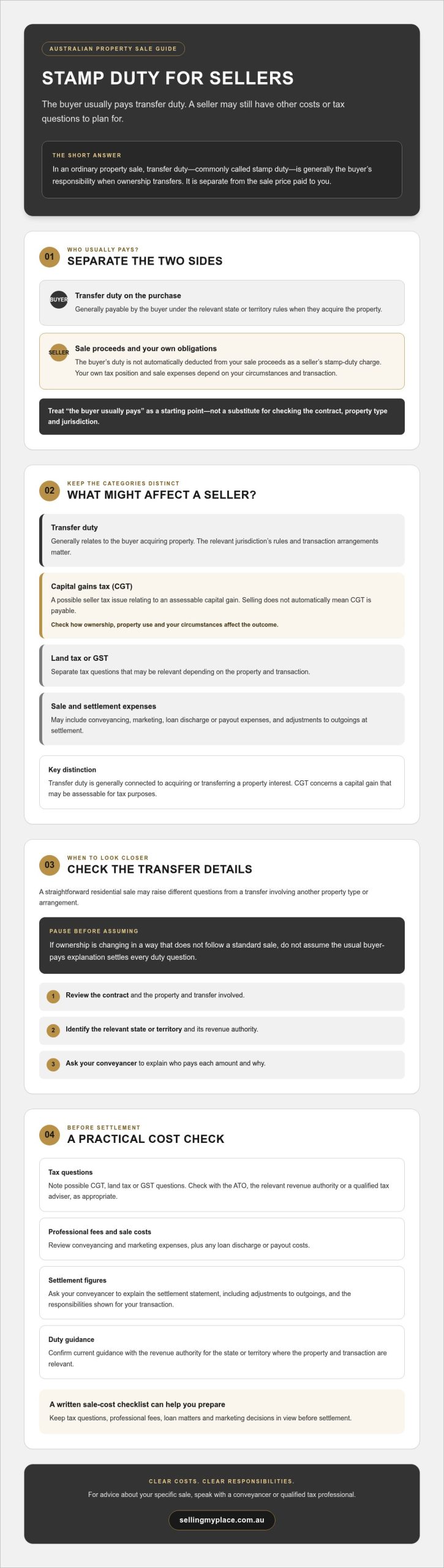
How sellers can check stamp duty before settlement
A few well-organised checks can help you separate the buyer’s duty question from your own contract and settlement responsibilities. If you’re researching stamp duty for sellers australia, use this process to find the right official guidance and know which questions to put to your conveyancer.
What information should sellers gather first?
Start with the details that help an adviser identify the rules for your transaction. You don’t need to gather more personal or financial information than is relevant.
- Identify the property’s jurisdiction. Note the state or territory where the property is located. The applicable duty guidance comes from that jurisdiction’s revenue authority.
- Describe the transaction. Clarify whether it’s an ordinary residential sale or has features such as a transfer of part of an interest, related parties or unusual consideration. These details are prompts for review, not proof that duty applies.
- Review the contract. Have the signed or proposed contract available, including any wording about duty, contributions or adjustments. Ask your conveyancer to explain clauses you’re unsure about.
- Check settlement arrangements. Gather the proposed settlement date and relevant settlement information, then ask how payments and adjustments are expected to appear in the settlement statement.
Share only what’s needed with the professionals helping with the transaction. Take care not to circulate unnecessary identifying, banking or other sensitive personal information.
Who can confirm the answer for your transaction?
For the current official position, check the revenue authority for the state or territory where the property sits. Its guidance is the appropriate starting point for duty rules and any relevant forms, calculators or updates. Don’t rely on a general online estimate unless you’ve confirmed that its inputs and assumptions match your transaction.
Your conveyancer or solicitor can help interpret the contract and settlement implications. Ask them to clarify who is legally liable, how any agreed payment arrangement is recorded, and whether unclear contract wording needs attention before settlement. If the answer depends on unusual transaction details, ask what further professional advice is appropriate.
Keep tax questions in their own lane. For income-tax or GST guidance, consult the Australian Taxation Office (ATO) or a qualified tax professional. Duty checks shouldn’t be replaced by decisions about how to market the property.
For information about preparing and marketing your residential property, see the property sale support options. This support can help you plan the sale process, while duty and tax questions remain with the relevant authority and qualified advisers.
Plan the sale with clear costs and the right support
A clear cost picture can make a major sale feel more manageable. Buyers generally pay transfer duty, while sellers should separately check their own tax position and the expenses involved in preparing and completing the sale. Keep those categories distinct: the buyer’s duty isn’t a substitute for checking your own obligations, and a marketing decision doesn’t determine your tax liability.
How should sellers build a reliable sale-cost picture?
Start a written checklist and label each item as confirmed, estimated or awaiting professional advice. That simple step helps prevent an assumption from being mistaken for a settled cost. You might organise it under these headings:
- Taxes: note any advice or official guidance you’ve received about your own tax position. Keep buyer transfer duty separate.
- Professional fees: record conveyancing and any tax advice you’re seeking, based on information provided by the relevant professional.
- Loan matters: ask your lender and conveyancer what needs to be checked about your loan and its handling at settlement.
- Marketing and preparation: list the services and sale-preparation choices you’re considering, and confirm their terms directly.
Update the checklist as the contract and settlement details become clearer. For a practical overview of the owner-led sale process, read this guide on how to sell your own home. It can help you think through the steps involved without mixing them up with duty or tax advice.
Where does property-selling support fit in?
Marketing support can help organise how your home is presented and listed, but it can’t determine who owes tax or how duty rules apply. Kincade International Direct Sales offers flat-fee property marketing and advisory packages, including professional photography and floorplans. Its commission-free model is separate from tax, conveyancing and loan-related questions. Find out more about professional residential property listing services.
For anyone weighing up stamp duty for sellers australia, the steady approach is to verify duty with the relevant revenue authority, get transaction-specific advice where needed, and plan the rest of the sale costs in their own categories. A marketing service can support the sale process, but it doesn’t change your duty or tax position.
Move ahead with a clearer sale plan
For stamp duty for sellers australia, the key takeaway is that buyers generally pay transfer duty, while sellers should check their own tax position and sale costs separately. The contract, transaction details and state or territory rules matter, so confirm what applies with the relevant revenue authority and a conveyancer before settlement.
A written checklist can help you keep confirmed obligations, professional advice, loan matters and marketing decisions organised. Kincade International Direct Sales is a commission-free property marketing and advisory service with a flat-fee model. Its services include professional photography and floorplans, separate from tax advice or duty obligations.
With clear information and the right support, you can take the next step with greater confidence.
Frequently Asked Questions
Do sellers pay stamp duty when selling a house in Australia?
Generally, no. In an ordinary Australian residential sale, the buyer usually pays transfer duty, commonly called stamp duty, when acquiring the property. It’s separate from the sale price and isn’t automatically deducted from your proceeds as a seller’s duty payment. Check the contract and settlement arrangements for your specific transaction, particularly if the transfer is unusual or involves more than a standard sale.
Is stamp duty the same as capital gains tax?
No. Transfer duty is generally associated with acquiring or transferring certain property interests, while capital gains tax (CGT) concerns a capital gain that may be assessable for tax purposes. Selling a property doesn’t automatically mean you’ll owe CGT. The outcome can depend on factors such as ownership and how the property was used. Check current Australian Taxation Office (ATO) guidance and seek advice for your circumstances.
Can a seller be responsible for transfer duty in Australia?
The buyer generally pays transfer duty in an ordinary property purchase, but don’t assume that rule answers every transaction. The applicable legislation and transaction details determine legal liability, while a contract may separately describe how the parties arrange or share a payment. If your sale involves a partial interest, related parties or another non-standard feature, ask your conveyancer to check the relevant state or territory rules.
How much stamp duty does a seller pay?
For a typical residential sale, the seller generally doesn’t pay the buyer’s transfer duty, so there usually isn’t a seller stamp-duty amount to calculate. That doesn’t mean the seller has no sale costs or tax questions: conveyancing, loan-related matters and a possible CGT liability are separate considerations. Don’t rely on a generic calculator for an unusual transfer. Confirm the transaction details with the relevant revenue authority and your adviser.
What happens if the sale contract says the seller pays stamp duty?
Ask your conveyancer to explain the clause before relying on it. Contract wording may set out an agreed payment or reimbursement arrangement between the parties, but it doesn’t necessarily change who is legally liable under the relevant duty legislation. Have the clause read alongside the transaction details and settlement statement, and clarify who is expected to pay what before settlement. If needed, seek advice from a qualified professional.
Do sellers pay stamp duty on an investment property sale?
In an ordinary sale, the buyer generally pays transfer duty, whether the property is an investment or a home. For the seller, an investment property may raise separate tax questions, including whether a capital gain is assessable. The result depends on the owner’s circumstances and the property’s history. Check the ATO’s current CGT guidance and speak with a qualified tax professional rather than assuming duty and CGT are the same.
Does every Australian state and territory have the same stamp-duty rules?
No. Transfer duty is governed by state and territory rules, so terminology, processes and the way a particular transaction is treated can vary. The property’s location determines which revenue authority’s guidance to check. For a current answer, use that authority’s official information and ask your conveyancer how it applies to your contract and settlement. Avoid relying on a rule or calculator intended for a different jurisdiction.
Should I check stamp duty before settlement?
Yes, especially if the transaction isn’t a straightforward residential sale or the contract includes unclear payment wording. Identify the property’s state or territory, review the transaction type and contract, then check the relevant revenue authority’s current guidance. Ask your conveyancer to clarify liability and settlement arrangements before you rely on an assumption. For sellers researching stamp duty for sellers australia, this helps keep the buyer’s duty distinct from your own sale costs and tax questions.
Calculating the Total Cost of Selling Property in Australia (2026 Guide)
What if your sale price looks strong, but the amount left after settlement is much lower than you expected? When calculating total cost of selling property, the difference often comes down to expenses that vary with your approach, from agent fees and marketing to conveyancing and mortgage discharge costs.
It can be hard to tell which charges are essential, which are optional and whether a commission-based service or flat-fee approach offers better value. Comparing headline fees alone can be misleading. A more useful comparison includes everything each option covers and how the full set of costs affects your estimated proceeds.
This guide will help you build a property-specific estimate, compare selling approaches on equal terms and work out what may remain after settlement. It covers common expenses, less obvious items to check and costs that apply only in certain circumstances. You’ll also find out what to confirm with your conveyancer, lender, tax adviser or service provider, so you can plan with fewer surprises.
Key Takeaways
- When calculating total cost of selling property, group expenses by when they’re paid: before marketing, during the sale and at settlement.
- Use an itemised checklist and mark each cost as applicable, not applicable or awaiting a written quote.
- Compare commission and flat-fee options using the same sale scenario. Check inclusions, exclusions, payment timing and contract terms.
- Estimate potential proceeds by starting with your expected sale price, then subtracting relevant expenses and settlement deductions.
- Keep optional preparation spending separate from transaction costs, and verify unclear items with the relevant professional or provider.
How to approach calculating total cost of selling property
Start by separating the amount your property sells for from the costs and deductions associated with the sale. The sale price is the agreed amount, not necessarily what you retain. Your estimated net proceeds are what remains after applicable selling expenses and settlement deductions, including any loan payout. Tax outcomes depend on your circumstances, so treat tax as a separate consideration and seek advice from an Australian tax professional if needed.
Costs also fall due at different stages. You might pay some expenses before the property is listed, incur others during marketing, then have certain amounts accounted for at settlement. Timing and costs depend on your property, contract, selling method and personal circumstances. First identify what may apply, then confirm the figures and obligations with the relevant professionals and providers.
Selling costs versus sale price and net proceeds
Think of the sale price as the starting point for your estimate, not the final result. Sale-related expenses may include agent or flat-fee marketing charges, advertising, conveyancing, property preparation or an auctioneer if you choose to sell by auction. At completion, settlement may also involve paying out a mortgage and accounting for relevant adjustments under the contract.
For a working estimate, subtract expected selling costs and applicable settlement deductions from your assumed sale price. Keep the loan balance and any potential tax liability on separate lines. Both can affect what remains, but neither is the same as a marketing or transaction fee.
Which costs vary between Australian property sales?
Some costs are common to many sales, while others depend on the property and the approach you choose. Marketing inclusions can differ, for example. Check whether photography and floorplans are included or quoted separately. Styling, repairs, auction services and mortgage discharge costs may apply only in particular circumstances. Stamp duty, also called transfer duty, is generally a buyer’s cost, not a seller’s expense.
Conveyancing helps manage the transfer of property title. You can read more about the legal process of conveyancing, but the work and requirements for an Australian sale can vary by state or territory. Don’t rely on a single national fee schedule. Ask a conveyancer or solicitor for a current, itemised quote, and check the settlement terminology and requirements that apply to your transaction.
Make a property-specific list and mark each line as applicable, not applicable or awaiting a written quote. Ask providers to clarify inclusions, exclusions, payment timing and contract terms. You can compare a flat-fee marketing option with other sale approaches, but use the same assumptions and include the same non-agent costs. This gives you a fairer view of likely expenses and potential proceeds.
Which property-selling costs should you include in your estimate?
A reliable estimate reflects the costs that apply to your sale, not a standard list where every item is assumed. For calculating total cost of selling property, create a line for each category below and mark it applicable, not applicable or awaiting a written quote. Ask providers what’s included, what may be charged separately and when payment is due.
Marketing, preparation and professional support
Start with the sale method and the services you plan to use. If you’re comparing an agent with a flat-fee marketing option, check the fee basis and service scope side by side. Confirm whether photography, floorplans, listing exposure and advisory support are included or charged separately. Ask how long the listing remains active under the agreement, and verify the current inclusions and listing terms directly with the provider.
- Agent or marketing: Record the agreed commission or flat fee, any marketing charges, applicable GST and payment timing. Don’t compare headline fees without checking what’s included.
- Property preparation: Consider repairs, cleaning, styling, gardening or moving only if they suit the property and your plans. These are choices to assess after inspecting the home, not automatic selling costs.
- Professional support: Note any separate advice or services you intend to use. Request a written quote that sets out the scope.
Conveyancing, finance, tax and settlement items
Ask a conveyancer or solicitor to identify likely legal, contract and settlement charges for your transaction. Processes and requirements can vary by state or territory, so request a current, itemised estimate rather than relying on a general figure.
- Finance: If there’s a mortgage, ask your lender for a current payout figure and whether any discharge-related amounts apply. Use a figure that reflects your expected settlement timeframe.
- Settlement: Ask your conveyancer which adjustments or deductions may apply under your contract and how they’ll appear in the settlement statement.
- Tax: Don’t guess a potential capital gains tax amount. Your circumstances matter. Speak with a qualified tax adviser and consult the ATO’s guidance on calculating Capital Gains Tax.
Once you’ve gathered the relevant quotes and figures, you’ll have a more useful estimate for your property. If you’re considering a flat-fee marketing approach, you can ask about property marketing options and confirm which inclusions and terms apply to your sale.
How do commission and flat-fee selling approaches compare?
For a fair comparison, hold the sale scenario constant. Use the same property and estimated sale price, then keep conveyancing, finance, preparation and other applicable expenses identical for each option. Change only the selling service and the costs that genuinely differ. This makes calculating total cost of selling property more useful than comparing two headline fees in isolation.
With a commission-based arrangement, the fee is generally calculated as a percentage of the agreed sale price, so the amount changes if the final price changes. A flat fee is a set service charge under the provider’s written terms. For either option, confirm the fee basis, additional charges and payment timing in the agreement.
Compare the complete service, not just the headline fee
Ask what each option includes, such as professional photography, floorplans, listing exposure and advisory support. Check for exclusions and extra charges, as well as cancellation terms, listing duration and any conditions that could affect the final bill. Request the details in writing so you can compare like with like. A lower fee doesn’t automatically mean weaker service or better value. The right fit depends on the support and inclusions you need.
| Comparison point | Commission-based arrangement | Flat-fee arrangement |
|---|---|---|
| Fee basis | Percentage of the agreed sale price. Confirm how it’s calculated. | Set service charge. Confirm what the written terms cover. |
| Inclusions and exclusions | Record photography, floorplans, listing exposure and advice, plus anything charged separately. | Record the same items and note any exclusions or optional extras. |
| Payment timing | Check when the fee becomes payable and how payment is arranged. | Confirm payment timing and any conditions in the agreement. |
| Contract terms | Check cancellation provisions, listing duration and other conditions. | Check the same terms, including how long the listing remains active. |
How a flat-fee model fits into the calculation
Kincade International Direct Sales is one example of commission-free, flat-fee property marketing. Its service includes professional photography, floorplans, global property listings and advisory support. Confirm current inclusions and listing terms with the provider before using them in your estimate.
To compare estimated net proceeds, start with the same assumed sale price for both approaches. Subtract each option’s service and marketing charges, then deduct the same conveyancing, finance, preparation and settlement items that apply to your property. If the final sale price differs from your estimate, recalculate any percentage-based fee using the actual agreement terms. This is an informed comparison, not a guarantee of what you’ll retain.
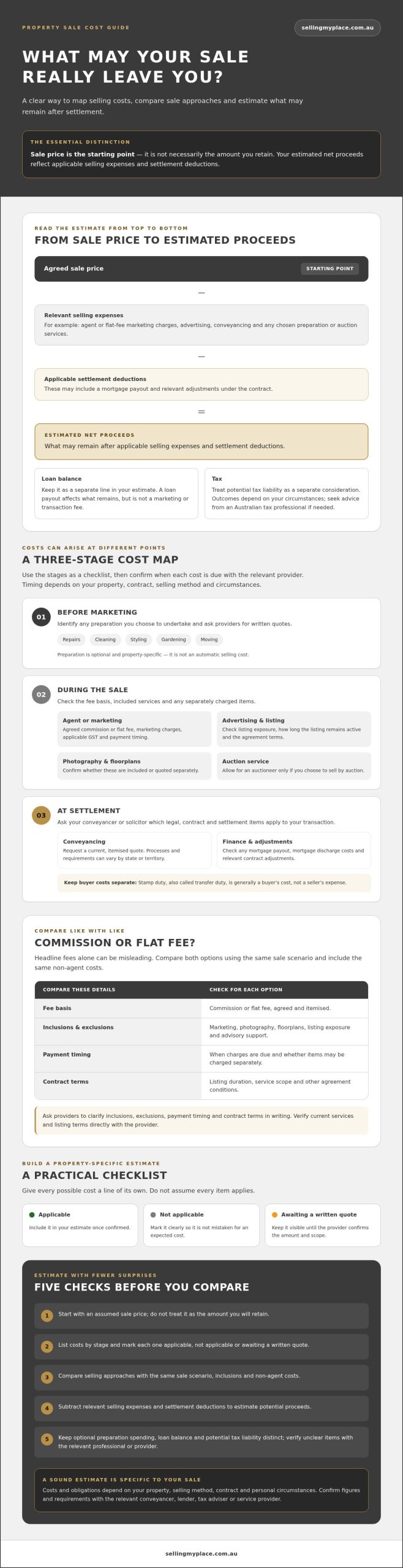
How to calculate your estimated selling costs step by step
A worksheet brings quotes and settlement details together in one estimate you can update as the sale progresses. Keep the assumed sale price separate from expenses, and label each figure as confirmed, estimated or unknown. Use A$ placeholders until you have figures for your property.
Gather the figures needed for a property-specific estimate
Collect written quotes and check what each covers, including marketing inclusions, conveyancing, any preparation work and your lender’s current payout information. Base your sale-price assumption on relevant market evidence rather than an unsupported online estimate. For help developing that assumption, see this guide to determining a home’s market value.
Build your worksheet
- Estimated sale price: A$[amount] | Status: [estimated/unknown]. Note the evidence and date behind your assumption.
- Agent or flat-fee service: A$[amount] | Status: [confirmed/estimated/unknown]. Record the fee basis and written agreement terms.
- Marketing and listing expenses: A$[amount] | Status: [confirmed/estimated/unknown]. List photography, floorplans, listing exposure and any separately quoted items.
- Conveyancing and transaction charges: A$[amount] | Status: [confirmed/estimated/unknown]. Use an itemised estimate for your state or territory and transaction.
- Property preparation: A$[amount] | Status: [confirmed/estimated/unknown]. Include only work you’ve decided is worthwhile, such as cleaning, repairs or styling.
- Finance payout and discharge items: A$[amount] | Status: [confirmed/estimated/unknown]. Enter the lender’s current payout figure and note any applicable charges.
- Settlement adjustments or other deductions: A$[amount] | Status: [confirmed/estimated/unknown]. Confirm relevant items with your conveyancer.
- Potential tax liability: A$[amount] | Status: [adviser to confirm]. Don’t treat this as a generic estimate. Ask a qualified tax adviser about your circumstances.
Estimated net proceeds = assumed sale price − selling expenses − applicable settlement deductions. Keep tax and loan figures clearly identified so you can see what’s confirmed and what still needs checking. Don’t treat an unknown as a confirmed charge. Flag it and follow up with the relevant provider.
To stress-test your estimate, repeat the calculation with more than one plausible sale-price assumption. Apply the same non-agent expenses to each scenario, changing only figures that genuinely depend on the sale price or agreed terms. These are planning scenarios, not promises of a result. The agreed sale terms can also affect the final outcome, so review these property sale negotiation tips.
Update the worksheet when quotes, the lender payout figure or sale assumptions change. For help reviewing property marketing options and inclusions, contact Kincade International Direct Sales.
How to manage selling costs and choose your next step
Once your worksheet is taking shape, make each line clear and verifiable. A low headline fee can look appealing, but it’s difficult to judge until you know what’s included, what may cost extra and when payment is due. Ask providers for written details, then update your estimate rather than relying on verbal assurances.
Reduce uncertainty without overlooking essential support
Request an itemised quote that identifies inclusions, exclusions, additional charges, payment timing and relevant contract terms. For marketing services, check the scope of professional photography, floorplans, listing exposure and advisory support. A clear comparison helps you decide whether the service suits your needs, rather than simply choosing the lowest quoted fee. For a closer look at what listing services can cover, read this residential property listing services guide.
Keep optional preparation spending separate in your worksheet. Cleaning, repairs or styling may be useful for your property, but they’re not automatic costs for every seller. Transaction and settlement items also need checking with the relevant professionals. Ask your conveyancer about the sale process and settlement figures, your lender for current payout information, and a qualified tax adviser about any tax questions that apply to your circumstances.
Choose a selling approach that fits your cost plan
Use the same worksheet to compare a commission-based arrangement with a flat-fee option. Keep your sale-price assumptions and non-agent expenses consistent, then compare the service fee, inclusions, exclusions, payment timing and contract terms. This gives you a more grounded view of estimated net proceeds than comparing headline charges alone. The aim of calculating total cost of selling property is to understand the whole picture, not to assume one method will suit every owner.
Kincade International Direct Sales is an option for owners considering commission-free marketing through a flat-fee model. Its service includes professional photography, floorplans, property listings and advisory support. Confirm current inclusions and listing terms directly before adding them to your estimate.
If you’d like to explore whether commission-free marketing fits your plans, discuss your property sale. Ask about the service scope and terms so you can assess the option without assuming a particular sale price or saving.
Make your next property-sale decision with confidence
Calculating total cost of selling property is easier with a property-specific estimate than with a headline fee or broad rule of thumb. List each expense and settlement deduction, mark what’s confirmed and what still needs a quote, then check relevant figures with your conveyancer, lender or tax adviser.
Before choosing a selling approach, compare the full service scope and written terms. Commission-free, flat-fee marketing may suit some sellers, but value depends on the inclusions and support you need. Kincade International Direct Sales describes professional photography, floorplans and advisory support as service inclusions. Confirm current inclusions and listing terms directly before comparing them with other options.
A clear estimate and a considered comparison can help you decide what to do next. The questions and answers below cover common points sellers may need to check.
Frequently Asked Questions
Is the agent commission the only major cost when selling a property?
No. Depending on your sale, the estimate may also include marketing, conveyancing, property preparation, finance-related amounts and settlement deductions. Some items may be included in a provider’s fee, while others are charged separately or are optional. Ask for written, itemised terms so you can see what each service covers. Then check which expenses actually apply to your property before comparing selling approaches or estimating your proceeds.
What costs should I include when calculating the total cost of selling property?
Start with the selling service and marketing, then check conveyancing, property preparation, moving, lender-related amounts and any tax questions that may apply. Not every seller will incur every cost, and some services may be bundled. Create an itemised list and label each figure as confirmed, estimated or not applicable. Verify transaction-specific charges with the relevant provider or professional instead of treating a general checklist as a final quote.
How do I calculate how much money I may keep after selling?
Begin with a realistic sale-price assumption, then subtract your selling expenses and relevant settlement deductions. Use verified figures where possible, and clearly mark estimates or unknowns. The result is an estimate, not a guaranteed amount. Your final proceeds may depend on the contract, lender’s payout information, transaction costs and personal tax circumstances. Confirm the final figures with your conveyancer and lender as settlement approaches.
Is a flat-fee property service cheaper than a commission-based agent?
It depends on the agreed fee, sale circumstances, service inclusions and any extra charges. Compare both approaches using the same sale-price assumption and identical non-agent expenses. Check the written terms for marketing, photography, floorplans, advisory support, listing duration and payment timing. Kincade International Direct Sales offers commission-free property marketing through a flat-fee model, with service inclusions to verify. A headline fee alone can’t establish overall value.
Can I deduct property selling costs from capital gains tax?
Tax treatment depends on the property, your ownership history and individual circumstances. Don’t assume every selling expense can be deducted or estimate your tax outcome from a general guide. Keep invoices and transaction records, then ask a qualified Australian tax adviser which costs may be relevant to your situation and what evidence you’ll need. This helps you avoid treating a general explanation as personal tax advice.
What happens if my selling-cost estimate changes before settlement?
Update your worksheet when you receive a revised quote, agree to additional work or obtain current lender or conveyancing information. Keep earlier figures and assumptions so you can track what changed and why. Before settlement, ask the relevant professionals to confirm outstanding amounts and explain any adjustments. An estimate is a planning tool, not a final proceeds statement, so don’t rely on an older version as the settlement figure.
Do selling costs vary between Australian states and territories?
Yes. Some conveyancing steps, transaction requirements and related charges may vary by state or territory, while other costs depend on your property and chosen services. A national guide can help you identify cost categories, but it can’t confirm every local requirement or charge. Ask a conveyancer familiar with the property’s jurisdiction to check which costs apply and when they’re payable. Request a current, itemised estimate for your transaction.
Ready to compare flat-fee marketing with your other selling options? Discuss your property-selling options with Kincade International Direct Sales and confirm the service inclusions and terms for your sale.
Benefits of Selling Your Own Property: Is It Right for You?
What if selling your own property gave you more say over the process without leaving you to work everything out alone? The benefits of selling your own property can include greater control over pricing, inspections and buyer conversations, as well as the opportunity to avoid agency commission. Those advantages need to be weighed against the time and responsibility involved.
It’s understandable to wonder whether potential savings are worth the extra work. Marketing, buyer enquiries, offers and sale paperwork all need attention. Selling independently doesn’t have to mean managing every detail without help: some owners use flat-fee marketing and advisory services while keeping control of key decisions.
This article looks at the financial, practical and personal benefits, alongside the challenges to consider before choosing your approach. You’ll learn where greater control may help, which tasks you may need to take on, and what to ask when deciding whether to sell entirely on your own or seek professional support.
Key Takeaways
- The benefits of selling your own property can include fee flexibility and a more hands-on role, but the right balance depends on your priorities.
- Compare the full cost of each approach, including marketing and professional support, rather than focusing on commission alone.
- Consider how much time you can set aside and where you’d want expert advice, particularly with offers and paperwork.
- Before choosing a service, check its written terms, what’s included and which responsibilities remain yours.
- Use your priorities, confidence and available support to decide whether to sell independently or take a supported approach.
What are the benefits of selling your own property in Australia?
Selling your own property means taking the lead on some or all of the work involved in marketing it and managing the sale. Often described as For sale by owner (FSBO), this approach can give you closer control over decisions, more flexibility in how you pay for selling services and direct conversations with prospective buyers.
The benefits of selling your own property depend on your priorities, the property, market conditions and the support you choose. “Selling yourself” doesn’t have to mean doing everything without professional help. You could manage buyer enquiries yourself while using professional photography, floorplans, property listings or conveyance advice. Kincade International Direct Sales offers flat-fee property marketing and advisory packages, giving owners the option to stay involved while accessing selected services.
How does selling your own property differ from using a traditional agent?
The main difference is who is responsible for coordinating each part of the sale. If you sell independently, you may organise marketing, arrange inspections, respond to enquiries and lead offer discussions yourself. With an agent, some or all of these tasks may be handled on your behalf, depending on the agency’s service and your agreement.
There’s no single standard arrangement. Some owners choose a traditional agency, while others select specific marketing or advisory support and keep more tasks in their own hands. Before deciding, clarify who will prepare listing materials, manage buyer contact and assist with offers or paperwork. The written service agreement matters more than the label.
Who may benefit most from selling independently?
This approach may suit owners who are comfortable organising details, communicating with prospective buyers and staying involved as the sale progresses. If you value direct oversight, you may appreciate deciding how the property is presented, when inspections take place and how to respond to buyer feedback.
Be realistic about your time and confidence, too. A busy schedule, uncertainty about discussing offers or a property that needs more involved marketing may make a supported approach feel more manageable. The choice doesn’t have to be all or nothing. Consider which responsibilities you’re ready to take on and where professional advice could help.
How more control can shape your property sale
A hands-on role lets you stay close to the details that shape how buyers see your home. You can review listing information, decide how the property is presented and communicate directly with prospective buyers. That oversight may help you notice questions or feedback early, then decide whether anything needs clarifying or changing.
Control also comes with practical responsibilities. Someone needs to keep the sale moving. Enquiries may arrive while you’re at work or managing family commitments, and inspections need to suit both your circumstances and prospective buyers. A simple plan for checking messages, recording conversations and following up can make the process easier to manage.
Control over a property sale also means taking responsibility for decisions and following through on them. The right level of involvement is personal. You can take on selected tasks and seek professional support for others rather than assuming you must manage every part alone.
Choosing how and when to present your property
As the owner, you can check that listing details are accurate and that the property’s features are described clearly. You’ll also have input into presentation and the timing of marketing activities, based on your circumstances and readiness. For an overview of what listing support can involve, read this guide to professional residential property listing services.
Professional photography and floorplans are examples of marketing materials you may choose to use, whether you arrange them independently or through a service. Before signing up, check what’s included, who organises each item and which decisions and tasks remain yours.
Communicating directly with prospective buyers
Speaking with buyers yourself gives you first-hand insight into what they want to know, from a feature of the home to the timing of an inspection. Their feedback can help you answer clearly and keep track of recurring questions. It also calls for organisation: note enquiries, record agreed next steps and reply within a timeframe you can reliably manage.
Offer discussions require care and clear judgement. Think about your priorities before negotiations begin, including what matters to you beyond the proposed price. If you’re unsure how to assess an offer, seek advice. Explore these property sale negotiation tips as you prepare.
For guidance on the rules and process that apply to your sale, check the relevant state or territory resources. This consumer guidance on selling property is one reference; requirements and processes can differ across Australia. If you’d like to explore a more supported, hands-on approach, you can ask about property listing and advisory support.
Can selling your own property reduce selling costs?
It can. If you sell without a commission-based agency arrangement, you may avoid that particular selling expense. But commission is only one part of the picture. Owners may still pay for marketing, professional services and transaction-related costs. The benefits of selling your own property are best assessed by comparing the full costs and responsibilities of each approach, not by focusing on one fee.
Which costs should an owner compare?
Depending on your property and chosen approach, your budget may need to account for:
- Agency commission, if charged under your agreement
- Property marketing, photography and floorplans
- Conveyancing or other professional advice
- Mortgage discharge and other transaction-related expenses, where applicable
A commission-based arrangement and flat-fee marketing use different fee structures. With commission, the fee is generally linked to the sale under the agreed terms. A flat fee is set for specified services, so check exactly what it covers. Neither label tells the whole story. Compare inclusions, exclusions, payment terms and the tasks you’ll need to handle yourself.
| Arrangement | What to check | Possible owner responsibilities |
|---|---|---|
| Commission-based agency | How commission is calculated, when it’s payable and which services are included | Reviewing decisions and documents, with some sale tasks handled by the agent as agreed |
| Flat-fee marketing | Which listing and marketing services are covered, and what costs are separate | Depending on the agreement, responding to enquiries, coordinating inspections or discussing offers |
| Fully independent sale | Any separately arranged marketing and professional services | Taking the lead on sale activity and arranging advice or support where needed |
How to think about your potential net proceeds
As a starting point, estimate net proceeds by subtracting relevant selling and transaction expenses from the sale proceeds. Include costs you’ll pay directly as well as any agreed service fees. Selling independently may reduce one expense, but it can also mean taking on tasks that might otherwise be included in another arrangement.
Lower selling costs don’t guarantee a higher net sale outcome. The final result also depends on the sale price achieved and the expenses involved, and no fee structure can guarantee a particular price. To inform your planning, read this guide on how to determine a home’s market value, then compare written service terms before choosing an approach.
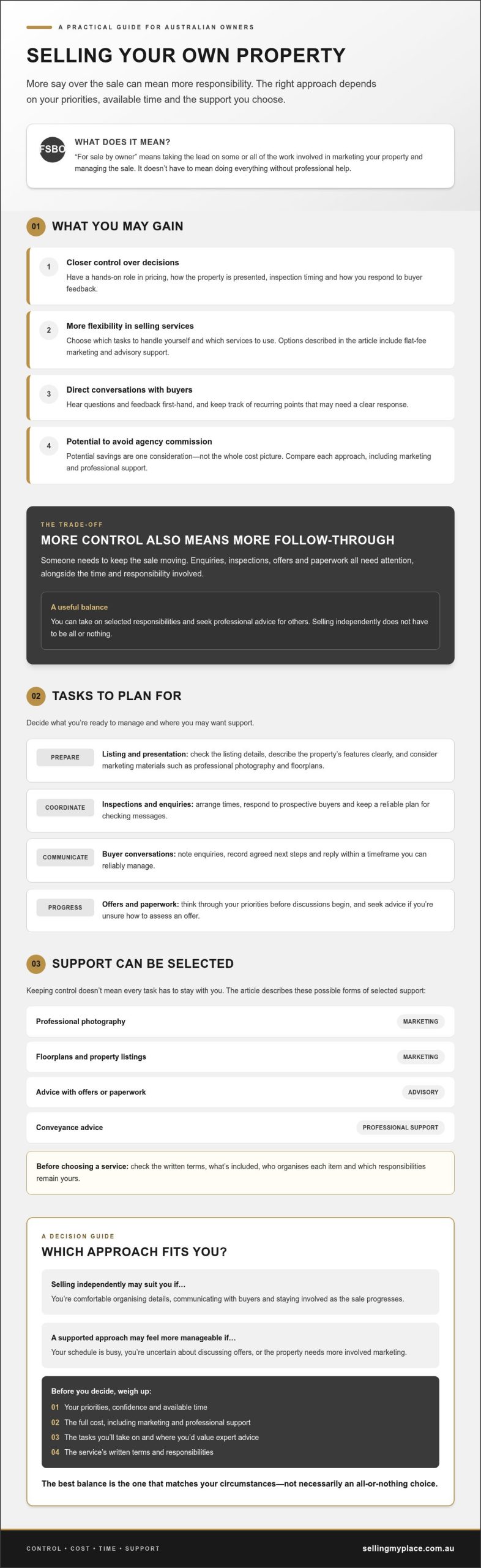
What should you weigh against the benefits of selling your own property?
A private sale can give you a closer hand in the process, but that involvement takes time and consistent follow-through. You may need to prepare marketing information, organise inspections, respond to buyer questions, keep track of conversations and manage offer discussions. These tasks can overlap with work and family commitments, so picture how the sale would fit into an ordinary busy week, not just an inspection day.
Paperwork is another consideration. Documents and disclosure requirements can vary between Australian states and territories and may depend on your circumstances. Check current guidance for the relevant jurisdiction and seek appropriately qualified advice if you’re unsure. The benefits of selling your own property don’t remove the need to understand the steps that apply to your sale.
How much time and confidence does a private sale require?
Ask yourself whether you can regularly monitor enquiries, arrange suitable inspection times and follow up with interested buyers. Think, too, about how comfortable you feel discussing the property and responding to questions or offers. You don’t need to be an experienced negotiator, but you should have a plan for handling conversations calmly and keeping clear records.
Make a list of the tasks you’re happy to manage and those you’d rather delegate. This can help you work out whether a fully independent sale is practical or whether selected support would make the process more manageable.
When might professional support make the process easier?
Support may be useful for preparing a property listing, arranging photography or floorplans, getting pre-sale advice or understanding conveyance steps. A service can cover selected parts of the process while you remain involved in decisions and buyer communication. Conveyance advice can help with process questions, but it shouldn’t be treated as a substitute for legal advice from a qualified legal professional.
For a practical overview of the stages to plan for, see this step-by-step guide to selling your own home. It can help you identify which responsibilities you’re prepared to take on and where you may want guidance.
A private sale may offer more direct oversight and flexibility, while asking you to coordinate more of the work. A supported arrangement can share some of that workload, but its scope and terms matter. Neither approach is automatically best for every owner. Weigh your available time, confidence and preferred level of involvement. If you’re considering flat-fee listing or advisory support, ask about property marketing and advisory options, then check the written terms and current inclusions before deciding.
How to decide whether selling your own property suits you
The best approach is the one that fits your priorities and the way you want to manage this major transition. The benefits of selling your own property may matter most if you value direct control. Having some tasks handled by a professional may matter more if time or confidence is limited. You don’t have to choose between doing everything yourself and handing over every decision.
A practical checklist for weighing your options
Before choosing, consider what you want to be responsible for and what you’d prefer to delegate. Be honest about your time, confidence and need for guidance. Then compare the written terms of each service rather than relying on a headline claim.
- Priorities: Which decisions do you want to make directly, such as how your property is presented or how buyer enquiries are handled?
- Time: Can you organise sale activity and follow up with prospective buyers alongside your other commitments?
- Confidence: Are you comfortable communicating with buyers and discussing offers, or would advice help you feel prepared?
- Support: Which tasks can you manage, and where would marketing, pre-sale consulting or conveyance advice be useful?
- Terms: What does each service include, what falls outside its scope and which responsibilities remain yours?
Compare the full service terms, including marketing inclusions and your expected workload. A lower headline fee may not tell you how much you’ll need to organise yourself, while a broader service may include tasks you don’t need. Make sure you understand the arrangement before committing.
Getting support while keeping ownership of your decisions
An owner-led sale can still include professional support. Flat-fee property marketing and advisory packages may suit sellers who want to stay involved without arranging every element alone. Depending on the service and its current inclusions, support may include property photography, floorplans and pre-sale consulting. Confirm the details and terms directly so you know what’s covered and what you’ll manage.
This can offer a middle ground: you remain closely involved in decisions while drawing on selected expertise where it’s useful. The right balance depends on your property, priorities and capacity, not a one-size-fits-all rule. Compare your options and choose the level of responsibility that feels manageable.
If you’d like to talk through what could suit your circumstances, talk through your property-selling options.
Choose a selling approach that feels right for you
The benefits of selling your own property are most meaningful when the approach suits your priorities, available time and confidence. You can keep a close hand on decisions without necessarily managing every part of the sale yourself. The key is to understand what support is available, what it includes and which responsibilities stay with you.
Kincade International Direct Sales offers flat-fee property marketing and advisory packages with no agency commissions, along with professional photography, floorplans and advisory support. Its residential listings remain available until sold, with no time limits. Check the current service details and written terms to decide whether this kind of support fits the way you want to sell.
A property sale is a significant step, and there’s no single approach that suits every owner. Compare your options and choose a path that gives you clarity about the costs, responsibilities and support involved. Talk through your property-selling options and explore what may work for your circumstances.
Frequently Asked Questions
What are the main benefits of selling your own property?
The main benefits can include having more control over sale decisions, communicating directly with prospective buyers and choosing a fee structure that suits your needs. The benefits of selling your own property depend on how much of the process you manage and what support you select. You might take the lead on enquiries while using professional marketing or advice for specific tasks. Weigh those advantages against the time and organisation involved.
Can I sell my property without using a real estate agent?
Yes, Australian owners can choose to sell without engaging a real estate agent. You can take the lead on marketing, buyer enquiries, inspections and offer discussions, or arrange selected professional services to assist. Sale processes and requirements can differ between states and territories, so check the rules that apply to your property. Consider seeking conveyancing or legal advice about contracts, disclosure and the steps needed to complete the sale.
Is selling your own home cheaper than using an agent?
It may cost less in some circumstances, but that isn’t automatic. Selling independently may avoid an agency commission, while costs for marketing, professional services and transaction-related expenses may still apply. A flat-fee marketing service has a different fee structure, so compare its written inclusions and terms with an agency agreement. Consider both the fees you’ll pay and the tasks you’ll manage yourself before deciding which option represents better value for you.
How much work is involved in selling your own property?
The workload depends on what you take on and what you delegate. Tasks may include preparing listing details, organising marketing, responding to enquiries, arranging inspections, keeping records of buyer conversations and following up on offers. You’ll also need to coordinate the sale’s next steps with the relevant professionals. Before committing, consider how these responsibilities will fit around your work and personal commitments, and identify any tasks you’d prefer to hand over.
What happens if I receive an offer I am unsure about?
You don’t need to make a decision on the spot. Ask for the offer and its conditions in writing, clarify anything you don’t understand, and consider how the terms fit your priorities. An offer may involve more than the proposed price, so check details such as conditions and proposed settlement arrangements. If you’re uncertain about the contract or legal implications, seek advice from an appropriately qualified professional before responding.
Do I still need professional help when selling privately?
Not necessarily for every task, but professional help can be useful in areas where you want more confidence or expertise. Depending on your needs, you could consider property marketing, pre-sale consulting, conveyance advice or legal advice. The right support depends on your sale and the requirements in your state or territory. Clarify what each provider does, what their service excludes and whether you need separate legal advice for contracts or other matters.
Can I use professional photography and floorplans when selling my own property?
Yes. Selling independently doesn’t prevent you from using professional photography or floorplans. You can arrange these services separately or check whether they’re included in a property listing service. Confirm the current inclusions, how the materials will be supplied and whether you need to arrange anything else for your listing. Clear images and an accurate floorplan can help prospective buyers understand the home before deciding whether to make an enquiry or arrange an inspection.
The Most Profitable Way to Sell a House in Australia: A 2026 Net-Wealth Guide
Did you know that the highest offer on your property doesn’t always result in the biggest deposit into your bank account? It’s a bit of a hard pill to swallow, isn’t it? When you’ve spent years building equity and making memories, the thought of losing tens of thousands in commission fees can feel like a personal blow to your family’s future. Finding the most profitable way to sell a house in Australia isn’t just about chasing the biggest number on a contract; it’s about being protective of what you keep once the legal settlement is finalised. With the national median commission sitting at roughly 2.65 percent in 2026, many homeowners are rightfully questioning if there’s a more transparent, supportive way to move forward.
We understand that this is one of the most significant transitions you’ll ever make, and you deserve a partner who values your legacy. You’re likely looking for a way to achieve a premium result without the pressure of traditional agency models. In this guide, we’ll show you how to maximise your final takeaway by pairing professional marketing with a commission-free approach that keeps your equity where it belongs. We’ll explore the strategic shifts and expert advisory tools that allow you to retain your full sale profit while still enjoying a polished, high-end presentation.
Key Takeaways
- Understand why the headline sale price is only half the story and how focusing on your net profit helps you keep more of your hard-earned wealth.
- Discover why a commission-free approach is the most profitable way to sell a house in Australia, helping you avoid the tens of thousands usually lost to traditional agent fees.
- Learn how high-quality visual assets, such as professional photography and detailed floorplans, underpin the most profitable way to sell a house in Australia by creating a strong emotional connection with potential buyers.
- Explore how a partnership-based model that values your local insight is the most profitable way to sell a house in Australia while safeguarding your family’s equity.
- Get a practical, step-by-step roadmap to organise your sale, from securing a market report to finalising your listing with confidence.
Redefining Profitability: Why Sale Price is Only Half the Story
When you decide to sell your family home, it’s easy to get swept up in the glamour of a record-breaking headline price. We see those big numbers on the evening news and think that’s the ultimate goal. However, focusing solely on the gross sale price is a bit like judging a book by its cover; it doesn’t tell the whole story of what actually ends up in your pocket. For many Australian families, the “Gross Sale Price” is a vanity metric, while the “Net Profit” is the reality that funds your next chapter. Net Sale Profit is the final amount cleared after all marketing, legal, and commission costs have been deducted from the gross purchase price.
Think of it this way. If you achieve a $1.2 million sale but pay a $30,000 commission, your takeaway is $1.17 million. Conversely, a $1.18 million sale through a commission-free model leaves you with $10,000 more in actual wealth. This subtle shift in perspective is the most profitable way to sell a house australia because it prioritises your equity over an agent’s bonus. Savvy sellers in 2026 are moving toward “Equity Retention” as their primary goal, ensuring that the years of hard work they’ve poured into their mortgage stay with their family.
The Mathematics of a Modern Australian Sale
Selling a property involves a series of financial layers that can quickly erode your hard-earned equity. Beyond the standard conveyancing fees, the “commission sting” is often the largest single expense. With the national median real estate commission in Australia sitting at approximately 2.65 percent in late 2026, a million-dollar sale could cost you $26,500 in fees alone. To truly grasp the context of your transaction, an Australian property market overview can provide the necessary historical perspective on how equity has grown across different cycles. When you factor in additional marketing levies, the “opportunity cost” becomes significant; that’s money that could have been your next deposit or a substantial boost to your retirement fund.
Why Traditional Models Often Favour the Agent Over the Owner
There’s often a quiet misalignment of interests in traditional real estate. While you want the highest possible price, an agent’s primary incentive is often just to secure a sale quickly so they can move on to the next listing. High-pressure auction environments are a classic example; they can create urgency, but they can also lead to suboptimal net outcomes if the final bid doesn’t quite cover the heavy marketing and commission costs. As homeowners become more digitally literate, there is a clear trend towards “Direct Sales.” This model empowers you to take the lead, supported by expert advice, ensuring the most profitable way to sell a house australia remains focused on your bottom line rather than a corporate commission structure.
The Commission Trap: How Traditional Fees Erase Your Equity
Traditional agencies often frame their commission as a performance incentive. In reality, it is a significant portion of your family wealth being redirected. With the 2026 national median commission at approximately 2.65 per cent, the numbers add up fast. On a $1.5 million property, that is nearly $40,000. Many sellers also fall for the “tiered commission” trap, where an agent might take a standard rate up to a certain point and then a much higher percentage (sometimes up to 10 or 20 per cent) on the “bonus” amount. While it sounds like they’re working harder for you, it often just means you’re paying a premium for the market doing its job. This is why many are realising that a flat-fee model is the most profitable way to sell a house australia.
Commission vs. Flat-Fee: A Side-by-Side Comparison
Let’s look at the numbers plainly. A traditional 2.5 per cent commission on a $1 million home costs you $25,000. Often, this doesn’t even include the “marketing levy” for things like photography or portal listings, which can add several thousand more to the bill. By contrast, a professional flat-fee service provides these essential tools (including high-definition floorplans and professional photography) for a single, transparent amount. Moving to this model allows the average owner to save around $20,000. It’s important to remember that “cheap” DIY options without professional-grade marketing can be a false economy, as poor presentation often leads to lower offers from buyers.
The Hidden Costs of Traditional Agency Agreements
Beyond the headline rate, traditional contracts often contain “vulture clauses” that can haunt you long after the initial signing. These might include long “exclusive authority” periods, locking you into a relationship with an agent even if they aren’t delivering results. You might also find yourself paying “advertising contributions” that seem more about promoting the agency’s brand than your specific property. When calculating your final takeaway, you also need to consider capital gains tax implications and how these costs affect your net position. Understanding these fine-print details is vital for protecting your equity. If you’re feeling overwhelmed by the complexity of these agreements, reaching out for a friendly chat can help clarify the most profitable way to sell a house australia for your specific situation.
Maximising Market Value: Pre-Sale Consulting and Visual Storytelling
Driving a premium result is rarely about luck; it’s a calculated blend of high-end presentation and data-led decision-making. Once you’ve secured your equity by avoiding traditional commissions, the next step in the most profitable way to sell a house australia is to ensure your home stands out in a crowded digital marketplace. This isn’t about expensive renovations that eat into your profit. Instead, it’s about surgical improvements and professional-grade marketing that capture the heart of the right buyer from the very first click.
The Power of First Impressions: Photography and Floorplans
In 2026, the first “open home” happens on a smartphone screen. High-end visual marketing acts as the great equaliser, allowing direct sellers to present their homes with the same polish as the largest national franchises. Professional photography is non-negotiable; it creates the emotional hook that stops the scroll. Just as importantly, a professional floorplan provides the structural clarity serious buyers crave. It allows them to mentally move in, measuring their lifestyle against your walls before they’ve even stepped through the front door. To ensure maximum click-through on portals, focus on a simple “less is more” approach. Declutter surfaces, open the curtains to invite natural light, and ensure every room has a clear, singular purpose before the photographer arrives.
Expert Advisory: The Secret Weapon of Profitable Sellers
One of the biggest risks for sellers is over-capitalising on pre-sale work. You don’t want to spend $20,000 on a bathroom refresh only to see a $10,000 return. This is where pre-sale property consulting becomes your secret weapon. By identifying high-ROI minor improvements, such as modernising light fittings or refreshing garden mulch, you can lift the perceived value of your home without draining your bank account. These small, thoughtful touches often resonate most with the “emotional buyer” who is willing to pay a premium for a move-in-ready lifestyle.
Equally vital is the use of Neighbourhood Market Reports to establish a price floor based on real-time data. The Real Estate Institute of Australia emphasises that understanding market standards is fundamental to a fair and successful sale. By combining this data with an Agent Advisory Service to help vet enquiries, you can focus your energy on genuine prospects. For a deeper look at establishing your home’s worth with surgical precision, explore our guide on How to Determine the Market Value of a Home in Australia: The 2026 Seller’s Guide. This layer of professional support ensures you remain the “steady hand” throughout the negotiation process.
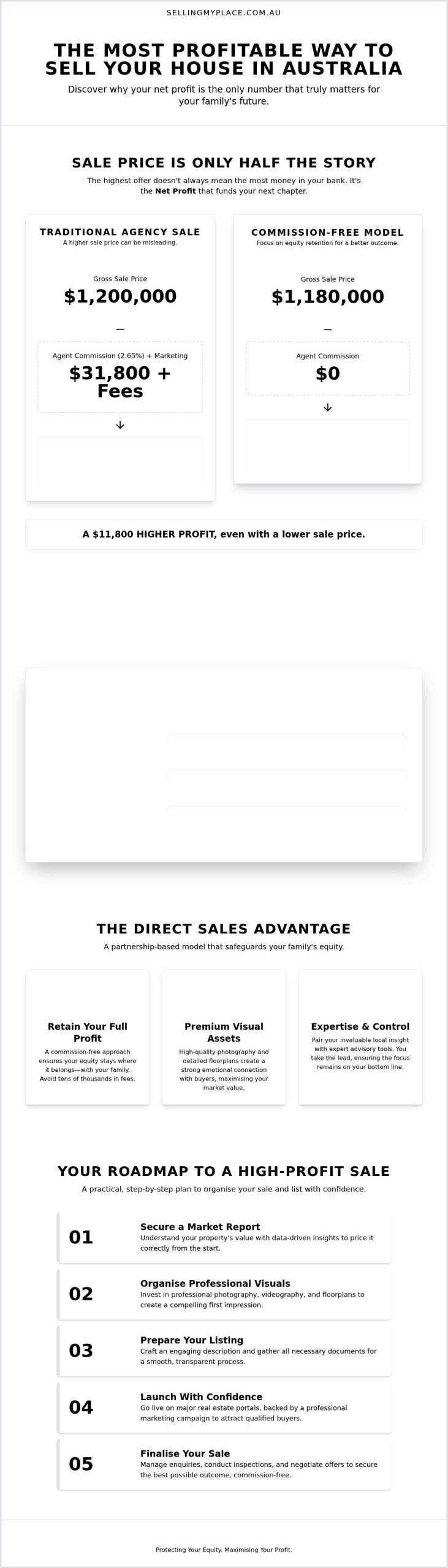
The Direct Sales Advantage: Retaining Control and 100% of Profit
Transitioning from the preparation phase to the actual transaction requires a different kind of support. While traditional agencies offer a service, the Kincade International Direct Sales (KIDS) model is designed as a genuine partnership. This approach recognises that you are the best person to tell your home’s story. You provide the local heart and the intimate knowledge of the property, while we provide the global infrastructure and professional polish. By choosing this path, you are embracing the most profitable way to sell a house australia, ensuring that every cent of the final sale price stays within your family’s wealth portfolio.
Operating within a 0% commission structure changes the entire dynamic of a negotiation. When you aren’t worried about losing a massive percentage of your equity to an agent, you gain a level of flexibility that traditional sellers simply don’t have. You can hold firm on your price with confidence or negotiate with a clearer head, knowing exactly what your “walk-away” figure is. If you’re curious about the practicalities of managing the process yourself, our guide on How to Sell Your Own Home: A Step-by-Step Guide to Sale by Owner in Australia offers a detailed look at the journey ahead.
Global Reach Without the Global Price Tag
The digital age has removed the need for expensive physical shopfronts and large corporate overheads. Through our digital infrastructure, your property reaches the same international buyer pools as any major franchise, but without the high marketing costs. One of the most reassuring aspects of this model is the “listed until sold” guarantee. Unlike traditional 90-day authority periods that create a ticking clock and mounting pressure, you have the freedom to wait for the right offer. Direct communication between you and the buyer often leads to faster deals, as there’s no middleman to misinterpret feedback or delay the flow of information. It’s a cleaner, more transparent way to do business.
Legal Security: Conveyance and Settlement Support
A common myth is that selling directly is legally “risky” or complicated. In reality, the legal transfer of property is handled by qualified professionals regardless of whether an agent is involved. To ensure a smooth transition of title, expert conveyance advice is a core part of the process. This professional advisory protects you from common contract pitfalls and ensures all documentation is handled with surgical precision. Having a “steady hand” to guide you through the legal settlement provides the calm confidence needed during such a major life transition. To see how this partnership can protect your equity, feel free to contact our advisory team for a confidential chat.
Your Roadmap to a High-Profit Sale in 2026
Success in the Australian property market is rarely an accident; it’s the result of a deliberate, step-by-step strategy. When you’re looking for the most profitable way to sell a house australia, you need a plan that balances professional-grade marketing with a fierce protection of your equity. By following this clear roadmap, you can transition from homeowner to successful seller with calm confidence.
- Step 1: Secure a comprehensive Neighborhood Market Report. This data-led approach ensures you aren’t guessing your property’s value but are instead establishing a realistic price floor based on recent local sales.
- Step 2: Engage a professional flat-fee service. This allows you to handle your photography, high-definition floorplans, and portal listings for a single, transparent fee rather than a percentage of your home’s value.
- Step 3: Utilise pre-sale consulting. Use expert advice to “de-clutter” and style your home specifically for your target demographic. Small, high-ROI improvements can significantly lift the perceived value without eating into your final profit.
- Step 4: Manage enquiries directly. You know your home best. By handling enquiries yourself with the backing of an expert advisory service, you can filter out “tyre-kickers” and focus on serious buyers.
- Step 5: Finalise the sale. Use professional conveyance advice to ensure the legal settlement is handled perfectly, securing your 100% profit as it moves into your bank account.
Avoiding the “Cheap DIY” Pitfall
It’s tempting to think that simply putting a sign in the yard or using “free” listing sites is enough. However, these platforms often fail to attract the high-intent buyers who live on the major Australian property portals. Maintaining professional decorum and “brand quality” in your listing is essential for driving a premium price. You want buyers to feel they are dealing with a sophisticated partner, not just a casual seller. Using buyer representation data to your advantage during negotiations also allows you to understand the market’s pulse better than any traditional agent could. This refined approach is what makes this the most profitable way to sell a house australia.
Take the Next Step Toward an Empowered Sale
Take a moment to visualise your financial future. What would an extra $20,000 in your pocket mean for your family? Whether it’s a larger deposit for your next home or a more comfortable retirement, that money belongs to you, not an agency. The KIDS model is designed to provide that “steady hand” support, ensuring you never feel alone during this major life transition. You have the local knowledge; we have the global tools to make it happen. Contact our expert advisors today to start your commission-free journey and reclaim your home equity.
Securing Your Family’s Financial Future
The journey to a successful property sale is about more than just the final figure on the contract. It’s about protecting the equity you’ve built through years of hard work and ensuring your family’s legacy remains intact. By shifting your focus from the gross sale price to your net profit, you’ve already taken the first step in discovering the most profitable way to sell a house australia. You don’t have to sacrifice quality for savings; with professional photography and floorplans included as standard, your home can shine on the national stage without the burden of a traditional commission.
Transitioning to a new lifestyle should be a time of celebration, not stress. With an average saving of $20,000 per sale and the constant support of an Expert Agent Advisory Service, you can navigate the market with the calm confidence of a seasoned professional. You have the local heart and the intimate knowledge of your home; we provide the global infrastructure to help you succeed. Secure your 100% profit-enquire about our commission-free marketing packages today and take the lead in your property journey. Your future self will thank you for being so protective of your hard-earned wealth.
Frequently Asked Questions
Is it really possible to sell a house in Australia without a traditional agent?
It is absolutely possible and legally sound to sell your property without a traditional agent. Many homeowners are choosing this path to protect their hard-earned equity from unnecessary fees. With Kincade International Direct Sales, you aren’t alone in the process. We provide the digital infrastructure and global networking needed to find the right buyer. You retain full control of the sale while enjoying professional tools and expert advisory support to ensure a premium result.
How much can I actually save by using a flat-fee real estate model?
Australian homeowners save an average of $20,000 by choosing a flat-fee model over a traditional commission-based structure. When you consider the national median commission in 2026 is approximately 2.65 per cent, the savings on a million-dollar home are significant. By avoiding the “commission sting,” you keep more of your family’s wealth. This approach is the most profitable way to sell a house australia because it ensures every dollar of the final price stays in your pocket.
Will my property get the same exposure on major websites if I sell it myself?
Your property will receive the same high-level exposure on major Australian property websites as any home listed by a big-brand agency. Our digital infrastructure ensures your listing reaches high-intent buyers across the country and even internationally. You aren’t just listing your home in a vacuum; you’re using a professional network that keeps your property active until it’s sold. This strategy maximises your reach while helping you avoid high marketing costs and traditional agency commissions.
What happens if my property doesn’t sell within the first few weeks?
We offer a “listed until sold” guarantee, so there’s no pressure if your property doesn’t sell in the first few weeks. Unlike traditional 90-day agency agreements that can feel like a ticking clock, our model has no time limits. This allows you to remain a “steady hand” during negotiations, waiting for the offer that truly reflects your home’s value. You can adjust your strategy with our advisory team’s support without the stress of an expiring contract.
Do I need a lawyer or conveyancer if I am not using a real estate agent?
You will still need a qualified conveyancer or solicitor to handle the legal transfer of your property. Whether you use a traditional agent or a direct sales model, professional legal support is essential for a successful settlement. We provide expert conveyance advice to ensure your contracts are sound and the transition of title is handled with surgical precision. This protects your 100 per cent profit and ensures the entire process is legally compliant and stress-free.
Can I still have professional photography and floorplans if I don’t pay commission?
Professional photography and floorplans are included as standard in our flat-fee marketing packages. We believe high-end visual storytelling is the “great equaliser” in the modern property market. These tools allow your home to stand out on digital portals, attracting serious buyers with the same polish as a luxury agency listing. You don’t have to sacrifice professional presentation just because you aren’t paying a traditional commission. It’s about achieving a premium look for a fair price.
How do I handle the actual price negotiations with potential buyers?
You handle the enquiries directly, but our Expert Agent Advisory Service is there to guide you through the process. We help you vet potential buyers and filter out “tyre-kickers,” allowing you to focus on genuine prospects. This partnership is the most profitable way to sell a house australia because it combines your local heart with our professional negotiation support. Direct communication often leads to faster, more transparent deals where both parties feel heard and respected.
What is the most profitable month to sell a house in Australia in 2026?
Spring and autumn remain the most profitable seasons to sell a house in Australia in 2026. Months such as October and March typically see the highest levels of buyer activity, which can drive more competitive offers. However, a successful sale is less about the calendar and more about meticulous preparation. By using our pre-sale consulting to style your home and address minor repairs, you can achieve a record-breaking result in any month of the year.
Flat Fee vs Commission Real Estate: Protecting Your Equity in 2026
Why should a stranger’s percentage-based fee dictate the size of your family’s next chapter? It’s a question many Australian homeowners are asking as they weigh up the benefits of flat fee vs commission real estate in 2026. You’ve spent years building equity, yet when it’s time to move on, it can feel like you’re being “taxed” by traditional agents. Many sellers find the lack of transparency and high commissions quite overwhelming. It’s natural to feel a sense of anxiety about managing such a transition without a seasoned expert by your side.
We understand that your home is more than just a listing; it’s your legacy. In this guide, we’ll break down the strategic differences between these models to help you keep the maximum profit. Our goal is to show you how to maintain professional standards while ensuring your property benefits from high-quality photography and global exposure. We’ll explore how savvy sellers are saving upwards of $20,000 in fees and achieving record prices without the traditional commission “haircut.” It’s about finding a steady hand to guide you through the process, ensuring you stay in control of your wealth.
Key Takeaways
- Understand how the digital shift in property marketing has empowered homeowners to move away from outdated, percentage-based commission models.
- Learn the transparent maths of flat fee vs commission real estate to ensure you keep the maximum amount of equity at settlement.
- Discover the “compounding loss” effect and how saving on fees today can significantly increase your budget for your next family home.
- Use our professional evaluation framework to determine if your property is suited for a flat-fee approach that maintains high listing standards.
- Find out how to access a “steady hand” advisory service that offers the expert backing of a traditional agent without the high marketing costs.
The Evolution of Selling: Why the Commission Model is Under Fire
For generations, selling a home in Australia followed a predictable, albeit expensive, script. You’d sign up with a local agent, agree to a commission of roughly 2% to 3%, and hope the final sale price justified the five-figure fee. This model was built on the agent’s role as a gatekeeper of information. If you wanted to see what the house down the street sold for, or find out who was looking to buy in your suburb, you had to ask a professional. It was a system based on mystery rather than transparency.
Times have changed. The digital age has stripped away those barriers, moving the power from the agent’s desk to the palm of your hand. Today, buyers find properties on global platforms long before they ever speak to a listing agent. This shift has led many to question the logic of Real estate agent commission models that haven’t evolved alongside technology. When comparing flat fee vs commission real estate, the debate often centres on whether that old-school “hustle” still provides value in a transparent market. With the national average listing agent commission sitting at 2.77% as of March 2026, the cost of this “hustle” has never been higher.
The Disruption of Traditional Real Estate
We’re seeing a move toward Direct Sales as homeowners realise that “local knowledge” is now available via instant market reports. Professional residential property listing services now provide the same global reach as traditional agencies but without the heavy success fee. This shift is part of a broader international movement, where innovative services like Gratisverhuizen Makelaardij are proving that homeowners can achieve great results without traditional commission costs. This isn’t just about DIY; it’s about using modern tools to manage a major life transition with a sense of calm and control. Why pay for a rolodex of contacts when the entire world can see your home on their smartphone? Savvy owners are choosing a partnership approach that prioritises their equity over an agent’s overheads.
There’s an inherent tension in the traditional model. A higher commission doesn’t always guarantee a higher sale price for you. In fact, an agent might be incentivised to push for a quick sale to secure their fee; rather than holding out for the record price your property deserves. As the cost of living bites, Australians are looking at their equity as a lifeline. Losing $20,000 or more to a commission “haircut” isn’t just a transaction cost; it’s money that could have paid off a significant chunk of your next mortgage or funded your retirement. It’s time to rethink the value of an agent’s time versus the actual value of the home you’ve worked so hard to maintain.
Unpacking the Numbers: Flat Fee vs. Commission Real Estate
Numbers might seem clinical, but when they involve your home, they represent years of hard work and the dreams you have for your future. Understanding the math of flat fee vs commission real estate is the first step toward reclaiming control over your financial legacy. In a traditional model, you’re often looking at a success fee that grows alongside your property’s value, regardless of whether the agent’s workload actually increased. It’s a structure that can feel more like a partner taking a slice of your hard-earned cake rather than a service provider charging for their time.
Traditional commissions are often a moving target. With the national average listing agent commission reaching 2.77% in 2026, the final bill at settlement can be a shock. This percentage is calculated on the total sale price, and once you add the 10% GST and potential marketing levies, the “haircut” to your equity is substantial. A recent Federal Reserve economic analysis suggests that these percentage-based structures can lead to market inefficiencies and elevated prices that don’t necessarily benefit the homeowner. Transitioning to a flat fee model replaces this uncertainty with one clear, upfront cost for professional service and global marketing.
Calculating the Savings: A National Perspective
Let’s look at the “Equity Gap” in real terms. On a $750,000 family home, a 2.77% commission plus GST totals roughly $22,852. If your property is a more substantial estate valued at $1.5 million, that fee balloons to over $45,000. The Equity Gap is the difference between the net profit you keep under a traditional commission model versus the significantly higher return of a flat-fee approach. It’s money that belongs in your pocket, not as a contribution to an agency’s overheads. If you’re feeling unsure about the math, it’s often helpful to discuss your specific property goals with a trusted advisor who values your equity as much as you do.
What Does Your Money Actually Buy?
In a flat-fee partnership, your investment buys high-end professional tools that actually move the needle. You receive professional photography and detailed floorplans that present your home in its best light to a global audience. Unlike traditional agreements that might expire after 90 days, a quality flat-fee service offers a “listing until sold” promise. You also gain access to neighbourhood market reports, giving you the same data-driven insights that agents use to price homes. You’re paying for the professional infrastructure, not a percentage of your home’s worth.
The Hidden Cost of Percentages: Impact on Your Home Equity
Your home equity represents the quiet accumulation of years of mortgage payments, weekend renovations, and market growth. It is almost certainly your most valuable financial asset. When we discuss the choice between flat fee vs commission real estate, we aren’t just looking at a line item on a settlement statement; we’re talking about the capital you need for your next chapter. Losing $20,000 to an agent’s commission today creates a “compounding loss” that can echo through your finances for decades. If that $20,000 had stayed in your offset account or been used as a larger deposit on your next property, its value could have potentially doubled over the next ten years. Choosing who owns the appreciation of your asset is a serious decision.
Protecting Your Next Move
Think about what an extra $20,000 or $30,000 actually buys in the current Australian market. It could be the difference between a modest three-bedroom house and a spacious four-bedroom home with a study for your growing family. Savvy investors and financial planners often favour a Direct Sales model because it prioritises the preservation of capital. By keeping your equity safe during a sale, you ensure that every dollar you’ve worked for goes toward your future, not toward an agency’s franchise fees or office overheads. It is a strategic choice that values long-term stability and family legacy over a purely transactional convenience.
The Myth of the Super-Negotiator
A common concern for many sellers is the fear that they’ll miss out on a higher price without a traditional agent “negotiating” for them. However, research into buyer behaviour shows that emotional connection to a property is the primary driver of a record sale. Buyers fall in love with the lifestyle your home offers, not the person standing at the front door. High-quality professional photography and detailed floorplans do more to drive competition than any sales pitch ever could. When you have multiple buyers vying for a home they can’t stop thinking about, the negotiation becomes a matter of managing offers with a steady hand.
Our Real Estate Advisory Services provide the professional backing you need to handle these conversations with confidence. Armed with expert property sale negotiation tips and a comprehensive Neighborhood Market Report, you can speak to buyers with authority. You’ll have the same data as any traditional agent, allowing you to secure a top-tier result while keeping your equity intact. It’s about having the right tools and a bit of expert guidance to ensure you aren’t forced into a commission “haircut” just to get the deal done.
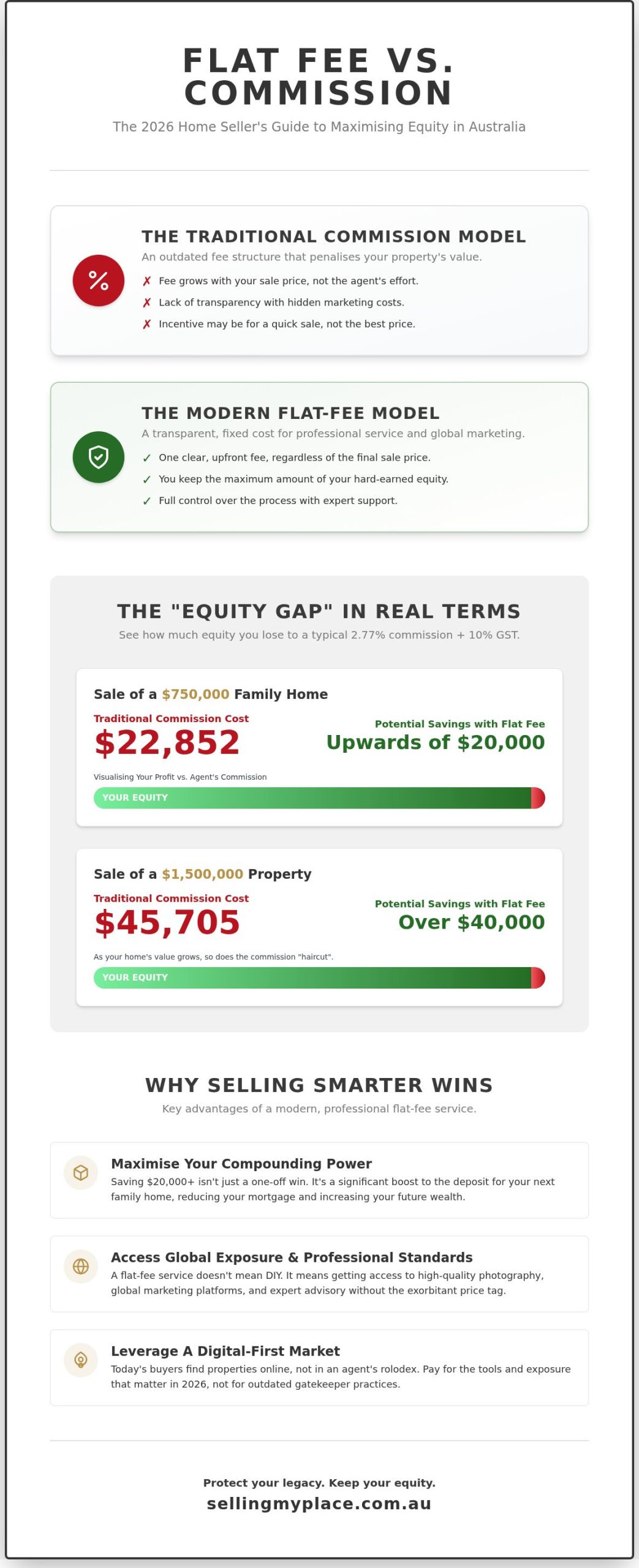
Choosing the Right Path: A Seller’s Evaluation Framework
Deciding how to sell your home is a deeply personal choice that balances financial goals with your own lifestyle needs. While the debate over flat fee vs commission real estate often focuses on the bottom line, it’s equally about the level of control you wish to maintain. Most standard residential properties in high-demand suburbs are perfectly positioned for a direct sale. If your home is well-maintained and you have a clear understanding of its place in the market, you might find that a traditional agent’s high commission is an unnecessary expense for a relatively straightforward process. Consider whether your local market favours private treaty or auction, as this will influence how you manage buyer enquiries and offers.
Success in any property sale begins with a solid foundation of professional conveyance advice. Regardless of the model you choose, ensuring your legal documents are in order before the first inspection is vital. It provides a sense of calm confidence, knowing that when the right buyer appears, the transition will be smooth and protected. You aren’t just selling a structure; you’re handing over a legacy, and that requires a steady hand at every turn.
Is Your Property Suited for a Flat Fee Sale?
Not every property is the same, and your strategy should reflect that. Residential homes in established areas often sell themselves when presented with professional standards. A key part of your framework should be learning how to determine market value of a home in Australia. Setting a realistic, data-backed price is the most effective way to drive competition. While a flat fee model might require you to host your own open homes, many sellers find this a rewarding experience. It allows you to share the unique stories and local secrets that only a resident would know, creating a genuine connection with potential buyers.
The Legal and Technical Checklist
Maintaining professional listing standards is non-negotiable. To achieve a record price, your marketing must include high-end photography and detailed floorplans that allow buyers to visualise their future in the space. Without an agency middleman, you’ll be the primary point of contact for enquiries. This isn’t as daunting as it sounds; it simply requires being organised and responsive. Understanding the settlement process and your obligations ensures you remain in the driver’s seat from the initial listing until the final handover. If you’re ready to explore how this approach fits your specific property, we invite you to reach out for a personal consultation to discuss your next move.
Selling Smarter: Why a Professional Flat-Fee Service Wins
Selling a home is a milestone that marks the end of one chapter and the beginning of another. It shouldn’t be a process where you feel like a passenger in your own journey; watching your hard-earned equity disappear into someone else’s pocket. Kincade International Direct Sales (KIDS) offers a modern alternative, acting as a vital bridge between the isolation of a pure DIY sale and the high-cost traditional agency route. When you evaluate flat fee vs commission real estate, the real winner is the model that offers professional infrastructure without the commission-based “haircut.” We provide the global listing network, professional photography, and floorplans needed to attract top-tier buyers; all while ensuring you keep 100% of your profit.
Our Agent Advisory Service is designed to be your “steady hand” throughout this transition. Selling a property involves complex negotiations and emotional hurdles that can feel daunting if you’re going it alone. Having a seasoned expert in your corner for pre-sale property consulting ensures your home is presented perfectly from day one. You aren’t just paying for a spot on a website. You’re investing in a partnership that prioritises your family’s financial future and respects the legacy you’ve built.
Expert Backing, Not Just a Listing
Accessing the right data is the secret to achieving a record price. Our Neighborhood Market Reports provide the “insider” edge that agents usually keep behind a curtain of jargon. This transparency allows you to price your home with confidence and handle buyer enquiries with authority. It is about having the reassurance that you’re making informed decisions at every stage. Whether it’s deciding on the right settlement date or navigating a multi-offer situation, our advisory team is there to guide you through the technicalities; a level of professional support also provided by international firms like Arrowhead Realty Company to help sellers navigate their local markets with confidence. We believe that professional backing should be accessible, not a reason to sacrifice your profit.
We’re seeing a fundamental shift in how people view property transactions. More Australians are taking control of their home sale in 2026. This shift isn’t just about saving money. It’s about transparency, fairness, and the empowerment of the homeowner. By removing the pressure of expiring agency agreements, we allow the market to work in your favour, not the agent’s schedule. The long-term benefits of this commission-free revolution are clear: more equity stays with the families who built it. Protecting your legacy starts with choosing a partner who values your profit as much as you do.
Take Control of Your Property Legacy
Choosing the right path for your property sale is about more than just numbers; it’s about protecting the life you’ve built. We’ve explored the significant differences found in flat fee vs commission real estate, highlighting how the traditional percentage model often eats into your hard-earned equity. By opting for a modern, direct approach, you can save an average of $20,000 per sale while still maintaining the professional standards your home deserves. You don’t have to navigate this transition alone.
With our professional Agent Advisory Service included, you’ll have a steady hand to guide you through negotiations and technicalities. Plus, your property remains listed until sold with no restrictive time limits, giving you the space to achieve the result you want without undue pressure. It’s time to take control of your profit and your future. We’re here to help you move forward with confidence and a sense of calm. Your next chapter deserves a strong start.
Discover how Kincade International can help you sell commission-free and save your equity.
Frequently Asked Questions
What is the main difference between a flat fee and a commission in real estate?
The main difference is that a flat fee is a single upfront cost for marketing and support, while a commission is a percentage of your final sale price. When weighing up flat fee vs commission real estate, the commission model often results in a much higher bill at settlement. Choosing a flat fee ensures you keep 100% of your profit rather than losing a large slice of equity to agency fees.
Will my property get the same exposure with a flat fee service as it would with a traditional agent?
Yes, your property receives the same global exposure on major real estate platforms as it would with any traditional agency. We utilise a global marketing network to ensure your home is visible to active buyers across the country and overseas. Because most buyers now search online, our digital infrastructure provides the same reach as a high-street office but without the unnecessary overheads or high marketing costs.
How much can the average Australian homeowner save by using a flat fee model?
Australian homeowners save an average of $20,000 by choosing a flat-fee model over a traditional commission structure. This figure is based on the national average commission rates and the typical value of residential properties in 2026. By removing the percentage-based success fee, you retain more of your home’s equity to put toward your next deposit or retirement fund. It is a significant financial advantage for your family.
Do I have to do all the work myself if I choose a flat fee real estate service?
No, you don’t do all the work alone because you have the backing of a professional Agent Advisory Service to guide you. While you might host your own open homes to share your unique local knowledge with buyers, we handle the technical side. This includes providing professional photography, floorplans, and pre-sale property consulting. You get the expert support of a seasoned advisor without the transactional feel of a traditional agency.
Is a flat fee real estate model legal and recognised in all Australian states?
Selling your own home via a flat-fee service is completely legal and recognised in every Australian state and territory. There is no “discount license” or legal restriction that prevents you from listing your property this way. All sellers, regardless of the model they choose, must comply with the same state-based property laws and disclosure requirements. We provide the professional framework to ensure you meet these obligations with calm confidence.
What happens if my property doesn’t sell within a few months?
Your property remains listed until it is sold, with no restrictive time limits or expiring agreements. Traditional agencies often pressure sellers to drop their price as an agreement nears its 90-day end, but our model removes that unnecessary stress. This “listing until sold” approach allows you to wait for the right buyer and the record price your property deserves, ensuring you never feel rushed in your decision-making.
How do I handle the legal paperwork and conveyance without a traditional agent?
You handle the legal paperwork through professional conveyance advice and the support of your own qualified solicitor or conveyancer. While a traditional agent might act as a middleman, they aren’t legally permitted to provide legal advice anyway. We provide the necessary guidance to ensure your paperwork is in order before listing. This partnership approach ensures the settlement process is handled with a steady hand and full legal protection.
Can I still have professional photography and floorplans with a flat fee package?
Yes, professional photography and detailed floorplans are standard inclusions in our flat-fee packages. We believe that presenting your home in its best light is the key to driving buyer competition and achieving a record price. When comparing flat fee vs commission real estate, you’ll find that our marketing tools are equal to or better than those used by traditional agencies. This ensures your home maintains a premium standard on all global listing platforms.
List Your Home for Private Sale: 2026 Australian Guide
What if you could hand over the keys to your family home without handing over a $20,000 cheque to an agent at the same time? With the national median dwelling value sitting at $912,885 in late 2026, that’s a massive amount of hard-earned equity to lose just for a few weekend inspections. Learning how to list your home for sale by owner isn’t about cutting corners; it’s about taking the driver’s seat in one of your life’s most significant transitions. We know the traditional sales process often feels like a bit of a black box where transparency is thin and the fees are thick. It’s completely natural to feel protective of your profit, especially when you’ve spent years building a legacy within those four walls.
This guide is designed to give you the calm confidence you need to manage your own sale successfully while ensuring you maintain a professional market presence. We’ll walk you through the essential 2026 legal requirements, show you how to craft a high-impact marketing campaign, and explain the exact steps to secure a premium price without the commission sting. You’ll discover that with the right partnership and a steady hand, keeping 100% of your sale price is not only possible but remarkably rewarding.
Key Takeaways
- Protect your hard-earned equity by bypassing traditional agent commissions, ensuring you keep 100% of the profit from your sale.
- Learn why professional-grade photography and floorplans are essential for creating a polished, trustworthy market presence that attracts premium buyers.
- Remove the guesswork from your asking price by using detailed Neighbourhood Market Reports to make informed, data-driven decisions.
- Follow clear, step-by-step instructions on how to list your home for sale by owner to gain maximum exposure on Australia’s major property portals.
- Discover how a partnership-based advisory service provides the professional guidance you need to navigate contracts and negotiations with total confidence.
The Rise of Commission-Free Selling in Australia
The Australian property market in late 2026 has entered a more contemplative phase. As we move through a broader national correction, homeowners are becoming increasingly protective of their hard-earned equity. It’s no longer just about the final sale price; it’s about what you actually walk away with once the dust settles. Many families are realising that the traditional 1.8% to 3% commission model, plus GST, often feels out of step with the effort required in a digital-first world. When you consider that a standard commission on a median-priced home can easily exceed $20,000, it’s easy to see why the For Sale By Owner (FSBO) movement has gained such significant momentum across the country.
This shift isn’t just about the bottom line, though that’s a massive part of the appeal. It’s about empowerment. Modern technology has democratised the selling process, allowing you to reach the same massive audience as a high-street agency without the high-street price tag. If you’ve been wondering how to list your home for sale by owner, you’re part of a growing group of Australians choosing a smarter, more transparent path that puts you in control of your own transition.
Why Homeowners are Choosing the Flat-Fee Model
Selling a home is a deeply personal journey. Many owners now prefer to hold the reins themselves. By choosing a flat-fee approach, you gain complete control over your home’s narrative. You know your property better than anyone; you know where the light hits the floorboards in winter and which local park has the best coffee cart. This model replaces high-pressure tactics with a calm, expert-supported framework. It’s a partnership that values your local knowledge while providing the professional infrastructure needed to succeed. You aren’t doing this alone; you’re simply doing it without the unnecessary middleman.
The Real Cost of Traditional Real Estate Commissions
The financial impact of a traditional commission is often more substantial than it appears on a single-page agreement. In regional areas or certain states, commissions frequently climb toward 3%. Once you add the mandatory 10% GST, that figure becomes a significant hurdle. This is money that could be your next deposit, a retirement nest egg, or a renovation fund for your new place. Preserving this equity is vital in a fluctuating market. A flat-fee model is a fixed-cost professional service that provides all the essential marketing tools for one clear, upfront price. By removing the variable commission, you ensure that every extra dollar a buyer offers goes straight into your pocket. Understanding how to list your home for sale by owner effectively means you can bypass these drains on your profit while still appearing just as professional as any other listing on the market.
Preparing Your Property for a Professional Listing
Your home is likely your most valuable asset. It is also a collection of memories. When you decide to sell privately, the first step is shifting your perspective from homeowner to seller. This transition requires a level of presentation that matches the high standards buyers expect from premium agencies. When considering how to list your home for sale by owner, remember that your online listing is often the only chance you get to make a first impression. In the digital-first market of 2026, your property needs to stand out instantly against a sea of competing tiles on a smartphone screen.
The Importance of High-End Visual Marketing
Professional photography is no longer an optional extra; it is a baseline requirement for a successful sale. High-quality, wide-angle images captured during the “golden hour” can significantly increase the number of clicks your listing receives compared to amateur snapshots. These images tell a story of light, space, and lifestyle that draws buyers in emotionally. Alongside photos, professional floorplans are a vital psychological tool. They allow a potential buyer to walk through the house in their mind, measuring where their furniture might sit or how the kitchen flows into the outdoor entertaining area. This level of detail helps filter out tyre-kickers, ensuring that the people who book an inspection are already seriously considering your property as their future home.
Staging and Presentation Tips for Australian Homes
Staging your home isn’t about hiding its character, it is about highlighting its potential. You want to create a blank canvas that allows buyers to visualise their own lives unfolding within your walls. Start with a thorough decluttering and depersonalising process. Removing excess furniture and family photos makes rooms feel larger and more inviting. Don’t forget the power of kerb appeal; a freshly painted front fence, a tidy garden, and a clean driveway set a positive tone before a buyer even steps inside.
Maximising natural light is perhaps the simplest way to enhance your professional photos. Open every blind, trim back any overgrown bushes near windows, and use neutral colours to make spaces feel airy and bright. If you find yourself feeling a little stuck on where to start, a quick chat about pre-sale property consulting can provide the professional eye needed to prioritise the right improvements. By focusing on these high-impact areas, you ensure your property is market-ready and capable of attracting a premium price.
Pricing Your Property: Data-Driven Decisions
Pricing a home is often the most emotionally charged part of the entire sales process. It’s where the years of memories, weekend renovations, and late-night gardening sessions meet the cold reality of a spreadsheet. While it’s tempting to set a price based on what you need for your next deposit, the market in late 2026 is driven by data rather than sentiment. With the national median dwelling value sitting at $912,885, buyers are more cautious and informed than ever. Understanding how to list your home for sale by owner effectively starts with a grounded, realistic assessment of what a buyer is actually willing to pay in the current climate.
We are currently seeing a significant divergence in performance across different Australian markets. While some capital city areas have entered a correction phase, other high-demand pockets and regional hubs continue to test record highs. This means you cannot rely on national headlines to price your specific property. You need to look at what has sold within a two-kilometre radius of your front door in the last ninety days. These “comparables” are the same figures a bank valuer will use when your buyer applies for finance, so aligning with them early ensures a smoother path to settlement.
Utilising Professional Market Reports
A Neighbourhood Market Report is your most powerful tool for removing guesswork. These reports provide a comprehensive property value estimate by analysing recent sales, current listings, and local demand. It’s vital to distinguish between a basic automated valuation, which might miss your brand-new kitchen or solar array, and a professional appraisal that considers the unique features of your home. If you want to dive deeper into the mechanics of pricing, you can learn more about how to determine market value of a home in australia to ensure your starting point is rock solid.
Adjusting Your Strategy Based on Buyer Feedback
In the three months leading up to July 2026, the national median time a property spent on the market was 35 days. This timeframe is your barometer for success. The first two weeks of your listing are the most critical; this is when “new listing” alerts hit thousands of phones. If you aren’t receiving enquiries or seeing foot traffic at your inspections during this window, the market is sending you a clear signal. Recognising the need for a subtle price tweak early is a sign of strength, not defeat. It shows you’re a proactive seller who is in tune with buyer demand, allowing you to maintain momentum rather than letting your listing go stale. When you know how to list your home for sale by owner with a flexible, data-backed strategy, you remain the one in control of the negotiation.

The Listing Process: Getting Onto Major Portals
Once your home is staged and your price point is backed by solid data, the technical phase of your journey begins. While social media groups can offer a bit of local buzz, they simply don’t have the reach needed to find a premium buyer. To get the best result, your property must appear where 90% of buyers start their search: on the national property portals. Learning how to list your home for sale by owner effectively means understanding that these major sites don’t actually allow private individuals to list directly; you need a licensed partner to bridge that gap and provide the professional visibility your home deserves.
Accessing National Marketing Infrastructure
Flat-fee services provide the digital bridge you need to get your property in front of millions of active searchers. This isn’t just about a single upload. It’s about a professional ecosystem that supports your listing until the “Sold” sticker is finally applied. One of the greatest benefits of this modern approach is the “List Until Sold” feature, which removes the ticking-clock pressure often felt with traditional 90-day agency agreements. When you discover how to list your home for sale by owner with the right technical support, you realise that the exposure sells the house, not the commission. If you want a deeper look at the logistics, our guide on Sale by owner breaks down the timeline from your first photo to the final handshake.
Managing the enquiries that follow is often the most rewarding part of the process. You’ll receive emails and calls directly, allowing you to speak with genuine passion about your home’s history and the local community. Organising inspections becomes a simple matter of checking your own calendar, ensuring you aren’t rushing to tidy up for a last-minute agent walkthrough. You are the expert on your own lifestyle, and buyers often find this direct honesty incredibly refreshing.
Legal Steps and Conveyance Advice
While the marketing is your domain, the legal framework is where you need a steady, professional hand. Every state and territory has its own specific rules regarding documentation; some regions require a vendor statement to be ready immediately, while others mandate a formal Contract for Sale before any advertising begins. Engaging a solicitor or conveyancer early is a non-negotiable step for a smooth settlement. This ensures that when the right offer arrives, you are legally prepared to move forward without delay. If you feel uncertain about the finer points of the contract or how to handle a complex negotiation, you can always contact our advisory team for expert support. Having professional Real Estate Advisory Services tucked in your back pocket gives you the calm confidence to navigate the final stages of your sale with ease.
Selling Smarter with Kincade International Direct Sales
Kincade International Direct Sales (KIDS) represents a thoughtful evolution in the Australian property market. We believe that the equity you’ve built in your home belongs to you, not an agency. Discovering how to list your home for sale by owner shouldn’t feel like a lonely endeavour; it should feel like a supported professional transition. Our model is built on a simple partnership: you remain the boss of your sale, while we provide the high-end tools and global marketing network usually reserved for traditional agencies. It’s a “steady hand” approach that balances the seriousness of a high-stakes transaction with the warmth of a neighborly guide who truly understands your local area.
The KIDS advantage starts with a digital infrastructure that places your local home on a global stage. We ensure your listing doesn’t just exist online but thrives there. By including professional photography and floorplans in our packages, we make your property look like a million-dollar listing from the moment it goes live. These aren’t just pretty pictures; they are essential assets that build trust with buyers and justify your premium asking price. When you choose how to list your home for sale by owner through our tiered packages, you’re investing in a sophisticated marketing campaign that preserves your profit while maintaining a polished, authoritative market presence.
Expert Backing Every Step of the Way
While you handle the inspections and the heart-to-heart conversations with buyers, our Agent Advisory Service acts as your secret weapon in the background. Our pre-sale consulting helps you identify the small, high-impact changes that maximise your final sale price before you even take the first photo. This professional real estate advisory provides a grounded sense of calm, especially when it comes to the complexities of contracts and negotiations. We also offer buyer representation to help you transition smoothly into your next chapter, ensuring your entire journey, from selling the old home to finding the new one, is handled with care and competence.
Taking the Next Step Toward a Commission-Free Sale
As we move through 2026, there has never been a better time to take control of your property legacy. By choosing a flat-fee model, you aren’t just saving an average of $20,000 in commissions; you’re choosing a more transparent and empowering way to move house. You get to keep 100% of your hard-earned profit while enjoying the peace of mind that comes with expert support and a global reach. It is a smarter, more modern way to sell that puts your family’s needs first. Ready to save your commission? Explore our professional listing packages today.
Your Path to a Successful, Commission-Free Sale
Taking the reins of your property sale is a significant step toward securing your financial future. By focusing on professional presentation and data-driven pricing, you ensure your home stands out for all the right reasons. You’ve now seen that learning how to list your home for sale by owner isn’t just about avoiding fees; it’s about being the most passionate advocate for your own property while backed by expert tools. With average seller savings of $20,000, that extra equity can make a world of difference as you transition to your next chapter.
You don’t have to navigate the technicalities alone. Our partnership-based approach provides everything from professional photography and floorplans to a dedicated Agent Advisory Service, giving you the calm confidence of a seasoned expert. It’s time to move forward with a sale that values your legacy as much as you do. Start your commission-free journey with Kincade International Direct Sales and discover how rewarding a private sale can be when you have a steady hand to guide you.
Frequently Asked Questions
Can I really list my home on major websites without a traditional agent?
Yes, you can certainly reach the same massive audience as any traditional agency. While major portals like realestate.com.au don’t allow direct individual uploads, Kincade International Direct Sales acts as your licensed partner to bridge this gap. This ensures your property appears alongside every other listing in the country, providing the professional visibility you need to attract serious buyers while you remain in total control of the process.
How much can I actually save by listing my home for sale by owner?
On average, homeowners save approximately $20,000 by choosing to sell privately rather than paying a traditional commission. With capital city commissions in late 2026 often ranging between 1.8% and 3% plus GST, the financial impact of skipping the middleman is substantial. By utilising a flat-fee model, you preserve your hard-earned equity, allowing those funds to go toward your next deposit or retirement instead of an agent’s pocket.
Do I need a lawyer or conveyancer if I sell the house myself?
Engaging a solicitor or conveyancer is a legal requirement for all property sales in Australia. While you handle the marketing and inspections, these professionals manage the critical legal documents, including the Contract of Sale and state-specific disclosure statements. Having your paperwork ready before you learn how to list your home for sale by owner ensures a smooth, legally sound settlement that protects both you and the buyer during the transition.
Will buyers be put off by a private sale listing?
No, buyers are primarily interested in the property itself rather than who is holding the open house. In fact, many people find it refreshing to speak directly with the owner, who can provide authentic insights into the home’s history and the local community. As long as your listing features professional photography and floorplans, it will be indistinguishable from an agency listing, projecting the same level of authority and trust.
What happens if my home doesn’t sell within the first month?
One of the greatest benefits of our model is the “List Until Sold” guarantee, which removes the ticking-clock pressure of a standard 90-day agreement. If your home hasn’t sold within the first month, it simply stays live on the major portals at no extra cost. This gives you the breathing room to review your strategy or adjust your price point based on buyer feedback without the fear of your listing expiring.
How do I handle the negotiation process without an agent?
Negotiating directly with buyers is often more straightforward than people expect. It’s about having a clear, data-backed understanding of your home’s value and staying grounded during the discussion. You can use our Neighbourhood Market Reports to justify your price and rely on our Agent Advisory Service for expert guidance if things get complex. Remember, you aren’t alone; you have professional support to help you secure a premium result with confidence.
Is professional photography really worth the extra effort for a private sale?
High-end visual marketing is absolutely essential if you want to achieve a premium sale price. Professional photography captures your home in its best light, highlighting space and character in a way that smartphone snapshots simply can’t match. When you’re figuring out how to list your home for sale by owner, remember that these images are your primary tool for generating enquiries and filtering out tyre-kickers before they even arrive.
What is an Agent Advisory Service and how does it help me?
Our Agent Advisory Service is a dedicated support system designed to give you the confidence of a seasoned professional. It provides expert pre-sale consulting, helping you maximise your profit through strategic improvements and market insights. Whether you need advice on handling an offer or navigating the contract phase, our advisors act as a steady hand, ensuring you feel empowered and protected throughout the entire sales journey while you remain the boss.
How to Prepare Property for Sale: 2026 Australian Guide
What if the twenty thousand dollar renovation you are currently agonising over actually does more to drain your bank account than it does to boost your final sale price? It is a daunting thought, especially when you are already feeling the weight of decades of memories and a seemingly endless to-do list. We understand that preparing to leave a family home is rarely just a financial transaction; it is a deeply emotional transition that requires a steady hand and a calm, clear head to navigate successfully.
Learning how to prepare property for sale shouldn’t feel like a second full-time job or a high-stakes gamble with your hard-earned equity. You deserve to feel certain that every dollar and hour you invest is working toward a premium result. This 2026 guide will help you master the art of pre-sale presentation to maximise your final sale price while protecting your financial legacy. We will walk through which repairs yield the highest return on investment, how to capture the hearts of modern buyers through professional visual assets, and provide a clear roadmap to move you from overwhelmed to organised.
Key Takeaways
- Shift your perspective from “family home” to “marketable asset” to ensure every decision you make prioritises long-term financial stability and a successful transition.
- Learn exactly how to prepare property for sale using a systematic buyer walkthrough, helping you identify the specific repairs that yield the highest return on investment.
- Adopt the “Rule of Three” for decluttering and use strategic styling to define each room’s purpose, making it easier for buyers to visualise their own future in your space.
- Understand why professional photography and floorplans are non-negotiable in 2026, as they form the crucial first impression for buyers browsing on their mobile devices.
- Gain the confidence to manage a direct sale by leveraging expert pre-sale consulting, allowing you to protect your hard-earned equity while achieving a premium result.
The Pre-Sale Mindset: Why Preparation is Your Best Investment
Deciding how to prepare property for sale is the moment your relationship with your house changes forever. For years, this space has been a sanctuary; a collection of growth charts on doorframes and slow Sunday mornings. Now, it must become a marketable asset. This transition is less about ‘cleaning up’ and more about building a strategic bridge between the home you lived in and the product a buyer wants to buy.
Think of it as the difference between property presentation and price maximisation. Presentation is the act of tidying; maximisation is the strategic science of ensuring a buyer perceives enough value to offer their absolute limit. To do this, you must detach emotionally. It is undeniably difficult, but seeing your home through a stranger’s eyes is the only way to protect your equity. A helpful rule of thumb for this process is the ‘Two-for-One’ return. Every dollar you spend on preparation should ideally put at least two dollars back into your pocket at settlement.
The ROI of First Impressions
First impressions happen instantly. The ‘Three-Second Rule’ suggests buyers decide how they feel before even entering the home. This mood is dictated by street appeal. Neutralising isn’t about ‘boring’ decor; it’s about employing home staging techniques to create a blank canvas. Professional Residential Property Listing Services help establish this authority immediately, signalling that your home is a premium, well-cared-for offering.
Setting a Realistic Preparation Budget
The fear of over-capitalising is real in our shifting market. You don’t need a full kitchen strip-out to see a result. High impact often comes from fresh paint, updated cabinetry hardware, or brighter lighting. When considering how to prepare property for sale on a budget, consult a neighbourhood market report. Knowing what buyers in your price bracket expect prevents wasted spending. It’s about being surgical with your investment to ensure your hard-earned equity stays with your family.
The Blank Canvas Strategy: Decluttering and Repairs
Once you have the right mindset, it’s time to get your hands dirty. Creating a blank canvas isn’t about erasing the soul of your home; it’s about making space for a buyer’s imagination. When considering how to prepare property for sale, the goal is to remove every visual and functional distraction that could pull a buyer out of their “dream home” daydream. You want them focusing on the lifestyle they could lead, not the chores they’ll inherit.
The first step is a rigorous “Buyer Walkthrough”. Walk through your front gate and try to see every hairline crack, every squeaky floorboard, and every carpet stain as if you’ve never seen them before. These tiny flaws might seem like “character” to you, but to a buyer, they look like a growing to-do list. Use the “Rule of Three” for decluttering: sort every item into Keep, Donate, or Store. If you haven’t used it in a year, it shouldn’t be in your living room during an inspection.
Addressing deferred maintenance is equally critical. If a tap leaks or a gate doesn’t latch, a buyer starts wondering what else is broken that they can’t see. Removing this “negotiation leverage” ensures they focus on the price, not the repairs. Finally, invest in a deep clean that goes beyond the surface. Scrub the grout, wash the windows inside and out, and steam the carpets. A home that smells and looks fresh feels instinctively well-maintained and loved.
The Repair Audit: Fixing What Matters
Focus on “Functional Integrity” first. Ensure every tap, door handle, and light switch works perfectly. A fresh coat of a neutral paint, like “Antique White USA”, can brighten a room instantly and hide minor scuffs. Don’t forget the garden; a fresh layer of mulch and defined edges create that all-important street appeal. If you’re feeling overwhelmed by the volume of tasks, our Pre-Sale Property Consulting can help you prioritise the repairs that truly matter.
Depersonalising Your Space
Remove family photos and quirky collections. You want buyers to see themselves in the kitchen, not feel like they’re intruding on your private life. Organise your cupboards and robes too. Buyers will peek inside to see if there’s enough room for their own belongings. By removing heavy drapes and bulky furniture, you invite in air and light, making every room feel larger. This isn’t just about cleaning; it’s about creating a sense of possibility for the next family to build their own legacy.
Strategic Styling: Staging Your Home for Success
Styling often feels like a luxury reserved for high-end glossy magazines, but in reality, it is a fundamental part of how to prepare property for sale for any Australian homeowner. While professional staging involves replacing every stick of furniture, strategic styling is a more nuanced, cost-effective approach. It is about working with your existing layout to highlight space and flow, ensuring that a buyer’s first thought isn’t “where will my table go?” but “I can see myself living here.”
Every room in your home needs a clearly defined job. If you have a ‘junk room’ filled with old exercise bikes and half-packed boxes, it is time to transform it into a clear, inviting home office or a peaceful reading retreat. This clarity helps buyers understand the value of every square metre you are selling. It can be difficult to see your own home objectively after years of living there, which is why our Pre-Sale Property Consulting is so valuable. It provides a fresh set of expert eyes to ensure your layout makes sense to a stranger’s perspective.
Consider the sensory experience as well. You want the atmosphere to feel neighbourly and welcoming. A subtle scent of fresh linen or a soft, low-volume acoustic playlist can lower a buyer’s guard and make the inspection feel like a visit to a friend’s home rather than a high-stakes transaction. These small, thoughtful touches build an emotional connection that hard data alone cannot achieve.
The Power of Hire Furniture
Sometimes, your old faithful sofa or a worn dining set can anchor a room in the past. Hiring a few key pieces for your ‘Hero Rooms’, specifically the living area, master bedroom, and outdoor entertaining space, can instantly elevate the home’s overall class. You don’t need a full house of new furniture; often, a modern coffee table or a contemporary bedhead is enough. Pairing these with soft furnishings like textured throws, rugs, and cushions adds warmth and soul without reintroducing the clutter you worked so hard to remove.
Lighting and Atmosphere
Light is the ultimate space-maker in any property. Start by maximising natural light; clean your windows thoroughly and trim back any external shrubs that are casting heavy shadows. For the interior, follow the ‘Warm White’ rule. Ensure all light globes are consistent in colour temperature and functional. Flickering or mismatched globes can make a space feel unsettled or neglected. By using floor lamps to create cosy nooks, you can suggest a lifestyle of evening relaxation that resonates deeply with modern buyers.

The Visual Marketing Trifecta: Photography, Floorplans, and Digital Appeal
In 2026, the first inspection of your home doesn’t happen at the front gate; it happens on a smartphone screen. Whether a buyer is scrolling through a property portal during their commute or lying in bed at night, your digital presentation is the ultimate gatekeeper. If your photos don’t captivate them within seconds, they won’t bother reading your carefully crafted description. Understanding how to prepare property for sale must include a “digital first” strategy, as your online appeal directly dictates the quality and volume of your enquiries.
There is a profound psychological difference between professional wide-angle photography and DIY “phone shots”. A smartphone often struggles with light balance, making rooms appear cramped, dark, or distorted. Professional imagery, however, manages perspective to create a sense of breathability and aspiration. It signals to a buyer that the home is a premium asset that has been cared for with pride. To ensure your home is ready when the photographer arrives, follow a simple morning checklist: clear all cars from the driveway, turn on every light, hide all bins, and ensure every toilet lid is firmly down.
Capturing the Lifestyle
Great photography does more than just document a room; it tells a story about the life a buyer could lead within those walls. We often suggest aiming for a “Golden Hour” shot, where the soft, amber light of dusk makes a property look its most inviting and neighbourly. These lifestyle close-ups, like a sun-drenched breakfast nook or a perfectly styled outdoor entertaining area, help justify your asking price by selling a future state of relaxation and comfort. Because we know these visuals are the cornerstone of a successful direct sale, KIDS includes professional photography in our flat-fee marketing packages as a standard feature.
The Essential Floorplan
After the main hero photo, the floorplan is statistically the most important feature of any listing. It allows buyers to “move in” mentally, helping them decide if their existing furniture fits or if the layout suits their family’s specific rhythm. Accurate floorplans are a practical necessity that reduces “wasted” inspections from buyers whose needs don’t match your home’s dimensions. For those with larger blocks, including a site plan is a brilliant way to showcase the full potential of your land, especially if you have a granny flat or significant outdoor space.
Ready to showcase your home to its full potential? Contact our team today to learn more about our professional marketing assets and advisory services.
Transitioning to Market: The Direct Sale Advantage
The final stage of your journey is where the hard work of preparation meets the excitement of the market launch. By following a structured plan on how to prepare property for sale, you have already done the heavy lifting that most traditional agents would claim as their own. This thoroughness gives you the ultimate leverage: the ability to Sell Your Own Home with absolute confidence. You aren’t just a seller; you are an informed owner who knows every corner and value point of the asset.
Transitioning to market requires a “Steady Hand” approach. Using our Real Estate Advisory Services allows you to finalise your strategy with an expert who values your family’s outcome over a quick commission. Part of this involves reviewing a detailed Neighbourhood Market Report to time your “Go-Live” date perfectly. You want to launch when buyer demand is peak and competition is manageable. Before that first “Open for Inspection”, ensure your conveyance advice is locked in and your contracts are ready for a signature. Being prepared legally is just as important as being prepared visually.
Negotiation Readiness
When a home is presented flawlessly, it naturally creates a sense of “Fear Of Missing Out” (FOMO) among buyers. They see a property that is move-in ready and well-loved, which reduces their desire to haggle. To defend your price, you must know your property’s specific “value drivers”, whether it’s the north-facing backyard or the high-end kitchen hardware we discussed earlier. For those looking to sharpen their skills, we recommend reading Mastering the Deal to learn expert tactics for managing offers.
The Flat-Fee Revolution
The traditional model of paying away a large percentage of your home’s value is rapidly changing. Australian sellers are now saving an average of $20,000 in commissions by choosing a direct sale model. When you consider how to prepare property for sale, remember that these savings can be life-changing. They could fund your next house deposit, pay for a professional relocation, or simply sit in your offset account as a buffer for the future. Partnering with Kincade International Direct Sales (KIDS) means you get the professional photography and floorplans needed to shine, without the high marketing costs or commission drain. It is a smarter, more profitable way to honour the legacy of your home while protecting your family’s financial future.
Take the Next Step Toward a Successful Sale
Mastering how to prepare property for sale is ultimately about honouring the years you’ve spent in your home while positioning your family for whatever comes next. By focusing on high-impact repairs, strategic styling, and professional visual assets, you ensure your equity remains protected and your final price is maximised. You’ve already taken the most important step by moving from a state of overwhelm to a clear, actionable roadmap that puts you in control of your financial legacy.
Now, it’s time to turn that preparation into profit. At Kincade International Direct Sales, we act as your steady hand through this significant life transition. Our partners save an average of $20,000 in commissions, all while receiving the professional photography and floorplans essential for a modern, premium result. With our expert Agent Advisory Service by your side, you can navigate the final stages of the market with absolute confidence and calm.
Start your commission-free selling journey with Kincade International Direct Sales today and keep your hard-earned equity where it belongs. You have done the hard work; now let us help you celebrate the result your home deserves.
Frequently Asked Questions
How much should I spend on preparing my house for sale?
Aim for a preparation budget that prioritises high-impact, low-cost updates rather than major structural changes. A common benchmark is to spend around 1% to 2% of your target sale price, ensuring every dollar spent returns at least double in value. Focus on painting, garden maintenance, and fixing visible wear and tear. This strategic approach helps you understand how to prepare property for sale without risking your hard-earned equity on unnecessary renovations.
Is it better to sell a house empty or staged with furniture?
Staged homes typically attract higher offers and sell faster than empty properties because they provide a sense of scale and purpose. An empty house can often feel cold or reveal minor imperfections that furniture would otherwise soften. By using strategic styling with your existing pieces or hiring key furniture for hero rooms, you create an emotional connection that allows buyers to visualise their own lifestyle within the space.
Should I renovate the kitchen before selling my property?
A full kitchen renovation is rarely recommended just before a sale, as you risk over-capitalising and not recouping the full cost. Instead, focus on refreshing the heart of the home. Replacing dated cabinet handles, installing a modern splashback, or applying a fresh coat of specialised tile paint can transform the room for a fraction of the price. These small, thoughtful updates often yield a much higher return on investment than a complete strip-out.
What are the most important repairs to do before an open home?
Prioritise functional integrity by ensuring everything a buyer touches or tests works perfectly. This includes fixing leaky taps, sticking doors, loose handles, and flickering light globes. These minor issues might seem insignificant, but they can signal a lack of maintenance to a buyer. A clean, well-functioning home reduces their negotiation leverage and builds trust in the property’s overall condition before they even reach the first open home.
How long does it take to prepare a property for market?
Most Australian homeowners find that two to four weeks is an ideal timeframe to prepare a property for market. This allows enough time for a thorough declutter, deep cleaning, and minor cosmetic repairs without the process becoming exhausting. If you are balancing work and family life, our pre-sale property consulting can help you create a streamlined schedule, ensuring you stay on track for your preferred go-live date.
Do I really need a professional floorplan for my listing?
Yes, a professional floorplan is essential as it is the second most viewed item on a listing after the main hero photo. It helps buyers understand the flow of the home and determine if their furniture will fit, which reduces the number of wasted inspections. Because we know how vital this is, KIDS includes professional floorplans in our flat-fee packages to ensure your digital presentation is as accurate as it is inviting.
How can I make my home look better for photos without spending a fortune?
Maximising light and space is the most effective way to improve your photos without a large budget. Start by cleaning every window, opening all drapes, and removing bulky furniture that blocks the flow of a room. Using the Golden Hour for exterior shots can also add a warm, neighbourly glow to your listing. Remember, professional photography is included in our residential property listing services, ensuring your home looks its absolute best.
What is the best colour to paint my house before selling in Australia?
Neutral tones remain the gold standard for selling in the Australian market, with shades like Antique White USA or soft greys being top choices. These colours create a clean, bright, and airy blank canvas that appeals to the widest possible range of buyers. Avoid bold or highly personal colour schemes, as they can be distracting. A fresh coat of neutral paint is one of the most cost-effective ways to modernise your space instantly.
Expert Conveyance Advice: Navigating the Legal Side of Selling Your Home
What if the biggest threat to your home sale profit isn’t a low offer, but a single missing tick on a Section 32? Selling your property is a significant emotional milestone, yet it’s often clouded by the stress of legal jargon and the fear of a settlement snagging at the finish line. It’s completely normal to feel overwhelmed by the technicalities of PEXA or the shifting nuances of state-based disclosure laws. Seeking expert conveyance advice early in the piece ensures you’re prepared for these hurdles, protecting your equity from the very start.
This professional guidance acts as a protective shield for your hard-earned profit, ensuring every legal requirement is met with precision so you can enjoy a seamless transfer without the burden of traditional commissions. In this guide, we’ll walk you through the essential legal timeline and explain how a steady hand at the closing stage guarantees your sale is rock-solid. You’ll gain the confidence to navigate the process with ease, knowing your legacy is protected and your transition to the next chapter is as smooth as possible.
Key Takeaways
- Discover why expert conveyance advice is more than just paperwork, acting as a vital shield that interprets complex clauses to protect your financial interests.
- Navigate the Australian property sale timeline with confidence, from preparing essential disclosure documents to managing the high-stakes exchange of contracts.
- Evaluate the true cost of DIY kits versus professional legal guidance to avoid the pitfalls of expensive litigation or unexpected settlement delays.
- Learn how to reinvest a fraction of your commission-sized savings into a steady legal hand that secures your 100% profit at the finish line.
- Understand how our Agent Advisory Service provides the professional bridge needed to ensure your sale is legally binding and entirely stress-free.
What is Conveyance Advice and Why Does Every Seller Need It?
When the time comes to pass on the keys to your family home, you’re doing much more than just offloading an asset. You’re closing a significant chapter of your life. While many people ask, “What is conveyancing?“, the answer is more than just the legal transfer of a title from one person to another. It’s the framework that ensures your hard-earned equity moves safely from the property into your next adventure. In the current Australian property market, simply “processing” a sale isn’t enough. You need genuine conveyance advice to navigate the nuances of the 2026 regulations and the mandatory digital settlement environment.
Professional advice differs from mere administrative work because it focuses on protection and interpretation. It involves understanding how a specific clause might affect your bottom line or your settlement timeline. Are you clear on the latest disclosure requirements? Are you prepared for the updated Anti-Money Laundering checks that now apply to all property professionals as of July 2026? Having an expert in your corner reduces the anxiety that often accompanies these high-stakes decisions. It turns a potentially overwhelming process into a series of clear, manageable steps.
The Difference Between a Solicitor and a Conveyancer
It’s a question we hear often: do I need a solicitor or a conveyancer? Both are qualified to help you, but their scope varies. A licensed conveyancer is a dedicated specialist in property law. They live and breathe property transfers. A solicitor is a lawyer who can handle property but also offers broader legal expertise. If your sale involves complex family law issues, probate, or unique easements, the extra legal weight of a solicitor might be wise. Selling My Place helps you understand these choices, ensuring you have the right expertise for your specific situation without the burden of agency commissions.
Securing Your Legacy Through Legal Clarity
We view the sale of your home as a partnership. This isn’t just about a transaction; it’s about your legacy and the stability of your future. Professional conveyance advice is a non-negotiable component of a “Selling Smarter” strategy. It ensures that when you save an average of $20,000 in commission, that profit stays firmly in your pocket. Our Agent Advisory Service provides that essential steady hand, acting as the bridge between your independent listing and a professional, legally binding result. We’re here to make sure the finish line is as rewarding as the first day you decided to sell.
Decoding the Australian Property Sale Process
Selling a home is a journey of many moving parts. From the moment you decide to list your property to the final second when funds hit your bank account, each phase requires a steady hand. Understanding the conveyancing process in Australia is about more than just checking boxes; it’s about gaining the clarity needed to make confident decisions for your family’s future. While the legalities can feel like a maze of jargon, the path is actually quite logical when broken down into four key stages.
- Preparation: This is where your contract of sale and disclosure documents are drafted. It’s the foundation of your sale.
- Exchange: Once a buyer is found, contracts are signed and swapped. This is the moment the deal becomes official, often followed by a short cooling-off period.
- Management: During this “in-between” phase, you’ll manage building inspections and wait for the buyer’s finance approval. It’s a time for patience and precise communication.
- Settlement: The finish line. This is the legal finalisation where the title transfers and you receive your profit.
Vendor Disclosure: What You Must Tell the Buyer
Transparency is your best friend when selling property. In the Australian landscape, failing to disclose certain information can lead to messy contract terminations or legal disputes. You’ll need to provide title searches, plan diagrams, and council certificates to give the buyer a clear picture of what they’re purchasing. Seeking professional conveyance advice early ensures no stone is left unturned, protecting you from the stress of last-minute legal hurdles. It’s about starting the relationship with your buyer on a footing of honesty and mutual respect.
Digital Settlements and the Role of PEXA
Gone are the days of physical bank cheques and manual paper filing at a central registry. In 2026, electronic conveyancing via platforms like PEXA is the mandatory standard across most of the country. This modernisation is a win for sellers. It means fund transfers are near-instantaneous on settlement day, and the risk of manual errors is significantly reduced. Your legal representative acts as your gateway to these secure systems, ensuring the digital handshake is flawless. It’s a sophisticated way to secure your legacy with minimal fuss.
As you move through these steps, having a partner who understands the local landscape makes all the difference. If you’re feeling a bit unsure about the paperwork, you can always reach out for a chat to see how our Agent Advisory Service can simplify the legal side of your sale. With the right conveyance advice, you can focus on the excitement of your next move while we help you keep the legal details on track.
DIY Conveyancing vs. Professional Legal Advice: Is it Worth the Risk?
It’s tempting to think that once you’ve successfully marketed your home and found the perfect buyer, the rest is just a bit of paperwork. After all, if you’re already saving an average of $20,000 in agency commissions, why not try to trim the legal costs too? DIY conveyancing kits are readily available and often promise a way to settle your sale for a fraction of the price. However, this is often where the ‘false economy’ begins. Property law in Australia is notoriously precise, and a single misunderstood clause can lead to expensive litigation that dwarfs any initial savings. Professional conveyance advice isn’t just an expense; it’s an insurance policy for your hard-earned equity.
The #1 objection we hear from savvy sellers is, “I can do the paperwork myself.” While it’s true that you can fill out the forms, the value lies in knowing why you are filling them out and what the legal implications are. Professionals are trained to spot the red flags that a standard kit might miss. By securing expert guidance, you ensure that the profit you’ve worked so hard to keep stays firmly in your pocket. It’s about having a steady hand to guide you through the complexities while you focus on the excitement of your next chapter.
Common Pitfalls in Self-Managed Property Transfers
Self-managed sales often run into trouble not because of a lack of effort, but because of strict statutory time limits. Missing a deadline by even a few hours can sometimes give a buyer the legal right to void a sale. Other frequent issues include inaccurate descriptions of easements or encumbrances on the title, and failing to provide the most current council certificates. These mistakes often lead to settlement delays, which can cause a stressful domino effect if you’re trying to coordinate the purchase of your next home at the same time.
The Value of a Professional Buffer
Beyond the technical documents, a legal expert provides an emotional and professional buffer. They act as the primary intermediary between you and the buyer’s legal team, ensuring that communication remains calm and focused on the result. This is particularly vital during the final stages of a deal. Maintaining a professional atmosphere can prevent small disagreements from escalating into deal-breakers. This level of poise is a perfect companion to expert property sale negotiation tips, as it ensures the terms you’ve fought for are legally airtight. Organisations like the Australian Institute of Conveyancers set the high standards our advisors follow, providing you with a reliable partner through every twist and turn of the legal process.
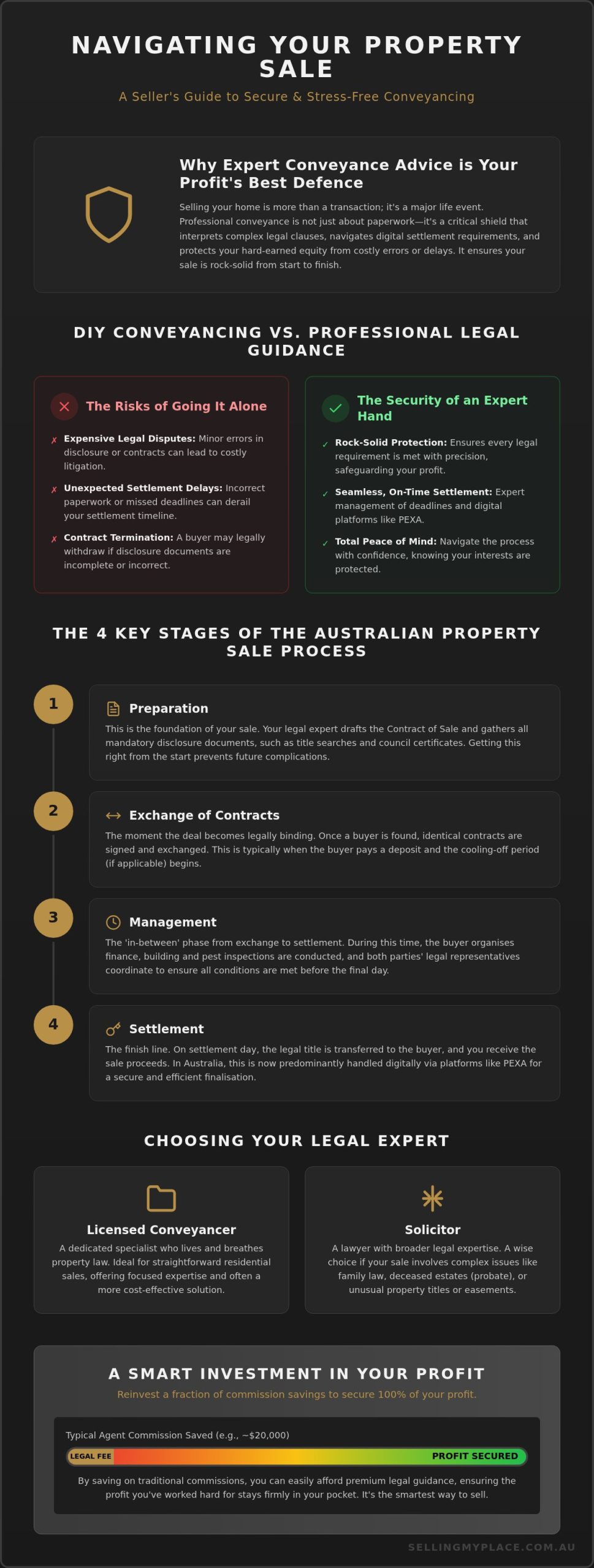
Protecting Your Equity: Legal Guidance for Commission-Free Sellers
When you choose to sell your home without a traditional agent, you’re making a bold decision to prioritise your family’s financial future. Saving an average of $20,000 in commission is a significant win. It changes the way you look at every other part of the process. Suddenly, investing a small fraction of those savings into premium conveyance advice doesn’t feel like a burden; it feels like a strategic reinvestment in your own success. You aren’t just saving money; you’re buying peace of mind. (And let’s be honest, that’s worth every cent.)
This approach gives you a distinct psychological advantage. You become an empowered seller, standing on equal footing with any professional agency. By choosing to lead the sale yourself, you’re taking ownership of your legacy. However, being an independent seller doesn’t mean you have to be a lonely one. Having expert legal backing ensures that your “Sale by owner” journey is perceived by buyers as a sophisticated, professional transaction. It removes the “amateur” stigma and replaces it with a sense of grounded, calm confidence.
Integrating Legal Strategy with Your Marketing Plan
Many sellers wait until they have a buyer to think about the legalities. That’s a mistake. Having your contract of sale ready the moment your listing goes live is a genuine power move. It signals to every person who walks through your door that you are a serious, well-prepared vendor. This level of organisation often translates into faster offers and smoother negotiations because there’s no delay in getting the paperwork to a keen buyer. For a deeper look at how to align your legal prep with your listing, our Modern Australian Seller’s Guide offers a comprehensive roadmap for the contemporary market.
Keeping Your Equity Safe Until the Final Cent is Paid
The legal side of selling isn’t just about the transfer of title; it’s about the math of the final payout. Your advisor ensures that the buyer’s deposit is held securely in a trust account, protecting you from the risk of a deal falling through without recourse. As settlement approaches, they’ll handle the intricate adjustments for council rates, water levies, and land taxes. These small details can add up to thousands of dollars if not managed correctly. Expert conveyance advice ensures that every cent is accounted for, so the profit you calculated on day one is exactly what arrives in your account on settlement day.
If you’re ready to secure your profit and ensure a flawless legal finish, book a consultation with our advisory team today. We’ll help you cross the finish line with the professional support you deserve.
The Kincade Approach: Expert Advisory for a Smooth Settlement
Selling your home independently doesn’t mean you have to wander through the legal wilderness alone. At Selling My Place, we’ve designed a bridge between the traditional agent model and the “For Sale by Owner” experience. This is where our Agent Advisory Service truly shines. We understand that while you’re more than capable of showing your own home and sharing its story, the legal finish line requires a different kind of expertise. Our approach is built on a flat-fee model that prioritises your profit, giving you access to the same professional results as a high-commission agency without the unnecessary overheads.
By facilitating expert conveyance advice through our broader advisory ecosystem, we ensure you have a “steady hand” guiding you through the settlement process. It’s about ensuring that the $20,000 you’ve saved in commission isn’t put at risk by a technicality early in the piece. We’re here to help you navigate the final exchange with the poise of a seasoned professional, ensuring your legacy is protected and your profit is secured. It’s a sophisticated way to sell that keeps you in the driver’s seat while providing a professional safety net.
Beyond the Listing: A Partnership Until Sold
We don’t reckon a “set and forget” approach works for something as important as your family home. Our relationship doesn’t end the moment your listing goes live on the major portals. We view this as a partnership that lasts until the keys are handed over and the funds are in your account. Having a dedicated advisor means you always have someone to turn to when a legal query pops up or when the settlement process starts to feel a bit heavy. This support is designed to facilitate a stress-free transition, allowing you to focus on the emotional significance of your next move rather than the fine print.
Getting Started with Selling My Place
Preparing for a successful transfer starts long before the “Sold” sticker goes on the board. You can tap into our extensive network of professional contacts to find the right legal representative for your specific needs, ensuring they understand the “Selling Smarter” philosophy. When you combine this legal readiness with our Step-by-Step Sale by Owner Guide, you’re setting yourself up for a flawless result. We empower you to take the lead while we provide the professional guidance to back you up. It’s your home, your profit, and your future. We’re just here to make sure the legal side of your journey is as celebratory and smooth as possible.
Step Into Your Next Chapter with Confidence
The sale of your home marks a significant milestone, representing years of memories and hard-earned equity. Ensuring this transition is legally seamless is the final piece of your “Selling Smarter” puzzle. By prioritising expert conveyance advice, you protect your financial interests and gain the peace of mind that comes from a professional, binding settlement. You’ve worked hard to prepare your property for the market; now it’s time to ensure the legal finish line is just as rewarding.
Selling My Place has been trusted by Australians for over 25 years to bridge the gap between independent selling and professional results. Our dedicated Agent Advisory Service provides the steady hand you need to navigate modern digital settlements while you keep 100% of your sale profit. We believe in a partnership approach that values your family’s needs as much as the technicalities of the law.
Ready to finalise your sale with total clarity? Secure your profit and get expert conveyance advice with Selling My Place. We are here to support you every step of the way, ensuring your move is celebratory and entirely stress-free.
Frequently Asked Questions
What exactly does conveyance advice cover for a seller?
This guidance covers the legal preparation of your contract of sale and the mandatory vendor disclosure documents required by law. Your advisor reviews your property title for easements or encumbrances, manages the formal exchange of contracts, and oversees the electronic settlement. Professional conveyance advice ensures you meet all statutory obligations, including the updated 2026 regulations and mandatory identity checks, which are now required for all property professionals to help prevent financial crime.
Can I really do my own conveyancing in Australia?
You can legally manage your own property transfer, but it is a path that carries significant risk. Self-managed sellers often struggle with strict statutory deadlines and the technical complexities of mandatory digital settlement systems like PEXA. If a document is misunderstood or a disclosure is missing, you could face expensive litigation or a voided contract. Most homeowners find that reinvesting a small portion of their commission savings into professional guidance is a much safer way to protect their equity.
How much does professional conveyance advice typically cost in 2026?
For a standard residential sale in late 2026, professional fees generally range between $500 and $3,000 for a licensed conveyancer, while solicitors typically charge from $1,500 upwards. You should also budget between $300 and $800 for disbursements, which cover essential searches and registration fees. While these costs vary depending on the complexity of your title, they represent a tiny fraction of the average $20,000 you save by avoiding traditional agency commissions and high marketing costs.
What is a Section 32 or Vendor Statement, and why is it vital?
This is a mandatory legal document that discloses essential information about your property to potential buyers before they sign a contract. It includes details on zoning, easements, rates, and any building permits issued in the last seven years. It is vital because failing to provide an accurate statement can give the buyer the legal right to withdraw from the sale at any time before settlement, potentially costing you months of progress and your hard-earned profit.
How long does the settlement process usually take from exchange?
A standard settlement period in Australia typically spans 30, 60, or 90 days from the date of exchange. However, the exact timeframe is negotiable and must be agreed upon by both parties before the contracts are finalised. With the mandatory shift to eConveyancing in 2026, the final day of settlement is now much more efficient. Funds are often transferred near-instantaneously once the digital handshake is completed in the secure settlement workspace, reducing the stress of waiting for cheques to clear.
What happens if the buyer pulls out during the cooling-off period?
If a buyer exercises their right to withdraw during the cooling-off period, the contract is cancelled and they usually forfeit a small percentage of the purchase price to you. The exact percentage and the length of the cooling-off period vary between different states and territories. This phase is designed to give buyers a short window for due diligence, so it is helpful to have your advisor ready to restart marketing efforts immediately if a deal doesn’t proceed as planned.
How does Selling My Place support me during the legal process?
We act as your steady hand by providing a dedicated Agent Advisory Service that bridges the gap between listing and settlement. Our team offers pre-sale consulting and expert conveyance advice to ensure your contract is rock-solid before you even find a buyer. We help you navigate the nuances of the 2026 regulations and connect you with our trusted network of professionals, ensuring your “Sale by owner” journey remains professional, legally binding, and completely stress-free for your family.
Do I need a different conveyancer if I am selling commission-free?
No, you don’t need a specialised type of conveyancer, but you do need one who respects your choice to sell independently. Some traditional professionals are accustomed to working only with high-commission agents and may not understand the “Selling Smarter” philosophy. At Selling My Place, we ensure you’re partnered with experts who understand our flat-fee model and are committed to helping you keep 100% of your profit. Our goal is to provide the professional backing you deserve at every stage.
The Best Alternatives to Real Estate Agents in Australia for 2026
What if the most valuable person in your property sale wasn’t a high-commission agent, but you? You’ve likely spent years pouring love and hard work into your home, so the thought of handing over a massive chunk of your profit to a traditional agency feels quite unsettling. Many homeowners are now seeking professional alternatives to real estate agents in Australia to protect their equity from being eroded by fees. It’s natural to feel protective of your hard-earned wealth; the usual process often involves a lack of transparency or pressure to lower your price just to get a deal done quickly.
We’re here to help you discover how to take control of your sale without the stress of going it alone. You can bypass those heavy commissions and still achieve a successful result at full market value by using a strategic partnership approach. This guide will explore how modern flat-fee services and expert advisory models can save you tens of thousands of dollars while providing the safety net you need. We’ll show you how to blend professional marketing with your own local knowledge to create a selling experience that feels both empowering and deeply rewarding.
Key Takeaways
- Understand why the traditional commission model is losing its shine in a high-value market and how digital tools are putting power back into your hands.
- Explore the most effective alternatives to real estate agents in Australia, from purely independent sales to strategic flat-fee listing services that get you on the major portals.
- Learn how to manage the transition safely by using pre-sale consulting and data-driven market reports to ensure you don’t under-price your family’s biggest asset.
- Discover the financial impact of choosing a commission-free path, potentially saving an average of $20,000 while maintaining total control over your sale.
- Realise that selling without a traditional agent doesn’t mean selling alone; it’s about choosing a professional partnership that prioritises your equity over an agency’s profit.
Why Australian Homeowners are Ditching Traditional Agents
There is a quiet revolution happening in Australian driveways lately. As we move through 2026, the way we perceive property sales is changing, moving away from the old-fashioned “agent-as-gatekeeper” model toward a more transparent, partnership-based approach. With the average dwelling value in Australia hitting a record high of $1,111,100 in the early part of this year, the stakes have never been higher for families looking to move. When your home is your greatest financial asset, the thought of handing over a significant portion of its value to a third party can feel quite daunting. It’s this very feeling that’s driving a surge in interest regarding alternatives to real estate agents australia.
The desire for control is at the heart of this shift. Many homeowners have felt the sting of a “quick sale” where an agent pushed for a lower price just to clear their books, or they’ve grown tired of the lack of transparency in closed-door negotiations. By stepping into the driver’s seat, you’re not just saving money; you’re ensuring that the story of your home is told with the warmth and detail only an owner can provide. After all, who knows the afternoon sun in the kitchen or the quietness of the street better than you do?
The Real Cost of a 2.5% Commission
In 2026, the national average real estate commission is approximately 2.3% of the sale price plus GST, which effectively totals over 2.5% for most sellers. While that percentage might sound small in isolation, the reality on a million-dollar property is a staggering $25,000 or more. When you add marketing costs, which typically range from $2,000 to over $8,500, the total bill can easily exceed $30,000. This is money that could be funding your next renovation, boosting your retirement nest egg, or helping your children with a deposit of their own. These “hidden” costs of the traditional model often represent years of hard work and mortgage repayments that vanish in a single transaction.
The Transparency Gap in Modern Real Estate
In an era of open data, the traditional role of the agent as the sole source of market information has dissolved. Buyers are increasingly savvy and often prefer the directness of a conversation with the owner. Engaging in the For Sale By Owner (FSBO) process allows for a level of honesty and clarity that is sometimes lost when a third party is involved. To feel truly confident in these interactions, homeowners are turning to professional tools like Neighborhood Market Reports to ensure their pricing is backed by solid, local evidence. By using alternatives to real estate agents australia, you remove the “gatekeeper” and replace them with a direct line of communication, leading to outcomes that feel fair and transparent for everyone involved.
3 Main Alternatives to Real Estate Agents in Australia
Deciding how to navigate your property sale is a deeply personal choice that depends on your confidence, your schedule, and your financial goals. It’s not just about the transaction; it’s about finding a path that feels right for your family’s future. Fortunately, the landscape has shifted significantly, and there are now several professional alternatives to real estate agents australia that allow you to bypass traditional commissions. Whether you want to handle every detail yourself or prefer a guided experience, there’s a model that can help you protect your equity while achieving a successful result.
Pure Private Sales (FSBO)
The most independent route is the pure For Sale By Owner approach. This model gives you total autonomy over the entire process, from the initial photography to the final handshake. You are the sole voice for your home, which allows you to share those intimate details that an agent might overlook. While the independence is liberating, it does require a significant time commitment and a high level of organisation. Historically, around 70% of purely private sales can encounter hurdles, often because the property lacks the professional marketing reach needed to attract a wide pool of buyers. This path is typically best suited for those with prior experience in property or a ready-made buyer within their local community.
Flat-Fee Listing Services
Flat-fee listing services offer a practical step up from the purely DIY method. Because the major national property portals generally don’t allow private individuals to list directly, these services act as a licensed bridge to get your home in front of active buyers. You pay a set upfront fee to have your ad placed on Australia’s leading real estate websites, giving you the visibility of a big agency without the commission. It’s a functional choice, though it’s important to remember these services are often quite transactional. They provide the “billboard,” but the quality of the listing and the weight of the negotiations remain your responsibility.
The Assisted Direct Sales Model
For many Australian homeowners, the assisted direct sales model provides the most balanced and secure experience. This hybrid approach combines the savings of a commission-free sale with the professional tools and advisory support of a top-tier agency. It’s widely considered the most reliable Sale by owner method because it includes a dedicated Agent Advisory Service. Having a “steady hand” to guide you through the nuances of offers and contracts ensures you never have to guess your way through the critical moments. If you’re looking for a way to sell smarter while keeping your hard-earned profit, you might like to discuss your specific needs with our team.
Comparing the Costs, Risks, and Rewards
Deciding to move away from the traditional path requires a clear-eyed look at the numbers and the responsibilities involved. It’s a balance between the incredible financial reward of protecting your equity and the practicalities of managing the sale process. While the savings are often life-changing, we always encourage our clients to consider the full picture. Success isn’t just about avoiding a fee; it’s about achieving a result that leaves you feeling secure and satisfied with your family’s future.
Calculating Your Potential Equity Savings
Let’s look at a practical example. On a property selling for $1,000,000, a traditional agent’s commission of 2.3% plus GST effectively removes over $25,000 from your pocket. When you add marketing packages and potential auctioneer fees, your total outlay often climbs toward $35,000. By choosing alternatives to real estate agents australia, you replace that variable commission with a fixed investment. Our data shows that the average owner saves approximately $20,000 by using a flat-fee model. This isn’t just a number on a page; it’s the difference between a basic relocation and a move that sets you up with a significant financial head start.
Mitigating the Risks of Selling Privately
The primary concern for many is the risk of “getting it wrong.” Common fears include under-pricing the home or missing out on the right buyer because the property wasn’t visible enough. This is where professional Residential Property Listing Services become your greatest asset. High-quality photography and accurate floorplans are non-negotiable in 2026; they ensure your home isn’t just another listing, but a standout destination for the global market. To manage the risks effectively, consider these key areas:
- Legal Compliance: New Anti-Money Laundering laws mean you must ensure buyer identity checks are handled by your solicitor or conveyancer.
- Negotiation: Having an advisory service behind you means you aren’t guessing when an offer lands on the table.
- Time Management: You’ll need to be available for enquiries and open homes, which allows you to vet buyers personally and share your home’s unique story.
By using professional alternatives to real estate agents australia, you gain the expertise needed to navigate complex negotiations without the high-stakes pressure of a commission-driven environment. It’s about selling with a steady hand and a full heart, knowing you have the right tools to protect your legacy.
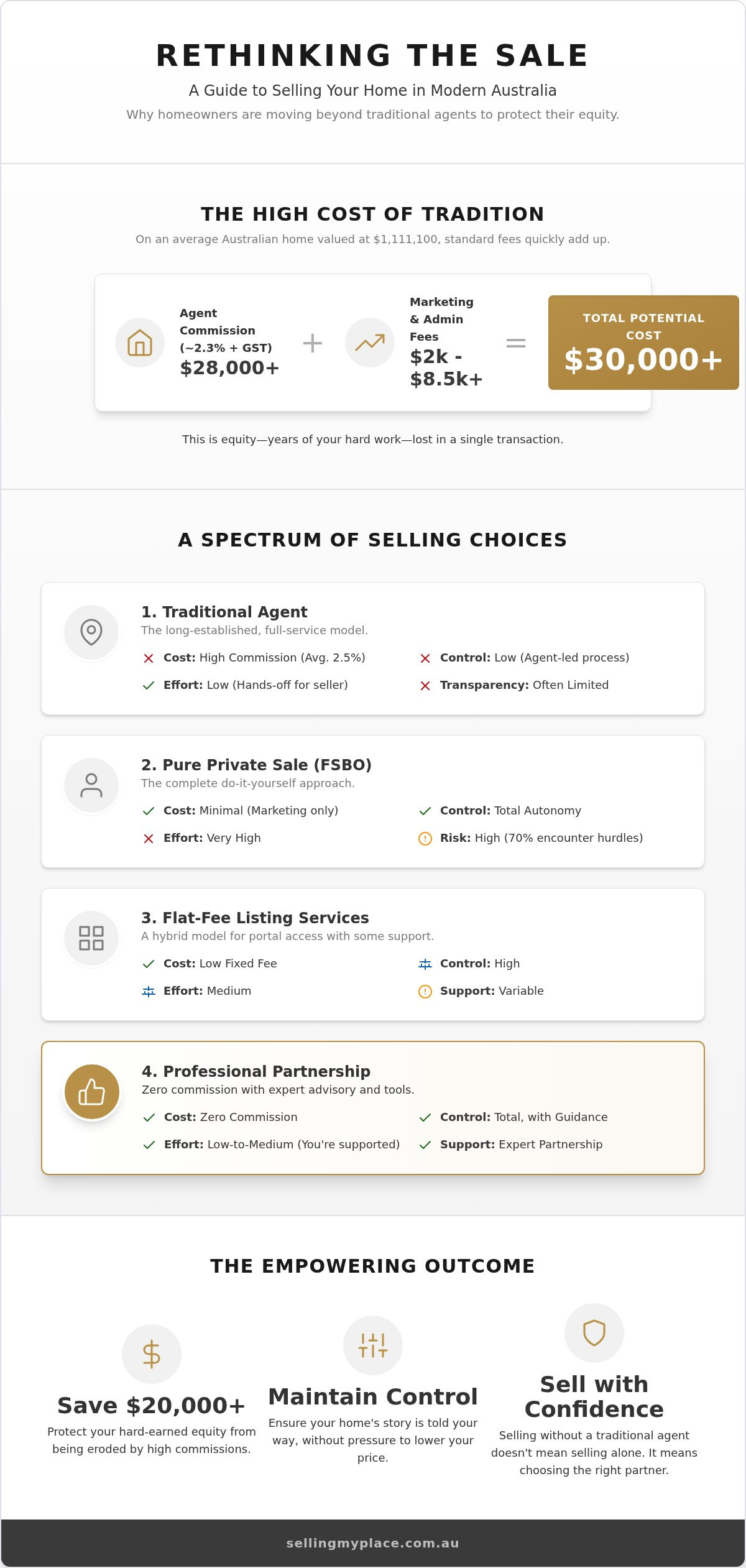
Steps to Successfully Sell Your Home Without an Agent
Taking the leap into a commission-free sale is an exciting moment, but it’s the practical, step-by-step execution that turns a plan into a successful result. Think of this process not as a solo climb, but as a guided walk where you hold the map. By leveraging professional alternatives to real estate agents australia, you can move through each phase with the confidence of a seasoned pro. The journey begins long before the first open home, starting with a thoughtful approach to presentation and a clear understanding of your property’s place in the current market.
Start with pre-sale property consulting to identify the small, high-impact improvements that add the most value to your home. Once your property is looking its best, use data-driven neighborhood market reports to anchor your expectations in reality. There’s no need to guess or rely on an agent’s “appraisal” that might be inflated just to win your business; the data tells the honest story of what buyers are actually paying in your street. This grounded approach ensures you enter the market with a price that attracts genuine interest from day one.
Marketing Your Property Like a Pro
In the digital age, your home’s first inspection happens on a smartphone screen. A successful sale relies on a “Listing Until Sold” strategy, ensuring you aren’t pressured by arbitrary agency timelines or expiring contracts. By using professional photography and floorplans, you create a narrative that resonates with both local families and international buyers. It’s about more than just a house; it’s about the lifestyle your neighbourhood offers, from the best local coffee spot to the quietest parks. This digital infrastructure allows you to reach a global audience while you maintain total control over who visits your home.
When the enquiries start rolling in, managing open homes becomes a chance to meet your future buyers face-to-face. You’ll find that being the owner often breaks down barriers, allowing for more honest and relaxed conversations. When an offer arrives, keep our property sale negotiation tips close at hand to ensure you’re securing the best possible terms. Remember, you’re the expert on your home, and that passion is your greatest asset during the negotiation phase.
The Legal and Settlement Process
While you’re handling the marketing, your legal team handles the fine print. It’s vital to secure professional conveyance advice early to prepare your contract of sale; this is a legal requirement in all Australian states and territories. This document, such as a Section 32, is the legal bedrock of your transaction. Once a price is agreed upon and the contract is signed, you’ll enter the settlement period. This is the time when final identity checks and financial transfers occur, leading to that wonderful moment when the keys change hands and your equity is safely in your bank account.
Ready to start your journey with a steady hand by your side? Reach out to our advisory team to discuss your sale.
The Kincade Approach: Professional Partnership, Zero Commission
Selling your home is about so much more than a contract; it’s about the memories you’ve built and the future you’re funding. At Kincade International Direct Sales (KIDS), we believe that choosing alternatives to real estate agents australia shouldn’t mean sacrificing professional quality or peace of mind. Our approach is built on a simple, honest truth: you deserve to keep your equity while having a steady hand to guide you through the complexities of the modern market. We don’t just provide a platform; we offer a partnership that values your family’s legacy as much as you do. It’s a way to sell that feels personal, protective, and entirely transparent.
The traditional agency model often feels purely transactional, but we know that moving house is one of life’s major transitions. By removing the 0% commission structure and replacing it with a flat-fee model, we align our goals with yours. We aren’t rushing you toward a sale just to collect a cheque; we’re providing the tools and advisory support you need to achieve the best possible market value. This is the most honest way to handle real estate, ensuring that the average owner saving of $20,000 stays in your bank account to fund your next chapter.
Expert Backing Every Step of the Way
The heart of our service is the Agent Advisory Service. Think of it as having a seasoned, multi-generational expert in your corner who isn’t motivated by a commission. Whether you’re navigating the identity checks required by the 2026 anti-money laundering laws or weighing up the nuances of a multi-offer situation, our advisors provide the calm confidence you need. We provide the same top-tier tools used by the country’s most expensive agencies, including professional photography and detailed floorplans, but at a fraction of the cost. It’s a partnership that provides a safety net, ensuring you never feel like you’re “going it alone” during such a significant life event.
Selling Smarter, Not Harder
One of the biggest stressors in a traditional sale is the ticking clock of an agency agreement. These time limits often create a sense of artificial pressure, which can lead to rushed decisions and compromised prices. Our “No Time Limit” policy removes that burden entirely, allowing you to wait for the buyer who truly recognises the value of your home. We leverage a sophisticated digital infrastructure and a global marketing network to ensure your property reaches the right audience, regardless of where they are. By choosing alternatives to real estate agents australia that focus on quality marketing and expert advice, you’re joining a growing community of savvy homeowners who value stability and smart financial management. It’s about taking control of your sale with a professional team that treats your home with the respect it deserves.
Take Control of Your Property Legacy Today
Choosing to move away from the traditional model is a powerful step toward securing your family’s financial future. By exploring modern alternatives to real estate agents australia, you’ve seen that it’s entirely possible to achieve a premium market result without the burden of heavy commissions. You don’t have to choose between going it alone or paying for services you don’t need; instead, you can embrace a professional partnership that puts you in the driver’s seat. It’s about selling with a steady hand and protecting your hard-earned equity through every stage of the process, ensuring your transition is as smooth as it is rewarding.
With professional photography, expert advisory services, and the peace of mind that comes from being listed until sold with no time limits, you’re perfectly positioned to succeed. On average, our clients save $20,000 on commissions, ensuring those funds remain available for your next life transition. We’re here to provide the tools and support you need to sell with confidence and warmth. Keep 100% of your profit and sell smarter with Kincade International Direct Sales today. Your home’s story is yours to tell, and we’re honoured to help you share it with the world.
Frequently Asked Questions
Is it legal to sell my own house in Australia without an agent?
Yes, it is completely legal to sell your own property in every Australian state and territory. While you handle the marketing and inspections, you are still required by law to engage a solicitor or conveyancer to manage the legal transfer. Many homeowners find that professional alternatives to real estate agents australia provide the perfect balance of legal security and financial freedom, allowing you to bypass commissions while staying fully compliant.
How much can I actually save by using a flat-fee real estate service?
Homeowners typically save an average of $20,000 by moving away from traditional commission structures. Since the average national commission is around 2.3% plus GST, a flat-fee model allows you to keep that equity for your next home or retirement fund. This approach replaces variable percentages with a single upfront investment that covers your marketing, photography, and advisory support, ensuring your profit stays exactly where it belongs.
Will my property still appear on the major Australian real estate portals?
Yes, your property will be visible on the most prominent Australian real estate portals. While these platforms generally don’t allow private individuals to list directly, flat-fee services use their professional licenses to place your ad where buyers are looking. This ensures your home receives the same level of exposure as any agency-listed property. Using such alternatives to real estate agents australia ensures you reach local families and international buyers through a global marketing network.
Who handles the legal paperwork if I don’t have a traditional agent?
You will need to engage a qualified solicitor or conveyancer to handle the legal complexities of the transaction. They are responsible for preparing the contract of sale and ensuring all identity checks comply with the 2026 anti-money laundering laws. Our service includes expert conveyance advice to help you navigate this phase, ensuring your paperwork is robust and your settlement process remains smooth and secure for all parties involved in the sale.
Can I still have an auction if I choose an alternative to an agent?
You can certainly choose to sell your home via auction even if you aren’t using a traditional agent. You simply need to hire a professional, licensed auctioneer to conduct the proceedings on the day. This allows you to benefit from the competitive atmosphere of an auction while still avoiding the high commission fees usually associated with the process. It is a strategic way to maintain control over the selling method and your final profit.
How do I know if I am setting the right price for my property?
Setting the correct price is achieved through detailed, data-driven research rather than guesswork. We provide comprehensive Neighborhood Market Reports that show exactly what similar properties in your street have sold for recently. By looking at actual settlement data rather than just asking prices, you can set a realistic figure that attracts genuine interest while protecting your equity. This ensures you don’t under-price your family’s most significant asset in a fragmented market.
What happens if my property doesn’t sell within the first month?
If your property doesn’t sell immediately, there is no need to feel pressured or stressed. Unlike traditional agency agreements that often expire after 90 days, our policy means your property is listed until sold with no time limits. This allows you to wait for the right buyer who truly values your home’s unique features, rather than feeling forced by an agent to lower your price just to meet an internal sales target or monthly quota.
Do I need a buyer representative if I am selling privately?
While you don’t need a buyer representative for yourself as the seller, you may encounter buyers who use their own professional representation. In these cases, having access to real estate advisory services can be incredibly helpful. An advisor acts as a steady hand during negotiations, helping you vet offers and communicate effectively with professional buyer’s agents. This ensures you remain on an equal footing throughout the entire negotiation process and secure a fair deal.
Negotiating House Price with Buyer Directly: An Australian Seller’s Guide
What if the most effective person to sell your home isn’t a high-pressure agent, but actually you? It’s a question that challenges the traditional Australian real estate model, especially when you consider that the average seller hands over $20,000 or more in commissions just for someone else to lead the conversation. We understand that the idea of negotiating house price with buyer directly can feel a bit daunting at first. You might worry about being lowballed or feel a natural discomfort when discussing large sums of money face-to-face. It’s perfectly normal to want to protect your family’s legacy while avoiding the typical stress of a financial tug-of-war.
This guide is designed to transform that uncertainty into a sense of grounded, professional confidence. We’ll show you how to master the art of direct negotiation to secure the best possible price for your property while keeping 100% of your hard-earned profit. You’ll learn how to use professional market data as your silent partner, how to handle offers with a steady hand, and how to ensure the entire transaction remains smooth and respectful from the first viewing to the final settlement. We’re here to help you talk price with authority, empathy, and a clear focus on your next chapter.
Key Takeaways
- Learn the “steady hand” philosophy to maintain calm confidence and professional decorum when talking to prospective buyers.
- Discover how negotiating house price with buyer directly allows you to secure the best market value while keeping an average of $20,000 in your own pocket.
- Use professional market reports and high-quality floorplans as the essential evidence needed to justify your asking price and anchor the conversation.
- Identify valuable non-monetary terms, such as settlement periods and deposit amounts, that can be just as significant as the final sale figure.
- Understand how an Agent Advisory Service provides the expert guidance you need during high-pressure moments without the cost of a traditional commission.
Mastering the Art of Direct Negotiation: Why Selling Your Own Place Works
Many people view the sale of a home as a high-stakes battle, but it’s actually a professional dialogue between two parties looking for a fair outcome. When you choose the path of negotiating house price with buyer directly, you’re stepping into a role of empowerment. You aren’t just a vendor; you’re the person who has lived within these walls and understands their true value. By adopting a “steady hand” philosophy, you maintain a calm, grounded presence that reduces the stress for everyone involved.
There is also a significant financial advantage to this approach. In Australia, the average seller might spend $20,000 or more on agency commissions. By removing that middleman, you’ve already “won” back a substantial portion of your equity. This provides you with more flexibility during the conversation. You can choose to pass some of those savings on to secure a faster sale, or simply keep that hard-earned profit to fund your next big move. It’s a position of strength that traditional models simply can’t offer.
The Psychology of the Direct Deal
Buyers often find it refreshing to speak directly with the homeowner. It cuts through the typical industry noise and offers a level of transparency that’s hard to find elsewhere. You can build genuine rapport by discussing the practicalities of the home, like which window catches the best winter sun or the friendly nature of the neighbours. While it’s great to be welcoming, it’s vital to stay authoritative. Understanding various negotiation tactics helps you remain friendly without oversharing details that might compromise your financial position. Think of it as a professional-casual partnership; you’re being a good neighbour while protecting your family’s interests.
Setting Your Negotiation Goals
Success starts long before the first offer arrives. You need to identify your “walk-away” price, which is the absolute minimum you’ll accept to make your next move viable. Knowing this number prevents you from making emotional decisions in the heat of the moment. Beyond the dollar sign, consider your ideal settlement timeline. Sometimes, a buyer who can move in quickly or wait an extra month is worth more than a slightly higher offer with rigid dates. In a private treaty context, the reserve price is the minimum figure you are willing to accept before you’ll commit to signing a contract. Having these goals organised in advance ensures you lead the process with clarity and confidence.
Preparation is Your Best Defence: Using Market Data to Anchor Your Price
Confidence in negotiating house price with buyer directly isn’t just about having a gift for gab; it’s about having the right evidence. When a buyer questions your asking price, having a stack of objective data turns a potential argument into a professional discussion. You aren’t just “guessing” what your home is worth. You’re basing your position on hard facts. This data acts as a shield against lowball offers, allowing you to stay calm and respectful while firmly pointing to recent sales that support your figure.
Knowing your competition is just as vital as knowing your own home. While the national median dwelling value was approximately $937,722 in June 2026, your local street value is what matters most to your buyer. Take the time to visit a few open houses nearby. See how they compare in terms of land size, finish quality, and layout. Understanding what else is available helps you articulate why your property holds a specific value. It’s much easier to hold your ground when you can say, “I’ve seen the other three-bedroom homes in the area, and our extra living space justifies the difference.”
Leveraging Neighbourhood Market Reports
To negotiate like a seasoned expert, you need to look beyond the “asking price” of other homes and focus on actual “sold” prices. These figures are the only true measure of market value. You can find detailed advice in our guide on how to determine market value of a home in Australia. Look for trends such as the average number of days on market or price growth over the last quarter. If you’re feeling unsure about the data, it’s often worth a moment to chat with our advisory team to ensure your pricing strategy is airtight.
The Power of Professional Presentation
First impressions dictate the entire rhythm of a negotiation. If your listing looks amateur, buyers will assume you’re an amateur negotiator. Professional photography and floorplans are non-negotiable tools. They establish a high “perceived value” before the buyer even walks through the front door. A clear floorplan helps buyers visualise their life in the space, reducing the likelihood of them haggling over minor layout “flaws” later.
When you organise your home for inspections, focus on light, space, and cleanliness. Removing clutter allows the buyer to focus on the home’s bones rather than your belongings. By presenting a polished, well-maintained environment, you signal that the property has been cared for, which naturally supports a premium price. You can find more property negotiation tips from experts who emphasise that emotional detachment starts with a professional presentation.
The Negotiation Table: How to Handle Offers with Confidence
When the phone rings or an email lands with those first few numbers, it’s natural to feel a rush of adrenaline. This is the moment where negotiating house price with buyer directly moves from theory into reality. Your primary goal is to remain the “steady hand” who leads with heart and logic. You don’t need to answer immediately. In fact, the “Silence is Golden” rule is one of your most potent tools. By taking 24 hours to consider a proposal, you signal that you are a serious, methodical vendor who isn’t acting out of desperation. This brief pause gives you the space to consult your data and respond from a position of calm authority.
Most offers in Australia come with strings attached, known as “subject to” clauses. These typically cover finance approval, building inspections, and pest reports. Don’t view these as hurdles; view them as standard steps toward a secure settlement. A buyer who asks for a building inspection is a buyer who is genuinely planning to move in. Your job is to ensure the timeframes for these clauses are reasonable, usually 7 to 14 days, to keep the momentum of the sale moving forward. When you are negotiating house price with buyer directly, your response to these conditions sets the tone for the entire transaction.
Responding to Your First Offer
Always acknowledge an offer in writing, even if it’s just a quick text or email to say you’ve received it and will respond by a certain time. This maintains a professional trail and sets clear expectations. If an offer feels complex or you’re unsure of the buyer’s motivations, this is where our Real Estate Advisory Services become your secret weapon. We can help you vet the proposal and phrase a counter-offer that invites a collaborative response rather than creating a standoff. The goal is to keep the buyer engaged, perhaps by meeting them in the middle on price while asking for a shorter settlement period that suits your lifestyle.
Managing Lowball Offers with Grace
It’s easy to feel insulted by a lowball offer, but try to see it as a compliment. They like your house enough to want to buy it. A low offer is simply the start of a dialogue. Instead of a flat “no”, use a script that acknowledges their interest while firmly pointing back to your evidence. You might say, “I appreciate your offer, however, based on recent sales in the street, we aren’t quite there yet.” You can find more specific phrasing in our guide on expert property sale negotiation tips to help you keep the door open without compromising your value. Remember, the first person to mention a number often sets the anchor, but the person who stays the calmest usually wins the deal.
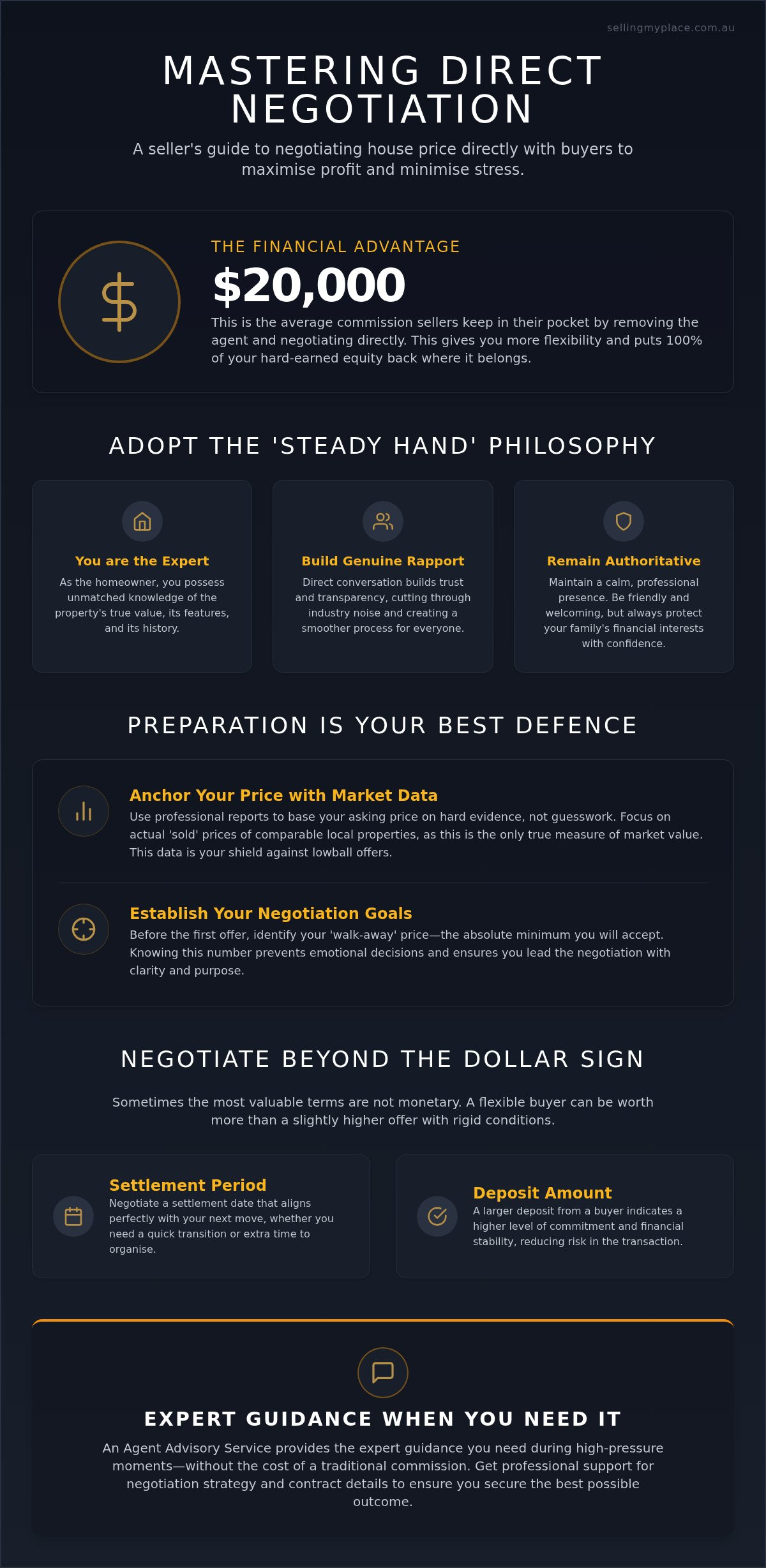
Looking Beyond the Dollar Sign: Negotiating Terms That Suit Your Lifestyle
While the final figure is what most people focus on, the terms of your contract are often where the real value lies. When you’re negotiating house price with buyer directly, you can prioritise what actually matters for your next chapter. Is it a quick exit, or do you need time to find your next home? By looking beyond the dollar sign, you can create a win-win scenario that feels respectful and grounded. You have the unique opportunity to discuss these lifestyle factors without them being filtered through an intermediary, which often leads to a more harmonious result for both parties.
The deposit is a crucial sign of buyer commitment. While a 10% deposit is traditional in Australia, some buyers may offer less. A larger deposit provides you with peace of mind that the buyer is financially stable and fully committed to the purchase. It’s an often-overlooked lever in the negotiation process. If a buyer is pushing for a lower price, you might counter by asking for a higher deposit or a shorter cooling-off period to secure the deal. These non-monetary wins can be just as significant as the sale price itself.
Settlement Periods and Possession Dates
Most Australian property sales involve a 30, 60, or 90-day settlement. If you’re still looking for your next home, a longer 90-day period gives you much-needed breathing room. Alternatively, you might negotiate a “rent-back” agreement, where you stay in the property as a tenant for a short period after settlement. This flexibility can be a powerful tool; sometimes, being accommodating on dates can help you hold firm on your asking price. It turns the transaction into a partnership rather than a battle of numbers.
Conditions and Inclusions
Clarity is your best friend here. Be specific about what stays with the home. Are those custom-made curtains included? Is the premium dishwasher part of the deal? Listing these inclusions early prevents awkward conversations later. If a building report identifies minor issues, don’t panic. You can negotiate a small price reduction or agree to fix the items before settlement. This is where having professional conveyance advice ensures that every agreement is legally binding and watertight. If you’re unsure how to phrase these specific terms in your contract, reach out to our advisory team for a chat about your unique situation.
Your Steady Hand in the Sale: How Expert Advisory Maximises Your Profit
Choosing to sell your home yourself is a rewarding decision, but it doesn’t mean you have to carry the weight of the entire process on your own shoulders. When you are negotiating house price with buyer directly, having a “professional in your pocket” can be the difference between a stressful stalemate and a celebratory success. The KIDS flat-fee model is designed to provide you with the professional infrastructure of a traditional agency—including our dedicated Agent Advisory Service—without the heavy burden of commissions. You get to keep the driver’s seat while we provide the map and the compass.
This partnership approach ensures you never feel isolated during high-pressure moments. Whether you’re unsure how to counter a complex offer or simply need a neutral second opinion on a buyer’s feedback, our advisors are here to help you stay grounded. We believe that a commission-free sale should be synonymous with a high-quality, professional experience. By removing the $20,000 average agency commission from the equation, you aren’t just saving money; you’re reclaiming the value of your most significant asset and ensuring your family’s future is as secure as possible.
The Partnership Approach to Selling
Our involvement begins long before the first offer arrives. Through pre-sale property consulting, we help you identify small, cost-effective changes that can deliver a significant return on investment. Sometimes, a fresh coat of paint in a neutral tone or a simple garden tidy-up can add thousands to your final sale price. Our advisory service acts as a steady, neutral party, helping you separate the emotional significance of your home from the practicalities of a market transaction. If you’re ready to start this journey, our step-by-step guide to sale by owner in Australia provides a clear roadmap for every stage of the process.
Securing Your Legacy and Profit
Take a moment to visualise what that $20,000 saving truly means for your lifestyle. It might be the deposit for your next investment, a complete renovation of your new kitchen, or a well-deserved family holiday to celebrate your next chapter. As you move toward closing the deal, keeping a final checklist ensures a smooth transition to settlement:
- Review all “subject to” clauses with a calm and methodical eye.
- Confirm the deposit has been received and held in a secure trust account.
- Coordinate closely with your legal representative to finalise the contract of sale.
- Prepare the home for the final inspection with the same care you used for the first open house.
Selling your home is a major life transition, and we are honoured to act as your nurturing guide through the complexities of the Australian property market. You have the local knowledge and the heart; we provide the professional tools to make it happen. Enquire about our flat-fee listing and advisory packages today and discover how simple and profitable direct selling can be.
Taking the Next Step Toward Your Successful Sale
Selling your home is far more than a simple transaction; it’s the bridge to your next big adventure. By mastering the process of negotiating house price with buyer directly, you’ve taken a significant step toward protecting your family’s financial future. We’ve explored how objective market data and professional presentation act as your silent partners, allowing you to anchor your price with confidence. You now understand that a successful deal isn’t just about the numbers, but also about finding the settlement terms and deposit conditions that respect your lifestyle and timeline.
You have the local heart and the personal stories that make your property special, and we provide the professional infrastructure to ensure those stories reach the right people. With our Agent Advisory Service by your side, you’ll have the expert guidance needed to handle every offer with a steady hand. Most sellers save an average of $20,000 in commissions by choosing this path, all while benefiting from professional marketing that truly rivals traditional agencies. It’s time to secure the profit you’ve worked so hard to build. Discover how to sell your home and keep 100% of the profit with Kincade International and let’s make your next move your best one yet.
Frequently Asked Questions
Do I have to accept the highest offer when negotiating house price with buyer directly?
No, you aren’t legally or morally obligated to accept the highest offer. When you’re negotiating house price with buyer directly, you should look at the “cleanliness” of the contract. A slightly lower offer with no finance or building conditions and a settlement date that aligns perfectly with your next move might be more valuable than a higher, riskier bid. It’s about finding the balance between the final dollar and your family’s peace of mind.
How do I handle a buyer who wants to negotiate face-to-face during an inspection?
It’s best to keep the inspection focused on the home’s features and handle financial discussions later. If a buyer tries to talk numbers on the spot, politely let them know that you’d prefer to receive all offers in writing so you can give them proper consideration. This avoids high-pressure snap decisions. You might say, “I’m glad you’re interested; please send through your proposal via email so I can discuss it with my family tonight.”
What is the best way to reject an offer without offending the buyer?
Start by thanking the buyer for their interest and acknowledging the effort they’ve put into their offer. You can then explain that the figure doesn’t quite meet your expectations based on recent local sales data. By referencing objective evidence rather than personal feelings, you keep the conversation professional. Always encourage them to come back with a revised offer if their circumstances change. This keeps the door open while maintaining your home’s value.
Can I negotiate the deposit amount in a private sale?
Yes, the deposit is a flexible term that can be negotiated just like the sale price. While 10% is the standard in Australia, you might ask for a larger amount to ensure the buyer is fully committed, especially if they’ve requested a long settlement. Conversely, you might accept a smaller deposit to help a first-home buyer get across the line. It’s a powerful tool to use when negotiating house price with buyer directly to gauge seriousness.
What happens if the buyer asks for a price reduction after the building inspection?
You should first ask to see the specific section of the building report that mentions the defect. If the issue is a genuine structural problem you weren’t aware of, a small price reduction or an agreement to fix the issue before settlement is a reasonable response. However, don’t feel pressured to lower the price for minor “wear and tear” items that are common in older homes. Stay grounded and focus on the major findings only.
How does the Agent Advisory Service help me during a negotiation?
Think of the Agent Advisory Service as your secret weapon for staying calm during the “crunch” moments. We provide you with professional scripts, help you vet the financial stability of a buyer, and offer a neutral second opinion on complex proposals. This ensures you don’t make emotional decisions under pressure. You get the benefit of years of industry experience to guide your direct negotiation, helping you secure a result that reflects the true market value.
Is a verbal agreement on price legally binding in Australia?
No, a verbal agreement is not legally binding for property sales in any Australian state or territory. For a sale to be official, both parties must sign a written Contract of Sale, and in some cases, the deposit must be paid. Until the contracts are exchanged and the cooling-off period has passed, the deal isn’t final. This is why it’s vital to move from a verbal “yes” to a signed document as quickly as possible.
What documents should I have ready before I start negotiating with a buyer?
You’ll need a valid Contract of Sale prepared by your solicitor or conveyancer, along with any state-specific disclosure documents like a Section 32. It’s also helpful to have your Neighbourhood Market Reports and professional floorplans handy to justify your price. Having these documents organised and ready to send electronically shows buyers that you’re a serious, professional vendor. This preparation reduces delays and builds a sense of trust from the very first conversation.
How to Handle Offers When Selling Privately: An Australian Homeowner’s Guide
What if the most daunting part of your property journey wasn’t the cleaning or the “for sale” sign, but the simple ping of an email notification? It’s the moment you’ve worked toward, yet many homeowners find themselves frozen when the first buyer makes a move. Learning how to handle offers when selling privately shouldn’t feel like a high-stakes gamble against a seasoned professional. You’ve likely felt that familiar prickle of anxiety about being low-balled or the confusion that comes with “subject to finance” clauses. It’s perfectly natural to worry about losing a buyer during the back-and-forth of a negotiation.
We understand that this transition is about more than just bricks and mortar; it’s about your legacy and your next chapter. This guide is designed to hand you the keys to the negotiation table, showing you how to evaluate, counter, and accept offers with total confidence. We’ll explore how to distinguish a serious buyer from a tyre-kicker and how to secure a clean, unconditional contract. By the end, you’ll be ready to achieve a premium sale price while keeping that $20,000 commission exactly where it belongs: in your pocket.
Key Takeaways
- Understand why verbal offers are merely expressions of interest and how to transition a buyer toward a formal, written contract that sticks.
- Learn how to handle offers when selling privately by weighing up the “Offer Certainty” of an unconditional bid against a higher price with complex conditions.
- Discover the art of the counter-offer and why keeping the conversation moving is the best way to secure a clean, high-value result for your family home.
- Recognise the importance of having your conveyancing advice ready early to navigate state-specific cooling-off periods with calm confidence.
- Explore how professional support and 0% commission models allow you to negotiate like an expert while saving an average of $20,000 in traditional fees.
Receiving Your First Property Offer: The Non-Binding Reality
That first notification that someone wants to buy your home is a milestone moment. It’s the culmination of your hard work, from decluttering the spare room to hosting open inspections. However, it’s vital to ground this excitement in the practicalities of the Australian property market overview. In our local landscape, an offer isn’t a final destination; it’s the start of a structured legal process. Understanding how to handle offers when selling privately begins with recognising that until ink meets paper, everything remains fluid.
A formal offer in the Australian residential market typically consists of four key pillars: the proposed purchase price, the deposit amount (usually 10%), the preferred settlement period, and any specific conditions such as “subject to finance” or a satisfactory building and pest inspection. Verbal offers, while exciting, are technically just “expressions of interest”. They carry no legal weight. You aren’t locked in, and neither are they. This non-binding reality is actually your best friend, as it gives you the breathing room to step back and evaluate the proposal without the pressure of an immediate deadline.
Verbal vs. Written Offers
Always ask a buyer to follow up a verbal offer in writing. This simple request acts as a natural filter, separating the casual browsers from the serious contenders who are ready to commit. A written “Letter of Offer” establishes buyer seriousness and provides a clear paper trail for your records. When you receive one, acknowledge it with professional warmth but maintain your boundaries. A simple, “Thank you for your offer, we’ll give it due consideration and get back to you shortly,” keeps you in the driver’s seat. Learning how to handle offers when selling privately means staying calm and professional, even when an offer is exactly what you were hoping for.
The Rule of Exchange
In Australia, the sale only becomes binding when both the buyer and the seller have signed the contract of sale and these documents have been physically or digitally swapped. This “Rule of Exchange” protects you from being pressured into a low price or a rushed decision. You have the right to change your mind or hold out for a better offer right up until that moment. It’s often helpful to have your Conveyance Advice ready early so you can move quickly once you find the right buyer. Exchange of contracts is the definitive point of sale where the agreement becomes legally binding for both the buyer and the seller.
Evaluating the Total Offer: Why Price is Only Half the Story
When that first written offer lands on the kitchen table, the big, bold number at the top naturally grabs your attention. It’s the figure you’ve likely been dreaming about since you first decided to list. However, masterfully knowing how to handle offers when selling privately requires looking past the price tag to evaluate “Offer Certainty”. A sky-high offer laden with complex conditions can sometimes be less valuable than a slightly lower, “clean” offer that guarantees a smooth path to settlement. You’re looking for a package that respects the value of your home while offering the peace of mind that the deal won’t fall over at the eleventh hour.
To benchmark these proposals effectively, many savvy sellers use Neighborhood Market Reports to see how similar properties have recently performed. This data provides the backbone for your decision-making, helping you weigh up whether a buyer’s terms are in line with current market standards. The private sale negotiation process often involves a delicate dance between these terms and the final price. A substantial deposit, usually 10%, is another critical indicator; it shows the buyer has “skin in the game” and is less likely to walk away for trivial reasons.
Common “Subject To” Conditions
Most offers come with strings attached. A “Subject to Finance” clause is standard, usually giving the buyer 7 to 14 days to secure formal bank approval. Building and pest inspections typically require a 7-day window. Be mindful that these inspections can sometimes lead to post-offer price chipping if minor issues are discovered. The most challenging condition is “Subject to Sale”, where the buyer needs to sell their own home before buying yours. These require extra caution for private sellers, as they can tie up your property for weeks without a guaranteed result.
Settlement Periods and Flexibility
The standard settlement in Australia is often 30, 60, or 90 days. While a 30-day settlement gets you your funds faster, a 90-day window might give you the breathing room you need to find your next home without the stress of moving twice. If you can be flexible with your dates, use it as a bargaining chip. You might accept a slightly lower price in exchange for a settlement date that aligns perfectly with your next move. If you’re currently staring at a complex offer and need a steady hand to help decode the fine print, you might like to speak with a property advisor who can guide you through the specifics.
The Art of the Counter-Offer: Professional Negotiation Strategies
Entering a negotiation can feel like a high-stakes chess match, but it’s really just a conversation about value and legacy. When you decide to issue a counter-offer, you are technically rejecting the buyer’s original proposal and presenting a new one. This is a critical step in mastering how to handle offers when selling privately. You aren’t saying “no” to the person; you’re saying “not yet” to the terms. By adopting a “Steady Hand” approach, you can remain firm on your property’s worth while staying warm and empathetic toward the buyer’s aspirations.
To keep the momentum, you might apply some property sale negotiation tips that help bridge the gap between their opening bid and your expectations. It’s about finding that sweet spot where both parties feel they’ve achieved a win. If a buyer seems hesitant or offers a price that is clearly disconnected from reality, you need to be prepared to walk away. Recognising a “tyre kicker” early saves you emotional energy and keeps your home available for a serious buyer who truly values what you’ve built.
Structuring the Conversation
Never simply reject an offer with a flat “no”. Always provide a “because”. Use your market data to justify your position. For example, you might mention how your home compares to recent sales mentioned in the Victorian government’s guide to private property sales or local market reports. Don’t be afraid of the power of silence. After you’ve made your counter-offer, give the buyer space to think. Rushing them often signals desperation, while a calm pause projects professional confidence and gives them room to visualise their future in the home.
Handling Multiple Offers
If you’re lucky enough to have multiple interested parties, transparency is your best tool. You don’t need to reveal the exact dollar amounts of other bids, but letting buyers know they are in a competitive situation is only fair. A “Best and Final” strategy can be very effective here. Ask all parties to submit their absolute highest offer and best terms by a set time. This avoids the messy practice of “gazumping” and ensures you maintain your reputation as a fair and honest seller. Mastering the skill of how to handle offers when selling privately involves knowing exactly when to stand your ground and when to invite everyone to put their best foot forward.
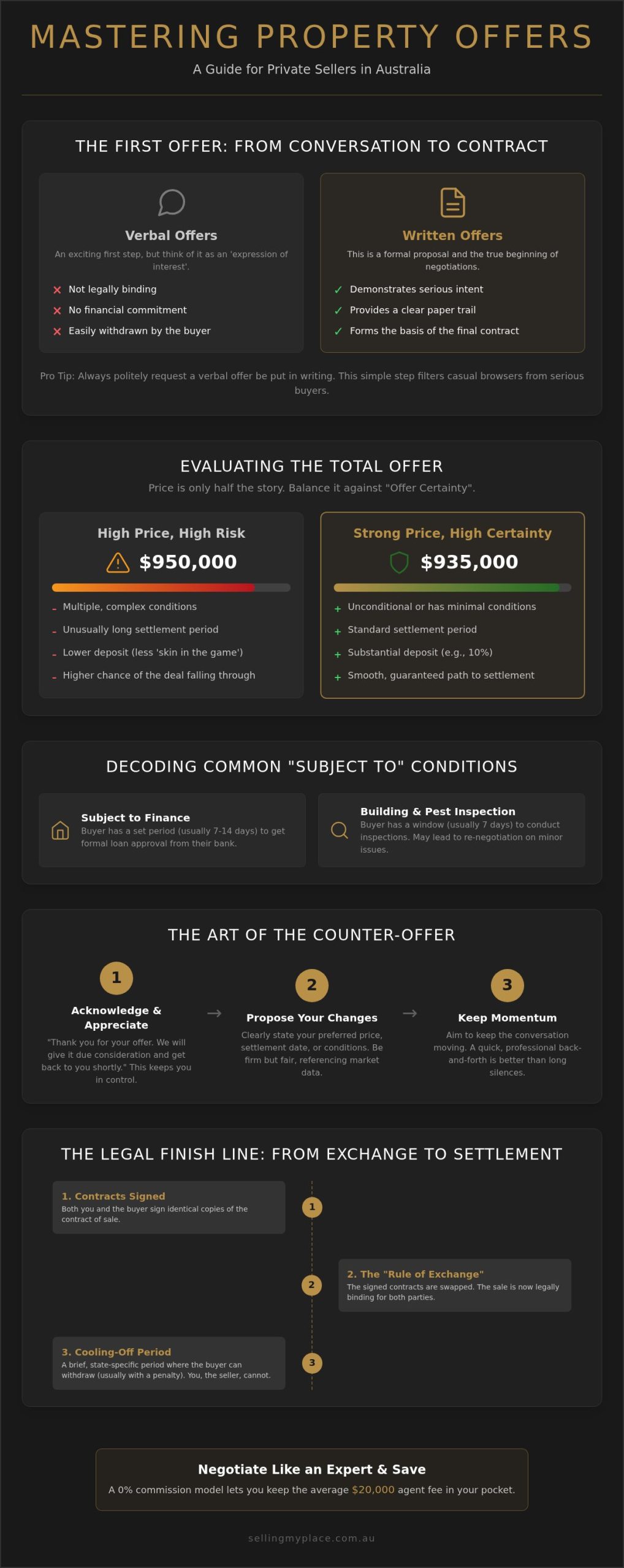
The Legal Finish Line: Contracts, Cooling-Off, and Conveyancing
The handshake is done, the price is agreed, and the emotional weight of the negotiation begins to lift. Now, the focus shifts to the technicalities of the legal finish line. Knowing how to handle offers when selling privately requires a clear understanding of the cooling-off period, which acts as a short safety net for buyers. In New South Wales, Queensland, and the ACT, buyers generally have five business days to change their minds; though this incurs a small penalty, typically 0.25% of the purchase price. In Victoria, it is three clear business days, while South Australia offers just two. Western Australia and Tasmania have no statutory cooling-off period at all.
Having your Conveyance Advice ready before you even open your first inspection ensures you aren’t scrambling when these timelines start ticking. If a buyer does decide to pull out during this window, the applicable penalty fee is usually deducted from their deposit and paid to you. It’s a protection measure that compensates you for the time the property was off the market. Once the cooling-off period expires, or if the sale was unconditional from the start, you can finally update your Residential Property Listing from “Under Offer” to “Sold”. This is a moment to celebrate. It signals to the community that your home has found its next custodian.
Finalising the Contract of Sale
Your solicitor or conveyancer will be your primary partner during this final phase. They ensure every detail you negotiated, from the final price to the inclusion of specific window furnishings, is accurately reflected in the paperwork. They will handle the formal exchange, which is the physical or digital swapping of signed contracts between parties. Once signed and exchanged, the contract is legally binding. This provides the ultimate security for both parties as you move toward the final handover of the keys.
The Settlement Process
The weeks leading up to settlement involve a flurry of administrative tasks, usually managed via digital platforms like PEXA or Sympli. You’ll need to organise your move while the buyer performs a final inspection, typically a few days before the keys change hands. This is their chance to ensure the property is in the same condition as when they first signed. Because you’ve chosen a flat-fee model, the most rewarding part of this process is seeing the final settlement statement. Without a hefty commission eating into your result, you keep every cent of the equity you’ve built over the years. If you’re ready to secure your legal paperwork and start the process, you can book a pre-sale consultation today.
Selling Smarter with the Kincade Agent Advisory Service
Selling your family home is one of life’s most significant transitions. It’s about more than just a transaction; it’s about the memories you’ve built and the future you’re creating. While the process can feel overwhelming, you don’t have to do it alone. The Kincade Agent Advisory Service acts as your professional partner, providing the expertise you need to understand exactly how to handle offers when selling privately. By combining professional Photography and detailed floorplans, we ensure your property makes a stunning first impression. This high-quality presentation doesn’t just attract more eyes; it attracts the right kind of serious buyers who are ready to make competitive offers from day one.
Professional Support Without the Commission
You deserve to keep the equity you’ve worked so hard to build. In a traditional sale, a significant portion of your profit disappears into agency commissions. By choosing a 0% commission model, our clients save an average of $20,000 per sale. That’s a life-changing amount of money that stays in your pocket. Our advisors provide the “steady hand” you need during the negotiation phase, helping you decode complex “subject to” clauses and evaluate the true certainty of every proposal. This partnership approach means you’re always in the driver’s seat, but you have a seasoned expert in the passenger seat to help navigate the tricky turns. It’s the most transparent and empowering way to sell your home in 2026, combining the savings of a private sale with the security of professional backing.
Your Next Steps to a Successful Sale
Ready to take the next step? Getting started is a straightforward and supportive process. Your journey begins with a KIDS marketing package, designed to give your home the professional edge it needs in a competitive market. You’ll gain access to a comprehensive neighbourhood market report, which is essential for setting a price that reflects your home’s true value. We’ve shown you how to handle offers when selling privately, from the first expression of interest to the final exchange of contracts. Now, it’s time to put that knowledge into action. You can move forward with the confidence that your legacy is protected and your financial future is secure. Organise your commission-free listing today and discover how a partnership-based approach can transform your selling experience.
Take Control of Your Property Legacy
Mastering how to handle offers when selling privately is about balancing the technicalities of a contract with the emotional significance of moving on. You now know that a “clean” offer often outweighs a higher, conditional bid and that staying firm but empathetic is the secret to a successful negotiation. By focusing on offer certainty and keeping your legal advice ready, you’ve turned a complex process into a manageable path toward settlement.
You don’t have to navigate this final hurdle alone. Our flat-fee model includes professional photography and floorplans to showcase your home’s true value, alongside an expert Agent Advisory Service to guide your decisions. Best of all, you’ll save an average of $20,000 in commissions, ensuring your hard-earned equity stays with your family. This is about more than just a sale; it’s about starting your next chapter on the best possible footing.
Ready to take the lead? Start your commission-free sale journey with Kincade International Direct Sales and move toward your future with total peace of mind. Your successful sale is just a conversation away.
Frequently Asked Questions
Is a verbal offer legally binding when selling a house privately in Australia?
No, a verbal offer is not legally binding in the Australian property market. It is simply an expression of interest. For a sale to be legally enforceable, both parties must sign a written contract of sale and a formal exchange must occur. This protects you from being locked into a deal before you’ve had the chance to review the terms with your legal advisor. Always ask for offers in writing to confirm the buyer’s seriousness.
What does “subject to finance” actually mean for a seller?
“Subject to finance” is a common condition where the buyer’s obligation to purchase depends on their bank formally approving their home loan. This clause usually specifies a timeframe, often 7 to 14 days. If the bank declines the loan within this period, the buyer can typically withdraw without penalty. Understanding these conditions is a key part of learning how to handle offers when selling privately so you can manage your timeline effectively.
How much deposit should I ask for in a private sale?
A standard deposit in Australia is typically 10% of the total purchase price. While you can negotiate a smaller amount, such as 5%, a higher deposit serves as a strong sign of buyer commitment. This money is usually held in a solicitor’s or conveyancer’s trust account until settlement. A healthy deposit provides you with security, ensuring the buyer has a significant financial stake in seeing the transaction through to completion.
Can I accept a higher offer after I have already said “yes” to someone else?
Legally, you can accept a higher offer until the contracts have been formally signed and exchanged by both parties. However, once you’ve verbally accepted an offer, the buyer will likely start spending money on inspections and legal fees. While “gazumping” is legal in most states, it can damage your reputation as a fair seller. It’s often better to use a “Best and Final” strategy to resolve interest from multiple parties before committing.
How long does the cooling-off period last for the buyer?
The cooling-off period varies significantly across Australia. In New South Wales, Queensland, and the ACT, it is five business days. Victoria offers three clear business days, while South Australia provides two. Notably, Western Australia and Tasmania have no statutory cooling-off period unless specifically written into the contract. Remember, these periods do not apply if a property is sold at auction, where the contract becomes binding immediately upon the fall of the hammer.
Do I need a solicitor if I am selling my home privately?
Yes, you will almost certainly need a solicitor or a licensed conveyancer to handle the legal transfer of title. While you can manage the marketing and negotiation yourself, the legal paperwork and settlement through platforms like PEXA require professional oversight. A legal expert ensures the contract of sale is drafted correctly and that all state-specific requirements are met. This protects your interests and ensures the final handover of your property is legally sound.
What is the best way to reject a low-ball offer without offending the buyer?
The best way to handle a low-ball offer is to remain professional and provide data-backed reasons for your rejection. Instead of a flat “no”, try saying, “We appreciate your interest, but based on recent local sales, we’re looking for an offer closer to our guide.” Providing a counter-offer keeps the conversation moving. This “Steady Hand” approach shows you’re serious about the value of your home while remaining open to a fair negotiation.
How does the Kincade Agent Advisory Service help with negotiations?
The Kincade Agent Advisory Service acts as your professional partner when you are learning how to handle offers when selling privately. Our advisors help you evaluate the “Offer Certainty” of every proposal, looking beyond just the price to the fine print of the conditions. We provide the expert backing you need to negotiate with confidence, ensuring you secure a clean contract while saving an average of $20,000 in traditional agency commissions.
Free Online Property Valuation: How Accurate Are They in 2026?
What if the number you just saw on a free online property valuation is actually $28,800 away from your home’s true worth? It’s a common scenario in 2026, where a 7.2% error rate on off-market properties can lead to significant confusion and the very real fear of underselling your most valuable asset. We understand the anxiety that comes with conflicting estimates; it’s hard to feel confident about your future when the digital data seems to change depending on which website you’re visiting.
You deserve to move forward with total clarity and a sense of calm. This guide will help you discover the truth behind automated property estimates and show you how to use that digital data to secure the best possible sale price for your Australian home. We’ll explore the latest 2026 accuracy benchmarks, explain why on-market data is more reliable than off-market guesses, and provide you with the tools to establish a realistic price range. By the end, you’ll have the confidence to manage your own sale and keep your hard-earned equity where it belongs.
Key Takeaways
- Learn how to treat a free online property valuation as a helpful data-driven compass rather than a definitive final sale price.
- Discover the specific “invisible factors” that algorithms often overlook, ensuring you don’t undervalue your home’s unique features or recent improvements.
- Master the technique of cross-referencing multiple digital tools to establish a realistic price floor and gain the confidence to lead your own sale journey.
- Understand how accurate market data allows you to sidestep traditional agent commissions and protect your family’s hard-earned equity.
- Explore how upgrading to a Neighborhood Market Report provides the professional-grade insights needed to secure a premium result with total peace of mind.
What is a Free Online Property Valuation?
When you’re standing in your kitchen, perhaps enjoying a morning flat white and thinking about the next chapter of your life, a free online property valuation is often the very first place your journey begins. It’s a digital starting line that offers a glimpse into your home’s potential without needing to tidy up for an unannounced visitor. While it feels like a simple search result, you’re actually interacting with a complex Automated Valuation Model (AVM). An AVM is a statistical tool that processes millions of data points to predict market value with mathematical precision.
It’s helpful to distinguish these estimates from other figures you might encounter. A bank valuation is typically conservative, focused on lender risk rather than your profit. A real estate appraisal is a human-led estimate, often influenced by the desire to secure a listing. An online estimate, however, acts as a neutral data-driven snapshot based on recent local sales and your property’s core characteristics. It provides a grounded starting point, helping you move from uncertainty toward a structured plan for your lifestyle transition.
The Role of Big Data in Australian Real Estate
Algorithms don’t just look at what happened yesterday; they analyse a decade of historical sales to identify long-term patterns in your suburb. In the Australian market, “Comparable Sales” (or “Comps”) are the lifeblood of these systems. The computer identifies properties similar to yours in land size, internal floor area, and bedroom count that have recently changed hands nearby. By weighing these “comps” against current market velocity, the algorithm calculates a price range. It’s a purely mathematical approach to a very personal asset, stripping away the noise to look at the cold, hard numbers.
Why Sellers Start with Online Estimates
The primary appeal of a free online property valuation is the lack of pressure. You can explore your options privately, without the intensity of a formal listing presentation or the feeling that you’re being pushed into a quick sale. Many homeowners use these tools to assess their equity, which is a vital step when deciding if you’re ready for a sea change or an investment upgrade. It’s about finding an objective figure to balance the deep emotional attachment we all have to our family homes. Having a realistic number in hand provides a sense of calm, allowing you to visualise your future state with confidence rather than guesswork.
The Science Behind the Screen: How Estimates are Calculated
Peering behind the digital curtain reveals a sophisticated engine room of data. When you request a free online property valuation, the algorithm begins by pulling the structural basics of your home: land size, internal floor area, and the all-important bedroom and bathroom count. These are the fixed variables, but the real intelligence lies in how the software weights recency. In our fast-moving 2026 market, a sale that settled yesterday carries significantly more weight than a similar property sold six months ago. This is because algorithms are programmed to track suburb-wide growth trends and “days on market” averages in real-time to sense the current heat of the local area.
However, these systems have a distinct blind spot. They see the box, but they don’t always see the beauty. While these models are highly advanced, research from the Brookings Institution highlights that automated systems can sometimes miss the mark when local nuances or unique architectural features aren’t perfectly captured in the raw data. If your home boasts a bespoke jarrah deck or a high-end kitchen renovation, the algorithm might categorise you simply as “renovated” without understanding the premium quality of the materials used.
Weighting Factors in the Algorithm
Software quantifies location proximity with ruthless efficiency. It measures the exact distance to amenities like train stations, parks, and schools, assigning a mathematical value to convenience. There’s often a tug-of-war between “Street Appeal” and “Land Value” in these calculations. While we might fall in love with a charming facade, the algorithm often prioritises the raw land size and zoning potential. Many tools now provide a “Confidence Score” alongside the estimate. This score is actually more important than the price itself; it tells you how much comparable data is available. A low score suggests the algorithm is guessing, while a high score means it has plenty of recent evidence to back its claim.
Data Sources: Where the Information Comes From
Most free online property valuation tools draw their power from government land registries and historical listing portals. This provides a solid foundation, but it’s not always instantaneous. There is often a lag time of several weeks between a sale occurring at auction and the official settlement data being processed by the state registry. To bridge this gap, some models incorporate user-submitted data. If you’ve recently updated your home, you can often “claim” your property on these portals to update the facts. If you’re feeling unsure about how your home’s specific upgrades are being weighed by the data, reaching out for a friendly chat can help provide the clarity you need to move forward.
Algorithm vs. Reality: Why Online Estimates Can Miss the Mark
While a free online property valuation provides a helpful ballpark, it fundamentally lacks the human eye required to judge quality. Algorithms are excellent at counting bricks and measuring land, but they’re terrible at feeling the atmosphere of a home. An Urban Institute study highlights how data-driven models can struggle with qualitative nuances, sometimes reinforcing local disparities because they cannot account for the tangible love and care poured into a property. We know your home is more than just a set of coordinates on a map; it’s a collection of memories and carefully chosen finishes that a computer simply cannot process.
Then there’s the “Outlier Effect.” If a neighbour sells their home in a desperate hurry, or if two emotional buyers get into a bidding war over a specific view, that single data point can skew the entire suburb average. A computer sees the price tag but doesn’t know the story behind it. Relying solely on a screen when setting your reserve price is a risky move. It doesn’t account for current buyer heat or the specific market sentiment on auction day. Without that human context, you might find yourself anchored to a number that doesn’t reflect the true competitive nature of the local market.
The Five Things an Algorithm Cannot See
The software often misses the sensory details that drive a buyer’s heart and ultimately their budget. These invisible factors often dictate whether a home sells for a standard price or a suburb record. They include:
- The specific orientation of the home and how natural light floods the living areas during a winter afternoon.
- Nuisance factors such as proximity to main roads or power lines which can dampen an otherwise strong valuation.
- The “wow factor” of high-end internal finishes and the quality of a professional renovation.
- The psychological pull created by expert Photography in attracting premium buyers to your listing.
- The functional flow and spatial clarity provided by accurate floorplans.
When Online Valuations are Most (and Least) Accurate
Accuracy is usually highest in “cookie-cutter” estates where every house is similar in age and style. In these areas, the algorithm has plenty of identical data points to work with. However, accuracy drops significantly for unique heritage homes or properties in rural areas with low transaction volumes. If the data is thin, the algorithm might “hallucinate,” generating a number that has completely lost touch with the ground reality. Recognising when the data is unreliable is the first step in protecting your equity and ensuring you don’t leave money on the table during your sale.
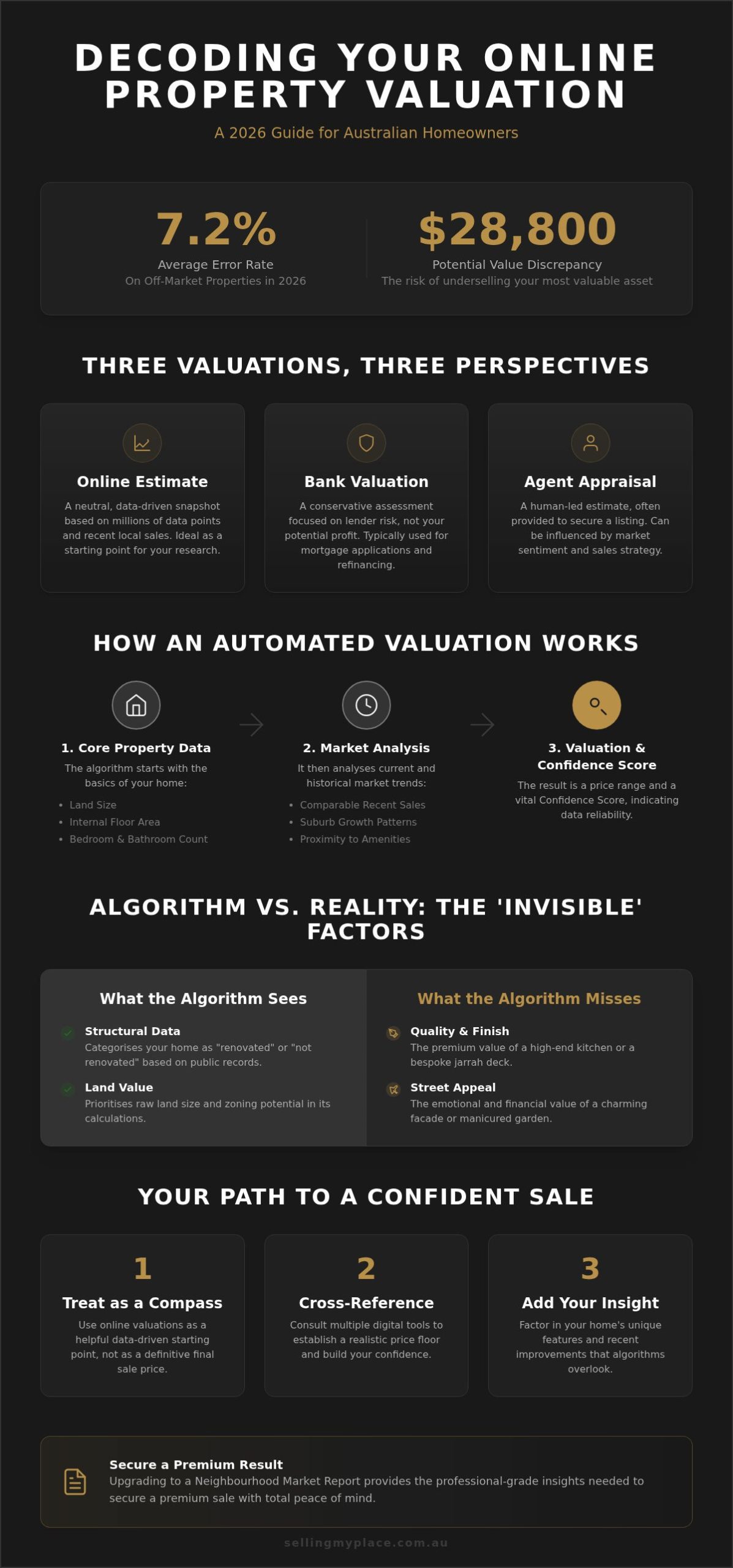
Using Your Valuation to Maximise Your Sale Price
Once you’ve received your free online property valuation, the real strategy begins. It’s helpful to view this number as your “floor” rather than your “ceiling.” It represents the minimum value the market expects based on raw data, but your goal is to build upon that foundation through smart presentation and timing. By cross-referencing estimates from three or four different digital tools, you can find a reliable median that filters out any single algorithm’s quirks. This balanced approach is a core part of how to determine the market value of a home in Australia, blending digital efficiency with a sensible reality check.
When you’re ready to list, consider whether a “Price Guide” or a “Fixed Price” better suits your suburb’s current energy. A guide often invites more conversation and competition, while a fixed price offers clarity for buyers who want to move quickly. The choice often depends on how much “buyer heat” is currently present in your specific street.
Bridging the Gap with a Neighborhood Market Report
A basic web search only tells you what has happened in the past. A Neighborhood Market Report acts as the “pro version” of a free online property valuation, telling you what is happening right now. It allows you to look closely at active competitor listings to see exactly what features buyers are prioritising this week. By identifying these “sweet spots” where demand is high but supply is low, you can position your home to stand out as the obvious choice for a premium buyer.
Pre-Sale Consulting: The Human Advantage
Data can’t tell you that a $500 tin of paint and a weekend of garden mulching might add $5,000 to your final result. Our Pre-Sale Property Consulting focuses on these high-return minor repairs that often yield a 10x return on investment. De-cluttering and staging also play a huge role in the psychological “buy-in” for visitors, making the space feel like their future home rather than someone else’s history. Professional advice transforms a static data point into a dynamic, profitable sale strategy.
Ready to see how your digital data stacks up against a professional sale strategy? Get in touch with our team today to start your commission-free journey with confidence.
The KIDS Approach: From Valuation to Commission-Free Success
Most websites treat a free online property valuation as a digital hook, designed to reel you in and hand you over to a traditional real estate agent. These agents then ask for a 2-3% commission, which can feel like a heavy price to pay for a service you’re increasingly equipped to handle yourself. We believe that once you have the data, you have the power. By choosing Residential Property Listing Services, you’re opting for a modern, commission-free alternative that puts you back in the driver’s seat of your own sale. It’s a partnership where we provide the tools and you keep the reward.
On average, our clients save $20,000 in commissions. That’s a significant sum that stays in your pocket, perhaps to fund your next deposit or simply to secure your family’s future. We also remove the ticking clock often associated with real estate listings. Our “Listed Until Sold” promise means you can test the market and wait for the right buyer without the stress of expiring contracts or mounting marketing fees. It’s a calmer, more methodical way to achieve a premium result. You shouldn’t feel rushed when making such a major life transition.
Keeping Your Equity Safe
The maths of a sale by owner is refreshingly simple: 0% commission equals 100% of the profit for you. While the idea of managing your own sale might seem daunting at first, you aren’t doing it alone. You’ll have access to professional advisory services to help you navigate the legalities, including essential Conveyance Advice to ensure the settlement process is smooth and secure. There’s a deep sense of peace that comes from being in total control of your financial legacy. You know your home better than anyone, so why not be the one to tell its story? It’s about protecting your equity and your family’s future with a steady hand.
Taking the Next Step
If you’ve spent time researching your free online property valuation and feel ready for something more substantial, it’s time to request a Neighborhood Market Report. This report moves you beyond the “just curious” phase and makes you truly market-ready. It provides the granular, local insights that algorithms often miss, giving you the professional edge needed to negotiate with confidence. We’re here to act as your seasoned guides, helping you translate data into a successful sale. Don’t just settle for a generic online number. Take the lead, secure your profit, and start your next chapter with the financial freedom you deserve.
Take Control of Your Next Chapter
Your home is likely your greatest financial asset, and moving on to your next adventure should be a time of excitement rather than anxiety. While a free online property valuation provides a useful digital compass, it’s the refined strategy and local expertise that ultimately lead you home. By combining the latest market data with professional pre-sale consulting, you ensure that no dollar of your hard-earned equity is left on the table. You’ve worked hard for your home; you deserve to keep the reward.
Choosing a commission-free path doesn’t mean going it alone. With our global marketing network and Expert Agent Advisory included in every package, you have a steady hand guiding you through every step of the process. Owners who partner with us save an average of $20,000 in commissions; money that belongs in your pocket for your future. It’s about more than just a sale; it’s about honouring your legacy and transitioning with total peace of mind. Are you ready to see what’s truly possible for your property?
Secure your equity and sell commission-free with Kincade International Direct Sales today and move forward with the confidence you deserve.
Frequently Asked Questions
How accurate are free online property valuations in Australia?
Accuracy depends on whether your home is currently listed. For properties on the market in 2026, the median error rate is often under 2%. However, for off-market homes, the discrepancy can climb significantly higher. These tools rely on “comparable sales” and public data, meaning they work best in suburbs with high turnover and many similar houses. In rural areas or for unique builds, the accuracy naturally starts to drop.
Why is there such a big difference between different online estimates?
Discrepancies exist because every platform uses a unique algorithm that weights data points differently. One website might prioritise government land registry data, while another focuses more on recent listing prices from real estate portals. These varied “recipes” for calculation mean you’ll often see a range of prices. It’s best to look at multiple sources to find a realistic median for your home’s potential value.
Can a bank valuation be lower than an online property estimate?
It’s very common for a bank valuation to come in lower than a digital estimate. This happens because banks are focused on risk mitigation rather than achieving a premium sale price. They want to know what the property would sell for in a forced sale scenario. An online estimate, by contrast, is trying to predict what a motivated buyer might pay in an open, competitive market.
How do I update the information used in my online property valuation?
You can usually update your property’s details by “claiming” the home on the specific website providing the estimate. This allows you to correct the number of bedrooms or bathrooms and add details about recent renovations. Updating these facts helps the free online property valuation tool refine its calculation. It ensures the algorithm isn’t working with outdated information from ten years ago when you first bought the place.
Do I still need a professional appraisal if I have an online estimate?
Yes, you should still seek expert advice before making a final decision on your sale price. An online tool can’t see the quality of your new stone benchtops or feel the natural light in your living room. A professional appraisal provides the human context that data misses. It helps you understand the “buyer heat” in your street and how to position your home for a premium result.
Will a free online valuation affect my credit score?
No, checking your property’s estimated value online will not affect your credit score in any way. These searches are considered “soft” enquiries that don’t involve a credit application. You can check as many different sites as you like without worrying about your financial standing. Only “hard” enquiries, which happen when a lender reviews your credit file for a loan, will show up on your report.
How often should I check my property value estimate?
Checking your estimate once every three months is usually enough to keep an eye on your equity. Property is a long-term asset, so watching the numbers too closely can be stressful. Suburb trends often take months to show up clearly in the data. A quarterly check-in gives you a grounded view of how your local market is performing without getting caught up in minor weekly fluctuations.
What is the best way to get a formal property valuation for a sale?
The most effective way to get a formal, actionable valuation for a sale is to request a Neighborhood Market Report. This provides a much deeper level of insight than a basic free online property valuation. It combines digital data with a detailed analysis of active competitors in your area. This professional approach gives you the confidence to manage your own sale and keep your hard-earned equity for yourself.
Private House Sales Australia: The Comprehensive 2026 Seller’s Guide
What if the most expensive mistake you make this year isn’t the price you set for your home, but the $20,000 you hand over to someone else just for selling it? In 2026, the traditional path of paying a 2.65% commission is no longer the only way to achieve a premium result. More homeowners are taking the reins through private house sales australia, discovering that they can maintain total control without sacrificing that polished, professional edge. It’s a shift towards keeping your hard-earned equity where it belongs, right in your own pocket.
We understand that your home is more than just an asset; it’s the heart of your family’s story. It’s natural to feel a bit of trepidation about managing the process yourself or worrying that a private listing might look less than stellar. You deserve the savings without having to compromise on quality or legal security. This guide will show you how to master the private sale process, keeping 100% of your commission while achieving a result that rivals any traditional agency. We’ll walk you through the latest 2026 identity verification laws, professional marketing strategies, and the expert advisory steps that ensure a smooth, confident settlement.
Key Takeaways
- Learn how a commission-free, flat-fee model can save you an average of $20,000 while maintaining a professional-grade property listing.
- Discover how private house sales australia leverage high-calibre marketing assets, like professional photography and floorplans, to attract premium buyers without high agency costs.
- Understand the value of a data-driven Neighborhood Market Report to ensure your home is priced competitively for the 2026 landscape.
- Explore the “steady hand” approach of Agent Advisory Services, providing you with expert support throughout the settlement process to reduce stress.
- Identify high-ROI home improvements through pre-sale consulting to ensure your property stands out in an increasingly crowded market.
Private House Sales Australia: The 2026 Landscape
Selling a family home is a significant life transition, often filled with decades of memories and hopes for the future. In 2026, the way we approach this milestone has shifted. Private house sales australia have evolved from a niche alternative into a mainstream choice for homeowners who value both their equity and their autonomy. At its core, a private sale is a direct exchange between the seller and the buyer, facilitated by professional-grade marketing rather than a traditional commission-based agent. It is about reclaiming the narrative of your move.
Why are so many Australians moving away from the standard 2% to 3% commission model? It often comes down to a desire for transparency and a refusal to lose $20,000 or more in fees that could otherwise fund a retirement or a child’s education. By utilising modern digital infrastructure, you can now access the same buyer networks once reserved for large franchises, ensuring your home is seen by the right people at the right time. The Australian property market has matured, and with that maturity comes the empowerment of the individual seller.
Why Direct Sales are Surpassing Traditional Agency
The shift toward owner-led negotiations is driven by a simple truth: no one knows the unique charm of your home better than you do. You can speak to the afternoon sun in the kitchen or the quietness of the street with a level of sincerity an agent simply can’t match. Technology has levelled the playing field, providing professional tools that make your listing indistinguishable from an agency-managed one. This rise in direct sales infrastructure means you’re no longer “going it alone”; you’re simply choosing a more efficient, modern partnership that prioritises your profit over an agent’s commission.
The Legal Framework for Private Sales in Australia
It’s a common misconception that you need an agent to sell residential property. In reality, every Australian homeowner has the legal right to sell their own home privately. While the process is straightforward, it must be grounded in sound legal practice. Engaging professional Conveyance Advice is essential to ensure all vendor disclosure requirements are met. Selling privately doesn’t mean you’re operating without a safety net. It simply means you’re the one in the driver’s seat, supported by the right experts at the right moments to ensure a secure, compliant transaction.
The Mechanics of a Successful Commission-Free Sale
Success in private house sales australia relies on a transparent, flat-fee structure that puts you back in control of your finances. Unlike the traditional commission model, where you’re essentially penalised for having a higher property value, this modern approach treats the sale as a professional service. You pay once for the high-calibre marketing and advisory tools you need, and you keep every cent of the final sale price. This clarity removes the guesswork and the hidden costs that often cloud the selling experience.
One of the most reassuring aspects of this model is the “List Until Sold” philosophy. Traditional agency agreements often come with a stressful 90-day ticking clock, creating a sense of urgency that might not serve your family’s best interests. By removing these arbitrary deadlines, you can wait for the right buyer who truly values your home’s unique story. It’s about selling with a sense of calm confidence rather than under the pressure of an expiring contract. If you’re ready to see how this partnership works, you can speak with our team about your specific goals.
Professional Marketing vs. DIY Listings
There’s a significant difference between “selling it yourself” and utilising a professional infrastructure. In 2026, a listing that looks amateur is a listing that gets overlooked. High-quality Photography acts as the digital front door to your property, creating that vital first emotional spark. When you pair those evocative images with accurate floorplans, you provide serious buyers with the spatial logic they need to fall in love with the layout. This level of polish ensures your home is presented with the dignity it deserves, avoiding the “cheap” look of low-quality, owner-taken photos.
Leveraging Global Reach
The private sale process in Australia has expanded far beyond the local neighbourhood. Our property remains a highly desirable asset on the international stage, attracting significant interest from ex-pats and overseas investors. By plugging into a global marketing network, your home is visible to buyers in London, Singapore, and beyond who are searching for the stability and lifestyle our country offers. This global digital infrastructure ensures you aren’t just waiting for a local buyer; you’re inviting the world to appreciate your home’s value.
Flat-Fee vs. Percentage Commission: The True Cost
When you sit down to calculate the potential return on your property, the numbers often tell a startling story. In the world of traditional real estate, a 2.5% commission on a $1 million home equates to $25,000. Once you add GST, that figure climbs to $27,500. This is money that effectively vanishes from your family’s balance sheet the moment the contract is signed. For those exploring private house sales australia, this realisation is often the catalyst for change. Why should the cost of selling your home increase simply because your property’s value has grown?
Traditional agencies frequently layer additional costs on top of this commission, often referred to as a “marketing levy” or advertising fee. This means you aren’t just paying for the agent’s time; you’re also footing the bill for their brand’s visibility. In contrast, a transparent flat-fee model provides a single, clear payment for professional listing services. You receive the high-calibre photography and floorplans needed to attract premium buyers, but you retain 100% of the final sale price. It’s a straightforward partnership where you pay for the work performed, not a percentage of your home’s legacy.
Calculating Your Potential Equity Savings
Visualising your net profit is about more than just digits on a screen. It’s about what that $20,000 or $30,000 saving represents for your next chapter. It could be the budget for a high-end kitchen renovation in your new place, a significant reduction in your next mortgage, or a well-deserved boost to your retirement nest egg. For families planning for future support, Aged Care Made Easy offers a comprehensive directory to explore care options. The Commission Gap is the unnecessary cost of traditional middle-management that often fails to provide proportional value in a modern, digitally-connected market. Keeping this equity gives you a stronger foothold for whatever comes next.
Beyond the financial gain, there’s a profound psychological benefit to the flat-fee approach. You’ll never feel the subtle pressure to “drop the price” just so an agent can secure a quick turnover and move on to their next listing. Since you’ve already covered the service fee, the timeline is entirely yours to command. This model offers complete transparency in all marketing expenditure, ensuring you know exactly where every dollar goes. There’s a grounded sense of calm that comes from knowing you’re in total control of the process, supported by experts who respect your bottom line as much as you do.
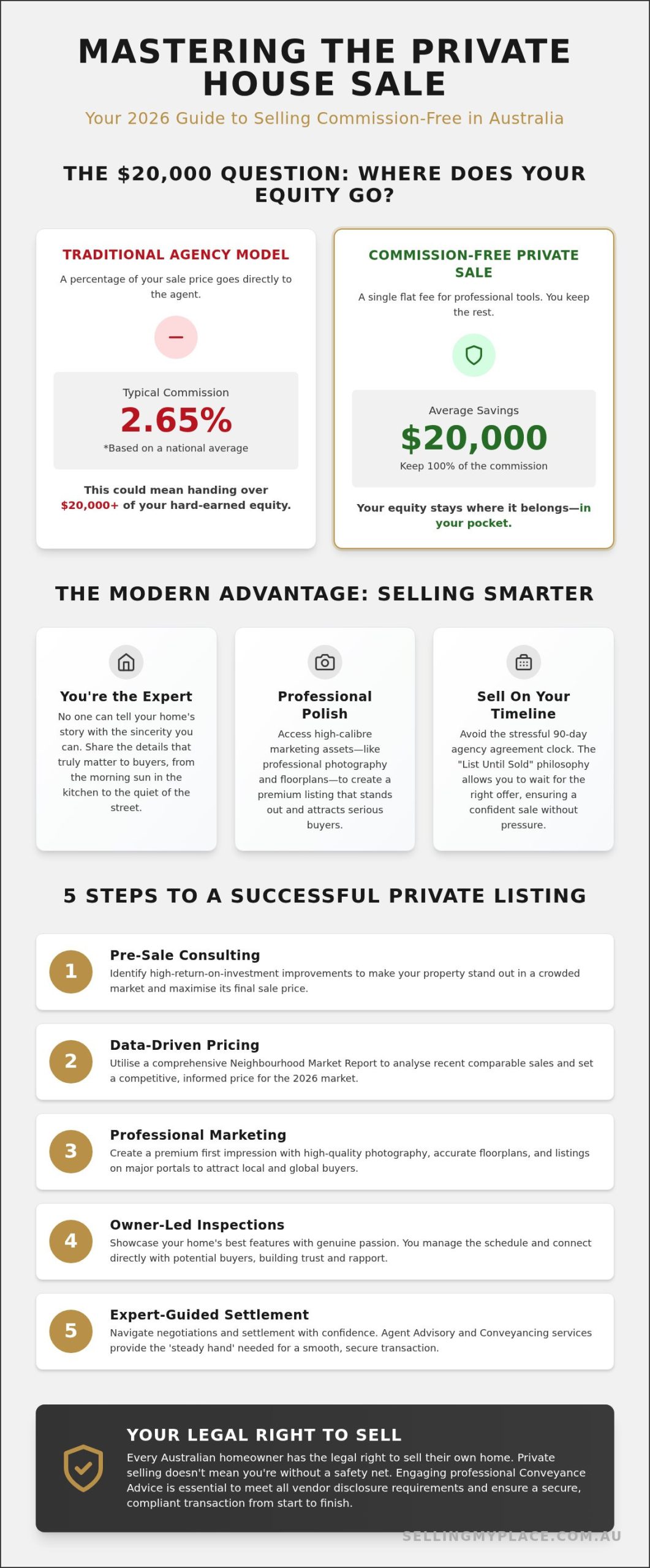
5 Essential Steps to Organise Your Private Listing
Approaching your sale with a methodical plan transforms the process from a daunting task into a series of manageable, rewarding milestones. Success in private house sales australia isn’t about luck; it’s about preparation. By following a structured path, you ensure that every detail of your home’s legacy is respected while maximising your financial return. It’s about being proactive rather than reactive.
- Step 1: Start with a data-driven Neighborhood Market Report. This removes the guesswork and helps you understand exactly where your property sits in the current local landscape.
- Step 2: Engage Pre-Sale Property Consulting. A fresh set of expert eyes can identify high-ROI improvements, such as minor repairs or styling tweaks, that significantly boost buyer appeal.
- Step 3: Arrange professional photography and floorplans. As we discussed earlier, these are your digital front door; they must be flawless to capture serious interest.
- Step 4: Write a compelling narrative. Don’t just list features; tell the story of the lifestyle your home offers, from the quiet morning coffee spot to the garden perfect for family gatherings.
- Step 5: Launch on major property portals. Use a dedicated dashboard to manage enquiries, ensuring you never miss a potential buyer while maintaining total control over your schedule.
If you’re feeling unsure about where to begin your journey, you can contact our advisory team for a personalised starting point.
Pricing for Success in the 2026 Market
Setting the right price from day one is the most critical factor in a smooth sale. You might feel tempted to “test the market” with a higher figure, but in 2026, buyers are more informed than ever. Overpricing can lead to your listing becoming “stale,” causing savvy buyers to wonder what’s wrong with the property. Using a guide on how to determine market value of a home in Australia allows you to set a price grounded in reality. When buyers ask about the price, you can confidently point to recent comparable data, showing them you’re a serious and fair seller.
Managing Inspections and Negotiations
Conducting your own open homes is a wonderful opportunity to share your genuine passion for the property. Keep the atmosphere welcoming and professional; offer a simple brochure and allow visitors the space to imagine their own lives in the rooms. When it comes to the business side, applying property sale negotiation tips ensures you remain the “steady hand” in the room. You don’t have to be a shark to get a great result. If a negotiation feels complex or emotional, that’s the perfect time to lean on your Agent Advisory Service for professional backing without the commission-based pressure.
The Kincade Advantage: Selling Smarter, Together
Entering the market without a traditional agent shouldn’t mean you’re left to figure it out on your own. At Kincade International Direct Sales (KIDS), we view ourselves as the steady hand in your journey, offering a partnership that respects the emotional weight of moving on from a family home. We’ve built a model for private house sales australia that replaces high-pressure tactics with professional support, ensuring your legacy is protected while your equity stays with you. It’s about moving forward with a sense of security and a clear path to your next chapter.
Expert Backing for Every Australian Seller
Our Agent Advisory Service is the cornerstone of this approach. It provides you with a professional safety net, giving you access to the same level of expertise you’d expect from a top-tier agency, but without the commission-based conflicts of interest. We believe that professional guidance should be a supportive resource, not a financial burden. By integrating conveyance advice and pre-sale property consulting into one cohesive experience, we reduce the stress of complex legal and marketing decisions. You don’t have to be an expert in property law or digital advertising to get a great result; you just need the right people in your corner.
Think of us as a nurturing guide who understands your community roots and family needs. We’re here to help you move through the settlement phase with absolute calm and confidence, providing answers when you need them and stepping back when you’re ready to lead. This balance ensures that while you’re in total control of the sale, you’re never truly alone in the process. It’s a professional-casual relationship built on trust, local knowledge, and a shared goal of maximising your profit.
A Global Network for a Local Sale
While your home is local, your potential buyer could be anywhere. The KIDS digital infrastructure provides a global marketing network that ensures your property is seen by a vast audience of motivated buyers, from those in your own neighbourhood to ex-pats looking to return home. This reach is a vital part of private house sales australia in 2026, allowing you to bypass the limitations of traditional local franchises. You get the best of both worlds: the personal touch of an owner-led sale and the massive visibility of an international marketing powerhouse.
This isn’t just about listing a house; it’s about taking control of your financial future and the stability of your next chapter. When you choose to sell smarter, you aren’t just saving money; you’re investing in your own family’s legacy. It’s time to embrace a more transparent, respectful way of selling that puts your needs first. To begin your journey with the right tools and a steady hand to guide you, explore our Professional Residential Property Listing Services and see how we can help you achieve a professional result on your own terms.
Secure Your Equity and Your Next Chapter
Choosing to sell your own home is a decision rooted in both financial wisdom and a deep respect for your property’s legacy. We’ve explored how the 2026 property landscape has evolved, making private house sales australia a sophisticated and secure option for those who value transparency. By bypassing the traditional commission model, you aren’t just saving an average of $20,000; you’re ensuring that the full value of your hard work remains with your family where it belongs.
Success comes down to pairing your local knowledge with professional-grade tools. With our expert Agent Advisory Service acting as your safety net and high-calibre assets like professional floorplans and photography at your disposal, you have everything needed to achieve a premium result. You don’t have to navigate this transition alone. Our team is here to provide the steady hand and nurturing guidance that makes the process feel calm, clear, and celebratory. It’s time to step into your future with confidence and total control over your move.
Start Your Commission-Free Sale Journey with SellingMyPlace.com.au today and discover how rewarding it feels to lead your own success story.
Frequently Asked Questions
Is it legal to sell my own house privately in Australia?
Yes, it’s completely legal across all Australian states and territories. Every homeowner has the right to manage their own residential sale without appointing a traditional commission-based agent. To stay protected, you simply need to ensure you’ve prepared a valid Contract of Sale and met all vendor disclosure requirements before you begin. Following the 2026 identity verification laws ensures your transaction is secure and professionally handled from start to finish.
How much commission will I save with a private house sale?
You’ll save the entire percentage-based fee typically charged by agents, which averages $20,000 per sale nationally. In 2026, with median commission rates often exceeding 2.5%, the financial benefit of a flat-fee model is significant. By retaining this equity, you’re able to put that money directly toward your next property purchase or retirement nest egg. It’s a practical way to ensure your home’s value stays in your own pocket.
Will my property appear on major national search portals?
Yes, your home will be featured on the leading property search platforms that buyers use every day. While these portals generally restrict direct access for individuals, our professional residential listing services provide the gateway you need for private house sales australia. This ensures your property maintains the same high digital visibility as any agency-managed listing, allowing you to capture the attention of motivated buyers across the country and overseas.
What happens if I need help with negotiations or contracts?
You’re never left to navigate the difficult moments alone. Our Agent Advisory Service acts as your professional safety net, offering the “steady hand” you need during complex discussions. Whether you’re unsure about a buyer’s terms or need guidance on handling multiple offers, we provide expert support to help you secure a fair result. This partnership ensures you have professional backing without the high cost of a traditional agency commission.
How do I handle the legal paperwork without a traditional real estate agent?
You manage the legal requirements by partnering with a qualified solicitor or conveyancer, which is standard practice for any property transfer. We provide integrated conveyance advice to help you understand the necessary steps for a smooth settlement. Your legal representative will handle the exchange of contracts and the final transfer of funds through the PEXA platform, ensuring the entire process is legally compliant and your family’s interests are fully protected.
Can I still get professional photography and floorplans if I sell privately?
Absolutely, as these high-calibre marketing assets are a standard part of our flat-fee model. We understand that your home’s “digital front door” must look impeccable to attract premium buyers in 2026. By providing professional photography and accurate floorplans, we ensure your listing has the polished, sophisticated feel required to stand out. You don’t have to sacrifice quality to save on commission; your home will always be presented with dignity.
Is there a time limit on how long my property can be listed?
There are no stressful time limits or 90-day expiry dates with our “List Until Sold” philosophy. We believe you should have the freedom to wait for the buyer who truly understands your home’s worth. This removes the artificial pressure often felt in traditional agency agreements, allowing you to manage the sale at a pace that suits your family’s needs. You maintain total control over your timeline and your moving plans.
What is the “Direct Sale” model compared to “For Sale By Owner”?
The Direct Sale model is a professional evolution of private house sales australia that moves beyond the basic “DIY” approach. While traditional “For Sale By Owner” methods often leave you to figure things out alone, Direct Sales provides a comprehensive professional infrastructure. You get the autonomy of an owner-led sale combined with expert advisory support, high-end marketing tools, and a global reach. It’s a smarter, more supported way to sell together.
How to Avoid Real Estate Agent Commission in Australia: The 2026 Seller’s Guide
What if the most expensive part of selling your family home wasn’t the preparation or the marketing, but a percentage-based fee that costs you the equivalent of a luxury SUV? In 2026, with the national median dwelling value sitting at $922,838, many Australians are questioning why they should hand over a massive slice of their equity just for a “sold” sticker. If you’re wondering how to avoid real estate agent commission while still achieving a premium result, you aren’t alone. It’s about moving away from a transactional mindset and toward an empowered, professional partnership.
We understand the weight of this decision. It’s common to feel a sense of anxiety about handling legal paperwork or a distrust of traditional “real estate speak” that often clouds the process. You deserve to feel protected and in control during such a significant life transition. This guide reveals the proven strategies to sidestep traditional commissions, potentially keeping an average of $20,000 more of your home’s equity. We’ll walk through how to access professional marketing tools, manage the sale with confidence, and use expert advisory services to ensure every legal detail is handled with a steady, experienced hand.
Key Takeaways
- Understand the “Equity Gap” and how a standard 2.5% commission can unnecessarily consume over $25,000 of your hard-earned profit on a million-dollar home.
- Learn how to avoid real estate agent commission by choosing between independent selling and modern flat-fee marketing models that provide professional support without the percentage-based cost.
- Discover the truth behind the negotiation myth and why traditional agents are often incentivised for a quick sale rather than securing the highest possible price for your family’s future.
- Master a five-step roadmap for a successful sale, from investing in high-quality photography to securing comprehensive neighbourhood market reports that put you in the driver’s seat.
- Explore a partnership-based approach where you maintain control of your sale process while accessing expert advisory services and global listing reach until your property is sold.
Why Australian Homeowners are Moving Away from Traditional Commissions
Selling your home is often the culmination of years of hard work, weekend renovations, and disciplined mortgage repayments. Yet, when the time comes to move on, many Australians find a significant portion of their hard-earned equity disappearing into a “success fee.” On a $1,000,000 home, a 2.5% commission equates to $25,000 plus GST, totalling $27,500. This is what we call the Equity Gap. It represents money that could have funded a renovation on your next property, paid for a child’s education, or bolstered a retirement nest egg. With the national median dwelling value reaching $922,838 in early 2026, these percentages are no longer just small fees; they are life-changing sums of money.
The traditional model relies on the myth of the “Super Agent” who possesses a secret database of buyers. In reality, the digital age has shifted the power. Most buyers find their next home through major online portals while scrolling on their phones during their morning commute. While it’s helpful to understand what a real estate agent does in a conventional sense, the modern seller is beginning to realise that the portal does the heavy lifting of finding the buyer, not the individual agent. For many, learning how to avoid real estate agent commission is less about cutting corners and more about protecting a family legacy.
The True Cost of a Traditional Sale in 2026
Commission is a success-based percentage that often exceeds the value of the labour provided. In a traditional sale, you aren’t just paying for a few open homes; you’re often subsidising the agent’s office rent, flashy car leases, and assistant salaries. This cost scales upward with your property’s value, which feels inherently unfair. Does it really take twice as much effort to sell a $2 million home compared to a $1 million home? Probably not. When you add auctioneer costs and high-margin marketing markups, the total bill becomes even harder to swallow. It feels less like a service and more like a tax on your success.
The Shift Toward Seller Empowerment
We’re seeing a beautiful shift in the Australian market toward transparency and seller control. Digital platforms have democratised the search process, allowing buyers to connect directly with the heartbeat of the home: the owner. By embracing how to avoid real estate agent commission through a direct sale model, you effectively become the CEO of your sale. You know the local schools, the best coffee spots, and the way the afternoon sun hits the deck better than any third party ever could. This movement is about reclaiming that narrative and ensuring every dollar of your home’s value stays where it belongs: with you.
Strategies to Avoid Real Estate Agent Commission
Most traditional advice suggests that the only way to save money on your sale is to interview three different agents and try to haggle their percentage down. We believe that’s missing the point. Even a “discounted” 1.8% commission on a median-priced home in 2026 still takes a massive bite out of your profit. If you want to know how to avoid real estate agent commission entirely, you need to look beyond negotiation and toward structural change. It’s about moving from a model where you pay for a person’s time to one where you pay for professional tools and results.
The FSBO Path: Pros and Cons
For Sale By Owner (FSBO) is the purest form of independent selling. It gives you total control over the narrative and every interaction with potential buyers. You are the one who knows the history of the home, the quietness of the street, and the way the morning light fills the kitchen. However, the biggest hurdle in the Australian market is that the major property portals don’t usually allow private individuals to list directly. This often leads to listings that look amateur or lack the reach needed to create genuine competition. Most sellers find that while they save on fees, they risk losing out on the “buzz” that drives a premium price. It’s the reason many eventually look for a professional marketing partner to bridge that gap.
The Fixed-Fee Revolution
This is where the landscape has truly changed for Australian families. Instead of a percentage, you pay for specific, high-quality services. A flat fee provides budget certainty from day one, ensuring there are no nasty surprises at settlement. You get the same professional photography, floorplans, and, crucially, access to the major portals that traditional agents use. The “Listed Until Sold” model is a particular favourite because it removes the artificial pressure of 90-day expiry dates. You sell when the right buyer arrives, not when an agent’s contract runs out. It’s a reassuring, grounded way to manage a high-stakes transition.
By decoupling services, you choose exactly what to outsource. You might want a professional photographer and a comprehensive neighbourhood market report, but you don’t need a middleman to open the front door for you. This partnership model allows you to act as the CEO of your sale while having a dedicated marketing department at your back. It’s a sophisticated way to maintain your equity while ensuring your property is presented with the polish it deserves. If you’re ready to take the next step, you can discuss a tailored approach for your property that keeps your profit in your pocket.
The ‘Negotiation’ Myth vs. The Flat-Fee Reality
A common narrative in the industry is that a traditional agent’s negotiation skills are so specialised that they effectively pay for themselves. They’ll suggest that an owner is too emotionally attached to stay objective during a deal. However, we need to look at who is actually motivated by the final result. If you’re researching how to avoid real estate agent commission, you’ve likely sensed the inherent conflict of interest in the traditional model. A quick sale at a lower price is often more profitable for an agent’s turnover than a patient sale at the highest possible price for your family.
If an agent is working on a 2.5% commission, the difference between a $950,000 sale and a $980,000 sale is only $750 for them. For you, that’s $30,000. Who is more motivated to hold out for that extra $30,000? The answer is simple. It’s you.
Who Really Negotiates the Best Price?
The truth is that nobody knows your home’s value or its unique story better than you do. You’re the one who can explain the craftsmanship of the kitchen joinery or the peace of the neighbourhood at dusk. When you act as the primary contact, you remove the “middleman whisper” where messages can be diluted or rushed. By using professional Neighborhood Market Reports, you gain the same data-driven confidence as any agency. You aren’t just hoping for a price; you’re justifying it with concrete evidence. Handling a “low-ball” offer becomes much easier when you can calmly point to recent comparable sales and local demand. It’s about being prepared, not being a salesperson.
Protecting Your Profit Margin
It’s vital to shift your focus from the gross sale price to your net bankable equity. Let’s look at the logic. If a traditional agent sells your home for $1,000,000 but takes a $25,000 commission, you walk away with $975,000. If you manage the sale yourself and achieve a price of $985,000, you actually end up with $10,000 more in your pocket. Modern Residential Property Listing Services provide the marketing reach of an agency without the equity-draining percentage. There’s also a significant psychological advantage to this approach. You won’t feel the mounting pressure to just sign so the agent can collect their fee and move to their next listing. You have the luxury of time and the security of knowing your profit is protected. Learning how to avoid real estate agent commission isn’t about doing everything alone; it’s about choosing a partnership that respects your bottom line.

A 5-Step Roadmap to Selling Without a Traditional Agent
Deciding how to avoid real estate agent commission is a bold step toward financial freedom, but it requires a clear plan of action. Taking the reins of your sale doesn’t mean doing it all alone; it’s about being the CEO of an efficient marketing department. By following a structured roadmap, you can maintain the professional standards buyers expect while keeping your equity where it belongs. This process is about replacing a middleman with a proven system that empowers you to succeed.
If you’re ready to learn how to avoid real estate agent commission, the path forward is surprisingly structured. It begins with professional preparation, where you invest in high-quality photography that captures the emotional heart of your home. Next, you need market intelligence. Securing a comprehensive neighbourhood valuation report ensures you are pricing for the current market, not yesterday’s news. Strategic marketing follows, placing your listing on major portals and global networks to cast the widest possible net. When the enquiries start, you take the lead on inspections. This dialogue allows you to share the lifestyle benefits only an owner truly understands. Finally, legal finalisation brings everything together, using expert support to ensure the contract of sale is handled with precision.
Presenting Your Home Like a Pro
Presenting your home like a pro is about more than just a tidy lounge room. 90% of buyers decide to inspect based on the first three photos they see online. If those images don’t sing, you’ve lost them before they even read your description. High-quality imagery is non-negotiable for achieving a premium result. Accurate floorplans are equally vital; they help filter out tyre-kickers who might find the layout unsuitable for their needs, saving you time and energy on unnecessary inspections. This level of professionalisation shows buyers that you are serious and that the property has been cared for with pride.
Navigating the Legal Landscape
Navigating the legal landscape is often the part that gives sellers the most pause. Understanding the Section 32 or your specific state’s contract requirements is essential for a smooth settlement. This is where professional Conveyance Advice becomes your greatest asset. An advisory service bridges the gap between doing it yourself and doing it right, providing the peace of mind that every detail is legally sound. It’s about having a steady hand to guide you through the paperwork while you focus on the move. If you want to ensure your sale is legally watertight while maintaining your profit, you can book a consultation with our advisory team to discuss your specific needs.
The Partnership Model: How Kincade International Empowers Sellers
Kincade International Direct Sales (KIDS) represents a fundamental shift in the Australian property market. We don’t see ourselves as a traditional agency, but rather as a dedicated marketing department for your home. By choosing this partnership, you’re learning how to avoid real estate agent commission while still accessing the same high-tier marketing tools used by the country’s top firms. Our 0% commission structure is designed to keep your equity where it belongs: in your bank account. On average, our sellers save $20,000 per sale, which is a significant sum that can change the trajectory of a family’s next chapter.
We understand that selling a home is often accompanied by a ticking clock. Traditional agents often push for a quick result to meet their monthly quotas, but our “Listed Until Sold” promise removes that artificial pressure. Your property remains live across major local and international portals until the right buyer is found. This global reach ensures that whether your buyer is just around the corner or looking to relocate from overseas, your home is presented with professional authority. It’s a grounded, calm approach that respects the emotional significance of your transition.
Expert Backing Without the Price Tag
Our model provides comprehensive support that covers every practical need. You’ll have access to our Agent Advisory Service for pre-sale consulting, ensuring your home is positioned perfectly before the first enquiry arrives. This isn’t a DIY project where you’re left to figure it out alone. The flat fee includes professional photography and floorplans, ensuring your digital storefront looks impeccable. We also provide conveyance advice to ensure your legal obligations are met with total precision. It’s about having a steady hand to guide you, providing the reliability of a seasoned expert without the percentage-based sting.
Taking the Next Step Toward a Smarter Sale
Stepping into the driver’s seat of your sale is an empowering experience. When you choose a Sale by owner package, you’re choosing a future where your hard-earned profit remains your own. You get the peace of mind that comes from knowing you have professional support at every turn, from the first photo to the final settlement. It’s time to reclaim your equity and sell with confidence. Start your commission-free journey with Selling My Place today.
Reclaiming Your Equity for the Next Chapter
Selling your family home is a deeply personal milestone, and you deserve to walk away with every dollar of your hard-earned profit. We’ve looked at how the digital shift has placed the power back in your hands, allowing you to tell your property’s story with an authenticity no third party can match. By moving away from outdated percentage-based fees, you’re choosing to value your own labour and protect your family’s financial legacy.
Learning how to avoid real estate agent commission is about more than just numbers; it’s about confidence and control. With an average saving of $20,000 and a 0% commission structure, you can achieve a premium result while enjoying 100% support. From professional photography and floorplans to expert advisory services, the tools for success are already within your reach. You don’t have to sacrifice quality to maintain your equity. A steady, experienced partner is here to ensure every detail is handled with care. It’s time to take the next step and keep 100% of your profit with Kincade International Direct Sales. Your future self will thank you for making the smarter choice today.
Frequently Asked Questions
Is it legal to sell my own home without a real estate agent in Australia?
It is entirely legal to sell your property independently in every Australian state and territory. There is no legislation requiring you to hire a third-party representative to manage your sale. While the process involves specific legal obligations regarding disclosures, many owners find that managing the sale themselves is a straightforward and deeply rewarding experience. With the right professional advisory support, you can navigate the entire journey with total legal security and confidence.
How much can I actually save by avoiding real estate agent commission?
The savings depend on your property’s final sale price, but most Australian families retain a significant portion of their equity that would otherwise be lost to fees. By understanding how to avoid real estate agent commission, you can keep tens of thousands of dollars in your bank account. These funds can then be redirected toward your next mortgage, a well-deserved holiday, or your family’s long-term financial goals, ensuring your hard work benefits you, not an agency.
Will my property be listed on the major Australian property portals?
Yes, your home will be visible on the nation’s leading property search platforms. While these sites typically restrict direct private listings, our service acts as the professional bridge required to get you online. This ensures your property is seen by the widest possible audience of active buyers, providing the same high-level exposure as any traditional agency without the associated commission fees. You get the reach you need to find the perfect buyer.
What happens if I can’t find a buyer on my own?
One of the greatest advantages of a modern partnership model is the absence of artificial time constraints. You aren’t pressured by a standard 90-day agency agreement that might force a rushed decision. If a buyer isn’t found immediately, your listing remains active and supported until the right person walks through your door. This patient approach allows the market to work in your favour, ensuring you don’t have to compromise on your property’s true value.
How do I handle the legal paperwork and contract of sale?
Managing the legal side of a sale is a methodical process that is best handled with expert guidance. While you take care of showing the home and talking to buyers, professional conveyance advice ensures your Contract of Sale and necessary disclosure documents are prepared correctly. This ensures your transaction is legally watertight and compliant with your specific state’s regulations. It is about having a steady, professional hand to guide you through the technical details.
Do buyers trust homes that are ‘For Sale By Owner’ or Direct Sale?
Modern buyers are increasingly comfortable dealing directly with homeowners because they value transparency and first-hand information. When a property is presented with high-quality marketing and professional photography, it carries an immediate sense of reliability. Buyers often find it refreshing to ask questions of the person who actually lives in the home, as you can provide detailed insights into the local community and the property’s unique history that an agent simply couldn’t offer.
What is a flat-fee real estate model and how does it work?
A flat-fee model is a transparent alternative to the traditional percentage-based commission. Instead of losing a slice of your home’s value, you pay a set price for the specific professional services you need, such as portal access and marketing tools. This is a highly effective way of how to avoid real estate agent commission because it provides absolute budget certainty. You know exactly what your costs are from the outset, allowing you to calculate your net profit with precision.
Can I still have an auction if I don’t use a traditional commission-based agent?
You can absolutely choose an auction as your preferred sale method without being tied to a commission-based contract. You simply engage a professional, licensed auctioneer to conduct the proceedings on the day for a fixed fee. This allows you to create that vital sense of urgency and competition among buyers while ensuring that every dollar of the final hammer price stays in your pocket. It is a sophisticated way to achieve a premium result on your own terms.
2026 Guide: Writing Private Sale Property Descriptions
Could the difference between a “sold” sticker and a stagnant listing really come down to the way you describe your morning coffee? When you’re managing your own sale, the pressure to get the words right can feel overwhelming. You know your home better than anyone, yet staring at a blank screen makes it easy to fall into the trap of listing cold facts or sounding a bit too clinical. Learning how to write a compelling property description for private sale isn’t about using fancy industry jargon; it is about capturing the lifestyle your home offers while maintaining a professional edge that builds trust with premium buyers.
We understand that this isn’t just a transaction. It is a major life transition, and you want to ensure your hard-earned equity stays in your pocket. With properties taking longer to sell in 2026 and national home prices showing slight softening, your listing needs to work harder than ever to stand out online. This guide will show you how to balance practical features with emotional benefits, helping you secure a successful sale and save upwards of A$20,000 in agent commissions. We will walk through the exact structure you need to move from writer’s block to a scroll-stopping advertisement that attracts high-quality enquiries from genuine buyers.
Key Takeaways
- Discover why your listing serves as your digital front door and the primary way to build trust with premium buyers before they even step through the gate.
- Learn how to write a compelling property description for private sale by balancing technical features with the emotional lifestyle benefits that drive buying decisions.
- Master the “Owner’s Advantage” by highlighting intimate home details that traditional agents often miss, such as the perfect morning sun spot or the local street culture.
- Optimise your copy for mobile users on platforms like Domain and realestate.com.au by focusing on the critical first 200 characters and using a skim-friendly structure.
- Understand how to pair your refined copywriting with professional photography and expert advisory services to secure a successful, commission-free sale.
The Power of the Pen: Why Your Private Sale Description is Your Digital Front Door
Selling your home is rarely just a financial transaction. It is a significant life transition that involves closing one chapter and opening another. Beyond simply understanding real property and its legal boundaries, a great listing captures the soul of the house. In 2026, with the Australian market showing signs of softening and properties staying on the market longer, your listing description acts as your “Digital Front Door.” This is the initial point of buyer contact that determines whether a prospect will step inside for an inspection or keep scrolling through their feed.
Many owners feel a sense of hesitation when they begin typing. There is often an “Authority Gap” where sellers fear they won’t be taken seriously without a traditional agent’s gloss. However, learning how to write a compelling property description for private sale actually gives you a unique advantage. You can honour the home’s legacy with an authenticity that no third party can replicate. By pairing your heart and local knowledge with our professional advisory tools, you create a partnership that sells smarter, not harder.
The Financial Value of a Great Hook
A brilliant opening line does more than just sound nice; it protects your bottom line. With the national median dwelling value sitting at A$922,838 as of early 2026, every day your property sits idle costs you in momentum. A compelling hook increases enquiry rates by speaking directly to the buyer’s aspirations. When you capture the right audience immediately, you reduce your “days on market” and strengthen your negotiating position. This professional approach is the key to successfully managing your own sale and protecting that significant A$20,000 or more you are saving in commissions.
Avoiding the “Amateur” Trap
Trust is the most valuable currency in a private sale. To build it, you must avoid the common mistakes that signal a lack of professionalism. Shouting at buyers in ALL CAPS or cluttering your text with excessive exclamation marks often has the opposite effect of what you intend. It can make a seller look desperate or disorganized. Instead, focus on these elements of professional-grade copy:
- Radical Transparency: Honest descriptions build more trust than traditional real estate fluff.
- Clarity Over Cleverness: Use simple, evocative language that describes the lifestyle clearly.
- Clean Formatting: Avoid the “wall of text” by using short paragraphs and logical flow.
By focusing on how to write a compelling property description for private sale, you bridge the gap between owner and expert. You aren’t just listing a house; you are inviting someone to envision their future within your walls. This grounded, calm confidence is exactly what premium buyers are looking for in today’s competitive landscape.
The Anatomy of a High-Converting Listing: A 4-Part Framework
A successful listing follows a deliberate rhythm. It isn’t enough to simply dump features into a text box; you need a framework that guides a buyer from curiosity to conviction. Think of it as a four-part journey: the headline stops them, the lead hooks them, the body informs them, and the call to action moves them. When you understand how to write a compelling property description for private sale, you are essentially building a narrative that makes the reader feel like they already belong in the space. This structure ensures that your home stands out among the 278,984 dwellings currently listed across Australia.
Crafting the Killer Headline
Your headline is your first impression. With only about 80 characters to work with on major portals, every word must earn its place. A “Benefit-First” headline like “Private North-Facing Oasis with Chef’s Kitchen” is far more effective than a “Feature-First” title like “4 Bedroom House for Sale.” By choosing the right words, you highlight your unique selling point (USP) immediately. Avoid generic terms; instead, focus on what makes your property special. If you’re unsure which angle to take, our Agent Advisory Service can help you polish your headline to ensure it resonates with the current 2026 market dynamics.
Writing to the Floorplan
Buyers often struggle to visualise how a home feels just from photos. This is where your professional floorplans become your best writing tool. Use a “Mental Walkthrough” technique to describe the flow of the home. Start at the entryway and lead the reader through to the “Entertainer’s Hub” or the “Private Retreat.” This approach allows you to point out hidden value that a camera might miss, such as the thermal orientation of the living area or the clever storage tucked under the stairs. It connects the dots between the 2D drawing and the 3D experience of living there.
The lead paragraph should immediately follow the headline with a lifestyle promise. Don’t start with the bedroom count. Start with the feeling of the morning sun in the breakfast nook or the quiet peace of the cul-de-sac location. The body of your listing should then group features logically into themes. Finally, never leave a buyer wondering what to do next. A clear call to action is vital. Tell them exactly how to book a private inspection or register for an upcoming viewing. If you feel stuck on the structure, you might want to speak with a property advisor to ensure your listing is ready for prime time.
Lifestyle vs. Features: Selling the “Sizzle” of Your Home
Buying a home is rarely a purely logical decision. While a buyer might start their search with a checklist of four bedrooms and a double garage, the final choice is almost always driven by emotion. They are looking for a sanctuary, a place for their children to grow, or a space to host Sunday lunches with friends. Your job is to provide the “sizzle” that ignites that emotional connection while offering enough “steak” (the hard facts) to help them justify the purchase with logic. When you master how to write a compelling property description for private sale, you bridge the gap between a simple building and a dream lifestyle.
As the owner, you possess a unique “Owner’s Advantage” that no real estate agent can match. You know exactly where the morning sun hits the kitchen bench for that first cup of coffee. You understand the quiet rhythm of the street and which neighbours have the best citrus trees to swap fruit with. These intimate details are what truly sell a home. In a market where 97.4% of house resales in the first half of 2026 resulted in a profit, highlighting these authentic lifestyle elements can be the difference between a standard result and a premium one.
However, the “sizzle” must always be balanced with the “steak.” Buyers still need to know the practicalities to move forward. Ensure you clearly state the land size, school catchments, and any recent sustainable upgrades like solar panels or greywater systems. This combination of heart and data creates a sense of reliability and grounded confidence that reduces the stress for potential buyers.
The “Owner Loves” Section
Including a dedicated “What we love about this home” paragraph is a powerful way to humanise your listing. It allows you to share memories, like the way the backyard becomes a private oasis in summer or the convenience of the local hidden cafe just three minutes away. To keep it professional, focus on the benefits these memories provide to a new owner rather than just the nostalgia itself. This section often uncovers unique selling points that agents typically overlook, such as the specific thermal orientation that keeps the lounge cool without air conditioning.
Choosing Your Words Wisely
The vocabulary you choose can significantly impact the perceived value of your property. In 2026, buyers are looking for resilience, community, and versatility. Using evocative, Australian-centric adjectives like “sun-drenched,” “seamless indoor-outdoor flow,” or “tranquil retreat” helps them visualise their future life. Conversely, certain cliches have become white noise and should be banished from your draft to maintain a sophisticated tone.
- Power Words: Sanctuary, versatile, bespoke, integrated, sustainable, resilient.
- Words to Banish: “Location, location, location,” “Renovator’s Delight,” “Hidden Gem,” “Must see.”
- Describing Potential: Instead of “needs work,” try “a blank canvas for your creative vision” or “scope to add significant value.”
By focusing on how to write a compelling property description for private sale that leads with lifestyle, you position your home as more than just another entry on a search results page. You are offering a future that a buyer can see, feel, and ultimately, want to own.
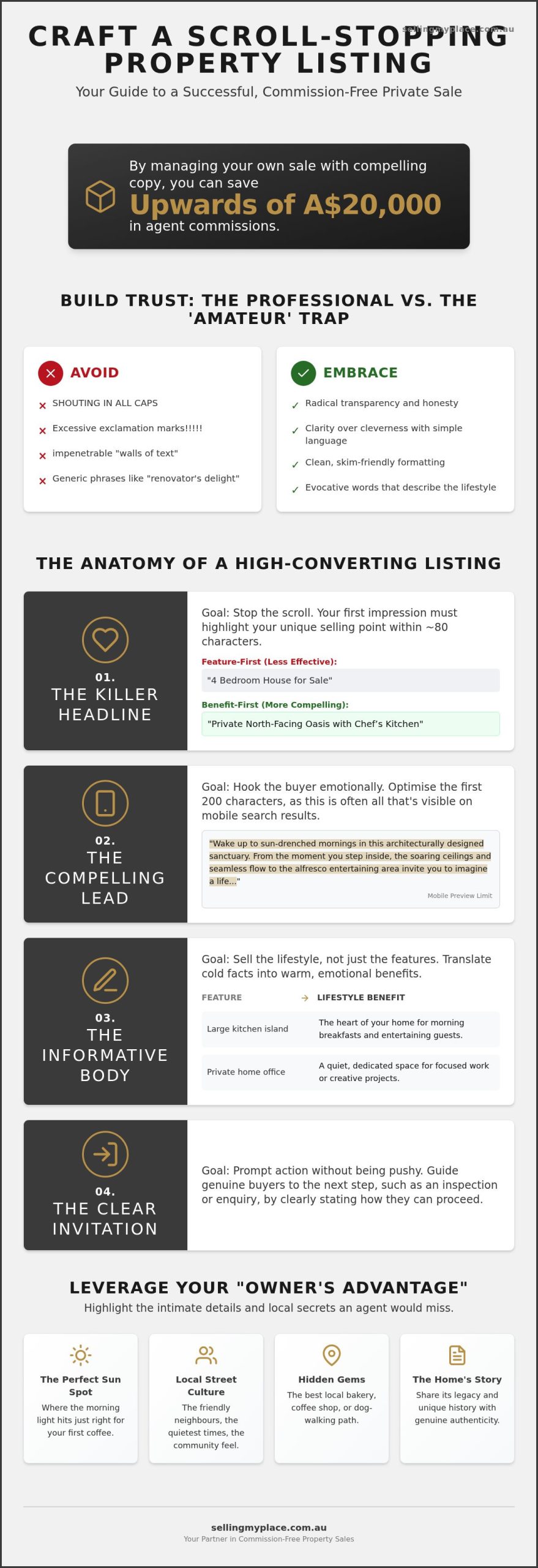
Technical Formatting for realestate.com.au and Domain
While the emotional narrative is the heart of your listing, the technical execution is the skeleton that holds it up. In 2026, the way you present your text is just as critical as the words themselves. If your formatting is clunky, buyers will simply bounce to the next property. Learning how to write a compelling property description for private sale requires a shift toward mobile-first thinking. Most Australians now hunt for homes on their smartphones, meaning your most vital information must appear before the “Read More” line.
The first 200 characters are your golden window. This snippet is what appears in search results and at the top of the mobile app. Use it to state your biggest unique selling point clearly. Beyond the hook, you must ensure your description aligns perfectly with the legal details in your Contract of Sale. Discrepancies between your marketing and the legal paperwork can create unnecessary friction or even legal hurdles during the settlement process.
Mastering the Mobile Scroll
Readability is the cornerstone of engagement. On a small screen, a “wall of text” is intimidating and often ignored. When you are refining how to write a compelling property description for private sale, remember that white space is your friend. Aim for paragraph breaks every two to three lines to keep the reader’s momentum going.
Utilising feature bullets is a brilliant way to provide quick-fire facts. Buyers in 2026 are specifically filtering for lifestyle upgrades that offer resilience and comfort. Consider a list like this:
- Energy Efficiency: 6.6kW solar system and double-glazed windows for year-round comfort.
- Working from Home: Dedicated executive study with custom built-in cabinetry.
- Outdoor Living: Saltwater pool and integrated alfresco kitchen for summer entertaining.
Bolding key terms and using sub-headings within the portal text box helps guide the eye to the information that matters most to that specific buyer. It allows them to find what they need without having to dig through paragraphs of fluff.
Portal-Specific Tips
Realestate.com.au and Domain have different character limits and display styles. While you might write a long-form story for your main advertisement, you may need to edit a punchier version for social media or secondary portals. Accurate data entry in the backend is equally important. If you forget to tick the “Pool” or “Solar” box in the features list, your property won’t show up when buyers use those specific filters.
Ensuring your listing is technically sound is a major step in the journey. For a broader look at the overall process, you can refer to our How to Sell Your Own Home: A Step-by-Step Guide. If you want to ensure your technical formatting is flawless before you hit publish, book a consultation with our advisory team for a final listing review.
Beyond the Words: The Partnership for a Successful Sale
Even the most evocative prose needs a professional stage to perform on. While you now understand how to write a compelling property description for private sale, those words must work in harmony with high-impact visuals. Think of it as a partnership where your words provide the emotional context and professional photography provides the immediate proof. When your authentic story is backed by gallery-quality imagery, you create a listing that doesn’t just inform buyers; it inspires them.
Our Agent Advisory Service is designed to bridge the gap between your intimate knowledge of the home and the professional polish required by the 2026 market. We don’t want to rewrite your experience. We want to refine it. By “peer-reviewing” your draft, our experts help you ensure that your unique insights are framed in a way that resonates with premium buyers. This collaborative approach allows you to maintain control of your narrative while benefiting from the “steady hand” of a seasoned expert.
The financial logic of this approach is compelling. By opting for a flat-fee model, you are choosing to reinvest in the quality of your marketing rather than paying for an agency’s overhead. Most of our clients find that saving upwards of A$20,000 in commissions allows them to present their home in the best possible light while still walking away with a significantly higher net return at settlement. You are the best person to tell your home’s story. We simply provide the platform and the tools to make sure that story is heard.
The Kincade Advantage
Kincade International Direct Sales (KIDS) combines your authentic voice with a marketing reach that rivals traditional agencies. Through our pre-sale property consulting, we help you identify the specific “lifestyle triggers” that will drive the most enquiry in your local area. Whether it is a sun-drenched reading nook or a resilient, sustainable garden, we know how to make those features shine. Plus, our “Until Sold” guarantee means you can move at a pace that suits your family, without the artificial pressure of a standard 90-day agency agreement.
Taking the Next Step
Before you hit the “Publish” button, take a final moment to read your listing aloud. Does it sound like the home you love? Does it clearly guide the buyer on how to take the next step? Ensure your contact details are correct and your professional floorplan is attached. Visualise the successful, commission-free settlement that awaits you. You have the knowledge and the tools to manage this transition with calm confidence.
Ready to write your success story? Contact our advisory team for a listing consultation to ensure your property hits the market with the professional edge it deserves.
Your Future Settlement Starts with the Right Words
Your journey from listing to a successful settlement is built on a foundation of trust and clear communication. By moving beyond a simple list of features and embracing the emotional narrative of your home, you’ve already done the heavy work that most agents overlook. Mastering how to write a compelling property description for private sale is the final piece of the puzzle, ensuring your digital front door is as welcoming as the real one. It is about showing buyers not just where they will live, but how they will feel when they arrive.
You don’t have to navigate this high-stakes transition alone. Our partnership approach gives you the professional tools to stand out, including high-end photography and floorplans that do the heavy lifting while your words capture the heart. With our expert Agent Advisory Service to review your draft and an “until sold” guarantee with no time limits, you can proceed with calm confidence knowing you are protecting an average of A$20,000 in equity. Start your commission-free selling journey today with our expert-backed marketing packages. We look forward to helping you turn the page to your next chapter with ease and success.
Frequently Asked Questions
How long should a property description be for a private sale?
The ideal length for a property description is typically between 300 and 500 words. This range provides enough space to cover the lifestyle narrative and the “Owner Loves” section without overwhelming a mobile user. Since the first 200 characters are the most critical for smartphone scrollers, ensure your most evocative hook is front-loaded to capture interest immediately before the “read more” break.
Do I need to mention the price in the description if it is already in the price field?
It is generally unnecessary to repeat the price within your main text if it is already clearly displayed in the portal’s dedicated field. Using that character count to focus on the home’s unique selling points is a better use of space. However, if you are using a strategy like “Offers Above” or a specific auction date, mentioning this toward the end can help clarify your expectations for the buyer.
Should I be honest about the property’s flaws in the description?
Radical transparency is one of the best ways to build trust in a private sale. While you don’t need to lead with a list of repairs, acknowledging a home’s “potential for improvement” or “original character” helps manage buyer expectations before they arrive for an inspection. This honesty ensures you are dealing with genuine enquiries from people who understand the property’s current state and see the value in its future.
Can I use AI to write my property description?
You can certainly use AI as a tool to overcome writer’s block or to help structure your initial draft. However, an AI cannot replicate your “Owner’s Advantage” or the heartfelt memories that make a house a home. Learning how to write a compelling property description for private sale involves adding those authentic, local details that only you know, which is why we recommend using our Agent Advisory Service to polish your final version.
How do I write a description for a property with “development potential”?
Focus on the technical “steak” of the property by leading with zoning, land dimensions, and street frontage. Mentioning ease of access or proximity to local infrastructure is vital for attracting investors and builders. While the potential is the main draw, briefly noting the current dwelling’s rental viability can provide a complete picture for those looking to land-bank or develop in the future.
What is the most important feature to highlight for Australian buyers in 2026?
Energy resilience and sustainable living have become the top priorities for Australian buyers in 2026. Highlighting features like high-capacity solar systems, double glazing, or thermal orientation speaks directly to the desire for lower running costs and year-round comfort. With national home prices falling slightly in July 2026, these value-add features help your property stand out as a smart, future-proof investment for families.
How often should I update my property description if it hasn’t sold?
Consider refreshing your listing every 21 to 30 days if you haven’t yet secured a successful sale. A new headline or a different lead photograph can often “reset” the listing in a buyer’s mind. Since national property listings increased by 12.4% in July 2026, staying fresh is essential to remain competitive. Use this update to respond to buyer feedback or to highlight a different seasonal lifestyle benefit.
Does the description affect my search ranking on realestate.com.au?
Your description affects your visibility through keyword optimisation rather than direct portal ranking algorithms. When you understand how to write a compelling property description for private sale, you include terms like “Home Office,” “Solar,” or “Pool” that buyers use in their filtered searches. While your listing tier determines your overall position, your copy is what ensures you appear in specific, high-intent search results.
High-Impact Real Estate Marketing Strategies for Sellers in 2026
What if you could command a premium sale price and professional-grade exposure without handing over a single cent of your hard-earned equity in commissions? It’s natural to feel a bit of anxiety when looking at the 2026 property market, especially when trying to implement effective real estate marketing strategies for sellers on your own. Between navigating the latest digital portal requirements and the stress of organising high-end photography, the weight of selling your own home can feel overwhelming. You want your property to stand out. However, the thought of high upfront costs or underselling your family’s biggest asset is enough to keep anyone awake at night.
This guide will show you how to master professional-grade tactics that rival any traditional agency, ensuring you keep 100% of your commission while achieving a top-tier result. We will explore everything from leveraging global digital networks to managing professional suppliers with ease, so you can transition to your next chapter with confidence and a much healthier bank balance. By the end of this article, you’ll have a clear roadmap to a stress-free, professional-looking listing that protects your profit and honours the value of your home.
Key Takeaways
- Discover how the shift toward property-centric marketing in 2026 allows you to reach global buyers without relying on traditional agency models.
- Learn why professional-grade photography and floorplans are essential to capturing interest within the critical first three seconds of a listing.
- Master effective real estate marketing strategies for sellers by utilising Australia’s major property portals and targeted social media to find passive buyers.
- Follow a clear, step-by-step playbook to prepare your property for a premium sale while retaining 100% of your commission.
- Explore how a sophisticated flat-fee approach can save you an average of A$20,000 while still providing expert advisory support and global exposure.
The Evolution of Property Marketing: Why 2026 Favours the Seller
The Australian property market has undergone a profound transformation. For decades, the focus was firmly on the agent, with their portrait dominating the billboard and their personal brand taking centre stage. However, the evolution of property marketing has shifted the spotlight back to where it belongs: on your home. In 2026, buyers don’t care about an agent’s career highlights; they care about the lifestyle your property promises. This move toward property-centric marketing means that the right real estate marketing strategies for sellers are now more accessible than ever, allowing you to present your home with the same polish as a high-end agency.
Digital globalisation has played a massive part in this shift. Your buyer is no longer just the person driving past your “For Sale” sign on a Saturday morning. They could be a professional relocating from Melbourne, an expat in London, or an investor in Singapore. Because the search process has moved entirely online, a property in a quiet Australian suburb can now achieve global visibility instantly. This transparency has empowered sellers, but it has also raised the bar for quality. A professional listing isn’t just a luxury; it’s a fundamental requirement for building trust with a buyer who may be viewing your home from thousands of kilometres away.
Breaking the Commission Cycle
Traditional real estate models often demand a 2% to 3% commission, which can feel like a heavy tax on your hard-earned equity. On a typical Australian home, this can easily amount to tens of thousands of dollars. Many savvy homeowners are joining the “Direct Sale” movement, realising that they can achieve a premium result without the sting of a commission. It’s a common misconception that choosing a no-commission path means going it alone. By using modern real estate marketing strategies for sellers, you can access professional listing services and global reach while keeping your profit in your own pocket. In fact, sellers using a flat-fee model often save an average of A$20,000, which is a significant boost to their next deposit or retirement fund.
The Role of Expert Advisory in Marketing
Effective marketing begins long before the first shutter click of a camera. It starts with pre-sale property consulting to identify the high-value improvements that actually move the needle for buyers. Whether it’s a fresh coat of paint in the right neutral tone or minor landscaping, these choices are informed by detailed neighbourhood market reports. Having a steady hand to guide you through the complexities of the settlement process and conveyance advice ensures that the professional image you’ve built is matched by a seamless transaction. This advisory-led approach provides the confidence of an expert partnership without the traditional agency price tag.
Visual Storytelling: Professional Photography and Floorplans
In the digital age, your first open house doesn’t happen on a Saturday morning at your front door. It happens on a smartphone screen, often late at night while a potential buyer is scrolling through property portals. You have roughly three seconds to capture their attention before they move on to the next listing. This is why visual assets are the cornerstone of effective real estate marketing strategies for sellers. It isn’t just about showing the rooms; it’s about telling the story of a life well-lived and inviting someone else to imagine their future within your walls.
Professional wide-angle photography is a non-negotiable element of this process. These specialized lenses capture the true volume of a room, creating a sense of space and light that a standard phone camera simply cannot replicate. While modern phones are impressive, they often struggle with “barrel distortion” or poor light balancing, which can make even the most beautiful home look cramped or gloomy. To ensure your shoot is a success, follow this simple preparation checklist:
- Declutter every surface, including kitchen benches and bathroom vanities.
- Open all curtains and blinds to flood the home with natural Australian sunlight.
- Turn on every light in the house, including bedside lamps, to create a warm glow.
- Remove personal items like family photos, fridge magnets, and pet bowls.
- Ensure the exterior is tidy, with bins tucked away and cars moved out of the driveway.
Capturing the Heart of the Home
Buyers generally buy on emotion and then justify the purchase with logic. Using natural light and “lifestyle” shots, such as a sun-drenched reading nook or a beautifully set alfresco dining area, helps create that vital emotional pull. Your “hero shot,” which is usually the front of the house or the primary living area, must be impeccable. DIY photos can actually devalue your property in the eyes of a buyer, as they suggest a lack of care or professional oversight. If you’re feeling unsure about how to present your home’s best side, reaching out for a bit of expert advice can ensure your visual presentation is flawless.
Floorplans: The Blueprint of a Sale
Research suggests that approximately one in three buyers will completely ignore a listing if it lacks a floorplan. It’s a critical tool that allows people to “move in” mentally before they’ve even stepped foot on the property. They can measure where their favourite sofa will go or see exactly how the master bedroom relates to the nursery. A professional floorplan adds a layer of agent-grade legitimacy to your listing, reassuring buyers that the information is accurate and professional. It provides the spatial context that static photos sometimes lack, making the entire marketing package feel comprehensive and trustworthy.
Maximising Digital Reach: Portals, Socials, and Global Networks
Getting your home in front of the right eyes requires more than just a “For Sale” sign and a prayer. In the Australian market, visibility is dominated by the leading property portals that attract millions of monthly visitors. While these platforms are often seen as the exclusive playground of traditional agencies, modern real estate marketing strategies for sellers now provide a direct pathway to these high-traffic platforms. By listing your home where the buyers already are, you ensure your property is seen alongside every other professional listing in your suburb. It’s about creating a level playing field where the quality of your home, and the professional visual storytelling we discussed earlier, can truly shine.
Beyond the major portals, successful sellers use data-driven neighbourhood market reports to understand exactly who their buyer is. Is it a young family looking for a backyard, or an investor seeking a high-yield unit? Knowing this allows you to tailor your digital reach. If your property is a high-value residence, a global marketing network becomes essential. In 2026, capital is incredibly mobile. An Australian lifestyle property is an attractive asset for international buyers, and your marketing should reflect that global appeal by appearing on international syndication networks that reach expats and investors worldwide.
Beyond the Local Suburb
Your property’s discoverability shouldn’t end at the suburb boundary. Sophisticated SEO ensures that when someone searches for a lifestyle change in your specific region, your home appears in the results. This is particularly vital for attracting international interest. Global listing syndication pushes your property to dozens of countries, reaching buyers who might never visit a local Australian portal. Even “off-market” strategies have evolved. You can build momentum through private networks and digital infrastructure before the public launch, creating a sense of exclusivity that can drive up the final sale price without the stress of a public deadline.
The Social Media Strategy
Social media is a powerhouse for finding “passive” buyers, making it one of the most effective real estate marketing strategies for sellers in a competitive market. These are people who aren’t actively checking portals every day but would move for the right opportunity. Targeted social media ads allow you to place your home directly into the feeds of people based on their lifestyle interests and browsing habits. A short, engaging video walkthrough can stop a thumb mid-scroll far more effectively than a static image. Don’t underestimate the power of community, either. Sharing your listing in local suburb groups can spark word-of-mouth interest that leads to a genuine enquiry. It’s a personal, neighbourly way to find a buyer who will love your home as much as you have.

The Direct Seller’s Playbook: A Step-by-Step Marketing Plan
Many traditional agencies like to keep their marketing processes shrouded in mystery, suggesting that only they possess the “secret tools” for a successful sale. In reality, the most effective real estate marketing strategies for sellers are quite straightforward when you have a structured plan to follow. This playbook demystifies the process, putting the power back into your hands while ensuring you don’t sacrifice an ounce of professionalism. By following these five steps, you can transition from a homeowner to a successful seller with total confidence.
- Step 1: Pre-Sale Consultation. Before you even think about a camera, you need to identify high-value improvements. A professional pre-sale property consulting session helps you decide which minor repairs or styling choices will actually increase your sale price.
- Step 2: Professional Assets. Secure your professional photography and floorplans. As we’ve discussed, these are the primary drivers of digital engagement.
- Step 3: Compelling Copywriting. Draft benefit-driven copy that highlights the lifestyle your home offers. Instead of just listing “three bedrooms,” describe the “sun-drenched morning coffee spot” or the “short, leafy walk to the local primary school.”
- Step 4: The Global Launch. Go live across the “Big Three” Australian portals and global networks simultaneously. This creates an immediate surge of interest and competition.
- Step 5: Advisory Support. Utilise expert real estate advisory services to manage enquiries, negotiate offers, and guide you through the conveyance process.
Timing Your Launch
The “Golden Window” for a property listing is typically the first 14 days. This is when your home is “new” to the market and receives the highest volume of views. To make the most of this period, you must coordinate your professional photography, signage, and online listing so they all hit the market at once. One of the greatest benefits of a modern flat-fee model is the “no time limit” listing. This removes the stress of a ticking clock, allowing you to wait for the right buyer without the fear of your listing becoming “stale” or being forced into a price reduction by a looming agency contract expiry.
Negotiating Like a Pro
Negotiation doesn’t have to be a high-stress confrontation. When you’re armed with detailed neighbourhood market reports, you have the data needed to defend your asking price with calm authority. If you receive multiple offers, you can manage them transparently without the pressure of a public auction. This methodical approach ensures the marketing success you’ve built translates into a premium final settlement. If you’re ready to take the first step toward a commission-free sale, get in touch with us to discuss your property’s potential.
The Kincade Advantage: Professional Results Without the Sting
Selling My Place (Kincade International Direct Sales) isn’t just about listing a property; it’s about redefining how Australians approach the biggest transaction of their lives. By combining global digital infrastructure with a personal, advisory-led model, we ensure you don’t have to choose between professional exposure and financial sense. Implementing high-impact real estate marketing strategies for sellers shouldn’t come with a hidden “success tax” that drains your profit. Instead, our model prioritises your equity, allowing you to deploy sophisticated tactics while retaining 100% of your commission. It’s a smarter, more transparent way to move forward.
The financial reality of this approach is quite remarkable. On average, our sellers save approximately A$20,000 by avoiding traditional percentage-based fees. When you consider that this saving comes while still receiving professional photography, detailed floorplans, and reach into global networks, the decision becomes a matter of logic rather than tradition. We view this as a genuine partnership. Our goal is your success, not a quick transaction to meet an agency quota. By removing the pressure of commission, we create an environment where the focus remains entirely on your needs and your property’s potential.
A Partnership Approach
We believe selling a home is an emotional transition that deserves more than a purely transactional service. Our Agent Advisory Service acts as your “steady hand,” providing the calm confidence needed to navigate complex negotiations and buyer enquiries. You aren’t left to figure out the legalities alone, either. With professional conveyance advice available, you have a clear, supported path from the first enquiry to the final settlement. This supportive experience aims to reduce the typical stress of selling, replacing it with a sense of shared purpose and expert local knowledge that feels both personal and protective.
Your Equity, Your Future
Take a moment to visualise what that A$20,000 saving could mean for your future. Perhaps it’s a significant boost to the deposit for your next family home, a contribution to your children’s education, or the security of a more comfortable retirement. This is your legacy. Keeping that profit where it belongs is a powerful way to honour the years of hard work you’ve put into your property. Selling smarter isn’t just about the final price on the contract; it’s about the financial freedom you carry into your next chapter. Are you ready to take control? Contact our expert advisors today to start your commission-free journey.
Your Path to a Successful, Commission-Free Sale
The shift toward property-centric marketing in 2026 has opened doors that were once locked behind agency gates. By mastering professional real estate marketing strategies for sellers, you’ve seen how simple it is to combine global reach with high-end visual storytelling. You don’t need to sacrifice your equity to achieve a premium result. Instead, you can rely on a model that includes professional photography and floorplans as standard, ensuring your home looks impeccable on every major portal from day one.
Choosing to sell your own home is an empowering step toward protecting your family’s financial legacy. With an average saving of A$20,000 in commissions and the peace of mind that comes from being listed until sold with no time limits, you’re firmly in the driver’s seat. We’re here to act as your steady hand, providing the advisory support you need to navigate this transition with total confidence and warmth. It’s about more than just a transaction; it’s about honouring the home you’ve built.
Start your commission-free sale today with our expert marketing advisory. It’s time to celebrate your home’s true value and keep your hard-earned profit exactly where it belongs.
Frequently Asked Questions
Can I really list my home on Australia’s major property portals without a traditional agent?
Yes, you can list on the nation’s premier property search platforms through a licensed listing service. While the largest portals typically don’t allow private individuals to list directly, a flat-fee service provides the professional bridge required. This ensures your home appears alongside every other agency listing, maintaining a level playing field for your property’s visibility and reach.
How much can I actually save by using a flat-fee real estate marketing strategy?
Australian homeowners save an average of A$20,000 in commissions by opting for a flat-fee model. This figure represents the equity you would otherwise pay to a traditional agent based on a percentage of the final sale price. By implementing these real estate marketing strategies for sellers, you retain more of your property’s value while still accessing professional-grade exposure and support.
Is professional photography included in the flat-fee marketing packages?
High-quality wide-angle photography and professional floorplans are standard inclusions in our marketing packages. We understand that visual storytelling is the most critical factor in capturing a buyer’s interest within the first few seconds of their search. Providing these assets as part of a fixed fee ensures your property presents with the same polish and authority as any high-end agency listing.
What happens if my property doesn’t sell within the first few months?
Your property remains listed until it’s sold, as there are no time limits on your listing. Traditional agency contracts often expire after 90 days, which can lead to stressful price reductions or the need to re-list. Our approach removes this pressure, allowing you to wait for the right buyer and the right price without worrying about additional fees or contract renewals.
How do I handle the legal side of the sale without an agent?
You can manage the legal requirements by utilising professional conveyance advice and advisory services. While you are the primary point of contact for buyers, experts guide you through the documentation and settlement process. This partnership ensures all Australian legal standards are met, providing a secure and compliant path from the initial offer to the final exchange of keys.
Will buyers take my listing seriously if I am selling it myself?
Buyers focus on the property’s quality and the professionalism of the listing rather than the name of the agency. When your home is presented with professional photography, accurate floorplans, and clear descriptions, it carries a high level of legitimacy. Many buyers actually prefer the direct transparency and local knowledge that only a homeowner can provide during an inspection.
What is pre-sale property consulting and do I really need it?
Pre-sale property consulting is a strategic review that identifies which minor improvements will yield the highest return on investment. It’s an essential step for those using real estate marketing strategies for sellers to ensure they aren’t over-capitalising on renovations. By focusing on high-impact changes like styling or landscaping, you can significantly boost your home’s appeal and final sale price.
How does a global marketing network help sell a local Australian home?
A global marketing network exposes your property to international investors and Australian expats living abroad. In a mobile world, your buyer might be searching from London or Singapore. Global syndication ensures your listing appears on international platforms, increasing the pool of potential buyers and creating more competition; this often leads to a more favourable sale price for your local residence.
2026 Guide: Sell Your Property Commission-Free
What if that $20,000 you’re about to hand over in agent commission isn’t actually buying you a better result, but is simply the price of your own uncertainty? You’ve likely spent years turning your house into a home, and the thought of underselling it while trying to navigate real estate marketing packages for owners is enough to keep anyone up at night. It’s completely natural to feel a bit of trepidation about managing contracts and negotiations without a traditional agent by your side. You want to protect your family’s legacy, and that starts with making the right choices from day one.
This guide shows you how to choose a professional marketing package that puts you firmly in the driver’s seat. You’ll discover how to present a professional-grade listing that commands top dollar while keeping every cent of that hard-earned equity for your next chapter. We’ll walk through the essential tools of the trade, from professional photography to our specialised Agent Advisory Service, providing a clear roadmap to a successful, commission-free sale in 2026. It is about more than just a listing; it is about having a steady hand to guide you through the transition with confidence.
Key Takeaways
- Learn why professional photography and floorplans are essential assets that protect your property’s equity from being discounted by potential buyers.
- Understand the financial impact of the commission trap and how a flat-fee model helps you retain an average of $20,000 of your own profit.
- Discover how to select comprehensive real estate marketing packages for owners that offer the same digital reach as major agencies while you keep 100% of the sale price.
- Gain confidence in managing legal contracts and negotiations with a dedicated advisory service acting as your steady hand throughout the process.
- Master simple styling and narrative techniques to ensure your listing sells a lifestyle that resonates deeply with premium buyers.
What are Real Estate Marketing Packages for Owners?
Choosing the right real estate marketing packages for owners is about more than just putting a price tag on your front gate. We understand that your home is likely your most significant asset; it is where memories were made and where your hard-earned equity lives. Protecting that legacy requires a strategy that goes beyond a simple listing. Think of these packages as your digital infrastructure. In the past, selling privately often meant you were essentially invisible to the broader market, relying on a sign in the yard and perhaps a small ad in the local paper. Today, a professional marketing package provides a private seller with the exact same digital footprint as a traditional franchise agency.
It is a strategic bundle of services designed to ensure your property doesn’t just sit on the market, but actually shines. A comprehensive package typically includes:
- Professional Photography: Capturing your home’s best angles in the right light to evoke an emotional response.
- Detailed Floorplans: Helping buyers understand the flow and lifestyle potential before they even step through the door.
- Portal Listings: Guaranteed visibility on realestate.com.au and Domain, where the vast majority of Australian buyers start their search.
- Expert Advisory: A steady hand to help you manage the technical details and legal hurdles with confidence.
The Evolution of Selling Your Own Home
Digital technology has completely rewritten the rules for Australian homeowners. The traditional barriers to entry, like expensive agency overheads and exclusive access to buyer databases, have crumbled. We have moved into an era of “Direct Sales,” where the owner is the best person to speak about the home’s unique charm, supported by a professional marketing engine. This approach moves beyond the outdated for sale by owner (FSBO) stereotype. Instead of a lonely sign on the kerb, your property is broadcast through global networks, reaching local families and international buyers alike. It is about having the reach of a multinational firm while keeping the heart of a local sale.
Why Professionalism Matters in a DIY Market
Buyers are visual creatures. They often decide whether they like a house within the first few seconds of seeing the lead photo. This is why the “professional” part of real estate marketing packages for owners is so critical. High-end photography and accurate floorplans do more than just show the layout; they build an emotional narrative. When a listing looks polished, it signals to the market that the property has been well-cared for, which helps justify a premium price. Conversely, amateur photos can lead to low-ball offers because the property appears undervalued. By investing in a high-impact strategy, you avoid any “cheap” stigma and ensure your home commands the respect it deserves. You aren’t just listing a house; you are presenting a lifestyle.
Essential Components of a High-Impact Marketing Package
When you begin exploring real estate marketing packages for owners, it is vital to look beyond the basic listing. A truly effective strategy is a symphony of professional assets that work together to build buyer trust and justify a premium price. You aren’t just buying a spot on a website; you are investing in a digital storefront that represents your family’s most valuable asset. The goal is to create a seamless experience that guides a buyer from their first scroll to the final contract. This requires a blend of visual storytelling and hard market data to ensure your property stands out in a crowded digital landscape.
Visual Assets: Photography and Floorplans
Research suggests you have roughly 2.7 seconds to capture a scroller’s attention before they move on. This is why “iPhone photos” are the fastest way to lose equity. Professional photographers use specialised equipment and lighting to make rooms feel spacious and inviting. They understand how to highlight the lifestyle features, such as a sun-drenched deck or a modern kitchen, that evoke an emotional response. Floorplans are equally critical; they act as a map for the buyer’s imagination. By reducing uncertainty about the layout, you encourage more qualified inspections and fewer “tyre-kickers” who are just curious about the size. Twilight shots and drone photography can further elevate your listing, showcasing the property’s position within the community.
Digital Reach and Listing Duration
Visibility on realestate.com.au and Domain is the baseline, but the hierarchy of your listing determines your success. Premiere or Highlight placements ensure you remain at the top of search results where buyers are most active. Perhaps the most significant advantage of a professional package is the “listed until sold” feature. Traditional agents often use 90-day contracts, which can lead to rushed decisions or forced price drops as the clock ticks down. Having the freedom to stay listed without time limits allows you to hold firm on your price until the right buyer arrives. Modern real estate marketing packages for owners also utilise social media amplification, retargeting serious buyers who have already shown interest in similar local properties.
Pricing with confidence is the final piece of the puzzle. By utilising Neighborhood Market Reports, you can access the same data agents use to set expectations. This removes the emotional guesswork and helps you identify the “sweet spot” that attracts multiple bidders. These reports provide a steady hand during the most stressful part of the sale, ensuring you don’t undersell your home out of a lack of information. If you would like to discuss how to position your home for a record result, you can always connect with our advisory team for a confidential chat.
Traditional Agent vs. Flat-Fee Packages: A Cost-Benefit Analysis
It is time to talk about the elephant in the room: the commission trap. When you list with a traditional agency, you aren’t just paying for their time; you are handing over a significant slice of your home’s value. For a property sold at $1,000,000, a standard 2.5% commission takes $25,000 straight out of your pocket. That is money that could be your next deposit, a renovation fund, or your retirement nest egg. It represents years of mortgage repayments and hard work that vanishes in a single transaction. Real estate marketing packages for owners change this equation by offering transparency over your equity.
Instead of a percentage, you pay a set fee for the actual services rendered. This covers the essentials like photography and portal listings without tying the cost to your property’s final sale price. Why should you pay more for the same marketing just because your home is worth more? Choosing a flat-fee model ensures you are paying for the work done, not the luck of the market or the suburb’s prestige. It’s a more equitable way to move into your next life stage.
Beyond the commission, traditional agency agreements often hide extra costs. You might find yourself hit with:
- Separate auctioneer fees that aren’t included in the commission.
- Marketing levies that have a significant markup added by the agency.
- Administration charges for “processing” your listing.
When you calculate your net profit, it becomes clear that a slightly lower sale price through a flat-fee model often puts more money in your bank account than a record price where an agent takes a massive cut. It’s about the bottom line, not just the headline figure.
The ‘Save $20,000’ Reality Check
Most Australian families save an average of $20,000 by managing their own sale with professional support. It is worth asking where a traditional commission actually goes. Much of it is swallowed by franchise fees, flashy office fit-outs, and agent car leases rather than directly benefiting your sale. By opting for a Sale by owner model, you ensure those funds stay within your family’s financial legacy. You keep 100% of the profit because, quite simply, it is your property.
Risk Mitigation and Success Rates
There is a common myth that only an agent can negotiate a top price. In reality, buyers fall in love with the home and the lifestyle it offers, not the person holding the clipboard. When you use professional real estate marketing packages for owners, you bridge the negotiation gap by presenting a listing that looks identical to any high-end agency. You get the benefit of a steady hand advisor to help with the technical bits, without the pressure of a commission-driven salesperson pushing for a quick result just to meet their monthly quota. This partnership allows you to hold out for the price your home truly deserves.
Maximising Your Marketing Results: Actionable Steps for Owners
Having the right tools is only half the battle; knowing how to wield them is what truly secures a premium result. When you invest in real estate marketing packages for owners, you’re essentially setting the stage for a performance. Your home needs to be the star. This begins with a rigorous approach to presentation. Decluttering isn’t just about tidying up; it’s about creating a blank canvas where a potential buyer can project their own life. Remove the family photos and the fridge magnets. You want them to walk through the front door and think, “I can see myself living here,” rather than feeling like a guest in someone else’s sanctuary.
Once the house is ready, your narrative must match the visuals. Don’t just recount the number of bedrooms or the brand of the oven; those are bricks and mortar. Instead, describe the lifestyle. Is there a sun-drenched nook perfect for a Saturday morning coffee? Does the backyard offer a safe, private space for children to play while the adults entertain? Crafting this story helps buyers connect emotionally with the property. This emotional hook is often what bridges the gap between a logical offer and a premium one.
Pre-Sale Consulting and Presentation
You don’t need a full renovation to increase your sale price. Often, small fix-ups like a fresh coat of neutral paint, updated cabinet handles, or well-manicured garden beds offer the highest return on investment. Street appeal is your first physical handshake with a buyer; if the lawn is overgrown, they’ll assume the rest of the house hasn’t been cared for either. To handle negotiations with a steady hand, use your market reports to deflect low-ball offers. Having hard data allows you to remain calm and objective when someone tries to test your resolve.
Managing the Sales Process
Handling enquiries requires a blend of hospitality and boundary-setting. We recommend setting up a dedicated email address and phone line for the sale. This keeps your personal life private and ensures you don’t miss a vital message in the clutter of daily life. When you organise private inspections, aim for a relaxed atmosphere. Open the windows, let the light in, and perhaps have some soft music playing. Your goal is to make them feel at home, not pressured. As you move toward the final stages, securing professional Conveyance Advice early ensures the legal transition is as smooth as the marketing phase. If you’re feeling unsure about the next step, reach out to our consultants for some friendly, expert guidance.
The Kincade Difference: Professional Marketing with a Safety Net
At Kincade International Direct Sales (KIDS), we believe that selling your home shouldn’t feel like a solo voyage into stormy seas. It is a significant life transition, and we understand the emotional weight that comes with handing over the keys to your family sanctuary. While many real estate marketing packages for owners focus solely on the digital assets, such as the photos and portal placements, we view our role as a strategic partnership. We provide the professional tools to attract premium buyers, but we also provide the seasoned expertise needed to navigate the complexities of the Australian property market. It’s about giving you the autonomy of a private sale with the protective “safety net” of an industry expert.
The core of this partnership is our commitment to your financial legacy. By removing the traditional agency commission, we help you protect your equity, ensuring that an average of $20,000 stays in your bank account where it belongs. We don’t just list your property and walk away; we give you access to global marketing networks that put your Australian home in front of international investors. This global reach, combined with our local knowledge, ensures your property receives 100% professional support from the first enquiry to the final settlement. You keep the profit, and we provide the platform.
Agent Advisory: Your Secret Weapon
Negotiating a property sale can be a high-stakes game of chess, and it is natural to feel a bit of anxiety when a buyer starts raising objections. This is where our Agent Advisory Service becomes your secret weapon. You aren’t just getting a listing; you’re getting a steady hand to help you navigate buyer psychology and complex contracts. Our advisors bring decades of real estate experience to your corner for a single flat fee, helping you stay calm and objective during the heat of a negotiation. Whether it’s vetting a serious offer or managing the pre-sale consulting phase, we’re here to ensure you never feel alone in the process.
A Comprehensive, Commission-Free Solution
Our approach is designed to provide complete peace of mind through a suite of Residential Property Listing Services that cover every base. We understand that the market doesn’t always move on a 90-day schedule, which is why our “Listed Until Sold” guarantee is so vital. It removes the ticking-clock pressure that often leads to underselling. By choosing one of our real estate marketing packages for owners, you are choosing to sell on your own terms, backed by professional photography, accurate floorplans, and an advisory team that genuinely cares about your outcome. It is time to reclaim your equity and step into your next chapter with confidence.
Take the First Step Toward a Commission-Free Sale
Your home is more than just a building; it’s the foundation of your family’s next adventure. Choosing the right real estate marketing packages for owners allows you to honour that value while keeping 100% of your sale profit. By combining professional-grade visibility with our dedicated Agent Advisory Service, you gain the steady hand needed to navigate negotiations with total confidence. Remember, you aren’t just saving an average of $20,000 in commissions; you’re investing in your own future. With our listed until sold guarantee, there’s no ticking clock or artificial pressure to settle for less than your property deserves. It’s time to sell on your terms and protect what you’ve built.
Maximise your sale profit; explore our commission-free marketing packages today.
We’re here to guide you through this transition with the respect and expertise your home deserves. You’ve done the hard work of building your equity, and now it’s time to see it rewarded. You’ve got this, and we’re ready to help you make it happen.
Frequently Asked Questions
What exactly is included in a flat-fee real estate marketing package?
Our real estate marketing packages for owners provide a complete digital storefront for your home, ensuring you look just as professional as any high-street agency. This includes professional photography and accurate floorplans to capture buyer interest, along with prominent listings on major portals like realestate.com.au and Domain. Beyond the visual assets, you also gain access to our Agent Advisory Service, which acts as a steady hand to guide you through the technical and emotional aspects of the sale.
Can I really sell my home for the same price as an agent using these packages?
You absolutely can achieve a premium price, because buyers fall in love with the home and the lifestyle it offers, not the person holding the clipboard. By using high-quality marketing assets, you present your property in its best possible light, which builds the emotional connection necessary to justify a top-tier valuation. When you combine professional presentation with the right market data, you are perfectly positioned to negotiate a record result for your local area.
How do I get my property listed on realestate.com.au and Domain without an agent?
While private individuals cannot list directly on these platforms, our service acts as your licensed bridge to the major portals. We hold the necessary subscriptions and industry credentials to place your listing on realestate.com.au and Domain on your behalf. This ensures your home is seen by the millions of active buyers who use these sites as their primary search tools every single day, providing you with maximum market exposure.
Do I need to be a professional photographer to use these services?
No, you don’t need any photography skills at all because we arrange for a professional to visit your property. They use specialised equipment and lighting to capture your home’s unique charm, ensuring it looks spectacular in search results. This removes the stress of trying to take your own photos and ensures your listing meets the high standards that premium buyers expect in the current market.
What happens if my property doesn’t sell within the first month?
Your property stays listed until it is sold, as we don’t believe in artificial time limits that create unnecessary pressure. Unlike traditional 90-day agency contracts that might force you into a rushed price drop, our “Listed Until Sold” approach gives you the luxury of time. This allows you to hold firm on your valuation and wait for the right buyer who truly appreciates the value of your home.
Is conveyance advice included in the marketing package?
Yes, we provide conveyance advice to help you navigate the legal transition from “listed” to “under contract” with total confidence. While the marketing assets handle the visibility of your sale, our advisory support ensures you understand the paperwork and legal requirements involved in a property transaction. This integrated approach provides a reassuring safety net from the moment you list until the final settlement day.
How much money can I realistically save by choosing a marketing package over an agent?
Most Australian homeowners save an average of $20,000 by choosing our real estate marketing packages for owners instead of paying traditional agency commissions. Since our model isn’t tied to a percentage of your sale price, every extra dollar you negotiate stays in your pocket. It is a significant financial win that can make a substantial difference to your next deposit or your family’s long-term financial legacy.
Will buyers be put off if they have to negotiate directly with the owner?
Modern buyers often find direct communication with the owner refreshing because it provides immediate, honest answers about the home and the neighbourhood. You are the true expert on your property’s history and the local lifestyle, which often builds more trust than a third-party agent can. As long as you remain professional and grounded, buyers are usually very comfortable negotiating directly with the person who knows the home best.
How to Run an Open House Without an Agent: The 2026 Australian Seller’s Guide
Would you hand over $33,000 of your hard-earned equity just for someone to unlock your front door and hand out a few brochures? With the national median house price sitting at $1.28 million in 2026, that is the reality of traditional commission rates. It is completely natural if the thought of learning how to run an open house without an agent feels a little daunting. You might worry about appearing unprofessional or feel a sense of anxiety about inviting strangers into your sanctuary, especially as the property market cools in our major capital cities. You deserve to feel both protected and prepared during such a significant life transition.
The truth is that a successful open home is not a high-pressure sales pitch; it is a curated lifestyle experience. We will show you how to master the art of the “open for inspection” to build competition and secure a premium price without paying a cent in commission. This guide provides a steady hand through the 2026 landscape. We will cover everything from meeting new state disclosure laws to the subtle presentation touches that make buyers fall in love, ensuring you stay in total control of your sale from the first hello to the final handshake.
Key Takeaways
- Master the “sweet spot” of timing to create social proof and genuine urgency among local buyers during your inspection window.
- Learn the emotional psychology behind the “display home” lifestyle and how strategic decluttering helps buyers visualise their own future in your space.
- Discover exactly how to run an open house without an agent by adopting a “steady hand” persona that feels both professional and welcoming to your neighbours and potential buyers.
- Implement the 24-hour follow-up rule to capture momentum and learn to distinguish polite feedback from serious financial intent.
- Utilise professional visuals and expert advisory support to build a competitive environment that secures a premium result while protecting your family’s equity.
Strategic Planning: Open House vs. Private Inspections
In the Australian property market, the “open for inspection” is more than just a logistical task; it’s a psychological masterstroke. When you’re learning how to run an open house without an agent, you have to appreciate the power of social proof. Seeing a crowd at the front gate or a queue in the hallway signals to potential buyers that your home is a hot commodity. it creates an immediate sense of urgency that a quiet, one-on-one private viewing simply cannot replicate. While a private inspection offers intimacy, the open house builds the competitive tension needed to drive offers toward that premium price point.
Timing is your greatest ally here. You might be tempted to leave the doors open for hours, but the “sweet spot” is actually much shorter. Aim for a 30 to 45-minute window. This condensed timeframe forces all interested parties to arrive at once, creating a visible “buzz” that suggests high demand. To understand the foundational concept of what is an open house and its role in real estate marketing, it’s helpful to view it as a curated event rather than an all-day drop-in centre. Stick to the Saturday morning tradition, usually between 10:00 am and 12:00 pm, to align with the rhythms of local buyers who are already out and about on the “open house trail.”
Setting the Scene for Success
Success starts at least two weeks before you turn the key. Once your listing is live, you need that lead time to build momentum and enquiry. Check the Bureau of Meteorology closer to the date; the Australian sun can be harsh, so have the air conditioning running or fans circulating well before the first guest arrives. If a sudden downpour hits, a bucket for umbrellas and a mat for wet shoes at the entrance shows you’re a thoughtful, organised host. Your “Open House Kit” should be ready to go, including sign-in sheets, professional brochures, and a summary of the contract of sale for those ready to move quickly.
Legal and Safety Foundations
Your safety and peace of mind are paramount. While you’re learning how to run an open house without an agent, remember that you’re the person in charge of your domain. A visitor register isn’t just for follow-up calls; it’s a vital security and insurance requirement. Ensure every guest provides their name and contact number before entering. Since you’re selling privately, check your home insurance policy regarding public liability for visitors. To protect your sanctuary, create a “Safe Zone” by removing small valuables, jewellery, medications, and sensitive documents from sight. This allows you to focus on being a welcoming host without the distraction of worry.
Presentation: Creating the ‘Display Home’ Lifestyle
When you’re mastering how to run an open house without an agent, your primary objective is to facilitate a mental shift in your visitors. You are no longer showing them your home; you are presenting a product that could become theirs. This transition from “lived-in” to “aspirational” relies heavily on the emotional psychology of first impressions. Buyers don’t just look at floorboards and kitchen benches. They look for a lifestyle that feels more organised, peaceful, and elevated than their current one. If they can’t visualise their own morning coffee in your kitchen, they won’t make an offer.
The golden rule of preparation is simple: if an object does not add value to a room’s specific purpose, it belongs in storage. This goes beyond a quick tidy-up. You need to depersonalise with heart. While you want to keep the warmth of a family residence, you must remove the specific “you” from the space. Family photos, trophies, and idiosyncratic collections should be packed away. Replacing them with neutral, high-quality textures like linen throws or local greenery maintains the soul of the house without making guests feel like they are intruding on your private life.
To truly help buyers commit, you must provide the tools for their imagination. Professional floorplans are essential here. They allow a couple to stand in an empty corner and mentally place their favourite armchair or heirlooms. Without a floorplan, many buyers leave feeling uncertain about dimensions, which often leads to a “no” simply because they couldn’t solve the spatial puzzle in their heads. If you’re feeling overwhelmed by the staging process, our team can provide tailored advice to help you prepare.
The Sensory Experience
Light is your most powerful staging tool. Open every blind and curtain to invite the Australian sun inside. You should also “centre” your lighting by turning on every lamp and overhead light, even during a bright afternoon, to highlight architectural features. Fresh air is equally vital. Avoid heavy perfumes or the old “baked cookies” trope, as these can feel like you’re hiding something. Instead, focus on neutral cleanliness and ensure the temperature is a cool sanctuary. Following a comprehensive Ultimate Open House Checklist can help you track these small but vital sensory details before the first guest arrives.
Curb Appeal and the ‘Drive-By’ Test
The “five-second” rule is real. Many buyers will perform a drive-by before they ever commit to an inspection. If the front garden is overgrown or the entrance looks neglected, they might not even step out of the car. Fresh mulch, manicured lawns, and a sparkling front door are non-negotiable. Strategic signage is the final touch. Place “Open House” pointers at the nearest major intersections to capture local traffic and neighbours who might know someone looking to move into the area. This visibility reinforces your status as a professional and prepared seller.
Hosting with Confidence: Managing the Big Day
Stepping into the role of host requires a specific mental shift. When you’re learning how to run an open house without an agent, your most effective tool isn’t a sales pitch; it’s the “steady hand” persona. Buyers often feel pressured by traditional agents who hover and push for immediate feedback. You can stand out by being the calm, authoritative, and welcoming guide. Your goal is to be present enough to answer questions but distant enough to let buyers emotionally “move in” as they walk through your rooms. You aren’t a desperate salesman; you’re a proud homeowner facilitating a major life transition for someone new.
The Greeting Protocol sets the tone for the entire visit. As guests arrive, a warm “Welcome, feel free to take your time looking around” is far more effective than a barrage of questions. If a buyer asks a technical question about the property’s structure or local zoning that you aren’t 100% certain about, don’t guess. A powerful response is: “That’s a great question; I’ll double-check that with my advisor and get back to you this afternoon.” This protects your credibility and ensures you don’t accidentally provide incorrect information that could complicate a later contract.
Once guests are inside, honour the “Quiet Tour.” Allow people the space to whisper to their partners and visualise where their own furniture might sit. If you follow them from room to room, you break the spell. Instead, remain in a central area like the kitchen or living room, ready to assist if they look your way. This approach builds trust and shows you’re confident in the value of your home.
The Professional Sign-In Process
Capturing contact details is vital for both security and follow-up, but it must be handled with care. While many tech-savvy Australian sellers prefer digital registers on a tablet for ease of data entry, a high-quality paper register can feel more personal and less transactional. Whichever you choose, ensure you’re meeting Australian privacy standards by keeping the list out of sight from other guests. As they finish their tour, offer a tangible takeaway. A professional brochure that includes a neighborhood market report provides immense value, giving them the data they need to justify a premium offer later that evening.
Security and Crowd Control
Managing the flow of traffic is where a “Sale by Owner” campaign truly benefits from the “Two-Person” Rule. Having a trusted friend or family member help you is essential, especially if twenty groups arrive at once. One person can manage the front door and sign-in process while the other stays inside to answer questions and keep an eye on the property. If a room becomes too crowded, don’t be afraid to politely ask guests to wait a moment in the garden. Once the 30 to 45-minute window closes, perform a final walkthrough of every room. Check that all windows are locked, small valuables are still secure, and lights are off before you sit down to review your visitor list.
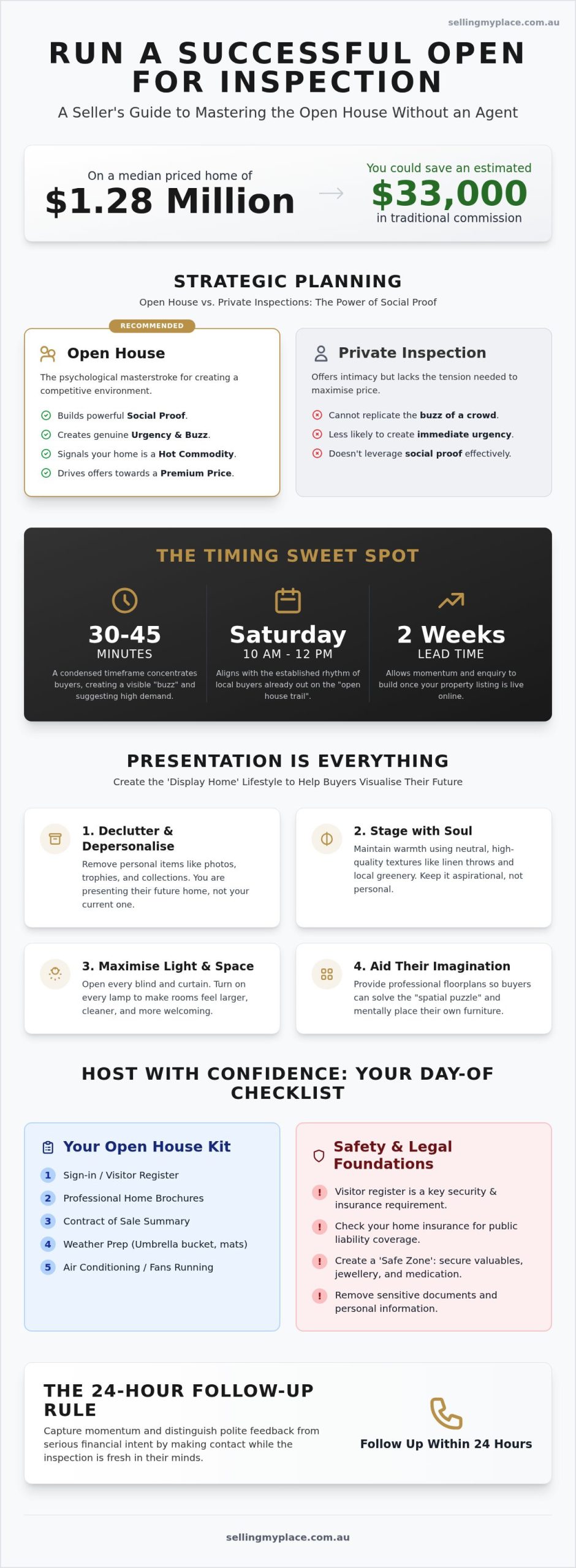
From Foot Traffic to Formal Offers: The Follow-Up
Once the final guest has departed and you have locked the front door, the most critical phase of your campaign begins. While the physical preparation was about aesthetics, the follow-up is about momentum. The “24-hour rule” is your guiding principle here. If you wait several days to contact your visitors, the emotional connection they felt while walking through your sun-drenched living room will have started to fade. By calling every person on your register within one business day, you demonstrate that you are a professional, organised seller who is serious about a result.
Learning how to run an open house without an agent means becoming adept at deciphering buyer feedback. You will quickly find that “it’s a lovely home” is often a polite way of saying the property isn’t for them. You are looking for “genuine intent,” which sounds very different. Serious buyers ask about settlement terms, request copies of the strata report, or inquire about recent council rates. When you identify these “hot” prospects, your role is to move the conversation from verbal interest to a formal “Letter of Offer” as quickly as possible. This written commitment is the only way to truly gauge a buyer’s capacity and desire.
Ethically creating a sense of competition is also part of this process. If you have multiple parties showing interest, it is perfectly acceptable to let them know. A simple, honest statement like, “I’ve had a couple of requests for the contract this morning,” can be enough to encourage a hesitant buyer to put their best foot forward. You aren’t playing games; you are simply providing them with the market context they need to make a decision.
The Art of the Follow-Up Call
Your follow-up script should be gentle and inquisitive rather than pushy. Start with a simple opening: “Hi, it’s [Your Name] from [Address]. I’m just touching base to see what your thoughts were on the home now that you’ve had some time to reflect.” If the feedback is negative, don’t take it personally. Instead, use those insights to determine the market value of your property more accurately. Sometimes, the market is telling you that a small adjustment in strategy or price is needed to find the right match.
Negotiation and Closing
When the offers do start arriving, stay grounded. The first offer you receive is often from the most eager buyer, but it isn’t always the best price the market will give you. This is where mastering property sale negotiation tips becomes invaluable. You are the one holding the phone and making the decisions, so take your time to breathe and consult your notes. Once you have agreed on a price and terms, it’s time to introduce your conveyancer to handle the legal exchange. If you find the negotiation phase daunting, our expert advisors can guide you through the conversation to ensure you secure the best possible outcome for your family.
The Competitive Edge: Selling Smarter with Expert Backing
It’s a common misconception that taking the reins of your own sale means navigating the complex Australian property market in total isolation. It doesn’t have to be that way. While you are the face of your home, having a “steady hand” in the background provides the professional authority needed to secure a premium result. If you’ve been wondering how to run an open house without an agent while still maintaining a professional edge, the answer lies in a collaborative model. You manage the heartfelt, personal connection with buyers; we provide the high-octane marketing and strategic advice that usually costs tens of thousands in commissions.
Your digital “invite” is the first point of contact. Professional Photography and floorplans are not just optional extras; they are the essential tools that get people through your door in the first place. In a cooling 2026 market, buyers are more discerning than ever. High-quality visuals signal that the property is well-maintained and that the seller is serious. When this is paired with an Agent Advisory Service, you gain a secret weapon for those technical moments. Whether it’s a question about a complex clause in the contract or a buyer trying to low-ball based on national trends, you have expert guidance just a phone call away.
The financial impact of this partnership is profound. On a median-priced capital city home of $1.28 million, saving the typical 2.65% commission keeps over $33,000 in your pocket. Think about what that does for your next chapter. It might mean a higher deposit for your next family legacy, a complete renovation of your new kitchen, or a significant boost to your retirement stability. By choosing a flat-fee model, you protect your hard-earned equity and ensure that every cent of the final sale price belongs to your family, not an agency.
The KIDS Advantage
Kincade International Direct Sales (KIDS) offers a global marketing reach that ensures your open house is seen by more than just local neighbours. Our pre-sale consulting acts as a professional review of your presentation, ensuring your “display home” lifestyle is ready for the 2026 buyer. We provide a flat-fee promise with 0% commission, meaning there are no time limits on your campaign and no hidden marketing costs. You get the professional floorplans, photography, and advisory support needed to lead your sale with total confidence.
Empowerment Through Partnership
There is a powerful psychological shift that happens when you move from “I hope it sells” to “I am selling my home.” This empowerment comes from knowing you have the best tools in the industry at your disposal. As you prepare for your first inspection, use this final checklist to ensure you’re ready:
- Are your professional floorplans and brochures displayed prominently?
- Have you secured your “Safe Zone” and organised your visitor register?
- Is the temperature controlled and the lighting “centred” to highlight your home’s best features?
- Do you have your advisor’s number ready for those tricky negotiation questions?
By following this guide, you aren’t just running an inspection; you’re protecting your family’s legacy and taking charge of one of life’s most significant transitions with heart and expertise.
Your Path to a Successful Commission-Free Sale
The journey from listing to a final settlement is one of the most significant transitions your family will ever undertake. By mastering how to run an open house without an agent, you’ve taken back the keys to your financial future and your peace of mind. You’ve seen that a premium result isn’t born from high-pressure sales tactics. Instead, it comes from a curated lifestyle presentation and the calm, steady confidence of a well-prepared host. Whether it’s the strategic timing of your 30-minute inspection or the disciplined follow-up within 24 hours, these professional habits ensure you remain in total control of your sale.
You don’t have to walk this path in isolation. With an average saving of $20,000 in commissions, you can protect your hard-earned equity while still enjoying the security of professional photography, detailed floorplans, and expert Agent Advisory backing at every step. This partnership ensures that while you lead the way, you always have a seasoned expert standing right behind you. Are you ready to take the next step toward a smarter, more rewarding sale? Start your commission-free selling journey with KIDS today. Your home is a vital part of your legacy; we are here to help you move forward with the respect and reward you deserve.
Frequently Asked Questions
Is it legal to run an open house without a real estate agent in Australia?
Yes, it’s completely legal to sell your own home in every Australian state and territory. While you can manage the marketing and inspections yourself, you must engage a solicitor or conveyancer to handle the legal transfer and contract preparation. This ensures you meet all disclosure requirements, like the seller disclosure scheme in Queensland that came into effect in August 2025, providing peace of mind for both you and your buyer.
How do I handle security and prevent theft during an open for inspection?
Protecting your sanctuary starts with a strict visitor register. Ensure every guest provides their name and contact number before they enter your home. By removing small valuables, medications, and sensitive documents, you create a safe environment for everyone. Having a trusted friend or family member present allows you to manage the flow of people effectively, ensuring no room is left unattended while you’re busy answering questions.
What should I do if a buyer wants to make an offer on the spot?
If a buyer makes an offer on the spot, acknowledge their enthusiasm with a warm smile. It’s a wonderful sign of interest, but it’s best to ask them to put their intent in writing through a formal Letter of Offer. This gives you the space to breathe and consult with your advisor before making a decision. Moving from a verbal chat to a written document ensures the process remains professional and grounded.
Do I need to provide a Section 32 or contract of sale at the open house?
You absolutely need to have your legal documents ready before you open your doors. In states like New South Wales and Victoria, a Contract of Sale or Section 32 must be available to prospective buyers before the property is even advertised. Having these documents prepared by your conveyancer shows buyers that you are an organised seller who is ready to facilitate a smooth, transparent transition for the next family.
How many open houses should I run before considering a price adjustment?
Typically, you should run your campaign for three to four weeks, covering six to eight inspections, before reviewing your price. With capital city house prices falling by 1.4% in the June quarter of 2026, it’s vital to stay responsive to market feedback. If you’ve mastered how to run an open house without an agent but aren’t seeing offers, your advisor can help you determine if a strategic adjustment is necessary.
What are the most important things to mention to buyers during the tour?
Focus on the aspects of the home that a brochure can’t capture, such as the way the morning sun hits the breakfast nook or the quietness of the street at night. Mentioning local community highlights, like the best nearby coffee shop or school zones, helps buyers visualise their new lifestyle. Your role as a host is to provide that local insider knowledge that makes the house feel like a future home.
Should I have my pets at home during the open house?
It is best to have your pets away from the home during an inspection. While your furry family members are a joy to you, some buyers may have allergies or feel uneasy around animals they don’t know. Taking your dog for a long walk or dropping your cat at a sitter’s house ensures the environment remains neutral and calm, allowing buyers to focus entirely on the property’s features without any distractions.
How do I follow up with buyers without sounding desperate?
Following up doesn’t have to feel pushy if you focus on gathering feedback. When you’re learning how to run an open house without an agent, use the 24-hour rule to check in and ask what they liked most about the home. This approach feels like a helpful consultation rather than a sales pitch. It allows you to build a relationship with genuine prospects while staying in total control of the narrative throughout the sale.
Exploring the Best Alternatives to Using a Real Estate Agent in Australia [2026]
Would you comfortably hand over $24,000 of your hard-earned home equity just for the privilege of a few weekend open homes? With the Australian national median dwelling value reaching $922,838 in 2026 and commissions averaging 2.65%, many families are realising the traditional model takes a significant bite out of their future. It’s often disheartening to feel like just another number in a busy agency’s database, especially when you’re seeking transparency and a genuine partnership. If you’ve been looking for practical alternatives to using a real estate agent, you’re likely ready for a process that respects both your time and your bottom line.
We know that selling your home is about much more than a transaction; it’s the start of a new chapter for your family. You want the polished, professional look that attracts the right buyers, but you also want the peace of mind that comes with a stress-free settlement. This article explores how you can secure a professional-grade listing and a successful sale without the weight of traditional commissions. We’ll walk through the best modern options available in the current market, helping you protect your equity while ensuring you’re supported by a steady, expert hand every step of the way.
Key Takeaways
- Recognise why traditional commissions are becoming a thing of the past and how you can keep more of your hard-earned equity when selling.
- Explore the most reliable alternatives to using a real estate agent in the current Australian market, from pure DIY to supported flat-fee models.
- Learn why professional-grade visuals and strategic floorplans are the secret to attracting high-quality buyers without an agency’s help.
- Understand the value of a “steady hand” advisory service that keeps you listed until sold, providing peace of mind throughout the settlement process.
- Discover how to reach buyers beyond your local suburb by tapping into global marketing networks that traditional local agents might overlook.
Beyond the Commission: Why Australian Homeowners are Seeking Alternatives
The Aussie property market has undergone a bit of a quiet revolution recently. As we move through 2026, the squeeze on household budgets has made every cent of home equity more precious than ever. It’s no wonder so many families are questioning the logic of traditional fees. When you’re looking for alternatives to using a real estate agent, you aren’t just looking to save money; you’re looking for a way to manage one of life’s biggest transitions with more transparency and less stress. Selling your home is a deeply personal journey, and for many, the traditional agency model can feel a bit too transactional and hurried.
Choosing a different path doesn’t mean you’re sacrificing quality or taking on unnecessary risks. It’s about finding a partnership that respects your intelligence and your goals. By taking control of the process, you gain the freedom to set your own pace, host viewings that suit your schedule, and speak directly to the people who will live in the home you’ve loved. This personal connection often leads to better outcomes because nobody knows the “soul” of your home better than you do.
The Financial Impact: What Could You Do With an Extra $20,000?
Let’s look at the numbers plainly. With the national median dwelling value sitting at $922,838, a standard 2.65% commission takes roughly $24,455 out of your pocket. That’s a massive sum that could otherwise fund a renovation, pay down a significant chunk of your next mortgage, or simply provide a safety net for your family. Traditional agencies often add to this burden with marketing mark-ups or auction fees that can feel like they’re nibbling away at your results. By choosing a partnership-based approach, you keep that equity where it belongs. It’s about protecting your legacy, not just making a sale.
The Shift in Buyer Behaviour: Why Portals Level the Playing Field
The way we find our dream homes has changed. Today, buyers don’t walk past shopfront windows; they set alerts on their phones. They’re searching for the right number of bedrooms, the perfect kitchen, or that sun-drenched backyard, not a specific agency brand. This digital-first environment has truly levelled the playing field. Many homeowners are finding success through the For Sale By Owner (FSBO) model because they realise that a high-quality online listing reaches just as many eyeballs as any big-name franchise.
Taking the reins doesn’t mean you’re on your own. It’s a common misconception that stepping away from traditional agents means sacrifice. In reality, modern alternatives to using a real estate agent offer the same professional photography and floorplans that buyers expect. You get to set the pace, handle the enquiries with a personal touch only an owner can provide, and enjoy a level of privacy that agencies often overlook. It’s a professional, calm, and deeply rewarding way to move forward.
A Roundup of the Top Alternatives to Traditional Real Estate Agents
Choosing to step away from the traditional agency model doesn’t mean you’re walking this path alone; it simply means you’re choosing a more modern, transparent way to trade your property. While we’ve already looked at why families are moving away from commissions, it’s helpful to see what the landscape of alternatives to using a real estate agent actually looks like in 2026. Finding the right fit for your sale is a bit like finding the right home. It has to feel right for your lifestyle, your family’s future, and your level of comfort with the process.
The options today range from completely independent DIY routes to sophisticated partnership models that provide professional-grade support. While some competitors might suggest that these paths are only for the “brave,” the reality is that thousands of Aussies are successfully managing their sales with confidence and ease. It’s about choosing the level of support that matches your needs while keeping your hard-earned equity in your own pocket.
For Sale By Owner (FSBO) and Private Treaty
For many, the first port of call is the pure “Sale by Owner” route. This is a wonderful choice if you have a bit of spare time and a deep love for your local area. You manage your own inspections, speak directly with potential buyers, and handle the negotiations yourself. Because nobody knows the afternoon sun in your kitchen or the quietness of your street better than you do, this personal touch can be a massive selling point. If you’re curious about the specific steps involved, you can find a detailed breakdown in this How to Sell Your Own Home: A Step-by-Step Guide to Sale by Owner in Australia, which covers everything from legal requirements to negotiation tips.
Flat-Fee Real Estate Models
Flat-fee marketing services have become a staple for the savvy Aussie seller who wants the reach of the major portals without the commission sting. This model decouples the marketing effort from your final sale price. Instead of a percentage-based fee, you pay for the service itself. One of the most reassuring aspects here is the “listed until sold” peace of mind, which stands in stark contrast to traditional 90-day agency contracts. It allows you to wait for the right buyer rather than feeling pressured to drop your price for a quick agency turnover.
You might also consider specialized auctioneers or even direct sales to developers if your block has subdivision potential. However, a word of caution: while selling directly to an investor can be incredibly fast, you often lose a significant chunk of value compared to a sale on the open market. A better middle ground is the assisted direct sale, such as the model offered by Kincade International Direct Sales (KIDS). This provides the “steady hand” of an expert advisor and global marketing networks while you maintain control of the heart of the sale. If you’re wondering which of these alternatives to using a real estate agent suits your specific suburb, feel free to reach out for a quiet chat about your goals.
The Reality Check: Comparing Effort, Cost, and Control Across Models
It’s completely natural to feel a flutter of hesitation when stepping away from the “standard” way of doing things. While the financial benefits of choosing alternatives to using a real estate agent are clear, you might be wondering if you have the time or the “sales gene” to pull it off. Let’s be honest; selling a home does require some effort. However, the modern tools available in 2026 have shifted the heavy lifting from manual labour to smart management. You aren’t just saving money; you’re gaining a seat at the table where the big decisions are made.
A common worry is whether a private sale can look as “slick” as one backed by a big-name agency. In the digital age, first impressions happen on a screen, not a business card. By using professional photography and high-quality floorplans, your listing will stand shoulder-to-shoulder with any corporate agency’s portfolio. The difference is that you’re the one telling the story. You can highlight the quiet nook where you drink your morning coffee or the way the garden glows at sunset, which are details a busy agent might miss while juggling twenty other listings.
Negotiation and Price Maximisation
There’s a persistent myth that only a licensed agent can squeeze the best price out of a buyer. In reality, negotiation is about preparation and confidence. When you have access to data-driven Neighborhood Market Reports, you aren’t guessing your home’s value; you’re stating a fact backed by recent local sales. Buyers often find it refreshing to speak directly with the owner, as it removes the “middle-man” games that can lead to frustration. If you’re feeling a bit nervous about the “ask,” take a look at these Mastering the Deal: Expert Property Sale Negotiation Tips for Australian Homeowners to build your confidence.
The Legal Safety Net: Conveyancing and Contracts
One of the biggest misconceptions found on online forums is that agents handle the “legal stuff.” They don’t. In every Australian state, the heavy legal lifting is done by a qualified solicitor or conveyancer. They’re the ones who draft the contract of sale, manage the exchange, and ensure the settlement goes through without a hitch. Whether you use a traditional agent or explore alternatives to using a real estate agent, your legal protection remains exactly the same.
By partnering with a professional advisory service, you get the best of both worlds. You have a “steady hand” to guide you through the paperwork and the process, ensuring you never feel lost. It’s about having expert support in the background while you stay in the driver’s seat. This partnership approach takes the stress out of the settlement process, allowing you to focus on your next move with a sense of calm and excitement.
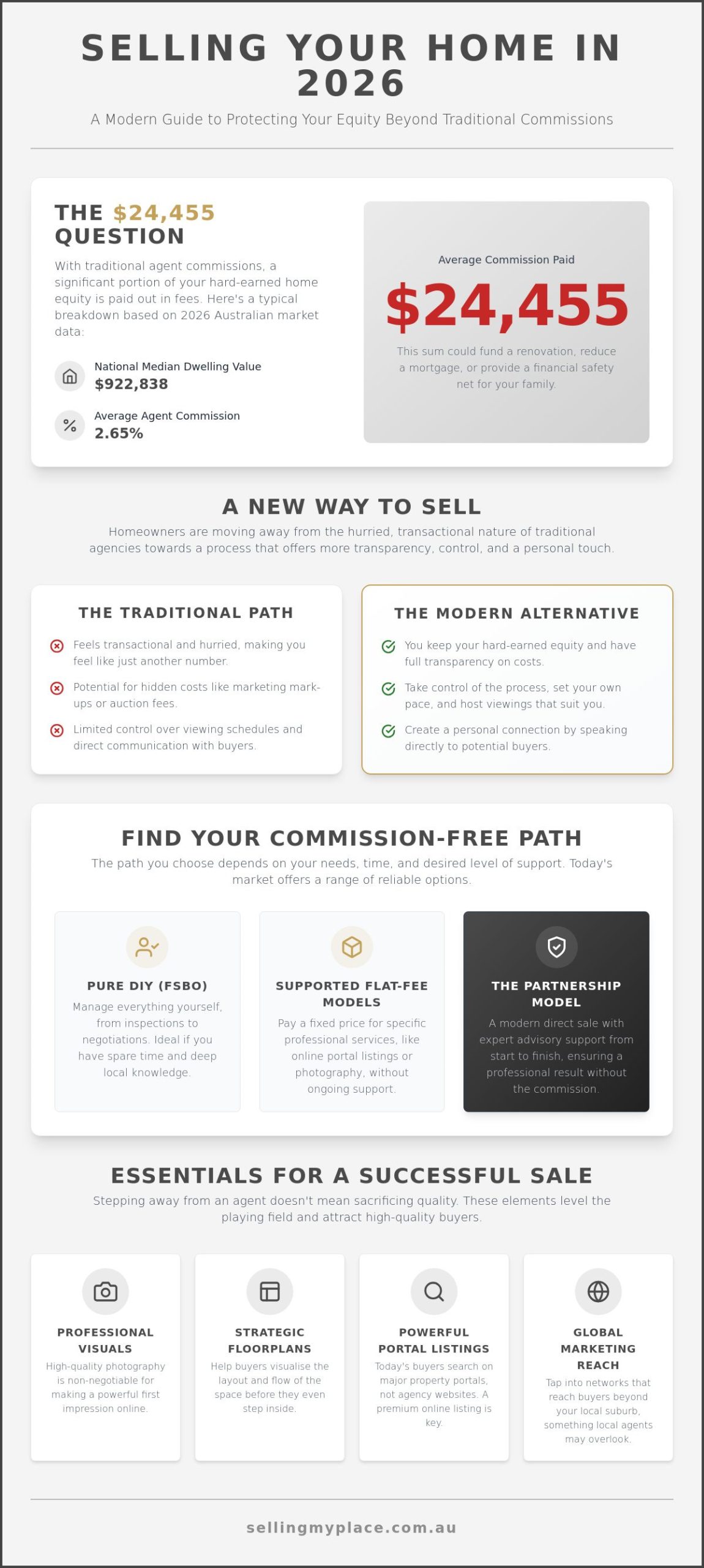
Essential Elements for Success When Skipping the Traditional Agent
Success in the 2026 property market isn’t about luck; it’s about meticulous preparation and a commitment to quality. When you choose to explore alternatives to using a real estate agent, you’re stepping into the role of the curator of your home’s story. This is a deeply rewarding process, but it requires a focus on the details that big agencies often rush. You aren’t just selling bricks and mortar; you’re offering a future lifestyle to another family. To do that effectively, your presentation must be beyond reproach.
While some might suggest that a few quick snaps on a smartphone are sufficient, we know that first impressions are non-negotiable. Buyers today are tech-savvy and expect a high-end digital experience. If your listing doesn’t stop their scroll, you’ve lost them before they’ve even seen your front door. A professional approach ensures your home is presented with the respect and polish it deserves, reflecting the legacy you’ve built within its walls.
Visual Storytelling: Photography and Floorplans
Professional photography is the bedrock of your marketing campaign. It’s about capturing that “hero shot” that highlights the soul of the home, whether it’s the way the light hits the breakfast nook or the expansive feel of the living area. We call this the “Red Dot” standard of presentation. Alongside beautiful imagery, professional floorplans are essential. They provide a sense of stability and clarity, allowing potential buyers to mentally place their furniture and imagine their daily lives in your space. Listings with clear floorplans consistently see higher enquiry rates because they reduce uncertainty and build buyer confidence.
Data-Driven Pricing Strategies
Setting the right price is a delicate balance of logic and aspiration. It’s tempting to set a figure based on what you hope to achieve, but the market responds to evidence. By using detailed Neighborhood Market Reports, you can ground your price in reality. This data acts as a protective shield during negotiations. When a buyer questions your price, you can calmly point to recent comparable sales in your street to justify your position. This transparency builds trust and helps you stand firm without the need for aggressive sales tactics. Avoid the trap of over-pricing, which can lead to a stagnant listing; instead, aim for a figure that is both ambitious and defensible.
Managing your own open homes is a wonderful opportunity to lead with warmth and local knowledge. You’re the best person to explain why the local schools are fantastic or where to find the best coffee on a Saturday morning. This neighborly accessibility creates a welcoming atmosphere that purely transactional agents simply cannot replicate. If you’re ready to ensure your home is presented at its absolute best, reach out for a Pre-Sale Property Consulting session and let’s start this journey together with a steady hand.
The Modern Direct Sale: Why a Partnership Model Wins in 2026
Most discussions about alternatives to using a real estate agent frame the choice as a binary one. You’re either handing over a massive commission to a traditional agency or you’re out on your own with a “For Sale” sign and a prayer. But as we’ve seen throughout 2026, the most successful sellers are choosing a middle path. It’s a partnership model that combines the significant cost-savings of a private sale with the high-end marketing and strategic support of a professional advisor. This isn’t about doing it all yourself; it’s about being the boss of your own sale while having a seasoned expert in your corner.
Kincade International Direct Sales (KIDS) was founded on this very principle. We believe that your home equity represents years of hard work, family memories, and your future stability. It belongs in your pocket. By offering a flat-fee, commission-free service, we provide the professional tools you need to succeed – from high-end photography to detailed floorplans – without the $20,000 average commission cost. We act as a “steady hand,” providing a global marketing network that reaches buyers across the country and overseas, combined with the local market expertise you need to stay competitive.
The Kincade Advantage: Professional Listing Services Simplified
Our approach removes the “fear of the unknown” that often stops people from exploring alternatives to using a real estate agent. We provide a comprehensive Professional Residential Property Listing Services: The Modern Australian Seller’s Guide to help you understand every milestone. Perhaps the most reassuring part of our partnership is the “Listed Until Sold” promise. Unlike traditional agencies that might pressure you to drop your price as a 90-day contract nears its end, we stay with you. There are no time limits and no hidden pressure; we’re here until the right buyer walks through your door and the keys are handed over.
Your Next Move Starts Here
Selling your home is a major life transition, but it doesn’t have to be a stressful one. You have the heart, the local knowledge, and the passion to represent your property better than anyone else. All you need is the right support structure to make it official. Whether you’re just starting to wonder what your home is worth or you’re ready to list next week, we’re here to help you move forward with confidence. Your equity is your legacy; let’s make sure it stays with your family where it can do the most good.
Ready to see how the market views your suburb? Request your free Neighborhood Market Report or book a Pre-Sale Property Consulting session today. Let’s turn that “thinking about it” into a successful settlement, together.
Protect Your Future and Your Equity
Choosing to explore alternatives to using a real estate agent is a powerful way to prioritise your family’s hard-earned home equity. Throughout this guide, we’ve seen that a successful sale isn’t about paying a high commission; it’s about professional presentation and a transparent, personal connection with buyers. You have the local knowledge and the heart to tell your home’s story, and with the right partnership, you can achieve results that rival any traditional agency.
Our model is designed to give you that “steady hand” support without the transactional feel of a big franchise. With an average owner saving of $20,000, you can move toward your next milestone with more stability and peace of mind. We provide the essential elements for success, including professional photography and floorplans as standard, alongside a dedicated Agent Advisory Service to guide you through every complex step of the process.
Discover how to save $20,000 on your sale with Kincade International and start your next chapter with confidence. We’re here to help you every step of the way.
Frequently Asked Questions
Is it legal to sell my own home in Australia without an agent?
It is perfectly legal to sell your own property without a licensed real estate agent in every state and territory of Australia. While the process may feel unfamiliar at first, you have the right to represent your own home and manage the sale yourself. Most owners find that with the right advisory support and a steady hand, the process is quite straightforward and deeply rewarding.
Will my property appear on Australia’s major property portals if I don’t use an agent?
Yes, your property can certainly appear on the leading property websites, but you cannot list directly as a private individual. You’ll need to use a licensed intermediary platform or a professional advisory service to facilitate the listing. This ensures your home reaches the same massive audience of buyers as any traditional agency listing while you maintain complete control of the sale process.
How do I handle the contract of sale and legal paperwork?
You’ll need to engage a qualified solicitor or conveyancer to handle the legal aspects of your sale, including drafting the contract of sale. It’s a common misconception that agents do this work; in reality, legal professionals manage the paperwork regardless of the selling method. Having a partnership-based advisory service can help you coordinate with your legal team for a smooth and stress-free settlement.
Do buyers feel comfortable dealing directly with the owner?
Many buyers actually prefer dealing directly with the owner because it offers a level of transparency and local knowledge that agents often lack. You can answer specific questions about the neighbourhood and the home’s history with genuine warmth and honesty. As long as you maintain professional decorum and provide clear information, buyers usually feel very comfortable and even refreshed by the direct connection.
What is the most cost-effective alternative to a traditional agent?
The most cost-effective alternatives to using a real estate agent typically involve flat-fee marketing or “Sale by Owner” models. These options allow you to pay a set fee for essential services like photography and portal listings rather than a percentage of your final sale price. For the average Australian home, this can result in keeping an extra $20,000 of your equity in your own pocket.
Can I still have an auction if I choose a commission-free model?
Absolutely, you can still opt for an auction by hiring an independent professional auctioneer to conduct the proceedings on the day. Many sellers find this a highly effective way to create competition and transparency among buyers. You simply pay a flat fee for the auctioneer’s time, allowing you to benefit from the auction environment without the burden of a traditional agency commission or high marketing costs.
How do I determine the right asking price without an agent’s appraisal?
You can set a confident price by using data-driven Neighborhood Market Reports that show recent comparable sales in your specific street and suburb. For extra peace of mind, you might also consider a professional independent valuation, which usually costs between $200 and $600. This evidence-based approach ensures your asking price is realistic, defensible, and grounded in the actual local landscape rather than a sales pitch.
What happens if my property doesn’t sell within the first month?
If you’re using a partnership model, you have the benefit of being “listed until sold” with no restrictive time limits. Unlike traditional 90-day agency contracts that can create immense pressure to drop your price, this approach allows you to wait for the right buyer. You can take the time to adjust your strategy or presentation based on feedback without the stress of a looming expiry date or hidden fees.
Agency Flat Fee vs Commission: The Australian Seller’s Guide for 2026
Why should your real estate agent’s pay cheque increase simply because your home’s value has grown? It’s a question many homeowners are asking as they look at the equity they’ve spent years building. When you’re selling a property in the Australian market, where property values are often substantial, a standard 2.1% commission can feel less like a fair fee and more like a significant slice of your hard-earned wealth. Choosing a flat fee real estate agent sydney families can trust is no longer about cutting corners; it’s about finding a smarter, more transparent way to protect your legacy while moving toward your next chapter.
We know that selling your home is about much more than a transaction; it’s an emotional transition that deserves a steady hand and a partnership built on trust. You might feel a bit of a sting at the thought of high commission rates, or perhaps you’re anxious that a lower fee could mean sacrificing professional quality. This guide, brought to you by Kincade International Direct Sales, will show you how to retain 100% of your sale profit while still accessing elite global marketing and expert advisory support. We’ll explore the 2026 transparency regulations and demonstrate how a fixed-fee model can save you an average of A$20,000, ensuring your equity stays exactly where it belongs.
Key Takeaways
- Learn how to keep 100% of your property sale profit by moving away from traditional percentage-based commissions. This simple shift helps you retain an average of A$20,000 in equity.
- Discover why partnering with a flat fee real estate agent sydney homeowners trust doesn’t mean sacrificing quality. You’ll still receive professional photography and access to a global marketing network.
- Understand the 2026 regulatory landscape and how a fixed fee provides the total transparency you deserve. You’ll know exactly what you’re paying for marketing and advisory services from day one.
- Explore how a dedicated Agent Advisory Service supports you through the entire process, from listing to settlement. This professional guidance ensures you feel protected during one of life’s biggest transitions.
- See how properties stay active until sold with no restrictive time limits. This model prioritises your long-term goals and family needs over a quick, transactional result.
The Shift Toward the Agency Flat Fee in Australian Real Estate
For decades, the traditional commission model was the only path for Australian sellers. But as we move through 2026, the landscape is changing. Homeowners are looking at their equity and asking why a percentage of their life’s work should be handed over for a standard service. This is why the search for a flat fee real estate agent sydney families can rely on has surged. It isn’t just about saving money; it’s about a fairer, more transparent exchange of value. People want to know they are paying for professional expertise, not just giving away a slice of their future.
There is a vital distinction to make between budget listing services and a professional flat fee agency. A budget service often leaves you to manage the complexities alone, which can be overwhelming during a major life transition. In contrast, a professional flat fee model provides a partnership. It offers the same high-end marketing and advisory support you expect from a traditional firm but decouples the cost from your home’s final sale price. Understanding what a real estate agent does helps clarify that the core tasks, such as professional photography and expert negotiation, don’t actually cost more just because your property is worth more.
The True Cost of a 2.5% Commission
When you look at the actual dollar amounts, the impact of the old commission model is staggering. With Sydney’s median house price now sitting around A$1.6 million, a 2.5% commission takes A$40,000 directly out of your pocket. That is a massive amount of money. It’s often the difference between being able to afford a dream home in a better suburb or having to settle for less. Many agents argue that a percentage-based fee provides an incentive to get a higher price, yet most sellers now see this as a myth. The real driver of a high sale price is professional marketing and a broad reach, both of which can be achieved without sacrificing your hard-earned equity.
Why “For Sale By Owner” is Evolving
The old “DIY” method of selling a home used to feel risky and unpolished. Today, that model has matured into a sophisticated Direct Sales approach. Thanks to modern digital infrastructure, you can now access the same global marketing networks that the big franchises use. This evolution means you can reach buyers across the country or even overseas with ease. You get the professional backing of high-end photography and floorplans, combined with an advisory service that acts as your steady hand during the process. It’s a grounded, reassuring way to sell that prioritises your family’s needs and your long-term stability.
What is an Agency Flat Fee and How Does It Work?
An agency flat fee is a straightforward, single payment that covers the professional marketing and sales support required to sell your home. Unlike a commission, which fluctuates based on your final sale price, this model is fixed and transparent. It represents a “Pay-for-Service” philosophy. You are paying for the actual work performed, such as professional photography and expert advisory, rather than giving away a percentage of your property’s wealth. This approach aligns perfectly with NSW Fair Trading regulations on agent agreements, ensuring you have total clarity from the moment your home goes live.
When you choose to work with a flat fee real estate agent sydney families often find that the entire process feels more collaborative. You aren’t waiting for a middleman to relay feedback from every single viewing. Because you know your home’s history and the local community better than anyone, leading your own viewings can create a more authentic connection with potential buyers. This directness often leads to faster sales. Buyers appreciate the honest, “straight from the source” information that only a homeowner can provide.
Professional Marketing Components
To stand out in the competitive 2026 market, your home needs to look spectacular. A professional flat fee model includes high-end photography and floorplans that capture the heart and flow of your property. Your listing isn’t just tucked away on a local site; it’s broadcast across global networks to reach interstate and international buyers. We also provide detailed neighbourhood market reports. These reports use real-time data to help you set a price that is both competitive and reflective of your home’s true value.
The Role of the Agent Advisory Service
Selling a home involves complex paperwork and high-stakes decisions. You don’t have to face this alone. An Agent Advisory Service acts as your professional guide, offering pre-sale consulting to ensure your home is presented in its best possible light. It’s the perfect blend of modern digital reach and expert human insight. If you’re curious about how this partnership could work for your specific suburb, you might like to reach out for a friendly chat about your goals.
Flat Fee vs. Commission: A Direct Comparison
Deciding between a traditional commission and a modern flat fee is about more than just numbers on a spreadsheet; it’s about understanding the true value of your home’s equity. In a fluctuating market, the traditional percentage model can feel like a moving target. If your property value increases, so does the agent’s pay cheque, despite the workload remaining largely the same. By choosing a flat fee real estate agent sydney sellers can lock in their costs early. This provides a level of financial certainty that is especially grounding during the high-stakes period of a property sale. When you know your costs are fixed, you can plan your next move with a calm confidence that isn’t possible under a commission-based structure.
It is vital to look at the net profit rather than just the sale price. For example, on a A$1.5 million sale, a 2.1% commission takes A$31,500 from your pocket. In contrast, a flat fee model allows you to retain a much larger portion of that wealth. From a tax perspective, while selling costs are often factored into Capital Gains Tax calculations for investment properties, for your family home, every dollar saved is pure cash in hand for your next deposit. The Real Estate Institute of Australia maintains high professional standards across the industry, but they don’t regulate fee structures, leaving you free to choose the model that best protects your legacy.
The “Incentive” Debate
Traditional agencies often claim that a percentage-based commission incentivises agents to work harder for a higher price. However, does a small fractional increase in an agent’s commission truly outweigh the owner’s natural passion? You are the best person to sell the lifestyle and heart of your home because you’ve lived it. A flat fee model empowers you to lead viewings while professional advisory services handle the heavy lifting of negotiation. This partnership ensures you have the skills of a seasoned expert behind you without the disproportionate cost of a commission.
Hidden Costs to Watch Out For
One of the biggest surprises for sellers is the “No Sale, No Fee” myth. In many traditional agreements, you still have to pay for Vendor Paid Advertising (VPA) even if the property doesn’t sell. These costs in Sydney can range from A$4,500 to A$10,000. When you add up the extras, the bill grows quickly:
- Auctioneer Fees: Often an additional A$500 to A$1,000 per event.
- Premium Portal Listings: Extra charges to stay at the top of search results.
- Administration Fees: Small “sundry” costs that bloat the final settlement statement.
An all-inclusive flat fee package removes these layers of complexity. It offers a transparent, single payment that covers your marketing and support, making the settlement process simple and stress-free.
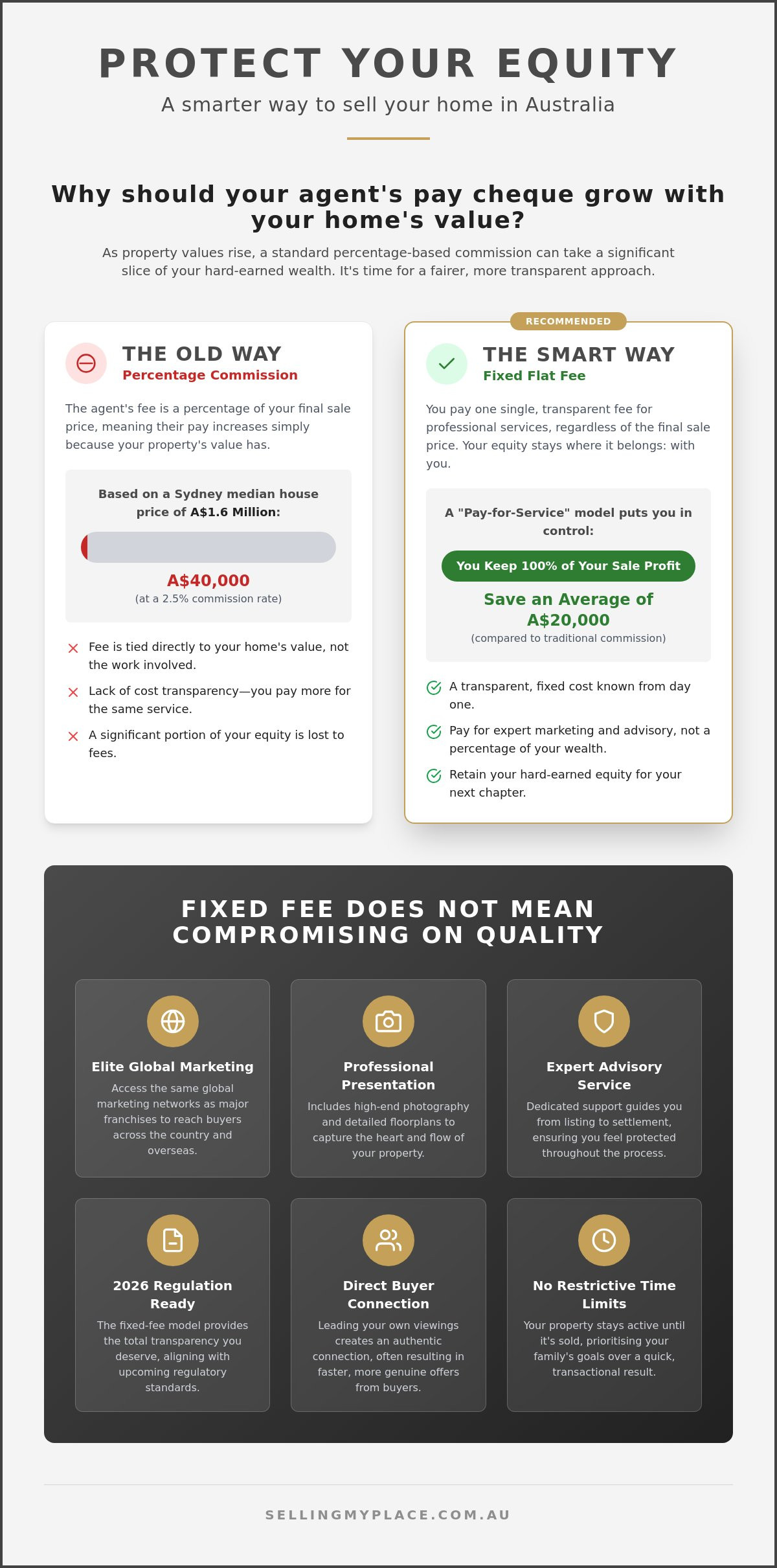
What to Look for in a Flat Fee Property Listing Service
Finding the right flat fee real estate agent sydney homeowners can trust involves looking far beyond a simple listing price. You’re searching for a partner who understands that your home is your most significant asset and a sanctuary of family memories. A truly professional service doesn’t just upload your property to a portal and leave you to it. It provides a comprehensive suite of tools designed to attract serious interest and protect your interests during the delicate journey toward settlement. It’s about combining the cost-effectiveness of a fixed fee with the sophisticated support of a seasoned expert.
When you evaluate potential partners, check for the absence of listing expiry dates or “pressure windows.” Traditional contracts often bind you to a 90-day limit, which can create a sense of desperation as the deadline looms. A partnership-based model keeps your property listed until it’s sold. This approach gives you the breathing room to wait for an offer that truly respects your home’s worth. It’s a grounded, reassuring way to sell that puts your needs ahead of an agency’s quarterly targets.
Evaluating the Marketing Package
Your online presentation is your digital kerb appeal. In the competitive 2026 market, professional photography is non-negotiable. It’s the first thing a buyer sees on their smartphone, and it must evoke an emotional connection immediately. Similarly, accurate floorplans are essential for qualifying buyers before they even step through your front door. They allow people to mentally place their furniture and imagine their daily lives in your space. Ensure your listing will appear on all major Australian property portals and reaches beyond our borders through a global marketing network to capture interstate and international interest.
The Advisory Advantage
The best services provide more than just digital space; they offer a “steady hand” through expert advisory. This includes receiving property sale negotiation tips from professionals who understand the nuances of the Australian market. You also need access to detailed reports that help you determine the market value of a home in Australia using real-time, local data. This expert backing ensures you aren’t navigating the complexities of conveyance or pre-sale consulting alone. If you’re ready to see how professional advisory can change your selling experience, you can contact our team for a personal consultation to discuss your property’s potential.
Maximising Your Sale Profit with the KIDS Direct Sales Model
The Kincade International Direct Sales (KIDS) model is designed for the savvy Australian seller who values both their hard-earned equity and professional support. When you choose a flat fee real estate agent sydney homeowners trust, you’re making a choice to protect your family’s financial legacy. Our 0% commission promise is the cornerstone of this approach. It ensures that every cent of the final sale price remains in your pocket. On average, our clients save A$20,000 per sale. That’s not just a statistic; it’s a significant amount of capital that can be reinvested into your next home or your children’s future.
We understand that the traditional “For Sale” sign represents more than a transaction. It’s a major life transition. That’s why we’ve built a digital infrastructure that rivals the largest global franchises, ensuring your home is seen by buyers across Australia and overseas. Unlike local boutique agencies that may have a limited reach, our network casts a wide net, while our Agent Advisory Service provides the grounded, personal guidance you need to navigate the process with calm confidence. It’s about having the best tools in the industry without the disproportionate price tag.
A Partnership, Not Just a Listing
Our advisors act as your professional back-office team, removing the stress of complex processes so you can focus on your move. This model is truly the logical conclusion of the Sale by owner evolution. It bridges the gap between doing everything yourself and paying an expensive commission. You’ll have a steady hand to help with everything from pre-sale property consulting to conveyance advice, ensuring you never feel alone in the journey. By decoupling the marketing cost from the sale price, we create a transparent partnership where our goals are perfectly aligned with yours.
Your Next Chapter Starts Here
Imagine the difference that saving A$20,000 on commission makes to your future buying power. It could be the extra room in your next house, a higher-quality renovation, or simply the peace of mind that comes with a larger financial buffer. You’re joining a community of empowered Australian homeowners who are moving away from outdated fee structures. The path to a successful sale is methodical and inviting. It starts with a detailed neighbourhood market report that gives you a clear picture of your property’s value. From there, we provide the professional photography and global visibility needed to reach the right buyer. Your next chapter is waiting, and we’re here to help you start it on the best possible financial footing.
Secure Your Financial Legacy and Your Next Move
Selling your home is a milestone that should leave you feeling empowered, not overcharged. We’ve explored how the traditional commission model often takes a disproportionate slice of your equity as property values rise. By choosing a flat fee real estate agent sydney families can trust, you ensure your hard-earned wealth stays exactly where it belongs. You’ve seen that a 0% commission approach doesn’t mean sacrificing quality; it means gaining a professional partner who provides high-end photography and global marketing without a “success tax” on your home’s value.
With an average saving of A$20,000 per sale, our model ensures you retain 100% of your profit to put toward your family’s future. Ready to take control of your sale? Discover how much you can save with a commission-free sale and keep every cent of your equity. Your next chapter deserves the best possible start. We’re here to provide the steady hand and professional guidance you need to make it happen with confidence.
Frequently Asked Questions
Is an agency flat fee better than a percentage commission?
Choosing an agency flat fee is often better for homeowners who wish to maintain control over their sale profits. Instead of paying a percentage that grows as your home’s value increases, you pay a fixed amount for the actual work performed. This model provides financial certainty and ensures you aren’t penalised for the growth of the Sydney property market. It’s a fairer way to pay for professional service without sacrificing your hard-earned equity.
What exactly is included in a property marketing flat fee?
A comprehensive marketing flat fee typically includes professional photography and high-quality floorplans to showcase your home’s best features. You also receive access to a global marketing network and major Australian property portals. Beyond digital listings, this fee covers dedicated Agent Advisory Services, providing the professional support needed to manage your sale from the initial listing through to settlement. It’s a complete package designed to give you a “steady hand” throughout the journey.
Will my property get the same exposure as a traditional listing?
Your property will receive identical exposure to traditional agency listings, appearing on all major property portals that Australian buyers use daily. Because we utilise a sophisticated digital infrastructure, your home is also broadcast through a global marketing network. This ensures you reach local, interstate, and international buyers, providing the same competitive visibility as any traditional firm without the high commission costs often associated with a flat fee real estate agent sydney search.
Do I have to do the house viewings myself with a flat fee model?
You typically lead the viewings yourself, which is a significant advantage because nobody knows the heart and history of your home better than you. Buyers often appreciate the authentic, direct communication that only a homeowner can provide. Our Agent Advisory Service supports you throughout this process, ensuring you feel confident and prepared to welcome potential buyers into your space. It’s a partnership that values your personal insight as the best selling tool available.
Can I still get professional negotiation help if I pay a flat fee?
Professional negotiation support is a core component of our service through the Agent Advisory Service. While you lead the viewings, our experts act as your professional “back-office” team, providing negotiation tips and guidance to help you secure the best possible offer. This partnership ensures you have seasoned real estate expertise on your side during the most critical stages of the deal. You get the benefit of expert advice without giving away a percentage of your sale price.
What happens if my property does not sell within three months?
Your property remains listed until it’s sold, as we don’t impose the restrictive 90-day time limits common in traditional agency contracts. This lack of “listing expiry” pressure allows you to wait for the right buyer and the right price without feeling rushed. It’s a patient, supportive approach that prioritises your family’s long-term goals over a quick, transactional result for an agent. We stay with you for as long as it takes to achieve your goal.
How much can I realistically save by using a commission-free service?
Sellers save an average of A$20,000 per sale by choosing a commission-free model over traditional percentage-based fees. On a median-priced Sydney home of A$1.6 million, a typical 2.1% commission would cost you over A$33,000. By partnering with a flat fee real estate agent sydney families can retain that equity, significantly increasing their buying power for their next property or life transition. It’s a meaningful saving that can change the course of your next chapter.
Is a flat fee service legal and licensed in Australia?
Flat fee services are fully legal and operate under the same Australian licensing requirements as traditional real estate agencies. We comply with all national and state regulations, including those set by NSW Fair Trading. You receive the same professional standards and legal protections you’d expect from any licensed property professional, ensuring a safe and transparent experience for your family. Our commitment is to provide a service that’s both highly competent and deeply rooted in professional duty.
