Online Property Appraisal Tools and How Accurate Their Price Estimates Are
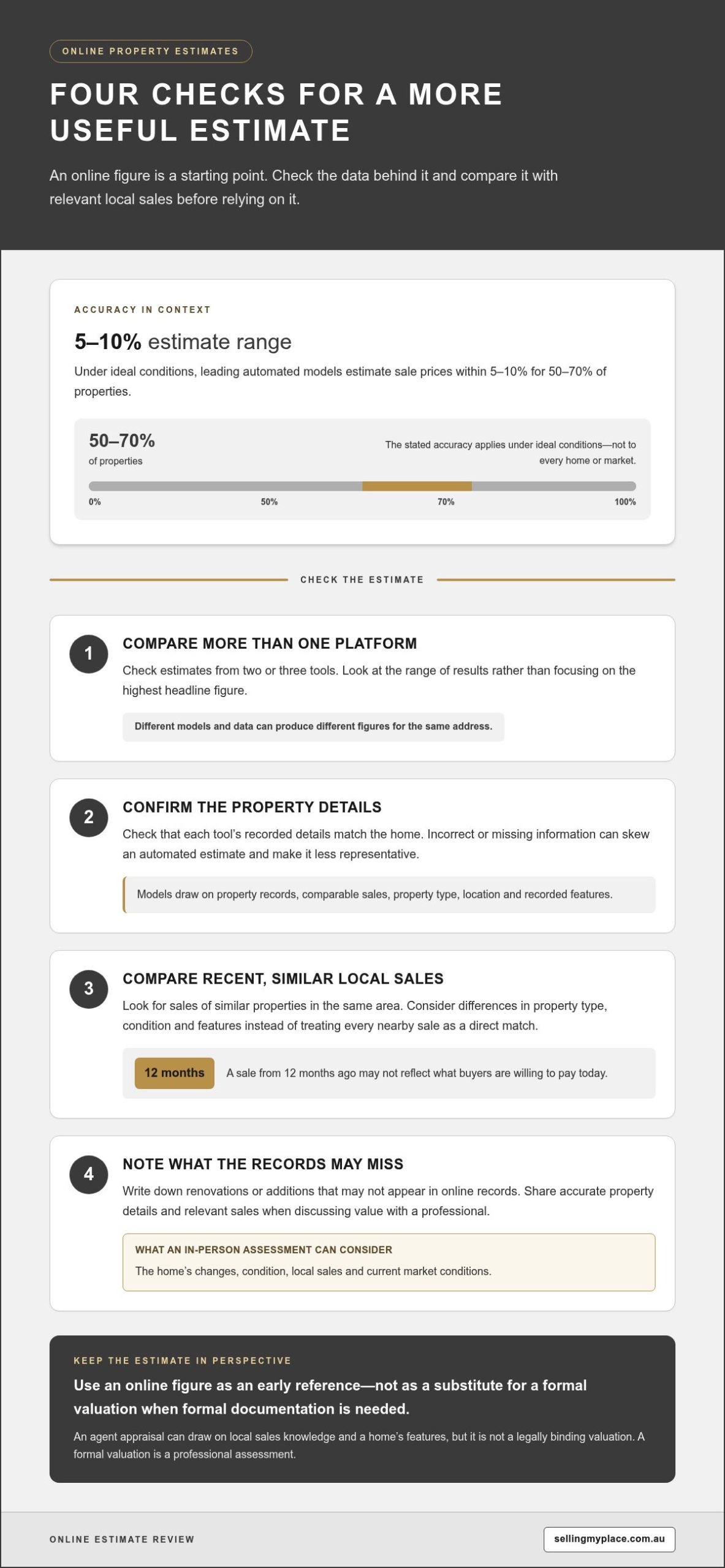
A quick online estimate is a starting point, not a definitive price. Under ideal conditions, leading automated models estimate sale prices within 5-10% for 50-70% of properties. That’s the practical limit of the accuracy of online property appraisal tools: useful for a first indication, but not a substitute for an assessment that accounts for a home’s individual features and current local conditions.
It makes sense to want a clear figure before making a major property decision. Online calculators are quick and convenient, but their accuracy depends on the property data and comparable sales available. The right option depends on how precise and formal the answer needs to be.
This guide explains how Australian online property calculators produce estimates, why their results can differ, and when those figures are useful. You’ll also learn how online estimates compare with paid valuation options, so you can choose the right next step.
Key Takeaways
- Use an online estimate as an initial guide: under ideal conditions, leading automated models estimate sale prices within 5-10% for 50-70% of properties.
- Compare estimates from more than one tool and look at the range, not just the highest figure.
- Understand what a formal valuation adds: an assessment can account for a home’s condition, renovations and features that automated data may miss.
- Compare costs with the purpose of the valuation: paid desktop reports and certified valuations serve different needs and have different price ranges.
- Allow for less reliable estimates when comparable sales are scarce or a home is an apartment, prestige property or otherwise unusual.
How accurate are online property valuations?
Online valuations offer a fast indication, but their accuracy depends on the available property data and comparable sales. Under ideal conditions, leading automated models estimate sale prices within 5-10% for 50-70% of properties.
For Australian homeowners, the key is knowing what each estimate can support. An online figure can help you start planning a sale, but it is not a substitute for a formal valuation when you need one.
Comparing Estimates and Professional Valuations
An online estimate is an automated guide, an agent appraisal draws on local sales knowledge, and a formal valuation is a professional assessment of a property’s value. Knowing the difference helps you use the right figure for the decision ahead.
Online platforms return instant estimates; agent appraisals can reflect recent local sales and a home’s particular features. However, an agent appraisal is not a legally binding valuation. A formal valuation may include an in-person assessment, considering condition, renovations, location and nearby amenities. It can take 7-14 days, rather than arriving instantly.
A seller, for example, can use an online figure as an early reference, then discuss comparable sales with an agent. If a buyer needs a formal valuation, they should engage a registered valuer. A quick estimate may not be suitable for decisions that require formal documentation.
How Automated Models Estimate Property Values
Automated valuation models use property records, recent sales and market trends to estimate value. In Australia, a model looks for comparable properties, then uses their sale prices alongside details such as property type, location and recorded features.
The result depends on the quality and relevance of those inputs. A standard home in an active market may have plenty of recent comparable sales. An estimate based on incorrect property details or older sales may be less representative. Different platforms can also use different models and data, producing different estimates for the same address.
One tool might give more weight to nearby sales, while another focuses more on broader market trends. Neither instant result captures every detail a person could assess during an inspection. Online property appraisal tools are only as useful as the data they can access and the way their models interpret it.
Checking and Improving an Estimate
Check an online estimate by comparing results from two or three platforms and reviewing the range, rather than focusing on one headline figure. Confirm that the property details shown by each tool match the home, as incorrect records can skew an estimate.
Then compare the estimate with recent sales of similar properties in the same area. Look for meaningful differences in property type, condition and features, rather than treating every nearby sale as a direct match. A sale from 12 months ago may not reflect what buyers are willing to pay today.
To prepare for professional advice, note renovations or additions that may not appear in online records. An in-person assessment can consider those changes alongside local sales and current market conditions. The online figures remain useful context, but presenting accurate property details and relevant examples gives a professional a clearer starting point for discussing value.
What is an online property value calculator?
An online property value calculator uses recorded property details and sales data to generate an automated estimate. Australian homeowners can use one for a quick indication, but formal valuations serve a different purpose and involve a more detailed assessment.
Automated Models and Professional Appraisals
An automated model calculates an estimate from property records and comparable sales, while a professional appraisal applies human assessment to the property and its local market. A quick estimate and a formal report are not interchangeable.
Australian banks use automated valuation models and recent market data, including comparable sales, property features and location trends. For refinancing, a professional bank valuation is necessary. For some Australian home loan applications, a valuer may inspect the property in person before preparing a formal valuation.
Most mortgage lending, estate settlements, divorce proceedings and court cases require valuation reports from licensed professional appraisers. These reports must meet documentation and credibility standards. A calculator can help homeowners understand an indicative figure, but it doesn’t provide that formal report. For property owners managing overseas assets or UK investments that require formal documentation, professional valuation firms such as Winfields Surveyors London offer the certified, on-site assessments needed to satisfy legal and financial requirements.
Generating Online Valuations in Australia
Online property valuation algorithms analyse recent sales, property characteristics, location and market trends to estimate value. They compare the home with properties that share relevant features, then process the available information through an automated model.
For example, a calculator may use recorded land and building details alongside recent sales in the area. If the records accurately describe the home and comparable sales reflect current conditions, the model has more relevant inputs. Missing or incorrect details can make its estimate less representative of the property as it stands.
Some platforms combine automated valuation models with comparative market analysis and, at times, input from real estate professionals. The mix varies between tools, so homeowners may see different results for the same address. An online figure remains an estimate, not a formal property valuation.
Free Online Valuation Tools
Free online tools are typically calculators on property portals that return an instant automated estimate. They offer an accessible starting point without requiring a formal report.
That convenience is useful when exploring a possible sale or tracking broad market trends. A calculator may show a range or a single figure, based on the property information and sales data available to its model. Treat the result as a guide, not as a documented valuation for lending or legal matters.
For a practical comparison, enter the same address and property details into more than one platform. Review the estimates together and note differences in the data shown. A spread between results can signal that the tools rely on different records or methods.
How Often Valuations Are Updated
Australian online valuations are refreshed as platforms add property records and sales data, but update timing varies between tools. There is no single schedule shared by every calculator.
Check when an estimate was generated and consider whether its comparable sales reflect current market conditions. A sale from 12 months ago may not represent what buyers would pay today, particularly if local trends have shifted.
Before a sale decision, use the online figure as context alongside recent comparable sales and property details. For guidance on how estimates fit into a selling decision, discuss your property sale plans.
Limitations of automated valuation algorithms
An instant estimate reflects the records and comparable sales available to a model, not a physical inspection. Missing property details, market movement and distinctive features can all affect the result.
Accuracy Limits of Automated Algorithms
Automated algorithms find patterns in recorded sales and property information, but they cannot assess every factor that influences buyers. Incorrect details in property databases can skew an automated valuation or comparative market analysis. A home’s condition, visual appeal and recent maintenance may also be difficult to capture in records.
Renovations are a clear example. An algorithm may not know about a $100,000 kitchen renovation if the improvement isn’t recorded, so its estimate may not reflect the home as it stands. Models also don’t physically inspect properties or capture buyers’ emotions and impulses, which can influence what they’re willing to pay.
Market timing presents another limitation. A sale from 12 months ago may not reflect what buyers would pay today, and an online estimate may not immediately respond to market shifts or location-specific changes. Treat the output as a data-based guide, not a complete answer to the question of what a particular buyer might offer.
Comparative market analysis has its own blind spots. A comparison may miss differences in site size, garage size, outbuildings, accessory dwelling units or property condition. For example, two homes with similar recorded floor areas may have different outdoor spaces or upkeep needs, which can affect their estimated values.
Estimates for Regional and Unusual Properties
Estimates are generally more useful for standard homes in active markets, where abundant comparable sales give a model relevant examples. In a regional area with fewer recent sales, an algorithm may have less closely matched evidence, making its comparison less specific to that home and location.
Apartments can also differ in ways that headline records do not capture. Condition, layout and features may affect value, while a sale from another apartment nearby may not be a close match. The model can only weigh distinctions represented in its data.
Prestige and unique homes are harder to value online because distinctive attributes may have no close comparable. Unusual design, extensive grounds or special additions may not fit patterns drawn from standard property sales. A human assessment can consider characteristics an algorithm may not recognise.
Use the estimate as a prompt for closer comparison: review the recorded property details, then consider whether the sales used resemble the home in condition, features and setting. This helps show where the model’s evidence is strong and where it may leave important differences out.
Costs of professional appraisals and online tools
Online calculators provide instant property estimates, while paid valuation services offer different levels of detail. In Australia, the cost depends on the assessment type and its purpose. Weigh the fee against what the valuation needs to establish, such as a sale guide or formal report.
It uses available property information and sales evidence without an in-person inspection, making it a lower-cost option than a detailed report. The trade-off is scope: a desktop assessment may not capture physical features or condition that become clear during an inspection.
These can provide more analysis than a basic desktop assessment, but paid desktop valuations are not legally binding. This matters if you need a valuation for a formal lending or legal purpose, rather than a more informed estimate of value.
These ranges describe different categories of professional work, so they should not be treated as interchangeable quotes. A formal assessment may involve an inspection and a more detailed report than a desktop estimate.
Timing also forms part of the comparison. Automated property appraisal systems return instant results, while professional appraisals typically take 7-14 days. For an owner weighing a sale, an instant figure can help with early planning; a professional report takes longer but can consider property details beyond a calculator’s records.
For example, a homeowner could begin with online estimates to understand the broad range, then decide whether a paid desktop report or formal valuation fits the next step. If refinancing, an estate settlement, divorce proceedings or a court case is involved, the required documentation can make a professional report more suitable than an instant calculator result.
A real estate agent can also use recent local sales and past sale prices to estimate a property’s value. That appraisal offers market context for selling, but it is not a legally binding valuation. Its usefulness depends on the current market, comparable properties and the home’s features. For sellers managing residential assets overseas, such as in the UK, regional specialists like Taylors Estate Agency show how local expertise captures nuances that automated systems often miss.
Compare each option by asking what evidence it includes, whether it involves an inspection, and what the report is intended to support.
In short, online estimates suit quick orientation, while paid reports provide more analysis. Match the cost and turnaround time to the decision: an initial selling plan may need market context, while formal lending or legal matters can require a professional valuation report.
How accurate are online property estimates in regional areas and for apartments or unusual homes?
Online estimates are most useful when a property has close comparables and the market has regular sales. Homes with fewer direct matches, including apartments and distinctive properties, may have less relevant evidence behind their estimates. Judge the figure against the type of property and sales data the model uses.
When nearby sales are scarce, a calculator may draw on sales from a wider area. But properties in different localities can vary in access to services, infrastructure and buyer demand. A sale elsewhere may offer context without reflecting the appeal or setting of the specific property.
Consider two houses with similar recorded floor areas. One might be near local amenities, while the other has a larger site or different condition. An automated model can only account for details in its records, so a broad comparison may be less meaningful. Recent sales of similar property types in the same locality are a more relevant reference.
Apartments bring another comparison challenge. A nearby sale may be in the same building but differ in layout, condition or outlook. Comparative market analysis can also miss differences in site size, garage size, outbuildings, accessory dwelling units and property condition. Compare like with like, including the features and condition recorded for each sale.
Unusual and prestige homes are harder to value with automated tools because standard sales may not capture their distinctive attributes. Extensive grounds, unusual design or a unique layout can set a property apart from the model’s usual comparisons. A professional inspection can add context, particularly where renovations or additions have changed the home beyond what property records show.
Some improvements need careful interpretation. Solar panels can positively affect property value, but the effect varies with system size, age and location. A calculator without those details cannot distinguish between installations. Likewise, an unrecorded extension may make a property appear more comparable to smaller homes than it really is.
For a regional, apartment or unusual property, treat the online figure as one reference point. Compare it with recent sales that share the property’s type, location and meaningful features. Then note which differences could explain a gap between the estimate and those sales. That gives a real estate professional more useful context for an appraisal.
If you’re preparing to sell a distinctive or regional home, get guidance on your property sale using local sales and property-specific details.
Kincade International Direct Sales: Residential Property Listing Services
Kincade International Direct Sales can help you turn an online estimate into a considered selling plan. Its Residential Property Listing Services support Australian homeowners preparing to bring a property to market, while Neighborhood Market Reports add sales context to an automated figure.
For owners weighing renovations, timing or how to present a home, Pre-Sale Property Consulting can help shape decisions before listing. Buyer Representation is available for people assessing a purchase and comparing an asking price with relevant property information.
An online calculator is a starting point, not a selling strategy. Pairing its estimate with local market context can help you approach the next decision with a clearer view of your property and plans. To discuss your next steps, contact Kincade International Direct Sales or visit sellingmyplace.com.au.
Turn your estimate into a considered next step
A property estimate becomes more useful when it helps you make a decision that fits your plans. Rather than chasing a single perfect figure, consider what you need to decide next: preparing to sell, assessing a purchase or understanding which improvements matter before going to market. That context gives the accuracy of online property appraisal tools a practical role, without asking an automated figure to make the decision for you.
Kincade International Direct Sales offers Residential Property Listing Services, Buyer Representation and Pre-Sale Property Consulting to support different stages. The right next step depends on whether you’re planning a sale, weighing a purchase or preparing your home. A conversation can connect the property information you’ve gathered with the decision ahead.
Contact Kincade International Direct Sales to discuss your property plans. Take the next step with a clearer sense of what matters to you.
Frequently Asked Questions
What should I do if I need a more detailed valuation than what is provided by the online tool?
Choose the next assessment based on why you need the figure. For a sale discussion, an agent can consider local sales and the features buyers may notice. If you need formal documentation for lending, legal proceedings or an estate matter, engage a registered valuer. Before arranging an assessment, gather details of renovations, property features and comparable sales to provide useful context.
Where does the property data and insights come from?
Online calculators generally draw on property records, recent sales and market trends. Government records and property databases can supply details such as location, property type and recorded features. Some platforms combine automated calculations with comparative market analysis or input from real estate professionals. If a property record omits an extension, for example, the estimate may not reflect the home’s current layout or size.
How accurate are online property appraisal tools in Australia?
Accuracy depends on the property and the quality of its comparable sales data. Under ideal conditions, leading automated models estimate actual sale prices within 5-10% for 50-70% of properties. That result applies to a portion of properties, not every home. A standard property in an active market has more relevant comparisons than a distinctive home with few similar recent sales.
What is the average error rate of Australian online property valuations?
There isn’t one average error rate that describes every Australian calculator or property. Under ideal conditions, top-performing automated valuation models estimate sale prices within 5-10% for 50-70% of properties. This is a performance range, not a promised margin for an individual home. Compare the estimate with recent, similar sales and consider whether the tool has accurate property details before interpreting its gap from a sale price.
Which Australian property appraisal websites and tools are most accurate?
No single ranking establishes one Australian platform as the most accurate for every home. Compare two or three tools using the same address, then check whether each shows the correct property features and recent comparable sales. A wide spread between estimates signals uncertainty in the available data or methods. For a sale decision, use the results as context alongside professional advice.
How do online appraisals compare with a real estate agent’s appraisal and a professional valuation?
An online appraisal produces an automated estimate; an agent’s appraisal adds local sales knowledge, while a professional valuation provides a formal assessment. An agent’s appraisal is not legally binding. A seller exploring an asking price may find an agent’s view useful, while a lender or court matter may require a professional valuation report. Match the assessment to the decision and documentation required.
What data do Australian online property appraisal tools use?
Australian tools commonly analyse recent sales, property characteristics, location and market trends. Their records may include property type and features that help identify comparable homes. Some platforms also draw on comparative market analysis or professional input. Check the address and recorded details shown in the estimate: a missing pool, incorrect bedroom count or unrecorded addition can lead the model to compare the home with properties that aren’t close matches.
What factors can make an online property appraisal inaccurate?
Incorrect records, limited comparable sales and market changes can all distort an online estimate. A model may miss renovations, maintenance, condition or features absent from its data. A recent kitchen upgrade, for instance, may not appear in property records, while an older sale may no longer reflect current buyer demand. Unique layouts, large sites and differences between nearby homes can also weaken the comparison behind the estimate.
Average conveyancing fees in Australia and what fixed-fee quotes include
A fixed-fee quote can make conveyancing costs easier to understand, but it may not include every expense. Conveyancing is the legal and administrative work involved in transferring property ownership. The total depends on whether you’re buying or selling, the property and the searches required.
It’s understandable to want a clear figure before making a major property decision. Buyers and sellers need different work, and government charges or third-party search costs may sit outside a quoted professional fee.
This guide explains what conveyancing covers, why costs vary for buyers and sellers, and how to compare fixed-fee quotes without overlooking possible extras. It also outlines what to look for in a quote to understand the costs before settlement.
Key Takeaways
- Separate the professional fee from disbursements and government charges to understand the full conveyancing cost.
- Compare the work required for a purchase with a sale, as the searches, documents and settlement tasks can differ.
- Look beyond the “fixed fee” label: identify which services are included and which third-party costs may be additional.
- Match your quote to the transaction, including whether the property is a house, unit or more complex sale.
- If you’re preparing to sell or buy, Kincade International Direct Sales offers residential property listing services, buyer representation and pre-sale property consulting.
Why Do Buyers and Sellers Pay Different Conveyancing Fees?
Buyers and sellers need different legal work, searches and settlement documents, so their quotes can differ. Separate the professional fee from third-party disbursements to see what each quote covers.
Professional Fees and Disbursements
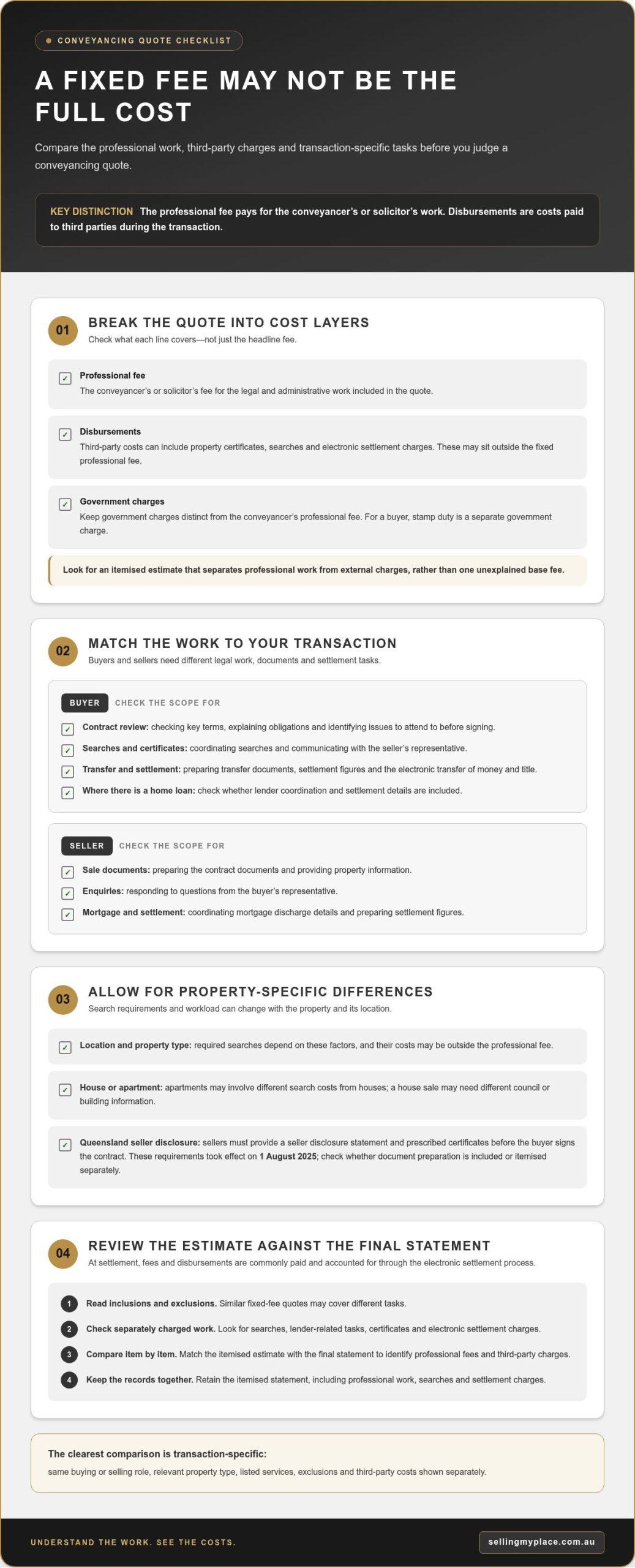
The professional fee pays for the conveyancer’s or solicitor’s work; disbursements are costs paid to third parties during the transaction. This distinction matters because a fixed professional fee may not include searches, certificates or electronic settlement charges.
The work varies depending on your role. A buyer’s conveyancer reviews the contract, coordinates title and property searches, works with the lender where relevant, and prepares for settlement. A seller’s conveyancer prepares sale documents, responds to enquiries and arranges discharge of existing mortgages.
Property type can change the workload. A house sale may require different council or building information. The quote should distinguish the conveyancer’s work from external charges, rather than presenting everything as one unexplained base fee.
Property Certificates and Search Fees
Property certificates and search fees are third-party disbursements that provide records about a property, its title or associated charges. Required searches depend on the property’s location and type, and their costs may sit outside the professional fee.
These charges help explain why apartments may involve different search costs from houses.
Are conveyancing fees tax deductible or included in the property’s cost base in Australia? Tax treatment depends on the property’s use and whether each cost is capital or relates to earning income. Keep the itemised statement, separating professional work, searches and settlement charges, so each amount can be assessed in the right context.
At settlement, conveyancing fees and disbursements are commonly paid and accounted for through the electronic settlement process. Compare the itemised estimate with the final statement to identify professional fees and third-party charges, such as certificates, searches or platform fees.
Services included in conveyancing fees
A conveyancer coordinates the legal and administrative work required to transfer property ownership. For a buyer, this can mean reviewing the contract and organising settlement; for a seller, it includes preparing sale documents and responding to enquiries.
Typical inclusions depend on the transaction and the quote’s scope. Read the service description alongside its exclusions, especially for searches, lender-related work and third-party charges. Similar fixed-fee quotes may cover different tasks, so check the listed services against whether you’re buying or selling.
What a Buyer’s Quote May Cover
For a purchase, conveyancing often starts with contract review. The conveyancer checks key terms, explains obligations and helps identify issues that need attention before signing. Once the contract is agreed, they coordinate searches and certificates, communicate with the seller’s representative and prepare transfer documents.
If a buyer has a home loan, the conveyancer also coordinates settlement details with the lender. They calculate the funds required, prepare settlement figures and arrange the electronic transfer of money and title. Stamp duty is a separate government charge, not the conveyancer’s professional fee, so the quote should distinguish legal work from the buyer’s wider purchase costs.
When reviewing a buyer’s quote, separate contract work from settlement coordination. Check whether the scope includes correspondence with the lender and preparation of transfer documents, or whether those tasks are charged separately. Property type can also affect which searches or certificates are needed.
What a Seller’s Quote May Cover
A seller’s conveyancer prepares the contract documents, provides property information and responds to questions from the buyer’s representative. They also coordinate mortgage discharge details where a loan is secured against the property, then prepare settlement figures showing adjustments and amounts payable.
In Queensland, sellers must provide a seller disclosure statement and prescribed certificates before the buyer signs the contract, under requirements effective from 1 August 2025. That work can affect what a seller’s quote includes. A Queensland seller can compare whether preparing those documents appears in the professional fee or as a separate item.
Third-Party and Settlement Charges
Some charges relate to the platform used to complete the transaction, rather than the conveyancer’s professional work. Check whether this amount is included in the quoted fee or listed separately as a disbursement, so it’s accounted for in your expected settlement costs.
Ask how the final statement separates professional work, certificates, searches and electronic settlement charges. This breakdown helps explain changes between the initial estimate and settlement, particularly if a lender, property type or required document adds work. Keep the quote and final statement together to make the transaction costs easier to review later.
If you’re preparing a property sale and need guidance alongside the legal process, conveyance advice for your sale can help you understand the roles involved.
Choosing a conveyancer or solicitor
The right professional depends on your state, transaction type and the legal work involved. Compare the service scope and total conveyancing costs, not just the headline charge.
Choosing a Conveyancer
A conveyancer focuses on the legal and administrative tasks involved in property transfers. Their experience with your state’s contracts, searches and settlement process matters because requirements and costs vary across Australia.
These figures are professional fees, not necessarily the total cost, which may also include searches, certificates and other disbursements.
Queensland has no separate licence for non-lawyer conveyancers, so conveyancing is handled by solicitors and law practices. Consider the professional’s legal practice and relevant property experience. In NSW, conveyancers must disclose costs upfront and transparently, helping you understand the stated scope and charges.
Compare quotes by checking the transaction covered, the work included and any exclusions. A straightforward house transfer may require different searches and documents from an apartment purchase. Where relevant, check whether the quote accounts for lender coordination, contract review, certificates and electronic settlement.
Online conveyancers in Australia typically charge professional fees 10-20% less than traditional practices. A lower fee alone doesn’t explain which services are included, so compare the scope alongside the price. The useful comparison is the work being done for your particular property and transaction.
Choosing a Solicitor
A solicitor can handle conveyancing as part of a broader legal practice. This may suit a transaction with additional legal issues, such as a complex contract or company involvement, where advice beyond routine transfer work is relevant.
Professional fees differ by state and practice.
These ranges help put quotes in context, but the transaction’s requirements influence the fee. A property with multiple titles, unusual contract terms or additional parties may need more review and coordination. Council and title searches also affect disbursements, which should be distinguished from the solicitor’s professional charge.
Read the quote for its named services, exclusions and likely third-party costs. Check whether it covers contract advice, lender communications, document preparation and settlement coordination. An itemised quote makes it easier to compare professional work with external charges, rather than judging conveyancing costs by one figure.
Choose a professional whose experience and quoted scope suit your transaction. A routine sale and a complex purchase require different work, so look for a clear outline of the legal tasks involved in your matter.
Comparing fixed-fee conveyancing quotes
A fixed fee sets out a defined professional charge, but the transaction’s full cost may include separate disbursements. Compare quotes for the same property type and service scope to see what each figure covers.
Factors Affecting Quotes
A conveyancing quote reflects the transaction’s complexity, required documents, property type and included work. A seller’s matter differs from a purchase, while an apartment may need strata information that a standard house does not. Multiple titles or lender coordination can add tasks, which is why similar-looking quotes may cover different work.
State-based charges affect the overall amount, even when the professional fee is fixed. In Victoria, transfer registration costs A$104.30 plus A$2.34 for every A$1,000 of the purchase price, capped at A$3,614. These government charges are separate from professional fees, so check whether a quote includes them or lists them separately.
Transaction timing and structure matter, too. Off-the-plan conveyancing can take months or years, depending on when construction is completed.
Comparing Quotes and Saving on Fees
Compare like with like: use the same transaction type, property details and requested services for each quote. Then separate the professional fee from searches, certificates, electronic settlement charges and government costs. This gives you a clearer estimate than comparing headline totals alone.
Check each inclusions list against the work your transaction needs. For a purchase, look for contract review, title searches, settlement coordination and lender communication where relevant. For a sale, check whether document preparation and mortgage discharge coordination are covered. A missing item can make a low initial fee difficult to compare.
Use an itemised quote to identify optional tasks and third-party charges. A search is not the same as professional work, and transfer registration is not the conveyancer’s fee. Comparing these categories separately helps you see where quotes differ and avoid paying for services your transaction doesn’t require.
Low-Cost Conveyancing Quotes
A low-cost quote may offer a narrower service scope or use an online process. Online conveyancers in Australia typically charge professional fees 10-20% less than traditional practices. That difference makes the listed services and exclusions especially important to compare, rather than assuming each quote covers the same work.
Check whether the quoted amount covers your actual transaction, including searches, titles and settlement tasks. If a seller’s quote excludes a required document, or a buyer’s leaves out lender coordination, the final total may differ from the initial fee. A clear breakdown shows what is included and charged separately.
Choose the quote that matches the work required, not simply the lowest amount. A standard purchase and an off-the-plan purchase involve different timeframes and coordination. Comparing quotes for the same transaction lets you assess professional fees and disbursements fairly.
Fixed conveyancing fees for buying and selling
Fixed-fee quotes can make the professional charge predictable, but buyers and sellers need different work. The quoted fee is only one part of the transaction’s total cost.
The total can include searches and statutory disbursements, while transfer registration, stamp duty and other government charges may sit outside the conveyancer’s fee. Check the quote’s inclusions before treating its fixed professional fee as the full amount required for settlement.
Why Buyer and Seller Quotes Differ
Buyers need contract review, title searches, transfer documents and coordination with their lender where a loan applies. A unit purchase may also require strata information. These tasks shape the quote, along with the property’s location and the number of titles involved.
Sellers have different responsibilities. Their conveyancer prepares sale documents, responds to buyer enquiries and coordinates discharge of an existing mortgage.
The difference between buying and selling estimates reflects different work and disbursements, not simply a different label on the quote. Sellers should check which documents and settlement tasks are included; buyers should look for searches and lender coordination where relevant.
What a Fixed Fee Covers
“Fixed fee” usually describes the professional charge for the work listed in the quote, rather than every cost associated with buying or selling. Search fees, certificates, registration charges and electronic settlement costs may be listed separately. For a fair comparison, match quotes for the same transaction type and property details.
Government charges can materially affect a buyer’s final budget. In Victoria, transfer registration costs A$104.30 plus A$2.34 for every A$1,000 of the purchase price, capped at A$3,614. Queensland transfer registration costs A$248.04 plus A$46.56 for every A$10,000 above A$180,000. These charges are distinct from professional fees.
For sellers, the fixed-fee scope may depend on the sale documents and settlement work required.
Before comparing totals, separate professional fees, disbursements and government charges in each quote. If you’re preparing to sell, get guidance on preparing your property sale alongside your conveyancing arrangements.
Kincade International Direct Sales: Residential Property Listing Services
Kincade International Direct Sales can help if you’re preparing to sell and want property marketing support alongside your conveyancing arrangements. Its Residential Property Listing Services use a flat-fee model and include professional photography. The packages also offer features such as floorplans and neighbourhood market reports to help owners present their home to buyers.
The service provides residential listings through a global marketing network, with no time limits and a 0% commission structure. Pre-Sale Property Consulting can help you plan the sale, while Buyer Representation supports people looking for guidance on a purchase. These services address marketing and property decisions, while legal transfer work remains part of conveyancing.
If you’re weighing up your next property move, you’re welcome to contact Kincade International Direct Sales or visit sellingmyplace.com.au.
Make your next property move with a clear plan
Use the average conveyancing fees in Australia in 2026 as a planning reference, then shape your next steps around your own property goals. A move is more than a transaction: it can mean choosing a home that fits your life or preparing a place that holds years of memories. Clarity about responsibilities and costs gives you more room to make those decisions thoughtfully.
If you’re preparing to sell, Kincade International Direct Sales offers Residential Property Listing Services and Pre-Sale Property Consulting to support your marketing decisions. Buyer Representation can help buyers approach their search with a clearer sense of what matters to them. These services complement, but do not replace, the legal work involved in conveyancing.
Take the next step at your pace. Contact Kincade International Direct Sales to discuss your property plans and find a considered way forward.
Frequently Asked Questions
What is conveyancing?
Conveyancing is the legal process of transferring property ownership from seller to buyer. It covers tasks such as reviewing the contract, preparing transfer documents and coordinating settlement. For example, a buyer’s conveyancer helps arrange registration of the transfer, while the seller’s representative handles documents needed to complete the sale. This work connects the contract, payment and title transfer so the change in ownership can be completed.
Are conveyancing fees paid upfront?
Conveyancing fees and disbursements are commonly paid at settlement and accounted for through the electronic settlement process. They’re often included in the settlement figures rather than paid as one upfront bill. Search costs or other arrangements may have different payment timing, so read the payment terms in the engagement documents. Keep the final statement with your property records for reference.
How do I get an accurate quote?
Give the conveyancer the details that shape the work: whether you’re buying or selling, the state, property type and transaction structure. Include relevant information about a loan, multiple titles or an owners corporation, as these can affect searches and settlement tasks. Ask for an itemised estimate that separates professional work from disbursements and government charges. A quote based on the actual contract is more useful than a generic estimate.
What goes wrong if I just pick the cheapest option?
The lowest headline fee may cover a narrower scope than another quote. Search fees, lender coordination or additional title work could be charged separately, making the final bill different from the initial comparison. A missing service can also leave you unsure who handles a task before settlement. Compare itemised inclusions and exclusions, not just the professional fee, and match each quote to the same transaction details.
What government fees do you pay on top in QLD?
Queensland buyers may pay transfer duty and Titles Queensland registration charges, separate from professional fees. Transfer registration is A$248.04 plus A$46.56 for every A$10,000 of the purchase price above A$180,000. From 1 July 2026, registering a new mortgage or releasing an existing mortgage costs A$248.04 each.
What are the average conveyancing fees in Australia in 2026 for sellers?
These Australia-wide estimates depend on the sale’s documents, searches and settlement work.
How much do conveyancers and property solicitors charge in each Australian state and territory?
Indicative professional-fee ranges vary by location and practitioner. These are professional fees, not total costs.
What is included in a fixed conveyancing fee, and what costs extra?
A fixed conveyancing fee generally covers the professional tasks listed in the quote, such as contract work, document preparation and settlement coordination. Search costs, certificates, government registration charges and electronic settlement platform fees may be additional. Check the itemised scope against your transaction, including whether lender-related work or property-specific searches are included or charged separately.
What a Conveyancer Does for a Seller and What It Costs
A property sale isn’t finished when an offer is accepted. The seller’s conveyancer manages the legal work needed to transfer ownership, from preparing the contract to coordinating settlement and finalising the handover. Understanding what a conveyancer does for a seller also means knowing how their work fits across the pre-contract, pre-completion and post-completion stages.
Selling a home involves plenty to organise, and the legal details matter as much as the practical ones. A conveyancer helps manage contracts and disclosure requirements, handle buyer enquiries, coordinate with the seller’s lender and arrange settlement. Their fees and other transaction costs are also worth understanding early.
A conveyancer’s role has limits. Building inspections, for instance, are handled separately, and conveyancing requirements vary across Australian states and territories. Internationally, closing procedures also differ by region; for instance, US sellers often turn to dedicated agencies like County Properties for personalised transaction guidance. Understanding the process and its costs can help you approach a sale with more confidence and fewer surprises.
Key Takeaways
- A seller’s conveyancer manages the legal transfer, from preparing sale documents to completing post-settlement notifications.
- Disclosure and contract requirements vary between states, so getting the paperwork right can help prevent delays and disputes.
- Settlement involves coordinating with the buyer’s conveyancer and, where relevant, the seller’s lender to finalise funds and transfer ownership.
- Conveyancing fees and disbursements depend on the work involved; an itemised cost breakdown helps clarify what you’ll pay.
- Separate legal support from sale preparation with property marketing and pre-sale advice tailored to your selling plans.
Conveyancer and solicitor roles in property sales
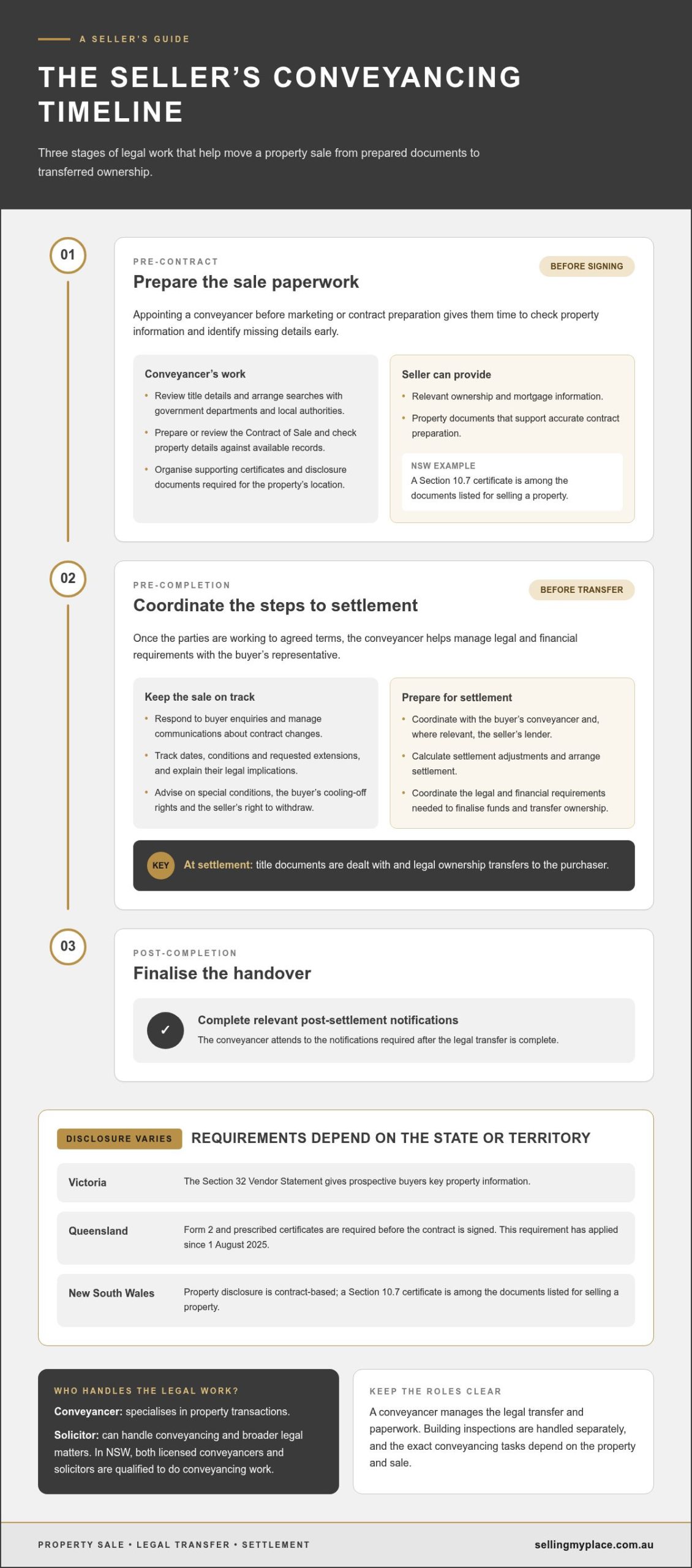
A seller’s conveyancer manages the legal work that transfers a property to its buyer. In Australia, conveyancing generally has three stages: pre-contract, pre-completion and post-completion.
Conveyancer and solicitor responsibilities
A conveyancer specialises in property transactions, while a solicitor can handle conveyancing and broader legal matters. In NSW, licensed conveyancers and solicitors are both qualified to do conveyancing work. A solicitor’s broader legal knowledge may help if a sale raises issues beyond the transfer itself. For a seller, understanding what a conveyancer does means knowing who prepares the sale documents, checks details and coordinates the legal steps with the other parties.
Property information and supporting certificates
Property information and certificates help describe the land and identify matters that could affect a sale. In NSW, a Section 10.7 certificate is among the documents listed for selling a property under the Conveyancing Act 1919. A seller’s conveyancer can review title details and arrange searches with government departments and local authorities. For example, information in a certificate or search may need to be considered when preparing the Contract of Sale, so the buyer receives relevant details before proceeding.
Sale documents and seller-provided information
Sale documents set out the property, agreed terms and information required for the transaction. In NSW, the Contract of Sale is a central document, and the Conveyancing Act 1919 specifies documents required to sell a property, including a Section 10.7 certificate. The conveyancer prepares or reviews the contract and checks that property details align with available records. The seller can help by providing relevant ownership and mortgage information, along with documents about the property that support accurate contract preparation.
Ownership transfer and appointment timing
Legal ownership transfers through the conveyancing process at settlement, when the title documents are dealt with. The seller’s conveyancer handles the legal work needed to transfer the property to the purchaser, then completes relevant post-settlement notifications. Appointing a conveyancer before marketing or contract preparation gives them time to review property information and prepare documents. This can help identify missing details before a buyer is ready to sign, rather than during a time-sensitive exchange.
The three stages provide a useful map of the work. Before the contract, the conveyancer prepares documents and checks property details. Before completion, they coordinate outstanding legal and financial requirements with the buyer’s representative. After completion, they attend to relevant notifications. In NSW, this work can include checking the contract, arranging searches, calculating settlement adjustments and attending settlement. The exact tasks depend on the property and sale, but each stage supports the same outcome: transferring ownership with the legal paperwork in order.
Risks of incomplete contracts and missed disclosure obligations
An incomplete contract or missed disclosure can complicate a sale and lead to disputes between buyers and sellers. Documents and disclosure rules vary across Australia, so the conveyancing process must reflect the property’s state or territory.
Preparing the contract and vendor’s statement
The seller’s conveyancer prepares or reviews the contract and the disclosure documents required for the property’s location. In Victoria, the Section 32 Vendor Statement gives prospective buyers key property information. In Queensland, the seller disclosure statement is Form 2, with prescribed certificates.
These documents help buyers understand the property before signing. Since 1 August 2025, Queensland sellers must give buyers Form 2 and prescribed certificates before the contract is signed. A conveyancer helps organise the required material and prepare the contract so the sale terms and disclosure documents are consistent.
Contract review and seller disclosures
Contract review means checking the proposed terms and disclosure material for accuracy, completeness and potential issues. In Victoria, the seller must provide prospective buyers with a Section 32 legal document containing key property information. Queensland’s Property Law Act 2023 introduced mandatory seller disclosure and stricter compliance obligations.
NSW property disclosure is contract-based, unlike the named disclosure documents used in Victoria and Queensland. A conveyancer reviews the contract and relevant information, then advises the seller about their obligations and any points needing attention. This review matters because buyers rely on the documents to understand what they are agreeing to purchase.
Contract terms, conditions and deadlines
Contract advice explains what each term requires and how a proposed condition could affect the sale. A conveyancer can advise on special conditions, the buyer’s cooling-off rights and the seller’s right to withdraw. A lawyer may also help if questions extend beyond conveyancing or involve broader legal issues.
Once the parties agree on terms, dates and conditions need to be tracked throughout the sale. For example, a requested extension changes the timing the parties are working towards, while a condition may require a particular action before proceeding. The conveyancer manages these communications and explains the legal implications before the seller responds.
Buyer enquiries, inspections and contract changes
The seller’s conveyancer handles legal communication with the buyer, including questions about title and requests to extend dates. If the buyer proposes a contract change, the conveyancer explains its effect and helps the seller consider a response before the revised terms are documented.
Building inspections are separate: conveyancers don’t arrange or carry out structural, pest or drug residue testing. A buyer may seek a building and pest condition in the contract, and a conveyancer can help ensure suitable wording is included. For support with the broader sale plan, explore property sale advice.
Arranging settlement and coordinating with the seller’s financial institution
Settlement is when the sale funds and ownership transfer are completed. The seller’s conveyancer coordinates the financial and title steps with the buyer’s conveyancer and, if the property has a mortgage, with the lender.
Settlement adjustments for rates and levies
Settlement adjustments divide property charges between the seller and buyer according to their agreed responsibilities at settlement. Using the relevant account details and settlement date, the conveyancer calculates adjustments for council rates, water usage and body corporate levies.
For example, if council rates cover a period beyond settlement, the settlement statement accounts for the buyer’s share after ownership changes. Water charges and body corporate levies may also need adjustments. These calculations account for ongoing property expenses alongside the purchase funds, rather than leaving an amount unresolved after the transfer.
The conveyancer prepares a settlement statement showing the payments needed to complete the sale and tells the buyer’s conveyancer which amounts are due at settlement. Reviewing the statement against the contract of sale and available rates or levy information can help identify an incorrect charge before funds are transferred.
Financial institution coordination
If the property is mortgaged, the seller’s conveyancer liaises with the existing mortgagee to arrange discharge of the mortgage. They can request a loan payout figure from the lender, establishing the amount needed to repay the debt from the sale proceeds.
This coordination connects the lender’s payout process with settlement and the title transfer. The conveyancer checks the payout information and includes the relevant payment in the settlement arrangements. This addresses the lender’s interest in the property as part of completing the sale, rather than leaving it as a separate task after ownership has transferred.
The conveyancer also checks the buyer’s deposit and coordinates with the buyer’s representative about payments needed for settlement. The contract of sale sets the agreed terms, while the settlement statement brings together the financial amounts due. If the seller has a mortgage, the payout figure is an important part of working out how the sale funds will be allocated.
Electronic settlement and title registration
Electronic settlement uses an electronic conveyancing workspace to coordinate funds and title documents between the parties. The seller’s conveyancer can facilitate settlement in the workspace and advise the seller when completion occurs.
At settlement, funds are exchanged and the legal title transfer proceeds. In Victoria, the change of ownership is registered with Land Use Victoria. The conveyancer prepares or coordinates the title transfer documents and checks that the settlement arrangements reflect the agreed transaction.
After completion, the seller’s conveyancer can notify relevant authorities of the change of ownership and pay outstanding rates and taxes. These final checks close out the seller’s responsibilities connected with the property. The buyer receives legal ownership, while the seller can see how the sale proceeds were applied, including any mortgage payout and settlement adjustments.
How does a conveyancer handle buyer enquiries, inspections and contract changes?
The seller’s conveyancer manages legal communication with the buyer and their representative during the sale. They respond to questions about title, consider requests to change dates and explain how proposed contract changes affect the seller’s position.
Buyer enquiries may concern the title, contract wording or details that need clarification before the transaction proceeds. The conveyancer checks each question against the sale documents, then communicates the response to the buyer’s conveyancer. For example, if the buyer asks about a title detail, the seller’s conveyancer can review the relevant information and explain what it means for the transaction. This keeps legal questions in the right channel and gives the seller a clearer basis for deciding how to respond.
Date changes need careful attention because a requested extension can affect the timing agreed by the parties. The conveyancer assesses the request, explains its effect and relays the seller’s response. If the seller agrees, the conveyancer helps document the variation so both parties have a clear record of the updated arrangement. A casual conversation should not be treated as a settled contract change; the conveyancer can clarify what has been agreed and what needs formal documentation.
Inspections are separate from legal enquiries. Conveyancers don’t organise or carry out building inspections, including structural, pest or drug residue testing. Those inspections concern the property’s physical condition, while conveyancing concerns the legal transaction. A buyer may ask for a building and pest inspection condition in the contract. The conveyancer can help ensure the contract wording is suitable, so the parties understand how the condition relates to the sale.
Contract changes may follow a buyer’s request, a question about a condition or a change to a proposed date. The conveyancer explains the legal effect before the seller responds. For instance, a buyer might seek more time to meet a condition or ask to change the wording. The seller can then consider the request with a clear view of its impact, rather than relying on an informal summary or assuming the change has no practical consequence.
Throughout these exchanges, the conveyancer acts for the seller, not as a neutral negotiator for both parties. Their role is to communicate the seller’s position, explain the contract’s implications and help document agreed changes. This distinction matters when a buyer’s request could alter a condition, deadline or obligation. The seller makes the commercial decision; the conveyancer provides legal guidance and helps ensure the response is accurately reflected in the transaction documents.
Keep relevant messages and documents together for the conveyancer, including buyer requests, inspection-related conditions and proposed date changes. A clear record helps them compare each request with the current contract and respond consistently. If a buyer raises several points at once, the conveyancer can separate legal questions from inspection arrangements and contract negotiations, then address each through the appropriate channel.
When should a seller appoint a conveyancer, and what should they provide?
Appointing a conveyancer before preparing the sale contract gives them time to organise the legal work and review property information. Sellers in Australia aren’t legally required to use one, but professional conveyancing is recommended because the transfer involves detailed documents and deadlines.
Early involvement is especially useful when the property needs searches, disclosure documents or mortgage discharge arrangements. In NSW, a conveyancer must be licensed with NSW Fair Trading, or the work must be done by a practising legal practitioner. In Queensland, paid conveyancing work must be carried out by a solicitor with a current practising certificate, or by supervised support staff in a law firm.
When you engage a conveyancer, provide details that help establish who owns the property and what may affect its sale. Useful records include:
- Ownership and title information, including the names of all registered owners.
- Mortgage details and the lender’s contact information, if the property has a loan.
- Available council rates, water charges and body corporate levy notices.
- Existing property documents and information relevant to buyer disclosure.
- Your contact details and identification for identity and authority checks.
For example, if two people appear on the title, the conveyancer needs to account for both when preparing sale documents. Mortgage details help them coordinate with the lender, while current rates or levy notices support settlement calculations.
Share information promptly, even if you’re unsure whether a document matters. The conveyancer can assess how it relates to the contract, searches or disclosure requirements in your state. In NSW, property disclosure is contract-based; in Victoria, the seller provides a Section 32 Vendor Statement. Queensland sellers provide Form 2 and prescribed certificates before the buyer signs.
Ask for an itemised estimate before work begins. In NSW, conveyancers and solicitors generally disclose certain conveyancing costs before or when retained. Request an itemised statement of likely costs before work starts. Disbursements may include title searches and authority certificate fees, so ask which professional fees and property-related charges are included in the estimate.
Understanding what a conveyancer does for a seller helps you appoint them at a useful point: before contract preparation, not after a buyer is waiting. For help planning your sale and organising the next steps, discuss your property sale plans.
Kincade International Direct Sales: Residential Property Listing Services
Kincade International Direct Sales helps Australian homeowners prepare and market a residential property through its Residential Property Listing Services. While your conveyancer manages the legal transfer, Kincade supports the separate task of presenting your home to buyers.
Its flat-fee marketing model includes professional photography, floorplans and neighbourhood market reports, with listings remaining active until sold and no time limits. Pre-Sale Property Consulting can help you plan the sale before launch, while Buyer Representation supports people looking to purchase. These services complement conveyancing; they don’t replace the legal work of preparing contracts or transferring ownership.
If you’re planning a sale, explore Kincade International Direct Sales’ fixed-fee packages at sellingmyplace.com.au.
Take the next step towards your property plans
Knowing what a conveyancer does for a seller helps you distinguish the legal transfer from the decisions that shape your sale. Next, clarify the outcome you want, the support you need and how you’ll present the property to potential buyers. Keeping those choices aligned can make the move from planning to market more considered.
Kincade International Direct Sales offers Residential Property Listing Services and Pre-Sale Property Consulting for owners preparing to sell. If your plans also include buying another home, its Buyer Representation can support that part of your next move. The right focus depends on where you are in the process, whether you’re weighing up your sale approach or getting the property ready for market.
For a considered conversation about your plans, contact Kincade International Direct Sales. Take the next step at your own pace, with a clearer path ahead.
Frequently Asked Questions
What is conveyancing and how does it work?
Conveyancing is the legal process of transferring land ownership from one party to another. A sale involves coordinating legal documents and transaction details between the parties. The work spans preparing the sale, managing contract and settlement arrangements, and finalising the transfer. For example, details agreed in the contract inform the checks and payments needed to complete the transaction.
How long is the conveyancing process?
Most conveyancing processes in NSW take 42 days, or around six weeks. The timeline depends on the contract’s settlement date and how quickly required documents, searches and lender arrangements are completed. A title issue or late information can affect the sequence of work, so the agreed dates in the contract provide the practical reference point. Conveyancing timeframes differ across Australia and between individual sales.
What is a conveyancer and why are they essential in 2026?
A conveyancer is a licensed professional who specialises in property transaction advice and information; they may or may not be a solicitor. Using one is not legally required in Australia, but professional help is recommended because contracts, disclosure material and settlement require careful coordination. In 2026, sellers also need to account for state-specific disclosure rules, such as Queensland’s Form 2 process, when preparing a sale.
What does a conveyancer do for a seller in Australia?
A seller’s conveyancer handles the legal work needed to transfer the property and supports the seller through the transaction. Understanding what a conveyancer does for a seller means looking beyond paperwork: they also communicate with the buyer’s representative, explain the legal implications of requests and coordinate relevant checks. For instance, if a buyer asks to change a contract date, the conveyancer explains the effect before the seller decides.
What documents does a seller’s conveyancer prepare and review?
A seller’s conveyancer prepares or reviews the Contract of Sale and checks property records and disclosure material relevant to the state. The particular documents differ: NSW sales include a Section 10.7 certificate among required documents, while Victoria uses a Section 32 Vendor Statement. In Queensland, Form 2 and prescribed certificates form part of seller disclosure. Sellers can help by sharing ownership, mortgage and property records early.
How does a conveyancer prepare the contract of sale for an Australian property?
A conveyancer prepares the contract using information about the property, its ownership and the proposed sale terms. They review title details and relevant searches, then consider whether the contract accurately describes the property and records the parties’ agreement. For example, the seller’s proposed settlement date or a buyer-requested condition needs clear wording. State requirements also shape the supporting material, so a NSW contract differs from disclosure documents used in Victoria or Queensland.
What are the steps in the conveyancing process for a property seller in Australia?
The process generally moves through pre-contract, pre-completion and post-completion stages. First, the seller’s representative gathers property information and prepares sale documents. After the buyer and seller enter the contract, the parties deal with enquiries, required checks and settlement arrangements. At settlement, funds and the title transfer are coordinated. Afterwards, the seller’s representative can manage relevant ownership notifications. State rules and the agreed contract shape the details at each stage.
What does a seller’s conveyancer do at settlement, including calculating adjustments and paying out the mortgage?
At settlement, the conveyancer coordinates the seller’s financial and title requirements with the buyer’s representative. They calculate adjustments for council rates, water usage and body corporate levies, then include those amounts in the settlement statement. If there is a mortgage, they obtain the lender’s payout figure and arrange for the loan to be paid from the sale proceeds. The remaining funds are distributed according to the settlement arrangements.
Selling a Townhouse Privately in Australia: A 2026 Guide
When selling a townhouse privately, buyers may ask about more than the home itself. Your title, owners corporation or body corporate arrangements, shared facilities and strata records can all shape their questions. Knowing what to gather, how to present the property and how to manage buyer interest can make the process clearer and help you avoid confusion.
You can stay in control of your sale and still use practical listing support. This guide covers townhouse-specific records, pricing and presentation, marketing, enquiries, inspections and offers. It also explains how a fixed-fee listing service can help with portal exposure while you manage listing edits, buyer enquiries and inspections.
Use the steps below to prepare a workable plan, understand which details buyers may want to know about shared areas and ownership arrangements, and identify where a qualified conveyancer or solicitor can help with sale documents. You can then choose the level of listing support that suits your needs.
Key Takeaways
- Selling a townhouse privately means you lead the sale, with fixed-fee listing support available.
- Check your title and organise relevant owners corporation records so you can explain shared areas and property details clearly.
- Plan pricing, presentation and marketing around your townhouse’s layout, outdoor space, parking and shared facilities.
- Set a consistent process for responding to enquiries, arranging respectful inspections and recording offers.
- Compare listing packages by their included features and price, while keeping control of listing edits, enquiries and inspections.
Selling a townhouse privately: what makes it different?
A private sale is owner-led: you decide how the property is presented, respond to buyers, arrange inspections and consider offers. You can manage these tasks yourself and use listing support to reach buyers online. Kincade International Direct Sales (KIDS) acts as a licensed intermediary for listing purposes, while you remain in control of listing edits, access and sale decisions.
Townhouse is a style of home, not a single ownership arrangement. Depending on the title, a property may have shared access, common property or an owners corporation, also called a body corporate in some contexts. Buyers may want to know which areas belong to the individual lot, which are shared and how shared areas are maintained.
These details sit alongside the home’s condition and likely buyer expectations. A private courtyard, shared driveway or common garden can affect how you describe the property and plan inspections. Clear, accurate information helps buyers picture day-to-day living and reduces the chance of confusion later. Private selling is legal across Australia, but sale, disclosure and contract requirements differ between states and territories.
How title and shared areas can affect a townhouse sale
Start with the title and the documents available for your property. Don’t assume a neighbouring townhouse has the same arrangement: ownership and shared-area responsibilities can differ within the same development. Buyers may ask about shared entryways, driveways, gardens or other common property, as well as owners corporation records that explain arrangements affecting the lot.
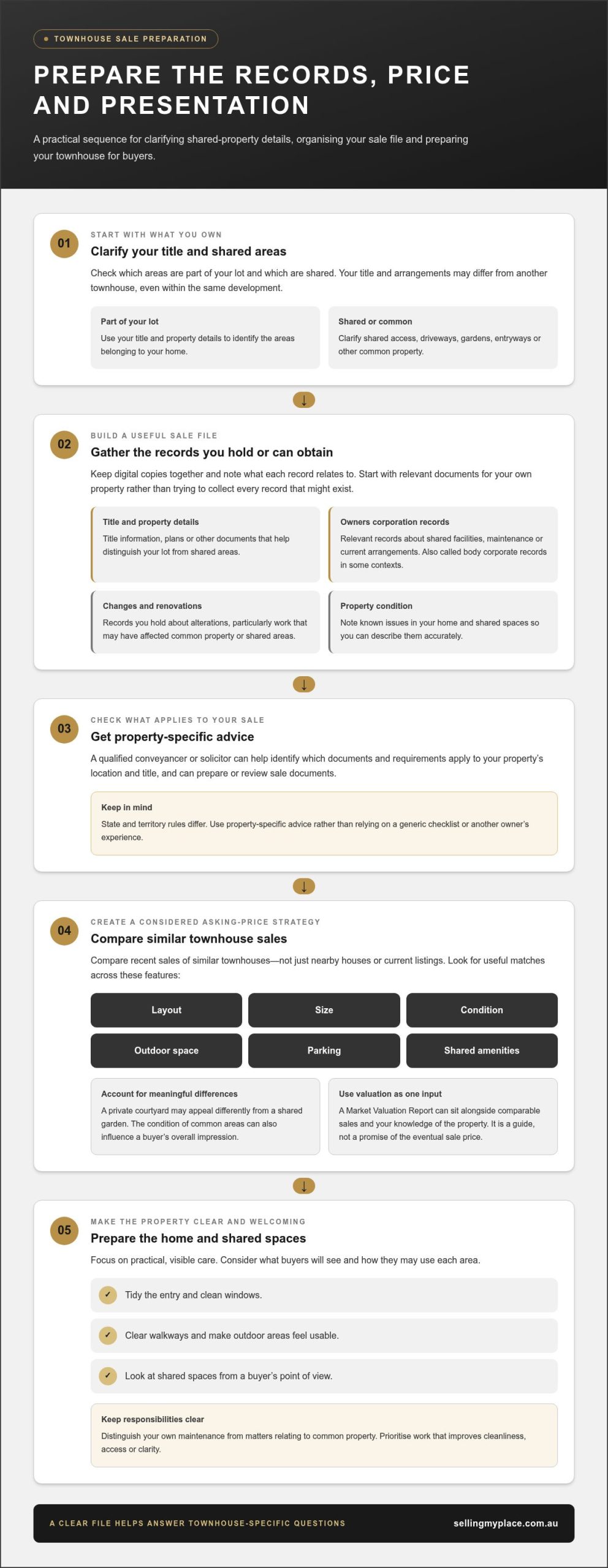
- Identify which areas are part of your lot and which are shared.
- Gather relevant title and owners corporation or body corporate records you hold or can obtain.
- Note known condition issues in both private and shared areas.
A qualified conveyancer or solicitor can help you understand the property-specific documents and which requirements apply to your sale. State and territory rules vary, so use property-specific advice rather than relying on a general checklist or another owner’s experience.
What private selling means for the owner
Selling a townhouse privately means you lead the sale without handing the whole process to an agent. You decide how to manage access, host inspections and assess offers. While many vendors choose private negotiation for flexibility over timing and price, comparing different transaction methods—such as property auctions run by Auction Property Ltd—can offer helpful insight into how competitive bidding structures work in practice. A listing intermediary has a different role: it can provide portal and marketing support, but it doesn’t take over your decisions or replace your responsibility to understand the sale process.
Private selling doesn’t remove the need for professional legal advice. Engage a qualified conveyancer or solicitor to advise on the applicable requirements and prepare or review sale documents. KIDS provides listing support as a licensed intermediary, not as a real estate agent or conveyancer. With the right documents and a clear understanding of your title, you can prepare to answer townhouse-specific questions with confidence.
Prepare a townhouse sale: records, condition and pricing
A well-organised preparation file makes it easier to answer buyer questions and decide what needs attention before your townhouse is listed. You don’t need to collect every document that might exist. Start by understanding your property’s title, organising records you already hold and getting advice on what applies to your specific sale.
Gather townhouse records and clarify shared-property details
Townhouse titles and shared-property arrangements vary, so build your checklist around your own documents rather than assuming another property in the complex works the same way. Keep digital copies together and note what each record relates to.
- Title and property details: gather your title information and any plans or property documents that help distinguish your lot from shared areas.
- Owners corporation or body corporate records: collect relevant records available to you, such as information about shared facilities, maintenance or current arrangements.
- Changes and renovations: keep records you hold about alterations, particularly where work may have affected common property or shared areas.
- Property condition: note known issues in your home and shared spaces, so you can describe them accurately and plan presentation accordingly.
A qualified conveyancer or solicitor can help identify which documents and requirements apply to your property’s location and title. State and territory rules differ, so don’t rely on a generic checklist as a substitute for property-specific advice.
Set a considered price and prepare the property
For a considered asking-price strategy, compare recent sales of similar townhouses, not just nearby houses or current listings. Look for useful matches in layout, size, condition, outdoor space, parking and shared amenities. Then account for meaningful differences: a private courtyard may appeal differently from a shared garden, while the condition of common areas can influence a buyer’s overall impression.
A Market Valuation Report can be one input alongside comparable sales and your knowledge of the property. Treat it as a guide for your decisions, not a promise of the eventual sale price. For more on the factors that inform a pricing view, see this guide to determining a home’s market value.
Presentation starts with practical, visible care. Tidy the entry, clean windows, clear walkways and make outdoor areas feel usable. Look at shared spaces from a buyer’s point of view, but distinguish your own maintenance from matters relating to common property. Prioritise work that improves cleanliness, access or clarity, and weigh each repair on its own merits rather than assuming it will deliver a particular return.
If you’d value support as you organise records and pricing inputs, discuss your townhouse sale preparation.
Market your townhouse privately and present its strongest features
A strong listing helps buyers picture both the home and how it fits into its surroundings. For a townhouse, explain the layout and practical features while being precise about what’s private and what’s shared. Clear details build confidence; broad claims can leave buyers unsure what they’re viewing.
Present layout, outdoor space and shared amenities clearly
Describe the home in the order a buyer might experience it: entry, living areas, bedrooms and outdoor space. Be specific about features such as stairs between levels, built-in storage, a study nook, courtyard access or allocated parking. If an outdoor area is part of your lot, call it a private courtyard. If it’s communal, describe it as a shared garden or facility instead.
Photography and a floorplan work together. Photographs show condition, natural light and the feel of rooms. A clear floorplan helps buyers understand room flow, proportions and how levels connect. Include shared amenities only when the description and images make their status clear. Avoid wording or images that could suggest a communal area belongs exclusively to your townhouse.
Choose listing reach and marketing assets
Plan your marketing around three things: the facts buyers need, visuals that help them assess the property, and channels that put the listing in front of them. This simple checklist can keep your message consistent:
- Property facts: layout, bedrooms, bathrooms, parking, storage, outdoor areas and which facilities are shared.
- Visual assets: accurate photographs and a floorplan that reflects the home’s layout.
- Distribution: online property portal listings, a dedicated property website where included, and a signboard if suitable for the property and its arrangements.
Property portals help buyers discover listings, while a dedicated property website gives your townhouse its own space for the description and visual material. A signboard can offer another way for people nearby to notice the sale, but it complements, rather than replaces, accurate online information.
Every Kincade International Direct Sales package includes a listing on major property portals and local platforms such as Homely and Soho, professional photography, enquiry forwarding by SMS and email, and access to a 24/7 seller dashboard. Signature and Prestige also include a dedicated property website and URL. You retain control of listing edits, while Kincade International Direct Sales acts as a licensed intermediary for listing purposes. Keep the wording consistent across each channel, and check that the photos, floorplan and description all tell the same story.
For owners selling a townhouse privately, a focused set of accurate facts and visuals can help buyers assess whether the home suits their needs before arranging a visit. If you’d like support planning your listing, explore townhouse marketing support.
Manage townhouse enquiries, inspections and offers with care
A steady process helps buyers get timely answers and makes it easier to track who has viewed the property and what they’ve asked. Townhouses can add practical considerations: shared entryways, common areas and building arrangements may affect how you coordinate access. Set expectations early, then keep a clear record as interest develops.
Organise enquiries and townhouse inspections
Use a spreadsheet or notebook to record each buyer’s name, contact details, questions, inspection request and any follow-up. Reply consistently, even if you’re simply acknowledging an enquiry and letting the buyer know when you’ll provide an answer. KIDS forwards enquiries by SMS and email and provides a seller dashboard, helping you keep track while you remain responsible for responses and inspection arrangements.
For each inspection, plan a simple sequence:
- Respond: note the buyer’s questions and answer accurately, or record what you need to clarify.
- Arrange access: agree on a suitable time and explain where to meet, how to enter and which areas are shared.
- Host the viewing: make the route through the home clear and respect neighbours’ privacy and access to common areas.
- Follow up: record feedback and any next steps so you can respond consistently.
If access involves a shared entrance, driveway or building procedure, explain the arrangement before the buyer arrives. Don’t suggest that a communal space is part of your private lot, and avoid obstructing shared paths during a viewing. These small courtesies help inspections run smoothly for buyers and neighbours alike.
Consider offers and handle contract steps appropriately
Look beyond the headline price when comparing offers. Record the proposed deposit, any conditions, the buyer’s requested timing and other terms in writing. A clear comparison makes it easier to weigh what matters to you and discuss the details with your conveyancer or solicitor. For a framework on reaching and assessing terms, use this property sale negotiation guide.
Contract and disclosure processes differ across Australia. Before listing or responding to an offer, ask a qualified conveyancer or solicitor which documents and steps apply to your property and state or territory. State-specific documents may include a Contract of Sale or vendor statement. Don’t rely on a general online checklist to decide when documents must be prepared or provided.
KIDS forwards enquiries and provides sellers with dashboard access, while you retain control of buyer communications, inspections and offer decisions. KIDS does not provide legal advice, contracts or conveyancing. Engage a qualified conveyancer or solicitor for legal matters and contract preparation. For listing support that leaves you in charge of managing buyer interest, get in touch about your townhouse sale.
Use fixed-fee listing support while keeping control of your townhouse sale
Selling a townhouse privately doesn’t mean you have to manage every part of getting your listing online alone. Kincade International Direct Sales (KIDS), a service of Kincade International Realty, provides fixed-fee marketing packages and acts as a licensed intermediary for listing purposes. It isn’t a real estate agent or conveyancer, and you remain in charge of your sale’s day-to-day decisions.
Every package includes a Market Valuation Report, enquiry forwarding by SMS and email, access to a 24/7 seller dashboard, professional photography, and listings on Realestate.com.au and local portals such as Homely and Soho. You can use the report as one input to pricing decisions, review forwarded buyer enquiries and keep track of your listing while deciding how to respond and arrange inspections.
Match listing support to the marketing you need
The packages differ in price and included marketing assets. Choose based on the presentation materials and level of support that suit your townhouse, rather than assuming any option will achieve a particular sale result. Prices below are ex GST.
- Classic: $799 ex GST. Includes the features in every package and a 600 × 900 mm For Sale signboard.
- Signature: $999 ex GST. Includes everything in Classic, plus a 1200 × 1800 mm For Sale signboard, a dedicated property website and URL, and email and phone expert support.
- Prestige: $1,999 ex GST. Includes everything in Signature, plus 15-20 professional photographs, a floorplan redraw, a Facebook and Instagram ad campaign, 50 premium A4 brochures, a 1-on-1 dedicated specialist, a James Edition listing and a 1200 × 1800 mm Photo signboard.
Signature and Prestige include a dedicated web address for the property; Prestige adds a broader set of visual and promotional materials. For a townhouse, photographs and a floorplan can help buyers understand the levels, room flow and relationship between indoor and outdoor spaces. Keep each asset accurate, especially when showing shared facilities.
Keep ownership of decisions while using listing support
With KIDS, you retain control of listing edits, enquiries and inspections. The service supports portal listings and forwards enquiries, but you decide how to communicate with buyers, schedule access and consider offers. That distinction matters if you want practical marketing support without handing over the choices that shape your sale.
Kincade International Network exposure extends across Australia, the United Kingdom and the United States. Listings remain active until sold, withdrawn or two years from the commencement date, whichever occurs first. Each package has a fixed fee and 0% commission. Package prices are ex GST.
KIDS doesn’t provide legal advice, contracts or conveyancing. Engage a qualified conveyancer or solicitor for contract preparation and legal questions, including requirements that apply to your state or territory. To compare the packages and get started, discuss your townhouse sale with KIDS.
Take the next step with confidence
Selling a townhouse privately is a series of considered decisions, not a test of how much you can do alone. Start by writing down what you want to manage yourself, where you’d value practical listing support, and which property-specific questions need professional legal advice. This gives you a clear starting point without committing to a process that doesn’t suit your circumstances.
A townhouse sale also marks a change in the place you’ve called home. Give yourself room to prepare carefully, ask questions and choose the level of support that fits your plans. KIDS offers fixed-fee listing packages with 0% commission, while you remain in control of the sale decisions. Explore the packages and get started with KIDS.
With a thoughtful plan and a qualified conveyancer or solicitor for legal matters, you can move forward at your own pace and stay in control of the decisions that matter. If your townhouse sale is the first step towards relocating or investing overseas, boutique agencies like King Estates offer helpful insight into luxury properties and coastal lifestyle living abroad.
Frequently Asked Questions
Is selling a townhouse privately legal in Australia?
Yes. It is legal for Australian property owners to sell privately in every state and territory, provided the sale meets the requirements that apply to the property and its location. For a townhouse, the title may affect which records or disclosures are relevant. This is general information, not legal advice. Before listing or signing documents, engage a qualified conveyancer or solicitor to explain the requirements for your circumstances and help you understand the documents involved.
Do all townhouses have an owners corporation or body corporate?
No. Arrangements depend on the title and the rules applying in the relevant state or territory. Some townhouse communities have shared property and a formal owners corporation or body corporate, while others are structured differently. Check the title and property records rather than relying on what applies next door. A qualified conveyancer or solicitor can explain which records and obligations relate to the townhouse you’re selling.
Can I sell a townhouse with a tenant living in it?
A sale with a tenant in place may be possible, but tenancy conditions and applicable rules can affect inspections, access and what buyers need to know. Review the tenancy documents before planning viewings, and don’t assume you can enter or change arrangements without the required notice. Make the occupancy situation clear in buyer communications, and seek qualified advice about the rules that apply to your property.
Can a buyer make an offer subject to finance on a townhouse?
Yes, a buyer may propose a finance condition as part of an offer. Its effect depends on the exact wording and the contract, so don’t treat a general explanation as advice about your legal position. Keep the proposed terms in writing and ask your qualified conveyancer or solicitor to review the documents. Consider conditions and proposed timing alongside the price when weighing an offer.
What happens if a townhouse buyer withdraws their offer?
It depends on whether the buyer has made an offer only or the parties have entered into a binding contract, as well as the contract terms and applicable rules. Don’t assume a withdrawal has no consequences or that a sale is assured. Contact your qualified conveyancer or solicitor promptly, share the relevant communications and documents, and get advice on what to do next. Keep other buyer enquiries organised in the meantime.
Should I disclose townhouse renovations that affect shared areas?
Records of work affecting shared property may be relevant, particularly if approval was involved. What needs to be disclosed depends on the property documents and applicable law, so avoid guessing whether approval was required or obtained. Gather plans, approvals and correspondence you hold, then ask a qualified conveyancer or solicitor what matters for your sale. Describe the work accurately and distinguish documented facts from anything you’re unsure about.
Do townhouse buyers usually ask for owners corporation records?
Buyers may ask about shared facilities, levies, rules or available records if the townhouse has an owners corporation or similar arrangement. What’s relevant depends on the title and jurisdiction. Before responding, sort the records you hold by topic, such as shared-area maintenance or building rules, and get advice from a qualified conveyancer or solicitor about which information applies. Don’t assume another townhouse’s records or arrangements are the same as yours.
Selling Off Market Privately in Australia: What Homeowners Need to Know
Selling off market privately means managing your own sale while limiting how widely your property is promoted. It’s different from selling privately with a public listing: you can advertise online to reach more buyers while still handling buyer conversations and sale decisions yourself.
It’s understandable to want privacy and avoid traditional agent representation, while wondering whether a smaller audience could affect buyer interest. A private sale also means taking an active role in enquiries, inspections and offers. This guide explains the trade-offs and how to choose an approach that fits your priorities.
We’ll cover what an off-market campaign involves, what sellers need to manage and how it differs from a flat-fee listing service. Kincade International Direct Sales (KIDS) offers fixed-fee packages that include major portal listings and enquiry forwarding. KIDS is a licensed intermediary for listing purposes, not a real-estate agent. You remain involved in managing the sale, and you’ll need a qualified conveyancer or solicitor for legal matters.
Key Takeaways
- Before selling off market privately, decide how much confidentiality matters and whether you’re comfortable managing buyer conversations yourself.
- A focused sale still needs a clear plan for preparing the property, reaching prospective buyers, handling enquiries and progressing the paperwork.
- Compare confidential marketing with public portal exposure by considering buyer reach, privacy, time commitment and how enquiries will be managed.
- Use a practical checklist to settle your preferred balance of privacy, visibility and control before choosing a marketing path.
- KIDS offers fixed-fee packages with public portal exposure and enquiry forwarding. It acts as a licensed intermediary for listing purposes, not a real-estate agent.
Selling off market privately: what the terms mean for Australian homeowners
A quieter sale can appeal if you want to keep home life private, choose when inspections happen and stay closely involved in decisions. But “private” can describe who manages the sale, or how widely the property is promoted. Those are separate choices. Treating them as the same thing can lead to a marketing plan that doesn’t match your priorities.
Private selling describes who manages the sale; off-market selling describes whether the property is publicly advertised.
What does selling off market privately actually involve?
An off-market sale is marketed or completed without public advertising. Rather than appearing on property portals or in public advertising, the home may be offered through direct introductions to prospective buyers or other targeted approaches. This can reduce public visibility, but it can’t guarantee complete privacy: people may share information, and interested buyers may discuss the property with others.
Private selling, by contrast, means the owner manages the sale rather than appointing a traditional agent. This can involve responding to prospective buyers, coordinating inspections and considering offers. You can keep promotion targeted or advertise publicly on portals. A privately managed sale can therefore still be highly visible online.
For a broad overview of the real estate market in Australia, remember that these terms describe different aspects of a property sale, not one fixed method.
Why do Australian sellers consider an off-market approach?
Some owners value discretion. They may prefer not to advertise their home widely while testing buyer interest, managing a sensitive life change or keeping the sale less visible to neighbours and the wider community. An off-market approach may suit that preference, but it isn’t a promise of secrecy or a guarantee of a particular sale result.
Control is another drawcard. A hands-on owner may want to decide when buyers can view the property, how enquiries are handled and whether to continue discussions with an interested party. For example, you could arrange inspections directly with a small number of prospective buyers rather than hold a public open home. The trade-off is that you’ll need time and a clear process to respond consistently and keep conversations moving.
Think about your circumstances before choosing. If discretion is the priority and you’re comfortable with targeted buyer discovery, an off-market route may suit. If you want more people to find the property, public portal advertising may be a better fit, even if you still manage the sale yourself. Selling off market privately is a combination of two decisions: who handles the sale and how broadly the home is promoted. Choose each deliberately.
How an off-market property sale works, from preparation to agreement
A well-run off-market sale still needs a clear process. The difference is how buyers hear about the property: instead of relying on broad public advertising, an off-market campaign may use targeted introductions. If you’re selling off market privately, you’ll also take an active role in organising the sale and making decisions.
Use this sequence to plan the main steps:
- Prepare: Gather accurate property details, consider how to present the home and decide what information prospective buyers will need.
- Choose your reach: Decide whether to approach a limited group directly or advertise publicly through property portals. A smaller audience may mean fewer opportunities for buyers to discover the home. Portal exposure gives the property a broader public audience, but doesn’t guarantee interest.
- Handle enquiries: Set up a reliable way to receive and respond to questions. Keep a record of who has enquired and what information you’ve provided.
- Arrange inspections: Coordinate access with interested buyers and allow time to prepare the property for each viewing.
- Negotiate and progress the sale: Consider offers and communicate your decisions. Engage a qualified conveyancer or solicitor for legal matters and sale paperwork.
Preparing the property and deciding who to reach
Before approaching buyers, make sure your property information is consistent and ready to share. Prepare details about the home’s key features, inclusions and other relevant points. Decide on your preferred level of visibility as well. A targeted introduction may feel more discreet, while public portal advertising makes the listing easier for a wider pool of buyers to find. Neither approach guarantees a particular level of interest, so choose based on your priorities rather than an assumed result.
Your choice of audience shapes the rest of the campaign. If you’re relying on introductions, plan how you’ll identify and connect with prospective buyers. If you choose public advertising, decide how you’ll respond if several enquiries arrive at once.
Managing enquiries, inspections and sale paperwork
In a privately managed sale, you remain closely involved. You’ll need to reply to buyer questions, arrange suitable inspection times, provide consistent information and decide how to respond to offers. A simple record of enquiries and follow-ups can keep conversations organised, particularly when more than one buyer is considering the property.
Keep the boundary around legal work clear. Kincade International Direct Sales (KIDS) is a licensed intermediary for listing purposes, not a real-estate agent, and doesn’t provide legal advice, contracts or conveyancing services. Engage a qualified conveyancer or solicitor for legal questions and guidance through the paperwork.
KIDS packages offer a different route to a privately managed sale: every package includes public property portal listings and enquiry forwarding. Because portal advertising is public, this isn’t an off-market campaign, even though you manage the sale. If broader online reach with seller control suits your plans, explore privately managed listing support as you map out your next steps.
Off-market sale or public listing: compare privacy, reach and control
Choosing between a confidential campaign and public portal exposure comes down to the balance you want between privacy and buyer discovery. Neither approach is automatically better. Consider how you want buyers to find the property, how much visibility feels comfortable and how much of the day-to-day work you’re prepared to manage.
Selling privately is about who controls the sale; off-market describes how widely the property is marketed.
| Consideration | Off-market marketing | Public portal exposure |
|---|---|---|
| Visibility | Promotion is limited or targeted rather than publicly advertised. | The property is publicly advertised on online portals where prospective buyers can discover it. |
| Privacy | Less public visibility may suit owners who prefer a discreet approach, but it doesn’t guarantee confidentiality. | More people can see the listing, so the sale is more publicly visible. |
| Seller workload | You may need to identify potential buyers and coordinate targeted introductions. | You’ll manage enquiries and inspection arrangements for a public listing. KIDS packages include enquiry forwarding. |
| Enquiries and discovery | Enquiries may come through the people or channels used to reach the targeted audience, which may be narrower. | Portal exposure allows a wider pool of buyers to find the property, though it can’t guarantee interest or an offer. |
The trade-off is straightforward: reducing public exposure can support a privacy preference, but may also limit the audience reached. Public advertising gives buyers more opportunity to discover the home, while making the sale more visible. In either case, you remain responsible for decisions about conversations, access and offers in a privately managed sale.
When might a confidential off-market approach suit?
A confidential approach may suit owners who place a high value on limited public visibility and are comfortable with a focused campaign. Targeted introductions can put a property in front of selected prospective buyers, but they don’t guarantee demand. Before proceeding, consider who could make suitable introductions, how you’ll assess enquiries and how you’ll keep communication clear and timely.
When might public portal exposure better fit a private sale?
Public portal listings can make a home discoverable beyond a buyer pool sourced through personal or targeted introductions. Kincade International Direct Sales (KIDS) offers owners a privately managed listing option with listings on major property portals and enquiry forwarding. KIDS is a licensed intermediary for listing purposes, not a real-estate agent. This portal-listed approach is not off-market. If broader exposure matters more than keeping the sale out of public view, compare the visibility you want with the time you can give to managing the sale.
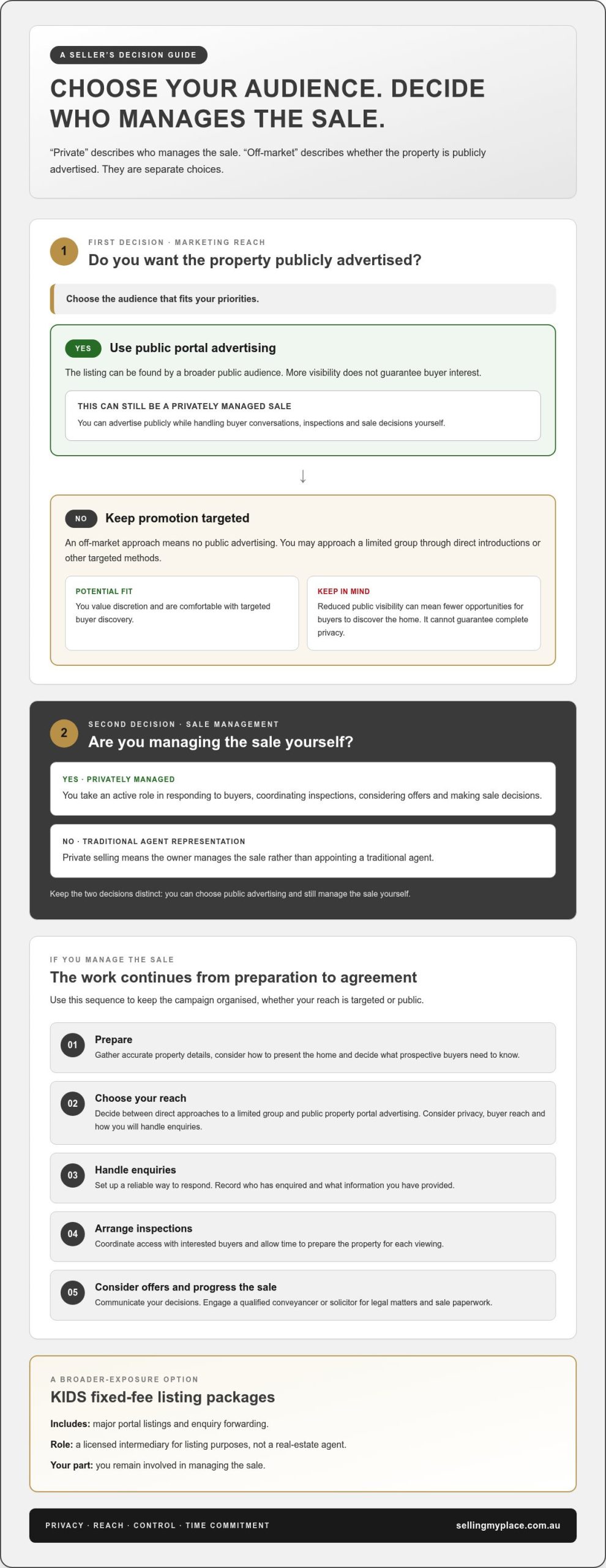
A practical checklist for deciding how to sell your property privately
Before settling on a marketing path, decide what kind of sale experience you want and what work you can take on. Selling off market privately may give you more control over who hears about the property, but it also calls for a deliberate plan to reach buyers and manage the sale. Use this checklist to clarify your priorities.
- Set your privacy preference: Do you want limited public visibility, or are you comfortable with the property appearing on public portals?
- Choose your desired reach: Would targeted introductions suit you, or do you want potential buyers beyond your existing network to discover the home?
- Assess your available time: Can you respond to enquiries, arrange inspections and follow up with interested buyers as the campaign progresses?
- Plan who will communicate: Are you comfortable answering questions and discussing offers directly, or would listing administration and enquiry forwarding help?
- Decide what support you need: Which parts of the process do you want to manage yourself, and where would practical listing support make the experience easier?
- Allow for legal support: Plan to engage a qualified conveyancer or solicitor for legal matters and conveyancing questions.
Questions to answer before choosing your marketing approach
Start with the key choice: is limited visibility more important to you than broad public discovery? Then consider how you’ll reach prospective buyers, manage inspection requests and keep communication organised. A confidential approach may mean more direct work to find and engage interested buyers. Public portal exposure makes the property visible to a wider audience, while bringing enquiries to manage. Be realistic about the time and support you’ll want throughout.
For a fuller owner-led process, use a step-by-step guide to selling your own home in Australia alongside your checklist. Before moving towards an agreement, arrange independent legal and conveyancing support suited to your circumstances.
What to understand before using a flat-fee listing service
A flat-fee listing option can combine owner control with public exposure. Kincade International Direct Sales (KIDS) offers three fixed-fee packages with 0% commission: Classic at $799 ex GST, Signature at $999 ex GST and Prestige at $1,999 ex GST. Every package includes listings on major property websites and local portals such as Homely and Soho, enquiry forwarding by SMS and email, 24/7 seller dashboard access and a Market Valuation Report. This is a public listing approach, not a confidential off-market campaign. KIDS is a licensed intermediary for listing purposes, not a real-estate agent.
The packages differ in their included marketing. Classic includes professional photography and a 600 × 900 mm For Sale signboard. Signature includes everything in Classic, with a larger 1200 × 1800 mm signboard, email and phone expert support, and a dedicated property website and URL. Prestige includes everything in Signature, plus 15-20 professional photographs, a floorplan redraw, a Facebook and Instagram ad campaign, 50 premium A4 brochures, a 1-on-1 dedicated specialist, a James Edition listing and a 1200 × 1800 mm photo signboard.
Listings remain live until sold, withdrawn or two years from the commencement date, whichever occurs first. Consider this listing period alongside the package features and the role you want to play in managing the sale. If this balance of reach and control suits your plans, explore privately managed listing support.
A privately managed sale with broader exposure: how KIDS supports owners
Choosing a privately managed sale doesn’t mean you have to keep your property out of public view. Kincade International Direct Sales (KIDS), a service of Kincade International Realty, offers fixed-fee packages for listing on property portals while you retain control of buyer conversations and sale decisions. This differs from a confidential off-market campaign: the listing is public, but you remain closely involved.
KIDS is a licensed intermediary for listing purposes, not a real-estate agent. Its role is to provide listing support. You remain responsible for managing the sale and deciding how to respond to buyers. This distinction matters if you want portal exposure without traditional agent representation.
What KIDS includes in its privately managed listing packages
Every KIDS package includes a Realestate.com.au listing, listings on local portals such as Homely and Soho, a Market Valuation Report and 24/7 seller dashboard access. Enquiry forwarding by SMS and email is included across all packages, so buyer enquiries can be forwarded to you.
All three packages are listed until sold for a fixed fee, with 0% commission. Classic costs $799 ex GST and includes professional photography, a 600 × 900 mm For Sale signboard, email expert support, a dedicated website and URL, international network access and the included portal listings and dashboard. Signature costs $999 ex GST and includes everything in Classic, plus a 1200 × 1800 mm For Sale signboard and email and phone expert support.
Prestige costs $1,999 ex GST and includes everything in Signature, plus Kincade Global Network priority in the UK and USA, 15-20 professional photographs, a floorplan redraw, a Facebook and Instagram ad campaign, 50 premium A4 brochures, a 1-on-1 dedicated specialist, a James Edition listing and a 1200 × 1800 mm photo signboard. All listed features are included in the package fee.
You can edit your listing, manage enquiries and host inspections, staying involved in the practical decisions. These tools support your role as seller; they don’t guarantee a buyer, a sale or a particular price. KIDS isn’t responsible for the outcome of a sale or lease.
Listings remain live until sold, withdrawn or two years from the commencement date, whichever occurs first. KIDS provides global exposure through its network across Australia, the United Kingdom and the United States. This broader reach is distinct from a confidential off-market campaign, because KIDS packages include public portal listings.
How to take the next step with confidence
Before choosing a package, consider the kind of support you want and how much of the sale you’re ready to manage directly. Portal exposure can help buyers discover the property beyond a privately sourced audience, while you retain control over communications and decisions. It isn’t the same as selling off market privately because the property is advertised publicly.
KIDS offers three fixed-fee packages with 0% commission. Prices are ex GST, and each package bundles its listed features into the flat fee. Comparing the inclusions can help you choose the level of listing support that fits your priorities, from the Classic package through to Prestige with its additional marketing features and dedicated specialist.
For legal matters and conveyancing questions, engage a qualified conveyancer or solicitor. KIDS doesn’t provide legal advice, contracts or conveyancing services. If a privately managed, portal-listed approach suits your plans, explore KIDS listing support.
Choose a sale path that feels right for you
A property sale is a significant step, and the right approach should reflect more than a preference for keeping things quiet or reaching a wider audience. Consider what will help you feel informed and in control: a clear plan, time to respond to buyers and confidence in the decisions ahead.
If selling off market privately is still on your mind, use your priorities as your guide. Start by deciding how much visibility you’re comfortable with and what kind of support would make managing the sale more manageable.
KIDS offers a privately managed listing option for owners who want public portal exposure while staying involved in their sale. Compare the three fixed-fee packages and choose the level of included support that suits your plans. To explore your options, get started with KIDS.
With a considered plan and qualified legal support, you can move towards your next chapter with greater clarity.
Frequently Asked Questions
Can I sell my property off market privately in Australia?
Yes. Australian owners can sell privately, but selling off market privately means choosing not to advertise the property publicly. Requirements for preparing and progressing a sale can vary between states and territories, so general information isn’t legal guidance for your circumstances. In NSW and the ACT, a Contract of Sale is required before listing. In Victoria, a Section 32 Vendor Statement must be provided before contracts are signed. Engage a qualified conveyancer or solicitor for advice about the legal steps and documents relevant to your property.
Is selling off market the same as selling privately?
No. These terms refer to separate choices: whether you manage the sale yourself and how the property is promoted. For example, an owner can manage buyer conversations and decisions while advertising the home on public portals. Alternatively, they can manage the sale themselves and approach buyers through more limited channels. Think about whether you value discretion, wider discovery or direct involvement most, then choose your marketing approach accordingly.
Does off-market selling mean my property will not appear online?
Not necessarily. “Off market” usually means the home isn’t publicly advertised, which may include not appearing on public property portals. Its actual visibility depends on the channels used to reach prospective buyers. If you choose a KIDS package, your listing appears on Realestate.com.au and local portals such as Homely and Soho, so it receives public online exposure. That’s different from a confidential campaign, even though you remain involved in managing the sale.
Can I list my home on Realestate.com.au without an agent?
Individual owners can’t list directly on Realestate.com.au, according to KIDS’ service information. KIDS acts as a licensed intermediary for listing purposes, helping private owners access portal listings without appointing a traditional real-estate agent. Enquiries are forwarded by SMS and email, and sellers can use the 24/7 dashboard to stay across their listing. KIDS isn’t an agent and doesn’t provide legal advice, prepare contracts or provide conveyancing services.
What are the risks of selling a property off market?
A limited campaign may mean fewer buyers discover the property, which can reduce the range of interest you receive. You may also be responsible for keeping track of conversations, arranging inspections and deciding how to respond to offers. Before choosing this path, consider how you’ll reach potential buyers and whether you have time to manage the process. A more discreet approach isn’t automatically the best fit for every seller.
Do I need a conveyancer to sell my home privately?
Engage a qualified conveyancer or solicitor for legal matters, including advice about contracts and requirements that apply to your sale. KIDS doesn’t provide legal advice, prepare contracts or provide conveyancing services. Requirements can differ across Australia, so a qualified professional can explain what applies to your property and circumstances. It’s sensible to arrange that support early, rather than waiting until you’re discussing an offer or preparing paperwork.
How long does a KIDS property listing stay active?
A KIDS listing stays live until the property is sold, withdrawn or two years from the commencement date, whichever happens first. That describes how long the listing can remain active; it isn’t a promise that a sale will happen within that time or at a particular price. Owners remain responsible for decisions about the sale, and KIDS isn’t responsible for its outcome.
Queensland Private Property Sale Legal Requirements: What QLD Sellers Must Know
Selling your home without an agent in Queensland might seem straightforward, but the legal side is anything but simple. If you are navigating the selling your house privately legal requirements in Queensland for the first time, there is a lot to understand before you sign anything or accept an offer.
Queensland operates under some of the most distinctive property sale laws in Australia. From the mandatory Form 2 Seller Disclosure Statement introduced under the Property Law Act 2023, to a five-day cooling-off period that gives buyers room to reconsider, the rules here differ significantly from other states. Getting these requirements wrong, even unintentionally, can give buyers the legal right to walk away from the contract at any point before settlement.
This guide is designed specifically for Queensland private sellers who want to understand exactly what the law requires before they list. You will learn about disclosure obligations, contract requirements, cooling-off rules, common mistakes to avoid, and practical steps to keep your sale on track from start to finish. Consider this your complete legal foundation for selling privately in Queensland with confidence.
Why Queensland Private Sale Law Stands Apart From Other States
Queensland operates under some of the most seller-specific property laws in Australia, and recent reforms have made that distinction sharper than ever.
The Property Law Act 2023 represents the most significant overhaul of Queensland property law in over 50 years. Its centrepiece, a mandatory seller disclosure scheme, came into effect on 1 August 2025. From that date, every seller of residential property in Queensland must provide a completed Form 2 Seller Disclosure Statement to the buyer before a contract of sale is signed. This is not a procedural formality; it is a statutory obligation with direct legal consequences if ignored.
What makes Queensland distinct is who carries that obligation. In some other Australian states, disclosure is informal or managed largely by the selling agent. In Queensland, the law places responsibility squarely on the seller. Private sellers cannot assume an agent will handle this on their behalf, because in a private sale there is no agent. If you want to understand the broader landscape of selling your property privately in Australia, Queensland’s framework is among the most structured you will encounter.
Queensland also applies a five-day cooling-off period to residential contracts, giving buyers the right to withdraw after signing. This differs meaningfully from cooling-off rules in states like New South Wales and Victoria, where periods, conditions, and exemptions vary. In Queensland, the five-day window applies to private sales in full.
Critically, for sale by owner sellers face identical statutory obligations to those selling through a licensed agent. There is no reduced-compliance pathway for private transactions.
These laws exist for clear reasons: buyer protection, market transparency, and confidence in property transactions. Understanding that intent helps sellers apply each requirement correctly rather than treating compliance as a bureaucratic obstacle.
Form 2 Seller Disclosure Statement: What It Is and Why It Matters
The central document in any Queensland property sale is the Form 2 Seller Disclosure Statement, prescribed under the Property Law Act 2023. Sellers must provide a signed Form 2 to the buyer before the buyer signs the contract of sale. Providing it afterwards does not satisfy the obligation.
As a standardised, enforceable framework across all residential property sales in Queensland, including houses, townhouses, units, and vacant land, it replaced the fragmented, informal disclosure practices that previously varied between transactions, obligations that are explained in detail in the sections that follow.
Form 2 is not a courtesy document or a summary sellers can choose to include. It is a statutory requirement. If it is absent, incomplete, or inaccurate, the buyer gains the right to terminate the contract at any point up to settlement, regardless of whether the seller’s error was deliberate.
The official Form 2 is available through the Queensland Government publications portal. Use only that source. Generic templates or documents downloaded from unofficial sources may omit fields required under the current scheme, and using them creates exactly the kind of defect that gives a buyer grounds to walk away.
Private sellers completing Form 2 without an agent should build preparation time into their timeline before listing. Reviewing the form, gathering accurate property details, and having a solicitor check the completed document takes time. Discovering an error after a contract is signed is a far more disruptive and costly problem than investing that time upfront.
For context on how Queensland’s disclosure obligations compare with other states, the State-by-State Breakdown: Navigating Regional Rules provides useful perspective on what makes the QLD framework distinctive.
What Sellers Must Actually Disclose: Inside the Form 2 Requirements
Knowing Form 2 exists is one thing; knowing exactly what to put in it is another. The form covers several distinct categories of disclosure, and missing even one can expose you to serious legal risk.
Title and statutory matters form the core of the form. You must disclose all encumbrances registered against the title, any statutory charges, neighbourhood disputes you are aware of, and any notices or orders issued by a government authority that affect the property.
Environmental and planning overlays are equally important. You must disclose whether the property appears on the contaminated land register, whether it sits within a drainage or flooding overlay, and whether any heritage listing applies. A heritage listing, in particular, can significantly restrict what a buyer is permitted to do with the land, making it a material fact no buyer should discover after signing.
Community titles scheme properties carry additional obligations. If you are selling a unit in a strata complex or a lot within a body corporate, you must also provide current levy amounts, the scheme’s by-laws, and financial statements for the body corporate. These disclosures go beyond the standard Form 2 and require a Body Corporate Information Certificate.
Beyond the form itself, your obligations extend to common law. Queensland sellers must disclose known defects and any material facts relevant to the property. Understanding the full scope of what selling involves before you list helps you approach these obligations methodically rather than reactively.
If you are unsure whether something needs to be disclosed, treat that uncertainty as a signal to consult a Queensland property solicitor. The law does not distinguish between deliberate omission and honest oversight, meaning incomplete disclosure gives the buyer grounds to terminate the contract even when the gap was unintentional.
What Happens If You Get the Disclosure Wrong: Seller Liability Explained
Knowing what to disclose is only half the equation. Understanding what happens when disclosure goes wrong is what motivates sellers to get it right the first time.
Under the Property Law Act 2023, a buyer who does not receive the Form 2 Seller Disclosure Statement before signing can terminate the contract at any point up to settlement. That window can span weeks or months after the contract was executed. The sale can unravel long after both parties believed it was proceeding smoothly.
There is no good-faith exception, intent is irrelevant, and the compliance standard is strict. When a buyer terminates on these grounds, they are entitled to a full refund of their deposit. The seller receives nothing, absorbs transaction costs already incurred, and must restart the process entirely. For sellers managing their own timeline and finances, that outcome carries real weight.
Non-disclosure is not the only exposure. Inaccurate or misleading information within a completed Form 2 can give rise to misrepresentation claims, which carry consequences beyond simple contract termination. These claims are separate legal proceedings with their own financial and reputational risks.
Private sellers carry a higher risk profile in this area because there is no licensed agent in the transaction to flag errors before a contract reaches the buyer. That intermediary role falls to no one unless the seller deliberately fills it. Engaging a Queensland property solicitor to review both the Form 2 and the contract before exchange is a practical necessity. For context on how these obligations compare across different states, the guide to state-specific requirements and disclosure rules is a useful reference.
The Queensland Cooling-Off Period: How It Works and What Sellers Need to Know
Beyond disclosure obligations, Queensland law gives every residential buyer a statutory safety net: a five-business-day cooling-off period during which they can walk away from the contract without providing any reason.
The clock does not start from the date you sign. It begins on the first business day after the buyer receives a copy of the fully executed contract, signed by all parties. This timing detail matters practically: if you sign on a Friday and the buyer doesn’t receive the contract until Monday, the cooling-off period starts Tuesday. Deliver the signed contract to the buyer promptly and keep evidence of when delivery occurred, because that date determines when the period closes.
If the buyer decides to withdraw, they must give written notice to you before 5:00 pm on the fifth business day. You are entitled to retain a termination penalty of 0.25% of the purchase price from their deposit, a partial offset for your holding costs.
Private sales carry no exemption. Auction sales and certain post-auction contracts are exempt from cooling-off provisions under the Property Occupations Act 2014, but a private sale is fully subject to the five-day rule regardless of how committed the buyer appears.
You cannot contract around this. Any clause attempting to shorten or remove the cooling-off period is void under Queensland law. A buyer can voluntarily waive their rights by providing and signing a written notice to the seller at the time of signing the contract. That decision belongs entirely to the buyer.
For a broader view of how Queensland’s cooling-off rules compare with other states, the guide on navigating state-specific regulations and cooling-off periods provides useful context.
Contract of Sale Requirements for Private House Sales in Queensland
Once the cooling-off period is understood, the contract of sale itself becomes the next critical focus.
In Queensland, a contract for the sale of land must be in writing and signed by both parties to be legally binding. Verbal agreements carry no enforceability, regardless of how committed both sides appear. This is a foundational requirement, not a technicality.
Use the REIQ standard-form contract. The Real Estate Institute of Queensland Contract for the Sale of Houses and Residential Land is the accepted standard in Queensland transactions. It is prepared by the seller’s solicitor or licensed conveyancer. Private sellers should never attempt to draft their own contract; the REIQ form exists precisely because property contracts require precise legal language that protects both parties and satisfies statutory requirements.
The Form 2 must be attached before the buyer signs. The contract must include the completed Form 2 Seller Disclosure Statement at the point it is presented to the buyer. Providing it separately after signing does not satisfy the requirement under the Property Law Act 2023. This sequencing is non-negotiable.
Key terms private sellers must understand before signing:
- Deposit amount and timing: When the deposit is due and how it is held
- Settlement date: The agreed completion date, as negotiated between the parties
- Finance clause timeframe: The period the buyer has to secure formal loan approval
- Building and pest inspection period: The window for the buyer to conduct inspections
- Special conditions: Any agreed variations to standard terms
For a broader view of the documents involved in a private sale, The Essential Legal Documents for a Private Sale provides useful context.
Engage a Queensland property solicitor or licensed conveyancer to prepare or review the contract before it reaches any buyer. This single step prevents the majority of errors that derail private sales at exchange.
Step-by-Step: How to Navigate the Disclosure Process as a Private Seller
Knowing what the contract must contain is one thing; assembling the documents correctly, in the right order, is where private sellers most often stumble. Follow these five steps before presenting any contract to a buyer.
Step 1: Gather your title documents
Order a current title search from the Queensland Land Registry. This confirms ownership details, registered encumbrances, easements, caveats, and any other interests that must appear in your disclosure. Do not rely on documents from a previous purchase; interests can be added to a title at any time.
Step 2: Download and complete the Form 2
Access the official Form 2 Seller Disclosure Statement from the Queensland Government publications portal. The form was last updated 21 July 2025, ahead of the scheme’s 1 August 2025 commencement. Complete every section accurately. Blank fields without a genuine reason are a red flag during legal review and can give a buyer grounds to challenge the disclosure.
Step 3: Address body corporate and special disclosure items
If your property sits within a community titles scheme, such as a unit complex or body corporate lot, you must also obtain a Body Corporate Information Certificate (Form 14) and current financial records. These documents must accompany the Form 2; they are not optional supplements.
Step 4: Have your solicitor review the completed form
Before approaching any buyer, ask a Queensland property solicitor to review both the completed Form 2 and your draft contract of sale. The Queensland Government explicitly advises sellers to seek independent legal advice on their specific disclosure obligations under the Property Law Act 2023. A single review at this stage costs far less than a contract termination later.
Step 5: Attach the Form 2 to the contract before signing
The disclosure statement must be physically or electronically attached to the contract before the buyer signs. Providing it separately after signing does not satisfy the legal requirement and immediately triggers the buyer’s right to terminate.
Platforms like SellingMyPlace.com.au support the marketing and logistics of a for sale by owner QLD listing, but these five compliance steps require qualified legal input. Marketing and legal preparation run in parallel, not in sequence.
Common Mistakes Private Sellers Make With QLD Legal Requirements
Even sellers who follow the step-by-step process carefully can fall into errors that are entirely avoidable. These are the most consequential mistakes private sellers make under Queensland’s current legal framework.
Providing Form 2 after the contract is signed. As covered in the liability section above, this breach immediately gives the buyer a statutory right to terminate at any point up to settlement.
Using an outdated or unofficial form. Always use the Form 2 published directly through the Queensland Government publications portal, as detailed in the step-by-step guide above, to ensure all fields required under the current legislation are present.
Failing to check your own title before listing. Easements, caveats, and registered covenants must be disclosed, but sellers who have never reviewed their title often do not know these interests exist. A current title search from the Queensland Land Registry, obtained before listing, surfaces every registered encumbrance in time to disclose it accurately.
Misreading when the cooling-off period starts. The five-day window begins when the buyer receives their signed contract copy, not when the seller signs. Treating the contract as unconditional before that window closes can expose a seller to a dispute they cannot easily resolve. For a fuller picture of how timing errors create legal exposure, Legal and Negotiation Pitfalls: Protecting Your Settlement covers this in detail.
Assuming a committed buyer changes the rules. A paid deposit and a willing buyer do not waive disclosure obligations. Informal commitment creates no exemption under Queensland law.
Private Sale vs Agent Sale in Queensland: Are the Legal Requirements the Same?
Knowing the common mistakes is useful, but a related question often follows: does selling privately actually change what the law requires of you? The short answer is no.
The Form 2 disclosure obligations and the five-day cooling-off period apply equally to every Queensland residential property sale, as set out in the earlier sections, private sellers and agent-assisted sellers share the same compliance standard.
The difference is in who carries the responsibility, not what the responsibility is.
In an agent-facilitated sale, a licensed real estate agent typically coordinates the preparation and delivery of disclosure documentation and checks that the contract is compliant before it reaches the buyer. In a private sale, every one of those coordination tasks falls to you.
Licensed agents in Queensland are also regulated under the Property Occupations Act 2014 and must hold professional indemnity insurance. If an agent makes an error in the disclosure process, there is a regulatory framework and insurance cover behind them. Private sellers operate outside that framework entirely. If something goes wrong, there is no equivalent safety net.
This does not mean private sellers are at a disadvantage, only that they need to be more proactive, more organised, and more reliant on a qualified Queensland property solicitor than a seller using an agent would be. The solicitor effectively fills the compliance-coordination role that an agent would otherwise perform.
Private sellers who understand their obligations before listing, and who engage the right legal support early, can complete a fully compliant sale. For a more detailed walkthrough of the private sale process from start to finish, the Frequently Asked Questions covering how to sell your own home covers each stage in plain terms. The legal requirements are the same; the savings on commission are real.
Financial and Tax Considerations Specific to Private Sales in Queensland
Beyond legal compliance, private sellers should also understand the financial and tax dimensions of their sale before contracts are exchanged.
Transfer duty obligations in Queensland are determined by state legislation, sellers should confirm with their solicitor which party bears this cost in their specific transaction.
Capital gains tax (CGT) applies if the property is not your primary place of residence. If you are selling the home you live in, the main residence exemption under federal tax law eliminates CGT in most cases. This exemption operates identically in Queensland to every other state. If you are selling an investment property, a holiday home, or a property you have only partially occupied, CGT will likely apply to some portion of the gain. Sellers in this position should consult a tax accountant or registered tax agent before settlement, not after.
GST implications vary depending on property type and seller circumstances, consult the ATO or a tax adviser to confirm your position before contract.
At settlement, your solicitor will calculate any adjustments for outgoings such as council rates, water rates, and body corporate levies, confirm the figures with them in the week before settlement.
How SellingMyPlace Helps Queensland Private Sellers List With Confidence
Once the financial and tax side is organised, the remaining piece is getting your property in front of buyers efficiently and cost-effectively.
SellingMyPlace.com.au offers flat-fee property marketing services from $799 (excl. GST), giving Queensland private sellers access to major real estate portals without paying agent commission. That means you retain 100% of your property’s equity rather than surrendering a percentage at settlement.

The platform supports the full pre-market preparation process. Free online valuations help you set a realistic asking price before you list. Pricing strategy guidance ensures your listing is competitive from day one, reducing the risk of sitting on market while buyers question your credibility. Step-by-step selling resources walk first-time private sellers through each stage, so nothing is overlooked before contracts are exchanged.
Professional listing tools and marketing floor plans help your property stand out to serious buyers. A well-presented listing attracts buyers who are already informed and motivated, which directly reduces friction through the contract and settlement process. Buyers who proceed confidently are far less likely to withdraw during the cooling-off period or raise last-minute objections at settlement.
SellingMyPlace’s expert guides on legal tips and selling requirements are designed to work alongside, not replace, the advice of your Queensland property solicitor. The practical split is straightforward: the platform handles your marketing and listing distribution, while your solicitor manages Form 2 preparation, contract compliance, and disclosure obligations under the Property Law Act 2023. Both workstreams run in parallel rather than in sequence, which keeps your timeline on track.
For private sellers working through how to private sale a house from initial listing through to settlement, SellingMyPlace provides the infrastructure to do it cost-effectively, with legal professionals handling the compliance side.
Your QLD Private Sale Legal Checklist: Key Takeaways Before You List
With your marketing infrastructure in place, legal compliance is the final layer that protects everything you’ve built. Before you list, confirm every item below.
Form 2 Seller Disclosure Statement. Complete it accurately and attach it to the contract before any buyer signs, see the disclosure liability section for the full consequences of late or incomplete provision.
Current title search. Order one from the Queensland Land Registry before listing. Encumbrances, easements, caveats, and registered covenants you are unaware of cannot be disclosed. A title search removes that blind spot.
Five-day cooling-off period. The window opens when the buyer receives a signed copy of the contract, not when you sign, review the cooling-off section above for how timing and waiver rules work in practice.
Queensland property solicitor or licensed conveyancer. Engage one before exchange, not after. They prepare or review your contract of sale, confirm your Form 2 is complete and correctly attached, and flag any compliance gaps while there is still time to fix them.
Marketing and legal compliance run in parallel. SellingMyPlace.com.au handles your listing distribution and marketing materials cost-effectively. Your solicitor handles documentation and statutory obligations. Neither depends on the other being finished first. Start both early and you arrive at exchange prepared on every front.
Frequently Asked Questions
What is the Form 2 Seller Disclosure Statement and when must I provide it to the buyer?
The Form 2 Seller Disclosure Statement is a mandatory document introduced under Queensland's Property Law Act 2023 that came into effect on 1 August 2025. Every seller of residential property in Queensland must provide a completed Form 2 to the buyer BEFORE the buyer signs the contract of sale. This is a statutory obligation, not optional. If you provide it after the contract is signed, the buyer gains the legal right to terminate the contract at any point up to settlement. You must use only the official Form 2 from the Queensland Government publications portal to ensure all required fields are included.
What happens if I fail to provide the Form 2 or provide it incorrectly as a private seller?
If you don't provide the Form 2 before the buyer signs the contract, or if it's incomplete or inaccurate, the buyer can terminate the contract at any point up to settlement—weeks or months later. When a buyer terminates on these grounds, you must refund their full deposit, lose any transaction costs already incurred, and must restart the entire selling process. There is no good-faith exception; the law doesn't distinguish between deliberate omission and honest oversight. This makes engaging a Queensland property solicitor to review your Form 2 before exchange a practical necessity for private sellers.
What exactly must I disclose in the Form 2 and on my title?
You must disclose: all encumbrances registered against the title, statutory charges, neighbourhood disputes you're aware of, any government notices or orders affecting the property, environmental and planning overlays, contaminated land register listings, drainage or flooding overlays, and any heritage listings. If selling a property in a community titles scheme (unit complex or body corporate), you must also provide a Body Corporate Information Certificate and current financial records. Beyond the form, Queensland law requires you to disclose all known defects and any material facts relevant to the property. When in doubt, consult a solicitor—the law doesn't distinguish between deliberate omission and honest oversight.
How does Queensland's five-day cooling-off period work and when does it start?
Queensland law gives every residential buyer a five-business-day cooling-off period during which they can withdraw from the contract without reason. The clock starts on the first business day after the buyer receives a fully executed copy of the contract signed by all parties—not when you sign. For example, if you sign on Friday and the buyer receives it Monday, the cooling-off period begins Tuesday. The buyer must provide written notice of withdrawal before 5:00 pm on the fifth business day. If they withdraw, you're entitled to retain a termination penalty of 0.25% of the purchase price from their deposit. This applies to all private sales with no exemptions, and buyers cannot waive this right unless they provide written notice at contract signing.
Do private sellers have the same legal obligations as sellers using a real estate agent in Queensland?
Yes, absolutely. Form 2 disclosure obligations and the five-day cooling-off period apply equally to every Queensland residential property sale, whether sold privately or through an agent. The difference is responsibility, not requirements. In agent-facilitated sales, the licensed agent coordinates disclosure documentation and contract compliance. In private sales, you carry all those tasks yourself. Licensed agents are regulated under the Property Occupations Act 2014 and carry professional indemnity insurance, while private sellers operate outside that framework. This is why private sellers should engage a Queensland property solicitor early to fill the compliance-coordination role an agent would otherwise perform. The legal requirements are identical; the commission savings are real.
How to Write a Property Description That Sells: A Practical Australian Guide
What makes a buyer pause on one listing and scroll past another? Learning how to write a property description that sells isn’t about piling on superlatives. It’s about helping the right buyer picture daily life in the home and giving them a clear, honest sense of what they’ll find at an inspection.
It can be tricky to choose a distinctive angle, decide which details deserve space and keep the language appealing without overpromising. The strongest descriptions make a home’s real advantages easy to understand, whether that’s a practical layout, useful storage or a sunlit living area.
This guide shows you how to turn verified details into a concise, buyer-focused listing that’s easy to scan online. You’ll learn what to prioritise, how to replace tired clichés and why accuracy matters across both words and images. In Australia, property advertising must not create a misleading impression, so compelling copy should also be truthful.
Key Takeaways
- Learn how to write a property description that sells by connecting verified features with the lifestyle they can support.
- Prepare before drafting: consider who the home’s features may suit, gather accurate property facts and choose the details that matter most.
- Use a flexible structure to lead with the home’s strongest appeal, then add useful specifics and a clear inspection invitation.
- Replace clichés and inflated claims with precise, easy-to-scan language.
- Bring the description, professional photography and listing details together so they present a consistent, accurate picture of the property.
Why a well-written property description matters to Australian buyers
A property description connects confirmed features to the lifestyle they may support. It helps buyers understand not just what a home contains, but how its layout and practical details could work for everyday life. The aim is to help suitable buyers decide whether the property deserves a closer look.
Photographs show what rooms and outdoor spaces look like; the description adds context. Explain how living areas connect, where storage is located or what a flexible room could be used for, as long as those details are accurate. Together, words and images help buyers build a fuller picture before arranging an inspection. This is one part of the wider real estate business, where marketing communicates a property’s features to potential buyers.
An effective property description is specific, accurate and centred on benefits that matter to buyers. Relevant detail is more persuasive than hype. Calling a home “perfect” or “unmissable” doesn’t explain what makes it worth seeing. If it’s accurate, saying the kitchen opens onto a covered outdoor area gives buyers something concrete to consider and sets a realistic expectation.
What buyers need from a property listing description
Online readers are deciding whether a home fits their needs before making time for an inspection. Make the essentials easy to understand: the confirmed features, how the rooms are arranged and what practical advantages follow from that layout. A clear description helps buyers assess whether the home offers space for working from home, a separate area for guests or an outdoor setting they’ll use. For investors evaluating rental potential, transparent details about layout and amenities also make it easier to judge suitability for executive or leisure stays through short-term letting specialists like Home Vacay.
Keep facts distinct from promotional phrasing. “Three bedrooms and a separate study” is verifiable; “ideal for every family” assumes what buyers want. Give readers enough context to decide whether to explore further, without suggesting that one type of buyer will suit every home.
Why accuracy makes persuasive copy more convincing
Specific, supportable details give buyers a sound basis for interest and help avoid a mismatch between the listing and the inspection. If a description promises generous storage, for instance, buyers should be able to identify the storage when they visit. Vague praise can create expectations the property doesn’t meet.
In Australia, misleading or deceptive conduct in trade or commerce is prohibited under section 18 of the Australian Consumer Law. Review the overall impression created by the words and images, not just whether each sentence sounds appealing. Avoid unsupported superlatives, assumptions about how buyers will feel and claims you can’t substantiate. A truthful description won’t promise a sale, but it can help attract interest from people whose needs align with the property.
Before drafting, identify the right buyer and gather the property facts
Preparation makes the writing clearer and the final listing more dependable. Before reaching for a catchy opening, consider who the home’s features may suit, collect relevant details, choose what deserves emphasis and verify every claim. This turns scattered notes into a useful brief, so the description focuses on the property rather than guesswork.
Build a buyer profile from the home’s real strengths
Start with the home, not a stereotype of its future owner. A flexible room might work as a study or guest space; a low-maintenance outdoor area may appeal to someone who wants room to relax without extensive upkeep. These are possibilities, not promises. Prioritise relevant facts over trying to appeal to everyone, and connect each genuine feature to a practical benefit without assuming who will buy.
Use this preparation process to move from broad impressions to a focused writing brief:
- Define likely buyers. Consider which needs the home’s confirmed layout and features may meet. Keep the audience open to different routines and household types.
- Gather the facts. Note room uses, inclusions, improvements and other features buyers may need to understand before inspecting.
- Choose priorities. Select the strongest practical benefits, such as connected living areas or useful storage, rather than giving every detail equal weight.
- Verify details. Check measurements, dates, specifications and improvement claims against reliable records or other dependable information before publication.
Create a verified fact sheet before you write
Keep confirmed information separate from personal impressions and details that still need checking. “The living area opens onto a covered deck” is factual if verified; “the perfect spot for entertaining” is an opinion about how a buyer may use it. For clear, reader-focused wording, the Australian Government Writing Handbook offers a useful reference. This distinction keeps the copy engaging without blurring fact and promotion.
Group details on a fact sheet under headings such as layout, inclusions, improvements and outdoor features. Mark anything that needs confirmation and leave it out of the draft until checked. Prioritise facts that help buyers understand the home and decide whether an inspection makes sense. A room’s actual use, what’s included in the sale and verified specifications are usually more useful than decorative adjectives.
This groundwork is the practical starting point for how to write a property description that sells: choose a relevant audience, build the story from accurate details and edit out assumptions. If you’re preparing your sale, explore pre-sale property support as part of planning your listing.
How to structure a property description buyers can scan
A useful listing guides readers from first impression to practical detail without making them search for the essentials. Try this sequence: opening hook, strongest features, useful specifics, then a simple invitation to inspect or enquire. Treat it as a framework, not a formula. The order depends on the home’s verified strengths, and the aim is to make important information easy to absorb on a phone screen.
Short paragraphs give readers space between ideas. Give each sentence a clear job: introduce a feature, explain why it may matter or clarify a relevant detail. Don’t cram every inclusion into one long paragraph. Buyers have different priorities, so broad Australian housing market statistics may provide context, but the description should stay focused on this particular property.
Write an opening that earns the next few seconds
Lead with a distinctive, verifiable feature or combination of features, rather than a generic claim. If a home has a separate studio and a private courtyard, for example, those confirmed details give readers a reason to continue. The opening should orient them to the property, not repeat the listing headline or rely on phrases such as “something special”. If you use a broad claim, show what supports it in the next sentence.
Turn features into clear, specific benefits
Pair each selected feature with a practical use, while letting buyers decide what suits them. A built-in desk nook may offer a place to work or study; describe it plainly rather than promising a better work-life balance. Use sensory language only when it reflects what buyers can genuinely experience. Follow with useful details and a calm invitation to arrange an inspection or make an enquiry.
Here’s a template, not a description of a real property. Replace each prompt with details you’ve verified:
- Opening: Introduce the home through its most distinctive confirmed feature.
- Key appeal: Describe the strongest practical features and how they may be useful.
- Specifics: Add relevant information about layout, inclusions or other confirmed details.
- Next step: Invite interested buyers to arrange an inspection or enquire.
Keep the structure adaptable. A home with a standout layout might lead with how its rooms connect; another may be better introduced through a confirmed feature that sets it apart. Put the most buyer-relevant information early, then add context rather than repeating the same selling point in different words. That’s the practical heart of how to write a property description that sells: make each line clear, useful and grounded in the home itself.
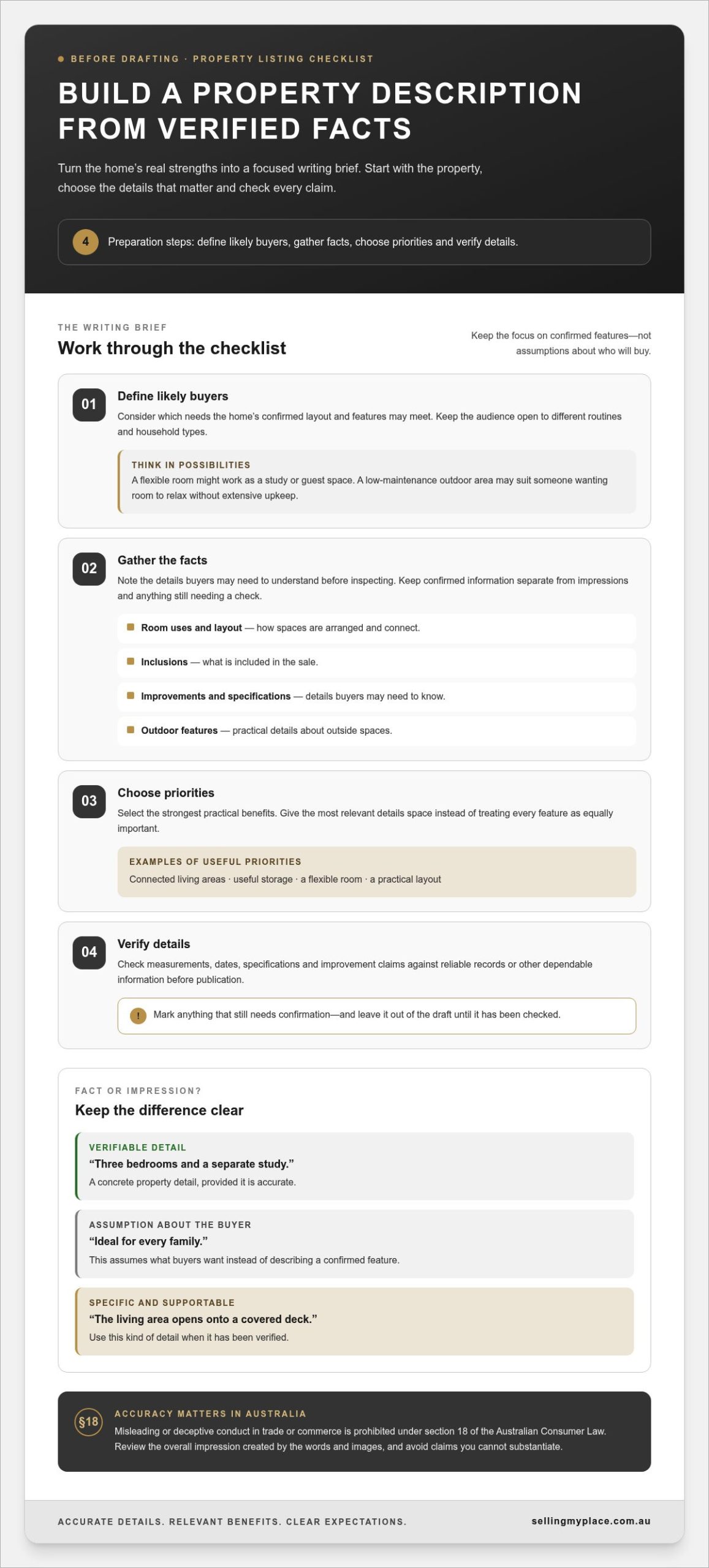
Edit property description wording for clarity, accuracy and appeal
A first draft captures what you want buyers to notice. Editing helps you decide what they need to know. Read each sentence with a buyer’s questions in mind: does it add a verified detail, explain a practical benefit or help someone understand the home? If it does none of those things, trim it.
Replace clichés and vague adjectives with evidence
Words such as “stunning”, “spacious” and “perfect” can sound positive, but without supporting detail they leave buyers guessing. Replace them with an observable feature: instead of “a spacious kitchen”, describe its confirmed bench space, storage or connection to another room. Use comparisons only when you can explain the basis and support them fairly. Specific wording helps readers picture the home without asking them to take your praise on trust.
Use this paired checklist as you revise:
- Keep: Verifiable details, clear descriptions of layout and inclusions, and benefits that follow naturally from those facts.
- Cut: Repeated points, familiar clichés, strings of similar adjectives and inflated claims the property’s features don’t support.
For example, if two sentences both say the living area is “light-filled” and “bright”, keep the stronger one and use the space for a different useful detail. A precise fact gives buyers more to consider than another layer of praise. Likewise, instead of saying “perfect for entertaining”, explain what supports that impression, such as a confirmed connection between the dining area and an outdoor space, or leave the claim out.
Comparisons need care, too. Say a home is “larger than others nearby” only if you have a sound, like-for-like basis for the claim. Otherwise, focus on the property’s own measurable or observable features. That keeps the description persuasive without stretching what it promises.
If you’re refining your listing alongside a broader sale plan, explore property listing support.
Run a final accuracy and readability check
Before publishing, compare every factual statement with the property information and listing details. Check that room names, inclusions, measurements, dates and specifications are consistent, and that the wording doesn’t imply a feature the home doesn’t have. Then review spelling, punctuation, tense and paragraph breaks. Short blocks of text are easier to follow on a phone.
Read the draft aloud. You’ll often hear repeated ideas, awkward phrases or sentences that try to do too much. A trusted reader can flag anything unclear, but keep your own perspective in the final copy. A useful edit sharpens the message without flattening your voice.
This final pass is central to how to write a property description that sells: retain what’s distinctive and supportable, remove what’s vague, and make sure the finished words match the home buyers will see.
Publish your property description with clear photos and listing details
Before the listing goes live, review the full presentation as a buyer would encounter it. The description, photographs and listing details should tell one consistent story: the words explain what matters, the photos show the home, and the listing information helps buyers understand what’s being offered. A polished description can’t do its job if key details are hard to find or images create a different impression.
Make the description and listing presentation work together
Compare each claim in the copy with what the photographs show. If you describe a room as a study, make sure the wording doesn’t imply it’s a separate bedroom. If the description highlights an outdoor area, check that the images give buyers a clear view of the space. Each element should support an accurate overall picture.
Professional photography is included in every Kincade International Direct Sales package. Use the copy to add context rather than narrate what’s already obvious in a photograph. A photo may show a dining area, for instance, while a concise sentence can explain how it connects to another part of the home, if that layout detail is accurate.
Before publishing, check that essential listing details are complete and consistent with the description. Keep room uses, inclusions and other relevant facts easy to locate. Don’t bury a key qualification in promotional wording or repeat the same feature in the description, headline and listing fields when it’s already clear. Buyers should be able to scan the page and understand the home without piecing together conflicting details.
Manage enquiries after the listing goes live
Good presentation is only one part of publishing. Sellers also need a practical way to follow up on interest once the listing is online. Kincade International Direct Sales (KIDS) is a licensed intermediary for listing purposes, not a real estate agent. Every package includes a listing on major property portals such as Homely and Soho, enquiry forwarding by SMS and email, 24/7 seller dashboard access and a Market Valuation Report.
Use the dashboard and forwarded enquiries to keep track of buyer interest. Note any questions that point to unclear listing details, and make sure your responses align with the information shown in the listing. If a detail needs correcting, update the relevant listing information so the copy and other materials continue to match. KIDS listings remain active until sold or withdrawn, or for two years from the commencement date, whichever occurs first.
The packages are fixed-fee and commission-free: Classic is $799 ex GST, Signature is $999 ex GST, and Prestige is $1,999 ex GST. Signature and Prestige include a dedicated property website and URL; Prestige also includes 15-20 professional photographs, a floorplan redraw, a Facebook and Instagram ad campaign, 50 premium A4 brochures, a dedicated specialist and a James Edition listing. All listed package features are included in the flat fee. KIDS does not guarantee a sale or sale price. Sellers remain in control of their listing and enquiries, while KIDS provides the listing platform and included marketing features.
Taking care with how to write a property description that sells also means checking how it works in the live listing, not just on the page where you drafted it. For support with listing your property and managing buyer enquiries, explore listing support with KIDS.
Take the next step with confidence
Your property description is part of the way you introduce a home and invite the right people to take a closer look. Before publishing, ask whether buyers can understand the home’s appeal, find the details that matter and see a clear path to enquire.
That’s the heart of how to write a property description that sells. It’s not about finding the loudest phrase or promising a particular result. It’s about presenting a home with care, so interested buyers can make an informed choice about whether it could suit them. A thoughtful listing gives you a clear starting point for the conversations that follow.
Ready to prepare your listing? Explore listing support with KIDS and take the next step with a clear picture of what your home has to offer.
Frequently Asked Questions
How long should a property description be?
There’s no single ideal length. Include enough detail to help buyers understand the home without making them sift through unnecessary copy. Remove sentences that repeat a feature or add no new information. Preview the listing in its intended format, as text may appear differently on a phone, and check the platform’s current field limits before you publish.
Should I write a property description in first person or third person?
Either voice can work, provided it stays natural and consistent. First person can add a personal touch, such as explaining why an owner values a particular feature. Third person often keeps attention on the property itself. Avoid turning personal opinion into a claim about buyers: “we love the garden” is clearly an owner’s view, while “every buyer will love the garden” assumes a reaction you can’t guarantee.
Can I use emotional language in a property description?
Yes, as long as the feeling comes from real features rather than replacing useful information. You might describe morning light in a room if that reflects the home’s actual conditions, then give readers a concrete detail about the room or its layout. Keep emotional phrasing measured, and don’t promise buyers will feel at home or enjoy a particular lifestyle. The property’s facts should carry the description.
What words should I avoid in a property description?
Be wary of sweeping superlatives and familiar phrases that could fit almost any listing. “Perfect”, “stunning” and “one of a kind” tell buyers little unless you explain the specific, supportable feature behind the claim. Remove language that implies a room or inclusion has a use or status it doesn’t have. Replacing broad praise with a precise description gives readers something tangible to assess.
Should I include the property’s flaws in the description?
Describe the home honestly and don’t use positive wording to disguise a concern or create a false impression. How to handle a defect or other potentially important information can depend on the circumstances and applicable requirements, so marketing copy isn’t a substitute for legal guidance. For questions about disclosure obligations or sale documents, seek advice from a qualified conveyancer or solicitor. KIDS does not provide legal advice, contracts or conveyancing services.
Can I update a property description after the listing goes live?
Whether and how you can edit a live listing depends on the platform and listing arrangement. If you revise the copy, check that the change matches the property information, photographs and other listing fields, then review the published version to make sure it displays as intended. KIDS sellers can use the 24/7 seller dashboard to manage their listing and buyer enquiries as details or communication needs change.
Common Mistakes Selling Property by Owner: An Australian Checklist
A private sale rarely falters because of one dramatic mistake. More often, it’s a series of small oversights: an asking price that isn’t supported by comparable sales, a listing that misses important details, or an enquiry that slips through the cracks. If you’re looking up the common mistakes selling property by owner, the reassuring news is that many can be avoided with a clear plan.
Selling your own home gives you control, but it also means managing the tasks that help a sale progress. You’ll need to prepare the property, present it accurately, respond to buyers and consider offers carefully, while keeping legal matters with a qualified conveyancer or solicitor.
This checklist covers preventable pricing, marketing, communication and preparation mistakes. It also explains how listing support can help with online exposure and enquiry follow-up while you remain in control of buyer communication and inspections. Requirements vary across Australia, so treat the sale as a managed process, not simply a listing.
Key Takeaways
- The common mistakes selling property by owner are easier to prevent when you treat the sale as a planned process, not a one-off listing.
- Use relevant market evidence to sense-check your asking price, and review presentation details that could affect buyer confidence.
- Make your listing clear and useful, with accurate descriptions, helpful photographs and an easy way for buyers to enquire.
- Keep a simple record of enquiries, inspection arrangements and buyer feedback so follow-up stays organised.
- KIDS listing support includes portal exposure, enquiry forwarding and a 24/7 seller dashboard, while you remain in control of buyer communication and inspections.
Common mistakes selling property by owner starts with treating the sale as a one-off task
Selling privately is manageable when you prepare and follow a clear process. A property sale isn’t just a listing going live: it involves decisions, information and follow-up at each stage. This checklist offers general guidance, not a promise of a particular sale outcome.
Small oversights can leave buyers unsure, make a listing easier to scroll past or cause an enquiry to go unanswered. A little organisation before launch helps you present information consistently and handle each next step with more confidence.
Preparation before launch gives you time to catch preventable mistakes before buyers encounter them.
For context, For sale by owner (FSBO) is the process of selling real estate without the representation of a broker or agent. An owner-led sale still needs a plan for the work around the listing.
Mistake: starting before the property and sale plan are ready
Before advertising, decide what matters most to you. Consider your preferred timing, how you’ll manage buyer enquiries and inspections, and who will take responsibility for each task. If others in your household are involved, agree on roles early so buyers receive clear, consistent communication.
Make a room-by-room list of preparation tasks, then separate essentials from optional styling. Checking that lights work, clearing walkways and tidying outdoor areas may be practical priorities. Buying new furniture or undertaking cosmetic changes may be optional. Focus first on a clean, safe and accessible presentation rather than assuming every room needs a full makeover.
- List the rooms, outdoor areas and features buyers are likely to ask about.
- Note straightforward maintenance or presentation jobs to complete before photography and inspections.
- Set aside optional styling ideas so they don’t distract from essential preparation.
This plan makes the workload easier to see and helps you avoid launching while key details or practical arrangements are unsettled.
Mistake: relying on assumptions instead of checking details
It’s easy to overlook a detail you’ve lived with for years, or describe a feature from memory and later discover the wording is inaccurate. Before including a claim in marketing or an answer to a buyer, verify it using reliable records and information you can substantiate. If you’re unsure, don’t guess. Check the detail before responding.
Map out how to sell your own home from preparation through to buyer follow-up. A step-by-step plan shows what needs attention before advertising, rather than leaving you to resolve every question under pressure once enquiries begin. These are common mistakes selling property by owner that preparation can help you recognise early.
Avoid pricing and presentation mistakes that weaken buyer confidence
A considered asking price starts with evidence, not the figure you hope to achieve or the value you feel the home holds for your family. Those expectations are understandable, but buyers assess the options available to them now. A price that doesn’t reflect relevant market conditions can make them hesitate before they’ve even inspected.
A considered asking price is grounded in comparable market evidence. A personal expectation alone can’t show how buyers may assess the property.
Mistake: choosing an asking price without checking comparable evidence
Look at recent sales of genuinely comparable properties, then account for meaningful differences such as land size, condition, layout and features. A sale nearby may not be a useful comparison if the homes differ substantially or the sale took place under different market conditions. Treat online estimates and asking prices as clues, not proof of what a buyer will pay.
A Market Valuation Report can provide another useful input, but it isn’t a guaranteed sale price. Use it alongside your review of comparable sales and the particular qualities of your home. For a fuller explanation of the factors to consider, consult the separate 2026 guide to determine your home’s market value.
Don’t build expectations around one appealing sale or an untested hope. If you can explain why a comparison is relevant, you’ll have a clearer basis for your asking-price decision and a more measured way to respond to buyer feedback. This is one of the common mistakes selling property by owner that an evidence check can help you avoid.
Mistake: presenting the property or its details carelessly
Presentation doesn’t have to mean a major renovation or a complete styling project. Start with the basics: clean and tidy rooms, clear walkways, working lights and a setting that’s ready for photographs or an inspection. A bright, uncluttered space makes it easier for buyers to see the room and consider how they might use it.
Check each photograph against the property as it is now. Images should be clear and representative, not framed to conceal a feature buyers will encounter at an inspection. The written description should match too. Verify claims about renovations, included appliances and property features. Avoid exaggeration; a mismatch between the listing and the home can create doubt and lead to avoidable questions.
- Check that descriptions, photographs and inclusions agree.
- Describe features clearly without overstating them.
- Keep a record of the information behind details you include in the listing.
An accurate listing gives buyers a more straightforward first impression. If you’d like support with listing your property and a Market Valuation Report, explore KIDS listing support.
Prevent listing and marketing mistakes that make buyers scroll past
A listing has little time to make its purpose clear. If key details are missing, the wording is hard to follow or there’s no obvious way to enquire, a potential buyer may move on. Think of the listing as a first conversation: it should answer basic questions and make the next step clear.
Accurate details help buyers understand the property, and clear contact instructions make it easier to take the next step.
Include the information a buyer needs to decide whether to learn more, such as the property’s features, inclusions and inspection arrangements. Keep the description easy to scan with useful headings or short paragraphs rather than a long block of text. Avoid unexplained abbreviations and broad claims that could mean different things to different readers. If a detail needs clarification, improve the wording rather than leaving buyers to guess.
Mistake: treating a listing as a single upload
Publishing is the start of the listing’s life, not the end of the task. Once it’s live, read it as a buyer would. Check that the title and description display properly, the photographs appear in a sensible order and important information is easy to find. Review the page on a phone and a computer; a paragraph that looks tidy on a larger screen may be harder to read on mobile.
Where the property appears in more than one place, keep details aligned. An inconsistency about an inclusion or property feature can create confusion and prompt buyers to ask which version is correct. Keep a current copy of the approved description and key details as your reference for updates.
Check enquiries regularly after the listing goes live. If a verified detail changes, update the listing promptly and correct any other versions too. A brief review routine can catch a typing error, broken contact instruction or outdated inspection detail before it causes friction.
Mistake: overlooking who sees the listing and how enquiries arrive
Reach matters, but so does the path from seeing a listing to contacting the seller. Make your preferred contact method and inspection instructions easy to spot. Check the channels you’ve provided consistently, and decide who will track messages if more than one person is involved. Otherwise, an interested buyer might receive a delayed reply or have to repeat a question.
Every Kincade International Direct Sales (KIDS) package includes widespread property portal distribution and local platforms such as Homely and Soho, plus enquiry forwarding by SMS and email and access to a 24/7 seller dashboard. These tools help keep buyer messages visible and organised while you remain in control of replies and inspections.
Use a simple follow-up habit: review incoming messages, record who contacted you and what they asked, then note when you responded or arranged an inspection. Treating online marketing as “set and forget” is one of the common mistakes selling property by owner that you can avoid. A clear listing and steady attention to enquiries help keep the buyer journey straightforward.
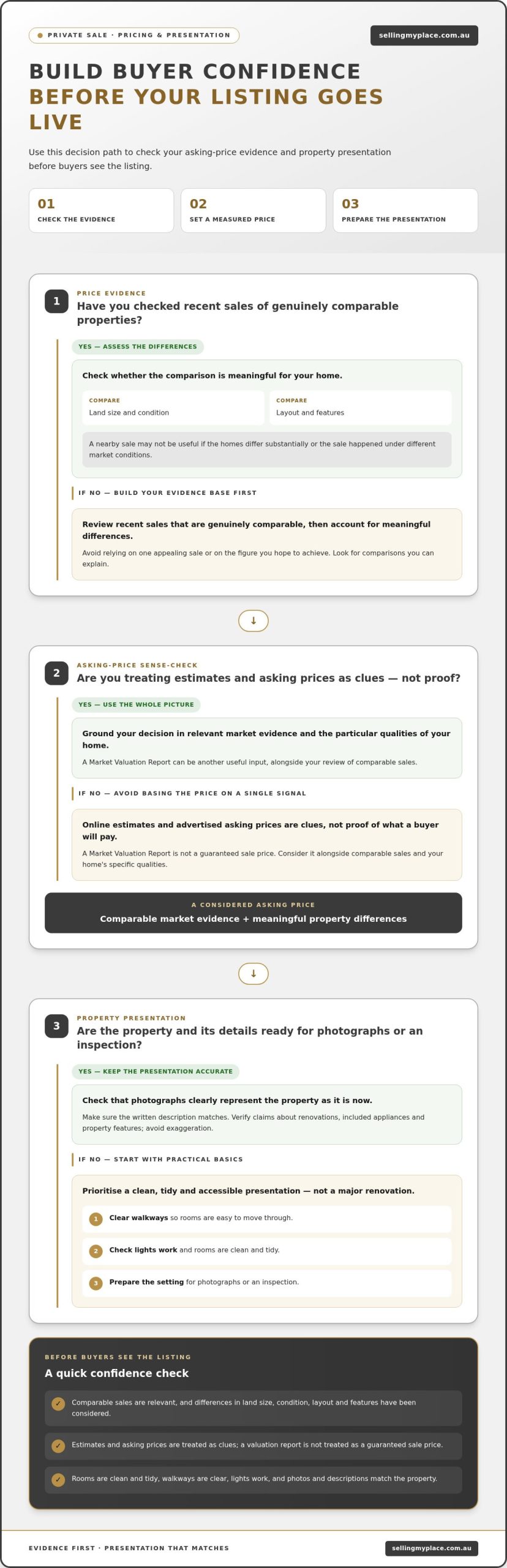
Avoid owner-sale mistakes when handling enquiries, inspections and offers
Buyer communication can gather pace once a listing is live. A simple, repeatable system helps you stay courteous and organised without feeling that every message needs an immediate decision. Keep your responses factual: if you don’t know the answer, say you’ll check rather than guess.
A useful sequence is straightforward:
- Record the buyer’s name, contact details, enquiry and any question they’ve raised.
- Reply clearly, then note any agreed follow-up.
- Confirm inspection arrangements, including the time and any practical details the buyer needs.
- After the inspection, record relevant feedback and any next steps discussed.
This routine gives you a reliable record to refer to, especially if several buyers are asking similar questions or more than one person is helping with the sale.
Mistake: responding late or losing track of buyer conversations
Enquiries can arrive through different channels, so decide how you’ll check them and keep track of replies. A simple spreadsheet or notebook can capture the buyer’s details, what they asked and when you agreed to follow up. Respond promptly and courteously, even if only to acknowledge the question while you verify an answer. Confirm inspection arrangements in writing so both sides have the same details.
Every KIDS package includes enquiry forwarding by SMS and email, as well as 24/7 seller dashboard access. These tools help keep messages visible and organised, while you remain in control of buyer conversations and inspections.
Mistake: improvising inspections, offers or legal steps
Set clear inspection arrangements rather than deciding the details afresh with each buyer. After an inspection, note useful feedback in neutral terms, such as a question about storage or a feature the buyer wanted to understand. Don’t treat one person’s reaction as a verdict on the whole sale. Records help you consider comments thoughtfully and identify questions that may need a clearer answer in your listing.
When an offer arrives, take time to understand what the buyer has proposed and keep your response calm, accurate and professional. Negotiation can involve more than the stated offer, so avoid assumptions or agreeing to terms you don’t understand. For broader guidance on this part of the process, refer to the dedicated Australian property sale negotiation guide.
Contracts and legal questions are separate from listing and buyer communication. Engage a qualified conveyancer or solicitor for legal matters, and direct questions outside your knowledge to them rather than trying to interpret documents yourself. Keeping that boundary clear helps prevent common mistakes selling property by owner.
A steady follow-up routine helps you keep conversations clear and make considered decisions. If listing support and organised enquiry forwarding would help, explore KIDS support for private sellers.
Use a final checklist and the right listing support to keep the sale organised
Before your listing goes live, check the whole process, not just the advertisement. A final review can catch small gaps while they’re still easy to address. Once the listing is active, keep checking messages, preparing for inspections and recording what you’ve agreed with buyers.
A practical final check before and after launch
Use this checklist as a final sense-check, then revisit it as details change:
- Confirm the description is clear, accurate and consistent with verified property information.
- Check that photographs and stated inclusions represent the property as it is being offered.
- Make sure inspection arrangements are clear and the property is ready to show.
- Check that enquiry notifications are accessible and someone is responsible for responding.
- Keep a record of buyer questions, replies, inspection notes and agreed next steps.
After publication, view the live listing on a phone and a computer. Check that key details are easy to find and contact instructions make sense. If you update information, keep the changes consistent wherever the listing appears. A quick review after an inspection can also help you spot a detail that needs clarification, without relying on memory later.
This routine turns common mistakes selling property by owner into practical points you can check and manage. It doesn’t guarantee a particular outcome, but it can make the work more orderly and help buyers receive clear, consistent information.
Where listing support fits into an owner-managed sale
Listing support can help with online exposure and incoming enquiries while you remain responsible for buyer communication and inspections. Kincade International Direct Sales (KIDS) is a licensed intermediary for listing purposes, not a real-estate agent. Every package includes listings on Realestate.com.au and local portals such as Homely and Soho, enquiry forwarding by SMS and email, 24/7 seller dashboard access and a Market Valuation Report.
KIDS offers three fixed-fee packages, all priced ex GST: Classic is $799, Signature is $999 and Prestige is $1,999. Every package includes professional photography and a For Sale signboard. Classic includes a 600 × 900 mm signboard; Signature and Prestige include a 1200 × 1800 mm signboard. Signature and Prestige also include a dedicated property website and URL. Prestige adds 15-20 professional photographs, a floorplan redraw, a Facebook and Instagram ad campaign, 50 premium A4 brochures, a 1-on-1 dedicated specialist and a James Edition listing. All listed features are bundled into the package price.
Listings remain active until sold, withdrawn or two years from the commencement date, whichever occurs first. The dashboard and enquiry forwarding help you keep track of buyer messages, but you decide how to respond and arrange inspections. KIDS provides listing support, while you stay involved in the sale.
Legal work is separate. Engage a qualified conveyancer or solicitor for contracts, conveyancing and legal questions, rather than relying on listing support for those matters. Clear boundaries help prevent confusion about who is responsible for each step.
If you’d like listing support while staying in control of your sale, explore KIDS listing options.
Take your next step with a clear plan
A private sale can feel more manageable when the next action is clear. Choose one practical task to complete: check your listing details, organise your sale records or map out how you’ll manage buyer conversations. Small, deliberate steps can replace last-minute scrambling with a steadier routine.
Common mistakes selling property by owner often begin when responsibilities are vague or decisions are rushed. You don’t need to resolve every detail at once. Decide which parts you want to manage yourself and where listing support could help you organise the process. That balance lets you stay involved in important decisions while giving the sale a more considered foundation.
Ready to explore support for your private sale? Explore KIDS listing support and choose the package that suits your needs.
Frequently Asked Questions
Is it legal to sell a property by owner in Australia?
Yes, Australian property owners can legally sell privately in every state and territory. That general position doesn’t replace advice about your own transaction: required documents and sale processes can differ depending on where the property is located and its circumstances. Speak with a qualified conveyancer or solicitor about the requirements that apply to you.
Can I list my property on Realestate.com.au without an intermediary?
No. Individuals can’t list directly on major property portals such as Realestate.com.au and Domain. Kincade International Direct Sales (KIDS) acts as a licensed intermediary for listing purposes, enabling private sellers to access portal listings without KIDS acting as a real-estate agent or broker. This relates to listing access only; it doesn’t determine how much interest a property will receive or whether it will sell.
What happens if my property does not sell straight away?
An unsold property isn’t automatically proof that you’ve made a mistake. Review the listing: check that the details remain accurate, consider the questions buyers have asked and review feedback from inspections. Look for patterns before making changes, and verify information before updating the advertisement. A KIDS listing remains active until sold, withdrawn or two years from the commencement date, whichever occurs first.
Do I need a conveyancer or solicitor when selling privately?
Engage a qualified conveyancer or solicitor for legal matters, contracts and conveyancing. They can advise on the documents and process relevant to your circumstances. KIDS provides listing support, not legal advice, contract preparation or conveyancing services. Keep those responsibilities distinct: questions about listing information differ from questions about contract wording or legal obligations, which belong with your qualified professional.
How can I avoid missing buyer enquiries when selling by owner?
Choose a regular time to check each channel you’ve provided, then record the buyer’s contact details, question and any agreed follow-up in one place. For example, note whether you need to confirm an inclusion or arrange an inspection, then mark it off once done. Every KIDS package includes enquiry forwarding by SMS and email, plus 24/7 seller dashboard access to help keep messages organised.
Should I change my asking price if buyers are not making offers?
Not automatically. A lack of offers can have several possible explanations, so review the listing’s accuracy, questions or feedback you’ve received and relevant recent sales before deciding what to do. Avoid a rushed change based on one response. For a structured overview of the evidence to consider, consult the separate guide on how to determine your home’s market value. It can inform your thinking, but it can’t guarantee a sale price.
Does selling by owner mean I have to manage every part of the sale alone?
No. You keep control of decisions and inspections, while listing and marketing support can help with the online side. KIDS packages include portal listings, enquiry forwarding and seller dashboard access. This support is separate from legal work: engage a qualified conveyancer or solicitor for contracts, conveyancing and advice about your transaction. Knowing which tasks you’ll manage and which support you’ll use can make responsibilities clearer from the outset.
How to Sell a Duplex Privately in Australia: A Practical Guide
What if the first step in how to sell a duplex privately isn’t choosing an asking price, but finding out exactly what you own? A duplex may look like two homes, yet its title could treat it as one property or as separately titled residences. That distinction affects what you can offer buyers and how you should describe the sale.
Selling privately gives you control of the process and can avoid traditional agency commission, but it still calls for careful preparation. You’ll need to understand the title, organise property information, present the duplex clearly and manage buyer enquiries. Professional marketing and advisory support can help with specific tasks while you retain control of the sale.
This guide explains how to clarify your duplex’s title before advertising, prepare a credible listing and approach buyer enquiries with confidence. You’ll also learn how state and territory requirements can affect sale documents, and how photography, floorplans, market information and advisory support can help you choose a private-sale approach that suits your needs.
Key Takeaways
- Before deciding how to sell a duplex privately, establish whether its residences share one title or are separately titled. This affects what you can offer buyers.
- Gather ownership documents, plans, approvals and property records, then confirm which sale and disclosure requirements apply in your state or territory.
- Compare similar properties carefully, considering title structure, condition and layout when setting a price and describing what’s for sale.
- Use a consistent process for buyer enquiries, inspections and offers, and arrange appropriate legal support for contracts and settlement.
- Choose the level of support that suits you, from managing the sale yourself to commission-free, flat-fee marketing and advisory support.
Selling a duplex privately: first confirm what you legally own
In a private sale, you manage the sale yourself, from presenting the property and handling buyer enquiries to considering offers. You can still get professional help with specific tasks such as marketing, pre-sale advice or conveyancing. For a duplex, the first step isn’t setting an asking price. It’s establishing what the title says you can sell.
A duplex describes a building or arrangement with two dwellings, but its physical layout doesn’t tell you how the property is legally owned. As general background, What is a duplex? A title configuration is the legal structure recorded for the land and residences. It determines what’s being sold and whether the homes may be marketed separately, subject to applicable requirements. Two front doors don’t necessarily mean two separate properties.
That distinction is central to how to sell a duplex privately with confidence. Requirements for contracts, disclosure and other sale steps differ across Australian states and territories, so don’t treat one state’s process as a national rule. Confirm the property’s structure before describing the offer to buyers.
Is your duplex on one title or separately titled?
A duplex may sit on one title or have separate titles for each residence. Don’t infer the answer from the building’s appearance, separate entrances or the way the homes have been used. Review the title search and title plan with a conveyancer or solicitor. They can help interpret what’s recorded and identify questions to resolve before you advertise.
If both dwellings are on one title, you may be selling the property as a whole. Separate titles may allow different sale arrangements, but separate marketing or sale still depends on the ownership records and applicable requirements. Get clarity before writing a listing that suggests buyers can purchase one residence independently.
What shared features could affect the sale?
Look beyond the title boundaries to the practical details buyers are likely to ask about. Walk around the property, note anything that appears shared, then verify the arrangements against records rather than relying on memory or informal assumptions.
- Check whether the driveway or accessway is shared, and note how each residence reaches the street.
- Identify utility connections and any arrangements for access, use or maintenance.
- Review fences, easements, covenants and written agreements that may affect how parts of the property can be used.
These details can shape a buyer’s understanding of privacy, access and ongoing responsibilities. A shared driveway, for example, may prompt questions about who can use it and how maintenance is handled. Record verified facts clearly, but leave legal interpretation to a qualified professional. A conveyancer or solicitor can explain how relevant title entries or agreements apply to your property and what information should be reflected in the sale documents.
Prepare a duplex for private sale with the right documents and details
Once you’ve established what’s being offered, build a clear information pack before drafting the listing. Duplex details can be easy to blur together: which kitchen belongs to which residence, what parking is included, and whether an outdoor area is shared. Keeping the facts in one place helps you answer buyer questions consistently and spot gaps before they become last-minute concerns.
Use this preparation sequence as a starting point, not a universal legal checklist. Sale and disclosure requirements vary by state and territory, so have a conveyancer or solicitor identify the documents and steps that apply to your property and location.
- Collect ownership and plan records. Gather available title information, title plans and any plans showing the layout or boundaries of the residences.
- Find building and renovation information. Set aside available approvals, plans, warranties or records relating to building work, alterations and additions. Ask your conveyancer or solicitor what’s relevant.
- Note services and shared arrangements. Record known information about utility connections, access, maintenance and shared facilities, along with any supporting documents you hold.
- Confirm local sale documents. Ask your legal professional which contract, disclosure material and other jurisdiction-specific documents are needed, and when they must be ready.
Which duplex records should you gather before listing?
Keep the file practical rather than trying to assemble every record that might exist. Include relevant documents you already hold, such as title and plan records, building or renovation paperwork, and information about services or shared areas. Don’t assume the same documents apply to every Australian duplex. A conveyancer or solicitor can explain what’s required locally and how any available records should be handled.
Make a short index of what you have and what each item relates to. For example, label plans by residence or identify which renovation record concerns a particular part of the property. This makes it easier to find accurate answers during an inspection or follow-up. For a broader overview of the sale-by-owner process, see this guide to how to sell your own home.
How can you make the property straightforward to assess?
Prepare a separate fact sheet for each residence, even if you’re offering the duplex as one property. Note its layout, condition, inclusions and access, then describe shared spaces and services clearly. Check that the written description, floorplans and photographs show the same features and don’t imply exclusive use where an area is shared.
- Describe parking, outdoor areas and entrances accurately for each residence.
- List inclusions clearly, such as fixtures or appliances being offered with the property.
- Keep known property information together so inspection follow-ups are consistent.
Professional photography and floorplans can help buyers understand how the homes relate to each other. A prepared information pack also supports clear, measured answers. If you’d value guidance as you organise the sale, explore private-sale advice and marketing support that can complement the work you want to manage yourself.
Price and market a duplex privately to reach the right buyers
Pricing and presentation work best when they tell the same clear story: exactly what’s for sale, how it’s configured and what a buyer can expect. A whole duplex on one title isn’t automatically comparable with two separately titled residences, even if the buildings look alike. Before choosing comparable sales, establish the title structure and whether your listing is for one residence or both.
How should you assess a duplex’s market value?
Start with properties that genuinely resemble the offering. Compare land, layout, condition and title structure, as well as whether each sale involved one dwelling or the whole duplex. How to determine a home’s market value offers a useful framework for considering comparable sales and factors that can influence an estimate.
An online estimate can help orient your research, but treat it as a starting point, not a promised sale price. A neighbourhood market report or professional advice can add context to the sales you’re reviewing. Note where a comparable differs from yours rather than relying on a headline figure that may reflect a different title, condition or buyer proposition.
| Sale arrangement | What to consider when comparing |
|---|---|
| One title, whole duplex offered | Compare with properties sold as a whole, considering both residences, the land and any shared features. |
| Separately titled residences | Assess each residence against relevant individual sales, including its layout, condition and title details. |
This is a guide to comparison, not a legal determination. Confirm what can be sold and how it should be described against the title and applicable requirements.
What should a duplex listing show buyers?
Make the offer unmistakable from the first lines: is it the whole duplex, or a specific titled residence? Describe each home and its features separately where useful, and use accurate floorplans and professional photography to show the layout, access and shared areas. A clear listing helps interested buyers picture how the property works day to day.
- Identify the residence or residences included in the sale.
- Describe parking, outdoor areas, access and shared features accurately.
- Set out inclusions consistently across the listing, floorplan and inspection information.
Don’t imply that a shared driveway, yard or service is exclusive to one residence unless that’s accurate. Plain, consistent wording helps buyers assess the offer and gives you a reliable reference when answering enquiries. This is a practical part of how to sell a duplex privately: match the pricing evidence to the legal configuration, then make that configuration easy to understand in your marketing.
Professional photography, floorplans and neighbourhood market reports can support a considered presentation while leaving you in control of the sale. Explore private-sale marketing and advisory support if you’d like help shaping your plan.
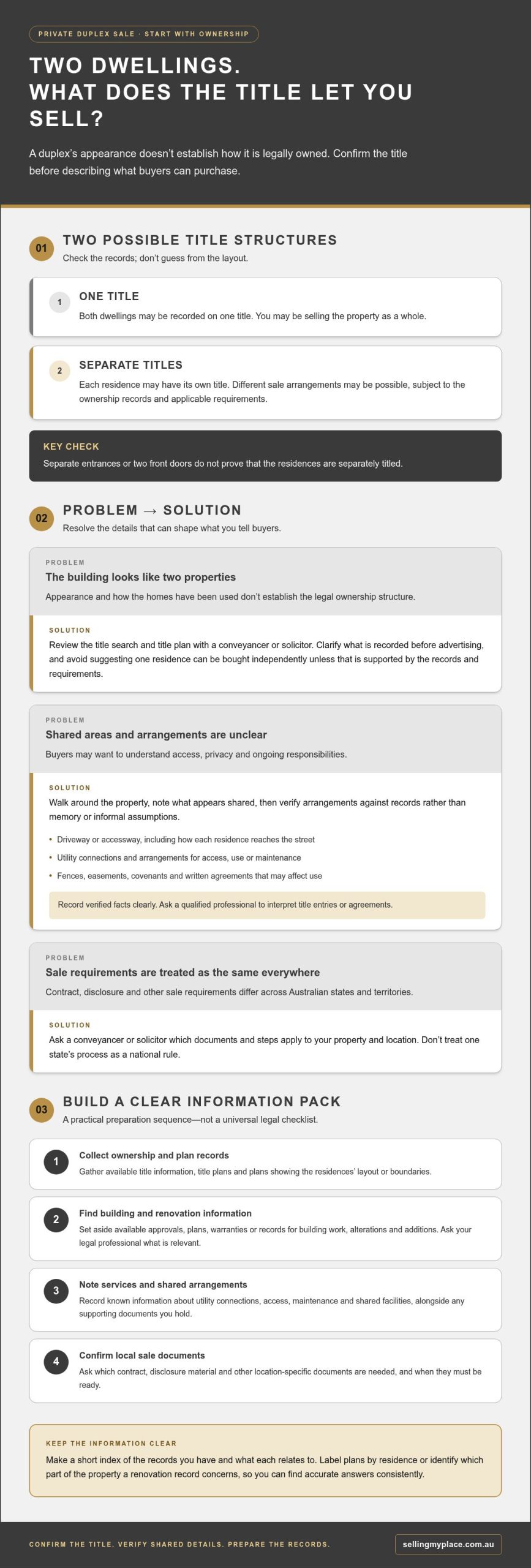
Manage duplex inspections, offers and contracts without an agent
Selling privately doesn’t mean handling every detail without help. A steady process for inspections and buyer communication, paired with appropriate legal support, can make the work more manageable. Duplexes can prompt extra questions about access, shared services and which spaces are included, so keep your answers consistent and grounded in verified property information.
How can you handle duplex inspections and buyer questions?
Plan each inspection around the property’s layout. If both residences are included, make sure buyers can understand each one and any shared areas. If occupants live in either residence, organise access considerately and explain which areas can be viewed. Before inspections begin, prepare concise answers about title, services, access, inclusions and known shared arrangements.
Keep a simple enquiry record so details don’t get lost between conversations. For each buyer, note:
- their name and preferred contact details
- questions asked and the information you provided
- inspection arrangements and any follow-up requested
- offers received, your response and the next agreed step
This record helps you respond consistently, especially if different buyers ask similar questions about a shared driveway or outdoor space. If you don’t know an answer, note it and verify the information rather than guessing. Clear communication builds confidence without overstating what the title or shared arrangements allow.
What happens when a buyer makes an offer?
Consider the complete offer, not just the headline price. Compare any conditions, proposed timing and the buyer’s stated readiness to proceed. For example, a higher offer may include conditions or timing that differ from a lower offer. Weigh each on its terms and decide whether to accept, negotiate or decline; don’t assume one factor settles the decision.
Before agreeing to terms, have a solicitor or licensed conveyancer explain the contract and requirements that apply in your state or territory. Contract preparation, deposit arrangements, cooling-off rights and settlement processes can vary by jurisdiction and transaction. Don’t describe an offer as binding or the sale as complete until your legal professional has explained the applicable steps and status.
Once discussions progress, keep written records of the offer, any changes and what each party has agreed to do next. Avoid relying on a verbal summary when formal documents need to reflect the arrangement. This helps you stay organised while leaving legal interpretation and contract guidance to the right professional.
If you’d like practical guidance while retaining control of your sale, explore private-sale advisory support for your duplex.
Choose the right support to sell your duplex privately
Private selling doesn’t have to mean doing every task alone. You can decide how much of the marketing and preparation to manage while retaining control of key decisions, such as how to present the property and respond to offers. The right fit depends on your time, confidence and the complexity of the sale.
For owners weighing how to sell a duplex privately, three broad approaches can help clarify the choice:
- Fully self-managed: You organise the marketing, buyer enquiries and inspections, and coordinate the sale process with appropriate legal support.
- Traditional agency representation: An agent manages more of the sales process on your behalf, under the arrangement you agree with them.
- Flat-fee marketing with advisory support: You retain control of the private sale while accessing professional marketing and practical guidance, without agency commission.
What can professional marketing and advice take off your plate?
A well-presented duplex needs to make its layout and offer easy to understand. Professional photography and floorplans can show how the residences relate to one another, while neighbourhood market reports give you information to consider as you shape your marketing plan. Residential listing support can help with exposure while you remain in control of decisions about the sale.
Pre-sale consulting and the Agent Advisory Service can provide guidance as you prepare and work through the process, including conveyance advice. This can suit owners who are comfortable speaking with buyers but would value support with presenting the property or understanding the steps ahead. The flat-fee model is commission-free, and listings remain active until sold, with no time limit.
How can you decide what level of help suits you?
Think honestly about the tasks you’re ready to take on. Do you have time to respond to enquiries, arrange inspections and keep buyer discussions organised? Are you comfortable coordinating marketing and seeking legal guidance when needed? A clear view of your capacity helps you choose support that adds value without taking away the involvement you want.
Then match the support to your duplex and sale plan. A whole-property offering may need different presentation from a plan involving separately titled residences. Consider which tasks you want to manage, where advice would help, and what information buyers will need to understand the property. Support can help organise the process, but no marketing or advice can promise a particular sale price or timeframe.
A private sale can be personal and practical at the same time. If you’d like to talk through an approach that fits your duplex and the role you want to play, Talk through your duplex sale.
Take your next step with a plan that feels right
A duplex sale doesn’t need to follow a one-size-fits-all path. As you decide how to sell a duplex privately, focus on the level of involvement that gives you confidence and keeps your decisions aligned with your goals and circumstances. You can manage the process yourself or draw on professional support where it would make the next step clearer.
A commission-free, flat-fee approach can bring together marketing and guidance while you retain control of the sale. Professional photography, floorplans and neighbourhood market reports can support your presentation, alongside the Agent Advisory Service for pre-sale consulting and conveyance advice. The aim is to help you make informed choices, not to promise a particular sale price or outcome.
Start with a conversation about your duplex, your preferred role and the support that would be useful. A considered plan can make a major property decision feel more manageable, one step at a time. Discuss a private-sale plan with our team, and move forward with confidence.
Frequently Asked Questions
Can I sell a duplex privately in Australia?
Yes, private property sales are legal in every Australian state and territory. You can advertise the duplex, communicate with prospective buyers and consider offers yourself, while arranging professional help for tasks such as marketing or conveyancing. Before you begin, establish who owns the property and how it’s titled, then identify the sale and disclosure requirements that apply in your jurisdiction. These local details can influence the steps and documents involved.
Can I sell one side of a duplex separately from the other?
Possibly, but a building’s two-residence layout alone doesn’t mean each side can be sold independently. The title and any relevant ownership arrangements determine what you own, while local requirements may also affect whether separate sales are possible. For example, if both dwellings form one titled property, you may not be able to offer one residence as a standalone sale without addressing the legal structure. Get advice based on the actual records.
Does every duplex have separate titles?
No. Some duplexes have one title covering the property, while others have separate titles for each residence. You can’t reliably identify the arrangement just by looking at the building, its entrances or its fences. A title search and plan provide a more dependable starting point. If the records are difficult to interpret, a conveyancer or solicitor can explain what they mean for ownership and the proposed sale.
Do I need a conveyancer or solicitor to sell my duplex privately?
Legal support is strongly relevant, particularly because the sale contract and required documents depend on the property’s jurisdiction and title. A solicitor or licensed conveyancer can prepare or advise on the contract, explain obligations and help you understand the formal steps towards settlement. Their guidance is also useful if the title includes easements or other entries you don’t understand. Arrange advice early enough to inform your sale plan and advertising.
What happens if my duplex has shared utilities or access?
Shared services or access don’t automatically prevent a sale, but they can affect how buyers understand the property and its practical arrangements. A common driveway, for example, may raise questions about who can use it or how upkeep is handled. Gather relevant written agreements and service information, and distinguish documented arrangements from assumptions. A conveyancer or solicitor can explain the legal effect of any easement, covenant or agreement affecting the property.
Can I sell a duplex privately if it is tenanted?
A tenant living in one or both residences doesn’t automatically rule out a private sale, but the tenancy can affect access, inspections and what a buyer needs to understand about the property. Review the tenancy documents and get jurisdiction-specific advice about applicable notice, access and disclosure requirements before arranging viewings or advertising vacant possession. Be clear with prospective buyers about the occupancy situation, and don’t promise a move-out date unless it’s properly established.
How do buyers assess the value of a duplex?
Buyers may compare recent sales, land, layout, condition and title structure, as well as what’s included in the offer. Their assessment can differ depending on whether they’re considering the whole duplex or one separately titled residence. Shared access, services and outdoor areas may also shape their view of how the property works. Comparable sales and market information can help frame expectations, but an estimate can’t guarantee the eventual sale price.
Marketing a Luxury Home Without a Prestige Agent: An Australian Seller’s Guide
What if the right buyers respond to your home’s story and presentation, rather than the prestige agent’s name on the signboard? It’s natural to wonder whether an established brand is essential for reaching luxury buyers, particularly when your property is distinctive and privacy matters. Marketing a luxury home without a prestige agent can still be professional and considered, provided each part of the campaign has a clear purpose.
This guide explains how to position your home, showcase its defining features and build buyer interest without relying on prestige branding. You’ll learn how professional photography, accurate floorplans and lifestyle-led listing copy can help buyers understand the property, and how to make deliberate choices about information and access to manage privacy.
You’ll also find a practical comparison between managing every part of a private sale yourself and using flat-fee marketing and advisory support. Kincade International Direct Sales offers global residential listings, professional photography, floorplans, neighbourhood market reports and pre-sale guidance. These services can support your campaign while you remain involved in decisions. The aim is to help you choose an approach that suits your home and circumstances, without promising a particular sale price or outcome.
Key Takeaways
- Define luxury through your home’s distinctive design, setting and lifestyle, rather than relying on a universal price threshold.
- Build buyer confidence with a consistent story across listing copy, professional photography and accurate floorplans.
- When comparing sale approaches, look beyond the label and weigh marketing assets, reach, advice, seller control and fee structure.
- Plan each campaign stage, from preparation to buyer conversations, and balance visibility with the level of privacy you want.
- Marketing a luxury home without a prestige agent can include structured support, such as global residential listings, neighbourhood market reports and pre-sale advice.
Marketing a luxury home without a prestige agent starts with the property’s story
A prestige-agent brand can signal a particular kind of service, but a familiar name is not a complete marketing plan. The presentation needs to help suitable buyers understand what makes your home distinctive and how its features may suit the way they want to live. You can build that story carefully with clear, accurate information and considered marketing materials.
Luxury isn’t defined by one price threshold. It may be expressed through architecture, craftsmanship, setting, privacy, outlook or the way indoor and outdoor spaces connect. The strongest positioning reflects the property itself, rather than applying a prestige label and leaving buyers to fill in the details. In practical terms, luxury-home positioning is the clear, evidence-based expression of a property’s distinctive qualities and the lifestyle they support.
Branding can still be part of the picture. For context, the Sotheby’s International Realty overview describes a prominent international brokerage brand. Its presence illustrates the prestige-agent model, but a recognisable name does not replace a property-specific story, credible information or a plan to reach relevant buyers. When marketing a luxury home without a prestige agent, start with the fit between the home and the people it may appeal to.
Identify the features that make the home distinctive
Start with what is enduring. Architectural lines, considered materials, a well-planned layout or an established garden may shape a home’s character more than changeable styling, such as cushions or decorative accessories. List the features that are both distinctive and supportable with property details. Then choose the few that matter most to your story. This gives your listing copy and photography a clear focus, instead of presenting a long catalogue of unrelated features.
Build a clear message for prospective buyers
Translate each chosen feature into a benefit a buyer can picture, without assuming everyone has the same priorities. A sheltered courtyard might offer a private place to unwind; a generous kitchen island may make cooking and conversation easier to share. Keep descriptions consistent with the home’s condition and available documentation. Specific, measured language is more convincing than grand claims such as “the finest home” or “unrivalled luxury”.
Before drafting your listing, try this simple positioning exercise:
- Feature: Name a distinctive quality you can substantiate.
- Experience: Describe how it shapes daily life in practical terms.
- Evidence: Check that the description matches the property and its supporting information.
For example, rather than calling a room “spectacular”, explain that its large windows frame a garden outlook and bring natural light into the living area. That detail lets buyers form their own impression. A polished story doesn’t need to overstate the home. It needs to help the right people see its character clearly.
Create a luxury-home listing that earns buyer confidence
A considered story needs equally thoughtful presentation. Buyers should see the same qualities reflected in the listing copy, photographs and floorplan, rather than having to reconcile different impressions. For a distinctive home, consistency helps people understand what is being offered and decide whether it suits their needs. It can’t promise a particular response or sale result, but it gives prospective buyers clear information to assess.
A credible luxury-home listing brings together accurate photography, a clear floorplan and fact-checked copy that explains the property’s defining features. Each element has a different job: photographs show the home as it is, the floorplan makes the layout easier to understand, and the written description provides relevant details. Together, they give buyers a more complete picture.
Use photography and floorplans to make the home legible
Plan a sequence of photographs that helps viewers get their bearings. Include exterior and interior views, main living areas, transitions between rooms and the features that anchor the property story. Images that show room proportions, natural light and sightlines clearly make it easier for buyers to understand how the spaces feel and connect. Professional photography can present the home with care, while still reflecting its actual condition and presentation.
A floorplan adds information a photograph can’t provide. It shows how rooms connect, where living and sleeping areas sit, and how the home relates to outdoor spaces. Check that the plan is easy to read and accurately reflects the property. A polished image shouldn’t create an impression that the layout can’t support.
Write listing copy that balances detail with restraint
Lead with the most relevant verified features, then add practical details buyers need to assess the home. Name materials precisely where known, distinguish permanent fittings from removable furnishings, and describe inclusions accurately. Avoid claims such as “flawless” or “unrivalled” unless you can substantiate them. A calm, welcoming voice lets the property’s qualities do the work.
Before publishing, review the copy alongside the floorplan and photographs. If the text describes a separate study, for example, make sure the plan identifies that space and the images don’t imply it is a bedroom. Check that descriptions of finishes, renovations and included items match the property and its supporting information. This final review can prevent avoidable confusion during buyer conversations.
For broader guidance on bringing listing details together, explore professional residential property listing services. The same principles apply to marketing a luxury home without a prestige agent: the presentation should feel elevated, but every claim should be grounded in the home itself.
Kincade International Direct Sales provides professional listing support, including photography and floorplans. To discuss your property marketing needs, get in touch with the Kincade International Direct Sales team.
Prestige agent or direct-sale marketing: compare the work, not the label
A prestige brand can help signal a property’s intended positioning, but the name alone isn’t a marketing plan. Compare the work behind the sale: how the home is presented, where it’s promoted, what advice is available and who handles buyer conversations. Looking at these functions separately gives you a clearer basis for choosing an approach that fits your property, priorities and appetite for involvement.
Traditional agency and direct-sale arrangements can allocate these tasks differently. The table below outlines general distinctions. The scope of a traditional agency arrangement can vary, while Kincade International Direct Sales’ flat-fee service includes the listed marketing and advisory support.
| Consideration | Prestige-agent approach | Flat-fee direct-sale approach |
|---|---|---|
| Marketing assets | May coordinate photography, floorplans and campaign materials. | Includes professional photography and floorplans as part of listing support. |
| Listing reach | May use agency channels and public or discreet promotion. | Includes residential listings with global exposure. |
| Advice | May include guidance on positioning, pricing and negotiations. | Includes pre-sale consulting and advisory support. |
| Seller control | The agent typically coordinates more of the sales process. | The owner retains greater control over decisions and buyer interactions. |
| Fee structure | May involve agency commission. | A flat-fee, commission-free model. |
What a prestige agent may contribute, and what to evaluate
Decide which tasks you want to manage and where support would be useful. Direct sale doesn’t have to mean doing everything alone: professional listing assets and advisory services can support a considered campaign while you remain involved in key decisions.
How a flat-fee direct-sale model changes the arrangement
With a flat-fee model, the service fee is set rather than calculated as an agency commission on the sale. That changes the fee structure, not the need for thoughtful planning. You retain more control over how the sale is handled and can draw on support for presentation and advice while staying involved in buyer communication.
Kincade International Direct Sales offers flat-fee, commission-free property marketing and advisory support. Its residential listings remain active until sold, without a time limit. For a practical overview of owner responsibilities, see how to sell your own home. If you’re weighing the right balance of control and support, discuss your luxury-home marketing approach with Kincade.
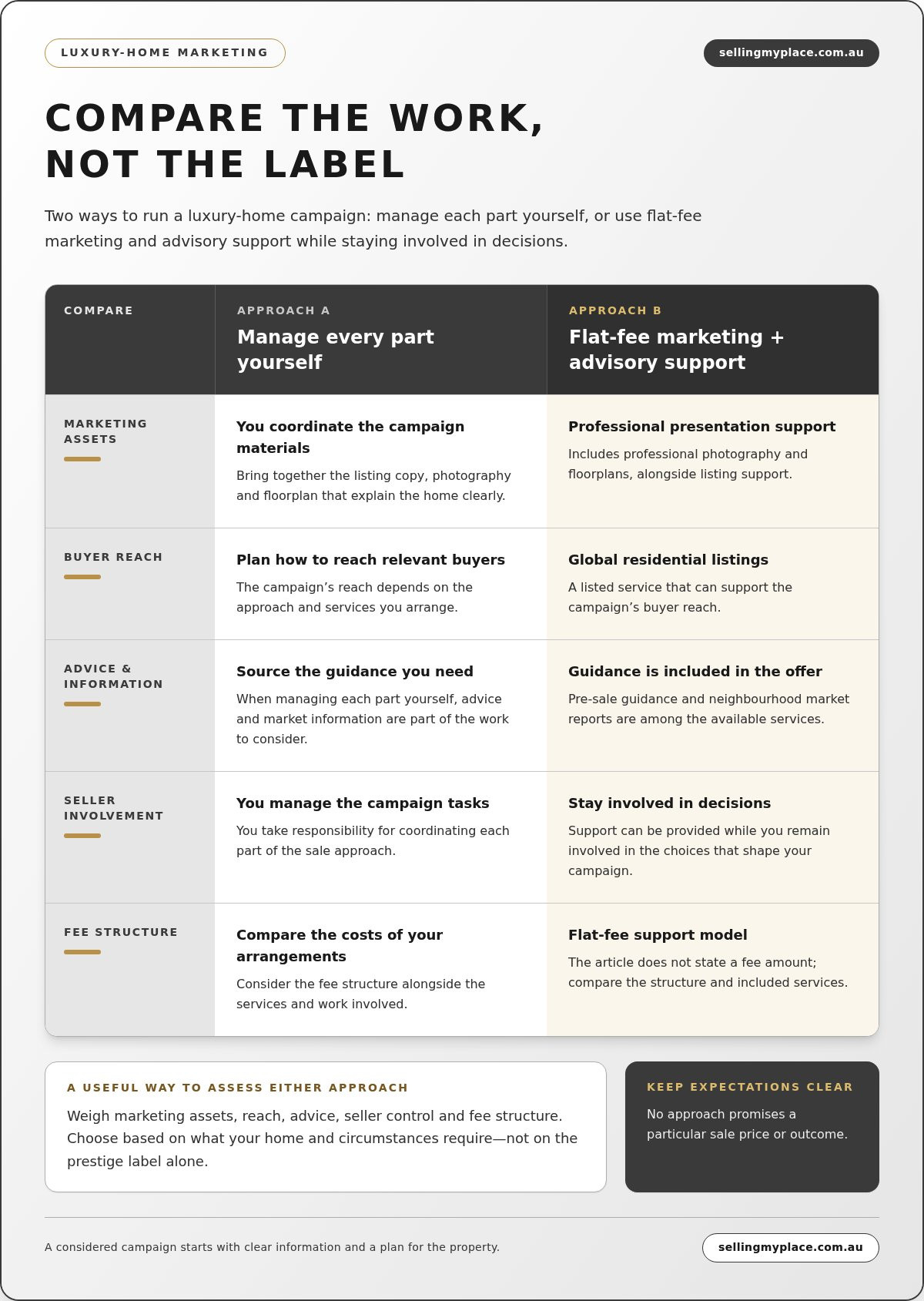
Plan a luxury-home marketing campaign from preparation to buyer conversations
A clear campaign sequence makes an owner-led sale easier to manage. It also helps you make deliberate choices about visibility, privacy and how you’ll handle interest. When marketing a luxury home without a prestige agent, the aim isn’t to do every task unaided. It’s to decide what needs doing, who will manage each part and what support will help you stay organised.
- Prepare: Gather accurate property information, note any work or inclusions you’ll refer to in the listing, and decide what needs attention before photography or inspections.
- Position: Set the central story for the campaign and choose the features you want buyers to understand first.
- Create assets: Organise photography, a floorplan and listing copy that present the home consistently and reflect its condition.
- Publish: Choose a public or more discreet approach that fits your priorities for reach and privacy.
- Manage enquiries: Use a consistent response process, keep a record of questions and interest, and arrange follow-up in a considered way.
- Review feedback: Look for recurring questions or points of confusion, then consider whether the presentation or campaign approach needs refining.
Choose a visibility approach that matches your priorities
A public listing makes the property visible to a broader audience, while controlled or discreet marketing can limit how widely details are shared. Neither approach suits every seller. Consider how much exposure you want, how you’ll communicate the home’s value and what information you’re comfortable making public. Set clear boundaries for photography, open inspections and personal details, including items or identifying features you don’t want shown.
Privacy is also practical. Before images are shared or inspections arranged, decide what should be removed from view and how access will be managed. Be thoughtful about publishing details that reveal household routines or personal circumstances. A clear plan helps you present the property while keeping control over what you disclose.
Prepare for enquiries and negotiation
Keep key property information in one place so you can respond accurately and consistently. Maintain a simple log of who has enquired, what they asked and what follow-up is due. A prepared response can acknowledge a question, provide relevant facts and explain the next step without disclosing personal information or making claims you can’t substantiate.
Before negotiations begin, decide what matters beyond the proposed price: timing, included items and any terms that would affect your next move. You don’t need every answer in advance, but knowing your priorities can help you assess an offer calmly. These property sale negotiation tips can help you prepare for those conversations.
A well-managed campaign brings presentation, visibility and follow-up into one practical plan. Kincade International Direct Sales offers flat-fee marketing and advisory support for owners who want to stay involved in their sale.
How Kincade International Direct Sales supports luxury-home marketing
For owners considering marketing a luxury home without a prestige agent, Kincade International Direct Sales offers a middle path between a traditional agency arrangement and managing every detail alone. The service combines flat-fee, commission-free property marketing with advisory support, professional listing assets and owner involvement in the sale.
The service includes global residential listings, professional photography, floorplans and neighbourhood market reports. These can help you prepare a coherent presentation and share useful information with prospective buyers. Listings remain active until sold, with no time limit. That describes the listing arrangement, not a guarantee of buyer interest, a sale, a particular price or a profit.
Combine professional marketing assets with owner control
Preparing a distinctive home for market takes coordination: the images, floorplan and property details need to work together. Kincade’s photography and floorplans help you assemble core presentation materials, while a neighbourhood market report provides useful context for your planning. You remain involved in decisions about the campaign and communication with interested buyers.
That balance matters. Professional presentation doesn’t require you to hand over every decision, and staying in control doesn’t mean creating every marketing asset from scratch. You can retain a direct role in the sale while drawing on structured support for the materials and preparation that help prospective buyers understand the property.
Know what support can continue through the sale
Kincade’s Agent Advisory Service includes pre-sale consulting and conveyance advice. This support can help you think through preparation and sale-related decisions as the process unfolds. Conveyance advice is guidance, not a substitute for legal advice or an interpretation of state or territory requirements. It gives owners a source of support while they remain responsible for their choices.
A flat-fee approach also makes the fee structure distinct from agency commission. Rather than basing the service charge on a percentage of the sale, Kincade uses a flat fee and does not charge agency commission. This can help owners retain more of their sale proceeds, though the final amount depends on the sale and other costs. No sale price or financial outcome is assured.
Before deciding on your next move, consider which parts of the sale you want to manage personally and where professional marketing or advice would be helpful. You may want support with presentation, a sounding board during pre-sale planning or guidance as you prepare for buyer conversations. A considered plan can make the process feel more manageable without taking decision-making out of your hands.
To explore a practical, owner-led approach, talk with Kincade International Direct Sales about your next steps.
Choose your next step with confidence
Deciding how to sell is personal. Consider what matters most to you: the level of privacy you want, how closely you’d like to manage buyer conversations and the guidance that would help you feel prepared. Those priorities can shape an approach that feels considered, rather than driven by someone else’s idea of prestige.
Marketing a luxury home without a prestige agent doesn’t mean lowering your standards. It means making deliberate choices about how your property is presented and how you want to take part in the process. You don’t need every detail solved today. A clear first conversation can help turn a broad idea into practical next steps.
Plan your next steps with Kincade International Direct Sales and explore an owner-led approach supported by flat-fee marketing and advice. With thoughtful preparation, you can move forward with greater clarity and confidence.
Frequently Asked Questions
Can I sell a luxury home without a prestige real estate agent?
Yes, you can sell your home without appointing a prestige agent. Marketing a luxury home without a prestige agent can be owner-led, with professional support for specific parts of the process. Before choosing your approach, decide which responsibilities you’re comfortable managing, such as arranging inspections or responding to buyers, and where advisory or listing support would make the sale more manageable.
Do luxury homes have to be sold off-market?
No, a luxury home doesn’t have to be sold off-market. A public listing can give the property broader visibility, while a discreet approach may better suit a seller who wants to limit public exposure. Consider the trade-off: who can discover the home, what details will be shared and whether you’re comfortable with public enquiries. Choose the approach that fits your circumstances, rather than assuming one is right for every property.
How do I protect my privacy when marketing a luxury home?
Set privacy boundaries before any listing goes live. For example, remove family photographs, documents and valuables from areas being photographed, and avoid sharing details about household routines or times when the home is vacant. Decide how inspection requests will be handled and what information you’ll provide before arranging access. You can still describe the property’s appeal while keeping personal details and sensitive features out of public-facing material.
What marketing materials does a luxury home listing need?
A listing usually needs clear photographs, an accurate floorplan and copy that explains the home’s defining features and practical details. Depending on the property, you may also want to organise information about renovations, included fixtures or notable materials so your descriptions are precise. Review every asset together before publication. If a feature appears in the text, make sure the images and floorplan don’t suggest something different.
How should I set an asking price for a luxury home?
Start by looking at recent sales of properties with relevant similarities, then account for differences such as condition, design, land and outlook. Luxury homes can be distinctive, so a single comparable sale may not provide a complete picture. Consider your preferred sale terms and timing alongside the available evidence, and decide how you’ll respond to offers below your expectations. A neighbourhood market report can add context, but it can’t guarantee a particular price.
Can a flat-fee service help with a luxury property sale?
Yes. A flat-fee service can provide structured marketing and advisory support while leaving the owner involved in decisions and buyer communication. Kincade International Direct Sales uses a flat-fee model with no agency commission. Map out who will handle each task, from preparing information to following up enquiries, so you understand how the support fits your role. No marketing arrangement can promise buyer interest or a particular sale result.
What should I prepare before marketing my luxury home?
Gather clear property information before drafting the listing: renovation dates, details of fixtures or inclusions, records for significant work and documents that support claims you plan to make. List questions buyers may ask, such as what stays with the property or how a particular system works. In Australia, sale documentation requirements vary by state and territory, so arrange the appropriate conveyancing advice before advertising.
Pricing Your Home for Private Sale in Australia: 2026 Guide
What if the right asking price isn’t one perfect figure, but a defensible range you can refine as buyers respond? Working out how to price your home for private sale can feel daunting when comparable sales are hard to find, online estimates disagree and the stakes are personal.
In 2026, market conditions are shifting: Australian home prices had fallen for six consecutive months by September, according to atRealty. That makes current, relevant evidence especially important. Price too high and buyers may look elsewhere; price too low and you could leave value on the table. An online estimate alone won’t resolve either risk.
This guide explains how to build an asking-price range from comparable sales, choose a pricing and negotiation strategy, and decide when buyer feedback calls for a review. It also covers how neighbourhood market reports and pre-sale advice can support an evidence-led approach throughout your private-sale campaign.
Key Takeaways
- Learn how to price your home for private sale by building a realistic asking-price range from relevant evidence, not guesswork.
- Use settled sales to assess what buyers have paid, then account for the differences between those homes and yours.
- Compare firm, range-based and competitive asking-price strategies, and weigh the risks before choosing an approach.
- Set review points before your campaign begins, then assess patterns in enquiry, inspections, feedback and comparable sales before adjusting.
- Bring pricing evidence together with pre-sale planning and marketing support, including neighbourhood market reports and a flat-fee model without agency commissions.
How to price your home for private sale: start with a defensible range
Choosing a price is a balance: you want to protect the value of your home while giving suitable buyers a reason to take a closer look. The asking price is your public starting point for attracting interest and negotiating. It isn’t a guaranteed sale result. Your decision should reflect both the evidence and your circumstances.
A defensible asking-price range is an evidence-based guide, not a promise. It gives you reasoned boundaries for pricing and negotiation, while recognising that the eventual result depends on the buyer, the property and the terms you agree.
What does an asking price mean in a private sale?
In a private sale, you negotiate the price and terms directly with a prospective buyer, or with support you’ve engaged. The advertised figure starts that conversation; it isn’t automatically the amount a buyer will pay. The final agreed sale price is the amount recorded in the sale contract once you and the buyer reach agreement.
Market value is different. It’s an informed view of what a property could reasonably sell for, based on relevant evidence and its characteristics. It helps guide your decision, but it isn’t the same as an advertised price or a guaranteed outcome. The private sale process describes the broad approach of selling without a traditional agent. Within that process, supported by Kincade International Direct Sales, you choose how to present and negotiate your price.
Your strategy should reflect the evidence and your priorities, including how much flexibility you want in negotiations. There’s no single approach that suits every home or seller.
Why a range is more useful than one unsupported figure
A single figure can suggest more certainty than the evidence supports. A range makes that uncertainty visible and helps you decide where to begin, which offers merit consideration and when new information might justify a change. Each boundary should have a reason behind it, rather than being chosen simply because it feels comfortable.
For example, if a home has a feature that makes comparisons difficult, a range can acknowledge that uncertainty while keeping the decision grounded in evidence. You don’t have to advertise a range: it can be a private planning tool to help you choose one public asking figure and prepare for negotiation.
To make the range useful, connect it to comparable settled sales, your property’s features and condition, and the circumstances of your sale. Asking prices show what sellers hope to achieve, not what buyers have agreed to pay. In the next section, you’ll build your range from comparable evidence. For a deeper look at valuation principles, consult a guide to determining your home’s market value, then weigh that context alongside property-specific sales evidence.
Build your private-sale price range from comparable evidence
A sound price range starts with what buyers have actually paid for homes like yours, not simply what other sellers hope to receive. Recent, genuinely comparable settled sales provide a stronger pricing anchor than asking prices alone. Advertised prices reveal a seller’s expectations; they don’t confirm that a buyer agreed to pay that amount.
Use this process to turn market information into a reasoned range:
- Gather recent settled sales. Look for completed sales rather than relying on current listings. Note the sale date and check that the evidence reflects the market conditions you’re selling into.
- Select the closest comparisons. Prioritise homes with a similar property type, size, layout, condition and features. A nearby property isn’t automatically a useful comparison if its design or presentation differs substantially.
- Assess the differences. Consider how renovations, outdoor space, parking, natural light, aspect and overall condition may affect buyer appeal. Describe each difference and its likely direction of influence instead of applying a made-up standard percentage or dollar adjustment.
- Form a supported range. Use the strongest comparisons to establish sensible lower and upper boundaries. Give each end a clear rationale, and set weaker or less similar sales aside rather than letting them distort your view.
Choose comparable sales that genuinely help
Start with homes that match yours in the ways buyers are likely to notice: property type, floor area, bedroom and bathroom layout, condition and key features. Then consider whether they sold in a similar market context. If close comparisons are scarce, broaden your search cautiously, perhaps to a different property type or a less recent sale, and note why that evidence is less certain. Don’t force a poor match just to fill a list.
Keep a simple record of each sale’s relevant features alongside its settled price. This makes it easier to see whether your range is supported by a consistent group of homes or rests on one unusual result. For wider context, the Real Estate Institute of Australia market insights can help you follow broader residential market information. National or state trends, however, can’t replace property-level comparisons.
Use online estimates and professional input with care
Automated estimates are useful starting points, but an online tool may not account for your home’s condition, recent improvements or distinctive features. Compare estimates from several sources. If they differ substantially, investigate what information or assumptions may explain the gap. Don’t simply average the figures and treat the result as a valuation.
Neighbourhood market reports and pre-sale consulting can add context as you assess sales and property differences. A fuller guide to neighbourhood market reports can help explain how broader local data fits alongside comparable sales. Kincade International Direct Sales also provides pricing and private-sale advice as part of its advisory support.
Choose an asking-price strategy without overpricing or underpricing
Once you have a supported range, decide how to present your price to buyers. The right approach depends on your evidence, how much flexibility you have and the conditions of your campaign. A figure below your estimate isn’t automatically a smarter move: it may attract attention, but it can also expose you to offers that don’t meet your acceptable outcome.
When deciding how to price your home for private sale, consider three common approaches:
- Firm asking price: State one figure grounded in your sales evidence. This gives buyers a clear reference point, while still leaving room to negotiate if you choose.
- Price range: Where appropriate, a range can signal flexibility and acknowledge uncertainty. Its boundaries should be meaningful, and you should be prepared to explain the basis for them.
- Competitive asking price: Set an attractive, evidence-supported figure to encourage enquiries from qualified buyers. Pricing below your estimate is a deliberate tactic with trade-offs, not a requirement for every private sale.
Think about your priorities before choosing. If you have room to negotiate, a firm figure may give you a useful opening position. If you need a particular outcome or have limited flexibility, make sure your advertised approach doesn’t invite offers you’re unwilling to consider. Campaign conditions matter too: buyer interest and relevant settled sales may shift, so keep your decision anchored to evidence rather than assumptions about how buyers will react.
When a competitive asking price may help
A compelling price can prompt suitable buyers to enquire, especially when it aligns with comparable evidence and the home’s presentation. But a figure chosen solely to generate attention can create pressure to consider offers below your acceptable level. Decide your boundaries in advance. Strong enquiry or interest from more than one buyer may affect negotiations, but it doesn’t guarantee competing offers or a particular sale result.
How to avoid an asking price that stalls interest
Limited qualified enquiries or repeated buyer comments that the price feels too high may point to a mismatch, particularly if your campaign is reaching its intended audience. First check the presentation: unclear photos, incomplete property details or difficulty arranging an inspection can also weaken interest. Look for patterns across feedback and activity rather than treating one person’s reaction as proof that the price is wrong.
If the evidence suggests a change is warranted, review your comparable sales and campaign response before revising the figure. A considered adjustment can be more effective than a rushed reduction after a quiet viewing or a single low offer.
Before advertising, check the current price-advertising requirements for your state or territory. Rules and guidance can differ, including how prices or ranges may be presented. Use the relevant government or consumer regulator’s current guidance to make sure your chosen strategy is appropriate for the property’s location.
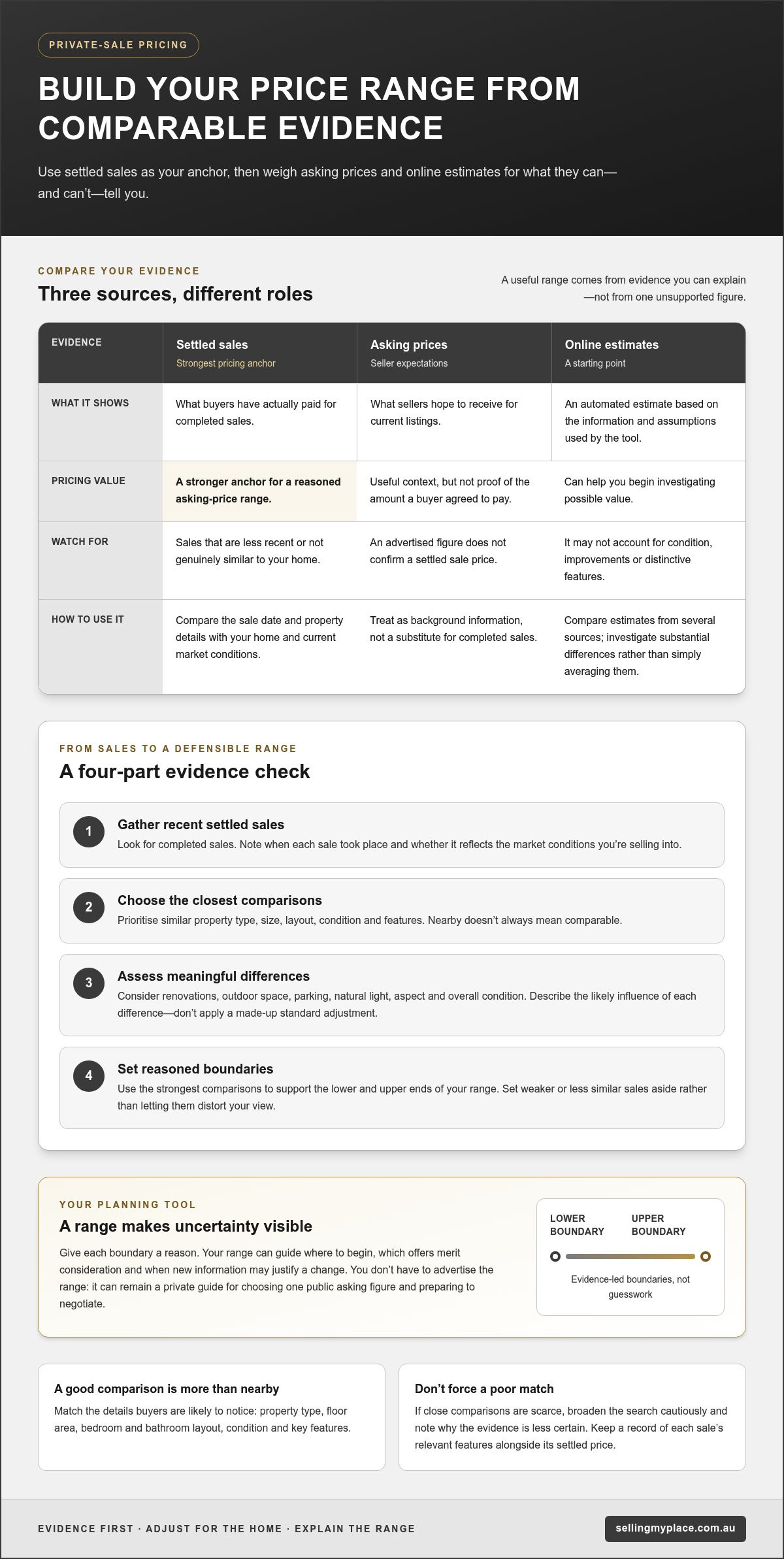
Review and adjust your private-sale price using campaign evidence
Before your listing goes live, decide when you’ll review its performance. A planned check-in helps you avoid changing the price in response to one buyer’s comment or a quiet inspection. You might review after a set period or once you’ve gathered enough enquiry and viewing feedback to spot patterns. Choose a schedule that suits your campaign, then stick to it unless genuinely new evidence calls for an earlier review.
At each check-in, assess the whole picture: the number and quality of enquiries, inspection attendance, recurring feedback and any new comparable sales. One signal on its own rarely tells the full story. A listing might attract plenty of casual questions but few serious inspections, or have steady attendance alongside repeated concerns about price. Those patterns point to different things to investigate.
Read buyer responses without overreacting
Separate general interest from serious engagement. A buyer who asks about availability is at an earlier stage than someone who inspects, asks detailed questions and discusses terms. Record what people say and do, including whether they return for another look or make an offer. One person’s view is useful feedback, not a verdict on your home’s value.
Look for repeated, specific comments. If several prospective buyers independently raise the same concern about price, compare that pattern with your original sales evidence and any new settled sales. If their comments focus on a feature or presentation issue instead, a price change may not address the real obstacle.
Make a measured price review
Before revisiting the figure, check that the listing is accurate and the marketing materials show the property clearly. Confirm that key details are complete, photographs and floorplans represent the home well, and inspection arrangements are straightforward. If those basics need attention, improve them before deciding that the asking price is the problem.
When sustained campaign evidence conflicts with your initial assumptions, return to your price range. Ask whether the comparable sales still support it and whether buyer feedback consistently sits outside your expectations. A revised asking price should recognise what the evidence suggests while respecting your priorities and acceptable terms. If you keep the price unchanged, record why. If you adjust it, note what information supports the decision.
Keep a simple review log with the date, enquiry and inspection patterns, recurring comments, comparable sales considered, presentation checks and your decision. This creates a clear record of how your view developed, rather than leaving you to rely on memory during a stressful campaign. Once interest turns into an offer, a guide to property sale negotiation can help you consider the proposed price alongside conditions and timing.
Kincade International Direct Sales provides private-sale campaign and pricing advice to help you review buyer feedback and your approach.
Set your private-sale price with Selling My Place support
Pricing evidence is most useful when it informs the whole sale plan. Bring your comparable sales, proposed asking-price range and preferred negotiation approach together with a clear plan for presenting the home and reviewing buyer response. Pre-sale consulting and neighbourhood market reports can help you examine your assumptions and form a considered view before your property is advertised.
Kincade International Direct Sales supports Australian homeowners with flat-fee property marketing and advisory packages, without agency commissions. The service combines listing support with practical advice, while keeping the asking price grounded in evidence rather than presenting any figure as a guaranteed result.
What professional private-sale support can contribute
Pre-sale consulting and the Agent Advisory Service can help you review pricing assumptions alongside your sale preparation. Professional photography and floorplans give buyers a clearer picture of the home and its layout, while neighbourhood market reports provide relevant context for weighing your comparisons. Conveyance advice is also available as part of the advisory support, helping you consider the transaction process without treating this article as legal advice.
As you prepare to list, keep the key decisions connected. A price supported by sales evidence still needs marketing that accurately represents the property, and a well-presented listing is more useful when you’ve decided how you’ll assess enquiries and offers. Organise your plan around these practical elements:
- Evidence: Keep a record of the settled sales and property features that inform your pricing view.
- Range: Set reasoned lower and upper boundaries, and decide which figure or format to advertise.
- Strategy: Be clear about your flexibility, priorities and approach to negotiating with interested buyers.
- Review points: Choose when you’ll assess enquiry quality, inspections, feedback and any new comparable sales.
Take the next step with a clear pricing plan
Knowing how to price your home for private sale doesn’t mean predicting the final agreed price. It means making a considered starting decision, understanding the evidence behind it and being ready to review the plan as the campaign unfolds. A flat-fee model gives sellers access to listing and professional services without agency commissions, while keeping the sale decision in their hands. Residential listings remain active until sold, with no time limits.
Kincade International Direct Sales brings the pricing plan together with flat-fee marketing and advisory support, so you can make informed decisions without agency commissions or a promised sale price.
Move forward with a pricing plan you can stand behind
Deciding how to price your home for private sale is an important step, but it doesn’t mean you have to predict the future. Treat your asking price as a considered starting point, then let credible evidence and buyer response inform your next decisions. A written plan can help you stay steady: note what supports your price, what you’re willing to negotiate and what campaign signals would prompt a review.
That clarity can make the next stage feel more manageable. Kincade International Direct Sales brings flat-fee marketing and advisory support together, from professional photography and floorplans to neighbourhood market reports, pre-sale consulting and conveyance advice. There’s no agency commission, and the focus is on helping you make informed choices without promising a particular sale price.
Ready to turn your sales evidence into a practical private-sale pricing plan? Talk with Kincade International Direct Sales about the flat-fee marketing and advisory support available for your campaign.
Frequently Asked Questions
Can I change my asking price after listing my home privately?
Yes, you can generally revise your asking price during a private-sale campaign, but check any applicable state or territory requirements before updating your advertising. Make the change consistently wherever the property is promoted, and note the date and reasoning. For instance, a fresh settled sale or a clear pattern in buyer feedback may support a review. A change is a pricing decision, not a guarantee of increased interest or a particular offer.
Should I price my home above market value to leave room for negotiation?
Not automatically. A higher asking price may give you negotiating room, but if buyers see it as out of step with comparable properties, some may not enquire. Decide first what terms and outcome you could accept, then consider whether your starting figure is supported by the evidence and leaves realistic scope to negotiate. If you choose a higher figure, be prepared to explain its basis and review the response rather than assuming buyers will bargain it down.
Is an online property estimate accurate enough to set my asking price?
Use an online estimate as a prompt for further research, not as your only pricing basis. Automated tools may rely on recorded property details and sales data that don’t reflect renovations, condition, layout or features that make your home distinctive. If two estimates differ, check whether their property information or comparable sales differ too. When working out how to price your home for private sale, test any estimate against relevant settled sales and the specific characteristics buyers will see.
How do I price a home when there are few comparable recent sales?
Start with the closest settled sales you can find, even if the matches aren’t exact. Note where each comparison differs, such as property type, size, condition or sale date. You can widen the search to less recent or less similar sales, but treat those as supporting context rather than equal evidence. If your property is unusual, a market report or pre-sale advice can help you build a reasoned range from the available information.
Can a buyer offer less than the advertised price in a private sale?
Yes. An advertised price is an invitation for buyers to consider the property, not a requirement that they offer that amount. A buyer can propose a lower figure or different terms, and you can accept, decline or make a counteroffer. Consider the complete offer, including conditions and proposed timing, rather than focusing on price alone. Keep your preferred terms and minimum acceptable outcome clear before responding, and have the agreed details documented appropriately.
Do Australian states and territories have different rules for property price advertising?
Yes, requirements can differ between states and territories, and some rules apply to agents rather than private sellers. Don’t assume a rule described for an agent applies to your own listing. Before publishing or changing a price, check current guidance from the relevant state or territory consumer affairs or fair trading authority, especially if you plan to advertise a price range.
Sell Property Zero Commission: A Smarter Australian Selling Guide
What if avoiding percentage-based agent commission didn’t mean managing every part of your sale alone? If you’re exploring how to sell property zero commission, it’s worth understanding what “zero” covers, whether a flat fee includes the marketing you need and how much support is available when buyers have questions.
Zero commission doesn’t mean selling is free. It usually means paying a set fee for an agreed service instead of a percentage of the sale price. The useful comparison isn’t just the fee structure: look at what’s included and how comfortable you are handling buyer conversations, negotiations and practical sale tasks.
A flat-fee approach can offer a middle ground between traditional commission-based representation and managing everything yourself. Kincade International Direct Sales combines professional photography, floorplans and neighbourhood market reports with Agent Advisory Service support, pre-sale consulting and conveyance advice. This gives sellers professional resources while retaining control over key decisions.
In this guide, you’ll learn how zero-commission selling works, what to look for in a flat-fee service and how to weigh marketing and support against the tasks you’re prepared to manage. You can then choose an approach that fits your priorities, not just its fee structure.
Key Takeaways
- To sell property zero commission, understand that a flat fee replaces percentage-based agency commission, but other sale costs may still apply.
- Compare the service scope, marketing materials, advisory support and listing duration, not just the fee structure.
- Professional photography and floorplans can help present your home clearly, while a digital listing network can provide exposure without guaranteeing a sale.
- Decide how involved you want to be and how much time you can give to buyer communication and sale tasks.
- Consider whether photography, floorplans, neighbourhood market reports and advisory support offer the balance of control and assistance you want.
What does sell property zero commission actually mean?
In plain English, zero commission means no percentage-based agency commission is charged on the property’s sale price. Instead of paying an agent a share of the final amount, a seller may use a service with an agreed flat fee for defined marketing or advisory support. The phrase describes how the service is charged, not whether selling a home is entirely cost-free.
Zero-commission property selling means marketing a home without a percentage-based agency commission, usually through a fixed-fee service with a defined scope. It doesn’t guarantee a sale or a particular sale price. The service can help you promote the property and access advice, but the outcome still depends on factors such as buyer interest, the property and your sale decisions. For context on how agent compensation can differ, see Real estate broker commissions and flat-fee services.
If you’re working out how to sell property zero commission, separate the marketing and advisory arrangement from the legal work involved in transferring a home. Property marketing can cover materials and listing support; conveyancing concerns the legal sale process and is a distinct part of the transaction. The two may happen alongside each other, but don’t assume one service fee covers both.
How is zero commission different from no-cost selling?
“Zero commission” refers to the absence of a sale-price percentage charged as agency commission. A marketing or advisory service may still charge a flat fee for agreed work. Sellers may also have separate expenses connected with preparing, marketing or legally transferring a property. The useful question is not whether a service sounds free, but what its fee covers and what remains separate.
Compare the written inclusions and fee terms rather than relying on labels. Look for details on the marketing materials, advisory support and listing period covered, as well as work or expenses outside the service scope. This gives you a clearer view of the arrangement before deciding how you want to sell.
What does a flat-fee property service change?
A percentage commission changes with the final sale price; a flat fee is set for defined services rather than calculated as a share of the result. This can make the service charge easier to understand in advance, but the fee structure alone doesn’t tell you how much practical help you’ll receive. Scope matters just as much as price: listing support, photography, floorplans and advice can all differ between services.
The model can also change how involved you are. With a commission-based agent, the arrangement may include representation across parts of the sale; with a flat-fee service, you may retain more control and take a more active role. Neither structure suits every seller. Consider the tasks you’re comfortable handling and the support you value before weighing the options.
Keep the legal conveyancing process in view, too. A marketing or advisory fee doesn’t automatically include the preparation or handling of sale documents. Conveyance advice can help you understand that part of the journey, while the legal work itself remains distinct. Knowing where one service ends and another begins helps you budget and plan with fewer surprises.
What can a zero-commission property marketing service include?
A flat-fee arrangement describes how the service is charged, but its inclusions determine what practical help you receive. A commission-free marketing service can bring together listing exposure, presentation materials and advice, allowing you to retain a role in decisions while getting professional support. The right mix depends on what you want help with and which selling tasks you’re comfortable managing yourself.
A digital listing network can put a property in front of potential buyers through online marketing channels. Kincade International Direct Sales uses a global digital marketing network, but exposure isn’t a promise that a particular buyer will see the listing or that the property will sell. Professional photography and floorplans add useful context: images show the home’s presentation, while a plan helps people understand room layout and flow.
How do listing materials support a property sale?
Photos help prospective buyers form an initial impression of spaces, finishes and features. A floorplan adds another layer by showing how rooms connect, which can be difficult to judge from images alone. Clear listing information helps people assess whether the home’s layout and features may suit their needs before arranging a closer look. These materials support informed consideration; they don’t guarantee interest or an offer.
Neighbourhood market reports can add context as you prepare for sale and discuss pricing. They’re one input for understanding the market, not a promise of what a buyer will pay. For wider industry context, Real Estate Institute of Australia (REIA) insights can help readers explore information about Australia’s property sector and market.
What role does professional advice play?
Pre-sale consulting provides guidance before a home goes to market, helping you think through preparation and sale decisions. The Agent Advisory Service offers support as you weigh choices, while leaving you in control of how you proceed. Buyer representation has a different focus: it relates to representing a buyer, rather than marketing a seller’s property.
Conveyance advice is also distinct from listing and buyer-facing activity. It relates to the legal side of a property transfer, while marketing services focus on presenting and promoting the home. Advice can help clarify the process, but it isn’t the conveyancing work itself.
Use this table to compare what each feature can contribute and the questions it may help you answer:
| Service feature | Potential seller benefit | Question it helps answer |
|---|---|---|
| Digital listing network | Online exposure across a marketing network | Where may buyers encounter the listing? |
| Photography and floorplans | Visual detail and a clearer sense of layout | How can buyers understand the home’s presentation and flow? |
| Neighbourhood market reports | Context for preparation and pricing discussions | What market information can inform my decisions? |
| Pre-sale consulting and Agent Advisory Service | Guidance for planning and decisions | Where would professional input be useful? |
| Conveyance advice | Guidance distinct from marketing activity | What legal-transfer questions should I understand? |
If you’re considering how to sell property zero commission, compare the actual support and deliverables with the tasks you’ll take on. Commission-free property marketing support brings together marketing resources and advisory assistance for sellers who want to retain control.
Zero commission versus traditional commission: how should you compare?
A percentage-based commission ties the agency fee to the property’s sale price. A flat-fee model uses an agreed charge for defined services instead. Neither structure tells the whole story: services with different fee models may also differ in marketing, advice and how much of the sale you manage yourself.
The fee structure alone can’t tell you which selling service is right; compare the support, deliverables and seller responsibilities that come with it. This matters because a lower or more predictable fee may still leave you with tasks you’d rather have help handling. Equally, paying a percentage doesn’t automatically mean every service or level of support is included.
Which selling model fits your preferred level of involvement?
Start with an honest assessment of your time and confidence. If you’re comfortable coordinating parts of the sale and making direct decisions, a flat-fee service may suit your preference for control, especially when paired with defined marketing and advisory support. If you want someone to take a more hands-on role, clarify what that representation involves. Traditional agents’ services can vary, so don’t assume every commission arrangement includes the same tasks or support.
More control can mean more participation. Depending on the service structure, you may have a greater role in responding to enquiries, communicating with interested buyers or making decisions during negotiations. Think about when you’d welcome professional guidance and when you’d rather manage things directly. The best fit should reflect your comfort level, not just how the fee is calculated.
What should you compare beyond the fee structure?
Set the service details side by side. Compare the included marketing deliverables, the reach of the listing network, access to advice and how long the property remains listed. Then clarify how buyer enquiries, negotiations and sale decisions are handled. These practical details show what you’re paying for and where your own time may be needed. For more context on listing support, see Professional Residential Property Listing Services: The Modern Australian Seller’s Guide.
A useful comparison separates the fee basis from the working arrangement:
| Model | Fee basis | Seller role | Support structure |
|---|---|---|---|
| Traditional commission | Percentage linked to the sale price | Depends on the agreed representation and service scope | Can involve agent support, but inclusions and responsibilities vary |
| Flat-fee marketing and advisory | Agreed fee for defined services | May retain more direct control and take an active role | Can combine marketing materials with advisory support; clarify how enquiries and decisions are handled |
For a like-for-like comparison, write down the service inclusions and responsibilities before weighing the fee. A service may, for example, include professional photography, floorplans, advisory access and a listing that remains active until sold without time limits. Match each inclusion against what matters to you, then note any tasks you’d handle yourself. That gives you a clearer picture of the trade-off between hands-on assistance, seller control and the practical work of bringing a property to market.
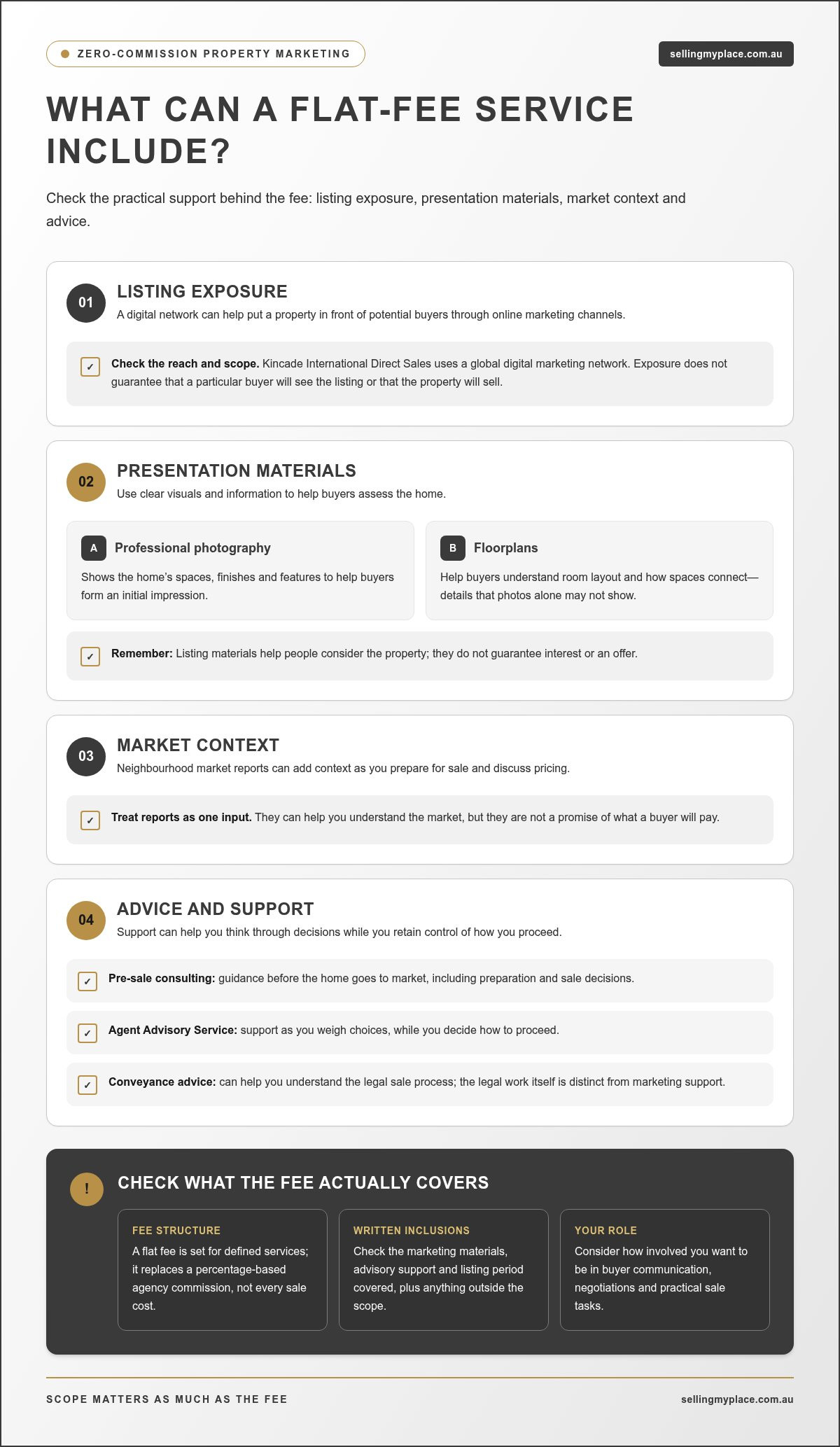
How can you decide whether selling property zero commission suits you?
The right selling approach should fit your time, confidence and appetite for direct involvement. Before deciding whether to sell property zero commission, map out the tasks you’re happy to manage and where professional guidance would make the process more manageable.
- Start with your involvement and available time. Consider how much time you can set aside for preparing the property, responding to buyer enquiries and keeping sale tasks moving. Greater control can be appealing, but it often comes with more direct participation.
- List the support you value most. Write down the marketing materials, advice and communication support you want. You might prioritise photography and floorplans, guidance before launch, help thinking through buyer conversations or advice as you weigh sale decisions.
- Compare the arrangements in writing. Set out each option’s fee basis, included services, listing terms and any responsibilities you’ll take on. A written comparison makes differences easier to spot than a headline label alone.
- Separate the stages of the sale. Preparation, marketing, negotiation and conveyancing each need attention, but they aren’t the same task. Decide where you’ll lead, where advisory support would help and how you’ll handle the legal transfer process.
What should you clarify before choosing a service?
Look for clear descriptions of which marketing materials and advisory services the flat fee covers, how long the listing stays active and what ongoing support means in practice. Then consider your own capacity: would you feel comfortable handling buyer communication and making sale decisions, or would guidance at key moments help you feel more assured?
For a service that keeps a listing active until sold without time limits, that duration can be an important part of your comparison. Listing duration alone doesn’t tell you how buyer enquiries or negotiations are managed. Add those responsibilities to your written notes so you understand the working arrangement as well as its timeline.
How can you prepare for the sale without taking on every task alone?
Divide your plan into seller-led decisions and tasks supported by marketing or advisory services. You might lead on presentation choices and decisions about an offer, while using professional photography, floorplans and pre-sale consulting to support preparation. The Agent Advisory Service can also provide input as you consider your next steps.
Plan how you’ll respond to buyer enquiries and approach negotiations before the first conversation arises. A step-by-step guide to sale by owner in Australia can help you map the process, while a guide to property sale negotiation can help you think through buyer discussions. Conveyancing remains a distinct part of the transaction, so include it in your planning rather than treating marketing support as a substitute.
Commission-free property marketing and advisory support combines marketing resources with guidance for sellers who want to stay involved in the sale.
How Selling My Place supports a zero-commission property sale
Selling a home involves more than choosing a fee model. You need a clear way to present the property, reach prospective buyers and make considered decisions as the sale progresses. Kincade International Direct Sales’ flat-fee marketing and advisory service offers a middle ground: you retain control of key choices while accessing professional marketing materials and guidance.
The service brings together professional photography, floorplans, neighbourhood market reports and a global digital marketing network. Each supports a different part of the sale: photography and plans help present the home, market reports provide context for preparation and pricing discussions, and the network supports digital marketing exposure. Exposure can’t guarantee buyer interest or a sale, but these resources give you practical tools for putting your property forward.
What support can sellers access through the service?
Listings can remain active until sold without time limits, giving sellers an ongoing listing rather than a set end date. This doesn’t guarantee a sale or a particular timeframe. Agent Advisory Service support, including pre-sale consulting, can help you consider decisions before the property goes to market and as you work through the sale. Conveyance advice relates to the transfer process, distinct from marketing and buyer-facing activity.
The balance is intentional: you stay involved in decisions, with professional resources to support the work around them. For example, use photography and floorplans to present the property clearly, then draw on neighbourhood market information as you prepare for pricing discussions. Advisory support can help you think through your approach while you remain responsible for the choices that matter to you.
As you consider the support, think about which parts of the sale you want to lead and where guidance would be useful:
- Property presentation: professional photography and floorplans help show the home’s features and layout.
- Market context: neighbourhood market reports offer information to consider during sale preparation and pricing discussions.
- Digital marketing: a global digital marketing network supports the listing’s exposure without promising a specific audience or result.
- Sale guidance: Agent Advisory Service support, pre-sale consulting and conveyance advice address different decisions and stages.
What is a sensible next step for an interested seller?
Before discussing your options, jot down a few details: the property you’re selling, your preferred timing and how involved you want to be. Note the marketing and advice you value most, too. This gives the conversation a useful starting point and helps you focus on whether the service scope and flat-fee structure fit your priorities, rather than judging by the fee label alone.
For sellers considering how to sell property zero commission, a practical discussion can help clarify the model and the support available. Talk through your property sale with our team.
Choose a selling approach that feels right for you
A property sale is a significant transition, and the process should feel workable for your circumstances, not simply appealing on paper. Before you decide how to sell property zero commission, think about what would help you feel informed and in control: a clear view of the service scope, room to make your own decisions and professional guidance where you’d value it.
Your next step can be a practical conversation about your property, timing and preferred level of involvement. Talk through how the flat-fee model works, what support it includes and whether the balance suits the way you want to sell. Arriving with a few priorities in mind can make that discussion more useful, whether you’re ready to move ahead or still weighing your options.
Talk through your property sale with our team to discuss a sale plan that fits your priorities. You don’t need every detail settled before you begin; a clear conversation can help you identify your next steps.
Frequently Asked Questions
Is selling property with zero commission really free?
No, not necessarily. Zero commission means no percentage-based agency commission is charged, not that selling has no costs. A flat-fee service may charge for defined marketing and advisory work, while other sale-related expenses can remain separate. If you plan to sell property zero commission, compare written inclusions, fee terms and your responsibilities before deciding. This helps you understand what the arrangement covers rather than relying on the label alone.
Can I sell my property without an agent and still get professional support?
Yes. You can take a more active role in the sale while using a property marketing and advisory service for professional assistance. For example, photography and floorplans can help present your home, while pre-sale consulting can support decisions before launch. You’ll still have responsibilities, such as making sale decisions and handling agreed tasks. This differs from traditional full-service representation, and the support offered varies between arrangements.
How much can I save by selling property with zero commission?
There’s no single saving that applies to every seller. The difference depends on your sale price, the fee structure and which services are included in each arrangement. Compare the full written scope and fee terms with the commission-based option you’re considering, including any tasks you’ll manage yourself. A lower fee alone doesn’t show which model is the better fit; the value of the support and your preferred involvement matter too.
What happens if my property does not sell straight away?
What happens next depends on the listing duration and ongoing service terms. With Kincade International Direct Sales, a property can remain listed until sold without time limits. That means there’s no set time limit on the listing, not a guarantee that a sale will occur. Review the service terms to understand how continued listing and support work if the sale takes longer than expected.
Do zero-commission property services include photography and floorplans?
Inclusions vary, so look at the stated deliverables rather than assuming every service provides the same materials. Kincade International Direct Sales provides professional photography and floorplans. Photos give prospective buyers a visual impression of the home, while a floorplan helps them understand how rooms connect and how the layout works. These tools can make property information clearer, but they don’t guarantee more enquiries, a higher sale price or a faster result.
Is a flat-fee service better than paying a traditional property commission?
It depends on your priorities, how involved you want to be and the support you need. A flat fee changes how the service charge is structured compared with percentage-based commission, but it doesn’t determine the service scope or your responsibilities. Compare marketing deliverables, advisory access, listing duration and the tasks you’ll handle yourself. The better fit is the arrangement that aligns with your comfort level and sale priorities, not simply the fee label.
Can I negotiate the sale price when using a zero-commission service?
Yes. As the seller, you make decisions about offers and the sale outcome you’re prepared to accept. The support available during buyer discussions depends on the service arrangement. Kincade International Direct Sales offers advisory support and buyer representation, which is a distinct service for buyers. Before negotiations begin, consider your priorities and how you’ll communicate them clearly. Preparing in advance can help you approach offer discussions thoughtfully, without guaranteeing a particular result.
List Until Sold: A Guide for Australian Sellers
A list until sold property service can keep your home listed without a set time limit, while you retain a say in how the sale is managed. “Until sold” describes the listing period, not a guarantee of a buyer or a completed sale. The marketing, fee structure and guidance included can also differ between services.
It’s reasonable to ask whether a flat fee covers the resources needed to present your home well, and how much of the buyer communication and sale process you’ll handle yourself. The right arrangement depends on what’s included and the level of involvement you want.
This guide explains how the service works and what to compare, including listing duration, marketing, property presentation and advisory support. You’ll see how professional photography, floorplans, neighbourhood market reports and guidance with pre-sale preparation and conveyance can fit into a flat-fee model. Use these details to weigh the service against the time and responsibility you’re comfortable taking on, then choose an approach that suits your property and circumstances.
Key Takeaways
- “Until sold” means a listing has no set time limit; it doesn’t promise a buyer or a completed sale.
- When comparing a list until sold property service, look beyond the label and assess listing reach, marketing assets and advisory support.
- Decide how much of the sale you want to manage, including buyer enquiries, inspections and offer discussions.
- Compare flat-fee listings, sale by owner and traditional agency arrangements by looking at fees, support and your role in the process.
- Kincade International Direct Sales combines ongoing listing, professional photography, floorplans and advisory guidance in a flat-fee model.
What does a list-until-sold property service mean for Australian sellers?
A list-until-sold property service keeps a home listed for sale without a set time limit, under the terms of the service. “Until sold” describes how long the listing can remain active. It doesn’t guarantee a buyer, an acceptable offer or settlement.
Listing duration is just one part of a sale. Marketing reach concerns where and how buyers may see the property. Advisory support covers the guidance available as you prepare and manage the sale. Consider these elements separately, because the listing label alone doesn’t explain what’s included. For context on the broader Australian market, see this overview of real estate in Australia.
For sellers across Australia, a list until sold property service can be an alternative to a commission-based agency arrangement, combining an ongoing listing with professional marketing and advice. Before choosing, identify what the service provides and which parts of the sale you’ll manage yourself.
What does ‘listed until sold’ actually promise?
It means the listing has no set time limit under the arrangement. It does not mean the property will sell within a particular period, attract an offer or reach settlement. Those outcomes depend on factors such as the property, its presentation and pricing, and how buyers respond. An ongoing listing provides time on the market, not certainty about the result.
Also distinguish continued listing from marketing reach. A property can remain listed, but the value of that exposure depends on the marketing infrastructure and assets supporting it. Advisory help is a separate consideration. It can support decisions about preparing and selling, but it is not the same as keeping a listing active. Assess the service as a combination of duration, exposure and support rather than relying on the label alone.
Who might consider a list-until-sold service?
This approach may suit owners looking for an alternative to a percentage-based agency arrangement who are comfortable taking an active role in the sale. They may value professional photography, floorplans and market information while remaining involved in tasks such as responding to enquiries, arranging inspections and discussing offers.
An owner who wants a more hands-off experience may prefer an arrangement where a professional manages more of the sale process, such as partnering with a full-service agency like RealHelp Real Estate to oversee marketing and buyer communications. Neither preference is unusual. The practical question is how much responsibility you want to retain and whether the available marketing and advisory support suits that choice. A flat-fee arrangement can avoid commission-based fees while pairing owner involvement with professional resources. Consider the week-to-week workload too: responding to buyers and coordinating inspections takes time, even when the listing and presentation are professionally supported.
What should a list-until-sold property service include?
A useful package brings together more than an ongoing listing. Assess three parts: the materials used to present your home, the infrastructure that gives it exposure, and the guidance available as you prepare for and manage the sale. Clear inclusions help you understand what the flat fee covers and what you’ll be responsible for, rather than relying on the “until sold” label alone.
Kincade International Direct Sales combines professional photography, floorplans and neighbourhood market reports with global marketing infrastructure, pre-sale consulting and conveyance advice. These components support different stages, from preparing a listing to making informed decisions during the sale.
- Marketing assets: Professional photography presents the home visually, while floorplans help buyers understand its layout. Neighbourhood market reports provide context as you consider how to position the property.
- Listing infrastructure: Global marketing infrastructure supports the property’s exposure. Reach is different from listing duration, so consider how the marketing works alongside the ongoing listing.
- Professional guidance: Pre-sale consulting and conveyance advice provide support with preparation and sale-related decisions.
Each component serves a different purpose: presentation, visibility or informed decision-making. None can promise a particular buyer response or sale price. Knowing what’s covered, however, makes it easier to compare a service with your priorities and preferred level of involvement.
How professional marketing supports a property listing
Good listing material helps buyers form a clearer first impression before they enquire or arrange an inspection. Photography shows the home’s presentation, while a floorplan gives practical context about room arrangement and flow. Together, they help buyers picture how the property might suit their needs. Kincade’s professional residential property listing services sit alongside global marketing infrastructure. Listing duration alone doesn’t indicate how a home is promoted.
When comparing packages, look for specific marketing assets and infrastructure rather than broad claims about exposure. A clear description helps you understand how the listing is supported and what role you’ll play in presenting your home to buyers.
What advisory support can add to the selling experience
Preparing to sell involves decisions as well as presentation. Pre-sale consulting can help you think through preparation, while neighbourhood market reports offer context for planning and seller decisions. They provide insight, not a promise of a particular outcome.
Conveyance advice can make sale-related steps easier to understand; it isn’t legal representation. Together, these forms of guidance provide a framework while you remain involved in the sale. To discuss your priorities and the support available, discuss your property sale.
How does list-until-sold compare with an agent or selling privately?
The right selling arrangement depends on more than the fee label. Compare each option using the same practical questions: how you pay, what marketing is provided, how much of the work you’ll handle and what advice is available. Traditional agencies, sale-by-owner arrangements and flat-fee listings can have different inclusions, so don’t assume every service in a category works the same way.
- Traditional agency: The fee may be commission-based, and the agent may manage more of the marketing and sale process. The fee structure, campaign and level of involvement depend on the arrangement.
- Sale by owner: You retain a high degree of control and take responsibility for more of the selling process. The marketing tools and advice available depend on the resources you use.
- Flat-fee listing: You pay a defined fee for the agreed service rather than a percentage-based agency commission. Marketing assets and advisory support are part of the package, and you may remain closely involved in managing the sale.
A list until sold property service may use a flat-fee model, but the label doesn’t tell you how much support comes with it. Compare the actual inclusions and your responsibilities before weighing one arrangement against another.
How to compare fees and marketing without false equivalence
A flat fee and a commission are different charging methods, not a complete measure of value. For a fair comparison, set out the fee structure alongside the marketing assets, listing infrastructure and guidance included in each arrangement. Check whether photography, floorplans, market information or pre-sale advice form part of the service, then note which selling tasks remain yours.
Be cautious with headline savings claims. An average saving is useful only when its calculation, comparison and relevance to your sale are clear. Focus on the terms and inclusions that matter to your situation rather than treating a broad figure as a prediction of what you’ll save.
How to decide how much selling responsibility you want
Consider the practical workload. Are you comfortable handling buyer communications, arranging inspections and making decisions about offers, or would you prefer a professional to manage more of those steps? Service structures balance owner control and professional support in different ways. A step-by-step guide to selling your own home can help you understand the tasks involved before choosing how hands-on to be.
Negotiation is another part of the decision. If you’ll speak directly with buyers, consider how you’ll assess an offer, respond to conditions and keep your priorities clear. These property sale negotiation tips offer useful prompts as you prepare. Choose an arrangement that suits both your preferred involvement and the support you value, not simply the one with the most appealing fee description.
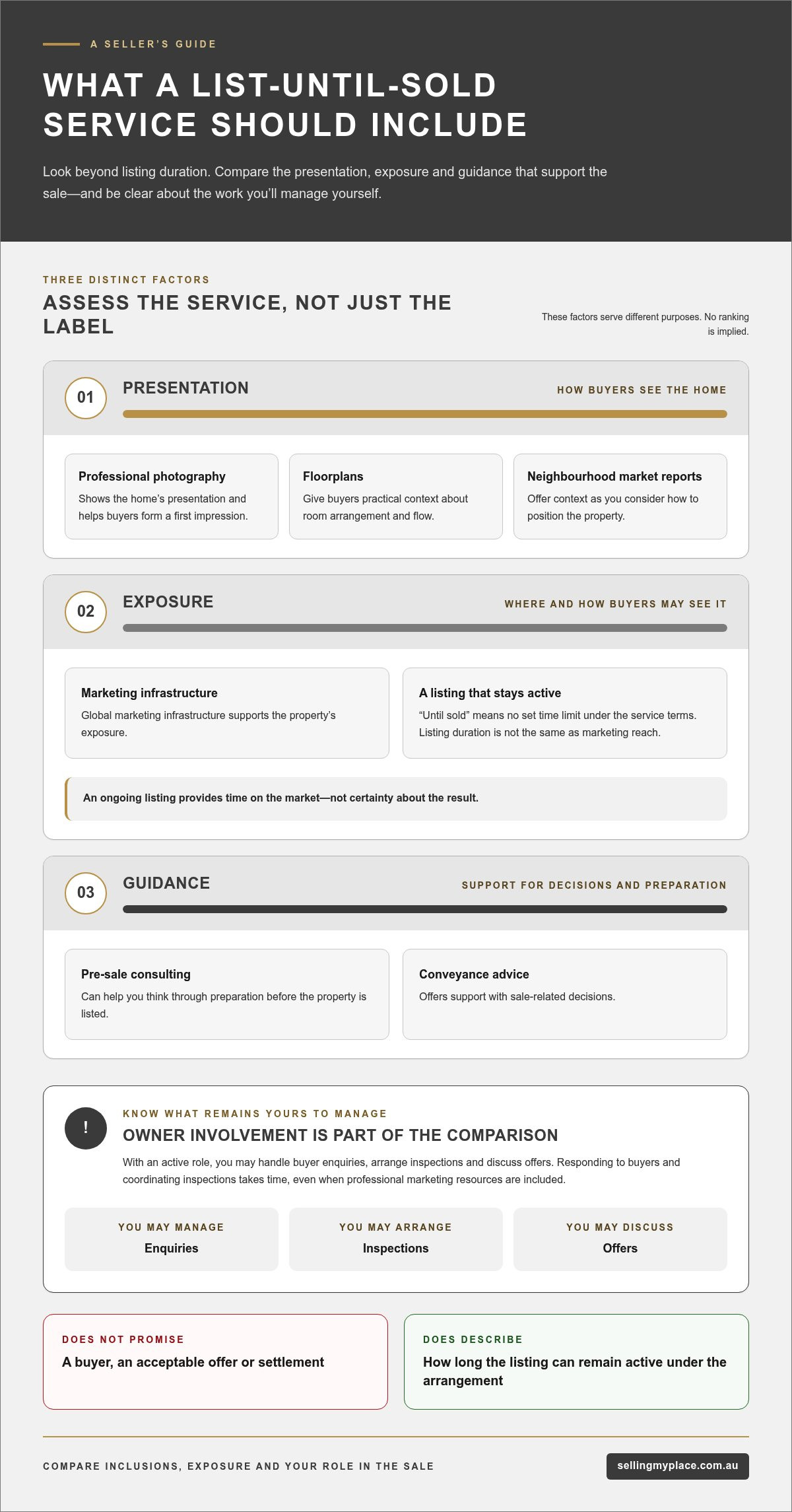
What should you assess before choosing a list-until-sold service?
Some preparation makes it easier to judge whether a service fits your home, priorities and preferred level of involvement. Instead of starting with the “until sold” label, decide what you need the arrangement to do and what you’re comfortable managing yourself.
Match the service to your property and selling priorities
Start by naming your main priority: broader marketing reach, polished presentation, practical guidance or greater direct involvement. A list until sold property service can combine these elements in a flat-fee arrangement. The right balance depends on your needs. Photography can showcase the home, floorplans can help buyers understand its layout, and neighbourhood market reports can provide context for your planning. Consider which resources will help with your property and the decisions ahead.
Use this ordered checklist to assess the fit:
- Set your priorities. Decide what matters most, such as presentation, marketing infrastructure, advice or control over the sale process.
- Match inclusions to those priorities. Consider whether professional photography, floorplans and market information address your needs, and what guidance is available.
- Understand your role. Identify how involved you want to be in communications, inspections, offers and other sale decisions. The service structure should make the balance between owner participation and professional support clear.
- Review the terms. Understand how long the listing can remain active, how the flat fee works and which services are included. Treat duration as a listing term, not a forecast of when the property will sell.
Clarify the listing terms and the owner’s role
Before choosing an arrangement, make sure you can explain its core terms in plain language: what “until sold” means, what the flat fee covers and where your involvement begins. This helps avoid mistaking an ongoing listing for a fully managed sale. Base your decision on the stated inclusions and responsibilities rather than assumptions about what a label usually means.
Price preparation deserves attention too. An asking price based only on a neighbour’s sale, an online estimate or personal hopes may not reflect the evidence relevant to your property. Consider comparable properties and the features and condition that may affect how buyers assess your home. A considered pricing approach gives you a more grounded starting point, though market response can still differ from expectations. For a structured overview, see how to determine a home’s market value.
Once you’ve identified your priorities, the terms and the role you want to take, assess the service as a whole, not just its listing duration. To discuss how a flat-fee listing and advisory support could fit your sale, talk through your property sale.
How Kincade International Direct Sales supports a list-until-sold sale
Kincade International Direct Sales provides commission-free residential property marketing on a flat-fee basis, with an ongoing listing and practical advisory support. The service gives Australian property owners professional marketing resources while letting them decide how involved they want to be in the sale.
“Until sold” means the listing has no set time limit. It isn’t a promise that a buyer will be found, an offer accepted or a sale completed. The result still depends on the property, its presentation and pricing, and how buyers respond. Understanding the distinction helps set clear expectations from the outset.
What the Kincade service brings together
The service combines a residential listing with global marketing infrastructure and property presentation materials. Professional photography helps showcase the home, while floorplans give buyers a view of its layout. Neighbourhood market reports provide context owners can consider as they prepare and make decisions about the sale.
These marketing elements sit alongside the Agent Advisory Service, which provides pre-sale consulting and conveyance advice. This guidance complements the marketing work by helping owners approach preparation and sale-related steps with more information, without promising a sale price or outcome. Conveyance advice is guidance, not legal representation.
- Ongoing listing: The property can remain listed without a set time limit.
- Marketing and presentation: Global marketing infrastructure is supported by professional photography, floorplans and neighbourhood market reports.
- Advisory support: Pre-sale consulting and conveyance advice can help inform the owner’s decisions.
Together, these elements form a defined service model: a flat fee, an ongoing listing and marketing resources, with advisory support alongside them. Consider how those components fit your property and which parts of the sale you want to manage yourself.
A straightforward next step for Australian property owners
If you’re considering this approach, outline the property you’re selling and how involved you’d like to be. You might want to take an active role while using professional presentation materials and advice, or you may be weighing up the balance of support that would suit you.
A conversation can help you understand the service structure and decide whether it fits your priorities. An ongoing listing is not a guaranteed result, so take the time you need to make a considered choice. Talk through your property sale and the level of involvement that feels right for you.
Choose a selling approach that feels right for you
Selling a home is a significant step. The right arrangement should fit both your property and the way you want to take part. A list until sold property service gives you a framework to assess: a flat fee without agency commission, an ongoing listing that doesn’t guarantee a sale, and marketing resources such as professional photography and floorplans, alongside advisory support.
Before moving ahead, picture what a well-supported sale would look like for you. Which decisions do you want to make yourself? Where would practical guidance help you feel more prepared? Thinking through these questions can make a conversation more useful and help you judge whether the service suits your circumstances.
To explore whether the service fits, talk through your property sale with our team. You don’t need to have every detail settled first. A clear understanding of your priorities is a good place to begin.
Frequently Asked Questions
Does a list-until-sold property service guarantee that my home will sell?
No. “Until sold” describes the listing period, not a guaranteed sale, accepted offer or settlement. A list until sold property service can keep a listing active under its terms, but buyer interest and offers depend on factors such as price expectations, presentation and market conditions. If enquiries are limited, review the feedback available and consider whether your pricing or presentation needs a fresh look with your adviser.
Can I sell my home myself while using a list-until-sold service?
Yes. Some arrangements support owners who want to stay actively involved, although the division of work varies. Before proceeding, map out who handles each task, including responding to enquiries, arranging inspections, discussing offers and coordinating sale steps. For example, if you prefer to speak directly with buyers but want professional marketing materials, make that preference clear when reviewing the service terms. Keep the decisions that remain yours in view.
How much does a list-until-sold property service cost?
The fee depends on the service’s pricing structure and inclusions. Kincade International Direct Sales uses a flat-fee model without agency commission. To understand the overall cost of selling, separate the service fee from other expenses you may incur, such as conveyancing or property preparation. Then compare what each arrangement provides rather than judging value by the fee structure alone.
What happens if my property has not sold after several weeks?
An active listing can continue under its terms, but review how the campaign is performing rather than relying on time alone. Consider the enquiries and buyer feedback received, and whether the presentation and asking-price expectations remain appropriate. You can discuss these points with the adviser supporting your sale and decide whether any changes suit your circumstances. No single adjustment suits every property.
Is a flat-fee property service the same as a traditional real estate agent?
Not necessarily. A flat-fee service charges differently from a commission-based agency arrangement, and the work handled for you can differ too. The distinction isn’t simply “online” versus “agent”; arrangements vary in their marketing, advice and owner involvement. Compare the written inclusions and responsibilities for the service you’re considering to see whether the support matches the way you want to sell.
Can I change my asking price while my property is listed?
You may be able to revise your asking price, subject to the listing terms and your instructions. Consider buyer feedback alongside evidence from comparable properties, rather than changing the price solely because time has passed. Repeated comments about value may prompt a review, while a lack of enquiries could have several explanations. Discuss the available information with your adviser, then decide whether a change aligns with your priorities.
What information should I prepare before discussing a property listing service?
Bring a basic outline of the property, your preferred timing and the support you’re looking for. Notes about its features, condition, recent improvements and any price expectations can make the discussion more practical. It’s also useful to think about how much of the sale you want to manage personally. You don’t need every decision finalised; identifying your questions and priorities is a helpful starting point.
Online Property Valuation Tools Compared: Which Estimator Is Most Accurate for Australian Sellers?
Two tools. Same address. A $120,000 difference in estimated value. This is not a hypothetical scenario; it is a routine experience for Australian property sellers who run their address through more than one free online estimator before setting an asking price.
The problem is not that these tools are unreliable. It is that each one draws on different data sources, applies different algorithms, and was built with a different end user in mind. CoreLogic, Domain, realestate.com.au, and the major banks all produce estimates for the same property, and they frequently disagree in ways that matter enormously when you are deciding where to pitch your listing.
Finding the most accurate property value estimator in Australia is not about identifying a single winner. It is about understanding which tool performs best for your property type, your suburb, and your specific selling circumstances.
This comparison stress-tests the leading free estimators against each other, exposing their data sources, typical error margins, and the conditions under which each one over- or underestimates. By the end, you will know exactly which tool to trust and when to go further.
Why the Same Property Gets Different Values from Different Tools
Run four free property valuation tools on the same address and you may get four meaningfully different numbers. A significant gap between the highest and lowest estimate is not unusual, and it reflects something fundamental: each tool draws on a different data set, updates on a different cycle, and applies its own algorithmic logic to fill the gaps.

Four distinct data ecosystems are in play. CoreLogic draws on extensive settlement data, giving it a deep historical sales record in Australia. Domain blends settlement data with its own listings database to capture current price momentum. Bank-embedded tools run proprietary mortgage-valuation models calibrated for lending risk, not market value. Aggregator tools layer public sources together, often without disclosing their exact inputs.
Every one of these tools is built on an automated valuation model, or AVM: a statistical regression that finds comparable sales, weights them by recency and similarity, then adjusts for property attributes inferred from available records and sale history rather than physical inspection. That distinction matters enormously for renovated or altered properties.
Two structural problems degrade accuracy regardless of which tool you use. Data lag means there is typically a gap of weeks to months between a property settling and that sale appearing in a database, anchoring estimates in fast-moving markets to yesterday’s prices. Thin comparable markets are the second problem; in suburbs recording a thin pool of comparable sales per quarter, the statistical foundation becomes too shallow to support a reliable estimate.
The stakes are real in both directions. Understanding the accuracy gap between online estimates and actual sale outcomes is the first step to using these tools without being misled by them. An overpriced listing stagnates and attracts price-reduction stigma; an underpriced one surrenders equity that is rightfully yours.
How This Comparison Was Structured
Each tool is evaluated against five criteria: data source transparency, update frequency, error margin, over/under-estimation bias, and best-fit property conditions. These criteria map directly to the decisions a seller faces when setting an asking price.
On error margins specifically: none of the major providers publish quantified accuracy ranges for their consumer-facing estimates. That absence is itself informative. In regulated financial contexts, ASIC consistently flags “valuation uncertainty” as a systemic risk requiring disclosure. Consumer property tools carry no equivalent obligation, giving vendors little external pressure to publish figures that might undermine user confidence. Absent data is not neutral data; it signals limited accountability.
Accuracy comparisons are made across four property segments where performance diverges sharply: a standard suburban house in an established suburb, an apartment in a high-turnover complex, a recently renovated property, and a low-transaction rural or semi-rural property. For a deeper look at why automated models struggle with these distinctions, see Algorithm vs. Reality: Why Online Estimates Can Miss the Mark.
Major providers announced machine learning improvements through 2025 and 2026 that have reduced systematic bias in well-supplied metropolitan markets. Those gains are real but uneven; volatile and low-volume markets remain the persistent weak point.
A necessary boundary: this comparison is a decision-support guide for sellers doing pre-listing research. It does not replace a licensed valuer’s report and is not financial advice.
CoreLogic: The Largest Data Set in Australia and Its Blind Spots
CoreLogic’s automated valuation model draws on a comprehensive settlement and sales history database in Australia. That data depth is why CoreLogic underpins most bank pre-approval tools and broker valuations, as well as its own consumer-facing estimates. When you see a property value estimate embedded in a major bank’s loan calculator, you are almost certainly looking at CoreLogic’s output.
Where it performs well: CoreLogic is most reliable for standard 3-4 bedroom houses on consistent land sizes in high-turnover metropolitan suburbs. Deep, recent comparable sales give the algorithm what it needs; in those conditions, the model’s output is a credible reference point.
The renovation blind spot: CoreLogic’s model infers property condition from available records and sale history rather than physical inspection. A home that has been substantially renovated without council permits, which is common in older housing stock across many Australian suburbs, will often be valued as though those improvements do not exist. The under-estimation gap in these cases can be material. When using neighbourhood market reports to build a data-driven foundation, this is precisely the kind of structural bias worth cross-referencing before committing to a price range.
The timing lag problem: In rapidly appreciating outer-ring suburbs, settled sales data lags behind listing-price momentum by weeks to months. CoreLogic’s model anchors to settled transactions, so it will structurally under-estimate in fast-moving growth corridors. The reverse applies in correcting markets, where recent comparable clusters can push estimates above what current buyers will actually pay.
How to use it: Treat CoreLogic’s estimate as a floor-price sanity check for standard metro properties, not a ceiling for asking price expectations. One important caveat: CoreLogic does not publish confidence interval ranges for its consumer estimates, so there is no transparency about how wide the uncertainty band is for any given address. Cross-referencing a second tool is not optional; it is necessary.
Domain Property Value Estimate: Strengths in Metro Apartments, Gaps Elsewhere
Where CoreLogic leans on historical settlement depth, Domain’s model takes a different architectural approach. Domain’s model combines settlement data with its own extensive listings database, giving it a dual signal of historical sale prices and live listing-price trends.
That dual-signal design is Domain’s core differentiator. In markets where listings are actively turning over, the model can respond to price momentum faster than tools anchored purely to settled sales, which carry an inherent lag of weeks to months from settlement to database entry.
Where Domain performs well
The Domain property value estimate is at its most reliable for units and apartments in high-density urban precincts: inner Sydney, the Melbourne CBD fringe, and inner Brisbane. In these markets, high listing volumes and structural homogeneity across comparable properties give the algorithm clean, plentiful inputs. When hundreds of near-identical two-bedroom apartments transact annually in the same postcode, the model has exactly what it needs.
Where accuracy degrades
In low-volume markets, the picture changes materially. Regional towns, prestige suburbs with thin annual comparable sale pools, and suburbs with highly varied housing stock all thin out Domain’s comparable pool. Confidence intervals widen significantly in these conditions, but that uncertainty is not disclosed to the user; the estimate is presented with the same apparent confidence regardless of how much data underpins it.
Bias direction to watch
In hot markets, Domain estimates tend to track listing-price optimism upward, which can push estimates above eventual sale prices. In cooling markets, the reverse applies: listings adjust down faster than the model updates, producing estimates that lag behind current buyer expectations.
For sellers in mixed or non-metropolitan markets, treat the Domain estimate as a read on market sentiment rather than intrinsic value. Cross-referencing it against recent comparable sales is essential. The pricing strategies covered in this 2026 seller guide explain how to use sentiment-based signals without anchoring to them.
realestate.com.au Price Estimate: Wide Reach, Variable Precision
Where Domain uses a dual listings-and-settlement signal, realestate.com.au takes a different approach: its property value estimate online draws primarily on REA Group’s own listings database, the largest by volume in Australia, combined with third-party settlement data feeds. The identity of that settlement data partner is not publicly disclosed, which limits independent verification of how the model is calibrated and how frequently it updates.
That scale cuts both ways. High listing volume produces strong market-sentiment signals, particularly in active capital city markets. But the same model must process extreme property diversity, from inner-Sydney terraces to rural Queensland acreage, and that breadth can dilute precision for any individual estimate.
Where it performs well: The tool is most reliable for standard residential properties in high-activity metropolitan suburbs where REA’s listings market share is dominant and comparable sales are plentiful. Agents broadly regard its suburb-level median and price range data as a sound market indicator, and for a straightforward three-bedroom house in an established Sydney, Melbourne or Brisbane suburb, it gives a credible read on where the market sits.
Where it falls short: Non-standard properties expose the model’s limits quickly. For dual-occupancy dwellings, properties with granny flats, unusual land configurations, or sites straddling residential and commercial zoning, the algorithm defaults to lot-level comparisons that frequently miss the value drivers that matter most.
In outer metropolitan and regional markets, the problem shifts. As comparable sales data thins, the model falls back on broader suburb-level medians, which can seriously misrepresent individual property value. Sellers in growth corridors frequently encounter this limitation.
The practical verdict: Treat the realestate.com.au estimate as a market-positioning guide, what comparable properties are listed and selling for in your suburb, rather than a precise individual appraisal. For deeper context on how suburb-level data translates into a defensible asking price, the Frequently Asked Questions on using property market reports covers that translation in practical terms.
Bank-Embedded Valuation Tools: Built for Lenders, Not Sellers
Where the tools covered so far serve sellers and buyers alike, bank-embedded estimators were built for a fundamentally different purpose: managing lending risk.
The major Australian banks offer free property value estimates inside their home loan calculators or property research hubs. These are typically powered by a major data provider or a proprietary AVM licensed from a third-party, though none of the major banks publicly discloses which engine sits behind their tool.
The structural bias is deliberate. Bank models are calibrated for lender risk, not seller optimism. If a bank’s AVM systematically over-estimates property values, the institution’s loan-to-value ratio exposure increases, which creates regulatory and balance-sheet problems. The conservative lean is a design feature, not a flaw. Mortgage brokers commonly observe that bank AVMs produce more conservative figures than agent appraisals, a calibration that reflects lender risk management rather than market value. None of the four major banks provides public documentation of the model powering their tool, so this pattern comes from broker experience rather than disclosed methodology.
The transparency problem compounds the bias issue. Bank tools rarely surface which data provider powers the estimate, the confidence interval around the figure, or the date of the most recent comparable sale used. Without that information, independent cross-checking is essentially impossible. For answers to common questions about property valuation, sellers need to look beyond the bank interface entirely.
Where bank estimates do carry signal: if a bank tool returns a figure higher than CoreLogic’s consumer portal or Domain, that is worth noting. A conservative model flagging strong value suggests the property has characteristics that hold up even under risk-calibrated scrutiny. Conversely, consistently low estimates across multiple bank tools can serve as a genuine price floor, the number below which market evidence is unlikely to support buyer financing.
For sellers, bank-embedded tools are most useful as a lower-bound reference, particularly when assessing likely equity position post-sale. They should not anchor an asking price.
SellingMyPlace Free Valuation Tool: A Seller-Oriented Starting Point
Where bank tools apply a lender’s conservative lens, SellingMyPlace’s free online property valuation is built around a different objective: giving private sellers a grounded starting point for a pricing strategy conversation, not a credit risk assessment.
The tool aggregates publicly available sales data and comparable property indicators, and is paired with human-reviewed pricing strategy guidance. That pairing matters. Most AVM-based tools deliver a number and nothing else; sellers are left to interpret it without context. SellingMyPlace couples the estimate with access to free pricing strategy resources and agent-free selling guides, so the output becomes a reference point within a broader research process rather than an isolated figure to anchor to.
Who it serves best: private sellers in the early research phase who want to establish a realistic price range before committing to a listing. This is especially relevant for sellers using SellingMyPlace’s flat-fee marketing model, where listing and selling your home without an agent means pricing precision at launch carries direct consequences. An overpriced listing on a flat-fee model sits on market without a commission-motivated agent adjusting the strategy; getting the range right before going live is the highest-leverage step.
Limitations, stated plainly: like every AVM-based tool, this estimate is not a substitute for a licensed valuer’s report in complex or disputed scenarios, including deceased estates, family law settlements, and SMSF acquisitions. The platform is transparent about that boundary, which is itself a meaningful signal about how the tool is positioned.
Where it fits in the process: use the SellingMyPlace estimate alongside a CoreLogic or Domain figure to triangulate a range. Validate that range against recent comparable sales, and commission a formal valuation if your property is non-standard or the estimates diverge significantly.
Which Tool Performs Best for Your Property Type
The tool that fits your property type matters more than which tool is most popular. Here is how accuracy breaks down across the main segments.
Standard suburban house (3–4 bed, established suburb) CoreLogic and realestate.com.au both perform adequately. CoreLogic’s deeper settlement data gives a slight edge in stable markets; REA’s listings signal reacts faster where turnover is brisk and prices are moving. Either is a reasonable starting point.
Apartment in a high-turnover complex This is where Domain’s dual-signal model (listings plus settled sales) has the clearest advantage. In high-density inner-city precincts, comparable turnover is high and units within the same complex are structurally similar, giving Domain’s algorithm clean, frequent inputs. For inner-city apartments, it is the most reliable of the major free tools.
Recently renovated property Every automated tool struggles here. AVMs cannot inspect, so a property with a full kitchen, bathroom, and flooring renovation will be estimated as if those improvements do not exist. The gap between AVM output and actual market value can be substantial. For a deeper look at how free tools compare to agent-prepared analysis in this scenario, the Professional CMA vs. Free Online Valuation Tools: A 2026 Comparison covers the limitations in detail.
Rural, semi-rural, or low-transaction suburbs All five tools degrade when comparable sale pools thin out. CoreLogic retains the most historical depth, but confidence intervals widen to the point where no free estimate is a responsible basis for pricing. A licensed valuation is the only defensible option.
Non-standard properties Dual occupancy, heritage listings, unusual zoning, and properties with any commercial component sit outside the residential comparison logic all AVMs are built on. No free tool handles these reliably. A licensed valuer is not optional.
How Suburb Conditions Affect Estimator Reliability
Property type explains a lot about estimator accuracy, but suburb market conditions determine how much any tool can be trusted on a given day.
Stable, high-turnover inner-ring suburbs (inner Sydney, Melbourne, and Brisbane) are where all major tools perform best. Deep comparable sale pools, short settlement-to-database lags, and homogeneous property types give AVMs clean inputs, producing narrow error margins and closely clustered estimates across tools.
Rapidly appreciating growth corridors present the opposite challenge. Outer metropolitan ring suburbs, sea-change destinations, and tree-change towns experiencing demand spikes move faster than settled sales data can track. As noted in the CoreLogic section above, tools anchored to settled sales lag market momentum by weeks to months, producing under-estimates precisely when sellers need accuracy most. Domain’s listings-signal component responds faster to price momentum, but can overshoot when listing prices run ahead of what buyers are actually paying.
Post-peak and correcting markets produce a mirror-image problem. When settled sales from three to six months prior represent the market’s ceiling, every tool anchors to a price point buyers have already moved below. Sellers relying on those estimates risk overpricing into a market that has structurally repriced.
Regional and rural markets with a thin annual comparable sale pool expose the core weakness of every tool: thin data forces a fallback to suburb-level medians, which obscure wide individual property variation. Any single estimate in these conditions is indicative at best.
Seasonal timing also matters. If an AVM’s most recent comparable sales cluster from a low-volume period, the same property can produce a materially different estimate at another time of year, with no change to the property itself.
Side-by-Side Summary: Strengths, Weaknesses, and Best Use Cases
Those suburb-level patterns clarify why tools diverge; this table consolidates what that means for each tool in practice.
| Tool | Primary Data Source | Bias Direction | Best Property Type | Best Suburb Type | Transparency |
|---|---|---|---|---|---|
| CoreLogic | Settlement data | Conservative in fast markets | Standard metro houses | Stable, high-turnover suburbs | Low |
| Domain | Settlements + own listings | Optimistic in hot markets | Inner-city apartments | High-density urban precincts | Moderate |
| realestate.com.au | Listings + third-party settlements | Variable by geography | Standard residential | High-activity capital city suburbs | Low |
| Bank models | Proprietary AVM (often third-party licensed) | Consistently conservative | Standard houses | Established metro areas | Very low |
| SellingMyPlace | Aggregated public sales data | Seller-oriented, acknowledged | Any standard residential | Metro and peri-urban | Honest about limits |
CoreLogic is covered in detail above; in summary, treat its output as a baseline floor for standard metro properties rather than a ceiling.
Domain is covered in detail above; in summary, it is the strongest performer for inner-city apartments with high comparable turnover, though its listings signal can drift upward in hot conditions.
realestate.com.au is covered in detail above; in summary, it is best used as a market-positioning read in active capital city suburbs, where its large listings volume is most informative.
Bank-embedded tools are covered in detail above; in summary, they are best used as a conservative lower-bound reference only, though consistently low readings across multiple lenders can signal a genuine value floor.
SellingMyPlace is covered in detail above; in summary, it is the most practical starting point for private sellers who need an estimate paired with pricing strategy context rather than a number in isolation.
When a Free Online Estimator Is Not Enough
The comparison above identifies which free tool suits which property type. But there are situations where no AVM is adequate, regardless of which one you choose.
Certain legal and financial contexts require a licensed valuer’s report, not an estimate. Deceased estates, family law property settlements, SMSF property acquisitions, capital gains tax disputes, and mortgage top-ups on substantially renovated properties all involve formal obligations or significant financial exposure where an algorithm-generated number carries no legal standing and can be directly challenged.
There is also a practical signal to watch. When the spread between your highest and lowest AVM estimate is wide enough to materially affect your listing strategy, the tools are collectively signalling that the property falls outside the standard comparable model. Averaging those figures does not resolve the uncertainty; it just splits the error. That spread is your cue to commission a formal valuation rather than proceed on contested data.
A licensed valuer physically inspects condition, identifies non-permitted improvements, assesses functional obsolescence, and applies professional judgement to anomalies the data does not capture, precisely the factors that cause the largest AVM errors.
The cost-benefit case is straightforward. A residential valuation typically costs a few hundred dollars. Against the risk of mispricing a $700,000-plus asset by even 3 to 5%, that is an exceptionally high-value insurance spend.
For properties where all major tools cluster closely and the asset is standard for its suburb, free tools may be sufficient for listing purposes. Divergence beyond that, or any of the legal contexts above, warrants professional input before you set an asking price.
How to Build a Reliable Price Range Using Multiple Tools
Assuming your tools have not flagged a formal valuation as necessary, the next step is translating multiple estimates into a working price range you can actually list against.
The Australian property valuation landscape consolidates around a small number of major data engines. Cotality (formerly CoreLogic, rebranded in March 2025) and Domain’s proprietary model are two of the primary sources underpinning the tools discussed in this guide. Understanding which engine sits behind the tool you are using helps you interpret its bias direction correctly.
Step 1: Run at least three estimates on the same day. Retrieve figures from CoreLogic (accessible via a bank pre-approval portal), Domain, and realestate.com.au for the identical address, and record each output with the date. Tool outputs shift as new comparable sales settle; a week-old figure from one source compared against a fresh figure from another is not a valid comparison.
Step 2: Apply what you now know about each tool’s bias direction. Do not average blindly. If CoreLogic is conservative in a fast-appreciating suburb, treat its figure as a floor. If Domain is tracking listing-price optimism upward in a hot market, weight it accordingly rather than accepting it at face value.
Step 3: Cross-reference against settled sales data. Both Domain and realestate.com.au publish recent sale prices at suburb level. State land title offices also publish settlement data, though lag times vary by jurisdiction. Actual sale prices anchor your range to what buyers have demonstrably paid, not what algorithms infer.
Step 4: Run SellingMyPlace’s free valuation tool as a sanity check. The platform pairs its estimate with pricing strategy resources oriented toward private sellers, making it particularly useful if you are selling without an agent. Pricing precision matters more in that context because there is no agent to course-correct mid-campaign.
Step 5: If the range still spans wide enough to materially affect your listing strategy, commission a licensed valuation. A residential valuation typically costs a few hundred dollars, a marginal cost against the risk of mispricing a property worth several hundred thousand dollars or more.
The Right Tool Depends on the Right Questions
Follow that five-step process and one conclusion becomes unavoidable: no single free estimator is the most accurate property value tool for every Australian seller. Accuracy is conditional, not fixed. It shifts with property type, suburb characteristics, the current market phase, and how recently comparable sales have settled.
As the side-by-side summary above sets out, each tool has a distinct best-fit scenario and a known bias direction. Triangulation across at least three tools remains the most reliable approach, but only when each estimate is interpreted against its known bias direction. Blind averaging of tools with opposing systematic biases produces a false precision that is no better than choosing one tool at random.
When the tools diverge meaningfully, or the property falls outside the standard residential comparable model, a licensed valuer is not an optional extra. It is the only defensible basis for a six- or seven-figure pricing decision.
Private sellers using a flat-fee platform carry the highest pricing stakes of anyone in this process. Without an agent to renegotiate terms, manage buyer objections, or adjust strategy mid-campaign, the asking price set before listing does most of the work. Getting that number right, before going to market, is the single highest-leverage action available.
Conclusion
Online valuation tools are useful, but no single estimator has the full picture. CoreLogic, Domain, and realestate.com.au each carry distinct strengths and systematic blind spots. Bank tools skew conservative by design. Using multiple tools together, interpreted against their known biases, produces a far more reliable price range than trusting any one figure alone.
For private sellers, the stakes are especially high. Your asking price does the work an agent would otherwise handle across the entire campaign. Getting it right from the start is not a minor detail; it is the foundation of a successful sale.
Start with SellingMyPlace’s free valuation tool to anchor your pricing with seller-focused context, cross-reference at least two additional estimators, and call a licensed valuer if the tools diverge or your property sits outside standard comparable models. Precision now protects your outcome later.
Frequently Asked Questions
Why do different property valuation tools give such different estimates for the same property?
Different tools produce varying estimates because they each draw on different data sources, apply different algorithms, and serve different purposes. CoreLogic relies heavily on settlement data, Domain combines settlements with its own listings database to capture price momentum, and realestate.com.au uses its listings database combined with third-party settlement data. Each tool also updates on different cycles and fills data gaps using different methodologies. Additionally, structural issues like data lag (weeks to months between settlement and database entry) and thin comparable markets in some suburbs can cause estimates to diverge significantly. A $120,000 difference between estimates on the same property is not uncommon, which is why understanding each tool's strengths and biases is crucial before setting an asking price.
Which valuation tool should I use if I have an apartment in an inner-city location?
For apartments in high-density urban precincts like inner Sydney, the Melbourne CBD fringe, or inner Brisbane, Domain's property value estimate is the most reliable of the major free tools. Domain's dual-signal model combines settlement data with its own listings database, which performs exceptionally well in high-turnover apartment markets where hundreds of structurally similar units transact annually. In these conditions, Domain has clean, plentiful comparable inputs that allow its algorithm to respond quickly to market momentum. For inner-city apartments, Domain significantly outperforms CoreLogic, realestate.com.au, and bank-embedded tools.
Why do free online valuation tools struggle with recently renovated properties?
Free online valuation tools struggle with recently renovated properties because they use automated valuation models (AVMs) that cannot physically inspect a property. These tools infer property condition from available records and sale history rather than actual observation. If a property has been substantially renovated—including new kitchens, bathrooms, and flooring—without council permits (which is common in older Australian housing stock), the AVM will often estimate the property as if those improvements do not exist. This means the gap between the AVM's estimate and the actual market value can be substantial. For recently renovated properties, relying solely on free online tools is not recommended; a licensed valuation is advisable.
Should I use bank-embedded property valuation tools to set my asking price?
No, you should not anchor your asking price to bank-embedded valuation tools. These tools are deliberately built for lender risk management, not seller pricing. Banks calibrate their AVMs to be systematically conservative because overestimating property values would increase loan-to-value ratio exposure and create regulatory problems. This means bank tools typically produce more conservative figures than actual market value. However, they are useful as a lower-bound reference point. If a bank tool returns a figure higher than CoreLogic or Domain, that is worth noting as a positive signal. If multiple bank tools consistently return low estimates, that can indicate a genuine value floor. Use bank tools as a conservative reference only, not as the basis for your listing price.
What should I do if multiple valuation tools give me wildly different estimates?
If different valuation tools produce estimates with a wide spread—large enough to materially affect your listing strategy—this is a signal that your property falls outside the standard comparable model and requires professional assessment. Averaging the conflicting figures does not resolve the uncertainty; it just splits the error. In these situations, you should commission a licensed residential valuation before setting your asking price. A licensed valuer physically inspects the property, identifies non-permitted improvements, assesses functional obsolescence, and applies professional judgment to anomalies the algorithms cannot capture. Given that residential valuations typically cost a few hundred dollars, this is a high-value insurance spend when protecting a six- or seven-figure asset. Additionally, certain legal and financial contexts—such as deceased estates, family law settlements, SMSF acquisitions, and capital gains tax disputes—absolutely require a licensed valuer's report rather than an algorithm-generated estimate.
Final Inspection Checklist: Prepare for Settlement
Reading Time: 11 minutes
What if the easiest way to avoid a settlement-day surprise is to start preparing before the buyer arrives? A final inspection can bring small details into sharp focus, from the property’s condition to the items listed in the contract. This final inspection checklist for sellers helps you get organised without turning the last days of your sale into a scramble.
It’s understandable to wonder what the buyer may check, whether cleaning or a minor repair could lead to disagreement, and which keys, remotes or manuals need to be handed over. The final inspection is generally an opportunity for the buyer to check the property against its condition at the time of sale, allowing for fair wear and tear, and to confirm agreed inclusions and any required work.
Use this practical Australian checklist to prepare the home, review inclusions and plan a clear handover. We’ll cover the rooms and features to check, the small jobs worth completing before inspection, and the details to gather for settlement, so you can approach handover with more confidence and fewer avoidable surprises.
Key Takeaways
- Use a final inspection checklist for sellers to work through the property room by room, rather than relying on a rushed final glance.
- Compare items that will remain with the sale contract and any written agreements so inclusions are clear.
- Separate routine presentation issues from damage, missing items or agreed repairs that may need follow-up.
- Plan access, inspection-day preparation and handover details in advance, including keys, remotes and manuals.
- For questions about contract terms or settlement arrangements, follow your conveyancer’s advice.
Final inspection checklist for sellers: what the buyer is checking
Before settlement, the buyer is generally given an opportunity to revisit the property and check that its condition is consistent with the sale agreement, allowing for fair wear and tear where applicable. For sellers, the contract and any written agreements are the practical starting point: they clarify what stays, what must be completed and what the buyer may reasonably expect to see at handover.
There isn’t one inspection scope that applies to every Australian sale. Timing, access arrangements and expectations can vary according to the contract and the state or territory. Use your sale documents as the guide, and direct questions about contract meaning or settlement arrangements to your conveyancer.
What does a buyer usually look at during a final inspection?
A buyer may look over the property’s visible condition, check agreed fixtures and fittings, and see that the home and relevant areas are accessible. They may compare what they see with the property’s earlier presentation, the contract and any written agreement about inclusions or repairs. For example, if a refrigerator is listed as staying, they may check that it remains at the property. If a repair was agreed, they may look for a visible sign it has been completed.
This visit isn’t automatically a fresh building inspection or a comprehensive assessment of the property’s structure and systems. A general Home inspection can involve a broader evaluation, while the final inspection is usually focused on checking the agreed condition and inclusions before settlement. The exact scope still depends on the relevant sale documents and arrangements.
As you prepare, keep these common areas in mind. The contract determines what applies to your sale:
- Visible changes or damage since the buyer last viewed the property.
- Fixtures, fittings and other items identified as included in the sale.
- Any agreed repair or other specific written commitment.
- Access to the home and any areas the buyer is permitted to inspect.
What is the seller’s role before settlement?
Your role is to prepare the property in line with the agreement and make the handover practical. That can mean checking each room, ensuring agreed inclusions are still in place, arranging completion of any agreed work and gathering keys or access devices. Organise inspection access through the appropriate sale contacts, rather than making assumptions about timing or entry.
A seller’s preparation role is to present the agreed property, preserve its inclusions and organise a clear handover.
Keep practical tasks separate from contractual interpretation. Note what has been completed, retain relevant receipts or messages, and take clear photos if you need a record of an item or repair. Whether a particular condition or item meets the contract is a contractual question, not something to settle by guesswork on inspection day. If there’s uncertainty, pass the details to your conveyancer for advice.
A useful final inspection checklist for sellers isn’t about promising a flawless home. It’s about knowing what the sale documents require, checking the details that matter and making the transition to settlement more orderly for everyone involved.
Before the final inspection: prepare the home and check agreed inclusions
A steady preparation routine beats a rushed lap of the house. Start with the sale contract and any written variations, then make a room-by-room list of what to check, remove or leave behind. This keeps practical jobs tied to what was actually agreed, rather than assumptions about what a buyer might expect. If you’re managing the sale yourself, a clear process such as this guide to selling your own home can help you organise the wider steps, too.
Room-by-room property condition check
Walk through each room in the same order, including storage areas and outdoor spaces that form part of the sale. Look for new damage or unfinished work, and check accessible fittings only where it’s appropriate and safe. The aim is practical: spot anything that needs attention, not to create a new property assessment.
- Check floors, walls, windows, doors and visible surfaces for fresh marks, damage or incomplete work.
- Where safe, check accessible lights and taps, and confirm agreed appliances are present and appear ready for handover.
- Remove rubbish and personal belongings that aren’t included, including items in cupboards, sheds or other storage areas.
- Make a note of anything you can’t resolve before the inspection, rather than relying on memory.
Fixtures, fittings and agreed inclusions
Use the contract and written variations as your reference for items meant to remain. Check each one is still there and hasn’t been swapped for a different item without agreement. A fixture can be easy to overlook during packing, especially if it’s something you use every day, so compare the documents against each room rather than relying on memory.
If wording about an item is unclear, don’t guess based on whether it seems fixed in place or removable. Note the item and ask your conveyancer to interpret the relevant wording. That keeps preparation moving while leaving contractual meaning to the right adviser.
Agreed repairs deserve the same orderly approach. Once work is completed, keep any relevant receipts, photographs and correspondence together with the written agreement. For instance, if you arranged a repair to a door, a dated invoice or a brief record of the completed work can help explain what was done if a question comes up. Keep the records easy to find, but don’t assume they change the terms of the sale.
A useful final inspection checklist for sellers can be as simple as a room-by-room list with three columns: check, remove and leave. Mark off each task as you go, then compare the property against the inclusion list. If you’d value informed guidance as you organise the sale, get property sale advice tailored to your next steps.
Final inspection concerns: condition, repairs and what to document
A buyer raising a concern at the final inspection doesn’t automatically change the sale agreement. First, identify what they’ve noticed and whether it relates to the property’s agreed condition, an item included in the sale or a repair you agreed to complete. A dusty shelf or minor presentation issue is different from new damage, a missing inclusion or work that appears unfinished.
That distinction matters, but don’t decide on the spot that an issue is insignificant or that you must offer a particular remedy. Any obligation or possible response depends on the contract, the facts and the relevant state or territory. Keep communication calm and pass the details to your conveyancer for guidance before agreeing to a change or making a commitment.
How to respond if the buyer raises a concern
Listen first. Ask which room, item or agreed repair they’re referring to, and make a note of the specific concern. Then compare it with the sale documents and any written repair agreement. A clear description, such as “the laundry tap is leaking” or “the listed outdoor table isn’t present”, is more useful than a general comment that something is wrong.
Keep your reply factual and measured. You might acknowledge the concern and say you’ll review the relevant documents and seek advice. Avoid promising to repair, replace or pay for anything until you understand what was agreed and have received appropriate conveyancer guidance. If the issue is unclear, request the details in writing so everyone is responding to the same point.
What evidence should sellers keep?
Make a simple record while the details are fresh. Save dated photos of the relevant area, copies of repair records or receipts, and messages or written agreements about the item. Keep them together in one folder, with filenames or notes that identify the room and date. These records won’t determine what the contract means, but they can help your conveyancer understand the sequence of events.
A compact comparison can help organise the facts before you follow up:
Observed issue: A mark on a wall, a missing agreed item or a repair the buyer says remains outstanding.
Relevant agreement: The contract clause, inclusion list or written repair arrangement that appears relevant.
Follow-up action: Locate supporting photos or correspondence, record what you know and refer the question to your conveyancer.
Use your final inspection checklist for sellers to note the concern without treating it as a settled dispute. If it’s routine presentation, record it accurately. If it involves damage, an inclusion or agreed work, preserve the evidence and seek advice promptly. This keeps the discussion grounded in the documents and leaves any decision about contractual remedies to the appropriate process.
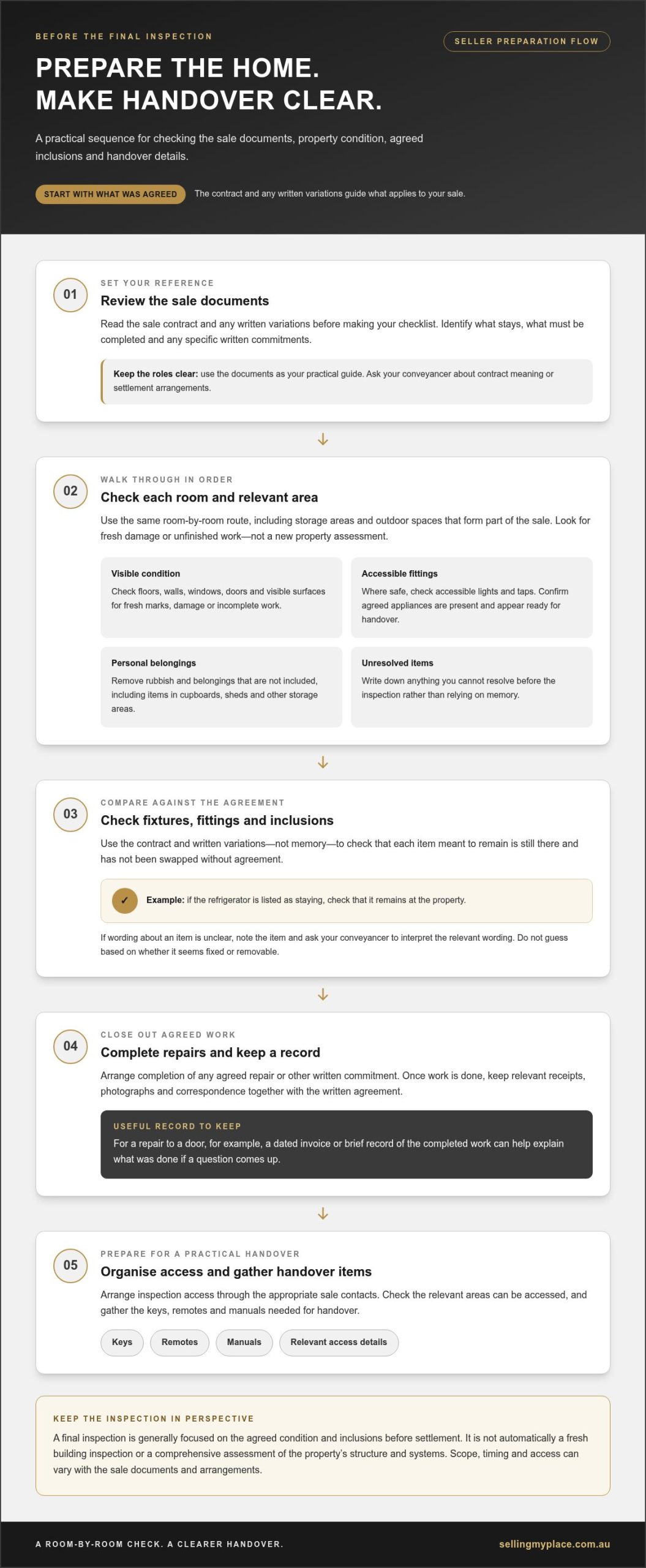
Inspection-day checklist for sellers: access, presentation and handover
A simple run sheet can make inspection day feel far less rushed. Use this final inspection checklist for sellers in order: confirm access, prepare the property, have handover items ready, then record any follow-up. Keep arrangements consistent with the sale documents and coordinate access through the relevant sale contacts. If questions develop into a broader discussion about sale terms, these property sale negotiation tips offer useful context.
The day before: final readiness checks
Confirm the inspection time and access plan with the relevant sale contacts, rather than assuming the buyer can enter independently. Finish any agreed cleaning, remove belongings that aren’t included and leave agreed items where they belong. Gather handover materials in one place so keys, remotes and manuals don’t get packed or misplaced in the final rush.
- Check the agreed time, access method and any instructions for gates, alarms or shared entry points.
- Do a final tidy and remove rubbish or personal items that aren’t part of the sale.
- Keep agreed inclusions in place and collect keys, garage remotes, access devices and appliance manuals.
- Put relevant handover notes together, such as which key opens a particular door.
At inspection time: keep access straightforward
Follow the access plan arranged through the sale contacts. Make sure the buyer can reach the areas they’re entitled to inspect, including any relevant storage or outdoor spaces, and avoid leaving access devices where they could be misplaced. If you’re present, be courteous and allow the inspection to proceed without hovering. If you’re not, make sure the agreed arrangements are clear.
Keep your notes nearby, but let the buyer raise any questions through the established contact. If an issue needs a response, record the specific item and follow up calmly rather than debating the contract at the doorway.
After the inspection: record and follow up
Once the inspection is finished, note any concerns raised, who received them and who will follow up. A short written summary helps keep details clear, especially if several items need attention. Keep communication courteous and timely, and use writing where practical so the request and response are easy to refer back to.
- Record the exact room, item or work mentioned, without adding assumptions.
- Save relevant messages and pass contract questions or proposed changes to your conveyancer promptly.
- Confirm who is handling each follow-up and keep a copy of any response or agreed next step.
Inspection day is one part of the wider handover. For support organising your property sale and the next steps, get advice about your sale.
From final inspection to settlement: get steady support for the next step
The inspection is a milestone, not the finish line. A clear close-out sequence helps you move from any follow-up questions to a practical handover, while keeping settlement decisions with the people responsible for advising on your contract. Your final inspection checklist for sellers can help you keep track of the last details, but it doesn’t replace guidance tailored to your sale documents.
A simple seller close-out sequence
Work through the remaining tasks in order, and keep a written record as you go. This gives you a clear reference if a question arises and helps prevent small handover details from getting lost among settlement arrangements.
- Confirm inspection follow-up. Record any concern raised, the response and any action agreed in writing. If the issue could affect your obligations, refer it to your conveyancer before making a commitment.
- Check the handover plan. Confirm how and when keys, remotes and other access devices will be provided, and make sure agreed items are accounted for.
- Follow settlement advice. Ask your conveyancer about contract interpretation, required steps and timing for your transaction. These details can depend on the contract and the relevant jurisdiction, so avoid relying on general assumptions.
Keep the roles clear. Your conveyancer advises on the contract and settlement arrangements; practical preparation means following that advice, keeping agreed handover details organised and completing any confirmed actions. If something changes or an issue remains unresolved, share the relevant written record promptly rather than trying to settle a contractual question informally.
When broader selling advice can help
Questions at the end of a sale can also highlight where informed support across the wider process is useful. Kincade International Direct Sales offers pre-sale consulting to help owners understand the steps involved in selling and approach decisions with greater clarity. Its conveyance advice can provide guidance through a complex sale, alongside the role of your conveyancer. The residential property listing services guide offers broader context on organising a sale, from preparing the listing to managing the process through to handover.
Take the next step steadily: resolve outstanding questions through the appropriate contacts, confirm the handover plan and follow your conveyancer’s settlement guidance. For owners who are also preparing for their next move, specialist representation from Robert Caicedo Real Estate can help navigate residential transactions with clarity and confidence. With those details in order, the final stretch can feel more manageable and less like a scramble.
Speak with the team about selling support and get informed guidance for the wider sale process.
Move towards settlement with confidence
A well-used final inspection checklist for sellers can do more than help you prepare for one appointment. It gives you a clear starting point for the last stage of your sale, so you can make decisions calmly and keep moving towards the next chapter. If your next move involves financing another property, The Home Loan Partners can provide tailored guidance through the mortgage process. Let your sale documents and conveyancer guide settlement-specific questions, and focus on the practical handover.
Kincade International Direct Sales offers commission-free property marketing and advisory services for residential owners, with professional photography and floorplans as part of its offering. Its flat-fee approach means you can use listing and advisory support without paying a traditional agency commission.
Talk with the team about your property sale to discuss commission-free marketing and advisory support.
Frequently Asked Questions
Is the final inspection the same as a building inspection?
No. A buyer’s final inspection is generally a pre-settlement check of the property against the sale agreement, rather than a new, detailed assessment of its structure or building systems. A building inspection has a different purpose and scope. If the buyer raises a concern about a defect, avoid treating the final inspection as a technical report; note the concern and refer contract-related questions to your conveyancer.
Can a seller attend the buyer’s final inspection?
Possibly, but whether you attend depends on the arrangements made for the sale and any relevant contract terms. Coordinate access through the appropriate sale contacts rather than arriving unexpectedly or assuming you need to be present. If you do attend, give the buyer room to look around and keep any discussion calm and factual. This can help avoid turning a practical visit into a pressured negotiation.
What happens if the buyer finds damage at the final inspection?
Damage may prompt a request for clarification or action, but the outcome depends on when it occurred and what the contract requires. For example, a new crack or a broken fitting may need to be considered differently from a mark that was already visible when the buyer agreed to purchase. Record the location and details, avoid admitting liability or promising a remedy on the spot, and promptly seek your conveyancer’s advice.
Do sellers need to leave appliances and manuals at the property?
Leave appliances that are identified as inclusions in the sale documents, and don’t remove or swap them without agreement. Manuals aren’t automatically an inclusion in every sale, so check the contract and any written arrangements. If you have a manual for an appliance staying behind, placing it with the appliance is a considerate handover touch. Keep personal documents or account details out of manuals and paperwork you leave.
Should utilities remain connected until settlement?
There isn’t one rule that suits every property or transaction. If utilities are disconnected too early, it may affect access to services before settlement; leaving accounts active also has practical and billing implications. Check your contract and discuss timing with your conveyancer, then arrange any provider notifications to match your circumstances. If the property is vacant, clarify who is responsible for access and services during the period before handover.
Can a buyer request repairs after the final inspection?
A buyer can raise a concern or ask for a repair, but a request doesn’t automatically change the contract. Whether you’re required to act depends on the agreement, any relevant written promises and the circumstances of the issue. Don’t agree to a repair, payment or change to settlement arrangements before getting advice. Send the request and supporting details to your conveyancer so you can understand your position and available next steps.
When should sellers complete the final inspection checklist?
Start your final inspection checklist for sellers early enough to deal with agreed work and locate inclusions, then revisit it close to the inspection. The buyer’s visit is commonly arranged in the lead-up to settlement, but the contract and local arrangements determine timing. A practical approach is to do an initial pass while packing, then a final check the day before access, leaving time to follow up any overlooked handover detail.
How to Sell Your Own House in Australia: A Practical 2026 Guide
Reading Time: 11 minutes
What if selling your home yourself didn’t mean handling every detail alone? If you’re weighing how to sell your own house in australia, a clear sequence can help you stay in control: prepare the property, organise the paperwork, reach buyers and respond to offers. You can lead the key decisions while using professional support for tasks that need specialist advice or practical marketing help.
Sale documents and requirements vary between states and territories, so getting the legal foundations right is an important early step. This guide takes you through preparation and pricing, marketing, buyer enquiries, inspections, offers and settlement. It also explains how photography, floorplans, pre-sale advice and flat-fee listing support can fit into an owner-led sale.
Key Takeaways
- Use a step-by-step sale plan to organise preparation, pricing, marketing, buyer conversations and settlement.
- Gather property information and sale documents early, then use comparable sales to inform a realistic price range.
- Present your home with accurate listing copy, professional photography and a clear floorplan to help buyers assess it.
- When comparing offers, look beyond price to conditions, timing and buyer readiness before agreeing to terms.
- Learn how to sell your own house in australia while choosing which tasks to manage yourself and where flat-fee marketing or advisory support can help.
How to sell your own house in Australia: understand the process before you begin
Selling your own home means leading the sale’s key decisions and tasks, while arranging professional support for specialist work where it’s useful. You set your priorities, decide how to present the property and choose which offer to accept. You also organise the information, communication and transaction support needed to move the sale forward.
That’s different from appointing a traditional agent to manage the sale on your behalf, but it doesn’t mean you have to do every task unaided. The real estate market in Australia operates within a national framework, while practical sale requirements can vary by state and territory. Keep that variation in mind when planning your sale.
Break the process into stages so it’s easier to track what needs doing:
- Prepare: gather property information, plan presentation and get sale documentation underway.
- Establish a price: use comparable sales and current market evidence to inform a realistic range.
- Market: prepare an accurate listing and decide how you’ll reach prospective buyers.
- Manage buyers: respond to enquiries, arrange inspections and keep communication organised.
- Agree terms: assess offers and conditions, and seek appropriate advice before signing.
- Settle: coordinate the final transaction with the relevant conveyancing support.
Each stage builds on the one before it. Accurate property details support your pricing and listing, while a record of enquiries helps you keep track of buyer interest and follow-ups. This roadmap makes how to sell your own house in australia more manageable without assuming there’s only one way to do it.
What does selling your own house actually involve?
As the owner, you set the priorities, approve the marketing and decide how to respond to buyers. You can handle enquiries personally or use selected marketing and advisory support while keeping the final decisions in your hands. Contracts and conveyancing are specialist areas, so arrange suitable professional advice to understand the documents and transaction steps before you commit.
If you’d like a more detailed walkthrough of the stages, the existing guide How to Sell Your Own Home: A Step-by-Step Guide to Sale by Owner in Australia complements this overview.
Is a private sale the same as doing everything alone?
No. You can manage the sale and choose support for particular tasks, such as property marketing, photography, floorplans, pre-sale advice or conveyancing. Flat-fee marketing and advisory support can help with listing tasks without transferring sale decisions to a traditional commission agent. The right balance depends on your priorities and the time you can set aside.
Be realistic about the workload. You’ll need to keep information up to date, respond to buyers, coordinate inspections and track next steps. Decide early which tasks you’ll manage and where advice or practical support would make the process more manageable.
Prepare your Australian home for sale: pricing evidence, presentation and paperwork
Before publishing a listing, build a clear picture of the property, decide what needs attention and get the relevant sale documents underway. Accurate property information supports pricing and marketing, while organised paperwork helps you respond when a buyer is ready to proceed.
Use this pre-listing sequence:
- Gather property information: note the home’s features, improvements, inclusions and any relevant ongoing costs.
- Review presentation: walk through each room and identify decluttering, cleaning or straightforward repair jobs.
- Research the market: compare relevant sales and competing listings to shape your price expectations.
- Organise documentation: establish which sale documents and disclosures apply to your property and location.
How should you set an asking price?
Start with recent sales of genuinely comparable properties. Consider property type, land and floor area, condition, features and meaningful differences between the homes. Current competing listings provide context, but they show what other owners are asking, not what buyers have paid.
Use the evidence to develop a considered price range, then choose an asking strategy that suits your priorities and the conditions you observe. An asking price is a guide for the market, not a guaranteed sale result. For a closer look at the evidence behind a valuation, see how to determine the market value of a home in Australia in the 2026 valuation guide.
Presentation doesn’t have to mean a major renovation. Clear benches and walkways, tidy storage, freshen high-traffic areas and take care of small visible repairs. Where a home requires substantial remediation or a rapid timeline is required, some owners consider direct sale options through property specialists such as LPS Real Estate Group instead of listing publicly. Otherwise, aim for rooms that feel clean, bright and easy to understand in photographs, using a floorplan and professional photography to show how spaces connect while representing the property accurately.
What should you organise before listing?
Prepare a property fact sheet for your own reference and to keep listing details accurate. Include room names and uses, notable features, improvements, items staying with the home and relevant ongoing costs where applicable. Check measurements and descriptions rather than relying on memory. A mismatch between the listing and the property can create confusion during enquiries or inspections.
Sale documents and disclosure requirements differ across Australian states and territories, so one national checklist won’t cover every home. Arrange guidance that applies to your property and location, and have a conveyancer or solicitor advise on the relevant transaction documents. For a state-level example, the Victorian government guide to selling property outlines information for sellers in Victoria.
Once you’ve gathered the evidence and identified any gaps, pre-sale property advice can help turn your preparation decisions into a practical plan.
Market your own house in Australia: compare exposure, presentation and buyer enquiries
A strong campaign gives prospective buyers clear, accurate information and makes it straightforward to understand the property and arrange an inspection. As you decide how to sell your own house in australia, weigh the reach you want against the time you can commit and the decisions you want to keep in your hands.
With owner-managed promotion, you organise the listing and buyer communication yourself. That gives you direct control, but you’re also responsible for the practical details. Flat-fee marketing support can help with listing presentation, professional photography and floorplans while you retain decisions about the sale. Compare options by identifying what tasks you’ll handle, what support is included and where the listing will be distributed. Exposure varies with distribution, presentation and buyer demand; no listing method can guarantee a particular response.
What makes a property listing clear and compelling?
Lead with accurate details buyers can picture: the layout, natural light, storage, outdoor areas or a useful recent improvement. Avoid sweeping claims such as “perfect for everyone”. Specific, verifiable features give readers a better sense of whether the home suits their needs.
Professional photography and a clear floorplan help buyers understand the home before they inspect it. Check that room descriptions, advertised inclusions and inspection information match the property. If something changes, update the listing promptly so buyers aren’t working from outdated details.
Before publication, compare the listing copy with your fact sheet and walk through the home as if you were seeing it for the first time. Does the description match the photos? Are room uses and inclusions clear? This check can prevent avoidable questions and help set realistic expectations from the first enquiry.
How can you manage inspections and buyer enquiries?
Set up an enquiry log in a spreadsheet or notebook. Record each buyer’s name, contact details, questions, inspection request and follow-up. One reliable record makes conversations easier to track, especially when several people are interested at once.
Respond as promptly as you reasonably can, and keep answers factual. If you’re unsure about a detail, say you’ll clarify it rather than guessing or making a promise. Before inspections, decide how buyers will book, which areas they’ll see and how you’ll record feedback. Consistent communication helps you manage the process and give interested buyers the same information.
With flat-fee marketing support, professional photography and a floorplan can help present the property, while advisory support can assist with the marketing process. You remain responsible for decisions such as how to respond to interest and which offer to consider. This approach suits owners who want practical listing support without handing over control of the sale.
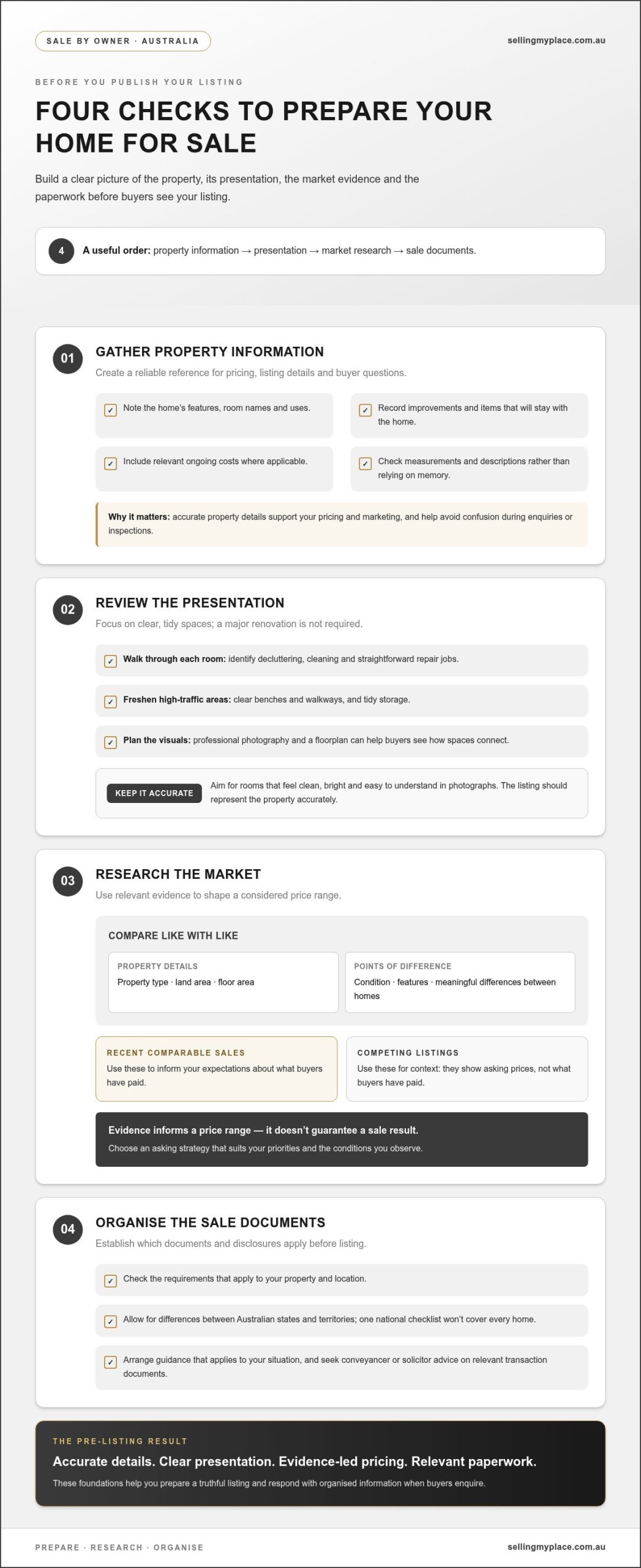
Manage offers and the sale process: practical steps from negotiation to settlement
An offer is more than a number. Before responding, make sure you understand what the buyer is proposing, what they need from you and what happens next if you agree. A consistent process helps you compare offers fairly and keep a clear record of decisions.
For each offer, note the proposed price, any conditions, the requested timing and what the buyer has said about their position. Record counteroffers and changes in writing too. If a point is unclear, ask for it to be set out plainly before you decide. This is a practical part of how to sell your own house in australia while keeping negotiations organised.
How do you compare offers beyond the headline price?
Consider the whole proposal. A higher price may come with conditions or timing that don’t suit your plans, while another offer may appear more straightforward based on the information available. Consider the buyer’s stated position, but don’t treat an expression of interest or assurance as a substitute for written terms.
Keep an offer record with the date received, proposed terms, your response and any agreed changes. Before accepting or signing, have the proposed contract and relevant terms reviewed by a conveyancer or solicitor. For further perspective on weighing proposals and responding thoughtfully, Mastering the Deal: Expert Property Sale Negotiation Tips for Australian Homeowners explores property sale negotiation in more detail.
What happens after you accept an offer?
Acceptance moves the sale into the contract and settlement process. The next steps depend on the contract and the rules and procedures that apply in the state or territory where the property is located. Cooling-off rights, where applicable, and other requirements can differ, so don’t rely on a general national checklist.
A conveyancer or solicitor can advise on the contract, explain its terms and help coordinate the legal steps towards settlement. Track agreed conditions and deadlines, keep communication clear between the relevant parties, and get professional advice on questions before you sign or act on a contractual obligation. This section is general information, not legal advice for a particular transaction.
As you plan how to sell your own house in australia, allow time to understand the paperwork as well as the offer. Your conveyancing professional can guide you on documents and settlement steps relevant to the transaction. Keep copies of correspondence and agreed changes together, and refer to the signed contract for the terms and dates that govern what happens next.
If you’d like support with the sale process while retaining your decisions, explore property sale advisory and marketing support.
Choose the right selling support: keep control without carrying every task yourself
Owner-managed selling gives you direct control over decisions, but it also requires time for the work behind the sale. You don’t have to choose between doing every task alone and handing the whole process to a traditional agent. Selected support can ease particular workloads while you remain responsible for the decisions that matter to you.
Match tasks to your time and confidence. You might be comfortable speaking with buyers but want help preparing marketing materials, or prefer advice on presentation while managing enquiries yourself. Be realistic about the time you can set aside alongside work, family and your next move. That assessment helps you decide how to sell your own house in australia in a way that suits your circumstances.
Which parts of the sale can you manage, and where can support help?
Owners commonly lead decisions such as setting priorities, approving the listing and considering offers. Support can focus on particular areas: pre-sale advice can help you plan preparation, while professional photography and a floorplan can help present the home clearly. Choose which tasks to take on and where guidance or practical help would be useful.
Kincade International Direct Sales provides national flat-fee residential marketing and advisory support, rather than acting as a commission agency. Its services include professional photography, floorplans, global residential listings and an Agent Advisory Service. Listings remain available until sold, with no time limits. This support helps present and promote an owner-led sale while you retain decisions about the property and offers.
For a broader look at listing presentation and seller considerations, Professional Residential Property Listing Services: The Modern Australian Seller’s Guide explores how listing support can fit into a sale plan.
How can you take the next step with confidence?
Before settling on an approach, write down your sale goals, likely timing and preferred level of involvement. Note which jobs you’re happy to manage, where you’d value advice and what you need to understand before committing to a plan. This turns a broad decision into a practical list of support needs.
A flat-fee model suits owners who want marketing and advisory support without agency commission while keeping control of sale decisions. Internationally, similar models are widely established; for example, providers such as Congress Realty offer structured listing packages that let sellers choose between standard listing options and fuller service support. The right arrangement depends on the tasks you want help with and the responsibilities you’re prepared to take on. Start with the parts that feel least clear.
If you’re considering an owner-led sale, discuss your home sale and the support you need to explore an approach that fits your goals.
Set your sale up for a confident next step
Your next move doesn’t need a perfect, fully mapped plan. Start by deciding what matters most: the level of control you want, the time you can give the sale and the support that would make the process manageable. Those priorities give you a practical foundation for choosing how to sell your own house in australia.
For owners who want marketing support while keeping sale decisions in their hands, Kincade International Direct Sales provides national residential property marketing through a flat-fee model with no agency commission. Professional photography, floorplans and Agent Advisory Service support can help with listing presentation and guidance, while you remain in control of decisions about your home.
Before taking the next step, note your preferred timing, the tasks you’d like help with and any questions you want to resolve. Talk through your home sale and explore a flat-fee approach, then decide what fits your priorities.
Frequently Asked Questions
Can I sell my own house in Australia without a real estate agent?
Yes, you can sell your own home without appointing a real estate agent in Australia. If you’re considering how to sell your own house in Australia, plan for the time involved in presenting the property, coordinating enquiries and responding to offers. You can still engage specialist help for legal documents or selected sale tasks. A private sale means you lead the process, not that you have to manage every part without support.
What do I need to do before listing my house for sale?
Before listing, gather records that support what you advertise, such as renovation documents, appliance manuals, warranties and available notices about rates or utilities. Keep digital copies together and note where original documents are held. This makes it easier to answer detailed buyer questions without relying on memory. Confirm the disclosure material required for your state or territory before publishing the listing, as requirements differ across Australia.
How do I work out an asking price for my house in Australia?
Use recent completed sales as your main evidence, then consider current listings as competition rather than proof of value. Compare homes with similar property type, land, layout and condition, and account for differences such as renovations or parking. Your asking price is a marketing decision informed by that evidence, not a promise of the final sale price. If buyer feedback consistently suggests a mismatch, review your approach.
Do I need a solicitor or conveyancer to sell my house?
Plan to use a conveyancer or solicitor to prepare or advise on the sale contract and related legal documents. Documents and processes vary between states and territories, so seek guidance that applies to your property and transaction. A legal professional can explain the terms before you sign and help coordinate the legal steps towards settlement. This FAQ is general information, not legal advice for your circumstances.
Can I sell my house privately and still get professional marketing support?
Yes. Selling privately is compatible with getting help to prepare and promote your listing while you retain decisions about the sale. Kincade International Direct Sales provides flat-fee residential marketing and advisory support nationally in Australia. For major property portals, sellers generally need to use a licensed third-party platform to arrange a listing. Clarify how promotion is handled so you understand where your property will be advertised.
What happens after I accept an offer on my house?
After accepting an offer, have your conveyancer or solicitor confirm the next steps under the proposed contract and the process in your state or territory. They can clarify when the agreement becomes binding, explain relevant conditions and help coordinate settlement communication. Keep a copy of the written terms and note any dates or obligations. Don’t assume an informal conversation settles every contractual detail.
How long does it take to sell a house privately in Australia?
There’s no fixed timeframe for a private sale. The time to find a buyer can depend on buyer demand, your asking strategy, the property, and how it’s presented and promoted. The time from an accepted offer to settlement is a separate part of the process, shaped by the contract, conditions and relevant local procedures. When planning your move, allow flexibility rather than relying on a single expected date.
What Happens After Accepting an Offer on a House in Australia?
Reading Time: 12 minutes
Accepting an offer is an important milestone, but it is only the beginning of the next stage of your sale. If you’re wondering what happens after accepting an offer on a house, you may be asking whether the deal is binding, what the buyer still needs to do and which deadlines matter.
In Australia, the next steps depend on the contract of sale and the rules in your state or territory. An accepted offer is not always the same as an unconditional, legally binding sale. Signing or exchanging the contract, any cooling-off rights and the agreed conditions all matter. The buyer’s finance approval and building or pest inspections may also affect progress, depending on the contract.
This guide covers the steps from acceptance to settlement, including how to prepare, track conditions and manage key dates. It also explains what can vary across Australia, so you can stay organised, follow the agreed terms and prepare for handover.
Key Takeaways
- Follow the contract-led steps from acceptance through to settlement.
- Check the signed contract for conditions, agreed terms and key dates. Requirements can differ between Australian states and territories.
- Track any finance or inspection conditions in the contract, including the deadlines and actions they require.
- Organise documents, confirm agreed property inclusions and access arrangements, and keep communication with your conveyancer or solicitor in one place.
- Plan your move and handover ahead of settlement, including keys, mail redirection and utility arrangements.
What accepting a house offer means for you as the seller
Hearing that a buyer wants your home can bring real relief after all the preparation and decisions involved in selling. Enjoy the milestone, then focus on what comes next: acceptance starts a contract-led process, but it is not settlement and does not automatically mean the sale is complete.
If you’re asking what happens after accepting an offer on a house, first distinguish an informal conversation from the legal paperwork. A buyer might make an offer verbally or in writing, and you might indicate that you agree with the price and terms. But don’t assume that a verbal agreement has the same effect as a properly completed contract of sale. The form of acceptance, signing or exchange process, and legal effect depend on the transaction and the rules in your state or territory.
The contract records the terms that matter, including the agreed price, deposit, settlement date, included items and any conditions. Once it takes legal effect, both parties generally need to follow those terms. Conditions can affect what happens next. For example, a finance or inspection clause may set out steps the buyer must complete before the sale becomes unconditional. The wording of the contract and applicable local rules determine the parties’ rights and obligations, so rely on the actual terms rather than a general rule of thumb.
Does accepting an offer make the house sale final?
Not necessarily. A sale may become legally binding once the required contract process is complete, but an accepted offer alone does not guarantee that the property will reach settlement. If the contract includes conditions, the buyer may need to satisfy them, or the contract may explain what happens if they are not met. Read the signed terms carefully and ask the conveyancer or solicitor handling your transaction to explain anything that is unclear.
What should a seller do straight after acceptance?
Keep the written offer and every version of the signed contract together. Make a clear record of the agreed dates, conditions and next steps, so you have one reliable reference if details are later discussed by phone or email. Contact your conveyancer or solicitor promptly to understand the contract process and coordinate the work they are handling.
- Save the paperwork: Store the written offer, signed contract and related messages together.
- Note the key dates: Record the contract deadlines and settlement date, plus who is responsible for each action.
- Keep communication clear: Share relevant documents with your conveyancer or solicitor. Keep important updates about the contract in writing.
These simple steps can prevent crossed wires as the sale progresses. Treat acceptance as the start of the agreed process, not a signal that every detail is settled. Let the written terms guide what happens next.
The contract, conditions and conveyancing steps after acceptance
Once the offer is accepted, use the contract as your working guide rather than relying on a handshake or a summary of what was discussed. It sets out the sale terms, conditions and dates that can affect progress. Review the completed contract, identify the next actions, share relevant documents and keep a reliable record of deadlines and communications.
- Check the completed contract. Make sure you have the latest version, signed or otherwise completed through the process that applies to your sale. Confirm that the written price, deposit, settlement date, inclusions and special conditions match the agreed terms.
- Mark each condition and date. Record what needs to happen, who is responsible and when a response or document is due. A finance condition or building and pest inspection condition might be included, but neither is automatic in every sale.
- Share the paperwork. Send the complete contract and relevant sale documents to the conveyancer or solicitor assisting you. Keep copies of important communications, especially updates about a condition or an agreed change.
- Track progress and follow up. Use a calendar or checklist to monitor deadlines. If a due date is approaching and you have not received an update, follow up with the person handling that step rather than assuming it is complete.
The buyer is generally responsible for arranging their own finance and inspections, subject to the contract. As the seller, you need to meet your contractual obligations and provide information or access where agreed. An offer may also depend on the buyer selling an existing property if the contract includes that condition. Read the clause itself, since its wording determines what happens next.
There is no identical process across Australia. Contract formation, cooling-off rights and conveyancing steps can vary between states and territories, and the contract may set out additional requirements for your transaction. For vendors navigating regional markets, local agencies such as Ollie James Real Estate can provide helpful insight into regional sale practices and timing. Always ensure you rely on the terms and procedures that apply to your specific sale.
Which contract dates and conditions should sellers track?
Use the signed contract to confirm exact dates and wording. Record condition deadlines, required documents, agreed access arrangements and responses expected from either party. A shared calendar or written checklist makes responsibilities easier to follow, particularly when several people are coordinating the sale. If a clause is unclear, raise it promptly with your conveyancer or solicitor.
What does a conveyancer or solicitor do after acceptance?
Your conveyancer or solicitor helps progress transaction documents and communicates with the other parties about conveyancing. Give them the full signed contract and relevant sale documents, and keep them informed of any agreed changes. Their support helps coordinate the transaction, but you still need to follow the contract and complete your own tasks.
For practical guidance alongside the paperwork, sale-process advisory support can help you stay organised as the transaction moves forward.
Buyer finance and inspections: what sellers can expect
Some buyers need time after signing to confirm finance or arrange property inspections. Others make an offer without these conditions, or may already have completed some checks. What happens after accepting an offer on a house therefore depends on the terms in your contract, not on a universal checklist that every buyer must follow.
Distinguish between a contract with conditions still to be met and one that has become unconditional. If a finance or inspection condition applies, the buyer’s next steps may affect whether the transaction proceeds under the agreed terms. Once applicable conditions are satisfied or dealt with, the contract may move to an unconditional stage. The timing and legal effect depend on the contract and the rules in your state or territory.
While the buyer completes any agreed steps, keep your own actions practical and measured:
- Provide access for inspections as agreed and keep arrangements in writing.
- Note contract dates and pass relevant updates to your conveyancer or solicitor promptly.
- Keep messages, notices and documents about conditions together, including requests and proposed changes.
- Do not assume a delay or inspection finding means the sale has ended. Check the contract and get guidance on the next step.
What happens if the buyer’s finance is delayed or declined?
First, check whether the contract includes a finance condition and what it says about the buyer’s obligations, timing and any required notice. A lender taking longer than expected does not automatically end the sale, and a declined application does not automatically give you the right to terminate or keep the deposit. Record any notice or update, then discuss the contract steps promptly with your conveyancer or solicitor.
Keep communication calm and factual. If the buyer says their lender has not provided an answer, note when you received the update and share it with the person handling your conveyancing. Do not assume an extension, termination or entitlement to the deposit based on a phone call alone. Handle any change to the agreed process in line with the contract and applicable rules.
How should sellers handle building or pest inspections?
Findings can range from routine maintenance observations to issues the buyer wants clarified. Respond through the agreed communication process and avoid promising repairs or changing terms informally. If a report leads to a proposed variation, ask your conveyancer or solicitor how it relates to the contract before agreeing to anything.
Contract wording and relevant procedures can differ across Australia. Keep the signed terms close, meet your agreed obligations and get advice on a specific notice or request rather than relying on another sale’s experience. A pause in progress may simply mean a condition is still being dealt with.
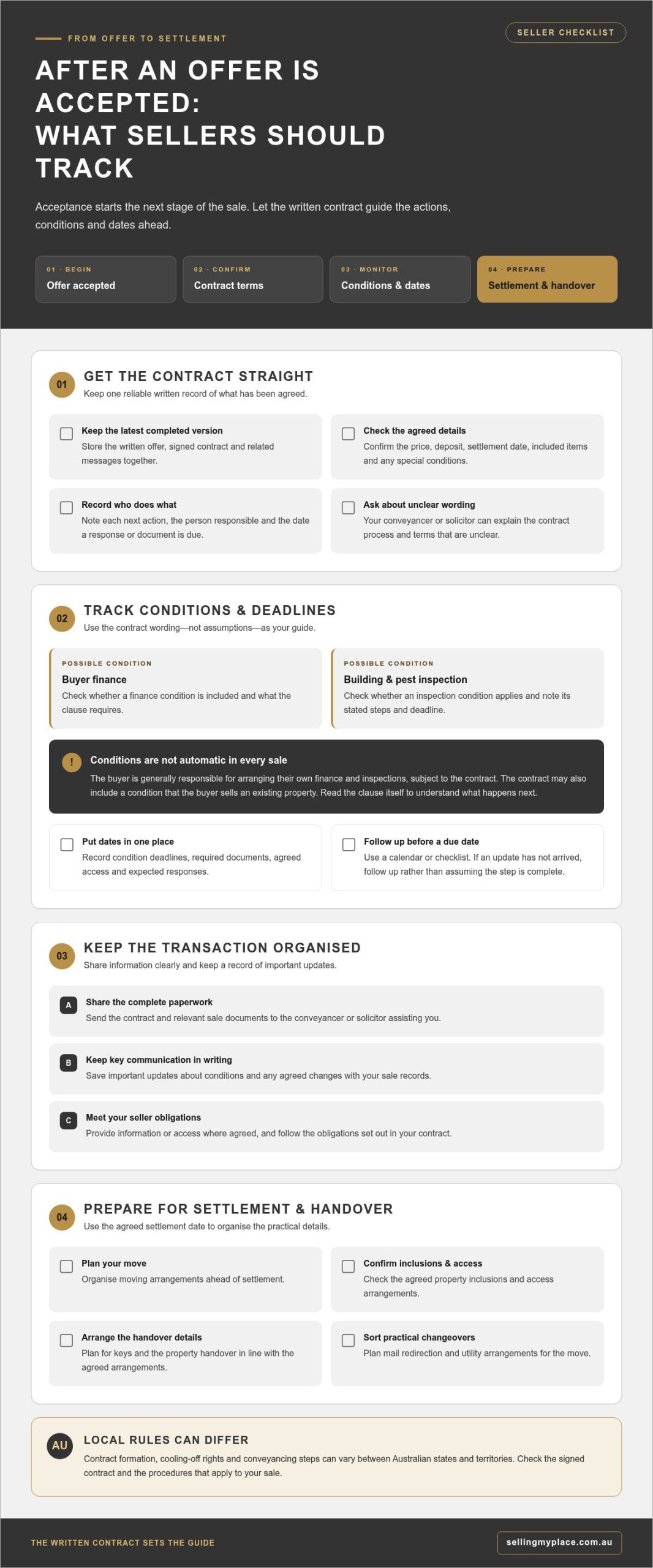
A practical seller checklist for the weeks before settlement
As settlement approaches, small details can take up more headspace than expected. A clear checklist helps you keep documents, property arrangements and moving plans together, with the contract and your conveyancer or solicitor as your reference points. The weeks before handover can vary between sales, so organise around your confirmed settlement arrangements rather than assuming every transaction follows the same timetable.
For sellers wondering what happens after accepting an offer on a house, preparing early can help avoid last-minute scrambles. Start with the records and commitments connected to your sale:
- Sale documents: Keep the contract, any schedule of inclusions and relevant correspondence together. Add transaction documents requested by your conveyancer or solicitor.
- Written commitments: Save records of agreed repairs, access arrangements or other promises made during the sale. Make sure everyone involved has the same written details.
- Questions and deadlines: Note document requests and dates. Ask your conveyancer or solicitor to clarify anything you do not understand.
- Moving arrangements: Plan removal, mail redirection, address changes and utility arrangements around the settlement date and handover instructions.
Keep the checklist practical and up to date. If an arrangement changes, update your records and tell the people involved rather than relying on memory or an old message thread.
What documents and property details should you organise?
Gather documents relevant to your sale, including the signed contract, inclusion list, correspondence and anything specifically requested for the transaction. Check which items stay with the property, such as fixtures or appliances, and distinguish them from belongings you plan to take. If a document request or deadline is unclear, ask your conveyancer or solicitor what is needed and when.
Keep a brief record of agreed work or access as well. Note what was agreed, who is arranging it and any timing discussed. That gives everyone a shared reference if questions come up before handover.
How can you prepare for the final inspection and move?
The buyer may have a final inspection under the contract or the process used in your state or territory. Check the relevant terms and arrangements rather than assuming an inspection is automatic or has the same scope everywhere. Before handover, review the agreed inclusions and leave the property in the condition required by the contract. If you are unsure what that means for a particular item, raise it with your conveyancer or solicitor.
Coordinate removal and utility changes with the confirmed settlement arrangements. Plan mail redirection, address updates and utility changes around the move and handover. Keep keys and any agreed access items ready for the handover process.
For practical guidance while organising your sale and preparing for settlement, get support with your property sale.
Settlement day and what comes next for the seller
Settlement is the final milestone in the sale, but the arrangements depend on your contract and the process used for the transaction. Your conveyancer or solicitor will generally coordinate the required documents and communicate with the other parties about readiness. If settlement is completed electronically, they will also coordinate through the relevant electronic settlement process.
In plain terms, settlement is when the sale is completed under the contract, the buyer pays the balance and ownership is transferred. Where relevant, the process also includes paying out the seller’s mortgage. The sale proceeds are then distributed according to the transaction arrangements.
What happens on settlement day?
The general sequence is to confirm the parties are ready, complete settlement and follow the agreed handover arrangements. Your conveyancer or solicitor can update you on progress and confirm when settlement has occurred. The precise steps and timing can vary across Australia, so use your contract and transaction updates rather than assuming every sale follows the same procedure.
Hand over keys and possession as set out in the contract and related arrangements. Do not assume the buyer receives the keys at a particular time simply because settlement is scheduled for that day. Follow the instructions from the people coordinating the transaction and have the agreed handover items ready.
If you are unsure whether settlement has been completed, wait for confirmation from your conveyancer or solicitor before treating the property as handed over. If arrangements change or a delay arises, ask how it affects the agreed handover. This can prevent confusion on a day when you may also be managing a move or saying goodbye to your home.
Where can sellers get practical support through the sale?
A well-organised sale involves more than preparing the property for buyers. Owners also need to manage information, communications and transaction steps as the sale progresses. Property advice can help you approach those tasks with a clearer plan, while your conveyancer or solicitor coordinates the legal and settlement documentation.
Kincade International Direct Sales supports residential owners with property marketing and advisory guidance, including professional photography, floorplans and pre-sale consulting. Its flat-fee, commission-free model gives owners an alternative to a traditional agency commission. Advisory guidance can help you stay organised through the process, while legal and conveyancing matters remain with the professionals handling your transaction.
Settlement completes the agreed sale and marks the handover stage, subject to the contract and local process. If you are planning a residential sale and want practical support with property marketing and your next steps, discuss sale support with Kincade International Direct Sales.
Take your next property step with confidence
The offer is one milestone in a bigger transition. As you look ahead, make room to plan what comes next, whether you are coordinating a move, preparing for a new home or checking that the sale is progressing as agreed. A steady plan can make the change feel more manageable.
Understanding what happens after accepting an offer on a house also means knowing when to pause and seek clarity. Use your signed terms as the reference point, and direct questions about your obligations or the conveyancing process to the professional handling your transaction. You can also get practical guidance with the sale planning and property marketing involved.
Kincade International Direct Sales supports residential owners with property marketing and advisory options, including a flat-fee, commission-free model. If you are planning a sale and want support with marketing and your next steps, talk with us about selling your property.
With preparation and the right support, you can move into the next chapter feeling more settled and ready for what is ahead.
Frequently Asked Questions
Can I change my mind after accepting an offer on my house?
Possibly, but it depends on whether a contract has taken legal effect, what it says and the rules that apply where the property is located. Once a contract is binding, withdrawing may have serious consequences. Do not cancel arrangements or tell the buyer the sale is off based only on a conversation. Review the signed documents and speak promptly with your conveyancer or solicitor before taking action.
When does a house offer become legally binding in Australia?
There is no single trigger that applies to every Australian sale. The legal effect depends on how the offer and acceptance are documented, the contract terms and the jurisdiction. A verbal agreement is not a substitute for checking the paperwork. Ask your conveyancer or solicitor to explain when your contract takes effect, which conditions apply and whether any deadlines have started. Do not rely on a process described for another state or territory.
Is there a cooling-off period after accepting an offer on a house?
It depends on the state or territory, the contract and the circumstances of the sale. Cooling-off rights can have exceptions, so do not assume a period applies simply because an offer has been accepted. Check the contract for relevant terms and promptly seek guidance specific to your location. If you are unsure whether the agreement is binding or a deadline is close, raise that with your conveyancer or solicitor.
How long does it take to settle after accepting an offer?
There is no single settlement timeframe for every Australian house sale. If you are wondering what happens after accepting an offer on a house, check the settlement date recorded in the signed contract. The parties may agree to different arrangements, and finance, documents or other contract conditions can affect progress. If circumstances change, ask your conveyancer or solicitor how the agreed date and next steps are affected.
What happens if the buyer cannot get finance approval?
Check whether the contract includes a finance condition, what deadline applies and how the buyer must give notice. The outcome depends on those terms and the relevant rules, so do not assume the contract automatically ends or continues. Keep the buyer’s updates and any formal notices in writing. Before responding or agreeing to a change, ask your conveyancer or solicitor to explain the steps available under your contract.
Can I accept another offer after accepting one?
Do not treat a later offer as replacing an agreement already in place. Your obligations depend on whether the first contract has taken legal effect, its terms and the law that applies. Before making a commitment or telling another buyer their offer is accepted, refer the situation to your conveyancer or solicitor. This helps you understand how the existing agreement affects what you can do next.
What should I do with utilities when selling my house?
Plan utility changes around the contract’s settlement and possession arrangements, rather than cancelling services as soon as an offer is accepted. Essential services may need to remain available for agreed access, inspections or handover. Note meter readings, account responsibility and changeover arrangements as you prepare to move. Your conveyancer or solicitor can clarify transaction dates, and you can arrange account updates or closure with the relevant providers.
How to Vet Potential Buyers Yourself: A Practical Australian Seller’s Guide
Reading Time: 11 minutes
What if the buyer offering the most isn’t the one best placed to complete the sale? If you’re working out how to vet potential buyers yourself, it’s natural to look for clear signs that an enquiry is genuine, especially when every inspection and follow-up takes time. But a confident manner or a high offer isn’t proof that a buyer is ready to proceed.
A fair, consistent process helps you distinguish serious interest from casual enquiries without relying on assumptions about someone’s demeanour. You also don’t need to collect more personal information than is reasonable to assess their readiness. A measured approach can protect your privacy while keeping conversations respectful and focused.
This guide explains what to ask, how to discuss a buyer’s finance and timing, and what evidence may help you assess their preparedness. You’ll also learn to compare offers by looking beyond the headline figure to conditions, timeframes and the buyer’s ability to proceed. A little structure, from your first reply through to the next steps after an offer, can help you stay in control of your private sale and make decisions with greater confidence.
Key Takeaways
- Learn how to vet potential buyers yourself with a consistent process for assessing readiness fairly.
- Ask clear, courteous questions to understand a buyer’s finance, timing and next steps without relying on first impressions.
- Compare offers by their conditions and likelihood of proceeding, not just the headline amount.
- Keep buyer checks proportionate and handle personal information thoughtfully. Treat warning signs as reasons to clarify, not proof of wrongdoing.
- Advisory and conveyance support can help you organise enquiries and move from an offer towards the next stage with greater confidence.
Why vet potential buyers yourself before progressing a home sale?
A promising enquiry is a welcome start, but it doesn’t tell you whether someone is ready to buy. Buyer vetting means asking consistent, relevant questions to understand a person’s readiness, ability to proceed and any conditions attached to an offer. It isn’t about interrogating every visitor or trying to predict the future. It’s a practical way to decide what follow-up makes sense before arranging another inspection or progressing negotiations.
A calm, repeatable approach helps you focus on useful indicators rather than impressions. Someone may be enthusiastic during a viewing but still need to arrange finance, sell another property or clarify their preferred timing. A reserved buyer may be well prepared. A person’s manner, appearance, occupation or communication style isn’t evidence of financial readiness or commitment. Ask each buyer the same core questions, then assess their answers and offer terms on their merits.
This is a practical form of due diligence: gathering and considering relevant information before making a decision. The general concept is outlined in What is Due Diligence? For a private seller, the aim is straightforward: understand the buyer’s next steps without treating a conversation or document as a guarantee of a completed sale.
What does it mean to vet a potential property buyer?
Separate interest from preparedness. An enquiry shows that someone wants to know more; a prepared buyer can usually explain their next step, such as arranging finance or making an offer with stated conditions. Neither guarantees the sale will proceed. Focus on observable details, including whether answers are clear and agreed follow-ups happen, rather than drawing conclusions from personal characteristics.
When should you start checking buyer readiness?
Start with light questions when arranging an inspection or a detailed property discussion. Ask what stage the buyer is at and whether they have a timeframe in mind. Save more specific questions about finance, conditions and offer terms for when you’re considering an offer. Casual browsers don’t need a formal screening. This staged approach keeps the exchange welcoming while helping you prepare for the next decision.
Keep your questions proportionate. You can ask a buyer to explain their finance position or relevant conditions, then consider what information you need for the decision at hand. Avoid collecting or circulating sensitive personal details unnecessarily, and handle anything shared with discretion. If a response is unclear, ask a neutral follow-up rather than assuming bad intent.
Early screening can help prevent avoidable delays. If a buyer says they need to complete another step before making an offer, take that into account before arranging repeated viewings or changing your plans. The purpose isn’t to discourage genuine buyers; it’s to make expectations clear on both sides. For an overview of the wider sale process, read this step-by-step guide to selling your own home.
How to vet potential buyers yourself: a clear screening process
A simple process makes buyer conversations easier to manage and compare. Use the same stages for each serious enquiry: make contact, ask readiness questions, consider relevant evidence, then record any offer and its terms. This keeps discussions fair and gives you a record to refer to if details change or you need to follow up.
A buyer who is ready, able and willing to progress is still subject to appropriate checks and the agreed terms of sale. This is a practical guide, not a guarantee that a sale will complete. Finance, conditions and timing can change, so assess the information in front of you at each stage.
What questions can you ask a potential buyer?
Keep questions neutral and consistent. For example: “Do you have finance pre-approval, are you using other funds, or are you still arranging finance?” Follow up with “Would you need to sell another property before proceeding?” and “What purchase and settlement timing are you working towards?” These questions focus on practical next steps, not private details unrelated to the sale.
Listen for specifics rather than a particular style of response. One buyer might explain that they have pre-approval and want to discuss an offer; another might say their purchase depends on selling their current home. Record what each person says, any conditions they mention and when they expect to follow up. If an answer is uncertain, note that accurately instead of filling gaps with assumptions.
Government guidance can also help you understand the steps buyers may be considering. Guidance on planning to buy a property outlines aspects of purchasing a home, including due diligence. Check the requirements and processes that apply to your circumstances, as they may differ across Australia.
What evidence can help establish readiness?
When you’re considering an offer, relevant evidence might include current finance pre-approval or suitable proof of funds. Match the request to the stage of the conversation and the question you need answered. A casual inspection doesn’t call for detailed financial records. A document can support what a buyer has told you, but it can’t remove all uncertainty or guarantee finance will be available at settlement.
Protect the buyer’s privacy as carefully as your own. Don’t request account passwords, login credentials or unrelated financial records. If someone shares a document, limit who can access it, store it securely and retain only what you reasonably need for the sale process. Avoid forwarding sensitive material casually or keeping copies indefinitely.
Write down the offer amount, conditions, finance information and proposed timing as separate items. That makes it easier to clarify an incomplete offer without pressure or crossed wires. If you’d value guidance while organising buyer enquiries and assessing next steps, explore property sale advisory support.
How to compare buyers and offers beyond the offer amount
A strong offer is more than its headline figure. Compare the amount with the buyer’s finance position, conditions, proposed timing and communication. A higher offer may be less certain if it depends on an unresolved sale or further checks. A lower offer may have different advantages, but still needs careful review. Neither enthusiasm nor a single piece of evidence guarantees settlement.
Use the same categories for each offer and compare like with like. A short written record helps you see what’s clear, what needs clarification and which details come from a conversation rather than the offer itself.
Which offer details deserve a closer look?
Read the full written offer instead of relying on a verbal summary. Note whether the amount is clear, what conditions apply, when the buyer proposes to proceed and whether the offer depends on selling another property. Record any requested contract changes or further checks, so you can identify what needs a response before deciding how to proceed.
- Offer amount: Record the amount as written and note whether any terms could affect it.
- Finance status: Note what the buyer has explained and any relevant evidence provided.
- Conditions: List outstanding checks, a required sale of another property or proposed changes.
- Timing: Note the proposed next steps and settlement timeframe.
- Communication: Record whether responses and follow-ups have been clear and timely, without treating style alone as proof of readiness.
For example, one buyer might offer more but need to sell their current home first, while another proposes a different amount and timing with fewer stated conditions. Neither buyer is automatically the stronger option. The comparison shows why you need to understand what each offer depends on and how its terms fit your circumstances.
How do you compare certainty without making assumptions?
Keep the comparison fair by using the same evidence categories for every buyer and recording when each detail was provided. Finance pre-approval can indicate progress, but it isn’t a guarantee of final lending or settlement. Prompt communication is useful context, not proof that a buyer can complete the purchase.
Separate confirmed information from unanswered questions. Write “pre-approval sighted” rather than concluding “finance secured”, or record “offer subject to sale” instead of assuming when that sale will happen. Careful wording helps you compare readiness without overstating what you know or making personal judgements.
Contract wording and conveyancing questions can have important implications, and sale requirements differ across Australia. If a condition or proposed change is unclear, seek advice from an appropriate conveyancing professional before relying on your interpretation. For more guidance on keeping discussions constructive while weighing terms, see these Australian property sale negotiation tips. A structured approach to how to vet potential buyers yourself helps you weigh the whole offer, not just the number that first catches your eye.
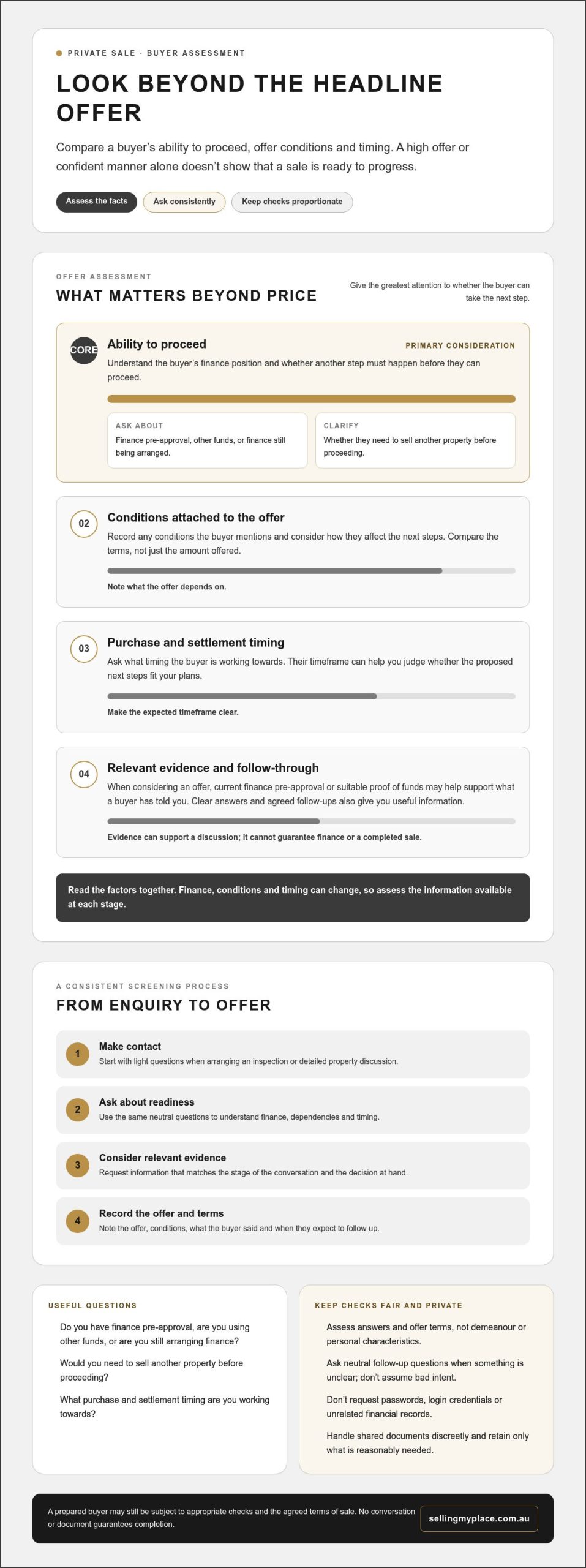
How to spot buyer red flags while protecting privacy
Buyer checks don’t need to feel like an interrogation. You can explain your process politely: “I ask each interested buyer the same questions so I can understand their timing and any conditions before we take the next step.” Keep requests relevant and give buyers a chance to clarify. A concern is a prompt to pause and ask, not proof of dishonesty.
Look for changes or pressure in the details, rather than judging someone’s personality. A buyer may have a genuine reason for changing plans. What matters is whether the updated information is clear enough for you to decide how to proceed.
Which buyer behaviours merit a pause or follow-up?
Pause to clarify if a buyer gives different accounts of their finance position, proposed timing or offer conditions. You can refer calmly to what they said earlier: “I understood your offer depended on selling another property. Has that changed?” This gives them room to explain and helps you keep your notes accurate.
Be cautious if someone repeatedly pressures you to decide before you’ve reviewed the written terms, asks you to proceed without documenting important details or requests sensitive information that isn’t needed to discuss the sale. Repeatedly missing agreed calls or follow-ups may also reduce your confidence in their readiness. None of these behaviours alone establishes fraud. Consider the full context and avoid making accusations you can’t support.
How can sellers share information safely?
Prepare your home for inspections with privacy in mind. Put away identity documents, financial paperwork, mail and anything showing passwords, alarm codes or other security details. Keep household information that isn’t relevant to the property out of view, and avoid sharing personal routines or travel plans during a viewing.
- Limit what you request: Ask only for information relevant to the buyer’s readiness or offer.
- Keep records secure: Store messages and relevant documents in a protected location, rather than leaving them open on a shared device.
- Restrict access: Share buyer information only with people who need it to progress the sale.
- Review what you retain: Don’t keep personal information longer than it’s useful for the sale process.
Privacy and identity-checking requirements can vary across Australia and may depend on the circumstances. Before requesting or retaining identity documents, check current guidance from relevant Australian government and privacy authorities, and get appropriate advice if you’re unsure about your obligations. Don’t assume a practice used in one part of the country applies everywhere.
A steady, documented approach helps protect your household while treating genuine buyers respectfully. If you’d like support with buyer enquiries and sale decisions, get guidance on assessing potential buyers.
How advisory support can help you vet buyers with confidence
Managing a private sale doesn’t mean you have to work through every buyer question alone. Advisory support can help you organise enquiries, prepare consistent questions and think through an offer’s terms, while you remain involved in decisions about your property.
Kincade International Direct Sales’ Agent Advisory Service provides dedicated support with pre-sale consulting and conveyance advice. This support can help as you prepare your sale process, respond to buyer enquiries and consider how to progress an offer. Buyer representation is also available. The right support depends on the questions you’re working through, rather than a one-size-fits-all script.
What support can make a private sale easier to manage?
Pre-sale consulting can help you set up a practical process before enquiries arrive: decide where to record contact details, which readiness questions to ask and how to track follow-ups. Having this framework ready can make buyer conversations more consistent and less pressured when interest picks up.
Good property information helps, too. Professional photography and floorplans give buyers a clearer view of the home, while neighbourhood market reports can support informed conversations about the property and its market context. These materials don’t establish a buyer’s finance position, but they can help keep discussions focused on the home and the buyer’s questions.
A flat-fee, commission-free residential marketing model may suit owners who want to retain control while drawing on professional support. Kincade International Direct Sales provides residential property marketing alongside advisory support, so sellers can take a hands-on role without managing every part of the process unaided.
What are your next steps after assessing a buyer?
Once you’ve assessed an enquiry or received an offer, keep the details together and work through them methodically. Record the written amount, conditions, finance information and proposed timing. Clarify any gaps before deciding, and use conveyance advice to understand questions about the sale’s progression and relevant documents. Contract requirements vary across Australia, so consider the rules that apply to your property and circumstances.
- Keep the offer on record: Refer to written terms, not just a verbal summary.
- Check the conditions: Note what needs to happen before the buyer can proceed.
- Plan the next conversation: Prepare focused questions about outstanding details or timing.
- Seek guidance where needed: Use advisory and conveyance support to work through the next steps.
If you’re weighing up how to vet potential buyers yourself while keeping a private sale organised, the guide to professional residential property listing services explains how listing support can fit into an owner-led sale. For advice tailored to your property sale, discuss your sale with the advisory team.
Move towards your sale with confidence
Assessing a buyer isn’t a pass-or-fail test. It’s a way to make your next decision carefully, based on the information available and the terms on the table. As your sale progresses, keep asking clear questions, considering the answers and seeking advice when a decision feels uncertain. A steady approach can help you protect what matters while staying open to genuine opportunities.
If you want to retain control while drawing on professional support, Kincade International Direct Sales offers commission-free residential marketing through a flat-fee model. Its Agent Advisory Service includes pre-sale consulting and conveyance advice, supported by professional photography, floorplans and neighbourhood market reports.
Whether you’re at the first enquiry or weighing up an offer, you don’t have to make every call alone. Talk through your sale with an adviser and take the next step with a clearer sense of direction. Talk through your sale with a steady, experienced adviser.
Frequently Asked Questions
How do you know if a homebuyer is serious?
You can’t know for certain from a viewing or conversation, but a buyer’s follow-through offers useful clues. Notice whether they respond to straightforward questions, arrange agreed next steps and explain what they need to do before making an offer. For example, if someone says they’ll send written terms, note whether those terms arrive. Treat these as indicators, not a guarantee of a completed sale.
Can a seller ask a potential buyer for proof of funds in Australia?
Yes, you can ask for relevant evidence, such as suitable proof of funds, when it’s appropriate to the discussion. Explain why you’re asking and limit the request to what helps you assess the buyer’s readiness. A buyer can decide what they’re comfortable sharing. Don’t ask for banking passwords, account login details or complete financial records, and avoid keeping documents you don’t need.
What should you ask a buyer before accepting an offer on your home?
Ask what the offer depends on, whether the buyer needs to sell another property, what their finance arrangements are and what timing they’re proposing. Clarify whether they’re requesting particular inclusions, contract changes or further checks. Ask for the complete offer in writing so you can consider all its terms together. If anything is unclear, get an explanation before deciding how to respond.
Is finance pre-approval a guarantee that a buyer can complete the purchase?
No. Finance pre-approval indicates that a lender has considered information provided by the buyer, but it isn’t a promise that a particular purchase will be funded. The lender may still need to assess the property, review updated information or complete other checks. Ask what stage the buyer’s finance is at, but don’t treat pre-approval alone as certainty that the sale will settle.
What are red flags when selling a house privately?
Possible warning signs include details that keep changing without a clear explanation, pressure to decide before reviewing written terms, or requests for personal information unrelated to the sale. A buyer who repeatedly misses agreed follow-ups may also warrant a pause. These behaviours don’t prove dishonesty. Keep a factual record, ask a calm clarifying question and decide whether you’re comfortable taking the next step.
Can you reject an offer if you are unsure about the buyer’s finance?
You can decide not to proceed with an offer if you’re uncomfortable with the information available, but property sale processes and contract rules vary across Australia. Before communicating acceptance or rejection, consider getting conveyancing advice about the offer, its conditions and how your response may be treated. If you need more information, ask the buyer to clarify their finance position before deciding.
How can you protect your personal information when selling your home?
Put away mail, identity documents, bills and papers that reveal account details before inspections. Keep buyer correspondence in a separate, secure place, and avoid sending sensitive documents through casual or public channels. Share only information needed for the sale, and remove access when it’s no longer required. If you’re unsure about handling identity information, check current Australian privacy guidance before collecting or retaining it.
Managing the Emotional Side of Selling a Home: A Practical Guide
Reading Time: 10 minutes
What if the hardest part of selling your home isn’t the paperwork, but letting go of the life you’ve built there? A familiar kitchen, family gatherings and quiet routines can make a property feel like part of the family. That’s why managing the emotional side of selling a home can be challenging, especially when buyer feedback or negotiation starts to feel like a judgement of your memories rather than an opinion about the property.
If you’re feeling attached, uncertain or unsettled by each new milestone, you’re not being unreasonable. Selling is both a practical decision and a personal transition, and there’s no need to rush yourself through it. A useful starting point is to identify what matters most in the sale, then use those priorities to guide decisions when emotions run high.
This guide shares practical ways to create space between emotion and decision-making, from setting clear priorities before listing to keeping buyer feedback in perspective. You’ll also learn how a clear sale process and professional advice can help organise decisions and reduce avoidable uncertainty, so you can stay involved and feel more in control as you move towards your next chapter.
Key Takeaways
- Recognise that a home sale can bring up memories, identity and feelings about a major life change. Managing the emotional side of selling a home starts with noticing those feelings without letting them make decisions for you.
- Identify pressure points across your sale timeline, including buyer comments about presentation or condition, which can feel more personal than intended.
- If an offer surprises or disappoints you, pause before responding and return to the priorities you set for the sale.
- Use a simple reset: name the feeling, identify its trigger, take a moment, then choose a considered next step.
- Professional marketing and advisory support can add structure to sale tasks, helping you stay involved while reducing avoidable uncertainty.
Why managing the emotional side of selling a home matters
Selling a home can mean more than changing address. It may involve letting go of familiar routines, a sense of independence or a place that has held important family moments. At the same time, a sale can bring opportunity and relief. Whatever your reason for moving, your response is personal, and it can change as the process unfolds.
Managing the emotional side of selling a home means noticing what you feel while giving yourself room to make decisions at a considered pace. It doesn’t mean suppressing emotion or caring less about the property. It means separating a feeling from the decision in front of you, so a difficult moment doesn’t automatically dictate what happens next. For example, feeling hurt by a buyer’s comment doesn’t mean you need to change the asking price or reject an offer straight away.
Emotional steadiness in a property sale means acknowledging your feelings while choosing your next step with care.
Feelings can shift between preparing the property, welcoming people through for inspections, considering offers and reaching settlement. You might feel ready to move one day, then unexpectedly unsettled when a room is cleared or an offer arrives. Sadness or uncertainty can be part of a significant transition; by themselves, they don’t mean you should abandon a sale. Pause and consider whether the feeling is signalling a practical concern, a need for more information or simply the weight of change.
Why a home can feel like more than a property
A kitchen might bring back family dinners; a spare room may represent the independence of a first home or the years spent raising children. These associations are examples of place attachment, the emotional bond that forms between a person and a specific environment, such as a home. Selling can also be complicated by circumstances such as downsizing, separation, bereavement or relocation. But there’s no single story behind a sale, and not everyone experiences it as a loss.
Common feelings sellers may experience
Attachment, relief, uncertainty, excitement and sadness can all arise during a sale. They aren’t competing reactions: you can be looking forward to a new chapter and still miss the home you’re leaving. Rather than judging yourself for feeling one way or another, notice what’s present and when it appears. That small pause can help you respond thoughtfully, especially when a sale milestone brings an unexpected emotional shift.
How to recognise emotional triggers during a home sale
Emotional pressure often rises at particular points in a sale rather than arriving all at once. Preparing your home may bring up questions about what to keep or change. Inspections can feel exposing, as people walk through rooms that are still part of your everyday life. An offer may prompt hope, disappointment or difficult decisions, while waiting for updates can leave you filling the silence with guesses.
Knowing your likely pressure points helps you prepare for them. Notice what tends to unsettle you, when it happens and what decision, if any, needs to be made. For instance, if inspection feedback tends to feel personal, plan to read it once, note any specific points about the property and take a break before deciding whether to act. This is a practical part of managing the emotional side of selling a home: it creates a moment to respond thoughtfully instead of reacting to the first feeling.
When buyer feedback feels personal
A buyer’s comment about the kitchen, paintwork or price can sting, especially when you’ve cared for the home over many years. But a buyer is usually expressing a preference, budget limit or idea for future changes, not assessing your taste or the life you’ve lived there. Buyer feedback is about how a property suits their needs, not a judgement of its owner.
Try separating the observable comment from the meaning you’ve attached to it. “They want to update the bathroom” is feedback; “they think we’ve neglected the home” is an interpretation. Still, don’t dismiss useful information. If comments repeatedly raise the same concern about condition, presentation or price expectations, consider them calmly and discuss what they may mean for your sale.
Why waiting and change can heighten stress
There may be gaps between an inspection, an enquiry, an offer and the next update. Not knowing what will happen or when can make it tempting to check for news constantly. Meanwhile, keeping the home ready, managing family routines and making it available for inspections can add to the load. Recognising that combination can help you plan for the strain rather than blame yourself for feeling unsettled.
Focus on what’s within your control: prepare a manageable list of sale tasks, decide when you’ll check for updates, and keep questions for your next conversation in one place. A predictable check-in routine can give the process some shape without assuming how quickly a sale will progress. For practical structure as you prepare, discuss your property sale plans.
Handle offers and negotiation without losing perspective
An offer can feel like a verdict on a home you’ve cared for, especially if it’s lower than you hoped or arrives with conditions you didn’t expect. Taking a measured approach doesn’t mean you care less. It means giving the offer a fair assessment before deciding what to do next.
Try not to infer a buyer’s motives from the terms alone. A proposed price, preferred timing or condition tells you what they’re putting forward, not necessarily why. Focus first on the details in the offer and how they compare with your priorities and the information available to you. For more practical guidance, explore these property sale negotiation tips.
A practical pause before responding to an offer
Before replying, record the offer details and note any response deadline. Then take a breath and review the full picture rather than focusing only on the figure. Consider the proposed timing, conditions and how each fits your circumstances. If you’re finding it hard to assess the terms on your own, property sale advice can help you consider your options more clearly.
| Immediate reaction | Considered next step |
|---|---|
| “They don’t value our home.” | Write down the offer as presented, then assess its terms against relevant information. |
| “We need to accept or reject this now.” | Check the response deadline and use the time available to review your priorities. |
| “Those conditions must mean the buyer isn’t serious.” | Separate the stated conditions from assumptions about the buyer’s intentions. |
How to keep the decision grounded in your priorities
Return to the reasons you decided to sell. Perhaps timing matters because of a planned move, or certainty is more important to you than holding out for an imagined perfect result. Your priorities provide a useful reference point, but they don’t have to dictate a single answer. Assess an offer against its terms, your circumstances and the information available, rather than against an ideal outcome that may not be realistic.
Declining, accepting or negotiating can each be a considered choice. Before settling on a response, ask: Does this option support what matters most to us? What information would help us decide? Managing the emotional side of selling a home includes allowing those questions to guide the discussion, rather than letting disappointment or excitement make the decision on its own.
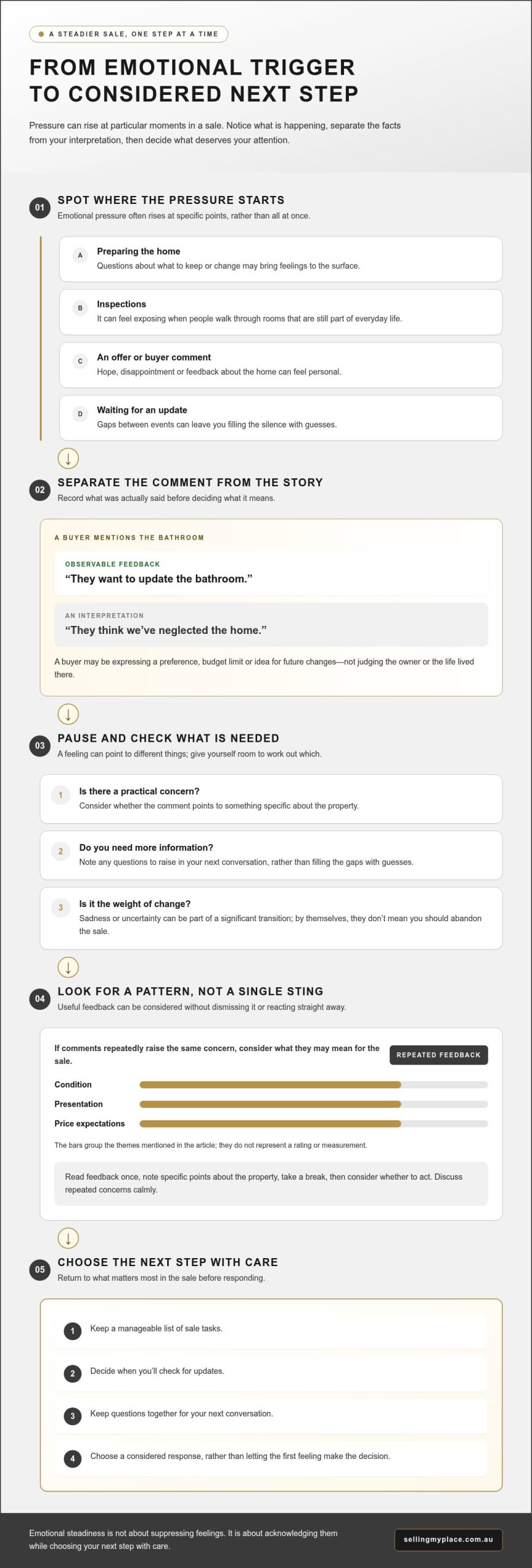
Practical ways to manage emotions before, during and after the sale
A simple reset can help you move from an immediate reaction to a considered response. Use it when a task feels overwhelming, a conversation becomes tense or a milestone brings up unexpected feelings:
- Name the feeling: Is it worry, frustration, sadness or relief?
- Identify the trigger: What happened just before the feeling surfaced?
- Pause: Give yourself a moment before replying or making a non-urgent decision.
- Choose a next step: Decide what information, conversation or practical action would help.
If your thoughts are racing, write down the facts separately from your interpretation. For instance, record “the inspection feedback mentioned the garden” as a fact, then note any assumptions you’re making about what it means. Revisit the decision when you feel more settled. This routine can make managing the emotional side of selling a home feel more deliberate, without expecting you to switch off your feelings.
Make room for priorities and questions
Keep a short list of what matters most in the sale, such as timing, household needs and the offer terms you need to understand. Add questions as they arise, then use the list to guide discussions rather than trying to hold every detail in your head. If you’re planning a sale by owner, this guide to selling your own home can help you think through the process and its practical steps.
Protect routines and relationships during the process
Keep familiar routines where you can, whether that’s a regular family meal, a walk or a quiet hour away from sale-related tasks. Agree with household members how you’ll share preparation jobs and discuss decisions. You might set aside a time to talk through sale matters, so they don’t take over every conversation or evening.
There’s no required way to say goodbye to a home. You may want to take photos, share a memory or simply focus on the move ahead. Make space for what feels right to you, without turning a farewell into another task to get perfect. After settlement, give yourself room to adjust; a change in routine can take time.
If distress persists, feels unmanageable or is affecting your day-to-day wellbeing, consider speaking with a qualified mental health professional. Practical property guidance can help organise sale tasks, while emotional support can address how the transition is affecting you. For guidance with the practical side of your sale, get in touch with our property advisory team.
How supportive guidance can make selling feel more manageable
A clear sale process won’t remove every difficult feeling, and it shouldn’t ask you to set those feelings aside. What it can do is make practical decisions easier to see: what needs attention now, what can wait and where you can get considered advice. That structure can reduce avoidable uncertainty while leaving you involved in decisions about your home.
What a steady, supportive sale process can provide
Professional marketing and advisory support can help organise the practical work of presenting a property and progressing a sale. Professional photography and floorplans give buyers useful ways to understand the home, while neighbourhood market reports provide context for discussions about the market. Pre-sale consulting and real estate advice can help you work through questions as they arise, rather than trying to solve every detail at once.
Kincade International Direct Sales provides flat-fee property marketing and advisory packages, with a 0% commission structure. The service includes residential listings, professional photography and floorplans, alongside pre-sale consulting and real estate advice. Owners remain involved in their sale while using a clear framework for marketing and sale tasks. Defined tasks and access to advice can help you approach each step with more information, without promising that the emotional parts will disappear.
As you consider your options, it may help to ask what would make the process feel clearer. Is it understanding the marketing plan, knowing what needs to happen before listing, or having advice available when you’re weighing a decision? Naming the question can make the next conversation more useful.
Choosing your next step at a pace that feels right
You don’t need to settle every detail at once. Identify the question creating the most uncertainty today, then review the proposed sale process before making commitments or major decisions. A clear explanation of the steps, marketing and advisory support can help you decide what suits your circumstances and how involved you want to be.
Taking time to understand your options is part of managing the emotional side of selling a home. If you’re ready to explore practical support for your sale, Talk through your next step.
Move forward with clarity and support
Selling a home can hold both personal meaning and practical decisions. Remember that feelings may shift throughout the process; noticing a trigger and pausing before you respond can help you make choices in line with your priorities. Managing the emotional side of selling a home isn’t about caring less. It’s about giving yourself room to consider each next step.
A clear sale process can help organise the practical details without pretending to remove every uncertainty. Kincade International Direct Sales’ flat-fee property marketing and advisory packages include professional photography and floorplans, as well as pre-sale consulting, so you can access practical support while remaining involved in your sale.
You don’t need to have every answer before taking the next step. Start with the question that matters most to you, then explore the marketing and advisory support available at a pace that feels right. Talk through your next step when you’re ready. With considered decisions and practical support, you can move towards what comes next with greater confidence.
Frequently Asked Questions
Is it normal to feel sad when selling a home?
Yes, sadness can be a natural response to leaving a home that holds memories or familiar routines. You might also feel relief, excitement or uncertainty, sometimes all at once. There’s no required way to feel, and your emotions don’t have to match anyone else’s. Notice when sadness arises and give yourself space to acknowledge it, while still considering the practical decisions in front of you.
How do I stop taking buyer feedback about my home personally?
Separate what the buyer actually said from the meaning you’re attaching to it. A comment about updating a bathroom may reflect the buyer’s preferences or plans, rather than a judgement of your care for the home. Write down the feedback plainly, then consider whether it raises a useful point about presentation, condition or price expectations. You can take relevant information seriously without treating it as a personal criticism.
Can emotions affect decisions when selling a home?
Yes, strong feelings can influence how you respond to feedback, offers or uncertainty. Disappointment might make an offer feel like an insult, while excitement could make it tempting to decide before weighing all the terms. Managing the emotional side of selling a home means noticing that reaction and pausing. Review the offer details, timing, conditions and your priorities before choosing whether to accept, decline or negotiate.
What should I do if I feel overwhelmed while selling my home?
Pause and work out what feels most difficult right now. Name the feeling, identify its trigger, then separate the known facts from assumptions or worst-case thoughts. Choose one manageable next step, such as writing down a question for your next sale discussion. Protect time for ordinary routines where possible. If distress persists, feels unmanageable or affects daily life, consider speaking with a qualified mental health professional.
How do I cope with selling a family home?
Give yourself permission to recognise what the home has meant to your family, without feeling you need to follow a particular farewell ritual. You might share stories, take photos or simply talk about the move together. If others are involved in the sale, agree how you’ll discuss decisions and divide practical tasks. People may respond differently, so making room for those differences can help the transition feel more considered.
How can I stay calm when negotiating a home sale?
Before responding, record the offer and review its terms, including timing and conditions. Compare them with your priorities and relevant information about the property, rather than guessing at the buyer’s motives or measuring the offer against a perfect outcome. If you feel surprised or disappointed, take a pause and seek measured advice if needed. A considered response may be to accept, decline or negotiate, depending on your circumstances.
Stress-Free Property Selling for Australian Owners
Reading Time: 11 minutes
A calmer sale often starts with fewer competing decisions, not more. Avoiding stress when selling property isn’t about controlling every twist; it’s about knowing what needs attention now, what can wait and who can help. From preparing for inspections to weighing an offer or adjusting plans, it’s easy to feel pulled in several directions at once.
If you’re unsure where to begin, you’re not alone. Selling a home is a significant change, and practical tasks can sit alongside plenty of emotion. A clear plan can make the next step feel manageable, while realistic milestones help you stay focused without expecting everything to happen at once.
This guide will help you set priorities, organise the sale into a sensible sequence and feel more in control of decisions and communication. You’ll also learn how practical support, such as pre-sale consulting, listing services, photography and floorplans, can ease the workload while you remain involved in your sale. The aim is a steadier process, clearer choices and more confidence as plans unfold.
Key Takeaways
- Reduce uncertainty by separating what you can influence from the outcomes you can’t control.
- Make avoiding stress when selling property more achievable by turning broad goals into clear, manageable steps.
- Look for patterns in buyer feedback before making changes, rather than treating one comment as a verdict on your home.
- Agree on communication routines and share practical tasks to protect your time and energy during the sale.
- Consider how flat-fee, commission-free marketing and advisory support can clarify responsibilities while keeping you involved in decisions.
Why selling property can feel stressful, and what you can control
Selling a home is more than a set of practical jobs. It can mark a move, a change in household plans or the closing of a meaningful chapter, while requiring decisions about preparation, timing and offers. It’s understandable if the process feels demanding, especially when several important things need your attention at once.
Sale-related stress often grows from uncertainty, competing tasks and decisions with real consequences. You may be organising the property while keeping up with everyday responsibilities, responding to inspection arrangements and considering buyer feedback. The pressure can feel heavier when it’s unclear who is handling each task or what needs to happen next. Every owner’s circumstances are different, so there’s no single pace or plan that suits everyone.
Which parts of selling tend to create the most pressure?
Preparation can bring a long list of jobs, from deciding what needs attention to getting the home ready for photography and inspections. Deadlines, inspection availability and regular communication can add to the workload. Offers may feel especially weighty because they call for careful consideration, not an automatic response. When responsibilities aren’t clearly divided, even small tasks can blur into one overwhelming list.
What can sellers influence, and what must they allow for?
You can organise the work around your sale: gather relevant information, plan preparation, set out when you’re available and agree how decisions will be reviewed. A simple task list can clarify who is responsible for each job. Setting a regular time to consider updates can also stop every message from feeling urgent.
Some things remain outside your control. You can’t guarantee when buyers will be interested, how they’ll respond to the property or when an offer may come forward. Trying to predict every outcome can use energy without making the process more certain. Instead, focus on the choices in front of you and the information that helps you make them thoughtfully.
A clear plan won’t control every part of a property sale, but it can turn a complex process into a series of more manageable decisions. That’s a practical starting point for avoiding stress when selling property: know what you can act on, and allow room for what you can’t. Simple routines that support your wellbeing can help too; this overview of stress management techniques offers broader ideas for handling pressure.
How to make a property sale feel manageable with a simple plan
A useful plan doesn’t need to account for every twist. Its job is to show you what matters next, keep essential information close and make progress easier to see. To make avoiding stress when selling property more achievable, break the process into steps you can review and adjust as circumstances change.
Try this simple sequence:
- 1. Define your priorities. Be clear about what matters most, such as your preferred timing, the home’s presentation or how involved you want to be.
- 2. Gather information. Collect property details and sale-related documents before key discussions or decisions.
- 3. Plan preparation. List the work needed to get the home ready, then separate essential tasks from optional improvements.
- 4. Organise communication. Decide where updates, questions and inspection arrangements will be recorded, and when you’ll review them.
- 5. Review decisions. Set aside time to consider new information and agree on the next action, rather than trying to resolve everything as it comes in.
How should you prioritise sale tasks?
Start with tasks that affect readiness or a decision you need to make. For each job, note who is responsible and what needs to happen before it can be marked complete. Optional upgrades can wait until you’ve weighed their purpose against the time and effort involved. Set personal milestones for preparation, listing readiness and availability, but treat them as guideposts, not guarantees. If plans change, update the sequence instead of viewing a revised schedule as a setback.
What information can reduce uncertainty early?
Use one central place, such as a notebook or digital document, to keep dates, property details, relevant paperwork, questions and decisions. That way, important information isn’t scattered across messages and reminders. Market reports and comparable property information can help frame expectations, but they aren’t a promise of the price your home will achieve. For more context, read How to Determine the Market Value of a Home in Australia: The 2026 Seller’s Guide.
Small, specific tasks make a large goal easier to manage. “Prepare the home” can become a list of separate jobs, each with an owner and a realistic target date. This lets you see what’s done, what’s underway and what can wait, without expecting the sale to follow a perfectly smooth path. If you’re selling independently, How to Sell Your Own Home: A Step-by-Step Guide to Sale by Owner in Australia offers further guidance on the process.
When practical guidance would help you shape your sale plan, explore property sale support to clarify your next steps while staying involved in decisions.
How to handle uncertainty, feedback and offers without feeling overwhelmed
Feedback and offers can feel personal, particularly when you’ve invested time and care in your home. A steadier approach is to treat each response as information to assess, not as a verdict or a decision you need to make on the spot. This can make avoiding stress when selling property more achievable, even when the next step isn’t immediately clear.
How can you keep buyer feedback in perspective?
One buyer’s comment may reflect their preferences, budget or circumstances, rather than an objective judgement of your property. Record feedback and look for recurring themes. If several people mention the same practical issue, consider whether a change fits your sale plan. A single suggestion doesn’t automatically mean you should alter the home or its presentation.
Give yourself a little time before making emotionally charged changes. Pause, review what you’ve heard and discuss any possible adjustment with your adviser. This helps you respond deliberately, rather than letting one inspection shape the entire campaign.
How can you make offer decisions with a clearer head?
An expression of interest signals that a buyer may want to discuss the property, but it isn’t the same as a clear offer ready for your decision. The detail and effect of communications can vary, so clarify what the buyer is proposing and what, if anything, they’re asking you to agree to. You don’t need to treat interest as a commitment to proceed.
Before reviewing an offer, revisit your priorities and questions. Consider the whole proposal, not just the headline amount. You might want to understand any conditions, proposed timing, inclusions and response deadline. For legal questions about contract terms, use appropriate conveyance advice.
| Decision factor | Question to consider |
|---|---|
| Offer amount | How does it fit with your expectations and priorities? |
| Conditions | What does the buyer require before proceeding? |
| Timing | Does the proposed schedule work for your circumstances? |
| Inclusions | Is it clear what is included in the proposal? |
Use the table to organise your thinking, not to predict which offer will succeed. If something is unclear, ask for clarification before responding. For more ideas on weighing proposals and communicating your position, see Mastering the Deal: Expert Property Sale Negotiation Tips for Australian Homeowners.
A short pause can create room for a better decision. For structured guidance as you assess buyer responses, explore property sale advisory support.
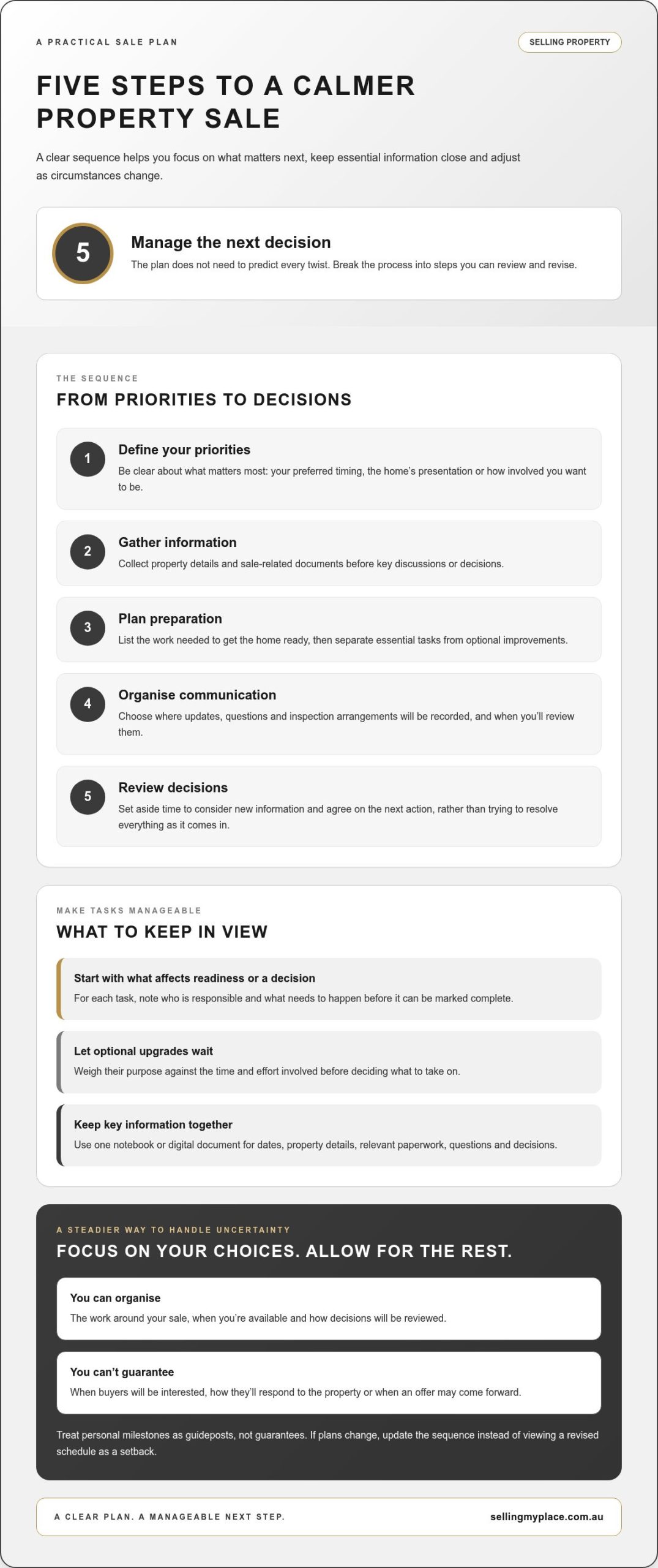
How to protect your time, boundaries and energy during a sale
A property sale can bring a steady stream of messages, questions and practical jobs. Setting a few clear routines helps you stay informed without feeling that you need to be on call every moment. It’s a useful part of avoiding stress when selling property, especially when sale tasks sit alongside work, family commitments and the ordinary rhythm of home life.
What boundaries make sale communication easier?
Agree on one reliable channel for routine updates, then keep key decisions and agreed next steps in writing. Choose practical times to review messages, such as once in the morning and again later in the day, rather than checking continuously. Set a simple process for urgent questions too: clarify what counts as urgent and which channel should be used. Important matters can then be raised promptly without every update feeling like an emergency.
Be clear about who needs to take part in decisions. A household member might coordinate access for inspections, while another keeps the task list up to date. An adviser can help organise sale-related information or discuss marketing, while you retain the final say on decisions that matter to you. Shared responsibility works best when everyone knows what they’re handling.
How can you preserve your energy during the sale?
Keep ordinary routines where you can. Protecting time for work, meals, rest or family plans gives the sale a place in your week without allowing it to take over. Some flexibility will be needed for preparation and buyer access, so identify in advance where you can adapt and where you need notice. A shared calendar can help household members coordinate commitments and avoid last-minute confusion.
When can outside support ease the workload?
Notice which tasks are taking the most effort. You may find it difficult to organise listing details, arrange photography and floorplans, interpret neighbourhood market information or decide what to prepare before going to market. Residential property listing and advisory support can take defined tasks off your plate while leaving you involved in decisions. A flat-fee, commission-free marketing model can also make service costs more predictable. For more context, see Professional Residential Property Listing Services: The Modern Australian Seller’s Guide.
Support should make responsibilities clearer, not add pressure or speak over you. Choose the parts of the process where guidance would genuinely help, then agree how updates and decisions will be handled. To share the practical load while staying involved in your sale, explore property listing and advisory support.
How the right selling support can help you move forward calmly
Good support should make the moving parts of a sale easier to understand, not add another layer of pressure or take your voice out of decisions. You can stay involved in choices about your home while sharing specific tasks with people who understand the selling process. For owners focused on avoiding stress when selling property, the key is finding support that fits the way they want to sell.
What should useful property-selling support help with?
Practical marketing support can reduce the jobs you need to coordinate yourself. Kincade International Direct Sales provides residential property marketing on a flat-fee, commission-free basis, with listing support, professional photography, floorplans and neighbourhood market reports. Listings remain active until sold. These defined services can help you organise how your home is presented and promoted, without promising a particular price, buyer response or timeline.
Pre-sale consulting and advisory support can help you clarify priorities, make sense of the next steps and identify where guidance would be useful. That might mean planning what to prepare, understanding the marketing material or working out which decisions need your attention. The aim is to share practical responsibilities while keeping you informed and involved, not to guarantee a stress-free sale.
How can you take the next step without rushing?
Start with one simple prompt: what part of selling feels hardest to manage right now? Write down the concern, whether it’s organising the listing, preparing the home or knowing what to do next. Then note the kind of help that would make a real difference. A focused conversation is often easier than trying to solve every part of the sale at once.
Seeking information doesn’t mean you need to make an immediate commitment. It gives you a chance to understand what support involves and decide whether it suits your priorities. Take the time you need to consider your options and keep ownership of the decisions that matter to you.
Selling is a meaningful transition, and you don’t have to work out every detail alone. To explore a more manageable way to prepare for your sale, talk through your property-selling plans.
Take your next step with a clearer plan
A more manageable sale starts with focusing on what you can influence: set clear priorities, break preparation into practical tasks and give yourself space to review feedback and offers. Simple communication boundaries can protect your time, while the right support can make responsibilities easier to understand without taking decisions out of your hands. These are useful foundations for avoiding stress when selling property, even when plans need to change.
Kincade International Direct Sales provides commission-free property marketing and advisory support through a flat-fee model. Listing support includes professional photography, floorplans and neighbourhood market reports, with listings remaining active until sold. Clear, defined support can help you organise the practical parts of selling while staying involved in your sale.
You don’t need to have every detail worked out before exploring your options. Start by identifying the part of the process you’d most like help with, then take the next step at your own pace. Talk through your property-selling plans and explore a more manageable way to prepare for selling. With a clear plan and support that suits your needs, you can move forward with greater confidence.
Frequently Asked Questions
How can I reduce stress when selling my property?
Reduce pressure by making the sale easier to organise, one decision at a time. Write down your priorities, gather relevant property information and break preparation into manageable tasks with clear responsibilities. Keep dates, questions and decisions in one place, and set regular times to review updates instead of monitoring messages constantly. You can’t control buyer timing, but a practical plan can help you focus on informed choices and adjust as needed.
What is the most stressful part of selling a property?
There isn’t one most stressful part for every seller. Preparation, deadlines, inspections, communication and weighing offers can all feel demanding, particularly when they compete with everyday responsibilities. The pressure often increases when it’s unclear who is handling a task or what needs attention next. Identifying your personal pressure points helps you decide where a simple routine, clearer responsibilities or practical selling support could make the process feel more manageable.
Can I sell my property without feeling overwhelmed?
You may not be able to remove every challenge, but you can make the work feel more manageable. Start by separating essential tasks from optional improvements, then set realistic milestones for preparing and listing your home. Keep space in your plan for changes, and share practical responsibilities where possible. Selling involves uncertainty, so aim for steady progress rather than expecting every step to happen exactly as planned.
How do I stay calm when receiving an offer on my property?
Pause before responding and review the proposal against the priorities you set before an offer arrived. Consider the terms as well as the headline amount, including any conditions, timing, inclusions and response deadline. If something is unclear, seek clarification and take time to understand what you’re being asked to decide. An expression of interest may signal buyer interest, but it isn’t necessarily a complete offer or a commitment to proceed.
What happens if my property takes longer to sell than expected?
A longer sale process can be frustrating, but it doesn’t mean you need to make a rushed decision. Review buyer feedback for recurring themes, consider whether your marketing and sale plan still reflect your priorities, and discuss possible adjustments with an adviser. Kincade International Direct Sales keeps listings active until sold, with no time limit. Buyer interest and timing can’t be guaranteed.
Should I use a property adviser to reduce stress when selling?
A property adviser may help if you’re unsure what to do next, find planning the sale time-consuming or want support interpreting market information. Pre-sale consulting and advisory support can help clarify priorities and organise next steps, while you remain involved in decisions. Kincade International Direct Sales provides commission-free property marketing and advisory services through a flat-fee model. Consider which tasks you’d genuinely like help managing before deciding what support suits you.
How can I manage inspections and buyer feedback without losing my routine?
Set practical availability for inspections and agree how arrangements and updates will be communicated. A shared calendar or task list can help household members coordinate access and preparation without relying on one person to remember everything. Protect everyday routines where possible, while allowing some flexibility for sale-related commitments. After inspections, record feedback and look for patterns before making changes; one buyer’s comment isn’t necessarily a reason to alter your plans.
Does selling with support mean I lose control of the sale?
No. Useful support should clarify responsibilities and help with practical tasks while keeping you involved in important decisions. For example, listing support, professional photography, floorplans and neighbourhood market reports can assist with preparing and marketing your property, while advisory support can help you plan. Agree on how you’ll receive updates and which decisions you’ll make. A flat-fee, commission-free model is one option for owners who want practical support while retaining involvement.
Fixed Fee Agency in Australia: A Seller’s Guide for 2026
Reading Time: 10 minutes
What if the fee you pay to sell your home didn’t rise with the sale price? An agency flat fee sets the charge for agreed services in advance, rather than calculating it as a percentage of the sale price. But the fee alone won’t tell you what support you’ll receive or which parts of the sale you’ll manage yourself.
To compare options, look at the service scope as well as the fee: what marketing is included, what advice is available and what responsibilities remain yours. This guide explains how flat fees differ from commission and what to weigh before choosing a selling approach. Kincade International Direct Sales provides commission-free residential property marketing with professional photography, floorplans, neighbourhood market reports and a dedicated Agent Advisory Service. These services can help you prepare and promote your property while retaining control of your sale.
Key Takeaways
- An agency flat fee sets the fee basis, but the agreed service scope determines what support you receive.
- Compare listing exposure, campaign materials, advice and sale support, as well as the tasks you’ll handle yourself.
- Decide how involved you want to be, then match the fee model and service scope to your marketing priorities.
- Kincade International Direct Sales combines commission-free residential marketing with global listing exposure, photography, floorplans and neighbourhood market reports.
- Read the written service scope and responsibilities to understand the trade-offs and retain greater control over your sale.
What does an agency flat fee mean for an Australian home seller?
An agency flat fee is a set charge for an agreed property selling service, rather than a fee calculated as a percentage of the final sale price. The amount is fixed under the arrangement, but the term alone doesn’t explain which services are included or what you’ll need to manage.
Separate the fee basis from the service scope. The fee basis tells you how the charge is calculated; the service scope sets out what you receive. Two services can both use a flat fee while offering different listing exposure, campaign materials and advice. Comparing both helps you understand the cost and the practical support behind it.
How does a flat fee differ from commission?
Commission is generally calculated as a proportion of the property’s sale price, so the amount changes with the final result. A flat fee is a set charge for services agreed in advance. Neither label defines the full arrangement: inclusions and responsibilities depend on the written scope. A real estate agent may support different parts of a property transaction, so compare the work provided as well as the way the fee is calculated.
For a useful comparison, list the fee, included listing and marketing assistance, available advice and any campaign expenses charged separately. This makes it easier to compare like with like instead of assuming every flat-fee or commission arrangement works the same way.
Does a flat fee mean selling without support?
No. The fee model doesn’t determine how much guidance you receive. Some arrangements combine owner involvement with professional marketing or advisory assistance. Depending on the service scope, you might lead buyer enquiries or sale discussions while receiving support with campaign materials and property advice.
Before choosing, identify the parts of the sale you’re comfortable handling and where professional guidance would be useful. An owner-led sale can still draw on campaign resources and advice. Be clear about who handles each task so you know what to expect.
In Australia, an agency flat fee can suit sellers who want a set-fee structure and a defined level of support. Check that the written scope explains the services, marketing plan and your role. The next step is to look at the practical service categories that may form part of a property campaign.
What can an agency flat fee include beyond a property listing?
A listing is one part of a property campaign. To assess an agency flat fee, consider how the property will be presented, where it will be promoted, what advice is available and which tasks remain yours. Use this checklist to compare the actual service scope rather than relying on feature names alone.
- Listing: What exposure is provided, and how is the property listing prepared and presented to prospective buyers?
- Campaign materials: Are professional photography and a floorplan included in the marketing support?
- Advice: Is pre-sale consulting or market context available as you prepare?
- Sale support: What advisory or conveyance-related assistance is provided, and which sale tasks will you manage?
Look at how each feature is delivered, not just whether it appears in a package description. For example, clarify how photography and floorplans will be used in the listing, and how market information can inform your campaign. A clear scope helps you understand what support is available from preparation through to buyer interest.
Which marketing services should sellers look for?
Professional photography gives buyers a visual introduction to the home, while a floorplan helps them understand its layout and how rooms connect. Together, these materials make it easier to assess a listing before arranging a viewing. Listing exposure determines how the property is presented to potential buyers, but broad reach does not guarantee buyer interest. Neighbourhood market reports can add context as you plan your campaign, but they can’t promise a particular sale result.
What advisory support can make the process easier?
Pre-sale consulting can help owners plan and organise their sale. An Agent Advisory Service provides guidance while you remain involved in decisions and tasks. Conveyance advice can help you understand aspects of the sale process, but it isn’t a substitute for legal advice.
Kincade International Direct Sales combines global listing exposure, professional photography, floorplans, neighbourhood market reports and advisory support in a commission-free residential marketing service. This combination supports owners who want to stay hands-on while drawing on campaign resources and practical guidance.
For related information on preparing a campaign, view the ways our team can support your selling plans.
Agency flat fee vs commission: how can sellers compare the models?
A useful comparison looks beyond the headline fee to the included support, your responsibilities and how the final charge is calculated. Percentage commission changes with the sale price. An agency flat fee is set for the agreed services, so the fee itself doesn’t rise or fall with the sale price. Neither model is automatically cheaper overall: the result depends on the agreement, any separate campaign costs and the sale itself.
Use this table as a starting point. The details depend on the written arrangement, rather than being standard inclusions attached to a fee label.
| What to compare | Percentage commission | Flat fee |
|---|---|---|
| Fee basis | Calculated as a proportion of the final sale price, so the amount changes with that price. | A set charge for the services agreed, rather than a proportion of the sale price. |
| Service scope | Depends on the written arrangement; the commission basis alone doesn’t define what’s included. | Also depends on the agreed scope. A set fee doesn’t automatically mean a particular package. |
| Marketing materials | Photography, floorplans and other campaign materials are agreement-specific. | These are agreement-specific too. Compare the materials and how they’ll be delivered. |
| Advice and support | Advisory access and sale support depend on the service arrangement. | Check what guidance is part of the agreed service, rather than assuming it from the fee structure. |
| Seller responsibilities | Clarify which tasks the owner handles and which are supported through the service. | Make the same distinction; a flat fee doesn’t automatically mean more or less owner involvement. |
What should the fee comparison table show?
Keep fee calculation, service scope and responsibilities as separate questions. A written comparison should show whether marketing materials are included, what advisory access involves and which tasks remain yours. Note any campaign costs outside the service fee so you can compare the overall arrangements. Treat details not specified in the agreement as separate questions, rather than assuming they are included.
How do responsibilities differ between selling models?
Whatever the fee basis, owners are commonly involved in preparing property information and making decisions about the sale. The level of support with campaign preparation, buyer communication or advice can vary independently of whether the fee is fixed or commission-based. Decide how involved you want to be, then compare your preferred role with the responsibilities set out in each written arrangement.
Once the fee and responsibilities are clear, consider how sale decisions and buyer discussions may unfold. Our property sale negotiation guide offers related guidance for Australian homeowners.
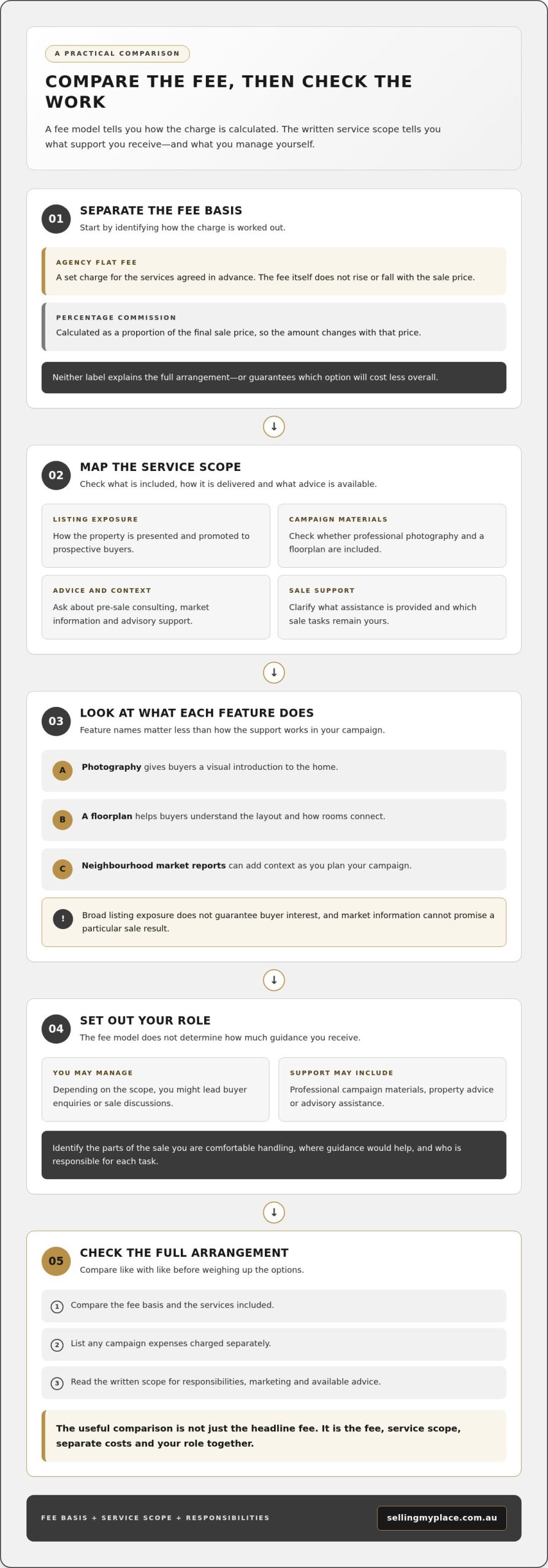
How can you decide whether an agency flat fee suits your sale?
The right fit depends on how involved you want to be, where guidance would help and what matters most in your marketing. A fee label can’t answer those questions. Use these steps to weigh your priorities before settling on an arrangement.
- Decide how hands-on you want to be. Consider the sale tasks you’re comfortable managing, such as preparing property information and making decisions as offers come in. If you prefer structured professional guidance at key points, include that in your priorities.
- Identify where support would help. Think about whether you’d value pre-sale advice, campaign guidance or conveyance advice. Pinpoint the stages where assistance would be useful, while keeping responsibility for your decisions clear.
- Set your marketing priorities. Consider the listing exposure, photography, floorplans and neighbourhood information that would help present your property. Check how each element fits into the campaign rather than focusing on a feature name alone.
- Compare the written arrangements. Review the fee basis alongside the service scope, delivery and seller responsibilities. This gives you a clearer view of what you’ll receive and what you’ll take on, whether the fee is flat or commission-based.
What level of involvement do you want in the sale?
Some owners are comfortable coordinating more of the sale themselves; others prefer a more guided experience. Your preferred level of involvement is separate from the fee structure. A flat fee doesn’t automatically mean you’ll manage everything, just as commission alone doesn’t define the support you receive. For a closer look at owner involvement, read our guide to selling your own home.
How can you assess the likely service fit?
Match the marketing resources to your needs. Photography gives buyers a visual introduction to the property, a floorplan clarifies its layout, and neighbourhood market information adds context. Then consider how advisory support fits into your preparation and sale decisions. Our residential property listing services guide provides a wider overview of listing support.
An agency flat fee may suit your plans when the agreed services and responsibilities match the way you want to sell. To explore Kincade International Direct Sales’ commission-free marketing and advisory support, read more about our property sale services.
How Kincade International Direct Sales supports a commission-free sale
Selling a home is a significant transition, and a clear plan can make each step more manageable. Kincade International Direct Sales combines commission-free residential property marketing with advisory support, giving owners campaign resources while they remain involved in their sale. Its flat-fee model provides agreed listing and professional services without an agency commission tied to the final sale price.
The service includes global listing exposure, professional photography, floorplans and neighbourhood market reports. Listing exposure presents the property to prospective buyers, photography helps showcase its features, and a floorplan makes the layout easier to understand. Neighbourhood market reports give owners context as they consider their campaign and sale decisions.
What support can owners expect during a sale?
A dedicated Agent Advisory Service includes pre-sale consulting and conveyance advice to guide owners as they prepare and work through the sale. This support can sit alongside your own involvement, so you can draw on advice while retaining control of decisions. Listings remain active until sold, with no time limit. This does not guarantee a sale, a particular price or a timeframe; the outcome depends on the property and market conditions.
How does commission-free marketing protect seller choice?
Without agency commission, the service does not charge a percentage of the sale price as agency commission. Owners can retain greater control over the selling process and their sale proceeds while using professional marketing and advisory resources. The practical value depends on how the service scope supports your priorities, not on the fee label alone.
If you’re weighing up how much involvement suits you and what guidance would be useful, explore Kincade International Direct Sales’ commission-free property marketing.
Choose a selling approach that fits your plans
The right agency flat fee arrangement involves more than a set charge. Compare the written service scope, marketing materials, advisory support and responsibilities you’ll take on, then weigh these against a commission-based model. Choose the approach that aligns with how involved you want to be and the support you value throughout the sale.
Kincade International Direct Sales provides commission-free residential property marketing and advisory services, including professional photography, floorplans and neighbourhood market reports. Listings remain active until sold, with no time limit. The services support your campaign while you retain control of the selling process, but they can’t guarantee a particular price or timeframe.
Discuss your property sale with Kincade International Direct Sales to explore a flat-fee marketing and advisory approach that fits your plans.
Frequently Asked Questions
What is an agency flat fee?
An agency flat fee is a set service charge agreed for property-selling support, rather than a fee calculated as a proportion of the final sale price. The fixed amount applies to the services in the arrangement, but the term alone doesn’t describe what they include. Read the written scope to understand the marketing, advice and sale support provided, and which responsibilities remain with you as the homeowner.
Is an agency flat fee cheaper than commission?
Not necessarily. The overall comparison depends on the agreed fee, the services included, any separate campaign costs and the final sale outcome. A percentage commission changes with the sale price, while a flat fee is set for agreed services. Compare the total arrangement and support you’ll receive instead of assuming one model is always less expensive. Your preferred level of involvement also matters.
What services are usually included in an agency flat fee?
Services depend on the agreement and may include property listing support, marketing materials such as photography and floorplans, market information, pre-sale consulting or other advisory assistance. Some arrangements also include conveyance advice or guidance during the sale. There’s no universal package attached to a flat fee, so read the service scope carefully. Check what’s delivered, how it fits into your campaign and which tasks you’ll manage yourself.
Can I sell my home myself with a flat-fee agency?
Yes. An owner-led sale can sit alongside professional marketing or advisory support. You might stay closely involved in sale decisions while using resources such as photography, floorplans or pre-sale guidance. Understand how responsibilities are divided before you begin. A flat-fee structure doesn’t mean you must manage every part alone, or that the service takes over the entire process.
Do flat-fee property services include professional photography and floorplans?
Inclusions vary by arrangement. Kincade International Direct Sales includes professional photography and floorplans as part of its commission-free residential marketing service. Photography gives buyers a visual introduction to a property, while a floorplan helps them understand its layout. Neighbourhood market reports add campaign context. These materials can support how a home is presented, but they don’t guarantee buyer interest or a particular sale result.
Does a commission-free property listing guarantee my home will sell?
No. A commission-free listing, like any other fee arrangement, can’t guarantee a buyer, a particular sale price or a timeframe for selling. Kincade International Direct Sales keeps listings active until sold, with no time limit, but that isn’t a promise that a sale will occur. Marketing materials and advisory support can help owners prepare and present a campaign, while the outcome depends on the property and market conditions.
How do I decide whether a flat-fee service is right for me?
Start by deciding how involved you want to be and where you’d value guidance. Then compare the written service scope, including listing exposure, photography, floorplans, market information and advisory support. Understand which responsibilities remain yours and how the fee is calculated. Comparing those details with a commission-based arrangement can help you choose an approach that suits your priorities and feels manageable.
What’s Actually Inside a Flat-Fee Property Marketing Package? An Australian Seller’s Breakdown
Reading Time: 15 minutes
You have seen the headline: “List your home for just $799.” It sounds simple. It sounds like a deal. But experienced Australian sellers know that what a flat-fee package advertises and what it actually delivers can be two very different things.
Flat fee real estate agents have genuinely disrupted the traditional commission model, giving sellers more control over their costs. The problem is that not every package is built the same way. One service’s $799 might include professional photography, premium portal syndication, and a floor plan. Another’s might include none of those things, leaving you to pay separately for every component that actually drives buyer interest.
This guide is designed to change how you evaluate your options. Rather than taking marketing copy at face value, you will walk away with a clear, practical understanding of every deliverable that belongs in a quality flat-fee property marketing package. From portal reach and visual assets to legal compliance and seller support, this breakdown covers the full picture. By the end, you will have a checklist you can use to compare any package with confidence before you commit.
Why Flat-Fee Marketing Packages Are Not All Created Equal
The flat-fee model has grown significantly across Australia as sellers seek to avoid traditional commission costs, but “flat fee” describes a pricing structure, not a guaranteed set of deliverables. Two packages priced at similar figures can produce vastly different results for your sale, depending on portal syndication tier, visual asset quality, and the level of support included after your listing goes live.
Understanding where flat-fee packages sit in the broader pricing landscape helps you evaluate them correctly. Australian real estate marketing generally operates on three billing structures: monthly retainers (ongoing management), performance-based pricing (rare, tied to results), and project-based pricing (finite deliverables for a fixed cost). Flat-fee property marketing packages are project-based. You are buying a defined scope of work, not an ongoing service relationship. That distinction matters because every item either is or is not included, and there is no automatic provision for extras.
The most important filter to apply immediately is transparency. Quality providers clearly separate what the flat fee covers from what requires additional spend. A package that buries portal upgrade costs, photography charges, or floor plan fees in the fine print is not genuinely flat-fee in practice. If a provider cannot tell you exactly what is and is not included, that ambiguity is a signal worth heeding.
For a thorough grounding in how the flat-fee model works before you compare packages, understanding exactly what you are paying for in a fixed-fee arrangement is a useful starting point.
The sections below break down every major component category so you can assess any package against a concrete checklist, rather than marketing copy.
Portal Syndication: Which Sites Your Listing Actually Reaches
Portal reach is the single most consequential variable in a flat-fee real estate marketing package, and it should be the first thing you verify in writing.
Realestate.com.au and Domain are Australia’s two dominant portals, commanding the overwhelming majority of active buyer traffic. Any package that excludes either one limits your buyer pool before a single enquiry is made. Confirm both are explicitly named in your package, not implied by phrases like “all major portals.”
Listing tier matters as much as portal inclusion. On realestate.com.au, a standard listing sits below Premiere, Highlight, and Feature placements in search results. Buyers who don’t scroll past the promoted results may never see your property at all. Ask your provider whether the flat fee covers a standard position or an upgraded tier, and whether any upgrade is a one-time cost or time-limited. The duration and placement tier of your listing directly affects how long it maintains prominent visibility in search results.
International syndication is not standard. Some flat-fee providers extend listings to international platforms. If your property is likely to attract offshore interest, verify whether international syndication is available and which markets it covers, rather than assuming it is included.
Two questions to ask before you commit:
- Does the package state the exact portal names, listing tier, and active duration in writing? Vague references to “major portals” are a red flag.
- If you reduce your asking price and need to refresh or re-list, does that incur an additional fee? This affects your total cost if the property takes longer to sell.
If you are still working out whether to list at all, the complete guide to listing and selling your home in Australia covers what to expect from valuation through to settlement.
Photography and Visual Assets: The Non-Negotiables and the Nice-to-Haves

Once your listing is live on the right portals, what buyers actually see determines whether they enquire. Visual assets are where that decision gets made.
Professional photography is the single highest-impact element in any listing. Buyers consistently engage more with professionally shot listings than those photographed on a smartphone, and the gap in enquiry rates is material, not marginal. Some flat-fee packages include a photo shoot in the base price; others treat it as a paid add-on. Confirm this before you sign up.
When reviewing any photography inclusion, check three specific things: the number of final edited images delivered, the turnaround time from shoot to delivery, and whether a reshoot is available if conditions on the day are poor. Bad weather or an unstaged property can undermine an otherwise strong shoot.
Beyond standard photography, several additional visual formats are worth understanding:
- Drone and aerial photography adds genuine value for large blocks, rural properties, and homes with notable outdoor features such as pools, views, or landscaping. It is rarely included in base packages and is usually priced as an add-on.
- 3D virtual tours (Matterport-style walkthroughs) allow interstate and overseas buyers to inspect a property without travelling. These extend your buyer pool meaningfully for premium or regional listings but are almost never included in a standard flat-fee package. For a fuller look at how these formats work alongside floor plans and drone footage, see Beyond Still Images: 3D Tours, Drones, and Floorplans.
- Video walkthroughs are a separate product from 3D tours. A video is a linear, edited production that typically requires a videographer and carries higher production costs. Clarify which format is being offered before assuming either is included.
- Twilight photography captures a property under dusk lighting and can markedly lift the visual appeal of certain homes. It is almost always a chargeable add-on. Confirm the cost before assuming it is bundled.
Floor Plans: Why Their Inclusion (or Absence) Affects Buyer Behaviour
Beyond photography, floor plans are one of the most requested elements by buyers browsing online listings. Photographs show how a property looks; a floor plan shows how it works. Buyers use floor plans to pre-qualify a property spatially before committing to an inspection, filtering out layouts that don’t suit their household before they ever contact the seller.
Understand what type of floor plan you’re getting
There are two distinct types. A marketing floor plan is a clean 2D diagram designed for listing purposes, showing room layout, flow, and approximate dimensions. An architectural or measured floor plan is a precise technical document used for construction and planning. Most flat-fee real estate packages that include floor plans provide the marketing version, which is entirely appropriate for listing purposes and what buyers expect to see on portal listings.
Check whether it’s measured on-site or drawn from council records
This distinction matters. Council-sourced plans can be outdated or inaccurate, particularly for apartments where internal layouts have been modified since original construction. A floor plan measured on-site is more accurate and more credible to buyers scrutinising room dimensions before making an offer. For a deeper look at why this matters and what to expect from the process, Beyond the Photos: Why Floor Plans are Essential for a Successful Sale provides useful context.
Know the cost range and upgrade options
Some providers include a marketing floor plan in their standard package; others charge it as a standalone add-on; the cost varies depending on property size and provider. 3D floor plans, which render the layout with furniture and spatial depth, are increasingly used in premium listings and may be available as a paid upgrade. Weigh that cost against your property’s price point and likely buyer profile before committing.
SellingMyPlace.com.au includes marketing floor plans within its flat-fee service. Given that comparable packages routinely treat floor plans as an extra cost, this inclusion directly reduces the add-on spend sellers face elsewhere.
Listing Copywriting and Property Description: Who Writes Your Listing?
Your listing copy is not decorative text. It is a searchable, keyword-bearing asset that influences how your listing ranks in portal search results and whether buyers click through or scroll past.
Copy quality affects discoverability. realestate.com.au’s support documentation addresses how search engines rank property listings, and experienced copywriters treat listing text and metadata as discoverability levers. A description that omits relevant suburb names, property features, or lifestyle keywords may rank lower than comparable properties, suppressing enquiry before a single buyer sees your home.
Flat-fee packages handle copywriting differently. Some include professionally written copy as standard. Others provide a template for sellers to self-complete, or offer copy review as an optional add-on. The more important question is whether included copy is tailored or generic. A templated description can miss the selling points that matter most: north-facing orientation, recent kitchen renovation, proximity to a new train station, or exceptional street appeal.
Platform formatting adds another layer of complexity. realestate.com.au enforces a 150-character limit for listing headlines. An experienced writer works within these constraints while keeping the headline compelling and keyword-rich. An inexperienced seller often does not know the limit exists until the platform truncates it.
If copy is seller-written, check whether the provider offers a review or edit service and whether guidance materials are available. Sellers writing their own descriptions risk overpromising on features, omitting key inclusions, or inadvertently using terms restricted under Australian Consumer Law. For practical guidance on structuring your own description effectively, review the Key Takeaways from a dedicated guide to writing private sale property descriptions.
For-Sale Signage and Print Marketing: Still Relevant in 2026?
Beyond your listing copy, physical and social marketing assets still play a meaningful role in generating buyer enquiry, particularly in markets where not every potential buyer starts their search online.
For-sale signage works hardest in suburban and regional areas, where passing traffic represents a genuine lead source. A corflute board planted at the front of a property catches neighbours, local commuters, and people actively driving streets in a target suburb. That passive visibility is difficult to replicate through digital channels alone.
Whether signage is included in a flat-fee real estate agent package varies considerably. Some providers include a standard corflute board and installation in their base fee; others charge it as an add-on. Availability also differs by location, as state regulations and individual council zoning rules govern permitted sign sizes, placement, and quantities. Confirm the rules for your local government area before factoring signage into your marketing plan.
One important exception: sellers in body corporate or strata-managed buildings should verify whether their scheme rules permit external signage before assuming it is usable, regardless of what the package includes. Many strata schemes explicitly prohibit for-sale boards on common property or building facades.
Print materials, including brochures and property flyers, are less commonly bundled but genuinely useful at open-for-inspections. Sellers conducting their own inspections, as is standard in private sale arrangements, benefit from handing prospective buyers a professionally printed summary to take away.
Social media graphic assets, pre-formatted listing images sized for Facebook, Instagram, and similar platforms, are increasingly included in a high-impact marketing package and allow sellers to promote their listing organically to their own networks at no additional cost.
Seller Support and Service Levels: The Difference That Doesn’t Show Up in the Brochure
Physical marketing assets get sellers to the starting line. Support is what carries them across it.
Support level is the most underestimated variable in any flat-fee property marketing package.
Confirm the basics first. Ask every provider which support channels they offer: phone, email, live chat, or an account portal. Then ask about hours and response times. A 48-hour email turnaround is not adequate when a buyer is ready to submit an offer today and has three other properties on their shortlist.
Pricing strategy guidance is a genuine differentiator. Access to comparable sales data, suburb price trend reports, and guidance on setting an asking price or auction reserve is high-value support that some providers include as standard and others reserve for premium tiers. Sellers who enter the market without this information risk overpricing into stagnation or underpricing unnecessarily. Confirm whether it is in the package before you commit.
Negotiation support separates the functional from the minimal. Some flat-fee providers guide sellers through the offer and counteroffer process; others consider their role complete once the listing is published. Know which type you are buying before you need it.
Inspection coordination is similarly inconsistent. Support for scheduling open-for-inspections, managing buyer enquiries, and following up with attendees post-inspection varies widely across providers. Ask specifically, because it rarely appears in the headline feature list.
SellingMyPlace.com.au includes pricing strategy tools, expert guides, and step-by-step resources designed to carry sellers from listing through to settlement. For sellers weighing up their options, the What to Look for in a Flat-Fee Property Service guide is a practical reference point before making any final decision.
Legal and Compliance Inclusions: What Australian Sellers Must Not Overlook
Australian property sales are governed by state-based legislation, and disclosure obligations differ materially across jurisdictions. A flat-fee real estate marketing package does not replace legal advice, but a quality provider will identify what documentation you must obtain before your listing goes live.
State-specific requirements every seller must know:
- NSW: Under the Conveyancing Act 1919, a solicitor or conveyancer must prepare a Contract for Sale before the property can be advertised. Required attachments include a title search, Section 10.7 Planning Certificate, and sewerage diagram. This is a conveyancing cost outside your marketing package; budget for it separately.
- Victoria: Victoria requires a Vendor’s Statement (commonly called a Section 32) to be prepared before a buyer can sign a contract, confirm the current requirements with a Victorian conveyancer, as specifics are governed by state legislation. Again, this sits outside the marketing fee. Confirm whether your provider offers guidance on obtaining one.
- QLD, SA, WA and other jurisdictions: Each has its own disclosure framework. Requirements vary enough that sellers should verify their state’s obligations before committing to a listing date.
Fair Trading obligations apply nationwide. Property advertising must not be misleading or deceptive under fair trading legislation in every state. When you self-manage a listing under a flat-fee model, you carry personal responsibility for the accuracy of your listing copy. A quality provider will make this responsibility explicit, not bury it in terms and conditions.
Some flat-fee platforms reduce this risk by including template contracts, disclosure checklists, or referrals to conveyancing partners. This compliance scaffolding meaningfully lowers the risk for sellers who are unfamiliar with their state’s requirements.
Before you commit to any package, ask directly: does the service include any legal review component, or does all contract and disclosure preparation rest with you? Then factor those external legal costs into your total cost-to-sell. Know what’s required before you list so there are no compliance surprises once your property is live.
Pricing Transparency: How to Read a Package Fee Schedule Like a Seller, Not a Buyer
Once legal costs are factored in, the next number to interrogate is the package price itself.
The foundational principle is simple: a transparent fee schedule separates the provider’s service fee from any third-party media spend. What the provider charges for their work is one line item. What gets paid to realestate.com.au or Domain is another. Any provider that bundles these without disclosure makes it impossible to know what you are actually paying for.
As covered earlier, low headline prices that require significant add-on spend can exceed the cost of a more inclusive package, build a total-cost model across every item you intend to use.
Build a total-cost model, not a headline comparison. List every item included in each package, then price every item you intend to use that is not included. This gives you a genuine like-for-like figure across providers.
GST affects that figure materially. A package priced excluding GST will carry a 10% GST component on top, factor this into your budget from the start. Portal listing fees from major portals are also typically subject to GST; confirm this with your provider. Calculate your total budget on a GST-inclusive basis or you will underestimate costs.
A specific red flag: some providers include portal listing fees as a pass-through cost at a marked-up rate. You pay above the actual portal charge, with the margin hidden inside the package. Transparent providers either include portal costs at actual cost within the flat fee or pass them through with no mark-up.
Finally, confirm payment timing. Most flat-fee packages are payable upfront and non-refundable, regardless of whether the property sells. This is structurally different from commission-based arrangements, where fees are deducted from settlement proceeds. Knowing this before you commit protects you from a surprise if circumstances change.
State-by-State Variations That Affect What Your Package Must Include
Fee transparency tells you what you’re paying. State-based licensing tells you whether the package can legally deliver what it promises.
Licensing requirements for private property sales differ across Australia. In some states, sellers can manage significant parts of the transaction without a licensed agent involved. In others, a licensed agent must be named on the listing or appointed before certain steps can proceed. Knowing which category your state falls into determines what your flat-fee provider must be authorised to do on your behalf.
Major Australian portals require listings to be submitted through licensed entities, private individuals cannot list directly. Confirm your provider holds the necessary access agreements with the portals before you commit.
Queensland sellers have an additional step to confirm. Queensland has additional agent-appointment documentation requirements before an agent can legally act for a seller, ask your flat-fee provider specifically how this step is handled in their Queensland process before you sign up.
Signage is governed at the local council level, not by your provider. Some councils restrict the size, placement, or number of for-sale signs permitted on a property. Body corporate and strata schemes may prohibit external signage entirely. Check your local rules before treating a sign as a guaranteed deliverable, even if it is included in your package.
Cooling-off periods after contract signing vary by state and affect how offers are received and accepted. A flat-fee provider operating across multiple states should proactively flag these differences. If they do not, that is a gap in their service.
Before committing, confirm the provider holds a valid licence in your state and that any state-specific obligations are clearly identified as your responsibility or theirs.
The Flat-Fee Package Evaluation Checklist for Australian Sellers
Once you have confirmed your provider is licensed in your state, apply this checklist to every package you are evaluating.
1. Portal syndication
- Which portals are included by name?
- What listing tier is provided: standard, feature, highlight, or premiere?
- Is international syndication available for offshore buyer reach?
- How long is the listing active, and does a price reduction trigger a re-listing fee?
2. Photography
- Is professional photography included or an add-on?
- How many edited images are delivered?
- Is drone photography available, and at what cost?
- What is the reshoot policy if weather or conditions are poor on the day?
3. Floor plan
- Is a marketing floor plan included in the base fee?
- Is it measured on-site or generated from council plans?
- Is a 3D floor plan available as a paid upgrade?
4. Copywriting
- Is listing copy written by the provider or self-completed by the seller?
- Is a copy review or edit service available?
- Are guidance materials provided to help sellers avoid errors under Australian Consumer Law?
5. Signage and print
- Is a for-sale board included and installed?
- Are property brochures or flyers available?
- Are social media graphic assets provided for organic promotion?
6. Support
- What channels are available: phone, email, live chat?
- What are the support hours and typical response times?
- Is pricing guidance included, such as comparable sales data or suburb reports?
- Does the provider offer negotiation support once offers arrive?
7. Legal and compliance
- Does the provider flag state-specific disclosure requirements relevant to your property?
- Are template contracts, disclosure checklists, or conveyancing referrals included?
- Is the provider licensed to operate in your state?
8. Pricing transparency
- Is the full fee schedule itemised, not summarised?
- Are portal listing costs included or charged separately as a pass-through?
- Is GST clearly stated on every fee line?
- Is the fee payable upfront or contingent on sale?
SellingMyPlace.com.au’s packages include portal syndication, marketing floor plans, and seller support tools. Use this checklist to compare it against any alternative side by side, scoring each item as included, available as an add-on, or absent. The package that answers every item in writing is the one built on transparency, not marketing copy.
What to Do Before You Choose a Flat-Fee Package
With the checklist complete, apply it before you commit to any provider.
Score every package in writing. Request a written breakdown of every item on the checklist above. If a provider cannot confirm their inclusions clearly and in writing, that evasiveness is the answer. Do not proceed.
Calculate your true cost-to-sell by adding GST and any add-on costs to the headline fee, the method is covered in full in the pricing section above.
Verify the provider’s licence in your state and confirm which compliance steps, contract preparation, mandatory disclosures, rest with you rather than the provider.
SellingMyPlace.com.au offers flat-fee property marketing packages with transparent inclusions, marketing floor plans, and seller support. For any seller applying this checklist, it is a strong and clearly structured starting point.
The right package is not the cheapest one. It is the one that covers the components that most affect buyer reach and sale outcome for your specific property and market. A package that saves you $200 but omits a key portal tier or offers no support after listing can cost you far more at settlement.
Conclusion
Choosing a flat-fee marketing package is not simply a cost decision; it is a strategic one. The right package delivers broad portal reach, professional visual assets, compliant documentation, and reliable seller support. The wrong one saves you a modest upfront sum while quietly costing you buyer engagement, negotiating leverage, and ultimately, sale price.
Before committing to any provider, verify inclusions in writing, calculate your true cost-to-sell, and confirm licensing in your state. Use the checklist in this post as your filter, not an afterthought.
Australian sellers who approach this process with the same scrutiny they apply to any major financial decision consistently achieve better outcomes. Your marketing package is the first impression your property makes on the market. Make it count.
Start your comparison today at SellingMyPlace.com.au and evaluate your options with full transparency from the first click.
Frequently Asked Questions
What is the difference between a flat-fee property marketing package and traditional commission-based real estate services?
Flat-fee packages are project-based pricing arrangements where you pay a fixed cost for a defined scope of work, not an ongoing service relationship. Traditional commission-based services charge a percentage of the sale price, typically deducted from settlement proceeds. With flat-fee services, you pay upfront regardless of whether the property sells, giving you certainty over costs but also personal financial responsibility. Additionally, flat-fee providers often give sellers more control over their marketing costs and what services they choose to add or exclude.
Are all flat-fee property marketing packages at the same price point created equal?
No. Two packages priced at similar figures can produce vastly different results because they vary significantly in what they include. One $799 package might include professional photography, premium portal syndication, and floor plans, while another might include none of those things, requiring you to pay separately for each component. The key is to verify what's included in writing rather than relying on marketing copy. Transparency about what is and isn't included is a quality signal—if a provider buries portal upgrade costs, photography charges, or floor plan fees in the fine print, that's a red flag.
Which portals should I absolutely confirm are included in my flat-fee package?
You must confirm that both realestate.com.au and Domain are explicitly included in your package, as these are Australia's two dominant portals commanding the overwhelming majority of active buyer traffic. It's equally important to verify the listing tier (standard, feature, highlight, or premiere) your package provides, since a standard listing sits below promoted results in search and buyers may never see your property if they don't scroll past the top placements. Ask for portal names and tier levels in writing rather than accepting vague references to 'all major portals.'
Is professional photography essential to include in a flat-fee package, or can I save money by photographing the property myself?
Professional photography is the single highest-impact element in any listing and should be prioritized. Buyers consistently engage more with professionally shot listings than those photographed on a smartphone, and the gap in enquiry rates is material, not marginal. While some flat-fee packages include professional photography in the base price, others treat it as an add-on. When evaluating photography inclusions, confirm three things: the number of final edited images delivered, the turnaround time, and whether a reshoot is available if conditions are poor. Investing in professional photography typically delivers much stronger returns than the cost savings from self-photography.
What state-specific legal requirements should I be aware of before listing a property under a flat-fee package?
Property sales are governed by state-based legislation with different disclosure obligations. In NSW, a solicitor or conveyancer must prepare a Contract for Sale before advertising, with required attachments including a title search, Section 10.7 Planning Certificate, and sewerage diagram. Victoria requires a Vendor's Statement (Section 32) before a buyer can sign a contract. Queensland has additional agent-appointment documentation requirements. Every state has its own framework, so verify your state's specific obligations before listing. Importantly, when you self-manage a listing under a flat-fee model, you carry personal responsibility for ensuring your listing complies with fair trading legislation and is not misleading or deceptive. Ask your provider explicitly whether they include any legal review component or if all contract and disclosure preparation rests entirely with you.
How to Analyse a Suburb Property Report: A Practical Australian Guide
Reading Time: 10 minutes
When learning how to analyse a suburb property report, it’s easy to focus on the biggest growth figure and miss what it actually measures. Unfamiliar metrics and conflicting figures can make a report difficult to interpret, but a single statistic rarely tells the whole story.
Look beyond the headline and ask what each figure measures, when the data was collected and whether it fits your purpose. A median price, for example, is more useful when considered alongside sales activity, days on market, rental conditions and the period covered.
This guide explains how to identify relevant metrics, check data dates and definitions, and make sense of differences between sources. Treat report findings as evidence, not a verdict: they provide context for a property decision, but they’re only one part of a careful assessment. You’ll learn how to connect suburb-level trends with the specific property and decision in front of you.
Key Takeaways
- Start with the decision you need to make, then focus on the report measures that can help inform it.
- To understand how to analyse a suburb property report, record who produced it and the dates and definitions behind its figures.
- When figures differ across reports, compare matching property types, areas and time periods before drawing conclusions.
- Use suburb trends differently depending on whether you’re buying, selling or considering an investment.
- Summarise the signals and their limitations, then identify what still needs property-specific assessment or advice.
How to Analyse a Suburb Property Report: What the Figures Can Tell You
A suburb property report summarises selected property and local-market indicators for a defined area. It can show broad patterns, such as changes in sale prices or rents, but it can’t tell you the condition or precise value of a particular home.
A suburb report is a snapshot of selected market and local-area data, not an assessment of an individual property. An appraisal estimates a property’s likely selling price; a formal valuation assesses a specific property for a defined purpose; and a property inspection examines the home itself. Each serves a different purpose.
A report’s usefulness depends on your decision, when its data was collected and how its figures are defined. For general context on how local results sit within a wider national market, see this Australian property market overview.
What information does a suburb property report usually include?
Depending on the provider, a report may include sale prices, rents, sales volume and days on market. Some also cover demographic information, housing stock or local amenity indicators. Consider these separate clues, not a complete portrait: an area-wide figure may combine homes that differ in age, size, type and condition.
Reports may use different measures, time periods and definitions. A median sale price and a price-growth figure, for instance, describe different things. Before comparing results, check what each measure represents and which area it covers. The report’s publication date also doesn’t necessarily mean every figure reflects activity up to that date.
Who can use a suburb report, and for what decision?
Start with your purpose. A buyer might use local sales activity and price trends to frame questions about the market, then assess suitable properties individually. A seller can use suburb-level trends as context when considering sale timing and preparation, but they aren’t a direct estimate of the home’s value. Investors may review rents, sales activity and other relevant indicators, while recognising that suburb-wide figures can’t predict how a specific property will perform.
So, how to analyse a suburb property report? Read it as evidence that helps shape your next questions, rather than a verdict. For owners considering a sale, Kincade International Direct Sales provides neighbourhood market reports and property advice to connect broader market context with property-specific preparation.
How to Analyse a Suburb Property Report Step by Step
A consistent process turns a page of figures into useful evidence. If you’re learning how to analyse a suburb property report, begin with the decision in front of you, then check whether the data helps you explore it.
Start with the report’s date, source and definitions
Before interpreting a trend, note the report’s publication date, the measurement period for each figure and the data provider. Check the geographic boundary and whether the provider explains its methodology. A report published this month may still contain measures from an earlier period. If a definition or timeframe is missing, record that limitation rather than treating the figure as clear-cut. For wider context on housing and dwelling characteristics, the ABS housing data can help you understand the kinds of information available at a national level.
Read prices, rents and activity together
Median sale prices show the middle value of recorded sales, while sales volume indicates how many transactions underpin the reported activity. Days on market adds another perspective on how quickly properties are selling. Rental measures relate to a different part of the market, so don’t assume rent and sale trends move together.
One indicator can raise a question, but it can’t establish a market trend on its own.
Work through these steps:
- Define your decision. Are you researching a purchase, preparing to sell or considering an investment? Write down the question the report needs to help you explore.
- Record the report details. Note its publication date, data provider, measurement period, geographic boundary and any definitions or methodology supplied.
- Choose relevant measures. Select indicators that relate to your question, such as sale prices, sales volume and days on market for a selling decision. Treat rental figures separately if they’re relevant.
- Look for alignment or tension. Ask whether the indicators point in a similar direction, or whether one measure tells a different story that needs checking.
- Write down the limits. Record missing context, unclear definitions and what the suburb-level data can’t tell you about a particular property.
Illustrative example: Imagine a report shows a higher median sale price than the previous period, but sales volume is lower. Don’t conclude that every home has gained value. Fewer transactions may make the headline figure harder to interpret. Check the periods and definitions, then look for property-specific evidence before relying on the figure.
If you’re considering a sale, Kincade International Direct Sales’ neighbourhood market reports and property advice can help connect suburb-level context with questions about your home. Discuss your property plans as a practical next step.
How to Check Suburb Report Data and Compare Conflicting Signals
Two reports can describe the same suburb differently without either being wrong. Before deciding which figure to rely on, check whether both reports measure the same thing, over the same period and across the same area. This is a key part of how to analyse a suburb property report: test the comparison before drawing a conclusion.
Why can two suburb reports show different results?
Providers may update data at different times, draw suburb boundaries differently, group property types in different ways or use distinct calculation methods. Even a median sale price can shift if the mix of homes sold changes between periods. A higher median might reflect more sales of larger homes, for example, rather than a rise in the value of every property.
Note differences rather than averaging figures that aren’t directly comparable. A blended number can look precise while hiding important differences in source, period or definition.
Use a quick comparison check
| Check | Why it matters | What to note |
|---|---|---|
| Measurement period | Different time windows can show different market conditions. | The start and end dates for each figure. |
| Property type | Houses and units may have different sales patterns. | Which dwelling types are included. |
| Geographic boundary | Nearby areas or different suburb boundaries can change the results. | The location or boundary used by each report. |
| Metric definition | Similar labels may be calculated differently. | How the provider defines the measure. |
| Transaction activity | A small number of sales can make a result less representative of the broader market. | Sales volume and any sample-size caveat. |
Be cautious with an unexplained score or ranking, too. Without knowing the inputs, weightings and comparison group, a high score doesn’t establish that a suburb is a good choice for your needs.
Which Australian data sources can help with a cross-check?
The Australian Bureau of Statistics (ABS) provides demographic and Census context that can help explain population and housing characteristics. Commercial property data providers may use different datasets and methods, so read each report’s notes instead of assuming the figures are interchangeable. Public statistics, suburb reports and market commentary each offer a different perspective.
If you’re buying, keep your personal priorities and finances in view alongside suburb research. ASIC’s Moneysmart guide to buying a house provides broader guidance on the buying process. Use it as complementary context, not as a substitute for checking the definitions and limits of property data.
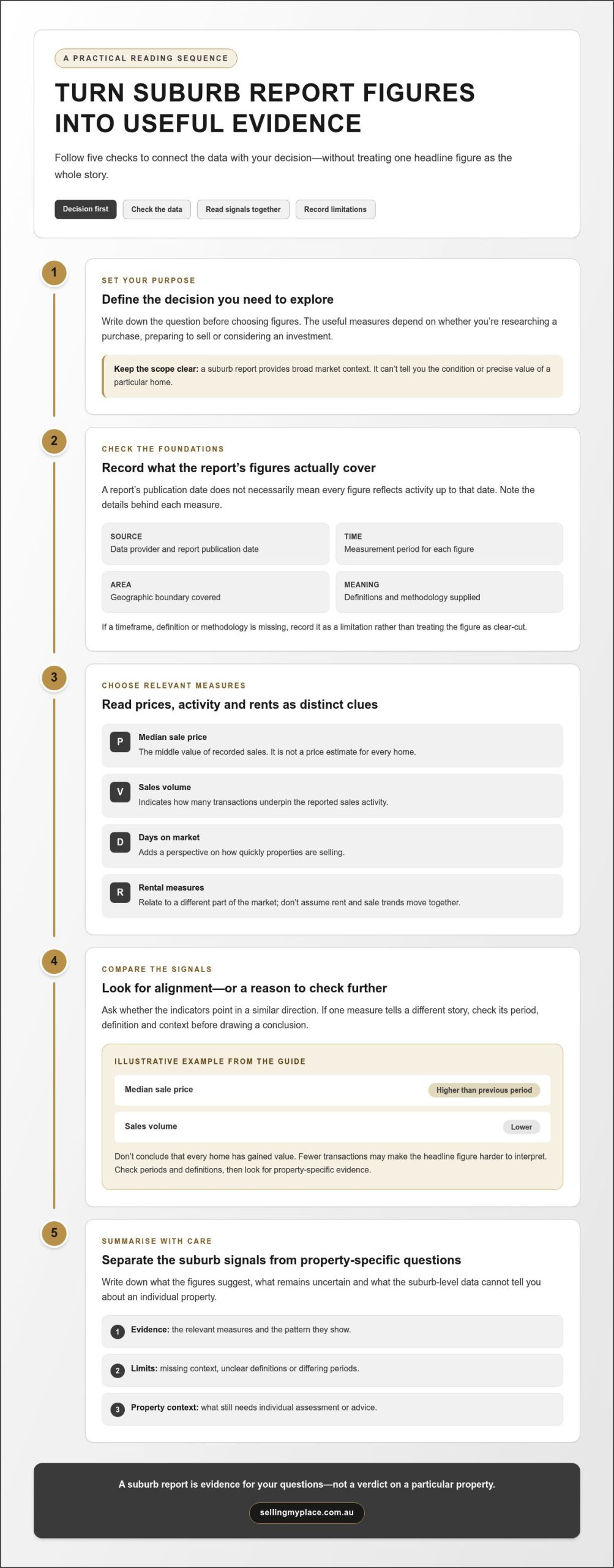
How to Apply Suburb Report Findings to Your Property Goal
A report becomes more useful when you connect its indicators to a decision you need to make. A buyer, seller and investor may read the same suburb data but need different answers. Keep your goal in view and separate broad market signals from details that only a property-specific assessment can reveal.
If you are preparing to sell, use suburb data as context
If you’re preparing to sell, use recent activity and sales of similar property types to understand the local backdrop and inform your preparation. Check whether the report covers homes genuinely comparable in type, rather than treating an all-property suburb median as a guide to your home’s likely result. A median summarises sales in an area; it isn’t a promised sale price or an individual valuation.
To explore how property-specific evidence can inform an estimate, read this 2026 Australian home value guide. When considering how to present and promote your home, the guide to professional residential property listing services can help you understand the marketing choices involved.
If you are buying or investing, test the report against your criteria
For a buyer, suburb indicators can frame questions about local sales activity or housing patterns. Compare those signals with the particular property’s features, condition and suitability for your needs. Your budget, plans and personal circumstances matter too; a suburb trend can’t tell you whether a home is the right fit.
An investor may consider sale and rental indicators in light of their objectives, but past performance isn’t a forecast of future results. A suburb-level figure also can’t establish the condition, costs or prospects of an individual property. Record what the report suggests, then list what it leaves unanswered, including property-specific risks that need further investigation.
That is the practical value of understanding how to analyse a suburb property report: use it to focus your next questions, not to make the decision for you. If you’re considering a sale, discuss your property plans and next steps.
Turn Your Suburb Property Report into a Clear Next Step
A useful analysis doesn’t need to produce a definite answer straight away. Its purpose is to clarify what the available evidence suggests, where it has limits and what you still need to find out. Bring those points together in a short written summary before acting.
Build a one-page summary before making a decision
Record the report’s publication date, data source and geographic scope, then write down the decision you’re weighing. This anchors the figures to your purpose and makes it easier to revisit your reasoning if circumstances change.
- Summarise the relevant signals: note the indicators that speak most directly to your goal and the direction they appear to suggest.
- Record the caveats: list differences between sources, unclear definitions, limited sales activity or other factors that may affect interpretation.
- Separate evidence from interpretation: label what the report directly shows, what you’re assuming and what remains unanswered.
- Identify your next question: decide what property-specific information or advice would help you move forward.
This record helps prevent a confident headline from overshadowing qualifications elsewhere in the report. It also gives you a practical starting point for a conversation with an adviser or further research.
When can a neighbourhood report or adviser add useful context?
A neighbourhood market report can organise relevant local context for an owner considering a sale. Kincade International Direct Sales’ pre-sale property consulting and real estate advisory support can help you think through preparation and sale decisions in light of that wider picture. Neither replaces an assessment of your individual home, and neither guarantees a particular sale price.
Keep the distinction clear: a suburb report supports your research; it doesn’t assess your property’s condition or establish its specific value. Those questions need property-specific consideration alongside the wider market signals.
The final step in how to analyse a suburb property report is to turn your notes into a measured next move: summarise the signals, acknowledge their limits and identify what you need to learn next. If you’re weighing a sale, discuss your property goals and explore how Kincade International Direct Sales’ flat-fee marketing and advisory services can support your plans.
Make Your Next Property Decision with Clarity
Learning how to analyse a suburb property report starts with looking beyond the headline: check dates and definitions, compare relevant indicators, and consider what the figures can and can’t tell you. Use the report to frame better questions, not as a stand-alone verdict on a suburb or an individual home.
For owners weighing a sale, neighbourhood market reports can organise local context, while pre-sale consulting and real estate advisory services can support decisions about preparation and next steps. Kincade International Direct Sales offers flat-fee property marketing with no agency commission, including professional photography and floorplans, alongside advisory support.
Ready to put your findings into perspective? Talk through your property goals with Kincade International Direct Sales and explore a clear next step for your sale.
Frequently Asked Questions
What should I look for in a suburb property report?
Focus on measures that relate to your decision, such as sale prices, sales volume and days on market, or rents if rental conditions matter to your research. Check the report’s publication date, measurement periods, geographic boundaries and metric definitions before interpreting a trend. Look for limitations too, including low sales activity or a small sample. A suburb-wide figure offers context, not an assessment of an individual home.
How do I know whether a suburb property report is up to date?
Check the report’s publication date and, separately, the period covered by each measure. A recently released report may still include figures collected earlier, so look for the latest date of the underlying data and the provider’s update notes. If a measure has no clear timeframe, treat it cautiously and record that limitation. Compare only figures covering relevant, matching periods rather than assuming every page was updated at once.
Why do different suburb reports show different property figures?
Reports can differ because providers use different datasets, update schedules, suburb boundaries, property categories and calculation methods. A median sale price may also shift if the types of homes sold changed between periods. For example, a period with more sales of larger homes could affect the median without showing that every property increased in value. Note these differences rather than averaging figures that aren’t directly comparable.
Can a suburb property report predict future property prices?
No. A suburb report describes selected data and past or current patterns; it can’t reliably tell you what prices will do next. Trends may help you frame questions, but they aren’t a forecast or a guarantee of future results. Consider what the figures cover, how recent the underlying data is and whether other indicators support the same interpretation. Keep any outlook separate from what the report directly records.
Is a suburb report enough to decide whether to buy a property?
No. A suburb report can help you understand broader market context, but a buying decision also depends on the particular property, its condition, your priorities and your financial circumstances. Use the report to develop questions, then assess the home itself and investigate any material concerns. A suburb-level median, for instance, can’t establish the value or suitability of a specific property. Treat the report as one part of your research.
Which Australian data sources can I use to cross-check a suburb report?
The Australian Bureau of Statistics (ABS) is useful for demographic, Census and housing context. Commercial property data providers such as CoreLogic, Domain and PropTrack publish market information, but their datasets and methods can differ. Public statistics, commercial reports and market commentary can complement one another, but they don’t measure the same things. Compare their dates, boundaries and definitions before drawing conclusions, and avoid combining figures that aren’t like for like.
How should a seller use a suburb property report?
A seller can use a suburb property report to understand local market context and consider which recent activity or comparable property types may be relevant to preparation and timing. It shouldn’t be treated as a direct estimate or promised sale price for an individual home. Check the report’s dates and limitations, then consider property-specific factors. Kincade International Direct Sales’ neighbourhood market reports and pre-sale consulting can help owners organise market context and think through sale preparation.
Pre-Sale Property Consulting: Prepare Your Home for a Smarter Sale
Reading Time: 10 minutes
What if the smartest pre-sale improvement is the one you decide not to make? Preparing a home can quickly become a long list of repairs, updates and styling ideas, but not every project will suit your property or sale goals. Pre-sale property consulting helps you sort through the options before you commit time and money.
If you’re unsure where to begin, you’re not alone. It’s natural to want your home looking its best while questioning whether each change will make a meaningful difference to its presentation or sale readiness. A considered plan can replace that uncertainty with clear priorities.
In this article, you’ll learn how pre-sale advice can help you assess your property, choose improvements and organise the steps towards going to market. We’ll also look at how preparation connects with the wider sale process, from market insights to photography and floorplans. With the right guidance, you can make decisions that fit your circumstances and move from preparation into marketing with greater confidence.
Key Takeaways
- Use pre-sale property consulting to shape a preparation plan around your home’s condition, your circumstances and your sale goals.
- Consider maintenance and presentation separately from optional renovations or styling, so you can weigh priorities before committing.
- Work through a simple sequence: clarify your goals, review the property, identify priorities and agree on practical next steps.
- Gather relevant property information and note outstanding questions early to make preparation decisions more straightforward.
- Connect your preparation plan with the next marketing steps, including property photography, floorplans and neighbourhood market reports.
What Is Pre-Sale Property Consulting, and When Can It Help?
Pre-sale property consulting is tailored advice that helps homeowners plan how to prepare a property before marketing it for sale. Rather than starting with a renovation wish list, the process considers the home’s condition, your goals and your priorities, then helps clarify which steps make sense before the next stage of selling.
Consulting guides decisions; it doesn’t guarantee a particular sale price or result. It’s also different from hands-on styling, building work or property management. Advice can help you decide whether presentation changes belong in your plan, while services such as photography, floorplans and listing support relate to marketing the property.
For example, you might be weighing up whether to address a maintenance issue, refresh a room or leave the home largely as it is. A pre-sale plan helps compare those options against the property and your circumstances, rather than making decisions under pressure. Selling can carry plenty of emotion, especially when a home holds family memories or marks a major change. Planning can make the practical decisions feel more manageable.
What does a pre-sale property consultant help you consider?
Advice brings together three connected questions: what condition is the property in, how is it likely to present to buyers, and what needs attention before marketing? This can help distinguish essential preparation from optional improvements or styling. Home staging, for instance, focuses on preparing a residence to appeal to potential buyers. Consulting takes a broader planning view, helping you decide whether presentation steps belong in your particular plan.
With pre-sale property consulting, you can weigh possible actions before committing time or resources. The aim is a considered set of next steps, not a one-size-fits-all checklist. Those decisions can then inform the move into marketing and selling, without assuming that any particular preparation will guarantee a faster sale or higher price.
When should you seek pre-sale advice?
Seek guidance while you still have room to plan, before marketing begins and decisions become rushed. That might be when you’re considering a move, preparing to sell an inherited property or responding to a change in household needs. Starting early gives you time to sort through questions in a calmer order.
There’s no single ideal time for everyone. The property’s condition, your priorities and your circumstances all shape what preparation is practical. Even if your plans are still taking shape, early advice can help you understand the decisions ahead and move towards sale with a clearer sense of direction.
How Pre-Sale Consulting Turns Uncertainty into a Clear Plan
A useful plan doesn’t begin with a shopping list of upgrades. It starts with a conversation about what you hope to achieve, followed by a practical review of the property and decisions about what deserves attention. Pre-sale property consulting brings those pieces together, so you can approach preparation with a clearer sense of direction.
What happens during a pre-sale consultation?
The discussion can cover your sale goals, timing considerations and concerns about getting the property ready. Perhaps you’re unsure whether to address a maintenance issue, how much preparation feels manageable or what needs to happen before marketing can begin. The adviser helps surface those questions and consider them alongside the home’s current condition and your circumstances.
You don’t need to arrive with every decision made. The value is in working through what matters, identifying what still needs thought and distinguishing practical priorities from assumptions or pressure to do everything at once. You can clarify which decisions are immediate and which can wait until you know more.
How does advice become a practical preparation plan?
Recommendations can be grouped by priority, likely effort and relevance to sale readiness. For instance, an issue affecting the home’s basic condition may warrant attention before optional cosmetic changes. A presentation update might be worth considering, but that doesn’t mean it must be part of your plan. The right choice depends on the property, your priorities and the resources you’re comfortable committing.
Keep perspective when considering improvement ideas. Ask what concern each task addresses, how much work it involves and whether it fits your intended timing. The goal is to make an informed choice, not to treat every suggestion as essential or assume a particular project will change the sale result.
Sale and conveyancing requirements can vary between Australian states and territories. Legal or transaction details relevant to your sale need careful, state-specific verification rather than assumptions based on general advice. Keep preparation decisions separate from matters that require advice specific to your sale and jurisdiction.
In practice, the steps are straightforward: discuss your goals, review the property, identify priorities, then agree on what happens next. This sequence helps you make informed choices and connect preparation with later marketing steps, such as organising photography and floorplans, without promising a particular price or timeframe.
If you’re weighing up what to do first, you can discuss your pre-sale plans and start shaping a considered approach.
Which Pre-Sale Improvements Should You Prioritise?
Start by separating issues that affect the home’s condition or day-to-day presentation from optional upgrades chosen mainly for a different look. Pre-sale property consulting can help you compare possible tasks against the property’s needs, likely buyer expectations and your own priorities. The aim isn’t to improve everything, but to decide what’s relevant before you commit time and resources.
| Task | Issue addressed | Effort | Dependencies | Reason to consider it |
|---|---|---|---|---|
| Attend to visible maintenance concerns | Wear or faults that may distract from the home’s condition | Varies with the issue | May need further assessment before work is planned | Helps make the property feel cared for and ready to present |
| Declutter and clean key areas | Spaces that feel crowded or difficult to view | Often manageable, depending on the home | Sorting belongings and planning access | Can make rooms easier to understand during a viewing |
| Refresh a presentation detail | A visible cosmetic distraction | Usually limited, but depends on the change | Choosing a suitable approach and organising the work | May help create a more consistent overall impression |
| Consider a larger renovation or styling change | A broader functional or aesthetic concern | Potentially substantial | Scope, timing and other preparation decisions | Worth weighing carefully against your goals and sale readiness |
Should you repair, renovate, style or sell as-is?
Repairs address condition; renovations change or update the home; styling focuses on presentation. Selling as-is may also suit your circumstances. These choices aren’t interchangeable, and none automatically improves the sale outcome. Consider the purpose and scope of each option rather than assuming every project adds value.
How can you decide what is worth doing before listing?
Ask whether the issue is visible, how it may affect a buyer’s experience, what effort is involved and how it fits your sale timing. A leaking tap, for example, is different from a colour choice you’d simply prefer to change. Consider likely buyer expectations in context, not as a reason to pursue every possible upgrade.
Imagine a home with a dated kitchen and several minor maintenance tasks. Rather than begin a major renovation, a considered plan might prioritise practical readiness first, then revisit whether the kitchen needs any presentation changes. That keeps decisions grounded in the home and your priorities. For wider context, consider how preparation choices relate to research on determining a home’s market value in Australia.
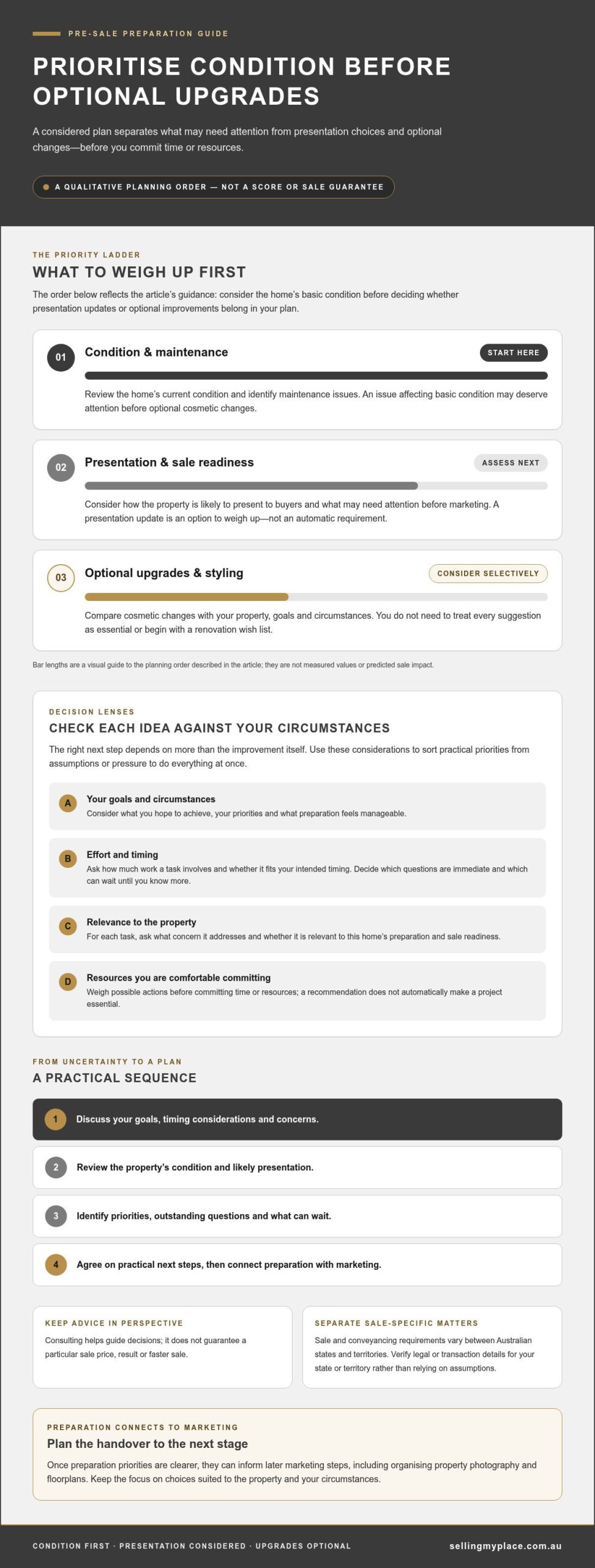
A Practical Pre-Sale Property Consulting Checklist for Homeowners
A little organisation before making decisions can make sale preparation feel more manageable. Use this checklist to gather your thoughts and identify what needs attention. It’s a starting point for discussion, not an exhaustive list of documents or a substitute for state-specific legal advice.
What should you have ready before discussing your sale?
- Goals: Note why you’re considering a sale, your intended timing and what a suitable outcome looks like for your circumstances.
- Property condition: Write down known repairs, maintenance concerns and improvements already completed. Include areas you’re unsure about.
- Priority decisions: List what matters most to you, along with any work you’re reluctant to take on or questions about whether it’s worthwhile.
- Preparation: Consider household routines, access to different areas of the home and how much time you can realistically give to getting ready.
- Marketing readiness: Record questions about what needs to be organised before photography, floorplans or property marketing can proceed.
Gather relevant property information and documents you already have, such as records of completed work or other details that may help explain the home’s condition. Keep a separate list of unanswered questions. This makes it easier to distinguish what you know from what needs further advice.
How can you keep preparation manageable?
Once you’ve discussed your situation, sort actions into three groups: decisions still to make, tasks you’ve agreed to organise, and items to revisit before marketing. Some owners can handle straightforward organising themselves, such as clearing surfaces or arranging access. Questions involving conveyancing, legal obligations or technical issues may call for appropriate professional advice. Requirements can vary across Australian states and territories, so avoid relying on a general checklist for legal matters.
Be realistic about sequence and capacity. A task may depend on access to a room, need to fit around family routines or require consideration alongside other work. Keep the agreed priorities visible, perhaps in a short written list, so optional jobs don’t quietly take over the plan.
Preparation should support your next steps, not become an endless project. If a new idea comes up, compare it with your original goals and decide whether it’s essential, useful or simply a preference. That check-in helps keep attention on sale readiness while leaving room to adapt if your circumstances change.
For a considered plan shaped around your property and priorities, discuss pre-sale consulting support.
How Kincade International Direct Sales Supports Your Pre-Sale Decisions
Kincade International Direct Sales provides pre-sale property consulting and real estate advisory services for Australian residential property owners. The focus is on helping you think through preparation decisions in context: your goals, the property’s condition and what you want organised before marketing begins.
That advice connects early planning with the practical steps that follow. Rather than treating preparation and marketing as unrelated tasks, you can consider how decisions about the home fit alongside sale planning, conveyance considerations and the listing materials you’ll need. No preparation plan can promise a particular price or sale timeframe, but a clear sequence can make the process easier to manage.
What support can sit alongside pre-sale consulting?
Pre-sale property consulting can sit alongside neighbourhood market reports and broader marketing preparation. Professional photography and floorplans are part of the wider listing offering, helping prepare property information for presentation to buyers. They’re marketing elements, not a guarantee of what a consultation or preparation work will achieve.
Conveyance advice can also help you consider transaction-related steps. It’s distinct from legal representation, and any legal requirements that apply to a sale should be considered in the context of the relevant Australian state or territory.
For owners looking at the wider selling pathway, Kincade International Direct Sales offers property marketing on a flat-fee, commission-free basis. Listings remain active until sold, with no time limits or agency commissions. This gives you a clear way to consider how preparation leads into listing and marketing.
What is a useful next step for a homeowner?
Begin with the details you already know. Think about your reasons for selling, likely timeline, concerns about the property and the decisions you’d like help weighing up. You don’t need every answer ready. A conversation can start with the home and your priorities, then help clarify which questions deserve attention first.
That steady start can make the next choices feel more manageable, whether you’re still weighing up a move or beginning to prepare for market. Talk through your property sale plans with Kincade International Direct Sales and take the next step with a considered plan.
Move Towards Sale with a Clearer Plan
Preparing your home for sale doesn’t mean taking on every repair, renovation or presentation idea. A clear set of priorities can help you focus on what’s relevant to your property, your circumstances and your readiness to move forward.
Pre-sale property consulting and real estate advisory services can help you consider those decisions before marketing begins. Kincade International Direct Sales connects preparation with broader sale support, including neighbourhood market reports, professional photography and floorplans. Its property marketing model is flat-fee and commission-free, with no promise of a particular sale price or timeframe.
You don’t need every detail settled before taking the next step. Start with your goals, concerns and likely timing, then work through the decisions in a manageable order. Talk through your property sale plans and begin shaping an approach that feels right for your home and circumstances.
Frequently Asked Questions
Is pre-sale property consulting worth it?
It can be useful if you’re unsure what to address before selling or how to organise the work. Pre-sale property consulting helps you consider your home’s condition, your priorities and the steps ahead before committing to optional improvements. Its value is in clearer decisions and planning, not a guaranteed sale price or a promise that every recommendation will increase buyer interest. It can help you focus on what’s relevant to your circumstances.
What does a pre-sale property consultant do?
A pre-sale property consultant helps you think through preparation before marketing begins. This may involve discussing your sale goals, reviewing concerns about the property and identifying practical priorities. The adviser can help separate necessary preparation from optional work and map out possible next steps. Advice should reflect your home and circumstances, rather than follow a one-size-fits-all renovation checklist. You remain in control of which tasks, if any, you decide to pursue.
When should I get pre-sale property advice?
Consider seeking advice when you’re beginning to think about selling, particularly if you’re unsure what work to do or when to start. An earlier conversation gives you more room to weigh options and organise priorities before marketing preparations gather pace. You don’t need every detail decided first. Your goals, questions and concerns provide a useful starting point for working out what deserves attention and what can wait.
What should I fix before selling my house?
There’s no single repair list that suits every property. Start by noting known condition issues and anything that could affect a buyer’s understanding or experience of the home. Then consider each task in light of its relevance, the effort involved and your priorities. An adviser can help organise those decisions, but no repair or improvement should be treated as a guaranteed way to raise the sale price.
Should I renovate my house before selling?
A renovation isn’t automatically the right choice before selling. Consider the home’s current condition, the scope of the proposed work, your available time and what you hope to achieve. For some owners, maintenance or presentation tasks may be more suitable; others may prefer to sell without major work. Pre-sale advice can help you compare these options in context, without assuming a renovation will deliver a particular return or sale outcome.
Can pre-sale consulting guarantee a higher sale price?
No. Preparation advice can’t guarantee a particular sale price or a faster sale. The outcome depends on factors including market conditions, buyer decisions and the property’s features. Consulting can help you make informed choices about readiness and presentation, then plan the steps ahead with greater clarity. Treat it as decision support, not a promise of a financial result. A considered plan helps you focus on actions that suit your home and circumstances.
Can I get pre-sale property advice without using a traditional commission agent?
Yes. Property advice and the structure of a marketing service are separate considerations. Kincade International Direct Sales offers pre-sale consulting alongside commission-free, flat-fee property marketing for residential owners. The advice can help you plan preparation, while the wider service supports the selling journey. You can outline your goals, concerns and likely timeline to discuss how these options fit your plans, without assuming the marketing approach guarantees a particular sale outcome.
Tips for a Fast House Sale: A Practical Australian Seller’s Checklist
Reading Time: 11 minutes
The fastest way to sell your home may be to slow down before it goes on the market. These tips for a fast house sale start with reducing buyer hesitation, not rushing into a listing or accepting the first offer. When your home is prepared, priced with current comparable sales in mind and presented clearly, serious buyers have fewer reasons to hold back.
It’s understandable to feel pressure to move quickly, especially when there’s a big life change behind the sale. But a fast result shouldn’t mean making decisions in the dark or leaving important tasks until inspection day. A little structure can help you attract early interest while keeping your expectations and priorities in view.
This practical Australian seller’s checklist will help you decide what to tackle before launch, how to shape a pricing and marketing plan, and what to look for as enquiries, inspections and offers come in. Whether you’re selling by owner or using professional support, you’ll have a clearer way to prepare, compare your options and make considered decisions without feeling hurried.
Key Takeaways
- Use these tips for a fast house sale to build a clear plan around your timing, priorities and what buyers are looking for.
- Compare recent sales of similar homes with current competing listings to support a realistic price position, rather than relying on a formula.
- Help buyers assess your home with clear photographs, accurate listing details and a floorplan that answers practical questions.
- Review enquiries, inspection attendance and buyer feedback regularly to spot when your presentation, listing information or price positioning may need attention.
- Compare selling by owner, traditional agency support and flat-fee marketing based on the involvement, guidance and fee structure that suit you.
Tips for a Fast House Sale Start With a Clear, Realistic Plan
A move can be time-sensitive, whether you’re coordinating a new job, a family change or your next home. But setting a firm sale date before you know how ready the property is or what buyers are doing can add pressure without giving you more control. Treat a fast sale as a goal shaped by your preparation, buyer demand and the terms you’re willing to accept.
Preparation before launch can reduce avoidable buyer hesitation by making the home, its price and its key details easier to assess. Start with four practical areas: set a considered price position, prepare the property for presentation, organise accurate marketing information and decide how buyers can view the home. Then record your preferred timing, acceptable terms and what needs to happen before you can move.
What Can You Control When Selling a Home Quickly?
You can organise the parts of the sale that are in your hands. Buyers and market conditions aren’t controllable, and even a well-prepared property may take longer to sell than you’d hoped. Focus first on a price position informed by comparable evidence, a tidy and presentable home, and listing information that answers likely questions. These steps improve readiness; they can’t guarantee a particular result or timeframe.
Before the listing goes live, check that the home is ready to be photographed and inspected, and that the property details are consistent and complete. Buyers should be able to understand what’s being offered and decide whether it suits their needs without having to chase basic information.
Set Your Sale Priorities Before You List
Write down your preferred timeframe, how flexible you can be and which sale conditions matter most. Consider practical constraints, too: where you’ll move next, how much notice you need to organise the move, and when you can make the home available for inspections. If you’re considering a seller-led approach, this overview of For Sale By Owner (FSBO) offers background on the model. Check sale or contract questions against relevant Australian advice.
Turn those priorities into a working checklist. Assign each task, set a realistic deadline and record decisions that still need advice. For example, one household member might coordinate repairs while another gathers property information. The right split depends on your circumstances. This simple plan keeps urgent tasks visible without letting a hoped-for sale date drive every decision.
- Timing: preferred move window and flexibility.
- Terms: conditions you’re prepared to consider.
- Readiness: tasks, owners and target dates.
- Open questions: decisions to clarify before listing.
With your priorities recorded, you’ll have a steadier basis for the next decisions: setting a price position and preparing the property for buyers.
Price and Prepare Your House Before the Listing Goes Live
Price and presentation work together. Buyers weighing your home against other options may lose interest if the asking price seems out of step with the evidence or the property is difficult to assess from its listing. One of the most useful tips for a fast house sale is to do this thinking before launch, when you still have time to make considered adjustments.
Evidence-based price preparation means comparing recent sales of genuinely similar homes with current competing listings, then accounting for differences that may affect buyer appeal. It doesn’t mean applying a fixed discount or relying on one online estimate. For a closer look at the process, read this 2026 guide to determining a home’s market value.
How to Set a Realistic Asking Price
Look for recent sales with meaningful similarities in property type, size, layout and condition. Note where a comparison differs: a renovated kitchen, extra parking or a larger block may affect how useful that sale is as a guide. Then review current listings buyers are likely to consider alongside yours. Compare their presentation and asking prices, but remember that a listing price doesn’t show the eventual sale price. Discuss what the evidence suggests with a suitably informed adviser, and revisit your position if new comparable evidence emerges. For context on weighing offers, see these property sale negotiation tips.
An asking price set too high for the available evidence may discourage buyers from enquiring or inspecting, especially if competing homes appear to offer better value. There’s no universal adjustment that suits every property. Aim for a price position you can explain using relevant comparisons, and be ready to consider both the buyer’s offer and its conditions.
A Pre-Launch Home Preparation Checklist
Choose practical improvements that help buyers understand and inspect the property, rather than rushing into renovations with uncertain value. Before photography, work through this short list:
- Declutter and clean each room, including windows, floors and high-touch surfaces.
- Address obvious maintenance issues, such as a sticking door or a dripping tap.
- Arrange furniture so rooms feel easy to move through and their purpose is clear.
- Keep personal touches balanced so buyers can picture their own life in the space.
- Once the home is ready, arrange professional photography and an accurate floorplan.
Clear images and a reliable floorplan help buyers judge the home before they book an inspection. Kincade International Direct Sales provides professional photography and floorplans as part of its property marketing service. For guidance on preparing your property or reviewing your sale approach, explore pre-sale support.
Make Your House Easy to Discover, Understand and Inspect
A buyer who can quickly understand a home’s layout, features and practical details is better placed to decide whether to enquire or book an inspection. Accurate listing materials help buyers assess whether a property suits their needs and make more informed enquiries. Treat the photographs, description and floorplan as one set of information, and check that they tell a consistent story.
What Buyers Need From Your Listing
Use clear photographs that represent the home honestly and help buyers understand how rooms connect. Pair them with accurate property details, useful room descriptions and a well-prepared floorplan. Before publishing, check that the description matches what a buyer will see in person. For further guidance on presenting a home online, read this guide to residential property listing services.
A simple question-and-answer check can reveal gaps in your listing:
- How does the home flow? Use the floorplan and images to show the connection between living areas, bedrooms and outdoor spaces.
- What are the rooms used for? Give each room a clear, accurate description rather than relying on photos alone.
- What details might affect a buyer’s decision? Confirm the relevant property information and have reliable answers ready for common enquiries.
If a detail is uncertain, verify it before the listing goes live. Clear information builds confidence; vague or inconsistent details can leave buyers with questions that might otherwise have been answered upfront.
Prepare for Inspections Without Adding Unnecessary Stress
Inspection access needs to work for buyers and your household. Choose times that offer reasonable opportunities to view the home while fitting around work, school, pets and other routines. If several people share the home, agree on the plan in advance so everyone knows what to expect.
Before each viewing, focus on a short reset rather than trying to make the house perfect:
- Clear everyday clutter from key surfaces and walkways.
- Open curtains and switch on lights where needed.
- Secure personal belongings and confidential paperwork.
- Make sure buyers can move through the main rooms comfortably.
After each inspection, note attendance, recurring questions and feedback. If visitors repeatedly ask about the same feature, consider whether the listing needs clearer information. These observations can help you refine the buyer experience as the campaign progresses. Kincade International Direct Sales provides residential listing and marketing support, with details available through its listing options.
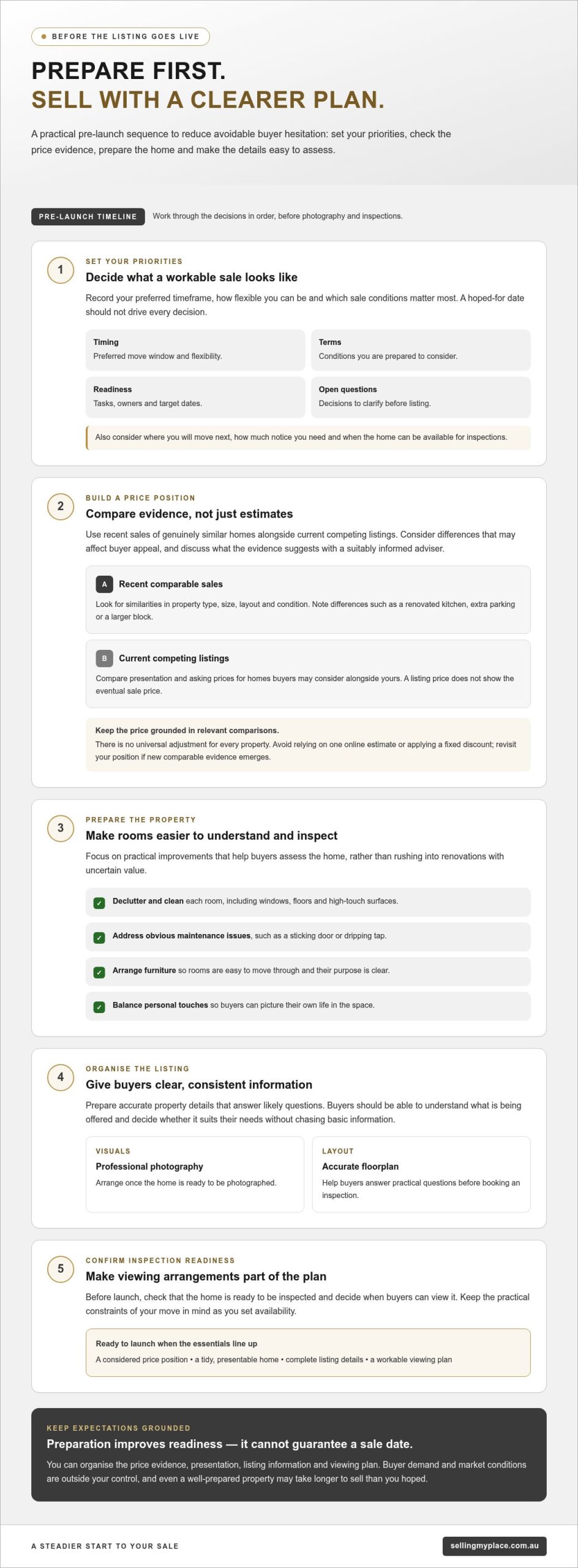
Use Early Buyer Feedback to Keep Your Sale Moving
Once your home is listed, buyer response gives you useful evidence about how the campaign is landing. Rather than reacting to every comment, look for patterns across enquiries, inspection attendance, questions and offers. These tips for a fast house sale are about making measured decisions, not changing course simply because the first few days feel quiet.
A Simple Process for Reviewing Buyer Response
After each inspection, record how many people attended, what they asked and any feedback they shared. Note the quality of enquiries and offers, too: are buyers asking relevant questions, requesting another look or proposing terms you can consider? Compare this with the expectations you set before launch. If you’re managing enquiries yourself, this step-by-step guide to selling your own home may help you organise the process.
Look for repeated signals. One visitor’s preference may be personal; several buyers asking about the same missing detail or expressing the same concern could point to something worth addressing. A trusted adviser can help you judge whether feedback is a pattern or an isolated view.
What to Revisit if Enquiries Are Slow
Work through the likely causes in a calm order before changing your strategy. Check whether the listing is reaching buyers, whether the photographs and description represent the property clearly, and whether inspection times are manageable for people interested in viewing. Then revisit your price position against current comparable evidence and competing listings.
Change one well-supported element at a time, then observe whether the response shifts. If you update the listing details and adjust the price simultaneously, it may be harder to tell what helped. Keep a short review record:
- Enquiries: volume and recurring questions.
- Inspections: attendance and any consistent feedback.
- Offers: price, conditions and how well the terms fit your priorities.
- Next step: the single change you’ll make, or why you’ll hold steady for now.
A quiet spell doesn’t automatically call for an incentive or price change. Consider the offer’s conditions and likely net proceeds alongside the headline amount, and seek advice if you’re unsure. A considered response can protect your sale priorities while keeping the campaign responsive.
Kincade International Direct Sales offers real estate advisory support to help owners interpret buyer response and consider next steps. Review the available sale support.
Choose a Fast-Sale Pathway That Fits Your Priorities
The right sale pathway depends on how much time you can give the process, how confident you feel handling buyer communication and what kind of support you want. Selling by owner, using traditional agency support or choosing flat-fee marketing are different ways to organise the work. None guarantees a faster sale or a higher price, so compare responsibilities and support before committing.
| Pathway | Seller involvement | Marketing support | Advice and fee structure |
|---|---|---|---|
| Sell by owner | You manage buyer enquiries, inspections and sale decisions. | You organise the listing and any photography or floorplan support you need. | You retain direct control, and should identify the advice you need and how any services are charged. |
| Traditional agency support | You make key decisions while agreeing on who handles campaign tasks and buyer contact. | Review the agreed scope for listing exposure, photography and floorplans. | Review the advice provided, commission or other fees, contract terms and your responsibilities. |
| Flat-fee marketing | You may retain decision-making control while taking responsibility for agreed seller tasks. | Review the agreed scope for listing, photography and floorplan support. | Understand the flat-fee structure, advisory support, contract terms and any additional responsibilities. |
How to Compare Selling Options
Don’t compare pathways by headline fee alone. Review the listing exposure provided, whether photography and a floorplan are included, what advice is available and which tasks remain yours. Read the contract carefully so the fee structure, term and responsibilities are clear before you agree. Choose a level of hands-on involvement that fits your available time and confidence, not just your preferred sale date.
Kincade International Direct Sales provides commission-free residential property marketing for a single flat fee. The service includes listing support, professional photography, floorplans and advisory support, so owners can retain control of key decisions while drawing on help with their sale. Consider how that combination fits the tasks you want to manage and the guidance you need.
Prepare for the Next Step After an Offer
An offer is more than its price. Review the conditions, proposed timing and settlement requirements as a complete package, and consider how each part fits your stated priorities and next move. Before committing to legal documents, seek conveyancing or other qualified professional advice relevant to your circumstances. Keep written records of offers, questions and agreed next steps so everyone involved is working from the same information.
For an overview of the support and responsibilities available through Kincade International Direct Sales, explore property sale options.
Take the Next Step With a Sale Plan That Fits
A well-managed sale starts with choices you can explain: a price position informed by evidence, a home ready for buyers to inspect, and a pathway that suits your time and appetite for involvement. These tips for a fast house sale can help you act with purpose, but buyer demand and decisions remain outside your control. A clear plan keeps your goals in view without making speed the only measure of success.
Kincade International Direct Sales provides commission-free property marketing through a single flat-fee model. The service includes professional photography, floorplans and an Agent Advisory Service, and listings remain active until sold with no time limit. This gives owners marketing and advisory support while keeping the sale free of agency commissions.
Talk through your sale plan with Kincade International Direct Sales to explore its flat-fee marketing and advisory support.
Frequently Asked Questions
How can I sell my house quickly without underselling it?
Set your price using recent sales of genuinely comparable homes and the current competition, then assess each offer against both price and conditions. Consider your preferred timing, settlement needs and likely net proceeds before deciding what you’re willing to accept. Strong preparation and clear marketing can help buyers assess the property, but no approach guarantees a quick sale. If evidence or offers are difficult to interpret, seek advice before changing your expectations.
What should I fix before listing my house for a fast sale?
Start with obvious maintenance and presentation rather than rushing into major renovations. Fix practical issues such as a dripping tap or sticking door, declutter, clean thoroughly and make rooms easy to move through. These steps help buyers focus on the home and its layout. Consider whether larger work is worthwhile for your property, budget and timing before committing. Have the home ready before photography and check that listing details are accurate.
Is it better to stage a house before selling?
Staging may help buyers understand how rooms can be used, but it isn’t essential for every home. First try simple presentation: remove excess furniture, clear surfaces, improve lighting and keep the layout easy to navigate. Consider professional staging if it addresses a specific presentation challenge and fits your circumstances. Weigh the expected benefit against the effort and cost, and avoid assuming staging will guarantee a faster sale or a higher offer.
How much does pricing affect how quickly a house sells?
Pricing can influence whether buyers consider your home alongside competing listings. A price that appears out of step with recent comparable sales, condition or current alternatives may discourage enquiries and inspections. There’s no universal discount or formula that determines the right asking price. Review relevant evidence, understand how your property differs from comparisons, and reassess if buyer response is consistently weaker than expected. Market conditions and buyer decisions also affect timing.
Can I sell my house fast without using a traditional real estate agent?
Yes. You can sell by owner, or use a marketing and advisory service while retaining responsibility for key decisions. The right fit depends on the time and confidence you have for managing enquiries, inspections and offers. Kincade International Direct Sales provides commission-free property marketing for a single flat fee, supported by professional photography, floorplans and an Agent Advisory Service. Review what’s included, what you’ll manage and the available advice before choosing.
What happens if my house gets few enquiries after listing?
Review the evidence before making a change. Check whether the listing is visible, the photos and description are clear, and inspection access is workable. Compare your price positioning with current comparable sales and competing homes. Then look for repeated feedback rather than reacting to one comment, and consider changing one well-supported element at a time. Avoid rushed price changes or incentives without weighing the offer terms and likely net proceeds.
How can professional photos and a floorplan help sell a house faster?
Professional photographs can help buyers see the home’s presentation, while an accurate floorplan makes its layout and room relationships easier to understand. Together with a precise description, these materials let people assess whether the property may suit them before arranging an inspection. They can support clearer, more informed enquiries, but can’t guarantee a faster sale. Check that images represent the home honestly and that the floorplan and listing details are accurate.
Stamp Duty for Sellers in Australia: 2026 Guide
Reading Time: 11 minutes
Could a tax you usually don’t owe still affect how you plan your sale? For anyone searching “stamp duty for sellers australia”, the usual answer is reassuring: transfer duty, commonly called stamp duty, is generally the buyer’s responsibility, not a tax charged to the seller simply for selling a home. Still, settlement can involve other costs, and the details of your transaction matter.
It’s understandable to worry that an unexpected bill could reduce your sale proceeds, especially when stamp duty is easily confused with capital gains tax, land tax, GST or conveyancing costs. These are separate charges and obligations, and whether they apply to you depends on your circumstances.
This 2026 guide explains who usually pays transfer duty and when, which sale-related costs sellers may still face, and what to check before settlement, including rates adjustments. You’ll also learn where to confirm the rules for your state or territory and when to ask a conveyancer or qualified tax professional about your specific sale, so you can plan with greater clarity.
Key Takeaways
- For stamp duty for sellers australia, the usual starting point is that the buyer pays transfer duty when ownership changes.
- Transfer duty is separate from capital gains tax and other sale-related costs, which may depend on your circumstances.
- Check the transaction details carefully if your sale isn’t a standard residential property transfer.
- Use the relevant state or territory revenue authority to confirm current duty guidance for the property and transaction.
- A written sale-cost checklist can help you prepare for tax questions, professional fees, loan matters and marketing decisions before settlement.
Stamp duty for sellers in Australia: what the term means
“Stamp duty” is the familiar name Australians often use for property transfer duty. The precise terminology and rules depend on the state or territory, because the duty is imposed under state or territory arrangements rather than as a single federal property tax. The general Stamp duty overview explains the term’s wider use, but your local revenue authority is the place to confirm how it applies to a particular transaction.
For sellers, the usual position is reassuring: the buyer generally pays transfer duty when property ownership transfers. It’s separate from the amount the buyer agrees to pay you under the sale contract, so the buyer’s duty isn’t automatically deducted from your sale proceeds as a seller’s stamp-duty charge. Treat this as a starting point, though, not a substitute for checking the contract, property type and jurisdiction.
Is stamp duty normally paid by the buyer or seller?
In an ordinary property sale, the buyer is generally responsible for the duty associated with acquiring the property. The sale price is paid to the seller under the contract; transfer duty is a separate obligation assessed under the relevant jurisdiction’s rules. Settlement can also involve other payments and adjustments, so ask your conveyancer to explain the figures and responsibilities shown for your transaction.
As a general rule, the buyer pays transfer duty on a property purchase, but the applicable jurisdiction, transaction details and contract should always be checked.
What does transfer duty apply to?
Transfer duty is commonly associated with acquiring or transferring certain interests in property. The exact transactions covered, how duty is assessed and who is responsible are determined by each state or territory’s legislation and official guidance. A straightforward residential sale may therefore raise different questions from a transfer involving another property type or arrangement.
If ownership is changing in a way that doesn’t follow a standard sale, don’t assume the usual buyer-pays explanation settles every duty question. Check the contract and ask a conveyancer to identify the relevant revenue authority’s guidance for the property and transfer involved.
If you’re looking up stamp duty for sellers australia, focus on separating the buyer’s transfer-duty obligation from your own sale proceeds and obligations. A clear explanation of the contract and settlement figures can help you understand what is being paid, by whom and why.
Do sellers pay stamp duty, or other taxes and selling costs?
Understanding stamp duty for sellers australia starts with separating the buyer’s transfer duty from the costs and tax questions that may belong to you as the seller. They aren’t interchangeable, and not every seller faces the same obligations. The Australian Government’s Stamp duty rules page explains the general framework and links to state and territory guidance.
| Item | How it may relate to a sale | What to check |
|---|---|---|
| Transfer duty | Generally payable by the buyer when they acquire property, subject to the relevant rules. | Confirm the jurisdiction’s guidance and the transaction arrangements. |
| Capital gains tax (CGT) | A possible seller tax issue relating to an assessable capital gain. A sale doesn’t automatically mean CGT is payable. | Ask the ATO or a qualified tax adviser how your ownership, use and circumstances affect the outcome. |
| Land tax or GST | Separate tax questions that may be relevant depending on the property and transaction. | Check with the relevant revenue authority, the ATO or a qualified adviser. |
| Sale and settlement expenses | May include conveyancing, marketing, loan discharge or payout expenses, and adjustments to outgoings at settlement. | Review your contract, loan details and settlement statement with the relevant professional. |
How is transfer duty different from capital gains tax?
Transfer duty is generally connected to acquiring or transferring a property interest. CGT, by contrast, concerns a capital gain that may be assessable for tax purposes. Whether CGT applies, and how it’s treated, depends on individual circumstances. Don’t assume that selling a home or investment property automatically creates a tax bill. The Australian Taxation Office (ATO) provides current CGT guidance. For advice tailored to you, speak with a tax professional who can consider ownership, how the property was used and your wider circumstances.
Could land tax or GST affect a property seller?
Possibly, but neither is another name for transfer duty, and their application isn’t identical for every seller. Property use, ownership structure and the type of transaction can all be relevant factors to verify. Check land-tax questions with the relevant state or territory revenue authority, and GST questions with the ATO or a qualified tax adviser. Your conveyancer can help identify transaction details to raise, but shouldn’t replace tax advice.
A written cost checklist can help keep confirmed taxes separate from professional fees, marketing decisions and loan matters. If you’re considering how to prepare and market your home, property sale support information is available here. Kincade International Direct Sales provides flat-fee property marketing and advisory services. Marketing support is separate from stamp-duty advice and doesn’t determine your tax obligations.
When can an Australian property sale need a closer duty check?
The usual buyer-pays approach is a useful starting point, but it won’t answer every question about a particular transfer. If the arrangement differs from a straightforward residential sale, pause before assuming the standard explanation applies. The relevant rules depend on the state or territory where the property is located and on the details of the transaction.
Which transaction details should sellers flag?
Before settlement, tell your conveyancer if the transfer involves anything out of the ordinary, such as:
- a transfer between related parties rather than an ordinary sale to an unrelated buyer
- a partial interest in the property, rather than the whole interest
- unusual consideration, or an arrangement where the agreed payment isn’t straightforward
- a property type or transaction structure that isn’t a standard residential sale.
These are prompts for a closer review, not claims that duty will necessarily apply or that a particular party must pay it. Terminology and treatment can differ across jurisdictions. Ask your conveyancer to check the current guidance from the revenue authority for the state or territory where the property sits, and to seek qualified tax advice if the transaction raises broader tax questions.
Can a contract change who pays a duty?
There’s an important distinction between who may be legally liable under duty rules and what the parties agree about payments between themselves. A contract may set out payment or reimbursement arrangements, but that wording shouldn’t be treated as a substitute for confirming the statutory position. The effect of any clause depends on the transaction and applicable law, so have a conveyancer explain it before you rely on an assumption.
Contract terms may allocate costs between the parties, but they don’t replace checking who is liable under the relevant duty rules.
Read the sale contract closely and ask how any duty-related wording flows through to the settlement statement. Check which party is expected to make each payment, whether an agreed contribution or adjustment is recorded, and whether those arrangements match the advice you’ve received. If something is unclear, raise it before settlement rather than relying on a verbal understanding.
For sellers researching stamp duty for sellers australia, the practical safeguard is to match three things: the property’s jurisdiction, the nature of the transfer and the contract’s payment terms. A conveyancer can help interpret the settlement documents and identify questions for the relevant authority. That way, the general rule remains a guide while the actual transaction gets the careful review it needs.
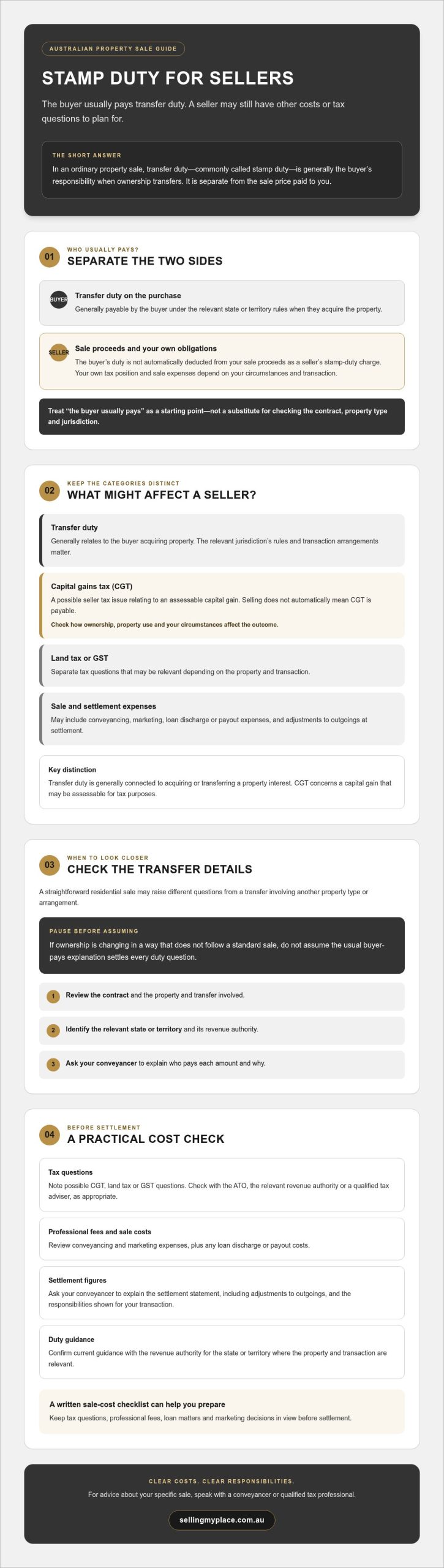
How sellers can check stamp duty before settlement
A few well-organised checks can help you separate the buyer’s duty question from your own contract and settlement responsibilities. If you’re researching stamp duty for sellers australia, use this process to find the right official guidance and know which questions to put to your conveyancer.
What information should sellers gather first?
Start with the details that help an adviser identify the rules for your transaction. You don’t need to gather more personal or financial information than is relevant.
- Identify the property’s jurisdiction. Note the state or territory where the property is located. The applicable duty guidance comes from that jurisdiction’s revenue authority.
- Describe the transaction. Clarify whether it’s an ordinary residential sale or has features such as a transfer of part of an interest, related parties or unusual consideration. These details are prompts for review, not proof that duty applies.
- Review the contract. Have the signed or proposed contract available, including any wording about duty, contributions or adjustments. Ask your conveyancer to explain clauses you’re unsure about.
- Check settlement arrangements. Gather the proposed settlement date and relevant settlement information, then ask how payments and adjustments are expected to appear in the settlement statement.
Share only what’s needed with the professionals helping with the transaction. Take care not to circulate unnecessary identifying, banking or other sensitive personal information.
Who can confirm the answer for your transaction?
For the current official position, check the revenue authority for the state or territory where the property sits. Its guidance is the appropriate starting point for duty rules and any relevant forms, calculators or updates. Don’t rely on a general online estimate unless you’ve confirmed that its inputs and assumptions match your transaction.
Your conveyancer or solicitor can help interpret the contract and settlement implications. Ask them to clarify who is legally liable, how any agreed payment arrangement is recorded, and whether unclear contract wording needs attention before settlement. If the answer depends on unusual transaction details, ask what further professional advice is appropriate.
Keep tax questions in their own lane. For income-tax or GST guidance, consult the Australian Taxation Office (ATO) or a qualified tax professional. Duty checks shouldn’t be replaced by decisions about how to market the property.
For information about preparing and marketing your residential property, see the property sale support options. This support can help you plan the sale process, while duty and tax questions remain with the relevant authority and qualified advisers.
Plan the sale with clear costs and the right support
A clear cost picture can make a major sale feel more manageable. Buyers generally pay transfer duty, while sellers should separately check their own tax position and the expenses involved in preparing and completing the sale. Keep those categories distinct: the buyer’s duty isn’t a substitute for checking your own obligations, and a marketing decision doesn’t determine your tax liability.
How should sellers build a reliable sale-cost picture?
Start a written checklist and label each item as confirmed, estimated or awaiting professional advice. That simple step helps prevent an assumption from being mistaken for a settled cost. You might organise it under these headings:
- Taxes: note any advice or official guidance you’ve received about your own tax position. Keep buyer transfer duty separate.
- Professional fees: record conveyancing and any tax advice you’re seeking, based on information provided by the relevant professional.
- Loan matters: ask your lender and conveyancer what needs to be checked about your loan and its handling at settlement.
- Marketing and preparation: list the services and sale-preparation choices you’re considering, and confirm their terms directly.
Update the checklist as the contract and settlement details become clearer. For a practical overview of the owner-led sale process, read this guide on how to sell your own home. It can help you think through the steps involved without mixing them up with duty or tax advice.
Where does property-selling support fit in?
Marketing support can help organise how your home is presented and listed, but it can’t determine who owes tax or how duty rules apply. Kincade International Direct Sales offers flat-fee property marketing and advisory packages, including professional photography and floorplans. Its commission-free model is separate from tax, conveyancing and loan-related questions. Find out more about professional residential property listing services.
For anyone weighing up stamp duty for sellers australia, the steady approach is to verify duty with the relevant revenue authority, get transaction-specific advice where needed, and plan the rest of the sale costs in their own categories. A marketing service can support the sale process, but it doesn’t change your duty or tax position.
Move ahead with a clearer sale plan
For stamp duty for sellers australia, the key takeaway is that buyers generally pay transfer duty, while sellers should check their own tax position and sale costs separately. The contract, transaction details and state or territory rules matter, so confirm what applies with the relevant revenue authority and a conveyancer before settlement.
A written checklist can help you keep confirmed obligations, professional advice, loan matters and marketing decisions organised. Kincade International Direct Sales is a commission-free property marketing and advisory service with a flat-fee model. Its services include professional photography and floorplans, separate from tax advice or duty obligations.
With clear information and the right support, you can take the next step with greater confidence.
Frequently Asked Questions
Do sellers pay stamp duty when selling a house in Australia?
Generally, no. In an ordinary Australian residential sale, the buyer usually pays transfer duty, commonly called stamp duty, when acquiring the property. It’s separate from the sale price and isn’t automatically deducted from your proceeds as a seller’s duty payment. Check the contract and settlement arrangements for your specific transaction, particularly if the transfer is unusual or involves more than a standard sale.
Is stamp duty the same as capital gains tax?
No. Transfer duty is generally associated with acquiring or transferring certain property interests, while capital gains tax (CGT) concerns a capital gain that may be assessable for tax purposes. Selling a property doesn’t automatically mean you’ll owe CGT. The outcome can depend on factors such as ownership and how the property was used. Check current Australian Taxation Office (ATO) guidance and seek advice for your circumstances.
Can a seller be responsible for transfer duty in Australia?
The buyer generally pays transfer duty in an ordinary property purchase, but don’t assume that rule answers every transaction. The applicable legislation and transaction details determine legal liability, while a contract may separately describe how the parties arrange or share a payment. If your sale involves a partial interest, related parties or another non-standard feature, ask your conveyancer to check the relevant state or territory rules.
How much stamp duty does a seller pay?
For a typical residential sale, the seller generally doesn’t pay the buyer’s transfer duty, so there usually isn’t a seller stamp-duty amount to calculate. That doesn’t mean the seller has no sale costs or tax questions: conveyancing, loan-related matters and a possible CGT liability are separate considerations. Don’t rely on a generic calculator for an unusual transfer. Confirm the transaction details with the relevant revenue authority and your adviser.
What happens if the sale contract says the seller pays stamp duty?
Ask your conveyancer to explain the clause before relying on it. Contract wording may set out an agreed payment or reimbursement arrangement between the parties, but it doesn’t necessarily change who is legally liable under the relevant duty legislation. Have the clause read alongside the transaction details and settlement statement, and clarify who is expected to pay what before settlement. If needed, seek advice from a qualified professional.
Do sellers pay stamp duty on an investment property sale?
In an ordinary sale, the buyer generally pays transfer duty, whether the property is an investment or a home. For the seller, an investment property may raise separate tax questions, including whether a capital gain is assessable. The result depends on the owner’s circumstances and the property’s history. Check the ATO’s current CGT guidance and speak with a qualified tax professional rather than assuming duty and CGT are the same.
Does every Australian state and territory have the same stamp-duty rules?
No. Transfer duty is governed by state and territory rules, so terminology, processes and the way a particular transaction is treated can vary. The property’s location determines which revenue authority’s guidance to check. For a current answer, use that authority’s official information and ask your conveyancer how it applies to your contract and settlement. Avoid relying on a rule or calculator intended for a different jurisdiction.
Should I check stamp duty before settlement?
Yes, especially if the transaction isn’t a straightforward residential sale or the contract includes unclear payment wording. Identify the property’s state or territory, review the transaction type and contract, then check the relevant revenue authority’s current guidance. Ask your conveyancer to clarify liability and settlement arrangements before you rely on an assumption. For sellers researching stamp duty for sellers australia, this helps keep the buyer’s duty distinct from your own sale costs and tax questions.
How to List on realestate.com.au Without an Agent in Australia
Reading Time: 11 minutes
Want your home to reach a major property portal without appointing a traditional selling agent to manage the sale? If you want to list your property without an agent, note that private sellers can’t submit a for-sale property directly: a licensed real estate agency must handle the portal listing. A flat-fee platform like Kincade International Direct Sales may provide a route through an agency while you manage much of the sale yourself, rather than appointing a traditional commission-based agent.
It’s understandable to wonder whether a private listing will reach enough buyers and whether you’re ready to field enquiries and present your property accurately. Portal access is only the first step. Clear details, strong photography and a floorplan can help create a credible advertisement. You’ll also need to understand which parts of the selling process remain your responsibility.
This guide explains the available routes to a major portal listing, what information to prepare and how to weigh a fully self-managed sale against a supported private-sale service or traditional agency. Before choosing a package, check whether it currently provides portal access and what marketing or advisory support is included. With the right preparation, you can make a considered choice about control, exposure and support.
Key Takeaways
- Private sellers can’t submit a sale listing directly to the major property portal, but may be able to use an eligible provider.
- Compare self-managed and supported private-sale routes by checking who handles the listing, marketing and owner responsibilities.
- Prepare accurate property details, quality images and a floorplan, and make sure every advertised feature can be substantiated.
- Before proceeding, confirm portal placement, package inclusions, fees and listing duration in writing.
- Choose your level of support based on the time, confidence and control you want throughout the sale.
Can you list on a major property portal without an agent? Understand the available routes
Yes, you may be able to sell without appointing a traditional selling agent to manage the sale, but private owners can’t submit a for-sale property directly to the major Australian property portal discussed in this guide. Under current submission arrangements, a licensed real estate agency must handle the portal listing. A private-sale or flat-fee marketing provider may offer a route through an agency, but confirm the provider’s eligibility and the package’s portal access before committing.
This distinction matters because portal rules determine who can submit sale advertisements. A provider that helps prepare or promote an advertisement doesn’t automatically mean it can be published on your preferred portal. Check the current submission requirements and get clear confirmation from the provider rather than relying on a general claim of online exposure.
What does “without an agent” mean when listing a property?
Usually, it means not appointing a traditional selling agent to take charge of the sale. With a private-sale arrangement, you may manage buyer enquiries, organise inspections and lead negotiations yourself. A flat-fee marketing service can provide listing or marketing support, but that support is separate from managing the sale on your behalf. Check exactly what the provider handles and what remains yours to organise.
Can owners submit directly to the portal?
For a property offered for sale, private owners can’t submit an advertisement directly under current arrangements. The listing must be submitted through a licensed real estate agency, which may be arranged through a private-sale platform. As portal requirements and provider eligibility can change, check the portal’s current seller information and ask the provider to confirm it can place your sale listing. Get the answer in writing, including any conditions that apply.
At a glance: possible routes to a sale listing
- Traditional selling agent: The agent manages the sale and submits the listing.
- Private-sale platform: A licensed agency may submit the listing, while you manage agreed parts of the sale.
- Direct private submission: Not currently available for sale listings on the major portal discussed here.
These routes describe the general distinction, not a promise that any particular provider or package is eligible. Confirm current access, inclusions and your responsibilities before proceeding.
Whichever route you consider, a private sale still takes active work. You’ll need to prepare accurate property information, promote the home, respond to buyers and keep the sale moving. Choosing not to use a traditional agent doesn’t remove the need for an eligible submission pathway or a clear plan for managing the listing.
Compare direct, self-managed and flat-fee routes to a realestate.com.au listing
Portal access is only one part of the decision. An advertisement can be prepared and a sale managed in different ways, so consider separately who submits the listing and who handles the work once it’s live. The comparison below outlines the broad distinctions. Confirm current portal access and exactly what any provider will do before you choose.
| Route | Portal access | Owner responsibilities | Support and questions to check |
|---|---|---|---|
| Direct owner submission | Private owners can’t currently submit a sale listing directly to realestate.com.au. | You’d prepare and manage the sale, but need to establish an eligible submission pathway first. | Check the portal’s latest requirements. Don’t assume an owner account allows you to publish a sale ad. |
| Self-managed sale through an eligible pathway | Access depends on the agency or provider submitting the listing and its current eligibility. | You may prepare the advertisement, respond to enquiries, coordinate viewings and discuss offers. | Confirm who submits the ad, what support is included and which sale tasks remain yours. |
| Flat-fee marketing service | Placement depends on the service’s current portal access and package terms. | You may still manage buyer communications, inspections and negotiations, depending on the arrangement. | Ask in writing whether realestate.com.au placement is included, along with the specific marketing and advisory inclusions. |
What does a fully self-managed listing involve?
Self-management gives you greater control, but it also puts the practical work in your hands. You’ll need to prepare the property information and advertisement, respond to prospective buyers, organise viewings and handle offer discussions. It may suit sellers with the time and confidence to take on those tasks. First, confirm how the listing can reach the portal. Don’t rely on direct submission being available.
How can a flat-fee property marketing service help?
A marketing service can support parts of the preparation without necessarily taking over sale management. Kincade International Direct Sales describes services including professional photography, floorplans, neighbourhood market reports and advisory support. Its flat-fee model is an alternative to agency commission, not a promise of a particular sale result. Check which inclusions apply and whether the current package enables realestate.com.au placement.
Think about the tasks you’re comfortable owning. If you’re confident managing enquiries but want help presenting the home, marketing support may be worth exploring. If you’d prefer someone else to lead the sale, assess that responsibility separately from the cost structure. To compare the available support, review flat-fee property marketing and advisory options and confirm portal access and package details before deciding.
Prepare a credible realestate.com.au listing before you publish
A clear, well-prepared advertisement helps buyers understand the home before deciding whether to arrange an inspection. Reviewing it before publication also gives you a chance to catch mistakes while there’s still time to correct them. Gather the key details, check every claim and decide how prospective buyers will contact you.
Gather property details, photography and a floorplan
Build your listing from information you can check, rather than memory or assumptions. Use this pre-publication checklist:
- Property details: Confirm the address, property type, room count and features. Check dimensions and inclusions against reliable records where available.
- Features and condition: Describe fixtures, renovations and other selling points precisely. Don’t present an upgrade as new or recently completed unless you can support that description.
- Photography: Review each image to ensure it shows the property fairly and represents its current condition. Check that the photos match the written description.
- Floorplan: Use a clear floorplan and verify that its labels and dimensions are correct. Buyers use it to understand the layout, so errors can lead to confusion.
- Enquiries: Decide which contact details to publish, who will respond and how you’ll arrange viewing requests. A simple plan helps you keep track of buyer conversations.
Professional photography and floorplans can help present the home clearly. If you’re using a marketing provider, confirm which materials are included and review the final advertisement yourself before it goes live.
Check advertising claims and seller obligations
Accuracy matters. Avoid unsupported statements about renovations, included fixtures, boundaries or potential future development. If a detail is uncertain, check it or leave it out rather than asking buyers to rely on a guess. Keep relevant records available so you can substantiate information in the advertisement if questions arise.
Disclosure, advertising and sale requirements can differ between Australian states and territories. Check current guidance from the relevant official state or territory consumer affairs or fair trading authority, and seek conveyancing advice about documents and transaction responsibilities. A conveyancer or solicitor can help clarify what applies to your circumstances. Don’t assume the requirements in one state apply everywhere.
Before you list on realestate.com.au without an agent, read the completed advertisement from a buyer’s point of view. Are the features easy to understand? Do the photos and floorplan match the claims? This final check can help you publish a more credible listing and begin buyer conversations on a sound footing.
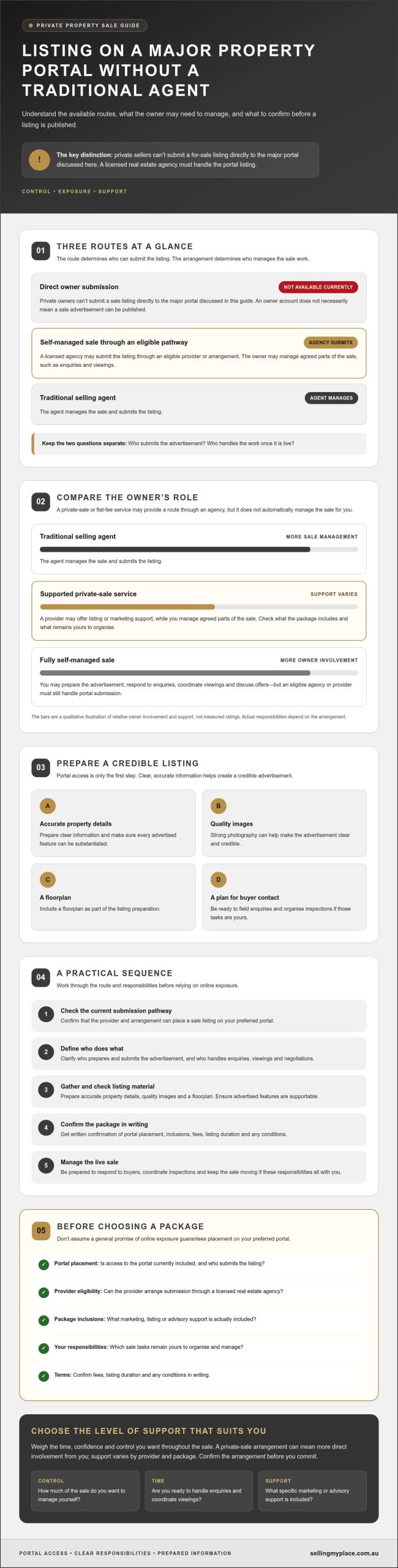
Follow these steps to publish and manage your private property listing
A smooth sale starts with confirming the listing pathway, then keeping the advertisement and buyer communication organised. Use this workflow before and after publication. If you plan to list on realestate.com.au without an agent managing the sale, be clear about which tasks you’ll handle and what your chosen provider will do.
- Confirm the submission route. Check realestate.com.au’s current requirements and ask the service provider to confirm in writing that it can submit your sale listing. Don’t assume portal access is included just because a service offers online marketing.
- Review the service scope. Ask which platforms the package covers, what marketing materials and advisory support are included, and what you’ll need to manage yourself. Confirm any applicable fees, listing duration, renewal or extension conditions, and other terms in writing.
- Prepare the final advertisement. Gather the property details, images and floorplan, then check that every material claim is accurate. Decide how prospective buyers will contact you and who will receive their enquiries.
- Approve before publication. Read the complete advertisement as it will appear to buyers. Verify the address, features, inclusions, room details and contact arrangements. Ask the provider how to request corrections and who is responsible for submitting them.
- Set up an enquiry routine. Choose a reliable way to monitor messages and respond consistently. Keep a record of questions, your answers and inspection requests so you can follow up and give prospective buyers the same accurate information.
- Check the live listing. Once published, confirm it appears on the agreed platform and review the displayed details. Check it regularly and promptly request corrections if information changes or an error appears. Keep track of the agreed listing period so you know what happens as it approaches its end.
Clear written terms make it easier to spot gaps before they become frustrating. If a provider offers marketing or pre-sale advice, clarify precisely what that assistance covers. It doesn’t necessarily mean the provider will manage enquiries, inspections or negotiations for you.
To compare the support available for a private sale, ask about property marketing and advisory options, including current portal access and package conditions.
Choose the right support for listing on realestate.com.au without an agent
The right level of support depends on how much time you can give the sale, how comfortable you feel speaking with buyers and how much control you want to retain. If you’re confident handling enquiries, viewings and offer discussions, an owner-managed approach may suit you. If you’d like help presenting the property or getting advice before sale, a flat-fee service may offer a middle ground between doing everything yourself and appointing a traditional selling agent.
Kincade International Direct Sales describes a flat-fee model without agency commission, with services including professional photography, floorplans, neighbourhood market reports and an Agent Advisory Service. These inclusions may help with marketing preparation and advice, but they don’t automatically mean the provider manages the sale or can place your property on realestate.com.au. Treat it as an option to investigate, and confirm current portal access and package terms directly before deciding.
When a flat-fee supported sale may suit your plans
This route may appeal if you want to stay closely involved while getting help with selected parts of the process. For example, you might be happy to speak with prospective buyers but prefer professional photography and a floorplan to support the presentation. Check which inclusions apply to the package you’re considering, and ask what tasks, such as enquiries and negotiations, remain yours.
Questions to ask before choosing a listing service
Get clear, written answers before you commit. Cover portal access as well as the work involved in preparing and managing the listing.
- Portal access: Can the service currently arrange a sale listing on realestate.com.au? Who submits it, and what eligibility conditions apply?
- Platforms and duration: Which websites are included, how long will the listing remain active, and what happens if the agreed period ends?
- Inclusions and terms: Are photography, floorplans, market reports or advisory support included? Confirm applicable fees and any other package conditions in writing.
- Your responsibilities: Who prepares or approves the advertisement, responds to buyer enquiries, coordinates viewings and handles offer discussions?
- Advice and conveyancing: What does the advisory support cover, who provides it, and what conveyance advice is available? Clarify the scope and whether separate professional advice may be needed.
Choose the arrangement that fits the way you want to sell, not just the way the listing is submitted. Before committing, compare the support you’ll receive with the time and responsibility you’re prepared to take on yourself.
Take your next step with clarity and confidence
You can list on realestate.com.au without an agent managing your sale, but confirm the current portal pathway and provider eligibility before relying on a listing. Prepare accurate property details, then weigh the time and responsibility of managing buyers yourself against the marketing and advice a supported private-sale service may include.
Kincade International Direct Sales describes a flat-fee marketing model without agency commission, with professional photography, floorplans and an Agent Advisory Service offering pre-sale consulting and conveyance advice. Confirm current portal access, package inclusions and your responsibilities directly before making a decision.
If you’re considering a supported sale, discuss a supported, commission-free sale and ask what applies to your circumstances. With the right information and level of support, you can choose a way forward that suits your plans.
Frequently Asked Questions
Can I list on realestate.com.au without an agent?
Not by submitting a for-sale advertisement directly as a private owner. Current submission arrangements require a licensed real estate agency to lodge sale listings, although you may be able to manage the sale yourself through a private-sale pathway. Portal rules and provider eligibility can change. Check realestate.com.au’s current seller information and ask any provider to confirm in writing that it can arrange placement before you pay or rely on that exposure.
How do I get my property on realestate.com.au without a traditional agent?
You may be able to use a private-sale service that arranges submission through a licensed agency, rather than appointing a traditional agent to manage the sale. If you want to list on realestate.com.au without an agent overseeing the process, first confirm the provider’s current access and eligibility. Then agree who prepares the advertisement, fields enquiries, arranges inspections and handles offers. Get the portal placement and your responsibilities confirmed in writing.
Can a flat-fee service list my home on realestate.com.au?
A flat-fee service may be able to arrange a listing, but don’t assume portal access is included or currently available with every provider or package. Ask who submits the advertisement, whether the service can currently place sale listings on realestate.com.au, and what conditions apply. Confirm the platforms, listing period, inclusions and fees in writing. Marketing support and portal submission are distinct, and neither guarantees a sale or a particular result.
What information do I need to list a property on realestate.com.au?
Prepare the property address, type, room details, features, inclusions and any dimensions you plan to advertise. Gather clear, current photographs and a floorplan, then check that they match the home and written description. Have relevant property records available to support claims about renovations, fixtures or boundaries. You’ll also need seller contact arrangements for buyer enquiries. Check applicable state or territory disclosure and advertising requirements through official sources before publication.
Do I still have to manage buyer enquiries if I sell without an agent?
Often, yes. In a self-managed sale, the owner may need to monitor and respond to enquiries, arrange inspections, answer questions consistently and discuss offers. A marketing provider may assist with advertising without managing those parts of the sale. Before engaging a service, ask which communications it handles and what remains your responsibility. Set up a reliable way to record enquiries and follow up so interested buyers receive accurate information.
Is selling privately the same as selling without any professional help?
No. Selling privately usually means retaining control of key sale tasks, not necessarily doing every part alone. You can seek separate marketing or advisory support while managing buyer communications and negotiations yourself. For example, Kincade International Direct Sales describes a flat-fee model without agency commission, with photography, floorplans, neighbourhood market reports and an Agent Advisory Service for pre-sale consulting and conveyance advice. Confirm which services apply and what professional guidance you may still need.
What should I check before paying for a private property listing service?
Ask whether realestate.com.au placement is currently available, who submits the listing and what eligibility conditions apply. Confirm the platforms, marketing materials, advisory inclusions, listing duration, fees and any renewal terms in writing. Clarify whether you or the provider will prepare the advertisement, respond to buyers, arrange inspections and manage offers. Check the provider’s current terms and verify relevant state or territory selling and disclosure requirements through official sources before committing.
How to Price Your House for Private Sale: Australian Guide
Reading Time: 11 minutes
What if the asking price that feels safest is the one that puts buyers off, or leaves money on the table? If you’re working out how to price your house for sale privately, conflicting online estimates and well-meant opinions can make it hard to know where to start. You want a credible price that attracts serious interest without undervaluing a home you’ve cared for.
A steadier approach is to use evidence to set a realistic range, then pay attention to how buyers respond. Comparable sales help anchor your expectations, while enquiries and inspection feedback show whether your asking price is connecting with the market. You don’t have to rely on guesswork or a single online estimate.
This guide explains how to research comparable properties, weigh up your home’s features and set an evidence-led asking price for a private sale in Australia. You’ll also learn how to read buyer feedback, recognise when your strategy may need a review and adjust your price thoughtfully.
Key Takeaways
- Learn how to price your house for sale privately by using recent completed sales to develop a credible asking range.
- Compare a fixed price, a price range and expressions of interest to choose an approach buyers can understand.
- Track enquiries, inspections, questions and offers to see how buyers are responding.
- Before changing your price, consider whether weak interest could also relate to marketing, presentation or timing.
- Prepare a simple pricing rationale and review plan to support clear, consistent communication with buyers.
How to price your house for sale privately without guesswork
Setting a price for a major asset can feel like a lot to carry, particularly when you’re selling privately without a traditional agent guiding the decision. Online estimates and informal opinions can provide a starting point, but they may differ and may not reflect your home’s condition or what buyers are considering now.
To work out how to price your house for sale privately, treat price as a decision informed by several kinds of evidence, not a single definitive number. An estimate helps you consider a possible value. Your asking price is the public position you choose to invite buyer discussions. The price buyers may be willing to pay can depend on comparable sales, your property’s condition and features, current competition and buyer feedback once your home is on the market.
What is the difference between market value and asking price?
Market value is an estimate informed by relevant evidence, such as sales of comparable properties and market conditions. A formal appraisal or valuation may follow a particular process and serve a specific purpose. For general background, see Appraised value. An estimate, however, isn’t the same as a confirmed sale price.
Your asking price is the figure or price position you advertise as the starting point for buyer discussions. It communicates your expectations, but doesn’t establish what a buyer will pay. Offers, the strength of competing interest and the terms of a potential sale all contribute to the eventual outcome. Keep these distinctions clear and you can use estimates as evidence without treating them as promises.
Why can private-sale pricing feel difficult?
There’s a balance to strike: you want to pursue a strong result while setting a price that encourages genuine buyers to take a closer look. It can be harder to judge objectively when a home holds years of family memories or you’ve invested time and care in improvements. Those things matter to you, but buyers may weigh them differently.
A credible asking price starts with evidence and stays open to review. Consider comparable sales alongside your property’s presentation and condition, then watch how buyers respond. If interest is quieter than expected, don’t assume price is the only cause. Marketing, presentation and timing may also affect the response. A calm review helps you decide what the evidence suggests instead of reacting to one comment or an early impression.
Private selling doesn’t mean you have to make the decision without support. Neighbourhood market reports and pre-sale property consulting can provide useful context as you assess your options, while the pricing decision remains yours. Next, build a clearer range from completed sales and compare those homes carefully with your own.
Build an evidence-based asking price from comparable Australian sales
A useful asking range comes from a repeatable process, not from picking the highest nearby sale or averaging a handful of online estimates. Gather completed sales, choose properties that genuinely resemble yours, assess the meaningful differences, then use the evidence to form a range you can explain.
How do you find useful comparable property sales?
Start with recent completed sales of residential properties similar to yours. Search more than one credible source, such as property sale records where available, property portals showing sold results and neighbourhood market reports. Record each sale date, price, property type and the details available about the home. Asking prices can provide context, but they show what sellers hope to achieve, not what a buyer has paid.
Look for several relevant examples rather than relying on one sale. A result may be unusual because the property has distinctive features or the sale circumstances differ from a typical transaction. If you can’t tell why a sale stands apart, mark it as less reliable rather than letting it set your expectations.
How should you adjust for differences between homes?
Compare like with like, then note where your home differs. Consider land size and shape, building size and condition, layout, renovations, outdoor areas, parking and other features buyers may value. A refreshed kitchen, for instance, may improve appeal compared with a similar home needing work. That doesn’t mean you can assign a fixed dollar adjustment without supporting evidence.
Ask what each difference could mean to a buyer, and whether the sales you’re comparing help show its relevance. A practical comparison table can keep your reasoning clear:
- Sale: date, completed price and source.
- Similarities: property type, land and building characteristics.
- Differences: condition, layout, improvements and notable features.
- Relevance: why the difference may affect buyer appeal.
Once you’ve assessed several sales, use the closest matches to develop a considered range rather than a falsely precise figure. Keep your sources and dates with your notes so you can revisit the evidence if circumstances change. For more on the underlying valuation process, read this guide to determining a home’s market value in Australia.
Neighbourhood market reports and pre-sale property consulting can offer useful context as you work through the comparisons. If you’d like support reviewing your pricing evidence, you can ask about property pricing advice. Your final range should reflect the evidence for your home and remain open to review as buyer responses come in.
Choose a private-sale price strategy buyers can understand
Once you’ve developed a price range from comparable sales, decide how to present your position to buyers. A fixed asking price, a range and expressions of interest each communicate something different. The right fit depends on your evidence, sale goals and how clearly the format will guide buyer discussions. No single approach suits every home.
| Approach | Clarity | Flexibility | Possible buyer interpretation |
|---|---|---|---|
| Fixed asking price | Gives buyers a clear reference point. | Can leave room to consider offers, depending on your wording. | May be read as the amount you expect, or as a price open to discussion. |
| Price range | Shows a price bracket rather than one figure. | Signals some flexibility within the stated range. | Buyers may focus on the lower end, so make the range clear and evidence-backed. |
| Expressions of interest | Doesn’t state a specific asking figure. | Lets buyers put forward offers for you to consider. | Some buyers may be unsure what level of offer you’re seeking. |
Should you use a fixed price or a price range?
A fixed price offers a straightforward reference point, which can help buyers decide whether to enquire. A range can communicate flexibility, but make sure its wording is honest and doesn’t imply a level of certainty you can’t support. Neither format guarantees a particular offer or final sale price. Before advertising, check the requirements that apply to property price advertising where you’re selling, as rules can vary between jurisdictions and circumstances.
How should you account for your sale goals?
Your timeframe, next move and minimum acceptable outcome all matter. Decide privately what result you could accept after considering your plans, but don’t confuse that confidential negotiation threshold with the public asking price. Your advertised position should be supported by your sales evidence and communicated consistently across your marketing. For ideas on managing offers and conversations, read these property sale negotiation tips.
Your price format should be clear, evidence-backed and consistent across every advertisement. That consistency helps buyers understand your position and gives you a steady basis for responding to enquiries and offers. Choosing how to price your house for sale privately isn’t just about selecting a figure. It’s also about presenting it in a way that suits your sale goals and leaves room for considered discussion.
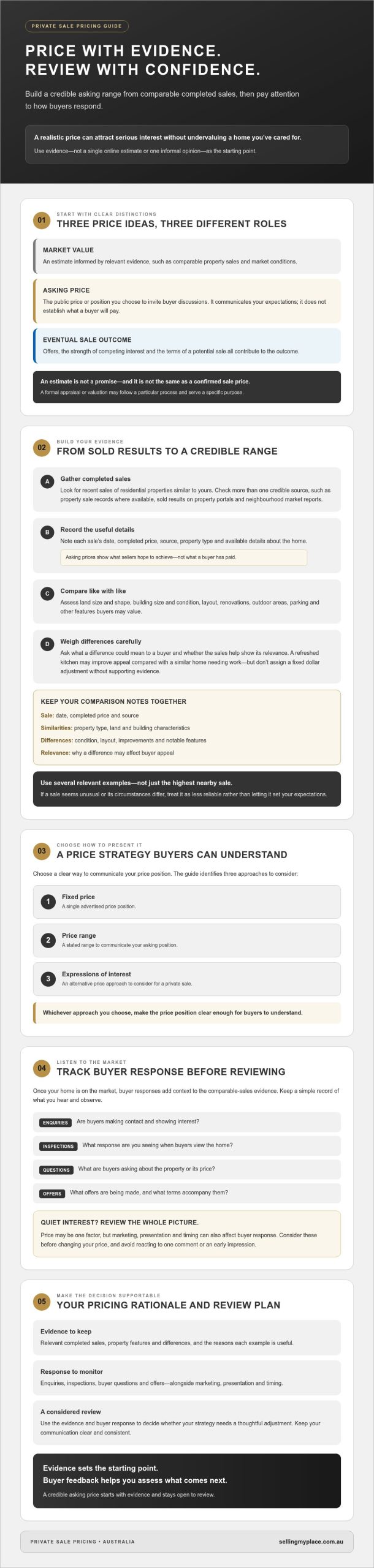
Test your asking price and adjust it using buyer feedback
A price strategy needs a way to check how it’s landing with buyers. If you’re working out how to price your house for sale privately, record what happens after launch rather than relying on a single reaction or a quiet day. Buyer response can help you assess your asking price, but it may also point to issues with marketing, presentation or timing.
Keep a simple log of:
- Enquiries and the questions buyers ask
- Inspection attendance and follow-up interest
- Repeated comments about value or property features
- Offers, including how well their terms align with your expectations
What does buyer feedback say about your asking price?
Look for patterns, not verdicts. One buyer’s view may reflect their own preferences, while similar comments from several interested people could suggest a wider concern about value, condition or a feature of the home. Compare inspection interest and offer quality with the response you hoped your campaign would attract. Keep notes factual, protect buyers’ privacy and follow any requirements that apply to handling their information.
Limited enquiries don’t automatically mean the price is wrong. First check whether your advertising is reaching buyers and explaining the property clearly. Consider whether the photography, floorplan and listing details present the home accurately, and whether inspection feedback raises a presentation issue. Separating these factors helps you avoid changing the price to solve a problem that may lie elsewhere.
When should you review or change the price?
Choose a review point before advertising begins. This gives you a basis for assessing meaningful buyer response rather than reacting to one slow day. At that point, revisit your enquiry and inspection log, check your listing’s exposure and presentation, then compare your asking position with current evidence from relevant completed sales.
If the evidence supports a change, decide on a clear update rather than making repeated small adjustments that could leave buyers uncertain about your position. Make sure the revised price is consistent wherever the property is advertised, and explain it plainly in buyer conversations. A simple sequence can keep the decision grounded:
- Check exposure: Is the listing clear and reaching its intended audience?
- Gather feedback: What themes appear across enquiries and inspections?
- Revisit evidence: Do comparable sales still support your asking position?
- Communicate consistently: If you update the price, reflect the change across your advertising.
A measured review can help you respond to the market without losing sight of your goals. If you’d like support interpreting buyer feedback or reviewing your pricing approach, contact the advisory team.
Prepare to sell privately with a price you can confidently support
A well-considered asking price is easier to stand behind when your evidence, advertising and buyer communication tell a consistent story. Before your home goes live, make sure you can explain how you arrived at your price and have a plan for reviewing it once buyers respond. This brings your work on how to price your house for sale privately into a practical plan.
What should you have ready before advertising your home?
Gather your notes in one place so you can refer to them throughout the sale. Your preparation checklist should include:
- A documented price range, supported by relevant completed sales and a brief explanation of how you assessed differences between those homes and yours.
- Your confidential minimum, considered in light of your next move and sale goals. Keep this separate from your advertised price.
- An agreed review plan, including when you’ll assess enquiries, inspections and offers rather than reacting to every quiet spell.
- Accurate listing information, with property details checked and presentation, photography and floorplan reviewed for accuracy.
Clear marketing helps buyers understand what’s being offered, while accurate information and consistent responses help set sensible expectations. For a broader view of the owner-led process, use this step-by-step guide to selling your own home.
Where can private sellers get support with pricing and marketing?
You remain responsible for deciding your asking price, but you don’t have to gather every piece of context alone. Neighbourhood market reports can help you review relevant sales, while pre-sale property consulting can provide guidance as you consider your approach. These resources can inform your judgement, but they shouldn’t be treated as guaranteed valuations or promises about what a buyer will offer.
Kincade International Direct Sales provides flat-fee marketing and advisory support for private residential sales. Services include property listings, professional photography, floorplans, neighbourhood market reports, pre-sale consulting and conveyance advice. This support can complement your pricing decisions, but it doesn’t replace your own assessment or guarantee a particular sale price.
With your evidence gathered, your price rationale recorded and a review plan in place, you can move into the sale with a clearer sense of direction. If you’re ready to explore practical help with your private sale, discuss private-sale support.
Move forward with a pricing plan you can support
Choosing how to price your house for sale privately doesn’t have to come down to guesswork. Use relevant completed sales to build a realistic range, choose an asking format buyers can understand, then review enquiries, inspections and offers against your plan. If the response is quieter than expected, check your marketing and presentation as well as the price before deciding what to change.
A clear rationale helps you communicate consistently and make considered decisions during an important transition. Practical support can help, too. Kincade International Direct Sales offers flat-fee property marketing with no agency commission. Professional photography, floorplans and neighbourhood market reports are available, and its Agent Advisory Service provides pre-sale consulting to complement your pricing decisions.
If you’re ready to take the next step, discuss your private-sale plans with the team. Sound evidence and a thoughtful review plan can help you approach your sale with greater confidence and make decisions that suit your circumstances.
Frequently Asked Questions
How do I price my house for sale privately in Australia?
To work out how to price your house for sale privately, use recent completed sales of similar homes as your starting point. Compare property type, land, layout, condition and features, then account for differences when forming a realistic asking range. Choose an advertising format buyers can understand and decide in advance when you’ll review their response. Online estimates can help with initial research, but shouldn’t be your only evidence.
Should I price my house above market value when selling privately?
Only set an asking price above your evidence-based estimate if you have a clear reason and understand the risk. Buyers may compare your home with other available properties, and a price that seems out of step could reduce enquiries or delay useful feedback. Decide privately what offers you’d consider, but keep the public asking price credible and supportable. Don’t assume that starting high will necessarily lead to a higher final offer.
How do I find comparable sales for my home?
Search property portals, sale records where available and neighbourhood market reports for completed sales of homes that resemble yours. Compare the property type, land and building characteristics, condition, layout and notable features. Note the source and sale date for each result, and look across several examples rather than relying on one unusual sale. Advertised prices can offer context, but they show seller expectations, not completed transactions.
Can I use an online property valuation to set my asking price?
Use an online valuation as an initial reference, not as a definitive asking price. Automated estimates may not reflect a home’s condition, renovations, layout or features, and different tools can produce different results. Check the estimate against recent completed sales of comparable properties and consider whether the information used is current and accurate. Your asking price should reflect the wider evidence and buyer response, not one online figure alone.
How often should I review my asking price when selling privately?
Set a review point before advertising, then assess the asking price once you have meaningful campaign evidence to consider. Review enquiries, inspection attendance, repeated feedback and offer quality alongside your listing’s exposure and presentation. If interest is limited, don’t assume price is the only issue. Revisit comparable sales and check the marketing before deciding whether an adjustment is warranted. Review again if market conditions or your sale circumstances change.
Should I advertise a fixed price or a price range?
A fixed price gives buyers a clear reference point, while a range can signal flexibility but may lead some buyers to focus on its lower end. Neither approach guarantees a particular offer. Choose the format that best fits your evidence and sale goals, and make the wording clear and consistent wherever the property is advertised. Check the price advertising requirements that apply to your circumstances, as requirements can differ across Australia.
Can I change the asking price after listing my house privately?
In general, you can review and update your advertised asking price during a private sale. Before changing it, consider buyer feedback, listing exposure, presentation and comparable sales rather than reacting to one quiet day. Check any applicable requirements and the terms of the platforms carrying your listing. If you decide to make an update, revise the price consistently across your advertising and communicate the change clearly to interested buyers.
Online real estate agent vs traditional: which suits your sale?
Reading Time: 10 minutes
When comparing an online real estate agent vs traditional sale, the biggest difference may not be where the agent works, but who handles each part of the process. An online model doesn’t automatically mean you’re on your own, and a traditional agency’s higher level of involvement shouldn’t be assumed without checking what’s included.
It’s understandable to weigh a lower-fee option against the reassurance of more hands-on support, especially when you’re managing buyer enquiries, inspections and important sale paperwork. The useful comparison is between the actual services, tasks and terms, not just the labels or headline fees.
This guide explains how to compare marketing, communication, negotiation support, costs and your responsibilities under each model. Before signing, find out who handles buyer enquiries and inspections, what support is available when offers arrive, and whether professional photography, floorplans, neighbourhood market reports or advisory services are included. Once you know who does what, you can choose an approach that fits your time, confidence and support needs.
Key Takeaways
- Compare the online real estate agent vs traditional options by the tasks and support included, not the label alone.
- Check which marketing materials and advisory services are included in writing, and whether any costs are separate.
- Before signing, clarify who manages buyer enquiries, inspections, negotiations and sale paperwork.
- Match the level of hands-on support to your available time, confidence and preferred level of involvement.
- Review the agreement and complaint pathways so you know what to expect if questions arise during the sale.
Online real estate agent vs traditional: what is the real difference?
The main distinction is usually how the service is delivered, not whether a real person is involved. An online provider may use digital tools for property information, communication and listing administration. A traditional agency often works through direct contact with an agent and an agency team. Neither label tells you on its own how much support you’ll receive or how much of the selling work you’ll need to do.
For a useful overview of what is an online real estate agent, separate the online platform from the service agreement. The online real estate agent vs traditional comparison comes down to which tasks are included, who carries them out and how the provider charges.
What does an online real estate agent do?
Online property services can combine digital listing tools with professional marketing and human advice. A service might provide a property listing, photography, floorplans or a neighbourhood market report, alongside advisory support. Inclusions vary, so check the agreement for the specific service you’re considering.
A listing service doesn’t necessarily manage every step of the sale. Ask who responds to buyer enquiries, arranges or conducts inspections, follows up interested buyers and communicates offers. If you’re expected to take on any of these tasks, consider whether you have the time and confidence to do so.
What does a traditional real estate agent do?
A traditional agency may coordinate the campaign, communicate with buyers, arrange inspections and negotiate offers on the seller’s behalf. The agent may also guide you through decisions as the sale progresses. The level of involvement depends on the provider, the people handling your sale and the terms you agree to.
Traditional service isn’t identical across Australia, and online support varies too. One provider may offer substantial advice through online communication; another may leave more buyer-facing work to the owner. Read the agreement rather than relying on assumptions about the model.
In short: online describes a way of delivering services, while traditional usually describes a more agency-centred approach. The service agreement sets out what you actually receive, including:
- Fee structure: whether you’ll pay a flat fee or a commission, and what the charge covers.
- Marketing: which listing and promotional materials are included.
- Support and tasks: who handles buyer contact, inspections and follow-up.
- Terms: what the agreement requires and how long it applies.
Compare these details side by side. That will show whether the service matches your preferred level of involvement, instead of leaving you to choose by label alone.
Compare fees, marketing and support, not just the agent label
A lower or more predictable fee can be appealing, but it only tells part of the story. In the online real estate agent vs traditional comparison, weigh the fee model against the work included, the support available and any expenses treated separately in the agreement. A fee structure alone can’t tell you how a campaign will perform or what sale outcome to expect.
How do commission and flat-fee models differ?
A commission is generally calculated in relation to the sale, while a flat fee is a set charge for the agreed service. Ask for the full terms in writing: what the fee covers, whether any costs are payable separately, and what happens if the sale doesn’t proceed as planned. Compare the full services and costs rather than assuming one model will automatically cost less overall.
| What to compare | Questions to ask |
|---|---|
| Fee model | Is the fee commission-based or flat? What services and any separately payable expenses are covered? |
| Marketing | Which listing channels and campaign activities are included? Are professional photography and floorplans part of this agreement? |
| Support | Who is your main contact? Who responds to buyer enquiries and helps you consider or discuss offers? |
| Your tasks | Are you expected to arrange or host inspections, answer enquiries or follow up interested buyers? |
| Agreement terms | How long does the agreement apply, and what are the conditions for ending or changing it? |
What marketing and personal support should you check?
Look beyond a promise of online exposure. Ask which platforms will carry the listing, whether photography and floorplans are included, and who coordinates campaign updates. Confirm whether you’ll speak directly with an adviser about buyer interest and offers, or whether those tasks sit with you. Get the details in writing before you commit. For more on the elements to assess, see this guide to professional residential property listing services.
Traditional agencies and online providers can have different agreements and service arrangements. For wider context, explore the Real Estate Institute of Australia’s information on Australian real estate industry standards.
If you’re considering a flat-fee listing and advisory support, you can discuss your selling options with Kincade International Direct Sales and clarify which services and responsibilities apply to the arrangement.
Will an online agent provide enough support during your sale?
Online service doesn’t automatically mean you’re left to manage the sale alone. Some providers pair digital listing tools with professional advice, while others expect the owner to take a more active role in dealing with buyers. The key questions are what support is available, when you can access it and where the provider’s role ends.
That distinction matters when offers arrive and you need to make decisions. Ask whether an adviser can help you understand an offer or prepare for a negotiation, and what that assistance covers. For practical pointers, read these property sale negotiation tips. Advice and negotiation support vary by service, so check the scope rather than assuming it’s included.
Which sale tasks might remain with the owner?
Before signing, map out the work from listing to offer. For each task, confirm whether the provider, you or another professional is responsible. This can reveal gaps that aren’t obvious from a marketing description.
- Buyer contact: Who answers enquiries, shares property information and follows up interested buyers?
- Inspections: Who arranges access and conducts inspections? If you’re responsible, what coordination is expected?
- Campaign updates: Who prepares or organises marketing materials, and how will you hear about buyer interest and progress?
- Offers and paperwork: Who communicates offers and explains the next steps? Clarify separately who handles contract preparation and legal or conveyancing work.
Marketing assistance and conveyancing are different services. If a provider mentions conveyance advice, ask what it covers and whether you’ll still need a solicitor or conveyancer for other parts of the transaction.
How can you assess the support before signing?
Ask who your main contact will be, how you can reach them and what response expectations apply during the campaign. Request written details of any advice, negotiation assistance and service limits. Check the agreement’s duration, exit terms and any obligations that continue if you change your selling plans.
A clear conversation now can prevent uncertainty later. CHOICE’s guide to how to choose a real estate agent offers further questions to consider when assessing an agent’s service and terms. Use those questions alongside your own task list, then choose the arrangement that gives you the level of guidance and involvement you’re comfortable with.
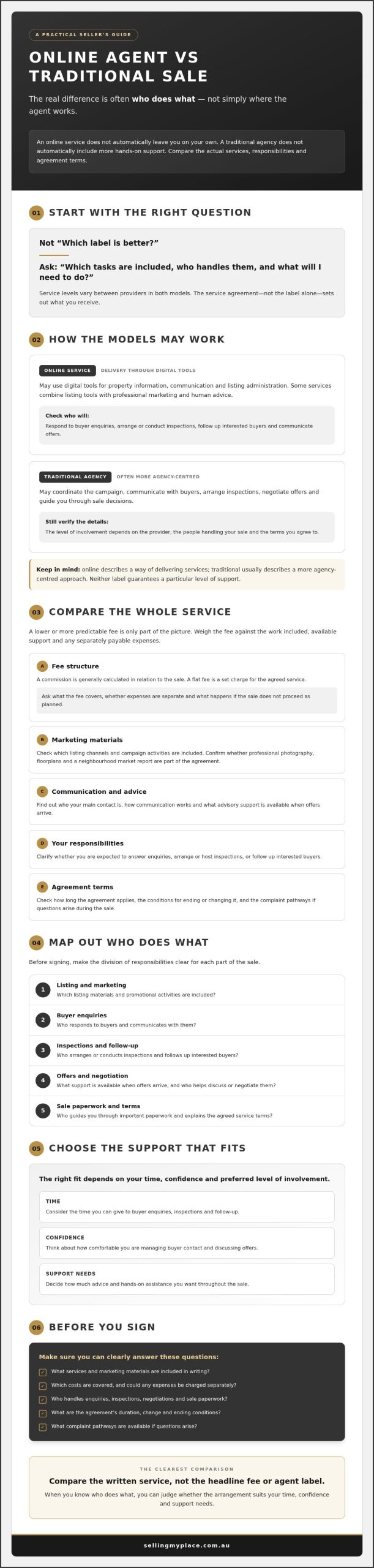
Which real estate agent model fits your time, confidence and priorities?
The right choice depends on more than the fee. Think about how much time you can give the sale, how comfortable you feel speaking with prospective buyers, and whether you’d rather coordinate tasks yourself or have an agent take a more hands-on role. Choose a service whose responsibilities feel manageable from the outset, while allowing for your needs to change during the sale.
When might a traditional agency suit your situation?
A traditional agency may suit you if you want an agent to coordinate more campaign activity and prefer regular, direct communication as decisions arise. That can feel reassuring if you have limited time or would rather not lead buyer conversations and offer discussions yourself. Still, don’t assume every agency agreement includes the same hands-on help. Confirm who manages each task, how updates are provided and what the agent’s role covers.
When might an online service suit your situation?
An online service may appeal if you’re comfortable being more involved, value digital access and want to consider a different fee structure. Some services combine residential property listings with marketing materials and advisory support, but inclusions and the scope of advice vary. Check that the services address the areas where you want help. A flat fee alone won’t tell you how much you’ll need to do.
For a practical sense of the owner’s role, read this guide on how to sell your own home. Even if you don’t plan to manage the whole sale yourself, it can help you identify which responsibilities you’re happy to take on and where you’d value professional guidance.
To compare providers fairly, use the same written checklist for each option. Assess how well each agreement matches your needs across:
- Time: Can you respond to buyers and coordinate any tasks assigned to you?
- Confidence: Are you comfortable discussing interest and offers, or do you want more guidance?
- Control: Do you want to be closely involved, or would you prefer the agent to coordinate more of the campaign?
- Support: Is your contact and their role clear, including the limits of any advice?
- Fit: Are marketing inclusions, responsibilities and agreement terms set out clearly in writing?
The best match is the one that fits your actual capacity, not an ideal version of your schedule. If a flat-fee listing and advisory approach is on your shortlist, discuss your selling options with Kincade International Direct Sales and confirm which inclusions and responsibilities apply.
How to choose an Australian selling service with confidence
Once you’ve compared the models, turn your priorities into a simple due-diligence check. The aim isn’t to find a label that sounds reassuring. It’s to understand exactly what you’re agreeing to and whether the service fits your sale.
A practical checklist before you commit
- 1. List your priorities. Note how much time you can give the sale, which tasks you’re comfortable handling and where you want advice or hands-on help.
- 2. Compare written inclusions. Check marketing deliverables such as listing exposure, photography and floorplans alongside the fee structure. Ask which services are included and whether any expenses may be charged separately.
- 3. Clarify responsibilities. Confirm who manages enquiries, inspections, negotiations and campaign updates. Find out who your contact is and what advisory support covers.
- 4. Review the agreement. Read the duration, cancellation conditions, service responsibilities and other obligations before signing. Ask for an explanation of anything unclear.
- 5. Check complaint pathways and local guidance. Find out how the provider handles complaints and where to seek further help. Property sale and consumer requirements can vary by state or territory, so check current guidance for your location and obtain independent advice if needed.
Questions to ask every prospective provider
Ask each provider the same questions so you can compare answers fairly: What does the fee cover? Could any services involve separate charges? Who responds to buyers, coordinates inspections and supports offer discussions? How will campaign progress be communicated? What happens if you want to end the agreement? Clear written answers make it easier to compare the support on offer, not just the presentation.
The online real estate agent vs traditional decision comes down to the service and terms that suit your priorities. Kincade International Direct Sales offers flat-fee, commission-free property marketing and advisory packages. Its listed services include professional photography, floorplans, neighbourhood market reports and advisory support. Confirm current package inclusions, responsibilities and the scope of advice before deciding.
Compare those details with each provider’s written offer, then choose with a clear view of who does what. To discuss the available selling options, contact Kincade International Direct Sales.
Choose the support that lets you sell with confidence
The online real estate agent vs traditional decision isn’t simply about choosing a lower fee or a familiar agency model. Compare what each provider will do, what you’ll need to manage and how much guidance you want with buyer enquiries, inspections and offer discussions. Then check the written agreement for marketing inclusions, responsibilities, terms and any separately payable expenses.
Kincade International Direct Sales offers a flat-fee, commission-free property marketing and advisory model. Professional photography and floorplans are among its listed services, and its Agent Advisory Service offers pre-sale consulting and conveyance advice. Confirm which services are included in the package you’re considering, along with the current scope of advisory support and the terms.
If you’d like to explore whether this approach fits your priorities, discuss your property sale with Kincade International Direct Sales. Contact the team to clarify the package inclusions and responsibilities before deciding.
Frequently Asked Questions
Is an online real estate agent cheaper than a traditional agent?
An online service may use a flat-fee structure, while a traditional agency commonly charges commission linked to the sale. The total cost depends on the agreement and any separate expenses. Compare what each fee covers, including marketing and support, rather than judging by the headline fee. The online real estate agent vs traditional choice should also reflect which sale tasks you’ll handle and how much professional guidance you want.
Can an online real estate agent negotiate with buyers?
Some online services may provide advice or assistance with offers, but negotiation support varies between providers. Before signing, ask who communicates offers, whether an adviser can help you assess or respond to them, and what the service’s limits are. Get the answers in writing. If you’re expected to lead negotiations yourself, consider whether you feel comfortable discussing terms and responding to buyer questions.
What is the difference between an online agent and a traditional real estate agent?
The difference is generally how the service is delivered, not whether human support is available. Online providers may use digital tools for listings and communication, while traditional agencies often coordinate directly through an agent or team. Either model can vary in marketing, advice and seller responsibilities. Compare the written agreement to see who handles enquiries, inspections, offers and campaign updates before deciding which arrangement suits you.
Do online real estate agents include professional photography and floorplans?
Some online property services include professional photography and floorplans, but inclusions vary by provider and package. Check whether both are part of the specific service you’re considering, or whether they involve separate arrangements or charges. Also confirm how the listing will be presented and where it will appear. Kincade International Direct Sales lists photography and floorplans among its services, but verify current package inclusions before proceeding.
How much does an online real estate agent cost in Australia?
There isn’t one standard cost for an online real estate agent in Australia. Providers may charge a flat fee or use another structure, and marketing or other services may be charged separately. Ask for a written breakdown of the fee, inclusions and possible additional expenses so you can compare the full agreement with other options. Kincade International Direct Sales describes its model as flat-fee and commission-free; confirm its current terms directly.
What should I check before signing with an online real estate agent?
Check the written inclusions, fee structure, agreement duration and cancellation conditions before signing. Clarify who handles buyer enquiries, inspections, offer discussions and campaign updates, and identify the contact available to you. Confirm whether photography, floorplans and advisory support apply to your agreement, and ask about any separate expenses. If a term is unclear, request an explanation in writing and consider independent advice before committing.
Can I sell my home without a traditional real estate agent?
Yes, you can choose a sale-by-owner approach or use a property marketing and advisory service instead of a traditional agency. The level of support differs: you may take responsibility for buyer enquiries, inspections and follow-up, or receive some guidance depending on the service. Before choosing, consider the time you can give the sale and confirm who handles each task, including any conveyancing or contract responsibilities.
How to Handle Offers and Negotiate the Sale Price When Selling Privately in Australia
The listing is live, the inspections are done, and now a buyer has made an offer. This is the moment most private sale guides quietly skip over, and it is precisely where many sellers feel most exposed without an agent in their corner. If you have chosen to sell your own home, navigating this stage confidently is not just possible; it is a skill you can learn and repeat.
Negotiating the sale price privately in Australia requires more than gut instinct. You need a clear framework for evaluating what an offer is actually worth, structured techniques for countering without undermining your position, and a working knowledge of how state-by-state legal differences affect what is binding and when. You also need to understand the psychological dynamics that experienced negotiators use to their advantage.
This guide covers every stage of the offer process, from the moment a bid lands through to signing contracts. You will learn how to set response deadlines, manage competing offers, handle conditions like finance and building inspections, and know exactly when walking away is the right move.
What Happens When an Offer Lands Without an Agent
The moment a buyer submits an offer, most private sellers feel an immediate spike of anxiety. Without an agent buffering the interaction, the negotiation feels personal, high-stakes, and unfamiliar. That reaction is understandable, but it overstates how complex the process actually is.
What an agent does during negotiation is largely procedural: they relay offers and counter-offers, advise on price movement, set response deadlines, and manage buyer communication. None of those tasks require a licence. They require preparation, a clear framework, and the discipline to follow it.

Before you respond to any offer, three things must be in place:
- Your walk-away number. A firm price floor based on comparable sales, not emotion or what you need for your next purchase.
- Your settlement preferences. Your ideal settlement period, deposit size, and vacant possession date, so you can trade these conditions strategically rather than scrambling to answer on the spot.
- Your legal documentation. Your contract of sale, prepared by a conveyancer before offers arrive, and any state-required disclosure documents such as a Section 32 Vendor Statement in Victoria.
Sellers who do this groundwork consistently achieve outcomes comparable to agent-run negotiations. Removing the agent also removes a commission incentive that can quietly favour speed over price; when you negotiate directly, every dollar you gain is a dollar you keep.
This guide walks through a repeatable five-stage framework: receive the offer, evaluate it on price and terms together, counter with a single anchored position, manage any competing offers through a structured process, and close with a signed contract. For a broader view of how this stage fits the full private sale process, the guide on managing enquiries, inspections, and price negotiations provides useful context before you proceed.
What You Need Before You Respond to Any Offer
Before a single word of negotiation leaves your mouth or inbox, five things must already be settled in your own mind.
Your reserve price and walk-away point are the foundation. As outlined above, anchor this number in comparable sales data and write it down before any offer arrives so emotion cannot move it in the moment.
A prepared contract of sale shifts the power dynamic immediately. Sellers who engage a solicitor or conveyancer before offers arrive can present a ready-to-sign contract the moment a buyer commits. This signals organisation, shortens the buyer’s due diligence window, and reduces the risk of a deal unravelling while paperwork is still being drafted. Consumer Affairs Victoria confirms the conveyancing obligation for sellers applies early in the process.
Your preferred settlement terms need to be decided in advance. Knowing your ideal settlement period, minimum deposit size, and vacant possession date lets you trade conditions strategically rather than improvising under pressure.
Documentation readiness matters beyond legal compliance. Building and pest reports, a current title search, and your Section 32 or Vendor Statement (requirements vary by state; see the key takeaways on vendor disclosure obligations) prepared in advance signal a serious seller and accelerate buyer due diligence.
Your timeline pressure is information buyers will attempt to extract. A seller with 30 days before settlement on a new purchase negotiates from a different position than one with no urgency at all. Know your real deadline, keep it private, and never volunteer it during negotiations.
How to Evaluate an Offer Properly (Not Just the Price)
With your preparation locked in, the next skill is reading what a buyer has actually put on the table.
Price is only one variable. An offer of $720,000 with no conditions is frequently worth more than $740,000 subject to finance, a building inspection, and the sale of the buyer’s existing property. Each condition is a trapdoor: the deal can legally collapse through it. An unconditional offer removes that risk and often justifies accepting a lower headline figure.
Deposit size signals commitment. Deposit norms vary by state and by negotiation; ask your conveyancer what is standard in your market. A buyer offering a very thin deposit is either financially stretched or testing your flexibility. Treat a thin deposit as a prompt to ask more questions and factor it into your risk assessment.
Settlement timing is tradeable. If a buyer requests 90 days but you can move in 45, that misalignment costs you. Conversely, if you need extra time and a buyer offers flexibility, that has real value. For guidance on trading settlement terms strategically, Beyond the Price Tag: Negotiating Settlement Terms and Conveyance Advice is worth reading alongside this section.
Decode the conditions before you respond. A finance clause gives the buyer a reasonable window to obtain formal loan approval; if approval fails, the contract falls over. A building and pest clause lets the buyer renegotiate or exit based on inspection findings. A sunset clause sets a date after which either party can terminate, relevant when the buyer’s own sale is involved.
Spot the low-ball test bid. If an offer sits more than 10 to 12% below your listed price with no explanation, it is usually a probe rather than a genuine position. Respond with a firm counter close to your asking price rather than splitting the difference, which only encourages further low anchoring. A genuine opening offer, even if below asking, typically comes with realistic conditions and a reasonable deposit.
How to Counter an Offer: A Step-by-Step Approach
Once you have assessed an offer on its full merits, the next task is responding with precision. How you counter matters as much as what you counter with.
Make one move, not a menu. Respond with a single number or a single set of changes, never a range. Saying “we’d accept somewhere between $850,000 and $870,000” hands the buyer the lower figure immediately. One clear position signals confidence and forces a response rather than letting the buyer pick the most favourable option.
Anchor high, not at the midpoint. Your first counter should sit much closer to your asking price than to the buyer’s offer. If you listed at $900,000 and received $840,000, countering at $870,000 feels like a fair split but is not. You have signalled that $870,000 is acceptable and invited a further push toward $855,000. Counter at $890,000 instead. The midpoint fallacy costs sellers thousands at the first exchange.
Choose your medium deliberately. Use a phone call to read tone, test flexibility, and understand what is driving the buyer’s number. Follow every phone discussion immediately with a written summary. Formal counter-offers should always be in writing: they create a clear record and signal seriousness. For private sellers who want to develop stronger negotiation tactics for independent selling, written confirmation is one of the most protective habits you can build.
A written counter-offer template you can adapt:
“Thank you for your offer of [amount]. We are pleased to counter at [your price], with a 10% deposit payable on exchange, a [X]-day settlement period, and the removal of the finance condition. We invite your response by [date and time].”
Keep the language direct and complete, adjusting terms to suit your situation.
Counter on conditions, not just price. As covered in the evaluation step above, each condition is a trapdoor that can collapse the deal. If a buyer will not move on price, offer a modest reduction in exchange for something tangible: removing a finance clause, shortening the building inspection window, or increasing the deposit. A price concession that removes a lengthy finance condition often produces a better outcome than holding firm.
Set a deadline on every counter. Give the buyer 24 to 48 hours to respond. An open-ended counter invites stalling and gives buyers time to inspect competing properties. State the deadline clearly in your written response and hold to it.
Using Deadlines to Control the Negotiation Pace
Once your counter is sent with a deadline attached, the deadline becomes your primary negotiating tool. A response window signals that you are a confident, organised seller with other options, shifting leverage before a word of negotiation is exchanged.
Choosing between 24 and 48 hours comes down to three factors: buyer engagement, how active your inquiry pool is, and market conditions. A buyer who has inspected twice, asked detailed questions, and submitted promptly deserves 48 hours to arrange finance pre-approval or consult a solicitor. A buyer in a competitive market with other registered inspections warrants 24 hours. Tighter deadlines are justified when genuine interest from other parties exists; looser ones preserve goodwill when working with a single serious buyer.
Phrase your deadline as a practical necessity, not a threat. Avoid “take it or leave it” or “this offer expires.” Instead: “We are continuing to receive interest in the property, so we would appreciate your response by 5 pm this Wednesday.” That framing is firm and professional without issuing an ultimatum that could cause a buyer to withdraw on principle.
When a buyer misses your deadline, you have three paths. Extend once, briefly, if the buyer has communicated a genuine reason such as awaiting a bank callback. Proceed to the next interested party if a stronger or cleaner offer exists. Or use the missed deadline to re-open at your original counter, noting conditions have been reset. Do not wait in silence; that cedes control entirely.
On signalling genuine interest from other buyers: you may reference real inquiry or inspection activity honestly. Misrepresenting competing offers could expose you to legal liability; keep any references to buyer interest factually accurate. Keep it factual: “We have had several groups through and are expecting further offers this week.” If you are building your buyer pipeline through broad-reach marketing, the complete guide to listing and selling your home in Australia covers how to maximise exposure so that scarcity signals reflect reality.
Managing Multiple Offers When Selling Without an Agent
When more than one buyer is interested simultaneously, you have two structured approaches to choose from.
Best-and-final-offer round: Notify all buyers simultaneously that competing offers are in play, invite each to submit their strongest written offer by a set deadline (24 to 48 hours works well), then evaluate and accept one. This approach suits sellers with three or more interested parties and a property attracting strong demand.
Sequential negotiation: Work through buyers one at a time, counter the strongest offer first, and move to the next only if that negotiation fails. This suits situations with just two buyers or where one offer is materially stronger than the others.
Notifying Buyers Fairly
As covered in the deadline section above, confirm that multiple offers exist without disclosing specific amounts. Revealing figures creates a Dutch auction dynamic where buyers simply outbid each other by a dollar rather than submitting their genuine ceiling. A straightforward message works:
“We have received multiple written offers on this property. We are inviting all interested parties to submit their best and final offer in writing by [date and time]. We will review all submissions at that point and respond accordingly.”
Evaluating Competing Bids
Price is not the only axis. An unconditional offer at $10,000 less than a finance-dependent one is often the stronger choice. Rank each bid across three criteria: net price, number and weight of conditions, and settlement timing alignment with your own plans.
Listing through a platform that walks you through the full private sale process helps generate the broad buyer exposure that makes competitive tension possible without requiring an agent.
Mistakes to Avoid
- Giving verbal price hints to any buyer during a multi-offer round
- Making verbal commitments before contracts are exchanged
- Accepting any offer without receiving it in writing first
Every communication and every offer must be documented. Verbal commitments create confusion, dispute risk, and in some circumstances legal exposure.
Handling Conditions: Finance, Building Inspection, and Settlement Terms
Once you have navigated competing offers, the focus shifts to conditions. As covered in the evaluation step above, each condition is a trapdoor where the deal can legally collapse, and this is where private sellers lose money and momentum if they do not understand their rights.
Finance conditions are standard and legitimate. A typical clause makes the contract subject to the buyer obtaining unconditional finance approval within a reasonable window. Ask for a pre-approval letter before accepting any finance condition, and treat requests for an unusually long approval period as a signal that the buyer may not have yet approached a lender. Confirm current standard timeframes with your conveyancer.
Building and pest inspection clauses do not give buyers an automatic right to a price reduction. They give buyers the right to negotiate, and so do you. If a report returns minor defects, counter with an adjustment reflecting actual rectification cost, not the buyer’s inflated estimate. The most effective way to neutralise this lever is to commission your own pre-listing building and pest report. Buyers who have already seen it cannot use it as a renegotiation tool later.
Settlement period is an underused price lever. If a buyer will not move on headline price, offer a longer or shorter settlement window. A buyer needing 90 days to arrange bridging finance may trade several thousand dollars for that flexibility.
Sale-of-existing-property conditions carry the highest risk. Your property sits off-market until the buyer’s home sells. If you accept this condition, insist on a time clause giving you a short notice period (confirm standard practice with your conveyancer) to waive or release, plus a sunset date after which the contract lapses automatically.
To lock in agreed terms while a buyer completes due diligence, use a conditional acceptance letter:
“We confirm acceptance of your offer of $[amount], subject to finance approval by [date] and a building inspection completed by [date]. All other terms remain as stated in the draft contract. This acceptance lapses if conditions are not satisfied or waived by [date].”
Review Legal and Negotiation Pitfalls: Protecting Your Settlement before you countersign anything.
State-by-State Legal Differences Every Private Seller Must Know
Beyond managing conditions, the legal framework beneath your sale changes depending on which state you’re in. Getting this wrong can invalidate a contract or expose you to a claim.
When offers become binding
In every Australian state, a contract becomes legally binding only on exchange of signed documents, not on verbal acceptance. In VIC, NSW, and QLD, exchange triggers the cooling-off period. In WA, contracts typically become binding at exchange with no cooling-off protection for buyers on private treaty sales. SA rules vary and should be verified with a local conveyancer before you proceed.
Cooling-off periods at a glance
| State | Duration | Buyer penalty if withdrawn |
|---|---|---|
| VIC | 3 clear business days | 0.2% of purchase price or $100 |
| NSW | 5 business days | 0.25% of purchase price |
| QLD | 5 business days | 0.25% of purchase price |
| WA | None | N/A |
You retain the penalty, but it covers only a fraction of the price. Your sale remains uncertain until the cooling-off window closes.
Disclosure obligations before signing
VIC requires a Section 32 Vendor Statement before a valid contract can be signed. NSW requires a Contract for Sale that includes title documents and associated disclosure materials. QLD uses a Contract of Sale with attached disclosure schedules. WA and SA have their own prescribed contract forms with embedded disclosure requirements. Missing any mandatory document can allow a buyer to rescind. For a full breakdown of what each state’s contract must contain, the Frequently Asked Questions guide to private property sale contracts covers each jurisdiction.
Verbal offers have no legal force
No Australian state recognises a verbal offer as binding. Confirm every offer, counter, and acceptance in writing before acting on it.
Engage a conveyancer before offers arrive
A conveyancer prepares your state-compliant contract and disclosure documents. Appointing one after an offer lands introduces delays that can cost you the sale. Engage them at listing stage, not after.
Negotiation Psychology: What Experienced Sellers Know
With the legal framework understood, the psychological dimension is where private sellers consistently under-prepare.
Anchoring is the single most powerful tool you hold. Your listed price is already an anchor; every buyer who views it forms their expectations around that number. Research confirms that anchors perceived as deliberate and reasoned, not arbitrary, produce stronger pull on final outcomes. State your price with confidence and let it do its work. Sellers who apologise for their asking price or invite low offers by saying “we’re flexible on price” dismantle their own anchor before negotiations begin.
Signal flexibility on terms, not price. Keeping a buyer engaged without triggering a downward spiral means offering movement in areas that cost you less: settlement timing, included chattels, or a shorter inspection period. “We’re open to discussing settlement terms” is a very different concession to “we’ll look at the price.” The first invites negotiation; the second invites discounting.
Do not reply immediately to every counter-offer. A measured pause of 12 to 24 hours before responding shifts perceived power meaningfully. Instant replies signal anxiety and availability. A considered delay signals other interest, confidence, and that your decision requires genuine thought. Use that window to reassess your position calmly, not to play games.
Frame counters around loss, not gain. Buyers feel the pain of losing something more acutely than the pleasure of gaining it. Instead of “we think the property is worth more,” consider: “At this price, this settlement date won’t be held for long.” You are not threatening; you are accurately describing scarcity.
Watch for emotional commitment signals. When a buyer asks about school catchments, requests early access to measure for furniture, or probes settlement flexibility around a specific date, they have mentally moved in. That information is ethically yours to use. Buyers who have committed emotionally rarely walk away over modest price differences; hold your position with that knowledge.
Knowing When to Walk Away (And How to Do It)
Reading buyer signals tells you when to push forward. Knowing your walk-away number tells you when to stop.
Set your floor before the first offer arrives, not during negotiations. Base it on comparable sales data for your suburb, recent median price movements, and your property’s condition relative to those benchmarks. What you need to fund your next purchase is a separate financial question; letting it drive your floor price introduces a figure the market does not recognise and will not meet.
The sunk-cost trap is the most dangerous force in private seller negotiations. After months of preparing, marketing, and showing a property, accepting a below-floor offer feels like recovering something from the effort. It is not. The time and listing costs already spent are gone whether you accept or decline. The only question is whether this offer reflects genuine market value. If it does not, relisting with adjusted marketing is the rational move, not capitulation.
Communicating a final position does not require aggression. A simple, direct message works: “We appreciate your offer and we’ve given it genuine consideration. Our position is $X and we’re not in a position to move below that. We wish you well in your search.” This closes the negotiation without hostility and leaves the door open if the buyer reconsiders.
When a negotiation fails, treat it as data. If multiple buyers have stalled at the same price point, your asking price may be above market. Review comparable sales, refresh your listing photos, revisit your headline copy, or consider whether a different buyer demographic needs targeting.
Sometimes accepting 95% of your target price is the stronger decision. A fast, unconditional offer at 95% eliminates holding costs, reduces further negotiation risk, and frees capital sooner. Run the numbers against a realistic extended timeline before declining.
What Selling Without an Agent Actually Saves You
Knowing your walk-away number protects you during negotiation. Knowing what you save by selling without an agent tells you exactly why it was worth the effort.
A typical agent commission can amount to tens of thousands of dollars on a mid-range property; money that comes directly from your equity. That amount does not come from profit. It comes from the proceeds you have built up over years of ownership.
SellingMyPlace’s flat-fee model starts from $799 (excl. GST), giving you access to major portal listings, marketing tools, and floor plans without any commission arrangement. The cost is fixed regardless of your sale price, so the more your property is worth, the larger the saving.
The common counter-argument is that agents negotiate better outcomes. This holds some weight in auction environments, where an auctioneer’s skill and crowd management genuinely affect results. In private treaty sales, the evidence for agent superiority is far weaker. A prepared seller who understands anchoring, deadline-setting, and condition management, as covered throughout this guide, can perform comparably.
There is also a structural conflict to consider. An agent paid on commission earns the same percentage whether they hold firm for your best price or close quickly at $20,000 below it. Their incentive is completion. Your incentive is price. Retaining negotiation control means those two objectives are never in conflict; every decision you make is purely in your own interest.
Your Offer-to-Contract Checklist
With the savings framing from the previous section in mind, here is the process that gets you from first offer to signed contract.
Before you respond to any offer:
- As outlined above, your walk-away price and settlement preferences should already be locked in writing. Ensure your conveyancer has your contract of sale ready to issue. Sellers who arrive at the offer stage without documentation hand buyers a reason to stall.
When the offer arrives:
- As covered in the evaluation section, assess price and terms together. Risk and certainty have real dollar values; an unconditional offer frequently beats a higher but heavily conditioned one.
When you counter:
- As detailed in the countering section, respond with a single, anchored position and attach a firm 24 to 48-hour response deadline.
If multiple offers arrive:
- As set out in the multiple-offers section, move all parties to a best-and-final round, notify each buyer in writing, set an identical deadline for all, and document every offer and every response.
Before signing anything:
- Have your conveyancer review or prepare the contract regardless of state. Cooling-off periods, binding trigger points, and disclosure obligations differ across every Australian jurisdiction. Professional review at this stage costs a fraction of what a dispute costs later.
The most important reminder:
Every skill covered in this guide is learnable. Evaluating terms, anchoring a counter, managing competing bids, and reading buyer urgency signals are repeatable processes, not innate talents. Sellers who go to market prepared, with clear numbers and a documented process, consistently achieve strong outcomes when selling without an agent. The framework exists; using it is entirely within reach.
Conclusion
Selling privately in Australia is entirely achievable when you approach negotiations with structure and preparation. The key takeaways are straightforward: evaluate every offer on its full terms, not just the headline price; counter from an anchored position with a firm deadline attached; manage multiple offers transparently and consistently; and always have a conveyancer review the contract before you sign.
The process rewards sellers who treat each stage as a repeatable skill rather than a guessing game. Understanding conditions, reading buyer behaviour, and knowing when to hold firm or walk away are all learnable with the right framework.
Now it is time to act. Download the offer-to-contract checklist, brief your conveyancer, and go to market with a clear negotiation plan. The agent commission you save is significant. Keeping it starts with being prepared before the first offer arrives.
Frequently Asked Questions
What should I have prepared before I receive an offer on my private sale?
Before receiving any offers, you need five things in place: (1) your walk-away price based on comparable sales data, not emotion; (2) a prepared contract of sale from a conveyancer; (3) your preferred settlement terms decided in advance; (4) documentation ready including building and pest reports and your state's required disclosure statements; and (5) clarity on your timeline pressure so you don't reveal it during negotiations.
Is an offer of $720,000 with no conditions really better than $740,000 with conditions?
Yes, often it is. An unconditional offer removes legal trapdoors where the deal could collapse (such as failed finance approval or failed building inspections). Each condition adds risk and uncertainty. When comparing offers, evaluate the net price after accounting for conditions, not just the headline figure. An unconditional lower offer frequently provides better security and outcome than a higher conditional one.
How should I respond to a low-ball offer that's 10-12% below my asking price?
A very low offer with minimal explanation is typically a probe or test bid rather than a genuine position. Respond with a firm counter close to your asking price rather than splitting the difference, which only encourages further low anchoring. By countering at your asking price level rather than the midpoint, you signal confidence and avoid inviting the buyer to push even lower.
What's the best way to handle multiple offers at the same time?
You have two options: (1) Best-and-final-offer round—notify all buyers simultaneously that competing offers exist (without disclosing amounts), invite each to submit their strongest written offer by a set deadline of 24-48 hours, then evaluate and accept one; or (2) Sequential negotiation—work through buyers one at a time, starting with the strongest offer first. Use the approach that fits your situation, but always keep the process documented and transparent.
When does a contract become legally binding in Australia, and what protection do cooling-off periods provide?
A contract becomes legally binding only on exchange of signed documents, not verbal acceptance. Cooling-off periods vary by state: Victoria (3 business days), New South Wales (5 business days), Queensland (5 business days), and Western Australia (none). If a buyer withdraws during the cooling-off period, you retain a penalty (0.2-0.25% of purchase price), but this covers only a fraction of the price and your sale remains uncertain until the window closes.
