Commission-free property selling: what fees might you pay
You don’t have to appoint a real estate agent to sell your property in Australia. Commission-free property selling is legitimate, and agent commissions and fees are negotiable. But “commission-free” doesn’t always mean cost-free: a flat fee or separate selling expenses may still apply.
It’s sensible to get a clear picture of the costs before making a decision about your home. To judge whether commission-free property selling is legitimate, look beyond the label and check what you pay for, what the fee covers and when it is due.
This guide explains how commissions and flat fees work, what selling privately involves and how an agency agreement may affect a fee if your property sells. Use it to compare options and decide which selling approach suits you.
Key Takeaways
- You can sell a property in Australia without appointing an agent, but selling privately still involves practical and legal work.
- Agent commissions and fees are negotiable; compare the commission, marketing costs and other charges together before agreeing.
- A flat-fee arrangement sets a dollar amount payable upon sale, regardless of the final sale price, so understand what the fee covers.
- Read the agency agreement closely: exclusivity, the sale period and how a buyer was introduced can affect whether commission is payable.
- Commission-free listing services can suit owners who want property marketing support without a percentage-based agency commission.
Negotiating commission and fees
In Australia, agent commissions and fees are negotiable, so discuss the terms before signing an authority. Compare the full cost as well as the selling approach, including who handles buyer negotiations and any auction arrangements.
Comparing total costs and sale prices
To compare total costs, weigh commission, advertising and other charges against the sale price achieved. A lower fee alone doesn’t tell you which option leaves you with more after costs.
Australian agent commissions average two to three per cent of the selling price. Commission-free selling can reduce commission costs, but the final sale price depends on factors such as buyer demand, property presentation and negotiation, not the fee model alone.
Fees and advertising costs
Commission-free services may charge a flat fee or separate fees for services such as advertising. What you pay and what it covers depend on the arrangement, so compare each charge before deciding.
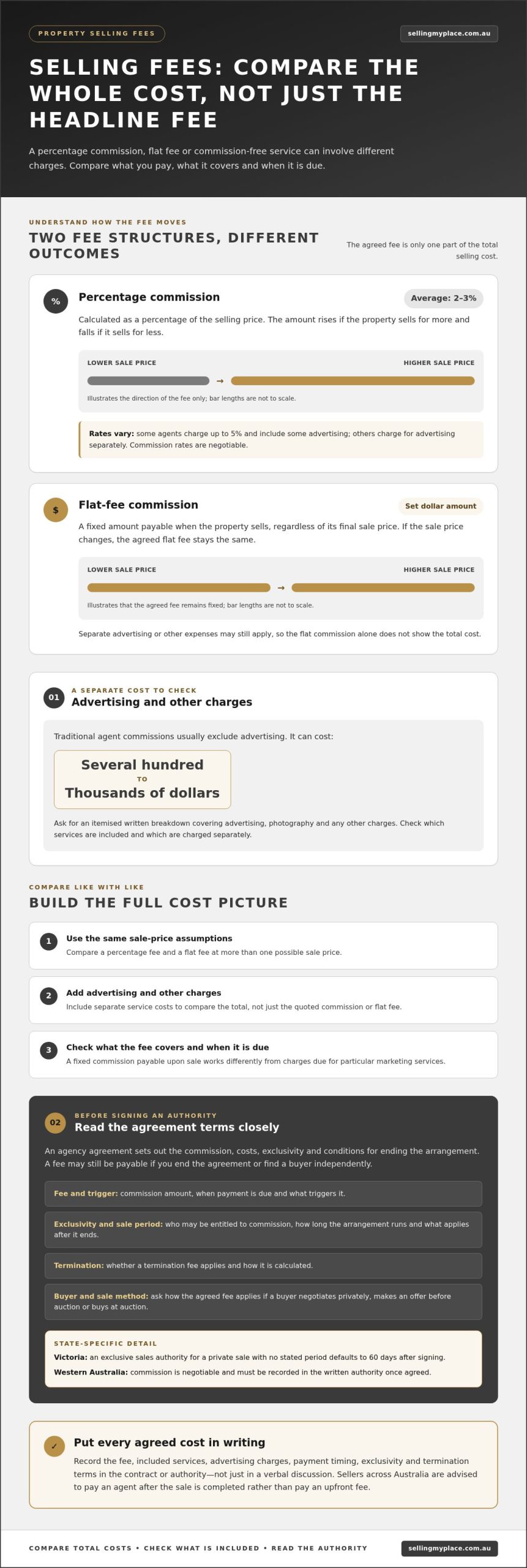
Traditional Australian agent commissions usually exclude advertising, which can cost from several hundred to thousands of dollars. Some agents charge up to five per cent and include some advertising; others charge for it separately. Ask for a written, itemised breakdown covering advertising, photography and other charges, then compare like with like.
Agency agreement terms
An agency agreement, also called an authority, sets out the commission, costs, exclusivity and conditions for ending the arrangement. Read these terms carefully: a fee may still be payable if you end the agreement or find a buyer independently.
Before signing, identify any termination fee, how it is calculated, the exclusive period and what happens when that period ends. In Victoria, an exclusive sales authority for a private sale with no stated period defaults to 60 days after signing. Get any agreed changes recorded in the contract or authority, not just discussed verbally.
Buyer negotiation and auctions
An agent may negotiate with buyers or conduct an auction, and those services can form part of the commission discussion. Ask how the agreed fee applies if a buyer negotiates privately, makes an offer before auction or buys at auction.
Treat examples as prompts for negotiation, not set rates.
Negotiating before you sign
Compare the proposed commission, advertising charges and payment timing before agreeing. In Western Australia, commission is negotiable and must be recorded in the written authority once agreed. Sellers across Australia are advised to pay an agent after the sale is completed, rather than pay an upfront fee.
Ask whether the fee changes if the sale method or marketing plan changes. A written breakdown makes it easier to compare commission with a flat-fee arrangement and identify which costs are payable at settlement.
Flat-fee commission structures
A flat-fee real estate commission is a set dollar amount payable when a property sells, regardless of its final sale price. It gives you a fixed figure to compare with a percentage-based charge. Separate expenses may still apply, so the commission alone doesn’t show the total cost.
If a property sells for more than the owner expected, a percentage commission rises with the sale price, while an agreed flat-fee commission stays the same. If the property sells for less, the flat fee doesn’t automatically fall. The fee structure determines how the cost changes with the final result.
To estimate likely proceeds, compare the flat fee with the percentage commission at more than one possible sale price, then add any advertising or other charges. Use the same sale-price assumptions for each option. This shows how the fees behave across different outcomes, rather than relying on one appealing figure.
Check what the flat fee covers before accepting the agreement. The authority should identify included services, separately charged advertising, when payment is due and what triggers it. A fixed commission payable upon sale, for instance, works differently from charges due for particular marketing services.
Check whether the fee applies under an exclusive arrangement. An exclusive authority can affect who is entitled to commission if you or another agent finds the buyer. The wording matters, including the agreement’s duration and any conditions that apply after it ends. A flat amount doesn’t remove the need to understand these terms.
“Flat fee” and “commission-free” aren’t always interchangeable. A flat-fee model has a set commission amount payable upon sale; a commission-free arrangement may charge for selling services in another way. The practical questions are what costs apply, what work they cover and when each charge is due.
Compare advertising as a separate item. Australian agent commissions usually don’t include advertising, which can cost from several hundred to thousands of dollars. A flat-fee agreement may also charge separately for advertising. Compare the total cost and included work instead of assuming one quoted fee covers every part of the sale.
Before signing, write down the fee, payment trigger, included services, advertising charges, exclusivity and termination terms. Then compare those terms with the sale approach you want. If you believe a flat-fee structure suits your plans, explore flat-fee property listing support as one way to consider the arrangement.
Selling property privately
You can sell without appointing an estate agent, but you take on more of the sale’s organisation. Australian state and territory rules still shape the legal work and any agency agreement already in place.
Checking licences and reputation
Checking a representative’s licence and conduct helps clarify who is responsible for the services offered. In Western Australia, an agent must hold a real estate agent licence or work as a registered sales representative employed and authorised by a licensed estate agent.
Review licensing information from the relevant state or territory consumer protection agency, then consider recent, independent feedback about the business and its conduct. Real estate laws are state and territory-based, so requirements differ. If you believe an agent has acted improperly or breached licensing obligations, you can complain to your local consumer protection agency.
There isn’t one Australia-wide licensing rule for every type of commission-free selling service. Legal requirements can vary by state and territory, so distinguish a property marketing service from an agent representing you in a sale.
Risks of commission-free services
A lower or absent percentage commission doesn’t automatically mean the same level of hands-on sales support. Depending on the service and agreement, you may need to take a more active role in handling buyer enquiries, inspections, offers or auction arrangements.
Your role can affect how quickly buyers receive information and how negotiations progress. If you manage an offer yourself, for example, understand its conditions, proposed settlement and any competing interest before responding. The agreement should make clear which tasks the service handles and which remain yours.
Existing agency paperwork matters too. In Western Australia, an agent may be entitled to a selling fee if your property sells privately or through another agent during the exclusive rights period. Read any current agreement before changing your selling method, especially the exclusivity and fee provisions.
Private selling still requires attention to the sale documents. In Victoria, a seller without an agent needs a conveyancer or legal practitioner to prepare the Section 32 statement and contract of sale. Those legal tasks are separate from marketing and buyer negotiations, so include them when considering the work involved.
An auction is another decision to weigh: under the chosen arrangement, the seller must organise the sale process and handle buyer interest. If you want to manage every step personally, private selling may suit you. If you prefer comprehensive marketing or hands-on sale support, examining how established agencies such as Steve Kooner & Associates present and manage listings provides a clear benchmark for what full-service representation delivers.
When commission may be payable
A commission-free arrangement doesn’t cancel an existing agency agreement or determine who earns a fee if an agent contributed to the sale. In Australia, the written authority and events leading to the transaction matter.
When commission becomes payable
Commission may be payable when an agent’s work is the effective cause of a completed sale, even if payment is disputed or the agency period has ended. The agreement and sale history help establish whether that connection exists.
An open listing or general authority lets a seller appoint multiple agencies, with commission payable to the agent who sells the property. Under an exclusive agency, the appointed agent may be paid even if the seller or another agent completes the sale. The authority’s terms determine how exclusivity works.
An agent claiming commission generally must show a causal connection between their efforts and the completed transaction, not merely that they introduced the buyer. Relevant events include the introduction, negotiations, offers and acceptance. A buyer’s first viewing alone, for example, may not establish that the agent caused a later sale.
Read the authority alongside the contract of sale, especially any clause defining what counts as a sale. Some authorities may define it to include a purchaser making an offer, even if the seller doesn’t accept it. In Victoria, an exclusive auction authority without a stated period defaults to 30 days after the auction date.
Take care when changing agents. A buyer introduced by one agent may later negotiate through another, potentially creating a dispute over which agent caused the sale. Keep records of viewings, offers and communications, and ensure the sale contract accurately identifies the agent involved.
Laws and disclosure rules
Australian real estate laws are administered by state and territory agencies, so the rules depend on where the property is located. Commission arrangements, licensing obligations and sale disclosures can differ between jurisdictions.
In Western Australia, a real estate agent must have a written contract with the seller to sell the property, and agreed commission must be recorded in the written authority. Changes to a signed authority must be made in writing, included on every copy and initialled by both seller and agent.
Agents must provide truthful, complete information relevant to a property, including its features, location, zoning, history, land use and price. The Australian Consumer Law applies to agents in Western Australia. A commission-free label doesn’t remove these disclosure duties when an agent is involved.
Before signing, compare the authority with any proposed contract of sale. Check the fee trigger, exclusivity, sale period and responsibilities for property information. If an agent’s conduct seems unfair or misleading, raise the concern with the agency first. Local consumer protection agencies handle complaints about improper conduct or licensing obligations.
How do commission-free property selling services make money?
“Commission-free” describes the commission structure, not necessarily a service with no charges. One model is a flat fee: a set dollar amount payable when the property sells, regardless of its final sale price. A service may also charge separately for advertising or other agreed work. The agreement explains which charges apply and when they’re due.
For example, a seller might agree to a fixed fee for listing support and pay advertising costs separately. Unlike a percentage commission, that fee doesn’t rise with the sale price. The seller’s total outlay still depends on the agreement and any additional services selected. Consider separate charges alongside the headline commission structure.
Advertising is a separate cost to examine. Australian real estate commissions usually don’t include advertising, which can cost from several hundred to thousands of dollars. A commission-free arrangement may also involve a marketing expense. Check what the advertising charge covers, how it is billed and whether it is payable if the property doesn’t sell.
Payment timing matters too. A flat fee may be payable upon sale, while an agreement may set separate payment terms for advertising or other work. Read the sections that describe each charge, the service it relates to and the event that triggers payment. Distinguish a fee due on completion from a marketing expense payable under different terms.
To understand how a service earns revenue, compare the agreement’s full list of charges with the work provided. Identify the listing service, marketing components, optional work and fee attached to each. Then compare that total with a percentage-based commission and separate advertising expenses. This makes the model clear without assuming that “zero commission” means zero cost.
Clear terms also help you judge whether the arrangement suits your sale. A service that charges a flat fee may offer a different balance of support and seller involvement than a traditional agency—for instance, full-service brokerages like Pinnacle Realty manage client consultations, active marketing and end-to-end negotiations on the seller’s behalf. Consider which tasks you expect the service to handle, and match them against the written inclusions. Ask about the relevant fee structure through commission-free property selling support.
Kincade International Direct Sales: Residential Property Listing Services
Kincade International Direct Sales offers residential property listing services for Australian owners considering a commission-free sale. Its model combines a flat-fee structure with professional photography, floorplans and neighbourhood market reports, helping sellers present their property and share it with buyers.
Listings remain active until sold, with no time limits or agency commission. This approach may suit owners who want marketing support while avoiding a percentage-based commission. Kincade International Direct Sales also provides pre-sale property consulting and buyer representation, which can help address other parts of a property decision.
If you’re weighing these options for your sale, contact Kincade International Direct Sales to discuss your property and visit sellingmyplace.com.au.
Make your next move with clarity
To decide whether commission-free property selling is legitimate, check that the written terms match the way you want to sell. Start with your priorities: how involved you want to be, which support matters most and which responsibilities you’re comfortable managing.
Consider what a good selling experience would look like for your household. You might value control over the process, help preparing the property or guidance with decisions. Let those preferences shape your choice instead of relying on the label alone.
Kincade International Direct Sales can help you explore the options that fit your property plans. Start a conversation about your property sale and consider a path forward that feels informed, practical and right for your next chapter.
Frequently Asked Questions
Do I have to use an agent to sell my property?
No. Australian homeowners can sell privately without appointing a real estate agent. You’ll take responsibility for presenting the property, responding to buyers, considering offers and coordinating the sale. The legal paperwork still needs attention: in Victoria, a private seller needs a conveyancer or legal practitioner to prepare the Section 32 statement and contract of sale. Decide how much of the process you want to manage yourself before choosing your selling approach.
How much do real estate agents charge?
There’s no single fixed commission rate across Australia, and sellers can negotiate the amount. Some agents charge up to five per cent, with some advertising included. Check how the rate is calculated, whether advertising is included and when payment is due.
What is an agent’s commission?
An agent’s commission is the agreed payment for helping sell a property, commonly calculated as a percentage of its final sale price. For example, an agreement might set a percentage rate or use tiers that change above a specified sale amount. The authority explains the commission terms and payment trigger. Don’t confuse commission with marketing expenses, which may be charged separately.
Are commission-free real estate agents legitimate and licensed in Australia?
Yes, commission-free property selling is legitimate in Australia, but a commission-free service isn’t necessarily a real estate agency. Kincade International Direct Sales acts as a licensed intermediary for property listings, not as a real estate agent. Private property owners can sell in every Australian state and territory. Licensing obligations depend on the work performed and local rules, so distinguish listing support from an agent representing you in a sale.
What steps are involved in selling a property commission-free in Australia?
Start by choosing your selling approach, then arrange the listing and legal documents in the right order for your state.
- Decide what marketing and buyer support you want.
- Arrange listing access and prepare accurate property details.
- Engage a qualified conveyancer or solicitor for legal matters.
- Prepare the required documents: NSW and ACT require a contract of sale before listing; in Victoria, provide a Section 32 Vendor Statement before contracts are signed.
- Manage buyer enquiries, offers and settlement arrangements.
Flat Fee Listings Compared on Cost, Services, and Savings
What you get with a flat fee listing depends on the package: it may cover the property listing and marketing materials, while support with pricing, buyer enquiries, inspections and negotiations can vary. A fixed fee is different from a percentage-based commission, but the fee structure alone doesn’t determine what a home sells for. The final sale price depends on the property, its presentation, buyer interest and the negotiations.
It’s understandable to wonder whether choosing a lower-cost listing means giving up essential support, or whether a traditional commission brings enough extra help to justify the difference. The important comparison is what’s included, what tasks stay with you and how each fee is calculated. This guide explains the services flat fee packages can include, how their trade-offs compare with traditional commission, and what to weigh when deciding which approach fits your sale. With the details laid out clearly, you can focus on the right balance of support, control and value for your next move.
Key Takeaways
- Compare the flat fee with percentage-based commission against the expected sale price to see how each fee structure affects your costs.
- Look beyond online exposure: photography, floorplans, signboards and other marketing can affect the overall value of a package.
- Know which tasks you’ll handle yourself, especially pricing, buyer enquiries, inspections and negotiations.
- Review the listing term and what support is included so you can judge whether the package suits your preferred level of involvement.
- Consider professional listing support and market guidance if you want to manage costs while presenting your property with care.
What Is Flat Fee Real Estate, Exactly?
A flat-fee listing charges an agreed fixed amount for specified property marketing or listing services, rather than calculating the listing fee as a percentage of the sale price. What do you get with a flat fee listing depends on the agreement: the fee structure alone doesn’t tell you which tasks or support are included.
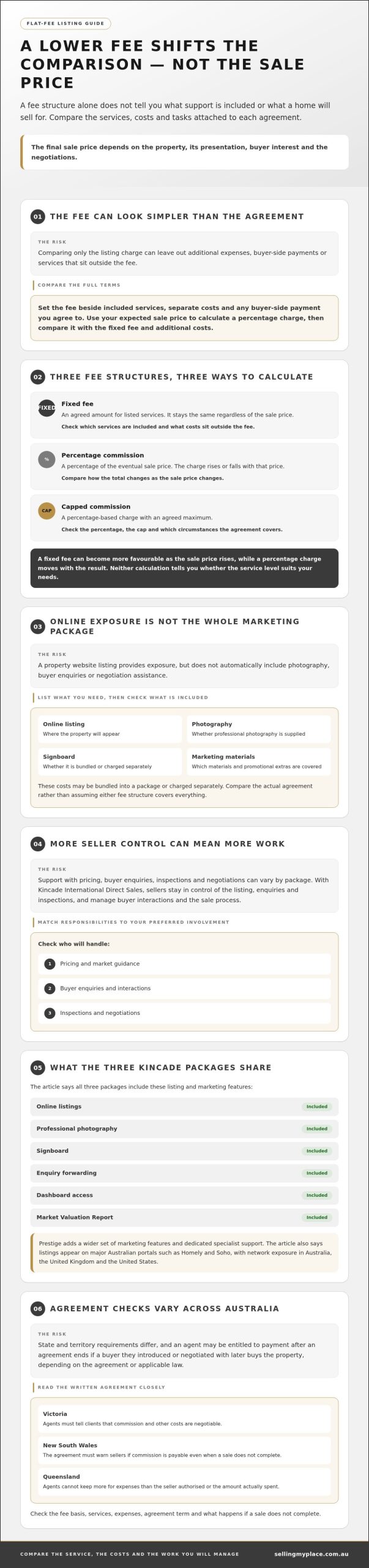
With a percentage commission, the charge rises or falls with the eventual sale price. A fixed fee stays the same regardless of the sale price, while a capped commission is percentage-based but has an agreed maximum. Compare the full terms, including any separate expenses and any buyer-side payment you agree to, rather than focusing on one figure.
| Option | How the charge is calculated | What to consider |
|---|---|---|
| Fixed fee | Agreed amount for listed services | Which services are included and what costs sit outside the fee |
| Percentage commission | Percentage of the eventual sale price | How the total changes as the sale price changes |
| Capped commission | Percentage, up to an agreed maximum | The percentage, cap and circumstances covered by the agreement |
For a simple comparison, calculate the percentage charge using your expected sale price, then set it beside the fixed fee and any additional costs. A fixed fee can become more favourable as the sale price rises, while a percentage charge moves with the result. Neither calculation tells you whether the service level suits your needs.
Australian requirements differ across states and territories, and the written agency agreement matters. Victoria requires agents to tell clients that commission and other costs are negotiable; in NSW, the agreement must warn sellers if commission is payable even when a sale doesn’t complete; Queensland agents can’t keep more for expenses than the seller authorised or the amount actually spent.
In any state or territory, read the agreement for the fee basis, services, expenses, term and what happens if a sale doesn’t complete. A real estate agent may also be entitled to payment after an agreement ends if a buyer they introduced or negotiated with later buys the property, depending on the agreement or applicable law.
To choose a package, compare its listing, marketing and support features with the work you want to manage. Kincade International Direct Sales offers three fixed-fee options, with features bundled into each package. Review the inclusions and listing terms, then select the package that matches your priorities.
Is a fixed fee cheaper than commission?
A flat-fee listing can be a cost-effective option, but compare the full package rather than the listing charge alone. Consider online exposure, photography, signboards, marketing materials and the work you’ll handle yourself.
Online listing and marketing costs
An online listing puts property details and images in front of buyers through property websites. A signboard adds visibility to people passing the home, while photography and other marketing materials shape how the listing appears. These costs may be bundled into a package or charged separately, so identify each item before comparing it with commission.
For a useful comparison, list the marketing materials you need, then note which are included and which you would organise yourself. A package with a fixed listing charge may still leave photography, signboards or promotional extras outside its scope. A commission-based service may handle different tasks, so compare the actual agreement rather than assuming either option covers everything.
Typical flat-fee MLS costs
MLS, or multiple listing service, is a US listing model, not the standard name for Australian property portals. While traditional agents in North America such as Christopher Seim actively manage client listings through full representation, flat-fee MLS services generally only place the property online. Kincade International Direct Sales lists properties on major Australian portals such as Homely and Soho. Its network also provides global exposure in Australia, the United Kingdom and the United States.
For Australian sellers, focus on where the listing will appear, what marketing is supplied and whether the fee covers support beyond publication. A listing sent to property websites provides exposure, but it doesn’t automatically include photography, buyer enquiries or negotiation assistance. The listing agreement defines the service, not the label attached to the package.
Flat-fee plan costs
Flat-fee packages vary in scope, so compare the specific features rather than assuming every service is the same. Kincade International Direct Sales offers three packages, each with online listings, professional photography, a signboard, enquiry forwarding, dashboard access and a Market Valuation Report. Prestige adds a wider set of marketing features and dedicated specialist support.
Also consider who handles the sale tasks. With Kincade International Direct Sales, you stay in control of your listing, enquiries and inspections. The service provides marketing and listing infrastructure, while you manage buyer interactions and the sale process. Consider how much time and involvement you’re comfortable taking on.
To compare fairly, write down the fee, included marketing, extra expenses and responsibilities for each option. Then consider how the service fits your sale, not only how it is priced. If you value structured listing support, explore a residential property listing service that includes professional marketing materials.
What are the pros and cons of flat fee MLS listings?
A flat-fee arrangement can reduce the listing-side charge, but the seller often takes on more work. In Australia, compare that practical responsibility with the support offered for marketing, buyer enquiries and negotiations.
Seller responsibilities and control
With an entry-only flat-fee MLS listing, the seller manages photography, pricing, buyer enquiries, showings and negotiations. That control lets you choose when inspections happen and how you respond to offers, but it also means coordinating each step yourself. For an Australian sale, distinguish the US term “MLS” from local property portals when reviewing the listing service.
Start by reviewing the Market Valuation Report and preparing the property for photography and inspections. When an offer arrives, consider its price, conditions and settlement timing before responding. Kincade International Direct Sales provides listing and marketing services; you remain in control of buyer interactions and decisions.
Potential seller savings
The potential saving comes from paying a fixed listing charge instead of a listing-side percentage that rises with the sale price. Compare both against the same expected sale price, then add marketing expenses and any buyer-side payment you agree to. A lower listing charge doesn’t itself establish the home’s sale price or the quality of its marketing.
Consider the value of your time as well as the fee. If you handle photos, enquiries and negotiations yourself, those responsibilities become part of the trade-off. A seller who wants guidance with presentation may prefer a package that includes professional photography, while a confident DIY seller may value greater control.
Technology can make seller tasks easier to organise, but it doesn’t remove them. A listing platform may support online changes or pass enquiries to the seller; the agreement determines the actual service. Before signing, identify who uploads photos, corrects property details and responds when buyers or their representatives make contact.
Presentation is one practical test. Prepare a room-by-room photo list, tidy visible surfaces and check that each image represents the property accurately. If you arrange photography yourself, you control the timing and selection. If professional photos are included, confirm how images are supplied for the online listing and other marketing materials.
Pricing requires active judgement. Use the Market Valuation Report included in every Kincade International Direct Sales package as one input when considering your price, alongside the property’s condition and buyer feedback. Asking prices are not the same as completed-sale evidence, and no listing service can guarantee a particular sale price.
Finally, keep the transaction organised. Record enquiries, confirm inspection arrangements, compare offer conditions and keep contract documents together. Flat-fee sellers generally deal directly with inquiring agents through contract and closing. Choose this route if you’re comfortable managing those tasks; choose more support if you want help through the sale process.
Basic listing price and duration
A flat-fee listing combines a fixed charge with a defined service period. In Australia, compare the written scope and listing term before weighing the fee against a percentage commission. The cost depends on the services selected, marketing materials, support level and payment timing; the price depends on the case and is given after a quote request.
In Australia, a property owner can sell privately in every state and territory. Kincade International Direct Sales acts as a licensed intermediary to list on Realestate.com.au and Domain, which do not allow individuals to list directly. Its flat-fee packages include listing and marketing features without agency commission.
Duration matters too. A limited listing agreement usually sets a listing term of 6 to 12 months. That is the period the agreement covers, not a promise that the property will sell within that time. Read the end date and any renewal or cancellation terms alongside the services and payment conditions.
To compare two offers, use the same expected sale price and service requirements. A percentage commission changes with the eventual sale price; a fixed fee remains the agreed amount. Then add any separate expenses shown in the agreement. This step-by-step comparison helps reveal whether a lower starting charge also means fewer included services.
- Listing scope: note whether the fee covers online publication, photos, floorplans and market information.
- Payment timing: identify what is payable upfront and what becomes payable when the sale proceeds.
- Term: record the start date, end date and process for ending or renewing the agreement.
- Extra costs: distinguish agreed expenses from the fixed listing charge.
Payment arrangements can differ. In October 2026, two of four published Australian agencies charged part of the fixed fee upfront and the remainder when the sale went through. That example shows why timing belongs in the cost comparison, alongside the total agreed fee and conditions for payment.
A listing term also affects your options if plans change. Check how the agreement treats expiry, cancellation and a buyer introduced during the term who purchases afterwards. An agent may be entitled to payment after an agreement ends in that situation, depending on the agreement or applicable law.
Before signing, write down the total fee, inclusions, separate expenses and dates. Compare those details with the level of real estate support you want, then make sure the agreement reflects the negotiation accurately. Clear terms make it easier to plan the sale and understand what the listing service covers.
Fixed-fee packages and what they include
A fixed-fee package groups agreed listing and marketing tasks for one set charge. Compare the written inclusions, optional extras and seller responsibilities before deciding whether it suits your sale.
Extra fees or upgrades can apply for services outside the agreed package, such as additional marketing or support. The price depends on the case and is given after a quote request; cost factors include the services selected and marketing required.
Photography, floorplans and online advertising may be included, but packages differ. Check each item in the agreement rather than assuming all three come with every flat fee.
Services included in fixed-fee packages
A package may cover the online listing, photos, floorplans, downloadable documents or customer support. Some plans also provide listing changes, direct buyer contact or agent support. Those items describe different levels of involvement: publication gives a property visibility, while practical assistance can reduce the tasks a seller handles themselves.
For example, a seller who has photos and floorplans ready may mainly need an online listing. Someone preparing to sell your home may value help with marketing materials or buyer enquiries. A realtor’s package description is less useful than the agreement’s specific list of services and responsibilities.
Optional upgrades and extra fees
Optional upgrades add services beyond the base package, while extra fees can apply to tasks excluded from its scope. Examples include additional promotion, photography or support with buyer enquiries. Their value depends on what the seller needs and which tasks the package already covers.
Compare each upgrade with the work it replaces. If you organise photos yourself, for instance, a photography add-on may not suit your plan. If marketing support matters, compare the total package scope rather than choosing solely by its headline fee.
Use a simple checklist to compare packages: online listing, photos, floorplans, listing changes, documents, buyer contact and agent support. Mark each item as included, optional or handled by you. This reveals whether a lower-cost basic package leaves important work in your hands.
Look at the specific features rather than relying on broad labels such as “full service”. Kincade International Direct Sales provides listing and marketing services, with you retaining control of the listing, enquiries and inspections. Its package descriptions set out what’s included.
Ask yourself which tasks you’re comfortable handling. A seller confident organising photography and responding to buyers may prefer more control; someone who wants help with marketing may favour a broader package. The right balance depends on your time, experience and priorities.
For a package comparison shaped around your sale, discuss your property listing needs and the marketing support that matters to you.
Kincade International Direct Sales: Residential Property Listing Services
Kincade International Direct Sales provides residential property listings with a commission-free flat-fee model for Australian owners who want marketing support without agency commission. Its service includes professional photography, floorplans and neighbourhood market reports, supported by a global marketing network and digital infrastructure. Properties remain listed until sold, with no time limits.
Your choice depends on the marketing and guidance you want. Kincade International Direct Sales offers Pre-Sale Property Consulting and Real Estate Advisory Services to help you prepare and make informed decisions, as well as Buyer Representation for people seeking guidance through a purchase. For buyers or investors exploring opportunities in overseas property markets, specialist agencies like upscalerealestate.ae provide guidance on purchasing ready and off-plan homes.
To compare the packages and choose the right level of marketing support, explore the options or get started through Kincade International Direct Sales.
Take the next step with confidence
Understanding what you get with a flat fee listing is an important part of choosing how to sell. Next, decide how involved you want to be, what marketing matters to you and how much guidance you’d like. Those priorities can help you select the package that fits your plans.
Kincade International Direct Sales offers Residential Property Listing Services for owners preparing to sell, Pre-Sale Property Consulting to help plan ahead, and Buyer Representation for people looking to purchase. Whether you’re weighing your options or ready to map out a sale, a conversation can help clarify which direction suits your circumstances.
Contact Kincade International Direct Sales to discuss your property plans and the support you’re looking for. A considered next step can make a major transition feel more organised and more your own.
Frequently Asked Questions
Do Flat Fee Listings Sell for Less Than Traditional Listings?
Not necessarily. The fee model alone doesn’t set the sale price. Buyer demand, property condition, presentation, pricing and negotiation all affect the result. Compare the marketing and support you’ll receive, and consider how confidently you can manage enquiries and offers yourself. Kincade International Direct Sales does not guarantee a sale or a specific sale price.
Can I negotiate a fixed fee?
Yes, fixed fees are negotiable in Australia. Victoria requires agents to tell clients that commission and other costs are negotiable. When discussing terms, focus on the services included, extra expenses, payment timing and agreement length. You can compare the proposed scope with the support you actually need, then negotiate the fee and terms together. Make sure any agreed changes appear in the written agreement before signing.
Does a flat fee MLS listing hurt your sale?
A flat fee doesn’t automatically harm a sale, but the service scope can affect how much work falls to you. MLS is a US listing term; Australian owners generally use property portals. Consider whether your arrangement covers the listing itself or also helps with presentation, buyer enquiries and offers. A seller who manages those tasks carefully may prefer the control, while someone wanting more assistance may value broader support.
How does a fixed fee work?
A fixed-fee arrangement sets an agreed charge for specified services, rather than calculating the listing fee as a percentage of the eventual sale price. The written agreement should describe the service, payment timing, duration and any separately authorised expenses. Before signing, match each included task to your sale plan. For example, note who will prepare listing details, respond to buyer enquiries and coordinate inspections.
How much do fixed-fee agents charge?
There isn’t one standard charge for every fixed-fee property service in Australia. The amount depends on the package scope, marketing materials, level of support and payment terms. Some services focus on publishing a listing; others include more marketing or assistance. Compare the total agreed charge and included work rather than relying on the label “fixed fee”. Put any negotiated changes in the written agreement.
Is a flat fee better than a commission?
Neither structure suits every seller. A flat fee can make the listing charge predictable, while percentage commission changes with the sale price. Your comparison should also account for included services and the tasks you’ll manage personally. For instance, sellers comfortable organising inspections and handling negotiations may prioritise cost control; those wanting more guidance may place greater value on support. Choose based on your preferred involvement and sale priorities.
What services are included in a flat-fee property listing in Australia?
In Australia, inclusions vary by package. Kincade International Direct Sales listings include online property portal placement, buyer-enquiry forwarding by SMS and email, dashboard access and a market valuation report. Signboard size and other marketing features vary between its packages. To assess what you get with a flat-fee listing, compare the written inclusions with the tasks you want handled, such as photography, floorplans or promotion.
How much does a flat-fee real estate listing cost in Australia?
The price depends on the case and is given after a quote request. Cost factors include the package scope, marketing materials and level of support. Compare the full written inclusions and payment terms, rather than judging the offer by its fee structure alone. Also distinguish the listing charge from other amounts you may agree to pay as part of selling, so you can plan your overall costs clearly.
The Real Cost of Selling a House in Australia: 2026 Seller’s Guide
What if the single largest expense in your property sale this year isn’t the glossy brochures or the legal fees, but a silent “tax” on your hard-earned equity? As we look at the cost of selling a house 2026, many Australian homeowners are realising that traditional percentage-based commissions often leave their bank accounts unnecessarily light. It’s completely natural to feel a sense of unease about where your profit goes once the “Sold” sticker is up. You’ve worked for years to build your home’s value, and seeing a significant portion of that legacy disappear can feel like a step backwards.
We believe you deserve a partnership that honours your hard work and protects your future. This guide provides a complete breakdown of the current selling landscape, offering the clarity you need to budget with total confidence. We’ll show you how to protect your equity from outdated structures while still achieving a premium, professional result that stands out. From understanding the latest ATO clearance certificate rules to identifying which marketing costs actually drive buyer interest, we’re here to provide the steady hand and expert insight you need to potentially save tens of thousands at settlement.
Key Takeaways
- Learn how to accurately forecast the total cost of selling a house 2026 by identifying the three pillars of expense: marketing, legal protection, and transactional friction.
- Discover which “unavoidable” costs, such as professional photography and conveyancing, are essential for protecting your legal interests and attracting premium buyers.
- Uncover the “Equity Tax” hidden within traditional commission structures and see how a flat-fee model allows you to keep 100% of your property’s hard-earned profit.
- Gain practical, zero-cost strategies for pre-sale presentation that maximise your return on investment and create an immediate emotional connection with visitors.
- Understand how to leverage a global marketing network and expert advisory support to sell your home with professional confidence and total control.
Navigating the Real Cost of Selling Your Property in 2026
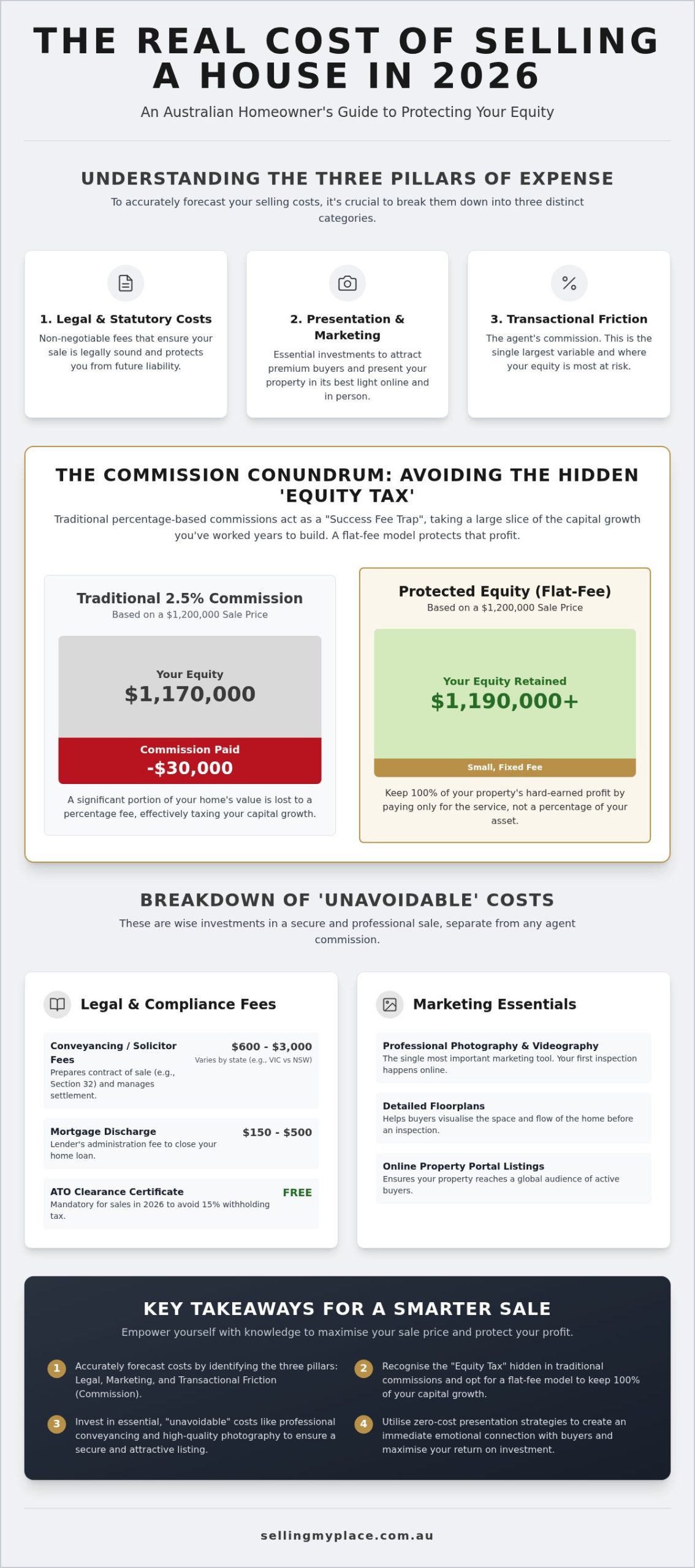
Selling your family home is a deeply personal journey, often representing the culmination of years of hard work and memories. Understanding the actual cost of selling a house 2026 requires looking far beyond the obvious marketing invoices or legal bills. We view the total cost as a combination of three distinct pillars: Statutory requirements, Presentation, and “transactional friction,” which is the commission paid to an agency. While some costs are fixed, others are highly negotiable, and it’s here that your equity is most at risk.
Many Australian families are currently focused on protecting their financial legacy. Given the historical discussions around the Australian property bubble, preserving every dollar of capital growth is vital. A significant gap in traditional advice is the failure to mention the “Success Fee Trap.” This is where an agent takes a percentage of the entire sale price, effectively taxing the capital growth you earned by simply holding the asset for years. Transitioning to a commission-free model isn’t just about saving money; it’s about reclaiming the profit that belongs to your family.
The Shift in the Australian Real Estate Landscape
The days when a local agency held the keys to the market are long gone. Digital platforms have dismantled the old gatekeeper model, allowing your property to reach the same global audience regardless of the logo on the “For Sale” sign. Savvy vendors now prioritise their own bottom line over an agency’s branding. You can now access professional photography, floorplans, and elite digital listings without the heavy burden of a percentage-based fee. This modern approach proves that “full service” can be sophisticated, supportive, and incredibly cost-effective.
Statutory and Compliance Costs You Can’t Skip
While you can avoid commissions, certain professional fees are essential safety nets. These statutory costs ensure your sale is legally sound and protects you from future liability. You’ll need to budget for several key items:
- Conveyancing: Professional Conveyance Advice is non-negotiable for preparing your Section 32 or Contract of Sale.
- Mortgage Discharge: Most lenders charge between $150 and $500 to close out your loan at settlement.
- Compliance Certificates: This includes the free ATO clearance certificate, which is mandatory for sales in 2026 to avoid a 15% withholding tax.
- Settlement Adjustments: Pro-rata payments for council rates and land tax are settled on the final day.
By identifying these pillars early, you can build a clear, honest budget. This transparency reduces the anxiety of hidden fees at settlement, letting you focus on the excitement of your next chapter. We believe that with the right guidance, you can navigate these complexities with a steady hand and a clear heart.
Breaking Down the ‘Unavoidable’ Costs: From Conveyancing to Marketing
While we’ve discussed the impact of commissions, certain outgoings are vital for a secure and successful transaction. These expenses ensure your property is legally protected and visually captivating. When calculating the cost of selling a house 2026, you’ll need to account for professional services that facilitate the transfer of title and attract the right calibre of buyer. It’s about finding the balance between spending wisely and ensuring no detail is overlooked during this significant life transition.
The Legal Side: Conveyancers vs. Solicitors
Securing professional Conveyance Advice is your most important safety net. In 2026, fees vary by state; for instance, NSW metro areas typically range from $1,000 to $3,000, while Victorian sellers might expect between $600 and $1,400. While conveyancers are specialists in property transfers, solicitors offer broader legal support if your contract involves complex trust structures. Preparing your paperwork early prevents stressful delays at settlement and ensures your disclosure documents, like the Section 32, are watertight. Local knowledge is particularly valuable here, as it helps navigate specific council requirements or heritage overlays that might affect your contract.
Marketing That Actually Moves the Needle
In a digital-first market, your first inspection happens on a smartphone screen. A standard marketing campaign in 2026 usually sits between $2,000 and $10,000. Investing in professional photography and accurate floorplans isn’t just about looking good; it’s about providing the data buyers crave. High-quality visuals increase click-through rates, while floorplans help buyers mentally move their furniture into your space. While premium major city campaigns can reach $20,000, focusing your budget on online listing ‘premiums’ often yields the strongest return on investment. Traditional signboards still have a place for local foot traffic, but your digital presence is where the real competition lives.
Don’t forget the ‘hidden’ costs that create that vital first impression. We often see that a weekend spent on high-pressure cleaning the driveway, fresh mulch in the garden, and fixing those small ‘to-do’ list items can add thousands to your final result. Additionally, your bank will likely charge a mortgage discharge fee to close out your loan. As of May 2025, these fees averaged around $329, though they can reach up to $795 at some institutions. These small details might seem minor, but tracking them early ensures a smooth, surprise-free settlement. If you’re looking for a steady hand to help coordinate these elements, starting a conversation with an expert can provide the reassurance you need.
The Commission Conundrum: Comparing Traditional vs. Flat-Fee Models
When you sit down to calculate the cost of selling a house 2026, the elephant in the room is almost always the percentage-based commission. While many traditional agencies frame this as an “unavoidable” expense, it’s actually the most significant variable in your budget. In Australia, commission rates typically range from 1.8% to 3.0%, with a national median sitting around 2.65%. On a property worth $1,000,000, that’s a staggering $26,500 plus GST, often before you’ve even paid for a single Facebook ad or signboard.
We often refer to this as the “Equity Tax.” It’s a confronting term, but it accurately describes how commission eats into your actual profit rather than just the sale price. If you bought your home for $800,000 and sell it for $1,000,000, your gross profit is $200,000. A $25,000 commission doesn’t just represent 2.5% of the sale; it represents 12.5% of the wealth you’ve built through years of mortgage payments and market growth. Reclaiming this portion of your legacy is why flat-fee models are rapidly gaining traction across every state and territory.
The Math of Selling: A Side-by-Side Comparison
To truly visualise the savings gap, let’s look at two common scenarios for a typical Australian family home. In Scenario A, a traditional agent charges a 2.5% commission plus a separate marketing budget. By settlement, the vendor may see over $30,000 deducted from their final cheque. In Scenario B, using the Kincade International Direct Sales model, that same vendor pays a transparent flat fee for professional marketing and advisory services. The difference is often an average saving of $20,000. Think about what that extra capital could do for your next deposit, a well-deserved holiday, or even a celebratory night of live music and cocktails at kissmybrass.au once the sale is finalised.
There is a persistent myth that a high-commission agent is the only way to secure a record-breaking price. However, buyers don’t pay more because an agent’s fee is higher; they pay more because the property is presented beautifully, marketed to the right audience, and negotiated with skill. Professionalism isn’t tied to a percentage of your asset’s value.
The ‘Success Fee’ vs. Professional Advisory
There’s a profound difference between paying a “success fee” and investing in professional expertise. You shouldn’t have to sacrifice a chunk of your home’s value just to access high-level support. By choosing an advisory-based model, you receive a steady hand to guide you through the complexities of the market without the high price tag. This includes access to expert property sale negotiation tips that empower you to handle offers with confidence. You maintain total control over your sale timeline and decisions, ensuring the process remains a celebratory transition rather than a high-pressure transaction.
Maximising ROI: Smart Spending on Pre-Sale Presentation
When you’re fine-tuning the cost of selling a house 2026, it’s tempting to think that every dollar spent on presentation will magically return double at settlement. This isn’t always the case. True success lies in identifying the high-impact activities that cost almost nothing but significantly shift a buyer’s emotional needle. We recommend starting with the “Rule of Three”: cleaning, decluttering, and depersonalising. These tasks require more elbow grease than capital, yet they allow potential buyers to visualise their own lives within your walls rather than feeling like a guest in yours.
Strategic spending also protects you from “buyer chipping.” This occurs when a building inspector identifies minor, easily fixable flaws that a buyer then uses as leverage to negotiate thousands off your price. Fixing leaky taps, tightening loose door handles, and ensuring all light globes are working prevents these small friction points from becoming expensive hurdles. By investing a few hundred dollars in maintenance now, you protect the tens of thousands in equity we discussed earlier.
Styling and Staging on a Budget
You don’t always need to hire a full house of furniture to create a premium feel. Often, the most effective styling involves “editing” what you already own. Focus your energy on the “entry zone.” First impressions are formed within the first eight seconds of a buyer stepping through the front door. Use lighting to your advantage by opening every blind and switching on warm lamps to maximise the sense of space. A fresh coat of neutral paint in high-traffic areas or new, plush towels in the bathroom can create a sophisticated lifestyle appeal without the heavy price tag of a full renovation.
Data-Driven Pricing
Pricing your home is an emotional exercise, but it must be grounded in hard data. Relying on gut feel or outdated figures is a risk to your bottom line. We provide Neighborhood Market Reports to help you understand exactly what buyers are paying for similar properties in your specific street. The first 21 days on the market are your most valuable; this is when the “new listing” glow is brightest and buyer urgency is highest.
If you overprice your home based on a guess, you risk the listing becoming “stale,” which often leads to a lower final result than if you had priced accurately from day one. Use recent comparable sales to determine your market value with precision. This transparency gives you the confidence to stand firm during negotiations. If you’re ready to see how our advisory approach can protect your equity and streamline your sale, get in touch with our team today for a personalised pre-sale consultation.
Selling Smarter with Kincade International Direct Sales
By now, you understand that the cost of selling a house 2026 doesn’t have to include a five-figure commission. We’ve built a model that bridges the gap between the high-cost traditional agency and the daunting prospect of going it alone. Kincade International Direct Sales (KIDS) provides the sophisticated digital infrastructure and global marketing network you need to reach buyers across Australia and beyond. It’s about giving you the tools of a top-tier agency while ensuring you remain the primary beneficiary of your property’s capital growth.
Our approach is built on the belief that professional marketing is a service you should own, not a percentage of your wealth you should give away. Every package we offer is designed to present your home in its best light, including high-end photography and accurate floorplans that meet the high standards of 2026 buyers. You aren’t just getting a listing; you’re gaining an entire ecosystem of support that allows you to sell your own home with the confidence of a seasoned professional.
Your Partnership for a Successful Sale
The most vital part of our service is the Expert Agent Advisory Service. Think of this as your “steady hand” throughout the journey. While you handle the inspections and connect with buyers, our advisors are in your corner to guide you through the nuances of negotiation and the technicalities of settlement. We take the stress out of the “what happens next” moments, providing a calm, grounded perspective when high-stakes decisions need to be made.
We also understand that life doesn’t always move to a strict real estate calendar. That’s why our “Listed Until Sold” policy is so important. It removes the ticking clock and the anxiety of expiring contracts, allowing you to wait for the right buyer at the right price. This patience, combined with our advisory support, is how we help you protect your legacy and keep 100% of your sale profit.
Getting Started with a Flat-Fee Package
Onboarding with us is a methodical and inviting process. We offer various marketing tiers, allowing you to choose the level of exposure that best suits your property and your budget. Whether you’re selling a cozy suburban unit or a sprawling family estate, our simple digital process gets your home on the market fast without the usual administrative hurdles. You’ll have total control over your listing, backed by a team that values your family’s needs over a quick transaction. If you’re ready to reclaim your equity and experience a more respectful way to sell, explore our flat-fee listing services today.
Your Path to a Successful and Profitable Sale
Your home is more than just a listing on a screen; it’s the foundation of your family’s future and a testament to your hard work. By understanding the true cost of selling a house 2026, you’ve taken the first step toward protecting that legacy from unnecessary “equity taxes.” We’ve explored how a strategic focus on presentation and professional legal advice provides a secure path forward, while the shift toward flat-fee models ensures you remain in the driver’s seat of your own transaction.
Why settle for traditional structures that eat into your hard-earned profit? With our support, you can access a global marketing network, professional photography, and floorplans without the burden of a percentage-based commission. Our Expert Agent Advisory Service acts as your steady hand, guiding you through every negotiation with calm confidence. Most of our partners save an average of $20,000 in commissions, allowing that capital to go exactly where it belongs: back into your pocket.
Are you ready to move forward with a partner who values your results as much as you do? Keep 100% of your profit; sell with Kincade International Direct Sales today. We look forward to helping you start your next chapter with total peace of mind.
Frequently Asked Questions
What is the average real estate commission in Australia for 2026?
The national median real estate commission rate in 2026 is 2.65% according to recent surveys. This is often the largest single component of the cost of selling a house 2026. Rates typically range from 1.8% to 3.0% of the final sale price. In Melbourne, you’ll usually find rates between 1.6% and 2.5%, while regional Victoria often sits between 2.5% and 3.5%.
Are marketing costs included in an agent’s commission?
Marketing costs are almost never included in a traditional agent’s commission. This is known as “Vendor Paid Advertising” or VPA. Sellers are usually expected to pay these costs upfront to cover online listings, professional photography, and signboards. For a standard 2026 campaign, you should budget between $2,000 and $10,000, though premium campaigns in major cities can reach $20,000.
How much should I budget for conveyancing when selling my house?
Your conveyancing budget will depend on your state’s specific requirements. In New South Wales metro areas, fees typically range from $1,000 to $3,000. Victorian sellers should budget between $600 and $1,400, while Queenslanders usually pay between $500 and $1,300. Remember that disbursements for title searches and certificates will add a few hundred dollars to these professional service fees at the end of the process.
Do I have to pay Capital Gains Tax (CGT) when I sell my home?
You generally don’t pay Capital Gains Tax on your main residence if you’re an Australian resident and the property is your primary home. However, if the property was an investment or used for business purposes, you’ll likely be liable for CGT. To help manage your investment records and tax obligations, you can learn more about PropAlly. As of 2025, you must also obtain a free ATO clearance certificate before settlement to avoid a mandatory 15% withholding tax.
Is it worth paying for professional home styling?
Professional styling often provides a strong return on investment by creating an immediate emotional connection with prospective buyers. While full staging can cost between $2,000 and $8,000, many sellers find success with partial styling. This involves using your existing furniture combined with hired accessories to highlight your home’s best features. It’s a strategic way to help buyers visualise their future lifestyle in your space.
What happens if my property doesn’t sell within the first month?
If your property hasn’t sold within the first month, it’s a good time to review your pricing strategy and presentation with a steady hand. The first 21 days are the most critical for buyer urgency. Unlike traditional agencies with expiring contracts, our model ensures your property stays listed until it’s sold. This gives you the patience and space to find the right buyer without unnecessary pressure.
Can I really sell my house without a traditional real estate agent?
You can absolutely sell your home without a traditional percentage-based agent. Many Australian families are now choosing flat-fee models to protect their hard-earned equity from high commissions. This approach provides the professional marketing and expert advisory support you need while you manage the inspections yourself. It’s a sophisticated way to manage the cost of selling a house 2026 and keep more of your profit.
What are the hidden fees I should look out for at settlement?
The most common hidden costs at settlement include mortgage discharge fees and pro-rata council rate adjustments. Mortgage discharge fees currently average around $329 but can reach $795 depending on your lender. You should also account for conveyancing disbursements. These cover the cost of required certificates and title searches that are often not included in the initial professional quote you receive from your conveyancer.
Real Estate Agent Fees to Sell a House in Australia (2026)
Why should your hard-earned home equity be treated like a communal pot of gold for everyone but your family? With the national median commission sitting at 2.65 per cent as of June 2026, many Australian homeowners are shocked to find that a standard sale can easily strip $20,000 or more from their final settlement. When you ask how much do real estate agents charge to sell a house, the answer is often a complex web of percentage-based fees, upfront marketing costs, and hidden expenses that can feel like an unnecessary tax on your legacy.
It’s completely understandable to feel protective of the value you’ve built over years of weekend renovations and mortgage repayments. This guide will peel back the layers of the 2026 property market to reveal the true cost of selling, from state-by-state commission averages to the latest anti-money laundering regulations. You’ll discover exactly how to navigate these expenses and, more importantly, how to secure a professional, premium result while keeping every cent of your profit where it belongs; in your pocket. We’ll explore the breakdown of marketing versus commission and introduce a more sophisticated, heart-led approach to selling that honours your home’s true worth.
Key Takeaways
- Identify the three main pillars of selling costs so you aren’t caught off guard by hidden legal or property preparation expenses.
- Get a clear breakdown of how much do real estate agents charge to sell a house in 2026 compared to more modern, commission-free alternatives.
- Learn why investing in professional photography and accurate floorplans is the most effective way to drive buyer interest without overspending on bloated marketing campaigns.
- Discover how to protect your hard-earned home equity by closing the “Equity Gap” typically created by traditional percentage-based models.
- Master the art of the deal with expert negotiation strategies that allow you to sell your property confidently while maintaining full control of your profit.
The True Cost of Selling a House: Understanding the 2026 Landscape
Selling a home is rarely just a financial transaction; it’s a major life transition that carries deep emotional weight. Whether you’re downsizing from the family nest or moving toward your next big adventure, the process involves a complex jigsaw of costs that can quickly add up. When you start tallying the figures, you’ll find the total cost of sale includes the agent’s commission, professional marketing, legal fees, and the necessary preparation to make your property shine. It’s a significant undertaking that requires a steady hand and a clear head to manage effectively.
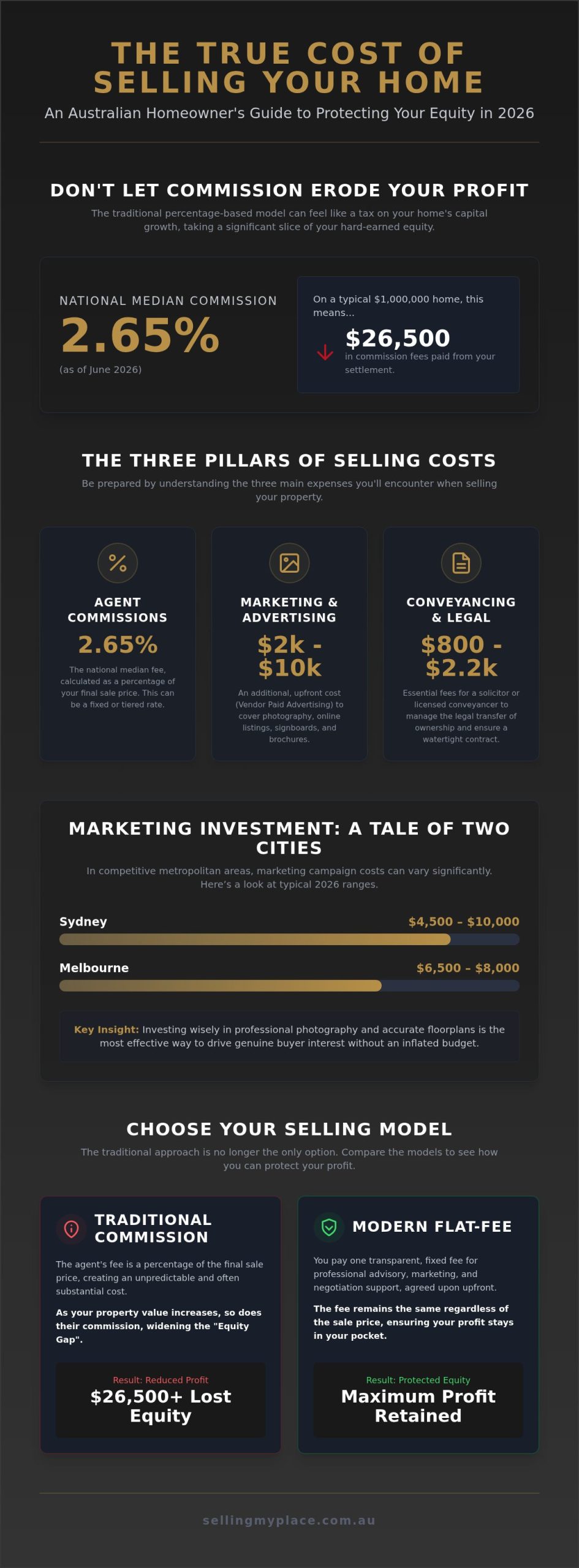
Many homeowners find themselves asking how much do real estate agents charge to sell a house only to be met with a figure that represents years of mortgage repayments. In 2026, the national median commission rate has settled at approximately 2.65 per cent. On a million-dollar home, that is over $26,000 gone before you’ve even considered the cost of signage or photography. This loss of equity can feel like a penalty for your property’s capital growth, making it harder to fund your next chapter. While this percentage-based model has been the standard for decades, modern alternatives now allow for professional, high-end results without the predatory price tag.
The Breakdown of Traditional Agent Commissions
Most agencies calculate their fee as a slice of your final sale price, which means as the market grows, so does their payday. You will likely encounter two main structures: fixed and tiered. A fixed commission is a set percentage regardless of the final price, while a tiered structure might charge a higher percentage on any amount achieved above a certain threshold. While this is often framed as an incentive for the Real estate agent to work harder, it often just widens the gap between the service provided and the fee paid. In competitive Australian markets where property values remain high, these percentage-based fees have become an increasingly expensive “tax” on your hard-earned equity.
Conveyancing and Legal Costs
Beyond the agent, you will need a solicitor or licensed conveyancer to handle the legal transfer of ownership. This role is vital for protecting your interests and ensuring the contract is watertight. In 2026, typical fees for professional conveyance advice range between $800 and $2,200, depending on the complexity of the sale. This cost covers the preparation of the Contract of Sale and the navigation of the settlement process. Local knowledge is essential here; a seasoned expert can spot special conditions or zoning issues that could derail a sale. It’s one of the few areas where professional support is non-negotiable for a smooth, stress-free settlement.
Understanding these costs is the first step toward taking back control of your sale. You don’t have to follow the traditional path just because it’s the most common one. By looking closely at how much do real estate agents charge to sell a house and comparing it to modern, flat-fee advisory models, you can protect your equity while still achieving a premium result. The landscape has changed, and today’s sellers are more empowered than ever to choose a partnership that values their profit as much as they do.
Marketing Your Property: Where Your Money Actually Goes
While the commission covers the agent’s professional time and expertise, the marketing budget is the engine that actually brings potential buyers through your front door. It’s often the most visible part of the cost to sell a house, yet many vendors are surprised to learn it’s typically an additional, upfront expense. In the industry, this is known as Vendor Paid Advertising (VPA). It represents a critical investment in your home’s legacy, ensuring that the years of care you’ve poured into your property are reflected in how it’s presented to the world.
When you’re weighing up how much do real estate agents charge to sell a house, you must account for these separate promotional costs. In 2026, a standard marketing campaign in Australia generally ranges from $2,000 to $10,000. For those in competitive metro areas, the numbers are often more specific; Sydney campaigns typically sit between $4,500 and $10,000, while Melbourne averages between $6,500 and $8,000. These funds cover everything from the digital “town square” of online portals to the physical presence of a signboard on your nature strip.
The Power of Professional Visuals
Your property’s first showing doesn’t happen at a scheduled open house; it happens on a smartphone screen, often late at night. This makes professional photography a non-negotiable requirement for capturing those crucial initial clicks. It isn’t just about lighting or high-resolution lenses; it’s about evocative storytelling that helps a buyer visualise their future life in your home. Alongside imagery, a professional floorplan is the second most vital feature of any listing. It allows buyers to mentally arrange their furniture and understand the flow of the space before they’ve even arrived. While some might suggest a modern phone camera is sufficient, in a sophisticated market, “good enough” often leads to being overlooked by the most serious buyers.
Digital Reach and Global Exposure
A significant portion of your marketing budget is dedicated to premium listings on major Australian property portals. These platforms provide the essential visibility needed to attract local interest. However, a truly effective strategy in 2026 looks beyond the local suburb to target interstate investors and global buyers. By using advanced social media targeting and a global marketing network, your home can find its way to the right person, regardless of where they currently live. This digital infrastructure ensures your property stays listed until it’s sold, providing a sense of calm and security that you won’t be hit with unexpected “re-listing” fees if the perfect buyer takes a little longer to appear. If you’re feeling a bit overwhelmed by these choices, you can reach out for a friendly chat about a tailored marketing plan that suits your home’s unique needs.
Flat Fee vs. Commission: Comparing the Two Models
When you start investigating how much do real estate agents charge to sell a house, the standard 2 per cent or 2.5 per cent commission can seem like an unavoidable cost of doing business. However, it’s vital to remember that this fee is essentially a tax on the wealth you’ve built through years of hard work. The “Equity Gap” is the difference between what you walk away with after a traditional sale versus a modern, commission-free approach. For most Australian families, this gap represents a significant sum that could be better used to secure their next chapter.
There’s a persistent myth that agents are only motivated to get the best price if they have a percentage-based incentive. In reality, a professional advisor’s reputation and duty of care are far more reliable drivers of success. Savvy sellers are increasingly turning to flat-fee real estate because it provides the same professional support and market reach without the predatory cost structure. It’s a partnership built on transparency rather than a transactional slice of your home’s value.
Calculating Your Potential Savings
The numbers speak for themselves when you look at the impact on your bank balance. On a typical $1M home sale, choosing a flat-fee model over a 2 per cent commission can save you more than $20,000 in pure equity. This isn’t just “extra money”; it’s a deposit for a child’s first home, a significant boost to your retirement fund, or the freedom to renovate your next property. When homeowners ask how much do real estate agents charge to sell a house, they’re often looking for a way to justify the expense, but the math rarely favours the seller in a high-value market. Knowing your costs upfront before the campaign even begins removes the stress of the unknown and lets you plan your move with a sense of calm confidence.
What’s Included in a Professional Flat-Fee Package?
Choosing a flat fee doesn’t mean you’re on your own. A comprehensive package through the KIDS model provides all the professional tools you need to achieve a premium result:
- Professional Assets: High-end photography and floorplans that make your listing stand out in digital searches.
- Expert Advisory: Access to seasoned professionals who guide you through pricing, presentation, and legal requirements.
- Market Intelligence: Detailed neighbourhood reports to help you understand your property’s true value and local competition.
- Freedom of Time: Unlike traditional agents who may push for a quick sale to move on to the next commission, a flat-fee listing often has no time limits, letting you wait for the perfect offer.
By shifting the focus from commission to professional advisory, you’re not just saving money; you’re taking an empowered stance in the property market. It’s about ensuring that the reward for your years of homeownership stays exactly where it belongs; with you and your family.
The ‘Negotiation Myth’: Do You Really Need a Traditional Agent?
One of the most common hurdles for homeowners considering a commission-free sale is the nagging fear of underselling. Traditional agencies often lean into this worry, suggesting that their specific “negotiation magic” is the only way to achieve a premium price. But is that true? When you reflect on how much do real estate agents charge to sell a house, it becomes clear that the value they provide must be weighed against the actual net profit you receive. Buyers in 2026 are savvy; they often find dealing directly with an owner refreshing and more transparent. You know the property’s soul, the best time of day for light in the kitchen, and the friendly nature of the neighbours better than any third party ever could.
The reality is that most buyers feel more at ease talking to the person who has actually lived in the home. This direct connection builds trust, which is the foundation of any successful negotiation. By removing the middleman, you eliminate the “transactional” feel that often accompanies traditional sales. When you combine your personal passion for the home with professional advisory support, you create a powerful environment for a successful sale.
Professional Backing for the Modern Seller
You don’t have to be a professional salesperson to achieve a professional result. By utilising detailed Neighbourhood Market Reports, you can price your home with the same precision as any local agency. Our Agent Advisory Service acts as your “steady hand,” ensuring you’re never navigating contract queries or conveyance hurdles alone. This support allows you to handle buyer enquiries with poise and confidence. Applying expert property sale negotiation tips ensures you maintain control of the conversation while keeping your family’s financial future at the heart of every decision.
Maximising Your Final Sale Price
True success isn’t measured by the “gross” sale price on a contract; it’s measured by the “net” result that lands in your bank account. If a traditional agent manages to squeeze an extra $5,000 out of a buyer but charges you $25,000 in commission, you haven’t won; you’ve lost $20,000 in hard-earned equity. Our pre-sale property consulting provides the styling and presentation insights needed to add genuine value before the first viewing. You can create a competitive environment among buyers by being transparent and responsive, often achieving a result that matches or exceeds traditional methods without the need for an expensive auctioneer.
Get expert advisory support for your sale today.
Selling Smarter: Protecting Your Equity with Kincade
Choosing how to sell your home is one of the most significant financial decisions you’ll ever make. In a 2026 market where every dollar of equity counts toward your future stability, the traditional commission model often feels like an outdated relic. When you look closely at how much do real estate agents charge to sell a house, it becomes clear that the value often doesn’t align with the cost. The Kincade International Direct Sales (KIDS) model offers a logical, sophisticated alternative. It’s a partnership designed for those who want to keep their profit while still benefiting from the “steady hand” of a seasoned expert. You aren’t just saving money; you’re choosing a more transparent, respectful way to handle a major life transition.
Many people start with a simple sale by owner mindset, focusing primarily on avoiding fees. However, the reality of being an empowered seller is much broader. It’s about having the confidence to lead the process, backed by the same high-end tools used by the country’s top agencies. This approach allows you to remain the primary advocate for your home, the person who understands its story best, while we provide the professional framework to ensure that story reaches the right audience. It’s a shift from being a “do-it-yourself” seller to a “professionally supported” owner who values legacy and community over quick, expensive transactions.
The Kincade Partnership Advantage
Our approach is built on providing a comprehensive suite of services that levels the playing field for every homeowner. You gain access to a global marketing network, ensuring your property is seen by investors and families across Australia and beyond. Professional photography and floorplans come as standard, because we know that high-quality visual storytelling is the most effective way to drive digital engagement. Throughout the journey, our dedicated advisory support remains by your side from the initial listing through to the final settlement, providing the calm confidence needed to navigate complex negotiations and legal requirements without the sting of a percentage-based commission.
Next Steps for Your Property Sale
Taking control of your sale is simpler than you might think. You can have a professional, high-impact listing live and attracting buyers in a matter of minutes. To get a clear picture of your starting point, we recommend requesting a neighbourhood market report to see exactly where your property stands in the current landscape. This data-driven insight, combined with our pre-sale consulting, ensures you price and present your home for maximum impact. When you’re ready to stop wondering how much do real estate agents charge to sell a house and start protecting your hard-earned equity, we’re here to help you take that next step. Start your commission-free selling journey with Kincade today.
Secure Your Legacy and Your Next Chapter
Deciding how to move forward with your property sale is about more than just finding a buyer; it’s about protecting the life you’ve built. We’ve explored the reality of how much do real estate agents charge to sell a house in 2026, from the national median commission of 2.65 per cent to the often hidden costs of premium marketing. You now know that while high-quality photography and floorplans are non-negotiable for a premium price, losing a massive slice of your equity to a percentage-based fee is entirely optional.
By choosing a partnership-based approach, you can keep your profit while still enjoying the security of a dedicated Agent Advisory Service. With professional visual assets included as standard, the average owner saves $20,000 per sale. This is money that stays in your pocket for your next deposit, your retirement, or your family’s future. You have the local knowledge and the passion for your home; we simply provide the professional tools and global reach to help you succeed.
Save an average of $20,000 and sell your home commission-free with Kincade.
It’s time to take the lead in your property journey with a steady hand by your side. You deserve a sale process that is as rewarding as it is professional. We look forward to helping you achieve the result your hard work deserves.
Frequently Asked Questions
How much is the average real estate commission in Australia in 2026?
The national median real estate commission in Australia is approximately 2.65 per cent of the final sale price as of June 2026. This figure varies significantly across the country; for instance, Tasmania often sees the highest median rates at around 3.25 per cent, while metropolitan areas in New South Wales and Victoria typically average closer to 2.1 per cent. These rates are fully negotiable and usually exclude GST and marketing costs.
Can I really sell my house without a traditional real estate agent?
Yes, you can absolutely sell your home without a traditional agent by choosing an empowered seller model. Modern platforms provide you with the same professional infrastructure used by high-end agencies, such as listings on major portals and expert floorplans, while allowing you to host your own inspections. This approach puts you in the driver’s seat, ensuring you retain the full value of your home’s equity without sacrificing professional standards.
What are the hidden costs of selling a house I should look out for?
When you’re trying to figure out how much do real estate agents charge to sell a house, don’t forget the separate marketing budget. These upfront advertising costs can range from $2,000 to $10,000 and are usually paid by the vendor regardless of the sale outcome. Other hidden expenses include conveyancing legal fees, auctioneer charges, and administrative costs related to 2026 anti-money laundering compliance checks for both buyers and sellers.
Is it worth paying for professional property styling?
Investing in professional property styling is often one of the most effective ways to increase your home’s perceived value. A well-presented home creates an immediate emotional connection with buyers, which can lead to a faster sale and a higher final price. Our pre-sale property consulting can help you decide whether a full furniture package or strategic decluttering is the right path to showcase your home’s unique character and legacy.
How do I negotiate the sale price if I sell the house myself?
Negotiating a sale requires a balance of firm market data and calm confidence. You should start with a clear understanding of your property’s value by using neighbourhood market reports to set a realistic expectation. When an offer arrives, focus on the buyer’s settlement terms as much as the price. Having access to a dedicated Agent Advisory Service ensures you have a professional sounding board to help you evaluate offers and counter-offer with poise.
What is the difference between a real estate agent and a property advisor?
A traditional real estate agent typically works on a commission basis and manages the entire sales transaction, often focusing on a quick result to move to their next listing. In contrast, a property advisor provides expert guidance and professional tools for a flat fee, acting as a “steady hand” to support your sale. This partnership model empowers you to handle the personal side of the sale while receiving high-level strategic support and market intelligence.
Does a flat-fee service include listing on major property portals?
A professional flat-fee service ensures your home is listed on Australia’s leading property portals, such as realestate.com.au and Domain. This digital visibility is the most critical element of any modern campaign, as it reaches the vast majority of active buyers nationally and globally. By using a professional listing service, you get the same premium exposure as a traditional agency but without the ongoing percentage-based commission costs that strip away your equity.
What happens if my property doesn’t sell within three months?
Unlike traditional agency agreements that often expire or require expensive renewals after 90 days, our model provides the freedom of no time limits on your listing. If your property hasn’t sold within three months, you can maintain your presence in the market without the pressure to drop your price prematurely. This allows you to wait for the right buyer who truly values your home, providing a sense of calm and security throughout the process.
Low Commission vs Flat Fee Real Estate: Which Saves Your Equity in 2026?
If you sold your family home for $900,000 this year, would you be comfortable handing over a $22,500 “thank you” note to an agent, especially if you still had to pay for marketing on top? It’s a significant slice of your hard-earned equity that could be better spent on your next chapter. We know many Aussie sellers feel a sense of dread when weighing up low commission vs flat fee real estate, fearing they must choose between losing their profit to high fees or being left to navigate a complex sale entirely on their own.
You deserve a selling experience that feels like a partnership, not just a transaction. In this article, we’ll pull back the curtain on the total out-of-pocket costs you can expect in 2026 and how to identify the best value for your specific situation. We will show you how it’s possible to save an average of $20,000 in fees while still securing the professional photography and expert guidance that ensures a premium result. It’s about finding that steady hand to guide you through the process, ensuring your home’s legacy is protected while your bank balance stays healthy.
Key Takeaways
- Understand why traditional percentage-based commissions have become a “legacy tax” on your equity in the current 2026 property market.
- Compare the total out-of-pocket costs of low commission vs flat fee real estate to see how even “discount” agents can leave you with a surprisingly large invoice.
- Identify the “hidden” marketing traps, such as Vendor Paid Advertising (VPA), that often inflate the final cost of a seemingly low-commission deal.
- Learn how an Agent Advisory Service bridges the gap between DIY and traditional agencies, providing professional support without the 2% price tag.
- Discover how to protect your profit and save an average of $20,000 by using a comprehensive flat-fee model that includes professional photography and floorplans.
The Evolution of Selling: Why Australians are Questioning Traditional Commissions
The Australian property landscape has shifted dramatically over the last decade. As we move through 2026, the old ways of doing things are being held up to the light. With property values sitting at record highs, that standard 2.5% or 3% commission doesn’t just feel like a fee; it feels like a massive chunk of your family’s future. When a house sells for $1.2 million, a 2.5% commission is $30,000. That’s a significant sum that could go toward your retirement, your children’s education, or the mortgage on your next home. Deciding between low commission vs flat fee real estate is no longer just a niche conversation for savvy investors; it’s a mainstream priority for every Aussie homeowner.
Digital platforms have changed the game for good. Nowadays, buyers find homes on their phones while they’re having their morning coffee. They aren’t searching for a specific agency brand or a high-profile agent. They’re looking for the right kitchen, the perfect backyard, and a suburb they love. This digital democratisation means the agent is no longer the sole gatekeeper of information. The “Direct Sale” movement is gaining momentum because Australians are realising they can take the lead while still presenting their home with professional polish. You don’t need to pay for an agency’s expensive office fit-out or their local awards dinner to get a great result.
The “Net Profit” Mindset
It’s easy to get caught up in the excitement of a high sale price, but the figure that truly matters is what lands in your bank account after the dust settles. If you’re planning to downsize or move into a bigger family home, every dollar of equity is precious. Before you list, it’s vital to determine the market value of a home in Australia so you can accurately forecast your net profit. Understanding this number helps you see exactly how much a traditional commission might eat into your next deposit. It’s about focusing on the outcome for your family, not just the number on the contract.
The Transparency Gap in Real Estate
For a long time, the industry relied on traditional real estate commission models where fees were often shrouded in complex marketing budgets and tiered structures. Today, the power has shifted. We live in an information-led era where transparency is the new gold standard. Buyers are savvy; they’re interested in the property’s story and its value, not the agency logo on the signboard. Choosing a path that offers upfront, honest costs isn’t just about saving money. It’s about taking back control of one of the most significant financial transitions in your life with a steady hand and a clear plan.
Decoding the Models: Low Commission vs Flat Fee Real Estate Explained
When you start interviewing agents, the terminology can quickly become a bit of a muddle. You will likely hear two main pitches: the traditional percentage model (sometimes dressed up as a “discount” or low-commission offer) and the modern flat-fee approach. Choosing between low commission vs flat fee real estate isn’t just about picking the smallest number on a page; it’s about understanding how that number is calculated and what it ultimately takes from your pocket at settlement. It’s the difference between sharing your home’s hard-earned equity and simply paying for the professional services required to find a buyer.
The Low-Commission Percentage Trap
Many agencies now offer “low” commissions, often ranging between 1.5% and 2%, to compete with digital alternatives. While this sounds appealing compared to the old 3% standard, the math can still be sobering. On a $1 million sale in Sydney or Melbourne, a 2% commission still results in a $20,000 invoice. You might also encounter “tiered commissions,” where an agent takes a higher percentage on any amount achieved above a certain price. While marketed as an incentive, this often means you are paying a premium for a result the market was already prepared to deliver. Homeowners are often caught off guard when a quoted commission rate excludes the mandatory 10% GST, effectively turning a “competitive” 2% fee into a 2.2% hit to the final settlement.
The Flat-Fee Transparency Model
In contrast, the flat-fee model treats real estate as a professional service rather than a partnership in your profit. By using Professional Residential Property Listing Services, you pay a set amount for the high-end tools needed to sell, such as professional photography, detailed floorplans, and listings on the major property portals. At Kincade International Direct Sales (KIDS), we’ve taken this a step further with a 0% commission structure. This “No Commission” revolution is built on the fact that you don’t legally need a traditional agent to sell property in Australia; you just need the right marketing and a steady hand to guide the process.
- Budget Certainty: You know exactly what you are paying from day one, with no surprises at the end.
- No Time Pressures: Unlike traditional 90-day agency agreements that can leave you feeling rushed, many flat-fee models allow your listing to remain active until it is sold.
- Retained Equity: Every dollar of the sale price above your costs stays with you, which can mean an average saving of $20,000 per sale.
If you are curious about how this structure might work for your specific suburb, you might find it helpful to speak with a property advisor who can walk you through the logistics of a direct sale.
The ‘Hidden’ Trap: Comparing Total Costs and Marketing Budgets
When you sit down to compare low commission vs flat fee real estate, it is vital to look beyond the headline rate. Many homeowners are seduced by a “discounted” commission only to find a secondary invoice for marketing sitting on their kitchen bench. This is the “plus marketing” model, and it’s where the costs of selling can quickly spiral out of control. It is a stressful experience to realise that the fee you negotiated only covers the agent’s time, not the actual tools needed to find a buyer.
The real sting often comes from Vendor Paid Advertising (VPA). Traditional agents typically ask you to fund the entire campaign upfront or at settlement. This includes everything from the portal listings on major websites to the physical signboards and social media boosts. Because the agent isn’t paying for it, there is often less incentive to keep these costs lean. It isn’t uncommon for a marketing budget to swallow another $5,000 to $10,000 of your equity before you’ve even hosted your first open home. These are out-of-pocket expenses that stay gone, regardless of whether your property actually sells.
Marketing: Investment or Expense?
We all know that high-end professional photography and detailed floorplans are non-negotiable in 2026. Buyers expect to see your home in its best light before they even think about booking an inspection. However, these shouldn’t be “add-ons” that keep ticking up your final bill. At Kincade, we include professional photography and floorplans within our flat fee marketing and advisory service. This approach treats marketing as a necessary investment in your sale result, not a profit centre for the agency. It ensures your home stands out without you having to second-guess every line item on a marketing schedule.
The Final Invoice: A Real-World Comparison
Let’s look at a hypothetical $1.2 million sale to see how the numbers truly stack up. With a 2% low-commission agent, you are looking at $24,000 in commission. Add 10% GST ($2,400) and a modest $6,000 marketing budget, and your total cost hits $32,400. When you compare low commission vs flat fee real estate through the lens of your final net profit, the difference is stark. The Kincade model focuses on a single, transparent fee with 0% agency commission, often saving sellers an average of $20,000. That’s money that stays in your pocket to fund your next deposit or perhaps a well-deserved family holiday.
Before you sign any agency agreement, look closely for the fine print. Ask about admin fees, auctioneer costs, and whether marketing “rebates” are passed back to you or kept by the agency. Having a clear, fixed cost from day one provides a sense of calm confidence. It allows you to focus on the emotional journey of moving house rather than worrying about a ballooning invoice that eats into your family’s future.
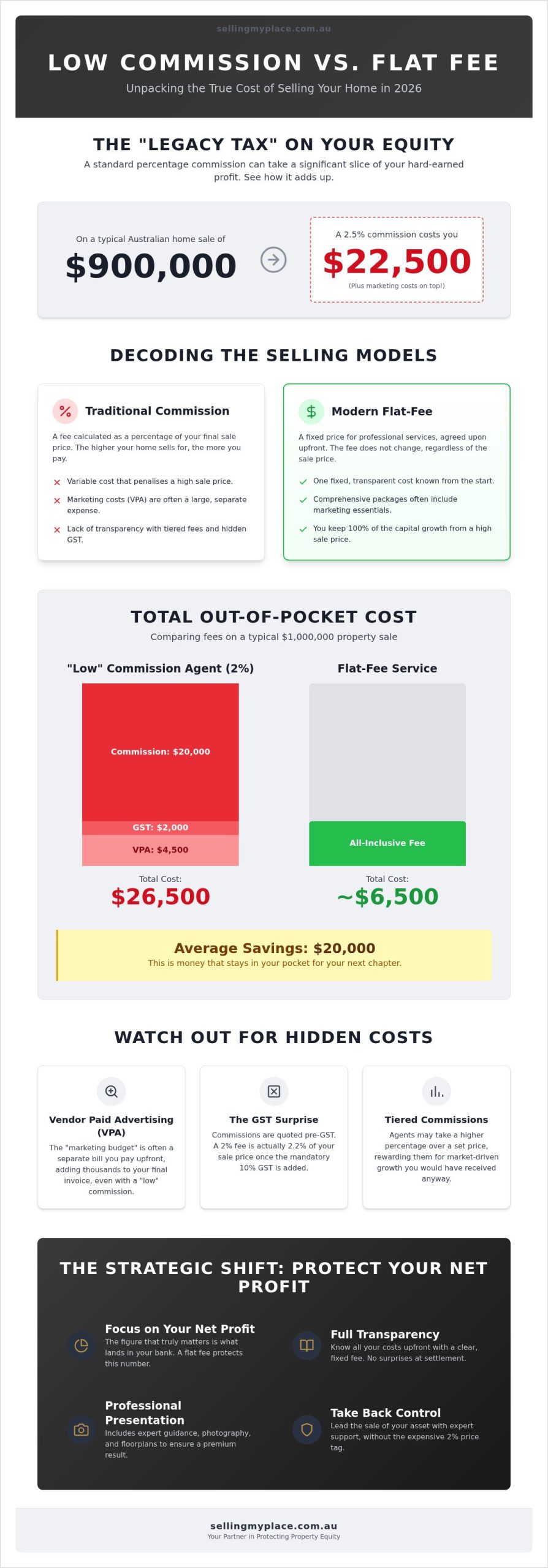
Service vs Savings: Can You Really Get Expert Support Without the 2% Tag?
There is an old saying in the property industry that you get what you pay for. It is a line often used to justify high commissions, suggesting that unless you are paying 2% or more, you are sacrificing the expertise needed to secure a top price. However, as we look at the choices between low commission vs flat fee real estate in 2026, it is clear that high fees do not always equal high service. In fact, many high-volume discount agents might treat your home as just another number to meet their monthly targets, whereas a partnership-based model focuses entirely on your result.
Choosing a flat-fee model doesn’t mean you are left to fend for yourself on the front lawn. It is about a strategic shift toward Direct Selling. You take the lead on showing your home, which, let’s be honest, nobody knows better than you do. But you aren’t doing it alone. When you sell your own home through a professional advisory model, you are backed by the same high-end tools and expert insights that traditional agencies use, just without the legacy tax on your profit. It is about having a steady hand to guide you, ensuring you feel protected throughout the entire journey.
The Value of Professional Advisory
A seasoned advisor is the missing piece that many people overlook when considering a flat-fee approach. This isn’t just about a listing on a website. It involves pre-sale consulting to ensure your property is presented perfectly and having an expert to help you navigate the nuances of buyer offers. Negotiation is an emotional process. Having an advisor to provide grounded, calm guidance during those final stages can be the difference between a good offer and a great one. They also provide essential conveyance and legal advice to ensure the transition to settlement is as smooth as possible, reducing the stress of complex paperwork.
What to Look for in a Flat-Fee Partner
Not all flat-fee services are created equal. To ensure you are protecting your equity while maintaining professional standards, use this quick checklist when comparing your options:
- Professional Marketing: Does the fee include high-end photography and floorplans? These are essential for a premium feel.
- Expert Advisory: Is there a dedicated human advisor you can call when things get complex or when an offer lands?
- Global Reach: Are your listings pushed to major national and global property portals to ensure maximum exposure?
Finding the right balance between saving on fees and receiving genuine support is key to a successful sale. It is about feeling empowered, not overwhelmed, as you transition to your next life stage. If you would like to see how our advisory model supports your specific goals, you can book a consultation with our team today.
Securing Your Equity: The Strategic Shift to Flat-Fee Property Marketing
Choosing between low commission vs flat fee real estate often feels like a trade-off between professional quality and cost savings. We believe it shouldn’t be. The strategic shift toward Direct Sales is about bridging that gap, providing you with a high-end marketing engine while keeping your equity where it belongs. It’s a sophisticated way to sell that respects both your property’s value and your family’s financial future. You aren’t just choosing a cheaper option; you’re choosing a smarter, more transparent way to move forward.
Kincade International Direct Sales (KIDS) operates on a 0% commission structure because we believe you shouldn’t have to pay a success tax on your own home. Instead of a traditional agency model that focuses on high-volume turnover, we act as a steady hand by your side. Our “Until Sold” guarantee is a cornerstone of this partnership. It removes the arbitrary 90-day pressure found in traditional agreements, giving you the peace of mind that your listing remains active and supported until the right buyer is found. This removes the anxiety of “what if it doesn’t sell in time?” and replaces it with grounded confidence.
One of the most empowering realisations for many sellers is that they are actually the best people to show their own home. You know which window catches the morning sun and which local cafe makes the best flat white. Buyers appreciate that authentic, local knowledge. When you combine your personal touch with our professional marketing and advisory, you create a powerful, trustworthy experience for potential buyers. It’s a collaborative approach that feels less like a high-pressure transaction and more like a neighbourly hand-over. By removing the middleman from the inspection, you foster a direct connection that often leads to clearer communication and better results.
The Kincade Advantage: Professional Marketing & 0% Commission
Our infrastructure is designed to give you a competitive edge without the high marketing costs. We plug your property into a global marketing network, ensuring it reaches the right buyers whether they are across the street or across the world. From high-end photography to detailed floorplans, we provide every tool necessary for a polished, professional listing. This isn’t a “DIY” project; it’s a fully supported Direct Sales programme that puts you in the driver’s seat with an expert navigator by your side. When you weigh up low commission vs flat fee real estate, the KIDS model stands out by offering the full-service results you expect with the 0% commission structure you deserve.
Taking the First Step Toward a Smarter Sale
Transitioning from considering a sale to actually listing your property can feel like a big leap. We make it easier by providing detailed neighbourhood market reports to help you understand your local landscape. Our pre-sale advisory consultation is a chance to discuss your goals, prepare your home for the market, and plan your strategy with confidence. You don’t have to navigate this alone. We’re here to ensure your transition is as smooth and rewarding as possible, protecting your legacy and your profit every step of the way.
See how much equity you can save with Kincade today
Take Control of Your Property Legacy
Selling your home is more than just a transaction; it is a major life transition that deserves both professional excellence and financial respect. By moving beyond the traditional commission model, you are choosing to prioritise your family’s net profit over an agency’s bottom line. we have explored how the choice between low commission vs flat fee real estate often comes down to transparency. You don’t have to settle for hidden marketing traps or high-volume discount agents who treat you like a number. Instead, you can embrace a partnership that provides a steady hand and expert guidance throughout the journey.
With Kincade International Direct Sales, you gain access to a 0% commission structure that helps sellers save an average of $20,000. Every package includes high-end essentials like professional photography and floorplans, backed by our expert Agent Advisory Service to navigate every offer. It’s about feeling empowered to show your own home while knowing you have a seasoned expert in your corner. If you are ready to keep your hard-earned equity and sell with confidence, we invite you to join the Direct Sale movement and save your equity today. Your next chapter is waiting, and we are here to help you start it on the best possible footing.
Common Questions About Selling Smart
Is a flat-fee real estate service legal in all Australian states?
Yes, selling your property through a flat-fee model is completely legal in every Australian state and territory. You have the legal right to represent your own home and manage the sale process yourself. This path is becoming increasingly popular as more homeowners look to protect their equity from traditional commission structures while maintaining professional marketing standards.
Do I still have to pay a commission to the buyer’s agent if I use a flat fee?
If a buyer chooses to engage their own professional representation, the seller is typically responsible for the buyer’s agent commission. This fee usually ranges between 2.5% and 3% of the sale price. It is a detail worth discussing during your initial consultation so you can factor it into your total costs when comparing low commission vs flat fee real estate.
What happens if my property doesn’t sell within three months?
With Kincade, your listing remains active until it is sold. Unlike traditional 90-day agency agreements that can leave you feeling rushed or pressured to drop your price, we don’t impose arbitrary time limits. We understand that finding the right buyer for your unique home takes a steady hand and a patient, methodical approach.
Who handles the legal paperwork and conveyance in a flat-fee sale?
While you manage the inspections and negotiations, the formal legal transfer is handled by a qualified solicitor or conveyancer. We provide expert conveyance advice to ensure you have the right legal support in place. This ensures all paperwork is compliant with your specific state’s property laws, giving you total peace of mind throughout the settlement process.
Can I really save $20,000 on commission by selling my own home?
Saving $20,000 is a very realistic outcome for many Australian families in the current market. When you consider that a 2.5% commission on an $800,000 home is $20,000 plus GST, the financial benefit is clear. By choosing a 0% commission structure, you are effectively keeping that entire slice of hard-earned equity for your own future needs.
Do flat-fee services include professional photography and floorplans?
High-quality visuals are essential for a premium result, so our flat-fee service includes professional photography and floorplans as standard. We don’t believe these should be hidden extras or expensive add-ons. Every listing is presented with the same professional polish you would expect from a high-end traditional agency to ensure it stands out online.
How do I handle negotiations with buyers without a traditional agent?
You aren’t left to negotiate in the dark. Our Agent Advisory Service provides a seasoned expert to guide you through buyer offers and counter-offers. We act as your “steady hand,” providing the data and strategic advice you need to make confident decisions without the stress or pressure of a traditional commission-driven environment.
Will my property be listed on the major Australian real estate portals?
Yes, your property will be seen by the widest possible audience. We ensure your home is listed on the major Australian property portals where active buyers are already searching. This visibility, combined with our global marketing network, ensures your home receives maximum exposure to both local and international buyers looking for their next move.
Flat Fee vs Commission Real Estate in Australia: The 2026 Seller’s Comparison Checklist
Why should you hand over $20,000 or more of your hard-earned equity just because property prices rose, even if the agent’s workload stayed exactly the same? It’s a question many families are asking (and rightly so) as they weigh up the merits of flat fee vs commission real estate australia in a shifting market. When you’ve spent years carefully maintaining your home and paying down the mortgage, the idea of a percentage-based commission can feel less like a service fee and more like a tax on your wealth. We understand that selling your home is a major life transition, and it’s natural to feel protective of the legacy you’ve built.
In this guide, we’ll explore the transparent reality of selling costs, showing you how to protect your wealth without sacrificing the professional quality your property deserves. You’ll discover how to avoid hidden marketing blowouts and learn about a modern approach that prioritises your net return over an agent’s quick turnover. We’ve put together a clear comparison checklist to help you navigate these costs with confidence, ensuring you feel supported and informed every step of the way. It’s time to put the heart back into the process and keep your equity where it belongs.
Key Takeaways
- Calculate the true cost of percentage-based fees and understand how they can drain your hard-earned home equity.
- Compare flat fee vs commission real estate australia to find a transparent path for your property listing that avoids hidden marketing blowouts.
- Uncover the reality of agent incentives and why a fixed-fee approach often aligns better with your personal goals as a seller.
- Use our ultimate comparison checklist to ensure your professional listing includes high-quality photography, floorplans, and high-impact marketing.
- Learn how to leverage the Kincade International Direct Sales model to maintain a polished presence on major portals while keeping the entirety of your sale profit.
The Real Cost of Selling Property in Australia in 2026
Selling a home in 2026 feels different than it did even a few years ago. With the national median home price sitting at approximately $903,000 as of June 2026, the stakes have never been higher for Australian families. Many are starting to look at the traditional real estate commission model with a more critical eye. It’s often referred to as the “Equity Leak.” If you sell a median-priced home at a 2.5% commission rate, you’re handing over more than $22,500 of your wealth. That’s a significant sum that could go toward your next deposit, a retirement fund, or helping your children get a foot in the property market door.
The choice between flat fee vs commission real estate australia isn’t just about the bottom line; it’s about fairness and transparency. Commission rates vary wildly across the country. While metro Melbourne or Sydney might see rates around 2%, sellers in Tasmania often face averages as high as 3.25%. This “standard” rate is negotiable, but many sellers feel pressured into accepting whatever the agent suggests. We’re seeing a rise in “Smart Sellers” who recognise that the effort to sell a $1.5 million home isn’t necessarily double the effort of selling a $750,000 one. Why should the fee double just because your suburb became popular?
Beyond the Percentage: Hidden Selling Costs
The headline commission is rarely the full story. Many agencies charge separately for marketing, and these costs can balloon quickly. A standard campaign in a major city often ranges between $6,500 and $8,000, but “premium” packages can exceed $12,000. Sometimes, there are even hidden “kickbacks” where agencies receive rebates from property portals that aren’t passed on to you. You might also find yourself paying for:
- Professional styling and furniture hire that costs thousands.
- Auctioneer fees, which are often an extra $500 to $1,000.
- Administrative charges or “settlement fees” tucked into the fine print.
Before you sign any paperwork, it’s vital to get a free property value estimate. Knowing your home’s true worth helps you calculate exactly how much equity is at risk under a percentage-based model.
The Emotional Weight of the Sale
Selling your family home is rarely just a transaction. It’s a major life transition, often tied to decades of memories, growth, and hard work. High-pressure commission environments can turn this emotional journey into a source of intense anxiety. Agents might push for a quick sale at a lower price just to secure their commission turnover, leaving you feeling like a number rather than a partner. By choosing a model that keeps you in control, you protect your legacy and ensure the process remains as calm and grounded as possible. You deserve to be the one steering the ship during such a significant life event.
Commission vs. Flat Fee: Understanding the Mechanics
Understanding the mechanics of flat fee vs commission real estate australia is the first step toward reclaiming your sale process. Traditional agencies typically operate on a percentage basis, where the fee is tied directly to the final sale price. Some even use “tiered” or “sliding” scales; for example, you might pay 2% on the first million dollars and a 5% “kicker” on every dollar above that. While agents pitch this as an incentive to get a higher price, it often feels more like a success tax on your home’s natural market growth. It’s a complex system that can leave you doing frantic mental arithmetic at the very moment you should be celebrating a result.
The flat-fee model, by contrast, is built on the principle of transparency. You pay a single, agreed-upon amount for professional listing services and marketing, regardless of how high your home’s value climbs. This approach treats real estate as a professional service rather than a gamble on your equity. Perhaps the most reassuring part of this modern model is the “No Time Limit” listing. It acts as the ultimate safety net, removing the frantic “ticking clock” pressure that often leads sellers to accept low-ball offers just because their agency agreement is about to expire. You sell when the price is right for your family, not when the agent’s contract says so.
How the Flat-Fee Model Works in Practice
When you move away from the traditional model, you aren’t sacrificing quality; you’re simply changing who controls the budget. A professional flat-fee service ensures your property stands out by including high-end photography and detailed floorplans as standard. These aren’t optional extras; they’re the bread and butter of a successful campaign. In 2026, the local agent’s window display is no longer the centre of the property universe. Buyers are looking at global digital networks and major portals from their smartphones. This shift has birthed “Real Estate Advisory Services,” where you receive expert guidance and market reports while maintaining the driver’s seat of your own sale.
Comparing the Long-Term Financial Impact
The financial difference between these two paths is often life-changing. Consider the net profit on a $1,000,000 sale. With a standard 2% commission plus $8,000 in marketing, you could be looking at a $28,000 deduction from your final settlement. With a flat-fee model, that figure is drastically reduced, often saving you enough to fully renovate your next kitchen or pay off a substantial chunk of debt. It’s important to remember that “low commission” isn’t the same as “commission-free.” Even a 1% fee on a million-dollar home is $10,000, which is still a significant sum compared to a fixed service fee. Ultimately, the flat-fee model is a service-based investment in your future rather than a success-based tax on your past hard work. If you’re curious about how this could work for your specific suburb, you might want to chat with a property advisor to see the numbers for yourself.
The Incentive Myth: Does Commission Really Get a Higher Price?
Does a percentage-based fee truly drive an agent to fight for every last dollar of your sale price? It’s the central argument used to justify high commissions, but the logic often falls apart when you look at the numbers. Let’s consider the “Agent’s Dilemma.” An extra $10,000 on your sale price is a life-changing win for you, perhaps covering a whole year of council rates and insurance. For an agent on a 2% commission, that same $10,000 only nets them an extra $200 before tax. When you weigh up that $200 against another three weeks of weekend open homes and difficult negotiations, it’s easy to see why an agent might pressure you to take a lower offer just to close the file. This inherent conflict of interest is a primary reason why many are re-evaluating flat fee vs commission real estate australia.
You are your home’s best advocate. No one knows the way the morning light hits the kitchen or the quiet safety of the cul-de-sac better than you do. When you use professional Residential Property Listing Services, you’re not just saving on fees; you’re gaining the tools to hold out for the price your property actually deserves. You aren’t being rushed by someone else’s monthly sales targets. Instead, you’re supported by a model that honours your timeline and your equity.
The Psychology of the Sale
Buyers in 2026 are more sophisticated than ever. They often prefer the transparency of dealing directly with the owner, finding it less stressful than the high-pressure tactics sometimes used by traditional agencies. Dealing directly allows you to answer specific questions about the neighbourhood with genuine warmth and local knowledge. To keep things professional and grounded, accessing expert conveyance advice ensures the legal side of the negotiation is handled with a steady hand. This partnership-based approach gives you the confidence of a seasoned pro while maintaining the personal touch that only an owner can provide.
Data-Driven Decision Making
The myth of the “Agent’s Secret Database” has largely been dismantled by the digital age. Most buyers come from the same major property portals, regardless of who uploads the listing. Success isn’t about a hidden list of names; it’s about accurate pricing and high-impact presentation. By utilising detailed Neighborhood Market Reports, you can price your home based on hard data rather than an agent’s “gut feeling” or a desire for a quick turnover. It’s about empowering yourself with the same information the professionals use, ensuring you never leave money on the table. For a deeper understanding of how to determine market value of a home in Australia using current data and proven methods, our 2026 Seller’s Guide to determining your home’s market value walks you through every step of the process.
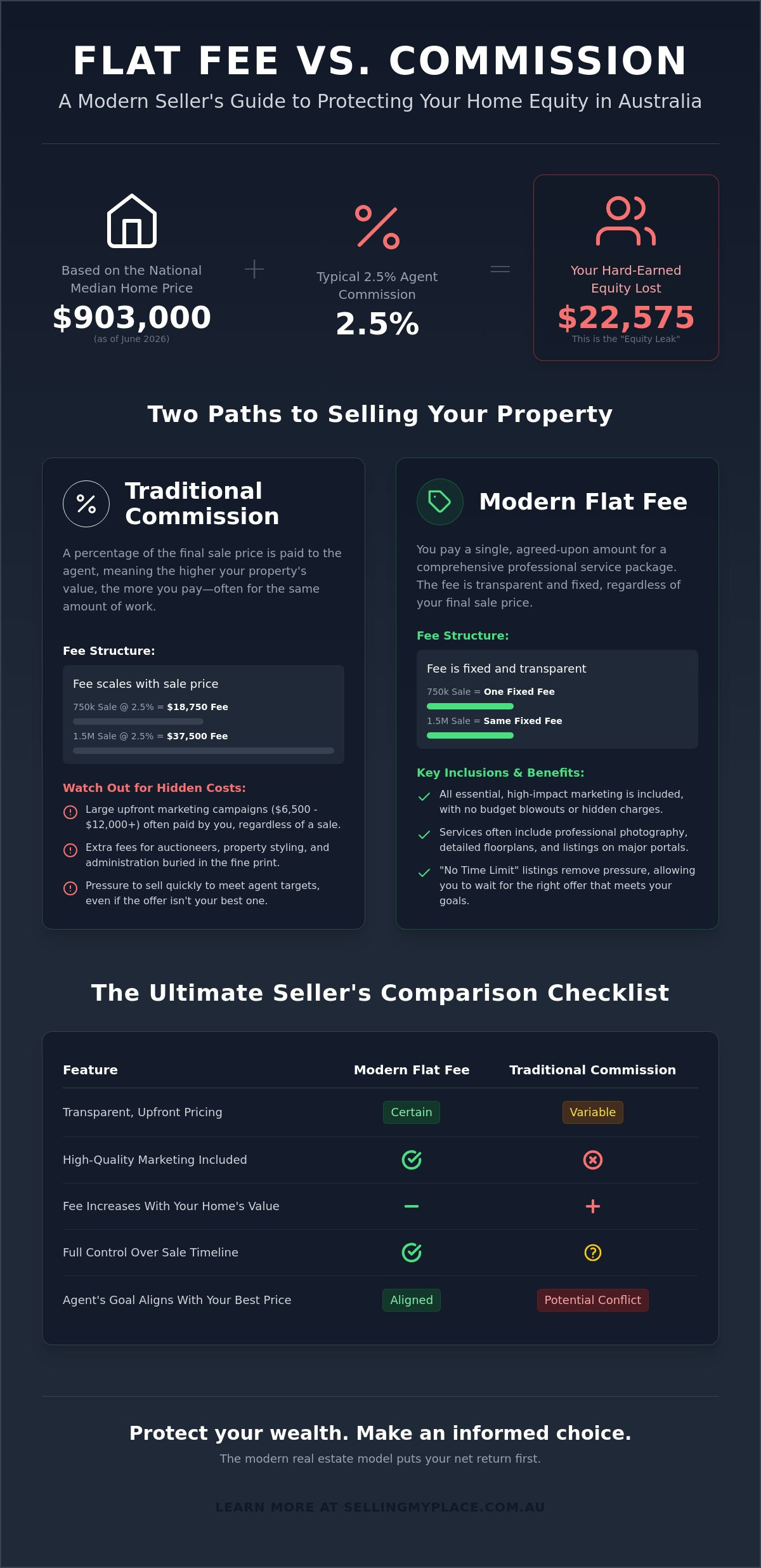
The Ultimate Seller’s Comparison Checklist
When you’re standing at the crossroads of a major life transition, clarity is your greatest ally. You’ve already seen how the “Equity Leak” can drain your savings, so now it’s time to move from theory to practice. Evaluating flat fee vs commission real estate australia requires looking past the glossy brochures and asking the hard questions that protect your bottom line. We want you to feel like a partner in this process, not just another entry in an agent’s ledger. This checklist is designed to help you peel back the layers of any service agreement, ensuring you keep the lion’s share of your home’s value.
Remember, a professional listing should never feel like a compromise. You deserve the same high-impact presence as the big agencies, but without the “success tax” attached to your final sale price. Use the following points to compare your options side-by-side. If a provider can’t give you a straight answer on these, it’s a sign that their interests might not be fully aligned with yours.
Marketing and Presentation Checklist
In the digital age, your first “open home” happens on a smartphone screen. If your presentation isn’t flawless from day one, you’re losing buyers before they even reach your front gate. Ensure your chosen service covers these essentials:
- Professional Photography: Will they send a specialist to capture your home in the best possible light?
- Detailed Floorplans: Are these included to help buyers visualise the flow of your living spaces?
- Global Reach: Will your property be listed on major Australian portals and international networks until it’s sold?
- Pre-Sale Property Consulting: Do you have access to expert advice on small improvements that could significantly boost your final price?
Financial and Legal Transparency Checklist
The “Total Cost” of a sale is often much higher than the initial percentage quoted. You need to account for GST, hidden advertising levies, and administrative charges that often hide in the fine print. A truly modern model should offer complete financial peace of mind. Check for the following:
- True Flat Fee: Is the price fixed, or are there “performance bonuses” that kick in if the home sells for more than expected?
- No Time Limits: Can you keep your listing active without being forced into expensive re-listing fees after 90 days?
- Advisory Support: Is there a professional to call when a contract lands on your table, and do they offer guidance on conveyance and settlement?
- Full Profit Retention: Does the model allow you to keep 100% of the sale price, or is there a “hidden” commission tucked away?
By using this structured approach, you remove the guesswork from one of the most important financial decisions your family will ever make. It’s about taking the “steady hand” approach to your future. If you’d like to see how these points apply to your specific property, you can book a consultation with our team for a transparent breakdown of your options.
Maximising Your Profit with Kincade International Direct Sales
Choosing between flat fee vs commission real estate australia is ultimately about who you trust with your family’s future. At Kincade International, we believe that trust is earned through transparency and a shared vision for your success. Our Kincade International Direct Sales (KIDS) model isn’t just a different way to pay; it’s a complete reimagining of the selling experience. By removing the traditional 2% or 3% commission, we empower you to keep 100% of your sale profit. It’s your equity, your hard work, and your legacy. Why should a significant portion of it disappear into an agency’s overheads just as you’re preparing for your next big life transition?
We’ve heard the concerns that flat-fee models are “risky” because they require an investment before the sale is finalised. We’ve addressed this head-on with our “Listed Until Sold” guarantee. This ensures your property stays active on major portals until the right buyer is found, removing the fear of losing your fee if the market takes a temporary breather. This is the “steady hand” approach we’ve discussed throughout this guide. You get the professional tools of a high-end agency, including expert photography and floorplans, without the looming success tax. It’s a partnership designed to reduce stress and maximise your net return.
A Partnership, Not Just a Listing
Our Real Estate Advisory Services act as your personal guide through every stage of the sale. We don’t just list your home and walk away; we provide pre-sale property consulting to help you present your home in its best light. Many of our clients find that by following our data-driven Neighborhood Market Reports and professional advice, they save an average of $20,000 in fees compared to traditional models. Our global marketing network ensures your home isn’t just seen by locals; it’s showcased to a vast pool of qualified buyers looking for their next chapter. You have a seasoned expert in your corner, providing the decorum and authority of a professional agency with the heart of a local neighbour.
Taking the Next Step
Transitioning from seller to buyer can be one of life’s most complex periods. Our support doesn’t end when the “Sold” sticker goes up. We offer buyer representation and conveyance advice to ensure your next move is as smooth and grounded as your sale. It’s about a long-term relationship built on community roots rather than a quick transaction. You can start your journey today by choosing a professional marketing package that puts you firmly in the driver’s seat. Join the growing community of Australian homeowners who are selling smarter, protecting their hard-earned equity, and moving forward with calm confidence.
Take Control of Your Property Legacy
Deciding between flat fee vs commission real estate australia is about more than just numbers on a balance sheet; it’s about honouring the years of hard work you’ve poured into your home. You’ve seen how a transparent, fixed-fee model removes the anxiety of hidden costs and aligns professional expertise with your actual needs. By choosing a partnership based on clarity rather than a percentage of your equity, you ensure that every dollar of your home’s value stays where it belongs: with your family. We’ve helped Australians save an average of $20,000 per sale by providing the high-impact tools normally reserved for big-budget agencies.
You don’t have to sacrifice professional quality to protect your profit. With our Expert Agent Advisory Service, stunning professional photography, and a global marketing network, you have a steady hand guiding you toward a successful settlement. It’s time to move forward with confidence and celebrate this new chapter of your life. Start selling smarter and keep 100% of your profit with Kincade International Direct Sales. Your future self will thank you for making the choice to lead with heart and local wisdom.
Frequently Asked Questions
Is a flat fee real estate agent better than a commission-based one?
A flat-fee model is often a superior choice for homeowners who want to protect their equity and maintain control over the sale process. While traditional agents argue that commissions incentivise higher prices, the actual difference in final sale prices is often negligible compared to the massive savings in fees. Choosing a flat fee allows you to treat the sale as a professional service rather than a percentage-based tax on your home’s value.
Do I have to pay the flat fee if my house doesn’t sell?
Most flat-fee services require an upfront payment to cover the costs of professional photography, floorplans, and portal listings. However, modern models often include a guarantee that keeps your property listed until it is sold. This means your home remains active on major networks without additional charges until a buyer is found. It’s a reassuring safety net that removes the time-pressure often felt during the 90-day contracts common in traditional agency agreements.
How much can I actually save by using a flat-fee service in Australia?
Sellers frequently save tens of thousands of dollars by opting for a fixed service fee over a percentage-based commission. When you compare flat fee vs commission real estate australia, the savings become even more pronounced as property values rise. On a million-dollar home, a standard 2.5% commission takes $25,000 from your pocket; a flat fee keeps the vast majority of that wealth with your family where it belongs.
Will my property get the same exposure without a traditional agent?
Your property will receive identical exposure on the major property portals where the vast majority of Australian buyers search for homes. Digital infrastructure has levelled the playing field. This means a listing uploaded through a flat-fee service appears alongside those from the biggest national franchises. High-impact presentation and professional marketing ensure you compete effectively for every buyer’s attention in the digital marketplace.
Can I still get a professional property appraisal with a flat-fee model?
Yes, you can access detailed Neighborhood Market Reports and advisory services that provide the same data-driven insights used by traditional agents. These reports allow you to price your home with confidence based on recent local sales and current market trends. It’s a transparent way to determine the market value of your home in Australia without the bias or pressure that sometimes accompanies a traditional agent’s appraisal.
What happens if I need help with negotiations or legal contracts?
Professional advisory services are specifically designed to support you through the negotiation and contracting phases of your sale. You don’t have to navigate the complex legalities alone. Many flat-fee models offer access to seasoned experts who provide conveyance advice and guidance on contract terms. This ensures you have a steady hand helping you manage the paperwork and legal requirements with total professional decorum.
Are flat-fee real estate services legal in all Australian states?
Flat-fee real estate services are fully legal and regulated across every Australian state and territory. Whether you are selling in Victoria, New South Wales, or Western Australia, you have the right to choose a service model that fits your needs. These services must still comply with national consumer laws and the new anti-money laundering regulations introduced in July 2026, ensuring a safe and professional transaction for everyone involved.
Is professional photography included in a flat-fee marketing package?
High-quality professional photography is a standard inclusion in any reputable flat-fee marketing package because it is essential for a successful sale. First impressions are made online, so your listing needs to look its absolute best to attract serious buyers. Along with professional photos, these packages usually include detailed floorplans to help potential buyers visualise your home’s layout before they even step through the front door.
